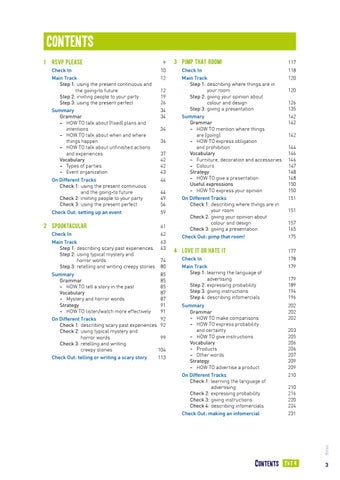
CONTENTS 1 RSVP please 9
3 Pimp that room!
117
Check In 10
Check In 118
Main Track 12 Step 1: using the present continuous and the going-to future 12 Step 2: inviting people to your party 19 Step 3: using the present perfect 26
Main Track 120 Step 1: describing where things are in your room 120 Step 2: giving your opinion about colour and design 126 Step 3: giving a presentation 135
On Different Tracks 44 Check 1: using the present continuous and the going-to future 44 Check 2: inviting people to your party 49 Check 3: using the present perfect 54 Check Out: setting up an event 59
2 Spooktacular 61 Check In 62 Main Track 63 Step 1: describing scary past experiences 63 Step 2: using typical mystery and horror words 74 Step 3: retelling and writing creepy stories 80 Summary 85 Grammar 85 – HOW TO tell a story in the past 85 Vocabulary 87 – Mystery and horror words 87 Strategy 91 – HOW TO listen/watch more effectively 91 On Different Tracks 92 Check 1: describing scary past experiences 92 Check 2: using typical mystery and horror words 99 Check 3: r etelling and writing creepy stories 104 Check Out: telling or writing a scary story 113
Summary 142 Grammar 142 – HOW TO mention where things are (going) 142 – HOW TO express obligation and prohibition 144 Vocabulary 146 – Furniture, decoration and accessories 146 – Colours 147 Strategy 148 – HOW TO give a presentation 148 Useful expressions 150 – HOW TO express your opinion 150 On Different Tracks 151 Check 1: describing where things are in your room 151 Check 2: giving your opinion about colour and design 157 Check 3: giving a presentation 165 Check Out: pimp that room!
175
4 Love it or hate it
177
Check In
178
Main Track Step 1: learning the language of advertising Step 2: expressing probability Step 3: giving instructions Step 4: describing infomercials
179 179 189 194 196
Summary 202 Grammar 202 – HOW TO make comparisons 202 – HOW TO express probability and certainty 203 – HOW TO give instructions 205 Vocabulary 206 – Products 206 – Other words 207 Strategy 209 – HOW TO advertise a product 209 On Different Tracks 210 Check 1: learning the language of advertising 210 Check 2: expressing probability 216 Check 3: giving instructions 220 Check 4: describing infomercials 224 Check Out: making an infomercial 231
three
Summary 34 Grammar 34 – HOW TO talk about (fixed) plans and intentions 34 – HOW TO talk about when and where things happen 36 – HOW TO talk about unfinished actions and experiences 37 Vocabulary 42 – Types of parties 42 – Event organization 43
Contents
T'n'T 4
3
5 #Backtothefuture 233 Check In 234 Main Track 236 Step 1: expressing reason and purpose 236 Step 2: describing the past 243 Step 3: describing the future 251 Summary 262 Grammar 262 – HOW TO express reason and purpose 262 – HOW TO talk about the future 263 Vocabulary 265 – Past and future 265 – Storage 265 – Items 266 On Different Tracks Check 1: expressing reason and purpose Check 2: describing the past Check 3: describing the future
267 267 273 280
Check Out: presenting a time capsule 288
6 How can I help you? 289 Check In 290 Main Track 292 Step 1: learning words to make complaints 292 Step 2: filing a complaint 302 Step 3: filling in a customer satisfaction survey 309 Summary 313 Vocabulary 313 Strategy 315 – HOW TO write a formal letter/email 315 – HOW TO make a complaint (spoken interaction) 316 On Different Tracks Check 1: learning words to make complaints Check 2: filing a complaint Check 3: filling in a customer satisfaction survey
317 317 326 335
Check Out: making a formal complaint 345
four
4
T'n'T 4
Contents
STARTEN MET TRACK 'N' TRACE Welkom in Track ‘n’ Trace. We leggen graag even uit hoe je met dit boek aan de slag gaat.
1 / Op weg met Track ‘n’ Trace Het leerwerkboek bestaat uit zes units en elke unit is op dezelfde manier opgebouwd. Op de voorpagina van elke unit vind je terug wat je zult leren om de taak aan het einde van de unit, de Check Out, goed uit te voeren. Deze voorpagina toont je de weg die je zult afleggen.
UNIT 2: SPOOKTACULAR check in Step 1: describing scary past experiences
main track
Step 3: retelling and writing creepy stories
Step 2: using typical mystery and horror words
In de Check In maak je kennis met het thema van de unit.
summary
trace your steps
CHECK IN The car never starts 1
Discuss these questions with a partner.
SPOKEN INTERACTION
a Do you like scary films or horror films? Why (not)? b Which ones are your favourite (scary) films? Describe what happens in the story.
on different tracks
2
SPEAKING
Imagine you could give horror film characters tips on how to survive. What would you tell them? Think of 3 good tips and then share them with the class.
check out: telling or writing a scary story
De Main Track is opgebouwd uit verschillende Steps. In elke Step leer je een afzonderlijke bouwsteen om de taak aan het einde van de unit te kunnen maken.
3
MAIN TRACK
listening
Watch the (funny) video How to survive a horror movie: A tutorial for white people.
a Were of your tips mentioned? Which one(s)? Step 1 any My room, my home, my world b Which tipsDescribing did you not think of? List them here. where things are in
your room
1 / What’s in a room? 1
Look at the photo and connect the numbers to the correct items in the photo.
15
13 7
9 14
4
11
2
10 8
6 3 5 1
12
sixty-two
62
UNIT 2:
a rug
a footboard
a headboard
a picture
a chest of drawers
a mattress
a wardrobe
a lamp
a duvet (a duvet cover)
bed sheets
a bedside table
a wall
a window
a bed
a pillow (a pillow case)
SPOOKTACULAR
Aan het einde van elke Step zie je een verwijzing naar een Check. Die Check vind je terug in het onderdeel On Different Tracks. In On Different Tracks ga je na of je de bouwsteen al onder de knie hebt. 2
CHECK 1, p. 44
What is the correct name for each number in the photo? 1 2
4
3
1
4
3
5 6
8
6
5
7
2
9
7
8 one hundred and twenty
120
UNIT 3:
GRAMMAR
Voor je start met On Different Tracks is er een Summary: een overzicht van de grammatica, woordenschat, strategieën en veelgebruikte uitdrukkingen.
9
PIMP THAT ROOM!
SUMMARY HOW TO mention where things are (going)
Prepositions of place and movement
1 Prepositions of place USE To say where things are.
above
below under
behind
in front of
next to beside by
to the left of on the left
to the right of on the right
between
Je leerkracht zal je zeggen wanneer je de Check, die bij een bepaalde Step hoort, kunt maken in On Different Tracks. Afhankelijk van je resultaat kun je – helemaal volgens jouw tempo en niveau – de leerstof nog even herhalen, extra oefenen of meer verdiepende oefeningen maken. in
Check 1 1
Checklist: letter to my future self
Learning the language of advertising
Source: M / Shutterstock.com
More (1)
than ever, the (2)
go-kart feel. It’s like
a (4)
date: (5)
(6)
with (7)
and credentials.
Every single model is packed with (8)
kit
character designed to make your life a whole lot (10)
.
<7
≥7
Next exercise
ex. 2
ex. 3
opposite
No
against
Feedback
Source: www.mini.co.uk
Score
among
2 Language • I built my sentences correctly. • I used correct vocabulary. UNIT 3: PIMP THAT ROOM! 142 • I used the correct tenses. • I used correct spelling and punctuation.
Mini 3-Door Hatch embodies the essence of low-centre-ofgravity handling and (3)
on on top of
one hundred and forty-two
awesome – brighter – charismatic – energetic – exhilarating – fun – iconic – impeccable – perfect – smart
2
near
Yes I think so
1 Content and structure • I discussed what my life is like today. outside • I mentioned my hopes for the future. • I used the letter structure correctly.
Fill in the correct words in this comment about the new Mini.
and (9)
inside
c Reflection: check your writing task by filling in this checklist.
ON DIFFERENT TRACKS
Read the promotional text taken from a Rolex commercial.
Je kunt je traject in On Different Tracks helemaal zelfstandig doorlopen, met een partner of samen met de klas. Aan de hand van de handige scorewijzers weet je meteen welke oefeningen je moet maken. a Fill in the correct word in the sentences below. Choose from the following words: complexity – easily – elegant – revolutionary – simplicity
For those who travel the world this is the Sky-Dweller. The first Rolex with two time zones and an annual calendar that discretely marks the passage of the months. At the heart of
Score
<9
9 – 12
> 12
Next exercise
ex. 2
ex. 5
ex. 6
the movement lies a planetary mechanism inspired by the alignment
of sun, moon and earth. It enables the Sky-Dweller to know the difference between a 30and a 31-day month.
2
Read these FutureMe emails and fill in the correct future forms.
a jumping hour hand to adjust to local time with a 24-hour disk for keeping track of time back home. To
operate the Sky-Dweller’s functions Rolex have engineered an
Source: rolex.com
To display two time zones simultaneously the Sky-Dweller combines
interface of : the ring
I haven’t started the course yet but I pray that I (to pass) my exams. When I read this, I (to know) the answer. That’s spooky!
command. Turning the bezel lets you select the date, local time or reference time for
two hundred and ten
b Watch the commercial for Rolex and check your answers in exercise a.
UNIT 4:
LOVE IT OR HATE IT
five
setting. Only Rolex can make such so elegantly simple. listening
2 Dear FutureMe,
Starten met Track 'n' Trace
I hope you smile at the future. I hope you laugh with your heart and sing with your soul.
T'n'T 4
College (to come up), but don’t be afraid. If you’ve changed your pick, then don’t worry – it’ (to come out / all) in the end.
hundred and eighty-one
210
1 Dear FutureMe,
5
Als je alle bouwstenen in de Main Track hebt doorlopen en ze voldoende hebt ingeoefend in On Different Tracks, dan ben je zeker klaar voor de Check Out, de taak aan het einde van de unit. Hier kun je alles wat je geleerd hebt in de unit toepassen.
CHECK OUT: PRESENTING A TIME CAPSULE Orientation You will put together your own personal time capsule and present it in 60 seconds to 4 of your classmates. You will choose 5 personal belongings that are very important to you and will still be important when you open the box.
Optional: add a letter to your future self. Open the box in 10 years from now!
Preparation 1
What do you want to know about your past self … in the future? a Choose 5 items that are important to you. b Bring a box or something similar that can be sealed and stored for 10 years. c Think of what you are going to say about each item. d Use the past and future forms correctly.
Action 2
Present your time capsule to a group of classmates. a You will present your own capsule and evaluate the other presentations. b You have about 60 seconds, so watch the timing. c Make sure you explain what each items is, what it meant or means to you and why you put it in your capsule. Use linking words correctly. d Speak clearly and mind your presentation skills. Use the tips on how to give a presentation (Unit 3, p. 148).
Elke Check Out gebruikt de OVUR-strategie:
Reflection
Orientation
Reflection 3
Reflect on your speaking task by filling in the checklist. Checklist: presenting a time capsule
Yes I think so No
1 Preparation • I picked 5 items and brought a box that can be sealed for 10 years. • I thought what I wanted to say about each item and made an outline of my presentation. • I thought of the most important vocabulary necessary for this topic. • I checked how to form the past and future forms. • I checked (online) if I didn’t know how to pronounce a word. • I practised the presentation.
Checklist: describing your holiday
Yes
Preparation
1 Preparation • I described my friends’ holiday activities. • I wrote my note or postcard in draft first.
I think so
No
Reflection
2 Content • I wrote about 75 words. • I included all the necessary elements. • I respected the rules for writing an informal note or postcard.
two hundred and eighty-eight
3 Language • I used the correct vocabulary. • I used the past and future tenses correctly. • I minded my pronunciation.
Feedback
c Reflection: check your writing task by filling in this checklist.
We willen graag dat je vorderingen maakt 3 Language use en dat je reflecteert op je taken en leert uit • I used the correct vocabulary to describe the activities and the feedback. weather.
Checklist: letter to my future self
Trace your steps on diddit.
Yes I think so
No
1 Content and structure • I discussed what my life is like today. • I mentioned my hopes for the future. • I used the letter structure correctly.
#BACKTOTHEFUTURE
UNIT 5:
Action
2 Content and structure • I spoke for about 1 minute. • I discussed all 5 items. • The presentation was fluent and I spoke clearly.
288
3 Reflect on your task by filling in the checklist.
2 Language • I built my sentences correctly. • I used correct vocabulary. • I used the correct tenses. • I used correct spelling and punctuation.
• I used the past simple tense correctly. • I paid attention to the structure of my sentences. • I checked my spelling and punctuation.
Feedback
Feedback
2
Trace your steps on diddit.
Score
<9
9 – 12
> 12
Next exercise
ex. 2
ex. 5
ex. 6
Read these FutureMe emails and fill in the correct future forms.
Ten slotte kun je na elke unit je online portfolio op diddit individueel of samen met je leerkracht invullen. Zijn er dingen die nog niet zo goed lopen, dan krijg je meteen ook digitale oefeningen bij je werkpunten. 1 Dear FutureMe,
I haven’t started the course yet but I pray that I (to pass) my exams. When I read this, I (to know) the answer. That’s spooky!
two hundred and eighty-one
2 Dear FutureMe, I hope you smile at the future. I hope you laugh with your heart and sing with your soul. College (to come up), but don’t be afraid. If you’ve changed your pick, then don’t worry – it’ (to come out / all) in the end.
2 / Nuttig voor onderweg
UNIT 5
#BACKTOTHEFUTURE
281
In de loop van elke unit word je ondersteund door een aantal hulpmiddelen. Use the examples in exercise 4 and your own answers to fill in the grammar grid below.
GRAMMAR
How to express reason and purpose
SUMMARY
Some linking words help you connect the ideas in a sentence.
GRAMMAR
1 Expressing reason: , – ‘Because’ is followed by and (= subclause or ). e.g. Laura included the comics because she thought they would become valuable later.
HOW TO express reason and purpose
Combining sentences with conjunctions and prepositions
Who did this? Tell me because I don’t like it.
C’mon, tell me who did this, so that I can punish them.
– ‘Because of’ is followed by . e.g. Laura included them because of the value they might have later. 2 Expressing purpose: , , - ‘So’ and ‘so that’ are followed by and (= subclause or ). e.g. She included them so (that) she could sell them later. - The most common type of purpose clause is a . e.g. She included them to sell later.
6
pagenumber
226
See p. 262 Connectors or linking words help you connect the ideas in a sentence. Some linking words are conjunctions, while others are prepositions, but they can be used for the same reasons.
Link a clause on the left with the most logical ending on the right. 1 I am donating any clean and usable items to a local church or shelter
A because I really hate clutter!
2 I’m keeping my report cards
B mainly because of all the hard work I put into it.
3 I’m keeping only a few really important pieces of my artwork
C because I enjoy looking back at them and I think my son will too when he gets older.
4 I got rid of all the stuff my mum saved for me, and I’ve never regretted it
D because a thing is just a thing unless there’s a story behind it.
5 I’m going to keep a few things that
E so they can go to those who would truly love to have them.
USE e.g. Laura included the comics because she thought they would become valuable later. e.g. Laura included them because of the value they might have later. e.g. She included them to sell them later.
them
because of + noun
The most common type of purpose clause is a to-infinitive clause.
e.g. She included them so (that) she could sell them later. so (that) + subject + (auxiliary verb) + verb
Adapted from ask.metafilter.com
2
3
4
5 Keep in mind! – Using the form ‘cause instead of because is informal and only done conversation. 3 /inOver to you! – The ‘so’-clause is usually put in the second part of the sentence. – If you can replace ‘so’ by: How to give a presentation • ‘so that’ = it expresses purpose e.g. I opened the box so I could see the items. = I opened the box so that I could see the items. 1 Choose an interesting topic. • by ‘therefore’ = it expresses result e.g. The box can’t be opened, so we will never know what is in it. = The can’t be presentation opened, 2 box Plan your and practise: therefore we will never know what is in it. • in front of a mirror
Omdat leerstrategieën ontzettend belangrijk zijn, vind je die ook in de Main Track terug wanneer je ze nodig hebt. Elke leerstrategie kun je via een handig schema of overzicht nog eens rustig bekijken in de Summary, ook als je er later nog eens gebruik van wilt maken. 7
because + subject + verb
– To express purpose.
UNIT 4: prompted a forgotten OFF WstoryEwhen WI unboxed ENT 1
FORM
– To express reason.
Grammaticale regels staan in de Main Track altijd in een kader, met een duidelijk voorbeeld erbij. Hier vul je zelf een aantal basiskenmerken van de regel in. Hoe je de grammatica gebruikt, vind je vervolgens terug in de Summary. Aan de hand van nog meer voorbeelden en illustraties schetsen we de context waarin je de grammatica kunt gebruiken.
Fill in a correct linking word in the sentences below.
1 It is a bizarre thing going through old photos of my past self it is like looking
when you want to and enjoy it.
give it to me when I was little.
#
3 My nan kept her old teddy bear for all those years
two hundred and thirty-nine
through a window into a past memory.
2 Store your memorabilia collected over the years in one box you can access it
262
UNIT 5
#BACKTOTHEFUTURE
UNIT 5:
STRATEGY
• film yourself. 3 Make sure the audience can follow what you are saying: • Use visuals: a video, a PowerPoint or Prezi. • Speak clearly: naturally and loud enough. • Be confident: stand up straight and look at your audience, not your visuals. 4 Reflect and do it all over again.
TWO HUNDRED AND SIXTY-TWOBACKTOTHEFUTURE
239
STRATEGY
5
HOW TO give a presentation BEFORE PRESENTING
What words come to mind?
Know your audience
See p. 148
Who are they?
1
SPEAKING
Choose 1 of the following topics and make a short presentation. First prepare yourself by filling in the grid. Use the strategy on how to give a presentation (check the Summary on p. 148 for more information).
TOPIC
What do they know? What do they want to know?
Favourite item in my bedroom
Outline presentation
My 2 favourite colours My 2 favourite classrooms at school
PLAN
What do you plan to talk about? e.g. I’m going to talk about (your chosen topic) … My topic(s) … is/are …
1 Your audience: think about these questions: • Who: do they know you or do you need to introduce yourself?
What is your message or story? e.g. In today’s presentation I’d like to … / show you … / explain to you how … I want to show you ... / I intend to demonstrate … / prove to you ... Let’s start by looking at … / I’d like to start by looking at … I got the idea when ... / I chose this because ... Now let’s move on to … / Moving on to the next part, I’d like to …
• What do they already know about your topic? • What do they want to know? 2 Outline presentation:
Conclude by repeating your message. e.g. In conclusion, I think it is clear that ... Thank you for your attention. That brings us to the end of my presentation. I’d like to thank you (all) for your attention and interest. If anyone has any questions, I’ll do my best to answer them. If anyone has any questions, please feel free to ask them now.
• What do you plan to talk about? I’m going to talk about (your chosen topic) My (topic) … is/are …
USEFUL EXPRESSIONS
• What is your message about the topic?
Omdat je Engels wilt gebruiken in een realistische context, reiken we je graag ook veelgebruikte uitdrukkingen aan. My favourite item in my bedroom is … because …. (Explain why this is
HOW TO express your opinion
important to you.)
1 Expressing your opinion
it is really soothing to me.’ I (really) think that …
I guess/imagine … I’m certain that … I strongly believe that … To be honest … / Honestly …
one hundred and forty
I feel that …
140
six
2 Agreeing ’Yes, I agree!’ I agree with the statement that says … Yes, I agree with you. I couldn’t agree more.
Starten met Track 'n' Trace
3 Disagreeing
’I disagree, red is an aggressive colour. I really think you can’t call it a ’calm’ colour at all.’
Speak clearly: naturally and loud enough. Check the pronunciation of words.
colours are your favourite.)
In my opinion … / My opinion is …
T'n'T 4
Use visuals: video, PowerPoint, Prezi, etc.
My 2 favourite colours are … and … because … (Explain why those 2
Practise: in front of the mirror or film yourself.
one hundred and forty-eight
I believe (that) …
6
Produce your presentation
’I really think that red is my ideal colour,
1
Choose topic/subject What do you know about the topic?
148 UNIT 3:
PIMP THAT ROOM!
UNIT 3:
PIMP THAT ROOM!
VOCABULARY
Word
Translation
My notes
VERBS
birthday party
prom
tea party
pool party
graduation party
Source: ChameleonsEye / Shutterstock.com
(gala)
bar mitzvah
fancy dress party
bar
house party feestje thuis
goodbye party
wedding
street party
baby shower
forty-two
UNIT 1:
sluipen, kruipen
to curse
vervloeken, vloeken
to disappear / to vanish (into thin air)
(plots) verdwijnen
to gasp
naar adem snakken
to go through walls
door muren gaan
to knock
kloppen
to lurk
op de loer liggen
to pursue / to chase
achtervolgen
to scare
laten schrikken, bang maken
to shriek / to scream
gillen, krijsen
to slither
glibberen, glijden
to stare
staren
to startle
doen opschrikken
to tremble / to shiver (with fear)
beven, trillen
to yell
gillen, roepen
dark alley
donker steegje
attic
zolder
castle / ruin
kasteel, ruïne
cave
grot
cellar / basement
kelder, kelderverdieping
graveyard / cemetery
begraafplaats, kerkhof
mental hospital
psychiatrische inrichting
retirement party
Questioning my worth, am I a mistake?
RSVP PLEASE
We were falling from the stars Bleeding from the heart
45
(uit het niets) verschijnen
to creep
NOUNS: LOCATIONS
dinner party
Chorus:
42
to appear (out of thin air)
eighty-seven
quinceañera
De woordenschat van elke unit geven we je graag mee via mindmaps of via een overzichtelijke woordenlijst met ruimte om je eigen woorden en zinnen toe te voegen.
VOCABULARY
WORD LIST
1 TYPES OF PARTIES
UNIT 2
Cos I’m black and my sisters white 70
SPOOKTACULAR
87
Does it mean it’s fate? That I end up on
And I (9 to believe) in you
the street
from day oh
Bottle at my feet questioning, where I’m
Vaardigheden zijn onderdeel bij het leren van een nieuwe taal. Daarom geven we Now I’m reaching for the stars een belangrijk gonna live Holding on to Mars And how I’m gonna eat? bij elke oefening aan op welke Because of you today oh Hell no vaardigheid je het meest aan het oefenen bent: listening, reading, Lemme tell you how it’s gonna be speaking , spoken interaction , writing. Yeah drama, stress, no dough I’m the priest of my own religion 75
50
I can only preach what I know
Tears, pain, so broke, lost, child And I’m about to take you back to the place that I’m just tryna forget
listening
READING
And what I’ve seen I can tell the streets 80
Every story from my journal I’m just still
SPEAKING
SPOKEN INTERACTION
WRITING
With theI drama, stress the imagine no When returnedthe to my car and you can my tryna compete to find dough With the lows, the peak when you’re a affixed to the windscreen. I cried, as Jesus did on Christmas 55
And the tears, the pain, so broke, lost, tryna find your feet Day. ‘Forgive these sinners, they know not what they do.’ I may have also chased your And your future looks so bleak you turn child parking enforcement shouting ‘DIE JUDAS’. 85 But that (10 to be) all about to to the streets and the roads
3 / Fijn en handig voor onderweg 60
My mummy (12 to try) her change ‘cos I was growing up I am to offer, as payment, a bottle of sherry. If you fail to accept this best and (13 to ignore) the Defended for myself look within 14 days it will be reduced to half a bottle. If you this offer I will I (11 to have) a step daddy side effects have to pay the using money fromCos the the orphanage will force strugglewhich (14me to teach) right 90is me to yin starve of the weaker children. Graham (picture But andone yang hasn’t always been His name all that I know.
Wanneer er moeilijke woorden voorkomen in het authentieke tekstmateriaal, worden die uitgelegd in de glossary.
):
black white he isand a 6-year-old boy with fair hair and the voice of an angel – doctors tell me that Chorus x2 Cos I could remember occasions where the winter. without food he will not make it through 65 we would have a fight gonna: going to , And I would run away, sit down and look lemme: let me Lycett upJoe at the sky tryna: trying to 3
READINGlistening
b Listen the song about and correct yourself. Answer thesetoquestions Lycett’s letter. a Who is Lycett (probably) writing to? 3 Answer the questions about the song. b What is his problem? a How does Bugzy Malone feel about his childhood? c What is his solution?
READING
Check 2
Describing the past
FEED – M.T. ANDERSON Feed (2002) is a young adult dystopian novel of the cyberpunk subgenre written by M.T. Anderson.
Indicate the different parts of the letter by putting the number in the right place of exercise 2. Prove withona how line from thethe textproblem that Bugzy’s mum wasn’t ready for a child. 1 Ac suggestion to solve 2 Name of the sender 3 Closing 4 Explaining what the problem is 5 Introduction to the problem UNIT 5: #BACKTOTHEFUTURE 6 Greeting the recipient
The novel portrays a near-future in which the feednet, a huge computer network (apparently an advanced form of the Internet), is directly connected to the brains of about 73 % of American citizens by means of an implanted device called a feed.
Source: wikipedia.org
1
READING
Read the 2 extracts from the novel Feed by M.T. Anderson.
In de Did You Know -kaders vind je leuke weetjes en 1 Describe life from before ‘the feed’. achtergrondinformatie. a Answer the questions.
Did you know? When you are talking to someone you know well (e.g. a friend), you are using informal language. You can use emoticons and abbreviations in your writing and when you speak you will often use shorter forms and certain words (e.g. chill, dude). When you are talking to someone who outranks you (e.g. a headmaster) or someone you don’t know well, you should use formal language. Respect all grammar and spelling rules, write full sentences and be polite.
UNIT 6:
HOW CAN I HELP YOU?
303
De volgende iconen helpen je ook nog een eind op weg.
2 Describe the pros and cons of ‘the feed’ as mentioned in extract 1. 3 How does the main character (Titus) feel about ‘the feed’ in extract 1? 4 Would you like to have ‘the feed’? Use the pros and cons from question 2.
Het luisterfragment dat hierbij hoort, vind je ook online5 terug. How do you feel when you are digitally disconnected?
Het beeldfragment dat hierbij hoort, vind je ook online terug. / 7
Als je dit icoon ziet, moet je iets online opzoeken of vind je extra materiaal terug op diddit.
UNIT 5
#BACKTOTHEFUTURE
Starten met Track 'n' Trace
T'n'T 4
273
seven
Score:
two hundred and seventy-three
4
three hundred and three
two hundred and forty-four
244
Soms jeletter? extra uitleg bij een boek, een auteur of d How doeskrijg he begin his e How doesdoes he end his letter? b How Malone describe his relationship with his father? een film. f Is Lycett’s letter appropriate? Why (not)?
7
het onlineleerplatform bij Track ‘n’ Trace Leerstof kun je inoefenen op jouw niveau. Je krijgt meteen feedback aan de hand van theoriekaders en instructiefilmpjes. Je kunt vrij oefenen en de leerkracht kan ook voor jou oefeningen klaarzetten.
Hier vind je de opdrachten terug die de leerkracht voor jou heeft klaargezet. Hier kan de leerkracht toetsen en taken voor jou klaarzetten. Trace Your Steps: vul hier jouw portfolio in om aan te duiden wat je al beheerst. Benieuwd hoe ver je al staat met oefenen en opdrachten? Hier vind je een helder overzicht van je resultaten. Hier vind je het lesmateriaal per unit (o.a. audio- en videobestanden). Alle instructiefilmpjes en leerbladen uit de Summary zijn hier ook nog eens verzameld.
SUMMARY
after-shave
airline company
cereal
She was running in the forest when suddenly the sound of an owl startled her.
1 Past simple FORM Subject
Positive (+)*
Negative (-)
Questions (?)
1st p. sing. 2nd p. sing. 3rd p. sing. 1st p. plur. 2nd p. plur. 3rd p. plur.
I laughed. You laughed. He/She laughed. We laughed. You laughed. They laughed.
I didn’t laugh. You didn’t laugh. He/She didn’t laugh. We didn’t laugh. You didn’t laugh. They didn’t laugh.
Did I laugh? Did you laugh? Did he/she laugh? Did we laugh? Did you laugh? Did they laugh?
Rule:
Subject + base form of the verb + (e)d
Subject + didn’t / did not + base form of the verb
Did + subject + base form of the verb
1 Expressing your opinion
cleaning products
it is really soothing to me.’
I (really) think that … In my opinion … / My opinion is …
container
I guess/imagine … I strongly believe that … To be honest … / Honestly …
device
diamond
Before listening watching
diet pills
What words come to mind?
Type of text/video What kind of text/video are you going to listen to/watch?
2 Agreeing
fan
maintenance products
Task
2 While listening watching
pillow
Focus on what you hear/see
eighty-five
85 two hundred and six
206
shampoo
UNIT 4:
soft drink
Read through the question and highlight key words.
3 Disagreeing
What do you already know about this type of text/video?
Do you understand the task?
I agree with the statement that says … Yes, I agree with you. I couldn’t agree more.
1
Topic What do you know about the topic?
’Yes, I agree!’
USE
SPOOKTACULAR
HOW TO listen/watch more effectively
I feel that …
I’m certain that …
Keep in mind: – Mind the spelling of regular verbs like ’try’ (tried), ’stop’ (stopped), ’arrive’ (arrived), ’travel’ (travelled) in the positive form. – In the negative, the auxiliary can have a long or short form: e.g. I didn’t send a reply back. = I did not send a reply back. – ’To be’ is a special verb: there is no ’did (not)’ for negative sentences and questions. e.g. My friend wasn’t downstairs. e.g. Was my friend downstairs?
UNIT 2
’I really think that red is my ideal colour,
I believe (that) … chopping board
*Irregular verbs: Mind the irregular verbs in the positive form. You have to learn them by heart (see Unit 1, p. 39).
– Consecutive actions in the past. e.g. I sent the message and waited for him to respond. – The events in a story that is told in the past. e.g. When he heard the clock strike midnight, he knew it was time to go.
HOW TO express your opinion
STRATEGY
USEFUL EXPRESSIONS
1 PRODUCTS
VOCABULARY
Past simple and past continuous
GRAMMAR
HOW TO tell a story in the past
Think ahead: what might happen next?
’I disagree, red is an aggressive colour. I really think you can’t call it a ’calm’ colour at all.’
Take short notes.
I disagree with the statement that says … No, I disagree with you. I don’t agree with you.
washing powder
LOVE IT OR HATE IT
Listen to the intonation and stress of the speakers.
Ignore the words you think are less important. Focus on key words and facts.
After listening watching 3 one hundred and fi fty
150
Check your understanding If possible, listen again to difficult passages.
UNIT 3:
PIMP THAT ROOM!
Have you completed the task?
Read your notes.
ninety-one
Have you understood the main points?
UNIT 2
eight
8
T'n'T 4
DIDDIT
SPOOKTACULAR
91
UNIT 1: RSVP PLEASE check in main track
Step 3: using the present perfect
Step 1: using the present continuous and the going-to future
Step 2: inviting people to your party
summary
trace your steps
on different tracks check out: setting up an event
UNIT 2: SPOOKTACULAR check in main track
Step 3: retelling and writing creepy stories
Step 1: describing scary past experiences
Step 2: using typical mystery and horror words
summary
trace your steps
on different tracks check out: telling or writing a scary story
UNIT 3: PIMP THAT ROOM! check in main track
Step 3: giving a presentation
Step 1: describing where things are in your room
Step 2: giving your opinion about colour and design
summary
trace your steps
on different tracks check out: pimp that room!
UNIT 4: LOVE IT OR HATE IT check in main track
Step 3: giving instructions
Step 1: learning the language of advertising
Step 2: expressing probability
summary Step 4: describing infomercials
trace your steps
on different tracks check out: making an infomercial
UNIT 5: #BACKTOTHEFUTURE check in main track
Step 3: describing the future
Step 1: expressing reason and purpose
Step 2: describing the past
summary
trace your steps
on different tracks check out: presenting a time capsule
UNIT 6: HOW CAN I HELP YOU? check in main track
Step 3: filling in a customer satisfaction survey
Step 1: learning words to make complaints
Step 2: filing a complaint
summary
trace your steps
on different tracks check out: making a formal complaint