
The Grand Staircase Paleis Het Loo

Page 1


if walls could talk

The Grand Staircase

If Walls Could Talk

a world in paint

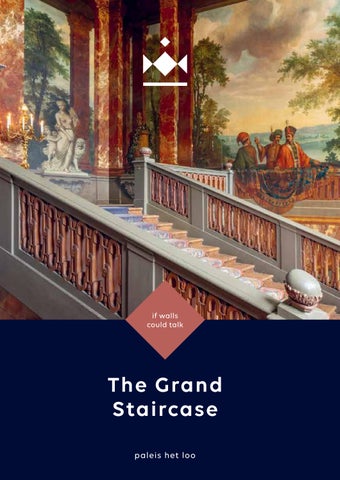
Visitors to Paleis Het Loo cannot possibly miss it: the Grand Staircase at the heart of the palace. The majestic staircase has 36 steps – old-fashioned shallow steps suitable for long skirts and close-fitting outfits. The staircase slows you down as you climb. A world in paint unfolds around you on the walls and ceiling. This is a staircase with a story.

The painting depicts a colonnade with glimpses of a distant vista. There are all kinds of details: a parrot, vases festooned with garlands of flowers, statues of goddesses. At the centre are seven figures – all men – leaning nonchalantly on the painted balustrades. They appear to be in conversation with each other, glancing with curiosity at the space below them. They are dressed in what looks like Ottoman attire. But who exactly they are and why they are depicted here remained a mystery for many years.

This monumental work has a long history. The original painting on the walls and ceiling was completed in circa 1692. Restoration work and changing taste completely changed the look of the staircase over the centuries. What visitors see today is a reconstruction from the early 20th century, based on old fragments and a 17th-century print depicting the original design.

The Grand Staircase at Paleis Het Loo.

More than a century later, new research has revealed how we might interpret this artwork. The painting tells a remarkable story that takes us from the Veluwe region of the Netherlands to Versailles in France and on to Istanbul. It reflects the Dutch House of Orange’s cultural and political ties with other royal courts and their involvement in world events around 1700. The painting is also part of the northern European tradition of monumental murals. Read on to discover the astonishing story of the Grand Staircase, and find out more about this unique piece of Dutch heritage.

The men appear to be in conversation.

There are four vases with garlands dotted about the staircase.

A Staircase with a View

In 1684 Stadtholder Willem III (1650-1702) and his wife Princess Mary II Stuart (1662-1695) bought a medieval hunting lodge, Het Oude Loo, and the surrounding land. They had a new, more modern hunting lodge built beside the dated castle. Mary laid the first stone on 7 May 1685, and the building was completed just over a year later. This ‘corps de logis’ – French for ‘main building’ – is now the heart of Paleis Het Loo.

We do not know for certain who produced the original design for the palace. Architect Jacob Roman (1640-1716) was at any rate closely involved in the construction. The Grand Staircase was located just beyond the Entrance Hall, in the central axis of the structure. Willem III had instructed his ambassador in Paris to request designs from the prestigious Académie Royale d’Architecture. He received the drawings on 5 April 1685, a few weeks before construction commenced. Although Roman did not precisely follow the French designs, they do indicate that it was to France that Willem turned for inspiration. Baroque architecture was the fashionable style there at the time.

Buildings were symmetrical, and built on a grand scale. The interiors had opulent decorations, featuring costly fabrics, marble and gold details. In the Dutch Republic, this exuberant style was toned down somewhat to produce the Dutch baroque as exemplified by Paleis Het Loo.

A parrot seated on the balustrade watches as visitors come and go.

From hunting lodge to royal palace

Willem and Mary became King and Queen of England, Scotland and Ireland in February 1689, following the peaceful overthrow of the English King James II (1633–1701), Mary’s father. Certain influential aristocrats invited Willem and Mary to accede to the throne in his place. To emphasise their new royal status, they had major extension work carried out on their palaces, starting in summer 1689. Hampton Court and Kensington Palace in London were extended, as was Paleis Het Loo, which would henceforth be used as a royal summer palace.

Mary II Stuart portrayed by Willem Wissing in circa 1686 (detail).

King-Stadtholder Willem III portrayed by court painter Jan Hendrik Brandon in 1698 (detail).

Today’s Paleis Het Loo with the ‘corps de logis’, the original building, in the centre.

Romeyn de Hooghe produced this bird’s-eye view in circa 1695, shortly after the palace was extended.

William and Mary as King and Queen of England, Scotland and Ireland in a print by Romeyn de Hooghe.

French artist Daniël Marot (1661-1752) played a key role in the decoration and furnishing of Paleis Het Loo. He was a Calvinist and had been forced to flee France with his family in 1685, when Protestants were persecuted after Louis XIV issued the Edict of Fontainebleau. Marot found a safe haven at the court of Willem III, who was happy to make use of his talent. He produced designs for Willem’s palaces in both the Dutch Republic and England. Marot was responsible for a large portion of the interior of Paleis Het Loo. He also designed a lot of the furniture and many garden ornaments.

Daniël Marot, portrayed in an engraving by Jacob Gole.

Daniël Marot

Comprehensive design

The palace as we know it was created during the second phase of construction, from 1690 to 1694. Pavilions were added to the ‘corps de logis’ to connect it to the side wings, and the gardens were expanded. Between 1690 and 1693 the walls and ceiling of the Grand Staircase were decorated with a contiguous painting covering some 550 square metres, executed in oil on plaster. The design was by Daniël Marot.

For the east and west walls of the staircase Marot designed a colonnade with vaulting that continued onto the ceiling. The architectural painting creates an optical illusion, making the space appear higher than it is in reality. The columns and vaulting were painted directly on the walls in oil. Between the columns, men casually lean against the balustrades. On the east wall, a parrot sits beside them. On both walls, in the corners, there are two large garden vases with a garland of flowers draped over them. Beyond the balustrades, there are views of a distant landscape, seamlessly merging the interior and exterior.

The painting on the east wall, seen from the first landing.

A painted ‘oculus’, a circular opening in the ceiling, gives the impression that we are looking straight at the sky. Reliefs are painted around it in grey tones. They depict small naked figures known as putti engaged in all kinds of hunting activities, referring to the palace’s original function. King-Stadtholder Willem III loved hunting.

Once the mural was completed, Marot made an etching of the finished result. It is likely that he did not use the painting itself as a reference, but rather a design sketch that has since been lost. It reveals that many elements of the wall paintings at Paleis Het Loo also occur in other designs by Marot. Yet there are noticeable differences too, making the Grand Staircase unique within his body of work. The two groups of men in Ottoman-style attire on the east and west walls of the staircase are particulary striking. They differ from the mythological or allegorical figures that Marot tended to depict in interiors like this, as at Slot Zeist and Huis de Voorst. Lavishly painted staircases were popular towards the end of the 17th century, and were a showpiece that graced many stately homes in the Netherlands.

A painted relief showing a scene with putti hunting. The painted ceiling above the staircase.

Marot produced this etching after the Grand

was finished.

Staircase
The staircase at Slot Zeist has mythological scenes on the walls.

Marot worked mainly as a designer, and no paintings actually executed by him have survived. His design for the Grand Staircase at Paleis Het Loo was largely executed by Robbert Duval (1649-1732), who had been Willem III’s court painter since 1682. He was probably assisted by other artists, including Johannes Lotyn (1618-1695), who was responsible for the many flowers painted on the ceilings and above the doors in the palace.

A royal gesture

The staircase is the main link between the entrance hall, or vestibule, and the Great Hall on the first floor where Willem and Mary received important guests. In accordance with the tradition of Dutch court architecture, the stadtholder and his wife lived on this floor. Leading courtiers inhabited the ground floor. The staff lived and worked in the basement. Paleis Het Loo was no exception.

In 1750 Pieter Tanjé etched this posthumous portrait of Robbert Duval based on a drawing by Aert Schouman, (detail).

Marot’s design for the staircase at Huis de Voorst.

Turn static files into dynamic content formats.
Create a flipbook
The Grand Staircase Paleis Het Loo by uitgeverijdekunst - Issuu