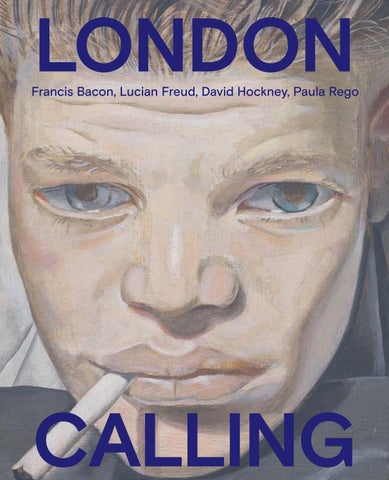
Edited by Thijs de Raedt
Francis Bacon, Lucian Freud, David Hockney, Paula Rego
Waanders Publishers, Zwolle
Kunstmuseum Den Haag
Foreword London Calling The School of London and Modern British Painting
Elena Crippa & Thijs de Raedt
Francis Bacon Michael Andrews Frank Auerbach Eva Frankfurther Leon Kossoff ‘Patterns of Human Existence’ Towards a School of Real London Circa 1976 Sanjukta Sunderason
R.B. Kitaj David Hockney Sylvia Sleigh Lucian Freud Sandra Fisher Francis Bacon and Parallel Movements Thijs de Raedt
Denzil Forrester Paula Rego Celia Paul Lynette Yiadom-Boakye Many Modest Lives The School of London and the Family in Britain After 1945 Gregory Salter
Exhibited Works
6
12 26 40 48 54 60
70 80 90 100 104 118 126 134 146 156 162
170 180
6
Foreword
This year marks the fiftieth anniversary of the exhibition The Human Clay at the Hayward Gallery in London, curated by the American painter R.B. Kitaj. In his catalogue essay, he suggested the existence of a ‘School of London’: not a coherent style or manifesto group, but a motley collection of idiosyncratic London-based painters with one thing in common: a fascination with the human form.
to enrich it. Here we present a layered survey of well-known icons while simultaneously offering a fresh perspective on parallel artists and movements who used oil on canvas to give expression to the world around them in the same city in the same period. Because this is ultimately what the School of London still represents today: paintings that explore what it means to be human.
In collaboration with Tate, the Kunstmuseum Den Haag now presents London Calling: a selection of iconic works by the masters of this illustrious constellation. They include some of Britain’s most acclaimed post-war painters – Francis Bacon, Lucian Freud and David Hockney – who, each in their own way, remained loyal to the representation of the human figure in an art world increasingly dominated by abstraction.
I extend my sincere thanks to our colleagues at Tate, especially Edward McDonald-Toone, Helen Little and Katie Chester, who have worked tirelessly, critically and constructively to help us showcase their beloved collection of British paintings in The Hague as effectively as possible. I am also indebted to former Kunstmuseum curator Laura Stamps and former Tate curator Elena Crippa who set up this ambitious partnership years ago. Together with his colleagues in London, Kunstmuseum curator Thijs de Raedt has enthusiastically elaborated the exhibition concept and compiled this beautiful catalogue, with the invaluable assistance of trainee curator Clairie Hondtong. I am grateful to Elena Crippa, Gregory Salter and Sanjukta Sunderason for their insightful contributions to this catalogue, and to Gerard Forde for his thoughtful translations. The catalogue has been designed by Loes Claessens and lovingly produced by Waanders Publishers. Roland Buschmann has provided the refined exhibition design.
This exhibition questions the way the School of London has been canonised over the past fifty years. Only a few of the names that Kitaj presented in 1976 would later be associated with the School of London: through exhibitions and publications over the last five decades, this small group has almost come to define the canon of post-war British painting. But this is only part of the story. For there were other ‘alternative’ London-based painters who remained just as faithful to the tradition of figurative painting in the second half of the twentieth century and who, indeed, helped to revive it. They include astonishing visual storytellers, like Paula Rego, who have been unjustly overlooked for years. And what were the ‘parallel movements’ in London? Women artists who stood in the shadow of men, such as Celia Paul, who until recently was known primarily as Freud’s muse and lover. Or immigrant artists, such as the Grenadaborn Denzil Forrester, who has employed the body to depict the Caribbean diaspora and experiences of city life in London. London Calling aims to investigate the mechanisms of inclusion and exclusion that still determine what we consider to be important, valuable or ‘good art’ by also looking beyond the familiar narratives that have dominated art history. Not to dismantle the School of London, but rather
Exhibitions such as this one would be impossible without financial assistance. I would therefore like to thank the Mondriaan Fund, the Cultuurfonds, Stichting Zabawas, Gravin van Bylandt Stichting, Gijselaar-Hintzenfonds and Vereniging Vrienden van Kunstmuseum Den Haag for their support. The Cultural Heritage Agency of the Netherlands has granted government indemnity on behalf of the Minister of Education, Culture and Science, an indispensable form of support and a demonstration of trust. Finally, I would like to thank Tate and all the museums, galleries and private collectors who have generously loaned works to the exhibition. Prof. Dr Margriet Schavemaker General Director, Kunstmuseum Den Haag
7
Bus Stop, East London, 1974
Euston Underground station, 1970
12
London Calling The School of London and Modern British Painting
Elena Crippa & Thijs de Raedt
Since the 1980s, a group of prominent British post-war painters who have afforded the human figure a central role in their work has been discussed collectively as the ‘School of London’. In this usage, the term was coined in 1976 by the painter R.B. Kitaj (19322007) in the catalogue of the exhibition The Human Clay that he curated for the Arts Council of Great Britain.1 Kitaj selected works by different generations of British artists, from Henry Moore (1898-1986) to David Hockney (b. 1937), with a concentration on drawings and in particular works with a single human figure: ‘the most basic art-idea, from which so much great art has come’.2 Although Kitaj brought together around fifty artists in The Human Clay, in the years that followed the term School of London was mainly employed for a smaller grouping of artists, always including Francis Bacon (1909-1992) and Lucian Freud (1922-2011), mostly alongside Michael Andrews (1928-1995), Frank Auerbach (19312024), Leon Kossoff (1926-2019) and, often, Kitaj himself.3 The discussion of these artists as a group has been justified by the fact that they studied or taught at the same schools in the 1950s and 1960s, the friendships and mutual admiration that united them despite working in isolation in their modest studios, and their appearances in each other’s paintings. In the first four decades of the twentieth century, Paris was the art world’s undisputed centre. The School of Paris had been shaped in those years by the unprecedented migration to the French capital of streams of artists from all corners of Europe. This came to an end with Hitler’s ascent to power in 1933 and the outbreak of the Second World War six years later. Now it was London that saw an influx of émigré artists, becoming the crossroads of disparate ideas and traditions and home to talents from Europe, the Commonwealth and beyond. Several of the artists discussed here were born outside Great Britain and moved to London to escape Nazism or because of their desire to study and work in the British capital. London is where they met and where they were exposed to and spurred on by each other’s work and ambition. Despite these artists’ mutual association in the first two decades after the war, it was not until the 1980s that the School of London gained currency as a concept. That is noteworthy given that many of its members had won prizes and earned critical praise early in their careers. Francis Bacon, the oldest of the group, would achieve widespread public recognition in the 1950s and 1960s, but figurative art was generally perceived in those years as outdated.4 It is in this context that the term School of London became strategic in an attempt to reconsider the history of post-war British art in relation (or in contrast) to North-American developments. It was the task of this School of London to afford greater visibility, partly by means of exhibitions organised by the British Council and the Arts Council of Great Britain, to a phenomenon that had long remained undervalued: paintings of great quality but which in their insistence on and attachment to the centrality of the human figure – and by extension the human condition – were out of sync with the dominant international cultural context. That context had for decades primarily been defined by art from the United States, above all Abstract Expressionism and Minimalism, and by all that was new rather than ‘traditional’.
But there was no actual School of London: no manifesto group, no shared style that united artists such as Auerbach, Bacon and Freud. Neither were they the product of a single generation or of a particular art school. Over the years, the notion of the School of London has been criticised by art historians and by the artists themselves, most enlisted as members against their will.5 As always, when it comes to groupings and movements, simplistic associations are an inadequate substitute for an exploration of complex and unique artistic visions, which in the case of these artists developed considerably over the course of lengthy careers. Furthermore, the theoretical framework underpinning the very idea of the School of London remained anchored in the early writings of David Sylvester, who viewed the work of Bacon, among others, in the spirit of French existentialism and formalist art theory.6 The School of London painters have repeatedly been framed and discussed in relation to that modernist perspective: as artists rooted in an engagement with reality as a purely visual and formal concern, with an emphasis on form and the handling of paint but with little eye for illustrative aspects, literary references, narrative approaches and psychological insight.7 In the past two decades, such restrictive analysis has been challenged by many, especially in discussing the work of individual artists. The discourse around Bacon’s work, for example, has expanded to address the construction of a personal narrative through the recurrent citation of specific biographical events and through the exploration of identity and gender formation.8 Even in the case of Freud, who always insisted that his work was simply a record of his life in the studio, critics have begun to address the theatrical mise en scène of his compositions and to liberate the artist, posthumously, and his paintings from the stuffy confines of his studio.9 Additionally, several group exhibitions in the past few decades have broadened the canon of post-war figurative painting, admitting a larger group of artists and avoiding categorisations that are overly narrow and simplistic.10 The term School of London was of great value in putting British figurative painting on the map, but in doing so it enshrined a limited narrative whose boundaries were always artificial. A case in point is David Hockney. A good friend of Kitaj, who included his work in The Human Clay, as a representative of yet another generation of promising painters he took a different path, one that led him from the Royal College of Art via Pop art influences to sunny California. With his obsessive outpouring of naturalistic portraits of people from his immediate circle in the 1960s and 1970s, Hockney grew to be one of Britain’s most influential figurative artists but has only occasionally been included in the exhibitions and publications dedicated to the School of London.11 Or take Paula Rego (1935-2022), who only later became associated with the School of London.12 With her extraordinary devotion to representing humanity, allowing bodies to tell stories that appeal as much to the subconscious as to political reality, she has enriched the figurative tradition that remained so strong in London. Viewed alongside the work of Bacon, Freud or Kitaj, her paintings can reveal what may have remained hidden in earlier readings: the narrative, the inner world, the life beneath the human form.
13
14
While we recognise the School of London as a historical construct, and while the extremely high quality of the individual painters within the group is beyond dispute, in what follows we will avoid the rigidly defined biographical parameters on which it is founded. Instead, in this essay we explore the manifold approaches that characterise the work of the painters who played a key role in one of the most distinctive, long-lasting and fascinating chapters of modern British art: painting as the record of a personal, sensuous, immediate and often intense experience of reality.
The Reproduced Body: Bacon and Andrews Although the human figure was a major preoccupation of all the artists associated with the School of London, their approaches varied considerably. These differences are apparent even in their relationship to their subject. Auerbach’s and Freud’s paintings, for example, emerged from a direct encounter with the sitter, often requiring numerous sessions. With others, including Andrews and notably Bacon, however, the subject was usually derived from reproduced images. Many of Bacon’s subjects, including his screaming men and popes – figures of power and paternal authority – were based on reproductions of paintings, sculptures, photographs and film stills taken from books, magazines and newspapers.13 Bacon accumulated an archive of angst-ridden images that resonated with him personally as much as with historical circumstances. From 1962 he expanded the range of his photographic sources by commissioning particular shots of models to facilitate already developed ideas for his compositions. As art historian Catherine Lampert has observed, working without a model did not lessen the power and poignancy of his figures. In fact, it may have had the opposite effect, as the artist reanimated the mechanically reproduced image through the treatment of paint.14 Figure in a Landscape (1945) is one of Bacon’s earliest paintings whose starting point was a reproduced image, based on a photograph of his partner Eric Hall dozing on a chair in Hyde Park. A substantial section of the body is overpainted, suggesting a black void. An open, bloodied mouth appears to speak into microphones, a detail that Bacon may have taken from photographs of Nazi rallies. The blue sky and idyllic setting contrast with this contorted figure and the intimation of organised political violence, making this an early example of Bacon’s conflation of aggression and the everyday. This painting was also one of the artist’s earliest efforts to synthesise powerful images of expressive physicality with personal and often autobiographical references. In 1949, a friend alerted Bacon to the extensive collection of photographs by Eadweard Muybridge in the Victoria and Albert Museum, just a few minutes’ walk from his studio.15 Muybridge’s numerous series in which he captured the movement of humans and animals in successive images impressed Bacon and provided him with a rich source of unconventional poses and body shapes. Like Muybridge, Bacon wanted to capture the body in a faltering moment. From the 1950s onwards, Bacon based various figures in his paintings on Muybridge’s images, such as Paralytic Child Walking on All Fours (from Muybridge) of 1961. Against a back-
ground of black and green – the same green as the walls of his favourite bar, the Colony Room Club – a naked body makes its way through an undefined space. Without the context of the title or the source, it would not be immediately apparent that this is a human being. Therein lies an uneasy tension: an ambiguity that makes the figure both vulnerable and unsettling. So too for Michael Andrews, his exploration of the human condition was intensified and complicated by an imaginative engagement that gave his paintings an odd quality, as if simultaneously part of reality and yet out of sync with it. The artist and writer Lawrence Gowing noted that Andrews’ oeuvre is distinguished by ‘the numinous quality of the real’.16 This characteristic is already present in A Man Who Suddenly Fell Over (1952), which Andrews painted while still a student of Freud at the Slade School of Fine Art. The fallen man, of Andrews’ father’s generation, displays a pitiful yet moving lack of physical prowess and self-assurance. This feeling of instability, and the desire to conceal it, was not uncommon in Britain in the immediate post-war years. In the 1960s, Andrews painted four ‘party paintings’. For The Colony Room I (1962) he took his own experiences of Soho’s vibrant nightlife as his starting point. The Colony Room Club was a private members’ club on Dean Street, frequented by artists such as Bacon (with his back to us on the right), Freud (facing us, centre right), Auerbach and Andrews himself. Andrews created his painting from various photographs, sketches and memories: a collaged representation of a fictional gathering but simultaneously a visual document of the times, underscoring the existence of the School of London as a historical group.
The Living Body: Freud and Hockney In contrast to Bacon’s contorted, moving bodies, the figures in Freud’s early paintings often look as if they are strapped into unnatural poses, exposed to and frozen by the painter’s gaze. This is certainly the case with his various paintings of his first wife, Kitty Garman, who posed for Girl with a White Dog (1950-51). This picture belongs to a period when Freud tightly controlled every aspect of his paintings, creating psychologically charged images in which he meticulously recorded the details of his subjects’ appearance and surroundings. The young woman’s act of self-exposure seems to lack sensuality, as if responding to a request by the painter that she was unwilling to grant and yet unable to refuse, a power relationship signalled by the wedding ring on her left hand. Her loyalty is amplified by the figure of the dog, a symbol of docility and submission to its master. Freud has captured his wife in a moment that oscillates between intimacy and reserve, between power and vulnerability. Intimacy, or at least proximity, is Freud’s primary subject of exploration in Boy Smoking (1950-51), made around the same time. Painted on a small copper etching plate, it portrays his neighbour and friend Charlie Lumley in extreme close-up, his face barely contained within the frame. According to art critic and Freud biographer William Feaver, portraits such as this one were the product of the uncomfortable scrutiny to which Freud subjected his models – sitting face to face, their knees touching – in multiple sessions over several months.17
From the 1960s onwards, Freud gradually developed a much looser, freer style of painting, that is recognisably all his own. He exchanged his fine sable brushes for coarser ones of hog hair and began to paint standing rather than sitting. Using broad strokes of paint – often laboriously mixed to achieve the desired hue – he explored the peculiar materiality of human skin. While the paint surface in his early work was uniform and matt, it now became glossier and more layered. Freud worked notoriously slowly, often labouring over a painting for months at a time, his models having to endure countless lengthy sessions. He subjected even inanimate objects to this intensity of observation: he painted Two Plants (1977-80) over a three-year period, in order, he said, to get used to the light in his new studio, treating each leaf as a miniature portrait. Freud’s new way of working coincided with a shift to a more empathetic and searching relationship to his sitters, evident in the tender depiction of his companion, the painter Celia Paul (b. 1959), who at the time was pregnant with their child, in Girl in a Striped Nightshirt (1983-85), and in his many portraits of his mother and daughters. Freud’s extremely serious, studious and ‘traditional’ way of working in the studio contrasted sharply with the playfulness and irony of a new generation of students at the Royal College of Art, the wellspring of British Pop art in the 1960s. These included Kitaj and Hockney. It was Kitaj who encouraged Hockney to draw inspiration from his own life and personal interests. In The Third Love Painting (1960), the third in a series in which he explored his homosexuality, a white and pink phallic shape is surrounded by words and phrases that Hockney took from graffiti on the toilet walls in Earl’s Court Underground station and from Walt Whitman’s love poem ‘When I Heard at the Close of Day’. Hockney chose to paint words instead of figures because figurative painting was then considered anti-modernist. Before long, he would shed his inhibitions and, like Freud – but in his own unique way – devote himself to meticulously painted portraits of friends and family. At the end of the 1960s, Hockney began a series of monumental double portraits that remain among his most personal works. Mr and Mrs Clark and Percy (1970-71) depicts his close friends, fashion designer Ossie Clark and textile designer Celia Birtwell, with their pet cat in their London home not long after they were married. Hockney required numerous sittings, repainting Birtwell’s face twelve times before he was satisfied.18 In My Parents (1977) Hockney combined the inquisitive gaze that he trained on his friends with an intimate staging replete with art-historical references. After years of struggle, and two failed attempts, Hockney finally succeeded in capturing his parents in a double portrait. His mother Laura sits upright watching her son at work. Where she radiates patience, Hockney’s father Kenneth is a restless contrast, viewed in three-quarter profile, leafing through Aaron Scharf’s Art and Photography, his back hunched and his heels raised. Between them is a trolley holding a vase of tulips, Proust’s À la recherche du temps perdu and a monograph on the eighteenth-century French genre painter Jean Siméon Chardin, known for his tranquil domestic scenes. The mirror reflects a postcard of The Baptism of Christ by Piero della Francesca, a masterpiece of the early Renaissance and among Hockney’s most beloved paintings. My Parents appears both full and empty, tranquil yet dynamic. Like Freud, Hockney was concerned with more
than physical resemblance: he wanted to capture the essence of his loved ones. The painting was executed from life through lengthy sitting sessions, a traditional approach that Hockney continued to champion.
Painting as Perception: Auerbach and Kossoff Already as fellow students at Saint Martin’s School of Art, Frank Auerbach and Leon Kossoff were fascinated by and began to paint the dramatic and changing materiality of London’s cityscape. They also attended evening classes at the Borough Polytechnic Institute with the painter David Bomberg (1890-1957), who urged his students to ‘define their experience of matter’ not just through sight but also through the other senses, especially touch.19 His teaching proved influential in the development of Auerbach’s and Kossoff’s approaches to painting as a vehicle of haptic experience, unveiling sensations that are hidden behind appearance. For Auerbach and Kossoff it was not perception that dictated the handling of paint: for them the act of painting was perception. Over the course of several decades, both artists worked from a small and familiar repertoire of subjects: London scenes and a handful of regular sitters. Each developed a method in which paint became matter itself – crusted, heavy, sculptural. Auerbach’s intense, almost obsessive working method is illustrated by his protracted collaboration with Stella West. They met in 1948, when Auerbach was seventeen and West a widow of thirtytwo, before he began at Saint Martin’s and befriended Kossoff. Over the course of the next two decades, he made approximately eighty paintings and drawings of her, often with dozens of sittings for a single work. In the 1950s, Auerbach made a habit of visiting West at home three times per week, working on his knees with the canvas propped against a chair while West posed for hours. West later recalled the intensity of Auerbach’s approach to mark making, stating that he ‘was very violent and quite in a world of his own’.20 Because the young painter had little money for materials, he used a limited palette of black, white and earth colours. He was also hesitant to scrape paint away in those early years, causing it to build up in thick layers, turning portraits such as Small Head of E.O.W. (1957-58) – Estella Olive West – almost into reliefs. Auerbach’s endless observations, his struggles and the hours of dedication of both painter and his model are congealed here, captured like sediment in paint. Like Auerbach’s, Kossoff’s paintings emerged from countless observations and drawings made in situ. The only School of London painter born in the city that gave the group its name, and where he lived his entire life, he felt a great attraction to certain places, returning repeatedly to paint buildings such as Nicholas Hawksmoor’s Baroque masterpiece Christ Church, Spitalfields, a stone’s throw from his native Shoreditch. He painted and scraped down his pictures over and over again until finally something convincing and exciting appeared: an intense, gripping portrayal of human presence. Children’s Swimming Pool, Autumn Afternoon (1971) is one of five large paintings of swimming pools that Kossoff completed between 1969 and 1972. They represent an important transition
15
16
Francis Bacon, Figure in a Landscape, 1945. (p. 33)
Francis Bacon, Paralytic Child, Walking on All Fours (from Muybridge), 1961. (p. 30)
Michael Andrews, A Man Who Suddenly Fell Over, 1952. (pp. 42-43) Michael Andrews, The Colony Room I, 1962. (pp. 46-47)
Lucian Freud, Boy Smoking, 1950-51. (p. 113)
Lucian Freud, Girl with a White Dog, 1951-52. (p. 105)
Lucian Freud, Two Plants, 1977-80. (p. 112)
Lucian Freud, Girl in a Striped Nightshirt, 1983-85. (p. 116)
David Hockney, The Third Love Painting, 1960. (p. 93)
17
Frank Auerbach, Small Head of E.O.W., 1957-58. (p. 52)
David Hockney, Mr and Mrs Clark and Percy, 1970-71. (p. 96)
David Hockney, My Parents, 1977. (p. 99)
Leon Kossoff, Children's Swimming Pool, Autumn Afternoon, 1971. (p. 64)
R.B. Kitaj, The Murder of Rosa Luxemburg, 1960. (p. 81)
R.B. Kitaj, Cecil Court, London W.C.2. (The Refugees), 1983-84. (p. 87)
Paula Rego, Bride, 1994. (p. 150)
18
in his work: the paint is relatively thinly applied, and the suggestion of movement is enhanced by the flickering reflections of the water in the crowded pool. While figures are barely defined in his drawings, in his paintings each person becomes an individual, known to, and often dear to, the artist.21 As a result these paintings are filled with a humanity that is never anonymous, the result of intimate observation and knowledge of others.
of them also called Rosa – who were forced to flee to the United States.25 A battered corpse dominates the picture, and a collaged paper element at the top right provides a succinct if chilling verbal description of Luxemburg’s killing. The painting also includes portraits of Kitaj’s grandmothers and references to German nationalist monuments. Its fragmented nature is exemplary of his approach, bringing together and giving form and meaning to an assemblage of unrelated elements.
The Body as a Battlefield: Kitaj and Rego
Migration and the Jewish diaspora became important themes in Kitaj’s work. In Cecil Court, London W.C.2. (The Refugees) (198384), the painting’s geographic setting – an alleyway in central London lined with shops selling rare and second-hand books – merges with his experience as an American of Jewish origins living in the capital. In the foreground we see Kitaj himself, reclining on a chaise longue. The figures around him and their postures are inspired in part by people Kitaj knew, and reflect his passion for Yiddish theatre, an expressive dramatic form he had learned about from his grandparents and read about in Kafka’s diaries, which served as an important cultural anchor for London’s Jewish community around 1900.
A fear of content, of experienced reality invading the painting as a self-sufficient and self-referential object, was one of the most extreme aspects of the modern movement, whose influence would be felt into the 1970s and beyond. While modernism repelled literary references, which it perceived as illustrative and, as such, inferior to painting as a formal exploration of its own internal development, there were contemporary ways of thinking that pointed in a different direction. Writing in the 1950s, the psychoanalyst and writer Marion Milner argued that drawings and paintings could embody both a form of knowledge or reflection on one’s specific human situation, and an experience with a medium. For Milner, art could be the expression of ‘thinking in the private language of one’s own subjective images, as against thinking in the public language of words’.22 Among the artists who, with very different results, adopted a similar approach in their work are R.B. Kitaj and Paula Rego. Since their early work in the 1950s and 1960s, they not only brought a constellation of disparate, fragmented elements into their images, borrowing from both topical sources and the work of the masters, but also took inspiration from a variety of stories, as captured in newsreels, historical accounts and literary texts. Both worked on large-scale figure compositions, unleashing their imaginative vision of life to explore inter-subjective relationships as part of their existentialist, socio-political or feminist concerns. They were, in different ways, preoccupied with human relationships – with the way in which men and women interact as part of small communities or public gatherings, or, more broadly, with the way in which their identities are shaped by historical and socio-political constraints.
In Paula Rego’s bewitching oeuvre, the body – and especially the female body – is the explicit bearer of political and ethical meaning. After studying at the Slade School of Fine Art from 1952 to 1956, Rego lived between London and Lisbon in the 1960s and 1970s and developed an abstracted idiom that nonetheless displayed strong narrative elements. From the 1980s – now permanently residing in London – she embraced realism, but a realism that incorporated both the physical reality of objects and the less tangible, yet in no sense less present, reality of dreams and unconscious drives. Taking inspiration from literature, myths and fairy tales, she created ambitious, large-scale figure compositions. Rego’s work underwent a significant shift in the 1990s as she switched permanently to pastel – in which she became a virtuoso – responding to her need for a more direct and tactile medium.26 She used it to create numerous impressive compositions unparalleled in their expressiveness, giving her work a unique and recognisable quality. In this period, her work also took on an outspoken feminist character.
As the art historian Marco Livingstone has noted, Kitaj was a major exponent of a critical type of realism, not aligned with a specific political movement but motivated by a desire for social reform.23 His reliance on poetry, history and literature fed into visual narratives of events with broad social resonance. The critic Robert Storr has argued that Kitaj’s approach allows us to define him as a ‘history painter’ but one who created his own pantheon, populated by figures who mattered to him personally.24
A strong sense of dissent, even defiance of prescribed social roles defines Rego’s Dog Woman series from 1994: large-scale pastels in which muscular women posture and behave like dogs, powerful in the expression of their physicality. Their behaviour is not constrained by social conventions and they express their feelings and libido freely. For Maria Manuel Lisboa, a long-term friend and model, they are ‘bitches who snarl at the heels of their masters and piss on the bed of aesthetics, ethical and political conventions’, creatures of an anarchic painter who employs rudeness as a means for social change.27
An early picture in which Kitaj revealed his preoccupation with the roots of socialism and political martyrdom is The Murder of Rosa Luxemburg (1960), which takes its title from the brutal killing in 1919 of the Marxist theorist and leader of the German Communist Party. Luxemburg was of Polish Jewish descent, and Kitaj has explained that the picture refers to the persecution of the Jewish people more generally, including two of his grandmothers – one
Rather than expressing a defiant independence through her behaviour, the female figure in Bride (1994) is trapped into a strained pose. The picture was inspired by Blake Morrison’s poem ‘Moth’, in which a man reflects on the failure of his marriage and recalls lying with his wife not for pleasure but as a punishment for her flirtations with other men.28 While seemingly docile, awaiting her groom, the woman’s back arches in a manner that may signal
an offering but betrays distress, while her fixed gaze lacks joy, seemingly the manifestation of a learned behaviour. It is a powerful and disquieting image, reminiscent of Freud’s Girl with a White Dog. As the painter and writer Timothy Hyman has remarked, Rego has played a key role in two respects: as a leading artist who reclaimed the right to paint confessional and imaginative pictures without fear of the stigma attached to illustrative, narrative art, and as a role model for the many women painters who from the 1970s onwards rejected the idea that painting was a strictly male activity.29 They include the London-based American artist Sandra Fisher (1947-1994) and the US-based British painter Sylvia Sleigh (1916-2010), both of whom painted men as men had painted women for centuries: naked and subjected to their gaze – objects of desire. Linda Nochlin has discussed the major role that female painters have played, particularly through portraiture, in subverting the laws of modernism through their ‘talents as seismographic recorders of social position, as quivering reactors to the most minimal subsurface psychological tremor’.30
Beyond the School of London Discussing specific works by and the working methods of artists as diverse as Francis Bacon, Frank Auerbach and Paula Rego serves only to reinforce their diversity. Central to their work is the human body, not as a neutral element but as one that is subjected to power relations, desires and violence, to countless representations and interpretations. The more different approaches we identify, the clearer it becomes that attempts to group them as a school say more about the need of art historians and curators to tell a particular story than about reality. If it was once the biographical connections and superficial similarities between these artists that summoned the School of London into being, it is this diversity that now makes its existence impossible. Just as the human figure in painting can never be neutral, so too the term School of London has never been a neutral descriptor. It is an
invented myth of unity, convenient for exhibitions and publications. But mechanisms of inclusion are also mechanisms of exclusion here. What this art historical construction conceals is perhaps just as important as what it has revealed over the past fifty years since Kitaj’s The Human Clay. Perhaps we should turn the question around and ask not what made these artists a school but what made post-war London a space for such intense and often disturbing explorations of corporeality? Was it a reflection of the shared trauma of war, the unravelling of the British Empire, a response to social reform movements or the vital impulses of immigrants? Or was it precisely the absence of a dominant modernist doctrine that allowed different conceptions of humanity to find a place in modern painting in London? Viewed in this way, the School of London is not only a historical phenomenon but also a starting point for new stories. Future explorations might broaden the horizon to include other networks within the same post-war London – parallel movements and voices that until recently fell outside the dominant narrative, moving away from a defined group towards a more complex and inclusive field of relations and influences. Not in order to dismantle the School of London, but rather to enrich it. And if the School of London was not really a group at all, the question remains: what legacy do these artists leave us with collectively? The real legacy of the School of London painters may not lie in shared convictions or a cohesive style but in the way they used painting to explore humanity in the modern age – to understand what it means to have a physical body. Within that quest lies an unwavering belief in the power of paint and figuration: painting’s ability to make tangible the human experience and to question it. As long as we have bodies that suffer, yearn and are burdened, painting will retain its relevance. The painters discussed here may not truly have constituted a school, but together their unique oeuvres have demonstrated what painting is still capable of being: a living practice that compels us to look, and to keep looking, at what it means to be human.
19
20
1
Although the art critic David Sylvester had spoken of a ‘School of London’ as early as 1948, Kitaj used the term to refer to an entirely different group of artists. See James Hyman, The Battle for Realism: Figurative Art in Britain During the Cold War, New Haven 2001, pp. 24-26.
13 Bacon’s use of photographs and printed reproductions as source material was already discussed in the early 1950s, for example, in Sam Hunter, ‘Francis Bacon: The Anatomy of Horror’, Magazine of Art, vol. 45, no. 1, January 1952, pp. 11-15.
2 R.B. Kitaj, ‘School of London’ in The Human Clay: An Exhibition Selected by RB Kitaj, London 1976, unpaginated.
14 See Catherine Lampert, ‘Painting from Life: “A Long Affair with Objects, Images, Appearances, Sensations… the Passions”’ in Catherine Lampert and Tanja Pirsig-Marshall (eds), Bare Life: Bacon, Freud, Hockney, and Others: London Artists Working from Life 1950-80, Münster 2014, p. 175.
3
Among the exhibitions that limited the term to these six artists are two that were toured internationally by the British Council: A School of London: Six Figurative Painters (1987-88) and From London: Bacon, Freud, Kossoff, Andrews, Auerbach, Kitaj (1995-96). 4 See Richard Morphet, ‘An Under-rated Art’ in The Hard-Won Image: Traditional Method and Subject in Recent British Art, London 1984,
15 Mark Stevens and Annalyn Swan, Francis Bacon: Revelations, London 2021, p. 294. 16
pp. 4-16. The lack of exposure of the artists of the School of London is exemplified by Lucian Freud’s record of institutional exhibitions between the early 1950s and early 1990s. After representing Britain, together with Bacon and Ben Nicholson, at the Venice Biennale in 1954, Freud had only two major museum exhibitions: one organised by the Arts Council of Great Britain at the Hayward Gallery in 1974, and the other an international touring show organised by the British Council in 1987-88.
1980, pp.
5
19
See Michael Peppiatt, ‘A School or Not a School’, Modern
Painters, vol. 8, no. 2, 1995, pp. 64-66. 6
Of particular relevance here are Sylvester’s writings on Bacon and Giacometti from 1954-55 and his essay ‘End of the Streamlined Era’ (1955), reprinted in David Sylvester, About Modern Art: Critical Essays 1948-1996, London 1996, pp. 49-58.
7
This reading is in line with that of the most influential art critic of the time, Clement Greenberg, who consistently stressed the need for content to be dissolved into form, while narration and illusion were to be eliminated from painting.
17 See William Feaver, ‘Lucian Freud: Life into Art’ in William Feaver (ed.), Lucian Freud, London 2002, p. 26. 18
Hans Werner Holzwarth (ed.), David Hockney: A Chronology, 45th ed., Cologne 2020, p. 102.
9
See, for example, Laurence des Cars, ‘Realist Echoes in Lucian Freud’ in Lucian Freud: The Studio, Munich 2010, p. 54, and Daniel F. Hermann (ed.), Lucian Freud: New Perspectives, London 2022. 10
Examples include The Mystery of Appearance: Conversations Between Ten British Postwar Painters at Haunch of Venison, London, 2011; Bare Life: Bacon, Freud, Hockney, and Others: London Artists Working from Life, 1950-80 at the LWL-Museum für Kunst und Kultur, Münster, 2014; and All Too Human: Bacon, Freud and a Century of Painting Life at Tate Britain, London, 2018.
11
See, for example, Michael Peppiatt, ‘Interview with Frank Auerbach: Going Against the Grain’, in Art International, Autumn 1987, p. 26. 12
See, for example, Alistair Hicks, The School of London: The Resurgence of Contemporary Painting, Oxford 1989. Hicks identifies three generations of School of London painters, placing Rego in the second generation.
Robert Hughes, Frank Auerbach, London 1990, p. 31.
20
Hannah Rothschild, ‘The Sitter’s Tale’, Sunday Telegraph Magazine, 28 October 2001, p. 35, quoted in Catherine Lampert, Frank Auerbach: Speaking and Painting, London 2019, p. 50. 21
Paul Moorhouse, ‘“The Eye Sees More than the Heart Knows”: The Work of Leon Kossoff” in Leon Kossoff, London 1996, pp. 21-22. 22
p. 123.
Marion Milner, On Not Being Able to Paint, New York 1957,
23
Marco Livingstone, Kitaj, London 1999, pp. 15-17 and 24.
24
Robert Storr, ‘A Draftsman’s Painter’ in R.B. Kitaj: A Survey
8
See Andrew Brighton, Francis Bacon, London 2001, pp. 13-18, and Robert Newman, ‘(Re)Imagining the Grotesque, Francis Bacon’s Crucifixion Triptychs’ in Dudley Andrew (ed.), The Image in Dispute: Art and Cinema in the Age of Photography, Austin 1997, pp. 205-222.
Lawrence Gowing, ‘Introduction’ in Michael Andrews, London 6-7.
1958-2007, London 2015, unpaginated.
25 Kitaj, quoted in The Tate Gallery 1980-82: Illustrated Catalogue of Acquisitions, London 1984, pp. 156-57. 26
John McEwen, Paula Rego, London 2006, p. 215.
27
Maria Manuel Lisboa, Paula Rego’s Map of Memory: National and Sexual Politics, Aldershot 2003, p. 197. 28
McEwen, op. cit. (note 26), p. 223. Blake Morrison’s ‘Moth’ is from The Ballad of the Yorkshire Ripper, London 1987, p. 37. 29 Timothy Hyman, The World New Made: Figurative Painting in the Twentieth Century, London 2016, p. 57. 30
Linda Nochlin, ‘Some Women Realists: Painters of the Figure’ in Arts Magazine, vol. 48, no. 8, May 1974, p. 29.