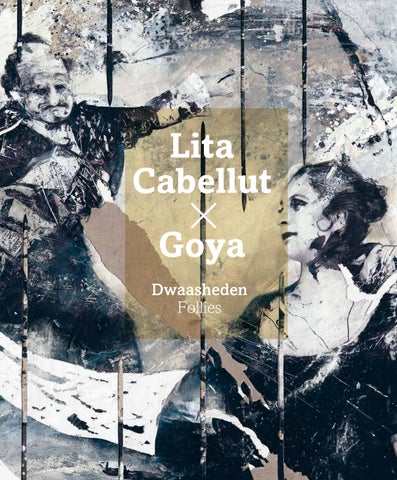
Lita Cabellut
× Goya
Dwaasheden Follies
Lita Cabellut
×
Goya Dwaasheden Follies
WAANDERS UITGEVERS, ZWOLLE MUSEUM JAN, AMSTELVEEN
4
Voorwoord
Foreword
In de loop van de jaren ontmoet je als museum directeur talloze kunstenaars, maar sommige ontmoetingen laten een onuitwisbare indruk achter. De samenwerking met de SpaansNederlandse kunstenares Lita Cabellut in het najaar van 2018 was zo’n bijzonder moment. Destijds toonde ons museum, toen nog onder de naam Museum Jan van der Togt, een grootschalig retrospectief van haar indrukwekkende, monu mentale portretten. De synergie tussen haar krachtige, fysieke werk en de intieme sfeer van ons museum in Amstelveen was voelbaar voor ieder een die de zalen betrad. Het was een buitengewoon fijne en inspirerende samenwerking. Al voor de sluiting van die succesvolle tentoonstelling spraken Lita en ik de belofte uit: ooit zouden we weer samen iets moois maken. Nu, acht jaar later, lossen we die belofte in met de ambitieuze tentoonstelling Lita Cabellut × Goya – Dwaasheden. Het is een weerzien waar ik naar heb uitgekeken, en de aanleiding is bijzonder. In de aanloop naar de herdenking van het tweehon derdste sterfjaar van Francisco de Goya brengt Cabellut in Museum JAN een visuele en conceptu ele dialoog tot stand die de tijd overstijgt. Ruim twee eeuwen scheiden deze twee Spaanse kunste naars van elkaar, maar hun artistieke ontmoeting legt een universele waarheid bloot over de menselijke ziel. Tussen 1815 en 1823 ving Goya zijn diepe politieke ontgoocheling, de maatschappelijke chaos en zijn donkere, absurde droomwereld in een reeks etsen getiteld Los Disparates (De dwaas heden); Cabellut reageert daarop met een over weldigende, fysieke oerkracht. In haar Haagse atelier heeft zij zich de afgelopen jaren volledig overgegeven aan haar passie voor Goya. Met multidisciplinaire schilderijen, sculpturen en ruimtelijke interventies vertaalt zij de 22 raadsel achtige prenten naar de existentiële onzekerheid van de 21ste eeuw. De thema’s van toen – macht, angst, onderdrukking, de kwetsbaarheid van het individu en de dunne grens tussen beschaving en chaos – zijn nog steeds actueel. Maar onder de duisternis en de confrontatie schuilt bij Goya en Cabellut een diep mededogen en een onwrikbaar
Over the years, as a museum director, you meet countless artists, but some encounters leave an indelible impression. The collaboration with the Spanish-Dutch artist Lita Cabellut in the autumn of 2018 was one such special moment. At the time, our museum – then still known as the Museum Jan van der Togt – was hosting a large-scale retrospective of her impressive, monumental portraits. The synergy between her powerful, physical work and the intimate atmosphere of our museum in Amstelveen was immediately apparent to everyone who entered the exhibition rooms. It was an exceptionally enjoyable and inspiring collaboration. Even before the closing of that successful exhibition, Lita and I made a promise: one day, we would create something beautiful together again. Now, eight years later, we are fulfilling that promise with the ambitious exhibition Lita Cabellut x Goya – Follies. It is a reunion I have been looking forward to, and the occasion is a special one. In the run-up to the bicentenary of Francisco de Goya’s death, Cabellut has created a visual and conceptual dialogue at Museum JAN that transcends time. More than two centuries separate these two Spanish artists, but their artistic encounter reveals a universal truth about the human soul. Whereas Goya captured his profound political disillusionment, the social chaos and his dark, absurd dream world in the series of etchings entitled Los Disparates (The Follies) between 1815 and 1823, Cabellut responds with an overwhelming, physical primal force. In her studio in The Hague, she has in recent years devoted herself entirely to her passion for Goya. Through multidisciplinary paintings, sculptures and spatial interventions, she has translated the 22 enigmatic etchings into the existential uncertainty of the 21st century. The themes of that era – power, fear, oppression, the vulnerability of the individual and the fine line between civilisation and chaos – remain as relevant as ever. Yet beneath the darkness and confrontation, both Goya and Cabellut reveal a deep compassion and an unshakeable faith in
human resilience. Her monumental canvases and sculptures, constructed from materials such as jute, blankets and tarlatan, show us that there is light, even in the midst of the deepest tragedy. It is fascinating to realise that Cabellut’s own artistic career began with a revelation at the Prado in Madrid, where, as a twelve-year-old girl, she came face to face with the old masters – and Goya in particular – for the very first time. With this series, she has come full circle. An exhibition of this scale and the production of this catalogue could only have been realised thanks to the tireless efforts of many people. My deepest thanks go to Lita Cabellut herself. Her infectious passion and generous trust meant that working with her once again felt like a warm welcome. We are honoured that she has entrusted this impressive series to us first in the Netherlands. I would also like to extend my warmest thanks to guest curator Eloy Martínez de la Pera for his insightful, conceptual vision and for bringing these two artistic worlds together. A very special word of thanks goes to Lita’s own team – Christine Riphagen, Marta Gil Guerrero and Virginia Villalobos Arévalo – who, behind the scenes, have contributed to the realisation of this project with unparalleled precision, dedication and enthusiasm. I am also deeply grateful to Aukje Vergeest, who was responsible for editing the exhibition texts, and Studio Berry Slok, responsible for the graphic design of the exhibition. A special word of thanks goes to the publisher, Marloes Waanders, for bringing this beautiful publication to fruition, designed by Harald Slaterus. Finally, I would of course like to thank the entire team at Museum JAN: the staff and our indispensable hosts and hostesses. Together, we have opened the doors to an encounter that will, I hope, inspire deep reflection, comfort and a renewed perspective on our own humanity.
geloof in de veerkracht van de mens. Haar monu mentale doeken en sculpturen, opgebouwd uit materialen als jute, dekens en tarlatan, tonen ons dat er licht is, zelfs te midden van de diepste tragedie. Het is fascinerend om te bedenken dat Cabelluts eigen kunstenaarschap ooit begon met een openbaring in het Prado in Madrid, waar zij als twaalfjarig meisje voor het eerst oog in oog stond met de oude meesters en met Goya in het bijzonder. Met deze cyclus is de cirkel voor haar rond. Een tentoonstelling van deze omvang en de totstandkoming van deze catalogus kunnen alleen gerealiseerd worden dankzij de tomeloze inzet van velen. Mijn allergrootste dank gaat uit naar Lita Cabellut zelf. Haar aanstekelijke passie en gulle vertrouwen maakten dat de hernieuwde samenwerking wederom als een warm bad voelde. We zijn vereerd dat ze deze indrukwekkende cyclus als eerste in Nederland aan ons toevertrouwt. Daarnaast dank ik gastconservator Eloy Martínez de la Pera hartelijk voor zijn scherpe, conceptuele visie en het samenbrengen van deze twee artistieke werelden. Een heel bijzonder woord van dank gaat uit naar Lita’s eigen team – Christine Riphagen, Marta Gil Guerrero en Virginia Villalobos Arévalo – die achter de schermen met ongekende precisie, toewijding en enthousiasme hebben bijgedragen aan de realisatie van dit project. Ook Aukje Vergeest, verantwoordelijk voor de redactie van de zaalteksten, en Studio Berry Slok die teken de voor de vormgeving, ben ik zeer erkentelijk. Een speciaal woord van dank gaat uit naar uitgever Marloes Waanders voor het realiseren van deze prachtige publicatie, vormgegeven door Harald Slaterus. Tot slot dank ik uiteraard het voltallige museumteam van Museum JAN: de staf en onze onmisbare gastvrouwen en -heren. Samen hebben we de deuren geopend voor een confrontatie die hopelijk aanzet tot diepe reflectie, troost en een hernieuwde blik op onze eigen menselijkheid.
Marieke Uildriks Director, Museum JAN
Marieke Uildriks Directeur Museum JAN
5
6
Lita Cabellut × Goya
Ralph Keuning
Wanneer begint verf te spreken? Lita Cabellut behoort tot een generatie kunstenaars die inmiddels evenveel achterom als vooruit kan kijken. Een omvangrijk oeuvre nodigt uit tot reflectie, terwijl de behoefte om nieuwe wegen te verkennen onverminderd aanwezig blijft. Juist dan dient zich een fundamentele vraag aan. Welke gedachte loopt als een rode draad door een in tientallen jaren opgebouwd kunstenaarschap? En in welke richting beweegt dat kunstenaar schap zich verder? Bij Cabellut begint het antwoord niet in haar atelier, maar in een museum. Als jong meisje groeide zij op in Barcelona, ver verwijderd van de wereld van de kunst. Toen zij voor het eerst in een museumzaal het werk van Francisco de Goya zag, gebeurde er iets wat zij
later vaak heeft beschreven. Zij voelde zich aangekeken, gezien. Alsof een hele reeks mensen op een doek hun armen naar haar uitstrekten. Een omarming die eeuwen overbrugde, mogelijk gemaakt door een kunstenaar die dit moment in haar leven vooruit leek te hebben gedacht. Dat deze ontmoeting beslissend is geweest voor haar kunstenaarschap, staat buiten twijfel. Hier ervoer zij de bijzondere kracht van de schilderkunst, het vermogen van verf om een levende mens te raken. Misschien ontstond daar ook het verlangen dat haar kunstenaarschap nog altijd draagt. Niet het verlangen te schilderen als Goya, maar om schilderijen te maken die doen wat Goya’s schilderijen met haar deden.
When does paint start to speak? Lita Cabellut belongs to a generation of artists who can now look back on their work as much as they look towards the future. A mature oeuvre invites reflection, but the need to explore new paths remains undiminished. It is precisely at this point that a fundamental question arises: what idea represents the common thread in an artistic career built over decades? And what direction is that career now about to take? In Cabellut’s case the answer started to emerge not in her studio, but in a museum. She grew up in Barcelona, far removed from the art world. When she first saw the work of Francisco de Goya hanging in a museum, she experienced something that she would often refer to later. She felt looked at, seen, as if an
entire series of people on a canvas were reaching out to her. An embrace across centuries, mediated by an artist who seemed to have foreseen this moment in her life. There is no doubt that this encounter had decisive importance for her career as an artist. It was at this point that she experienced the extraordinary power of painting, the ability of paint to touch a living being. Perhaps it was there that a desire first took shape that is still inherent in her artistic practice. Not a desire to paint like Goya, but to create paintings capable of doing to others what Goya’s paintings had done to her. It is a delight to talk to Lita Cabellut about art. Ultimately, the conversation repeatedly returns to human beings. To
Dwaasheden | Follies
the unique value of each individual life. To emotion as the force that connects people. Perhaps this comes from her own life. Cabellut has had to fight her way through life, so her work displays a particular interest in people’s state of mind, raw and unpolished. She tries to understand people, to embrace them, just as Goya’s figures did in that museum. She closes in on their vulnerability, their contradictions and their scars, full of compassion yet while retaining the analytical distance of an observer. Despite her great admiration for Goya, who has been a constant in her artistic practice, she never tries to paint like he did. Goya’s art also started with people. He was interested in war, violence, abuse
7
Het is een groot genoegen met Lita Cabellut over kunst te spreken. Uiteindelijk gaat het gesprek steeds weer over de mens. Over de unieke waarde van ieder individueel leven. Over emotie als de kracht die mensen met elkaar verbindt. Misschien komt dat voort uit haar eigen levensverhaal. Zij heeft zich een weg door het leven moeten vechten en juist daarom spreekt uit haar werk een uitzonderlijke belangstelling voor de geestelijke gesteldheid van de mens, in alle rauwe ongepolijstheid. Zij probeert mensen te begrijpen, te omarmen, net zoals Goya’s figuren dat deden in die museumzaal. Zij kruipt dicht op hun kwetsbaarheid, hun tegenstrijdigheden en hun littekens, vol compassie en tegelijkertijd met het analytische oog van de beschouwer. Ondanks haar grote bewondering voor Goya, die als een constante door haar kunstenaarschap loopt, probeert zij nooit te schilderen zoals hij. Ook voor Goya vormt de mens het uitgangspunt van zijn kunst. Zijn belangstelling gaat uit naar oorlog, geweld, machtsmis bruik, angst, dwaasheid en mededogen als historische gebeurtenissen en als menselijke ervaringen. In Los Caprichos, Los Desastres de la Guerra en Los Disparates onderzoekt hij hoe mensen handelen wanneer beschaving onder druk komt te staan. Zijn grafische reeksen zijn meer dan meesterwerken van de prentkunst. Zij vormen een moreel appel. Zij laten zien waartoe mensen in staat zijn en confronteren de beschouwer met zijn eigen positie.
of power, fear, foolishness and compas sion as historical events and human experiences. In Los Caprichos, Los Desastres de la Guerra and Los Disparates he explored how people behave when civilisation comes under pressure. These series are more than just masterpieces of the art of printmaking. They are a moral rallying cry. They show what people are capable of and force the viewer to confront their own position. Cabellut transforms this social dimension into something profoundly personal. Her people bear memories, desires, trauma and emotions. They struggle with themselves, with others, and with life. Sometimes their presence conveys an almost unassailable force. They are often so introverted that all contact with the outside world is gone for now. Their
8
Cabellut maakt die maatschappelijke dimensie radicaal persoonlijk. Haar mensen dragen herinneringen, verlangens, trauma’s en emoties met zich mee. Zij worstelen met zichzelf, met anderen en met het leven. Soms straalt uit hun aanwezig heid een bijna onaantastbare kracht. Vaker lijken zij zo diep in zichzelf verzonken dat ieder contact met de buitenwereld tijdelijk is verdwenen. Hun gezichten worden landkaarten van menselijke emoties. Steeds opnieuw zoekt Cabellut naar een vorm waarin die emoties zichtbaar kunnen worden. Jarenlang biedt de figuratie haar daarvoor alle mogelijkheden. Met een breed pallet aan technische middelen brengt zij de menselijke aanwezigheid zo dichtbij dat de verf vrijwel onzichtbaar wordt. De beschouwer kijkt dwars door de materie heen naar de mens. Toch bereikt iedere kunstenaar die gedurende een leven dezelfde fundamentele vraag onderzoekt vroeg of laat een punt waarop de bestaande beeldtaal begint te knellen. Niet omdat de vraag verandert, maar omdat het verlangen groeit haar opnieuw, en misschien nog indringender, te beantwoorden. Dan ontstaat de behoefte de grenzen van de eigen schilderkunst te verleggen. En voor Lita Cabellut is dat het moment waarop zij haar eigen schilderijen begint te breken. Niet in overdrachtelijke zin, letterlijk. De verflaag wordt opengebroken. Scheuren lopen over gezichten en lichamen. De gesloten huid van het schilderij verandert in een landschap van breuklijnen. De ingreep laat zich
faces become maps of human emotion. Cabellut repeatedly seeks a form that visualises emotion. For years, figuration provided an inexhaustible field of possibilities. Using a wide range of techniques, she brought the human presence so close that the paint became almost invisible, the viewer seeing through the material to the human being. Yet every artist who spends a lifetime exploring the same fundamental question sooner or later arrives at a point where their typical visual language starts to constrict. Not because the question changes, but because of a growing desire to answer it again, perhaps with more intensity. Then the need arises to push the boundaries of one’s own painting. For Lita Cabellut, that was the point at
which she began to fracture her own paintings. Not metaphorically, but literally. She breached the painted surface, cracks running across faces and bodies. The closed skin of the painting was transformed into a landscape of fractures. This intervention can hardly be described as a new technique. It has the intensity of an artistic act. There is something iconoclastic about it, all the more so since she subjects pieces she made long ago to the same treatment. Iconoclasm in the studio. Cabellut is prepared to assault her own images. The figuration, for so many years the natural foundation of her painting practice, is no longer spared. She accepts the rupturing of the carefully constructed illusion of human presence. This is a radical step. Every painter knows how much concentration,
Lita Cabellut × Goya
nauwelijks beschrijven als een nieuwe techniek. Zij bezit de intensiteit van een artistieke daad. Daarin schuilt iets icono clastisch, te meer daar ze allang bestaand werk deze behande ling laat ondergaan. Beeldenstorm in het atelier. Cabellut is bereid haar eigen beelden aan te tasten. De figuratie, jarenlang de vanzelfsprekende drager van haar schilderkunst, wordt niet langer ontzien. Zij accepteert dat de zorgvuldig opgebouwde illusie van menselijke aanwezigheid wordt opengebroken. Dat is een ingrijpende stap. Iedere schilder weet hoeveel concentratie, discipline en vakmanschap er besloten liggen in een voltooid schilderij. Juist daarom krijgt deze handeling zo’n bijzondere betekenis. Waarom gebeurt dit? Die vraag laat zich niet beantwoorden, maar zij dringt zich wel onvermijdelijk op. Misschien bereikt Cabellut een punt waarop de menselijke figuur alleen haar niet langer voldoende mogelijkheden biedt om emoties zichtbaar te maken. Misschien zoekt zij een nieuwe drager voor dezelfde intensiteit die haar schilderkunst vanaf het begin heeft bewogen. Dat is de vraag die haar recente werk voor mij oproept. Wanneer begint verf te spreken? Zolang de emotionele lading besloten ligt in de afgebeelde mens, blijft de materie dienend. De verf maakt het gezicht zichtbaar, draagt de blik, verbeeldt de emotie. Maar op het moment dat de verflaag wordt opengebroken, verandert deze positie. De scheuren vertellen mee. De
discipline and skill it takes to complete a painting. That is exactly why this act is so meaningful. Why has this happened? This question, which inevitably arises, is impossible to answer. Perhaps Cabellut reached a point where the human figure no longer gave her enough opportunity to visualise emotions. Perhaps she is looking for a new vehicle to convey the intensity that powered her painting from the very beginning. This is the question her recent work prompts in me. When does paint start to speak? As long as the emotion is encapsulated in the person depicted, the material is a tool. The paint makes the face visible, carries the expression, conveys the emotion
breuklijnen krijgen een eigen expressieve kracht. De materie wordt van middel betekenisdrager. Daarmee verschuift ook het zwaartepunt van de schilderkunst. De emotie bevindt zich niet langer uitsluitend in de afgebeelde mens. Zij nestelt zich ook in de huid van het schilderij. Juist dat maakt Cabelluts recente werk zo intrigerend. De mens verdwijnt niet. Integendeel. Nog altijd ontmoeten wij mensen wiens gezichten ons uitnodigen, ontregelen of juist op afstand houden. Tegelijkertijd ontstaat er een tweede werkelijkheid. Een wereld van verf, breuklijnen en spanning tussen materie die zich af lijkt te zetten van de voorstelling en zelf de hoofddrager is van emotie. In het monumentale werk dat in de tentoonstelling in Museum JAN prominent getoond wordt, lijkt die ontwikkeling een nieuwe fase te bereiken. De menselijke figuur is nog als aanduiding aanwezig, maar de constructie van het werk roept minstens zo sterk herinneringen op aan de materiële beeld wereld van Robert Rauschenberg als aan de negentiendeeeuwse schilderkunst waar Cabellut haar eerste grote voorbeeld vond. Dat betekent niet dat zij afscheid neemt van Goya, integendeel. Zijn fundamentele vraag blijft haar vraag. Hoe kan schilderkunst een mens werkelijk raken? Alleen lijkt de plaats waar zij naar het antwoord zoekt langzaam te verschuiven. Eerst vond zij het in de mens. Nu onderzoekt zij of ook de verf kan gaan spreken.
But this changes as soon as the painted surface is breached. The cracks matter. The fractures acquire their own expressive power. The material changes from medium to meaning, and this shifts the centre of gravity. The emotion no longer resides exclusively in the person depicted, it also lodges in the skin of the painting. This is precisely what makes Cabellut’s recent work so intriguing. The human presence has by no means vanished. On the contrary; we still encounter people whose faces are inviting, disconcerting, or alienating. At the same time, however, a second reality emerges. A world of paint, fractures and tension in material that seems to detach itself from the image, becoming the main conveyor of emotion. This development seems to be entering a
Dwaasheden | Follies
new phase in the monumental painting that will appear as the final piece in the exhibition at Museum JAN. The human figure is still suggested, but the structure of the piece evokes the Rauschenberg’s materially charged pictorial language just as much as the nineteenth-century paintings that were Cabellut’s first great inspiration. This does not mean that she is distancing herself from Goya – quite the reverse. His fundamental question remains her question. How can painting truly touch people? A slow shift does however seem to be occurring in terms of where she is seeking her answer. Initially, she found it in the human figure. Now she is exploring whether the paint itself can speak.
9
Eloy Martínez de la Pera
Lita Cabellut
×
Goya
12
Lita Cabellut × Goya
Disparate1 (Van het Latijnse disparatus) ‘Iets wat de grenzen van het gewone of het gewone overstijgt’
1 De gangbare vertaling voor Los Disparates is Dwaasheden. Iedere Disparate is een dwaasheid. 2 ‘Misera humanidad, la culpa es tuya’ is een citaat van Goya dat richtinggevend is geweest voor Cabellut’s interpretatie van de dwaasheden
1 The common translation of Los Disparates is The Follies. Each Disparate is a folly. 2 ‘Misera humanidad, la culpa es tuya’ is a quote from Goya which guided Cabellut’s interpretation of the follies
Goya × Lita Cabellut is een artistieke lezing van Goya’s Dwaasheden die het conventionele overstijgt, de brutaliteit van de meest roekeloze blikken overtreft, de grenzen van onze principes overschrijdt, de onzekerheden van wat komen gaat blootlegt. De kracht van Lita Cabelluts kunst is dat ze ons dwingt de strijd aan te gaan met de fundamenten van onze eigen tijd. Een kunst die het enorme vermogen heeft ons allemaal op individueel niveau te transformeren. Deze kunst kruist onze wegen en ontketent onze emoties, ze beweegt en verstoort ons, ze vult ons met twijfels en maakt ons verdrietig, ze stelt ons in staat ons voor te stellen hoe het voelt om niet onszelf te zijn, hoe het is om in een andere huid te leven, hoe het voelt om iemand of iets anders te zijn, ze reduceert ons tot slechts schaduwen of verlicht ons juist als fakkels. Ze slaagt erin onze barrières af te breken om onszelf te overtreffen, en ons ertoe te bewegen altijd verder te gaan dan onszelf en onze grenzen. In de ondertitel “ellendige mensheid het is jouw schuld”2 herkennen we Goya en Cabellut als twee scheppers die in
staat zijn de wereld op een andere manier te zien, de realiteit om hen heen te interpreteren door zichzelf onconventionele vragen te stellen. Hun kunst biedt hen een manier van analyseren en reflecteren waardoor ze in staat zijn de interpretatie die ze maken van hun omgeving en de veranderingen die daarin plaatsvinden te hergebruiken, te vernieuwen en opnieuw uit te vinden. Kunstenaars met de gevoeligheid, durf en moed om scenario’s te bedenken zodat ze daarop kunnen anticiperen; om de zekerheden die bekende modellen herhalen te bevragen en zo nieuwe mogelijkheden te openen; om conventionele benaderingen uit te dagen met een diepe, oprechte en soms meedogen loze, kritische visie op hun samenleving. Twee artistieke processen die elkaar ontmoeten, waarbij ieder diens eigen mechanismen van creatie, onderzoek en veroordeling ontwikkelt om universele kwesties aan te kaarten. Om deze reden begint Lita Cabellut, in haar visie op Francisco de Goya’s Dwaasheden, haar reis vanuit moed en diepgang: de moed om in de ogen van de duisternis te kijken en diep in het proces te duiken. Een ware obsessie. Deze tekst heeft als doel de mijlpalen van Lita Cabelluts artistieke lezing van Goya’s Dwaasheden over te brengen, die onvermijdelijk verstrikt raken met haar leven en denken. En de gedachte achter deze tekst is dat, net zoals Lita, op een bescheiden en transparante manier te doen. Een interview dat wordt gevoed door studie, documentatie van bezoeken aan Den Haag, gesprekken in de studio, een script en een daaruit volgende uitwerking vol nuances. Uit dit alles ontstond dit driedelige gesprek tussen Francisco de Goya, Lita Cabellut en mijzelf.
Disparate1 (From the Latin disparatus) ‘Something that transcends the boundaries of the normal, or the normal itself’
skin, how it would feel to be someone or something else, it reduces us to mere shadows or it lights us up like flaming torches. It succeeds in breaking down our barriers so that we exceed ourselves, it prompts us to always push beyond ourselves and our boundaries.
Goya x Lita Cabellut is an artistic reading of Goya’s The Follies that transcends the conventional, surpasses the boldness of the most reckless gaze, breaches the boundaries of our principles, exposes the uncertainty of what is to come. The power of Lita Cabellut’s art lies in its ability to force us to confront what underlies the age we live in. An art that has the formidable capacity to transform each of us at an individual level. This art crosses our path and unleashes our emotions, it moves and disturbs us, it fills us with doubt and saddens us, it enables us to imagine how it would feel not to be ourselves, what it would be like to live in another
The subtitle “Miserable humanity, the fault is yours”2 presents Goya and Cabellut as two creators who are capable of seeing the world in a different way, interpreting the reality around them by asking themselves unconventional questions. Their art gives them a way of analysing and reflecting that enables them to reuse, review and reinvent their interpretation of the world around them and the changes taking place there. Artists with the sensitivity, nerve and courage to devise scenarios so that they can anticipate them; to interrogate the certainties repeated in familiar models, thus opening up new possibilities; to challenge conventional approaches with a profound, sincere and sometime merciless, critical look at their society.
Dwaasheden | Follies
Two artistic processes meet, each having developed its own mechanisms of creation, exploration and censure to raise universal questions. It is for this reason that Lita Cabellut, in her vision of Francisco de Goya’s The Follies, begins her journey from a position of courage and depth: the courage to look into the eyes of the darkness and delve deep into the process. A veritable obsession. This text sets out to convey the milestones in Lita Cabellut’s artistic reading of Goya’s The Follies, which inevitably become intertwined with her own life and ideas. The intention is to do this in a humble and transparent way, like Lita. An interview informed by study, documentation of visits to The Hague, conversations at the studio, a script and a reworking full of nuance. All of these elements prompted a discussion between three parties: Francisco de Goya, Lita Cabellut and myself.
13
Den Haag, 2 juli 2024 Eloy Beste Lita, wat een eer om hier bij jou te zijn, in je atelier, een plek waar de kracht van de schepping woont. Een ruimte die je bijna kunt zien als de werkplaats van een alchemist uit de renaissance, waar je gevoelens hebt omgezet in plastische realiteiten. In deze ruimte wil ik je vragen: wie is Lita? Wie is Lita Cabellut? Lita Hoe kan ik je uitleggen wie Lita Cabellut is? Ze is een kunstenaar en iemand die haar leven aan de kunst heeft gewijd, uit geluk, talent of toewijding – maar bovenal is het uit liefde geweest, uit liefde voor de mens. Ik heb mijn reflectie in de kunst en in de mensheid gezocht, omdat ik mezelf beter begrijp door de mensheid beter te kennen. Het is een constante zoektocht naar wie ik ben en wie wij zijn. En Eloy, wie is Eloy Martínez de la Pera? E Hij is iemand die de kunst van Francisco de Goya en Lita Cabellut zeer waardeert en liefheeft. Jullie, als kunstenaars, hebben mij onderworpen, mijn leven getransformeerd, mijn ziel geraakt, en nog meer gedurende dit project. Ik geloof ook, net als jij en in de woorden van Dostojevski, dat ‘alleen schoonheid de wereld zal redden’. Maar laten we het nu hebben over die derde stoel hier, een stoel die – hoewel leeg – tijdens dit gesprek hier zal blijven staan. L Het is geen lege stoel, Eloy; het staat voor de aanwezigheid van Goya. In deze serie is hij zo dichtbij geweest dat ik heb geprobeerd zijn hele universum van bezorgdheid, liefde, moed en dwaasheid te begrijpen. Goya is een kunstenaar die, zelfs in een gevaarlijke situatie, zich niet laat intimi deren en de situatie benadert om deze weer te geven. Hij heeft me dichter bij waarden gebracht die ik bewonder en
liefheb, die me geweldig en kwetsbaar laten voelen. Hij móést wel bij dit interview aanwezig zijn, ik wil dat hij bij ons blijft in dit proces. E Toen ze me vertelden dat ik met jou en Francisco de Goya moest werken, voelde ik een soort overweldigende angst en tegelijkertijd een vitale behoefte om het te doen, want jullie zijn allebei angstaanjagend en overweldigend. In deze tentoonstelling ga je de dialoog aan met Goya en probeer je via jouw werk de ideeën over te brengen die ten grondslag liggen aan zijn meest hermetische en cryptische reeks gravures, namelijk de Dwaasheden. Een serie die gaat over geweld, pijn, gemarginaliseerde mensen en ook licht. Waar ben je naar op zoek geweest bij het interpreteren van Goya’s Dwaasheden? L Waar ik naar op zoek ben, is de waarheid, zijn waarheid. Ik wilde de Dwaasheden benaderen zonder te oordelen of mezelf te positioneren in de tragedie die hij heeft meege maakt, maar het observeren, voelen en reflecteren op dezelfde manier als dat ik denk dat hij dat deed. Ondanks zijn rillingen van afschuw had Goya de kracht om sentimen talisme opzij te zetten en zijn problemen te vergeten, om een getuigenis te geven waarin hij ons eraan herinnert: ‘Dit is wat we zijn.’ E In de Dwaasheden lanceert Goya een kritiek op de mense lijke natuur, vol duisternis en het verlangen naar het zien van het licht. De relevantie van deze dialoog tussen jou en Goya is enorm, gezien de historische situatie zelf: Goya leefde rond de overgang van de achttiende naar de negentiende eeuw. Dit was een tijd van grote veranderingen
The Hague, 2 July 2024 Eloy Lita, what an honour to be here with you in your studio, a place where the force of creation resides. A space that might almost be seen as the workshop of a Renaissance alchemist, where you have transformed your feelings into tangible realities. Here in this space, I am compelled to ask you: who is Lita? Who is Lita Cabellut? Lita How can I explain to you who Lita Cabellut is? She is an artist and someone who has dedicated her life to art, out of luck, talent or devotion – but above all it has been for love, love of people. I have sought my own reflection in art and in humanity, because I understand myself better if I know humanity better. It is a constant search for who I am and who we are. And Eloy, who is Eloy Martínez de la Pera? E He is someone who greatly appreciates and loves the art of Francisco de Goya and Lita Cabellut. During this project you as artists have conquered me, transformed my life, touched my soul and more. I also believe, like you, and in the words of Dostoevsky, that only ‘beauty will save the world’. But let’s talk now about the third chair, a chair which
14
– though empty – will remain here throughout this conversation. L It’s not an empty chair, Eloy; it symbolises the presence of Goya. He has been so close in this series that I’ve tried to understand his entire universe of care, love, courage and foolishness. Goya is an artist who, even in a perilous situation, will not be intimidated, will approach the situation in order to depict it. He has brought me closer to values I admire and love, which make me feel fantastic and vulnerable. He had to be present at this interview, I want him to remain with us in this process. E When they told me I was to work with you and Francisco de Goya, I felt a kind of overwhelming fear and at the same time an elemental need to do it, because you are both terrifying and overwhelming. In this exhibition you enter into a dialogue with Goya and attempt in your work to convey the ideas that lay at the basis of his most hermetic and cryptic series of engravings, The Follies. A series about violence, pain, marginalised people, but also about light. What were you looking for when you were interpreting Goya’s Follies?
L What I’m seeking is the truth, his truth. I wanted to approach The Follies free of judgment, without positioning myself in the tragedy he experienced, just observing, feeling and reflecting in the way I think he did. Despite his feelings of revulsion, Goya had the strength to put aside sentimentalism and forget his problems, to bear witness, reminding us, ‘This is what we are’. E In The Follies Goya criticises human nature, full of darkness and yearning for the light. This dialogue between you and Goya is hugely relevant, given the historical situation. Goya lived around the turn of the nineteenth century, a time of great change and conflict, including the fall of the House of Bourbon, the brutality of war and the ensuing political repression. Francisco de Goya managed to capture that complexity and turbulence with an emotional intensity and artistic inventiveness that make him one of the greatest painters of all time. Today, Lita, we are surrounded by heartbreaking violence that has almost turned daily life into a psychotic state. Men, women and children are shaped by unprecedented violence. And we see
Lita Cabellut × Goya
en conflicten, zoals de val van de Bourbons, de wreedheid van de oorlog en de daaropvolgende politieke repressie. Francisco de Goya weet die complexiteit en turbulentie vast te leggen met een emotionele intensiteit en artistieke innovatie die hem tot een van de grootste schilders uit de geschiedenis maakten. Vandaag, Lita, leven we omringd door een hartver scheurend geweld dat van ons dagelijks leven bijna een psychotische toestand maakt. Mannen, vrouwen en kinderen worden gevormd door ongeëvenaard geweld. En wij zien ze verscheurd worden vanuit andere delen van de wereld, en tegelijkertijd gaan we door met onze dagelijkse levens en zoeken we naar zaken om ons uit de angst van de realiteit te verlossen. Als je naar je werk kijkt, lijkt het alsof Goya en Lita paden volgen die hen leiden naar een onvermijdelijke dialoog om elkaar te vinden, omdat ze worden geteisterd door dezelfde angsten. L We zijn beiden getuigen en levend bewijs van wat er om ons heen gebeurt, wat we zien, wat rechtvaardig is en wat onrechtvaardig is. Die benadering maakt ons onherroepelijk tot één soort. Zijn getuigenis is vandaag de dag nog steeds aanwezig: de samenleving is nauwelijks veranderd, zijn veroordeling van tweehonderd jaar geleden is nog steeds geldig in de Dwaasheden. En ik heb het gevoel dat het voor mij makkelijk is, omdat ik de strijd vanuit een veilige plek zie, mijn atelier; hij zat midden in een oorlog, geweld, vervolgingen, de ballingschap van zijn vrienden ... Zelfs in die positie bleef hij hoop bieden, want het afbeelden
them being torn apart, while we carry on with our normal lives in other parts of the world and look for things to free us from our fear of this reality. If you look at your work, it’s as if Goya and Lita are both following paths that lead them to an inevitable dialogue, to find each other, because they are plagued by the same fears. L We are both witnesses to and living evidence of what is happening around us, what we see, what is right and what is wrong. This approach irrevocably makes us the same species. His testimony is still current today: society has barely changed, and the censure he expressed two hundred years ago in The Follies still applies today. I actually have a feeling that it is easy for me, because I observe the struggle from a safe place, my studio; he was in the midst of war, violence, persecution, exiled friends ... Even in that situation he continued to offer hope, because depicting the brutality and cruelty of humans does not imply a rejection of humanity, it is simply part of life. Goya loved humanity, that is why he condemned an imperfect society, where he could still cling to hope.
van de brutaliteit en wreedheid van de mens impliceert niet de afwijzing van de mensheid, het is onderdeel van het leven. Goya is een groot liefhebber van de mensheid; daarom veroordeelt hij een onvolmaakte samenleving, waarin hij toch hoop houdt. E Twee liefhebbers van de mensheid, beiden uit Aragon, hij is geboren in Fuendetodos, jij in Sariñena, elk met een eigen carrière – en jullie vertellen uiteindelijk verhalen over samenlevingen die ver weg in de tijd liggen, maar dicht bij elkaar in waarden. Hoe zie je je carrière als kunstenaar? L Als je tegen een kunstenaar zegt: ‘Kijk terug’, is het bijna onmogelijk om alle intensiteit, de goddelijkheid, de val, de nachtmerries of de momenten van glorie bij elkaar te brengen. Het is complex om zo’n emotionele reis te vertellen. E Hij wilde al op jonge leeftijd kunstenaar worden, jij voelde die impuls ook. Hoe herinner je je dat begin? L Op een euforische en glorieuze manier. Als je jong bent en je ziet dat kunst je roeping is, weet je dat. Je weet dat dit is wat je moet doen en je kunt niets anders kiezen. Ik denk dat Goya niet kon kiezen. Dit is bijna een onherroepelijke staat van zijn, onmogelijk te veranderen. Wanneer je wordt gekust door de grootsheid van de kunst, is het alsof het universum de ziel binnendringt. Het maakt je niet groot of klein, het laat je deel uitmaken van iets collectiefs. Ik voel me verantwoordelijk om te kijken. De weg is zwaar, maar altijd universeel.
E Two lovers of humanity, both from Aragon – he was born in Fuendetodos, you in Sariñena – each with their own career, but ultimately you tell stories about societies from eras that are far apart in time, though close in terms of values. How do you see your career as an artist? L If you say to an artist, ‘Look back’, it’s almost impossible to reconcile all the intensity, the divinity, the fall, the nightmares and the moments of glory. It’s complex recounting such an emotional journey. E He wanted to be an artist from a young age, and you felt that impulse too. How do you recall the start? L It was euphoric, glorious. When you’re young and you see that art is your calling, you just know it. You know that this is what you have to do and you can’t choose anything else. I think that Goya had no choice. This is almost a definitive state of being, impossible to change. When you have been kissed by the grandeur of art, it is as if the universe enters your soul. It doesn’t make you big or small, it makes you part of something collective. I feel a responsibility to look. The path is arduous, but always universal.
Dwaasheden | Follies
Francisco de Goya was born in Fuendetodos, a small town in the Spanish province of Zaragoza, on 30 March 1746. His father, Braulio José Goya, was a master gilder, and his mother, Gracia Lucientes, cared for her husband and six children. Goya was the couple’s fourth child. In 1749, when Francisco was approximately three years old, the Goya family moved to Zaragoza. Little is known about this period, but the family was undoubtedly seeking better employment, as Zaragoza offered more opportunities than a small town like Fuendetodos. Francisco de Goya attended a local school, where he received a basic education. He showed an interest in drawing and painting from a young age. In 1760, at the age of fourteen, he began his official apprenticeship at the workshop of local painter José Luzán y Martínez, where he studied for around four years. Luzán was a respected painter in Zaragoza, and Francisco de Goya learned to copy prints, and developed his drawing and painting skills. It was there that he started
15
Francisco de Goya werd op 30 maart 1746 geboren in Fuendetodos, een klein stadje in de Spaanse provincie Zaragoza. Zijn vader, Braulio José Goya, was een meestervergulder, en zijn moeder, Gracia Lucientes, zorgde voor het gezin met zes kinderen. Goya was de vierde. In 1749 verhuisde de familie Goya naar Zaragoza, toen Francisco ongeveer drie jaar oud was. Er is weinig bekend over deze tijd, maar het gezin was ongetwijfeld op zoek naar betere werkgelegenheid, want Zaragoza bood meer mogelijkheden dan het kleine stadje Fuendetodos. Francisco de Goya ging naar een plaatselijke school, waar hij een basisopleiding kreeg en al op jonge leeftijd interesse toonde in tekenen en schilderen. In 1760, op veertienjarige leeftijd, begon hij zijn formele leertijd in de werkplaats van de lokale schilder José Luzán y Martínez, waar hij ongeveer vier jaar studeerde. Luzán was een gerespecteerd schilder in Zaragoza, en Francisco de Goya leerde prenten kopiëren en ontwikkelde zijn vaardig heden in tekenen en schilderen. Daar begon hij aan kleine opdrachten en projecten te werken, waarbij hij de tech nieken van het vak leerde. Later zette hij zijn training voort bij Francisco Bayeu Subías. In zijn late tienerjaren, rond 1763, verhuisde Goya naar Madrid met de bedoeling toe te treden tot de Koninklijke Academie voor Schone Kunsten van San Fernando. Hoewel hij in zijn eerste pogingen (1763 en 1766) niet succesvol was, stelde deze ervaring hem in staat de artistieke omgeving van de hoofdstad te leren kennen en in contact te komen met andere kunstenaars en schilders.
working on small commissions and projects, learning the techniques of his profession in the process. Later, he continued his training with Francisco Bayeu Subías. In his late teenage years, around 1763, Goya moved to Madrid, intending to enrol at the San Fernando Royal Academy of Fine Arts. Although his initial attempts (1763 and 1766) were unsuccessful, the experience gave him the opportunity to acquaint himself with the artistic milieu in the capital, and make contact with other artists and painters. E You had a difficult childhood. What happened at some point in the life of Lita Cabellut to make you realise that art would set you free? How did that urge to paint come about? L It started in pools of water where I was playing with oil and saw the colours of the rainbow. I stirred the water with a stick and saw the dancing colours, oils forming shapes. I then started selling coloured stars. I didn’t know that that was already starting to shape me. And then, when I first walked into the Prado Museum and saw Rubens’ The
16
Peter Paul Rubens De drie Gratiën | The Three Graces, 1630-1635 olieverf op eikenhouten paneel | oil paint on oak panel 220,5 × 182 cm, Madrid, Museo Nacional del Prado
Three Graces, that was the door to the art world. It’s an emotion that suddenly makes you realise your place in life. Standing in front of that painting, I said to my mother, ‘I’m going to be a painter’. It was a revelation. When I saw it, I understood that I could change reality. In a sense, my life began at the Prado Museum. I discovered there was an unknown world where artists could create worlds and characters; they had a tool that allowed them to enter other universes ... It was a revelation, something that could transform my being. Religious people call it divine light, atheists an intellectual manifestation. There are no words to describe the kiss of art. Thanks to art, I realised I could transform life. In that early period, I was also influenced by artists like Goya and Rembrandt, as well as Rubens, because of their ability to capture the essence of the human condition, which aroused my artistic interest. Art consists of characters who are part of the real world. Not invented. Characters you might meet on the streets of Amsterdam or Madrid, like the eight surgeons in Rembrandt’s The Anatomy Lesson at the Mauritshuis.
Francisco de Goya toured Italy in 1770 and 1771, studying the masterpieces of the Renaissance and the Baroque, a fundamental step in the training of any artist of his day. While in Italy, he visited Rome, Naples and Venice, absorbing the influences of the great Italian masters. In Rome Goya took part in several art competitions, presenting his ‘The Victorious Hannibal Seeing Italy from the Alps for the First Time’, which was very well received at the Academy in Parma. After returning to Spain in 1771 Goya completed a piece commissioned for the Basilica del Pilar, entitled ‘The Adoration of the Name of God’. In 1773 he married Josefa Bayeu, sister of the painter Francisco Bayeu, which eased his entry into leading artistic circles. In 1775, thanks to his brother-in-law, Goya was summoned to Madrid to work at the Royal Tapestry Factory of Santa Barbara. There, he began designing patterns for tapestries that would adorn royal palaces. As a result, he grew closer to the royal court and won the favour of the royal family and the aristocracy. During this period, he
Lita Cabellut × Goya
E Je hebt een moeilijke jeugd gehad. Wat gebeurt er op een gegeven moment in het leven van Lita Cabellut om te weten dat wat je vrij zou maken, kunst zou zijn? Hoe ontstond die drang om te schilderen? L Die begon in waterpoelen waarin ik speelde met olie en zo regenbogen van kleuren zag ontstaan. Ik roerde met een stokje in het water en zag die dans van kleuren, van oliën die vormen werden. Toen begon ik gekleurde sterren te verkopen; Ik wist niet dat dat allemaal me al aan het vormen was. En daarna, toen ik voor het eerst het Prado Museum betrad en Rubens’ De Drie Gratiën zag, was dat de deur naar de kunstwereld. Het was een emotie die je opeens je plek in het leven doet beseffen. Voor dat schilderij zei ik tegen mijn moeder: ‘Ik ga schilder worden.’ Het was een openbaring. Toen ik het zag, begreep ik dat ik de realiteit kon veran deren. Op een bepaalde manier begon mijn leven bij het Prado Museum. Ik ontdekte dat er een onbekende wereld was waarin kunstenaars werelden en personages konden creëren; ze hadden gereedschap om zich in andere universums te begeven ... Het was een openbaring, iets wat mijn wezen kon transformeren. Religieuze mensen noemden het het goddelijke licht; atheïsten een intellec tuele manifestatie. Er zijn geen woorden om de kus van de kunst te beschrijven. Dankzij kunst wist ik dat ik het leven kon transformeren. In die vroege periode werd ik, naast Rubens, beïnvloed door kunstenaars als Goya en Rembrandt, vanwege hun vermogen om de essentie van de menselijke conditie vast te leggen, iets wat mijn artistieke interesse wekte. Hun
kunst bestaat uit personages die deel uitmaken van de echte wereld. Niet bedacht. Personages die je op straat van Amsterdam of Madrid kunt vinden, zoals de acht chirurgen die verschijnen in Rembrandts De Anatomieles in het Mauritshuis. Francisco de Goya reisde tussen 1770 en 1771 door Italië om de meesterwerken van de renaissance en de barok te bestuderen, een fundamentele stap in de opleiding van elke kunstenaar van zijn tijd. Tijdens zijn verblijf bezocht hij steden als Rome, Napels en Venetië, waarbij hij de invloeden van de grote Italiaanse meesters in zich opnam. In Rome nam Goya deel aan verschillende kunstwedstrijden, waarbij hij zijn werk ‘Hannibal de Overwinnaar bekijkt Italië voor het eerst vanuit de Alpen’ presenteerde, dat zeer goed werd ontvangen door de Academie van Parma. Terug in Spanje in 1771 voltooide Goya een opdracht voor de Basilica del Pilar, getiteld ‘De Aanbidding van de Naam van God’. In 1773 trouwde hij met Josefa Bayeu, de zus van de schilder Francisco Bayeu, wat zijn introductie in belangrijke artistieke kringen vergemak kelijkte. In 1775 werd Goya, dankzij zijn zwager, naar Madrid geroepen om te werken in de Koninklijke Tapijtfabriek van Santa Barbara. Daar begon hij patronen voor wandtapijten te ontwerpen, wandtapijten die later koninklijke paleizen zouden sieren. Dit stelde hem in staat dichter bij het hof te komen en de gunst van de koninklijke familie en de aristocratie te winnen. In deze
produced ‘costumbrist’ scenes of daily life, and of the festivities of the time, with the vitality and colour typical of the Rococo period. These works – including ‘Blind Man’s Buff’, ‘The San Isidro Meadow’ and ‘The Parasol’ – were distinctive for their loose brush work and sharp observation. E Art kissed you, and like Goya, who decided to go to Rome, where he discovered renaissance and baroque painting, you completed your training in the Netherlands, at the prestigious Gerrit Rietveld Academy. How was it? L It was then that I understood I had to know everything. I knew the great Spanish masters: Velázquez, Zurbarán and El Greco – who has divine status to me. He was able to express the soul in a way that no one has ever equalled. Now I got to know masters who had another goal in mind: to depict society. And I fell in love with the Dutch masters and the light of the city: transparent, crystal clear, changing colour as if seen through iridescent glass. From that point on I wanted to understand that light, that transparency and the sense of water in
Rembrandt van Rijn De anatomische les van Dr. Nicolaes Tulp The anatomy lesson of Dr. Nicolaes Tulp olieverf op doek | oil paint on canvas, 169,5 × 216,5 cm Den Haag, Mauritshuis
Dwaasheden | Follies
17
Johannes Vermeer Gezicht op Delft | View of Delft olieverf op doek | oil paint on canvas, 96,5 × 115,7 cm Den Haag, Mauritshuis
periode maakte hij ‘kostumbristische’ scènes over het dagelijkse leven maar ook over de feesten van die tijd, met een grote vitaliteit en kleur die typerend is voor het rococo. Deze werken worden gekenmerkt door een losse penseelstreek en een scherp observatievermogen, zoals te zien is in ‘De Blinde Hen’, ‘De Weide van San Isidro’ en ‘De Parasol’.
the air like Vermeer depicted it. When I go walking in the countryside now, I sometimes stop to observe the water between the earth and sky, how one reflects the other. There’s a prism of reflections in this transition which, with a trained eye and the desire to understand it, the curiosity, creates a new atmospheric world. E Speaking of Goya and of yourself, how did you use your talent? In 1780 Goya offered his services to the court as a portraitist and achieved important artistic and social goals. How did you experience the freedom of creation? L I believe and think – and I would like to think it’s the case – that an artist does not understand the words ‘virtuoso’ and ‘talented’. An artist understands words like ‘research’, ‘depth’, ‘understanding’, ‘search’ and ‘repetition’. When you work on a creative process you start to have doubts about how to convey specific concepts or feelings, compositions or the pain of creating. It’s hard work, requiring passion and dedication, an obsession. When the ink is drying on the plate, you don’t stop to eat, rest or shower. It becomes an obsession, a process full of
18
E De kunst kust je, en net als Goya die besloot naar Rome te reizen waar hij de renaissance- en barokschilderkunst ontdekte, rond jij je opleiding af door naar Nederland te reizen. Je gaat naar de prestigieuze Gerrit Rietveld Academie. Hoe was dat? L Toen begreep ik dat ik alles moest weten. Ik kende de grote Spaanse meesters al: Velázquez, Zurbarán en El Greco – die voor mij een goddelijk aanzien heeft, hij is in staat uitdrukking te geven aan de ziel op een manier die niemand heeft overtroffen. Nu leerde ik meesters kennen die een ander doel hadden: de samenleving afbeelden. En ik werd verliefd op de Nederlandse meesters en het licht van de stad: transparant, kristalhelder, dat van kleur verandert, alsof je het door een iriserend glas ziet. Vanaf dat moment wilde ik dat licht, de transparantie en het gevoel van water in de lucht zoals Vermeer dat weergaf begrijpen. Als ik nu een wandeling maak op het platteland, stop ik soms om het water tussen aarde en lucht te observeren, hoe het een in het ander weerspiegelt. In deze overgang is er een prisma van reflecties die, als je een getraind oog hebt en nieuwsgierig genoeg bent om het te willen begrijpen, een nieuwe atmosferische wereld creëert. E Over Goya en over jezelf gesproken, hoe heb jij je talent ingezet? Goya stelde zich in 1780 in dienst van het hof als portretschilder en bereikte belangrijke artistieke en sociale doelen. Hoe heb jij de vrijheid in de schepping ervaren? L Ik geloof en denk, en ik zou graag willen denken dat het zo is, dat een kunstenaar de woorden ‘virtuoos’ en ‘getalenteerd’ niet begrijpt. Een kunstenaar begrijpt woorden als ‘onderzoek’, ‘diepgang’, ‘begrip’, ‘zoektocht’
pain and determination – you see that in Goya, in all his graphic work: he was a hard worker. E Around 1815 the adult Goya, who was already ill, walked slowly through the streets of Madrid. Feeling the ill effects of the war and his advanced age, he made the prints we know as The Follies, at a point when he was channelling his existential fatigue into protest and an indictment of the wrongs of his society. How do you feel about creation, at this moment in your life, now you have attained your creative maturity? What do you want to say with your art? L Now, lightheaded with creative delirium, I am terrified of the eternal nature of art as opposed to the transience of life, because I can’t imagine having to divorce myself from the infinite. In 1780 Francisco de Goya was admitted to the San Fernando Royal Academy of Fine Arts and presented his painting ‘Christ on the Mount of Olives’, demonstrating his ability to make religious paintings and his mastery of chiaroscuro. This achievement signified a formal recognition of his
talent and gave him more visibility in Madrid’s artistic circles. Alongside his work for the Royal Tapestry Factory of Santa Barbara, he began receiving portrait commissions from members of the aristocracy and the upper classes in Madrid. These portraits were key to establishing him as a prestigious painter at court. They provided evidence of his consummate skill in depicting the human figure and his ability to capture the personality, dignity and nature of his sitters. Goya developed a personal and expressive style that allowed him to get closer to the character of the person, as he distanced himself from the rational academic style and seized more creative freedom. In 1786 he was appointed court painter to King Charles III, an important sign of recognition that signified a tur ning point in his career. This appoint ment gave him access to important people and consolidated his position at court. As the king’s portraitist, Francisco de Goya painted a series of official portraits of members of the royal family and important aristocratic
Lita Cabellut × Goya
en ‘herhaling’. Wanneer je aan een creatief proces werkt, ontstaan er twijfels over hoe je specifieke concepten of gevoelens, composities of de pijn van creatie overbrengt. Het is hard werken, gepassioneerd en met toewijding, een obsessie. als de inkt op de plaat droogt, stop je niet om te eten, uit te rusten of te douchen. Het wordt een obsessie, vol pijn en doorzettingsvermogen – dat zie je bij Goya, in al zijn grafisch werk: hij was een harde werker. E In Madrid, rond 1815, loopt een volwassen Goya, hij is al ziek, langzaam door de straten. Lijdend onder de oorlog en zijn eigen hoge leeftijd maakt hij de prenten die wij kennen als de Dwaasheden, op een moment dat hij zijn existentiële vermoeidheid kanaliseert in verzet en de aanklacht tegen de misstanden in zijn samenleving. Hoe denk je nu over creatie, op dit moment in je leven, waarop je je volledige creatieve volwassenheid hebt bereikt? Wat wil je vertellen met je kunst? L Nu, in de duizeligheid van het creatieve delirium, ben ik doodsbang voor de eeuwigheid van kunst tegenover de vergankelijkheid van het leven, omdat ik het me niet kan voorstellen mezelf te moeten scheiden van het oneindige.
Francisco de Goya De bedevaart van Sint-Isidorus | The pilgrimage of Saint Isidore, 1820–1823, gemengde techniek op wandschildering overgebracht op doek | mixed media on mural transferred to canvas, 138,5 × 436 cm Madrid, Museo Nacional del Prado
In 1780 werd Francisco de Goya toegelaten tot de Koninklijke Academie voor Schone Kunsten van San Fernando en presenteerde hij het werk ‘Christus in de Olijftuin’, dat zijn vermogen voor religieuze schilder kunst en zijn beheersing van clair-obscur toonde. Deze prestatie betekende een formele erkenning van zijn talent en gaf hem meer zichtbaarheid in de artistieke kringen van Madrid. Naast zijn werk voor de Konink lijke Tapijtfabriek van Santa Barbara begon hij opdrachten te krijgen voor portretten van leden van de adel en hoge kringen van Madrid. Deze portretten waren essentieel voor zijn vestiging als prestigieus schilder aan het hof. Werken die getuig den van zijn meesterschap in het weergeven van de menselijke figuur en zijn vermogen om de persoonlijk heid, de waardigheid en het karakter van de geportret teerden te vangen. Goya ontwikkelde een persoonlijke en expressieve stijl die hem dichter bij het personage bracht, weg van het rationeel-academische en met meer creatieve vrijheid. In 1786 werd hij benoemd tot schilder van koning Karel III, een belangrijke erkenning die een keerpunt in
figures. Among his most striking works from this period are ‘Charles III in Hunting Dress’ and ‘The Family of the Duke of Osuna’. In 1789, when Charles IV ascended the throne, Goya was appointed principal court painter, the most prestigious position for an artist at the Spanish court. This role enabled him to paint numerous portraits of the royal family and key figures of the day. In this period he produced well-known works like ‘Charles IV of Spain and His Family’ (1800-1801) and the portraits ‘The Nude Maja’ and ‘The Clothed Maja’. Shortly afterwards, in 1792, Goya developed a serious illness that left him deaf. Although the precise cause was never determined, it is likely that the illness had a profound impact on his life and work. Another defining event in Goya’s life
Dwaasheden | Follies
was the Spanish War of Independence (1808-1814), a devastating conflict between Spain and France’s Napoleonic army. It was shocking, and the horrors and barbarity of the conflict are reflected in the series of engravings entitled ‘The Disasters of War’ (1810-1820), 82 etchings that brutally depict the violence, suffering and dehumanisation of war. During this period, he explored the expressive potential of engraving in other series like ‘Bullfighting’ and ‘The Follies’. In his final years Goya withdrew to a house on the outskirts of Madrid known as the Quinta del Sordo. Between 1819 and 1823 he decorated the wall of his house with a series of fourteen murals that were later transferred to canvas and are known as the ‘Black Paintings’. They reveal a mature, reflective Goya, expressing
19
zijn carrière betekende. Deze benoeming gaf hem toegang tot belangrijkere kringen en consolideerde zijn positie aan het hof. Als schilder van de koning maakte Francisco de Goya een reeks officiële portretten van leden van de koninklijke familie en belangrijke aristo cratische figuren. Tot zijn meest opvallende werken uit deze periode behoren de portretten van ‘Karel III in jachtkostuum’ en ‘De familie van de hertogen van Osuna’. In 1789, toen Karel IV de troon besteeg, werd Goya benoemd tot eerste hofschilder, de meest prestigieuze positie voor een kunstenaar aan het Spaanse hof. Deze functie stelde hem in staat talrijke portretten te maken van de koninklijke familie en belangrijke figuren uit die tijd. Hij maakte bekende werken zoals ‘De familie van Karel IV’ (1800-1801) en de portretten ‘De Naakte Maja’ en ‘De Geklede Maja’. Korte tijd later, in 1792, kreeg Goya een ernstige ziekte waardoor hij doof werd. Hoewel de exacte oorzaak nooit werd vastgesteld, wordt aangenomen dat deze ziekte een diepgaande impact had op zijn leven en werk. Een andere katalyserende gebeurtenis voor Goya was de Spaanse Onafhankelijkheidsoorlog (1808-1814), een verwoestend conflict tussen Spanje en de napoleon tische troepen van Frankrijk. Het was schokkend, en de gruwel en wreedheid van het conflict zijn te zien in de reeks gravures van ‘De gruwelen van de oorlog’ (18101820), 82 gravures met een rauwe weergave van het geweld, het lijden en de ontmenselijking die uit het
conflict volgden. In deze jaren exploreerde hij de expressieve mogelijkheden van graveren in andere series zoals ‘Stierenvechten’ of ‘Dwaasheden.’ In zijn laatste jaren trok Goya zich terug in een huis aan de rand van Madrid, bekend als de Quinta del Sordo. Tussen 1819 en 1823 decoreerde hij de muren van zijn huis met een reeks van veertien muurschilderingen die later werden overgezet op doek en bekendstaan als de ‘Zwarte Schilderijen. Zij brengen ons dichter bij een volwassen, reflecterende Goya: in de ‘Schilderijen’ legt hij angst, obsessies en wanhoop vast. In 1824, teleurgesteld in de politieke situatie in Spanje nadat de absolutistische macht van Ferdinand VII voor de tweede keer bevestigd was, ging Goya in ballingschap in het Franse Bordeaux, waar hij op 16 april 1828 op 82-jarige leeftijd overleed. E Wat een diepzinnige uitspraak, Lita. Ik heb altijd het gevoel gehad dat de mens in zijn hele spectrum met jou resoneert: van duisternis tot geweld of de onschuld van de kindertijd. Als we het pad tussen Francisco de Goya en Lita volgen, wat brengt Goya jou uiteindelijk? L In het begin was ik er nog niet zo door gegrepen; ik moet toegeven dat het mij angst inboezemde. Maar zodra ik zijn
his fear, obsessions and despair. In 1824, disappointed with the political situation in Spain after Ferdinand VII’s absolutist power had been confirmed for the second time, Goya went into exile in Bordeaux, France, where he died on 16 April 1828 at the age of 82. E What a profound thing to say Lita. I’ve always had the feeling that the entire spectrum of humanity resonates with you: from darkness to violence to the innocence of childhood. If we trace the path from Francisco de Goya to Lita, what do you ultimately get from Goya? L At the beginning it didn’t captivate me so much; I have to admit it scared me. But as soon as I studied his ‘Black Paintings’ and his engravings, I understood that they were taking me to gloomy worlds, dark streets, dank places – sensations I knew myself. And above all the people, those faces, that unease… They moved me. It happened, for example, with The Third of May, 1808, which we know as The Executions. This man facing death with eyes full of fear, about to say his final words, hoping for dignity. Ultimately, Goya looks that violence, horror, fear
20
Francisco de Goya De Executies | The Executions, 1814 olieverf op doek | oil paint on canvas, 268 × 347 cm Madrid, Museo Nacional del Prado
and anxiety straight in the eye. That portrait, that look, gave me so much…. It taught me that I was to become a ‘tool of reality’. E Lita, listening to you it’s clear that Goya didn’t just crop up in this interpretation of The Follies. That Goya, so deeply human and reflective, revealing to us the world he was surrounded by, has already been present in your work for quite some time. When I look at your characters, how they look, their powerful presence, your
robust and expressive treatment… I think Goya has always been there. L Yes, Goya gave me everything, my training in human awareness, ethics, and he taught me to recognise the chiaros curo world we live in, where we spend our daily lives. It sometimes scares me to see how fear, poverty and despair have the same gestures, wrinkles and faces as they did two hundred years ago. Goya helps me to face up to ghosts and cut them down to size. He is probably the