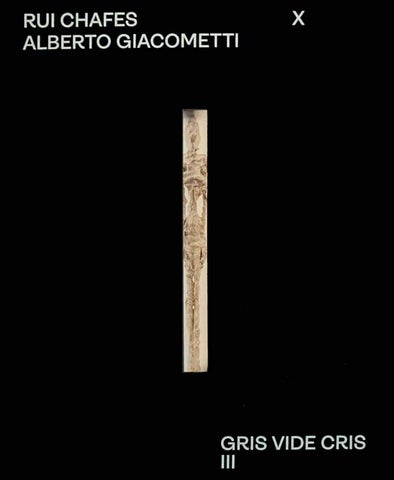
RUI CHAFES ALBERTO GIACOMETTI
X
BRIGITTE BLOKSMA DICK VAN BROEKHUIZEN RUI CHAFES HUGO DANIEL DORIS VON DRATHEN HELENA DE FREITAS MUSEUM BEELDEN AAN ZEE FONDATION GIACOMETTI CENTRO DE ARTE MODERNA GULBENKIAN WAANDERS UITGEVERS, ZWOLLE
GRIS VIDE CRIS III
ALBERTO GIACOMETTI (1901–1966)
RUI CHAFES (1966)
mort gris vide cris plein sonne pan pan tan gris vide cris cris vide gris sonne mort ouvert
10
VOORWOORD CHAFES EN GIACOMETTI AAN ZEE — BRIGITTE BLOKSMA
FORWORD CHAFES AND GIACOMETTI AT SEA — BRIGITTE BLOKSMA
16
WERKEN ALBERTO GIACOMETTI RUI CHAFES
WORKS ALBERTO GIACOMETTI RUI CHAFES
48
ALBERTO GIACOMETTI, RUI CHAFES. GRIS, VIDE, CRIS — HELENA DE FREITAS
ALBERTO GIACOMETTI, RUI CHAFES. GRIS, VIDE, CRIS — HELENA DE FREITAS
64
IN DE DONKERE KAMER VAN DE BEELDHOUWER — DORIS VON DRATHEN
IN THE SCULPTOR’S DARKROOM — DORIS VON DRATHEN
72
BEVATTEN: “HET GEVAAR DAT DINGEN VERDWIJNEN” — HUGO DANIEL
CONTAINING: “THE DANGER OF THINGS DISAPPEARING” — HUGO DANIEL
82
HET GAAT HELEMAAL NIET GOED MET HET HOOFD. HET IS NU SCHEEF. MERDE! GIACOMETTI’S PORTRETTEN — DICK VAN BROEKHUIZEN
THE HEAD ISN’T GOING WELL AT ALL. IT’S LOPSIDED NOW. MERDE! GIACOMETTI’S PORTRAITS — DICK VAN BROEKHUIZEN
94
WELLICHT — RUI CHAFES
PERHAPS — RUI CHAFES
98
GRIS, VIDE, CRIS III
GRIS, VIDE, CRIS III
110
LEXICON
LEXICON
130
BIOGRAFIEËN EINDNOTEN LIJST MET KUNSTWERKEN FOTOVERANTWOORDING COLOFON
BIOGRAPHIES ENDNOTES LIST OF WORKS PHOTOCREDITS COLOPHON
CHAFES EN GIACOMETTI AAN ZEE
CHAFES AND GIACOMETTI BY THE SEA
BRIGITTE BLOKSMA
BRIGITTE BLOKSMA
Rui Chafes noemt de plek waar hij leest, tekent, nadenkt en ijzer tot sculpturen vormt, zijn “sacred place”; zijn heiligdom. Deze bevindt zich ver weg van het lawaai in Lissabon, in zijn huis aan zee waar hij is opgegroeid. Zijn beelden ontstaan daar in stilte en in afzondering.
Rui Chafes calls the place where he reads, draws, thinks, and shapes iron into sculptures his “sacred place”; his sanctuary. It’s located far from the noise of Lisbon, in his seaside home where he grew up. His sculptures are created there in silence and solitude.
Voor Chafes is kunst een proces dat de herinnering van generaties en verschillende culturen met zich meedraagt. Hij benadert zijn relatie tot kunstenaars als één van continuïteit. Hij is met name geïnteresseerd in beelden uit de prehistorie, de klassieke oudheid en het boeddhisme. Binnen de tijdsperiode van de twintigste eeuw is de modernist Alberto Giacometti voor Chafes zijn belangrijkste inspiratiebron. Hierover zegt hij in 2023 in een interview met het Portico magazine:
For Chafes, art is a process accompanied by memories of generations and different cultures. He approaches his relationship with artists as one of continuity. He is particularly interested in images from prehistory, classical antiquity and Buddhism. The modern artist Alberto Giacometti is Chafes’s most important source of inspiration within the twentieth-century period. He commented on this in a 2023 interview with Portico magazine:
“Because his position was between (…) modernism, which first emerged in the 20th century, and the archaic world, the ancient world, the Egyptian world. Giacometti is a timeless sculptor.”
“Because his position was between (…) modernism, which first emerged in the 20th century, and the archaic world, the ancient world, the Egyptian world. Giacometti is a timeless sculptor.”
I n de afgelopen jaren heeft museum Beelden aan Zee uiteenlopende tentoonstellingen georganiseerd waarin het werk van toonaangevende hedendaagse kunstenaars werd samengebracht met dat van pioniers en avantgardisten van de moderne beeldhouwkunst. Zo ontstaat een dialoog tussen generaties, die nieuwe perspectieven biedt op het verloop van de kunstgeschiedenis en laat zien hoe het werk van een hedendaagse kunstenaar nieuw licht kan werpen op dat van grootmeesters en omgekeerd.
I n recent years, Museum Beelden aan Zee has staged a variety of exhibitions in which the work of leading contemporary artists was combined with that of pioneers and avant-gardists of modern sculpture. This creates a dialogue between generations, offering new perspectives on the course of art history and demonstrating how the work of a contemporary artist can shed new light on that of great masters and vice versa.
eze tentoonstellingscatalogus markeert een derde D ontmoeting tussen het oeuvre van Rui Chafes – de gerenommeerde Portugese kunstenaar, geboren in 1966 – en dat van de Zwitserse kunstenaar Alberto Giacometti, wiens leven eindigde in het jaar waarin dat van Chafes begon. Giacometti werd wereldberoemd en geliefd vanwege zijn lange, dunne mensfiguren in brons. I n 2018 vond de eerste editie van Gris, Vide, Cris plaats in Parijs, de stad waar Giacometti het grootste deel van zijn leven woonde en werkte. In 2023 reisde de tentoonstelling door naar Lissabon, de thuisbasis van Chafes. Voor de derde editie in museum Beelden aan Zee is een nieuwe selectie werken van Giacometti en Chafes samengesteld. Chafes maakte bovendien speciaal voor deze tentoonstelling drie nieuwe sculpturen. De beelden, bestemd voor binnen en buiten, laten zien hoe zijn relatie tot het werk van zijn illustere voorganger in de loop der jaren intiemer en gelaagder is geworden.
his exhibition catalogue marks a third encounter T between the oeuvre of Rui Chafes—the renowned Portuguese artist born in 1966—and that of the Swiss artist Alberto Giacometti, whose life ended in the same year in which Chafes’s began. Giacometti became world-famous and revered for his thin human figures in bronze. I n 2018, the first edition of Gris, Vide, Cris took place in Paris, the city where Giacometti lived and worked for most of his life. In 2023, the exhibition was reshaped and shown in Lisbon, Chafes’s home base. A new selection of works by Giacometti and Chafes has been compiled for the third edition in Museum Beelden aan Zee. Chafes has also created three new sculptures especially for this exhibition. These figures, intended for both indoor and outdoor use, demonstrate how his relationship with the work of his illustrious predecessor has become more intimate and multifaceted over the years.
Het Atelier van Rui Chafes, zijn “sacred place”. Foto: Alcino Gonçalves
11
Studio of Rui Chafes, his “sacred place”. Photo: Alcino Gonçalves
GRIS VIDE CRIS III
Alberto Giacometti’s atelier, 1966 Foto: Sabine Weiss Fondation Giacometti Archives
RUI CHAFES
Alberto Giacometti’s studio, 1966 Photo: Sabine Weiss Fondation Giacometti Archives
X
ALBERTO GIACOMETTI
De nieuwe selectie sculpturen, de ligging van ons museum aan zee met haar unieke lichtspel, en de grootte van de museumzaal heeft ook geleid tot een nieuwe tentoonstellingsarchitectuur. Magali Snelder heeft er met haar ontwerp voor gezorgd dat de dialoog tussen beide kunstenaars opnieuw wordt beleefd en voortgezet.
The new selection of sculptures, our museum’s location by the sea with its unique interplay of light and the size of the museum gallery has also led to a new form of exhibition architecture. Magali Snelder’s design has ensured that the dialogue between the two artists has been revived and continues.
In de tentoonstelling in museum Beelden aan Zee ontvouwen de drie termen gris, vide en cris (grijs, leegte en schreeuw), uit een gedicht van Giacometti, zich niet als losse woorden maar als drie toestanden van waarnemen. Grijs is hier geen kleur, maar een zone van nuance, een gebied waarin vormen verschijnen en weer oplossen. Leegte is geen afwezigheid, maar een actieve ruimte die het kijken vertraagt en het lichaam van de bezoeker betrekt. En de kreet is niet enkel een geluid, maar een stille spanning die tot uiting komt in het materiaal en in de afwisselend zachte en harde lijnen.
In the exhibition in Museum Beelden aan Zee, the three terms gris, vide, and cris (grey, emptiness, and scream), from a poem by Giacometti, do not unfold as individual words but as three states of perception. Grey is not a colour here, but a zone of nuance, an area where forms appear and then dissolve. Emptiness is not an absence, but an active space that slows down the gaze and almost takes possession of the visitor’s body. And the cry is not merely a sound, but a silent tension expressed in the material and in the alternating soft and hard lines.
e Grote Zaal van museum Beelden aan Zee, met haar D veranderlijke lichtinval, voegt een wezenlijke extra dimensie toe aan de ervaring: soms diffuus, soms weerkaatsend en dan weer scherp. Het licht tekent contouren, verzacht volumes en laat sculpturen soms bijna verdwijnen in hun omgeving. Wat zichtbaar is, blijft daardoor altijd tijdelijk en relationeel. De ontmoeting tussen Chafes en Giacometti gaat dan ook verder dan enkel het samenspel tussen twee oeuvres. De manier waarop bezoekers de sculpturen ervaren is zorgvuldig vormgegeven. De relatie tussen de kunstwerken en de ruimte die zij innemen, vormt een wezenlijk onderdeel van de beleving.
he Great Gallery of Museum Beelden aan Zee, T with its changing play of light, adds a significant extra dimension to the experience: sometimes diffuse, sometimes reflective and at times sharp. The light defines contours, softens volumes, and on occasion makes sculptures almost disappear into their surroundings. What is visible therefore always remains temporary and relational; the encounter between Chafes and Giacometti goes beyond the mere interplay of two oeuvres. The way visitors experience the sculptures has been carefully designed. The relationship between the artworks and the space they occupy is an essential part of the experience.
De nadruk op ruimte en haar betekenis voor de ervaring van sculptuur sluit ook nauw aan bij Rui Chafes’ artistieke praktijk. Zijn matzwarte objecten functioneren bijna als negatieve ruimte. Als een directe verwijzing naar het Japanse begrip dat wordt aangeduid met het karakter Ma, dat de betekenisvolle leegte tussen dingen beschrijft. Het werk van Chafes is gelijktijdig ook spiritueel. Zowel in de ervaring daarvan, als in het ontstaansproces. Betekenis en uiteindelijke vorm dienen zich aan terwijl hij werkt; ze worden niet vooraf door hem bepaald, maar openbaren zich gaandeweg. In één van onze correspondenties zegt hij daarover: “They are beyond my control. I’m receiving them in my life for the first time”.
13
The emphasis on space and its significance for the experience of sculpture is also closely in keeping with Rui Chafes’s artistic practice. His matte black objects function almost as negative space, a direct reference to the Japanese concept represented by the character Ma, which describes the meaningful void between things. Chafes’s work is simultaneously spiritual, both in the experience of it as well as in the creative process. Meaning and final form emerge as he works; they are not predetermined by him, but reveal themselves gradually. He talks about it in one of our correspondences: “They are beyond my control. I’m receiving them in my life for the first time”.
Deze architectonische en tegelijk spirituele benadering schept nieuwe voorwaarden om het werk van Alberto Giacometti te beschouwen en zijn verhouding tot ruimte beter te begrijpen. De bezoeker wordt zo uitgenodigd na te denken over de essentie van sculptuur en over de bijzondere dynamiek die tussen beide oeuvres bestaat.
This architectural yet spiritual approach creates new conditions for viewing Alberto Giacometti’s work and gives a better understanding of his relationship to space. The visitor is thus invited to reflect on the essence of sculpture and the unique dynamic that exists between the two oeuvres.
In de wisselwerking tussen sculptuur, ruimte en licht is de bezoeker geen toeschouwer op afstand, maar een aanwezig lichaam in een veld van subtiele verschuivingen. Gris, Vide, Cris is daardoor een zintuiglijke
In the interplay between sculpture, space and light, the visitor is not a distant observer, but a present body in a field of subtle shifts. Gris, Vide, Cris is therefore a sensory sequence, one
GRIS VIDE CRIS III
sequentie, die van zien, tasten met je blik, en het bijna hoorbare voelen van vorm in de ruimte. De intieme opstelling maakt bovendien zichtbaar hoe deze twee kunstenaars gedeelde vragen stellen over de menselijke conditie, de kwetsbaarheid van het bestaan en onze verhouding tot tijd en tijdloosheid.
of seeing, touching with your gaze, and the almost audible sensation of form in the space. The intimate arrangement also reveals how these two artists pose shared questions about the human condition, the fragility of existence and our relationship to time and timelessness.
De tentoonstelling is tot stand gekomen in samenwerking met de Fondation Giacometti en de Calouste Gulbenkian Foundation. Wij zijn hen zeer erkentelijk voor hun niet-aflatende adviezen en prachtige bruik lenen. In het bijzonder dank ik curator Helena de Freitas, en het geweldige team en alle vrijwilligers van museum Beelden aan Zee.
The exhibition was co-organised in collaboration with the Fondation Giacometti and the Calouste Gulbenkian Foundation. We are extremely grateful for their continuing advice and magnificent loans. Special thanks to curator Helena de Freitas, and the wonderful team and all volunteers from Museum Beelden aan Zee.
Veel dank gaat ook uit naar onze partners en fondsen die museum Beelden aan Zee in staat stellen internationale tentoonstellingen als deze voor een breed publiek te organiseren. We danken de VriendenLoterij, de Don Quixote Foundation, het LIDA Fonds, het Blockbusterfonds, het Cultuurfonds, Stichting Zabawas, De Gijselaar-Hintzenfonds, de M.A.O.C. Gravin van Bylandt Stichting, Molsbergen Development, Fonds 21, het Mondriaan Fonds, de Ambassade van Zwitserland, de Ambassade van Portugal, het Instituto Camões en alle geefkringen van Beelden aan Zee.
Many thanks also goes to our partners and funds that enable Museum Beelden aan Zee to stage international exhibitions like this for a wide audience. We thank the VriendenLoterij, Don Quixote Foundation, LIDA Fonds, Blockbuster fund, Het Cultuurfonds, Zabawas Foundation, De Gijselaar-Hintzenfonds, the M.A.O.C. Gravin van Bylandt Foundation, Molsbergen Development, Fonds 21, the Mondriaan Fund, the Embassy of Switzerland, the Embassy of Portugal, the Instituto Camões and all patron circles of Beelden aan Zee.
Tot slot dank ik Rui Chafes voor de geweldige samenwerking en het vertrouwen dat ik van hem kreeg. Het was een eer om zijn ‘sacred place’ te betreden en daar te zien hoe hij de grenzen van het bijna onmogelijke opzoekt met het onverwoestbare materiaal ijzer.
Finally, I would like to thank Rui Chafes for the wonderful collaboration and the trust he placed in me. It was an honour to enter his ‘sacred’ place and witness how he seeks out the boundaries of the nearly impossible with the indestructible material of iron.
Brigitte Bloksma Directeur museum Beelden aan Zee en co-curator Gris, Vide, Cris III
Brigitte Bloksma Director of Museum Beelden aan Zee and co-curator of Gris, Vide, Cris III
RUI CHAFES
X
ALBERTO GIACOMETTI
Tentoonstelling Rui Cafes X Alberto Giacometti. Gris, Vide, Cris III in museum Beelden aan Zee. Foto: Studio Gerrit Schreurs
15
Exhibition Rui Cafes X Alberto Giacometti. Gris, Vide, Cris III in Museum Beelden aan Zee. Photo: Studio Gerrit Schreurs
GRIS VIDE CRIS III
WERKEN
WORKS
ALBERTO GIACOMETTI RUI CHAFES
17
TITEL
specs
ALBERTO GIACOMETTI, STANDING WOMAN, 1961-1962
Fondation Giacometti
19
ALBERTO GIACOMETTI, SEATED WOMAN, 1956
Fondation Giacometti
ALBERTO GIACOMETTI, FIGURINE FOR THE CAGE (FIRST VERSION), 1950
Fondation Giacometti