
At home with Jan Steen

Page 1


AT HOME WITH JAN STEEN

FOREWORD

There always seems to be fun and games in the paintings of Jan Steen (1626–1679), people dancing, frolicking, making music, drinking and laughing. His lively images are timeless, and they still make viewers smile. In 2026 Museum De Lakenhal is celebrating the 400th anniversary of Jan Steen’s birth with a festive survey of his paintings in At Home with Jan Steen – 400 Years of Merrymaking

Jan Steen was born in Leiden and spent the first 22 years of his life here. He attended the Latin School, and important contacts made via his relatives set him on the path to becoming an artist. Although Steen moved house frequently – he also lived in The Hague, Delft, Warmond and Haarlem – Leiden remained a constant in his life. He repeatedly returned to the town of his birth, spending his final years here, from 1670 to 1679. Both the exhibition and this publication therefore consider the importance of the town and the interaction between Steen and the many Leiden artists in his circle.

Jan Steen was not only a talented painter, he was above all a brilliant storyteller. He captured daily life in paintings that are full of humour, displaying a keen eye for detail, depicting familiar scenes in which there is plenty to discover and laugh about. At the same time, there is almost always a deeper meaning behind all the merriment. He often depicted children commenting with telling gestures on the licentious behaviour of adults, who invariably set a bad example. He often modelled the characters in the paintings on himself and his large family. This makes his work seem personal, almost as if we had been invited into his home.

Leiden celebrated a previous Jan Steen anniversary exactly a century ago. Museum De Lakenhal organised a major survey exhibition, for which paintings came to Leiden from all four corners of the earth. At some 70 exhibits, it remains the largest Jan Steen exhibition of all time. Queen Wilhelmina was patron and visitors flocked to the museum from all over the country. As now, the museum was keen to honour the Leiden master in the place of his birth, and showcase the huge diversity of his work. It is impressive to note how our predecessors managed to stage such an ambitious exhibition a hundred years ago.

Unlike in 1926, we have now chosen only to borrow paintings from Dutch collections. For, although there are many spectacular works by Steen in collections abroad, there is a huge wealth of

extraordinary Steens here at home. They are found in the collections of museums like the Rijksmuseum, Museum Boijmans Van Beuningen, the Mauritshuis and the Frans Hals Museum, as well as those of the Cultural Heritage Agency of the Netherlands, and in many private collections, thanks in part to the mediation of the Hoogsteder Museum Stichting. This has enabled us to enrich Museum De Lakenhal’s formidable collection of Steens with some well-known public favourites, and with works from private collections that are rarely on public display. I am profoundly grateful to all lenders for their generous support. I would also like to thank Gerdien Verschoor, who wrote the essay, and curators Janneke van Asperen and Lea van der Vinde, who created the exhibition.

Jan Steen invites us to look, laugh and join in. His world is full of life, full of stories, and full of things that are still familiar today. This exhibition and book celebrate his diversity, his imagination and his abiding connection with Leiden.

The 1926 Jan Steen exhibition at Museum De Lakenhal

MERRYMAKING, MISCHIEF AND MARVEL: LOOKING AT THE WORK OF JAN STEEN

GERDIEN VERSCHOOR

Arriving in Leiden by train on a sunny morning and making your way up Stationsweg, you would never suspect it. Office blocks and residential buildings tower above everything. The noise emanating from behind the high fences around construction sites is deafening. Cyclists weave around each other, an occasional pedestrian sprints for the train. Is this the town where Jan Steen (1626-1679) was born, where the Leiden fijnschilders (‘fine painters’) flourished, the town whose wealthy citizenry hung hundreds of still lifes, landscapes and tavern scenes on the walls of their homes?

Let us continue in our quest for traces of Jan Steen. Cross the canals, continue straight on, over Blauwpoortsbrug bridge and along Kort Rapenburg to Breestraat. It is not until you turn into the first street on the right and stop at Brouckhovenshofje that you start to get a sense of Jan Steen’s Leiden. Here, on Papengracht, all the urban clamour is suddenly far away. The almshouses were founded in 1631–1640 and Jan Steen lived right next door at numbers 16/18 when he was ten years old. He must have seen them being built. His father, Havick Janszoon, was born just a stone’s throw away, at number 20 Breestraat, where his parents had an oil mill. The building no longer exists, unfortunately, and the house on Papengracht where Jan spent part of his childhood is also gone, having made way for number 16A, which was built in 1892. And now, 400 years after Jan Steen was born in Leiden, a rental bike has fallen over against the façade. A small group of

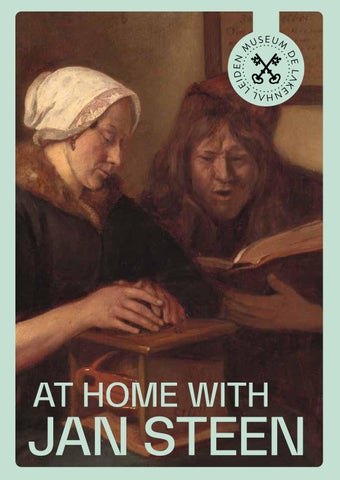
1 — Jan Steen, The Merry Threesome, c. 1670–1672 (detail from cat. 24)

2 — Jan van Goyen, View of Leiden from the Northeast , 1650. Panel, 66.5 x 97.5 cm Museum De Lakenhal, Leiden

boisterous students are lugging an old three-seater sofa, which they deposit on the corner of Schoolsteeg. One of them produces a few beers from an Albert Heijn carrier bag before they plonk themselves down on their latest acquisition and rowdily toast each other.

There are few Dutch speakers who do not know the expression ‘a Jan Steen household’. It evokes a scene where children engage in wanton destruction, men put their hands up women’s skirts, cats dance on the table. But Steen created a body of work that was much more diverse than just these roguish scenes, and his paintings continue to surprise.

EARLY YEARS IN WEALTHY LEIDEN

Leiden was a very prosperous place when Jan Steen drew his first breath there (fig. 2). It was the largest city in the Dutch Republic after Amsterdam, with flourishing industry (particularly textiles), a large group of wealthy residents (with the means to collect art) and a university that attracted students and scholars from around the world. Furthermore, a remarkably large number of artists were born in Leiden: Lucas van Leyden in 1494, Jacob Isaacsz. van Swanenburg in 1571, David Bailly in 1584, Jan van Goyen in 1596, Rembrandt in 1606. And that was not all: Jan Lievens (1607), Gerrit

Dou (1613), Jan Steen (1626), Gabriël Metsu (1629), Frans van Mieris (1635), Pieter van Slingeland (1640), Godfried Schalcken (1643)... Many other artists, some of them from distant Antwerp or Ghent, moved to Leiden, attracted by its cultural climate. They knew each other, taught each other, imitated each other’s work, and drank together in Leiden’s taverns. Biographers like Arnold Houbraken (1660–1719) and Jacob Campo Weyerman (1677–1747) recorded the lives of these artists, often embellishing their accounts with amusing anecdotes and juicy gossip. Nowadays, paintings by Leiden’s masters hang in museums around the world.

Jan Steen was born in 1626, the first son of Havick Janszoon Steen and Elisabeth Capiteyns. A number of other children followed, with lovely names like Wijbrand, Margaretha, Swaentje, Maria, Emerentia, Duifje and Catharina. Father Havick had taken over the family brewery, so they were relatively prosperous. This was a golden age for Leiden’s brewers, and beer production in the town doubled between 1630 and 1650. Beer – with a low alcohol content – was a basic necessity, as the water supply was so polluted that everyone drank beer. Havick Steen’s brewery, ‘De Rode Hellebaert’ (‘The Red Halberd’), where the family also lived for a number of years, was on the Vliet canal, just beyond Rapenburg. Like the house on Papengracht, De Rode Hellebaert brewery has also disappeared, but if you take a walk there today you will still see signs of the seventeenth century. When the young Jan left the house, he could see the roof and one of the spires of St. Peter’s church in the distance, beyond Rapenburg. He was privileged. While many of his contemporaries, particularly orphans, had to work long days in the textile industry, he attended the Latin school on Lokhorststraat, less than a ten minutes’ walk from De Rode Hellebaert. Dye sometimes coloured the water in the canals blue or red, and there must have been a stench in the air as he walked to school. The textile industry discharged its wastewater, which contained a lot of uric acid, directly into the canals. But as soon as Jan entered the Latin school, he would find himself in another world. Within the walls of the building with its distinctive stepped gable, he learned Latin and Greek, and took lessons in subjects like writing, history, maths, oratory skills and logic. The curriculum also included drawing, Biblical studies and the stories of writers like Ovid and Cicero. All things that would prove useful to him later in life.

After attending the Latin school, Jan was entitled to enrol at Leiden University, and he duly did so in November 1646 (fig. 3). How did he see his future? Did he wish to complete a degree,

or had he enrolled mainly because, as a student, he was not required to pay tax on beer and wine, and would not be called up to serve in the civic guard? His time as a student was short, as less than eighteen months later, on 18 March 1648, he joined the recently established Leiden branch of the Guild of St. Luke as a master painter. In order to do this, he must have taken lessons with other painters. According to his biographers, Steen had been taught by Nicolaus Knüpfer in Utrecht, Jan van Goyen, who came from Leiden, and Haarlem artist Adriaen van Ostade, but unfortunately there is no documentary evidence to confirm this. Whatever the precise details, however, his enrolment with the guild meant that Jan Steen had laid the foundations for a career as an artist.

3 — Hendrick van der Burgh, Graduation Procession at Leiden University, c. 1650. Canvas, 74.5 x 61 cm Rijksmuseum, Amsterdam, on long-term loan to Museum De Lakenhal

ARTISTIC SPARK

How did Steen hit upon the idea of becoming an artist? Why did he not join the family business run by his father, who had taught him how to brew beer? Was it down to the sudden crisis that hit the Dutch brewing industry? Did his parents spot a talent for painting, did relatives encourage him, or was there something else that ignited the artistic spark in Jan? The young Steen was surrounded by people from artistic and scientific circles. One of his great-uncles was a painter and goldsmith, several uncles had doctorates in medicine and his Aunt Marijtje was married to the bookseller Joost Lievens de Rechte, who had a shop on Rapenburg. Uncle Joost was the oldest brother of painter Jan Lievens (a friend of Rembrandt’s), who may also have visited the Steen family home (fig. 4). Another interesting figure was Jan’s uncle Dirck Steen, who had died in 1633, leaving his large library to the family.

4 — Jan Lievens, Young Man Tuning a Violin , c. 1625 Canvas, 95 x 76 cm. Museum De Lakenhal, Leiden

We do not know what or who prompted Jan Steen to take up a paintbrush. But shortly after he enrolled with the guild, he went to work in the Hague workshop of landscape painter Jan van Goyen – and promptly fell in love with Van Goyen’s daughter Margaretha (Grietje). Fortunately, they were both Catholic, and so were able to marry in 1649. Shortly after their wedding, Steen painted himself and Grietje in Couple Reading the Bible (fig. 5, cat. 3). He would habitually depict himself and his loved ones in his paintings throughout his life. Jan and Grietje had seven children who reached adulthood: Thaddeus, Eva, Constantinus, Havick, Johannes, Catharina and Cornelis. We know the faces of the Steen children – it is highly likely that their father used them as models in paintings like The Feast of St. Nicholas and Children Teaching a Cat to Dance (fig. 6 and 7, cat. 17 and 23).

5 — Jan Steen, Couple Reading the Bible, c. 1650 (detail from cat. 3)
6 — Jan Steen, Children Teaching a Cat to Dance, c. 1660–1679 (detail from cat. 23)

The young couple went to live in The Hague, where the Van Goyens had also settled after leaving Leiden. Steen’s development as an artist really took off in his new environment. In contrast to Van Goyen, who specialised in landscapes, Jan Steen explored a range of different options: genre paintings (depicting daily life), history painting (featuring stories from the Bible and mythology), the occasional townscape, winter scenes and landscapes, like Landscape with a Sandy Road (cat. 1). This painting clearly shows that Steen had studied his father-in-law’s work. He had closely observed the way he painted skies, trees and the sandy soil and, like Van Goyen, he included small figures in the foreground (fig. 8). Steen’s earliest genre paintings also reflect the influence of his other likely mentor, Haarlem artist Adriaen van Ostade (cat. 2).

Steen’s paintings immediately attracted interest from the public, both at home and abroad. One of his peasant wedding scenes was sent to Denmark to be sold as early as 1650, and a year later the

7 — Jan Steen, The Feast of St. Nicholas , c. 1665–1668 (detail from cat. 17)
8 — Jan van Goyen, Dune Landscape with Figures , 1632 Panel, 33 x 54.5 cm. Museum De Lakenhal, Leiden, on long-term loan from the Cultural Heritage Agency of the Netherlands (NK-collection)

9 — Jan Steen, Winter Landscape, c. 1650

10 — Jan Steen, The Village Wedding , 1653 (detail from cat. 7)

Swedish field marshal Karl Gustav Wrangel bought four paintings by him at an auction in The Hague. One of these panels, Winter Landscape, in which a range of different figures stand chatting, don their skates and venture out onto the ice, is now at Skokloster Castle in Sweden (fig. 9).

A few years later, Steen painted The Spanish Bride – a work of an entirely different order (fig. 10, cat. 7) – in which he presents many more characters. A large group of peasants, citizens and country people join with the groom in heralding the arrival of the new bride (who wears a bridal tiara, and has her eyes cast chastely down) with a drum and trumpet call. In the left foreground, an angry toddler is picked up by his sister – a direct quote from a print by Rembrandt. Steen thus demonstrated that he was well aware of the work of his famous contemporary (fig. 11). Other paintings by Steen also include aptly chosen quotations of other artists’ work, particularly Rembrandt’s prints.

Panel, 66.7 x 97.5 cm. Skokloster Castle, Bålsta

11 — Rembrandt, The Pancake Woman , 1635 Etching, 106 x 77 mm. Rijksmuseum, Amsterdam

In 1654 Jan van Goyen found himself in financial difficulties, and this impacted Jan and Grietje’s family, too. Fortunately, Jan’s father Havick Steen came to their assistance, renting a small brewery on Oude Delft in Delft. Jan was more or less able to support his family by brewing beer. The First Anglo-Dutch War had just ended, resulting in an economic crisis – and a slump in the art market. Yet Jan Steen produced one of his most famous works - Adolf and Catharina Croeser, known as ‘The Burgomaster of Delft and his Daughter’ (fig. 12) – during this period. The painting demonstrates the many skills Steen had developed by this point, showcased in the portraits of

12 — Jan Steen, Adolf and Catharina Croeser, Known as ‘The Burgomaster of Delft and His Daughter, 1655 Canvas, 82.5 x 68.5 cm. Rijksmuseum, Amsterdam

the wealthy grain merchant Adolf Croeser and his daughter Catharina, the delicate rendering of their garments, the bouquet of flowers on the windowsill to the left, the brushwork of the trees in the background and the sky above, and the architecture of the Oude Kerk church. The begging woman and her child were again inspired by a Rembrandt etching, but he need only set foot outside his own front door to find inspiration for the setting, as the Croesers lived opposite his brewery. Unfortunately, Steen was unable to make a success of the brewery, and he returned to Leiden. By 1658 he was again paying membership fees to the Leiden branch of the Guild of Saint Luke.

13 — Jan Steen, Girl Eating Oysters , c. 1658-1660 Panel, 20.4 x 15.1 cm. Mauritshuis, The Hague

THE LEIDEN FIJNSCHILDER PERIOD

Once he was back in Leiden Steen once again devoted himself entirely to his work as an artist. The brief period he spent in Leiden and Warmond is sometimes referred to as Jan Steen’s ‘Leiden fijnschilder period’. Many of the paintings he produced during this period are notable for their refined details, and some of them also feature subjects favoured by the fijnschilders (‘fine painters’). Girl Eating Oysters, which later became famous, is a prime example of this (fig. 13).

It was during this period that Steen also painted Baker Arent Oostwaard and His Wife Catharina Keizerswaard (cat. 8). Baker Arent, wearing his baker’s hat over his long hair, and his wife Catharina are seen offering their freshly baked loaves, rusks and pretzels. The boy behind Arent is Thaddeus, Steen’s oldest

14 — Susanna van Steenwijck-Gaspoel (attributed to), View of the Lakenhal in Leiden , 1642. 65.3 x 66.1 cm

Private collection

son. He is blowing a horn to signify that the bread is ready. And so Steen even manages to incorporate a little story into this expressive portrait. How closely this painting resembles reality is reflected in a painting of the Lakenhal, which features another Leiden baker with a similar stall and horn (fig. 14).

For reasons that remain unclear, Steen remained in Leiden for only a year or two. He relocated again in around 1660, to nearby Warmond, where he moved into a house on today’s Jan Steenlaan. There, he painted The Poultry Yard, in which he portrays Jacoba Maria van Wassenaer (fig. 15). The beautifully dressed and finely rendered girl feeding a lamb, the jocular servants, the collection of meticulously painted birds, the vista of the castle: Steen again displays all his skills in this painting. His client must have been very pleased with it.

15 — Jan Steen, Portrait of Jacoba Maria van Wassenaer, Known as ‘The Poultry Yard’, 1660 Canvas, 106.6 x 80.8 cm. Mauritshuis, The Hague

16 — Jan Steen, ‘Easy Come, Easy Go’, 1661 (detail from cat. 10)

VIBRANT AND DAZZLING

Shortly after his adventure in Warmond, Steen moved to Haarlem, where he became a member of the Guild of Saint Luke in 1661. These were to be his most productive years, a time when he produced vibrant, dazzling paintings. It is as if The Poultry Yard had prompted yet more ambitious work. His paintings became larger, populated by even more characters – many of them behaving in even more outrageous ways – and tell vivacious stories. His brushwork became looser and freer, perhaps because he was using larger canvases, but he will also have been inspired by his contemporaries in Haarlem, who had a coarser and looser

Turn static files into dynamic content formats.
Create a flipbook
At home with Jan Steen by uitgeverijdekunst - Issuu