
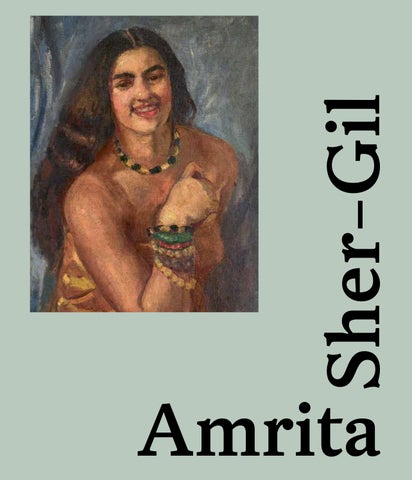
Amrita Sher-Gil - ENG

Page 1


'Europe belongs to Picasso, India belongs only to me.'
Waanders Publishers, Zwolle Drents Museum, Assen

Foreword

Robert van Langh

Foreword

Vivek Aggarwal

Amrita Sher-Gil

National Gallery of Modern Art, New Delhi

Amrita: artist, cosmopolitan, free thinker

Annemiek Rens

PART I

Paris and Hungary

1930-1934

Berber van der Veer and Annemiek Rens

PART II

India 1934-1938

Annemiek Rens

PART III

Hungary and India 1938-1941

Annemiek Rens

Timeline

Annemiek Rens

Notes

Index

Literature

Foreword

Unexpected spark

Sometimes a great story begins with a small gesture. In 2020, it was a letter written by museum visitor Pieter Spanjersberg that landed like an unexpected spark on the desks of Chief Curator Annemiek Rens and then General Director Harry Tupan. A quiet prompting that pointed us towards an artist’s body of work, still outside our field of vision, yet one that would soon never leave our thoughts.

What followed was a journey that, ironically, began at a time when travelling was impossible. While the world fell silent under the weight of the pandemic, the first outlines of a new project were taking shape elsewhere. Through the warm, open connections with the Indian Embassy in the Netherlands, a bridge was built to the National Gallery of Modern Art in New Delhi. The Dutch Embassy in India joined soon afterwards, as though the threads were weaving themselves naturally into a single story.

When Harry and Annemiek first saw the work of Amrita Sher-Gil – at a distance, yet strikingly close – it was as if a door had opened somewhere. The power of her paintings, and the profound authenticity of her imagery, left no room for doubt. This was art that deserved a new audience. Art that needed to find its way to the Netherlands, to an exhibition, to a book. To people willing to be touched by her artistic gaze. But Sher-Gil’s work is national heritage in India, carefully protected and cherished. It may only leave the country with special permission. As a result, exhibitions outside India have remained rare: only a few solo presentations in Budapest (2001), Munich (2006–2007) and London (2007) mark those exceptional moments.

That we will be able to present the first exhibition in the Netherlands in 2026 therefore feels both a privilege and a promise. A moment in which years of preparation, dedication and mutual trust come together. A new encounter between India and the Netherlands, between present and past, between a powerful artistic voice and an audience that has yet to get to know her.

Within our museum, Amrita Sher-Gil’s work resonates effortlessly with the narratives we hold dear: art from the early twentieth century, artists who broke open the boundaries of their time, and voices that – as in our earlier exhibitions, including that of Frida Kahlo – continue to inspire generations.

Acknowledgements

With profound gratitude, we wish to thank all those who have made this journey possible. In particular, the National Gallery of Modern Art in New Delhi, including General Director Sanjeev Kishor Goutam, Director Pooja Hali, and curators Sushmit Sharma, Meghna Vyas Arora and Aprajeeta Singh. We also thank Shri Vivek Aggarwal, Secretary, and Lily Pandeya, Joint Secretary of the Indian Ministry of Culture.

We are especially grateful for the invaluable support of the embassies, with warm thanks to Ambassador Marisa Gerards and Cultural Officer Shweta Kaushik of the Dutch Embassy, and Ambassador H.E. Mr Kumar Tuhin and First Secretary Tara Pathak of the Indian Embassy. Former King’s Commissioner Jetta Klijnsma played an important role in the realization of this project. Thanks to Devika Daulet-Singh of Galerie PHOTOINK and Geeta Kapur, we are able to present a large number of impressive personal photographs of Amrita Sher-Gil.

This book was written by Annemiek Rens in collaboration with the curatorial team of the National Gallery of Modern Art and junior curator Berber van der Veer of the Drents Museum, and was published by Marloes Waanders and Stefanie Klerks of Waanders Publishers. The design was created by Loes Claessens.

We would also like to extend special thanks to Pieter Spanjersberg, who, with a single letter, opened a path that led to this remarkable exhibition.

Dr. Robert van Langh

General Director - Drents Museum and Drents Museum De Buitenplaats

Foreword

It is an honour to present the work of Amrita Sher-Gil, an artist whose oeuvre is officially recognised as a National Art Treasure and whose egacy occupies a singular place in India’s cultural history. Born in Hungary, educated in France, and ultimately finding het creative and emotional anchorage in India, Sher-Gil’s life and artistic practise exemplify a profound cultural synthesis. While her heart, subjects, and sensibilities were quintessentially Indian, her artistic vocabulary remained deeply rooted in European modernism and the avant-garde.

In a brief yet remarkably prolific career, Sher-Gil forged a body of work that was both unique and unprecedented in its time. By weaving together Western techniques with Indian themes, she evolved a visual language that redefined the contours of modern art. From her evocative self-portraits and still lifes to her dignified and empathetic depictions of rural life, the emotional depth and boldness of her work remain as immediate and compelling today as they were nearly a century ago.

Her achievements speak to a talent that transcended borders. In 1933, at the age of only nineteen, she won the Gold Medal at the Paris Grand Salon for her painting Young Girls, becoming the youngest and the only Asian artist to receive this distinction, and was elected an Associate Member of the Grand Salon. Amrita Sher-Gil did not merely participate in the modern art movement, she challenged it.

When she observed, “Europe belongs to Picasso, Matisse, Braque, and many others. India belongs only to me”, she was not simply claiming artistic territory, but asserting her rightful place within the global canon of modern art.

Bringing this exhibition to the Netherlands is therefore more than a presentation of artistic excellence. It marks an important cultural milestone by reintroducing Amrita Sher-Gil as a global pioneer of modernism to European audiences. In doing so, it celebrates and strengthens the enduring cultural ties that connect India and the Netherlands.

Vivek Aggarwal Secretary, Government of India, Ministry of Culture

'Europe belongs to Picasso, Matisse, Braque,

and many

others. India belongs only to me.'

Amrita Sher-Gil

With characteristic boldness, this proud declaration was expressed by Amrita Sher-Gil in 1938, thereby highlighting her wish to be seen as the first truly modern Indian painter.

A scion of Indian Sikh aristocracy, Umrao Singh was a nationalist, independent scholar with philosophical interests, and an eccentric, somewhat Tolstoyan figure in appearance. The celebrated artist Amrita Sher-Gil was the elder daughter of Umrao Singh and his Hungarian wife Marie Antoinette. Born in Hungary, Hungarian was her first language, and she was brought up on Magyar folk tales. Béla Bartók had been the previous occupant of one of the apartments in the building the Sher-Gil family lived in.

Amrita's formal training in art began in 1929, when she was admitted to the École Nationale des Beaux-Arts (after a brief stint at the Académie de la Grande Chaumière) in Paris. She became proficient in French and the ways of Bohemian Paris. Mentally agile – she was sensually alert and avid –, over the next four years she won many prizes, was elected as an associate member of the Grand Salon, and gained recognition as a talented figurative painter. Amrita had led a disciplined life, so she would never let the distractions of Paris massively interfere with her creativity.

Amrita Sher-Gil was adept in a form of figurative painting that, for all its academic antecedents, tied in with various strands of realism. Her European background gave her the option to choose Paris as her workplace, but she could have easily chosen Budapest. In December 1934, Amrita returned to India, to her family’s home in Simla. She chose to move to India in order to find herself as an artist and further evolve over time. Her father, however, thought that staying back in Europe would be

a better idea for her. Amrita responded to this in a letter to her parents in October 1934: 'I must avow that was somewhat hurt by the reason you give for wishing us to stay on in Europe. I was rather sad to realize that you place the conservation of your good name above your affection for us.' And continued: 'I wish to return primarily in the interest of my artistic development. I now need new sources of inspiration and here you will perceive Duci [Amrita's Hungarian pet name for her father] how utterly mistaken you are when you speak of our lack of interest in India, its culture, its people, its literature; all of which interest me profoundly and which wish to get acquainted with, and I think will find it in India. Our long stay in Europe has aided me to discover as it were, India. Modern art has led me to the comprehension and appreciation of Indian painting and sculpture. It seems paradoxical, but know for certain that had we not come away to Europe should perhaps never [have] realized that a fresco from Ajanta or a small piece of sculpture in the Musée Guimet is worth more than the whole of the Renaissance!

With a distinct attitude and sentiment to keep other ideas away, she clearly stated in the article 'Modern Indian Art’, which was published in 1936: 'Although I studied, I have never been taught painting in the actual sense of the word, because I possess in my psychological makeup a peculiarity that resents any outside interference. I have always, in everything, wanted to find out things for myself.'2 However, Sher-Gil later admitted that she was not as allergic to instruction as she had made herself out to be. Indeed, she could not escape the academic tenets that came with a Beaux-Arts education, as she herself acknowledged once she had returned to India.

Letter Amrita Sher-Gil to Karl Khandalavala, The Holme, Simla, April 1938

She threw herself into travelling and rediscovering classical Indian art. She would paint most of her best known works in the following six years – a period of prodigious creativity that was cut short due to fatal illness. Amrita died in December 1941, at the age of 28.

In her short, but eventful life, the artist extraordinaire showed great versatility and a wide range of interests that further revealed her sensitivity towards aesthetic, social, emotional and psychological aspects. Her artistic gaze always searched for and discovered the relevance of Modernism within Indian reality.

It is hard to decipher a persona like Amrita Sher-Gil and place her in an appropriate context. While her legendary presence within the art sphere in India has remained alive for decades, mainly due to her personality, her works continue to be questioned and discussed, yet the results of this appear to be insufficient.

Her engagement with sexuality and her Bohemian lifestyle are constantly interpreted as the key elements of her short, but passionate existence.

Gifted with an inquisitive and thoughtful, self-evaluating mind – filled with the same provocative contradictions that are also found in her thematic and pictorial depictions – the thought-provoking and ruminative letters she wrote offer us the best insight into her life and work.

Amrita Sher-Gil depicted the life of Indians, notably the ordinary, oftenignored Indians, in images she painted with infinite submission and patience. She successfully developed her own pictorial language and an unbiased style of painting, mixing Western and Eastern traditions, and responding to her observations of the various cultural and sociological influences that were prevalent during her short, but colorful life. In her own words: 'I'm an individualist, evolving a new technique, which, though not necessarily Indian in the traditional sense of the word, will yet be fundamentally Indian in spirit.'3

Amrita’s career began with the usual oils, portraits, and depictions of life models in a largely academic style. Young Girls (1932) won her an associate membership of the Grand Salon, and can be seen as representative of that period. Her younger sister posed for a number of paintings, of which Sleep (1933) was arguably the most seductive. A few months before she started to paint sleeping figures, Amrita visited the National Gallery in London, where she encountered the paintings of Paul Gauguin.Gauguin’s stylishly simplified yet symbolically charged Tahitian nudes became a source of inspiration to her, which is evident from her Self-Portrait as a Tahitian (1934).

Amrita Sher-Gil never existed within the Surrealist orbit, and never ventured into the various forms of geometric abstraction that were prevalent in the 1930s. Instead, Amrita was impressed by Postimpressionist painters like Gauguin. Sher-Gil spent her time at Beaux-Arts to truly evolve what can be described as a generic figurative style with a psychological twist – a synopsis of the usual School of Paris categories: nudes, portraits, still lifes. She preferred to paint models from her inner circle, such as fellow students, friends, and her sister, but sometimes used professional models too.

'Towards the end of 1933 began to be haunted by an intense longing to return to India, feeling in some strange inexplicable way that there lay my destiny as a painter. We returned at the end of 1934. My professor had often said that, judging by the richness of my coloring, I was not really in my elements in the gray studios of the West, that my artistic personality would find its true atmosphere in the color and light of the East. He was right, but my impression was so different from the one I had expected, and so profound that it lasts to the day. It was the vision of a winter in India - desolate, yet strangely beautiful – of endless tracks of luminous yellow-gray land, of dark-bodied, sad-faced, incredibly thin men and women who move silently looking almost like silhouettes and over which an indefinable melancholy reigns. It was different from the India, voluptuous, colorful, sunny and superficial, the India so false to the tempting travel posters that I had expected to see.'4

The influence of early Indian sculpture, the earliest example of Indian art Amrita had been exposed to, the frescoes of Ajanta and Indian miniature painting deeply impacted her world of thinking. 'Vital, vibrant, subtle and unutterably lovely,' she wrote in a letter after visiting the Ajanta frescoes.5 She was deeply impressed by the sentient way in which the bodies were depicted in these frescoes, their delicate sensuality, and the undulating rhythms of the forms she glimpsed in the flickering light. The plasticity of these figures, the tenderness of their bodies and their classically poised tonal equilibrium were salient features she would later attempt to translate into her own artistic language.

Another remarkable feature of Amrita's South Indian trip was her experience of the Mattancheri Palace, where she discovered frescoes from the seventeenth century. She was se duced, enthralled, and transported by her discoveries – not only the art, but also the vivid South Indian landscapes played a huge role. From Trivandrum she wrote to her mother: 'The journey from Madura to here was beautiful. The soil was ochrered, on it rich emerald-green vegetation, coconut trees, banana trees, palms, small reed-thatched huts or red clay hovels, everybody is dressed in white and not a single European and no trace of European "civilization".’6 After returning to Shimla, she created her South Indian Trilogy.

During her stay in Bombay, she studied different Indian schools of art, including miniature painting, which was another eye-opener for her after her discovery of the frescoes of Ajanta. It was yet another facet of the Indian pictorial tradition that excited her and would lead to new ideas and creations. The new path she had carved out specifically involved visible changes in scale and a departure from her usual subject matter. During this period, her work became less abstract and was heavily influenced by the Pahari miniatures with their condensed and richly colored pictorial compositions. Amrita Sher-Gil opted for a less majestic but comfortable attitude towards the subjects she selected within the context of India. She wanted to achieve sonorous modulations of color and an unctuous texture.

Besides her enthusiasm for the Indian schools of art, her interest in European painters also remained prominent. Her passion for the Flemish master Pieter Brueghel the Elder was well known, for instance. She had been working on a painting before her untimely death in December 1941. This work contains clear indications that she was on the verge of a breakthrough in her language of painting, which had evolved over a period of time. The audaciously framed, simplified forms and distinct colorfulness were derived from the view from her studio window in Lahore, where she lived during her last days.

With a major exhibition already scheduled, she died unexpectedly. The cause of her death still remains obscure. She was only twenty-eight years old. Her painting remained unfinished, as did her life project: she was only on the threshold of becoming a truly modern Indian artist.

National Gallery of Modern Art, New Delhi

'Our long stay in Europe has aided me to discover, as it were, India. Modern Art has led me to the comprehension & appreciation of Indian painting & sculpture. It seems paradoxical but I know for certain that had we not come away to Europe I should perhaps never have realized that a fresco from Ajanta or a small piece of sculpture in the Musée Guimet is worth more than the whole Renaissance! In short now I wish to go back to appreciate India at its worth.'

Amrita Sher-Gil at a beach, location unknown, circa 1933, photo Victor Egan
Letter Amrita Sher-Gil to Umrao Singh and Marie Antoinette Sher-Gil, Hungary, September 1934
Amrita Sher-Gil wearing a sari, Simla (India), circa 1937, photo Umrao Singh Sher-Gil
View of the living room, Paris (France), circa 1930, photo Umrao Singh Sher-Gil

'My professor had often said that judging by the richness of my colouring, I was not really in my element in the grey studios of the West, that my artistic personality would find its true atmosphere in the colour and light of the East.'

Amrita Sher-Gil seated by the Mehrauli Iron Pillar in the Qutub Minar complex Delhi, circa 1936, unknown photographer
Amrita, Simla, circa 1935, photo Umrao Singh Sher-Gil
Amrita Sher-Gil, ‘MODERN INDIAN ART – Imitating the Forms of the Past’, The Hindu, 1 November 1936

Amrita: artist, cosmopolitan, free thinker

The story of an icon

With her outspoken and progressive ideas on art, faith, politics, love and equality, Amrita Sher-Gil made a striking impression. In her numerous self-portraits and nude studies she presented a new image of womanhood, and through her art she also became a voice for the people of India. In her short life she combined a rebellious spirit with boundless creativity,

leaving an indelible mark on art. She has inspired generations of artists after her. Her IndianHungarian heritage connected different parts of the world. In her work, Western modern art and traditional Indian art merge into an entirely new style through which Sher-Gil has claimed her own place in history.

High Acclaim in Paris

As a young woman, Amrita Sher-Gil made her debut on the international visual arts scene in Paris at the end of the 1920s. This was the interwar period, the era between the two world wars. Although the First World War had come to an end, bringing a measure of hope and calm, unemployment and poverty remained widespread. The threat of a new international conflict was already in the air. The European art world was in the twilight of a glorious era that had produced one celebrated figure after another, with (predominantly male) artists such as Courbet, Van Gogh, Gauguin and Picasso as its leading lights. The Parisian art scene remained dominant, ever on the lookout for the next outstanding talent. The promising artist Sher-Gil, who had exchanged India for Paris, quickly made her mark. Her accomplishment was recognised with a gold medal and membership of the illustrious Grand Salon.

Sher-Gil felt completely at home in Paris. She attracted influential teachers and rapidly established a wide network. The city’s open social life appealed to her: she relished its nightlife and pursued relationships freely. It would have been easy for her to remain in this world, continuing to develop her art under European influence. Yet Sher-Gil chose a far less obvious path, though one that lay closest to her heart. Her future was in India. She wrote to her father: ‘You know I have decided to return to India. Now, I will give you my reasons. I wish to return primarily in interest of my artistic development. I now need new sources of inspiration and here you will perceive Duci, how utterly mistaken you are when you speak of our lack of interest in India, in its culture, its people, its literature, all of which interest me profoundly & wish to get acquainted with, and I think I will find it in India.’7

New Forms in India

Sher-Gil fully embraced her return to India. She undertook a kind of self-imposed crash course in Indian art and culture, exchanging her European clothing for Indian saris and travelling extensively across the country. Everywhere she looked, Sher-Gil saw the poverty of the Indian people. It was precisely these people of flesh and blood she wished to paint—the real India. She felt a particular connection with women and their often arduous and solitary lives. She was also inspired by the cave paintings of Ajanta and the Mughal miniatures. What she observed she added to her mental archive of European art history, and together these influences provided fertile ground for a new artistic language. Her palette changed, acquiring brighter reds, earthy browns and sunlit ochres, perfectly suited to the warm sunlight and landscapes of India.

While many of her contemporaries explored the boundaries of visible reality, Sher-Gil remained committed to figuration. She was not concerned with creating a purely realistic image: ‘I have never slavishly imitated nature […] I evolve towards new ‘significant’ forms, which correspond to my individual conception of the essence of the inner meaning of my subjects.'8 She therefore sought a deeper layer in her work, avoiding all superfluous detail: simplicity was the foundation of perfection. Her modernity expressed itself in a process of continual stylisation, while her use of colour became increasingly bold. Through form and colour, she aimed to capture the soul of the Indian people without slipping into sentimentality.

A Language of Passion

With this approach and conviction, Sher-Gil connected in her own distinctive way with the other major artists of her time. Whether it was the Mexican Frida Kahlo, who shocked with self-portraits revealing the story of her broken body and turbulent love life, or the Dutch Charley Toorop, who depicted Belgian miners and Zeeland farm women with bold lines and strong colours. The American Georgia O’Keeffe captured the essence of flowers and landscapes in an abstracted and sensual manner, while the Jewish-Russian Marc Chagall drew on memories of his homeland to create a lyrical, fantastical world. Many of these artists

were indebted to Vincent van Gogh in their search for expression. Amrita herself commented: ‘That wonderful statement by Vincent van Gogh, “I want to express the great, the tremendous human passions with green and red,” so perfectly captures what I wish to convey.’9

Not only Van Gogh, but also Suzanne Valadon and Paul Gauguin were sources of inspiration for Sher-Gil. Yet she was determined to follow her own path: ‘Art cannot imitate the forms of the past; it must draw its inspiration from the present in order to create the forms of the future.’10 She gave powerful expression to this idea in Self-Portrait as a Tahitian This striking painting depicts a nude Amrita in the style of Gauguin’s famous portraits of Tahitian women. Yet she demonstrated that she transcended the image of the “exotic woman” as Gauguin, a European, had portrayed it.11 This Is not the gaze of an outsider; it is the portrait of a self-aware woman who wears her skin colour and nudity as a kind of armour, linking two worlds through her very being. Behind her, only a faint shadow of a man remains, completely relegated to the background.

Immersion

Sher-Gil effortlessly drew on a wide range of inspirations, of both European and Asian origin. When she returned to India, her style underwent a profound transformation. Influenced by European naturalism, her figures and compositions became increasingly stylised, and she adopted a new colour palette of reds, greens and browns. She studied the cave paintings of Ajanta and Ellora, taking inspiration from how earlier artists used shadow to create a sense of depth and form. Through her paintings, the graceful figures of these ancient grottoes seem to step directly into the rhythm of daily life.12 The influence of Indian miniature painting is evident in the way Sher-Gil structured her compositions: she experimented with a richer array of details and varied perspectives.13

Hungary must also not be overlooked as a source of inspiration.14 She had a Hungarian mother, spent much of her childhood there, visited in the summers during her years in Paris and lived there during her first year of marriage to Victor Egan. She spoke Hungarian and was familiar with folk songs and folk art. In her Hungarian works from her Paris years, we see Roma girls and landscapes rendered in a distinctly naturalistic style. In 1938–1939, her work became noticeably more stylised and symbolic, focusing on subjects such as village markets, cemeteries and peasants. During this period, she developed a fascination with the work of Pieter Brueghel the Elder. Much of the sixteenth-century Flemish master’s work was on display in museums across Austria and Germany.15 His influence is clearly visible in the paintings she produced during those winter months in Hungary. As she later wrote, what fascinated her most was his ‘astonishing ability to capture the characteristic essence of a face, a body, a hand, a foot and to distil these into the most subtly simple forms.’16

Free thinker

Amrita Sher-Gil was greatly influenced in her artistic development by her father, Umrao Singh Sher-Gil. From an early age, she observed how he carefully composed his photographs and created self-portraits. She also regularly modeled for his photographs. It is thanks to his photographs that we have an image of her today. Moreover, as an artist, he played an important role in shaping her free spirit.17 As a young girl Sher-Gil already stood out for her bold, independent ideas. She challenged the conventions of the Florence art academy by drawing nudes and was later expelled from her Indian boarding school for rejecting Catholic practices and openly declaring herself an atheist.18 From an early age, Sher-Gil was deeply interested in politics. She admired independence leader Jawaharlal Nehru, who would become the first Prime Minister of independent India in 1947, and with whom she would become friends in the 1930s.19 Her engagement with the fate of the Indian people aligned with the philosophy of Mahatma Gandhi, who at the time was travelling across India and enjoying immense popularity. In art, painting self-portraits was a way for her to express her search for identity as both an artist and a human being.

Mural painting in the Ajanta Caves
Frida Kahlo (1907-1954), Self-portrait with monkey 1945, oil on canvas, 56 × 41.5 cm, Museo Dolores Olmedo, Mexico City
Charley Toorop (1891-1955), Village Woman (Mother Akerboom) 1922-1923, oil on canvas, 147.4 × 112.5 cm, Kröller-Müller Museum, Otterlo
Georgia O’Keeffe (1887-1986), Mule's Skull with Pink Poinsettia 1936, oil on canvas, 101.9 × 76.2 cm, Georgia O'Keeffe Museum (gift from The Burnett Foundation)
Amrita (standing) with her models for the painting Young Girls Indira (centre) and Denise Proutaux (right), and the painting itself, Paris, 1932, photo Umrao Singh Sher-Gil
Balchand (circa 1595-circa 1650), Royal Lovers on a Terrace 1633
Amrita Sher-Gil with her paintings (Umrao Singh Sher-Gil reflected in the mirror), Paris, circa 1930, photo Umrao Singh Sher-Gil
Amrita India, 1936, photo Umrao Singh Sher-Gil

Her nudes depicted women of flesh and blood, rather than impersonal or idealised beauties.

Back in India, Sher-Gil spoke her mind freely about the art of her contemporaries, criticising what she saw as overly romanticised images of the country and works that looked like tourist postcards: ‘Not a single brushstroke that truly represents India.’20 ‘I would like to see Indian art […] produce something vital, rooted in the land, yet unmistakably Indian.’21 She was equally outspoken about the art world’s ability to judge her work. She refused a prize from the Simla Fine Arts Society, feeling they had not chosen her best pieces.22 She also rejected an award from the All India Fine Arts & Crafts Society for best female artist, insisting that her work should not be evaluated on the basis of her gender.23

Sher-Gil also challenged conventions in her personal life. She held a liberated view of what love could be: she made no distinction of gender and did not practise monogamy. Her consciously childless marriage to her close friend and cousin, Victor Egan, was a deliberate choice, giving her the freedom to explore both her romantic life and her artistic career.

Pioneer of Modern Indian Art

Just before the opening of a solo exhibition at the Punjab Literary League in Lahore, Amrita fell gravely ill and slipped into a coma. Her final words to Victor spoke of colours—blues, reds, greens, light and shadow. She died on 5 December 1941, at the age of only twentyeight, and the circumstances of her death remain shrouded in mystery. In 1942, Amrita’s essay “The Development of My Art” appeared post-humously in the magazine Usha She described herself as ‘an individualist developing a new technique which, although not necessarily Indian in the traditional sense, will nevertheless be fundamentally Indian in spirit. Through the eternal significance of form and colour, I interpret India, and especially the lives of India’s poor, on a level that transcends mere sentimental interest.’24 Her aim was to combine a modernist focus on form, colour and stylisation with a realism that gave attention and dignity to her subjects—the ordinary people of India.

Her art was still evolving when Sher-Gil died, yet she laid an important foundation for modern art in her country. It was precisely her unique background that allowed her to approach her subjects with a fresh and innovative perspective. with her unconventional ideas about artistry, individual expression and the world around her, Amrita Sher-Gil entered history as a pioneer. Her numerous self-portraits reinforced this image. Amrita’s story remains relevant today, reflecting the complexities of the modern world. We live in a time when hard-won freedoms, such as openness and freedom of expression, are under threat. International collaboration is perhaps more important than ever and culture provides a vital key. As a global citizen and young cosmopolitan, Amrita Sher-Gil embodied mutual understanding and respect for different values. Her life and artworks continue to inspire, offering guidance and hope for a better future.

Paul Gauguin (1848-1903), The Seed of the Areoi 1892, oil on jute, 92.1 × 72.1 cm, Museum of Modern Art New York (The William S. Paley Collection)
Amrita at her easel Simla, 1937, photo Umrao Sher-Gil
Pieter Brueghel the Elder (circa 1525/15301569), Hunters in the snow (winter) 1565, oil on panel, 116.5 × 162 cm, Kunsthistorisches Museum, Vienna
Suzanne Valadon (1865-1938), La Chambre Bleue 1923, oil on canvas, 90 × 116 cm, Centre Pompidou, Paris
Annemiek Rens
Amrita Sher-Gil, Self-Portrait as a Tahitian Paris 1934, oil on canvas, 90 × 56 cm, Kiran Nadar Museum of Art, New Delhi
Marc Chagall (1887-1985), Lovers among lilacs, 1930, oil on canvas, 131.4 × 89.5 cm, Metropolitan Museum, New York (Bequest of Richard S. Zeisler, 2007)
Vincent van Gogh (1853-1890), The Zouave Arles, June 1888, oil on canvas, 65.8 × 55.7 cm, Van Gogh Museum, Amsterdam (Vincent van Gogh Foundation)

Turn static files into dynamic content formats.
Create a flipbook