The enneagram can teach us something about our personality
Key words
Enneagram, Gurdjieff, New Age, Sufi, esoteric, ancient ‘knowledge,’ three-brained humans, moon.
What is the enneagram?
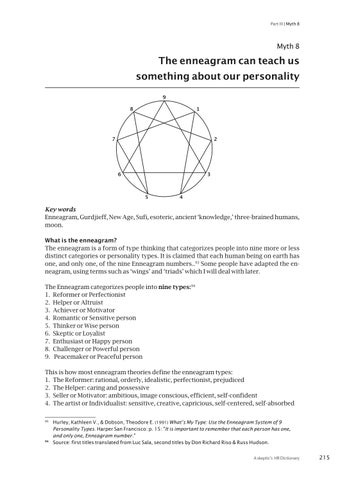
The enneagram is a form of type thinking that categorizes people into nine more or less distinct categories or personality types. It is claimed that each human being on earth has one, and only one, of the nine Enneagram numbers..93 Some people have adapted the enneagram, using terms such as ‘wings’ and ‘triads’ which I will deal with later.
The Enneagram categorizes people into nine types:94
1. Reformer or Perfectionist
2. Helper or Altruist
3. Achiever or Motivator
4. Romantic or Sensitive person
5. Thinker or Wise person
6. Skeptic or Loyalist
7. Enthusiast or Happy person
8. Challenger or Powerful person
9. Peacemaker or Peaceful person
This is how most enneagram theories define the enneagram types:
1. The Reformer: rational, orderly, idealistic, perfectionist, prejudiced
2. The Helper: caring and possessive
3. Seller or Motivator: ambitious, image conscious, efficient, self-confident
4. The artist or Individualist: sensitive, creative, capricious, self-centered, self-absorbed
93 Hurley, Kathleen V., & Dobson, Theodore E (1991) What’s My Type: Use the Enneagram System of 9 Personality Types Harper San Francisco: p. 15: "It is important to remember that each person has one, and only one, Enneagram number."
94 Source: first titles translated from Luc Sala, second titles by Don Richard Riso & Russ Hudson.
5. The Thinker or Investigator: perceptive, provocative, analyzing 6. The Family Man or Loyalist: committed, loyal, dutiful, law-abiding 7. The Team Player or the Enthusiast: spontaneous, fun-loving, excessive 8. The Boss or the Leader: powerful, self-confident, assertive, confrontational 9. The Peacemaker: pleasant, easygoing, complacent
Sometimes the nine personality types are grouped together in a so-called triad:
● The Feeling Triad encompasses the Helper, the Motivator and the Individualist.
● The Thinking Triad consists of the Investigator, The Loyalist and the Enthusiast.
● The Instinctive Triad integrates the Leader, the Peacemaker and the Reformer.
There is no consensus on the names of the nine types, as evidenced by the dozens of books out there about the Enneagram. All of them, without exception, use ‘woolly’ language that is sometimes simply incomprehensible and often subject to multiple interpretations. This makes it easier for readers to always recognize something of ‘truth’ in the welter of words is—a clear case of the Barnum effect.
There are also several questionnaires that measure the enneagram types:
● The Cohen-Palmer Enneagram Inventory
● The Wagner Enneagram Inventory
● The Zinkle Enneagram Inventory
● The Riso-Hudson Enneagram Type Indicator
● The Halin-Prémont Enneagram Inventory (HPEI)
Proponents maintain that the enneagram offers excellent insight and will allow you to adapt your behavior for the better. Don Richard Riso and Russ Hudson (‘famous’ for the Riso-Hudson Enneagram described in their book Personality Types: Using the Enneagram for Self-Discovery) promise that:
“psychologists and psychiatrists will be able to diagnose the problems of their clients more accurately”
“lawyers will be better able to understand their customers”
“personnel directors and businesspeople can become better managers by being more aware of their employees’ personality types.” (p. 9)
■ Executive Summary Theory
According to some, the obscure theory of the enneagram dates back several millennia, maybe going back to a Sufi tradition. Others trace it back to the 17th century. Let it be clear that, at that time, not much was known about the personality and people living at that time surely did not have access to our current scientific methods. So all they could do was speculate. Gurdjieff and Ichazo are usually credited for popularizing the theory of the nine enneagram types. It clearly has religious roots, but Catholic leaders have refuted the enneagram.
People’s personalities can’t be captured in fixed or even fluctuating ‘types.’ Our personalities consist of many aspects, some of which are captured by what are called ‘dimensional traits.’ One of the most important driving forces of evolution is ‘descent with modification’:
mutations that lead to variation (within certain boundaries). This variation is at odds with type-thinking.
The enneagram theory makes some outrageous claims. For example, it represents humans as “ three-brained beings ” who serve the moon to repay it an eternal debt, because ‘the moon has been split off from the earth.’ However, why humans are to blame for something that happened long before life evolved on this planet is a puzzle to me.
Empirical data
● There is no proof for three personality centers, three stages, or anything of the like.
● There is no evidence for the claim that children develop a preference for one of the nine styles. There is no proof of “wings” of adjacent styles.
● There is no evidence for the strong claims, such as that the enneagram could offer better psychiatric diagnosis, better understanding of customers, or could help people become better managers.
Psychometric properties
● The RHETI test is ipsative in nature, leading to artificial reliabilities and independencies between the scales as demonstrated by the intercorrelation matrices.
● he HPEI test uses a five-point Likert scale but fails to demonstrate that the test measures a good theoretical construct. It doesn’t demonstrate a continuous dimension as the visual representation of the enneagram suggests (nine types are represented on the circumference of a circle, with nice, equal spacing, which suggests a continuum).
Theoretical/empirical grid
Conclusion
Why would anyone want to use such a dubious theory and test material when we have modern, well-researched, reliable, and valid tools built on the 5FM or 6FM model of personality? I can only speculate that the proponents are so wrapped up in their belief system and confirmation bias that they are incapable of questioning themselves or their cherished beliefs.
Moral assessment
From a moral perspective, this malpractice should be abandoned sooner rather than later. You should expect to be treated with honesty and dignity by HR professionals, not with woo and spiritual pseudoscience.
Discussion
■ Theoretical soundness
The reasoning behind this typology contains a major fallacy, namely the assumption that every person has only one type (I know, some proponents95 have pulled a switcheroo, no longer claiming we have only one type, but it is their problem that they changed the theory in a self-serving manner). Human characteristics actually follow a normal or Gaussian distribution, whether in relation to height, muscle power, intelligence, or personality traits. Differences in personality are therefore gradual or ‘fluid.’ Modern personality psychology favors the trait approach—these traits are presented in continuous scales or dimensions instead of in dichotomies or in distinct types. The most accepted and scientifically established models are, of course, the 5FM or 6FM. In each case, the five or six major domains and the thirty underlying facets show a normal distribution.
Distribution of Extraversion
NEO-FFI, >1,000 College Students, 1991
Figure III.8: source: University of California, Berkeley
Typologies don’t consider gradual differences in personality and the enormous variation of human characteristics and their possible combinations. According to a typology, a person definitely belongs in either one category or the other. In other words, one category excludes the other. People are either extraverts or introverts; however, the bulk of the population is neither extraverted nor introverted, but situated somewhere in between (referred to as ambivert).
95 e.g. In 1987, Riso expanded the type with “wings”: each person has a wing of his/her adjacent type (if you are a three, you have a wing of four and of two). The notion of wings has also been embraced by Delobbe et al. (2012)
Any form of typology reasoning is problematic for two main reasons:
(1) the enormous variation in perso nalities as described above is a result of evolutionary influences (e.g. random mutations or the arbitrary mixture of genes as a result of reproduction), other biological influences (e.g. hormonal influences during pregnancy or viruses), and developmental processes;
(2) the influence of environmental or contextual factors that cause people to behave differently in different situations (Barkow, Cosmides, & Tooby, 1992; Moscowitz & Zuroff, 2004)
So, variations between people are mainly caused by evolutionary processes and the possible variations are certainly not limited to four, eight, nine, or sixteen types. There is little room for doubt given that the theory of evolution is considered one of the best founded scientific theories (Coyne, 2010; Dawkins, 2009; Dennett 1996; Williams, 1996). Remember, evidence for this theory has been supplied throughout history from many branches of science, including DNA research, genetics, anthropology, and archaeology. Therefore, some people call the theory of evolution a theorem, which indicates that it is a theory or hypothesis that has been indisputably proven. Hans van Gossum 96 summarizes evolution in four principles, which together offer an explanation for the personality differences between people.
1. There is variation between different individuals. One must only look at a school class photograph to realize that people are (outwardly) different in several respects.
2. The number of offspring (in our case: children) born is always greater than the number that grow to become adults. Nature provides limited resources; therefore, a lot of plant seeds and young animals perish.
3. The individual who best adapts to the current environment97 has a greater chance of survival. These adaptations are made possible by genetic variation. There are two known mechanisms that ensure a certain variation gets the upper hand. The first is coincidence: when genetic features randomly spread across a population, it is referred to as ‘genetic drift.’ The second mechanism is natural selection.
4. Beneficial features (adapted to the environment or ‘fit’ as Darwin called it) are passed on by means of procreation. Only those who can successfully procreate will spread the beneficial features, which means a population can adapt to changing circumstances.
Thus, the origin of differences between people can be explained parsimoniously by the theory of evolution and one doesn’t need an occult enneagram.
What are the historical roots of the enneagram?
The enneagram is a geometric figure in the form of a circle in which lines have been drawn between the nine points that are located at equal distances from each other on the circle’s circumference (the Greek word ennea means ‘nine’).98
Proponents of the enneagram often refer to the ancient oral tradition of the Sarmouni brotherhood, a Sufi sect, as having developed ‘the system,’ though others think it has Christian roots. One author (James Webb, 1987) traces the symbol back to the frontispiece of the Arithmologia written by the Jesuit Athanasius Kircher in 1665:
96 Hans van Gossum is a researcher from The Research Foundation of Flanders, and a member of the Evolutionary Ecology study group at Antwerp University. Source: special contribution on evolution in the EOS journal.
97 Evolution cannot ‘predict’ the future, that’s why evolution did not prepare us to drive a car. This capacity (or our capacity to do math) is a byproduct, a feature that was not in itself caused by natural selection but is nevertheless useful in some cases. Certain adapted functions can be used for other functions.
98 Translated from Occulte karaktertypen. De doodzonden van het enneagram by Rob Nanninga (2000)
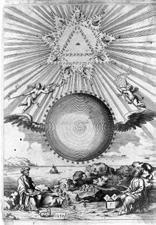
© Wikimedia Commons (Wellcome Library, London)99
His book indeed features the enneagram figure. On top of the image, Kircher wrote the Greek word ‘hierarch’ (p. 277) 100 The enneagram is referred to as an ‘occult’ system. Kircher tells us that the three triangles represent “ three degrees ” into which “nine choirs of angels” are divided. The three degrees represent three forces that are necessary to the creation of any phenomenon, according to Kircher.
However, most proponents credit George I. Gurdjieff (1866–1949), a mystic figure from Armenia, when referring to the current enneagram. It seems he first started his ‘teachings’ on the enneagram in the 1920s. The enneagram was later used as a personality description by Oscar Ichazo and his student Claudio Naranjo. Ichazo claimed that the human body and psyche is composed of nine independent systems that are interconnected. Imbalances within these systems were called “fixations.” The nine systems are represented by the 9 numbers (enneagons), which represent a ‘structural map’ of the human psyche.
Neither Gurdjieff nor Ichazo were psychologists or psychiatrists. Ichazo was a self-proclaimed ‘student’ of Zen, Sufism, Yoga, Buddhism, Confucianism, I Ching, and the Kabbalah. Helen Palmer, a clinical psychologist, was one of the first authors to actually write a book (1988) on the model.101
Gurdjieff claimed the three forces identified by Kircher were the Father, the Son, and the Holy Spirit, which together formed a suprahuman or supernatural force. He created the enneagram symbol using circles and lines, representing the ‘unification’ of the ‘law of three’ and the ‘law of seven’—a nonlinear pattern of spiritual manifestations in the material world or “the Ray of Creation.” Gurdjieff’s vision of humanity was bizarre, and fundamentally pessimistic. He believed that people were essentially “ asleep ,” or a kind of machine or vending machine that merely responds to external stimuli. As such, they have no control over their feelings, thoughts, and behavior. They can, however, be “awakened” by the right exercises, dance, and meditation. Notwithstanding his inscrutable language, he managed to gather a crowd of followers.
Gurdjieff believed people have three brains:
“And this was because the three-brained beings there were then existing more or less as is becoming to three-centered beings, and the emanations issuing from them yielded vibrations more akin to those required from them by Nature, both for the Most Great Common-Cosmic Trogoautoegocrat in general and for the maintenance of the Moon and Anulios in particular. And thereafter, Great Nature did not fail to adapt herself to the decline in their birth rate, the more so since for the following period the need for these vibrations to maintain the existence of the planet Moon had to be reduced.”
(p. 1010, Beelzebub’s Tales…)
99 Copyrighted work available under Creative Commons Attribution only license CC BY 4.0 http://creativecommons.org/licenses/by/4.0
100 This book is scanned in its entirety by Google Books.
101 She was sued by the Arica Institute for copyright infringement but she got off the hook.
Gurdjieff was clearly inspired by religion and his ideas become quite popular among Christians, although in 2000, U.S. Bishops alienated themselves from this model..102
Gurdjieff believed in a special kind of creation. Specifically, that there were several planets in the universe, and on each planet lived three-brained creatures. On earth, humans are those three-brained creatures. He later described this ‘trinity’ of brains as “spiritualized parts” or three personality centers (named path, oth, and kath103). In his third book he referred to this in the following manner:
“For instance, in the so to say “consciousness” of people existing in one part of Russia, from the general totality of information which had been given to them and which they took in certainly “a bit here and a bit there,” only that part was firmly crystallized which among other things explains theoretically by analogous examples the fact that the common presence of man is composed of three independently formed and educated parts, and on that alone they base the probable truth of all my ideas; in a number of people existing in another part of Russia, thanks to some fragments of the explained and proved information, there was crystallized in their consciousness the one idea that a man who has never worked intentionally on his perfecting is deprived not only of a soul but also of spirit.”
(p. 96, Life is real only then, when “I am”)
“The general psyche of every man on reaching maturity, which begins on an average in the male sex at twenty years and in the female sex at the beginning of the thirteenth year, consists of three totalities of functioning which have almost nothing in common with each other.” (p. 153, Life is real only then, when “I am”)
Gurdjieff then describes the three stages (“anode beginning, all-centered dozing and cathode beginning”) and how they develop. We learn that men and women can get really old: “But in the case of people who have consciously perfected themselves to the so-called “allcenters-awake state,” that is, to the state of being able in their waking state to think and feel on their own initiative, these factors still continue to form in man until the age of three hundred years and in woman until the age of two hundred.” (p. 154, Life is real only then, when “I am”)
His disciples attribute the development of the enneagram to him, although I was unable to find an original source from Gurdjieff himself. Don Richard Riso and Russ Hudson (1996, p. 10) write: “One of the main problems with introducing the Enneagram is that its exact origins are lost to history.” They do think it dates back to 2500 BCE though (p. 23)
In their French manual of the HPEI (a new enneagram questionnaire), Delobbe et al. (2012) also acknowledge the ancient Sufi tradition but explain that according to current theorizing, every newborn comes into the world with nine enneagram types. Then, through interaction with their environment, the child will develop a preferred style, eventually selecting a personality type around the age of four, “in order to protect and defend essence from injury in the material world.”104
102 http://www.natcath.org/NCR Online/documents/ennea2.htm : "While the enneagram system shares little with traditional Christian doctrine or spirituality, it also shares little with the methods and criteria of modern science.” And “The burden of proof is on proponents of the enneagram to furnish scientific evidence for their claims."
103 This comes from the Sufi tradition, which said there are three centers of energy: path = head, oth = chest and kath = belly. In the enneagram traditions, these “three centers of intelligence” are also recognized. Delobbe et al. (2012) also embrace this idea of three energy centers, which they call instinctive, emotional, and mental
104 Interview and Palmer, 1988, p. 19-20.
The curious case of… our debt to the moon I think there is no better way to make you laugh out loud than to have you read some excerpts from Gurdjieff’s original writings. He wrote three books, of which the first was titled Beelzebub’s Tales to His Grandson. An Objectively Impartial Criticism of the Life of Man.
On the first page, we read:105
“All written according to entirely new principles of logical reasoning and directed toward the accomplishment of the following three fundamental tasks:
FIRST SERIES To destroy, mercilessly and without any compromise whatever, in the mentation and feelings of the reader, the beliefs and views, by centuries rooted in him, about everything existing in the world.”
A few pages further in he writes:
“In my opinion, what will be troublesome for you in all this is chiefly that in childhood there was implanted in you—and has now become perfectly harmonized with your general psyche—an excellently working automatism for perceiving all kinds of new impressions, thanks to which “blessing” you have now, during your responsible life, no need to make any individual effort whatsoever.” (p. 8)
He really worshipped the moon and really believed humans have three brains, as you can read below:
“‘Yes,’ replied Beelzebub, ‘three-brained beings dwell on almost all planets of that solar system also, and higher being-bodies can be coated in almost all of them.
Higher being-bodies or, as they are called on some planets of that solar system, ‘souls,’ are coated in three-brained beings inhabiting all the planets except those before reaching which the emanations of our Most Holy Sun Absolute, through repeated deflections, have gradually lost the fullness of their strength and no longer contain the vivifying power needed for coating higher being-bodies.” (p. 58)
“The Moon is actually a fragment of this Earth, which must now constantly maintain the Moon’s existence. On the planet Earth also, three-brained beings are formed, and they too contain all the data for higher being-bodies to be coated in them.” (p. 61)
“The larger of these two fragments was named ‘Loonderperzo’ and the smaller ‘Anulios’; and the ordinary three-brained beings who arose and were formed on the Earth knew them by these names. But the beings of later times gave them different names at different periods, and more recently the larger fragment has come to be called ‘Moon,’ but the name of the smaller one was gradually forgotten. As for the beings there now, not only have they no name at all for this smaller fragment, but they do not even suspect its existence.” (p. 82)
“It is interesting to note, however, that in the beginning, that is, soon after the destruction of the organ kundabuffer in the three-brained beings breeding on this planet of yours, they knew about these two higher being-foods and made use of them with conscious intention, and certain beings of the continent of Atlantis, during its final period, even considered the process of the absorption of these higher being-foods as the chief aim of their existence.”
“The beings of the continent of Atlantis then named the second being-food ‘amarloos,’ which meant ‘help for the moon,’ and they named the third being food the sacred ‘amarkhoodan,’ which signified for them ‘help for God’.” (pp. 717-718)
105 It is not clear whether this was written by Gurdjieff or his publisher.
Others have picked up this ‘thinking’ and expanded it further. David Jones, (2011) for example, wrote:
“One of the most significant influences is the Moon. It feeds on human karmic factors and recycles them back to Earth endlessly, and has far greater effects. The Moon controls the tides, pulls on Earth’s gravity and supposedly agitates the psychological state of the mentally ill. Furthermore, its goal is to become a planet in its own right. According to the inner teachings of G.I Gurdjieff, P.D. Ouspensky, Rodney Collin and Boris Mouravieff, the spirit of the Moon absorbs some of the life force before it transmits the karmic factors back to Earth in a long and slow trek to once again become a living planet. Since it broke off from Earth, it is a bitter soul, lonely, barren and angry, feeding off the energy of others and attempting to reboot its lifecycle. As part of this process, certain unique alignments allow the Moon to increase its influence, causing disaster and suffering that helps accelerate its access to life energies and hence shorten its quest to once again become a living planet.”106
In Gurdjieff’s second book, Meetings with Remarkable Men , the impenetrable language continues:
“This ancient saying, chosen by me for the beginning of the second series of my writings, is formulated thus:
Only he will deserve the name of man and can count upon anything prepared for him from Above, who has already acquired corresponding data for being able to preserve intact both the wolf and the sheep confided to his care.
A ‘psycho-associative philological analysis’ of this saying of our ancestors which was made by certain learned men of our times—of course not from among those breeding on the continent of Europe— clearly showed that the word ‘wolf’ symbolizes the whole of the fundamental and reflex functioning of the human organism and the word ‘sheep’ the whole of the functioning of a man’s feeling.” (p. 5)
Gurdjieff also liked the number nine very much—he even saw regularities in the human body and mind:
“The human body, like everything that is a whole, bears in itself this regularity of measurement. In accordance with the number of notes of the octave and with the intervals, the human body has nine principal measurements expressed in definite numbers.” (p. 34, Views from the Real World)
Now do you believe Gurdjieff was crazy? I must admit I think so myself.
For those readers who are curious whether the moon really split off from the earth, I refer you to astrophysicist Neil deGrasse Tyson, who is an excellent science communicator. In episode one of the documentary Cosmos: A Spacetime Odyssey, he explains how the moon was formed:
“The Earth took one hell of a beating in its first billion years.107 Fragments of orbiting debris collided and coalesced, until they snowballed to form our Moon. The Moon is a souvenir of that violent epoch. If you stood on the surface of that long ago Earth, the Moon would have looked a hundred times brighter. It was ten times closer back then, locked in a much more intimate gravitational embrace. As the Earth cooled, seas began to form. The tides were a thousand times higher then. Over the eons, tidal friction within Earth pushed the Moon away.”
106 http://www.newdawnmagazine.com/articles/the-secret-of-the-moon-the-nature-of-war
107 It was bombed by asteroids.
What else is wrong with this stuf?
Apart from the fact that the enneagram is clearly very old and stems from the occult and esotericism, there is more to be said about it. However, even the ancient origins of the enneagram must be called into question, as the earliest appearance of numerals in Europe is about 1000 BCE. When traced back, it seems numerals were of Indian Hindu origin, perhaps dating back to 800 or even 1500 BCE (when numerals were probably written out in full text). At that time, many forms of the numbers existed. The first primitive inscriptions that appear to be some sort of numerals were found in the third century BCE. The modern form with a place value (1, 2, 3…) has never been found before 600 BCE (the era of the prophet Mohammed). Therefore, it is highly unlikely that the enneagram figure and its nine modern numbers were produced before the middle ages.108 By referring to various ancient cultures, the proponents probably intend to invoke a kind of mysterious, secret wisdom that has now been uncovered. Hallelujah!
Another worrisome aspect is that the enneagram uses words to describe pathologies such as “catatonic,” a highly exceptional and dangerous psychotic state. Other examples include “the imploding schizoid, ” “ the overreacting dependent, ” “ multiple personality disorder, ” and “dissociation.” These descriptions are clearly psychiatric, which would make this absolutely forbidden terrain for laypeople. What else is striking is that Don Richard Riso did not study medicine nor clinical psychology, but English and philosophy. Russ Hudson (who co-edited the second edition of Personality Type) holds a degree in East Asian Studies. It should therefore be no surprise that some of the other terminology used is utter nonsense: or can anyone explain the meaning of ‘disintegrated traits’?
What does my Champions League of experts say?
Steven Pinker explains why the idea that we are born as a Blank Slate is entirely wrong. Based on his view of innate human nature and personality development, the idea that humans have an innate scheme of 9 enneagram types and that we would pick our personality type around the age of four is impossible. Because of the occult and obviously esoteric nature of the enneagram, it is of no surprise that my Champions League hasn’t wasted their
precious time and money on studying it, a clear indication they don’t take it seriously in the slightest. This means we’ll have to refer to experts in the field of personality differences.
What does the majority of the feld of experts think?
Every profession has its outliers and quacks. Some GPs believe in the paranormal, or that water has a memory for the molecules it once contained (homeopathy), while parapsychologists believe in supernatural powers like clairvoyance and telepathy. The field of psychology may be plagued by weird beliefs., but business schools, which like to be linked to universities (probably because of the authority it lends them) seem even more prone to weird beliefs.
Indeed, some believers in the enneagram can be found in the academic world, such as Anna Sutton, Chris Allinson, and Helen Willems, who wrote a paper together on the enneagram (2012) when they held positions at the Business Schools of Leeds and Swansea, respectively. They try to lend credibility to the enneagram, though they only refer to the theory in an annex to their 2012 paper. Instead of explaining the theory and discussing if it is sound or not, they limit themselves to describing where it allegedly originated. They refer to “an oral tradition,” George Gurdjieff, Oscar Ichazo, and that’s pretty much it. The result is it has
108 Smith & Karpinski, 2011.
zero scientific credibility. A theory needs to be thoroughly explained using logic, reasoning, observations, and hypothesis formulation. Next, it needs to be empirically tested. Even in discussing the psychometric properties, they fail to deliver data about the obvious criteria: they do not report internal reliability of the scales, test-retest reliability, criterion validity, and the like.
Then there is the work of Rebecca Newgent, Patricia Parr, Isadore Newman, and Kristin Higgins (2004) . They tried to lend some credibility to the Riso-Hudson Enneagram Type Inventory, an ipsative, or forced-choice, inventory containing 144 items, but also fell short of explaining the theory. They simply state: “There is no underlying theory that is the sole basis for the Enneagram” (2004, p. 226). They don’t even refer to the ancient oral tradition, or Gurdjieff for that matter. They state that the enneagram was developed by Riso and Hudson to accommodate a number of psychological constructs. Disappointing.
A recent effort to validate a Dutch and French version of an enneagram, called the HPEI (Halin Prémont Enneagram Indicator), also fails to explain or defend the theory. They limit themselves to stating that the enneagram started as a spiritual model and that a child will develop a preference for one of the nine styles at an early age.109 However, this is sheer speculation, not academic theorizing. They don’t explain where the theorizing of the nine types comes from.
It is highly unlikely that an ‘oral tradition’ of describing personality according to 9 types, dating back to the early years of the Christian era, and influenced by Islamic thought and passed down by the Sufi, would not have suffered from many flaws. People did not have statistical tools or modern research methods at those times, so it is more likely to be an ‘invention,’ much like astrology and the horoscope.
In 2001, Dutch professor emeritus of psychology Dr. Wim Hofstee (globally recognized expert in personality theory) sounded the alarm: “The Enneagram is no serious scientific model. It belongs to the confusing and rapidly changing field of lay-psychology: it seems to be a flourishing trade. A psychologist who is a member of the Dutch Institute of Psychologists110 who works with the Enneagram, risks getting a complaint based on Article III.3 of the professional Code of Ethics, which is about expertise. For non-psychologists such restrictions of course do not apply. But as the Enneagram industry is making statements about our personality – which is subject to scientific research and a profession - we must call a spade a spade: it is simply nonsense.”
The theoretical score: -5. Because its proponents try to give the impression that it is a valid scientific theory.
■ Empirical findings
The theory completely contradicts valid theories of personality. Again, I could stop here, but I have an ‘instinctive feeling’ there are more problems to be detected in the psychometrics of the questionnaires used to measure your enneagram type.
What is the level of evidence?
I turned to the obvious sources to find out more about previous evaluations of the questionnaires. The Buros Institute of testing writes this about the enneagram: “ No review
109 I bought the manual “HPEI Ennéagramme évolutif.”
110 In Dutch: NIP or Nederlands Instituut voor Psychologen.
available. This test does not meet Buros Institute review criteria (that at least minimal technical and/or test development information is available).”
Not a single validation study can be found in the entire database of the American Psychological Association (APA) to date,111 apart from the article by Newgent et al. (2004) Like almost any (pseudo or bona fide) personality measure, the authors desperately try to cross-validate the RHETI to the NEO-PI-R, the most well-known measure for the 5FM of personality. Although they admit that “limited empirical evidence, however, exists to support the reliability and validity of the scores on the RHETI” (p. 227), they don’t set out to investigate its reliability and validity. No, as it seems, they only had the intention of testing convergent validity with the NEO-PI-R. They cite the excellent internal consistency reliability scores from the NEO-PI-R (ranging from 0.86 to 0.95) and report problematic scores from the RHETI, ranging from 0.56 (2 types—this is unacceptably low and points to complete unreliability) to 0.66 (one type), with some reaching the 0.80 level. They fail to consider this problematic, however.
Next, instead of predicting which of the nine types would theoretically relate to each domain of the NEO-PI-R, they just observe that all nine types correlate with the NEO-PI-R. It is quite amusing to see how they try to rationalize why three types don’t reach 0.70, the accepted minimum level of reliability: they make the capital blunder of stating that the low reliabilities could be due to the ipsative nature of the RHETI. Now wait, is that not completely opposed to what most scholars acknowledge? These scholars consistently state that ipsative tests result in artificially high correlations. I did a quick ‘acid test’ of the intercorrelation matrix using the formula by Clemans (1956): -1/(m-1). As a reminder:112 intercorrelation matrices based on ipsative scores have one very peculiar feature: the average intercorrelation of all correlations from the matrix is always equal to -1/(m-1), in which m stands for the number of variables (or scales) in the test. Therefore, irrespective of the items in the scales, the mathematical calculation of how the scales intercorrelate can be done in advance. Using the formula, the average intercorrelation can be predicted to be around -0.125 based on the calculation: -1/(9-1) where 9 is the nine enneagram types of course. Remember from my chapter on Belbin that this is a purely mathematical and thus artificial calculation.
The only thing we need to do now is see whether this upfront calculated artificial number will indeed be close to the actual numbers reported. And indeed, using the data from the Newgent study, the average correlation of the scales is -0.12389, a near-perfect match and a demonstration of the totally artificial nature of this ipsative measure. Luckily, even the authors acknowledge that “more investigation is needed to assess the psychometrics of the scores on the RHETI” (p. 235). This seems to me a complete waste of money, given that the underlying theory is absolutely unsupported by knowledgeable experts and empirical evidence.
It is highly likely that Riso tried to avoid the criticism that it is unlikely that people would nicely ‘fit in a box’ by pulling a switcheroo: claiming each type has a “wing” of the adjacent types. Much to my delight, this adaptation of the theory was tested by Edwards (1991) and found to be wrong. Of course, one can switcheroo ad infinitum, and that is exactly what Riso did: he later wrote that it is possible for someone to have a ‘wing’ of a non-adjacent type. Okay, so any type will do now. Right.
111 I searched the APA database on October 27, 2015.
112 For a more extensive discussion, see my chapter on Belbin.
The HPEI ( D elobbe et al., 2012) exists only in Dutch and French and consists of 51 items for measuring the nine distinct enneagram styles. Its reliability and validity studies were not published in peer-reviewed magazines, so I bought their manual. The first observation that strikes me is that they at least admit that using ipsative scoring is problematic. That is why they use a five-point normative Likert Scale. The internal consistency reliability and testretest reliability figures seem to be quite good, all showing reliabilities above the +0.70 mark. But as they only use 51 items for 9 scales (5 or 6 per scale113), we shouldn’t jump to the conclusion that the reliability is good in reality. It is possible to construct adequate measures by using five or six items in a five-point Likert scale (e.g. Hinkin, 1995), but this depends on aspects such as the construct or content validity of the items. Since the HPEI doesn’t specify the items used, it isn’t possible to assess whether this is a true reliability or an artificially high one. One could easily write 5 or 6 items per scale that show high resemblance, and thus obtain artificially high internal consistency reliability scores (Cronbach’s alpha).114 In fact, it is almost beyond doubt that the items won’t differ very much in content, making the construct or scale also very narrow. Such narrow scales cannot be represented in a circular plane, as this requires a continuum (like the interpersonal circumplex). But this is a nice demonstration of how to build a pretty ‘psychometrically reliable’ test based on entirely wrong theory.
Something else that struck me is that their paper contained an intercorrelation matrix (showing how much the 9 scales correlate with each other). Given that the enneagram has a circular representation, it is very common to check the circular structure using the statistical technique of Multi-Dimensional Scaling (MDS). That procedure was not reported in the manual, so I decided to ask Danny Rouckhout to run MDS with the data from the intercorrelation matrix. Here is the result:
Common Space Object Points
Figure III.9: MDS solution of the nine enneagram types using SPSS software. There is no circular structure with 40° spacing (360 ÷ 9 = 40) and equal vector lengths (i.e. same distance from the midpoint of the circle). The enneagram does not show a continuum.
Dimension 1
113 This is quite a common practice in the social sciences: very often surveys use 3 or 4 items to measure things like ‘political trust,’ ‘perceived risk of nuclear risk,’ etc. Such short questionnaires can be highly problematic and many scholars oppose this practice. The excuse one often hears is that long questionnaires are too time-consuming, too expensive, are tiring, etc. Normally, whether changing the length of a test has an impact on its reliability should be tested, e.g. by using the Spearman Brown formula.
114 Many scholars have argued that alpha coefficients for internal consistency are not a good measure of reliability. Internal consistency increases as the number of factors pertaining to each item increases or if the items are very similar (e.g. ‘My leader is trustworthy’; ‘I trust my leader’; ‘My leader can be relied upon.’).
Not only is the circular structure absent, the next comparison will reveal that the enneagram types are not located in the ‘theoretical’ positions of the circle as proposed by the model:
7 2 9 3 4 8 1 6 5
Figure III.10: the theoretical order of the nine enneagram types. The MDS below demonstrates the actual positions: the types are not in the predicted position. Actually, the order seems completely random.
The HPEI data also reveals that the idea of “ wings ” of the adjacent types is untenable. Adjacent types show small intercorrelations (1 shows a +0.14 intercorrelation to 2 and -0.12 to 9 for example).115 To make things worse, the opposite types are not correlated negatively, but positively: for example, type 1 and 6 show correlations of +0.44 (French) and +0.47 (Dutch). In their comparison to a 5FM test,116 they fail to notice that adjacent styles don’t show a continuous dimension. For example, if style 1 scores high on conscientiousness, the adjacent styles should somehow show at least medium correlations too. But this is not the case: for example, style 1 shows a correlation with conscientiousness of +0.58, whereas adjacent style 9 has a correlation of -0.07 and adjacent style 2 of 0.00. Except for extraversion (at least with three styles), this problem occurs for all 5FM personality traits and the enneagram styles.
The careful reader will have noticed by now that I only evaluated reports that did not appear in peer-reviewed magazines. This is due to the glaring lack of research findings in peer-reviewed academic literature.
The empirical score: -3. Several studies refute several of the hypotheses or predictions. The private (commercial) reports reveal many flaws and an incorrect use of statistics.
Why do people believe the enneagram can ofer them valuable insights?
Maybe people feel naturally attracted to the mystic, the occult, esoteric, sorcery, and gossip. The mere exposure effect may explain a lot as well since the enneagram has found itself a niche in the credulous world of HR. Having been subjected to the enneagram, some people might start thinking it is a valid model for explaining personality. After all, most people trust other people claiming to be professionals.
And then, of course, there is the Forer effect (1949) as I described in Part I. Recognizing yourself in the test result, or in a horoscope description, can be a very powerful experience. Especially for the credulous.
How likely is it this theory will ever prove to be valid?
Gurdjieff’s line of thinking about our universe, Earth and the moon, three-brained beings, putting people into nine distinct personality boxes or types, etc. is so outrageously false, I can say without a doubt: Never! The explanation of children developing a preference for one of nine base types present at birth in everyone is sheer speculation that starkly contradicts the current knowledge of personality. What this chapter clearly demonstrates, however, is that it is possible to develop a relatively good measure from a wrong theory (such as the horoscope). Much like how you can find spurious correlations in a dustbowl of data. A measure with good ‘psychometric’ properties, however, can never prove a theory right. At best, it offers a slight indication that your fabulous fabrications (theory), and the items in your test, are somehow coherent. Coherent but nonsensical.
115 Table 3.4 on page 56.
116 BB5 (Brief Big Five)—a French test that uses the 5FM, developed by Barbot, 2011.
■
Original sources consulted
Barkow, J.H., Cosmides, L. & Tooby, J. (eds.) (1992). The Adapted Mind: Evolutionary Psychology and the Generation of Culture. Oxford & New York: Oxford University Press.
Clemans, W. V. (1956). An analytical and empirical examination of some properties of ipsative measures. Psychometric Monographs, 14. Richmond, VA: Psychometric Society.
Delobbe, N., Halin, P., & Prémont, J. (2012). HPEI Ennéagramme évolutif: Manuel du Halin Prémont Enneagram Indicator pour le psychologue et le praticien certifié. Presses univ. de Louvain.
Edwards, A.C. (1991). Clipping the wings off the enneagram; a study in people’s perceptions of a ninefold personality typology. Social Behavior and Personality: an international journal, 19(1), 11–20.
Gurdjieff, G. I. (1950). Beelzebub’s Tales to his Grandson (Vol. 1). Library of Alexandria.
Gurdjieff, G.I. (1963). Meetings with remarkable men. UK: Penguin.
Gurdieff, G.I. (1973). Views from the real world. New York: E.P. Dutton.
Gurdjieff, G.I. (1974). Life is Real Only Then, When I am. UK: Penguin.
Hinkin, T. R. (1995). A review of scale development practices in the study of organizations. Journal of management, 21(5), 967–988.
Newgent, R. A., Parr, P. E., Newman, I., & Higgins, K. K. (2004). The Riso–Hudson Enneagram type indicator: Estimates of reliability and validity. Measurement and Evaluation in Counseling and Development, 36(4), 226–237.
Kircher, A. (1665). Arithmologia: sive, De abditis numerorum mysteriis. Romae MDCLXV.
Moskowitz, D.S., & Zuroff, D.C. (2004). Flux, pulse, and spin: Dynamic additions to the personality lexicon. Journal of Personality and Social Psychology, 86, 880–893.
Riso, D.R., & Hudson, R. (1996). Personality Types. Using the enneagram for self-discovery. Revised edition. Boston New York: Houghton Mifflin Company.
Smith, D. E., & Karpinski, L. C. (1911). The Hindu-Arabic Numerals. London: Ginn.
Sutton, A., Allinson, C., & Williams, H. (2013). Personality type and work-related outcomes: An exploratory application of the Enneagram model. European Management Journal, 31(3), 234–249.
■ Other References (abstracts, summaries, excerpts, or reviews)
Palmer, H. (1991). The Enneagram: Understanding yourself and the others in your life. San Francisco: Harper.