MAHY
A F A M I LY O F C A R S T H E T R A N Q U I L B E A U T Y O F U N I Q U E O L D -T I M E R S
MICHEL MAHY WOUTER RAWOENS
M A H Y – A F A M I LY O F C A R S Row after row of abandoned factory halls in the rolling hills of Belgian Hainaut. A long-faded festival of brick and red-painted steel, sandwiched between a rusting railway track and the tarmac of a road leading nowhere. Nothing is made here anymore, nothing except motoring history. There is an all-pervading smell of rust and motor oil. The only sound is provided by the slow drip-drip of a leak in the roof. In this dusty interior, in hall after hall, hundreds of classic cars stand bumper to bumper. Some of them are propped up at jaunty angles on axle stands. Most lean drunkenly on the rubber of their long-flat tyres. Legendary models, ordinary family cars, flamboyant old bangers, long-forgotten jalopies, each with its own story to tell. As a whole, they form the raison d’être of the Mahy family from Ghent. Three generations of dedicated collectors: father Ghislain, sons Ivan and Hans, and grandson Michel. They, like the cars, have a story to tell. It is a story of passion and hard work; of wanderings along a path that has led from the Winter Palace in Ghent to Houthalen, Brussels, and Leuze-en-Hainaut; of fierce differences of opinion and periods of moody silence. In short, a story of a life dominated by their fascination for the magnificence of the motorcar. What if we were to shed more light on a selection of the unique vehicles in their remarkable collection? Some (very) old; some not so old. Some backlit; some spotlit. All with captivating stories of the past etched into their rear-view mirrors. Stories of glory and loss, of death-defying rides over dangerous roads, of a never-ending search to find ultimate beauty on four wheels. True stories that have been told for generations in the Mahy family, a family of cars.
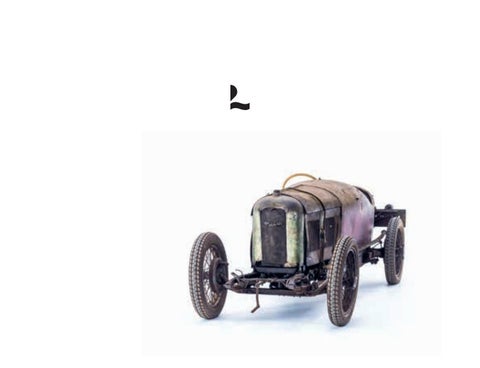
Buchet C2 C O A C H W O R K Buchet
Blue 4-cylinder D I S P L A C E M E N T 1551 cc G E A R B O X Manual
MAKE
CO LO U R COAC H WO R K
MODEL/TYPE
ENGINE
CONSTRUCTION YEAR
1923
BUCHET C2 (1923)
Ghislain Mahy had a number of scouts who kept their eyes peeled for possible new ‘finds’ in the dusty garages and old barns that are such a typical part of the French landscape. One of these scouts was Henri Malartre from Lyon, a renowned buyer and seller of cars in his own right. In many ways he was like Mahy, being a man of often eccentric behaviour and tastes. For example, he wanted nothing to do with German cars, even the more superior models. In spite of this, over the years he built up a fine collection of non-German cars that he displayed on the first floor of his draughty chateau at Rochetaillée- sur-Saône. How did he get them to the first floor? He took them to pieces, carried them up the stairs, and put them back together again! In 1960, he turned his display into a museum, which still exists. At the end of the 1950s, Malartre tracked down this Buchet C2 for Mahy. The Buchet dated from the Roaring Twenties and had to compete with the Bébé designed by Bugatti for Peugeot. The revolutionary and racy C2 ran on Michelin tyres and was one of the first cars with two doors. Until then, the passenger climbed in alongside the driver only after he had cranked the engine into action, which meant that only one door was necessary. The front of the Buchet was made completely from metal. The cockpit was chestnut, largely because there were many chestnut trees in and around Paris, where the Buchet factory was located. A thin metal plate was then carefully hammered over the wood. During the 1920s, it also became the custom for cars to be brightly coloured through the addition of a thick layer of oil paint – hence the turquoise craquelé, which resembles a dancer’s dress as it might have been painted by Degas! Before the First World War, Elie-Victor Buchet had earned a reputation as a daring and innovative engineer. After the war, this fire was gone. Now, he was prepared to live on his past successes, as a result of which he came to be seen as too conservative. Not surprisingly, production and sales began to fall, eventually leading to the closure of the company in 1929. With its copper-carbon headlights and S.A.M. radiator grille from the Avenue Montbarbon, the Buchet was much sought after in the 1950s by French scrap metal dealers. Copper was urgently needed to make weapons for the war in Indo-China and therefore fetched a good price. As a result, only a very few Buchets were saved from the car press. Ghislain Mahy paid Malartre 3,000 Belgian francs for this 1923 model: marginally more than its scrap value.
64
MG PB (1936)
The pointed rear end swayed slightly, as the MG came out of a bend. With a deft flick of the steering wheel, the pilot of the racing car brought it back straight. He cut to the inside of the track and guided the nose of the car perfectly into the next sharp right-hand bend. The driver in question was Paul Frère. Little could he imagine that in the future this bend would be named after him. He pushed the accelerator pedal harder. The MG growled in response as it roared towards Stavelot. Just four bends to go until the finish.
MAKE
MG
PB Unknown C O N S T R U C T I O N Y E A R 1936 C O L O U R C O A C H W O R K Red E N G I N E 4-cylinder H O R S E P O W E R 57.3 cu. in. D I S P L A C E M E N T 939 cc G E A R B O X Manual MODEL/TYPE
COACHWORK
When they took part in their pre-war MG PB for the first time in 1948, Paul Frère and Jacques Swaters finished in 15th position in the 24 Hours of Francorchamps. That year, the race around the 14-kilometre circuit through the woods near Spa was won by the Aston Martin DB1 of Jock Horsfall and Leslie Johnson. The following year, Frère partnered Horsfall to fourth place, again in an Aston Martin. Paul Frère would later become the first Belgian ever to win a Formula 1 Grand Prix. His best result at Spa-Francorchamps was achieved in 1956, with second place in that year’s Grand Prix. After his racing career, Frère worked as a motoring journalist and regularly paid visits to Mahy’s garage to admire the new acquisitions to their collection. During each of these visits he always lingered for a few moments alongside the small MG that Ghislain Mahy had been able to buy from a Brussels garage owner in the 1960s. It was a P-type dating from 1936, with race bodywork from just before the Second World War; a narrow two-seater with right-hand drive and a powerful fourcylinder engine under the bonnet. Although it was a long time ago, Paul Frère could have sworn that this was the same British beauty in which he had torn around the bends of Spa-Francorchamps for the very first time…
101
OPEL BLITZ (1959)
It followed Rik Van Looy over the cobblestones of ParisRoubaix. It witnessed the first cycling exploits of the great Eddy Merckx. This publicity van belonging to Ginder-Ale, a Belgian beer brand, was for many years a familiar sight in the travelling caravan of the Tour de France and many other cycling classics. Back in those days – the 1950s, 60s and 70s – the amber-coloured beer brewed in Merchtem flowed freely. However, times change and by 1991 the once famous Martinas Brewery – sold years before to the Artois conglomerate – was forced to stop production. Everything had to be sold, including the Blitz. A former driver of this mobile bottle on wheels couldn’t bear to see it scrapped and telephoned Ivan Mahy. Would he be interested in saving the Opel? If so, he would need to act fast. Fortunately, he did: he went to collect it with his lorry that very same day. The first Blitz appeared as early as 1930. Its name was chosen through a competition and the accompanying fork of lightning was later incorporated permanently into the Opel logo. A year later, Opel passed into the hands of General Motors, but it remained a German company, not only in name but also in spirit. Under the Nazis, Opel were only allowed to produce lorries and vans (needed for military purposes), and when war broke out in 1939 the mass-produced Blitz became an important cog in the German war machine. It saw service on both the western and eastern fronts, until a rain of Allied bombs obliterated the factories in Rüsselsheim and Brandenburg an der Havel. After the war, production of the reliable old workhorse was resumed and continued until 1975. This colourful example from 1959 has coachwork built by the Belgian Van Hool company from Lier.
232
MAKE
Opel
Blitz Van Hool C O N S T R U C T I O N Y E A R 1959 C O L O U R C O A C H W O R K Orange/beige/red E N G I N E 6-cylinder G E A R B O X Manual MODEL/TYPE
COACHWORK
MICHEL MAHY
WOUTER RAWOENS
DAV I D J A N S S E N S
(Ghent, 1965)
(Ghent, 1963)
(Antwerp, 1972)
Is the third generation of this family of car fanatics
Is a photographer who has worked on various
Is an editor and writer with a weakness for
and current curator of the Gh. Mahy collection.
books, magazines and newspapers. He is the creative
nostalgic stories. He loves the breathtaking
His life’s goal is to preserve this collection in the
inspiration behind this project. He feels a connection
beauty of the Chrysler Ghia ST and the Facel
best possible condition for future generations. It is
with every car in the book, but has a particular soft
Vega HK500, but is ultimately charmed by the
impossible for him to choose a favourite car from
spot for the Ford Anglia and wants a kitchen with
youthful memories and musty synthetic leather
the book, because each and every one of them is
the same kind of interior! Wouter drives a lime-green
of the Opel Rekord. David does not have a driving
dear to his heart. He does, however, regard the
Volkswagen Caddy, complete with CHG sticker,
license. He lives with his wife, children, dog and
photo of the beautifully lit Amilcar as the most
because he believes passionately that mobility must
cats in Gentbrugge. David wishes to thank Maarten
stunning. Michel drives a Mercedes-Benz 220
become greener. He lives with his wife, daughter
Van Steenbergen of Uitgeverij Lannoo and Michel
break, a bright orange UMM – because it is car few
and dog in Gentbrugge. Wouter would like to thank
Mahy for their belief in the project, not forgetting
people know – and a Porsche 911. He lives with
Michel Mahy and the board of directors of the
his good friend Wouter Rawoens, not only for their
his wife and dog in Ghent. Michel dedicates this
Gh. Mahy Collection for making this project possible.
intense conversations during the long drives to Leuze, but for so much more.
book to his grandfather Ghislain Mahy, the man
He is also grateful to Giuseppe and Fabien for their
who laid the first foundations for the collection,
hard work in Leuze, as well to Jacques Filliaert,
purely because of his love for the beauty of cars.
Marc Geldof, Bart Eeman, Cyriel Monserez, Bart Meyvis, Ivo Coppens, Stijn van Niel Schuuren and Aileen Van der Aa for all their help. A special word of thanks goes to Yves De Vadder, a colleague from France who generously shared his experience and expertise in studio photography, and also to layout designer Steven Theunis.
271
Photographs Wouter Rawoens
With many thanks to all members of the family, associates, fellow
Texts: Michel Mahy and David Janssens
workers and sympathisers who have ever contributed in one way
Advice: Jean-Pierre Sandrap
or another to the creation and preservation of the Mahy collection.
Design: Steven Theunis, Armée de Verre Book Design
Without their help, it would not have been possible.
Translation: Ian Connerty Thanks to: © Uitgeverij Lannoo nv, Tielt, 2020 and Mahy Mobiles
d/2021/45/462 – isbn 978 94 014 5523 7 – nur 653-686 All rights reserved. Nothing in this publication can be reproduced, stored in automated data files and/or made public in any form or manner,
The Claire and Michel Lemay Fund focuses on supporting creative,
whether electronically, mechanically or by any other means, without
innovative and future-oriented projects that contribute to the development
the express and prior written permission of the publisher.
of Picardian Wallonia. The fund is administered by the King Boudewijn Foundation, with particular attention for projects that combine heritage, culture and the economy. It launches two project calls each year: www.kbs-frb.be.