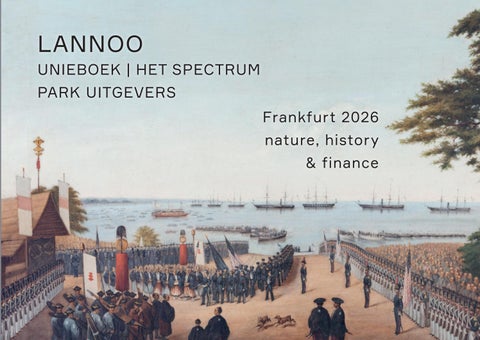
LANNOO UNIEBOEK | HET SPECTRUM PARK UITGEVERS Frankfurt 2026 nature, history & finance
Contents
The Plastic Paradox The Strange Life in the Ocean Do Not Touch!
3 5 6
A Year Full of Discoveries First Save Yourself (Then the Planet) When Goliath Falters The Body of Madness Press Rewind on History series Nippon The Union That Never Was A Plea for Peace The World’s Most Useless Encyclopaedia The Lazy Investor for Life What Smart Investors Do Differently
7 8 9 10 11 12 13 14 15 16 17
Contact Liesbeth, Gunther or Wouter foreignrights@lannoo.be www.lannoopublishers.com Kasteelstraat 97 b-8700 Tielt Belgium T +32-51 42 42 11
Jana Asselman
The Plastic Paradox How a miracle material became a global problem The Plastic Paradox argues against both plastic optimism and plastic panic. Plastic became successful for very good reasons: it saves lives, preserves food, enables technology and makes countless products safer and more accessible. Those same qualities - cheapness, durability, versatility and abundance - became problematic when combined with mass consumption and disposability. The Plastic Paradox 155 x 215 mm | ca. 256 pages ca. 66,000 words paperback all rights available
The solution is therefore not simply 'plastic = bad' or 'recycling = solution.' The book makes the case for a more mature question: Where does plastic provide genuine value, where can we avoid it, and how can we design the entire system so that its benefits no longer depend on shifting environmental and health costs elsewhere?
A scientifically grounded and accessible exploration that reveals the complexity and paradoxes of plastic A unique combination of science and storytelling: relatable examples make abstract concepts tangible and bring science closer to everyday life
Jana Asselman is a professor at Ghent University and is known as the ‘plastic professor’. She leads the Blue Growth Research Lab, where she researches the impact of (micro)plastics and chemicals on people and the environment.
3
How can we turn the story of plastic around, transforming it from a problem into part of the solution? What role can innovation still play today? And how can we reconcile convenience with responsibility without falling back on simplistic black-and-white choices?
Plastic is everywhere, and so is the debate surrounding it, yet public discussion is often dominated by alarming headlines, persistent myths and overly simplistic solutions. The Plastic Paradox offers a different perspective, moving beyond the familiar goodversus-bad narrative. •
The real challenge lies in the complex systems of production, consumption, regulation and waste that have developed around plastic.
•
Grounded in scientific research but written for a broad audience, the book brings together science, health, economics, sustainability and policy to provide a clear and nuanced picture.
•
Rather than telling readers what to think, the book encourages them to think critically about one of the defining environmental and societal challenges of our time. > OVERVIEW OF CHAPTERS
Moving beyond easy answers and often extreme headlines, Jana Asselman guides us through the multidimensionality of our relationship with plastic, highlighting important nuances. The Plastic Paradox is an engaging, thoughtful and much-needed contribution to a debate in which nuance, perspective and clarity are too often missing. – Joana Luísa Pereira (University of Aveiro, Portugal)
Jan Mees & Colin Janssen
The Strange Life in the Ocean From deep-sea monsters to microbes The ocean harbours unknown treasures: a world of sea monsters that are not frightening, but essential to our survival. From microbes that influence the climate to deep-sea organisms that contribute to the development of medicines and food, marine biodiversity provides humanity with invaluable services, yet it remains largely hidden and under threat. The Strange Life in the Ocean 140 x 210 mm | 280 pages 57,000 words paperback | B&W illustrations all rights available TAKE A LOOK
A journey from mythical sea monsters to real ocean biodiversity: from whales and coral reefs to life-shaping microbes Discover how new technologies and research are revealing the deep sea and redefining our role within the ecosystem
This book takes you on a journey from mythical sea dragons to the real wonders of the deep ocean. Science reveals what once seemed incomprehensible and shows how humanity, as the decisive factor, faces a choice: destruction or protection.
By the same authors
It is time to see the ocean for what it truly is: the source of life.
ENDORSED by the UN Jan Mees is the General Director of the Flanders Marine Institute. He is a professor of marine biology at Ghent University and publishes on marine ecology, biodiversity, and data systems. Colin Janssen is a full professor at Ghent University, where he teaches and conducts research in the fields of ecotoxicology and applied marine ecology.
(Ocean Decade)
The book by eminent Flemish marine scientists Jan Mees and Colin Janssen comes at a particularly timely moment. There is growing recognition that we need to change course if we are to avoid irreversibly damaging the ocean.
The Unknown Sea all rights available, except for English rights English manuscript available
– Dirk Draulans, biologist and journalist on The Unknown Sea 5
Martijn Peters, illustrations Margot Holtman
Do Not Touch! The book that stings, sprays and bites From the puss caterpillar to blue dragons, from deadly nightshade to the sea wasp, in Do Not Touch! Martijn Peters takes you on the world’s most dangerous journey. On every continent, he crawls between rocks and through the undergrowth to uncover 50 formidable defence mechanisms from the animal and plant kingdoms.
Do Not Touch! 160 x 240 mm | 224 pages 50,000 words full colour illustrations | hardcover all rights available TAKE A LOOK
50 vivid portraits of unusually dangerous animals and plants With an eye for biology, behaviour and the fascinating stories behind these creatures, Martijn teaches readers one important lesson: please, do not touch!
Did you know that a plate of mushrooms once changed the course of European history? That there is a poisonous bird that can make your skin feel as though it is being electrified? Or that there is a jellyfish three metres long, with 24 eyes, that can kill you in just five minutes? With her precise full-colour illustrations, Margot Holtman vividly captures the unique character and potential danger of each animal.
Martijn Peters holds a PhD in science and is a science expert at DPG Media. He regularly appears on Belgian and Dutch television and radio programmes. Margot Holtman lives in Amsterdam and studied at the Gerrit Rietveld Academie and Pratt Institute in New York.
6
Petra Vijncke, illustrations Christophe Istace
A Year Full of Discoveries 365 grand stories about tiny creatures Beneath your feet, in the garden, on nettles and even in the graveyard, creepy-crawlies live, each with their own fascinating story. For a full year, Petra and Christophe observed and sketched beetles, spiders, and other small creatures. They gathered 365 stories filled with wonder. In this book, you will discover a new protagonist from a hidden world: an invitation to set out on a journey of discovery in your own surroundings. A Year Full of Discoveries 170 x 240 mm | 408 pages 111,000 words B&W with spot colour | paperback all rights available
Since childhood Petra Vijncke has been passionate about everything that crawls, flies, or rustles. She works as a science communicator and translates current nature research into blogs, podcasts, and videos. Christophe Istace is an illustrator with a deep love for nature, drawing, and storytelling.
TAKE A LOOK
365 daily portraits of insects, spiders, and other small creatures, each accompanied by an illustration and a short explanation A unique blend of observation, education, and wonder: this book invites everyone to set out on their own journey of discovery
An insect, spider or other little creature every day. What a joy! Petra’s lively stories and Christophe’s punchy illustrations will have you itching to get outside and start looking for all 365 of them. – Menno Schilthuizen, author and evolutionary biologist at Leiden University 7
Louis De Jaeger
First Save Yourself (Then the Planet) How to be healthy on this polluted globe The accusations about how we are destroying the climate come at us from all sides. We use too much plastic, travel by plane too often, eat too much meat… Even vegetarians can’t escape it, because soy, too, has a heavy ecological footprint. First Save Yourself (Then the Planet) 150 x 230 mm | 288 pages 91,000 words paperback all rights available
Let go of climate guilt and discover how self-care can spark real change A no-nonsense book about how pollution is killing us and how we can protect ourselves Louis De Jaeger is the trailblazer of a new climate discourse
It can be hard to see the wood for the trees. But instead of feeling guilty about everything you’re doing wrong, you’re better off focusing on what you can do right for your own health and wellbeing, argues author and pioneering climate thinker Louis De Jaeger. The two are closely connected: by taking good care of yourself, with healthy food, a clean living environment, and fewer polluted products, you also or indirectly contribute to a healthier planet. Step by step, you’ll discover how focusing on your own well-being and that of your loved ones also benefits the planet and the climate.
The perfect balance between doom-laden pessimism and naive optimism. If you want to make the world a better place, read this book. – Johan Braeckman, philosopher and author
Louis de Jaeger is an exceptional changemaker and visionary.
Louis De Jaeger is a Belgian eco-entrepreneur, agricultural expert, landscape architect, and author. He is the founder of Commensalist, a company that creates more sustainable outdoor spaces for private individuals, businesses, and public authorities. He is also a soughtafter speaker and regularly takes part in debates.
– Harald Friedl, The Circular Economist & LinkedIn Top Voice 8
Mart de Kruif, Tom de Kruif & Théon Minten
When Goliath Falters Twelve surprising battles that didn’t go according to plan The cliché goes that history is written by the victors, but sometimes it is the unexpected victories that change the course of history. In this book, we explore twelve historical battles in which the underdog emerged victorious. What was their secret? Was it leadership, as at Mars-la-Tour? Or a clever ruse, like the one Ambiorix used to lure the Romans into a trap? When Goliath Falters 150 x 230 mm | ca. 312 pages ca. 87,000 words paperback with flaps all rights available
How the weaker side can gain the upper hand Combines gripping stories with historical and contemporary military tactics For history enthusiasts, military aficionados and anyone who loves a good underdog story
In each chapter the authors bring a decisive battle from European history vividly to life, as if they had been there themselves. Former Lieutenant General Mart de Kruif analyses each battle, revealing the tactics and strategies that led the underdog to victory. His sharp insights make it clear that warfare is not simply about numbers or weapons, but about making smart decisions and persevering against the odds. Let these stories serve as a lesson for the present: how can an underarmed Europe prepare for a world in which alliances can no longer be taken for granted?
Mart de Kruif is a former Lieutenant General in the Royal Netherlands Army. Between 2007 and 2008, he was responsible for around 45,000 NATO troops. Tom de Kruif is a history teacher at Rijnlands Lyceum in Sassenheim. Théon Minten is a historian and taught history at Rijnlands Lyceum in Sassenheim.
9
Wendy Wauters
The Body of Madness Body and mind in the late Middle Ages A portly man slouches in a chair. Another, wearing a funnel on his head, makes an incision in the crown of his skull. A flower emerges. Two strange figures look on, as if this were an everyday procedure. As if, with one simple cut, you could remove madness from someone’s head.
The Body of Madness 155 x 240 mm | ca. 352 pages ca. 89,000 words | full colour illustrations | hardcover with dust jacket all rights available TAKE A LOOK
Did people in the sixteenth century really believe that madness could be cut out of the head like a stone? Master storyteller Wendy Wauters takes readers inside the minds of people in the late Middle Ages The follow-up to the bestseller The Smells of the Cathedral
By the same author
16,000 copies sold
Wendy Wauters was astounded when she first saw The Stone Operation by Jheronimus Bosch. What exactly is happening here? Is this man being cured or being made a fool of? Was it intended as mockery or as a warning? In her search for answers, Wauters discovered many more images of this kind – far more. Bodies are mangled, steamed, ground up and baked. Noses are sharpened. The heads of loved ones disappear into ovens. These fictional operations were ubiquitous in the sixteenth century. They appeared in prints and paintings and were acted out at festivals and processions. Everyone in Western Europe knew about them and talked about them. But what on earth did they mean? The Body of Madness takes readers inside the minds of people in the late Middle Ages. With the stone-cutter as our guide, this wildly fascinating book reveals how people in the past thought about the body and its parts, about themselves and about others. With surgical precision, it opens up a world that may seem unimaginably distant, yet is not nearly as strange as you might think. Wendy Wauters is a Doctor of Philosophy in Art History (KU Leuven) with an awardwinning dissertation about the experiences of medieval churchgoers. She’s a much sought-after speaker and loves to bring the little stories about the 16th century out in the open.
The Smells of the Cathedral German rights sold
Wauters has written an utterly fascinating book about the extraordinary 16th century. She never resorts to a tone that mocks how “strange” people were back then. Indeed, many of their concerns turn out to be surprisingly close to our own.’ – Leading Belgian newspaper De Standaard ****
10
Benjamin Goyvaerts & Jonas Goossenaerts & Laurent Poschet
1492 – 1960
Press Rewind on History series
HET 1945 – 1991 KOLONI ALISME DE voor herbeginners KOUDE OORLOG
voor herbeginners
Press Rewind on History series 125 x 195 mm | ca. 176 pages paperback all rights available
The Cold War Colonialism The Romans, Colonialism, World War II, etc. We’ve all learned about them at school, but… how exactly did it all go? And more importantly: what should we really remember from history?
By the same authors
In this brand-new series for “history refreshers,” the hosts of the most popular history podcast in the Low Countries give you a crash course on the big stories and most inspiring figures from the past. In under 200 pages, the authors explain, in their familiar lively style, everything you need to know about Caesar and his lust for conquest, the Age of Discovery and the slave trade. The first volumes dive deeper into two topics that remain highly relevant today: the Cold War and colonialism.
On This Day in History Korean rights sold
A new series on the big stories of history… but how did it go again? History has never been so engaging! The podcast History for re-beginners – a spoken newspaper in viral times is made by Jonas Goossenaerts, Benjamin Goyvaerts and Laurent Poschet together with Filip Vekemans.
On This Day in Antiquity Korean rights sold
11
Kuniko Forrer & Matthi Forrer
Nippon Japan through the eyes of Philipp Franz von Siebold, 1832-1852 Japan was isolated almost completely from the West for more than two hundred years, from 1641 to 1854. One of the first Westerners to penetrate that barrier and reveal fundamental information about the country – and the Far East in general – was Philipp Franz von Siebold (1796-1866), a doctor from Würzburg in Germany. From 1823 to 1829 he lived on the small island of Dejima, a Dutch trading post in Nagasaki that was then the only point of contact between Japan and the West. Nippon 250 x 320 mm | 366 pages 86,000 words full colour illustrations | hardcover all rights available, except for English rights English manuscript available TAKE A LOOK
This centuries-old masterpiece offers a unique glimpse of a country that continues to intrigue people today The fine illustrations by Japanese artists give a wealth of information about ancient rituals, scenery, the art of war, court culture and much more
4,000 copies sold
Full of ambition, Siebold was sent from the Dutch East Indies to Japan with the task of gathering as much information as possible about the country, its geography, its people, religion, customs and traditional costumes. Working with Japanese artists including Kawahara Keiga and Hokusai, Siebold embarked on an unprecedented visual and scientific project, culminating in the book Nippon. In this publication of Nippon, we give Siebold’s work a new lease of life that lets us understand the Japan he saw. This edition includes all the original prints, while newly written essays and commentaries introduce the present-day reader to Nippon's most striking stories and details.
How wonderful that this remarkable book is now receiving the recognition - and the admiring readers - it has always deserved.
This publication is the result of a collaboration with Leiden University Libraries. The editors are Kuniko Forrer and Matthi Forrer. Kuniko is a book historian who has worked at Japan Museum Siebold Huis since 2012. Matthi is an art historian and authority on Japan. He is currently a senior researcher on the Japanese and Korean collection at Leiden’s Wereldmuseum.
– Annejet van der Zijl, bestselling author and biographer of Franz von Siebold 12
Rolf Falter
The Union That Never Was Why Europe stands still while the world races ahead
The Union That Never Was 155 x 240 mm | 360 pages 95,000 words paperback with flaps all rights available
EU expert Rolf Falter takes a critical stocktake after 75 years of European integration What is Europe's place in a rapidly evolving world order? A compelling look at Europe's past to explain the geopolitical challenges today
Europe is under pressure. Global geopolitical relationships are shifting, new powers are emerging, and the old continent seems at a loss. France and Germany are at odds, the British remain aloof and on the brink of bankruptcy, while Belgium and the Netherlands are unsure of their role. Borders are closing, protectionism is on the rise. In the east, an assertive Russia pushes against Europe’s borders; in the west, subversive forces are being supported. Some are even calling for a European army. The year is 1950, but it could just as easily be 2026. Seventy-five years after the founding of the European Coal and Steel Community, Europe is once again, or perhaps still, struggling with the same demons, even as new ones have emerged. The way the EU functions today, and the areas in which it falls short, are the direct result of its history. At times visionary, just as often chaotic and defiant, much like the politicians and bureaucrats who shaped it. Europe is therefore both a brilliant experiment and a brutal power struggle between nations and egos. That was true then, it is true today, and it will remain so in the future. In The Union That Never Was, EU expert and best selling author Rolf Falter delivers a vivid historical narrative, and a guide for anyone seeking to better understand the world of today and tomorrow.
Over the past decades, Rolf Falter has worked as a researcher, journalist, lecturer, adviser to senior Belgian politicians, and as a European civil servant.
13
Simon Gronowski
A Plea for Peace Long live friendship between people!
5,200 copies sold
On 19 April 1943, an eleven-year-old boy jumps from a moving train. The transport, the twentieth to leave Mechelen, is carrying more than 1,600 Jews to Auschwitz. Thanks to his mother’s love, the courage of members of the Resistance and an incredible series of coincidences, Simon Gronowski escapes death. His mother and sister never return.
A Plea for Peace 130 x 190 mm | 112 pages 13,200 words paperback German rights sold; French rights unavailable French manuscript available
Simon Gronowski's life story is a historical document of immeasurable significance, but above all, it is a deeply human message that speaks to every generation In a world marked by the rise of extremism, war and social division, this plea for peace and human dignity serves as a moral compass
Now aged 94, one of the last surviving witnesses of the Holocaust takes up his pen once again. Not to recount the horrors, but to make a case for peace, tolerance, justice and democracy. This deeply moving book combines memory with a powerful call to action. It tells the story of a life shaped by hardship and resilience, and sustained by jazz, law and friendship. It pays tribute to the Righteous, condemns hate speech and exclusion, and reminds us that forgiveness, even in the face of the unforgivable, can sometimes be possible. In a troubled world, A Plea for Peace is a rare voice of clarity and light. It is the voice of a man who has witnessed the very worst and who nevertheless continues to believe, with undiminished conviction, in the goodness of humanity.
Simon Gronowski, born in 1931, is one of the last surviving witnesses of the Holocaust. After escaping from a train bound for Auschwitz at the age of 11, he went on to become a lawyer, jazz musician and tireless keeper of the memory of the Holocaust.
14
Herman Boel
The World’s Most Useless Encyclopaedia From Astrocat to Sweat Factory: 666 completely unnecessary facts Did you know that…
The World’s Most Useless Encyclopaedia 125 x 200 mm | ca. 508 pages ca. 65,000 words hardcover all rights available
666 brand-new useless facts from trivia king Herman Boel This big, luxurious encyclopaedia makes the perfect gift book for young and old alike, and is guaranteed to get any conversation started
• • • • •
octopuses dream in colour? Napoleon was once attacked by 3,000 rabbits? Lego is the world’s largest tyre manufacturer? it’s perfectly normal to take your kitchen with you when you move house in Berlin? plants scream when they’re stressed?
For this gift-sized encyclopaedia, trivia king Herman Boel has collected more than six hundred fascinating facts. From animals and sport to history and popular culture, each fact is more gloriously useless than the last. Because do you know why basketball shoes squeak? That there are spiders that play the violin? Or that the United States isn’t the biggest film-making country in the world – not even the second biggest? Dinner parties, family gatherings or games nights: no get-together is safe from your wonderfully unnecessary knowledge!
Herman Boel is a translator and language trainer with a knack for fascinating facts. His books have sold tens of thousands of copies.
15
Tim Nijsmans & Yoran Brondsema
The Lazy Investor for Life The practical guide to help you get started, grow your investments and stay the course In 2023, the book The Lazy Investor sparked a genuine movement. Countless readers found their way into the world of investing through ETFs and trackers. Lazy investing proved to be the ideal solution for people with little time or knowledge who still want to put their money to work. The Lazy Investor for Life 150 x 230 mm | 316 pages 86,000 words | paperback all rights available, except for French rights French manuscript available
Since then, authors and investment experts Tim Nijsmans and Yoran Brondsema have been inundated with questions. Why are there so many ETFs that look alike? Is it better to invest everything at once or a little every month? When does it make sense to sell?
The bestselling The Lazy Investor showed tens of thousands of people the way to passive investing
In this second instalment, they bring together their tips and answers to all these practical questions, helping even the last doubters take the plunge. They explain how to really get started, how to automate and expand your portfolio, and how to stay comfortably in your hammock at every stage of life, from your first savings to life after retirement.
From your very first mouse click to hammock investing for your children, this must-have follow-up answers frequently asked questions and offers practical guidance, even during market downturns
By the same authors
50,000 copies sold
The Lazy Investor all rights available, excerpt for French rights | French manuscript available
Yoran Brondsema is one of the founders of Curvo, an investment app, which makes passive investing more accessible for everyone. Tim Nijsmans is an independent financial advisor, with a strong focus on passive investing.
16
Luc Kroeze & Gertjan Verdickt
What Smart Investors Do Differently The psychology of the stock market in 34 insights However rational the stock market may seem, the brains making the decisions rarely are. We happily buy at the top. We suddenly take risks with a windfall that we would never consider taking with our savings. A lucky break convinces us that we have a knack for investing, while wellresearched decisions that turn out badly are dismissed as nothing more than bad luck. Every investor is prone to such cognitive biases, but in the long run they can take a significant bite out of your returns. What Smart Investors Do Differently 155 x 240 mm | ca. 384 pages ca. 114,000 words paperback all rights available
The ultimate guide to the psychology behind investment decisions, because successful investing starts with knowing yourself
In What Smart Investors Do Differently, market expert Luc Kroeze and behavioural economist Gertjan Verdickt show that successful investing is above all about self-knowledge, not just knowledge of the markets. Through 34 common cognitive biases, they reveal what successful investors do differently. For each cognitive bias, the book offers a practical takeaway to help you manage both your portfolio and your behaviour more intelligently. Also available by Luc Kroeze:
15,000
Translates 34 insights from behavioural economics into practical tools for building a stronger portfolio
copies sold
All That Glitters Is Not Gold all rights available
The Art of Quality Investing Simplified Chinese, Korean, German, English and Polish rights sold English manuscript available
Luc Kroeze has been active on the stock market since 2008. In 2014 he quit his job and became a full-time investor. He regularly writes for financial magazines and investment websites. Gertjan Verdickt is a university lecturer and researcher specialising in behavioural economics, economic history and portfolio management.
17