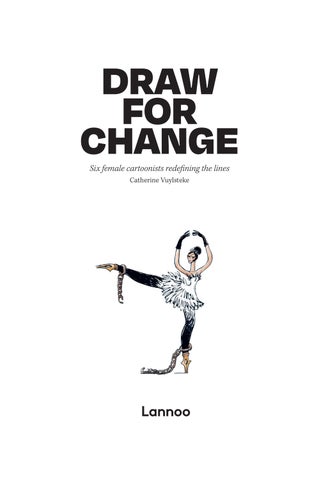
DRAW FOR CHANGE Six female cartoonists redefining the lines Catherine Vuylsteke
6
INTRO DUCTION
A
llow me a little confession: before embarking on documenting the life stories of the six female graphic artists to whom the acclaimed documentary series Draw for Change is dedicated, I didn’t have a clue about the world of comics. It is not a matter of disdain but rather of absolute ignorance. Consider it a deficiency, both in talent and practice. If learning to appreciate and understand editorial cartoons, comics, and graphic novels had been a compulsory skill, integrated into the school curriculum, perhaps I would have fared better. But it was not the case—so society’s undervaluation of this art form is to be held at least partially accountable.
7
Over the past years, much has changed, and with diligence, small wonders can be achieved. Nevertheless, I’ll never truly become a connoisseur. I do not feel fundamentally connected to this medium, but I find a profound resonance with the six women at the center of this book. Victoria Lomasko (Russia), Amany Al-Ali (Syria), Doaa El-Adl (Egypt), Rachita Taneja (India), Mar Maremoto (Mexico), and Ann Telnaes (USA) are all formidable artists. They hail from diverse worlds and belong to different generations: the eldest was born when John F. Kennedy won the elections, while the youngest entered this world nearly 35 years later. They are women who persist in their battles, displaying a determination bordering on foolishness. They confront patriarchal dogmas, authoritarian leaders, reactionary frameworks, religious edicts, and chauvinistic traditions. With humor, courage, and originality, they engage with the world, and often, their graphic statements prove more illuminating than the long, intricate explanations of others. They challenge rigid social conventions, expose the blind spots in our thinking, and assail society’s narrowmindedness. In other words, they liberate us and offer new perspectives, attempting to ignite debates, introspection, and change. I have spent many hours with each of them, listening to their stories. They shared painful memories, endearing anecdotes, moments of happiness and triumph. We met in Cairo, Leipzig, and Brussels—both in person and virtually. Some served me their favourite foods, while others allowed me to pet their cats. We drank countless cups of tea. And one of them was a true Scheherazade, spinning tales day after day, always promising that tomorrow would be even more exciting.
8
Often, their life trajectories are closely intertwined with those of their fathers. Amany Al-Ali’s father moved heaven and earth to shield her from the immoral art world, while Doaa El-Adl’s dad paved the way for her self-realisation. Victoria Lomasko’s father, even before her birth, decided that she would pursue a career as an artist. The artistic styles and lives of these women diverge as widely as the climate zones they come from, the languages they learned in their early years, and the gods that surround them. Some denounce homophobia, fatshaming, or misogyny, while others focus on censorship and persecution. Despite their differences, what stands out are the similarities. Rachita Taneja often aims her arrows at Prime Minister Narendra Modi, Amany Al-Ali directs hers at President Assad. Ann Telnaes takes aim at American leaders—she has created books on both Vice President Dick Cheney and Donald Trump. None of them chose an easy path—thus, they stumbled, they got hurt, and even thought of chucking it in. Loneliness, sorrow, controversy, and self-doubt became part of their journey, yet they picked themselves up. In order to go against the current and to tear off the gags to free speech. To find a spot, not just for themselves, but for all those people, whom they see as more vulnerable, less able to stand up for themselves. It is an eternal, incomplete attempt—to make the crooked straight. That already is a phenomenal achievement. Catherine Vuylsteke
9
1
Draw for Change
AMANY AL-ALI °1983
“She was killed by her partner.”
Draw for Change
I
n the beginning Amany is the radio from the desert. Or at least, that’s what her bedridden granddad in Aleppo calls her. She imagines stories for him, inventions in which children cut a path beyond the house, which is bolted on the inside and is built on the edge of the oasis. What Amany remembers most are the intrepid princesses, who travel alone to places where the doors are open and no rooms are forbidden. The grandfather and the child only see each other in the summer, when Amany and her six brothers and sisters swap
12
Amany Al-Ali
a Saudi provincial city for the native land of their parents. Syria is always a rainbow-coloured feast: the whole family picnics in the park or passes the time on the beach, gaping at the elegant women and innocently playing children. Whenever they get a chance, the girls lick sorbets, wearing the flower-pattern dresses that their mother tells them not to take with them when they leave. Even though they know the rules, this always ends in tears. In Amany’s mind Saudi Arabia is black, the black that swallows up everything. All other colours, dreams, bodies and lives alike. It begins when she is eleven. Her three-year older sister Shada gets a room of her own, she’s allowed to accompany their mother to the bath house and travels to Riyadh with her on family visits. These trips take an intriguing turn, as they invariably end in Shada barricading herself in her room for days on end. Things go on like this for years. Shada’s privileges amaze and upset the other children, even if she herself doesn’t seem to care. She is thin as a broomstick and hardly ever laughs. Mother offers no explanation, father comes home ever later, and angry winds rage at school. Rumours, wild stories—according to gossip, Shada is on the verge of collapse. But how would anyone know? The girl hardly spends any time at school. And after that one afternoon, she refuses to attend at all. Amany remembers it all too well. A scuffle breaks out on the playground. Shada gets pushed, many hands tug at her long garments. She staggers, lets out a scream, and freezes. The baldness of her scalp leaves onlookers breathless. But soon dismay turns into mockery. That evening, mother warns her anxious children that their patience is being tested. By tormentors who want
13
Draw for Change
“Assad and Putin’s peace is bombs and missiles.”
“The world does not want to see the massacres taking place in Syria.”
14
Amany Al-Ali
“The Syrian people are united until victory is achieved.”
15
2
Draw for Change
MAR MAREMOTO °1994
16
“My body is a revolution.”
Draw for Change
“My favourite place is with me.” “Just a simple drawing showing my idea of a perfect, chill day: lounging in my bed in my underwear, with my cat by my side.”
18
Mar Maremoto
“I am my own home.” “I’ve been crazy about tiny houses for as long as I can remember, you know those classic ones with the pointy roofs and brick walls? After checking out Louise De Bourgeois’s art, I got inspired to draw my version of a woman with a house for a head.”
“I don’t give a damn about your opinion.” “This text compliments the illustration Mi cuerpo es un revolución.” (see p.37)
4
Draw for Change
DOAA EL-ADL °1979
20
Stop Violence Against Women
Draw for Change
#Me Too - Sexual Harrassment
At Work
22
Doaa el-Adl
Female Genital Mutilation
23