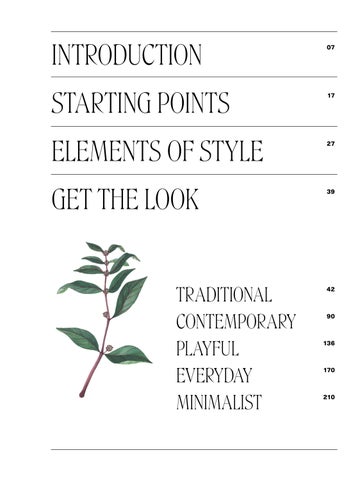
INTRODUCTION STARTING POINTS ELEMENTS OF STYLE GET THE LOOK TRADITIONAL CONTEMPORARY PLAYFUL EVERYDAY MINIMALIST
07
17
27
39
42
90
136
170
210
But how do you get to this point? Firstly, I’d suggest looking with fresh eyes at the space you currently have and begin to think of it as an extension of your interior and very much a part of your home. As such, aim to create similar comforts to those indoors, for example cosy places to sit, cook, eat, lounge around and sleep. Consider how to get the best use from what you have available and the sort of ‘look’, ‘feel’ and ‘emotional response’ you’d like to have. With regards to aesthetics, there is no right or wrong as this will depend on your own personal taste, which, like you, is unique. During the pandemic, many people realised the huge benefits of extending their homes into the outdoors. Properties with well-designed outdoor living areas have become more desirable than ever, so money spent on improvements is a good investment. It’s worth bearing in mind that a beautiful outdoor space can improve the interior space too by offering a great view, a feeling of spaciousness and an engagement with the natural world.
10
INTRODUCTION
ELEMENTS OF STYLE
27
THERE ARE NUMEROUS ELEMENTS that need to be considered for the
purposes of creating a practical and stylish outdoor space. While the list below is not comprehensive, I have included the most important constituent parts that will help you make it beautiful and a joy to spend time in.
28
ELEMENTS OF STYLE
BOUNDARIES The boundaries of your outdoor space play an important role in the overall aesthetic as well as the peace and comfort of time spent outdoors. Boundaries are often installed for security reasons or for defining the edges of your property, but they are also useful for creating a sense of privacy, to screen off the neighbours or unwanted views, and to improve the overall aesthetic. The best boundaries are the ones that blur into their surroundings by appearing to merge with what’s beyond. It’s worth being aware that the smaller the garden is, the more important it is to disguise walls as they are closer and therefore have a more dominant presence than in a larger garden.
Hedging & climbing plants The most straightforward way to achieve this is by using hedging plants to form a barrier, however, if this is not possible and you have to have fencing then it’s well worth using climbing plants to make it ‘disappear’. Hedges make a wonderful backdrop, are excellent at filtering the wind, and create safe havens and a source of food for wildlife. With both hedging and climbing plants, it is important to take into consideration whether or not the plant is evergreen, scented, the speed at which it grows and how much maintenance it requires. The benefit of evergreen plants is that you get year-round cover. However, you may prefer to have that plants lose their leaves over autumn and winter and allow more light into the area during those darker months. The speed of growth and the amount of maintenance is also important. Remember, if you want plants to grow quickly to create a hedge or cover a wall then they are not just going to stop when they’ve done so! If you’d prefer to reduce the amount of pruning and cutting back, it may be better to be patient and choose something that grows slowly. Be aware that some of the more vigorous climbers can potentially damage walls and fences once established, so you may want to consider installing a separate frame or a strong system of wire supports for them to grow up.
Fencing The most popular material for boundaries is wooden fencing as it sits well in the landscape, comes in numerous styles, is relatively long-lasting and often cheaper than other options. To ensure wooden fences have as long a lifespan as long as possible, it is best to choose either a softwood such as pine that has been treated with a wood preservative (often referred to as ‘tanalised’ wood) or, if your budget allows, then a good quality hardwood. In terms of style, it’s worth looking around to see what is used locally. If you live in the countryside, a more rustic look might work best, whereas if you live in a city then something smarter and more ‘finished’ is often preferable. You can also buy metal fencing such as railings, estate fencing or chain-link. The height of your fence is also an important consideration and it’s advisable to check local planning laws to find out what is permissible. In general terms, fences of around 1.8m provide a decent amount of privacy without feeling too dominant. Bear in mind the taller your fence, the more light you will block out. Solid fencing can cause the wind to eddy, damaging plants and sometimes causing fences to fall over, therefore those that have gaps or are woven and allow some degree of wind to blow through them work best in windy situations.
29
33
GET
THE
LOOK
39
GET
THE
LOOK
CONTEMPORARY
90
222
GET THE LOOK
PLAYFUL
143
EVERYDAY
187
TROPICAL ZONE
The scale of the planting, towering over the furniture, brings an unmistakable drama to this outdoor seating area. The unusual mix of turquoises, pinks, greys and the palest of greens work surprisingly well with the deep green foliage.
1 Extra-large planting containers arranged in
a wide curve bring a sense of fun and weightiness to this outdoor space. They also ensure there’s plenty of space for the root balls of the giant plants. The pots’ various pastel colours in a matte finish work perfectly with those of the predominantly turquoise furniture, forming a cohesive and balanced look.
2 A mixture of large-leaved, exotic-looking plants in various sizes bring structure and drama to the setting.
3 A low coffee table on slim supports brings a
touch of lightness to the rest of the substantial looking furniture and containers. The colour scheme – turquoises, pale greens and pinks – creates a peaceful, almost otherworldly, atmosphere that is distinct and memorable.
2
4 Outdoor rugs are a great way to add colour, cosiness and a feeling of connection to the interior of your home. Make sure they are specifically for use outside and can withstand rain and dirt.
7
5 The rich, dark green tops of these rounded, low
white forms are a perfect match for the green leaves of the plantings scheme, bringing interest while ensuring a level of unity.
6 Large cushions provide seating and help give weight to the scene, drawing the eye down from the drama of the large plants.
7 The backdrop of a plain grey rendered wall helps emphasise the sculptural quality of the outsized plants and picks up the shadows cast by the leaves and stems.
3
4
1
PLAYFUL
5
6
165