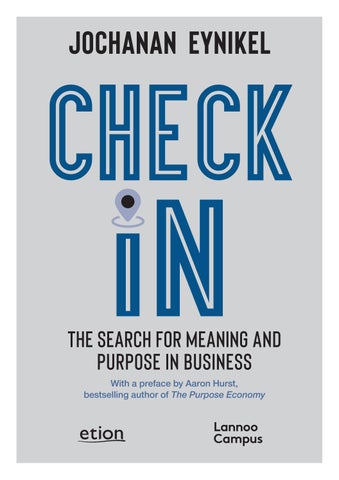
Check-in_BW_ENG.indd 3
3/05/2021 13:48
This book was originally published as Check-In, LannooCampus, 2020. D/2021/45/254 – ISBN 978 94 014 7803 8 – NUR 800, 740 Cover design: Gert Degrande | De Witlofcompagnie Interior design: Wendy De Haes Translation: Ian Connerty © Jochanan Eynikel & Lannoo Publishers nv, Tielt, 2021. LannooCampus Publishers is a subsidiary of Lannoo Publishers, the book and multimedia division of Lannoo Publishers nv. All rights reserved. No part of this publication may be reproduced and/or made public, by means of printing, photocopying, microfilm or any other means, without the prior written permission of the publisher. LannooCampus Publishers Vaartkom 41 box 01.02 P.O. Box 23202 3000 Leuven 1100 DS Amsterdam Belgium Netherlands www.lannoocampus.com
Check-in_BW_ENG.indd 4
3/05/2021 13:48
content
CONTENTS PREFACE BY AARON HURST
9
MY CHECK-IN
13
PART I COMPANY SEEKS MEANING
23
1 A Man Goes to the Doctor...
25
2 Signals of Meaning
29 29 33 39 46
3 More Than Spiritual Window Dressing
49
4 The Check-In Moment
55
The Shift to Meaning The Why of Work Meaning in an Era of Bits and Bots The Rise of The Purpose Economy
Check-in_BW_ENG.indd 5
3/05/2021 13:48
PART II ECONOMICS OF GOOD AND EVIL 1 The Original Purpose Economy
65 68
2 The Great Separation: The Enlightenment
75 75 78 80
3 An Ethical Revival
87 87 92
Economics as Religion
Greed Is Good The Birth of Homo Economicus The Shadow of The Enlightenment
More Value for More People Costly Signalling
PART III COMPANIES AS MEANING-MAKERS
97
1 The Meaning of Meaning
99 101 102 103 104
2 Bullshit Jobs
107 114
3 Building Meaning
119 120 122
4 The Profit in Values
131
Coherence Purpose Significance Meaning = Connection
I Do, Therefore I Am
How Meaningful Work Works Person, Job, Goal and Group
Check-in_BW_ENG.indd 6
63
3/05/2021 13:48
PART IV SPIRITUAL CAPITAL
135
1 The Undercurrent
137 138 143
2 Diving to the Depths
149 152 156 158 160
TIME FOR A BETTER NORMAL
165
CHECK-OUT
173
EPILOGUE
177
REFERENCES AND LITERATURE
180
ENDNOTES
187
Business Spirituality The Power of Stories
Step #1: The Personal Check-In Step #2: My Story in the Organisation Step #3: In Search of Our Story Step #4: From Meaning to Inspiration
Check-in_BW_ENG.indd 7
3/05/2021 13:48
check-in [noun] The action of registering one’s presence - Oxford English Dictionary -
Check-in_BW_ENG.indd 8
3/05/2021 13:48
PREFACE BY AARON HURST 9
Every December 31st, I quit my job. The next day I decide if I want to take the job again for the New Year. It helps me clear the noise and make sure I am 150 percent behind what I am doing and that it is how I want to spend the majority of my waking hours. On January 1, 2020, I woke up early and went for a walk on the beach. We were staying at a hotel at the very tip of Cabo San Lucas, Mexico. Earlier that week, they had released baby sea turtles into the Pacific and we had watched them try to make it to the water, fighting the waves as they crashed and then rolled up the beach catching and spinning the turtles in every direction. Most evenings we had sat and watched the sunset and had seen whales making their way up and down the coast less than 200 meters from where we sat. Walking on the beach, I weighed the pros and cons of continuing my current work at Imperative, the company I started in 2013 with the publication of The Purpose Economy. The first years at Imperative were spent touring and promoting the thesis of the book – that the creation of meaning for people was the catalyst for the fourth economy in history. I travelled the world making the case that quest for purpose was driving innovation in consumer markets and radical changes in the demands of the workforce. As I walked along the beach, the impact of this work became clear to me. In just a few years, purpose was very definitely on the map. In 2019, 181 of the top CEOs in the world had worked together through the Business Roundtable to mark the change. They had collectively embraced that shareholder value creation is not the only objective of a
Check-in_BW_ENG.indd 9
3/05/2021 13:48
CHECK-IN
10
company. They defined a new purpose that embraced the new Purpose Economy. Larry Fink, the CEO of BlackRock, had made purpose an imperative for his portfolio companies. And perhaps most telling, nearly every major consulting firm had established a purpose practice. They had spent the last few decades selling digital transformation services and now they were selling purpose transformation services. But after the publication and tour, I struggled. We moved from Brooklyn to Seattle and had to restart the company. We spent four years trying to build a scalable platform to enable employers to develop and support a purpose-driven workforce. The constant state of invention, excitement, and failure had taken a toll on me. I had started to feel like a fraud. I was selling people a big and important idea but never delivering on the promise – a solution to sustainably scale purpose to every employee in every company. 2019, I had promised myself and my family, was likely going to be the last year at Imperative. January 1, 2020 was likely to be the day when I finally decided not to hire myself back. It wasn’t just the lack of traction at Imperative that had gotten me down. Donald Trump’s election in 2016 had really dealt a blow to my worldview. I had seen the march of progress as a given with the election of Barack Obama and the rise of the Purpose Economy. The democracy and march of progress I had taken for granted were under attack. But something happened in 2019 that renewed my commitment to our work. After years of struggle, we had discovered something that truly had the potential to make the impact we had been working to realize. When I had done keynotes for companies on the Purpose Economy, I would have employees in the audience break into pairs and answer a set of questions about their own purpose and work:
1
When did you first realise that work could be about more than status or a pay check?
Check-in_BW_ENG.indd 10
3/05/2021 13:48
2 What is the most personally meaningful impact you have made at work this year? Why?
3 What is one thing you can do in the next week to make your work more meaningful?
What struck me at one of these events in late 2018 was that these conversations were purpose moments. People were meaningfully connecting with another person. They were helping a peer discover their purpose. And they were growing as human beings. Why don’t these kinds of conversations happen more often at work? If we had these kinds of conversations regularly in the workplace they would not only be energising but also create the space for people to have the courage and insights to own their work and tailor it to make it personally meaningful.
PREFACE BY AARON HURST
Every time that I tried to bring the room back from the conversations it felt like trying to dam water in a roaring river. No one wanted to stop talking to their partner. There was such a powerful energy in the room!
11
In 2019 we studied the idea. We spoke to people who had experienced it. We spoke to human resources executives. We did a survey of the American workforce to understand the potential. We tried experiments with employees at partner companies. The feedback was consistent and encouraging – conversations may be the unicorn opportunity for workplace technology in the Purpose Economy. We developed a pitch deck and began raising venture capital to build what we described as the peer coaching platform. We envisioned a platform that would continuously match and guide employees through conversations that would empower them to work with purpose. So, walking on the beach on January 1st in Mexico at the start of the new decade, I was reenergized by the potential of our discovery. But I was also acutely aware that we had less than three months of cash left and if we didn’t raise capital soon we were done. I gave my New Years’ practice a three-month extension. I hired myself back for three months to see if we could raise the capital.
Check-in_BW_ENG.indd 11
3/05/2021 13:48
CHECK-IN
12
With two weeks of cash left, we closed on seed funding from Voyager Capital and Court Lorenzini, the co-founder of Docusign. They saw the potential, as a lucrative venture-backed start-up and as an idea that could truly impact the lives of millions of people. We began beta testing the new platform and the response was overwhelming. People trapped at home during the pandemic were experiencing meaningful human connection for the first time in months, if not years. They were working through the changes in their lives and the world with peers who shared similar fears and dreams. By the end of 2020, we had begun to sell the platform and quickly had six companies purchase pilots and a pipeline of dozens more who shared our vision for peer coaching as the heart and soul of the new workplace. I closed out 2020 watching New Year’s on CNN and woke the next morning to find that, like most people, I was stuck at home. No baby sea turtles. No whales. No beach. What I did have, when I did check in with myself, was a great deal of hope. The election was over. A vaccine was on the way. Corporations had taken the most serious steps in my lifetime to addressing systemic racism. And we had seen the power of reconnecting people on Imperative enabling us to find ourselves, each other, and our shared purpose. We were back on track. This book by Jochanan is all about making connections too. If there is no connection between person and purpose, or no personal check-in with the why and the values of an organisation, the purpose economy lacks a foundation and authenticity. Check-In is an invitation to dive deeper into the foundation and the undercurrent of the purpose economy: sharing stories about what truly matters to every one of us. After all, the power of purpose is rooted in our personal need for meaning. So check in and let yourself be inspired by (t)his story!
Check-in_BW_ENG.indd 12
3/05/2021 13:48
MY CHECK-IN 13
My grandfather was a pilot. With the Belgian national airline Sabena, the forerunner of Brussels Airlines. Flying had always been his life’s dream. During the Second World War, he used to climb trees to watch the fighters and bombers passing overhead. At the start of the 1950s, as the young son of a butcher from the small Flemish village of Afsnee, he was given the unique opportunity to travel to Texas in the United States to follow a pilot’s training course for the air force. This was so exceptional that there was even a report in the local press when he returned. Flying was his life. Not his profession. He repeatedly told us that he had never worked a single day. Work was a burden, something that you have to do against your will. Hard labour. In contrast, flying was something that he loved to do, preferably as often as possible. For him, flying meant much more than simply taking people from A to B. Flying was daring to defy gravity, seeing the world, experiencing new cultures. Back then, it also meant status and, above all, the freedom to spread your wings. For him, being a pilot was an important part of his identity. Perhaps even the most important part. He inspired both of his sons and two of his grandsons to follow in his professional footsteps. When he retired in the mid-1980s, after a fine career as a captain and director of training, he found himself facing emptiness for the first time in his life. To fill this void, he dedicated himself to a new passion: philosophy. In particular, he was greatly inspired by the 17th century
Check-in_BW_ENG.indd 13
3/05/2021 13:48
CHECK-IN
14
Dutch philosopher of the Enlightenment, Baruch Spinoza. The rationalist Spinoza challenged the dogmas and superstition of the religious leaders of his day. He developed a strictly rational theory of God, mankind and the world. Spinoza still had a place for a god, but not for one who operated beyond the laws of nature and directed the lives of people like some kind of all-powerful puppet master. Instead, he offered an image of god as Deus sive Natura. God is Nature, which manifests itself to us in many different ways. This combination of a scientific way of thinking, but without jettisoning the spiritual, strongly appealed to my grandfather and closely reflected his own approach to life. Rational, but not soulless. At the start of the 1990s, the Norwegian author Jostein Gaarder published Sophie’s World (1991). It became a worldwide bestseller. In the form of a novel about the life of the fourteen-year-old Sophie Amundsen, Gaarder presented a concise summary of Western philosophy. I must have been about the same age as the fictional Sophie when my grandfather gifted the book to each of his nine grandchildren. Including me. It was my first real contact with philosophy. It was not the only reason why I later went on to study this subject at university – as the son of two religious scholars the humanities were never very far away – but my grandfather’s gift unquestionably planted a seed for my later development. And so it was that in 1999 I enrolled as a student of philosophy at the Catholic University of Leuven. My studies did not disappoint me, but gradually I began to feel that I was missing something. Perhaps it was because I was too close to my subject – right in the middle of it, as it were – that I found it was not always easy to see the practical relevance of philosophy. I had the feeling that I was engaged in ‘philosophie philosophienne’.1 Philosophy for philosophy’s sake, which occupied itself primarily with philosophical reflections on what other philosophers had already said. The comparison and critical questioning of history’s great thinkers is, of course, an essential part of the development of any philosopher, but I was increasingly worried by the absence of any par-
Check-in_BW_ENG.indd 14
3/05/2021 13:48
allel form of applied thinking that focused on contemporary societal themes and problems.2 In one way or another, I began to experience a growing gulf between what fascinated me intellectually and the things that I found to be truly important as a person.
MY CHECK-IN
Two things happened to change this. In the final year of my studies I was able to spend a term at the University of Stellenbosch in South Africa. There, we worked together in small interactive groups. After a few introductory lessons given by the departmental professor, the study material was divided up amongst the students, following which each of us was expected to give the introduction for one of the subsequent lessons. At first, I was uneasy about this prospect, but it turned out to be the best lesson I ever had in learning how to philosophise for yourself. Marshalling your arguments, building up a sequence of thought, providing new perspectives. At last, I had discovered a form of philosophy in practice!
15
The second eye-opener was my introduction to Socratic questioning.3 This is a structured method of dialogue based on the manner in which the Greek philosopher Socrates challenged the ‘captains of society’ in Athens during the 5th century B.C. He did not do this within the hallowed walls of a university or academy, but in the highly public arena of the agora or market place. As a result, it is probably fair to say that Socrates was the first business philosopher in history. Socrates did not have a fixed or written method, but simply asked ‘difficult questions’. Other more recent philosophers, such as the German Leonard Nelson, rehabilitated the Socratic concept from the start of the 20th century onwards as a method for seeking enlightenment and the truth (Nelson, 1922). A Socratic dialogue attempts to provide answers to fundamental questions in a structured way. These might be classic philosophical questions, such as the existence of free will, but more frequently – and often more interestingly – they will deal with fundamental questions that are relevant to everyday modern life, such as ‘Is it acceptable to make fun of everything?’, ‘Does change always mean progress?’, ‘When is an
Check-in_BW_ENG.indd 15
3/05/2021 13:48
organisation morally responsible?’ or ‘What is leadership?’ In other words, questions that also have relevance for the business world.
CHECK-IN
16
A unique aspect of the Socratic method is the manner in which it takes the concrete experience of one of the participants as the starting point for the dialogue. For instance, an example of change that did mean progress to one of those present or a situation in which someone recognised what they regarded as leadership. Using this concrete experience as the basis, the dialogue works back towards more abstract insights relating to the central question. These insights are not derived from a source of authority or books, but from the dialogue itself. Socratic dialogue allowed me to become familiar with a practical form of philosophy that could be applied to day-to-day life. It dealt with the questions that really mattered. It was engaged philosophy. In this way, philosophy was given extra meaning for me, because it related more closely to things that were also important to me personally: the questioning and investigation of the ‘why’ of things and the gaining of insights into the modes of thought and frames of reference which underlie what people do and say. With a number of friends amongst my fellow students, I very quickly began to experiment with this method. At a series of monthly meetings, we invited people to enter into discussion about a number of the fundamental questions with which we were confronted in our personal or professional lives. In this way, the seeds were once again sown for what I still today experience as meaningful. Via this process of Socratic dialogue, my philosophical interests began to turn more and more towards the world of business. This world also needs to answer fundamental questions, such as what motivates people or what is the raison d’être or ethical mission of an organisation. Moreover, these questions are becoming increasingly urgent in a context in which companies are being challenged to their very core by critical consumers and citizens who are better informed and can exchange information more quickly than ever before – a situation that is further exacerbated by competition with newly emerging economic superpowers and by wider societal challenges, such as global warm-
Check-in_BW_ENG.indd 16
3/05/2021 13:48
ing, migration and geopolitical change. Some innovations, such as artificial intelligence and robots, even challenge what it means to be human.4
17 MY CHECK-IN
Since 2013, I have had the pleasure and the privilege as a business philosopher to make the consideration of fundamental questions in the business world my profession. If feels both good and right to be able to work at the point where my personal interests, ambitions and values all intersect. I experience little conflict or distance between what I do and who I am. ‘Good for you!’ I can hear you think. ‘But can we please get on to the heart of the matter now?’ As a matter of fact, this is the heart of the matter! No, not my individual story, but rather the importance of personal meaning in giving shape and form to meaningful work and to organisations that wish to have a worthwhile purpose that goes beyond mere profit. Whether we are dealing with work in general, an organisation or a product, if we want to add meaning to our economic activities – and in the pages ahead we will see that there is a clear need for this – we must take as our starting point the human being as a person in his or her own right, and therefore as a creature that both gives meaning and seeks meaning. Providing meaning in the economy is therefore closely related to the raison d’être of our personal life or of life itself within the economic process (Opdebeeck, 2016). This is precisely what I wish to highlight by telling my own story and that of my grandfather. Meaning begins with yourself. With the individual. With the non-reducible experience of how each of us leads our own life. And – now that ‘life’ is increasingly becoming a part of ‘work’, rather than simply being kept in balance with it – with the personal meaning that work, entrepreneurship or creativity has for each of us. That is the starting point for providing meaning in an organisational context. Consequently, this personal note with which I have chosen to start the book should be regarded as a personal check-in on the theme of economic meaning, which – mindful of Socrates – I first wish to remove from abstraction, before proceeding to analyse it and frame it
Check-in_BW_ENG.indd 17
3/05/2021 13:48
theoretically. Meaning and meaningfulness in the professional context are inextricably intertwined with our personal frames of reference. With our own story.
CHECK-IN
18
We will see that the finding of meaning in work is not a matter of finding your dream job or the ultimate formula for success. Instead, it is about how you relate personally to your work or organisation. Is it simply a way to earn money? Or is it something more? Something with which you can identify at a personal level? Something where you don’t need to leave behind a piece of yourself as soon as you walk through the company door, but can be present in your entirety? In short, somewhere where you can be yourself: not only intellectually, but also emotionally, socially and even spiritually? Meaning in organisations is about the search for the connection between what motivates us personally and what drives organisations collectively. With this book, I want to examine how the playing fields of the economy and meaning relate to each other in today’s world. Because the situation is unquestionably changing. Both internally and externally, a growing number of organisations wish to mean something more than just profit. From the provision of meaningful work to a transformation into a company with a mission or purpose, organisations are looking for meaning. The question about the ‘why’ of work and production has never been more relevant. Of course, the ‘why’ question is also the most important question in philosophy. The ‘why’ expresses the sense of inquiry and wonder that all philosophers take as their starting point. Why do people think what they think? Why do people care for each other? ‘Why is there something rather than nothing,’ as the German philosopher Leibnitz put it in 1714 in the most classic of all philosophical questions. A good two hundred years later, his compatriot Martin Heidegger concurred in his inaugural address at Freiburg University that this was indeed ‘the fundamental question’ (Heidegger, 1929). At this point, let me calm your fears: this book has no intention of dealing with ‘hardcore’ philosophical questions like ‘the Being of beings’. However, I do believe that philosophy and human sciences that
Check-in_BW_ENG.indd 18
3/05/2021 13:48
19 MY CHECK-IN
think more deeply about the underlying foundations and mechanisms of human existence can contribute to the search for greater meaning in the economic sphere. The ‘why’ behind economic questions such as ‘Why do we work?’, ‘Why do people choose a particular product?’ or ‘Why do companies exist?’ seeks answers that go beyond straightforward economic logic. They are interwoven with the views that we hold of mankind and the world, albeit often unconsciously. Ever since the time of Plato in the fourth century B.C., philosophy has been an instrument to make us more aware of true and false ideas about ourselves and the world we live in.5 To a significant extent, these ideas and stories determine our choices and our behaviour, because they give meaning to the world and allow us to experience meaningfulness, also in terms of economic activity. The link between the economy and meaning is to be found first and foremost in our work, but also increasingly in the relationship of organisations with their customers and society at large. This process of economic meaning is what I want to examine in this book. Not only from the perspective of philosophy, but also from the perspective of other human sciences, such as psychology and sociology, and from my own practical experience of working with entrepreneurs and leaders. These various perspectives on meaning and meaningfulness can inspire companies to make a difference in the economic field. For their staff, their customers and society as a whole. By gaining greater insight into the foundations and mechanisms of meaning, we can contribute to a more meaningful economy. In the first part of the book, I will explore the economic world’s current search for meaning. I will identify a number of the signals at the macro level that indicate a convergence between these two different aspects of life. At the same time, I will highlight the place and, above all, the importance of providing meaning at the micro level. I will then take this a stage further to explain why, in my opinion, the search for meaning in the business world is doomed to failure unless it responds to people’s need for individual meaning in their economic activities.
Check-in_BW_ENG.indd 19
3/05/2021 13:48
CHECK-IN
20
Following this, we will look briefly at the past. Throughout most of history, economics and meaning have been closely intertwined. However, this link has been severed since the time of Enlightenment. As a result, today’s search for economic meaning is primarily a process of rediscovering and reconnecting with what has been lost. In part III, I will focus on the psychological mechanisms of meaning within the context of work and organisations. Nowadays, too many people regard their work as being meaningless: ‘bullshit jobs’, as they have been described by the American anthropologist David Graeber (2013 and 2018). Contrary to what Graeber thinks, I can see no point in vilifying capitalism, but I do want to suggest a number of building blocks that may help to make work and organisations more meaningful from the inside out. The schedule on page 125 gives an overview of these building blocks. Finally, in the fourth part, I will outline a number of steps that companies can take to discover and strengthen their spiritual capital from within. These steps are focused on developing a form of organisational structure and a company purpose to which people can feel personally committed. In other words, organisations where you, as an individual, can check-in.
Check-in_BW_ENG.indd 20
3/05/2021 13:48
Check-in_BW_ENG.indd 21
3/05/2021 13:48
Multiple case studies have been written about how great achievements start with passion. It is that high octane fuel that has powered organisations and individuals to new heights. But is it really? For many years, I have asked myself, and others, the question ‘What is your passion?’. I have come to realise the more fundamental and essential question is one click deeper. It is not about passion. It is about purpose. Your true north star. I define my personal leadership purpose as helping others be the best they can be. Crystallising my purpose helps me bring my full authentic self to work, defines my servant leadership style and galvanises the values and beliefs that guide my actions. My highest and most gratifying reward is witnessing an individual or a team outperform themselves. Fulfilling my purpose requires me at my best. For me to thrive, I need a purpose-driven environment that is congruent with my personal value system. One that I have found at Starbucks. For the past 50 years, our mission has been deeply rooted in the belief that the pursuit of doing good goes hand in hand with the pursuit of profit. Our actions are guided by doing what is right and by acting with courage and respect, especially in the face of adversity. And, in the end, that algorithm works well: when you take genuine care of farmers, suppliers, partners (our employees), customers and communities, then shareholders will benefit as well. This fills my cup.
– HANS MELOTTE, EXECUTIVE VICE PRESIDENT STARBUCKS
Check-in_BW_ENG.indd 22
3/05/2021 13:48