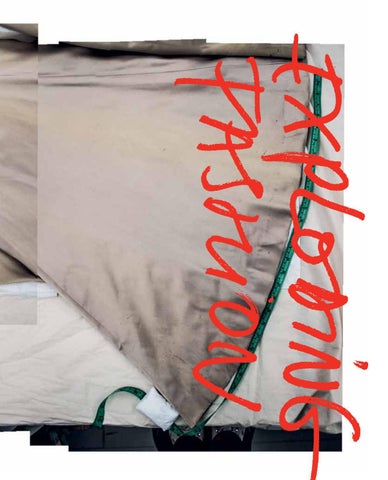
Introduction The Rationale Exploding Fashion unpicks and pulls apart twentieth-century fashion and then puts it back together again in order to understand it better. Like an exploded-view drawing, or artist Cornelia Parker’s sculpture Cold Dark Matter: An Exploded View (1991), this Central Saint Martins research project deconstructs five museum objects – key examples of the work of five twentiethcentury fashion designers invested in pattern-cutting – in order to unmask the design and construction processes of fashion. The Italian art curator Germano Celant, who was also director of the Fondazione Prada Milan from 1995, wrote an essay about the importance of cutting in art and fashion. He said: ‘To cut is to think and to see.’1 Indeed, pattern-cutting involves a technical, conceptual and creative transformation: it turns two-dimensional cloth into three-dimensional garment form, changing fabric into fashion. This research project foregrounds the pattern cutter as an essential maker and technician in the fashion design process – a figure largely unfamiliar in both design histories and popular imagination. The pattern cutters in our research team brought not only an extraordinary level of technical knowledge to the project but also an intuitive sensibility in reading garments, something that again is not fully recognised in fashion histories in general, or museum cataloguing in particular. At the same time, we examine the industrial craft of pattern-cutting and the role it plays in dress design. In relating the concept of ‘thinking through making’ to traditional archival research methods, the project has the potential to catalyse a different paradigm for object-based research in the field.
3D exploded view drawing of the remade Madeleine Vionnet dress 12 INTRODUCTION
Halston, envelope containing sarong dress paper pattern, 1976, The Halston Archives, MFIT
21
1. Methods and Making From 2D to 3D to 3D Animation The title, Exploding Fashion, was intended as a provocation; we wanted to ‘explode’ the mystique of the fashion design process in two ways. Firstly, we sought to dispel the myth of the designer as sole creative genius by uncovering the intriguing role of the pattern cutter. Secondly, we elected to reverse-engineer five historical designs by game-changing designers who were also innovative pattern cutters, digitally reanimating museum objects as moving images in order to visually narrate how these designs were once made, and how they moved on the body in real time and space. The final products of the project are 3D animations of the dresses in motion, but Exploding Fashion was never intended as a showcase for the latest technology, as by definition it will always become outdated in a rapidly changing field. Instead, it explores longer-lasting ideas about craft, the digital, the body and movement. ‘Methods and Making’ investigates the three principle parts of the process: garment construction from the inside out; the transition from 2D to 3D; and the transition from 3D to 3D motion. The Halston Envelope The project was initiated by a problem encountered in studying surviving dress in museum archives, where a researcher with an appointment is permitted to study objects from the collection at close quarters. Compared to other kinds of museum objects, such as furniture or sculpture, fashion is for the most part made in fine and perishable materials that make it fragile and prone to damage. For conservation and financial reasons, museum archives show garments on a table and will not generally put them on a dressmaker’s dummy, so the researcher cannot see them in the round. Nor is the researcher permitted to touch them. It can be difficult to record and understand the design details of a complex garment that resists being laid flat on the table, or of pattern pieces that appear ambiguous. One of the aims of Exploding Fashion is to show the cut and construction of ‘difficult’ garments that a visit to a museum archive might not reveal. It also generates resources that could sit alongside the museum object, such as patterns, or copies of the dress and film animations showing how it moved on the body, to enrich understanding without breaking museum conservation regulations. If there is one object that typifies the problem encountered backstage in the museum, it is the pattern for the Halston dress at the Halston Archives at the Museum at FIT (Fashion Institute of Technology) in New York. When we found out the collection included the pattern that matched the surviving dress we had
24
SECTION A: MAKE, UNMAKE, REMAKE_METHODS AND MAKING
An Upside-Down Tulip in Palm Beach From our research at the Clothworkers’ Centre in London, the project’s historian Caroline Evans and curator Alistair O’Neill were inspired by the way the pattern cutters inspected garments on the table. By turning them on their sides or inside out, new vistas were revealed. The outline of the garment (or the pattern) shape-shifted in moving from the flat to the round, helping to communicate in visual terms the translation from 2D to 3D. Often these shapes were geometric; sometimes they suggested natural forms (we found one that looked like a stingray); but they always conveyed a hidden side to the nature of the garment, as if acting as a secret pictorial language of pattern-cutting. We were struck by something American fashion designer Ralph Rucci once said about how he secured a job working for Halston: ‘He asked me, “What does the pattern look like?” And I said, “An upside-down tulip in Palm Beach.” He adored that answer.’2 The project’s curator found these visual ideas mesmerising, and wanted to employ them as a means of expressing the transformative potential of woven cloth in transmutative, symbolic form. They appeared as hieroglyphs, only grasped by those with a technical understanding of how garments appear; who are able to see threedimensional form arising from lines traced across two-dimensional cloth. It was a non-verbal language to learn and celebrate. Reverse-Engineering In order to reverse-engineer each dress design, we had to make a pattern from the existing garment, known in the fashion industry as ‘rubbing-off’ or lifting a pattern. The method is as old as pattern-cutting itself, and is chiefly used for copying a garment where no pattern exists or where it cannot be accessed. It is commonly employed today when using vintage garments as ideas for contemporary fashion design, so it was known to the project’s pattern cutters. But the method is also found in fashion history. Dress historians take patterns from surviving dress in order to understand its cut and construction, publishing scale patterns of extant garments as pattern books.3 More recent research identifies reconstructions of historical dress as a method by which to understand a garment from the inside out, as a material-led form of embodied knowledge.4 At the Clothworkers’ Centre, our pattern cutters were taught the method of toile-making as practised by museum conservators, employed in creating a facsimile to test the mounting of a museum object.5 This was new to them, as they had to measure, trace and plot each panel in the garment independently. In the fashion industry it is still common practice to unpick and disassemble the garment in order to lift the pattern.
The Victoria and Albert Museum was the host museum for the project, and the Clothworkers’ Centre was where we did most of our initial thinking, our training in conservation handling, and our first object investigations. Starting from a dress laid out flat on a museum archive table, by turning it on its side or inside out, new vistas were revealed. Photographing the object from above as it lay on the table was also a way of reducing it to a two-dimensional picture plane.
Testing the pattern pieces of the Charles James dress on the stand at the Costume Institute
These adjustments were then transferred back to the patterns and a reproduction dress was made in the final fabric, based on the original dress material.
By asking Kitty Garratt, our fit model, to walk in the toile, the dress was exposed to human locomotion. It showed us aspects of the dress designs that we could not appreciate in the museum store, or at the pattern-cutting table. The secrets of the Charles James dress, for example, were only revealed as we made it. As we could not touch the surviving original, we did not realise until the toiling stage that it required weighting in the hem to hang properly. It was only when the machinist was pressing the skirt for sewing that the four kicks to the front of the skirt, set between the side panniers, fell as they should.
Toile for the remade Comme des Garçons, Autumn/Winter 1983/84, a jersey dress with two looping panels and sleeves
35
Heel heights have a bearing on how a model walks in a dress. In order to capture the historically correct heel height, for each model we provided shoes to work in, fitted with sensors – low-tech objects used in the service of cutting-edge digital visualisation.
Our models were then dressed in the studio’s motion capture suits. They reminded us of the suits Marey made for his models to wear in his photographic experiments, which bridged the realms of photography and film: we created a twenty-first-century ‘black box’.
Examining the Madeleine Vionnet dress at the MAD archive
Kitty modelling the remade Comme des Garçons dress
144
SECTION A: MAKE, UNMAKE, REMAKE_DRESS SUMMARIES AND MUSEUM STATEMENTS
145
In making the toile at Central Saint Martins, the pattern cutters discovered another issue. Esme:
With the Comme dress I thought the sewing would be really simple but no, it’s not.
Alistair:
Why?
Esme:
Because it was sewn on a zig-zag machine and the machine is pulling the fabric, making the edge go frilly. And the toile is pressed, so it was actually worse than that to begin with. But we are going to try a walking foot, or a roller foot, and see if that will do. Otherwise it will be an absolute nightmare.
Patrick:
Do we have any pictures of the dress?
Liam:
No, remember, we don’t have any!
Patrick:
What occurs to me is that they might have sewn transparent thread first and then zig-zagged.
Esme:
Well, there have been various thoughts about how this could be resolved if we can’t get a foot, such as putting miniscule tape on, like a thread. Or there’s another technique that people used to do, particularly on fine fabric. They’d fold it over and zig-zag, and then cut away. People did that with chiffon in the 1970s.
The use of a walking foot to ease the fabric through the sewing machine at a continuous tension was the solution for the toile, but the selection of the final fabric for the dress was another issue. The Comme fabric was a medium weight wool jersey, but crucially without stretch. The majority of wool jersey available today has stretch in it, but it was inappropriate for the dress. In some instances, when we asked textile mills for natural fibre fabrics, we were sent man-made examples, which had the weight and handle (the term used to describe tactility) of the fabric we were looking to source; this might have been permissible in other contexts, but it was not viable for the project. In the end, a natural fibre wool jersey with virtually no stretch was sourced.
149
Paper Pattern Pieces