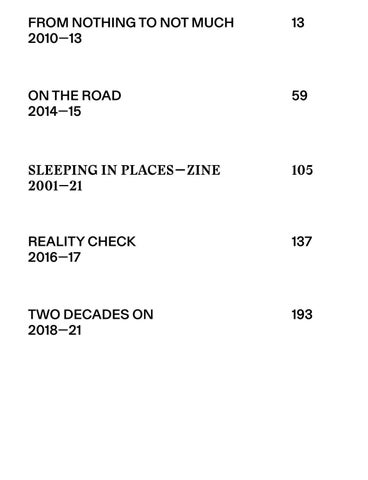
FROM NOTHING TO NOT MUCH 2010—13
13
ON THE ROAD 2014—15
59
SLEEPING IN PLACES—ZINE 2001—21
105
REALITY CHECK 2016—17
137
TWO DECADES ON 2018—21
193
FOREWORD
BY HUMPHREY OCEAN
The art I love most is unpreventable. It can only be made at the time it was made and is urgent, in the way a Mexican revolutionary poster is. The bison drawn on early cave walls are so present and correct we accept they were darting about nearby. The more transient the art, the more it risks losing meaning. For Broken Fingaz (no use asking about the name) with something to say, a wall is a call to arms. They know the static image absorbs. If you can catch them, they arrive, look around, get the picture, then design and draw. With all the punch of print, their almost-pop motifs are – their word – ‘bombed’ onto planes of colour sprayed and corralled to a crisp edge. This is friendly fire, animating like the air we breathe. Their walls brim with cunning and provocation, and are all done so deftly the passerby no longer passes by. My feeling is the Fingaz crew share something with the Italians: though it is unlikely the 15th-century artist Masaccio talked of bombing, his Holy Trinity, painted on a wall in Santa Maria Novella,
shocked and then endeared the people of Florence. For the first time in a devotional work the faces showed a suffering they recognised. It allowed them to understand and feel part of what was going on. When we come to it, 600 years later, we are standing where they stood. And where the artist stood. The same ground. This Is Also Temporary, painted on a building in a dusty street in Jerusalem, is every bit as local. A routine wall is transformed. Though Broken Fingaz, of course, are nowhere to be seen, they’re there. Here is your chance to get a little closer.
INTRODUCTION
BY CHARLOTTE JANSEN
‘Art is not a mirror for reality,’ Bertolt Brecht famously once suggested, ‘but a hammer with which to shape it.’ There’s a responsibility that comes with creating an illusion of reality, Brecht implied, and art should always be as close to the bone as possible. Art that adheres too much to reality is in danger of comforting its audience – in other words, it is stagnant. What is the point of art, if not to shake us out of our usual perspective? It’s often understood that the act of graffiti is a rebellious one, but in fact, graffiti might be closer to Brecht’s hammer: a way of making the world into something you want it to be; an expression of existence; a rallying cry from those who don’t have a voice or a place in the establishment. It is less about rebellion, and more about communicating something primordial. Graffiti is, after all, the most primitive and ancient of art forms. For me, what has always been so unique about the
work of Broken Fingaz (BFC) has been the collective’s desire to be part of the world, not against it. Their aim is to create something that begins with the eyes but enters the soul. To make art that lives and breathes. The BFC story really begins on Mount Carmel, with a group of young artists, architects and activists called Tav Group. Founded in 1989, Tav´s members focused on a humble but radical idea: to integrate their creative practice with their way of life, art and community in symbiosis. They lived in small round houses – which they referred to as ‘mushrooms’ – on the hillside, where they worked and raised their families, and some animals, together. It is in this environment that some of the BFC members grew up. Given this unique upbringing, it was only natural that later they would continue Tav’s legacy (now based in Haifa, the group is still active as an ecoarchitectural practice) by working collectively and collaboratively, building a community of their own with art as its beating heart. When BFC started out, they didn’t have any grand designs. They would be the first to say that for them, it was all about fun and freedom – the same reasons most young people would give. Only their reality was particularly extreme and harsh: the unrelenting Middle
Eastern sun, which they often mention in relation to their bright colour palettes, and the dry landscapes, everything around them fractured and broken by borders, violence and war. Painting on the street became a way for the BFC to find solace and solidarity with others across the city of Haifa, a place they are profoundly attached to. This was the early 2000s, before smartphones and social media; their attention and their ambitions for the first ten years of their career were local. But slowly, starting with poster art to publicise gigs, they built a scene in their city that revived their generation. They began to find a purpose, and a community. After a decade working in Haifa, platforms including Flickr and then Instagram meant the BFC began to reach audiences further away, and they found themselves quickly gaining popularity, especially as their practice resonated with a new trend for street art (a term the artists have never really used to describe their work). A homemade stop-motion video shot on the roof of their apartment in Haifa blew up on YouTube. They were getting more attention abroad for their ambitious bombings and pieces, and it was inevitable that they would eventually leave Haifa. But every time they did, their main hope was to bring the feeling of their community to other places. They would never just
paint a wall and leave; they would make vats of hummus to serve up to strangers, build an entire club, bring speakers, a tattoo machine, somewhere to sit – and then print zines, stickers and T-shirts so that anyone could take away their own small piece of it. Community is the reason the BFC keeps pushing the boundaries with what they create. This isn’t about art for art’s sake; it’s about the ways a visual language can bring speakers of any language together, and how art might inspire movement and dancing, laughter and love. It is mark-making with a hammer; a solid, scintillating proof that we are here, in this moment, a reminder that, as the Palestinian poet Fadwa Tuqan wrote, ‘despite our great distance/ Existence unites us.’
FROM NOTHING TO NOT MUCH
1
2010—13
2010
Cotti poster
14
2010
Gonjasufi and The Gaslamp Killer poster (Unga)
15
2010
Bare Noize poster (Tant)
16
2011
Funtcase and Slumdogz poster (Tant)
17
↑ Torpor Mosquito (Deso) ↗ Haifa Boom (Kip) → Sylvester rave poster (Unga)
2011
Posters
18
2011
Son Of Kick & Cookie Monsta poster (Tant)
19
2011
You'll Never Know, Case à Chocs
Neuchâtel
20
21
TRAGIC MISTAKE
INSTALLATION HAIFA, 2011
Tragic Mistake (2011) is one of the BFC’s first major collaborative works: all of the crew’s original members worked on the large-scale piece (1.5 metres wide and stretching to 2.5 metres high) that is made up of six layers of wood panels, cut and painted with acrylic to create a 3D effect evocative of a 1970s comic book. The technique used to make the work was a new medium for the BFC at the time and was closer to stage or set design for theatre, while still utilising their skill for working on a large-scale with paint. The graphic work plays on tropes from classic comics, graphic novels and horror films, in which nature fights back against the urban machine and humans meet gory ends. Tragic Mistake was conceived as a dystopian vision of their hometown Haifa, which we encounter in a dramatic near-future: wild boars (found locally in the region) have turned carnivorous and taken over the city which is ablaze in the background. The hammedup horror is somewhat tongue-in-cheek: in the background, Unga’s ‘Fat Man’ character battles it out against the boars. The work was first exhibited at the group exhibition Formally Speaking, curated by Ruti Direktor, at the Haifa Museum in 2011, and then travelled—not without some significant issues with shipping—to the Broken Fingaz first solo exhibition in London in 2012. In 2016, five years after Tragic Mistake was made, wild fires destroyed many areas of Haifa. In 2020, wild boars became so prevalent in the city that it became a municipal crisis with no solution at the time of writing.
2011
22
Acrylic on wood panels, 150 × 250 cm. The work was first presented at the Haifa Museum
2011
23
2011
Vadi Niceness installation
Tel Aviv
24
`Inside Job` group show, The Helena Rubinstein pavilion, Tel Aviv Museum
25