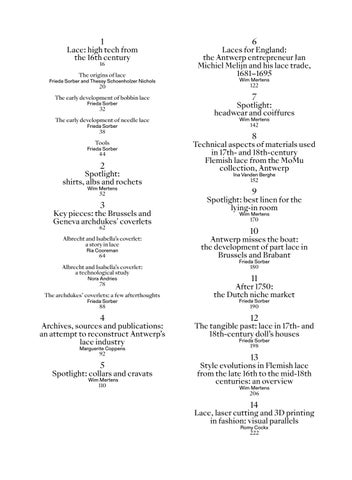
1
Lace: high tech from the 16th century 16
The origins of lace
Frieda Sorber and Thessy Schoenholzer Nichols 20
The early development of bobbin lace Frieda Sorber 32
The early development of needle lace Frieda Sorber 38
Tools
Frieda Sorber 44
2
Spotlight: shirts, albs and rochets Wim Mertens 52
3
Key pieces: the Brussels and Geneva archdukes' coverlets 62
Albrecht and Isabella’s coverlet: a story in lace Ria Cooreman 64
Albrecht and Isabella’s coverlet: a technological study Nora Andries 78
The archdukes’ coverlets: a few afterthoughts Frieda Sorber 88
4
Archives, sources and publications: an attempt to reconstruct Antwerp’s lace industry
Marguerite Coppens 92
5
Spotlight: collars and cravats Wim Mertens 110
6
Laces for England: the Antwerp entrepreneur Jan Michiel Melijn and his lace trade, 1681–1695 Wim Mertens 122
7
Spotlight: headwear and coiffures Wim Mertens 142
8
Technical aspects of materials used in 17th- and 18th-century Flemish lace from the MoMu collection, Antwerp Ina Vanden Berghe 152
9
Spotlight: best linen for the lying-in room Wim Mertens 170
10
Antwerp misses the boat: the development of part lace in Brussels and Brabant Frieda Sorber 180
11
After 1750: the Dutch niche market Frieda Sorber 190
12
The tangible past: lace in 17th- and 18th-century doll’s houses Frieda Sorber 198
13
Style evolutions in Flemish lace from the late 16th to the mid-18th centuries: an overview Wim Mertens 206
14
Lace, laser cutting and 3D printing in fashion: visual parallels Romy Cockx 222
6
Foreword Kaat Debo
From April 2018 to August 2021, the ModeMuseum closed its doors for a thorough renovation and expansion of its exhibition and visitor facilities. For the reopening of the museum, MoMu presents P.LACE.S – Looking Through Antwerp Lace, an exhibition and accompanying publication. This ambitious project tells the extraordinary story of the emergence of lace as a new luxury product at the beginning of the sixteenth century, and of the prominent role played by the city of Antwerp: a story of extraordinary professional skill and craftsmanship, technology and innovation, international trade and enterprise. It is also a story of girls and women who played an important role not only in the creative process and the production of lace, but also in the commercial activities of the international lace trade. The starting point for this project was the unique lace expertise of Frieda Sorber, former conservator at MoMu, who in this capacity over the last few decades was able to bring together an exquisite lace collection for the museum. The prospecting investigations that Frieda Sorber carried out in recent years at numerous international lace collections, in cooperation with the current conservator of the museum, Wim Mertens, form the basis of this project. Wim Mertens and Romy Cockx have curated the exhibition at MoMu, along with four different historical sites in Antwerp. As the title suggests, each of these locations has a – often less wellknown – historical connection with the creation, production and trade of lace. One of the world’s oldest archives on the lace trade is kept at the Plantin-Moretus Museum, the original home and studio of the Plantin-Moretus master printers. In the mid-sixteenth century, the young daughters of Christopher Plantin ran a lace and linen trade, with customers in Paris who supplied, among others, the French court. Here, we now bring you the story of the international lace trade and the commercial importance of lace. At the Snijders & Rockox House, the place where Nicolaas Rockox, mayor of Antwerp at the start of the seventeenth century, resided and displayed his art collection, we illustrate the prestigious position that lace occupied in the life of Antwerp’s wealthy and political elite.
7
Next, St Charles Borromeo Church is home to the most important ensemble of lace from the seventeenth and eighteenth centuries in Antwerp. A large part of this collection reflects local production. This church now offers a handsome overview of Antwerp lace production and the evolutions in style that it underwent. Finally, in its former life, the Maagdenhuis Museum had an important workshop where orphan girls learned sewing and lace making. Here, we focus on the production and the socio-economic aspects of lace. We invited SHOWstudio, the digital platform of fashion photographer Nick Knight, to create an artistic intervention at two of the exhibition locations. For St Charles Borromeo Church, his studio created a poetic film in which the transparency of lace is given an emotional embodiment through rhythm and movement. In the Maagdenhuis, the studio looked for parallels between historical and contemporary production techniques, in terms of both content and visuals. For this purpose, an appeal was made to the youth of Antwerp, as an ode to the orphans whom the Maagdenhuis had sheltered for four and a half centuries. Lace, originally intended as an openedge finishing for clothing and interior textiles, creates a dimension that both obscures and accentuates the boundary between textiles, body and space. In the sixteenth century, because of its transparency and its varying degrees of density, lace was something completely new. It is this aspect that inspired curator Romy Cockx to add a window into contemporary fashion to the historical selection. In a dialogue between old and new, she illuminates visual parallels between needlepoint and bobbin lace as new textile techniques in the sixteenth century and computer-controlled production processes such as laser cutting and 3D printing in fashion at the beginning of the twenty-first century. This publication and exhibition came about thanks to the input and enthusiasm of many. First, I would like to thank Romy Cockx, Wim Mertens, Frieda Sorber, the entire MoMu team and the numerous researchers and authors who contributed to this project. My sincere thanks also to the four exhibition partners, who generously opened their institutions for this ambitious project, as well as to the numerous lenders from Belgium and abroad. Finally, my sincere thanks to scenographer Ania Martchenko and graphic designer Jelle Jespers for the design of the exhibition and the book, respectively.
Azzedine Alaïa, dress in laser-cut cotton, haute couture, 2014
Band of bobbin lace (detail), tape lace, Flemish, linen, Southern Netherlands, 1670–1700, 13 × 138 cm, MoMu, Antwerp, long-term loan from King Baudouin Foundation, inv. B20/GV025
Spotlight: headwear and coiffures Wim Mertens
1 François-Alexandre-Pierre de Garsault, L’Art de la lingère, n.p., 1771, pp. 15–16. 2 Martine Gauvard, Gérard Picaud and Jean Foisselon, Fils de lin, lumière de l’autre. Modes et dentelles à la Visitation, exh. cat., Paris, 2017, p. 156.
147
From their introduction in the sixteenth century, needlepoint and bobbin lace were used to decorate white linen bonnets. As with other linen garments, there were bonnets and headdresses intended for public and formal occasions and others for wearing in the privacy of one’s home while carrying out daily, routine activities. In the seventeenth and eighteenth centuries, much of the headwear worn at home, including men’s headwear, was also embellished with lace or embroidery. In fact, these embellishments were not reserved exclusively for family members: lady’s maids and other household servants wore bonnets trimmed with lace, albeit of less costly kinds and more sparingly applied.
Pair of lappets inspired by French garden design, (detail), Mechlin type, point de Malines ground, linen, Southern Netherlands, 1745–55, 10.9 × 52 cm, The Bowes Museum, Barnard Castle, County Durham, inv. 2007.1.2.333
With the arrival of fontanges – also known as frelanges in English – at the end of the seventeenth century, prominence was given to lace in ladies’ coiffures. Sported in the circles of the French king Louis XIV, this essentially informal bonnet was highly popular for two decades. It consisted of several parts. The erect, stiffened and pleated strips varying in height on top of the head attracted the most attention. The pleats of the most expensive fontanges were made mainly or entirely of lace, attached to a wire frame known as a commode (and sometimes covered with bows on the back of the head) and ending in lappets on either side. From then on, dangling parts appeared frequently on lace headwear, even though bonnets without lappets were still popular, too. Bonnets with a lace or ribbon embellishment continued to be prevalent throughout the eighteenth century. There were also bonnets made entirely of lace. They consisted of three parts: a cap crown, a band or rim, and a pair of lappets. The lace followed the latest stylistic developments both in terms of form and embellishment. The crown could be strengthened by sewing it on to a lining, and possibly also the rim, for which muslin was used. A so-called carcass was customary, too: wire bound with silk threads which gave the rim its shape.1 The lappets were worn either hanging loose on the shoulders or tied up. Coiffures consisting exclusively of lace lappets and silk ribbons were also in fashion around 1750. The middle of a strip of lace was attached to the wig at the front, and the two halves of the strip laid over the wig towards the back and secured in a pleat. Such ornamentation did not consist of two separate bonnet lappets but of a single part, sometimes with a central motif. The Musée de la Visitation in Moulins has a rare Brabantine bobbin lace example, dating from around 1740.2 Bonnets that were part of a regional costume were often decorated with lace, too. Throughout the eighteenth century, Antwerp lace was very popular for the so-called ‘German bonnets’ worn in the north of the Netherlands. As the century progressed, the brim of these bonnets became wider and wider, so that bands of lace had to be put together and supported by a metal frame.
Haider Ackermann, shirt in cotton with laser-cut sleeves, Spring–Summer 2019
Peter Paul Rubens, Aartshertogin Isabella van Oostenrijk (Archduchess Isabella of Austria) (detail), 1615, Frey-Näpflin Stiftung, Stans, on long-term loan to the Snijders&Rockox House, Antwerp
220
Ill.. 7: Sarah Burton for Alexander McQueen, ensemble in laser-cut pony skin and Mongolian wool, Autumn–Winter 2012–13
Ill.. 8: Reticella band, linen, 1580–1620, MoMu, Antwerp, inv. S74/21
234
Ill 14: Iris van Herpen, in collaboration with Philip Beesley, Lucid Geodesic dress in laser-cut transparent acrylic, Lucid collection, Autumn–Winter 2016–17
240
Ill. 15: Iris van Herpen, in collaboration with Philip Beesley, Glitch dress in laser-cut Mylar® fabric, In Between the Lines couture collection, Spring–Summer 2017
Iris van Herpen, Cymatic dress in 3D Shibori-formed Amaike organza and cotton, Seijaku couture collectie, Autumn–Winter 2016–17
Band in bobbin lace (detail), Binche type, snowflake ground, linen, Southern Netherlands, 1700–1750, 15.5 cm × 44 cm, MoMu, Antwerp, S66/24AB