THIS BOOK BELONGS TO:
P RI NT ED I N A LIMI T ED EDI T I ON OF 2.000 COP I ES
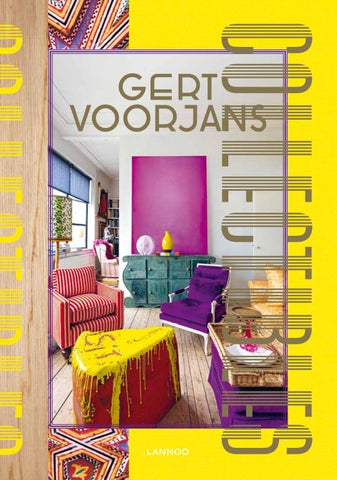
Gert Voorjans is not a collector. He lacks the hunger and need for control of real collectors. Nor is he nostalgic. Voorjans does not accumulate; he adopts art objects and furniture, in anticipation of a new home. The instant they enter his studio, they are in transit. They have arrived in the departure hall. Voorjans’s collectibles are so much more than the extras in his realisations. They’re not the protagonists, because those roles are reserved for colour, light and space. If you take the time to look through his flamboyant furniture ensembles, what strikes you first are clean contours, pure sightlines and inviting volumes. But the objects are the essential accessories in his rigorous scenography. ‘I can easily let go of things,’ he says. ‘I’m not tied to stuff. Objects just cross my path. Nothing more or less. Pieces come and go, like catwalk models. Even if I own an art object, I always feel as though I’m its temporary guardian. What is a collection other than an impermanent cluster of stories? There comes a point when it’s time for me to let everything go. Just as I have to leave my interiors to their occupants.’
5
This is not an auction catalogue. Because the word ‘catalogue’ has no place in Gert Voorjans’s philosophy. It implies something generic or standardised. But nothing Voorjans creates is taken from a catalogue. Those with a penchant for standard kitchens or for salons from a home collection had better close this book. Voorjans’s approach or taste cannot be captured in a catalogue. For that, his signature is too individualistic. And his creations too unique. Voorjans is not a ready-made, he is a pièce unique. Do not attempt to label him or confine him to a book. Let him dream out of the box. Let him explore uncharted territory. Allow him that folly. He won’t fail to surprise.
6
7
8
9
10
11
12
RENÉ STOELTIE (1957) was born in Arnhem, the Netherlands. He studied graphic design in Amsterdam and moved at a young age to Brussels with his wife, the painter and art critic Barbara Laforce. As a photographer he embodies all the culture of the north such as bold colours, the understanding of particular lightfall and the tradition of the portrait and the still life. René Stoeltie creates the image in his mind and then he recreates it and modifies it. When his vision is clear, what is left is only the technical formality of closing the shutter. Like a stonemason, he doesn’t have the luxury of making mistakes; he cuts the light in a single blow.
13
NICOLAS KARAKATSANISÂ (1977) is both a photographer and cinematographer. These two complementary activities broaden the scope of his photographic experimentation and greatly influence his aesthetic style, which is often characterised by an intense chiaroscuro and a lively pictorial quality. He says of his artistic work that he is not trying to show the world as it is but rather as how he perceives it. The photographs he choses to exhibit are only ever single shots of an image. Among the films to his credit are the Oscarnominated Bullhead (2011) by Michael Roskam, Violet (2014) by Bart Devos, The Drop (2014) by Michael Roskam, The Loft (2014) by Erik Van Looy, Welp (2014) by Jonas Govaerts and Triple Nine (2016) by John Hillcoat. In the field of contemporary art, has worked twice for Michael Borremans. His film work has received several awards and prizes.
14
15
For Gert Voorjans, fireplaces hold great importance. Given the opportunity, he literally creates ‘places for fire’. He considers the fireplace much more than an architectural ornament or source of warmth. The fireplace, he says, is the beating heart of a home. The concept of fire is vital to understanding Voorjans’s work. Fire isn’t simply a metaphor for the passion with which he tackles his projects. He believes no other ritual is as hospitable as lighting a fire in the hearth. There is no warmer way to welcome guests. A fire creates a place and a momentum. A fire burning in a hearth ignites something real and true. Fire is like a beautiful interior: it feels good and reassures, but also keeps you sharp. It casts the same spell as a coverlet, offering pleasure or solace. Fire stills yet also ignites the conversation. Fire is introverted and extroverted at the same time. A fireplace is a convivial risk. It creates cosiness, and danger, too. Fire compels you to sit on the edge of your seat. Fire smoulders like Voorjans’s interiors: they are warm, but sparks can always fly.
16
17
“I like bare walls. People think I’m obsessed with colour. But I am equally inspired by large expanses of white. The emptiness can be sublime.” — gert voorjans
18
19
20
21
22
23
DIDIER MAHIEUÂ (1961) is a Belgian contemporary artist. He navigates between different media: painting, drawing, photography, cinema and sound. Painting is a starting point to develop a personal mythology, a history of the intimate. His work has featured in several exhibitions at key galleries and museums in New York, Beijing, London, Tokyo and Frankfurt.
24