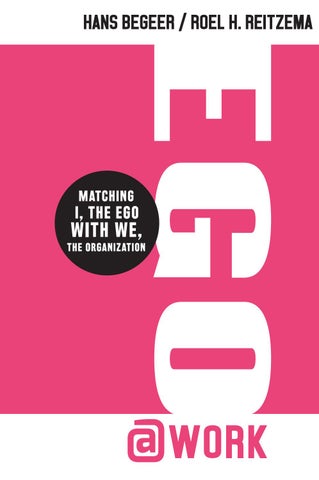
EGO
HANS BEGEER / ROEL H. REITZEMA
MATCHING
I, THE EGO
WITH WE,
THE ORGANIZATION
LC_BW_EGO@WORK_opm_ENG.indd 3
@WORK
14/01/20 14:53
This book was originally published as Ego@WORK, LannooCampus, 2019.
D/2020/45/146 – ISBN 978 94 014 6825 1 – NUR 807, 808 Cover and interior design: Gert Degrande | De Witlofcompagnie Translation: Lynn Butler © Hans Begeer, Roel H. Reitzema & Lannoo Publishers nv, Tielt, 2020. LannooCampus Publishers is a subsidiary of Lannoo Publishers, the book and multimedia division of Lannoo Publishers nv. All rights reserved. No part of this publication may be reproduced and/or made public, by means of printing, photocopying, microfilm or any other means, without the prior written permission of the publisher.
LannooCampus Publishers Vaartkom 41 box 01.02 P.O. Box 23202 3000 Leuven 1100 DS Amsterdam Belgium Netherlands www.lannoocampus.com
LC_BW_EGO@WORK_opm_ENG.indd 4
14/01/20 14:53
Sometimes my ego shouts at me, it tells me what to do It builds me up or tears me down It helps me yet it hurts me as it pushes me around Sometimes it whispers softly, so softly I can’t tell It makes me act like such a fool Makes me lash out and be quite cruel Sometimes I stop my ego from getting in my way Then others’ thoughts and hopes and words Can touch my soul, be really heard Sometimes my ego balances with others in my life Our egos then mesh beautifully We work together fruitfully With time I know I’ll find the path to ego virtuosity My ego as an instrument Finely tuned, my implement To build a better life (Lynn Butler)
LC_BW_EGO@WORK_opm_ENG.indd 5
5
14/01/20 14:53
EGO
LC_BW_EGO@WORK_opm_ENG.indd 6
@WORK
14/01/20 14:53
CONTENTS
1 WHY SHOU LD YOU REA D T HI S B OO K? 2 T HE EGO AS A N A N T HOLOGY OF W H O W E A R E 3 WHERE D OES EGO C OM E FROM A N D
WHAT D OES I T D O?
4 T WO P ERSP ECT I V ES: I A N D WE 5 C HA RACT ERI ST I C S OF T HE LOU D
EGO I N ORGA N I ZAT I ON S
6 EGO-AWA REN ESS: I B EGI N S TO C ON SI D ER WE
7 EGO- M A N AGEM EN T : FROM I TO W E 8 EGO A N D ORGA N I ZAT I ON D EV ELOPME NT 9 B E YON D I A N D WE:
SP I RI T A N D WHOLEN ESS
10 CASE ST U DY : V I AT T EN C E 11 SU M M A RY A N D C ON C LU SI ON S 12 HOW T HI S B OOK CA N B E OF HELP TO YO U A B OU T T HE AU T HORS P RA I SE WITH WORD OF T HA N KS PRACTICAL
9 13 25 32 42 51 64 82 94 98 103 106 111 113 117
MODEL
P. 38 & 41
LC_BW_EGO@WORK_opm_ENG.indd 7
14/01/20 14:53
EGO LC_BW_EGO@WORK_opm_ENG.indd 8
@WORK
14/01/20 14:53
1 WHY SHOULD YOU READ THIS BOOK? You probably don’t think about your ego very often. Do you have any idea how your ego comes across to other people? Did you know that 95% of your behavior is driven by your unconscious mind? Can you apply your conscious mind to manage yourself better? When we talk about the ego, it is often in a negative sense: “A really big ego just entered the room; he is so self-centered!” But what is an ego? The ego is the instrument through which you develop your behavior. Your ego has made choices for you over the course of your life, from your infancy through your childhood, education and work experiences. We are unaware of most of these choices, but they influence our behavior. Today, everything we do must be done quickly, we must identify problems and fix them immediately. As a result, we don’t take enough time to consider our options. We act almost without thinking, driven by our ego, on autopilot. This is true of almost
LC_BW_EGO@WORK_opm_ENG.indd 9
9
14/01/20 14:53
E GO @WO RK
everyone. Groups of people who must work together have to deal with many egos. When everyone reacts automatically, driven by their egos, collisions and conflicts result and efficiency suffers. How can we get to know more about our ego and how it determines our behavior? This can be done through introspection and by contemplating the feedback of others. It is in our interest to adjust our own ego so that we can evolve to a point where we are aware of our ego and manage it to make choices from an inclusive (We) rather than an egocentric (I) perspective. The focus of this book is to help us become more aware of our ego, to provide techniques to evolve from I to We thinking and to facilitate harmony and improve efficiency in the workplace. Each topic in this book is presented from the perspective of I and We. After reading this book, you will have answers to the following questions: From the I-perspective: • How do I develop more ego-awareness or consciousness?
10
LC_BW_EGO@WORK_opm_ENG.indd 10
14/01/20 14:53
WHY SHOULD YOU READ THIS BOOK?
• How does positive ego-development contribute to more authenticity? • How can I overcome defense mechanisms of the ego? • How can I increase my creativity and problem-solving capacity? • How can I develop new behavior? From the We-perspective: • Which leadership competencies do you have, that will enable you to develop more ethical and social skills? • What new authority do you have to develop and how can you get rid of the old authority? • What kind of new social contracts are needed? • Which roles and processes fit these? • How do you grow spiritual presence? The book is structured as follows: • In chapters 2-4, we describe what ego is about and how it manifests itself. • In chapters 5-9, we develop and present our model. • In chapter 10, we describe a case study to illustrate the use of our model. • In chapter 11, we discuss lessons from the book. • In chapter 12, we advise how this book can be of help to you.
LC_BW_EGO@WORK_opm_ENG.indd 11
11
14/01/20 14:53
E GO @WO RK
We interviewed business leaders from a range of sectors in Belgium and the Netherlands on the topic of ego at the workplace. Their combined views together with our experience in the field of management consulting and training constitute this book. Excerpts from the interviews appear throughout the book, with the initials of the interviewees appearing between brackets.
12
LC_BW_EGO@WORK_opm_ENG.indd 12
14/01/20 14:53
2 THE EGO AS AN ANTHOLOGY OF WHO WE ARE QUOTES FROM BUSINESS LEADERS – SNAPSHOTS OF THE EGO IN THE WORKPLACE The word “ego” is defined by most dictionaries in mostly negative terms such as egocentric, egoism, egotistic, ego trip, and so on. We found the same thing in our consultancy work and in interviews conducted for this book. But when we probed more deeply, we found that strong ego, nevertheless, is deemed necessary to drive changes in the workplace. Interviewees also believed that ego development can be beneficial. Our interviewees see ego as an anthology, a collection of the different facets of our personalities. In this chapter, we present quotes from the interviews.
LC_BW_EGO@WORK_opm_ENG.indd 13
13
14/01/20 14:53
E GO @WO RK
W H AT C O M ES TO MI N D W H EN YOU T H I NK O F EG O I N T H E WO R K P L AC E ? Ego is seen too often as negative, as an obstacle, as a distraction. But a strong ego can help people to be more authentic, to have more respect for themselves and for others. (BDB)
Leaders without vanity, without ego, don’t exist. Leaders need to rule the pack, to be the alpha animal. (JMD)
I don’t see myself standing above my team, but my team does. My challenge is to stay in line with my team – not too far ahead nor lagging behind. (HW)
I care for my employees and I expect them to care for our company. (IGe)
14
LC_BW_EGO@WORK_opm_ENG.indd 14
14/01/20 14:53
THE EGO AS AN ANTHOLOGY OF WHO WE ARE
Ego is powerful and destructive. Dominant, limited, all about survival, ego is often in a childish, infantile state. (NB)
Everybody has the right to have a strong ego but they must take care that their egos evolve enough to be manageable. (RV)
Big egos are characterized by a blue suit and brown shoes, people who talk a lot and listen little and who are looking solely for promotions. (SVU)
Environments that accept egos are characterized by security, openness, inclusiveness and acceptance of differences. As long as the egos don’t feel threatened, these are the environments that promote growth. (AVP)
Employees of today have a low tolerance for big egos and egotistic behavior. They will protest against people with big
LC_BW_EGO@WORK_opm_ENG.indd 15
egos if necessary. (TS)
15
14/01/20 14:53
E GO @WO RK
Ego is simply a mental concept, a state of mind. If I look for my ego, I find nothing. (RH)
Open environments are needed to develop the ego. Show trust by involving people in taking difficult decisions, show vulnerability. (MH)
Ego does not improve the quality of life; rather, it restrains one from being happy. Ego is a form of self-defense; it masks our true selves. (ME)
Ego is the essence of a person, the fundamental nature combining our heart and our soul. Our ego determines how we feel and behave. (TL)
Believing in ego is like believing in God. We humans need something to ground us, something to believe. Identification with this gives us energy and drive. But egos can be dangerous. (IGo)
16
LC_BW_EGO@WORK_opm_ENG.indd 16
14/01/20 14:53