This book is
MARKED is an initiative by Uitgeverij Lannoo. www.markedbylannoo.com
@booksbymarked Original publisher: © Editions Apogée, 2019 © English publication: Lannoo Publishers, Tielt, 2020 ISBN 978 94 014 6701 8 D/2020/45-331 – NUR400/510 www.lannoo.com Translation: Clare & Mike Wilkinson, Tessera Translations, Wageningen Lay-out: Asterisk*, Amsterdam Join the MARKED COMMUNITY on @markedbylannoo Or sign up for our MARKED newsletter with news about new and forthcoming publications on art, interior design, food & travel, photography and fashion as well as exlusive offers and MARKED events on www.markedbylannoo.com If you have any questions or comments about the material in this book, please do not hesitate to contact our editorial team: markedteam@lannoo.com All rights reserved. No part of this publication may be reproduced or transmitted in any form or by any means, electronic or mechanical, including photocopying, recording or any other information storage and retrieval system, without prior permission in writing from the publisher. This English version may be distributed and sold throughout the world
N o r way ClĂŠmence Polge & Thomas Corbet
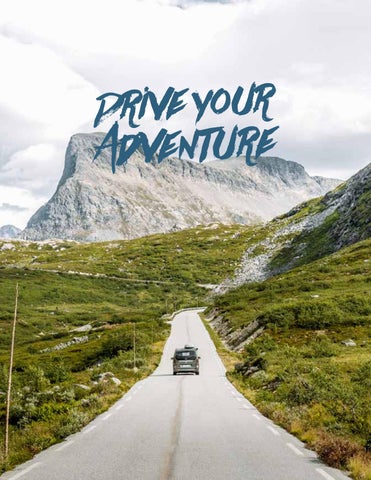
Foreword A little over four years ago, I took over Clémence’s flat. A few weeks later, she came back to pick up her bike and we got chatting. The conversation quickly turned to our travel bucket list and our common dream of discovering Norway, which became our first destination together and something that really made the heart beat faster! After two years living together, we discussed the option of living in a van. In 2017, we took the plunge becoming full-time digital nomads. As we were eager for a more environmentally friendly lifestyle and were in love with road travel, Drive Your Adventure was an obvious choice for us when WeVan launched the second stage of its European adventures by van. The opportunity to return to Norway seemed too good to be true, especially as the book from the first edition had already taken pride of place in our library. To put it another way, there was some serious dancing about in the middle of the restaurant when we learned we had been selected! In our own words and with Clémence’s eye for a good photo, we were going to be able to share both our way of life and our Scandinavian experience. So come on board with us and we’ll take you to Norway!
Clémence Polge and Thomas Corbet, the team for DYA #2
Contents Preparing your Norway trip properly pages 10 to 17
Making a success of your Norwegian adventure pages 18 to 25
South Coast pages 26 to 49
The Great East pages 50 to 75
The South-West pages 76 to 107
The Western Fjords pages 108 to 139
The Central Region pages 140 to 155
The North-Western Islands pages 156 to 189
The High North pages 190 to 221
The High North The North-Western Islands
The Central Region
Categories
The Western Fjords
Stop-overs
Overnight spots
The Great East The South-West Activities
South Coast
Meet-ups
P r e pa r i n g fo r th e j o u r n ey: be for e t h e r oad t r ip
Preparing your Norway trip properly The main regions of Norway
Norway has only been independent since 1905, but it has a long history, from which it has inherited its administrative subdivisions. Long before the country’s emancipation, the territory was in fact under Danish control, run by the jarls – a rank equivalent to a count. Norway is divided into eighteen fylker, the largest administrative subdivision (such as Finnmark, Hordaland, Telemark, etc.). Each fylke is then divided into kommuner or municipalities. From a purely geographical point of view, though, the national territory is divided into five large regions, the landsdeler: Nord-Norge, encompassing the whole of the northern part of the country Midt-Norge (or Trøndelag): the Trondheim region Vestlandet, the south-west of the country, which is where most of the famous fjords are to be found Østlandet, the south-eastern part containing Oslo, the capital city Sørlandet, the southernmost point. To let us stick as closely as possible to our experience and to balance the various parts of our narrative, we decided to divide our journey into seven zones, which we’ll let you discover as you turn the pages!
Nord-Norge
Midt-Norge
Vestlandet Østlandet
Sørlandet
10
P r e pa r i n g fo r t h e j o u r n ey: be for e t h e r oad t r ip
Climate From a climate point of view, Norway is one huge paradox. You might expect hostile, cold weather but the country is actually quite temperate. This is particularly true along the coasts, where the influence of the Gulf Stream is very much in evidence: although the Baltic Sea freezes in winter, further south, the Norwegian coastline never gets caught up in ice. Conditions inland are much harsher, however, which is why many roads are closed during the winter months. So you’re advised to visit the country between April and October, especially as you will enjoy the long – very long – days during this period, particularly in the north of the country from May to July, when the sun doesn’t set at all. The only downside to this climate, which is in the final analysis pretty mild, is that it rains all year round!
The administrative formalities
Health
Although Norway is not part of the European Union, it has a close relationship with the EU as a member of the European Free Trade Association (EFTA) and the European Economic Area (EEA). This guarantees the same freedoms as in the EU, including the freedom of movement of people (which is relevant for us). So a visa is not required for citizens of EU countries (including the UK at the time of writing) to stay in Norway. They do need to have a valid identity document, though (a European ID card or passport). And last but not least, an EU driving licence – including UK at the time of writing – is valid in Norway (and can even be exchanged for a Norwegian one if you plan to settle there). All you have to do is check that your van’s insurance covers Norway as well as the countries you’re travelling through!
You may not necessarily want to think about it when planning your trip, but it’s always better to be prepared for any eventuality. All the more so when it comes to health. There are two solutions available to travellers: – a European Health Insurance Card (which you can get through your usual channels) to cover your health expenses and get access to care without having to make advance payments, in the same way as Norwegians who are insured – retrospective reimbursement through your usual health insurance company So much for the administrative bits. Now you get the more medical bit. That means vaccinations (we were just as surprised as you are!) – principally against tick-borne encephalitis if you’re planning excursions in the countryside or forests (these small parasites have tended to proliferate in recent years). The guidebooks don’t tell you 11
Pr e pa r i n g fo r t h e j o u r n ey: be for e t h e r oad t r ip
that yet and we don’t want to seem alarmist but it’s information that a travel doctor confirmed for us: this disease can really wreak havoc on the nervous system. Find out the timing of the injections so you don't get caught out: you need three and you will only be protected from the second one onwards, and then only for a limited time! And of course, all road trips should have a first aid kit and/or a small medicines box. As for the ticks: don't forget to take a special tick remover with you, particularly if you're travelling with your pet. While we’re on the subject, don't forget to vaccinate your furry friend if necessary (rabies vaccine). The same advice may also apply to birds or reptiles, but we don’t know enough about them to say. But frankly, who travels in a van with a boa constrictor? Our tip: there are sites that list tips and formalities for preparing your trip, broken down by animal and by country.
transport and so forth Finally, for those who will be leaving with all their multimedia equipment, Norwegian sockets are standard European ones (you will therefore need an adapter for British plugs).
Finances The country's currency is the Norwegian krone, norsk krone or NOK for short, which was worth about 11 eurocents (nine to the euro) or 8.5p (twelve to the pound) at the time of our trip. We reckon most people who are driving a van into Norway are going to be pretty familiar with euros, but not necessarily with pounds (except for the Brits), so we’ve mostly chosen to work from euros as the main reference. Ask your bank what charges you will have to pay for withdrawals and card payments. These transactions can quickly become expensive, depending on the type of credit card. Forewarned is forearmed if you want to stay within your budget, especially as the cost of living in Norway isn’t cheap! To give you an idea: prices in Norway are 1.2 to 1.5 times higher than in most European countries for food, fuel and so forth. Be sure to budget your stay carefully!
Connectivity Since 2017, your phone and 4G package has been valid throughout Europe with no roaming charges (however, you should check the latest conditions from e.g. British operators in particular before leaving) – and this also applies for Norway. That means you won't get a monster bill if there’s a glitch... and the rest of the time, you’re easy to reach! Last but not least: as long as you’ve got a signal, you’ll be able to use your mobile data on your computer thanks to connection sharing, and you can use your phone as a GPS. If your application allows it, like Google Maps, take the opportunity to save offline maps as that can be very useful when you’re without a network in the tundra. Handy! It’s also worth noting that Norway is well to the fore in terms of Wi-Fi networks, which can be found in most towns, restaurants, public 12
P r e pa r i n g fo r th e j o u r n ey: be for e t h e r oad t r ip
In terms of daily life Contrary to what we’ve read in other guides, credit cards are accepted almost everywhere, even for small amounts (contactless too, where the cards are compatible), and the vast majority of towns have ATMs. Tipping is not mandatory in Norway. But if you want to leave a little something for your hosts, it will most often be between 5 and 15% of the total.
for the automated tolls for our itinerary so that we could give you the most complete information possible. But unfortunately, at the time of writing this guidebook, we have not yet received the invoice. Information from other travellers suggests that this can take more than a year to appear! To conclude this financial section, this overall figure of €75 per day, which is well above the €40 we usually stick to in our vanlife, is explained by the special budget item for ferries, the extra trips and the higher cost of living in Norway.
To let you calculate your budget as accurately as possible, we’ve suggested daily averages here based on our expenses, which you simply have to multiply by the length of your trip to get a ballpark figure!
Last but not least, please note that all the prices and rates mentioned in this book are purely indicative and may of course vary according to the season or change in the future!
During our two-month adventure, we spent about €75 / £65 per day for two people (and a half: yes, that’s Nel the cat): Petrol: €25 / £21 Ferries: €19 / £16 Shopping: €13 / £11 Going out (restaurants, cafés, bars) : €10 / £8 Campsites: €4 / £3 Other (parking, souvenirs, ski and kayak trips) €4 / £3 A little more detail to explain these figures: in terms of food expenses, we are used to having only one main meal a day in the van (and snacks elsewhere), obviously, if you choose to have three square meals a day, your food budget may be bigger than ours. In addition, we travelled nearly 13,000 kilometres (8,000 miles) in two months, since we had to cover as much territory as possible in a limited amount of time. This won’t be the case for everyone, and that should allow less hurried travellers to save money compared to us at the petrol station. We also wanted to determine the total amount 13
P r e pa r i n g fo r t h e j o u r n ey: be for e t h e r oad t r ip
The itinerary Say ‘road trip’ and you assume there’ll be plenty of driving. The route you take will depend on the time you have available and the pace that suits you best. We personally worked our way through numerous guides, blogs and books about Norway. The advantage of going by van is that you can get off the beaten track, so we just set a framework beforehand for our trip, assuming it would take two months and cover about 13,000 kilometres (8,000 miles). If you don’t have that much time, you’ll have to make choices. Our book is here to help you do that, but our first recommendation is not to plan too many kilometres into the time available. That will give you the flexibility to explore your new surroundings without having to spend all your holiday on the road (and your kids will thank you for it too)! Next, we used a very handy tools to transfer that basic outline onto a map: Mapstr. Mapstr is a kind of community guide on a global scale that anyone can use to find out what’s interesting to visit, the must-see places and where you should go/eat/sleep (or share that informa-
tion if you want or feel the need to). You will often find feedback, contact details, opening hours and links to websites as well. This is another tool we are pleased to have discovered! When you start working out a general route for your journey, these tools will make your job a lot easier. That’s especially true for a country like Norway, where the coastline is continually broken up by fjords and you often have to choose between a ferry crossing (which will cost you) and a big detour round the end of the fjord taking several hours. And for all those who still appreciate the touch and smell of paper, a good old-fashioned map never goes amiss (it’s also always nice to be able to trace your route with your finger)! To summarize, Norway is a huge country with a very jagged coastline. Distances can look short as the crow flies but turn out to be greater than expected, and the speed limits tend to be low. Make sure that you organize the legs of your journey properly to keep them efficient and effective!
The playlist Ah – the music! You can’t have a successful road trip without a cool playlist. Which will depend on individual tastes, of course. For those who need music when behind the wheel, you could create a playlist in advance to accompany you on those magical journeys across Norway! We put together some amazing playlists on Deezer, which has a pretty inexhaustible supply of tracks! Of course, this assumes you have a network connection or sufficient storage space on your phone to save all the tracks, or a selection of them.
Throughout the book, you’ll find tracks at the bottom of the pages from the original musical backdrop to our journey, tracks that we will always associate with the magnificent scenery we drove through. If you want to join us in reliving the experience of this second edition of Drive Your Adventure, we invite you to listen to this playlist on Deezer by going to www.deezer.com/fr/playlist/5471783842
P r e pa r i n g fo r t h e j o u r n ey: be for e t h e r oad t r ip
the necessary information before you set off! You can go skiing in Norway in summer or winter. If you want to take your own equipment to save on costs when in Norway, remember to fit roof racks and perhaps a roof box for storing skis, boots and so on. Note that it can get cold in Norway, even in summer. Make sure your equipment is appropriate for the temperatures! Given this precarious mission and the fact that space in a van is limited however nifty the layout, we were very glad to have the technical advice of the specialist sales staff at the Au Vieux Campeur stores (they test the gear themselves so they know what they’re talking about)! We’re not just saying this because they were kind enough to assist us on this adventure but also because they have been following us on all our adventures for years now.
Equipment There are two elements you need to deal with in Norway in summer: the rain and the mosquitoes (tiny and insatiable). So remember to take some protection with you. We asked around and it seems that the only effective mosquito repel-
Now we get to the big question: what do you need to take in the camper van? The answer will be slightly different for everyone, depending on their habits, but we believe there are five indispensable things: 1 Multimedia equipment: a camera, phone, laptop and so on for keeping a great record of your trip and sharing it. Having said that, there’s nothing stopping you going totally offline and off-grid during your adventure. 2 Equipment for making coffee and/or tea. We Roammates really go for the coffee dripper and Italian-style cafetière, while Clémence can’t start the day without her latte macchiato. 3 A good pair of shoes for strolling round town and/or roaming the countryside. Flip-flops for showering in the wild or at campsites. 4 A pack of cards and some e-books, to pass the time on long days or rainy evenings (which are guaranteed at some point, regardless of the season). 5 Non-perishable food, which will help you save on costs for eating.
lents are the ones sold in the country itself. We’d recommend drenching the van’s mosquito nets in the stuff as well to increase the effect. For hiking, there are hats with nets available that are really quite... er... becoming. Kit yourself out appropriately for your outdoor activities, depending on what you’re expecting to do. That can vary from a swimsuit to a fishing rod or hiking boots. On the subject of freshwater fishing, be aware that you will need to observe certain rules (minimum fish size depending on the species and so on) and have one or more permits (issued by various local associations, the owners of the land or certain websites such as inatur.no, and valid for very limited areas). Get 15
P r e pa r i n g fo r th e j o u r n ey: be for e t h e r oad t r ip
As regards everyday items, if you’re intending to hire your fittings from WeVan, please note that the team will give you all the basic equipment you need such as kitchen utensils, fitted sheets or even a solar-powered shower. Going further, they can also offer you an extensive range of accessories and options such as roof racks, roof boxes or bike racks (yes, there are some great mountain bike tracks in Norway).
16
P r e pa r i n g fo r t h e j o u r n ey: be for e t h e r oad t r ip
More info in books and on the Internet Although this travel guide/story aims to be as comprehensive as possible to assist you in planning your camper van adventure, we’ve included a list here of other publications and websites where you can find more detailed information. You can use them for making specific preparations (for hiking, for example).
Bibliography:
Drive your adventure: a guide for camper van road trips in Europe. I Love the Seaside - Vol 2 (Northwest Europe): for water sports fans. Lonely Planet Norway : for a more exhaustive list of useful addresses.
Internet:
we-van.com: for finding your van and the closest WeVan agency to you. To help you budget for your project, the website will give you a rental estimate based on your departure location, the length of your trip, the planned mileage, the camper van you have in mind and the various options (insurance, services, equipment, accessories and so on). driveyouradventure.com : the WeVan blog gives you a taste of our journey, letting you discover our highlights and soak up the experience that awaits you.
www.visitnorway.com: a comprehensive and very intuitive site about tourism in Norway. There are versions in languages other than English if you want, but the English version is much more extensive (or language nerds could try the Norwegian version). rando-lofoten.net/en/ list, descriptions and recommendations for various hiking trails on the Lofoten islands. We really liked the feedback section and the awareness raising. nasjonaleturistveger.no/en: a site with 18 scenic and tourist routes through Norway. It is incredibly detailed and essential for pinpointing those unforgettable sections and bends on your road trip. epcplc.com (Euro Parking Collection): site for registering your vehicle for toll payments. inatur.no: information about the rules governing fishing in Norway. You can even buy permits here. park4night.com, gamping.com, homecamper. com: these sites and apps are like TripAdvisor or Airbnb for finding a spot to bed down and while they are more useful in countries that don’t have Allemannstretten, they are great at putting your mind to rest when you go looking for your spot! We personally liked comparing the details and recommendations of Park4Night with those in the Campercontact app, as the two complement one another nicely. Mapstr and Google Maps for defining and refining your itinerary. Instagram and Pinterest: to get inspiration from the pictures and identify the must-sees.
Preparing for the journey: during the road trip
Making a success of your Norwegian adventure Outdoor activities in Norway
• paddle across a fjord or two, or a hundred... • put on your skis and hurtle down the slopes of a glacier • go fishing in freshwater or the sea • go horse-riding here and there – but not everywhere, obviously • take advantage of the beaches in the south to chill out for an afternoon
Water, mountains, forests – you’ll find them all in Norway. That’s what makes it the place for countless adventures where you are spoilt for choice. For example, you could: • get on your surfboard anywhere along its long shoreline, as far north as the Arctic waters of the Lofoten Islands • go hiking in one of the country’s many national parks, or elsewhere
Feel free to add to the list!
18
Preparing for the journey: during the road trip
• National Music Festival, Oslo, first weekend in June • Slottsfjell, Tønsberg, mid-July • Bukta Festival, Tromsø, July • Øya, Olso, early August • Parkenfestivalen, Bodø, August Norway doesn’t go into complete hibernation the rest of the year, obviously. On the other hand, it would be much more difficult to take your camper van to the activities on offer in the winter!
Getting to Norway by camper van You will need to arrange in advance how to get to Norway as you have two basic options: by sea or overland. If you go for the first option, consider booking a ferry if for example you want to get to Kristiansand (Norway) from Hirtshals (Denmark) – a voyage of a little over three hours. To give you an idea of the costs, we paid €317 for two adults, one cat and one Mercedes Marco Polo (a camper van in the category length < 6 metres and height 2.6 metres) for a crossing with Color Line. The other main company, Fjord Line, has similar rates but the crossings are less frequent. Other cities also have a ferry service, including Oslo from Kiel (in Germany), Larvik (southwest of Oslo) and Bergen (on the west coast) from Hirtshals.
List (not complete!) of unmissable events en route Although Norway is pretty sleepy for six months of the year, the place comes alive with cultural events and all kinds of gatherings as soon as the weather gets warmer. Gastronomic events, both Norwegian and international, are well worth a detour just for the atmosphere and the products. The main food festivals are: • Gladmat, Stavanger, second half of July • Trondersk Matfestival, Trondheim, late July to early August • Bergen Matfestival, Bergen, late August to early September • Matstreif, Oslo, early September • Rakfisk Festival, Fagernes, late October to early November
For those who like to stick to the roads or who get seasick, you can drive to Norway via Sweden. It costs €48 one way to cross the Øresund Bridge that connects Denmark to Sweden for a vehicle of < 6 metres in length or €96 for a vehicle of between 6 and 10 metres. Well, you could avoid it by driving through Russia and Finland – but the bridge will be a lot cheaper than the detour!
The country is bubbling in the summer, with music festivals all over the place. Sunshine and a great atmosphere are guaranteed! Take your pick from:
19
Preparing for the journey: during the road trip
Obviously you’re not likely to be going there from Paris like we did, but the relative extra distances may help you decide. So here’s a mini-summary of the distances from Paris via the different routes: • Paris – Hirtshals, 1,400 km (870 miles) • Paris – Oslo via Sweden, 1,970 km (1,200 miles) • Paris – Kirkenes via Russia and Finland, 4,300 km (2,700 miles), which is a bit excessive
The Norwegian road network The network is not exactly dense, to put it mildly. Once you get there, keep an eye on your fuel as some areas don’t have very many petrol stations where you can fill up again. And think about taking chains, in both winter and summer! You have to pay tolls on lots of roads and sometimes when entering built-up areas as well. As most of these toll booths are unmanned, consider registering your vehicle on the Euro Parking Collection site (epcplc.com) to make payment easier.
sky’, or Atlanterhavsveien (the Atlantic Route), which encapsulates the force of the elements in contrast to the elegant twists of its eight bridges. To get all the info, go to the website nasjonaleturistveger.no or check out the Norwegian Scenic Routes pages on the visitnorway.com site. Once again, to help you pick the route that’s best for you, here’s an overview of the distances between some of the country’s main attractions:
While the Norwegian road network might be sparse, it does have one big advantage: it was designed in part to take you through the most impressive scenery. That’s thanks in the first place to Norway’s celebrated scenic routes put together by the Norwegian Public Roads Administration. They certainly do a great job! The 18 national tourist routes (or nasjonale turistveger to the locals) are mostly in the west of the country. They offer hours of beautiful surroundings punctuated by structures that enhance the country’s natural assets. Most routes are named after the region or exceptional spot that they serve to highlight but some have more poetic names, such as Helgelandskyten, which literally means ‘it joins the land to the
• Lindesnes Lighthouse (southernmost point) – North Cape, 1,960 km (1,210 miles) • Kristiansand – Oslo, 320 km (200 miles) • Kristiansand – Bergen, 450 km (280 miles) • Oslo – Bergen, 470 km (290 miles) • Oslo – Stavanger, 560 km (350 miles) • Oslo – Trondheim, 500 km (310 miles) • Oslo – Tromsø, 1,620 km (1,000 miles) • Bodø – Bodø via the Lofoten Islands, 740 km (460 miles) plus two hours by ferry between Bodø and the southern end of the islands.
20