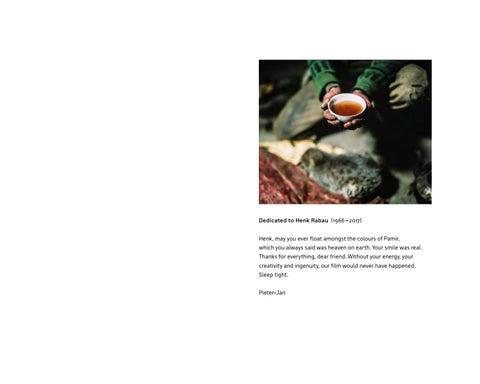
Dedicated to Henk Rabau (1966–2017) Henk, may you ever float amongst the colours of Pamir, which you always said was heaven on earth. Your smile was real. Thanks for everything, dear friend. Without your energy, your creativity and ingenuity, our film would never have happened. Sleep tight. Pieter-Jan
The children of The Land of the Enlightened
10
Foreword
11
Pieter-Jan De Pue – better still: ‘PJ’, as he is known – is the most ‘healthily
international prizes. In 2017, Pieter-Jan received the Flemish Culture Prize
curious’ person I have ever met. When you get to know him, he initially
for Film. The title of this book, The Kings of Afghanistan, pays homage to
comes across as a kind of contemporary explorer. Classic explorers would
its main characters, the Afghan children who, through romantic dreams
travel to all four corners of the globe in order to improve and civilise
and creative pragmatism, manage to survive in this gigantic, mercilessly
people in Europe’s image. When Marco Polo, Vasco De Gama and finally
beautiful country.
Stanley departed for far-off lands, theirs was not a cultural mission, but a political and economic one wrapped in a veneer of culture and religion.
Pieter-Jan graduated from the RITS in Brussels in 2006 as a filmmaker,
They travelled to other parts of the world to improve them, to civilise
but he first discovered Afghanistan as a photographer. In exchange for
them in their own and our image, and above all, to derive economic profit
travel and accommodation expenses, he photographed the country for
from them along the way.
NGOs. It was during these trips that his plan to create a docufiction developed. The land of the Enlightened was created between 2007 and 2015,
PJ learnt about Afghanistan from the News of the Flemish state funded
a period of more than eight years. Afghanistan is a country that does not
channel VRT. It was journalist Jef Lambrecht’s (1948-2016) excellent stories
come with an instruction manual. Some places are accessible on horse
and reports that awoke his fascination for this mysterious country. PJ was
back, others only on foot or by helicopter. PJ records the deep gazes of the
able to question Jef in depth, and it was he who set him on his course.
Afghans and the boundlessness of their landscape. Nothing in this trip, in these photos or in this film was entirely anticipated.
Pakistan, Iran, Turkmenistan, Uzbekistan and China together span an area of six hundred and fifty thousand square kilometres. There are thirty
As well as researching, preparing and making his film, PJ also continued
million Afghans, 80% of whom are Sunnis and 19% Shiites. Half of them
to take photographs. His photos are portraits of people and landscapes,
speak Dari, a variant of Farsi from Iran, and 35% speak Pashtu. Following
as are his diary entries. A recurring theme is his huge admiration for the
attempts by England to impose colonial rule on Afghanistan, it has taken
country, its spectacular landscape, and the resourceful children for whom
first the Soviet Union and then the United States (and their allies) half a
survival became the art of living.
century to work out that a contemporary colonisation of Afghanistan is impossible. Afghans are a poor but proud people in a rich, monumentally
It was never PJ’s intention to make a political film. He does not judge and
beautiful country.
he never condemns. He refuses to take sides, unless it is that of his natural allies for the film: a group of Afghan children. They became his friends
The world premiere of Pieter-Jan’s docufiction The Land of the Enlightened
and shared their secrets with PJ. A Soviet army vehicle graveyard is a
was at the Sundance Festival in Salt Lake City in 2016, where he was
fabulous playground for them. A ten-year-old who has already lost one
immediately awarded the prize for Best Cinematography. After that, the
leg speaks softly to the mine that he is prising open in order to sell the
film was screened at multiple foreign festivals and he won numerous
still-usable explosive to those working in the Lapiz Lazuli mines. Via a
12
story that unfurls in between reality and imagination, in between the
both humans and animals, as well as the fuel for the Land Cruiser and the
dreams and the actions of small smuggler-soldiers, PJ tells us the tale of
generator. He charged the batteries and repaired technical defects. He
his Afghan king and the princess to whom he promised the Palace in Kabul.
both rewrote and rethought the script with PJ if this seemed necessary. Without Henk, the shoot in 2014 would not have been possible following
The story in the film is a fiction that makes the facts easier to comprehend.
the attack on the team by the Taliban in 2013. This is why PJ dedicated the
Every image hovers between fiction and reality. Like the Dadaist image of
Flemish Culture Prize for Film posthumously to Henk Rabau.
the man with the horse and the bed with the rolled-up mattress in the middle of nowhere. This is not a staged composition, but the photo of a resting
The Afghan team members also deserve a special mention. Wais Amiree
place for a horse and its rider somewhere on a journey in Afghanistan.
was the production manager in and around Kabul. His calmness and
PJ’s photos and film are an ode to patience. He likes to talk about the
smart approach to the negotiations with the numerous authorities did
gallons of tea that he drunk with village elders. In this highly feudal
wonders, and made it possible to film in sensitive places. The assistants
country, you have to show respect to all the petty rulers. Everyone wants
Najib Sahil and Aman Mohammedi were very faithful allies. Camera
to be acknowledged and this acknowledgement is primarily expressed in
assistant Quasim Housseini was on exactly the same wavelength
time. Time is a mark of respect.
artistically. Today, he continues to work as a director in Afghanistan.
Time is also an essential component of quality, certainly when it comes to
Bram Celis was the sound engineer during the filming with the American
the creation of these images. All credit to producer Bart Van Langendonck
army in 2010. With his humour and daring, he made the dangerous
who (… sometimes through gritted teeth …) accepted yet another delay
moments lighter and more bearable. Sound technician Boban Bajic
and ‘understood’ yet another budgetary deviation. During the making of
Slobodan and camera assistant Brice Dujardin made a valuable
the film, the distance between reality ‘on the ground’ in Afghanistan and
contribution to the shoot in the Lapiz Lazuli mine. Grégoire Verbeke,
the interpretation and knowledge of the facts by the production team in
director’s assistant and a good friend, was the perfect sounding board
Brussels was immense. Bart Van Langendonck has never been to
during the last two years of the production process, both in Afghanistan
Afghanistan … because he did not want to witness ‘the dangers’ at first
and during the post-production in 2014 and 2015. With the making of the
hand. He feared that more information might have convinced him not to
film The Last Omelette, he created an authentic and sincere record of the
continue with the project because the risks for staff were too great.
film’s genesis. In 2015 the project reached its conclusion with a trip to Pamir, together with Grégoire, to screen the film for the children and the
The Land of the Enlightened is also the story of a strong team. Sound engineer
group of people around Gholam Nasir in the high mountains. It was the
Henk Rabau (1966 - 2017) played a crucial role in winter 2014 during the
first time after years of collaborating they saw themselves on screen,
final, most difficult shoots in the Pamir Mountains. This is the most
realizing they were part of a film. This projection was the finale of eight
important part of the film with the children surrounding the main
years in Afghanistan.
character Gholam Nasir. Henk was more than just a soundman. His flexibility, practical intelligence and empathy made him the ideal camera
I got to know PJ via choreographer Wim Vandekeybus. I spoke to him just
assistant who also kept track of the script. He was also aware of the metres
before his second departure for Afghanistan and promised to organise an
of film that had to be shot every day. He took care of the food supplies for
exhibition at deBuren in Brussels of the photos that at that point did not
13
yet exist. PJ fills you with confidence. deBuren exhibited the first images
Afghanistan is a ‘farming country’ with a highly specialised agriculture.
in 2008. In 2011 the photos travelled to the Biermans-Lapôtre Foundation
Afghanistan is a ‘country of conflict’ with complex geo-political interests
in Paris and in 2016 they were exhibited at Gallery C41 in Antwerp.
and a rich, still-to-be exploited subsoil. With these images, PJ has shown that Afghanistan is also a country of smart and exceptionally talented
PJ’s images – both film and photos – come about as a result of a slow
people. In Afghanistan, the forces of nature are the most dominant
process. The landscapes with caravans of people and animals taken from
feature. But the Afghans inspire admiration. With new rituals, the men,
the helicopter show the silence of Afghanistan. Despite the presence of
women and children of this country are on the road from antiquity to
thirty million Afghans, the country is, above all, empty.
modernity, but it is they themselves who will determine the rhythm and speed of their history.
The people and especially the children that PJ depicts are the country’s magicians. They have been hardened by the capricious climate in which
With these photos - and his film - Pieter-Jan De Pue gives us a lesson in
they live. The ‘actors’ that PJ introduces in his docufiction are all facing a
contemporary diplomacy. It is a privilege to gaze through his lens with
camera for the first time. The fact that PJ presented their film on an
him. He teaches us to see more and to look more attentively.
improvised screen in an exclusive screening beneath the Afghan sky is a tribute to the warm atmosphere and to the great respect that he has for these debutants. The Land of the Enlightened is thus also a film about a
Dorian van der Brempt
relationship between a very attentive Westerner who directs images with
former managing director of the Flemish/Dutch Center deBuren
enormous care, and happy, grown-up Afghan children who want to be
5 december 2017
viewed heedfully and with love.
14
“This is the Land of the Enlightened. Soon our visitors will go home. Some of us will continue working with the caravans. Some of us will grow up to be soldiers. We won’t all fight for the same side. But at the very end everybody will have the same aim as I have. I will never be a soldier. I will be a Khan and live in a castle.” Gholam Nasir, The Land of the Enlightened
15
22
When God created the world, his messenger called on up the people to line up so he could distribute the lands of the earth. From every corner of the world people came to claim their lands. Afghan men are not big. They are very polite and do not use his elbows. So, Nasrullah representing the Afghans, found himself at the end of the line. When it was Nasrullah’s turn, God looked surprised: “I made a mistake,” he said. “I don’t have any land left for you.” Nasrullah began to cry. And everyone knows that when an Afghan man cries, God cries too. God put his arm on the shoulder of the Afghan man and said: “This is all my fault”. “Actually, I do have a piece of land left. I was going to keep it as my garden. But because I made such a big mistake, I will give my garden to you. This will be The Land of the Enlightened. Your land will be the envy of the world. You will have many visitors. Treat them generously.
Nasrullah became very rich. For his new land was full of flowers with ever- flowing sap, and blue veins with precious stones. King Nasrullah built a magnicifant palace and filled it with blue stones. The whole world wanted to do business with King Nasrullah. Even the powerfull warrior, Djenghis Khan. But Nasrullah wanted to keep the riches for himself. He murdered Djenghis Khan’s envoys. Dhenghis Khan sent his army to kill every Afghan. Nasrullah ordered a white and a black cat. He let them fight. If the black cat won, Djenghis Khan would prevail. The black cat won. Nasrullah was terrified and deserted Afghanistan. Without their King, the Afghan warriors were weak. Since that day, army after army has plundered God’s Garden. The Afghans are still waiting for their King.
23
24
25
26
27
28
29
30
“Don’t look for the sweet life on earth” Yuri Kirsanov, Soviet veteran in Afghanistan
40
“My goal is to have this place completely safe. But I need your help. Why is it when I am driving on the road, no Taliban is coming out? If there are 250 fighters in Ghaziabad, where they are at? Can anybody tell me? Where they are at? You know what, they are cowards! They hide behind hills. While you are teaching your kids, they use them as cover. How does a grown men use children as cover to attack Bari Alai? How does a man sit on the ridgeline of Gewi, shoot from there, knowing that we’ll probably gonna drop a bomb there. How does that happen? Don’t call us cowards, I am here to help. Because you are all my brothers.” Maj. Charles V. Slider - Bravo Troop 1-23 cavalry – SFAAT 101st Airborne, The Land of the Enlightened
42
43
46
47
48
49
50
“I don’t understand why they want to conquer our mountains. Why are they important to them? They are empty and cold. Only we know them.” Child in Nichimgam, Northern Kunar, The Land of the Enlightened
52
53
54
55
56
57
58
59
60
61
204
PAGE 143:
PAGE 144–145:
Mountain climber and guide Amruddin Sanjar is preparing his garden for the summer. Amruddin and Malang Darya were the first two Afghans who reached the highest mountain peak of Afghanistan, Noshaq. (Khandood village, Wakhan corridor. Badakhshan province. Spring 2015)
Robinat, the daughter of mountain guide Malang Darya, harvesting the wheat. (Qasideh village, Wakhan corridor. Badakhshan province. Fall 2016)
PAGE 146–147:
PAGE 148:
The end of the road, the beginning of the horse. (Sarhad de Broughil, Wakhan corridor. Badakhshan province. Winter 2014)
Malang Darya is trying to cross the melting ice of Chaqmaqtin Lake. (Chaqmaqtin Lake, Little Pamir, Wakhan corridor. Badakhshan province. Spring 2011)
PAGE 149:
PAGE 150–151:
A game of ‘buzkashi’, the national Afghan sport, is being organised on the plains of Khandood village, close to the Tajik border, to celebrate the Afghan new year ‘Nau Ruz’. (Khandood village, Wakhan corridor. Badakhshan province. Spring 2015)
Wakhjir valley, Wakhan corridor. Badakhshan province. (Winter 2012)
PAGE 153:
PAGE 154–155:
Shepherd Qasim preparing a sheep offering at the memorial of Langar settlement. (Langar valley, Wakhan corridor. Badakhshan province. Summer 2013)
A Khyrgyz girl is doing the laundry. (Ghash Kosh summer camp, Little Pamir, Wakhan corridor. Badakhshan province. Summer 2007)
PAGE 156–157:
PAGE 159:
Three Afghan border guards on horseback returning from a border patrol near the Chinese – Afghan border. (Langar settlement, Wakhan corridor. Badakhshan province. Summer 2007)
The migration of the livestock from the summer fields towards the winter fields. (Torres Pass. Fall 2009)
PAGE 160–161:
PAGE 162–163:
Lunch in the snow after a film shoot for The Land of the Enlightened. (Langar valley, Wakhan corridor. Badakhshan province. Winter 2014)
Gholam Nasir and his ‘right hand’ Khyrgyz Baj are listening to the radio about the US army withdrawal, while enjoying a warm-water bath. (Ararkar Hot Spring, Little Pamir, Wakhan corridor. Badakhshan province. Winter 2014)
PAGE 164–165:
PAGE 166–167:
A Khyrgyz Khan is smoking opium. Since there is a lack of any kind of medicines in Pamir, opium is widely used as a replacement. (Karchyndy village, Little Pamir, Wakhan corridor. Badakhshan province. Winter 2014)
Gholam Nasir offering a medal to his future wife and princess, Marbet. (Bozai Gombaz, Little Pamir, Wakhan corridor. Badakhshan province. Winter 2014)
PAGE 168–169:
PAGE 170–171:
Koko Ewas sharing a package of sheep fat for breakfast, before continuing towards the Roof of the World, Pamir. (Wakhjir Valley, Wakhan corridor. Badakhshan province. Winter 2012)
A Khyrgyz yurt in the middle of the remains of a former Soviet army outpost. (Bozai Gombaz, Little Pamir, Wakhan corridor. Badakhshan province. Winter 2014)
205
206
PAGE 172–173:
PAGE 174–175:
Koko Ewas has loaded his camel caravan and is saying goodbye to his family. The women are blessing the caravan by throwing flour over the men and animals. (Sarhad de Broughil, Wakhan corridor. Badakhshan province. Winter 2014)
Koko Ewas and his caravan on their way towards the Roof of the World, Pamir. (Sarhad de Broughil, Wakhan corridor. Badakhshan province. Winter 2014)
PAGE 176–177:
PAGE 178–179:
The main characters of The Land of the Enlightened crossing the frozen Panj River towards Deh Khan Khaney. From left to right: Deh Khan, Band Ali, Barsh, Khyrgyz Baj, Fais Mohammed, Mohammed Isa, Askar Khan and Gholam Nasir. (Sarhad De Broughil, Wakhan corridor, Badhakshan province. Winter 2014)
Gholam Nasir and his gang galloping through the snow during the film shoot of The Land of the Enlightened on the plateau of near Langar settlement. (Langar valley, Wakhan corridor, Badakhshan province. Winter 2014). Photo by Henk Rabau.
PAGE 180–181:
PAGE 182–183:
Gholam Nasir and his group are waiting beside the former Soviet army outpost ‘Broughil’ for a caravan coming from the Pakistani border. (Deh Khan Khaney, Wakhan corridor. Badhakhshan province. Winter 2014)
A test shoot for the ending scene of The Land of the Enlightened: Gholam Nasir and his group galloping towards the destroyed Darlaman palace in central Kabul. (Darlaman Palace, Kabul. Winter 2014)
PAGE 184–185:
PAGE 186–187:
The main hall of the destroyed Darlaman palace. (Kabul. Summer 2010)
Shoot of the final scene of The Land of the Enlightened: Gholam Nasir and his group entered the destroyed palace and are overlooking Kabul (Darlaman Palace, Kabul. Winter 2014). Photo by Grégoire Verbeke.
PAGE 188–189:
PAGE 192–193:
Cinema Pamir: Gholam Nasir, his friends and the villagers of Sarhad de Broughil who collaborated during several years on the production of the film, are watching The Land of the Enlightened. The open-air screening was taking place on one of the main locations of the film. (Sarhad de Broughil, Wakhan corridor. Badakhshan province. September 2016)
The core crew during the shoot of The Land of the Enlightened in Pamir. (Bozai Gombaz, Little Pamir, Wakhan corridor. Badakhshan province. Winter 2014)
207
MARKED is an initiative by Lannoo Publishers www.marked-books.com Sign up for our MARKED newsletter with news about new and forthcoming publications on art, interior design, food & travel, photography and fashion as well as exclusive offers and events.
Photography Pieter-Jan De Pue Texts Dorian van der Brempt Herwig Deweerdt Translation and text editing Marleen Francq Lynn Marcoen Vicky Morrisson Sher Mohammed Nazari Ségolène Ragu Ros Schwartz Copy-editing Robert Fulton Book Design Wout de Vringer Scanning and Image Editing Olivier Dengis/Mistral If you have any questions or comments about the material in this book, please do not hesitate to contact our editorial team: markedteam@lannoo.com © Lannoo Publishers, Tielt, Belgium, 2019 D/2019/45/168 – NUR 652/653 ISBN: 978 94 014 4928 1 www.lannoo.com All rights reserved. No part of this publication may be reproduced or transmitted in any form or by any means, electronic or mechanical, including photocopy, recording or any other information storage and retrieval system, without prior permission in writing from the publisher.
#AREYOUMARKED