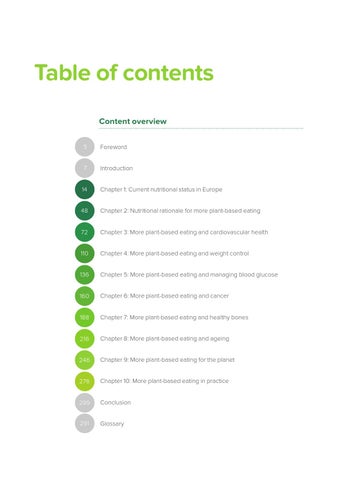
Table of contents Content overview 5
Foreword
7
Introduction
14
Chapter 1: Current nutritional status in Europe
48
Chapter 2: Nutritional rationale for more plant-based eating
72
Chapter 3: More plant-based eating and cardiovascular health
110
Chapter 4: More plant-based eating and weight control
136
Chapter 5: More plant-based eating and managing blood glucose
160
Chapter 6: More plant-based eating and cancer
188
Chapter 7: More plant-based eating and healthy bones
216
Chapter 8: More plant-based eating and ageing
246
Chapter 9: More plant-based eating for the planet
276
Chapter 10: More plant-based eating in practice
289
Conclusion
291
Glossary
Foreword We live in a time where consumers are constantly bombarded with dietary advice on how to improve their health and avoid chronic diseases such as heart disease and cancer. Some of this advice is measured and evidencebased, but much is ill-conceived and sensational, often promoting the latest trendy diet, leaving the poor consumer bemused and confused about what to eat to stay healthy. Exhorting the general public to eat so-called ‘superfoods’ or desist from consuming saturated fats is likely to have only minor effects if the rest of the diet is not healthful. PROF. IAN ROWLAND
It is becoming increasingly clear that focusing dietary advice on single foods
(Reading, UK)
and nutrients - such as polyunsaturated fatty acids, sugar or dietary fibre - is
Chair of Scientific
counterproductive. A more effective, and scientifically more sound strategy
Advisory Committee
is to look at dietary patterns and evaluate what their effects are on health
of the Alpro Foundation
outcomes. The Mediterranean and Okinawa diets, for instance, incorporate a wide range of foods and there is both epidemiological and experimental evidence for their beneficial impact on human health. These and similarly healthful dietary patterns emphasize the consumption of a diverse range of vegetables, fruits, legumes, and whole grains. It is not surprising that these plant-based foods feature strongly in dietary guidelines throughout the world. The aim of this book is to present, in a concise, comprehensive and objective form, the extent and depth of the evidence linking a plant-based diet to human health; from its contribution to good nutrition, to its role in modifying the risk of the major chronic diseases aicting the ageing populations of most countries in the world: cardiovascular disease, type 2 diabetes and cancer.
Foreword
5
Introduction In the last few years the concept of plant-based eating has grown in popularity and subsequently a number of “popular” plant-based diet books have now been published (for example [1-6]). But is there scientific evidence to support this way of eating? Is this another fad diet or is there real proof this diet can support good health? Traditional diets based on plant foods, such as the Mediterranean and East Asian diets, would seemingly endorse this, as it is this particular feature which is thought to contribute to positive health and longevity [7]. It has also been suggested that eating more plant foods while reducing animal foods, is beneficial for the planet. With a growing global population, rising incomes and urbanisation, an increased demand for meat is expected. Many believe this is neither practical nor sustainable. To explore this further, an extensive review of scientific literature was conducted in 2011. This resulted in the publication of “The Plant-based Plan©” which for the first time brought together evidence for nutritional, health and environmental benefits of plant-based eating patterns. Yet in the last few years, and since the first publication of The Plant-based Plan©, there has been a huge increase in the number of studies published in this field. As a result, an updated analysis of the scientific literature has been undertaken and the latest information is now included in this new edition of The Plantbased Plan©. This updated book provides an even greater insight into the benefits of plant-based eating. The evidence continues to support eating a diet based on plant foods and as such many international organisations and associations still place the emphasis on plant foods in their dietary recommendations to promote good health (Table I.1). Nearly all European countries have food-based dietary guidelines to support good health, and common to all these models is a diet that includes eating plenty of fruits, vegetables and complex carbohydrates, and choosing foods which are lower in SFA, salt and sugar. Animal foods, including meat and dairy, represent smaller segments in these models, highlighting
Introduction
7
Introduction
World Health Organisation (WHO) 2004, 2014 [8, 9]
Recommendations in the Global Strategy on Diet, Physical Activity and Health report included: ‘Increase the consumption of fruits and vegetables, and legumes, whole grains and nuts.’
World Cancer Research Fund (WCRF) 2007 [10]
‘Basing our diets on plant foods (like vegetables, fruits, whole grains, and pulses such as beans), which contain fibre and other nutrients, can reduce our risk of cancer.’ ‘To reduce your cancer risk, eat no more than 500 g (cooked weight) per week of red meats, like beef, pork and lamb, and avoid processed meats such as ham, bacon, salami, hot dogs and some sausages.’
Scientific Report of the 2015 Dietary Guidelines Advisory Committee [11]
‘Common characteristics of dietary patterns associated with positive health outcomes include higher intake of vegetables, fruits, whole grains, low- or non-fat dairy, seafood, legumes, and nuts; moderate intake of alcohol (among adults); lower consumption of red and processed meat, and low intake of sugar-sweetened foods and drinks, and refined grains.’ ‘Moderate to strong evidence demonstrates that healthy dietary patterns that are higher in plant-based foods, such as vegetables, fruits, whole grains, legumes, nuts, and seeds, and lower in calories and animal-based foods are associated with more favourable environmental outcomes (lower greenhouse gas emissions and more favourable land, water, and energy use) than are current U.S. dietary patterns.’
American Dietetic Association 2015 [12]
‘The low intake of foods containing saturated fat and cholesterol, and high intake of vegetables, fruits, whole grains, legumes, nuts, seeds and soya products that are rich in fibre and phytochemicals are components of a vegetarian diet that contribute to reduction of chronic disease.’
LiveWell for LIFE Project – defining country-specific sustainable diets across the EU [13]
‘Eat more plant foods – enjoy vegetables and whole grains’ ‘Moderate your meat consumption, both red and white, enjoy other sources of proteins such as peas, beans and nuts’.
Table I.1: International support for plant-based eating that only modest amounts are required as part of a healthy balanced diet. In contrast, plant-based foods represent larger segments. Not only do recent studies continue to support plant-based diets for good health, but there is also a larger evidence base to suggest this way of eating is preferable for the environment. Plant-based foods are more advantageous as they require less land, water and energy resources, and produce
8
fewer greenhouse gas emissions than animal-based products. In line with this the World Wildlife Fund (WWF) has recently launched the LiveWell for Low Impact Food in Europe (LiveWell for LIFE) project which uses a LiveWell plate to define country-specific sustainable diets across the EU. The LiveWell plate has now been adopted across the traditional diets of three countries – France, Spain and Sweden. The results from these three countries found that healthier eating can be aligned with environmental objectives. Also, this way of eating costs no more than the current dietary patterns, complies strictly with national nutritional requirements, and closely resembles the current dietary pattern. This was achieved by reducing the total amount of meat consumed, increasing the consumption of legumes as a source of protein, and increasing cereals and starchy foods (typically bread, pasta and potatoes). A number of other countries, e.g. the Netherlands and Norway, are now also taking sustainability into account, and at the same time address a healthy balance of nutrients in their food-based dietary guidelines [11, 14, 15].
Definition of plant-based eating Currently there is no exact definition of a plant-based diet, yet many people associate this way of eating with being vegetarian, which is not the case. The term “vegetarian” is very broad and encompasses a variety of eating patterns - some include variable amounts of animal foods (Figure I.1). Early studies investigating the benefits of plant-based diets tended to define this way of eating according to the relative absence of meat in the diet – from the complete avoidance of animal foods (vegans) through to individuals who consume meat on a daily basis. However, recent thinking is that the health benefits of plant-based diets are not solely due to the lack of meat in the diet but also to the increased quantity of plant-based foods. A better way to measure this is by using dietary pattern analysis. Studies using this method have found plant-based dietary patterns that include small amounts of animal products still offer nutritional and health benefits [16-18]. There are different ways of eating more plant-based foods. Plant-based eating does not automatically exclude all animal products but rather than meat being the focus of the diet, plant-based foods should be at the core.
Introduction
9
Introduction
Vegans
Avoid all animal products
Pescovegetarians
Avoid meat but include fish and/ or shellfish, dairy foods and eggs
Lactovegetarians
Lacto-ovovegetarians
Avoid meat, fish and eggs, but eat dairy foods
Avoid meat and fish but eat dairy foods and eggs
Semivegetarians
Plant-based 2/3
plant-based foods
1/3
animal-based foods
Eat small amounts of animal products
At least 2/3 of the diet is made up of plant-based foods. Less than 1/3 comes from animal products.
Figure I.1: Different types of vegetarians This advice is in line with the WCRF recommendations suggesting that twothirds of a meal should be plant-based foods and one-third animal products [10].
Introduction to the science A number of general principles have been adopted in this latest review. To identify the recent scientific evidence, initially a search of the scientific literature was undertaken in Medline using the term “plant-based”. As the previous review was conducted up to 2011, new literature from 2011 onwards was searched. This database was supplemented by using the search term “vegetarian” and by hand-searching the reference lists in reviews and meta-analyses. Animal studies were excluded. A database containing human studies or reviews was established, which resulted in approximately 400 new references. This database was then further searched using terms
10
2/3
plant-based foods
1/3
animal-based foods
relevant to each chapter. For example, for the heart health chapter the additional search terms were “heart”, “CVD”, “CHD”, “blood pressure”, “blood lipids” and “cholesterol”. Once the total database had been further searched with terms appropriate to each health condition, subgroups of references were available. These, along with the earlier studies identified in the original Plant-based Plan©, resulted in a doubling of the number of references available to a total of 1008 references being used to form the core scientific evidence for each individual chapter. The primary sources of information required were studies conducted in humans with plant-based eating patterns. However, in some cases data from vegetarian studies or studies undertaken of those adopting a Mediterranean Diet have been included, as this research can further add to our understanding of plant-based eating. Scientific support was obtained from two main sources; observational studies and clinical studies. Evidence provided by both groups of studies is valuable; observational studies tend to be much longer term and provide information about the overall impact on health of adopting a particular lifestyle and also provide feedback on day to day practice. However, in these studies associations are measured, not cause and effect. The shorter duration clinical studies provide an insight into the change in specific risk factors. Clinical studies may also help develop an understanding of the mechanisms involved and why a particular intervention is effective. This recent review identified many more randomized clinical trials than previously; they are considered the gold standard in nutrition studies. In the following chapters information from both clinical and observational studies is detailed (providing an insight into the overall strength of the evidence, based on both clinical disease endpoints and changes in surrogate markers, for the potential health benefits of plant-based eating) and each chapter is introduced with a guest editorial written by an expert in their respective field.
Introduction
11
Introduction
Plant-based eating in practice Although there is universal consensus that we should be eating more plant-based foods, many people find this difficult to achieve. This may be because they do not have enough information about plant-based eating or how to put it into practice [19]. At the same time, health professionals are becoming aware of the important role they have in helping people make sustainable dietary choices. With this in mind, as well as outlining the evidence supporting the nutritional, health and environmental benefits, the 2015 update of “The Plant-based Plan� provides practical advice on how to motivate and get people started on their eating plan. It is not about transforming the diet, but by making small changes to include more plant foods and less animal products a big difference can be made to both our health and that of the planet.
12
References 1.
McCowan, S., The Abundance Diet: The 28-Day Plan to Reinvent Your Health, Lose Weight, and Discover the Power of Plant-Based Foods. 2015: Vegan Heritage Press 224.
2.
Burton, D., Plant-Powered Families. 2015: BenBella Books.
3.
White, S., The Flexitarian Diet Guide: How To Eat Healthy And Lose Weight The Natural Way. 2015: CreateSpace Independent Publishing Platform.
4.
Finberg, S., The New Nordic Diet: Delicious Recipes for a Healthy Lifestyle: Volume 2. 2015: CreateSpace Independent Publishing Platform 80.
5.
Borysenko, J., The PlantPlus Diet Solution: Personalized Nutrition for Life. 2014: Hay House UK 777.
6.
Anderson, J., The Mediterranean Way of Eating: Evidence for Chronic Disease Prevention and Weight Management. 2015: CRC Press. 279.
7.
Panico, S., et al., Mediterranean dietary pattern and chronic diseases. Cancer treatment and research, 2014. 159: p. 69-81.
8.
WHO, Global Strategy on Diet, Physical Activity and Health. 2004.
9.
WHO, European Food and Nutrition Action Plan 2015–2020. Regional Committee for Europe, 64th SESSION, Copenhagen, Denmark, 15-18 September 2014.
10.
WCRF/AICR. Food, Nutrition, and Physical Activity, and the Prevention of Cancer: A Global Perspective., in Washington, DC: AICR. 2007.
11.
USDA, Scientific Report of the 2015 Dietary Guidelines Advisory Committee. 2015.
12.
Cullum-Dugan, D. and R. Pawlak, Position of the academy of nutrition and dietetics: vegetarian diets. J Acad Nutr Diet, 2015. 115(5): p. 801-10.
13.
WWF, LiveWell for Life Final Recommendations. On our plate today: healthy sustainable food choices.2014 [accessed May 2015].
14.
Health Council of Netherlands. Guidelines for a Healthy Diet: the ecological perspective. 2011.
15.
Nordic Nutrition Recommendations 2012: Nordic Council of Ministers www.dx.doi.org/10.6027/Nord2013009..
16.
Martínez-González, M.A., et al., A provegetarian food pattern and reduction in total mortality in the Prevención con Dieta Mediterránea (PREDIMED) study. Am J Clin Nutr, 2014. 100(Supplement 1): p. 320S-328S.
17.
Clarys, P., et al., Comparison of nutritional quality of the vegan, vegetarian, semi-vegetarian, pesco-vegetarian and omnivorous diet. Nutrients, 2014. 6(3): p. 1318-32.
18.
Orlich, M.J., et al., Patterns of food consumption among vegetarians and non-vegetarians. Br J Nutr, 2014. 112(10): p. 1644-53.
19.
Lea, E.J., et al., Public views of the benefits and barriers to the consumption of a plant-based diet. Eur J Clin Nutr, 2006. 60(7): p. 828-37.
Introduction
13
1
1
Chapter 1
Current nutritional status in Europe Introduction to Chapter 1, by invited expert Stefaan De Henauw Over the past few decades several international initiatives were developed in Europe to set population nutrient goals as a basis for a healthy life expectancy, based on thorough review of the available evidence from nutriPROF. STEFAAN
tion research. The EURODIET’s main conclusions have been disseminated
DE HENAUW
and quoted widely by the scientific nutrition community and more recently
Professor of public
EFSA have essentially confirmed this overall nutritional basis for healthy
health and nutrition
diet and healthy life.
at the Department of Public Health, Ghent
In addition, the know-how for translating nutrient reference values into so-
University (Belgium).
called food-based dietary guidelines has been improved and fine-tuned over the years. This know-how is now commonly available to all responsible public authorities. Most – if not all – countries in Europe have developed their own nutrition guidelines and many countries have adopted nutrition monitoring systems as an integrated part of their overall public health surveillance system. Finally, one of the noteworthy efforts in the scientific nutrition community – in collaboration with other stakeholders – has been the development of nutrient profiling systems and the many variations on this theme. A series of sophisticated, yet simple to use tools and aids are available in different formats, shapes and colors, to guide consumers in their choice as they are strolling through the modern food landscape. Today’s consumers are more than ever before interested in and informed about the foundations of a healthy diet. In spite of all this knowledge and all efforts to improve the general diet, the available data on mainstream daily eating practice in Europe and most indicators of current nutritional status of the population in Europe, are far from optimal and do not allow for optimism about the further improvement of the “diet-health” nexus.
Chapter 1 - Current nutritional status in Europe
15
Chapter 1 - Current nutritional status in Europe
The following chapter clearly demonstrates that current data on nutritional status in Europe essentially points at a series of major nutritional problems and challenges. The key issues for the overall nutritional imbalance, so it seems, are predominantly related to overconsumption of animal products and far too low consumption of foods from vegetable origin. Nested within the latter is the general choice for refined sources of starch instead of wholegrain variants. Interestingly, this trade-off between animal and vegetable sources plays a key role in another very important food and health related phenomenon; the issue of sustainability. Indeed, the 21st century Western diet is not only suffering severely from imbalances vis-à-vis good health maintenance for the people, it has also cast an increasingly worrying shadow on the health of the planet. Our modern Western food production and consumption system represents a disproportionally large contribution to the global challenge of climate control and sustainability. There is an urgent call to integrate global sustainability imperatives into the processes aimed at promoting a healthy diet. However, it is far from clear how this principle should be put into practice. Clearly, a transition is required to create a food system that will serve both the need for sustainable health at an individual level and the need for a sustainable planetary condition at a global and intergenerational level. This indicates a need for a horizontal transition across the chain of interrelated phenomena that ultimately lead to the food choices we make. Such a transition has to rethink and reinvent the position of our food at all levels, from the food production framework – with a shift towards less animal and more vegetable – to the food environment and the way we prepare new generations of people with knowledge and skills to find the “right diet”. A healthy diet, yes, for sure, but first and foremost a diet that becomes a major part of our culture, to be cherished and fostered as much as life itself. We are facing a big challenge. Hopefully, future reports on nutritional status in Europe will bring better news than what we are dealing with today.
16
1
Chapter 1
Current nutritional status in Europe Population nutritional goals It is well recognized that good nutrition is one of the key factors in maintaining positive health and well-being. As such, it is important to identify the optimum range of nutrient intakes for a population that is consistent with supporting good health. In Europe the most complete population nutritional guidelines are those published by the WHO/FAO and Eurodiet [1, 2]. The Eurodiet project started in October 1998 with the aim of contributing towards a coordinated European Union (EU) health promotion programme on nutrition, diet, and healthy lifestyles. More recently EFSA has added to these with their publication of Dietary Reference Values for fats [3], protein [4], carbohydrates and dietary fibres [5], as well as a number of micronutrients [6]. In addition to these international guidelines, a number of national reference values exist to take into account local factors such as existing dietary intakes, cultural traditions, lifestyles and genetics. For example, the ‘Dietary Reference Values for Food Energy and Nutrients for the United Kingdom’ by the Department of Health, the ‘Dietary reference intakes: energy, proteins, fats, and digestible carbohydrates’ by the Health Council of the Netherlands and the ‘Food recommendations for Belgium’ by the Health Council of Belgium. As well as these national reference values, further nutrient-based guidelines for groups of countries have been developed. These are the D-A-CH Reference values for the German-speaking countries and central Europe [7] and the Nordic Nutrition Recommendations for the Nordic Countries [8]. Due to varying local nutritional guidelines, the international and European recommendations will be referred to in this chapter (Table 1.1) to be able to make meaningful comparisons between European countries.
Chapter 1 - Current nutritional status in Europe
17
Chapter 1 - Current nutritional status in Europe
Nutrient
WHO [1, 9-11]
FAO [12]
Eurodiet [2]
Dietary Fat (En%)
15-30
15-35
< 30
SFA (En%)
< 10
10
< 10
EFSA [3-5] 20-35 Not set, but advised to be as low as possible within a nutritionally adequate diet
6-11 PUFA (En%)
6-11 n-6: 2.5-9 n-3: 0.5-2.0
Cholesterol (mg/ day)
< 300
Trans Fat (En%)
<1
n-6 PUFA: 4-8 + 2g 18:3(n-3) + 200mg LC n-3 PUFA
18:2(n-6): 4 (AI) + 18:3(n-3): 0.5 (AI) + LC n-3 PUFA: 250mg
Not set, but advised to be as low <1
<2
as possible within a nutritionally adequate diet
Total Carbohydrates (En%)
50-75
Free Sugars (En%)
< 10
Protein (En%)
10-15
> 50
45-60
0.83g/ kg/ day (PRI) Men (ref. wt. 74.6kg) – 62g/ day Women (ref. wt. 62.1kg) –52g/ day Fibre (g/ day) Fruit and Vegetables (g/ day)
> 25
> 25
≥ 400
> 400
25
AI – Adequate Intake (needed by the body for good health, but sufficient scientific data is not available to derive an average requirement, a lower threshold intake or a population reference); LC – Long Chain, ≥20 carbon atoms; PRI – Population Reference Intake; ref. wt. – Reference Weight
Table 1.1: Selected population nutrient-based guidelines for Europe
18
1 Current nutritional status in Europe Existing data suggests there are significant gaps between these proposed nutrient goals and actual intakes in Europe. There are three types of data collection available for comparing food and nutrients consumption patterns across Europe; nationwide surveys of individuals, household-based availability data and national food supply data. The most valuable of these comes from nationwide surveys of individuals that provide information on actual food consumption and nutrient intakes. However, caution does need to be taken when interpreting and comparing this data among countries. This is due to different methods being used to collect the information, as well as recent data not being available for all countries. Despite this, currently it is the best reflection of consumption. Using this information, a recent report on the health and nutrition status of Europe collated data by grouping different regions of the European Union and analysed the data accordingly [13]. These groups were as follows: • North: Denmark, Estonia, Finland, Latvia, Lithuania, Norway, Sweden • South: Cyprus, Greece, Italy, Portugal, Spain • Central and East: Austria, Czech Republic, Germany, Hungary, Poland, Romania, Slovenia • West: Belgium, France, Ireland, Luxembourg, the Netherlands, United Kingdom The findings suggested that for most of these European countries the percentage of energy coming from fat was above the recommended range set by WHO (28.4 to 45.0 En% in males and between 29.9 to 47.2 En% in females) [1]. Furthermore, the fatty acid pattern did not meet the recommendations, with SFA intakes being higher and PUFA lower than recommended in most countries [10]. Protein intakes were within or slightly above the recommended range, whereas dietary fibre intake in most countries was lower (Table 1.2). Data for individual European countries, based on individual food consumption, was also provided in the report. A similar pattern emerged for these nutrient intakes in the adult population in the UK, the Netherlands, Belgium, Germany, Spain and Sweden, although PUFA intake did meet the minimum
Chapter 1 - Current nutritional status in Europe
19
Chapter 1 - Current nutritional status in Europe
Fat (En%)
SFAs (En%)
PUFAs (En%)
Cholesterol (mg/ day)
Protein (En%)
Fibre (g/ day)
15-30
< 10
6-11
< 300
10-15
> 25
Men
31.0 – 44.9
12.0 – 14.6
4.7 – 8.9
256.0 – 477.9
13.7 – 16.8
18.0 – 25.0
Women
31.0 – 41.9
12.0 – 14.4
4.7 – 8.7
176.0 – 318.8
13.7 – 17.2
15.6 – 21.0
Men
28.4 – 45.0
8.8 – 12.7
4.8 – 6.4
282.9 – 378.4
14.1 – 18.5
19.3 – 23.5
Women
29.9 – 47.2
9.4 – 13.2
4.5 – 6.9
227.6 – 310.8
14.4 – 19.3
16.9 – 23.7
Men
31.3 – 38.9
11.7 – 26.3
5.7 – 8.8
352.5 – 800.0
13.5 – 17.8
18.7 – 29.7
Women
31.2 – 39.7
11.7 – 24.8
5.6 – 9.2
277.0 – 680.0
13.1 – 17.1
19.7 – 24.7
Men
34.8 – 36.5
13.7 – 14.6
6.7 – 7.0
250.0 – 279.0
14.7 – 16.3
12.8 – 24.4
Women
35.1 – 36.9
13.7 – 14.7
6.7
201.0 – 215.2
15.6 – 17.0
10.4 – 20.1
Nutrient
WHO Recommendations NORTH
SOUTH
CENTRAL & EAST
WEST
Table 1.2: Selected nutrient intakes (min. – max.) in adults across four European regions compared to international recommendations Source: Elmadfa [13]
recommendations in the first three countries but not in Spain and Sweden. Figure 1.1 compares these to the recommended targets, as a percentage, for adult men, with similar findings being observed for women. As previously highlighted, it is difficult to make direct comparisons between these countries due to differences in the dietary survey methodologies. However, the European Prospective Investigation into Cancer and Nutrition (EPIC) study uses a consistent methodology across the participating countries to collect dietary data. As a result more meaningful comparisons can be made. Information collected in this way shows similar results, in that the
20
1 Fat (En%) SFAs ( En%) PUFAs (En%) Protein (En%) Fibre (g/day) 200
Percentage of the recommended amount
180 160 140 120 100 80 60 40 20 0 BE
DE
ES
NL
SE
UK
Recommended targets based on WHO ranges: Dietary fat 30 En%, SFA 10 En%, PUFA 6 En% (minimum), Protein 10 En%, Fibre 25g/d (except for the UK where 18g was used to allow for the difference in fibre analysis) Data not available: fibre intake in Belgium and PUFA in Germany.
Figure 1.1: Selected nutrient intakes for adult men as a percentage of the recommended amounts Source: Elmadfa [13]
Netherlands, UK, Germany, Spain and Sweden are consuming too much fat and SFA, and not enough fibre or PUFA compared to the recommendations (Figures 1.2 and 1.3) [14-16]. Out of these selected countries the only group that appears to meet the recommended ranges is the UK health-conscious cohort. This group includes lacto-ovo-vegetarians, pure vegans, fish (but not meat) eaters and meat eaters. Compared to the UK general population overall, this health-conscious cohort has a lower intake of animal products and fairly high intake of legumes [17], which may account for the nutritional differences.
Chapter 1 - Current nutritional status in Europe
21
Chapter 1 - Current nutritional status in Europe
Fat (En%) SFAs ( En%)
Total fat recommended intake (15- 30En%) Fibre recommended intake (> 25g/ d)
PUFAs (En%) Protein (En%)
Saturated fat recommended intake (<10En%) PUFA fat recommended intake (6-11En%)
Fibre (g/day) 45 40 35 30 25 20 15 10 5 0 DE (Heidelberg)
DE (Potsdam)
ES (Granada)
ES (Navarra)
NL
SE (Malmo)
SE (Umea)
UK
UK
(General
(Health-
Population)
conscious)
Figure 1.2: Mean selected nutrient intakes in men in the EPIC study Source: Ocke [14] Cust [15] Linseisen [16]
Fat (En%) SFAs ( En%)
Total fat recommended intake (15- 30En%) Fibre recommended intake (> 25g/ d)
PUFAs (En%) Protein (En%)
Saturated fat recommended intake (<10En%) PUFA fat recommended intake (6-11En%)
Fibre (g/day) 45 40 35 30 25 20 15 10 5 0 DE (Heidelberg)
DE (Potsdam)
ES (Granada)
ES (Navarra)
NL
SE (Malmo)
SE (Umea)
UK (General Population)
UK (Healthconscious)
Figure 1.3: Mean selected nutrient intakes in women in the EPIC study Source: Ocke [14] Cust [15] Linseisen [16]
22