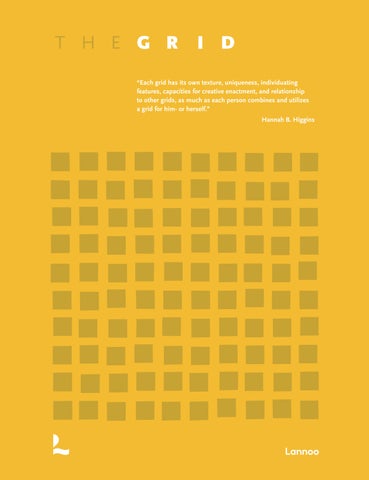
T H E G R I D “Each grid has its own texture, uniqueness, individuating features, capacities for creative enactment, and relationship to other grids, as much as each person combines and utilizes a grid for him- or herself.” Hannah B. Higgins
T H E G R I D
T H E G R I D Edited by Alexander Streitberger
5
TABLE OF CONTENTS
Foreword Elisa de Jacquier de Rosée The Ambiguous Grid. A Journey Through the Meanders of a Multidimensional Artistic Matrix Alexander Streitberger ”Brazilian Geometry”. The Grid in Contemporary Brazilian Art: Territories, Identities, and Historical Narratives Under Scrutiny Olivia Ardui
7
10
40
Optical and physical grids Verena Loewensberg Vera Molnár François Morellet Carl Andre Sol LeWitt Rosemarie Trockel Sherrie Levine
59
The Grid in Action Dennis Oppenheim Jacques Lizène Gina Pane Esther Ferrer Analívia Cordeiro
91
Matrixes of Memory and Identity Douglas Huebler Christian Boltanski On Kawara Claudia Andujar Michael Ensdorf
62 66 70 74 78 82 86
94 10 0 10 4 10 8 114 119 12 2 12 6 13 0 13 4 13 8
7
FOREWORD
The Musée L is honoured to host this exhibition, which stems from a collaboration with Professor Alexander Streitberger (UCLouvain) on the subject of the grid, an emblematic structure in modern art that continues to inspire the imagination of contemporary artists. Drawing on the Guillaume Wunsch and Monique Van Kerckhove collection, the exhibition focuses on major artworks from the 1960s and 1970s (geometric abstraction, Conceptual Art, Op Art, etc.), while also featuring a number of works by contemporary artists including Douglas Huebler, Sol LeWitt, François Morellet, Rosemarie Trockel, Vera Molnár, Christian Boltanski, Gina Pane and Esther Ferrer, to name but a few. The unexpected scope of the theme of the grid is illustrated in the essays and notes in this catalogue. In his introductory essay, Alexander Streitberger embarks us on a journey through time and space to reveal the complex and multiple roles that the grid played as a form, structure and device of artistic creation. Then, examining the grid as an icon of artistic modernity in countries outside the United States and Europe, Olivia Ardui turns to contemporary art in Brazil, a country that is represented in the exhibition through works by Claudia Andujar, Analívia Cordeiro and Anna Bella Geiger. Finally, the notices, which are structured around three main themes, cast a valuable light on the most important artworks in the exhibition.
We would like to express our warmest gratitude to Professor Alexander Streitberger, the exhibition’s enthusiastic curator, and to his teaching assistant Olivia Ardui. We would also like to thank the students in the master seminar “History of Art from the Avant-Garde to Contemporary Art” for their contribution to this exhibition project. We should like to offer our appreciation to Anne Colla and Laurence Waterkeyn for their valuable work in coordinating the production of the exhibition and its catalogue. Our heartfelt gratitude also extends to all the lending institutions and collectors who have shown their trust and accepted this collaboration. We should like to thank the Centre national des arts plastiques (CNAP) and the Espace de l’art concret, the Fonds régionaux d’art contemporain (FRAC) Franche-Comté, Grand Large (HDF), Lorraine, Normandie Caen, Occitanie Toulouse, the Fédération Wallonie-Bruxelles, the Musée des Arts contemporains de la Fédération Wallonie-Bruxelles (MAC’s Grand-Hornu), the Musée de la Photographie de Charleroi, the Museum of Contemporary Art of Antwerp (M HKA), the Municipal Museum of Contemporary Art (SMAK), the ING Belgian Collection, the Vanmoerkerke Collection, the Philosophy Library of UCLouvain, the Library of the Université Saint-Louis Bruxelles, the KBR, the Wittert ULiège Museum, the Nadja Vilenne Gallery, the Anita Beckers Gallery, the Mendes Wood DM Gallery, Mr Piet Van Cauwenberghe, Mr Bernd Stiegler, Mr Guillaume Wunsch and Mrs Monique Van Kerckhove, and Mr Michael Ensdorf. We are particularly grateful to our donors, Mr Wunsch and his wife Mrs Van Kerckhove. This exhibition could not have been staged without the presence of their collection.
8
We cannot emphasise it enough: teaching, researching, and serving society constitute the daily missions of the Museum L in its capacity of university museum. As the exhibition project unfolded, students were given the opportunity to engage with the artworks to participate in the exhibition design process, and to work on mediation by drafting notes on the pieces and artists presented. Such knowledge and skills transfer proved mutually enriching and fostered some wonderful collaborations.
9
And finally, I would like to conclude this preface with the words of Baudelaire, which Vera Molnár, the creator of the work on the cover, found so inspiring: “Monotony, symmetry, and surprise”. Allow yourself to be captured by the grid as you explore the pages of this catalogue and the exhibition spaces. Elisa de Jacquier de Rosée Museum L Director a.i.
THE AMBIGUOUS GRID A Journey Through the Meanders of a Multidimensional Artistic Matrix
“Each grid has its own texture, uniqueness, individuating features, capacities for creative enactment, and relationship to other grids, as much as each person combines and utilizes a grid for him- or herself1.”
Lattice, grating, mesh, network, screen, bars, matrix – all these words suggest what dictionaries call the “grid”. Simultaneously terming a fence (the bars on the windows of a prison), a form of social, informational or economic distribution (the reading grid and the wage grid), an architectural or urban planning layout (the grid of a building plan), a means of map projection (the network of parallels and meridians), and a method of reproduction (Dürer’s perspective machine and the screen or grid in photoengraving), the grid is omnipresent in our daily lives, where it assumes a variety of functions and meanings. In The Grid Book, Hannah Higgins explores the history of the grid from the invention of the brick, circa 9000 BC, as a fundamental element of the wall as “a grid that is equal parts mortar and module”, to grid computing as a virtual infrastructure that combines multiple computers to “coordinate complex and diverse information into a vast global knowledge network2”. Throughout the history of art, the grid is commonly associated with two historical moments: the emergence of abstract painting in Europe at the beginning of the twentieth century, with Piet Mondrian’s neoplasticism at its pinnacle; and modernist and neo-avant-garde tendencies of the 1950s and 1960s, including
1
Higgins, Hannah B., The Grid Book, Cambridge, MA, MIT Press, 2009, p. 276.
2
Ibid., p. 13 and p. 255.
10
Alexander Streitberger
11
Concrete Art, Minimal Art, Conceptual Art, Kinetic Art, and Optical Art. The discovery of the grid as a primary structure of artistic creation is directly related to a theoretical debate that took place in New York’s artistic and intellectual scene in the 1970s in the wake of the exhibition Grids Grids Grids Grids Grids Grids Grids Grids, curated by Suzanne Delehanty at the University of Pennsylvania’s Institute of Contemporary Art in 1972. In her introductory text for the catalogue “Top to Bottom, Left to Right”, Lucy R. Lippard describes the grid as an emblematic principle of American and European art in the period from 1940 to 1970, which provides “an armature for a variety of styles, means and contents”, or “an instrument by which to control the void [...] a way to violate the ominously blank surface.3” The artists exhibited included Carl Andre, Eva Hesse, Sol LeWitt, Agnes Martin, Robert Ryman, Ad Reinhardt and Andy Warhol, who, in the following years, would establish a canon of “grid artists” who were regularly featured in the art press, particularly in John Elderfield’s and Amy Goldin’s articles in Artforum magazine, respectively in May 1972 and September 19754. Although there is no doubt that the grid has been in use in art since at least Ancient Egypt, its recognition as an autonomous artistic principle and its historiographical fortunes are directly connected to the discourse that took place in American art criticism in the 1970s. Rosalind Krauss’s text “Grids” undoubtedly proved a major milestone in this discourse. Krauss begins her essay by chronicling the saga of modernist painting: “In the early part of this century there began to appear, first in France and then in Russia and in Holland, a structure that has remained emblematic of the modernist ambition within the visual arts ever since. Surfacing in pre-War cubist painting and subsequently becoming ever more stringent and manifest, the grid announces, among other things, modern art’s will to silence, its hostility to literature, to narrative, to discourse5.” 3
Lippard, Lucy R., “Top to Bottom, Left to Right”, in Grids Grids Grids Grids Grids Grids Grids Grids, cat., Institute of Contemporary Art, University of Pennsylvania, 1972, n.p.
4
Elderfield, John, “Grids”, Artforum, May 1972, p. 52-59; Amy Goldin, “Patterns, Grids, and Painting”, Artforum, September 1975, p. 50-54.
5
Krauss, Rosalind, “Grids”, October, vol. 9, summer 1979, p. 50.
6
McNamara, Andrew, “Between Flux and Certitude: The Grid in Avant-garde Utopian Thought”, Art History, Vol. 15, No. 1, March 1992, p. 61.
According to this Modernist interpretation, the structure of the grid, by virtue of its flatness, its geometric character, and its regular, antihierarchical arrangement, asserts the autonomy of art, while simultaneously opposing the mimetic and narrative principles of figurative art. But as we know (and Krauss was one of the first to point this out), this modernist fantasy of an autonomous, pure, and self-reflexive art conflicted with the utopian pretensions of avant-garde painters whose final aim was to reconcile the spiritual ambition of depicting the abstract mechanisms of the Universe with a scientific approach at the service of rational and technological progress6. Thus, Mondrian stated
12
that the New Plastic aspired to geometric harmony, founded on “the pure plastic of [abstract] relationships”, to express ‘the universal, the harmony, the unity that are proper to the spirit7.” Le Corbusier also believed that the rigorous grid of the Voisin plan, an urban planning project designed between 1922 and 1925 for the centre of Paris, epitomised the vision of a serial, mathematical and progressive order created to serve “a community without limits or hierarchy.8” Far from being a pure, autonomous form, the grid is a complex, ambiguous structure that evokes the rational order of science while at the same time opening up hitherto unimagined spaces for imagination, intuition, and creativity. This ambiguity is further reinforced by the fact that “the slightest formal variation in the grid can produce, depending on the context, a complete transformation of meaning9.” To appreciate the complexity and diversity of the grid in art, we shall look briefly at its age-old history as a tool of representation, before revisiting the debate raging in the 1970s and the paradoxes of the modernist grid. We will then examine the meanders of the ambiguous grid in art since the 1950s.
Projections of the World As far back as the 18th Egyptian dynasty, i.e., between 1550 and 1292 B.C., wall painting was already executed using a preparatory drawing transferred to the wall by means of a grid that allowed the exact transfer of lines and colour planes10. The introduction and subsequent development of this transfer process was a direct result of the growing popularity of mimetic representation of reality through the rendering of space and volume. While in the 19th and 20th Dynasties paintings, two distinct grid systems were used to allow for the difference in size between standing kings and seated gods [Fig. 1], more recent examples seem to have abandoned this symbolic heterogeneity and adopted a homogeneous grid across the entire surface11. Yet the schematism of Egyptian wall paintings can be attributed to the fact that the grid was intended as an absolute, mechanically constructed system, adapted to the outlines of the body and limbs to the detriment of their organic forms. According to Erwin Panofsky, the Greeks inverted the relationship between the grid and the body, by starting with the human body to then relate it to other bodies and incorporate it into a coherent whole12. But the Greeks – and then the Romans – conceived the representation
7
Mondrian, Piet, “Neo-Plasticism: The General Principle of Plastic Equivalence” (1921), in Charles Harrison & Paul Wood (ed.), Art in Theory; 1900-2000. An Anthology of Changing Ideas, Oxford, Blackwell, 2003, p. 291-292.
8
McNamara, Andrew, op. cit., p. 66.
9
De Chassey, Éric, “Beyond the Grid / Après la grille”, in Abstraction/ Abstractions : géométries provisoires, cat., Musée d’Art moderne, Saint-Etienne, Éditions du Musée d’Art moderne, 1997, p. 12.
10 Dyett, Marleen, Aus der Perspektive – Raster, Gitter, Netze: Betrachtungen zu einem Formelement der Kunst, Wurzbourg, Königshausen und Neumann, 2014, p. 9. 11 Robins, Gay, “Composition and the Artist’s Squared Grid”, Journal of the American Research Center in Egypt, Vol. 28, 1991, p. 41-43. 12 Panofsky, Erwin, “Die Entwicklung der Proportionslehre als Abbild der Stilentwicklung”, Monatsheft für Kunstgeschichte, 14, Vol. 2, 1921, p. 194.
13
Fig. 1 Temple of Sety I at Abydos, 19th dynasty, drawing by Gay Robins, “Composition and the Artist’s Squared Grid”, Journal of the American Research Center in Egypt, vol. 28, 1991, p. 52
of space as a theatrical production – a “skenographia” – whose goal was not a systematic reconstruction of real space according to the laws of central perspective, but rather the creation of the illusion of a scenography13.
13 Dyett, Marleen, op. cit., p. 15 and p. 20. See also Hans Belting, Florenz und Bagdad: eine westöstliche Geschichte des Blicks, Paris, Munich, Beck 2008, p. 27. 14 Williamson, Jack H., “The Grid: History, Use, and Meaning”, Design Issues, Vol. 3, No. 2, Autumn 1986, p. 15 and p. 18.
In the Middle Ages, the function of the grid as a means to create the illusion of reality was supplanted by its symbolic status expressing vertical relationships between a material world (below) and a supernatural, divine reality (above). The vertical and horizontal lines in the illuminated text columns and miniatures of the late Middle Ages served to create representational and symbolic relationships between various elements across the page. In contrast, during the Renaissance, the grid was “conceived of as a field comprised of points and axes possessing either neutral or numerical (quantitative) value14”. Leon Battista Alberti’s velum and Albrecht Dürer’s perspective machine [Fig. 2] perfectly incarnate the desire to submit the world to a rational, calculated system of representation, which would find its ultimate manifestation in the notion of central perspective as a conical projection, allowing a three-dimensional space (and the objects contained within it) to be mapped onto a two-dimensional plane. In his book De pictura, Alberti suggests the use
14
of an intersecting veil, positioned between the world and the eyes, for capturing the contours of things (circumscriptione) and assembling them in a composition (compositio). Here is Alberti’s description of the process: “a veil loosely woven of fine thread, dyed whatever color you please, divided up by thicker threads into as many parallel square sections as you like, and stretched on a frame. I set this up between the eye and object to be represented, so that the visual pyramid passes through the loose weave of the veil15.” Published in 1538, Dürer’s posthumous Instruction on Measurement (Underweysung der Messung) includes an engraving showing the functioning of the perspective machine, a device made up of a frame, the inside of which is squared by stretched strings. Using an eyepiece fixed to the end of a stick, the artist traces the shapes as seen through the grid onto a sheet of paper, also gridded, thus obtaining an exact copy of reality. The drawn rectangle, conceived by Alberti as a window opening onto the world, was transformed for good into a mechanical device enabling a faithful projection of reality onto the flat surface, which, according to Hubert Damisch, went “less in the direction of a rationalisation of vision than of a rationalisation of representation16”. The vertical grid of the perspective machine is the equivalent of the projection of paving stones in perspective onto the canvas, as seen in many Renaissance paintings. The fact that the checkerboard motif was so popular in Renaissance painting17 is partly due to the fact
Fig. 2
Albrecht Dürer
Draughtsman Making a Perspective Drawing of a Reclining Woman. Books on Measurement (a manual of measurement of lines, areas, and solids by means of compass and ruler) (third edition), Nuremberg, 1538
15 Alberti, Leon Battista, De pictura, (On Painting and On Sculpture. The Latin Texts of De Pictura and De Statua), ed. by Cecil Grayson, London, Phaidon, 1972, p. 56-57. 16 Damisch, Hubert, L’Origine de la perspective, Paris, Flammarion, 1993, p. 49. 17 For example, Perugino’s Marriage of the Virgin, dating from 1501-1504, or The Ideal City of Urbino (1476), the author of which is not certain.
15
that it helped to situate figures in space and to represent them correctly in perspective. Furthermore, Damisch points out that the two-colour chessboard “represents the simplest and most economical way of articulating, decorating and informing a surface18”. The introduction of chess during the Renaissance as a “positional game, based on the opposition of two symmetrically conjugated fields” would turn it into a “stage” or “theatre” “where representation takes place”, which would coincide with the emerging form of painting where the istoria assigns each figure its place (“il suo luogo”)19. Thus, the construction of perspective and the depiction of a story are both based on the motif of a regular grid and its projection in space. In this way, the grid constitutes a principle of organisation and appropriation of the world through representation – but not just that! As several authors have pointed out, the invention of perspective as a means of dominating three-dimensional space chronologically coincides with Ptolemy’s rediscovery, around 1400, of a method of cartographic representation whereby a grid of parallels and meridians shows places in terms of latitude and longitude20. By the mid-sixteenth century, Mercator’s map projection used a grid to produce a precise projection of the globe on a flat map and became a valuable tool for navigating and colonising new territories. As with the mathematical perspective, Mercator’s cartographic grid was designed to simulate and document spatial relationships on a flat surface, with the aim of measuring, controlling, and, ultimately, dominating the world21.
Modernist Contradictions
18 Damisch, Hubert, “L’échiquier et la forme ‘tableau’”, in Irving Lavin (dir.), World Art: Theme of Unity in Diversity, proceedings of the 26th international art history symposium, University Park, Pennsylvania, State University Press, vol. 1, 1989, p. 187. 19 Ibid., p. 189-191 20 Kish, George, La Carte. Image des civilisations, Paris, Seuil, 1980, p. 38. For the relationship between perspective and cartography, see also Dyett, op. cit., pp. 70-72. 21 Williamson, Jack H., op. cit., p. 19. 22 Cézanne, Paul, “Lettre à Émile Bernard, 1904”, in Émile Bernard, Souvenirs sur Paul Cézanne et Lettres, Paris, Société des Trente, 1921, p. 38.
Up until the 19th century, perspective dominated the representation of space in visual art. But while abstract painting steadily distanced itself from a mimetic rendering of things and embraced the emancipation of shapes and colours, it signalled a radical break with a pictorial technique designed to project the real world onto a flat surface. While Paul Cézanne noted that it was essential to learn to paint and “treat nature by means of the cylinder, the sphere, the cone” and that one could then “do everything that one pleases22”, it became clear that geometry could no longer be envisaged as a mathematical method used to represent reality accurately, but rather, like a set of figures used to reveal the specific characteristics of painting. The grid is no longer used as an “intersection” between the world and the space of representation. Rosalind Krauss is unequivocal on
In this perspective, the orthogonal grids that completely cover the paintings of American painter Agnes Martin merely reinforce the flatness of the surface to which they are applied: “The physical qualities of the surface, we could say, are mapped onto the aesthetic dimensions of the same surface26.” However, this modernist approach presents a number of pitfalls. As we have already seen, Mondrian’s and Malevich’s non-figurative paintings do not merely refer to the inherent qualities of painting but seek a spiritual reality by suggesting a correlation between art and the cosmic order of the Universe. For her part, Agnes Martin adds an associative and sentimental dimension to her paintings when she evocatively titles her grid paintings (Summer, 1964; The Sea, Ocean Water, 1960; Friendship, 1963). This effect is further heightened by the colours and by the vibrations of the finely hand-drawn lines [Fig. 3]. In this, Krauss evokes the contradictory, paradoxical or schizophrenic nature of the modernist grid, which, whilst manifesting a materialist, logical and self-referential attitude, “provides us with a release into belief (or illusion, or fiction).27” Structurally, this schizophrenia of the grid is evident in the tension between its centrifugal and centripetal existence. While the repeated, monotonous organisation of horizontal and vertical lines suggests that the grid is merely “a tiny piece arbitrarily cropped from an infinitely larger fabric”,
16
this point: “But perspective studies are not really early instances of grids. Perspective was, after all, the science of the real, not the mode of withdrawal from it. [...] Unlike perspective, the grid does not map the space of a room or a landscape or a group of figures onto the surface of a painting. Indeed, if it maps anything, it maps the surface of the painting itself.23” On the basis of this observation, Krauss proposes a genealogy of the grid as a modernist structure, whose origins lie in European avant-garde painting, particularly with Cubism, De Stijl, Mondrian and Malevich. She continues by pointing out that, after the Second World War, the grid spread to the United States in the work of artists such as Ad Reinhardt, Agnes Martin, Robert Ryman and Sol LeWitt. As a planar, geometric spatial structure organised in an anti-hierarchical manner (“all-over”), the grid constitutes the ideal means of “crowding out the dimensions of the real and replacing them with the lateral spread of a single surface.24” If Krauss goes on to say that “The grid declares the space of art to be at once autonomous and autotelic”, in that it refers only to its own creation, she is perfectly in line with Clement Greenberg’s modernism, according to which every artistic discipline defines the limits and specificities of its medium to ensure its independence as a form of art25.
23 Krauss, Rosalind, op. cit., p. 52. 24 Ibid., p. 50. 25 Greenberg, Clement, “Modernist Painting”, in Charles Harrison & Paul Wood (ed.), Art in Theory; 19002000. An Anthology of Changing Ideas, Oxford, Blackwell, 2003, p. 773-779. 26 Krauss, Rosalind, op. cit., p. 52. 27 Ibid., p. 54.
17
Fig. 3
Agnes Martin
Summer, 1964 Watercolour, ink and gouache on paper, 23.4 × 23.4 cm Patricia Lewy Gidwitz Collection © Sabam Belgium 2023
its projection onto the limited, autonomous space of the canvas, whose texture it imitates, effectively keeps it within the frame28. This differentiation between centrifugal and centripetal forces can be traced to an earlier debate about the grid’s opposing functions between form and content, structure and narrative, and spatial and temporal phenomena. John Elderfield makes a distinction between grids as structures and grids as frameworks29. Whilst structure-grids are centripetal insofar as they constitute “allover small-scale textures”, insisting on their spatial, material and formal characteristics (for example, Jackson Pollock’s action painting or the grid systems of Minimalism), framework-grids are receptacles based on the principle of an accumulation of modules holding information and potentially forming an infinite continuum (Andy Warhol’s silkscreen prints or the photographic grids of Conceptual art)30.
28 Ibid., p. 60. 29 Elderfield, John, op. cit., p. 53. 30 Ibid., p. 54.
In her essay Patterns, Grids, and Painting (1975), art critic Amy Goldin reiterates this same distinction, while insisting on the centrifugal character of the grid as an anti-hierarchical, non-relational structure. By emphasising the interval at the expense of the motif, “Pattern trivializes and degrades its themes by turning them into aesthetic details within a larger, more inclusive
Andy Warhol
Twelve Electric Chairs, 1964 Acrylic and silkscreen ink on canvas, 235 × 225 cm The Andy Warhol Foundation for the Visual Arts, Inc. / © Sabam Belgium 2023
form”31. In this sense, Warhol’s Disaster and Electric Chair series [Fig. 4] illustrate the paradox that a shocking subject loses all emotional charge when it is repeated inside an ordered, rational system. By questioning the sentiments that the grid can elicit, Goldin raises another aspect that Elderfield and Krauss do not consider, i.e., that of the viewer’s emotional reaction to it. This is not insignificant since, as the critic explains, “Grids generate a greater emotional distance – a sense of the presence of objective, pervasive law.” A little later, Goldin wonders how this neutral structure generates a sense of anxiety and answers the question herself by suggesting that the lack of reference marks in a regular grid engenders disorientation32. I believe that Goldin touches on a fundamental paradox that is perhaps at the source of the other aforementioned paradoxes, and which has been at work in every grid-based work since Cubism. The paradox between cold distance and spontaneous affect, between objective rationality and emotional sensitivity. While this debate reveals the complexity of the grid as a form and structure, it is locked in binary terms, whereby modernist art would have prioritised the rational, objective, autonomous and spatial nature of the grid, while emotion, subjectivity, narrative and temporality would have been excluded or – in Krauss’s words – would
31 Goldin, Amy, op. cit., p. 51. 32 Ibid., p. 52.
18
Fig. 4
EXHIBITION
CATALOGUE
Exhibition curator Alexander Streitberger
Publishing director Alexander Streitberger
Exhibition production Anne Colla, project coordinator
Texts by Alexander Streitberger Olivia Ardui Elisa de Jacquier de Rosée Célia Arias y Soto Eléa Declercq Valentina Perazzini
Direction a.i., Musée L Elisa de Jacquier de Rosée Exhibition and Publishing Department, Musée L Anne Colla, Gwenaël Thomas, Laurence Waterkeyn Visitor Relations and Reception, Musée L Marie Baland, Pauline Baltieri, Flore d’Ansembourg, Sylvie De Dryver, Stéphanie Delmotte, Terence François, Manon Janssens, Isabelle Maron, Joëlle Pigeolet
Editorial coordination Laurence Waterkeyn (Musée L) and Michelle Poskin (Éditions Racine) Translation Paula Cook Graphic design [nor] production – Emmanuel Bonaffini
Collections Department, Musée L Muriel Damien, Laura Debry, Bénédicte Duvernay, Mickaël Lefèvre, Laura Swalué, Marie Van Bosterhaut
Production and publishing Éditions Racine, Brussels (www.racine.be) Éditions Racine is part of the Lannoo Publishing Group (www.lannoo.com).
Graphic design, Musée L Joëlle Deuse
Credits The publisher has made every effort to contact the owners of the rights to the illustrations in this book. In the event that any photographs or illustrations were used without the knowledge of the copyright holders, please contact the Musée L. All rights reserved. No part of this publication may be reproduced, stored in a retrieval system, or transmitted in any form or by any means, electronic, mechanical, photocopying, recording or otherwise, without the prior permission of the copyright owner.
Administrative Department, Musée L Anaïs Kasa-Vubu, Sophie Tumelaire Loaners CNAP, Espace de l’art concret, FRAC FrancheComté, Grand Large (HDF), Lorraine, Normandie Caen, Occitanie Toulouse, Fédération WallonieBruxelles, MAC’s Grand-Hornu, Musée de la Photographie de Charleroi, M HKA, SMAK, ING Belgian Collection, Vanmoerkerke Collection, Philosophy Library of UCLouvain, Library of the Université Saint-Louis Bruxelles, KBR, Musée Wittert ULiège, Nadja Vilenne Gallery, Anita Beckers Gallery, Mendes Wood DM gallery, Mr Piet Van Cauwenberghe, Mr Bernd Stiegler, Mr and Mrs Guillaume Wunsch, Mr Michael Ensdorf
© 2023; L – UCLouvain Museum, the authors, Uitgeverij Lannoo D. 2023. 6852. 22 Legal deposit: October 2023 ISBN 978-2-39025-253-5 Printed in the European Union
14 2
This book is published to mark the exhibition The Grid. Trame. Grille. Matrice on display between 6 October 2023 to 11 February 2024 at the Musée L – Musée universitaire de Louvain.
14 3
ACKNOWLEDGEMENTS Cover: Vera Molnár, 100 carrés jaunes (Computer Icône 3), 1977 FRAC Normandie Caen Collection, inv. FBN 1997-08 © Sabam Belgium 2023. Photo François Fernandez
The Musée L would like to express its sincere gratitude to the following lenders, without whom this exhibition would not have been possible: the CNAP and the Espace de l’art concret, the FRAC Franche-Comté, Grand Large (HDF), Lorraine, Normandie Caen, Occitanie Toulouse, the Fédération Wallonie-Bruxelles, the MAC’s Grand-Hornu, the Musée de la Photographie de Charleroi, the M HKA, the SMAK, the ING Belgian Collection, the Vanmoerkerke Collection, the Philosophy Library of UCLouvain, the Library of the Université Saint-Louis Bruxelles, the KBR, the Wittert ULiège museum, the Nadja Vilenne Gallery, the Anita Beckers Gallery, the Mendes Wood DM gallery, Mr Piet Van Cauwenberghe, Mr Bernd Stiegler, Mr and Mrs Guillaume Wunsch, Mr Michael Ensdorf. We also salute the artists and their representatives for their support: Claudia Andujar, Galeria Vermelho, Piet Van Cauwenberghe and Anne De Man Eleanor Antin, Richard Saltoun Londres and Ronald Feldman Gallery New York Henriette Coray Loewensberg Analívia Cordeiro Esther Ferrer Anna Bella Geiger and Mendes Wood DM Instituto Moreira Salles Sherrie Levine and Xavier Hufkens Marian Goodman Gallery Manfred Mohr Museo Reina Sofía One Million Years Foundation Rosana Paulino and Mendes Wood DM Amy Plumb Oppenheim and Dennis Oppenheim Estate Adriana Varejão Guillaume Wunsch and Monique Van Kerckhove We would like to extend our warmest thanks to the contributors and authors of this catalogue: Alexander Streitberger and Olivia Ardui for their essays; Elisa de Jacquier de Rosée, Musée L Director a.i., for her foreword; Célia Arias y Soto, Eléa Declercq, Valentina Perazzini for their research and writing. And finally, we would also like to express our appreciation to all the students of the seminar “History of Art from the Avant-Garde to Contemporary Art” (UCLouvain) for their involvement in the project: Célia Arias y Soto, Charlotte Davister, Eléa Declercq, Juliette Droesbeke, Marguerite Glesner, Camille Guastaferri, Alice Merlin, Valentina Perazzini, Laura Weber. With the support of
Musée L – Musée universitaire de Louvain Place des Sciences 3 – 1348 Louvain-la-Neuve, Belgium
T H E G R I D The Grid investigates the many ways in which the grid is exploited in contemporary art. Textile weave, graphic grid, material support, typological system, spatiotemporal framework, computer matrix, narrative and documentary device… the grid emerges as a complex, ambiguous structure evocative of the rational order of science, while simultaneously unlocking hitherto untapped avenues for imagination, intuition and creativity. This book features artworks by artists from Concrete Art, Minimalism, Optical Art, Conceptual Art, Narrative Art, Performance Art, and Digital Art, including a special focus on Brazilian Contemporary Art. Artists represented: Carl Andre, Claudia Andujar, Christian Boltanski, Analívia Cordeiro, Michael Ensdorf, Esther Ferrer, Douglas Huebler, On Kawara, Sherrie Levine, Sol LeWitt, Jacques Lizène, Verena Loewensberg, Vera Molnár, François Morellet, Dennis Oppenheim, Gina Pane, Rosemarie Trockel.