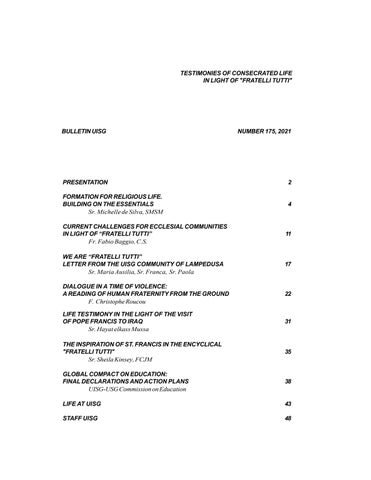
Presentation
BULLETIN UISG
NUMBER 175, 2021
PRESENTATION
2
FORMATION FOR RELIGIOUS LIFE. BUILDING ON THE ESSENTIALS Sr. Michelle de Silva, SMSM
4
CURRENT CHALLENGES FOR ECCLESIAL COMMUNITIES IN LIGHT OF “FRATELLI TUTTI” Fr. Fabio Baggio, C.S.
11
WE ARE “FRATELLI TUTTI” LETTER FROM THE UISG COMMUNITY OF LAMPEDUSA Sr. Maria Ausilia, Sr. Franca, Sr. Paola
17
DIALOGUE IN A TIME OF VIOLENCE: A READING OF HUMAN FRATERNITY FROM THE GROUND F. Christophe Roucou
22
LIFE TESTIMONY IN THE LIGHT OF THE VISIT OF POPE FRANCIS TO IRAQ Sr. Hayat elkass Mussa
31
THE INSPIRATION OF ST. FRANCIS IN THE ENCYCLICAL "FRATELLI TUTTI" Sr. Sheila Kinsey, FCJM
35
GLOBAL COMPACT ON EDUCATION: FINAL DECLARATIONS AND ACTION PLANS UISG-USG Commission on Education
38
LIFE AT UISG
43
STAFF UISG
48
UISG - Bulletin Number 175, 2021
TESTIMONIES OF CONSECRATED LIFE IN LIGHT OF "FRATELLI TUTTI"
1
Presentation
PRESENTATION
Testimonies of Consecrated Life in the Light of “Fratelli Tutti” The title of this issue of the Bulletin already gives a good description of its content. We are offering you testimonies of consecrated life in light of the Encyclical “Fratelli Tutti.” They are luminous examples of fraternity and sorority lived in different forms and places, each according to its context and situation, but they are united by the single desire to build a world that is more equitable, more respectful of each person’s dignity, in which we can live together as brothers and sisters.
UISG - Bulletin Number 175, 2021
Sr. Michelle de Silva, SMSM Formation for Religious Life. Building on the Essentials Gone are the days when we thought ourselves by necessity the group leaders and project initiators, our task today is be like Jesus on the road to Emmaus. We must be formed to accompany life’s complex questions, shares our lived experiences, stay and break bread with the people and then disappear so that it is Jesus who remains.
2
Fr. Fabio Baggio C.S. Current challenges for ecclesial communities in light of “Fratelli tutti” An encounter with the other puts into place an essential dimension of human existence; the quality of human relations shapes the growth and realization of happiness for every person. “To attain fulfilment in life we need others” (FT, 150). Human beings — adds the Holy Father — cannot “fully know themselves apart from an encounter with other persons” (FT, 87). Sr. Maria Ausilia, Sr. Franca, Sr. Paola We Are “Fratelli Tutti”. Letter from the UISG Community of Lampedusa “We are here in the place of the relatives and friends of those who have died at sea; we are here in the place of all those who have the right to demand justice for an absurd death; we are here to denounce the lack of humanity of the laws and politics that condemn human beings to death” ... This is how a member of the Forum expressed himself at the funeral of Yussuf, who was only six months old when the dinghy capsized and he escaped from the arms of his young mother.
Presentation
F. Christophe Roucou “Dialogue in a time of violence: a reading of Human Fraternity from the ground” Amongst the barriers of dialogue among Muslims as well as Christians, there may be a view of others proposed or, sometimes, imposed on those different from me by culture, origin or religion. The adage “outside the Church there is no salvation” has led to people ignoring those of other religions or even converting them at all costs so that they can be saved. What kind of theologies of salvation and of the Church are proposed, taught and disseminated today? By both Christians and Muslims. Sr. Hayat elkass Mussa Life testimony in the light of the visit Pope Francis to Iraq, especially to Qaraqosh I felt that the Spirit of the Lord once again fluttered over my suffering and torn people to be filled by a new spirit, the Spirit of Peace and solidarity and real citizenship. And I felt that its white scarf was like a dove wrapping Iraq in a full presence peace and reassurance, and his fatherly blessing granted to the people is like an ointment with which he heals our pains and wounds.
Commission on Education of UISG-USG Global Compact on Education: Final Declarations and Action Plans We have been experiencing the great prophecy of the Global Compact on Education, inspired by universal love and fraternity, which puts people at the centre of its action. We collaborate in a network with deliberative skills and gifts that lead us in our common path. We aim at empowering people, acknowledging and enhancing “their voice”; this voice is unique and plural, always open to the diversity that enriches the spiritual and human experience.
UISG - Bulletin Number 175, 2021
Sr. Sheila Kinsey, FCJM The inspiration of St. Francis in the Encyclical "Fratelli Tutti" We are asked to passionately reach out in an encounter and dialogue. We are to embrace the isolated and welcome them as belonging to our common home, just as St. Francis embraced the leper (2Cel 9) and realized in after thought, he had kissed the face of Christ. This was not just an event, but a process of learning how to accompany, care and support the most frail and vulnerable members (FT 64).
3
Sr. Michelle de Silva, SMSM
Formation for Religious Life
FORMATION FOR RELIGIOUS BUILDING ON THE ESSENTIALS
LIFE.
Sr. Michelle de Silva, SMSM Sr Michelle de Silva is a Marianist Sister of the Society of Mary, from Tobago. She has served as a Formator in Peru and Colombia since 2007 and was appointed novice mistress for her congregation in Boston.
UISG - Bulletin Number 175, 2021
Original in English
4
Since Vatican II there has been much consternation and conjecture about Religious Life. The conversation has revolved around its identity in the Church and world and the opinions offered to re-found, reform and renew are as numerous as the charismatic families that comprise this lifeform. But as a wise person once said, the only constant in life is change, so why be fearful? Presently, we are in the midst of a pandemic which has created another seismic shift in life as we know it and religious life is again being challenged to locate itself in this new panorama. I believe that formation for religious life- initial and on-going- needs to focus on the unchangeable fundamentals of this lifeform. Formation must focus on the ordinariness of this lifeform even in its extraordinariness, that the bedrock of this life is growing in intimacy with God through the deepening of our baptismal commitment with the public profession of vows testifying to this relationship and that intimacy with God causes us to look at the world differently and impels us to active participation Jesus’ salvific mission, so that none may be lost. 1
An ordinary life that is extraordinary In much of the literature on religious life, the words prophetic and radical are often used to describe this lifeform and Pope John Paul II called it a gift for the Church and the world. There has been much discussion on what makes this lifeform extraordinary since in the years before Vatican II it was seen as a superior way to holiness, a class subordinate to the clergy but superior to the
laity. But this distinction was removed with the declaration of the Council Fathers that all people are called to holiness. The results were the abandoning of some traditional ministries and the use of distinctive religious habits but the most obvious was the large numbers of departures and small number of entrances. Today, while some try to recuperate the ‘extraordinariness’ of religious life, perhaps the real invitation is to reclaim the ordinariness of this life which came to birth among the early Christian communities in the form of the consecrated virgins. These women lived very ordinary lives in their neighborhoods and towns but were viewed as extraordinary because they witnessed a wholehearted response to God’s call to holiness and relationship which transformed the way they lived and what they did.
Sr. Michelle de Silva, SMSM
Formation for Religious Life
Fr. John Markey’s suggestion that our Christology is reflected in what we believe and what we do in Jesus’ name is an important avenue to explore at all levels of our formation programs. Through his use of the fictional characters of Superman and Belle, 5 he invites us to consider that many times we have created our own image of Christ to suit our likeness. During this pandemic there have been many responses by people of faith but two come to mind which can shed light on the above point. For some Jesus is ‘Superman’ recognized as strength, miracles and removes all our problems without us having to lift a finger. When the social distancing order were first issued by governors to mitigate the spread of Covid-19, Tony Spell of Louisiana was just one of the Christian pastors who continued to defy the health instructions. He believed that if anyone in his church contracted the virus, Jesus would heal them.6 The Superman Jesus is otherworldly,
UISG - Bulletin Number 175, 2021
The call narratives in Scriptures offer a blue print for vocation discernment. The patriarchs, prophets, and even the disciples -male and female chosen by Jesus experience this call whose initiator is God. The hearers respond by entering into a relationship with God but unlike other followers, this relationship is one that takes over the person’s entire life, uprooting them from their society’s status quo causing them to appear as strangers to their own kin. In Jeremiah’s words, “Lord you have enticed me and I let myself be enticed” 2 is the heart of the vocation to religious life. It is an undeniable spiritual seduction wherein God invites some of us to live our Christian discipleship as “eunuchs for the sake of the Kingdom.” 3 While little is known of the early Christian virgins except the accounts of the lives of martyrs like St. Cecilia and St. Lucy, the radicality of their choice was the sacrifice of the protections afforded them by marriage and children in their patriarchal societies. Women like them gave prophetic witness as their belief in the resurrection of the dead, when no one would be married but would be like the angels, 4 which gave them the courage to embrace death for their faith. So, the bedrock of formation of religious life must begin with who is Jesus Christ for us? Do we follow Him or a caricature that we have created?
5
UISG - Bulletin Number 175, 2021
Sr. Michelle de Silva, SMSM
Formation for Religious Life
6
not subjected to the elements or limitations of the human condition, this is the Jesus who sits on God’s right hand in power and he will rescue us even from ourselves. This thinking is endemic not only among Protestants but Roman Catholics. This all-powerful Jesus was manifested in the way our Church conducts ad gentes mission. In the past, missionaries, predominantly from the First-World went to the nations of the global south, many on the coat-tails of the colonizers. Afforded privileged status by virtue of nationality and race, they imaged a Jesus who solved the developmental problems of the nations with little interest paid to the cultures and traditions of the people. The ‘Superman’ Jesus needed no one, and First World missionaries having access to apparently ‘inexhaustible’ financial and political support were able to dictate to the people and their local governments not only what was to done but how. Nationals who joined their ranks were expected to adopt their way of life with even the simplest of houses constructed to suit First world tastes. So, the Christ encountered was one of power expressed as access to higher education, financial resources and upward social mobility, very different from the poor God-man from Nazareth. Fr. Markey countered the all-powerful alien with a peasant girl, Belle from the movie ‘Beauty and the Beast’ perhaps the Christ-like figure who is closest to the founding men and women of most religious congregations. Belle lives an ordinary life in her village but is extraordinary because of the way she lives her life. She has simple tastes and cares for the welfare of others but because she does not follow the crowd she is grossly misunderstood by her neighbors. Her father’s imprudence forces her to enter a hostile situation which she transforms by offering love in the face of hatred and hostility. Does she not image for us the disciple’s call to have the same mind of Christ by engaging the world through self-emptying? 7 Jesus Christ fully enters the human reality not as a transient problem solver but as a fellow traveler. By pitching his tent with the people of Nazareth, 8 he shared the lot of Israel’s anawim not from a careful distance but in the very heart of their lives. In contrast to Pastor Spell is Pope Francis, who not only embraced the health guidelines but did so because Jesus accompanies us in the storm. Choosing Mark’s account of the disciples on the stormy sea with Jesus asleep at the helm, in his Urbi et Orbi blessing, the Pope offered comfort even as he called us to conversion, to leave behind socio-political agendas which harm the natural environment and humanity. 9 Coming predominantly from the Third world which has little economic and political power on the world stage, the people who join religious life today offer us the opportunity to re-embrace the God-man from Galilee who has been exalted by the Father because of his humility. What does this mean to a person whose experience of religious life is one of classism and racism? How do we
Simon Pedro Arnold, OSB, in his address to the CONFER on the occasion of its 50 th anniversary contrasted our lifestyles with that of our spiritual ancestors. Speaking of the Desert Fathers and Mothers, Arnold remarked that their movement into the desert was a prophetic rupture, a break from Christendom with its unjust social systems and a protest against the complicity of the Church at the time. He added that in the Post-Vatican II era while we embraced the world, which was correct because we are meant to be in the world but not of it, we made the world and not Christ our point of reference. While our external apostolic activities with the option for the poor are laudable, internally we have imbibed much of the world’s cultural values. He asked, “what difference is there between our lived values and that of the world?” 10 Speaking of formation, the SMSM constitutions describes it as a faith journey, where we confront our lives with the Gospel, a call to continual conversion that helps us to be “joyfully given to God for the Kingdom in the spirit of Mary.” 11 Formators and our local communities are charged with mentoring the future and we can only offer them what we live not what we say. We must model the discipline and sacrifices necessary to grow in an intimate love relationship with God, which involves finding an appropriate balance between prayer and work. We can only become Christ-like by making time to engage in dialogue with the Master, to sit at his feet like Mary in silence and solitude so as to make his values our own. Jose Rodriguez Carballo supports this as he calls communities to become schools of prayer and faith sharing that encourages vulnerability before God and each other as we journey together towards the fullness of the Kingdom. 12 In addition, careful attention must be paid to way that the electronic and print media influences our choices. Our unhealthy activism that leads some to ‘relax’ using television, internet and now social media. Which subtly leads us to consumerism, individualism and can numb us from the inconvenient truths around us. 13
So that none may be lost. 14 The public profession of religious vows is a concrete expression of the person’s response to God’s invitation to relationship and participation in Jesus’ salvific mission which while extraordinary in themselves creates duties for which the Church and society hold us accountable. The vows must be assimilated
UISG - Bulletin Number 175, 2021
reconcile the perception and in some cases the expectation of upward social mobility by some candidates and their families? From first contact, there needs to be transparency with inquirers of the value systems upon which this life is rooted, that of kenosis rather than acquisition and this challenges us already in the life to examine ourselves. What are the values systems upon which we have built our own lives?
Sr. Michelle de Silva, SMSM
Formation for Religious Life
7
Sr. Michelle de Silva, SMSM
Formation for Religious Life
by those who profess them and because faith is experienced and understood culturally, attention must be paid to the power of culture to the understanding and living of chastity, poverty and obedience because there can be no negotiation with the sacrificial nature of religious life. The current pandemic has unveiled the social inequities which especially in the First World have been hidden, and for religious here it questions our social location. During this pandemic I experienced ‘conscious inconsolability’ 15 as I listened to the news of lay-offs, hunger and sickness from my comfortable home in the suburbs with its full larder and enough space for social distancing, and like never before accepted that my congregation and I are unwittingly complicit in this cycle of injustice. The communal life affords us certain comforts but were religious intended to be part of society’s middle class? What does the Church and society expect from us?
UISG - Bulletin Number 175, 2021
In his presentation to the religious of CONFER, Arnold likened our approach to apostolic service as ‘firemen’ rushing to and fro to extinguish the infernos of society’s ills. His critique though was that we paid little attention to locating and confronting the ones who were setting these fires. He then added that problemsolving is impossible in the face of increasingly complex problems and our growing desperation and frustration are manifested in dysfunctional behaviors in our personal lives and communities. Like Fr. Markey’s insight of Jesus who enters into the broken reality and catalyzes transformation, Arnold invited his audience to become part of life’s drama by entering the fire. He used the analogy of the balcony to describe a way of service that is ‘self-referencing’ and Arnold invites religious today is to embrace the ambiguity of the world by not answering questions but accompanying them. We are reminded that apostolic activity is a response brought forth from time spent in contemplation and prayer to make Jesus’ way our own.
8
Jesus is not self-sufficient in the Gospels but he either used what people already had (fives loaves and two fishes) or called them to be protagonists in their own transformation (pick up your mat and walk.) The continuing decline in the number of active members and financial assistance for our projects will find religious relying more on our lay partners and the people we serve. The role of religious since the time of the consecrated virgins is to model an alternative world rooted in the example of the Risen Christ who makes himself present the ordinariness of life. Arnold suggests that religious are being called today to be schools of discipleship where members like the Desert Fathers and Mothers become mentors by sharing our experience. He called for a ‘return to Galilee’to the spontaneity and vulnerability of our beginnings, ‘to set out to Jerusalem’to expose the woundedness of the world to healing through the Christian hope and love and ‘to go to Rome’- by engaging with world beyond Christianity, embracing interculturality and making the faith relevant to those who hear it for
the first time which can include those already baptized. Like our founding members, religious life is about presence rather than projects. Being classified as non-essential workers gave my local community time for prayer and scripture study. With so many televised and live-streamed religious activities, we began to question our dependence and over-indulgence of electronic media. But most importantly, we began have hard conversations about our lives together and our societal footprint, where are being called to now? Jesus’ mission from the Father was that ‘none should be lost,’ and we must discern how to minister both to those in the infernos as well as those who set the fires. Within our formation programs careful attention must be paid to the social teachings of the Church and to ‘make connections’ 16 going beyond our suburban parishes to collaborate with social and cultural organizations that work for the common good. Gone are the days when we thought ourselves by necessity the group leaders and project initiators, our task today is to be like Jesus on the road to Emmaus. We must be formed to accompany life’s complex questions, shares our lived experiences, stay and break bread with the people and then disappear so that it is Jesus who remains.
Sr. Michelle de Silva, SMSM
Formation for Religious Life
Luke’s account of the encounter between Phillip and the Ethiopian eunuch on the wilderness road 17 speaks of the role of the formators in the growth of understanding of members of this lifeform called religious life. First, God through his angel calls and sends Phillip into the wilderness. It is important that those called to be formators recognize that their role is a call and commission from God. Because religious life is about relationship with God which then supports congregational membership, the formator need to cultivate a life of prayer and study for their own lives. ‘Who do you say that I am,’ remains a necessary question guiding their own lives for it is Jesus and not themselves they must proclaim. Secondly, they are called to ‘enter the wilderness,’ this uncharted territory which despite the dangers is holy ground because God can be encountered there. In accompaniment, the formator must tread carefully into the holy ground that is the life of their formandi and their own hearts. Where is God? Accompaniment is a sacred space and the formator must create a climate of trust so that they are welcomed into the mystery of another. It is not a right but a privilege in the formation process. Thirdly, the formator must be open to the person where they are on their faith journey not where s/he believes they should be. Rather than teachers, formators are called to be mentors helping their formands to become aware of Jesus’ presence and action in their lives. To encourage their formands to use sacred Scripture and their institute’s constitutions as the canon for their lives rather than people who will always fail. Finally, formators must know when
UISG - Bulletin Number 175, 2021
The Role of Formators: Phillip
9
UISG - Bulletin Number 175, 2021
Sr. Michelle de Silva, SMSM
Formation for Religious Life
10
to ‘disappear’ there is a time when their role ends but when this time comes they must be satisfied that they helped the formandi to cultivate a way of life that enables them to be attentive to God’s voice and become mentors for others themselves.
1
Cf John 6:39
2
Jeremiah 20:7 NRSV
3
Matthew 19:12
4
Matthew 22:30
5
Protagonist of Beauty and the Beast
6
https://www.nbcnews.com/news/us-news/louisiana-pastor-charged-defying-coronavirusorder-against-large-gatherings-n1173246 Accessed April 27, 2020
7
Cf. Philippians 2: 5-ff
8
Cf. John 1:14
9
https://www.vaticannews.va/en/pope/news/2020-03/urbi-et-orbi-pope-coronavirus-prayerblessing.html Accessed April 27, 2020
10
Conferencia de Religiosas y Religiosos del Peru- CONFER https://www.youtube.com/ watch?v=cOKflbkGmHY Accessed April 27, 2020
11
SMSM Constitutions Articles 192-194
12
Rodriguez Carballo, Jose, “Formation for Consecrated Life in a Period of Change.”
13
Forming for a Prophetic Way of life in an In-between time, 2007
14
John 6:39
15
Penned by Dorothee Soelle quoted in “Forming for a Prophetic Way of life in an In-between time,” 2007.
16
15th National Congress 2007, “Forming for a Prophetic Way of Life in an In-Between Time.
CURRENT CHALLENGES FOR ECCLESIAL COMMUNITIES IN LIGHT OF “FRATELLI TUTTI” Fr. Fabio Baggio, C.S.
Fr. Fabio Baggio, C.S.
Current challenges for ecclesial communities ...
Fr. Fabio Baggio, is a missionary priest of the Scalabrinian Congregation. He obtained a Baccalaureate in Theology as well as a Licentiate and Ph.D. in Church History at the Pontifical Gregorian University. In his first years of mission, Fr. Baggio served as advisor for migrations to the Chilean Bishops’ Conference and as Director of the Department for Migration in the Archdiocese of Buenos Aires. He has taught in different universities in Europe, Latin America and Asia. From 2002 to 2010, he was Director of the Scalabrini Migration Center (SMC) in Quezon City (Philippines) and editor of “Asian and Pacific Migration Journal.” In 2010, he was appointed Director of the Scalabrini International Migration Institute (SIMI), incorporated into the Pontifical Urban University in Rome. He has been Under-Secretary of the Refugees and Migrants Section of the Dicastery for the Promotion of Integral Human Development since 1 January 2017. (www.migrants-refugees.va)
As the title itself of the Encyclical states, “Fratelli tutti” is a document on fraternity and social friendship, a pairing that I would dare to say is unprecedented in the history of the Universal Magisterium. From his privileged observation point, the Holy Father reads the reality of the contemporary world and considers certain trends in the world “that hinder the development of universal fraternity” (FT, 9). They pose common challenges for ecclesial communities. The Holy Father refers to tragically shattered dreams of unity, the culpable lack of a common project for all human beings, the clear absence of a common direction in processes of globalization and development, the systematic breach of human rights at borders, and new forms of oppression of the poor and the vulnerable. Despite this, Pope Francis also sees seeds of goodness and paths of hope in today’s reality that may give new lustre to grand ideals (cf. FT, 10-55). Considering the mission that the Holy Father has entrusted to the Migrants
UISG - Bulletin Number 175, 2021
Original in Italian
11
Fr. Fabio Baggio, C.S.
Current challenges for ecclesial communities ...
and Refugees Section of the Dicastery for Promoting Integral Human Development, I have chosen to analyse the above-listed challenges from a particular angle: the ministry of human mobility. The arrival and presence of many migrants and refugees and the different reactions of host communities enable us to grasp the dangers of the throwaway culture that the Holy Father contrasts sharply, by way of antidote, with the culture of encounter. Throwaway culture, to which the Holy Father previously referred in his Encyclical Letter “Laudato si’”(cf. LS, 16, 22 and 43), finds in “Fratelli tutti” a different definition that highlights its negative effects on human relations: Some parts of our human family, it appears, can be readily sacrificed for the sake of others considered worthy of a carefree existence. Ultimately, “persons are no longer seen as a paramount value to be cared for and respected, especially when they are poor and disabled, ‘not yet useful’ – like the unborn – or ‘no longer needed’ – like the elderly. We have grown indifferent to all kinds of wastefulness, starting with the waste of food, which is deplorable in the extreme” (FT, 18). Throwaway culture clearly applies in the context of migration, where obvious differences make it easier to distinguish “us” from “them”, leading to their exclusion:
UISG - Bulletin Number 175, 2021
Migrants are not seen as entitled like others to participate in the life of society, and it is forgotten that they possess the same intrinsic dignity as any person… No one will ever openly deny that they are human beings, yet in practice, by our decisions and the way we treat them, we can show that we consider them less worthy, less important, less human. For Christians, this way of thinking and acting is unacceptable, since it sets certain political preferences above deep convictions of our faith: the inalienable dignity of each human person regardless of origin, race or religion, and the supreme law of fraternal love (FT, 39).
12
Throwaway culture, with its illusion of omnipotence and its creation of a global élite, inexorably leads us to entrench ourselves in our own interests, leads us to isolation and to the death of fraternity. To save humankind and its ideals, so that it can carry out God’s creative project, Pope Francis urges everyone to promote a culture of encounter: “Life, for all its confrontations, is the art of encounter”. I have frequently called for the growth of a culture of encounter capable of transcending our differences and divisions. This means working to create a many-faceted polyhedron whose different sides form a variegated unity, in which “the whole is greater than the part” (FT, 215). An encounter with the other puts into place an essential dimension of human existence; the quality of human relations shapes the growth and realization of happiness for every person. “To attain fulfilment in life we need others” (FT,
150). Human beings — adds the Holy Father — cannot “fully know themselves apart from an encounter with other persons” (FT, 87). All encounters with others are potentially enriching, and this potential is directly proportional to the otherness of the person encountered. The more different or “other” they are, the more that person helps those who meet her to grow in knowledge and humanity.
Fr. Fabio Baggio, C.S.
Current challenges for ecclesial communities ...
Pope Francis’s invitation should be viewed from this perspective: as an invitation to favour encounters with those on the peripheries of life, “for they have another way of looking at things; they see aspects of reality that are invisible to the centres of power where weighty decisions are made” (FT, 215). The existential peripheries, explained the Holy Father in July 2019, “are densely populated with persons who have been thrown away, marginalized, oppressed, discriminated against, abused, exploited, abandoned, poor and suffering” (Homily, 8 July 2019).
The encounter to which the Holy Father refers is not a chance or improvised encounter, but a deliberate way of life that becomes a passion, a constant commitment to “seeking points of contact, building bridges, planning a project that includes everyone” (FT, 216). This encounter helps all parties involved to grow in humanity, as Pope Francis clearly explained in a 2016 speech: “Opening ourselves to others does not lead to impoverishment but rather enrichment, because it enables us to be more human: to recognize ourselves as participants in a greater collectivity and to understand our life as a gift for others; to see as the goal, not our own interests, but rather the good of humanity” (Address at the “Heydar Aliyev” Mosque, Baku, Azerbaijan, 2 October 2016). In this context, it is interesting to observe that the Holy Father chose the parable of the Good Samaritan (Lk 10, 25-37) to illustrate the dynamics of the encounter that is an enrichment in humanity. This very special encounter is often used to explain the meaning of “neighbour” in the evangelical sense: love of this neighbour is the basis on which we will be judged worthy or unworthy of eternal life. However, Pope Francis identifies a different meaning in this parable: “the parable shows us how a community can be rebuilt by men and women who identify with the vulnerability of others, who reject the creation of a society of exclusion, and act instead as neighbours, lifting up and rehabilitating the fallen for the sake of the common good” (FT, 67).
UISG - Bulletin Number 175, 2021
On the existential peripheries, we find many migrants, refugees, displaced persons, and victims of human trafficking, who “have become emblems of exclusion. In addition to the hardships that their condition entails, they are often looked down upon and considered the source of all society’s ills” (Message for the 105th World Day of Migrants and Refugees). Renouncing encounter with them means giving up “the gift present in an encounter with those outside one’s own circle” (FT, 90); it means losing “an opportunity for enrichment and the integral human development of all” (FT, 133).
13
Fr. Fabio Baggio, C.S.
Current challenges for ecclesial communities ...
The encounter described in the Parable can be summarised with four verbs that are closely interrelated: to acknowledge, to be compassionate, to be close, to take care. The first verb is to “acknowledge” a brother or sister in need. But in order to acknowledge them, it is first important to “acknowledge” their presence. Those who retreat inwards, ignore others, or are indifferent, cannot see the neighbour beaten and abandoned along the road (cf. FT, 73). Acknowledging that our brother or sister is our neighbour requires a further effort, especially if they do not “belong to our social group” (FT, 81). Besides this immanent dimension of fraternity, there is also a transcendent one, relying upon what Jesus Christ clearly revealed: “I say to you, whatever you did for one of these least brothers of mine, you did for me.” (Mt 25, 40). Therefore, the Christian is called “to recognize Christ himself in each of our abandoned or excluded brothers and sisters” (FT, 85). From this perspective, the culture of encounter is transformed into a “theology” of encounter and, equally, a “theophany” of encounter.
UISG - Bulletin Number 175, 2021
The second step is “to be compassionate”. In this case, too, we can consider the immanent dimension that entails the Samaritan’s capacity to understand the suffering of the poor traveller, to be moved and feel empathy. “We cannot be indifferent to suffering; we cannot allow anyone to go through life as an outcast. Instead, we should feel indignant, challenged to emerge from our comfortable isolation and to be changed by our contact with human suffering” (FT, 68). At the same time, the transcendent dimension proposes divine compassion as a model. As Pope Francis explained in 2015, “God’s compassion is to place himself in the difficulty, to put himself in the situation of the other, with his Fatherly heart”, and “this is why he sent his Son” (Morning meditation, 30 October 2015).
14
The third step is “to be close”. The Holy Father stresses that the Samaritan “became a neighbour to the wounded Judean. By approaching and making himself present, he crossed all cultural and historical barriers” (FT, 81). In his message for the 106th World Day of Migrants and Refugees, Pope Francis explained that such barriers generate fears and prejudices that “keep us distant from others and often prevent us from ‘becoming neighbours’ to them and serving them with love.” Being neighbours means involving ourselves personally, giving others the most precious thing that we have: time! Certainly, the Samaritan “had his own plans for that day, his own needs, commitments and desires. Yet he was able to put all that aside when confronted with someone in need. Without even knowing the injured man, he saw him as deserving of his time and attention” (FT, 63). To be close means to be ready to “get our hands dirty”. And “Jesus gave us the greatest example of this when he washed the feet of his disciples: he took off his cloak, knelt down and dirtied his hands” (Message for the 106th World Day of Migrants and Refugees). The fourth step is “to take care”. Following in the footsteps of the Samaritan, the Holy Father urges us to “bandage the wounds” of every
“existential foreigner” (97) and all the “hidden exiles” (98), pouring “oil and wine” on them. Oil, wine and bandages symbolize the tools that we are called to use to soothe and heal, which range from attentive listening to saying the right word; from medical to psychological assistance; from restoring trust to restoring personal dignity. Taking care means partaking in the other person’s suffering. This long-term commitment transforms us into “traveling companions”, friends, walking along the same road towards a common destination. And when we realize that we cannot do everything alone, then we must do what the Samaritan did as he took the wounded man to an inn. “The Samaritan discovered an innkeeper who would care for the man; we too are called to unite as a family that is stronger than the sum of small individual members.” For “the whole is greater than the part, but it is also greater than the sum of its parts” (FT, 78).
Fr. Fabio Baggio, C.S.
Current challenges for ecclesial communities ...
Encounter is a challenge that helps us grow in humanity and concerns us all, as no one can opt out. “All of us have a responsibility for the wounded, those of our own people and all the peoples of the earth. Let us care for the needs of every man and woman, young and old, with the same fraternal spirit of care and closeness that marked the Good Samaritan” (FT, 79). In his visit to Lampedusa in 2013, Pope Francis recalled this common responsibility: “’Where is your brother?’ His blood cries out to me, says the Lord. This is not a question directed to others; it is a question directed to me, to you, to each of us.” (Homily, 8 July 2013). The question is clear and demands an answer from each of us, because as the Holy Father says, “here and now, anyone who is neither a robber nor a passer-by is either injured himself or bearing an injured person on his shoulders” (FT, 70).
A natural instinct of self-defence often leads us to feel doubtful and fearful towards others, especially foreigners and migrants. But we are called to move beyond “those primal reactions” because “there is a problem when doubts and fears condition our way of thinking and acting to the point of making us intolerant, closed and perhaps even – without realizing it – racist. In this way, fear deprives us of the desire and the ability to encounter the other” (FT, 41). Ecclesial communities should always be reminded that it is Jesus Christ who seeks to be encountered in the brother and sister knocking on our doors. As the Holy Father reasserted in February 2019, “it is really Him, even if our eyes struggle to recognise Him: with torn clothes, his distorted face, his wounded body, unable to speak our language” (Homily, 15 February 2019). In the Encyclical Letter “Fratelli tutti”, Pope Francis insists repeatedly on the need to transcend borders to prepare for the encounter with the other. First, the Holy Father refers to the geographical and political borders that end up defining the imbalance between those who enjoy the most resources and those
UISG - Bulletin Number 175, 2021
However, we must acknowledge that committing to this encounter, spreading a culture of encounter, is not easy. In “Fratelli tutti”, Pope Francis highlights two preparatory actions that imply two different movements: overcoming fears and transcending borders.
15
Fr. Fabio Baggio, C.S.
Current challenges for ecclesial communities ...
who are left with nothing in the modern world. “If every human being possesses an inalienable dignity, if all people are my brothers and sisters, and if the world truly belongs to everyone, then it matters little whether my neighbour was born in my country or elsewhere” (FT, 125). However, Pope Francis also refers to the social, cultural, economic, and religious borders that are erected to distinguish “us” from the “them”. As a result, “new walls are erected for self-preservation, the outside world ceases to exist and leaves only ’my‘ world, to the point that others, no longer considered human beings possessed of an inalienable dignity, become only ‘them’”(FT, 27). Even if the challenge posed by an encounter that helps us grow in humanity is addressed to all of humanity, ecclesial communities must feel called out by name, so to speak. Quoting Saint John Chrysostom, the Holy Father urges all Christians thus: “’Do you wish to honour the body of the Saviour? Do not despise it when it is naked. Do not honour it in church with silk vestments while outside it is naked and numb with cold’. Paradoxically, those who claim to be unbelievers can sometimes put God’s will into practice better than believers” (FT, 74). Ecclesial communities, called to be living witnesses of the coming of the Kingdom of God, are entrusted with the task of conjugating verbs of encounter in the first person, both singular and plural. This necessarily starts with listening. “We must not lose our ability to listen” (FT, 48). Listening to the territory and the inhabitants of the existential peripheries is a conditio sine qua non to identify spaces of exclusion and to lay the foundations for encounter.
UISG - Bulletin Number 175, 2021
Ecclesial communities are called to listen today to the “cry” of the People of God, who are often “silent”, as they suffocate in tears of suffering, and “silenced”, because they are disturbing and unsettling. However, the Lord has given us the Holy Spirit to discern His plan without letting the illusions of this world distract us. Let me conclude with the Holy Father’s prayer: “Lord, [...] pour forth into our hearts a fraternal spirit and inspire in us a dream of renewed encounter, dialogue, justice and peace. Move us to create healthier societies and a more dignified world, a world without hunger, poverty, violence and war” (FT, Prayer to the Creator).
16
WE ARE “FRATELLI TUTTI” LETTER FROM THE UISG COMMUNITY OF LAMPEDUSA. Sr. Maria Ausilia, Sr. Franca, Sr. Paola Sister Florence de la Villeon, RSCJ, in charge of the UISG Migrant Project, together with Sister Maria Ausilia, Sister Franca, and Sister Paola have gifted us with this beautiful letter from Lampedusa. It is a living testimony of service, welcome, and love that has done us good; and we are sure it will do our readers good too. We warmly thank the community of Lampedusa, a great little outpost of fraternity at the “gate of Europe”!
Sr. Maria Ausilia, Sr. Franca, Sr. Paola
Letter from the UISG Community of Lampedusa
On November 30 th, 2020, we celebrated the anniversary of the foundation of the UISG community of Lampedusa. This community is composed of Sr. Maria Ausilia, Salesian, Sr. Franca, Little Sister of Jesus, and Sr. Paola, Sister of Charity of St. Jeanne Antida. We were sent by the UISG, which fosters collaboration and dialogue among religious congregations in the Church and society. We were sent to weave bonds of friendship through our presence among the island’s inhabitants, with the desire to offer them services, according to our possibilities, and with the aim of collaborating with them in welcoming the many people who arrive from the other shore of the Mediterranean. In fact, this little island is like a rock thrown towards Africa; much closer to Africa than to the Italian peninsula, it is the extreme tip of Europe: the gate to Europe! For centuries, travelers have found a haven of salvation on this island. In recent decades, throngs have been seeking to reach these shores. These are people who want to flee from wars, dictatorships, persecution, hunger, and thirst; men, women, and children who launch themselves into an exodus, without realizing the traps and suffering of the journey, in search of a better future. Before boarding boats, rubber dinghies, or barges, that risk sinking, these human caravans cross deserts where thousands have been buried.
UISG - Bulletin Number 175, 2021
Original in Italian
17
Sr. Maria Ausilia, Sr. Franca, Sr. Paola
Letter from the UISG Community of Lampedusa
Pope Francis chose Lampedusa as the site of his first papal visit; he came to pray with the island’s inhabitants and migrants, to honor their courage and unspeakable suffering, to remember those whom the sea has swallowed. The Pope tenderly tossed a wreath into the sea, shouting forcefully, “Never, never again! ... Cain, where is your brother?” As soon as we arrived on the island, we found the migrants in the church square. The square is a meeting place: the parish offers them the possibility to connect to Wi-Fi, as well as other small forms of help, such as clothing or food. The migrants are received in the center set up for them; the quality of the reception leaves much to be desired. They are there in transit and are destined to be transferred to Sicily. We started to approach them in the square, to get to know them, to offer them a smile and, if the relationship went on, we would then meet at the bar, to listen to their stories over tea or coffee.
UISG - Bulletin Number 175, 2021
After just three months of this journey with them, the pandemic broke out and everything changed; no one came to the square anymore. What could we do? Yet, the landings continued there as before, and so we found a new possibility to meet them, by going to welcome them at their arrival. Immediately after disembarkation, the migrants have to go through a series of medical and military checks and undergo several interrogations. They arrive exhausted, but aware that they have been lucky enough to have landed safe and sound. Some of them, especially the Muslims, who make up the vast majority, when they set foot on the land, prostrate themselves and, touching the ground with their foreheads, murmur: “El hamdu l-illah” (Praise be to God!).
18
Not everyone is allowed to enter Favaloro Pier, the military space reserved for landings. During the first days after our arrival, we got to know “Mediterranean Hope” (MH), the program for refugees and migrants of the Federation of Evangelical Churches in Italy (FCEI), which was created after the tragedy on October 3 rd, 2013, when 368 people died in a terrible shipwreck a few miles from Lampedusa. Their choice to settle in Lampedusa arose from the awareness of the geopolitical centrality and the island’s strong symbolic charge in a phenomenon like migration that has a global scope. With them, we are part of the “Forum Lampedusa Solidale,” born in 2015 from the meeting of associations, ecclesial movements, voluntary organizations, the parish, women and men of civil society willing to commit themselves to the realization of an alternative model of reception and solidarity. The activity carried out by the Forum is not limited to distributing goods to migrants but aims at networking the ideas and skills that can give concrete answers to the needs of the local community and to the foreigners who travel through here. The activities organized by the Forum include discussion meetings, the organization
of solidarity events, and interventions to fight against social exclusion and poverty. The presence of the “Mediterranean Hope” project in Lampedusa has been marked by close ecumenical collaboration that the operators have developed with the local Catholic community. The ecumenical dimension and the dialogue with people of different faiths and religious denominations is evident every year in the organization of the commemoration in memory of the victims of October 3 rd , 2013. Our small community has become part of this fabric that works for migrants and islanders, and we collaborate, growing together in trust and friendship, with a common goal: welcoming people in a way that is more just and respects each person’s dignity, in the belief that the world is for all and saying, as Pope Francis does, that we are “fratelli tutti” – all brothers.
Sr. Maria Ausilia, Sr. Franca, Sr. Paola
Letter from the UISG Community of Lampedusa
Our activity with the MH workers consists of being at the port and, among the many soldiers of all ranks, offering a shy welcome to all, offering a glass of water or hot tea, giving a toy to a child, playing with another, holding the newborn child of an exhausted mother, finally being a presence of humanity, respect, compassion, and love!
“We are here in the place of the relatives and friends of those who have died at sea; we are here in the place of all those who have the right to demand justice for an absurd death; we are here to denounce the lack of humanity of the laws and politics that condemn human beings to death” ... This is how a member of the Forum expressed himself at the funeral of Yussuf, who was only six months old when the dinghy capsized and he escaped from the arms of his young mother. The whole community gave Yussuf a dignified funeral; his mother was able to attend and cry out her sorrow, and we promised not to forget him. Francesco Piobbichi, a cartoonist and social worker for the MH, made a beautiful drawing for Yussuf’s grave: a feather rising from the barbed sea that killed him. In Francesco’s drawings, there is infinite respect for the sea, there is a denunciation for those who make it a barbed border that kills, there is a cry of indignation for every death, there is the commitment not to forget it. Little Yussuf has become a symbol, a memory that must not leave us, and so we asked ourselves: How can others be involved? In this way the initiative “Yussuf’s
UISG - Bulletin Number 175, 2021
It does us good to recognize that they are worthy of being welcomed; it gives us dignity, just as it dignifies us to cultivate the memory of those who died at sea. For many of them, the Mediterranean is their Cemetery; others are buried in the small cemetery of Lampedusa, among the island’s inhabitants. When there are shipwrecks, a group organizes a small secular ceremony, those who participate (Catholics, Protestants, Muslims, or non-believers), do so motivated by their own deep reasons, what unites us is the faith in the value of this act.
19
Sr. Maria Ausilia, Sr. Franca, Sr. Paola
Letter from the UISG Community of Lampedusa
Blanket” was born in the Forum. A blanket made of knitted or crocheted squares. We received them from all parts of Italy and also from abroad. The women of Lampedusa have sewn them together. This blanket is a symbol of protection for the many men, women, and children who still risk dying, and a commitment to remember the many who have been swallowed by the sea. Because ignoring them, forgetting them, means saying that they never existed. The island’s inhabitants offer us a wide welcome, and it is they who occupy most of our days. Despite the pandemic, we have come to know the elderly and visit them. Most of them are well cared for by their families, but many are alone, and for them a visit is a ray of sunshine. Many women, mostly Romanian, work as caregivers, and we weave bonds of friendship with them as well. Listening to the elders, we discover that, on this truly isolated island where people used to live only by fishing, the inhabitants have, for years, had to endure loneliness, anguish, poverty, and the loss of people who perished at sea. The consequences have marked their health, and many are in fact mentally ill. The island underwent a transformation with the arrival of tourism, especially since the 80s. Everyone started working and, at the cost of great sacrifices, had access to a certain degree of well-being, which has however produced many disparities: the world of young and old tempted by drugs, alcohol, an easy life, etc. ... The island is beautiful and, in summer, the population multiplies, with the number of tourists exceeding that of the residents and the migrants. Both tourists and migrants land on the island all the time, living side by side without meeting.
UISG - Bulletin Number 175, 2021
In our community, the doors are open, and we receive many appeals; each of us responds according to our possibilities, and with our differences we complement each other. Our founders remain the inspiration for each of us and now they have, for all three of us, a place in our chapel and above all in our being and action... at least this is our desire!
20
Without prearranged programs, our life tries to respond each day to the appeals of people. We would like to offer you a small flash of yesterday: at 8:30 a.m., we received a message from the chat room at Molo Favaloro announcing the arrival of 93 people and we went to welcome them. At 2:00 p.m., another 200 people arrived, and we went to the pier again. We invited the two parish priests of the island for lunch; our collaboration with them is growing in trust. Sister Ausilia took Holy Communion to many people, as she does every Saturday and Sunday. Together, we visited A. and her Romanian caregiver. This morning we went to the commercial pier and, from behind the fence, we talked to the migrants who arrived yesterday and were put on boats to go to Sicily.
We are trying to follow a fatherless family in great difficulty, a mother with four children. Sister Ausilia is working with the social worker to offer them help. There would be so much to say about what we share with the people of Lampedusa. We cannot tell you about everything, but we cannot fail to mention the day care center with which we try to collaborate that welcomes the mentally disabled. We participate in small moments of celebration, we go on walks together, and we are closer to some—for example, to C., a woman whom we welcome for lunch every Saturday. These personal relationships, created during the months of the pandemic and forced isolation, which has led to regressions caused by loneliness and fear, are a way of helping so many people in need in this time of crisis.
Sr. Maria Ausilia, Sr. Franca, Sr. Paola
Letter from the UISG Community of Lampedusa
We are grateful to UISG for having brought us here. Lampedusa is one of the peripheries towards which Pope Francis sends us... it is a frontier outpost, one of those “places of fracture” between the north and south of the world, between the people who seek the most sophisticated leisure and vacations and the desperate from the poorest countries on the planet...
UISG - Bulletin Number 175, 2021
Can we dream that the presence promoted by the UISG can continue and be a sign of Hope, to contribute to the birth of a PLURAL HUMANITY? A humanity in which each person’s dignity is recognized. In which we can walk together as brothers and sisters? We believe it is possible, we ask it to the Lord, and we entrust it to your care.
21
Fr. Christophe Roucou
Dialogue in a time of violence
DIALOGUE IN A TIME OF VIOLENCE: A READING OF HUMAN FRATERNITY FROM THE GROUND
Fr. Christophe Roucou Father Christophe Roucou, is a professor at the “Institut Catholique de la Méditerranée” (ICM), Marseille, in charge of the “Pôle d’études et de Recherche Islamo-Chrétiennes” (PERIC) and the “Maison de la Sagesse” programme. The following text was presented on 1 March 2021 at a webinar “Dialogue in a time of violence: a reading of Human Fraternity from the ground”, organised by the Commission for Interreligious Dialogue of the International Union of Superiors General (UISG) and the Union of Superiors General (USG).
Original in French
Introduction
UISG - Bulletin Number 175, 2021
The brief given to me:
22
“Focus your presentation on relations with Muslims in the era of global terrorism. What is the current situation in France and what is the role of religious leaders in facing these challenges?” I have been asked to speak about the French context, hence I wish to make these remarks in my introduction: - Acts of violence and murders that have been committed in the recent months and years: an attack in Nice on 14 July 2016, killing 87 people and injuring 434; the murder of Father Jacques Hamel, a priest celebrating Mass, on 26 July 2016; the murder of a teacher leaving his school on 16 October 2020; and the murder of two women in a church in Nice on 29 October 2020. They were committed by individuals who claim to be Muslims.
- But while terrorism and violence occur regularly in France, we cannot state that we live in a context of violence or fear of terrorism on a daily basis. I would also like to include in my introduction the testimony of a friend, a second generation Algerian born in France, married to a practising Catholic with 3 children, whose wedding I performed. They belong to the Groupe des Foyers Islamo-Chrétiens (the GEFIC) or Group of Islamic-Christian households. He holds important responsibilities in a public sector structure, the Louvre Museum in Paris, and is the first deputy mayor of a district in the northern suburbs of Paris.
Fr. Christophe Roucou
Dialogue in a time of violence
"In the 1980s, at primary and secondary school, in the northern suburbs of Paris, we were in classes with pupils from all over: Poland, Senegal, France for several generations, and some of them were friends. I was born here second generation Algerian. Our differences were not emphasised at all; it was a question of family belonging. It was a matter of discovery and more than anything it was a richness for us. There were never any problems. The perspective was that of integration into French society. The time the French team won the World Cup in 1998 was a very strong symbol of the French model of integration: France “Black, Blanc, Beur” meaning “Black, White, Arab” It said something about the way things worked and about an ideal. Then two events shook things up and called everything into question: first the attacks of 11 September 2001 in New York, then the riots in Clichy-sousBois in France. These events revealed a deep malaise in French society." I will first address the specific French context from the point of view of Muslims in our society, then I will address possible places of encounter, exchange and dialogue to then examine what hinders dialogue and conclude on our role as religious leaders in this context.
Liberty, equality, fraternity Perhaps we should start by reminding you of the motto of the French Republic, which all French citizens hold dear, whatever their religion, their origins or their social background: liberty, equality, fraternity. And we know that in order to establish and enforce freedom and equality, laws are drafted and passed, but fraternity cannot be decreed. It is an ideal that depends on the responsibility of each citizen. I would like to say that it is our double responsibility as citizens and as Christians, since we believe that all human beings are created in the image and likeness of God and that Jesus Christ revealed this to us.
UISG - Bulletin Number 175, 2021
1. In what context are we called to embody fraternity in France?
23
Fr. Christophe Roucou
Dialogue in a time of violence
It is worth quoting the first sentence of the Declaration signed by Pope Francis and Sheikh Ahmed el-Tayyeb in Abu Dhabi on 4 February 2019: “Faith leads the believer to see in the other a brother to be supported and loved." 1 A long and complex history of France and its Muslims France had a colonial empire in countries where almost the entire population was Muslim, the Maghreb countries were colonised by France, in the form of a protectorate in Tunisia and Morocco, and assimilation in Algeria, which was a French territory where the inhabitants of Muslim faith were not considered as citizens except for serving in the army. To this day, the Algerian war of independence from 1954 to 1962 has left wounds on both sides. The memories remain vivid and painful almost 60 years after independence. Today, in a country of 68 million inhabitants, people of Muslim tradition represent about 5 million people, i.e. nearly 8% of the population, (noting that religious statistics are forbidden in France). More than 2/3 of them have French nationality, whereas for many of our compatriots, Muslim = immigrant = Arab, sometimes even= extremist or worse terrorist. A certain racism towards Arabs and black people exists in France. People with a Muslim background are represented in all socio-professional categories, but in much higher proportions amongst labourers or low-skilled occupations. Because of this situation at the bottom of the social ladder, many Muslim families live in working class neighbourhoods on the outskirts of our cities, where many difficulties and problems arise primarily for social and political reasons.
UISG - Bulletin Number 175, 2021
Religions and Secularism in 21st Century France Secularism is a French specificity that is difficult to explain outside our borders, as the word itself is often untranslatable into English, German or Arabic! Secularisation must be identified, which affects many contemporary societies and is often linked to modernity. Secularisation refers to a process in which whole areas of social life no longer depend on the Church (schools, hospitals, etc.), and in which very important aspects of people’s lives are no longer linked to religion. In this process, religion risks losing its place in society and being confined to the private sphere Secularism is a legal framework that defines the reciprocal non-interference of the State and religions: The State does not intervene in the affairs of the Church (in 1905) or of other religions and vice versa. But many Muslims, including imams, confuse secularisation with secularism
24
and attribute the fall in religious practice in France to secularism. Moreover, alongside the legal framework of secularism, a “secular mentality” and a “secularist” ideology has developed in France over the last century, which is opposed to the visible and social dimension of religions, starting with Islam. Islam and Muslims in France: a mosaic
Fr. Christophe Roucou
Dialogue in a time of violence
The Muslim community in France is not unified but crossed by multiple currents, some of which are linked to the countries of origin and the powers that be: Algeria (which appoints the rector of the Paris Mosque), Morocco, Turkey; these countries attempt to control their populations and the mosques. For 35 years, the government has sought to have a representative body of Muslims with whom to discuss matters of worship. But they have not succeeded. The CFCM (Conseil Français du Culte Musulman or French Council for the Muslim Faith) is not legitimate in the eyes of at least 80% of Muslims living in France! Where does the violence come from? In France, violence, particularly in working-class neighbourhoods, is not primarily religious or committed in the name of religion. The most visible violence is that linked to trafficking, in particular the drug trade, which brings in considerable sums of money and is considered by some politicians as what ensures “social peace” in neighbourhoods where unemployment and precariousness would lead to explosive social consequences.
In France, violence thus arises from people who feel forgotten by the Republic, excluded from the circuits of educational and social success. Violence arises in neighbourhoods that are becoming ‘lawless’ areas from which public services have gradually withdrawn. As a result, ‘mafias’ are taking over the law and, for example, control the entrances and exits of the neighbourhood, to the point that the police no longer go there. Religiously motivated acts of violence are very few compared to the daily violence suffered by poor people who, for social reasons, are often of Muslim tradition.
2. What are the places or times where Christians and Muslims specifically meet in France, and particularly in Marseille? Marseilles: second largest city in France in terms of number of inhabitants, almost 850,000, of whom nearly 300,000 are Muslims, 80,000 Armenians and
UISG - Bulletin Number 175, 2021
It is also a kind of cry or response from people who are destabilised by globalisation and see no future for themselves in this new world.
25
Fr. Christophe Roucou
Dialogue in a time of violence
60,000 Jews. Where do Christians and Muslims meet? In the life of the working-class neighbourhoods of Marseille: but the social, cultural and religious mix is on the way to disappearing. Some of these neighbourhoods have become almost completely Muslim, except for a few Christian families or one or two communities of nuns or monks, often elderly. In Catholic educational establishments: in Marseille, the Church has chosen to support schools in these working-class neighbourhoods. As a result, some Catholic schools, whether primary or secondary, have between 60% and 90% pupils of Muslim faith. Maintain these schools and support them with a perspective of living together, mutual knowledge, intercultural and interreligious dialogue. In the services of prison and hospital chaplaincies: to guarantee freedom of conscience and worship, the 1905 law provided for chaplaincies in all closed places that prevented a believer from going out to worship. Catholic and Protestant chaplains were the first to arrive in these places, often visiting sick people or Muslim prisoners, while respecting their faith. Often, they were the ones who helped their Muslim colleagues discover the importance of listening to the sick or detained, and the importance of being with them as bearers of God’s mercy.
UISG - Bulletin Number 175, 2021
At Muslim-Christian marriages: these are often delicate situations but, in France, more and more couples are being formed with differences in religious and, often, cultural affiliations. This is less of a problem when it is a Muslim man marrying a Catholic woman, but it can become very difficult or even impossible when it is a Christian man who wants to marry a Muslim woman. Family pressures are sometimes strong enough to force a Christian man to become a Muslim. Nonetheless, such couples do exist.
26
Without waiting for the Church, but with its support, the GFIC, Groupe de Foyers islamo-chrétiens or Group of Islamic-Christian Households, has existed for more than 30 years in France, a place for sharing experiences, accompanying young couples and reflecting on the religious education of children. An imam/priest group in which a woman of Muslim faith and one of Christian faith participate, has been meeting for 10 years in Marseille. The reason for this group is to get to know each other and to exchange ideas. Thus, as the meetings progress (5 times a year), bonds of trust have been established. This group reflects on themes, introduced by an imam and a priest. These meetings build trust, and shift each others intellectual and even theological positions. Because of the trust and friendship that has developed between the members, it is possible to discuss “controversial subjects” without any spirit of controversy or competition.
Fraternal group “gatherings” between Christians and Muslims: At a national level, I can draw attention to two initiatives that have existed for years: SERIC, Semaine islamo-chrétienne or Christian-Muslim Week, organised by an association of Christian-Muslim friendship (GAIC, Groupe d’amitié islamo-chrétienne), which organises events in many cities in France and in other European cities.
Fr. Christophe Roucou
Dialogue in a time of violence
“Together with Mary”, which has been proposing exchanges, meetings and moments of celebration thanks to the figure of Mary for the past seven years, is an initiative that originated in Lebanon and has spread throughout France by the Efesia association. In Marseille, a discussion group of Christian and Muslim women have launched an initiative for a convivial and spiritual day, open to all Christians and Muslims who wish to participate. For the last four years, this day in spring, gathers families with children and teenagers for a time of sharing around a meal, moments of prayer and discussions on a current theme. Spread by word of mouth, this initiative brings together more than 300 people. It is prepared many weeks in advance by a group that brings together Christians and Muslims. Acts of solidarity carried out together: For several years now, Muslim and Christian charities have been working together on joint operations to help people locally in precarious situations, for example in Créteil in the south-eastern suburb of Paris, where the Catholic parish and the mosque carry out food distributions when the other organisations are on holiday.
During reciprocal hospitality initiatives: how else to overcome the fear of others, if not by meeting one other? Reciprocal visits to places of worship: In many places this leads to reciprocal visits to the different places of worship where the rites are explained. Muslim speakers training in Catholic universities. For example, at the Institut Catholique de la Méditerranée, we offer a specific training course over the course of a year, for the Muslim-Christian encounter with Muslim speakers invited, and courses with two voices one Christian and one Muslim on the same theme.
UISG - Bulletin Number 175, 2021
The Covid crisis and the confinement measures have led many families into precarious situations and even poverty. In Marseille, in one neighbourhood, social organisations, Christians and the Muslim collective joined forces to help more than 300 families each week who could no longer feed their children after the 15th of the month. It was the state school teachers who alerted one other.
27
Fr. Christophe Roucou
Dialogue in a time of violence
3. What are the obstacles to dialogue today? The clash of ignorance It is not the clash of civilisations that we are facing but the clash of ignorance. We see in France that, particularly in the younger generations, people are ignorant of each other’s religion and of their own religion. In the name of secularism, there is no place for religions in the subjects taught, except through history or French literature classes. The fear of proselytising in schools leads to the religious dimension being ignored. And teachers in state schools do not know how to react to Muslim students who participate in class. They are entrenched in neutrality, which slides into silence. The absence of Muslim scholars We often talk about imams, but in fact what is cruelly lacking in Muslim communities in France is the lack of training for their religious leaders. Secularism does not allow for theological training in the framework of university as in Germany. Each movement develops its own training centre, but most often, it is imams who have studied abroad or even come to France from Algeria, Morocco or Turkey to serve for a few years. The influence of extremism We have to call things by their name.
UISG - Bulletin Number 175, 2021
There is a very small minority tempted by what the media call “jihadism”, a few hundred individuals out of the 5 million Muslims. No dialogue is possible with them since they call all the others “Kouffars”, i.e. unbelievers, not only Jews or Christians but other Muslims!
28
Beyond that, what is more worrying is the development of trends inspired by Saudi Wahhabism, i.e. a very rigorous conception of Islam, a literalist reading of the Koran, a rejection of any critical reading and the use of reason in religious matters. This Wahhabism has spread to sub-Saharan Africa and the Maghreb and thus also to Europe. This religious ideology is transmitted via Internet networks and videos from clerics living in the Gulf States, who have no idea of the context of life in Europe. In working-class neighbourhoods, the same young people may be tempted to follow this strict ideology while participating in the numerous trafficking operations, including drug trafficking, which supports a parallel economy and does not hesitate to use violence. Available theologies and/or philosophies Amongst the barriers of dialogue among Muslims as well as Christians, there may be a view of others proposed or, sometimes, imposed on those
different from me by culture, origin or religion. The adage “outside the Church there is no salvation” has led to people ignoring those of other religions or even converting them at all costs so that they can be saved. What kind of theologies of salvation and of the Church are proposed, taught and disseminated today? By both Christians and Muslims. What kind of approach towards the mission is this? It is no coincidence that Pope Francis repeats “No to proselytism” in his speeches (twice in Rabat, for example).
Fr. Christophe Roucou
Dialogue in a time of violence
Theology and philosophy: what is at stake is the conception of truth. Too many people function by saying “I have the truth”, with the consequence that the other is in error, forgetting the Christian conception of truth, recalled by Benedict XVI: “Certainly, it is not we who possess the truth, but it is the truth that possesses us: Christ, who is the Truth, has taken us by the hand, and on the path of our passionate search for knowledge, we know that his hand holds us firmly. Being inwardly supported by the hand of Christ makes us free and at the same time secure. » 2 It is clear that, at present, for a large majority of Muslims only faith in God practised on the path of Islam leads to salvation. Hence their desire that we all become Muslims, in order, in the best case, to be saved.
4. What is the role of religious leaders in this context? Within Christian communities - To raise awareness in the Christian community: Work on a theology of dialogue and its foundations in biblical revelation; - To make known to Christians the teaching of the Magisterium on dialogue and encounter; - Engage themselves, on the ground, in meeting and dialogue; there is no dialogue without a prior meeting; the two must be combined; - To give priority to the field of education in all its forms and to develop initiatives and pedagogies in this field (from school to university and the training of ministers of religion and pastoral agents); - Each in his community, in his tradition, implement this statement signed by Pope Francis and Sheikh Al-Tayyeb: “Faith leads the believer to see in the other a brother to be supported and loved." Together - To work together, e.g. imams and priests, to re-read our Scriptures and Traditions.
UISG - Bulletin Number 175, 2021
For all religious leaders
29
Fr. Christophe Roucou
Dialogue in a time of violence
To conclude A spiritual attitude conveyed by Christian de Chergé, Prior of the NotreDame de l’Atlas monastery in Tibhirine, caught up in terrorist violence, after the face-to-face meeting with the terrorist leader on Christmas Eve 1995: - “I cannot ask the Good Lord: kill him. But I can ask: disarm him. Then I said to myself: do I have the right to ask: disarm him, if I don’t start by asking: disarm me and disarm us in our community. This is my daily prayer, I simply entrust it to you”. 3
UISG - Bulletin Number 175, 2021
- “The Word became BROTHER, brother of Abel and also of Cain, brother of Isaac and Ishmael at the same time, brother of Joseph and of the eleven others who sold him, brother of the plain and brother of the mountain, brother of Peter, of Judas and of both in me”. 4
30
1
On Human Brotherhood, for World Peace and Common Coexistence, Pope Francis and Sheikh Ahmed al-Tayyeb, Abu Dhabi, 4 February 2019
2
Benedict XVI, Address to the Roman Curia, 21 December 2012.
3
Christian de Chergé, Invincible Espérance, Paris, Bayard, 1997.
4
Christian de Chergé, Homily on Holy Thursday, 1995.
LIFE TESTIMONY IN THE LIGHT OF THE VISIT OF POPE FRANCIS TO IRAQ, ESPECIALLY TO QARAQOSH Sr. Hayat elkass Mussa Sister Hayat elkass Mussa is a Dominican Sister of St. Catherine of Siena in Iraq . She Lives in the convent of Umm Al-Tahera (Maria tutta santa) – Qaraqosh- and is currently a professor at Al-Hamdaniya University, with a master’s degree in Social Anthropology. She works as a coordinator and responsible for setting up a number of camps and various festivals for youth, and prepares the students for the Holy communion . She also helps the responsible of the kindergarten and teaches children in “the house of the child Jesus” in Qaraqosh. Sister Hayet gives a number of lectures to different age groups of society on different spiritual, social, psychological and educational topics. She works with Father Wissam ( a monk) in the Youth Book Forum, which aim is to encourage young people to read and develop their talents and skills . A responsible of youth groups in the Nineveh Plains cheering for Pope Francis.
Sr. Hayat elkass Mussa
Life testimony...in Qaraqosh
A few days before the Pope’s arrival, I was commissioned along with Monk Wissam by the Higher Committee of the Syriac Catholic Archdiocese responsible of coordinating the Pope’s visit, to organize special programs for the youth in order to prepare them for the Pope’s visit and prepare their families as well. And for this purpose, we instituted a special committee under the name of “The youth of the Nineveh Plains cheering for Pope Francis”; the committee was formed by the monk Wissam, Father Ronnie, Sister Hayat, and a number of other religious men and women ( Brothers of Jesus the Redeemer, Franciscans and the efremist sisters ) along with young volunteers to serve and work together and I can truly say that I experienced the touch of the Holy Spirit that filled us while making preparations, and the activities in the evenings were varied (spiritual, sports, cultural, mimic prayers, various life, family, and monastic testimonies) presented by priests, nuns, and laypeople from theatrical scenes around the teaching of Pope Francis, an operetta on being earth rooted video interviews for young people ... etc. in addition to preparing two songs for the
UISG - Bulletin Number 175, 2021
Original in English
31
Sr. Hayat elkass Mussa
Life testimony... in Qaraqosh
Pope’s visit ( Santo Padre & La gioia del Signore). As Dominican sisters in Qaraqosh, we prepared the students and those working with us in our schools (kindergarten, primary and the secondary) by teaching them the hymn of the Pope’s visit and the choreography to dance. We have also presented a number of lectures about the Holy father, the significance of his visit to Iraq, his message to us, and how we should live this experience so his visit brings blessings to our families and communities. On 5 March 2021, as soon as the plane’s door opened and Pope Francis appeared, my heart was filled with joy that I cannot describe. My body started shaking by the overwhelming feeling that took over me at the sight of Pope Francis waving under the sky of Iraq, and I entered in a moment of silence. Tears rolled down my cheeks because the intensity of amazement and joy, and many questions arose within me: How could this old man challenge everything from illness, fatigue, a pandemic, and unstable security circumstances, how could he venture everything in order to say to the Iraqi people, I am here with you. I have come to wipe every tear from your eyes, bear your pain and give you hope. I come to you as a repented pilgrim but it was only moments, and the answers to my questions were given one at a time. I have lived days that I can only describe in one word, heaven on earth. I felt that Pope Francis was a tender father, a patient brother, a challenging young man, a man of God, and not only a close friend, but I felt that I had a very strong bond with him.
UISG - Bulletin Number 175, 2021
I felt that the Spirit of the Lord once again fluttered over my suffering and torn people to be filled by a new spirit, the Spirit of Peace and solidarity and real citizenship. And I felt that its white scarf was like a dove wrapping Iraq in a full presence peace and reassurance, and his fatherly blessing granted to the people is like an ointment with which he heals our pains and wounds.
32
As soon as your eyes see Pope Francis, they will involuntarily be filled with happiness, and his face shines from the light of the Lord and spreads the joy that we need, especially me, in order to fill my dark and painful depths of the light and joy of the Risen Lord. The Pope’s pilgrimage taught me a lot about humbleness and love of the vulnerable and how my life should be a permanent pilgrimage towards God and the other, towards forgiveness, compassion and solidarity, towards new initiatives for inner peace and healing of wounds. Pope Francis is a master of bold initiatives. His visit to His Eminence AlSistani engraved in me a deep lesson in which I can learn how to accept the other, transcend all differences, and respect the religion, belief and faith of the
other, so that we can build the nation with our humanity. The Pope’s visit was aimed at declaring peace in a land lacking peace, and the impact of his meetings with senior civil and religious representatives have had a historical and global impact on a world scale, and a spiritual and humanitarian impact on a personal scale. The visit was an invitation for the world to wake up and set its sights on the land watered by so much blood and destruction, marginalization, sectarianism and corruption.
Sr. Hayat elkass Mussa
Life testimony...in Qaraqosh
By visiting us, he assured the whole people, the Christians in particular, and me personally that God lives among his people, and that He is looking at us from heaven and is assuring us of his presence among us and that we are his people and we have the right to a decent life, hence the breath of the new life brought to us by Pope Francis, made us new people full of life, energy, faith and solidarity in our land despite all persecutions, wars and pains.
The mission of our congregation in Iraq is education; accompanying people in their learning, whether Christians or others, and this is clear in our institutions in different areas regardless of the presence or absence of Christians. Even in my work as a university professor, my presence is witnessing Christ and Christian values. My students and coworkers at university are of different religions, and being a nun, I treat everyone like my brothers and sisters, despite the immigration and pain we have suffered from and that was caused by others in Iraq due to our Christian religion. With the Pope, we prayed for the sake of a sincere and respectful brotherhood of all components. The Pope’s departure for me and the Iraqi people was not the end of the days of heaven but rather a new beginning for a life in the earthly kingdom with the other who is different from me. We still sense His sainthood unfolding in our earth and our depths, and his words resonating in my mind and my heart. On the third day, Christ rose from the dead, and we , as the people of Iraq, and me especially lived the experience of the resurrection in the three days of the Pope’s visit, especially his visit to my hometown of Karakosh, three days of joy, recovery, awe, and the presence of The Holy Spirit. My people and I have forgotten all the wounds, pain, fatigue, injustice of ISIS, and the pain of ruin, and
UISG - Bulletin Number 175, 2021
The Pope’s interreligious meeting and prayer with different religious leaders under the tent of our father Abraham is nothing but a strong and profound message to tell that we all have one father who loves to see us united and joyful and we can build a prosperous Iraq, a living Iraq from our differences. And in his prayers at Hawsh el bayaa’ in Mosul, I learned from his Holiness that neither the brutality of destruction, nor the injustice of man, or the ugliness of weapons will stand up in front of the people who pray, the Lord hears us from the depth of our despair and our brokenness, so even darkness has light for him.
33
Sr. Hayat elkass Mussa
Life testimony... in Qaraqosh
the Pope’s presence was a miracle fulfilled for us. One of our Muslim brothers from Babylon, confirmed to me while discussing Pope Francis’s visit that it is a real miracle for us and for all of humanity. It is true that I did not meet the Pope face to face and did not receive the grace of his blessing, but I was outside the Church of the Immaculate in Qaraqosh with my people rejoicing and announcing to the whole world that we are a living people, a people who love life, a people of hope, a people that love peace. We rejoiced , cheered and danced together just like the Prophet David did in front of the Ark of the Covenant to celebrate the Lord’s presence. My only wish is to meet him face to face to say one word to him, which is “thank you” and express to him the love and gratitude of my people. In the end, I add my voice to that of Pope Francis and I say in a voice full of confidence and faith: If God is the God of peace – for so He is – then it is wrong for us to wage war in His Name. If God is the God of love – for so He is – then it is wrong for us to hate our brothers and sisters.
UISG - Bulletin Number 175, 2021
Peace ... Peace ... Peace ... Thank you ... Thank you ... Thank you ... Pope Francis!
34
THE INSPIRATION OF ST. FRANCIS IN THE ENCYCLICAL "FRATELLI TUTTI" Sr. Sheila Kinsey, FCJM
Sr. Sheila Kinsey, FCJM Franciscan Sisters, Daughters of the Sacred Hearts of Jesus and Mary.
Sr. Sheila Kinsey, FCJM
The inspiration of St. Francis in "Fratelli Tutti"
Executive Co-Secretary JPIC Commission UISG-USG.
Original in English
Introduction The following is a reflection by a Franciscan Sister on Fratelli Tutti. I have engaged the spirit of the encyclical message on fraternity and social friendship from the Franciscan perspective. You may to consider the same message using the spirit of your congregational charism in a similar way.
Pope Francis has sought again the inspiration of St. Francis in his latest encyclical Fratelli Tutti. It is another opportunity for religious to help sow this message of fraternity and social friendship for a church and a world in urgent need to respond to this call because of the challenges we encounter today. To help cultivate our response, Pope Francis asks to consider the personal fruitfulness of our seeds of goodness with the following three questions: 1) What positive forces did I unleash? 2) How much social peace did I sow? 3) What good did I achieve in the position entrusted to me? (FT 197) Let us engage in our responses together. St. Francis spoke from the integrity of a united heart. He was consistent in his own self-reflection and sought out the counsel of trusted companions. He grew in his understanding of his calling, from physically rebuilding the Church of San Damiano (1Celano 18) to building up the Church of God. To be vibrant messengers, we need to have
UISG - Bulletin Number 175, 2021
Reflecting on "Fratelli Tutti"
35
Sr. Sheila Kinsey, FCJM
The inspiration of St. Francis in "Fratelli Tutti"
our lives integrated with the Gospel message—the good news. It is for us an ongoing day to day journey. We are to reach out to the marginalized and to find ways to enable them to grasp a sense of belonging. In reflecting on the Good Samaritan, we see that time is a precious gift we can give to others. We can also consider ways that advocate for the wellbeing of others by respecting their dignity, as we consider the need for their inclusion. We are asked to passionately reach out in an encounter and dialogue. We are to embrace the isolated and welcome them as belonging to our common home, just as St. Francis embraced the leper (2Cel 9) and realized in after thought, he had kissed the face of Christ. This was not just an event, but a process of learning how to accompany, care and support the most frail and vulnerable members. (FT 64) A revolution of tenderness is in the DNA of being a Franciscan.
UISG - Bulletin Number 175, 2021
Francis is paradigmatic as a person of peace. He was a person who sought peace within himself and called on others to do the same. His words of “peace and all good” was an urging to create such a place on Earth for all. Such a peace extended to all of creation entailing ecological concerns of both environmental and social. We are to look at ways in which unity prevails over conflict. Francis dealt with strife between the mayor and the bishop of Assisi through the singing of a verse in the “Canticle of Creation”, together with the citizens of Assisi in the presence of the two opponents (MP 101).
36
Pope Francis calls us to consider our political concerns in the same manner as we relate with our families. He asks us to view political opponents like we view disputes in the family, where the joys and sorrows of each of the members are felt by all. (FT 230) The diversity of our opinions is to be seen in the context of love and the integrity of our positions. We are encouraged to create such places where dialogue can be possible because it comes from the respect of the inherent dignity of the persons and the desire to build a common home. Today we have the “Need for peacemakers to work boldly and creatively to initiate processes of healing and renewed encounter.” (FT 225) The good we achieve in the position entrusted to us, yearns for a personal response based on our skills, capabilities and opportunities on one level and as a collective response on another. This cannot be answered once and for all, but on a day to day basis. The people of Assisi still tell how when Francis would speak to a crowd gathered outside San Rufino, he would be in prayer as long as necessary to share the message for the day. The crowd knew to wait. We are asked to be constantly open to others, whatever is our task in life. We are about spreading love. Our unique response is imperative. We respond from that interior space by being contemplatives in action. This connection is so integrated
that it is sacred action interconnecting all of creation. Each day offers new opportunities. “We have the space we need for co-responsibility in creating and putting into place new processes and changes.” (FT 77) Now is the time for our Franciscan Spirit to contribute to the vitality of our church. St. Francis and we, his followers, contribute to actualizing the reality of the interconnectedness of all of creation. He sang of his reverence for all of creation and even in his walk, he would remove worms from his path so that they would not be trampled on. Such was his ability to walk his talk. Francis engaged in dialogue, through translation with Al Kamil, a Muslim, even as the fighting of the crusade continued. (1 Cel 422) Both men were open to one another and the special place that Franciscans have in the Holy Land is due to this encounter. Today, we are asked to engage in many opportunities for such dialogue. In a similar way, “we are asked to promote a ‘culture of encounter’—to be passionate about meeting others, seeking points of contact, building bridges, planning a project that includes everyone.” (FT 216)
Sr. Sheila Kinsey, FCJM
The inspiration of St. Francis in "Fratelli Tutti"
UISG - Bulletin Number 175, 2021
We need to be responsive to whatever is being asked of us at this time. It is important to believe in the dynamic power of the whole of our Franciscans Family, which is better than the sum of our parts. As each of us make our humble contribution, we realize that “it is truly noble to place our hope in the hidden power of the seeds of goodness we sow, and thus, to initiate processes whose fruits will be reaped by others” (FT 196), knowing that, “The spiritual stature of a person’s life is measured by love”. (FT 92)
37
Commission on Education UISG-USG
Global Compact on Education
GLOBAL COMPACT ON EDUCATION: FINAL DECLARATIONS AND ACTION PLANS
UISG-USG Commission on Education
The Commission on Education of the two Unions of Superiors General (UISG-USG), has compiled the work done at the 2020 Seminar “Rebuilding the Global Compact on Education”, held on 12, 13 and 14 November, and led by Miriam Subirana and Pep Buetas on the basis of the Appreciative Inquiry. The resulting document is the contribution of the declarations of aspirations and guidelines for action, organized after a work of synthesis. In this issue of the Bulletin (and also in the following ones) we offer some extracts from this document. We hope that the launch of the Global Compact on Education will be an initiative that will encourage change in our way of educating, in our way of viewing people, of being present in the world we live in. May our dreams for a different future and a different school in a world we want to change, converge. Let us dream together in the construction of a more humane world for all!
UISG - Bulletin Number 175, 2021
Aspirational inspirations
38
1. Inspired by the Covenant of God with humanity, we joined our forces with many people from all over the world, forging a pact that is to give momentum to a global education plan, in which we recognize ourselves and others, in a circle of dance, encounter and dialogue. This is a covenant that opens up our hearts to give life, to fill gaps and walk bridges, to offer next generations trust and hope in the culture of encounter. 2. Jesus inspires us to treat all human beings as brothers and sisters, in order to create a fraternal and inclusive world, at the service of the most vulnerable. We are stewards of our common home and, together with the young generations, we have been draft ing projects to make this world more humane, filled with love, and our humankind peaceful, fraternal and in solidarity. 3. I am a creature, I am Earth: I am aware of my common origins, my mutual belonging and shared future (Laudato Si’ 202). I am worthy, in every corner of our planet and in every personal situation. Equality makes us brothers and sisters, it connects us to one another, and God reveals us that His universe grows with humanity and, by doing so, He engages us in its protection and care. We are learning a global wisdom.
4. Blessed be those who are free from prejudices and discrimination. We welcome every person as a gift to be unwrapped, serving his/ her human and spiritual development, in order to make God ‘s dream come true in him/her. Blessed are we, because we are interconnected and committed to the development of an education plan for everyone’s joy and happiness. 5. Educational action transforms the world and give hope to humankind. 6. We aim at creating a world that draws richness from its diversity, in which everyone is given a shining face, with which to mirror the beauty and greatness of God. 7. We are living in a new humanism, centred on the person and based on equality, inclusion, and improvement, within the framework of fraternal relationships. We, as human beings, are holistically linked to ourselves, to others, to God and to the care for our common home, being engaged in the process of changing the world. 8. We have been trying to build a world rich in fraternity and communion among us and with God. In this world there are collaboration, inner peace, trust in ourselves and in others, mutual help, communion of thoughts, and forgiveness. Everyone has his/her own place, everyone is committed and involved, and we all experience a new, human synergy.
Commission on Education UISG-USG
Global Compact on Education
1 . We are lively, open and fraternal educational communities, able to take decisions in a synodal way, with well-defined priorities that our community as a whole approved. As educators and members of families, we have been passionately experiencing the systemic revolution of the educational paradigm, always putting children at the core of our action, them being responsible subjects and agents of their learning process; we are constantly involved in accompaniment processes for young people and watch after children’s safety. 2 . We are a committed and brave educational community, always oriented towards the common good, where educational practices coincide with our will of making our students responsible, creative, and skilful, in order to revolutionize our surrounding world. 3 . We state that, in our educational community, everyone’s dignity is respected; the differences, uniqueness and rights of everyone are welcomed, and an egalitarian dialogue is promoted. We trust in the potential of every student and grant the freedom of all. We listen to the needs, opportunities, and dreams of every person with whom we live; we guide their personal development and, together, we enhance their vocation to the transformation of society. We are a community of peace and fraternity, because in it the human dignity is respected. 4 . We represent dignity, because we live as brothers and sisters, able to love and be loved, to dialogue, respect, collaborate, appreciate others, and pray together.
UISG - Bulletin Number 175, 2021
Educational community
39
UISG - Bulletin Number 175, 2021
Commission on Education UISG-USG
Global Compact on Education
40
5 . As educational communities, our critical conscience derives from dialogue and discernment, that enable us to analyse our local contexts, to committedly search for the truth and for concrete solutions to the challenges of our times, thus fostering welcoming, supportive, righteous, inclusive, and participative societies. 6 . As an orchestra, whose nature is encounter, we are a networking educational community that listens to the various sounds produced by the plurality of faces, voices and sounds of contemporaneity. Full of happiness, we live in the symphony of commitment, always unselfishly serving and caring for others, in a creative participation and cooperation, to generate life and promote education. 7 . The core values of the Catholic Social Teaching are active and integrated at every level of our educational environment. Being a lively model, the educational community inspires, animates, and educates children and young people to be agents of change, protagonists of their society’s development and guardians of our common home. 8 . We are an inclusive school that educates the youth to be open to the world; in our schools, all members know how to live as brothers and sisters. To create such a school, we need a space to involve all protagonists in our discussion and dialogue, to define our objectives and action plans: we have established committees, organized several meetings, and information seminars. To prevent and mend any breaking in our harmony, we have some dedicated spaces for meeting and dialoguing, in which we discuss what can enhance our work: this is done in school councils, in assessment meetings, in problem solving. To continue developing and growing, our school looks for good practices, always being open and collaborating with other institutions (inside the school, in the geographic area of the country and at a national level, as well as at the international level), in local and international network s. Our school’s motto, as the saying goes, is “alone, we go faster, but together we go farther”. 9 . We educate and carry out our task in a council, where we work with our vocation, living in an environment of colleagues, in a harmonic community and environment, constantly becoming more aware of our task from what we can learn from the past, from the present and from the future. We aim at building fraternity by integrating diversity, that destroys walls with social, ecological, and empathetic consciousness. 10. Our school is open to everyone. Inspired by its very nature, it creates bonds, weaves relationships, and connects with reality. We all participate in it, making good use of diversity, richness, originality, and change. Everyone is important and is involved in the development of the others’ potential, this especially being an opportunity for the marginalized of our society. Ours is a “humane” school, that gets moved when a child smiles, that gives voice to what it feels, accepting its drawbacks and being brave enough to prioritize what really matters.
a . Promoting spaces for encounter, dialogue and welcoming, in order to harmonically build the community we desire and to share what we like and what gives us energy. b . Creating bonds at all levels, including families. All actors of the educational community must be equally protagonists of our action, in a comprehensive network involving other institutions and organizations, even those concerning economy. c . Developing a school where processes of humanization are widespread in every action we undertake, creating bonds of communion and sharing the available resources. d . Working in the beauty and organizational model of the school environment, in order to welcome all with special attention to those who have special needs. e . Involving educators, students, managers, families, executive committees, etc., in the educational project and the most urgent matters, concerning: human dignity, human rights and responsibilities (e.g. the care for the creation and integral ecology, the empowerment of vulnerable people, economic justice and the promotion of peace in our fragmented world). f . Involving the educational community as a whole and especially families, the first educators of a child g . Forging covenants by forming heterogeneous groups, where all participants feel represented and at the service of their community. h . Connecting with interest groups and cooperating with them in local and regional plans. i . Welcoming and involving those people that we are trying to reach out to in our educational action. j . Accepting and enhancing the richness of multicultural diversity. k . Paving the way for community participation in the school life. l . Raising awareness in all people involved about the importance of education, participation and openness to creativity. m . Building religious communities to become points of reference. n . Dedicating some time every day to the individual and joint meditation with people from our educational community. o . Arranging a celebration meeting to get to know one another. p . Drafting a list of our current interest groups and a map of the external stakeholders. q . Fostering intergenerational cooperation and dialogue.
Networking 1. We joyfully feel that, together, we have been aiming at the common good, forging educational covenants that will allow us to build, among other things, institutions of peace, justice, and productivity. 2. Our educational centres cooperate in fraternal and collaborative networks;
UISG - Bulletin Number 175, 2021
Action plans
Commission on Education UISG-USG
Global Compact on Education
41
Commission on Education UISG-USG
Global Compact on Education
dialogue and open cooperation flows continuously, thanks to the joint search for covenants that can have a great impact on society, transforming it and generating life thanks to the sense of belonging and to the commitment of all, in an excellent teamwork that creates widespread synergy and happiness. 3 . We have been experiencing the great prophecy of the Global Compact on Education, inspired by universal love and fraternity, which puts people at the centre of its action. We collaborate in a network with deliberative skills and gifts that lead us in our common path. We aim at empowering people, acknowledging and enhancing “their voice”; this voice is unique and plural, always open to the diversity that enriches the spiritual and human experience. We share a common dream: educating. Educating means caring for the person in him/herself, living and putting at his/her disposal a whole world of opportunities, skills and dreams that make up the human village. 4 . Thanks to networking, we can really give life to the Global Compact on Education. We are a great, collaborative, and international team that works in educational environments where all boys and girls are educated. The school we strive for is open, inclusive, missionary and evangelizing: it has no barriers, it offers solutions, it goes forth, it works with skilled and trained educators inside learning communities. We support one another and we feel supported by the strength and energy of networking. 5 . Education institutions and family cooperate in networks as well, promoting human dignity and ensuring that all feel involved; both schools and families are committed to the development of the person, aiming at a high-quality universal education, understood in its broadest sense.
Action Plans -
UISG - Bulletin Number 175, 2021
-
42
-
Deepening the analysis and implementing the core principles of the Global Compact on Education and its implications, to transform it in an educational practice to be followed as teams, weaving networks. Under the coordination of the International Office of Catholic Education, we at U/SG-USG will create bridges between existing covenants and networks. Creating an international network for the educators/teachers’ formation in the strategic guidelines of the Global Compact on Education. Weaving communication networks with other Catholic schools. Planning the creation of international digital and thematic meetings. Cooperating with existing networks, to work for the common good and for the defence of life. Creating a communication platform that binds our action to shared educational projects. Participating in a ‘pilgrim school of collaboration: to walk together in our common path of educational fraternity. Sharing resources - such as the necessary background and skills to draft scholarships, material, articles, education-related texts, etc. - with those schools which don’t have equal access to high-quality education.
LIFE AT UISG
Life at UISG
From the Desk of the Executive Secretary
We know that while people in certain parts of the world have already received the vaccines needed, others have not. We continue to advocate for the availability of vaccines for everyone especially for those in the poorer parts of the world. We are working with many different entities through our Sisters Advocating Project and in collaboration with the Covid Health Task Force, set up by the Dicastery for Integral Human Development. We urge sisters worldwide to educate the local people about the benefits of taking the vaccine, counteracting the misinformation that is being spread widely. In many countries there are networks of Sister Ambassadors actively working in schools, parishes, clinics and hospitals in order to provide the people with correct information. Helpful information is available in English, Italian and Spanish on the Dicastery’s website at https:// www.humandevelopment.va/it/vatican-covid-19.html . Let us do what we can to play our part in the different parts of the world where we live and minister. These coming months are important ones for UISG as we begin to prepare for Assembly 2022. It will take place over a number of months in order to encourage maximum participation. While we are still hoping that many congregational leaders will be able to travel to Rome in May 2022, we have developed a four part process so that those who are unable to travel, will not be excluded. Here are the significant steps which we have planned: Part 1: March 14 Exploring the topic “Embracing Vulnerability on the Synodal Journey.” Part II: April 4 What is emerging as we prepare for the May Assembly? Part III: May 2-6 Assembly and Audience with Pope Francis (May 5) Part IV: July 11 Gathering the Fruits
UISG - Bulletin Number 175, 2021
In September 2021 the staff of UISG reassembled after many months working from home. Like so many of you, our lives have changed after these months in lockdown. I want to thank the UISG staff on your behalf for the many ways in which they worked to ensure that UISG continued to serve you the leaders and the members of your congregations during this difficult period. We have appreciated the many messages of appreciation and were so grateful that we already had the technology in place to move online immediately the lockdown was declared. Having the technology was due in large part to the generosity of two US congregations, with additional support from Foundations. This has been an enormous help in supporting the UISG in its efforts to reach out to its members worldwide and in enabling multi-lingual participation.
43
Life at UISG
We encourage members to put these dates in your diaries and to participate in whatever way you can – in person or online. This is an important gathering time for leaders of religious congregations as we join the Church worldwide in the synodal process. The various UISG projects have been developing well during this difficult times. The UISG Office for Care and Safeguarding has been supporting the new Joint UISG-USG Commission for Care and Protection. Many webinars have been offered to Superiors General and to their Delegates on different aspects of care and protection of minors and vulnerable adults. We continue to encourage Superiors General to appoint a Safeguarding Delegate who can attend these important online meetings. The Safeguarding Delegate is the person who is appointed at congregational level to assist the Superior General and her Council in the education and training of members in the area of care and safeguarding, in ensuring that policies and procedures are in place and in conducting periodic reviews. This person could also be supported by a team so that “care and safeguarding” are at the heart of who we are and what we do as religious. Please contact Ms. Claudia Giampietro at the UISG Office for Care and Safeguarding (safeguarding@uisg.org) to enroll your congregation’s Safeguarding Delegate or for any help or information. In early 2022 UISG-USG in a joint publication with the Pontifical Commission for the Protection of Minors, will make available the presentations of past webinars. This publications will appear in 3 languages (Italian, Spanish and English).
UISG - Bulletin Number 175, 2021
The Joint Commission for Care and Safeguarding is working closely with the Pontifical Commission for the Protections of Minors and the new Institute of Anthropology, Interdisciplinary Studies, on Human Dignity and Care (IADC) at the Gregorian University. This new institute offers a variety of programmes at various levels and an increasing number of sisters are enrolling and receiving specialized training in the area care and safeguarding. Programmes are offered in English and Spanish
44
See the following links for further helpful information: https://www.unigre.it/en/events-and-communication/communication/newsand-press-releases/creation-of-the-institute-of-anthropology-iadc/ https://www.tutelaminorum.org Finally we want to encourage you to commit your congregation to join the worldwide Catholic community in responding to Pope Francis’ appeal to participate in a seven-year journey toward sustainability and integral ecology by developing a Laudato Si’ Action Platform. This commitment marks our willingness as women religious to take up the “urgent appeal” of Laudato Si’ to listen and respond to the cry of the Earth and the cry of the poor by making it a congregational priority. Further information is available on the Sowing Hope for the Planet website - https:/ /www.sowinghopefortheplanet.org/ We are learning the benefit of collaborating and networking worldwide in order to respond to Pope Francis’ appeal for a personal and community ecological conversion.
Life at UISG
News
Sisters Empowering Women: A Webinar Series with and About Women Religious UISG has sponsored a series of 6 webinars on 7 key words from Pope Francis’ Magisterium: synodality, education, economics, health, peace, care, and advocacy. Throughout the series, which was conducted online from March to July 2021, we were accompanied by the encyclical Fratelli Tutti. The objective of this series was to highlight how women religious around the world, regardless of the type of mission they perform, succeed in weaving this human brotherhood and sisterhood through the empowerment of women, in particular, and people in general. All of the speakers were Religious with positions in Pontifical Universities, Vatican Dicasteries, or engaged in missions with people on the chosen topics. Nearly 2,000 people participated in the webinars. These events were held for the first time in 8 languages: in addition to the international languages, we included Polish, Arabic, and German. A challenge and an investment for the sisters to get to know each other. The recordings can be viewed again in the 8 languages at this link: http://bit.ly/ Empowering2021
UISG - Bulletin Number 175, 2021
Becoming Brothers, Becoming Sisters UISG-USG Meeting on Fratelli Tutti: Consecrated Life at the Service of Fraternity in a Wounded World, May 26-27-28, 2021 This joint meeting of members of USG and UISG grew out of a growing desire at the level of the Executives of USG and UISG for opportunities for leaders of both female and male congregations to meet and reflect together on important topics during this challenging time in the Church and the world. The structure and way of proceeding of the two Unions is quite different. USG holds two Assemblies per year in May and November while UISG meets in Assembly once every three years. Normally approximately 125 USG members attend their Assemblies and so it was decided that a similar number of Superiors General from UISG would be invited to join the May Assembly. The theme selected was Consecrated Life at the Service of Fraternity in a Wounded World. The participants from UISG included firstly the members of the Executive Board of UISG and the delegates from the UISG Constellations worldwide. Then the remaining participants were selected to represent other parts of the world and additional participants were added from the larger Constellations. This was a historic first meeting which was greatly appreciated by all the participants. It is intended to organize further meetings as we undertake a synodal journey together during which time other members of UISG will be invited to participate. To read the testimonies of the participants, please visit the UISG website www.uisg.org
45
Life at UISG
UISG - Bulletin Number 175, 2021
A Laudato Si Platform In May 2021, the Special Year dedicated to Laudato Si has ended, and the Laudato Sì Platform was presented with its initiatives and resources that will be available to the congregations for the next seven years: one theme per year. The UISG is collaborating with the Dicastery for Integral Human Development through the Campaign “Sowing Hope for the Planet,” in the person of Sr. Sheila Kinsey, the initiative’s coordinator. Sr. Sheila has succeeded in creating a veritable directory of sisters charged with the mission of “Integral Ecology” for their congregations. The movement “Women Religious Laudato Sì” is a real spiritual and concrete movement (critical mass) that exhorts us to take care of our common home. A website entirely dedicated to Laudato Sì has been opened: www.laudatosi.va. To stay updated on the Campaign, visit: www.sowinghopefortheplanet.org
46
Digital Communication and the Pandemic “Congregations that already had a number of updated virtual spaces were able to live through isolation in a more relational way and also respond, from a missionary and pastoral perspective, more readily and creatively to the needs of their contexts.” Several congregations promoted reflections on how our relationship with the information and communication technologies has changed during the pandemic: What have we learned and how do we enhance this capital? What can I do in my reality to enhance what we have learned? What do I need to learn to experience the two dimensions, virtual and material, in an integrated way? Reality today is both virtual and material: We have been living naturally in the virtual dimension for the past year and a half; the challenge is not to dissipate this potential and to train ourselves to live the two dimensions of the real, as consecrated women, in continuous digital awareness and discernment. The UISG Communications Office, in collaboration with the communications offices of some congregations, has compiled a document with some reflections and questions for dialogue as well as for discernment on a personal level and in institutes regarding “Communication and Pandemic.” The document is available in 3 languages on the UISG website www.uisg.org Collaboration between Leaders and Communicators In May, a dialogue took place between Superiors and communicators from different institutes with the aim of highlighting what good practices may facilitate collaboration between the two realities of the same congregation for the good of the mission. Today, digital communication plays an essential role: We cannot avoid communicating, because others will do it in our place. This poses new questions and challenges to women’s religious life, investment in communication and in the formation of the sisters. Taking care of one’s communication requires effective collaboration between superiors and sisters (or lay people) engaged in the mission of communicating.
Life at UISG
The document can be downloaded in Spanish, English, or French at this link: https://bit.ly/3gyqKVK
UISG - Bulletin Number 175, 2021
Sisters, Global Advocacy: UISG Project on Advocacy “Sisters are involved in so many aspects of life today, particularly with those who live on the margins of society. We’re involved in education and healthcare, in community development, and equally in emerging issues such as trafficking, migration and care for the Earth. As Sisters, we want to see how we can walk with people, be their companions, help them to raise up their voices, and raise up our own voices on their behalf. We’re particularly concerned with care for the environment, which we see daily being ravaged and destroyed, and with the effects of climate change, which are impacting our life together on Earth. This is our common home, and we want to work together with all people of good will to make a difference.” (Sr. Patricia Murray, Executive Secretary of UISG). This is the latest project born at UISG: It promotes training initiatives to help Sisters do advocacy and communication campaigns to raise awareness about the sisters’ mission in the areas of health, ecology, and human trafficking. For more information, contact: advocacy.coordinator@uisg.org or visit www.uisg.org
47
Life at UISG... SECRETARIAT
ST AFF STAFF Sr. Patricia Murray, ibvm Executive Secretary
segretaria.esecutiva@uisg.org 0668.400.236
Rosalia Armillotta Assistant to the Executive Secretary FINANCES
UISG
ufficio.segreteria@uisg.org 0668.400.238
Aileen Montojo Financial Administrator
economato@uisg.org 0668.400.212
Sr. Sunitha Luscious, zsc Assistant Financial Administrator Patrizia Balzerani Membership Secretary COMMUNICATION
assistente.economato@uisg.org 0668.400.249
Patrizia Morgante Communication Officer
comunicazione@uisg.org 0668.400.234
Sr. Thérèse Raad, sdc Communication Office (Volunteer)
comunicazione@uisg.org 0668.400.233
Antonietta Rauti Coordinator UISG Bulletin SERVICES
bollettino@uisg.org 0668.400.230
Bianca Pandolfi UISG Information Office
info@uisg.org
Svetlana Antonova Technical Assistant General Services
UISG - Bulletin Number 163, 2017
PROJECTS
48
assis.tec@uisg.org 0668.400.250
Sr. Florence de la Villeon, rscj International Coordinator Migrants Project Sr. Gabriella Bottani, smc Coordinator Talitha Kum Sr. Mayra Cuellar, mb Talitha Kum Database
coordinator@talithakum.info 0668.400.235
Sr. Mary Niluka Perera, sgs Catholic Care for Children International Claudia Giampietro Office for Care and Protection Sr. M. Cynthia Reyes, sra UISG Formators Programme
rete.migranti@uisg.org 0668.400.231
ccc@uisg.org 0668.400.225 safeguarding@uisg.org 0668.400.225
formators.programme@uisg.org 0668.400.227
Paula Jordão Formation Coordinator Giulia Oliveri Grant Manager
formation@uisg.org 0668.400.245 gm@uisg.org 0668.400.229
Canon Law Council
canoniste@uisg.org 0668.400.223