INTERNATIONAL NETWORK AGAINST HUMAN TRAFFICKING
ANNUAL REPORT 2025 1
TABLE OF CONTENTS 1
INTRODUCTION
SR. OONAH O’SHEA, NDS SR. ABBY AVELINO, MM
5 8
2
WHAT IS HUMAN TRAFFICKING?
12
3
OUR MISSION
16
4
5
WHAT IS TALITHA KUM? TALITHA KUM INTERNATIONAL COORDINATION COMMITTEE TALITHA KUM IN THE WORLD
GLOBAL IMPACT
2025 IN FIGURES GLOBAL FIGURES INSIGHTS AND FEEDBACK
KEY STRATEGIES FOR PREVENTION
TALITHA KUM AFRICA
6
4
17 21 22
ACCOMPANIMENT AND PROTECTION OF SURVIVORS
38
TALITHA KUM ASIA
39
7
RESPONDING TO WAR AND DISPLACEMENT
42
8
NETWORKING AND COLLABORATION
46
9
ADVOCACY
50
10
EDUCATING FOR CHANGE 54 TALITHA KUM OCEANIA
55
11
FROM AWARENESS-RAISING TO COMMUNITY TRANSFORMATION
58
TALITHA KUM EUROPE
TALITHA KUM LATIN AMERICA AND CARIBBEAN
TALITHA KUM NORTH AMERICA
43
47
51
24 25 28 30
34 35
TALITHA KUM WELLS OF HOPE
2
59
12
13
YOUNG LEADERS AGAINST TRAFFICKING
62
THE TALITHA KUM YOUTH AMBASSADORS PROGRAM YOUTH AMBASSADOR TESTIMONY
63 66
INSPIRING STORIES AND BEST PRACTICES FROM 2025
68
EMPOWERING SURVIVORS IN ARGENTINA
71
PREVENTION THROUGH SUSTAINABLE LIVELIHOODS IN THAILAND
70
ACCOMPANYING SURVIVORS IN GHANA
72
INTERFAITH COLLABORATION IN KENYA
14
15
GLOBAL RECOGNITION AND CELEBRATION OF THE COMMITMENT OF SISTERS
88
THE SISTERS’ ANTI-TRAFFICKING AWARDS (SATAS) TALITHA KUM THAILAND TALITHA KUM ZAMBIA TALITHA KUM INTERNATIONAL
90 92 94 95
16
NEXT STEPS AND CONCRETE PLAN OF ACTION
96
17
CONCLUSION
100
18
PARTNERS
104
19
LIST OF ACRONYMS
106
20
CREDITS AND CONTACT
108
73
SR. ROXANNE SCHARES, SSND
101
HIGHLIGHTS 74 TALITHA KUM NETWORKS’ REGIONAL ASSEMBLIES 75 11th INTERNATIONAL DAY OF PRAYER AND AWARENESS AGAINST HUMAN TRAFFICKING INNOVATION AND LEADERSHIP FORMATION THE WALKING IN DIGNITY APP
78
84
86
3
INTRODUCTION
SR. OONAH O’SHEA, NDS UISG President
4
1
I
n recent weeks with Pope Leo visits to the Canary Islands and Lampedusa we have heard a very clear message on the evil of human trafficking, his calling it “a grave crime against humanity.” Both of these locations are entry points to Europe for migrants fleeing poverty and violence in their home countries in the hope of a better life for their loved ones and themselves. So many of the people who have reached these destinations have been threatened, exploited financially and often sexually by traffickers, exploiters and criminal networks. In calling for the just treatment of every human being he commended those who are working to accompany and integrate migrants and who expose the evils of trafficking. Talitha Kum is one such organization exposing the evils of trafficking. The theme of the 2025 Jubilee year “Pilgrims of Hope” offered an invitation for renewing the networks commitment to restoring dignity to those who have been denied it. This same year 2025 marked the 60th anniversary of UISG. The tri-annual conference accepted as its third priority for the coming 5 years - “ In a broken world, to continue as a prophetic voice, reaching out to the margins and speaking and acting in solidarity with those who are vulnerable”. Talitha Kum is an embodiment of this vision and priority and is for UISG a tangible expression of it. The Talitha Kum network continues to expand globally which is cause for celebration. There are an increasing number of religious women and men congregations as well as lay partners joining and thus sharing their commitment to work towards ending human trafficking. The sad reality is that the scourge of human trafficking is not diminishing in our world and so the need and work of the network is as crucial as ever.
© Vatican Media
5
What is important in the approach of Talitha Kum is that it mirror the world it is trying to create, where all are treated with dignity. It endeavors to work towards creating lasting change by promoting synodality, collaboration and bridge building, acknowledging and respecting cultural differences, generations and different sectors, while at the same time addressing the roots causes and structures of exploitation and injustices which deny people their dignity as children of God. The network has continued to offer trainings and support to the different regions of the world to better equip those who are responding to the call to work against this scourge. The offering of encouragement to those active in accompanying survivors, as well as others working through prevention, education, advocacy and systemic transformation are all expressions of Talitha Kum response to the call of the Gospel of building a world of Justice and Peace. This response offers a message of hope for the victims of injustice. It also
testifies that when we work together as congregations and with lay counterparts we offer a strong witness to the Gospel by restoring freedom, protecting human dignity and helping persons who are vulnerable. UISG is grateful for all those who are involved in Talitha Kum, for their dedication and passion for seeking justice for those trapped in exploitative situations. It is hoped that congregations whose members are currently involved in Talitha Kum will continue to be supportive of their endeavors and other congregations will endorse and support members to become actively involved in this important work of the church. All in the network can be assured of the great value of their efforts to create a world which is free of human trafficking and where people have the opportunity to live in freedom and with dignity in the country or place of their choice. May God continue to bless the efforts of Talitha Kum in all of its different facets and locations.
6
7
© Lisa Kristine
INTRODUCTION
SR. ABBY AVELINO, MM International Coordinator, Talitha Kum
8
I
n 2025, as the Church celebrated the Jubilee Year and invited us to become Pilgrims of Hope, Talitha Kum network continued to walk alongside women, men, children, young people, and communities affected by human trafficking. For our global network, hope is lived and shared every day in every survivor accompanied, every young person empowered, every community strengthened, and every act of solidarity that restores dignity and freedom. The past year was marked by both grief and hope. We mourned the passing of Pope Francis, whose prophetic witness and unwavering commitment to migrants, the poor, and victims and survivors of human trafficking profoundly shaped our mission. At the same time, we welcomed Pope Leo XIV, whose call to build peace through dialogue, unity, and justice encourages us to renew our commitment to protecting those most vulnerable to exploitation and to strengthening a synodal Church that walks together.
Thousands of young people from Africa, Asia, and other regions have been deceived by false promises of employment, trafficked across borders, and forced into cyber-enabled criminal activities through violence and coercion. At the same time, wars and conflicts in the Middle East and in countries such as Burkina Faso, South Sudan, Nigeria, and the Democratic Republic of the Congo, together with forced displacement, climate-related crises, and growing inequalities, continue to expose millions of people to trafficking as criminal networks exploit fear, vulnerability, and desperation.
Human trafficking continues to evolve in increasingly complex ways. The rapid expansion of organized online scam operations across Southeast Asia has become one of the most urgent and alarming forms of exploitation. 9
Through the Talitha Kum network, we witness these realities every day. We accompany migrants and refugees, families searching for missing loved ones, and survivors rebuilding their lives with extraordinary courage. We encounter many young people who accepted what they believed were legitimate employment opportunities abroad, only to find themselves trapped in organized criminal networks and stripped of their freedom. In spite of these painful realities, we also witness remarkable resilience. One young survivor shared with us:
“I would like to express my deepest gratitude for everything you have done for me. Your support, kindness, and compassion have truly changed my life. Because of you and your team, I was able to return home safely after such a difficult experience.”
Throughout 2025, through regional and national conferences, Talitha Kum strengthened collaboration across Africa, Asia, the Americas, Europe, Oceania, and the Middle East while implementing the priorities adopted during the Second Talitha Kum General Assembly for 2025– 2030. The establishment of new national networks in Botswana, Malawi, Lesotho, and Eswatini further expanded our shared mission. Today, Talitha Kum is a global network of 68 national networks present in 113 countries, strengthening both our local presence and our collective global response. This Annual Report tells a story of resilience, compassion, collaboration,
and hope. As we commemorated the 25th anniversary of the Palermo Protocol, we renewed our commitment to promoting systemic change through partnerships with international organizations, governments, civil society, interfaith partners, survivor leaders, and local communities. We also recognize the inspiring leadership of our Youth Ambassadors, whose creativity and passion continue to strengthen prevention initiatives and promote safer digital spaces, including through the Talitha Kum Walking in Dignity App. Last year’s meeting with Her Majesty Queen Camilla offered meaningful international recognition of the
These words remind us that accompaniment is far more than providing services. It is about restoring hope, rebuilding trust, affirming dignity, and walking together toward healing, justice, and a future filled with new possibilities. Responding to today’s challenges requires far more than rescue alone. It calls for prevention, education, digital literacy, online safety, survivor leadership, international collaboration, and advocacy that addresses the systemic injustices allowing trafficking to flourish. 10 Corp/British Embassy to the Holy See © Arthur Edwards, News
© Lisa Kristine
With deep gratitude, I thank the International Union of Superiors General (UISG), our regional and national coordinators, every member of the Talitha Kum global network, survivors, young people, our interfaith and mission partners, donors and benefactors, and all people of goodwill who walk this journey with us. Your trust, generosity, and shared commitment sustain this mission and remind us that, together, we are united and stronger.
invaluable contribution of Catholic Sisters and affirmed the essential role of faith-based leadership in confronting one of the greatest human rights challenges of our time. In 2025, Talitha Kum reached more than 1.2 million people through prevention, protection, survivor accompaniment, advocacy, formation, and capacity-building initiatives. Behind every number is a real person: a survivor regaining freedom, a young person leading change, a family finding hope, and a community choosing solidarity over indifference. These stories reflect the commitment of our members, the courage of survivors, the energy of young people, and the generosity of our partners in mission, whose support strengthens our shared mission of transformation.
As Pilgrims of Hope, let us continue to walk together, rooted in the Gospel and committed to safeguarding human dignity. Together, we proclaim that no one is for sale and that every human life is called to live in freedom, justice, peace, and dignity. 11
WHAT IS OUR MISSION HUMAN TRAFFICKING?
12
2
A Multifaceted Crime
A
n estimated 50 million people experience modern-day slavery worldwide, generating more than $236 billion in criminal profits annually 1.
Twenty-five years ago, the Palermo Protocol established an international legal framework, promoting a human rights-based approach for victims and survivors, while simultaneously boosting protection and assistance programs, often under the principle of “non-punishment.” However, it has had limited effectiveness in actually reducing human trafficking. There is a contrast between legislative achievements and an operational reality where the crime continues to expand. Results in terms of justice are limited, impunity persists, and victims are often criminalized instead of protected. 1 International Labour Organization, 2022. Global Estimates of Modern Slavery: Forced Labour and Forced Marriage
Africa is the region with the most rapid growth in cross-border trafficking, affecting victims in 60 countries. In areas such as the Democratic Republic of the Congo, in addition to the reality of exploitation in mining and forced begging, armed groups impose conditions of sexual slavery. In Asia, the explosion of “cyber slavery” is luring thousands of young people to countries with centers of illegal operations. Fishing fleets remain a “blind spot” where men live in debt bondage, while child trafficking is exacerbated by climate disasters. In Europe, the sexual exploitation of women and girls tops the statistics. Labor exploitation is growing in agriculture, construction, hospitality, and domestic work. The displacement of millions of people from other continents due to war increases “invisible” labor exploitation. Surrogacy and forced marriage are also included as explicit forms of trafficking. 13
50
million
PEOPLE LIVE IN MODERN SLAVERY source: Ilo, 2022, UNODC, 2024
© Giovanni Culmone
EVERY YEAR
$236
billion
ILLEGAL PROFITS GENERATED FROM HUMAN TRAFFICKING source: Ilo, 2022, UNODC, 2024
© Kadir van Lohuizen
In Oceania, labor exploitation predominates in private sectors such as the fishing industry, agriculture, hotel industry, and domestic service. In Australia, a high percentage of victims are women and children, demonstrating an increase in child trafficking and forced marriages. The Americas are marked by an unprecedented human mobility crisis that has left more than 21 million displaced people at the hands of sophisticated criminal networks; twothirds of the cases involved digital recruitment. The percentage of child vulnerability in Central America and the Caribbean is the highest in the world.2 Human trafficking is increasingly shaped by technological developments and global crises, which the UNODC 3 describes as “vulnerability multipliers” that exacerbate existing vulnerabilities and increase the risk of trafficking and exploitation.
United Nations Office on Drugs and Crime, 2024. Global Report on Trafficking in Persons.
2
3
© Lisa Kristine
14
Ibid
• Women and girls continued to make up the majority of victims and survivors identified worldwide. The majority of identified girl victims (60%) continue to be trafficked for sexual exploitation. Around 45% of identified children are trafficked for forced labor; 47% are exploited for other purposes, such as forced crime. • Forced labor in some regions has surpassed sexual exploitation. Trafficking for the purpose of forced labor accounts for 42% of detected cases. • The use of digital technologies for recruitment, online deception, and control of victims has grown
exponentially. Criminal organizations exploit vulnerable individuals in cycles of victimization, forcing them to participate in cybercrime, such as online scams. • Impact of forced migration: Migrants are highly vulnerable, representing a large proportion of identified victims and survivors. Traffickers take advantage of the lack of resources and the desperation of people in transit to subject them to sexual exploitation and forced labor. • Increase in crime: Human trafficking shows a growing trend, with a 38% increase in the trafficking of minors4 , including forced marriage and
IN THE WORLD WOMEN AND GIRLS ARE THE MAJORITY OF VICTIMS AND SURVIVORS OF HUMAN TRAFFICKING
60% OF GIRL VICTIMS ARE TRAFFICKED FOR SEXUAL EXPLOITATION source: UNODC, 2024
45% OF IDENTIFIED CHILDREN ARE VICTIMS OF FORCED LABOUR source: UNODC, 2024
© Lisa Kristine
15
child labor. At least 74% of identified traffickers operate within organized crime networks. They recruit their victims through fake job offers, social media, dating apps, and then use coercion to maintain exploitation. • Risk factors: Institutional crises, economic inequality, climate disasters, and ongoing armed conflicts exacerbate vulnerability, especially in countries such as Burkina Faso, the Democratic Republic of Congo, Lebanon, Myanmar, Palestine, South Sudan, and Venezuela. Mass displacement caused by war creates severe risks; millions of people flee violence and destruction after losing their homes, income, and protection. Along their migration routes, they can be targeted by networks involved in sexual exploitation, forced labor, child recruitment, and cybercrime. Towards a Future Strategy Ending human trafficking requires faster, bolder action adapted to the realities of digital age. This requires the political will to end exploitation, and protect the vulnerable, through shared commitment and collaborative action, so we can build a future where everyone lives in freedom and dignity. 4
Ibid
OUR MISSON MISSION
16
3
What is Talitha Kum?
T
alitha Kum is the international network of consecrated life against human trafficking. Its name comes from the transformative Aramaic words of Jesus in the Gospel of Mark (5:41), to a young girl who appeared to be dead: “Little girl, I say to you, arise!” This expression defines our mission: to restore dignity and life to those who have been victims of exploitation. We believe that life transformation is possible even in the darkest situations. The voice of Jesus always whispers, “Rise Up, for life is sacred.” Talitha Kum was founded in 2009 within the International Union of Superiors General (UISG). Since then, Talitha Kum has become a global collaborative force that fosters healing and empowerment, uniting thousands of religious congregations in one project and one global voice: “to defend and restore dignity.” Today, Talitha Kum is a vast network that includes priests, lay people, young people, and volunteers worldwide. Talitha Kum’s mission is to restore hope where it has been broken, to weave networks of care and protection where life is treated as a commodity. Talitha Kum is a network of networks, present on five continents. It encourages, accompanies, and mobilizes others to “Rise Up!”
17
It is compassionate love that cares for, heals, empowers, and restores the
dignity of people at
It listens to the cry
and survivors of
people and
risk, victims,
of vulnerable
human trafficking.
reaches out to
It is a prophetic voice against injustice and exploitation,
speaking out in
favor of dignity,
reminding the world
that hope does exist. © Margherita Simionati-TK-UISG
18
prevent, condemn, accompany, and offer sustainable alternatives
It is the network that forges alliances and strong collaboration with the Church, organizations, society, and people of goodwill around the world in the fight against human trafficking. It is the presence of the Young Leaders who raise awareness and engage in the fight against trafficking with their enthusiasm, experience, creativity, and best practices. © Margherita Simionati-TK-UISG
19
20
Talitha Kum International Coordination Committee SR. ABBY AVELINO, MM International Coordinator, Talitha Kum MM - Maryknoll Sisters
SR. ANA MARÍA VILCA MAMANI , SNJM Regional Representative of Latin America and the Caribbean SNJM - Sisters of the Holy Names of Jesus and Mary
SR. KAYULA LESA, RSC Regional Representative of Africa RSC - Religious Sisters of Charity
SR. ISABELLE COUILLARD, SGM Regional Representative of North America SGM - Sisters of Charity of Montreal
SR. MARY DHAYALINI, AC Regional Representative of Asia AC - Sisters of the Apostolic Carmel
SR. ANNETTE ARNOLD, RSJ Regional Representative of Oceania RSJ - Sisters of St Joseph of the Sacred Heart
SR. ADINA BĂLAN, CJ Regional Representative of Europe CJ - Congregatio Jesu
21
Talitha Kum in the World
TK Network Contact Country
TK Network
TK Network
Contact Country
Contact Country
TK Network New TK Network in 2025 Contact Country
Contact Country: No formal network established; ongoing dialogue with one or more contact persons.
22
LATIN & NORTH AMERICA
AFRICA
DOMINICAN REPUBLIC
NIGERIA SOUTH AFRICA
COLOMBIA BRASIL PERU
ARGENTINA
GUATEMALA HONDURAS
COSTA RICA
EL SALVADOR PARAGUAY URUGUAY
MEXICO
ECUADOR BOLIVIA
PUERTO RICO
CANADA UNITED STATES OF AMERICA Contact Country NICARAGUA CUBA HAITI VENEZUELA
MIDDLE-EAST ZAMBIA IVORY COAST MALI TOGO TUNISIA ALGERIA MOROCCO MAURITANIA BURUNDI DEMOCRATIC REPUBLIC OF CONGO
UGANDA ZIMBABWE KENYA BURKINA FASO CAMEROON GHANA MOZAMBIQUE ETHIOPIA TANZANIA
ANGOLA
EUROPE SPAIN
AUSTRIA
IRELAND
NETHERLANDS
SWITZERLAND
PORTUGAL ROMANIA ALBANIA POLAND
Contact Country
UNITED KINGDOM FRANCE
DENMARK BELGIUM LATVIA
LITHUANIA UKRAINE
MOLDOVA BULGARIA GREECE TURKEY
INDONESIA INDIA SRI LANKA PHILIPPINES THAILAND SOUTH KOREA JAPAN MYANMAR CAMBODIA
SLOVENIA MALTA
CROATIA
MONTENEGRO KOSOVO
HUNGARY
SLOVAKIA
CZECH REPUBLIC
NORTH MACEDONIA 23
LEBANON JORDAN SYRIAN ARAB REPUBLIC EGYPT
Contact Country BENIN LIBYA SOUTH SUDAN NIGER SENEGAL CHAD RWANDA
ASIA
GERMANY ITALY
New TK Network in 2025 MALAWI BOTSWANA LESOTHO ESWATINI
OCEANIA TIMOR LESTE PAKISTAN TAIWAN BANGLADESH VIETNAM
AUSTRALIA
Contact Country NEPAL MALAYSIA
TONGA
NEW ZEALAND VANUATU FIJI
SOLOMON ISLANDS SAMOA
KIRIBATI
4
GLOBAL IMPACT
24
2025 in figures
I
n 2025, the Talitha Kum network continued to expand its global mission to prevent human trafficking, accompany survivors, promote justice, and advocate for systemic change. The global network grew to 68 national networks in 113 countries, including new networks in Malawi, Botswana, Lesotho, and Eswatini. Its mission was carried forward by 6,387 Sisters and partners (a 5.7% increase from 2024), including 882 women religious congregations (+15.6%) and 100 male congregations (+28.2%) —demonstrating the strengthened commitment of consecrated life to the global mission of ending human trafficking. To understand the impact of our work worldwide, Talitha Kum gathers indepth activity reports from local networks. These quantitative and qualitative annual reports help us translate grassroots actions into a wider picture of global action: who we reached, what support was offered, and how we worked collectively to prevent trafficking and restore dignity. 25
© Margherita Simionati-TK-UISG
Prevention is where our work often begins: Sisters, youth ambassadors, and partners meet communities where people live and learn: in schools, parishes, clinics, on TV, radio and social media, and through street theatre or film screenings. In 2025, this remained the largest area of intervention, reaching 928,972 people —a 34.6% increase over 2024. These activities aim to reach those most vulnerable to human trafficking, giving children, women and young people the information and tools they need to recognize and avoid trafficking risks. In 2025, prevention initiatives reached 303,359 women and girls (+36.3%) and 262,621 children under 18 (+28.7%). Protection and Care: Talitha Kum networks offer practical and spiritual support through safe shelter, medical and therapeutic care, legal guidance, language and skills training, and livelihood opportunities. In 2025, we supported 27,329 survivors. While this represents a decrease from 2024, Talitha Kum maintained its commitment to empowering and accompanying survivors. Among those assisted, 15,964 were women and girls, compared to 31,157 in 2024. © Margherita Simionati-TK-UISG
26
Access to Justice: T h i s key area of intervention recorded one of the strongest gains, supporting 7,141 survivors- a 72.4% increase compared to the previous year. Support included legal referrals, accompaniment during investigations and trials, and assistance in claiming their rights, and, when possible, support for their safe return home in collaboration with local partners. These efforts reinforce access to justice as an essential part of healing, protection, and prevention. We strive for fair outcomes that uphold survivors’ rights, believing that holding traffickers accountable helps to prevent further exploitation and harm.
Advocacy amplifies survivors’ voices and pushes for systemic change: Although our initiatives reached fewer people directly than in 2024, Talitha Kum continues to influence policies and strengthen public dialogue, addressing the root causes of human trafficking. Through petitions, policy dialogues, media engagement and appeals to human rights bodies, our networks work to remove barriers, improve services, and mobilize authorities to act against exploitation.
Overall, the Talitha Kum network reached 1.2 million people worldwide in 2025, representing a 29.6% increase from 2024. Beyond these numbers, these figures represent lives touched, communities mobilized, and hope restored. This reflects the network’s shared mission to prevent human trafficking and promote systemic change, while demonstrating its continued commitment to restoring freedom, justice, and dignity for survivors and all those affected by human trafficking.
Partnership and Networking: Talitha Kum’s strength comes from collaboration with religious congregations, interfaith partners, governments, non-governmental and civil society organizations joining forces. Increasing by 77.5% in 2025, these relationships allow responses to be more comprehensive, culturally sensitive and sustained across borders.
27
© Margherita Simionati-TK-UISG
68 NETWORKS
6387 ACTIVE MEMBERS AND COLLABORATORS
982 RELIGIOUS CONGREGATIONS
90% FEMALE 10% MALE
28
113 COUNTRIES IN ALL CONTINENTS
34% PURSUED INTERFAITH COLLABORATION
34470
27329 PROTECTION
VICTIMS/SURVIVORS SUPPORTED
CARE FOR VICTIMS AND SURVIVORS OF HUMAN TRAFFICKING
15964 WOMEN & GIRLS
7141 PROSECUTION ACCESS TO JUSTICE
262621 CHILDREN UNDER 18 Y/O
928972 PREVENTION
303359 WOMEN & GIRLS
WITH POPULATION AT-RISK, AWARENESS-RAISING CAMPAIGNS, EDUCATIONAL PROGRAMS WITH STUDENTS
34349 ADVOCACY
2025
219191 PARTNERSHIP
NETWORKING, TRAINING, CAPACITY BUILDING
29
1.21 M PEOPLE REACHED IN 2025
INSIGHTS AND FEEDBACK
PROF. SILVIA SCARPA Chair of the Department of Political Science and International Affairs John Cabot University 30
W
hat a profound joy it is to witness the extraordinary professionalism, tireless dedication, and compassion that permeate every page of this Report! It tells a remarkable story of unwavering faith in God, solidarity across borders, and an enduring commitment to restore the dignity of the most marginalized members of our human family at a time of unprecedented global challenges.
Talitha Kum’s distinctive strength lies in its grassroots, bottom-up approach and its unwavering commitment to placing people and communities at the center of every intervention. The Network possesses a unique ability to understand both the global dynamics and the local realities that create vulnerability to human trafficking. This enables the network to respond professionally and compassionately, precisely where they are most urgently needed. Their
I had the privilege of becoming acquainted with Talitha Kum in 2021. Over the years, I have come to deeply appreciate the Network’s serious commitment to eradicating the scourge of human trafficking. Today, Talitha Kum is present in 113 countries and brings together 6,387 members and collaborators worldwide. In 2025 alone, its initiatives reached an unprecedented 1.2 million people, a testament to the scale, relevance, impact, and global reach of its mission. This achievement is truly remarkable: to my knowledge, no other organization or network - whether governmental, intergovernmental, or non-governmental - has attained a comparable global impact in the fight against human trafficking.
31
deep roots within local communities allow Talitha Kum not only to address the consequences of trafficking but also to confront its structural causes. At the same time, while remaining firmly committed to providing direct assistance to victims and survivors, the Network has developed a comprehensive approach encompassing prevention, accompaniment, protection, advocacy, awareness-raising, education, and strategic partnerships.
Anyone who has had the privilege of participating in Talitha Kum’s work can immediately recognize the peculiarity of spiritual participation, shared responsibility, meaningful participation, and collective purpose of its members. Inspired by the Gospel’s call to “rise up” in hope and to stand in solidarity with those who have been dispossessed, exploited, and abandoned, the Network embodies an inspiring model of compassionate action. Over the years, Talitha Kum has launched several innovative initiatives, including the Walking in Dignity App, the Leadership Program, and the Youth Ambassadors Program. These exemplary initiatives demonstrate the Network’s commitment not only to respond to today’s challenges, but also to invest in the future by empowering young people and place them at the heart of its mission.
The Report clearly illustrates how the members of the Network remain united in their shared spiritual vocation and humanitarian mission while developing solutions carefully tailored to the specific needs of their regions, countries, and local communities. Each member of the Network preserves its own identity and responds creatively to local circumstances, while the International Coordination Office nurtures unity in diversity through shared governance, a common vision, and mutual learning. Successful practices are systematically identified, exchanged, and adapted throughout the Network, ensuring that innovation and accumulated experience become shared resources rather than isolated achievements.
Equally important is Talitha Kum’s commitment to building partnerships across sectors and faith traditions. Its increasing number of interfaith collaboration and cooperation with educational and academic institutions has significantly 32
amplified its impact, demonstrating that the fight against human trafficking requires broad alliances rooted in shared spiritual values and common purpose. These areas are correctly identified as strategic actions to be further promoted in Talitha Kum’s future program of work. Additionally, strengthening collaboration with trade unions, consumer and labor organizations, as well as technology and social media companies, will be essential in the years ahead, particularly to address exploitation in global supply chains and to combat online and technology-facilitated human trafficking. In an increasingly unequal world, it is imperative to take proactive action to address the emerging threats arising from insufficiently regulated advances in artificial intelligence (AI) and humanoid technologies.
In these turbulent times marked by profound geopolitical transformations, widening inequalities, armed conflicts, increasing
forced displacement, and new emerging forms of recruitment and victims’ exploitation, Talitha Kum’s mission is more necessary than ever. The Gospel’s call to stand beside the poor, the marginalized, the exploited, and the vulnerable unites Talitha Kum’s members and collaborators as they bring hope and healing, and restore human dignity to countless people across our fractured and wounded world. Moreover, uniting in the spirit of Talitha Kum’s Call to Action is of paramount importance, so as to join forces and invite everyone - including the Catholic Church, leaders of other religious traditions, national leaders, stakeholders in international and non-governmental organizations, representatives of the private sector, non-believers, and all people of goodwill - to strengthen their commitment, deepen their collaboration, and embrace their shared responsibility in addressing the global challenges posed by human trafficking. As Pope Leo XIV affirmed on the 12th World Day of Prayer and Reflection Against Human Trafficking, “Peace begins with dignity.” 33
KEY STRATEGIES FOR PREVENTION
SR. KAYULA LESA, RSC Regional Representative of Africa RSC - Religious Sisters of Charity 34
5
Africa
I
n 2025, Talitha Kum networks in Africa explored strategies currently employed. These include public education on human trafficking using both traditional media (TV and radio) and social media platforms; economic empowerment of young people; and promoting safe migration. This is undertaken out of the conviction that information acts as a protection tool to prevent trafficking, while economic empowerment reduces trafficking as it increases the likelihood that someone is assured some form of livelihood. A significant amount of attention to analyzing key factors contributing to human trafficking is needed to prevent it. In 2025, the Global Commission on Slavery and Human Trafficking launched its Global Report on Slavery and Human Trafficking. This document identifies specific risk factors, including: “vulnerabilities arising from personal/ family background; established cultural practices and behaviors; extreme poverty, deprivation and harsh living environments; displacement, smuggling
and the breakdown of family networks; lack of effective humanitarian protection; poor border controls, law enforcement and prosecution of victims” (pg. 55). What does this mean for Talitha Kum Africa? It could entail reflecting on widespread risk factors in our particular area. For example, in many countries in Africa, especially Sub-Saharan Africa, placing children and young people in affluent households within the extended family is widespread. Since time immemorial, this custom aims to ensure that no one in the extended family system, particularly orphans, would lack basic needs when other relatives can afford to offer support. Such help ranges from supporting a child or young person through school, to taking care of their needs as a dependent. 35
In the context of human trafficking, this cultural practice has facilitated recruitment. In Zambia, for example, internal trafficking is widespread. It often involves recruiting girls and young women from rural areas who are mainly exploited for domestic servitude, usually without payment, since it is understood that their relatives are providing for their basic needs, such as clean water, electricity, and food. Compounding this form of vulnerability is that families operate on trust. Therefore, when children and young people are placed in affluent homes, their families of origin do not often monitor how they are faring because they trust that he or she is being cared for. In addition, the children and young people in these contexts do not often recognize this as exploitation but tend
to consider the situation better than in their nuclear families. Vulnerability is also exacerbated by the difficulties involved in entering private homes where such exploitation takes place. One strategy in preventing this type of human trafficking is to promote structured dialogue around the thin line existing between traditional ways of caring for relatives in contexts of poverty and exploitation. This could require bringing families, particularly affluent families who tend to use the services of victims of trafficking, together for honest conversations on such topics as cheap labor, and what constitutes exploitation versus helping someone in need. These conversations could take place in neutral spheres like churches, communities, and schools. Promoting such dialogue could play a vital role in changing social attitudes and behaviors, particularly towards vulnerable people. The strong commitment of Talitha Kum Africa to prevention was reaffirmed during the 2nd Regional Conference in Zambia in November 2025, where the members emphasised the need to strengthen and expand Talitha Kum networks across the continent to address emerging trends of human trafficking. Today, Talitha Kum Africa is present in 26 countries, working together to prevent trafficking and promote human dignity. It is important that each network continues to reflect on what key factors lead to being vulnerable to human trafficking, what form of human trafficking is widespread in their particular context, and who is most affected so that strategies for prevention address those factors, perhaps in a layered way. In this way, prevention can begin to shape attitudes and behaviors that promote the dignity of the human person, beginning with a targeted audience as described above, so that systemic change, one of Talitha Kum’s strategic priorities, can be realized. 36
408260 PEOPLE REACHED IN 2025
115834
CHILDREN UNDER 18 Y/O
385432
143402
PREVENTION
WOMEN & GIRLS
VICTIMS / SURVIVORS SUPPORTED
4093
2640
PROTECTION CARE FOR VICTIMS-SURVIVORS
AFRICA
Talitha Kum’s African networks strengthened its commitment to preventing human trafficking through Regional Conference, which reinforced regional collaboration and context-specific prevention strategies. Across the continent, networks raised awareness through schools, parishes, radio, television, and youth-led dramas, reaching children, young women, and other vulnerable groups. Collaboration with welfare institutions, legal partners, faith-based and mission-aligned organizations, together with interfaith networks, enhanced survivor protection, referral systems, and community engagement. The establishment of the Talitha Kum Transit Center in Burkina Faso expanded survivor support and coordination within African networks. Joint petitions and public marches in South Africa, Zimbabwe, and Zambia strengthened advocacy and public trust. Motivated by the spirit of the Jubilee of Hope 2025, these initiatives embodied hope in action, promoting human dignity, solidarity, and systemic change.
14573 NETWORKING
252
SURVIVORS PARTICIPATION
2189
2184
PROSECUTION ACCESS TO JUSTICE
1522
ADVOCACY
PARTNER ORGANIZATIONS
ACTIVE MEMBERS AND COLLABORATORS
81
Catholic Organizations
64
Governmental Intergovernmental Organizations
59
NGOs
WOMEN & GIRLS
The numbers indicate the people reached through the different areas of activity in 2025.
REGIONAL COORDINATIONS East Africa Hub Northern Africa Hub
109
SUBDIVISIONS
23
NATIONAL NETWORKS
281
RELIGIOUS CONGREGATIONS
33
COUNTRIES INVOLVED
West Africa Hub (English speaking) West Africa Hub (French speaking) Southern Africa Hub
ACCOMPANIMENT 6 AND PROTECTION OF SURVIVORS
SR. MARY DHAYALINI, AC Regional Representative of Asia AC - Sisters of the Apostolic Carmel 38
Asia
A
cross Asia, countless women, men, and children continue to experience human trafficking, one of the gravest violations of human dignity. In response, our work encompasses protection, rehabilitation, psychosocial support, skills training, prosecution whenever possible, rescue interventions, longterm accompaniment of survivors, supporting repatriation processes, and serving as a bridge between survivors, embassies, government authorities, and partner organizations. This collaborative approach ensures that survivors receive the comprehensive assistance they deserve. Thus, our collective commitment across Asia enables us to respond effectively to the complex and transnational nature of human trafficking. Networks at the national level, particularly in India, Indonesia and Cambodia, focus on providing safe spaces and comprehensive support for survivors. Protection extends beyond immediate rescue and involves accompanying
survivors throughout their journey toward healing and reintegration. Through shelters and rehabilitation programs, survivors are offered opportunities to regain confidence, restore their sense of self-worth, and develop skills that can help them rebuild their lives independently. Since human trafficking frequently involves movement across countries, accompaniment has taken on a global commitment. F o r f o r e i g n survivors, the greatest need often lies in rapid rescue mechanisms and safe repatriation processes that frequently depend on government authorities, embassies, immigration services, and international organizations. Through cross-border collaboration, we strive to ensure that no victim is left alone and that every survivor is treated with dignity, compassion, and respect. We contribute by providing accurate information, guidance, emotional support, and coordination among relevant stakeholders to facilitate the best possible outcome for survivors. 39
The strength of cross-border collaboration became particularly evident through our direct coordination within Talitha Kum networks and with partner organizations in countries such as Indonesia and the Philippines. In 2025, a number of survivors were rescued, and even an infant (Brazil, the Philippines, and Indonesia) received support through consultation, referrals, and accompaniment assistance. One of the most lessons learned from such cross-border accompaniment is that in addition to practical assistance, survivors need to experience welcome, acceptance, understanding, and hope. Therefore, effective networking
across borders is about creating a community that embraces vulnerability and nurtures healing. Through these relationships survivors begin to believe in the possibility of a future free from violence and exploitation. An inspiring aspect of our work is witnessing survivors become advocates for change. Their voices carry a unique credibility. In this way, survivors become valuable resources within our network, contributing to advocacy, prevention, and policy dialogue. The journey toward eliminating human trafficking requires solidarity that transcends borders, cultures, and
40
institutions. No single organization can address this challenge alone. Through accompaniment, protection, and meaningful cross-border collaboration, we affirm our shared commitment to safeguarding human dignity and promoting justice for all survivors. As we move forward, we remain inspired by the resilience of survivors and strengthened by the partnerships that unite us across Asia and beyond. Together, we continue to build networks of hope, healing, and protection, ensuring that every survivor is accompanied on the path toward restoration, empowerment, and a life lived in freedom and dignity.
41842
167371
CHILDREN UNDER 18 Y/O
PEOPLE REACHED IN 2025
67711
WOMEN & GIRLS
135728 PREVENTION
VICTIMS / SURVIVORS SUPPORTED
9559
1051
PROTECTION CARE FOR VICTIMS-SURVIVORS
ASIA
Across Asia, Talitha Kum strengthened prevention, survivor accompaniment, youth leadership, and cross-border collaboration. Community awareness initiatives in schools, parishes, youth groups, and villages promoted safe migration and vigilance against trafficking. Youth Ambassadors were empowered to raise awareness, educate their peers, and advocate through social media and community initiatives. In Thailand, anti-trafficking education was integrated into school curricula from kindergarten to Grade 12. Survivors received legal accompaniment, livelihood support, and reintegration assistance, while regional networking enabled the rescue and protection of survivors across Indonesia, Malaysia, the Philippines, India, and Cambodia. Inspired by the Jubilee theme Pilgrims of Hope, Catholic institutions and partners strengthened collaboration for systemic change.
14629 NETWORKING
100
SURVIVORS PARTICIPATION
1912
PROSECUTION ACCESS TO JUSTICE
6404 ADVOCACY
PARTNER ORGANIZATIONS
ACTIVE MEMBERS AND COLLABORATORS
66
Catholic Organizations
42
Governmental Intergovernmental Organizations
53
NGOs
8308
WOMEN & GIRLS
The numbers indicate the people reached through the different areas of activity in 2025.
REGIONAL COORDINATIONS Talitha Kum East Asia Talitha Kum South Asia
78
SUBDIVISIONS
14
NATIONAL NETWORKS
225
RELIGIOUS CONGREGATIONS
16
COUNTRIES INVOLVED
Talitha Kum South East Asia
RESPONDING TO WAR AND DISPLACEMENT
SR. ADINA BĂLAN, CJ Regional Representative of Europe CJ - Congregatio Jesu 42
7
Europe
D
emyan was an electrician in Kharkiv before the shelling began. By the time he reached the Polish border, he carried only a dying phone battery and the number of a man that a neighbor said could help. “More than anything in the world I wanted to survive. I was playing out my legend in my head like an actor creating his role.” Members of the Bakhita network in Poland helped him escape and offered him support to start a new chapter in his life. Olena fled Zaporizhzhia with her children in 2022 after a German family offered her a room and assistance with paperwork. Over time, cooking, cleaning, and caring for an elderly relative became expected daily obligations. When she asked about the residence documents she had been promised, she was told they were still “being processed.” She later told our colleagues at SOLWODI that she never felt imprisoned, but indebted. 43
© Giovanni Culmone
Nasrin’s family in Lebanon paid a third party to move her and her younger brother toward Europe. During the journey, a new intermediary took her passport “for safekeeping” and informed her that the costs had increased. By the time she reached Serbia, she owed more than her family had originally paid. The journey had become an open-ended debt, leading to her being sexually exploited in Romania. In collaboration with the Police, our colleagues from SOLWODI Romania identified her. Nasrin is now following an intense recovery program.
Trained as a nurse, Catherine arrived in Albania after crossing several countries. She found work in a small guesthouse in Tirana, earning less than half the salary she had been promised. When she questioned the discrepancy, her employer reminded her that her temporary status left her few alternatives. With the help of URAT members in Albania she was able to ask for help and received a lawyer to help her navigate the system and find justice. Yusuf worked on a tomato farm outside Foggia, in Italy and eventually realized that his wages equaled the cost of the overcrowded accommodations that was deducted from his pay. He was technically free to leave, but with no money, documents, or support networks, leaving was almost impossible. These examples represent the changing face of human trafficking that in recent years has shifted away from visible, centralized forms of exploitation toward more fragmented, opportunistic systems embedded in everyday life. Abduction and organized criminal networks still exist but no longer define the full landscape. Several interconnected patterns increasingly characterize trafficking in contexts of war and displacement. 44
Against this shifting backdrop, the member networks of Talitha Kum across Europe continue to provide direct support to survivors of trafficking and to advocate with sustained commitment for their rights and recognition. These networks include RENATE Europe, SOLWODI Germany, Bakhita Poland, APT Ireland, URAT Albania, CAVITP Portugal, USMI Italy, and ProDemnFe Romania. They also bring grounded practical experience into policy conversations at the national level and within international bodies including the United Nations and the Council of Europe. Their role is increasingly important as exploitation is more relational, digital, and difficult to detect. The stories presented here are fictional composites drawn from documented patterns and survivor testimonies. The names have been changed. The situations have not.
2100
37471
CHILDREN UNDER 18 Y/O
PEOPLE REACHED IN 2025
23811
400
PREVENTION
WOMEN & GIRLS
VICTIMS / SURVIVORS SUPPORTED
8778
602
PROTECTION CARE FOR VICTIMS-SURVIVORS
EUROPE
Talitha Kum networks in Europe delivered training and awareness programs for law enforcement, staff in refugee camps and communities to improve victim identification in vulnerable areas. In Germany, Romania and Albania, survivors received support with legal-residency assistance, language and job guidance, medical and therapeutic care. In Italy, USMI engaged the general public in creative ways through film screenings, prayer vigils and exhibitions. The URAT Network played an active role in advancing Albania’s anti-trafficking framework through coordinated advocacy and policy engagement. Throughout the continent, the networks overall reinforced victim-centred protection and the strategic role of civil society in systemic reform.
3228
NETWORKING
2188
SURVIVORS PARTICIPATION
20
SUBDIVISIONS
7
NATIONAL NETWORKS
432
1052
ADVOCACY
PARTNER ORGANIZATIONS
ACTIVE MEMBERS AND COLLABORATORS
66
42
Catholic Organizations
22
Governmental Intergovernmental Organizations
23
NGOs
RELIGIOUS CONGREGATIONS
31
COUNTRIES INVOLVED
3445
PROSECUTION ACCESS TO JUSTICE
WOMEN & GIRLS
The numbers indicate the people reached through the different areas of activity in 2025.
REGIONAL COORDINATIONS Renate
NETWORKING AND COLLABORATION
SR. ANA MARÍA VILCA MAMANI , SNJM Regional Representative of Latin America and the Caribbean SNJM - Sisters of the Holy Names of Jesus and Mary 46
8
Latin America and Caribbean
I
n 2025, Talitha Kum significantly strengthened collaborative processes across the network both in Latin America and the Caribbean, and with the North American networks. Promoting spaces for reflection and training, such as the webinar on migration and labor exploitation in these countries held in March made a shared journey possible. In this shared journey, the seminar “Challenges and Opportunities to Eradicate Human Trafficking,” held in Quito in October 2025, with the participation of representatives from the Talitha Kum networks in 12 countries, provided another opportunity to consolidate fraternal bonds, share experiences, strengthen learning, and develop joint action to build common commitments aimed at defending human dignity. Once again, the importance of coordinated work among networks, organizations, faith communities, consecrated life, and civil society was reaffirmed. Hence the need to expand the networks and strengthen institutional coordination. 47
48
A highly significant experience was the collaboration among 14 national networks to develop regional targeted awareness-raising campaigns for the World Day Against Trafficking in Persons (July 30), and the International Day Against the Sexual Exploitation and Trafficking of Women and Children (September 23), among others. Thousands of people were reached through virtual meetings, social media, and community activities, especially aimed at young people, women, and vulnerable populations. In addition, strategic alliances were strengthened with regional organizations and institutions, such as the Latin American Conference of Religious (CLAR), the Latin American Observatory on Trafficking in Persons, the Clamor Network, and CHS Alternativo in Peru. Similarly, national networks fostered important local collaborations to develop coordinated action, accompanying and providing humanitarian assistance to migrants, missing persons, victims of exploitation, and survivors, promoting joint training, awareness-raising, and social and political advocacy. These alliances strengthen prevention and protection processes through more humane, accessible, and comprehensive care.
The high point of this process was the First Conference of Talitha Kum Networks of Latin America and the Caribbean, held in Quito in September 2025. This forum allowed us to connect, share experiences, and establish concrete agreements to strengthen regional collaboration and jointly address the many challenges facing our communities. The meeting became a true seed of unity, organization, and shared vision. Another important aspect was strengthening training programs for young leaders to become agents of prevention in their communities. Through online training sessions and intercultural exchange, 50 young people from 14 different countries shared experiences, methodologies, and creative proposals 49
to raise awareness about human trafficking using language accessible to new generations. Finally, during 2025, we gratefully celebrated the journey undertaken by various Talitha Kum networks in the region: the anniversaries of Un Grito por la Vida Network (Brazil, 18 years), and the Kawsay Argentina and Kawsay Peru networks (15 years). These celebrations allowed us to recognize the fruits of our efforts and to renew our hope in the face of new challenges. In the context of the Jubilee year journey the Church was experiencing, these anniversaries took on an even deeper meaning, inviting us to renew our commitment to life, justice, and human dignity.
ADVOCACY
SR. ISABELLE COUILLARD, SGM Regional representative of North America SGM - Sisters of Charity of Montreal 50
9
North America
H
uman trafficking remains one of the most serious and complex crimes to combat, both globally and locally. It encompasses various forms of exploitation—sexual, forced labor, etc.—and affects North American citizens as well as migrants in vulnerable situations. In the face of such a multifaceted phenomenon, advocacy plays an essential role in transforming laws, guiding public policy, and ensuring real protection for victims. In Canada, the Action Committee Against Human Trafficking (CATHII), and in the United States, the Alliance to End Human Trafficking (AEHT), and their partners, are engaged in calling on their respective governments to pass legislation requiring financial institutions and certain public programs to forgive coercive debt survivors incurred when trafficked. Specific recommendations accompany these efforts, including amending existing laws, establishing protection protocols, and adapting loan and scholarship programs. 51
In the United States, the Alliance addresses root causes of human trafficking. It mobilizes a vast network of congregations and partners to educate legislators and the public regarding possible legislative and policy solutions. Advocacy is a hallmark of AEHT’s mission to end human trafficking. In 2025, the Alliance focused on three pieces of landmark legislation: • The Trafficking Victims Protection Reauthorization Act (2022), which updated and expanded the initial Act adopted in 2000. • The Kids Online Safety Act (202526), which focuses on preventive measures for safeguarding children when using online platforms. • The Trafficking Survivors Relief Act (2025), which provides that certain convictions and arrests be voided or erased if trafficked persons were forced to commit them by their traffickers. For example, traffickers frequently steal the identities of exploited women to fraudulently make purchases; others use threats
or physical violence to force victims to transport drugs or commit theft. This legislation, therefore, provides relief to survivors, easing their ability to obtain basic needs like housing, which are difficult to acquire with a criminal record. The Alliance also conducts national awareness campaigns in an effort to build a more coherent, humane, and better-equipped system to prevent exploitation and support the recovery of survivors. In Canada, CATHII focuses on providing advocacy to highlight the grey areas and legislative loopholes in Canada’s Criminal Code defining human trafficking. CATHII’s Advocacy is not limited to the legislative sphere but also aims to improve the protection of survivors, particularly through access to shelter, healthcare, legal support, and social reintegration programs, since in North America funding is allocated more to law enforcement than to victim support.
52
97945
577040
CHILDREN UNDER 18 Y/O
PEOPLE REACHED IN 2025
90921
365393 PREVENTION
WOMEN & GIRLS
VICTIMS / SURVIVORS SUPPORTED
4213
2817
PROTECTION CARE FOR VICTIMS-SURVIVORS
AMERICA Across the Americas, Talitha Kum networks strengthened prevention, protection, and advocacy through survivor-centred approaches, strategic partnerships, and economic empowerment initiatives supporting long-term recovery and self-reliance. Activities ranged from awareness and training to congressional visits and advocacy education, amplifying migrant and survivor voices. Collaboration with governments, civil society and faith groups improved access to justice and services and helped shape national policy, including contributions to Brazil’s Fourth National Plan to Combat Human Trafficking. These coordinated efforts increased public awareness and strengthened protection systems, fostering more effective community responses across the region.
179442
25175
NETWORKING
ADVOCACY
242
1171
SURVIVORS PARTICIPATION
ACTIVE MEMBERS AND COLLABORATORS
1630
PROSECUTION ACCESS TO JUSTICE
PARTNER ORGANIZATIONS 135
Catholic Organizations
78
Governmental Intergovernmental Organizations
68
NGOs
WOMEN & GIRLS
The numbers indicate the people reached through the different areas of activity in 2025.
REGIONAL COORDINATIONS CLAR - Human Trafficking Commission
92
359
SUBDIVISIONS
RELIGIOUS CONGREGATIONS
CONTINENTAL COORDINATIONS Emisferic Coordination
17
21
NATIONAL NETWORKS
COUNTRIES INVOLVED
(North, Central and South America)
EDUCATING FOR CHANGE
SR. ANNETTE ARNOLD, RSJ Regional representative of Oceania RSJ - Sisters of St Joseph of the Sacred Heart 54
10
Oceania
I
n 2025, efforts in all areas of Talitha Kum Oceania to raise awareness and educate people about all aspects of human trafficking and modern slavery have been significant. One particular awareness-raising program in Australia is “Educating for Change,” a micro-credential program designed for university staff and students. This cross-sector partnership was developed between the Australian Talitha Kum network ACRATH, Flinders University, and Adelaide University, enabling robust content and presentations. ACRATH staff member, Melissa Halliday, provides the details of the program: Originally targeting 21 universities, “Educating for Change” has engaged with 34 universities across metropolitan and regional Australia, greatly benefiting both university staff and students. The program engages with the key ways universities can respond to modern slavery. First, universities are training future frontline professionals in fields such as health, social work, education, and law, who will play a critical role in identifying and responding to modern slavery. Second, universities themselves are important settings for prevention and response through student support and procurement practices. Many students experience financial hardship. International students face additional risks, and have limited support networks. Education on modern slavery is therefore both preventative and practical, equipping students and staff to recognize risks and respond effectively.
55
Education for Change feedback:
“This course changed my perspective. I used to think slavery was only physical and violent. Now I understand how social conditions create vulnerability to exploitation.”
“I think this project is really worthwhile, I think it will help make a difference in years to come.”
Mr Chris Evans inaugural Australian Anti-Slavery Commissioner
a university student
“The microcredentials on modern slavery produced by “Educating for Change” are a valuable resource for both staff and students. We have a duty of care to our students and all student-facing staff should be equipped with the knowledge on how to tackle this issue. As a community we have the power to make change, and these modules are a great step in the right direction.” an International Student Advice team leader at an Australian university 56
The “Educating for Change” program offers six free, self-paced, interactive online modules with a downloadable certificate. The online modules found on the ACRATH website include Introduction to Modern Slavery; Modern Slavery in Social Work Settings, Modern Slavery in Law and Legal Settings, Modern Slavery in School Settings, Modern Slavery in Healthcare Settings, Modern Slavery in University Settings. Students develop knowledge alongside understanding ethical, trauma-informed response principles and referral pathways. The program has received recognition from sector leaders. In fact, a Former Attorney-General noted, “Because modern slavery can occur in industry or domestic setting, I encourage you to learn and understand the indicators of modern slavery.” In addition, the modules received a Commendation from Dr James Cockayne, NSW Anti-Trafficking Commissioner, during the Building Freedom Together Forum. As Talitha Kum Oceania, we hope more people across the globe will access this significant, effective program, available free online. Thus, our global Talitha Kum collaboration can continue to maximize online opportunities to raise awareness and educate.
12071
18471 PEOPLE REACHED IN 2025
PREVENTION
VICTIMS / SURVIVORS SUPPORTED
615
10
PROTECTION CARE FOR VICTIMS-SURVIVORS
OCEANIA Numerous awareness activities and educational programs were conducted in secondary schools, parishes, community groups, hospitals and universities across Australia, New Zealand and Pacific Islands. ACRATH members continue to accompany survivors through their companionship program. They also provide informative sessions and personal support to seasonal workers. As a result of many years of advocacy in collaboration with partner organizations, “The Additional Referral Pathway to the Support for Trafficked People Program” was adopted in Australia in 2025, strengthening the country’s response to modern slavery.
PROSECUTION ACCESS TO JUSTICE
5683
92
NETWORKING
ADVOCACY
20
172
SURVIVORS PARTICIPATION
ACTIVE MEMBERS AND COLLABORATORS
13
36
SUBDIVISIONS
RELIGIOUS CONGREGATIONS
3
8
NATIONAL NETWORKS
COUNTRIES INVOLVED
PARTNER ORGANIZATIONS 32
Catholic Organizations
12
Governmental Intergovernmental Organizations
23
NGOs
332 WOMEN & GIRLS
The numbers indicate the people reached through the different areas of activity in 2025.
REGIONAL COORDINATIONS Talitha Kum Pasifica
CONTINENTAL COORDINATIONS Talitha Kum Oceania
FROM AWARENESSRAISING TO COMMUNITY TRANSFORMATION WELLS OF HOPE
58
11
Middle East
T
hroughout 2025, Wells of Hope implemented interventions across the Middle East among children, youth, women, migrants, refugees, and faith communities. These activities included awareness sessions, empowerment initiatives, psychosocial support, and community outreach. An important lesson emerged from these efforts that cut across contexts:
Prevention becomes more sustainable when communities themselves shift from being recipients of interventions to active participants in protective processes.
Contemporary anti-trafficking efforts increasingly operate within contexts shaped by conflict, displacement, economic insecurity, and social fragmentation. Within such realities, traditional awareness approaches often reveal important limitations. The change brought about in our perspective is that awareness should not simply be an educational intervention, but one that empowers communities to become resilient through strengthened social relationships, and shared responsibility. Such a perspective becomes particularly relevant in contexts where structural vulnerabilities and personal 59
experiences of trauma intersect and create conditions that increase exposure to exploitation and trafficking. A significant characteristic of this approach was the use of community and interfaith spaces as sites of engagement. Activities involving Muslim and Christian communities, migrant populations, and refugee groups demonstrated that trafficking constitutes a shared human concern that requires responses grounded in common values and collective responsibility. Experiences involving Sudanese migrants in Egypt and awareness initiatives implemented across Lebanon,
Jordan, and Syria illustrated how social cohesion itself can become a protective factor. Dialogue, participation, and shared spaces generated opportunities not only for learning but also for building trust and strengthening social networks capable of identifying and responding to vulnerability. Youth participation represented another important dimension. Through the Ambassadors of Hope initiative, particularly in Jordan and Lebanon, young people were positioned as social actors capable of influencing their environments and contributing to community change. Their experiences reflected a gradual movement from awareness toward agency. Testimonies demonstrated that participation contributed not only to increased knowledge regarding how human trafficking is embedded within everyday realities, but also to shifts in identity and responsibility, enabling youth to perceive themselves as actors capable of intervention and solidarity. Experiences of conflict, particularly in Lebanon, revealed that communities affected by violence often carry emotional wounds that influence trust, participation, and social engagement. Consequently, we integrated traumahealing interventions into awareness
and protection programs. This adaptation reflected an important understanding: prevention cannot be fully effective when emotional suffering remains unaddressed. Trauma healing, therefore, is a foundational element for rebuilding resilience. Similarly, women’s empowerment initiatives highlighted the relationship between economic vulnerability and protection risks. Skills training and livelihood opportunities were understood not solely as economic interventions but as mechanisms for strengthening autonomy and reducing dependency. The Wells of Hope experience, therefore, raises a broader reflection relevant to Talitha Kum globally: Building awareness ultimately becomes a process of building communities capable not only of recognizing exploitation but of generating collective responses grounded in dignity, solidarity, and hope. This perspective suggests an important shift in anti-trafficking practice: the shift from awareness as communicating information to awareness as community transformation. In contexts increasingly marked by crisis and vulnerability, such transformation may itself constitute one of the most meaningful forms of prevention. 60
“I learned that our voice as youth can make a difference, and the message we carry has the power to bring change. I discovered that leadership is not only about directing others, but also about listening, working as a team with love and responsibility to face human trafficking. This experience gave me greater confidence in myself and deeper faith that hope can become reality if we carry it together as one team, working for the dignity of every human that God has created, freeing them from oppression.” Syrian refugee, Ambassadors of Hope school program in Jordan
4900
8369
CHILDREN UNDER 18 Y/O
PEOPLE REACHED IN 2025
925 WOMEN & GIRLS
6537 PREVENTION
VICTIMS / SURVIVORS SUPPORTED
71
21
PROTECTION CARE FOR VICTIMS-SURVIVORS
MIDDLE EAST Wells of Hope continues to operate amid conflict, delivering awareness sessions on human trafficking, unsafe migration and protection in schools, parishes and community centers in Egypt, Lebanon and Jordan. Collaboration with partner organizations have been key in providing support to affected communities. Youth, women and displaced persons are at the centre of tailored social and psychological care designed to restore self-esteem, help people regain dignity and economic independence.
PROSECUTION ACCESS TO JUSTICE
1636
104
NETWORKING
ADVOCACY
Non available SURVIVORS PARTICIPATION
511
PARTNER ORGANIZATIONS
65 WOMEN & GIRLS
The numbers indicate the people reached through the different areas of activity in 2025.
REGIONAL COORDINATIONS
ACTIVE MEMBERS AND COLLABORATORS
4
15
SUBDIVISIONS
RELIGIOUS CONGREGATIONS
4
4
NATIONAL NETWORKS
COUNTRIES INVOLVED
14
Catholic Organizations
7
Governmental Intergovernmental Organizations
12
NGOs
Yanabia’ El’amal (Wells of Hope)
YOUNG LEADERS 12 AGAINST TRAFFICKING
62
The Talitha Kum Youth Ambassadors Program
T
he “Talitha Kum Youth Ambassadors” training program was designed to embrace the contribution of young people in anti-trafficking prevention within the networks. Its objectives align with the Sustainable Development Goals (SDGs), focusing on raising awareness of human trafficking, empowering vulnerable young people, and establishing a youth-led anti-trafficking advocacy network. The program was initiated in 2021 with a first cohort in Asia, and has expanded globally.
Youth Ambassador’s comprehensive journey begins with an intensive six-month online training. It covers a wide range of topics to understand the complexities of human trafficking, to be able to identify risk factors and warning signs; to gain program management skills; and to learn community awareness facilitation methods. During this initial phase, participants develop their own anti-trafficking project proposals that they subsequently implement in their communities in collaboration with their local Talitha Kum networks. The program concludes with the final online sessions, during which the young leaders present their projects and share their experiences, before officially graduating as Youth Ambassadors. 63
“This is a new vibrant generation of leaders standing up against one of the greatest injustices of our time, human trafficking. Talitha Kum Youth Ambassadors are not just advocates, they are changemakers, storytellers and bridge-builders, uniting faith, courage, and community action to stand up for humanity,”
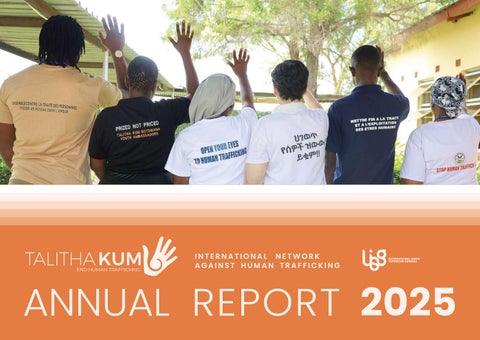
The projects developed by the program participants aim to create social and political impact. They primarily target children, adolescents, young people, families, and migrants, through faceto-face sessions in parishes, schools, universities, community centers, and the distribution of informative materials, and social media campaigns. They also organize activities to mark international Days that focus on human trafficking. Some ways they creatively extend their reach are online campaigns, webinars, radio broadcasts, conferences, and film screenings. For example in 2025, Young Leaders in Brazil launched “A voz que faltava” (The Missing Voice). This four-episode podcast explores human trafficking from a preventative angle. It seeks to empower youth and drive transformation by encouraging the use of social media and to speak up about trafficking. In Botswana, Youth Ambassadors presented the “Prized Not Priced” campaign, which combined parish visits, radio and television interviews, and workshops. The campaign’s title is a powerful reminder that every human being is God’s precious possession on which no monetary value can ever be attached.
Sr. Jackline Mwongela, CJ, Coordinator of the Youth Ambassadors Program in Africa 64
65
© Moses Mtonga
YOUTH AMBASSADOR TESTIMONY
Being a Young Leader Against Human Trafficking: My Experience with Talitha Kum
When I joined Talitha Kum as a young leader in Peru, I never imagined it would completely transform my perspective. It began as a personal commitment, then became a mission taking me to different provinces of my country to deliver an urgent message: human trafficking is a real and imminent threat, and prevention is our best weapon. Along this path, I have facilitated prevention campaigns for children, youth, and adults in communities where many are unaware of the issue. Herein lies one of the greatest challenges: lack of awareness. Many families don’t know how to identify the warning signs. Since they are unaware of the strategies traffickers use, they sometimes unknowingly expose their children to risky situations, believing they are offering them a better chance in life. Language is another barrier I learned to deeply respect. Quechua is the native language in some communities. Arriving with a message in Spanish and expecting it to resonate the same way was naive.
66
I had to listen, learn, adapt, and ask for help. Only with the arrival of a translator did I understand that effective prevention is not imposed but built together with the community. Each workshop I facilitated left me with something different: the perspective of a girl who, for the first time, understands that her body belongs to her; the father who recognizes that “a good job offer” can hide a trap; the young person who decides to replicate what was learned in his or her own community. And that became my next goal: creating alliances, working to bring together other young people and organizations who can replicate these workshops, because prevention can not depend on a single person or a single trip. It needs networks, it needs local voices, it needs community. Being a Talitha Kum youth leader has taught me that youth leadership is not a title, it’s a responsibility that is carried out with both feet on the ground and your heart on the journey. Claudia Ponte Talitha Kum Youth Ambassador Peru
67
INSPIRING STORIES AND BEST PRACTICES FROM 2025 68
13
T
he following best practices illustrate Talitha Kum’s commitment to preventing human trafficking, protecting survivors, and strengthening collaborative action rooted in dignity, justice, care, and hope. Across diverse contexts, these initiatives demonstrate how local networks translate Talitha Kum’s priorities into concrete action by strengthening prevention through sustainable livelihoods, accompanying and empowering survivors on their journey to healing and restoration, and fostering interfaith partnerships to address trafficking and exploitation together.
© CLAR
69
BEST PRACTICES
Prevention Through Sustainable Livelihoods in Thailand
T
he “Seed to Sustainability” project in northern Thailand demonstrates how we can prevent human trafficking by addressing its root causes. In remote rural areas where economic opportunities are rare, many are forced to leave their villages to find work. Migrating without safe options exposes people to deception, debt, and exploitation. With 80% of detected trafficking victims in East Asia and the Pacific being women and girls (UNODC, 2024), supporting local livelihoods is a crucial way to protect communities.
her family. She describes feeling secure and independent, and has begun teaching children in her village about nature. Another participant shared: “Now I can earn money without leaving my children. It’s a small change, but for me, it’s a big freedom.” Local schools now purchase smoked and sun-dried chili in bulk for students’ meals, creating reliable demand and strengthening the local economy. Grounded in the community for the past two years, the “Seed to Sustainability” project has helped 40 women earn a stable income, gain dignity, self-reliance, and resilience. While aligning with local needs and promoting environmental sustainability, this initiative has been particularly impactful in lowering the pressure to migrate along unsafe routes that can lead to trafficking.
Talitha Kum Thailand began a training program a few years ago, teaching women in remote villages small-business skills and organic farming methods. One woman who did not know how to manage money or sell products now produces sundried chili that provides a steady income so she can support
70
INSPIRING STORIES
Empowering Survivors in Argentina
A
rgentina’s critical economic context, marked by high inflation and unemployment rates, disproportionately affects already marginalized people. Survivors of sexual exploitation face greater economic vulnerability and social exclusion, making it difficult to rebuild stable lives, and increasing the risk of re‑victimization.
The Camino de Emprendedoras (Path to Entrepreneurship) project, l e d b y R e d K a ws a y Arg en tin a i n Córdoba, supports survivors of sexual exploitation. This project takes a holistic approach by promoting emotional group support alongside vocational training. This enables the women to gain self-confidence and to continue living anew with dignity and economic independence. The project has provided 11 women with training in bakery techniques,
art therapy, workplace management, organizational and financial skills, and product sales. The goal was that each of them would be able to start her own small business upon completion, while providing a safe space for open dialogue about their experiences. “Getting back on your feet isn’t easy; to do so, we need the support of others,” says project coordinator Cristina, a trafficking survivor herself. “Through our project, we encourage the use of talents and gifts that can enable the women we support to begin earning an income that leads to economic sustainability, so that the healing of their wounds and trauma can be holistic. Because we believe fundamentally that by caring for, accompanying, and supporting one another, the beauty that each of us possesses reemerges as the image and likeness of the Creator.” 71
INSPIRING STORIES
Accompanying Survivors in Ghana
I
n 2025, a young woman, Marita,* was referred to the Talitha Kum Ghana network in a state of fear and uncertainty. She had been deceived into accepting a false job offer and was instead subjected to exploitation. The Sisters welcomed her while also immediately putting measures in place to ensure her safety and well-being, helping her complete a police report, connecting her to medical and legal services, and standing by her at every step. Through the collaboration of Talitha Kum members, partners, and local authorities, her case progressed, leading to the arrest and prosecution of a key perpetrator. With traumainformed counseling, vocational training, and support toward employment, she gradually rebuilt her confidence, regained her independence, and today uses her experience to raise awareness and help protect others from exploitation. Another inspiring intervention was shared by Sr. Olivia, the National Coordinator of Talitha Kum Ghana. She shared that one day, Talitha Kum Ghana, in collaboration with the Safe-Child Advocacy, accompanied six survivors back to their country for whom they had been caring after they had been rescued. Accompanied by one of the Sisters, who is a social worker, and a Youth Ambassador leader, the survivors made the overnight journey from Accra to Lagos, helping them return safely for their reintegration and healing.
*The name has been changed.
72
© Lisa Kristine
BEST PRACTICES
Interfaith Collaboration in Kenya
T
he Interfaith Training of Trainers is a collaborative effort between Talitha Kum Kenya and St. Patrick’s Missionary Society. This initiative addresses human trafficking by bringing together Christian and Muslim leaders to educate communities and inspire collective action. It recognizes the reality that human trafficking does not discriminate on the basis of religion and that effective prevention must reach across religious divides. Faith leaders of all traditions hold unique positions of moral authority, community trust, and social influence within their congregations and communities. In 2025, Talitha Kum Kenya held a three-day intensive training for 30 religious leaders from Garissa and 30 from Mombasa, both critical hotspots for modern slavery and illicit smuggling rings. The cartels exploit economic
vulnerabilities, targeting youths and children with false promises of lucrative jobs in Europe and the Middle East. Talitha Kum Kenya developed this program to equip Muslim imams and Protestant pastors with anti-trafficking knowledge and advocacy skills, and to expand the reach and credibility of its prevention message across Kenya’s religiously diverse population. As a result of this, the inter-religious representatives who attended this initial training were subsequently present at Talitha Kum Kenya’s 2025 annual meeting. Since then, the synergy created between Muslim and other Christian communities has continued through open dialogue with Talitha Kum Kenya Talitha Kum Kenya was also invited to the mosque to raise awareness about child trafficking reflecting the growing trust and strong interfaith partnership.
73
HIGHLIGHTS
74
14
Talitha Kum Networks’ Regional Assemblies
T
he involvement and commitment of Talitha Kum in the fight against human trafficking around the world allows us to have a voice as we stand very close to our suffering sisters and brothers. On this journey, we recognize that social, economic, and political transformation requires constant collective efforts, a holistic approach, the progressive participation of survivors, and, of course, a steadfast prophetic hope. This positions us against the complex system that increases vulnerabilities to trafficking.
“Our mission also involves challenging the systems that increase trafficking in order to defend human dignity.”
THE TALITHA KUM ASIA REGIONAL ASSEMBLY WAS HELD FROM AUGUST 26–30 IN JAKARTA, INDONESIA WITH 60 PARTICIPANTS FROM 16 COUNTRIES.
75
The Talitha Kum networks in Asia, Africa, and Latin America celebrated their regional assemblies in 2025, attended by local coordinators, members, and Youth Ambassadors of Talitha Kum. These assemblies, together with the national assemblies across the global Talitha Kum network, integrated reflection on the Church’s Jubilee of Hope 2025 into their discussions and planning. Focused on the Final Declaration of the General Assembly in 2024, tailored to local realities, needs,
and urgencies, participants explored how Talitha Kum can be a concrete sign of hope for people at risk, victims, and survivors of human trafficking. United by the Jubilee theme of being Pilgrims of Hope, each assembly reaffirmed their shared commitment to the eradication of human trafficking through survivorcentered accompaniment, prevention, advocacy, and systemic transformation, thus manifesting our shared objective and commitment.
THE TALITHA KUM AFRICA REGIONAL ASSEMBLY WAS HELD FROM NOVEMBER 16–22 IN LUSAKA, ZAMBIA, WITH 55 PARTICIPANTS FROM 26 COUNTRIES
© Moses Mtonga
76
These regional assemblies mark an important milestone in strengthening the collaboration and mission of each network, helping us: • to share experiences and challenges, evaluate progress, and establish common priorities in the fight against human trafficking, which reinforces the sense of belonging to a global movement and preventing isolation; • To empower survivors to achieve long-term leadership;
• to share best practices in prevention, protection, advocacy, and care for victims and survivors; they share about the challenges that often limit action; • to reaffirm the unity, hope, and commitment of all the networks to continue working together, as women and men of faith, compassion, and action; • to provide spaces to listen and give thanks, to discern and strengthen ourselves, and to adopt servant leadership.
“Let us become leaders who listen, serve, and act with courage.”
Each regional assembly concluded with an action plan, new commitments and final declarations focused on: • spirituality, advocacy, communication and training; • interfaith collaboration; • the creation of new networks; • strengthening and empowering young leaders, communities and survivors, and ensuring long-term support.
THE FIRST-EVER TALITHA KUM LATIN AMERICA REGIONAL ASSEMBLY WAS HELD FROM OCTOBER 1–5 IN QUITO, ECUADOR WITH 39 PARTICIPANTS FROM 12 COUNTRIES
77
© CLAR
11th International Day of Prayer and Awareness Against Human Trafficking
F
rom February 2 to 8, 2025, Rome was at the center of a global movement marking the 11th International Day of Prayer and Awareness Against Human Trafficking. Coordinated by Talitha Kum and organized in collaboration with a vast network of partners, this year’s edition was rooted in the theme “Ambassadors of Hope: Together Against Human Trafficking.” In the spirit of the church’s Jubilee year, the week emphasized that hope is not merely a sentiment but a call to concrete action against the grave reality of human exploitation. The journey began on February 2 in Saint Peter’s Square, where a gathering for the Angelus prayer united voices in solidarity. Over the next few days, thirty-five youth ambassadors from across the globe gathered to transform awareness into action.
© Giovanni Culmone
78
prayagainsttrafficking.net Ambassadors of Hope: Together Against Human Trafficking
© Mr Asaf Ud Daula
79
© Giovanni Culmone
Their commitment was visibly demonstrated in the square outside the Basilica of Santa Maria in Trastevere through a silent protest observed by passersby, and journalists. Inside the Basilica, the atmosphere shifted to reflection and prayer, centered around the moving testimonies of two survivors of human trafficking. Momentum continued on February 6 at the Pontifical University of the Holy Cross during the “Call for Hope and Healing” event. This gathering featured powerful testimonies from young survivor advocates, a presentation by Italian photographer Lia Beltrami, and music performances by Gen Verde, a play performed by students from a Canossian school.
© Giovanni Culmone
© Giovanni Culmone
The highlight of the week was when the delegation of youth ambassadors, survivors of human trafficking, and representatives of the organizing network met with Pope Francis on February 7. In a passionate address he urged us to unite efforts, reminding everyone that combating this crime is a collective responsibility. These were Pope Francis’s last words to Talitha Kum, which we will always keep in our hearts. They serve as a powerful testament to the necessity of hope and solidarity in protecting the most vulnerable. 80
© Giovanni Culmone
From Rome, the International Day of Prayer and Awareness Against Human Trafficking was felt in parishes, schools, and communities globally. This annual online prayer pilgrimage live-streamed event in five languages connected Talitha Kum networks and partners globally. The week culminated in a dedicated Youth Day, a full session of dialogue and collaborative work on Saturday, February 8. This final day marked the launch of a new global Call to Action, drafted and presented by the youth ambassadors themselves. As “Ambassadors of Hope,” they hope to invite partners, governments leaders and communities worldwide to join them in turning hope into tangible actions for a world free of trafficking and exploitation.
81
© Giovanni Culmone
“But how is it possible to continue to nourish hope in front of the millions of people, especially women and children, young people, migrants and refugees, trapped in this modern slavery? Where do we get new impetus to combat the trade in
human organs and tissues, the sexual exploitation of children and girls, forced labor, including prostitution, drug and arms trafficking? How do we experience
all this in the world and not lose hope? It is only by lifting our eyes to Christ, our hope, that we can find the strength for a renewed commitment that does not allow itself to be overcome by the dimension of problems and dramas, but in the darkness strives to light flames of light, which together can illuminate the night until
the dawn breaks. The young people around the world who are fighting against
trafficking offer us an example: they tell us that we must become ambassadors of hope and act together, with tenacity and love; that we must stand by the victims and survivors.”
Pope Francis, February 7, 2025
https://www.vatican.va/content/francesco/en/messages/pont-messages/2025/documents/20250204-messaggio-giornata-controtratta.html
82
83
© Vatican Media
Innovation and Leadership Formation
F
ollowing in the footsteps of those who participated in the past four courses offered by Talitha Kum, 30 members from 27 countries took part in the 5th Leadership Training Course. The bi-lingual (Spanish and English) course was organized by Talitha Kum International, in collaboration with Tangaza University, Nairobi and the Pontifical University of the Holy Cross, Rome, who designed the course and tailored it to the network’s current needs. The annual Talitha Kum Leadership Training Course gathers a number of members each year to strengthen leadership skills and to continue weaving the network. The course challenges participants to become role models and to spur them on to renewed commitment. Each year’s training program offers sessions in the Talitha Kum spirituality, leadership models, the personal development of a leader, communication, and interpersonal relationship skills for group projects. Each participant is required to develop a short personal
written reflection and to work in a group on a project to implement in their local network, so that many can benefit from their experience. Participants not only receive theory in the program, but are trained in public speaking, learn different techniques to foster spaces of encounter and trust through workshops, forums, and hands-on group exercises. Group projects showcased the participants’ creativity in the design of projects meant to involve children, youth, and adults, in both in-person and virtual prevention of human trafficking events. The implementation of the group project was the key highlight of this course. One Spanish-language group dreamed of a project with a global reach that would be a valuable resource for everyone in the network. They developed a communication manual for all Talitha Kum networks. The manual contains basic communication principles that can be applied to both public presentations and to using social 84
media for prevention, an overview of graphics and digital design platforms, and the connection between leadership and communication in the network. This manual is currently under review and will hopefully be available by the end of 2026.
85
The Walking in Dignity App
T
he Talitha Kum Walking in Dignity app was developed to offer a meaningful way to learn about human trafficking while supporting Talitha Kum’s mission. It was developed in collaboration with Youth Ambassadors and launched on January 30, 2024.
The app counts the daily steps of its users who are encouraged to walk to unlock educational content. After reaching a certain distance, the steps accumulated are converted into “tokens” that can be donated to suppor t anti-trafficking projects led by the Talitha Kum network around the world. Each step taken becomes a symbolic commitment in the fight against trafficking and exploitation. In just one year, the app users walked a remarkable distance, jumping from 150,000 km in 2024 to 250,000 km in 2025 —a significant 66% growth. Since the app’s launch, our community has covered a total of 400,000 km across 111 countries, supporting 19 of Talitha Kum’s projects. Over the past year, the users contributed to 8 anti-trafficking projects, including 5
new initiatives in Albania, Argentina, Colombia, Myanmar, and Zimbabwe. Inspired by the app, Talitha Kum Youth Ambassadors in Japan started to organize “Walks for Humanity” – inviting their community to walk, reflect, and pray together while using the Walking in Dignity app. This initiative was shared on social media and was quickly replicated in other countries. Thus, a movement across continents was born, to “WALK with purpose, REFLECT with humility, and PRAY with hope for a world grounded in freedom and dignity.” Visit the Talitha Kum website to download the Walk for Humanity poster and replicate the initiative with your community.
Download the app 86
+111
COUNTRIES AROUND THE WORLD
400,000
KILOMETERS
500,000
15/19
PROJECTS HAD REACHED THEIR DONATION GOALS
TOKENS FOR ANTI-TRAFFICKING PROJECTS
© Edward Wafula
I appreciate how we can all contribute meaningfully by simply walking! Our steps can fund actual projects that are ending human trafficking around the world. As a youth ambassador, when I feel anxious and sad about my inability to physically help victims or fund projects, I’ll simply pull out the app and take a prayerful walk with St Bakhita and our Lady, and I know my steps will translate to some good! Lone Botshelo, Talitha Kum Botswana © Giovanni Culmone
87
GLOBAL 15 RECOGNITION AND CELEBRATION OF THE COMMITMENT OF SISTERS 88
2025 Recognition Features
T
alitha Kum members and networks are increasingly being recognized for their work and commitment against human trafficking. These awards highlight that Talitha Kum is keeping abreast of human trafficking shifts and global explosion.
Third Edition of the Sisters’ Anti-Trafficking Awards 2025
Talitha Kum Thailand
Talitha Kum Zambia (TAKUZA)
Talitha Kum International
The Sisters’ Anti-Trafficking Awards (SATAs)
T
he third edition of the Sisters’ Anti-Trafficking Awards (SATAs) were held on November 21, 2025, in Lusaka, Zambia.
• Sr. Martha Pelloni, CMT (Carmelitas Misioneras Teresianas), Argentina: Human Dignity Award, for lifetime achievement in addressing exploitation.
The 2025 SATAs took place around two significant dates, to underscore its global call for awareness and action: the G20 Summit in South Africa (November 22–23), and the International Day for the Elimination of Violence Against Women (November 25).
The laureates reiterated that human trafficking is linked to structural injustices and vulnerabilities that need to be addressed urgently, and that women are particularly targeted.
“To stay indifferent in front of such suffering - it’s impossible. Like every human being, women deserve respect and dignity. Equal opportunity is not a favor. It is a matter of justice and humanity.”
Three Catholic Sisters were awarded. They represent their congregations and networks, and have demonstrated exceptional courage, creativity, collaboration, and achievement in protecting their communities from human trafficking. • Sr. Benjamine Nanga Kimala, SMC (Comboni Missionary Sisters), Chad: Common Good Award, for courage and creativity in addressing exploitation. • Sr. Margaret Ng, RSJ (Sisters of Saint Joseph of the Sacred Heart), Australia: Servant Leadership Award, for excellence in network-building.
Sr. Benjamine Kimala
90
© Moses Mtonga
© Arise Foundation
“The question to ask is: are you eating, using or wearing somebody’s misery? No matter who and where you are, you can make a difference in the lives of people who have been enslaved.”
“I’ll never forget Estelita. She was 15 years old, silenced by fear, trapped by those who were supposed to protect her. Her voice broke the silence and started a movement of healing.”
Sr. Martha Pelloni
The SATAs is a yearly event coordinated and hosted by the Conrad N. Hilton Foundation, the Arise Foundation, and the International Union of Superiors General (UISG).
Sr. Margaret Ng
91
Talitha Kum Thailand
J
une 5th, National Anti-Human Trafficking Day, Thailand. Sr. Marie-Agnes Suwanna Buasap, S P C , r e c e i v e d t h e Outstanding Person Award for the Prevention and Suppression of Human Trafficking, awarded by the Thai Ministry of Social Development and Human Security. Since 2018, Sr. Marie-Agnes has established “Talitha Kum Kids” in Thailand, which has trained over 3,000 teachers, and strengthened the leadership of the Talitha Kum Youth Ambassadors to promote peer-led awareness. She also dedicates herself to the empowerment of women, leads capacity-building workshops, and heads the chili cultivation economic empowerment program. Sr. MarieAgnes is also the national coordinator for Talitha Kum Thailand.
92
93
Talitha Kum Zambia
T
alitha Kum Zambia - TAKUZA received the Impact Award at the 2025 Diamond TV Personality of the Year Awards. This award celebrates TAKUZA’s members, diocesan teams, sisters and priests, youth ambassadors and collaborators, who support their mission in Zambia’s 11 dioceses.
“We are merely servants promoting human dignity, reflecting our Catholic belief that every life is sacred…. We dedicate this award to the various victims whose stories you have listened to.”
Sr. Patience Shinondo, RSC 94
Talitha Kum International
O
ctober 25, Mondovi, Italy: Talitha Kum received the Res Publica “Solidarity and Inclusion” Award. This award recognizes individuals and organizations that promote civic responsibility and the pursuit of the common good. Talitha Kum International Coordinator Sr. Abby Avelino accepted the award on behalf of Talitha Kum.
“This award belongs to the thousands of Sisters of Talitha Kum present in more than 100 countries — women who rise each day to accompany those who have been silenced and forgotten. It belongs to the 46,000 survivors we supported last year — women rebuilding their lives, children rescued from forced labor, and young people finding strength to begin again. It belongs to our collaborators, volunteers, interfaith partners, youth ambassadors, and communities who walk with us in this mission of restoration. And it belongs above all to the survivors themselves, whose resilience transforms pain into purpose, and whose voices continue to guide our path.” Sr. Abby Avelino , MM 95
NEXT STEPS AND CONCRETE PLAN OF ACTION
96
16
B
uilding on the priorities for 2025-2030 affirmed during the Second Talitha Kum General Assembly, the global network will continue to walk together and strengthen its shared mission through the following strategic actions:
I. Formation for Mission: Expand innovative and accessible formation opportunities, including e-learning, to strengthen capacity across the global network. Enhance formation through the Annual Training for Talitha Kum Leaders, training for Youth Ambassadors, and regional and local formation initiatives. Revise and update the training manual by integrating principles for safeguarding of human dignity, and translate it into multiple languages to ensure that formation resources are accessible, relevant and responsive to the needs of the global network. II. Youth and Survivor Leadership: Promote the meaningful participation of Youth Ambassadors, and survivor advocates as protagonists of prevention, awarenessraising, advocacy, and survivor-centred initiatives. III. Collaboration and Networking: Strengthen collaboration within the Talitha Kum network and with Church, interfaith, government and non-government organizations, academic, and institutional partners to enhance shared learning, coordinated action, and a stronger collective response to human trafficking. Expand collaborative online training and e-learning opportunities, and promote across the Talitha Kum network the integration of human trafficking awareness into school curricula at all educational levels, inspired by the initiative of Talitha Kum Thailand TeachAgainstTrafficking, and other emerging best practices within the network. 97
IV. Advocacy for Systemic Change: Reinforce coordinated advocacy at local, national, regional, and international levels by amplifying the voices of survivors, promoting policies that protect human dignity, and addressing the root causes of trafficking and exploitation. V. Shared Learning for Strategic Priorities: Develop practical study packet on Talitha Kum’s strategic priorities, integrating safeguarding, andpromote survivor-centred, and rights-based responses across the network.
VI. Pilgrims of Hope and Peace: A journey with St. Josephine Bakhita: Beginning on 8 February in Rome on the occasion of the International Day of Prayer and Awareness Against Human Trafficking (2027), Talitha Kum will launch a global pilgrimage inspired by St. Josephine Bakhita, as a witness of hope and courage. This journey will accompany the network toward World Youth Day Seoul 2027 in South Korea, engaging young people as pilgrims of hope, peace, justice, and solidarity, committed to building a world free from human trafficking.
98
VII. Responding to Emerging Forms of Trafficking and Exploitation: Strengthen the network’s capacity to prevent and respond to evolving forms of exploitation, including online scamming, cyber ex plo itatio n , an d th e gro w in g impact of artificial intelligence. Talitha Kum will promote ethical and responsible use of AI, while carrying out research, digital literacy, and international cooperation to protect those most at risk.
99
© CLAR
CONCLUSION
SR. ROXANNE SCHARES, SSND UISG Executive Secretary
100
17
2
025 has been a transforming journey of hope for many around the world, especially for all involved in Talitha Kum. During the Jubilee Year, we were invited to be Pilgrims of Hope. It was an opportunity to be renewed in hope, for “Hope does not disappoint, because God’s love has been poured out into our hearts through the Holy Spirit, who has been given to us.” (Romans 5:5) Pope Francis noted in Spes non confundit that “In the heart of each person, hope dwells as the desire and expectation of good things to come, despite our not knowing what the future will bring.” Surely, that is true for all of us, and perhaps especially for those who become trapped in some form of human trafficking, as they seek something better in life. As the Jubilee year was drawing to a close, Pope Leo spoke often of hope. He said,
“To hope is to generate. To hope is to see this world become God’s world: the world in which God, human beings and all creatures walk together again. […] Indeed, hope is more powerful than threats and violence because it generates life, God’s life.” (Catechesis of Pope Leo XIV, 20 December 2025) 101
The Talitha Kum Annual Report 2025 reflects the experience of some of these profound insights about hope: the desire for good, the power to generate life and bring peoples around the world to walk together and touch the hope within each person and give birth to new life, God’s life within us and among us. On this journey, working and collaborating together, God’s gift of hope is revealed and springs forth, generating new
life. This is evident in how Talitha Kum has grown enormously as a network of networks, a global community walking together in hope. The Report highlights the expanding and deepening spirit of collaboration throughout the world. Through its global network of 68 national networks present in 113 countries, Talitha Kum has touched the lives of more than 1.2 million people through prevention, protection, advocacy, capacity-building, and accompaniment of survivors. This expanding collaboration by Talitha Kum includes strong partnerships within the Church, the Vatican Dicasteries, Embassies to the Holy See, various humanitarian and interfaith organizations, and congregations of women and men religious around the world. In October, Talitha Kum with other UISG members met with Queen Camilla, during which she expressed her deep appreciation of the work of Catholic Sisters. The 2025 Sisters’ Anti-Trafficking Awards (SATA) honored three Catholic Sisters who demonstrated exceptional courage, leadership, and collaboration in the protection of their communities from human trafficking. The strength of collaboration echoes the truth of a famous African proverb. 102
“If you want to go fast, go alone. If you want to go far, go together.” For Talitha Kum, the “far” is not only about the far-reaching distances and larger numbers, which is clearly evident in this report. It speaks as well of “depth” that authentic, global collaboration can bring about. There is greater awareness and understanding of evolving complex forms of exploitation and human trafficking. This makes possible more relevant and effective efforts toward prevention, protection and care, at the same time, empowering survivors and people of good will for impactful local and global advocacy that addresses root causes and systemic injustices. Talitha Kum, the International Network of Consecrated Life Against Human Trafficking, through the strength of its partnerships and collaboration, its commitment and work, and presence and accompaniment, promotes and facilitates a transformational journey of hope.
103
© Lisa Kristine
PARTNERS
104
18
The International Union of Superiors General is grateful to all the partners, collaborators and supporters of Talitha Kum International during the year 2025. Together, as partners in mission, you help us create lasting impact and drive meaningful change. Partners
Collaborators
Dicastery for Communication of the Holy See
Embassies to the Holy See
Dicastery for Promoting Integral Human Development
The Dicastery for Institutes of Consecrated Life and Societies of Apostolic Life Caritas Internationalis
World Union of Catholic Women Organizations Anti-Trafficking Working Group of the Justice and Peace Commission (JPIC) UISG - USG
Pontifical Gregorian University - Department of Social Sciences
Multilateral Section of the Secretary of State
International Organization for Migration – IOM
United Nations High Commissioner for Refugees – UNHCR
Organization for Security and Co-operation in Europe – OSCE International Justice Mission – IJM
UN Special Rapporteur on trafficking in persons, especially women and children
Tangaza University College
The Regional Implementation Initiative of Preventing and Combating Human Trafficking
John Cabot University
Focolari Movement
Pontifical University of the Holy Cross Jesuit Refugee Service
The Santa Marta Group The Clewer Initiative
Azione Cattolica Italiana – ACI
Association Pope John the XXIII Community of Sant’Egidio
Associazione Guide e Scouts Cattolici Italiani – AGESCI Anti-trafficking formation and networking consultants
The International Dialogue Centre – KAICIID
105
Supporters- Partners in Mission Conrad N. Hilton Foundation
Conrad N. Hilton Fund for Sisters Galileo Foundation
Lady of Bethany Sisters Porticus
Religious Sisters Congregations Online donors
LIST OF ACRONYMS
106
19
ACRATH
AEHT
Australian Catholic Religious Against Trafficking in Humans Alliance to End Human Trafficking
AI
Artificial Intelligence
APT
Act to Prevent Trafficking
CATHII
Comité d’action contre la traite humaine internet et internationale (Committee Against Trafficking in Persons)
CAVITP
Comissão de Apoio às Vitimas do Tráfico de Pessoas
CLAR
Confederation of Latin American Religious
SATAs
Sisters’ Anti-Trafficking Awards
DRC
Democratic Republic of the Congo
SDGs
Sustainable Development Goals
ILO
International Labor Organization
TAKUZA
Talitha Kum Zambia
TK
Talitha Kum
UISG
International Union of Superiors General
UNODC
United Nations Office on Drugs and Crime
URAT
United Response Against Trafficking in Persons
USMI
Unione Superiore Maggiori d’Italia
NGO
Non-governmental organization
ProDemnFe Pro Demnitatea Femeii RENATE
Religious in Europe Networking Against Trafficking and Exploitation
SOLWODI
Solidarity with Women in Distress
107
CREDITS AND CONTACT
108
20
© 2026 Talitha Kum - UISG. All rights reserved.
View the Report online at: www.talithakum.info Produced by Talitha Kum
Graphic Design: Marco Soma and Livia Ranzini @4Sigma
Editors Sr. Abby Avelino, MM Sr. Kayula Lesa, RSC Sr. IsaBelle Couillard, SGM Sr. Adina Balan, CJ Sr. Annette Arnold, RSJ Sr. Mary Dhayalini, AC Sr. Ana María Vilca, SNJM Sr. Carmen Ugarte Garcia, OSR Sr. Jackline Mwongela, CJ Sr. Denin Chiriyankandath, JMJ Marion Paparella Emma Pagé
Web Design: Domenico Cosentino @4Sigma Photos Talitha Kum/UISG British Embassy to the Holy See CLAR Giovanni Culmone Lisa Kristine Moses Mtonga Margherita Simionati Asaf Ud Daula/GMPT Vatican Media Edward Wafula
We gratefully acknowledge the efforts of the Talitha Kum network across the globe in populating and maintaining the database. Their contributions were essential to the development of this report.
/talithakum.uisg/
Special thanks to Sr. Bernadette Reis, FSP
/talithakumrome/
Review Editors Sr. Bernadette Reis, FSP (English) Fr. Joël Ouedraogo and Emma Pagé (French) Francesca Tucci and Alessandra Tarquini (Italian) Sr. Milagros Isabel Plaza, CMS, and Sr. Carmen Ugarte Garcia, OSR (Spanish) Laura Estephânia B. P. de Mello and Alix K. Blanco (Portuguese)
@TalithaKumUISG Contact us and subscribe our newsletter at talithakum.info/en/contacts/ coordinator@talithakum.info Support us donorbox.org/talitha-kum
Coordination: Alessandra Tarquini 109
www.talithakum.info 110