S
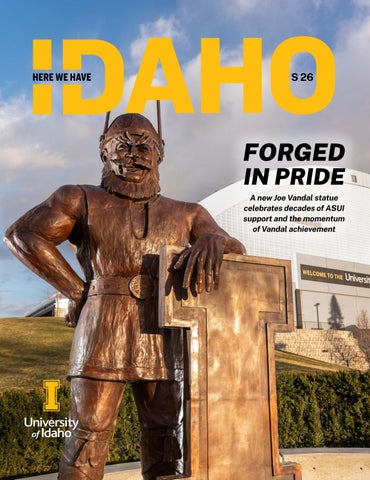
A new Joe Vandal statue celebrates decades of ASUI support and the momentum of Vandal achievement
23
LOCAL, AIMING HIGH
A longstanding partnership between U of I and North Idaho College is helping North Idaho students stay local, save money and earn fouryear degrees on time.
U of I partners with Amalgamated Sugar to design AI systems that protect workers and keep Idaho’s sugar production running at full speed.
An online food science graduate degree option is creating innovative opportunities for southern Idaho food processors.
13
U of I’s Dual Credit program is reshaping high school education by certifying teachers and giving students a head start on college.
15
Virtual technology and design students partner with Micron and the U.S. Forest Service to build immersive recruitment and training tools.

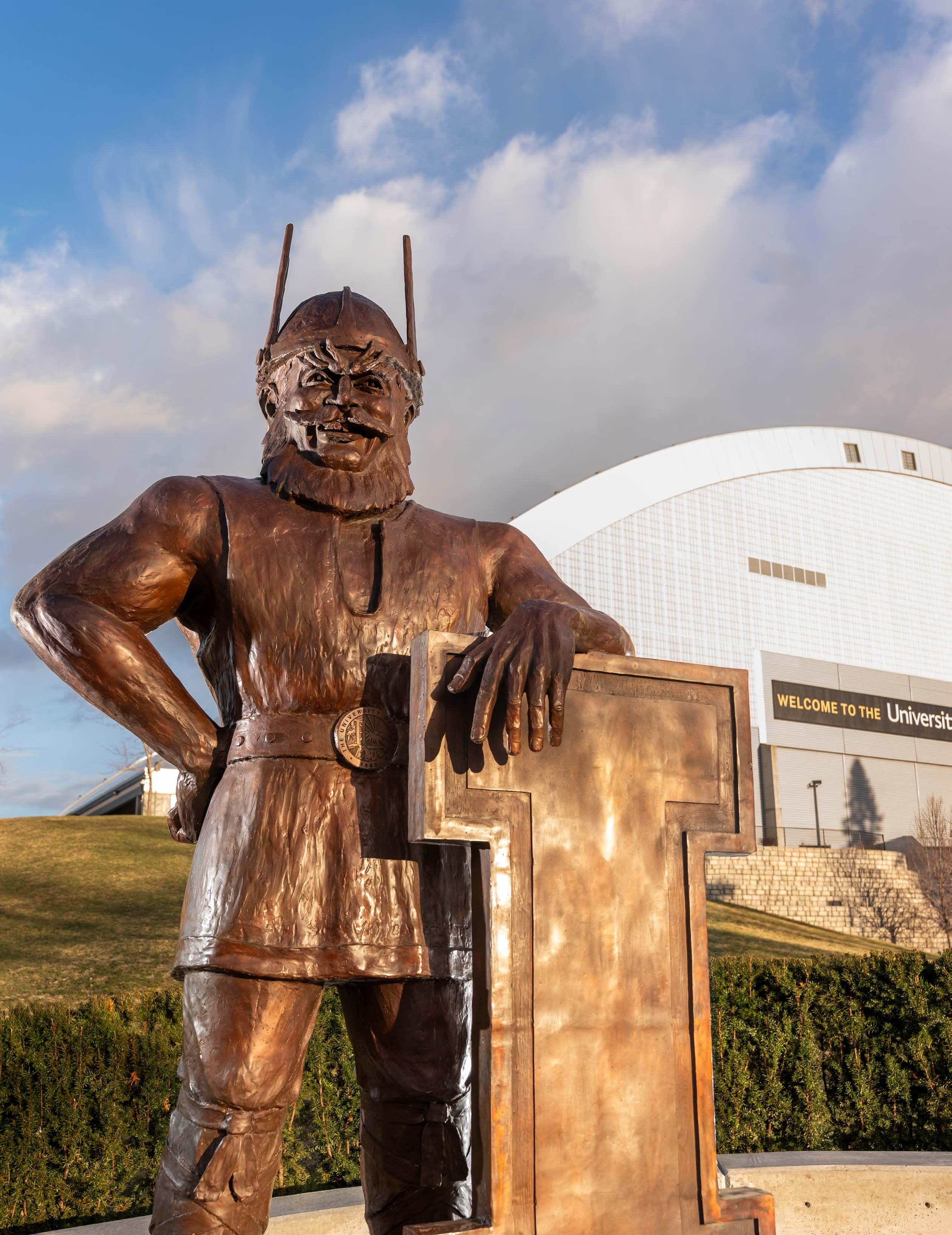
U of I unveiled a 9-foot-tall bronze Joe Vandal statue in Fall 2025 to honor generations of student support. Scan the QR code to watch a video about its creation.
A new era of modern graduate and undergraduate housing at U of I is supporting the university’s rising research profile and strengthening its commitment to student success.
Traveling thousands of miles using state-of-the-art tracking, a doctoral student follows elusive burrowing owls to discover more about the landscapes that sustain them. 28 U
The history of Ridenbaugh Hall shows how U of I adapted student housing and campus life to meet shifting needs. 29
Researchers harness computer modeling to create next-generation fungicides, giving Idaho potato farmers advanced tools to fight crop diseases.
A chemical engineering student helps develop a biodegradable gel to remove phosphorus from water, safeguarding Idaho’s rivers and lakes.
ECHO Idaho delivers the latest guidance to clinicians on opioid treatment, medications and fastchanging drug trends.
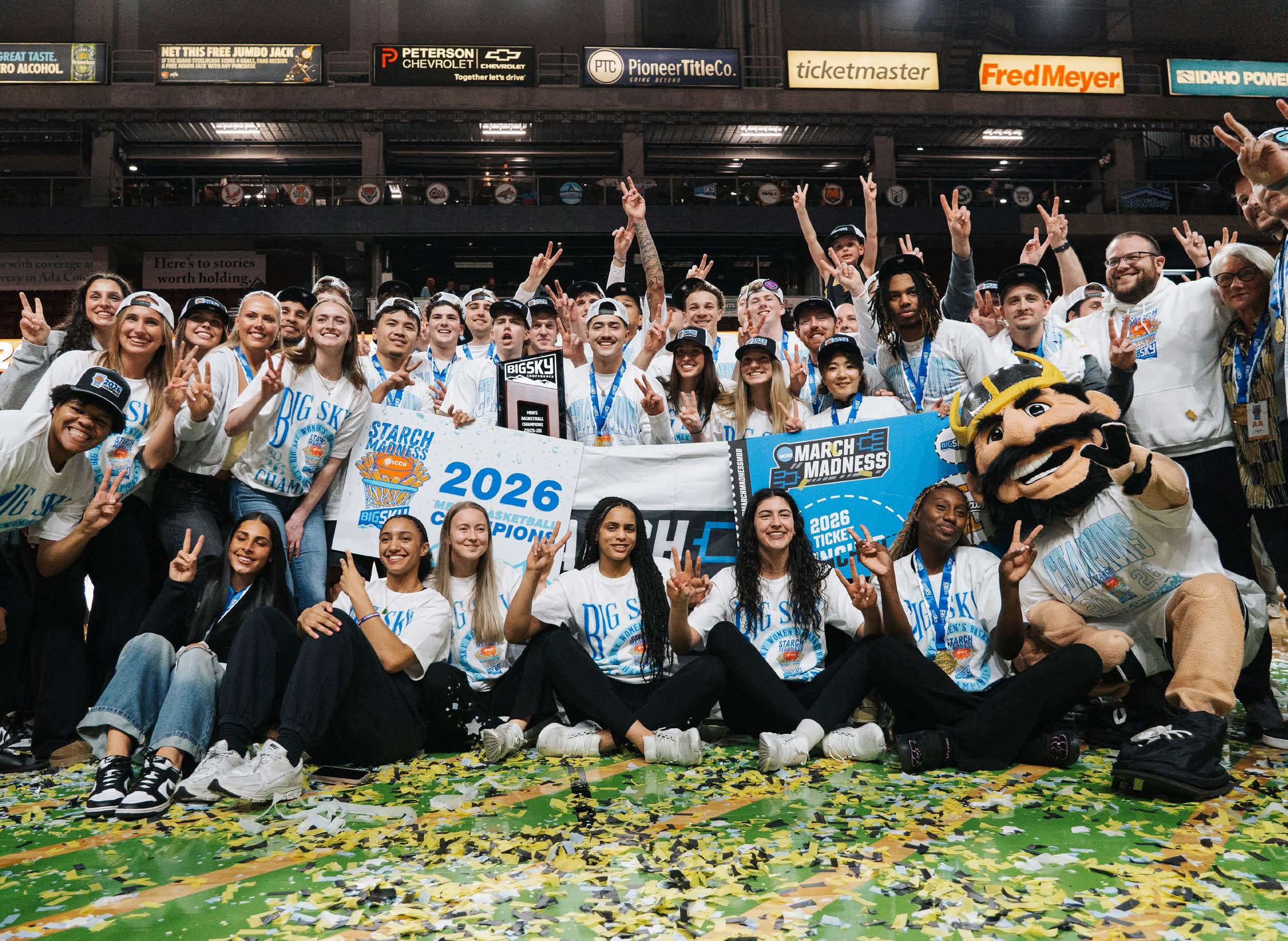
U of I’s men’s and women’s basketball teams celebrate their Big Sky titles with tournament trophies after securing NCAA tournament spots this spring.
Photo by University of Idaho Athletics
magazine delivered to your email. Read it online at uidaho.edu/ui/current-hwhi-magazine. 22
icons highlight projects supported by donors or developed with industry partners.
The University of Idaho relies on alumni, donors and community partners to transform ideas into real-world impact and expand pathways for students. Throughout the Brave. Bold. Unstoppable. campaign, our Vandal Family stepped up to elevate our mission and deliver solutions from classrooms and laboratories in Moscow to every corner of the state.
This commitment to turning knowledge into action is exemplified in our work with Amalgamated Sugar, where a U of I computer science team is using artificial intelligence to keep sugar beet processing lines running reliably. Their work helps prevent costly breakdowns and optimizes worker safety ensuring Idaho’s sugar industry can deliver both quantity and quality.
In Coeur d’Alene, U of I and North Idaho College (NIC) are collaborating to address critical workforce gaps in geoengineering, computer science and other fields. The partnership helps students seamlessly transition from NIC to U of I to complete U of I degrees on the NIC campus.
ECHO Idaho strengthens health care statewide by connecting clinicians with expert guidance and peer support on pressing issues such as opioid use disorder. These sessions help providers manage complex cases without leaving their communities and advance patient care across Idaho.
As the first graduate of U of I’s Dual Credit Certificate program in education, Lorenzo Rene aims to teach college credit courses in high school. The program prepares qualified teachers to offer advanced coursework in high schools, improving access and reducing the cost for students statewide. Potatoes are a cornerstone of U.S. agriculture, generating billions in revenue each year and supporting Idaho’s economy. A U of I research team aims to make potato production more sustainable by tackling diseases caused by fungal pathogens that currently have no chemical solutions. This work bolsters Idaho’s potato industry and supports long-term success for one of the state’s most important agricultural sectors.
Peter Krell, a senior food scientist in Twin Falls who helps develop new Chobani products, returned to school to pursue a master’s degree to update his food science expertise and make more informed decisions. As the first online food science graduate student, Krell sees his experience as a model for other Magic Valley professionals working in food processing.
These stories and others in this issue demonstrate the immense value our land-grant institution can provide with the support of our Vandal Family. We appreciate everyone who contributed to our Brave. Bold. Unstoppable. campaign. The impact will resonate in our state for decades to come.
Go Vandals!
Sincerely,
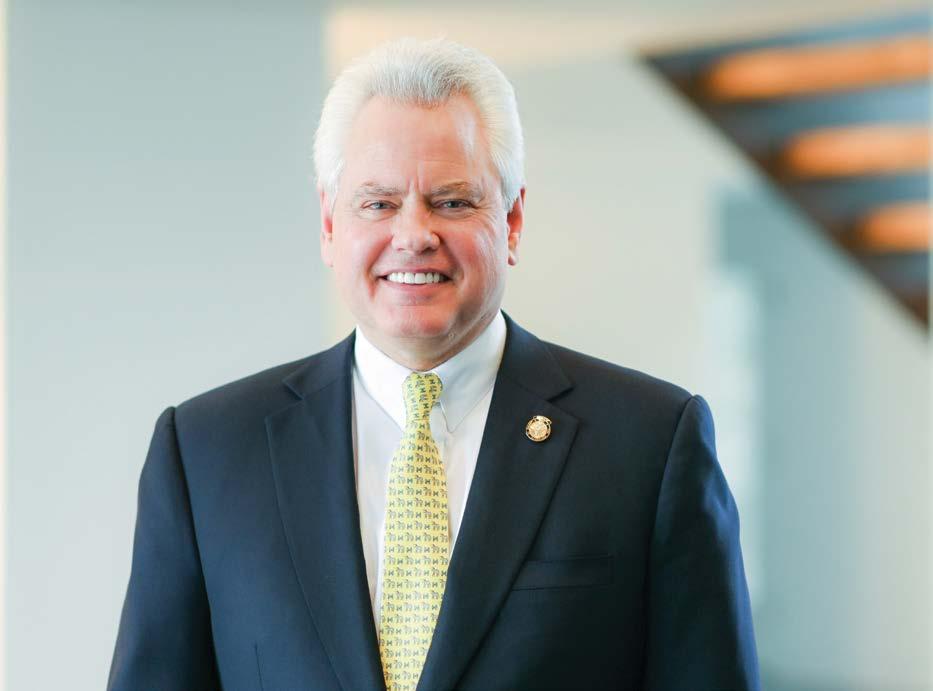
C. Scott Green ’84 President

The University of Idaho magazine Spring ʼ26
Executive Director, U of I Alumni Association
Vicki Sell ’89
Alumni Association President Erin Jessup ’05, ’10
University of Idaho Foundation Chair
Clint Marshall ’97
University of Idaho Foundation CEO Ben McLuen
Managing Editor
Jodi Walker
Editor Joy Bauer ’98
Designer
Hannah Kroese ’08
Stories
Ralph Bartholdt
John O’Connell
Leigh Cooper
David Jackson ’93
Danae Lenz
Jodi Walker
Photos
Idaho Visual Productions
Garrett Britton
Melissa Hartley
Leah Reitcheck
Anthony Locatelli
Bill Schaefer
University of Idaho Athletics
For detailed information about federal funding for programs mentioned in this magazine, see the online version of the relevant story at uidaho.edu/ui/currenthwhi-magazine.
University of Idaho is an equal opportunity, affirmative action employer and educational institution.
© 2026, University of Idaho
Here We Have Idaho magazine is published twice per year. The magazine is free to alumni and friends of the university. University of Idaho has a policy of sending one magazine per address. To update your address, visit uidaho.edu/alumni/get-involved or email alumni@uidaho.edu. Contact the editor at UIdahoMagazine@uidaho.edu
U of I team works side by side with industry to improve safety and efficiency
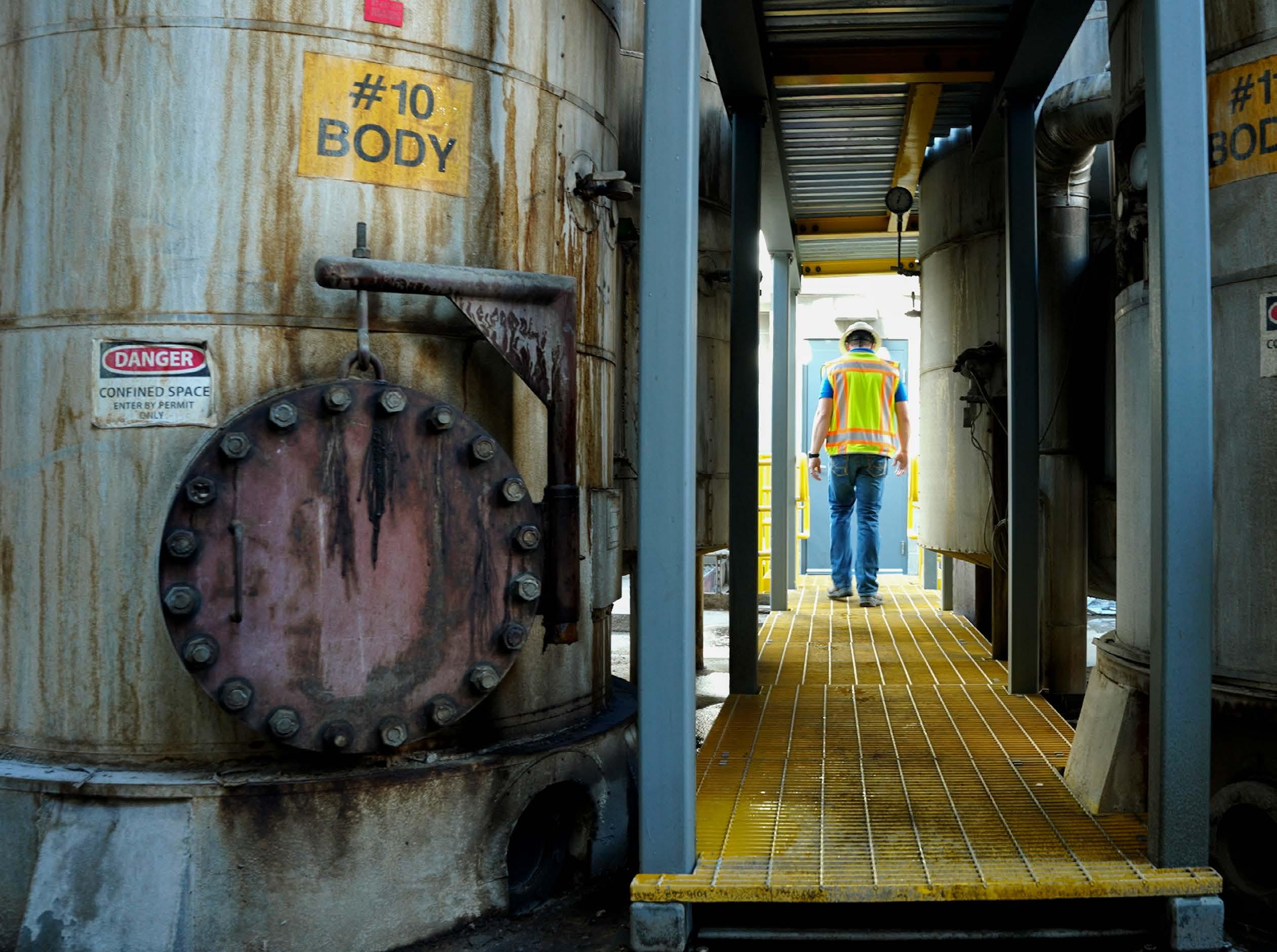

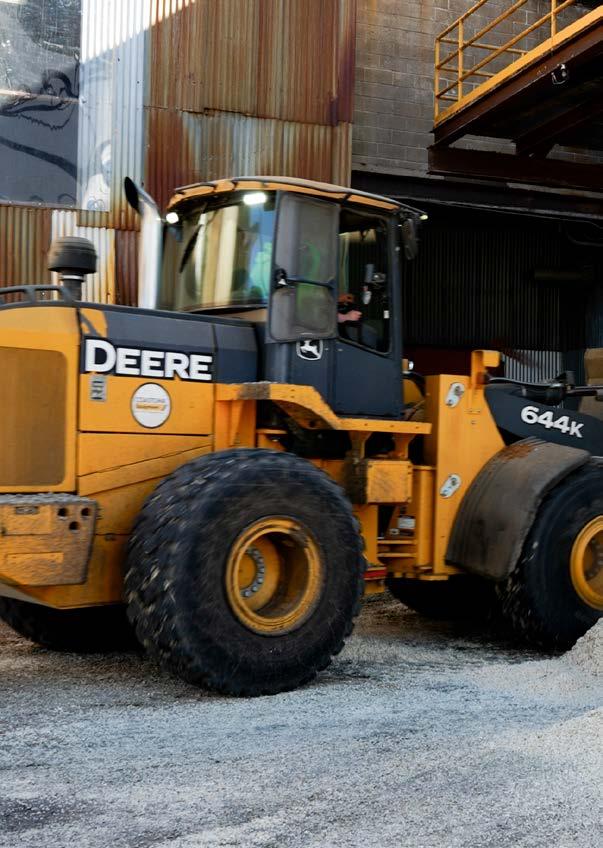
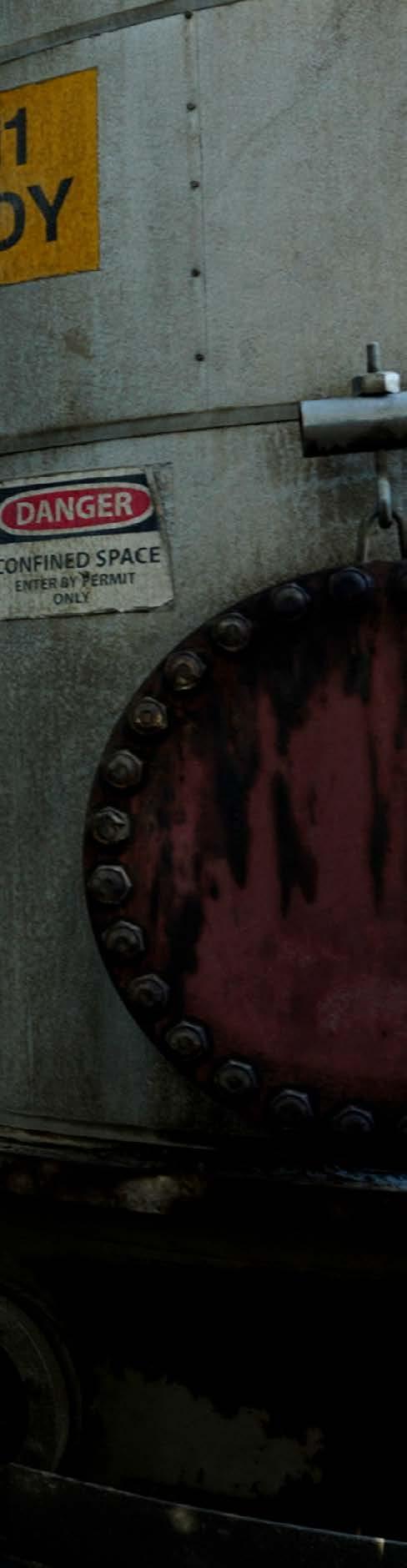
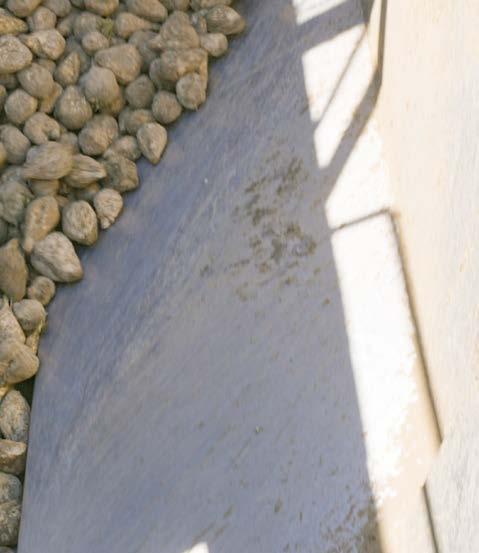
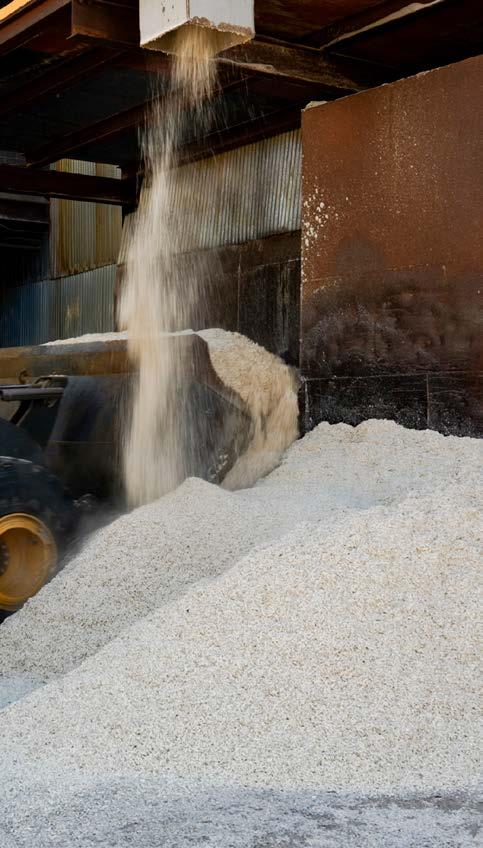
For nearly 30 years, the Amalgamated Sugar management team searched for a workable way to automate its steam dryer.
After listening to their team describe what they hoped to see in a solution, U of I graduate student Hunter Hawkins conceived an idea while waiting for a delayed flight.
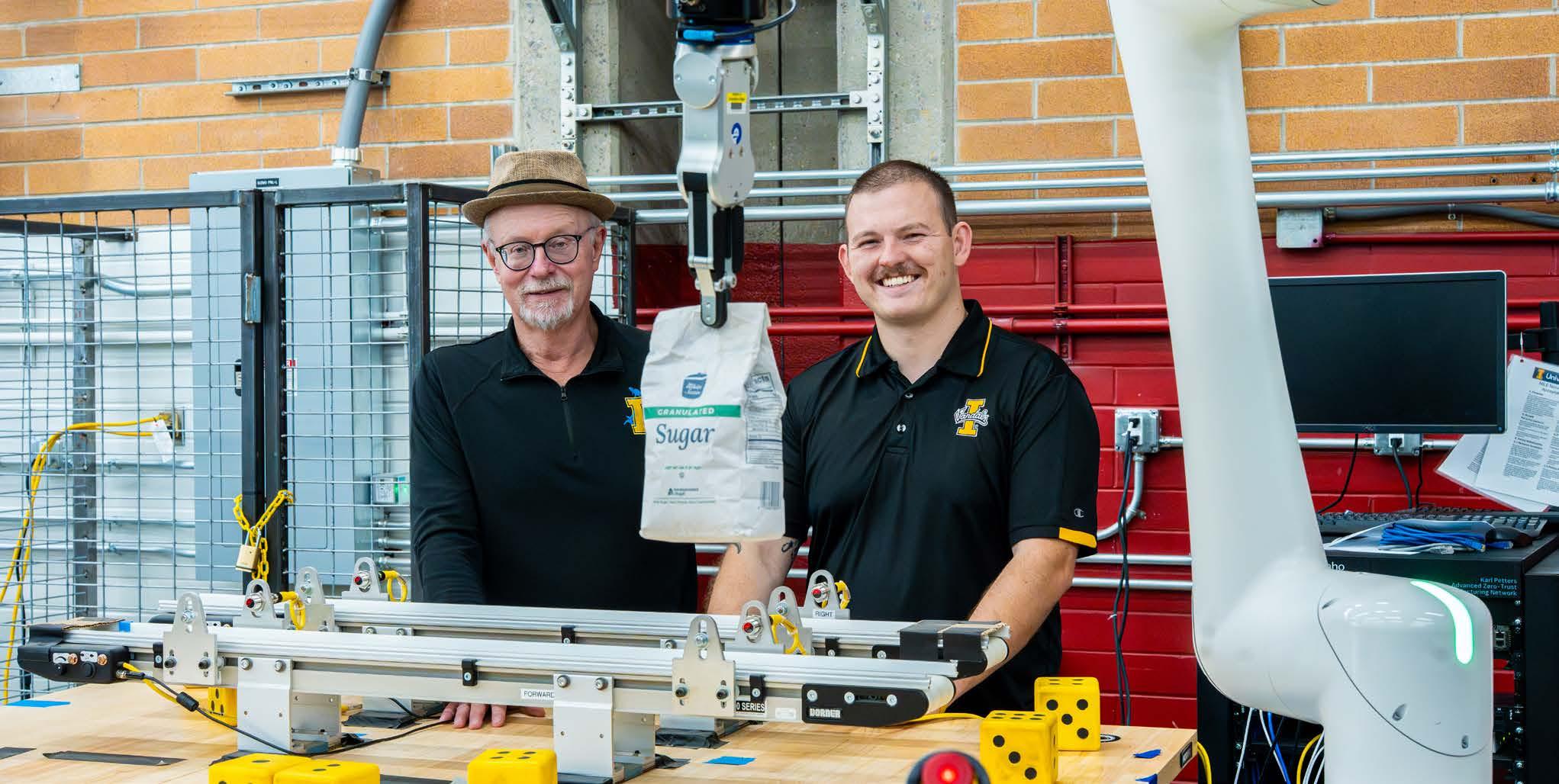
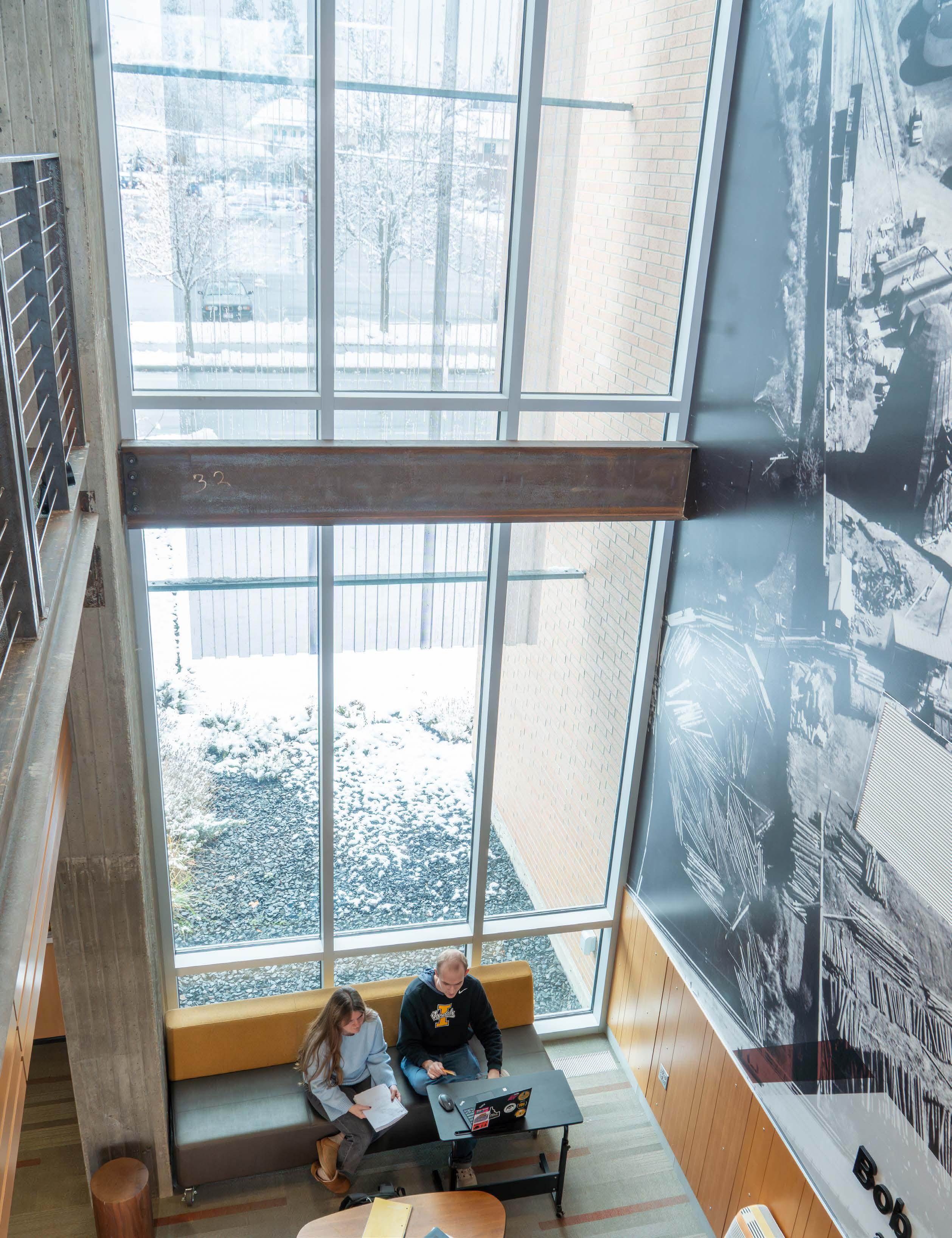
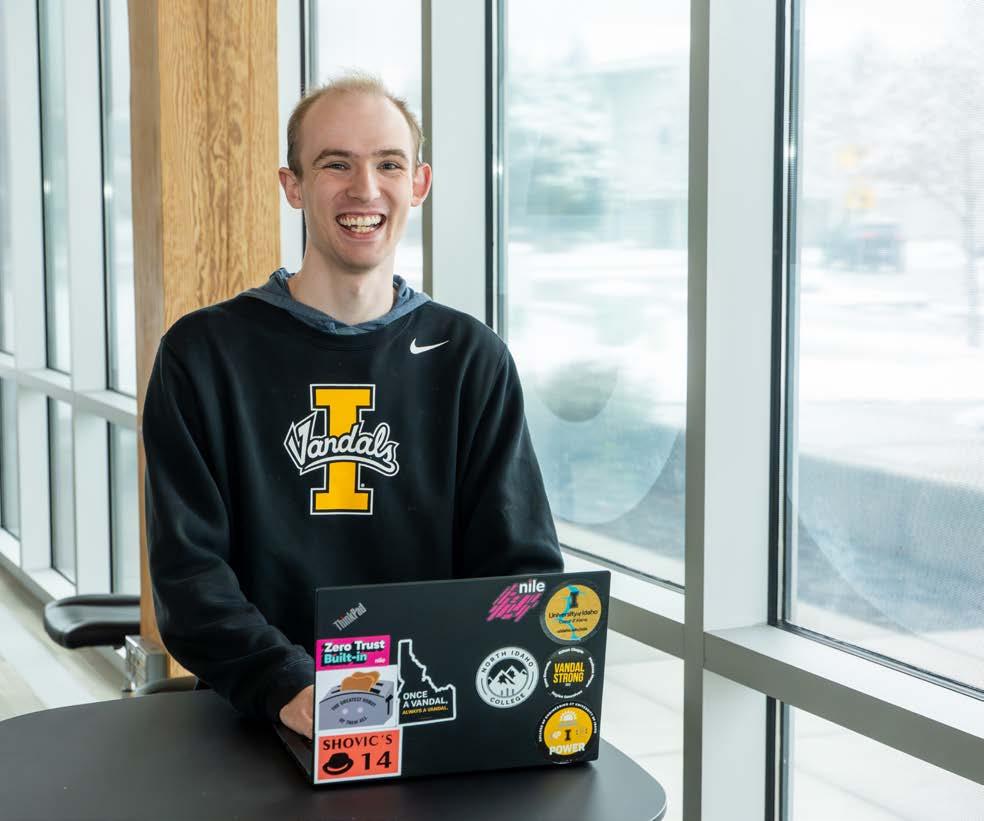
Using a combination of AI algorithms to monitor the plant’s steam dryer, Hawkins and John Shovic, director of the Center for Intelligent Industrial Robotics at U of I Coeur d’Alene, developed a system to warn the company of potential problems, allowing the Amalgamated team to improve employee safety while keeping their production line moving.
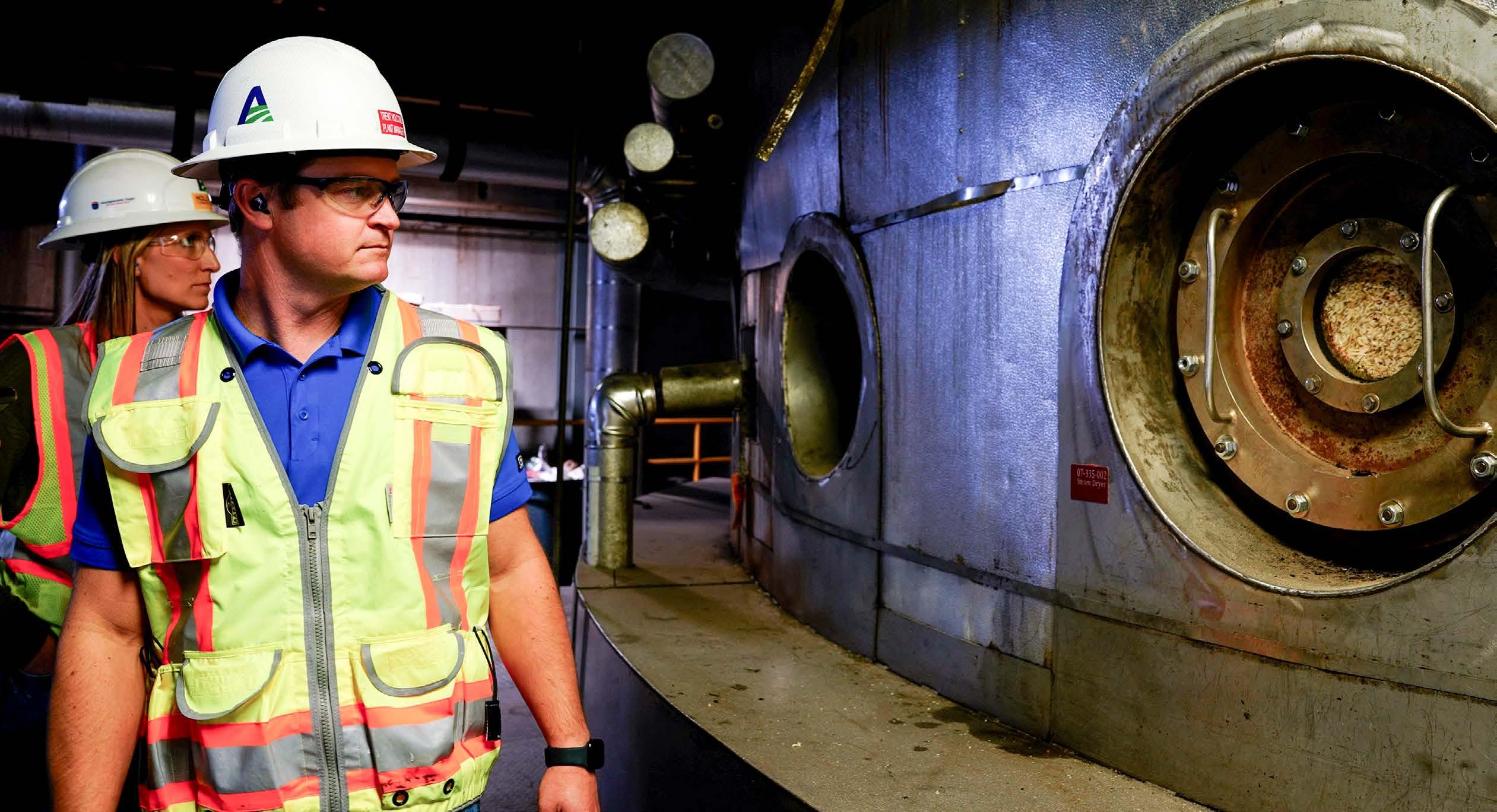
“When we have a plugging event, we have to shut down the dryer and send employees in to unplug it,” said Trent Holcomb, Amalgamated Sugar’s Nampa plant manager. “Because of the heat, pressure and moisture content inside the dryer, it can become very flammable when we open it up. Not having to send our people in there to unplug it is one of the biggest safety opportunities we have.”
For more than a century, Amalgamated Sugar has operated in Idaho, becoming a staple of the Treasure Valley after building its Nampa facility in 1942. The company processes more than 7 million tons of sugar beets each year at facilities in Nampa, Twin Falls and Paul. During peak season, the Nampa facility produces 2.2 million pounds of granulated sugar a day and 87,000 tons of dried-pulp cattle feed a year. Losing up to four days of production to a plugged steam dryer is hardly the stuff of sweet dreams.
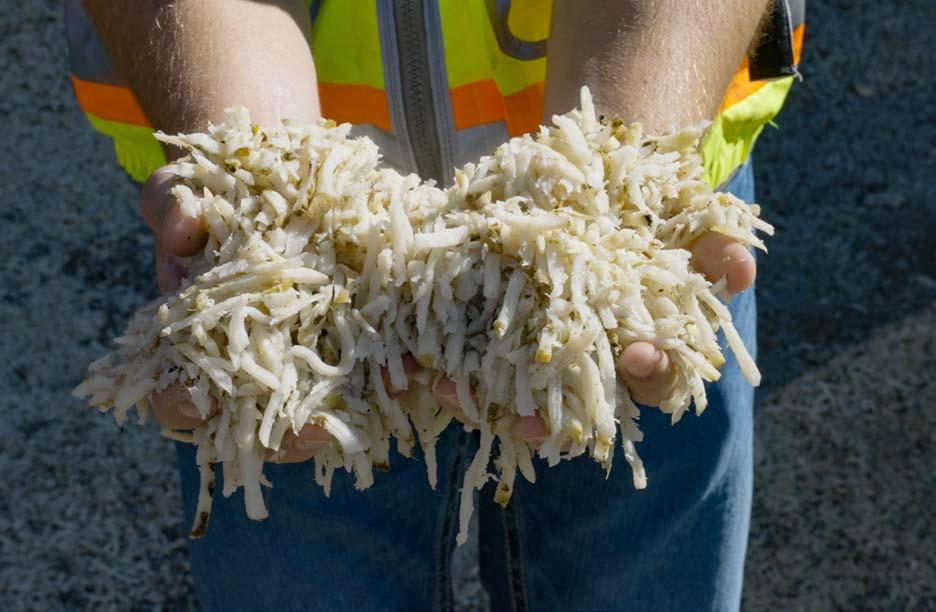
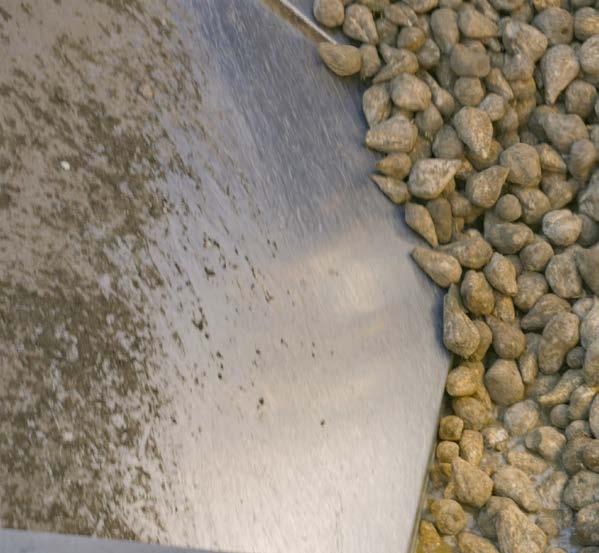
The process of producing granulated sugar from sugar beets is relatively straightforward — as truckloads of beets arrive at the factory, the root vegetables are cleaned and sliced into large strips that resemble french fries. The strips are then immersed into hot water, which allows sugar to diffuse from the pulp.
After diffusion, the pulp — still at about 72% moisture — moves into the steam dryer. Ninety seconds in the dryer at nearly 450 degrees reduces the moisture to around 10%, leaving a dry product that’s sold as shredded or pelletized cattle feed.
The process of drying pulp can lead to plugging issues. Excess pulp, incorrect temperature or steam pressure, or a mass that sticks and begins to burn can all cause problems. For the Amalgamated team, pinpointing the specific issue and exact location of a problem in the dryer required shutting it down and sending employees inside to investigate — until Hawkins and Shovic devised a system that helps the team anticipate issues before they arise.
“The steam dryer has always been on my radar as something we needed to automate,” Holcomb said. “It’s a fairly self-contained system with a lot of data points. Looking at an AI solution seemed like a great
fit because there are about 100 different data points in the dryer, and we have years’ worth of data we’ve already collected on it.”
As a busy doctoral candidate, Hawkins had no time to waste. When he and Shovic faced a long wait for their flight after meeting the Amalgamated team in Nampa last year, he pulled out his computer and began working on the problem.
Specializing in computer science and industrial automation, Hawkins agreed with the Amalgamated team that an AI-driven solution was feasible. The challenge lay in choosing the best AI algorithm to use. The idea Hawkins pitched to Shovic was novel to them both.
“I actually combined two models for this project,” Hawkins said. “I wanted to combine the prediction power of a deep-learning AI model with the explainability of a traditional machine-learning model. The result is a hybrid model that drives a dashboard, giving the Amalgamated team predictions and alerts to potential issues.”

The deep learning model, referred to as an LSTM (Long Short-Term Memory), takes in different data points throughout the steam dryer on a per-minute historical basis — such as the steam input from two boilers, motor amps and other supporting systems — to predict what the data points will be five to 20 minutes in the future. The future predicted data points are then given to a machine learning decision tree ensemble to determine the probability of a problem.
The Artificial Intelligence Predictive Appliance, built by Hawkins, is a dashboard that contains the hybrid model, as well as other predictive models. It is designed to detect patterns and anomalies in the data that indicate potential problems. This technology also allows the data to be displayed in a way that notifies the end user when, and more importantly where, an issue might take place.
“Our operators will be sitting at their control stations and this PC will be sitting next to the station and it will tell us very quickly and very clearly when and where it detects a problem,” said Scott Hyer ’10, operations manager at Amalgamated Sugar. “We can have the steam dryer restarted in less than an hour if we need to stop it prior to a plugging event.”
This project has sparked interest at Amalgamated Sugar in expanding AI modeling to make future processes more efficient. As they look ahead, Hyer and the rest of the management team are grateful for their partnership with U of I.
“We feel very lucky to be involved with U of I,” he said. “They’ve come down to us multiple times and that has helped us gain a better understanding of what they’ve put together and how the process works. Having a local collaboration is very beneficial for both Amalgamated and U of I.”
SPRING ’ 26
$1.3 million
Department of Defense funding for U of I research using machine learning to improve PTSD diagnosis and strengthen support systems for military families during deployment.
Here are some shining examples of U of I’s impact and excellence.
Read more articles at uidaho.edu/newsroom or follow University of Idaho on FACEBOOK, INSTAGRAM and X
2,000
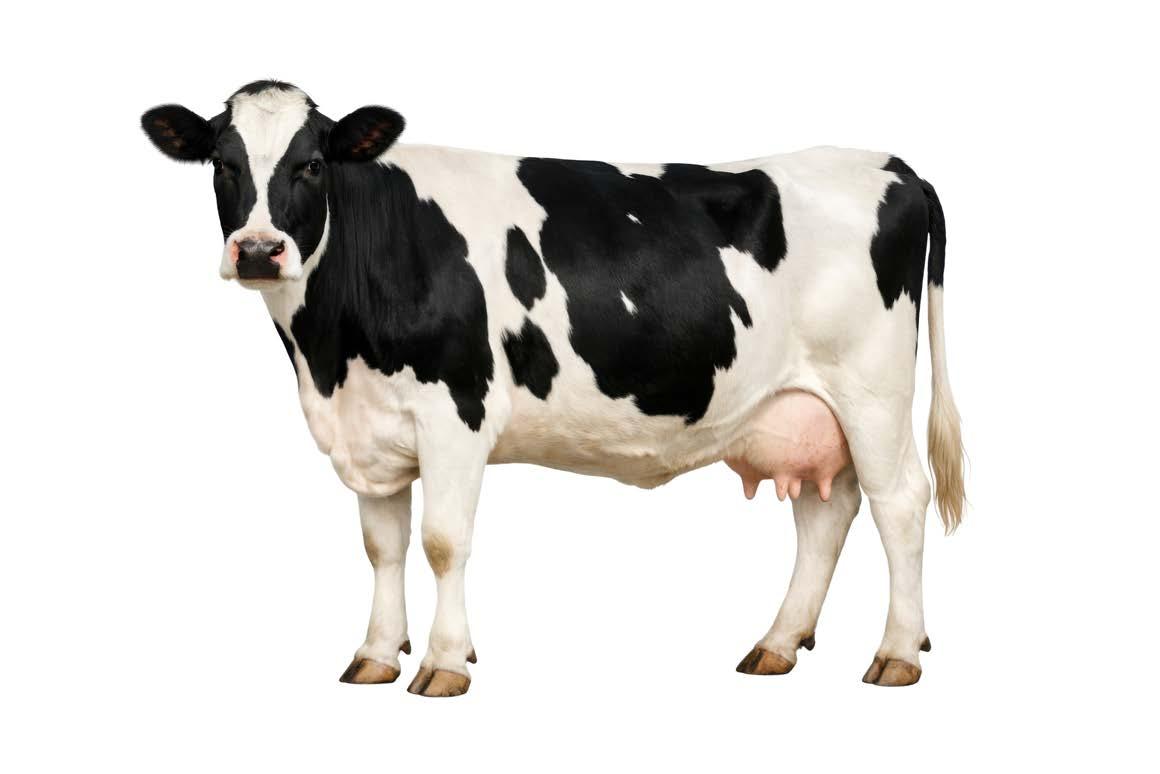
Cows that will be milked at the new milking parlor at U of I’s Center for Agriculture, Food and the Environment, the largest research dairy in the nation.
$1.25 million
National Science Foundation grant supporting U of I efforts to create an open data platform for the world’s largest mineral species database, advancing global mining research and workforce development.
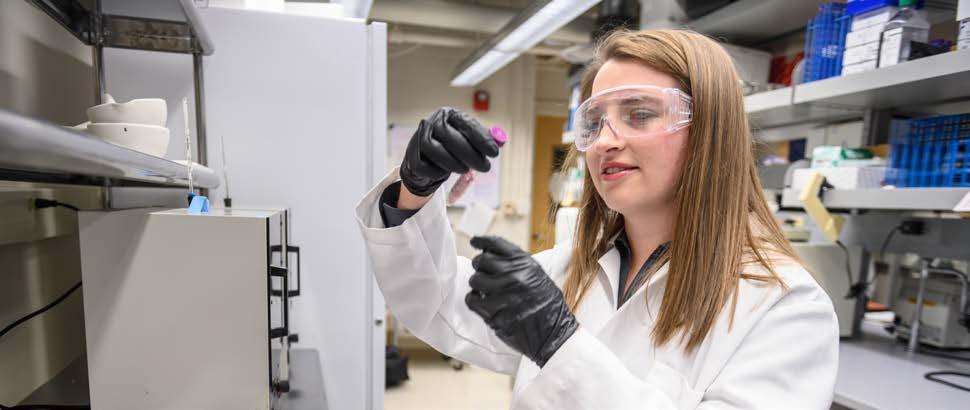
$19.3 million
Given by individuals and organizations in 2025 to support student scholarships.
110
Years since the Associated Students of the University of Idaho (ASUI) formally organized.
9 feet tall
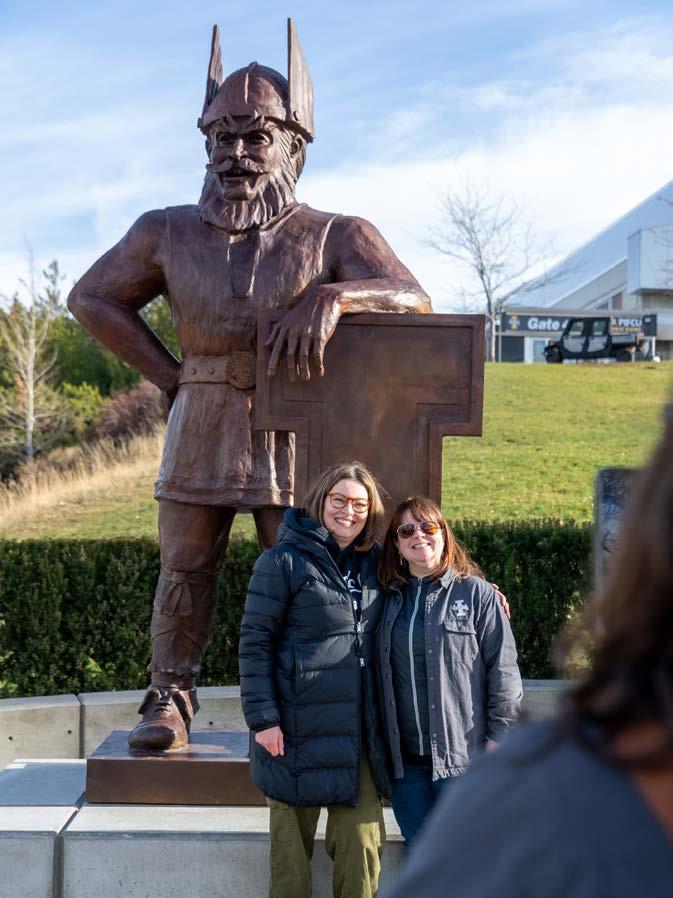
2,000 pounds
Bronze Joe Vandal statue installed as a permanent fixture Nov. 8, 2025, commemorating decades of ASUI support for the P1FCU Kibbie Dome.
100%
All recent graduates of the meat science program successfully obtained industry positions.
$1.4 MILLION
1st
Award backs U of I research developing effective teaching strategies based on children’s metacognition and its role in science learning.
Idaho captured its first-ever Big Sky Conference Presidents’ Cup in 2025, awarded for combined academic and athletic excellence.
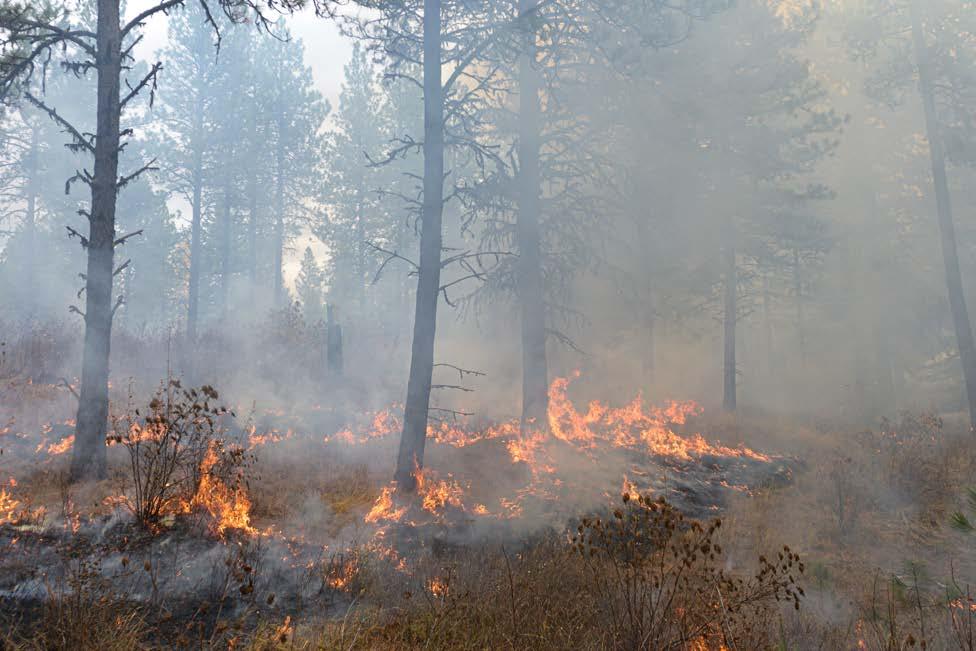
$1.4 million
National Science Foundation award expands U of I’s effort to confront wildfire challenges by funding nine new doctoral researchers.
$67.6 million
Record amount in donor dollars raised by U of I in fiscal year 2025 — the largest single-year total in its history.
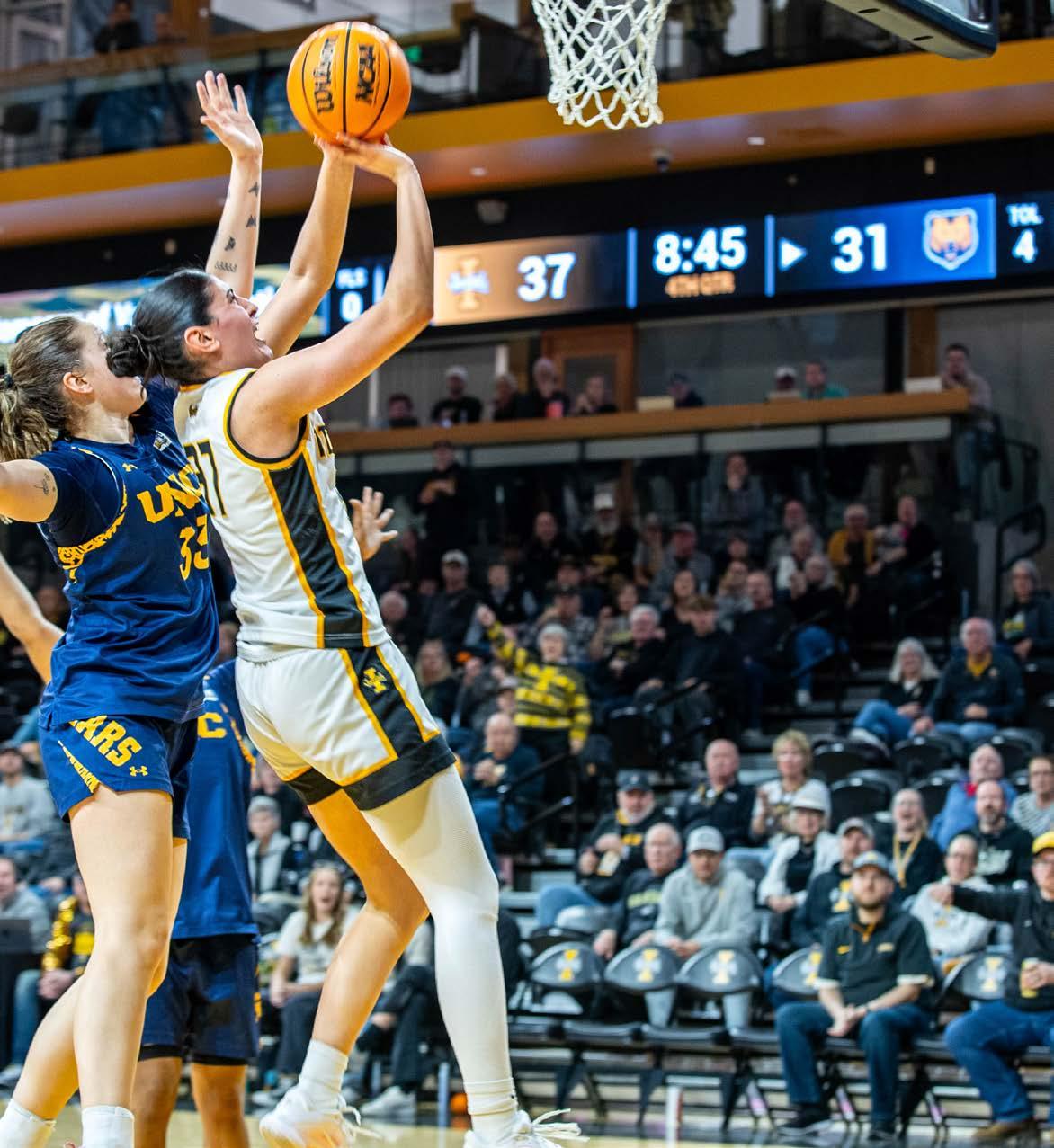
U of I’s men’s and women’s basketball teams both captured Big Sky titles this spring, with the men earning their first NCAA berth since 1990 and the women returning to the NCAA Tournament for the first time since 2016.
6th
For the sixth consecutive year, U of I is ranked Best Value Public University Nationwide by U.S. News and World Report.
$550,631,380
Total amount donated during the Brave. Bold. Unstoppable. philanthropic fundraising campaign. Thank you!
Brave. Bold. Unstoppable. is officially the most successful philanthropic campaign in Idaho state history. When the campaign closed on Dec. 31, 2025, the Vandal Family had contributed more than $550 million over 10 years to amplify student success, support sustainable solutions for our state and foster a thriving Idaho — and future — for all. The impact of your generosity can best be told through stories like these and will continue to unfold for decades to come.
DEAR VANDALS,
What an accomplishment!
This campaign is further proof that, when the Vandal Family comes together, we can make history. We shatter goals once thought unreachable and generate impact that turns ambition into action. We create an even brighter future for our students and our state.
Every gift made a difference, just as every gift is a reflection of the Vandal spirit that unites us all. The campaign may be closed, but our work moves ever forward to elevate lives and communities.
Speaking as a graduate, volunteer, donor and now executive director of your U of I Alumni Association, I’ve never been prouder to be a Vandal.
From the bottom of my heart, thank you and GO VANDALS!
Vicki Renfro Sell ’89

$166 MILLION raised for scholarships
347 NEW scholarship endowments
20% INCREASE in donor-funded scholarship awards since 2015
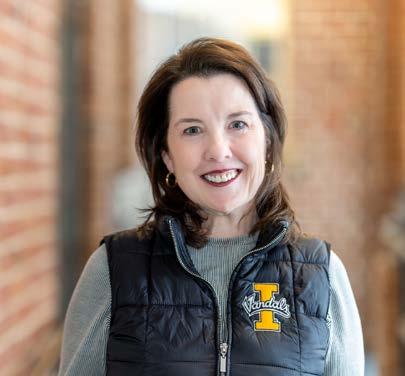
DEAR VANDALS,
MORE THAN $550 MILLION GIVEN BY
39,202 VANDALS WHO MADE 193,537 GIFTS THANK YOU, VANDAL FAMILY!
By giving of ourselves, we create initiatives, programs and spaces that empower people to discover their potential, define their purpose and gain the skills and confidence to pursue them.
Philanthropy becomes transformational when it moves beyond transactions and becomes personal. It means giving not just funding, but also time, talent and mentorship — because that’s how lasting change happens.
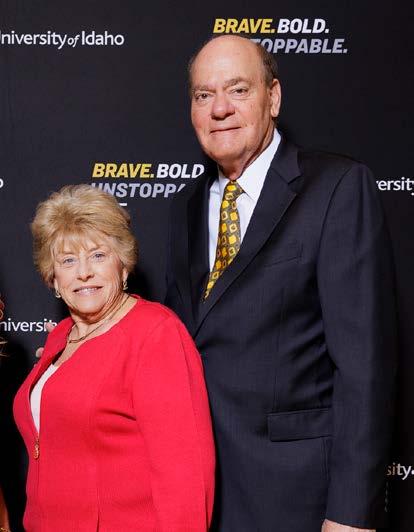
Our giving reflects our hope that today’s students become tomorrow’s alumni who are empowered to stay connected, give back and mentor the next generation — continuing a cycle that makes this university stronger with every passing year. For us, that is what this Brave. Bold. Unstoppable. campaign represents. Jim ’70 and Tedde Reid ’25 HON*
*Official Honorary Alumna designation
Story by John O’Connell
Photos by Bill Schaefer
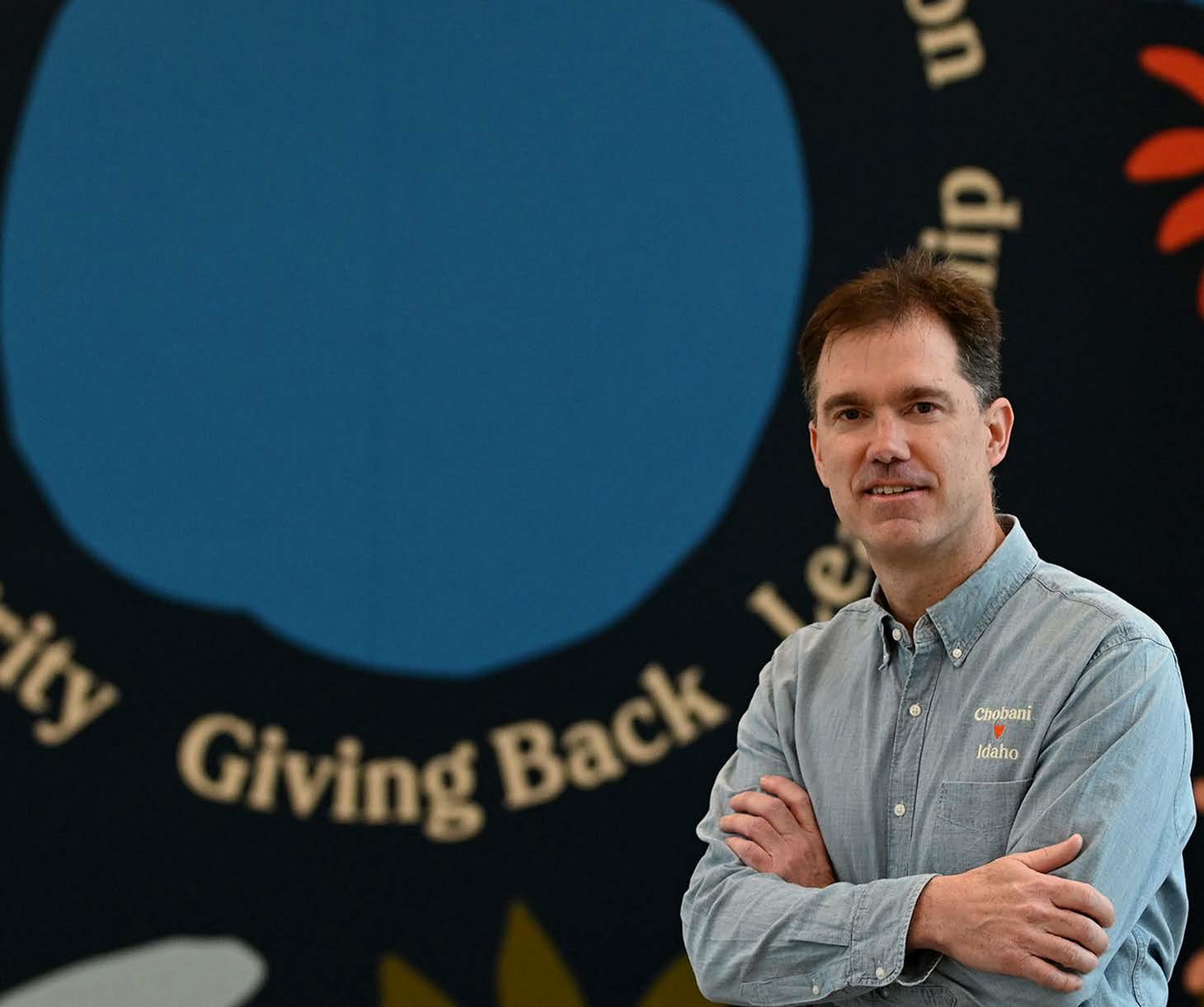
Mid-career food processing professionals throughout southern Idaho have a new option to boost their skills and ingenuity thanks to Peter Krell’s resolve to return to school.
Krell, 51, a senior food innovation scientist with Chobani, approached the faculty in University of Idaho’s expanded food science program about pursuing a master’s degree remotely while keeping his full-time job at the Twin Falls-based Greek yogurt plant. His instructors in U of I’s Department of Animal, Veterinary and Food Sciences expect more seasoned Idaho food processing employees will follow his lead and stay in the workforce while earning online graduate degrees to keep pace with industry changes.
“What I hope to gain from this is the ability to give back to Chobani and make a bigger contribution,” Krell said. “If I can learn and grow my knowledge and pass it on to the rest of the team, that’s the end goal.”

U of I’s Moscow campus is more than 300 miles from the state’s food processing hub in the Magic Valley. Krell’s faculty advisor, Ningjian Liang, assistant professor of food chemistry, believes the online graduate degree option Krell is pioneering will help the program close that distance and deliver workforce education and research that target industry priorities.
“Most of our food industry is located in the southern part of the state, so to bridge this geographical gap and better connect students with industry, we are trying something new,” Liang said. “Peter can learn remotely and gain hands-on experience on site, so he can not only work but also study and improve the company’s products. I think this is a win-win scenario for industry, students and the consumer.”
The food science program lapsed for about two years prior to Fall 2025, when the university hired three
new faculty members, including Liang, based on industry demand. U of I had long offered food science graduate degrees, but not remotely.
Liang, who specializes in milk processing methods that preserve healthy bioactive proteins, envisions each faculty member supporting three or four remote graduate students.
“We are definitely looking for more food science students who want to do an online master’s or doctoral program,” Liang said, adding industry partners will play a key role in growing the program.
Krell earned a bachelor’s in food science from Oregon State University in 1997 and joined Chobani in 2015 after working for a dairy company and a bakery. Chobani’s Twin Falls plant processes about 5 million pounds of milk a day into Greek yogurt and other products.
He’s part of a large innovation team developing new products, with recent emphasis on high-protein options such as a yogurt line that delivers 20 grams of protein per 6.7-ounce cup.
“This product is quite innovative and important for the company and its growth,” Krell said. “They say if you don’t innovate, the consumer gets bored.”
He is working closely with Liang to design a master’s thesis project examining how processing changes affect yogurt’s protein percentage and structure. Chobani is splitting the cost of the two-year study with Building University-Industry Linkages through Learning and Discovery (BUILD) Dairy — an
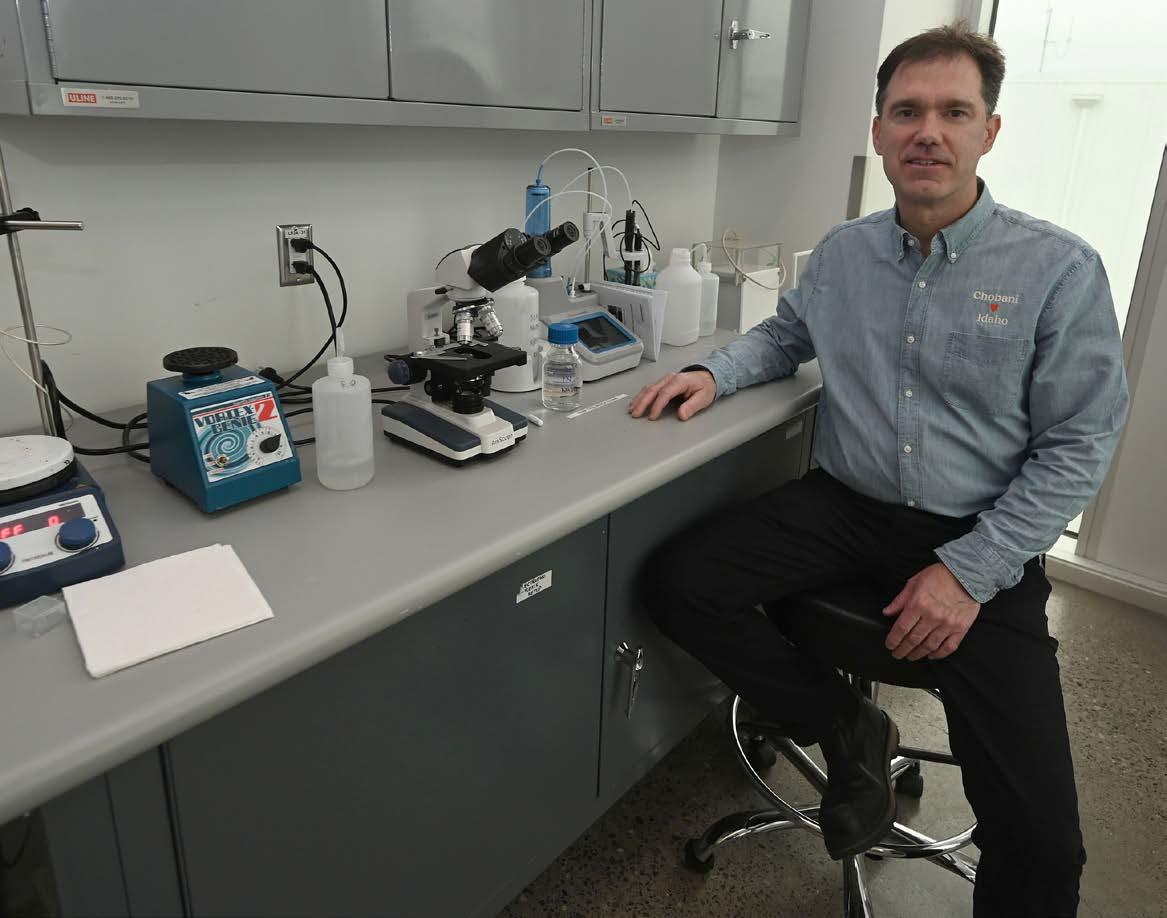
industry-led initiative connecting dairy companies with Western universities and researchers. The results will help Chobani communicate the health benefits of its products more clearly to consumers.
“We’re looking at different processing parameters we need to optimize,” Krell said. “There are things that can be done in Ningjian’s lab regarding testing of protein structure that we don’t have the resources to do here at Chobani.”
Krell completed a three-credit food chemistry course during his first semester back in school and is now taking a food product development class.
Weekdays are reserved for his full-time job, evenings for time with his wife and two young children and weekends for studying. He’ll also spend a few weeks on U of I’s Moscow campus, bringing food samples from Chobani for testing in Liang’s lab. Krell first considered graduate school while representing Chobani at BUILD Dairy meetings at Oregon State and Utah State universities, where graduate students presented dairy research.
“Going to those meetings and being involved with those students intrigued me and gave me a little spark to think, ‘Wow, maybe I could do that,’” he recalled.
Krell heard about U of I’s major investment in its food science program while visiting the faculty at the Twin Falls Research and Extension Center. Liang was excited when he approached her about pioneering a new online degree option.
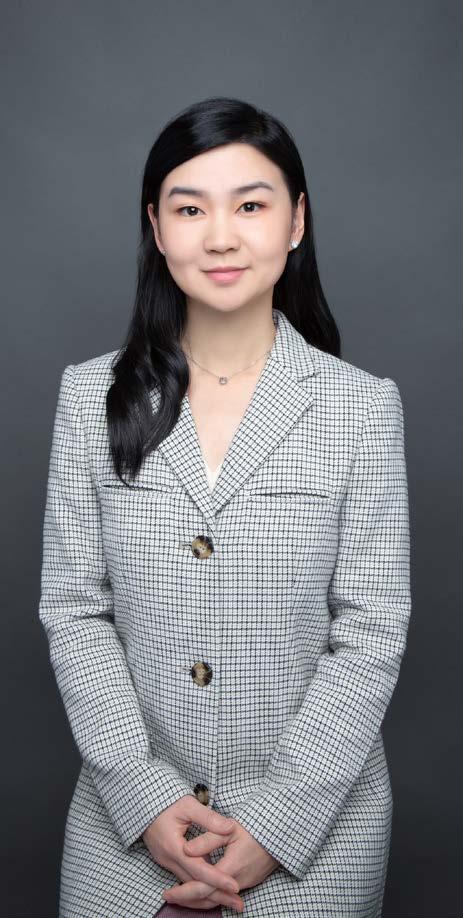
Krell anticipates colleagues at Chobani and other mid-career food processing employees will follow his lead.
“There’s been a lot of growth in the industry, both at Chobani and in the Magic Valley. We’re becoming a powerhouse in the southern part of the state,” he said. “As we grow, the employees who run these companies will need a higher skill set. Instead of coasting, you have to think, ‘How can I continue to move up and gain more skills so I can contribute better?’”

With dual credit enrollment surging, U of I’s certificate prepares teachers and students for a new era in education
Story by David Jackson ’93
Photos by Melissa Hartley and Garrett Britton
While teaching history and English language arts in a high school in Florida, Lorenzo Rene encountered many students who needed extra support, more guidance or someone to help them advance to the next level.
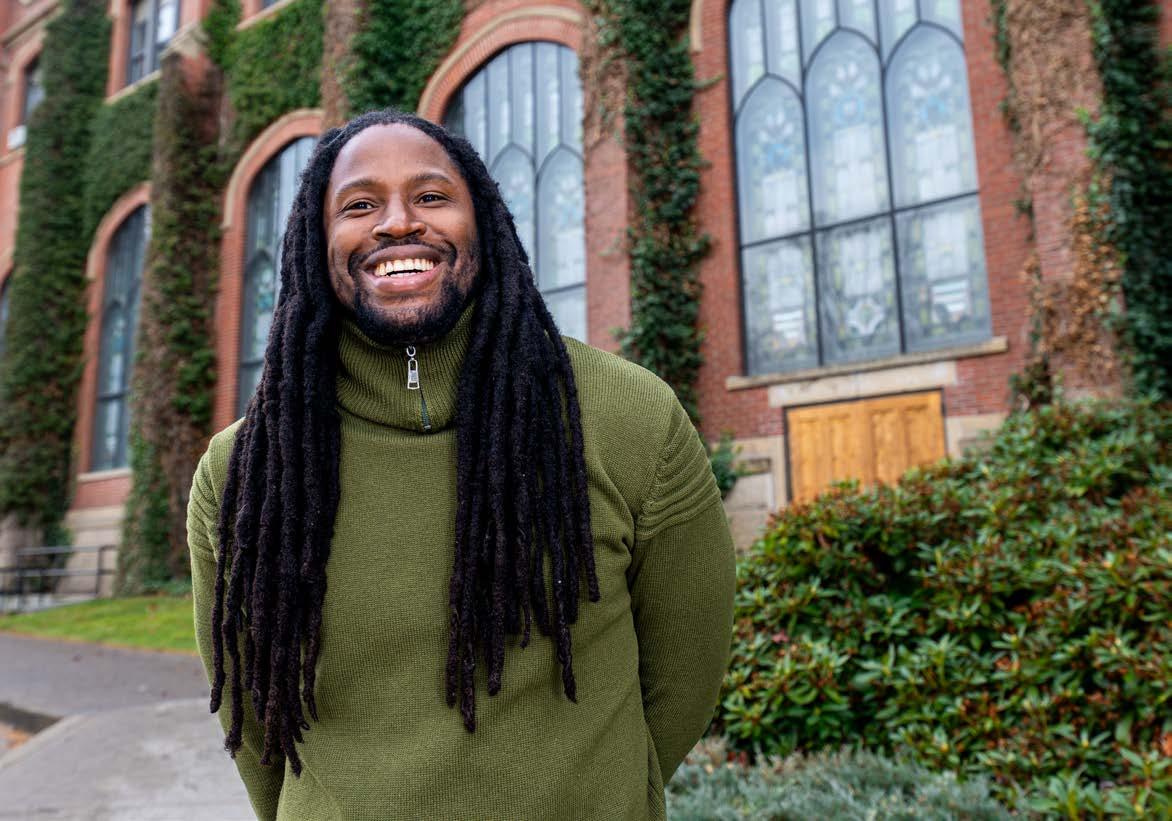
As the first graduate of University of Idaho’s Dual Credit Certificate in education, his goal is to teach college credit courses in high school while ensuring his students have everything they need to thrive.
“High school students today are seeking more dual credit opportunities, but teachers need to be certified to teach those classes,” said Casie Moreland, U of I Dual Credit program director. “Our program is the only one in Idaho for credentialing teachers for dual credit instruction. This ensures they are prepared to support those students.”
When Rene was teaching in his home state of Florida two years ago, the high school where he worked welcomed more than a dozen Ukrainian refugee students.
Most of the students didn’t speak English well, if at all, and Rene knew they needed a support system to succeed.


“I tried to pair those students with a buddy who I thought could help them figure things out,” he said. “I knew they needed more help than what I could provide. I could try and teach them, but they needed others to help them with things I couldn’t.”
Rene enrolled in U of I’s Doctor of Education program in the College of Education, Health and Human Sciences because he wanted a
Our program is the only one in Idaho for credentialing teachers for dual credit instruction. This ensures they are prepared to support those students.
CASIE MORELAND, U OF I DUAL CREDIT PROGRAM DIRECTOR
change of scenery after spending 30 years in Florida. He was also seeking a different way to teach. In addition to instructing his students, he wanted them to feel cared for.
While in Moscow, he explored different ways to connect with students. He published articles on supporting mental well-being for Englishlanguage learners and using Indigenous storytelling in teaching.
He worked with U of I’s Naval ROTC program on a study involving the mental and social well-being of populations who are often transient.
He is convinced that, upon completing his doctorate last December, his studies at U of I provided the answers he was seeking.
“I want to create a safe space where I can talk to students not only about their studies but also about their home life and to make sure they are doing OK,” he said. “They aren’t just students — they’re humans, and I want them to feel supported in my classroom.”
Dual credit courses in high school are more than just a way for Idaho students to earn college credits before arriving on campus — they are also funded by the Idaho State Board of Education.
“Every public high school student in Idaho has around $4,600 in credit available to them to essentially earn an associate degree by the time they graduate high school,” Moreland said. “But you have to be certified to teach dual credit courses, and not all Idaho high schools have certified teachers.”
U of I’s certificate program makes it easier for Idaho high school teachers without a graduate degree to obtain certification to teach a dual credit class for U of I — which is important because U of I’s Dual Credit program stipulates high school teachers must have the same credentials that U of I instructors need to teach a class for college credit.
Per U of I instruction regulations through the Higher Learning Commission, instructors can teach a U of I class if they are actively engaged in obtaining 18 hours of post-graduate experience in the field they wish to teach. This regulation also allows a U of I teaching assistant to instruct a course if they don’t have a graduate degree.
In turn, Idaho high school students can take a U of I class on the U of I campus to earn the same dual credits they would have received by taking the class in high school.
“We probably have around 100 high school students taking classes here on U of I campus right now,”
Moreland said. “They’re getting college credit, as well as a head start on the college experience by being here.”
Popularity of dual credit courses is skyrocketing, with more prospective college students stating they would like to finish their degree as early as possible. According to Moreland, around 33% of high school students nationally are taking dual credit courses.
“Dual credit classes are changing the way students are educated — in Idaho and across the U.S.,” said Moreland, who noted a 250% increase in dual credit enrollment at U of I since 2021. “I think higher education needs to respond to what our future students are asking for.”
U of I students created a simulated Micron cleanroom as part of a virtual experience the company uses to recruit potential employees.
Story by David Jackson ’93
Photos by Leah Reitcheck
While on a Zoom call during Summer 2025, virtual technology and design (VTD) senior Porter Howard was driving back to Moscow from a meeting in Boise, VTD graduate Sydney Tverdy ’24 was working on the U of I campus and Jean-Marc Gauthier, director of VTD and VRLab for the College of Art and Architecture, was in Pullman, Washington, conducting LiDAR scans of local topography.
Howard couldn’t miss the fact that they were working virtually while creating a virtual world for the U.S. Forest Service.
“It kind of makes sense, right?” he said. “That’s what the tool is for. We use it, too.”
U of I’s VTD VRLab is developing large-scale virtual projects for the Forest Service and Micron, a major semiconductor technology company headquartered in Boise, giving students direct experience in realworld projects for significant Idaho clients.
“I think there’s this idea out there that work at the university level has drifted away from industry,”
said Tim Yurkiewicz, a Forest Service program manager based in Tuscon, Arizona. “But these projects allow students to work with clients and understand budgets and timelines, while learning about the bigger picture. It’s a real job they can do while still in college.”
Employers like Micron are always on the lookout for new talent. They aim to attract potential employees by connecting with them through experiences that leave a strong impression.
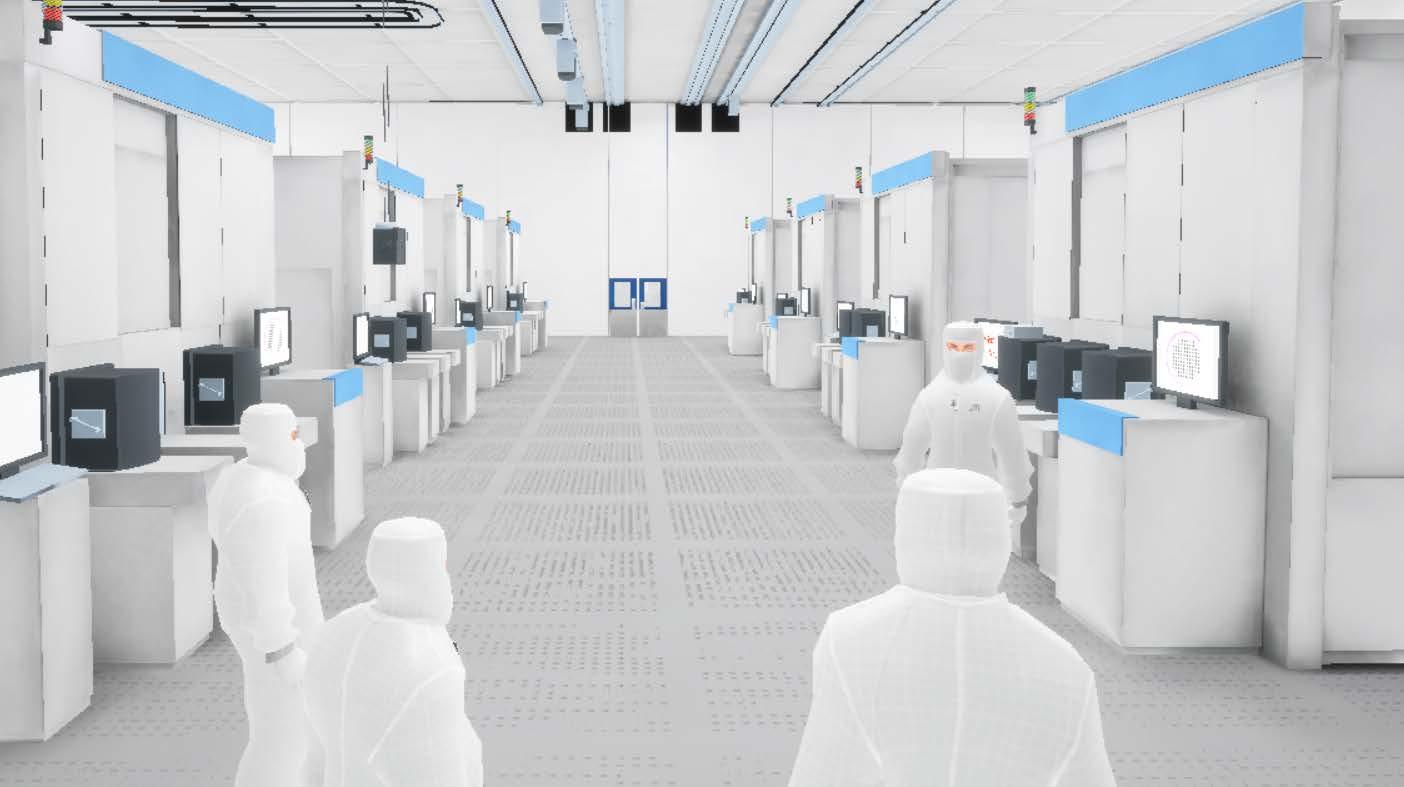
Madelyn Stoneman ’24 helped facilitate that experience as the team’s project manager. The VTD VRLab team created a tool that provides a realistic Micron replica that can be accessed through a virtual reality (VR) headset. She designed a computergenerated layout of a Micron fabrication facility, where semiconductors are manufactured, that can be experienced on the Micron Educator Hub website.
VTD students are also working with Micron to create a computer-based version of the VR experience to ensure it is accessible to learners and institutions without VR hardware.
Stoneman helped test the virtual tool at several Idaho career and technical fairs, including Hackfort in Boise, where local high school students used VR headsets to enter the virtual Micron facility and ask questions about the company’s careers.
“Once in the meeting space, participants can choose between two immersive modules,” Stoneman said.
The Dynamic Random-Access Memory (DRAM) experience puts participants at the nanometer scale inside a semiconductor memory array so they can see how data is stored within DRAM cells. A second module introduces the equipment technician role, showing learners how to dress before entering a state-of-the-art cleanroom and outlining key responsibilities and tasks performed in Micron’s fabrication environment.
Virtual Micron tours offer two advantages for students exploring opportunities with the company. First, the virtual space may feel familiar to them because it was built with gaming software that many tech-savvy students already feel comfortable with. Second, the platform can showcase parts of the company that aren’t accessible on a live tour.

“An example would be the cleanroom where you have to use special suits and where the floor has small filtering holes in it to keep the environment dust free,” Tverdy said. “It’s not really feasible to give tours through there, but we’ve created that room virtually where they can get that experience. We’ve even got the holes in the virtual floor.”
According to Tverdy, experiencing the Micron virtual tour through a headset gives students an impression that a website can’t match.
“I used a VR headset a lot for virtual meetings during COVID-19,” she said. “I found it helped me concentrate more, and I had less distraction. I think, because you are immersed in that world, it’s a much more memorable experience for the user.”
Firefighting techniques are usually perfected in the field, but Yurkiewicz thinks the VTD VRLab project could change that.
Over the past year, Yurkiewicz and the VTD team built virtual forests with different kinds of trees, brush and terrain. It’s the foundation for a tool he envisions will give firefighters new ways to train for wildfires without moving crews to and from multiple field sites.
“We’re creating different environments,” he said. “Different trees, different vegetation structure, what kind of canopy you have and how those environments might react to fire. And because it’s virtual, it takes travel out of the equation. You could have someone from Southern California learning about the environment in southern Florida.”
Next, the team will introduce fire to the forests, turning the classroom simulation into a training exercise.
“Introducing fire to the simulation is one of the biggest challenges,” Howard said. “Getting it to burn in a way that looks natural is tricky. A lot of trees burn from the top down instead of coming up from the brush, so getting all of those aspects into a digital space requires a lot of research.”
As the project develops, Yurkiewicz anticipates that the tool will help users understand different forest settings and learn how to fight fires more effectively in those conditions.
“We want to put our personnel in situations where they can understand these environments, learn about fire patterns and feel OK about making mistakes because you aren’t losing a structure like in a prescribed burn,” he said. “We think using virtual reality for knowledge and skill transfer and getting our folks more comfortable doing things in a simulated environment will be very beneficial for the wildland fire community.”
DEAR VANDALS,
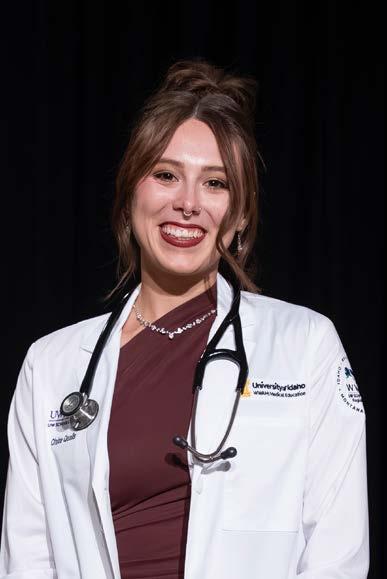
I am literally one-eighth of a doctor because of the Brave. Bold. Unstoppable. campaign.
The scholarships I received as an undergraduate gave me the freedom to work as a local EMT, seeing health care where it matters most — on the ground, in moments of urgency and in my own community.
When I faced a health challenge of my own, my professors helped me stay on track. I didn’t fall behind; I was lifted up. That’s what it means to be part of the Vandal Family.
These experiences shaped the doctor I’m becoming.
To me, this campaign has been about making sure students are seen as individuals, supported through challenges and empowered to become who they’re meant to be.
Thank you for believing in students like me.
Claire Qualls ’25, first-year Idaho WWAMI medical student
Donors from 50 STATES and 43 COUNTRIES gave boldly
$120 MILLION raised for facilities and campus enhancements
28 BUILDINGS, labs and learning spaces constructed or enhanced
19,685 ALUMNI made at least one gift

$264.5 MILLION for research, faculty and academics
17 NEW endowed faculty positions CARNEGIE R1 premiere research institution designation achieved 86% OF ALL GIFTS made were $500 or less 63% were $100 or less
DEAR VANDALS,
Throughout my career, I’ve done applied research in potatoes and onions, working side by side with growers, processors and industry partners.
As Idaho’s land-grant university, our responsibility is to deliver unbiased, applied research that solves real problems for the people who grow our food, steward our land and power our economy. This kind of impact doesn’t happen in isolation. It happens through partnerships.
Industries partner with U of I to augment their own expertise, sustain key research programs and educate students who are ready to lead on day one.
To me, this campaign was made for Idaho because it speaks to why U of I exists — to be brave in tackling complex challenges, bold in partnering for impact and unstoppable in our commitment to Idaho’s future.
Mike Thornton ’90, retired professor of plant sciences
U of I invests in housing upgrades to meet expectations of today’s students
By Jodi Walker

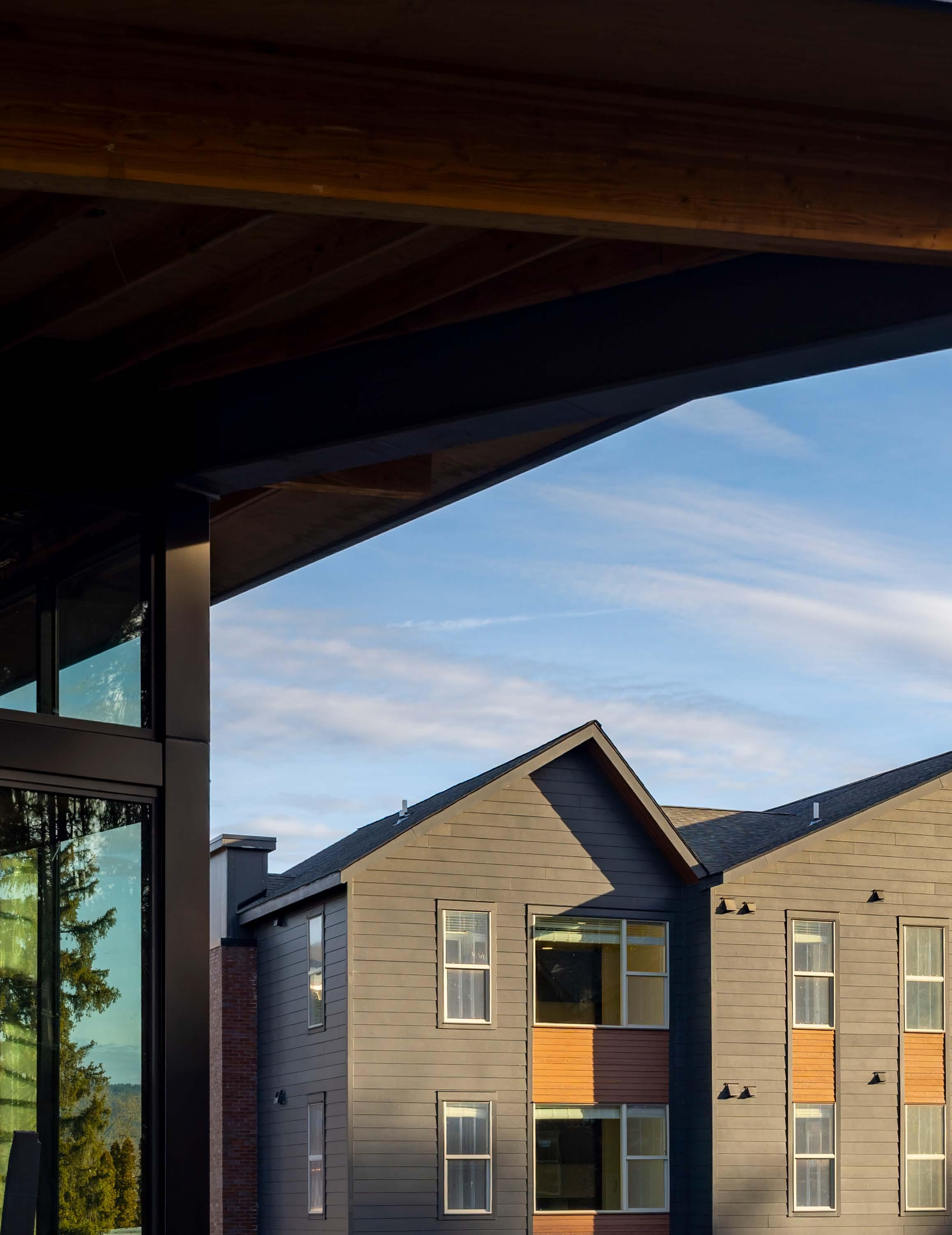
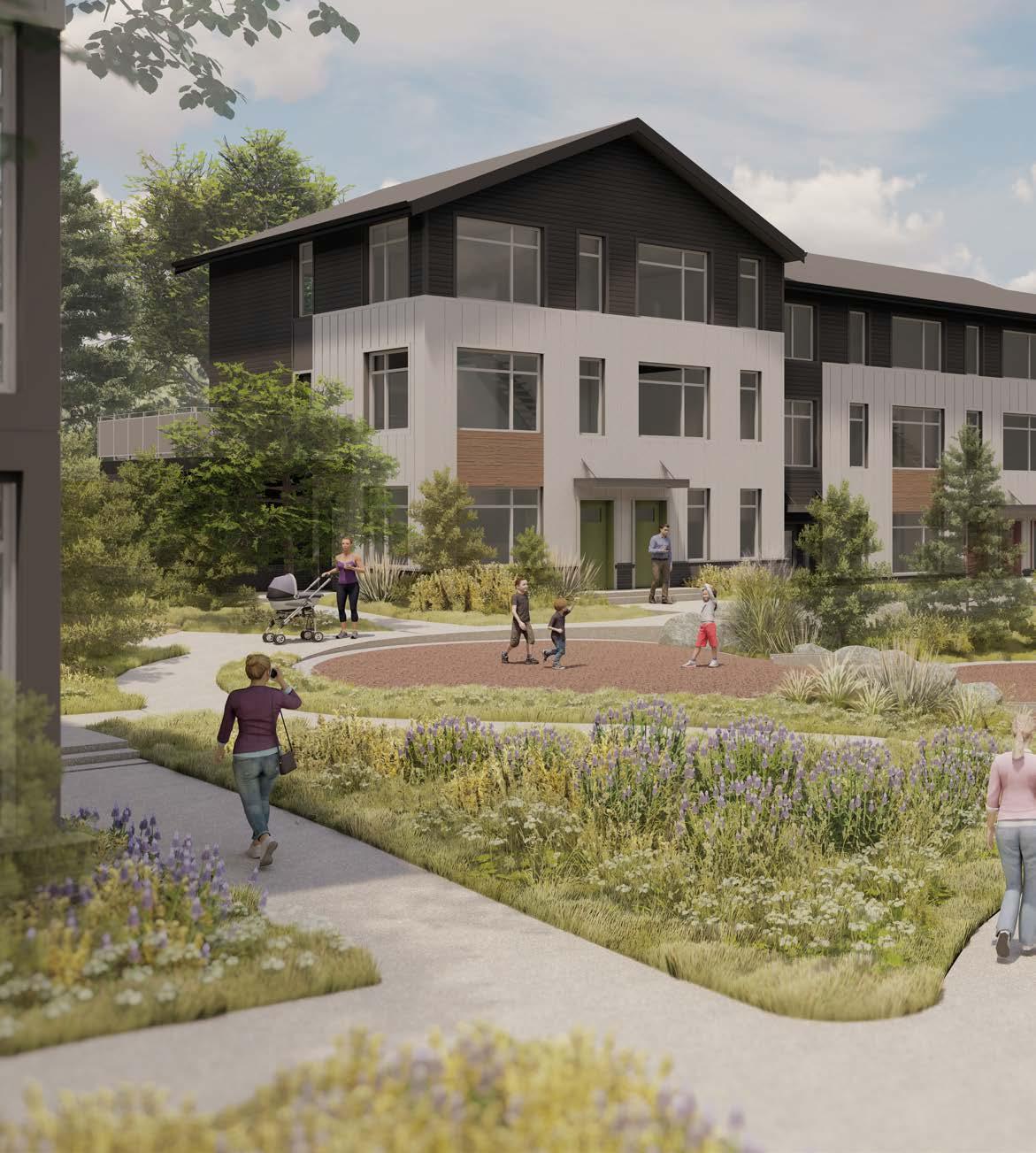
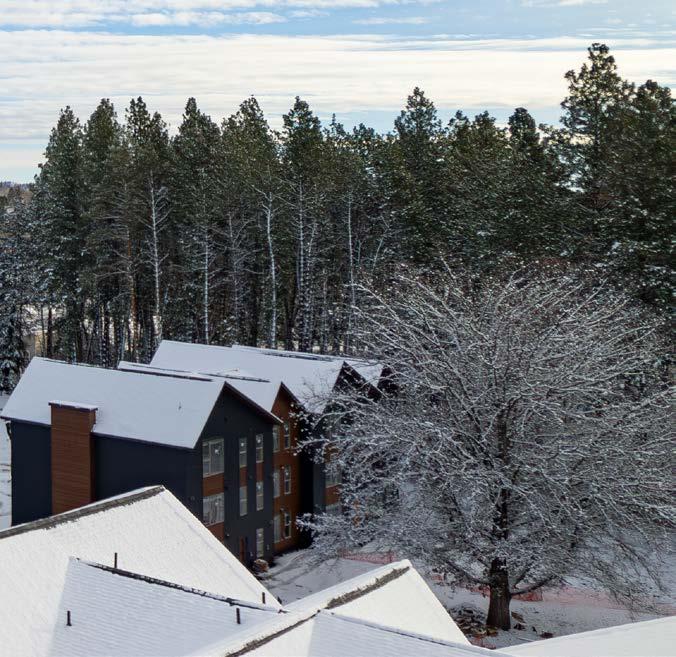
Militar y housing transformed into student housing in 1970 aimed to meet the short-term needs for University of Idaho graduate students and their families. That short-term answer served the university and its students for more than 50 years until they were razed last year, and modern, vibrant graduate student housing sprouted in the same location. South Hill, when completed, brings 120 units and 188 rooms to campus.
“The South Hill housing lasted far beyond its expected life,” said Erik Elordi, assistant vice president for campus services. “But now we are jumping feet first into an incredible new era of housing at U of I — one that we anticipate will not only attract students but also provide them with 21st-century amenities they deserve.”
Why does this matter? In early 2025, U of I earned Carnegie Research 1 designation, elevating it to the top 4% of research universities in the country. This requires and attracts more graduate students to participate in groundbreaking research and innovative solutions that make U of I a leader. The muchneeded space will fill with students in Fall 2026.
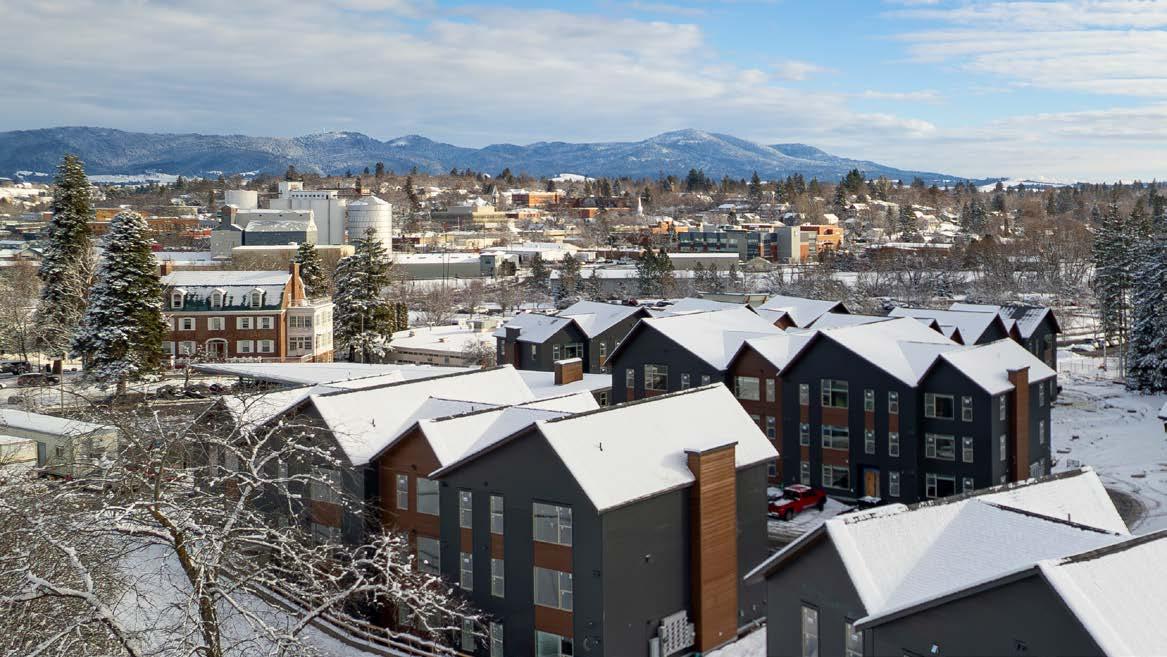
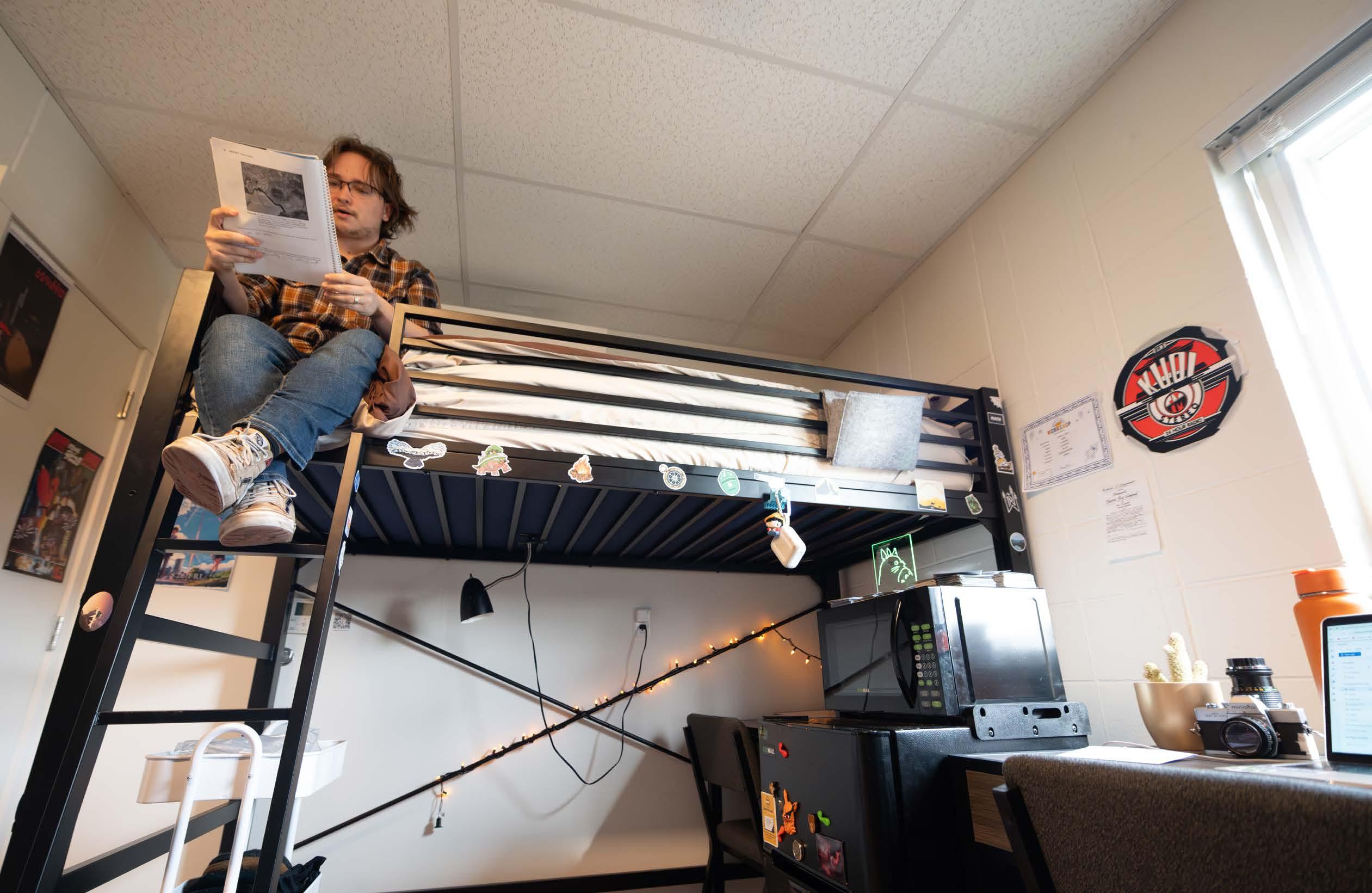
Meanwhile, across campus, the 1960s-era undergraduate residence halls are getting updates and upgrades, too — including the modern amenity of air conditioning. The top three floors of Theophilus Tower welcomed first-year students in Fall 2025. Students are enjoying the Wallace Complex upgrades this spring. Both projects continue with completion expected in Summer 2027. Residence hall capacity will increase by 36 beds.
“Research shows that students who live on campus during their first year perform better,” Elordi said. “They have, on average, higher GPAs as well as better retention and graduation rates. Everything we do at U of I is with student success in mind. This project is no different.”
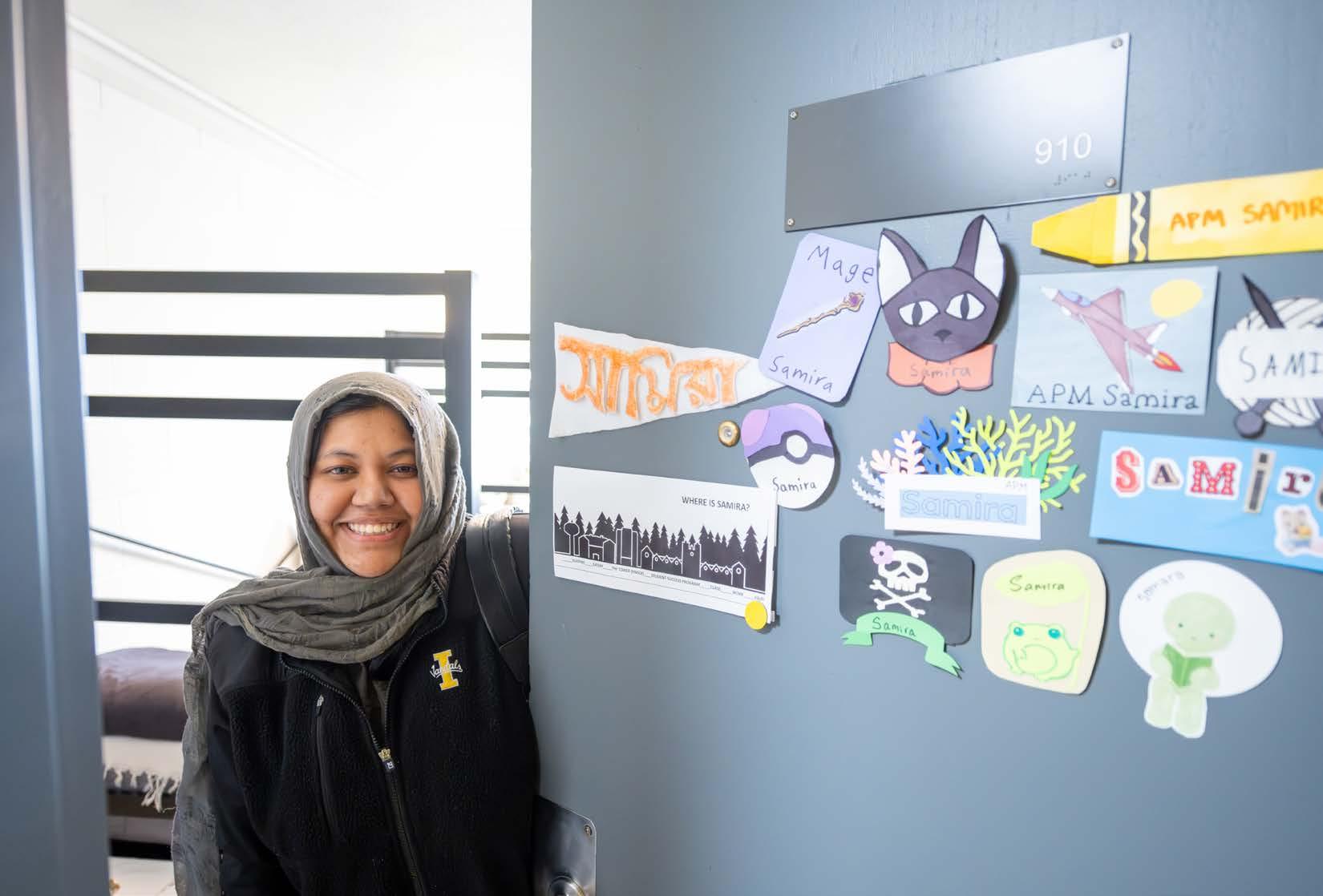
For senior Connor Blum, living on campus helped drive his success as a double major in biochemistry and physics.

“I often dump most of my time into homework and studying, so finding time is difficult,” he said. “Having the convenience of the proximity to classes, The Eatery and the Rec Center has been a great point in my college experience."
After the Boise native’s successful first year, he saw the value of on-campus housing. He was hired as a residence hall assistant, helping pay for his housing and food so he could excel in the classroom.
“I am excited to see the investment in our living and working spaces,” he said.
For Elordi, a Vandal alum from Caldwell, the project brings him full circle. He thrived in U of I’s Housing and Residence Life, serving as a resident advisor in the same halls now getting facelifts.
“I have led projects like this before,” he said, “but to do this at my alma mater and know that it is a legacy project that will serve our students long after I am gone is incredibly powerful.”
Story by Ralph Bartholdt
Photos by Anthony Locatelli
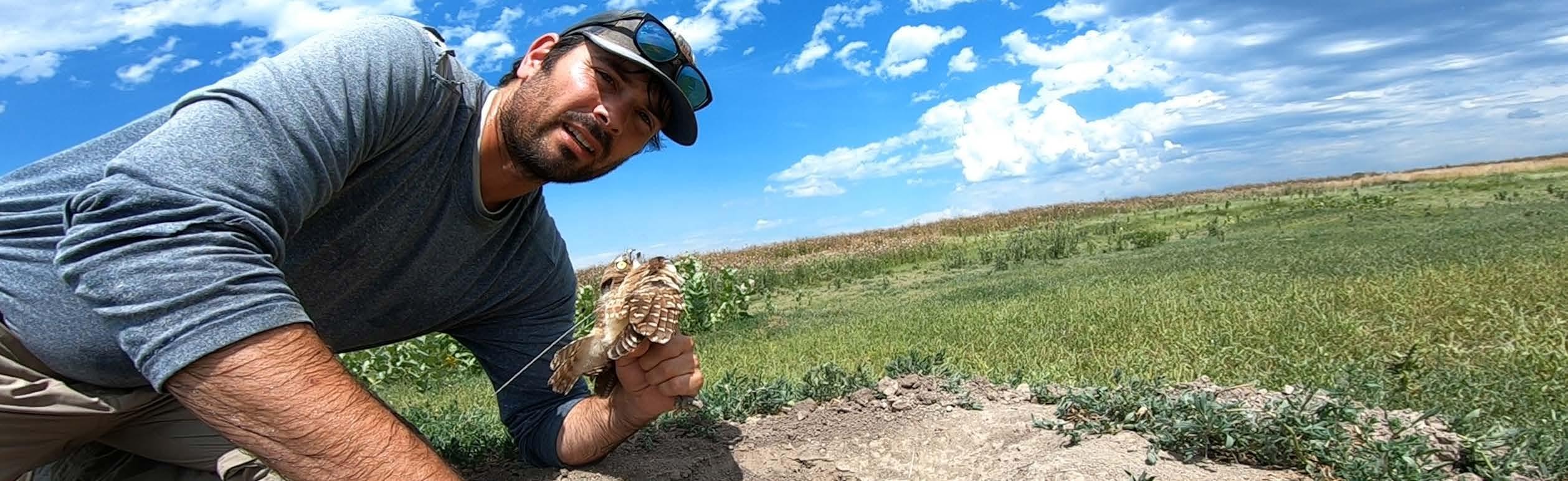
At dusk on a lonely South Dakota byway, Anthony Locatelli saw the flit of a bird’s wing at the edge of his headlights. He pulled his pickup over to the road’s edge, got out and — after the engine quit and night noises resumed in the vast Western plains — set up a speaker and played a recording of an owl call. There was a reply; one Locatelli knew well.
The return chirp came from a Western burrowing owl, likely perched out of sight on a rock or fence post in the looming darkness. The U of I doctoral student hadn’t logged this owl among those living in the region.
Locatelli noted the encounter and planned to return the next morning to spot the owl, capture it and fit it with a radio collar.
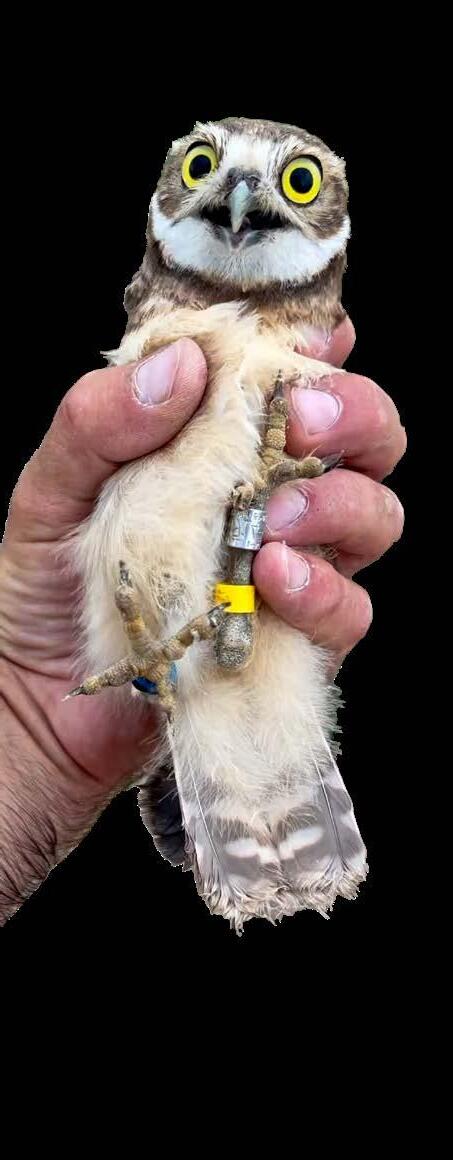
As part of his doctoral research in the Idaho Cooperative Fish and Wildlife Research Unit under Professor Courtney Conway, Locatelli has crisscrossed the West — from the Southwest to the Oregon high desert and east to the Dakotas — studying burrowing owls.
Western burrowing owls have vanished from much of their historic range, and their numbers are diminishing, Locatelli said.
Burrowing owl populations often decline when grasslands are converted into farmland or urban areas, and when there are fewer burrowing mammals to create the underground nests they rely on.
Named for refurbishing abandoned dens of animals such as skunks, gophers, ground squirrels and even tortoises,
burrowing owls are well studied during breeding, but little is known about their ecology afterward.
Locatelli’s research explores why some burrowing owls move to a distinct post-breeding range for about 10 weeks before fall migration, while others do not.
He is one of several researchers in western North America who have attached satellite transmitters to 280 burrowing owls in the U.S. and Canada over the past 11 years.
“It enables us to document movements and habitat selection of burrowing owls after they leave the breeding grounds,” Locatelli said.
During the summer, he drives thousands of miles crisscrossing the Western plains from the Dakotas to Oregon and south almost to Mexico to catch, watch and collect data on burrowing owls.
“Driving a lot of miles on these remote backroads is just something you do as a wildlife biologist; it’s kind of cool,” he said.
Locatelli locates owl dens and sets a live trap inside with a recording that mimics another owl. When an owl enters to confront the perceived rival, it’s caught in the trap.
The transmitters he attaches allow researchers to track the owls’ daily survival throughout their annual cycle, including migration and seasonal ranges.
He aims to detail post-breeding movements of migrating burrowing owls and document the food and habitat resources they select during migration.
All these factors affect the bird’s survival, he said.
“The results of this project will help ensure management efforts that target burrowing owls do not neglect to consider post-breeding and migration life stages where knowledge is currently lacking,” Locatelli said.
A
U of
I-NIC partnership is making higher education more accessible, affordable and attainable for North Idaho
From balancing trays to balancing textbooks, Michael Habermann walked the floor of many North Idaho restaurants before earning his college degree.
Habermann worked everywhere from The Boathouse on Hayden Lake to Terraza Waterfront by DeLeon’s on the Spokane River, spending years after high school waiting tables to pay for college.
When he enrolled at North Idaho College (NIC) in Coeur d’Alene, he wasn’t just starting classes — he was booting up a new future.
“I always had a knack for computers and knew I would attend North Idaho College and then transfer to the University of Idaho program,” said Habermann, a homeschooled student who, as a teenager,
loved playing video games and competing in robotics competitions nationwide.
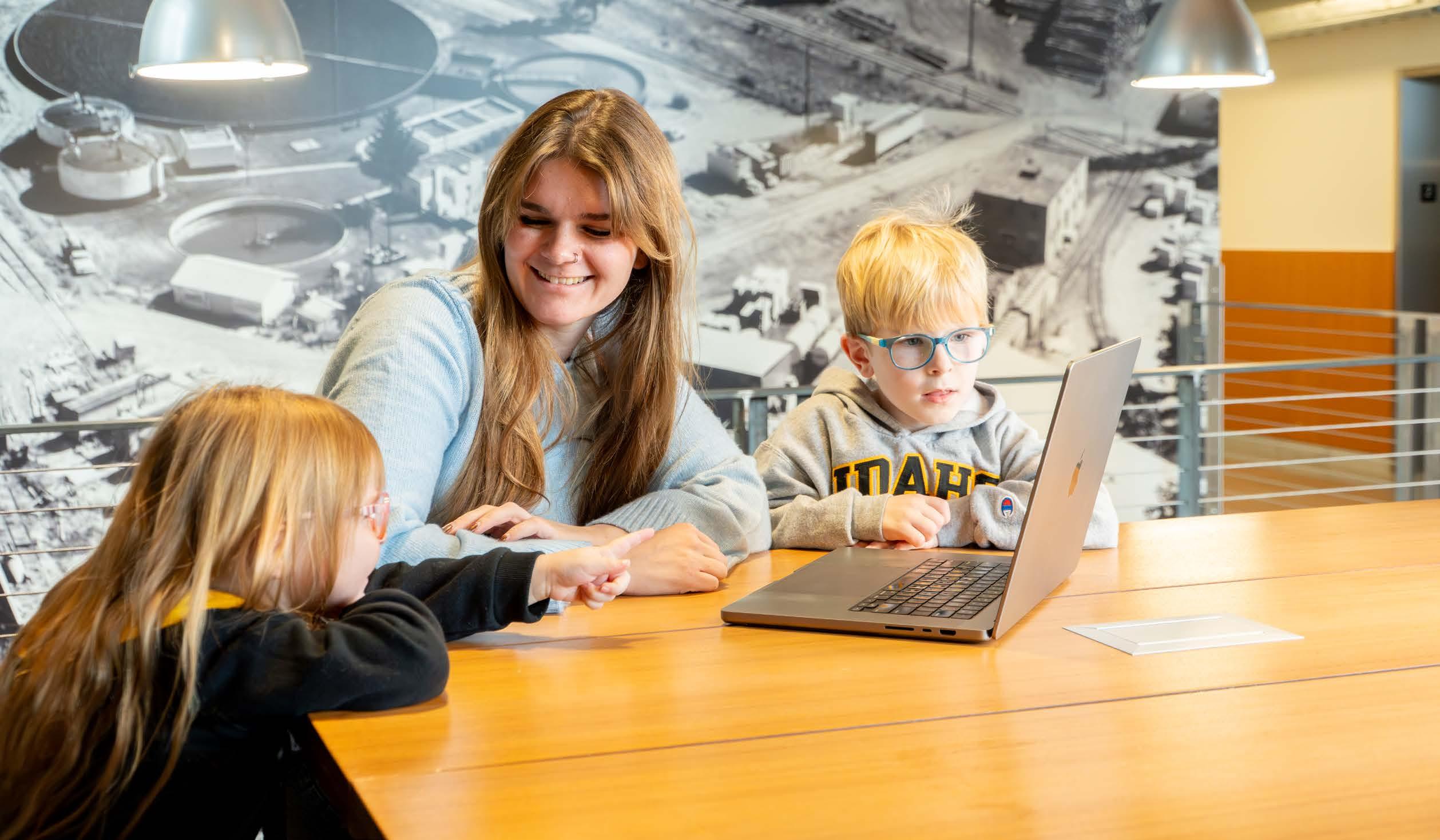
Habermann is one of many students who benefit each year from a long-standing partnership between NIC and U of I that allows students to finish prerequisites at NIC and complete their bachelor’s at U of I.
“I saved a lot of money going to a community college and knew all my classes would transfer seamlessly,” Habermann said.
He didn’t even have to leave town to attend U of I: The university houses a computer science and robotics program on the NIC campus.
“I still live at home,” he said. “It’s another cost-saving benefit of earning a bachelor’s at the U of I Coeur d’Alene campus.”
Ambur Robbins stays at home, too — in Bonners Ferry — while earning a U of I degree.
Unlike Habermann, Robbins lives in the home where she raised her family and manages a mortgage. She attended NIC as a nontraditional student before moving into U of I’s early childhood education and special education programs, taught at the U of I Coeur d’Alene Harbor Center and online.
“Being able to attend NIC and then transition to U of I, basically on the same campus, was a real blessing,” Robbins said.
Robbins, set to graduate this spring, makes 90-minute trips from Bonners Ferry to Coeur d’Alene for classes, sometimes through tumultuous winter weather.
“I had such quality educational experiences at both schools that the drive was always worth it,” she said.
As the Panhandle’s only community college, preparing students for their higher education goals is central to NIC’s mission.
“Our partnership with University of Idaho gives North Idaho students more choices and fewer barriers,” NIC President Nick Swayne said. “Together, we’ve built programs that make it possible for students to start strong in Coeur d’Alene and graduate with a four-year degree or beyond without leaving their community.”
Andrew Fields, CEO of U of I Coeur d’Alene, said when the idea of forming an education corridor in Coeur d’Alene was first proposed two decades ago, it was the perfect opportunity to serve North Idaho’s collegebound community.
“From the beginning, it was important for U of I to be part of this effort so students could find clear, local pathways to high-quality education and meaningful careers,” Fields said. “These partnerships let us meet students where they are and support the workforce needs of this region.”
The college offers cooperative pathways to bachelor’s degrees in computer science, geoengineering, education and liberal arts. Collaboration between
U of I, NIC and hospitals statewide adds innovative nursing opportunities that improve outcomes for nursing students, increase cost efficiency and expand their career options.
“This collaboration strengthens the region’s workforce, fuels economic growth and ensures educational opportunities remain within reach for North Idaho students,” Swayne said.
Becky Byers, associate director of admissions at U of I Coeur d’Alene, once transferred from NIC to U of I herself and knows how important a smooth transition is.
“I understand how confusing the transfer process might be without on-site support,” Byers said. She partners with the NIC advising team to ensure students’ plans align with U of I degree requirements, giving her early opportunities to talk with them about goals, how their credits will transfer and what steps they’ll need to take to enroll at U of I, Byers said.
“It’s extremely valuable to have those early discussions on the NIC campus, as it takes away some of the guesswork about the transfer process,” Byers said. “It’s my goal to walk NIC students through the transfer process so they feel excited and empowered to take their next steps at NIC and U of I.”
At first, Jasmine Martinez — a Rathdrum Army veteran and mother of two — planned to become a paralegal. But after completing NIC’s paralegal program, she realized she wanted to advance her education and began pursuing a history degree at U of I as a step toward law school.
Now, she juggles a full slate of online courses while caring for her two children and is on track to graduate in Fall 2026.
“I was really nervous about the transition process from community college to university, but with the help of advisors at NIC and U of I, it was very easy,”
Martinez said. “It was so easy that it almost felt like I didn’t do anything. They just did it for me, and all my courses transferred smoothly.”
Martinez knows her path is ambitious — but fully possible.
“I just woke up one morning and decided I wanted to go to law school,” she said. “I am fortunate to have two schools nearby that are helping me to do that.”
Strong Idaho workforce demand is evident in health care, K-12 education and technology fields. Here’s a look at annual employment projections from the Idaho Department of Labor for three popular areas of study for students who attend North Idaho College and the University of Idaho Coeur d’Alene.
Projected annual openings
COMPUTER OCCUPATIONS (programing, IT security and network architects)
897
TEACHERS (preschool through secondary)
1,711
Projected growth over the next 10 years for popular areas of study REGISTERED NURSES
1,226
Computer and mathematical occupations are expected to add 3,000-plus jobs in Idaho between 2022 and 2032 for an almost 18% increase in demand.
Health care practitioners and technical occupations will add almost 11,000 jobs over the next decade, a 23% increase.
Education, training and library occupations are expected to add 7,600 jobs, a 16.4% increase.
Source: Idaho Department of Labor
Story by Ralph Bartholdt
University of Idaho has launched the Forest Innovations Institute (FII), an interdisciplinary research hub dedicated to advancing forestry science, management and technology. Its mission is to help public and private landowners and industry partners apply frontline research to address 21st-century forestry challenges, said Dennis Becker, dean of the College of Natural Resources.
Research topics include tree physiology and genetics, fire modeling, silviculture, forest pests and pathogens, harvest operations and the economics and policy of forest management.
“FII will engage broadly with public and private forest landowners, industry partners, tribal governments, nonprofits and other universities on a regional and even international level,” Becker said. “FII aims to ensure that forestry research is not only innovative but also grounded in real-world needs and opportunities.”
A key goal is workforce development. The institute partners with U of I faculty members and students to prepare future forestry professionals with strong scientific foundations and skills in emerging technologies. These efforts align with U of I’s strategic
priority to deliver practical solutions for Idaho’s residents and workforce.
“Through our decades-long collaboration with University of Idaho’s College of Natural Resources, our sustainable forest management initiatives have benefited from high-quality research,” said Darrin Ball, vice president of Timberlands at PotlatchDeltic, which manages more than 620,000 acres of private Idaho timberlands.
He added that because more than half of their professional staff are U of I graduates, the institute’s commitment to building an even stronger workforce is a big win for Idaho.
Dustin Miller, director of the Idaho Department of Lands, said U of I’s forest research has shaped responsible practices in Idaho for more than a century. His agency manages a million acres of endowment timberlands.
“I’m excited about the launch of the new Forest Innovations Institute — and it couldn’t come at a better time,” Miller said. “As demand for wood and wood products continues to grow, advancements in forestry research and technology are essential to maintaining a sustainable supply of wood and fiber for mills in Idaho and across the country.”
The institute will leverage expertise and infrastructure from multiple U of I research units — including labs, experimental forests and technology centers — and is accepting project proposals and collaboration inquiries.
“With increasing pressures from wildfires, pests, climate change and economic shifts, our forests face unprecedented challenges,” Becker said. “The Forest Innovations Institute represents a bold response.”
Story by Leigh Cooper
A team led by the Southwest Research Institute, including University of Idaho physics Professor Matthew Hedman, has discovered a new moon orbiting Uranus using images from NASA’s James Webb Space Telescope (JWST). The ice giant’s 29th confirmed satellite is among its smallest moons.
Scientists captured 10 long-exposure images with JWST’s Near-Infrared Camera on Feb. 2, 2025, then spent months processing and analyzing the data.


Story by Danae Lenz
University of Idaho has been nationally recognized for pioneering the use of artificial intelligence to improve research management. The Association of Public and Land-grant Universities awarded U of I the Council on Research Advances in Research Enterprise Operations Award, honoring innovative approaches that make research operations faster and more efficient.
The moon is part of a cluster of small moons on tight orbits, while five larger moons circle farther out.
“This planet system pushes us to study its moons,” said Hedman, a project co-investigator. “This is the most densely packed satellite system we’re aware of, but there’s a few places where there aren’t many moons. We wanted to know, is that just because we haven’t found them yet? Or is that because the chaotic interactions among moons have led to one not being there?”
Computer simulations suggest the smaller moons orbit so closely that gravitational tugs likely cause occasional collisions, said Hedman, who helped process JWST imagery.
“One of the things that convinced us that we had a new moon was that we saw it in all 10 pictures, and it was roughly the same brightness in all 10 pictures,” he said.
It also moved at the expected speed for Uranus’s gravity. Researchers estimate its diameter at about 6 miles.
Hedman and his graduate students will continue analyzing the images to study moon interactions and search for more satellites.
“Understanding how this moon interacts with its neighbors and whether it has a role in sculpting the planet’s rings will be two big things that we’ll want to study,” Hedman said.
The moon is unofficially named S/2025 U1 until the International Astronomical Union assigns a formal name, following Uranus’s tradition of using characters from Shakespeare and Alexander Pope.
Chris Nomura, vice president for Research and Economic Development, received the award for leading U of I’s Office of Research and Economic Development and its Artificial Intelligence and Data Science team.
“Receiving this award is really about recognizing the incredible innovation happening across our research operations,” Nomura said. “Our team is showing how AI can remove barriers, save time and help people focus on higher-value work that moves discovery forward.”
Under Nomura’s leadership, U of I created a dedicated AI and data science unit that automates tasks such as award setup, contract review and compliance reporting — processes that once took hours or days but now take minutes. The team is part of the Institute for Interdisciplinary Data Sciences, directed by Barrie Robison. Their tools, including The Vandalizer suite, dramatically reduce administrative backlogs and improve research support services.
Other initiatives include AI4RA, a $4.5 million NSFfunded collaboration to build open-source AI tools, and a partnership with Google’s AI for Education Accelerator, giving students access to advanced AI training and certifications.
“The University of Idaho’s strategic investment and foresight have positioned us at the forefront of AI innovation in higher education,” said U of I President C. Scott Green. “We’ve helped redefine what’s possible in research operation thanks to Chris Nomura’s leadership and our dedicated team.”
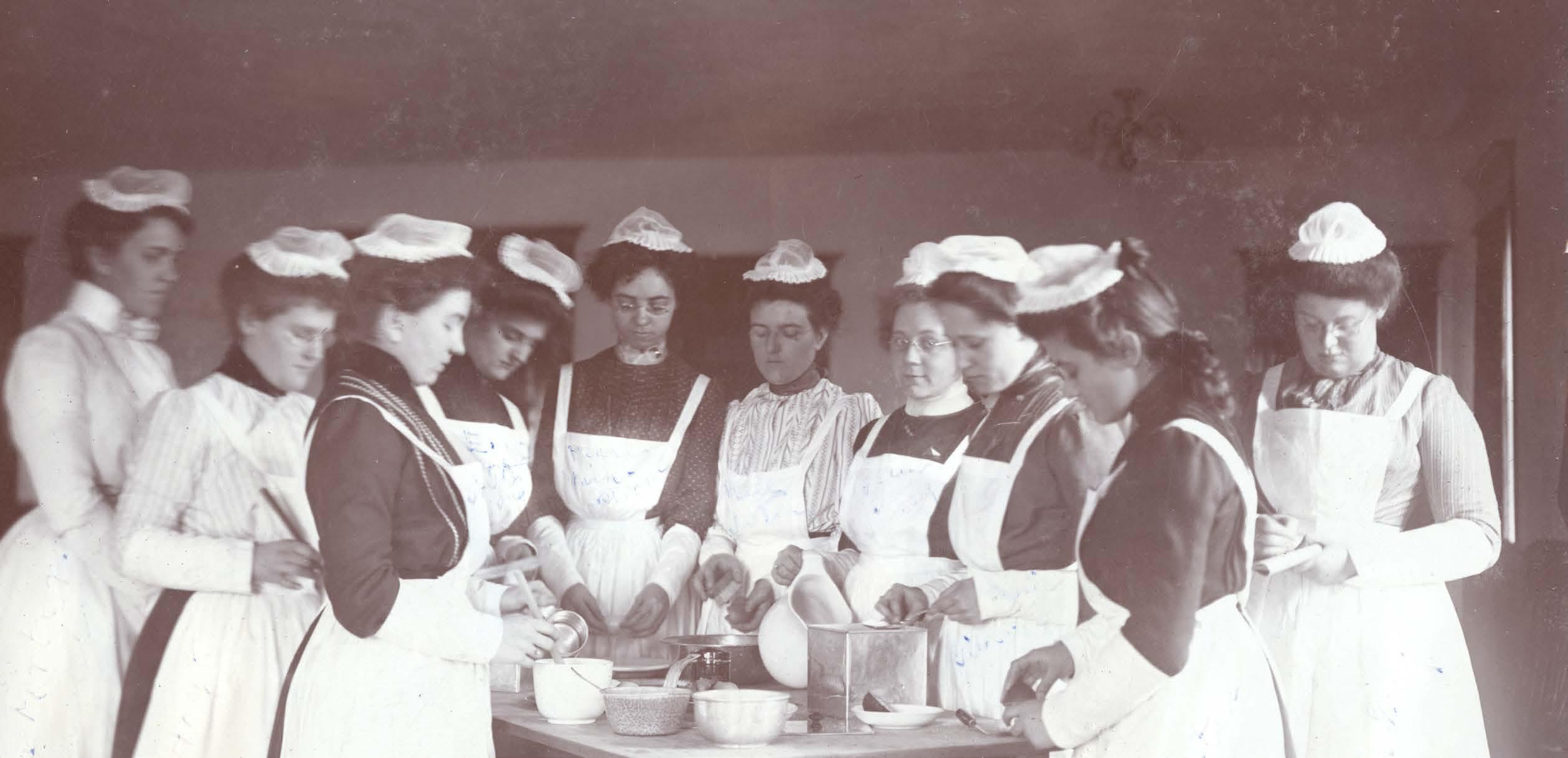
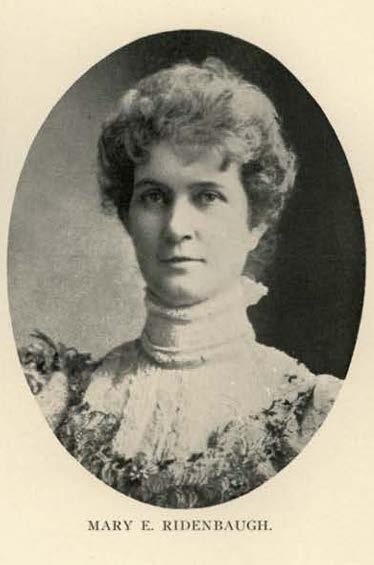
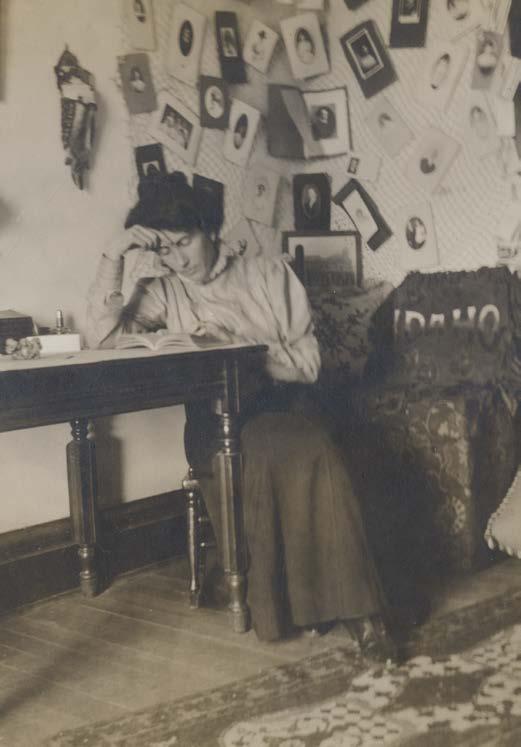
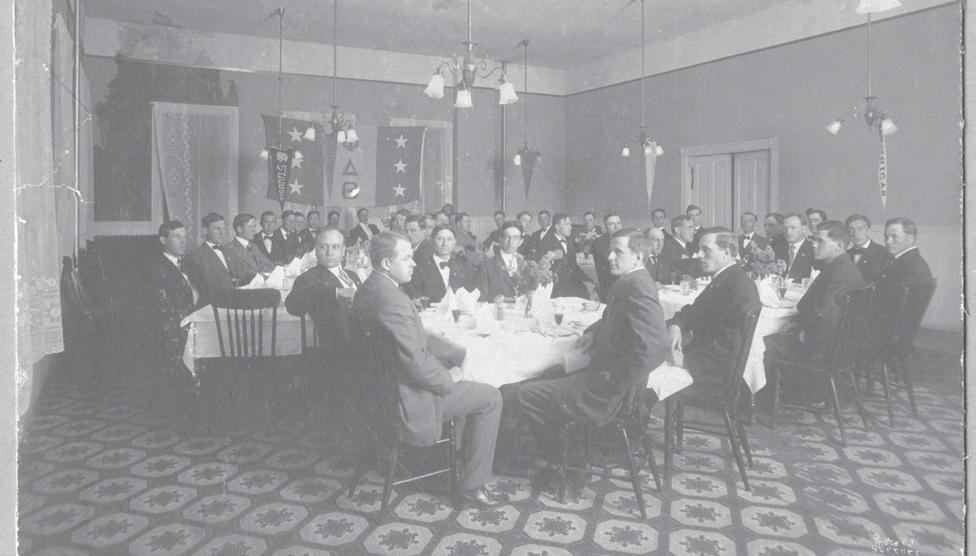
From its earliest years, University of Idaho drew young Idahoans to the rolling hills of the Palouse, offering both academic opportunity and a first taste of independence. When the university opened in 1892, the campus had only a handful of classrooms, laboratories and offices. There were no residence halls. Instead, students found rooms with local families or in boarding houses. Parents of young women, however, had serious reservations about moving their daughters in with strangers. Families expected the university to stand in for parental oversight and see that female students were properly supervised outside the classroom.
Ridenbaugh Hall, completed in 1902 as the second brick building on campus, was designed to meet that need. Its Renaissance design brought elegance to the growing university, and its women residents enjoyed single and double rooms with electric lighting and steam heat. Students had access to a library, a study room and a chaperoned social space for meeting male peers. All students and faculty members, no matter where they lived, dined there in the campus’s only dining hall. Ridenbaugh also hosted several domestic sciences classes, a popular field for women at the time.
In 1927, the hall was converted to a residence for men. In later decades, its rooms were repurposed as music rehearsal spaces, and today the College of Art and Architecture curates a student gallery on the first floor.
This is completely unique in the ag world.
At least for now, we’re the only ones doing it.
KRISTOPHER WAYNANT, ASSOCIATE PROFESSOR OF CHEMISTRY
Story by John O’Connell
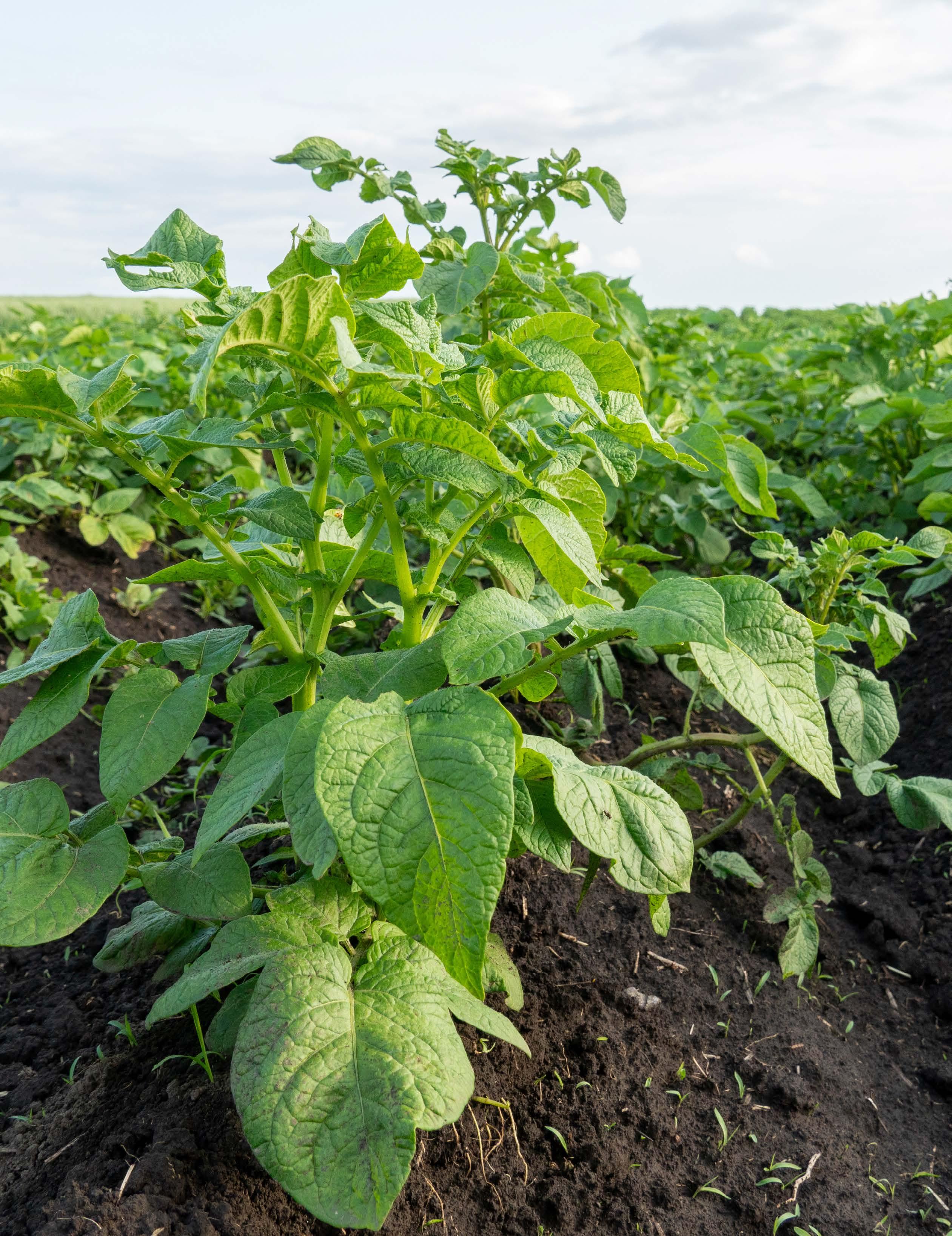
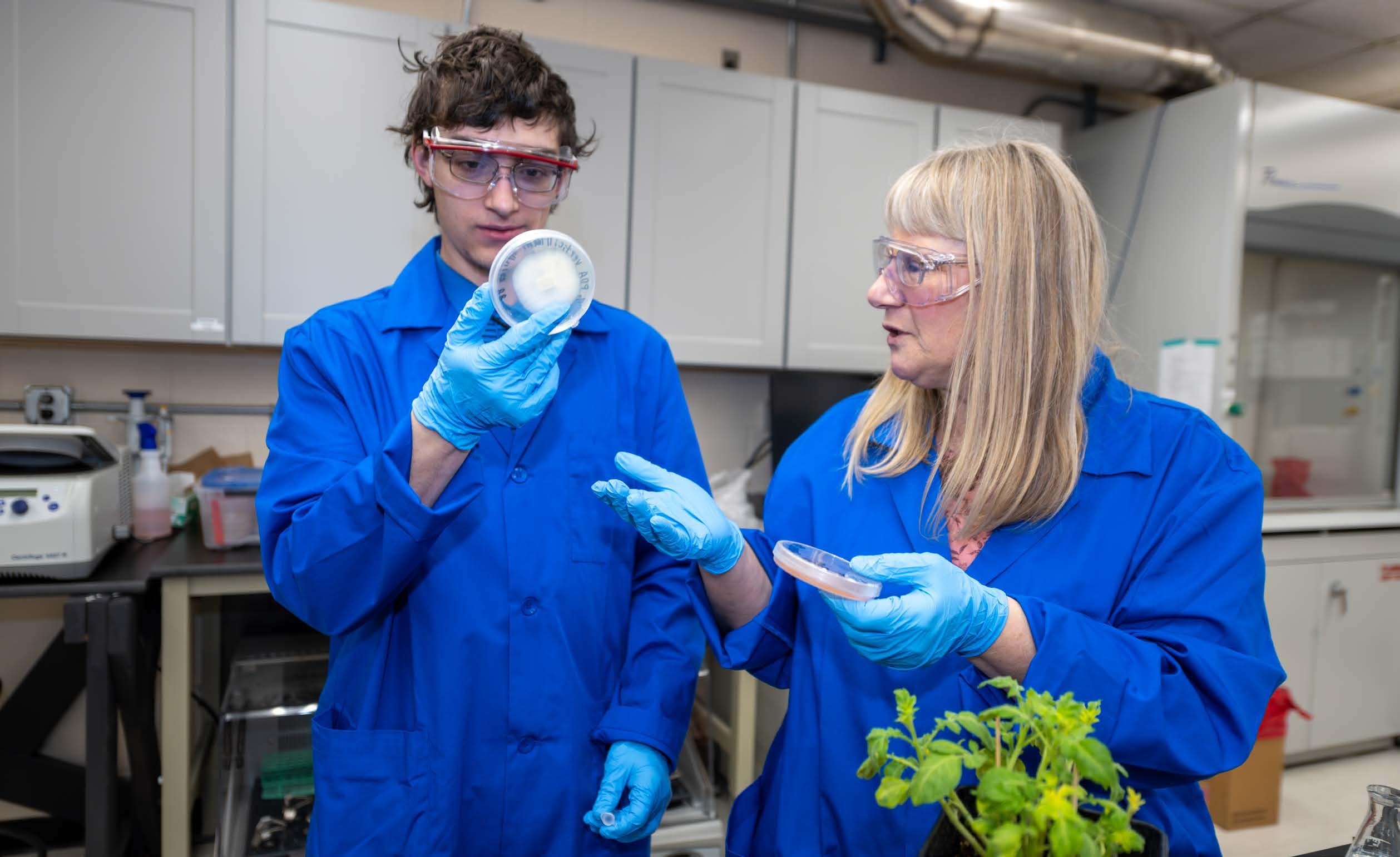
AUniversity of Idaho research team is pioneering the use of computer molecular modeling to develop new agricultural fungicides, including some that will attack crop pathogens in novel ways.
The approach is akin to methods used in designing pharmaceuticals for human health — developing fungicides by conducting experiments, running computer simulations and combining chemicals to form new compounds.
The U of I team includes seven scientists from the College of Agricultural and Life Sciences, the College of Science, and the College of Engineering, focusing initially on developing fungicides for potato production.
They have identified several compounds proven to be highly effective against major potato fungal diseases and expect their collaboration to yield new fungicides that U of I will license for chemical companies to produce.
“We’ve had a high success rate. We’ve screened fewer than 60 compounds and already have 15 that have some action,” said Brenda Schroeder, a researcher with the Department of Entomology, Plant Pathology and Nematology. “Looking at the bigger picture, this approach is adaptable to all pathogen groups in some fashion. This could be expanded past the fungi once the system is in place.”
A key strength of the project is the discovery of compounds belonging to entirely new fungicide classes with unique modes of action — targeting specific aspects of fungal biology to inhibit pathogen growth.
There are 17 fungicide groups. Overusing products from a single group without rotating modes of action can lead to chemically resistant fungi.
“When resistance pops up, there are not a whole lot of options out there,” said Marty Ytreberg, a professor with the Department of Physics and director of the Institute for Modeling Collaboration and Innovation.
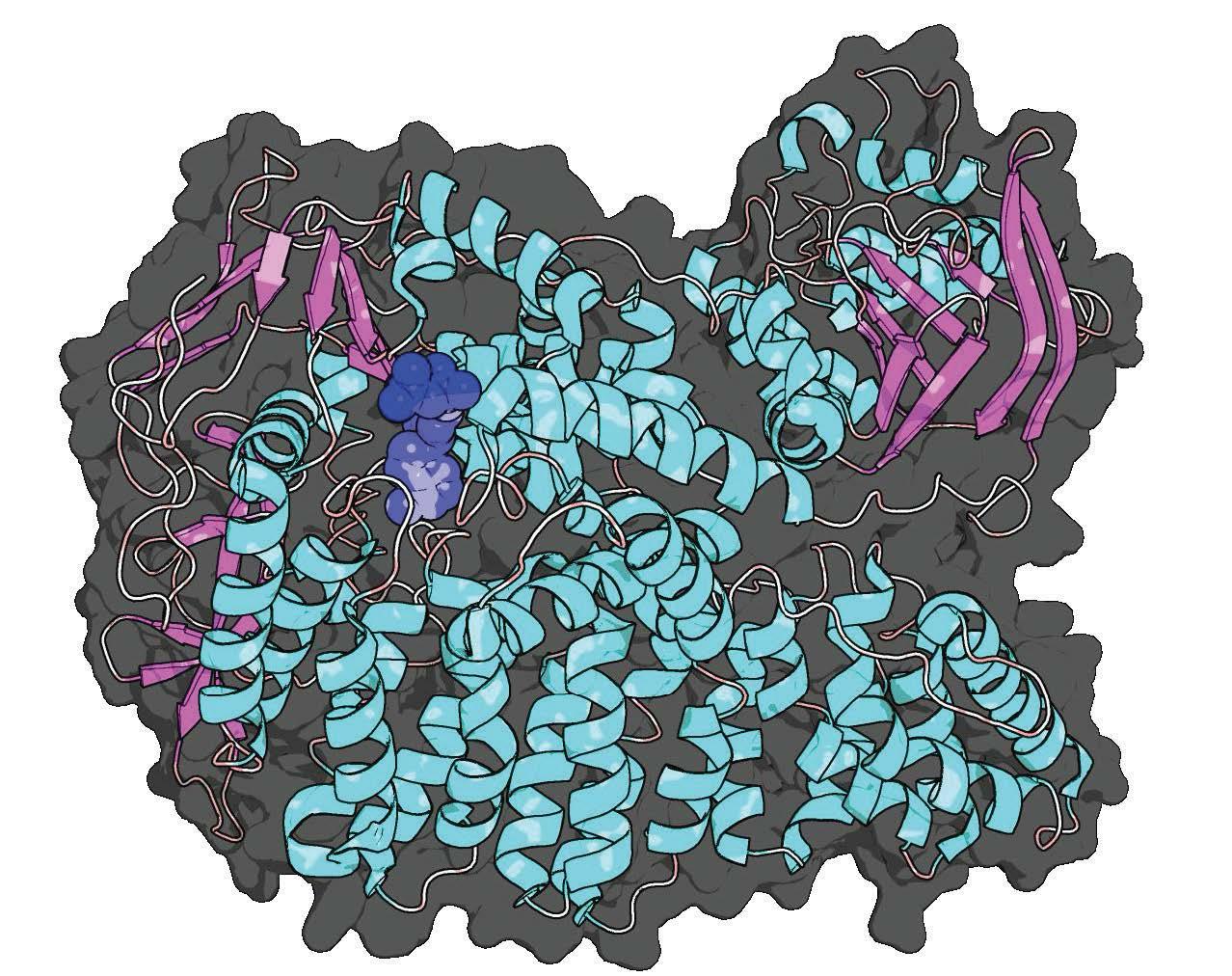
The researchers are developing compounds that target fungal proteins unused in existing fungicides, seeking to provide growers with new modes of action. Of those screened, Ytreberg anticipates three to five will eventually be commercialized, and two to three new fungicide groups will be introduced to the market.
An illustration of YEF-3, the protein researchers are targeting as they develop new fungicides for potato production.
The team prioritized targeting fungal proteins distinct from those in plants and animals to avoid unintended impacts on crops, human health or the environment.
“We’ve really only targeted a minimal number of proteins that we’ve identified in fungi as important,” said Schroeder, whose lab tests the compounds in greenhouse potato production to ensure spud growth isn’t hindered. “We have a large number of proteins that we’ve identified as important that we could potentially target, so this is just building the foundation.”
The team has identified 80 additional compounds that look promising based on modeling and await lab testing.
Once products are proven effective, Ytreberg, Jagdish Patel, with the Department of Chemical and Biological Engineering, and Kristopher Waynant, with the Department of Chemistry, explore chemical modifications to further improve the potential fungicide’s performance. Then, Schroeder and Department of Biological Sciences faculty members Klas Udekwu and Paul Rowley evaluate them yet again in trials and Matthew Bernards, with the Department of Chemical and Biological Engineering, investigates application techniques.
A major challenge is the lack of complete genomic sequences for most commercial crops. Genomic
sequencing — deciphering an organism’s DNA to reveal genetic information essential for biological functions — is critical for identifying target proteins for pesticide development.
“There are big pieces missing in the agricultural data, and when you move from potatoes to corn to wheat to onions, all of those hosts have very different genomes,” Schroeder said.
About three years ago, Ytreberg and Rowley began recruiting U of I researchers interested in drug design. After struggling to find funding for the work, they pivoted and played to U of I’s strength in agricultural science as a land-grant university.
“We put two and two together and said, ‘Wait a minute. What are we missing for conducting human research with antifungals? Well, a hospital,’” Rowley said. “Then we came to the realization that we have farm field trials. We have people doing all sorts of great work in agriculture. We have the complete package there.”
They recruited Schroeder for her expertise in fungal pathology and agriculture.
They have positioned themselves as trailblazers in crop protectant development. While major agricultural-chemical companies use computer
molecular modeling to refine products, U of I researchers aren’t aware of anyone else applying their strategy to develop compounds.
“This is completely unique in the ag world,” Waynant said. “At least for now, we’re the only ones doing it.”
The researchers first targeted four major potato diseases with an economic impact: late blight, Verticillium wilt, Fusarium dry rot and Pythium leak.
They launched the project with a one-year, $100,000 IGEM grant from the state’s Higher Education Research Council and, in fall 2025, secured a twoyear, $120,000 Specialty Crop Block Grant from U.S. Department of Agriculture’s Agricultural Marketing Service, administered by the Idaho State Department of Agriculture.
The team will use funding to screen compounds against early blight, black dot, silver scurf, Rhizoctonia, pink rot and powdery scab — diseases for which growers currently have few control options.
Royalties from licensed products are expected to be substantial, with the team estimating at least $60,000 annually per fungicide for U of I.
Chemical engineering students create biodegradable gels to tackle water pollution
Story by Ralph Bartholdt
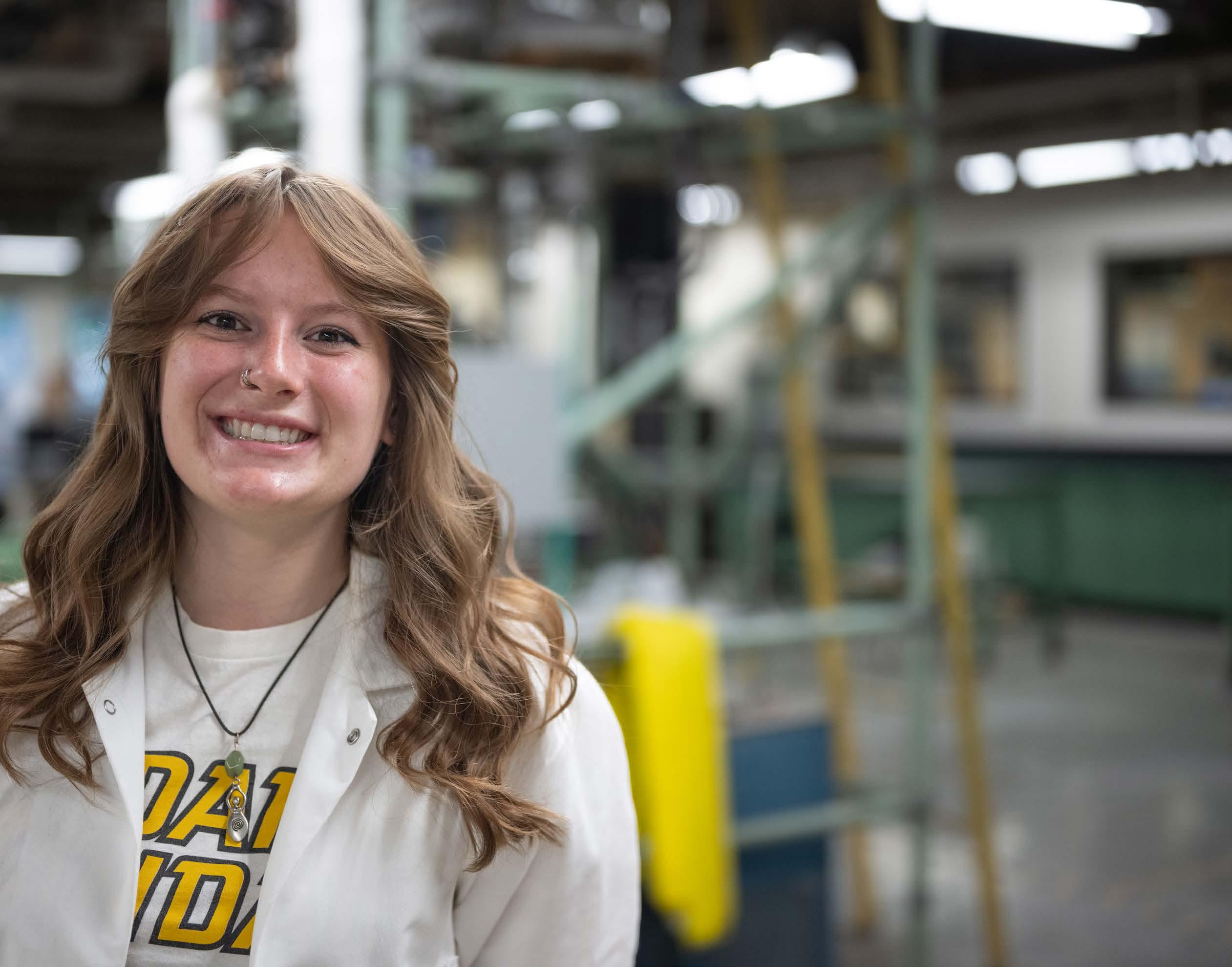
Madison Gilster grew up along the Snake River of southern Idaho, a meandering channel that carved canyons and left behind bends like giant horseshoe tracks filled with water.
The Twin Falls area — where she joined high school theater productions, edited her school newspaper and fell in love with math and science — is heavily agricultural, an industry that uses a lot of phosphorus as fertilizer.
Phosphorus can also pollute waterways, and the Snake River receives significant phosphorus runoff.
At University of Idaho, Gilster, a junior studying chemical engineering, is learning to extract
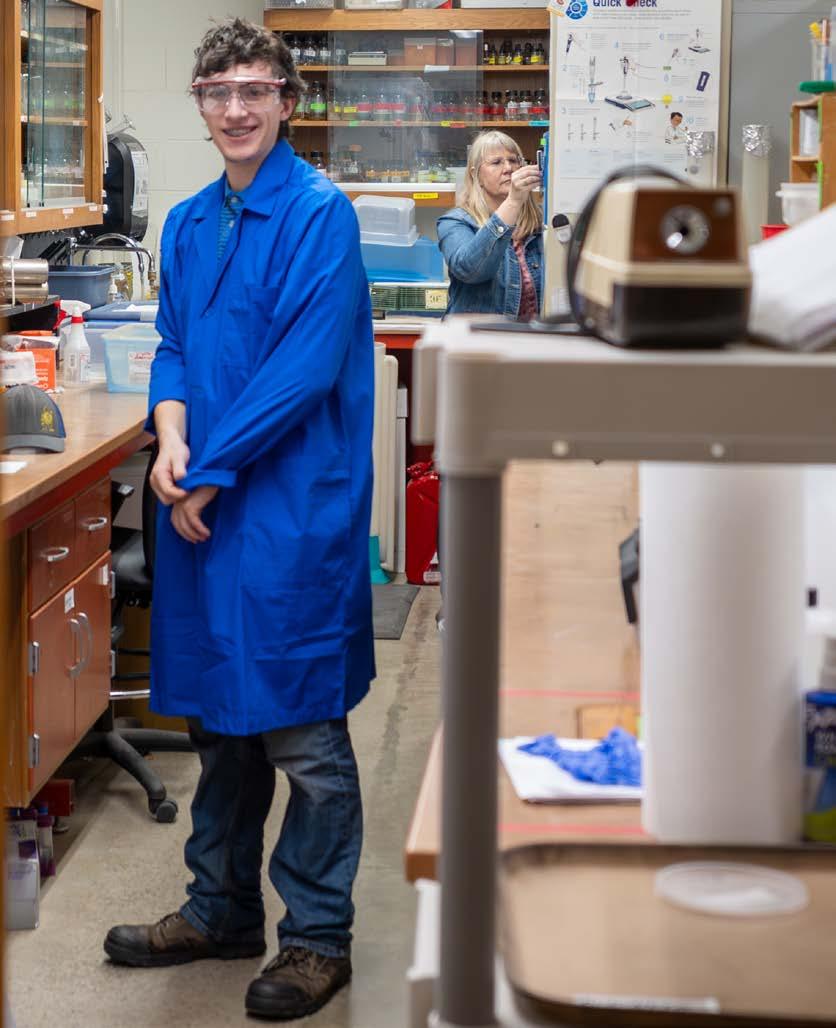
phosphorus from water to reuse it as part of a research project in the lab of Associate Professor James Moberly.
“I am really interested in sustainability, and this project looks for ways to potentially recycle environmental phosphorus,” she said.
The research focuses on creating hydrogels — a gelatinous material made of mostly water — that hold bacteria that absorb phosphorus and allow its extraction from wastewater treatment plants or natural systems such as lakes, ponds and rivers.
“Once we create a gel that picks up phosphorus, it can be removed from the water and the phosphorus can be recycled,” Gilster said.
The trick is creating gels — and the phosphorusgrabbing microorganisms that live in them — that can withstand tough environmental conditions while also remaining environmentally friendly.
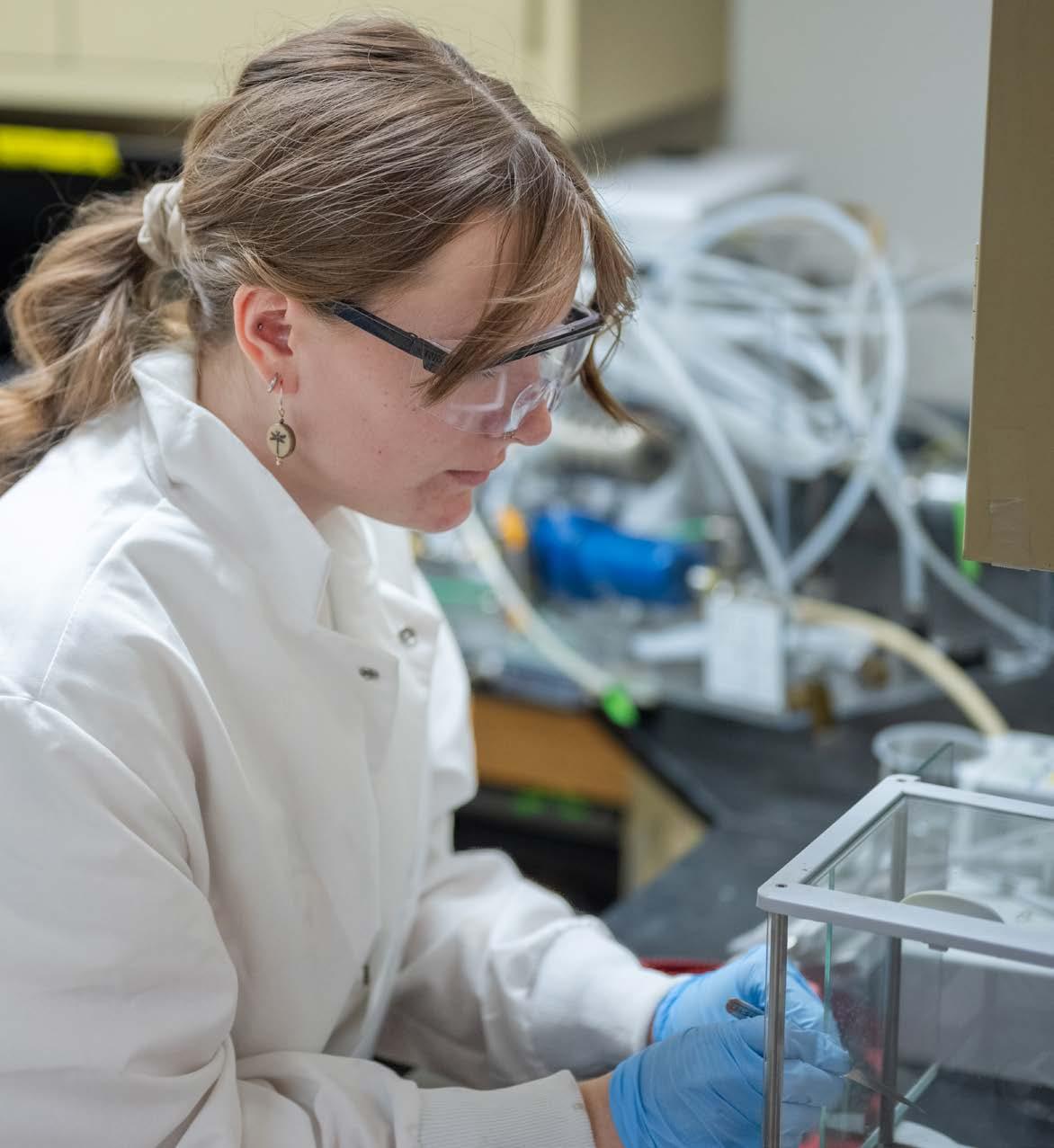
Gilster spent last summer testing biodegradable gels that support microorganisms while remaining durable in harsh conditions.
Because it’s a major nutrient that natural systems often lack, phosphorus is among the main ingredients of agricultural fertilizer. When excess phosphorus leaks into waterways, it can cause super fertilization, or eutrophication, resulting in excess algae growth. This overabundant growth can lead to depletion of oxygen from waterways, killing animals such as fish and aquatic insects. Some algae are toxic to animals and people who swim in or drink contaminated water.
Removing phosphorus from natural systems to prevent eutrophication is just one of the benefits of creating bacteria-supporting gels. Finding a sustainable way to reuse phosphorus is another benefit.
“Our innovative strategy aims to create a sustainable system for phosphorus biomining, advancing both environmental protection and resource recovery,” Moberly said.
By creating phosphorus-grabbing gels in the lab and testing their viability and stamina — whether they can capture phosphorus and withstand the rigors of their surroundings — Gilster’s work could lead to sustainable harvesting and reuse of
Our innovative strategy aims to create a sustainable system for phosphorus biomining, advancing both environmental protection and resource recovery.
JAMES MOBERLY, ASSOCIATE PROFESSOR OF CHEMICAL AND BIOLOGICAL ENGINEERING
excess phosphorus from Idaho’s waterways and wastewater plants.
Although municipal wastewater systems contain significant amounts of phosphorus, making them ideal for hydrogels, most phosphorus is lost downstream due to wastewater treatment limitations, Gilster said.
The new system developing in Moberly’s lab advances both environmental protection and resource recovery, she said.
“The information Madi collected this summer will be used to direct further research into these soft gelatinous materials,” Moberly said.
Gilster, a first-generation college student, opted to attend U of I because of its strong reputation as a STEM and research school. When she visited campus as a high school student, she was inspired by the guides running the campus tours.
“I love to talk, and I thought, I can do that,” she said. She has been a U of I tour guide for two years in addition to immersing herself in outreach such as the annual STEM Fair, Engineering Expo and the Society of Women Engineers.
“We coordinate events for kids,” she said. “I really want to get more girls involved in STEM.”
Gilster and her team of student researchers continue to design and test different biodegradable polymer hydrogels.
At U of I and across our state, philanthropic support has amplified learning and discovery. Your gifts have improved, expanded and created new facilities to serve the Gem State. These are just a few examples where generosity is making a lasting difference.
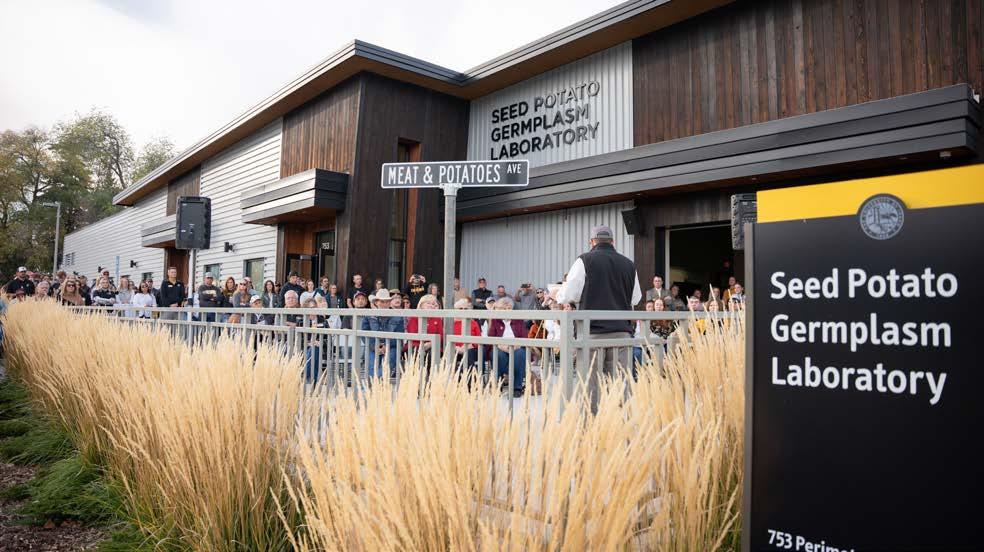
DEDICATED 2022 | MOSCOW
This state-of-the-art facility produces diseasefree, early generation plant material used to start Idaho’s potato crops. The upgraded space has modern cleanrooms, advanced propagation technology and expanded capacity for one of Idaho’s most important and iconic agricultural products.
NEW BUILDINGS DEDICATION IN PROGRESS | MCCALL
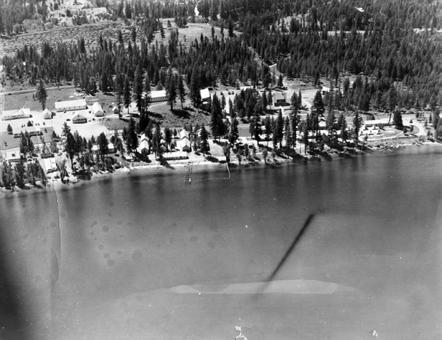
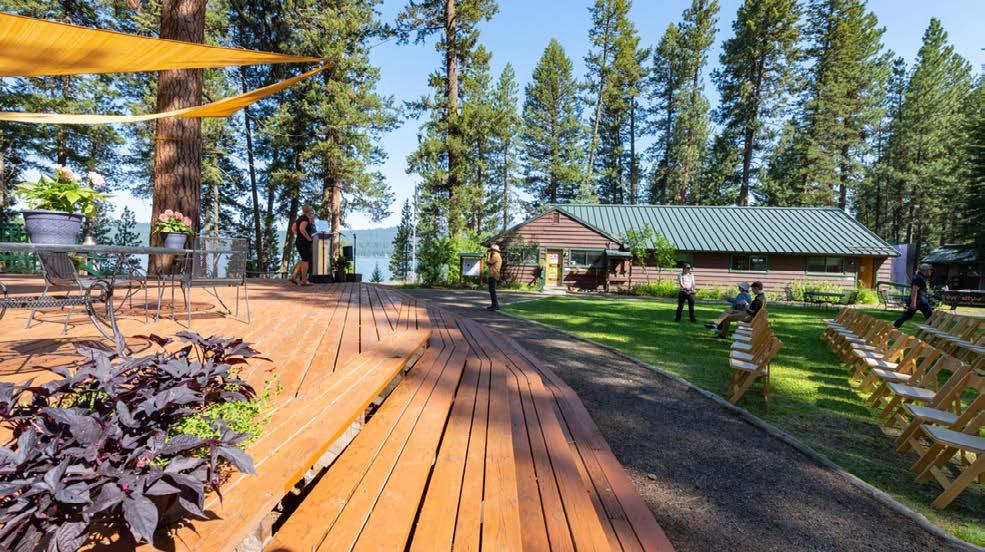
The McCall Field Campus provides immersive, field-based education in ecology, natural resources, outdoor leadership and environmental science. Ongoing improvements and new resource-smart structures strengthen its role as a statewide hub for environmental education, leadership development and research.
DEDICATED
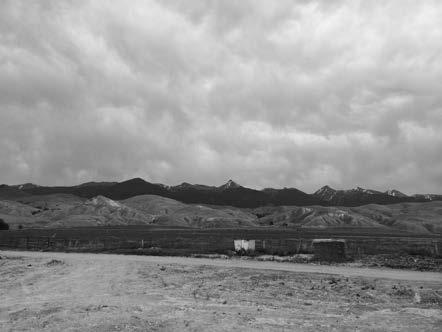
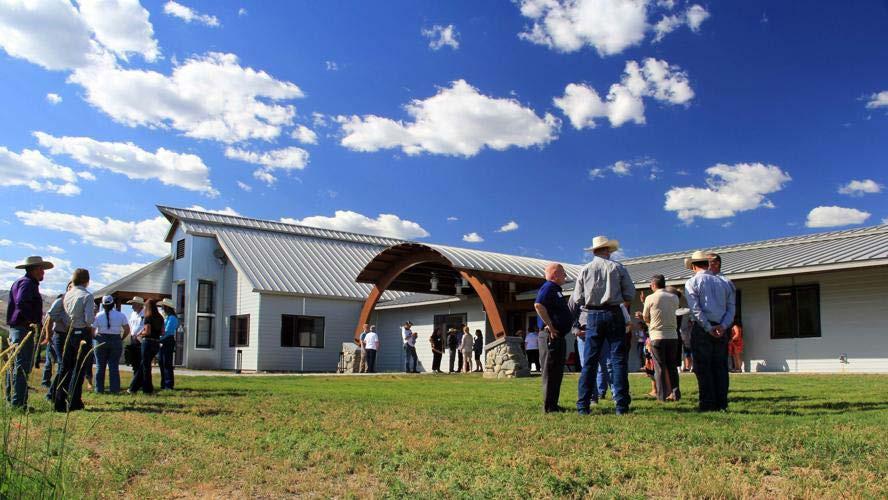
The new classroom and office building transformed the ranch into a hub for teaching, research and outreach. The center strengthens hands-on learning, applied beef cattle and forage research, and UI Extension programs serving ranchers across Idaho.

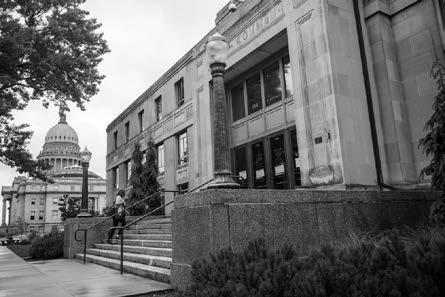
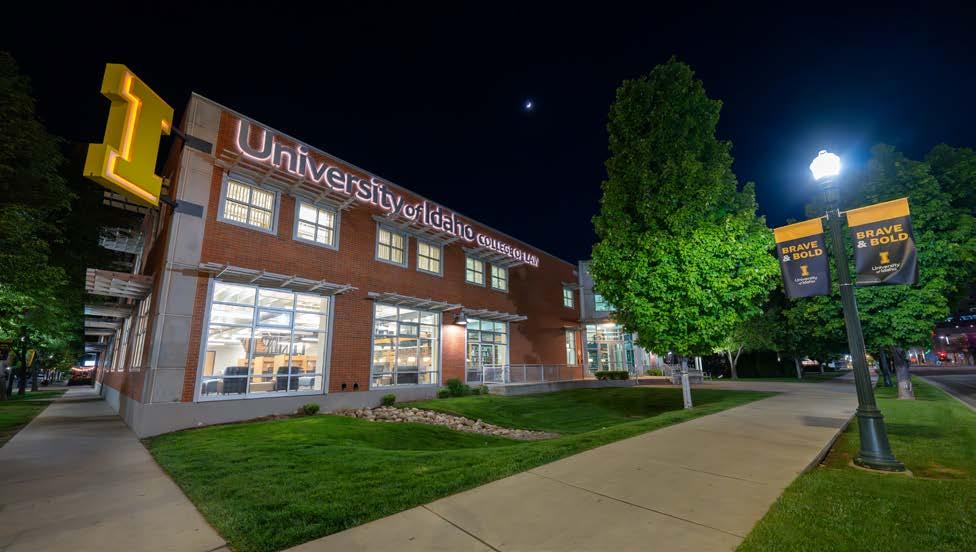
DEDICATED 2022 | BOISE
The new space at 501 W. Front St. greatly expands capacity for the College of Law Boise, providing larger classrooms, offices and a full law library. The site strengthens the university’s mission to deliver accessible legal education and serve Idaho’s growing need for practiceready attorneys.
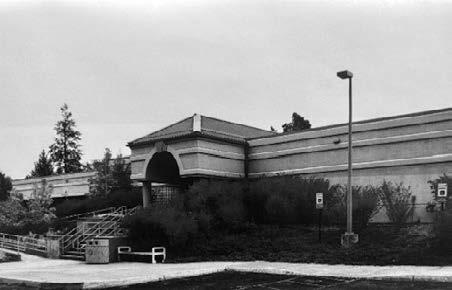
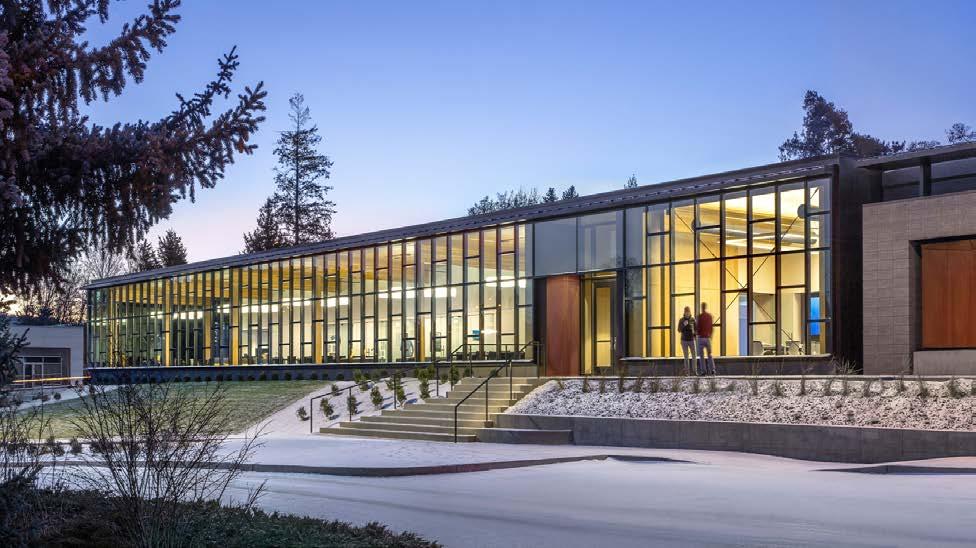
DEDICATED 2025 | MOSCOW
Home to the Idaho WWAMI Medical Education Program and the School of Medical and Health Professions, this renovated and expanded facility offers modern classrooms, clinical-skills spaces and student-support areas that prepare future physicians and health care professionals.
DEDICATED 2021 | MOSCOW
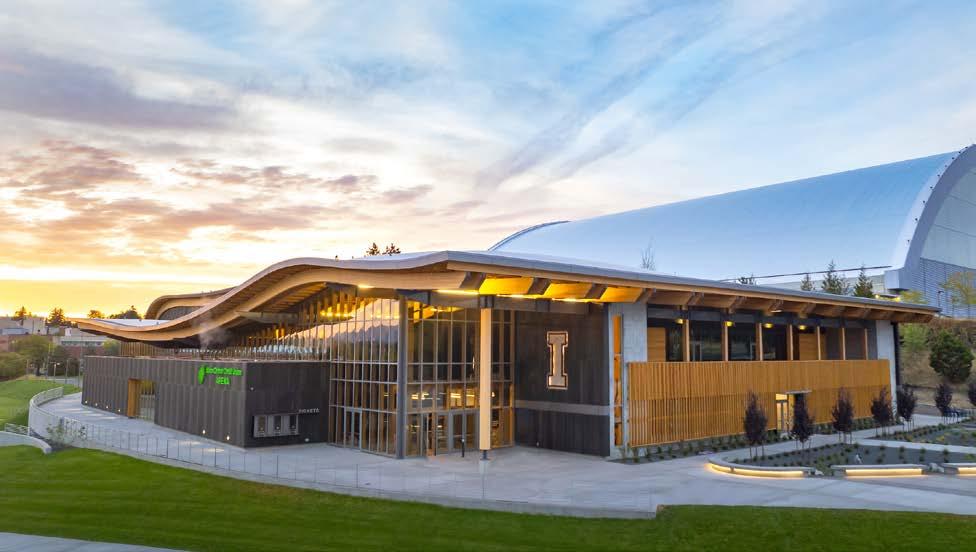
Using Idaho-sourced mass timber, the ICCU Arena provides our championship Vandal basketball teams and special events a sustainable, next-generation home. It stands as a signature campus landmark made possible through bold design and Vandal generosity.

THANK YOU FOR CREATING UNSTOPPABLE MOMENTUM FOR OUR FUTURE
As we close this momentous philanthropic campaign, University of Idaho enters its next chapter stronger, guided by a bold strategic plan and ready for what’s next — because of you and the power of the Vandal Family. Learn more about your impact at go.uidaho.edu/unstoppable.
Story by Leigh Cooper
Art by Hannah Kroese ’08
There are common signs of a fentanyl overdose: pinpoint pupils, a severely impaired mental state and slow, shallow breathing.
And then there is “wooden chest syndrome.”
During the 2025 Opioids, Pain and Substance Use Disorders (OPSUD) education series, one presenter discussed the rare fentanyl overdose symptom in which rigid chest muscles make breathing difficult.
“Never heard of it. I talked with another attendee who I work with afterwards. She hadn’t heard of it either,” said Amy McKenzie, the clinical director at the behavioral health treatment center Trivium Life Services and a specialist in substance use and trauma. “This shows why we need all of these different experts coming in and presenting, because there’s new things coming out all the time and that’s something we should know.”
Under University of Idaho’s School of Health and Medical Professions, Project ECHO Idaho facilitates the OPSUD series, providing prescribers such as
physicians, nurse practitioners and other primary care clinicians with the latest evidence-based science on treating substance use disorders (SUD) and pain. The online series equips Idaho health care workers to confidently prescribe medications for opioid use disorder (MOUD) and treat SUD, even as legislation, drug use trends and treatment recommendations continue to change.
In 2023, 5.7 million Americans had an opioid use disorder (OUD) but only 18% received MOUD. Although one in five people with OUD achieves two years of abstinence without medications, those who relapse face a higher risk of death, showing the importance of MOUD.
“Part of the reason so few people are getting MOUD is that we still haven’t saturated Idaho’s health
In 2023, 5.7 million Americans had an opioid use disorder, but only 18% received medication for the condition.
American Academy of Family Physicians
care community with the knowledge needed to confidently treat opioid use disorder,” said Dr. Jacob Harris, an addiction medicine specialist at the Boise VA Medical Center and member of the interdisciplinary panel that guides the OPSUD series. “There’s a reticence because of a lack of training, not knowing where to start and a fear of not doing it correctly.”
Project ECHO Idaho has worked to close this knowledge gap since 2018 through its OPSUD series — its longest-running course — and other online SUD series for health care professionals statewide. Many sessions count toward continuing education and professional development. With 264 Idahoans dying from opioid-related overdoses in 2023, the state’s opioid crisis remains a critical challenge. They have adapted to the needs of Idaho health care workers, said Shannon McDowell, Project ECHO Idaho program manager. MOUD prescribing requirements have changed over time. Before 2023, prescribers had to complete Drug Enforcement Administration X-waiver training to prescribe MOUD. Now, with eight hours of substance use continuing education a year, prescribers can be licensed to provide any controlled substance, including MOUD. The OPSUD series meets these requirements.
In 2023, 264 Idahoans died from opioid-related drug overdose.
Idaho Department of Health and Welfare
“ECHO used to provide the X-waiver training, but a lot of people across the state were nervous to prescribe so they didn’t go through the training,”
McDowell said. “The whole point of changing the requirements was to make sure that there were as few barriers to prescribing MOUD as possible, because it’s a life-saving medication.”
The two primary MOUD are methadone, usually dispensed through opioid treatment programs (OTP), and buprenorphine, which patients can take at home. Because methadone is available only through OTP, usually located in larger cities, buprenorphine has expanded access to lifesaving treatment in rural areas, Harris said.
ECHO has shifted its sessions to cover not only buprenorphine and methadone but also related topics such as mental health counseling, emerging street drug trends and behavioral interventions.
Although many cases of OUD follow predictable patterns, patients with overlapping factors — such as chronic pain or multiple SUD — often face more complex treatment needs.
One in five people with opioid use disorder achieves two years of abstinence without medication, and those who relapse face a high risk of death.
Alaska Department of Health and Social Services
For ECHO participants, these complex cases are a key reason to return. At the end of each session, a participant presents a deidentified patient case for feedback from the expert panel and other attendees, who offer recommendations, treatment suggestions and relevant resources.
“People aren’t a textbook. They’re not black and white,” said Jen Dixon, medication assisted treatment coordinator at the TriState Clearwater Medical Clinic in Lewiston and longtime OPSUD series participant. “I like to see what’s working for other providers or other specialty areas that really pertain to the client that we’re helping.”
Compounding the situation, Harris ’09, a WWAMI graduate, said the opioid landscape has shifted
Numbers represent all ECHO Idaho series since its 2018 inception.
1,000 ECHO SESSIONS
66 ECHO SERIES
6,502 PROVIDERS TRAINED
49,323 CONTINUING EDUCATION UNITS OFFERED
repeatedly every few years as people moved from prescription opioids to street oxycodone, then heroin and now fentanyl — all drugs in the opioid family. They are often laced with other substances to intensify their effects.
For example, misuse of xylazine — a nonopioid veterinary tranquilizer — emerged in the U.S. in the early 2000s. It slows the heart rate and produces
long-lasting euphoria. Kratom, a non-federally regulated drug made from a relative of the coffee plant, can mimic opioid-like sedative and euphoric effects. It has been in Idaho for about a decade.
“I went to my primary care doctor a couple weeks ago and was talking to her about xylazine and she asked, ‘What’s xylazine?’” said McKenzie, who is a panelist on OPSUD and owner of Otterly Resilient Counseling. “I think it’s important for clinicians to know drug trends so they know what’s coming in. Getting that extra knowledge could be critical for patient care.”
After someone has overdosed once, the chance of dying within the next year is one in 10.
Alaska Department of Health and Social Services
Harris noted that kratom and xylazine have been identified in Idaho, though their prevalence waxes and wanes, as all drug trends often do. Old substances can resurface and new ones emerge. To help clinicians stay prepared, ECHO Idaho’s 2025 OPSUD series included how to identify, test for and treat addiction or overdoses involving these drugs.
“People who know the current drug landscape and treatments will fall behind within a year or two if they don’t have a source for current information,” Harris said.
On the behavioral side of treatment, McKenzie said teaching updated therapy protocols and even revised language can help clinicians deliver more effective care.
“If I can vocalize what is going on with me, there’s better understanding and it’s not as scary, right? With the language comes advocacy,” she said. “They can stand up for themselves.”
For Harris, all SUD education comes down to helping Idaho’s communities.
“Treating opioid use disorder saves lives — not only those of people struggling with addiction, but also those who aren’t using,” Harris said.
Over 96% of participants believe the sessions will enhance the care they provide and improve their patients’ health outcomes, according to series feedback.
U of I congratulates these Vandals on their achievements.
James McLaughlin ’70 received the Gold Medal Award for 2024 from the Idaho chapter of the American Institute of Architects.
Eric Swenson ’97, ’03 accepted a position as an assistant manager with Montana Propane, Inc., in Helena, Montana.
Stephanie Clarkson ’03 started a new position as senior project architect at AECOM in Seattle.
Kami Jo (Barnes) Danaei ’08 was promoted to senior assistant dean at the School of Energy Resources at the University of Wyoming.
Connor Keating ’08 published the book of poetry “Warped” in November 2025. It was edited by Cherice Cameron ’08 with images contributed by Paul Deardorff ’91 and Robin Sarff ’08
Alexander Koeki CabreraFuentes Milles ’17 was hired as a marketing manager for 90 Meat Outlet in Springfield, Massachusetts.
Tyler Westbrook ’17 was honored as the 2025 State Park Ranger of the Year by the Idaho Department of Parks and Recreation.
Matthew ’18, ’19 and Helena ’19 Harned narrated the audiobooks “Heartmender” by V. Romas Burton, released in October 2025, and “Andromache” by L.E. Richmond ’19, released in March 2025.
Online subscriptions are more sustainable. They reduce the environmental impact of printing, transportation and disposal of paper products. Email advserv@uidaho.edu to opt out of the print edition and get the online magazine delivered to your email inbox. Read it online at uidaho.edu/ui/ current-hwhi-magazine.
Submit your news at uidaho.edu/class-notes. You can also email your information, including your graduation year, to alumni@uidaho.edu, or via regular mail to Class Notes, Alumni Relations, 875 Perimeter Drive, MS 3232, Moscow, ID 83843-3232. Please limit your submission to fewer than 50 words.
Wellington Conrad “Skip” Pierce ’53, Boise, Aug. 2, 2025
Grace Irene (Hobson) Eakin ’56, Meridian, July 3, 2025
Blanche “Bunny” Lucile (Pearson) Freeland ’57 , Centennial, CO, July 13, 2025
Gordon Homer Eccles ’60, Boise, July 27, 2025
William B. Mitchell ’60 , Eugene, OR, Nov. 18, 2025
Arnold Junior Nikula ’60 , Paradise Valley, AZ, July 27, 2025
Ann (Redford) Patterson ’60 , Darnestown, MD, Nov. 10, 2024

U of I extends its condolences to the family and friends of our departed Vandals.
Audrian Eleanor Huff ’62 , Moses Lake, WA, July 2, 2025
Robert Wilmer Steele ’69, ’71, Boise, Sept. 23, 2025
James R. Waite ’69, Wilmington, DE, May 28, 2025
Wayne Bret Anderson ’72 , Walla Walla, WA, Aug. 29, 2025
Raymond Leroy Horrace ’72, Caldwell, Dec. 12, 2024
LuRae Levering ’76 , Portland, OR, Aug. 25, 2025
Marilyn Jane Moses ’00 , Oxford, PA, Oct. 8, 2025

Griffin May ’14 to Natalie Hickman ’17 September 2025
John H. Ehrenreich Jr. ’81 , Dupont, WA, Nov. 20, 2024
Nicholas Leo Nash ’84 , Coeur d’Alene, Oct. 9, 2025
Peter E. Isaacson , Tekoa, WA, Dec. 21, 2025
Molly Stock, Portland, OR, Feb. 12, 2026
Ernest “Ernie” David Ables , Talihina, OK, March 7, 2026
Joseph Bonnell-Hall , Plummer, Jan. 29, 2026
Tristan Woodside, Emmett, Feb. 26, 2026
University of Idaho wishes these Vandal newlyweds lots of love and happiness.

Ethan Overfelt ’20 to Laura Hannon ’20 May 2025

Edward Steenkolk ’22 to Emily Ruth Ball ’22 September 2025

Erin Rose Daniels ’24 to Alex Hampton ’23 September 2025
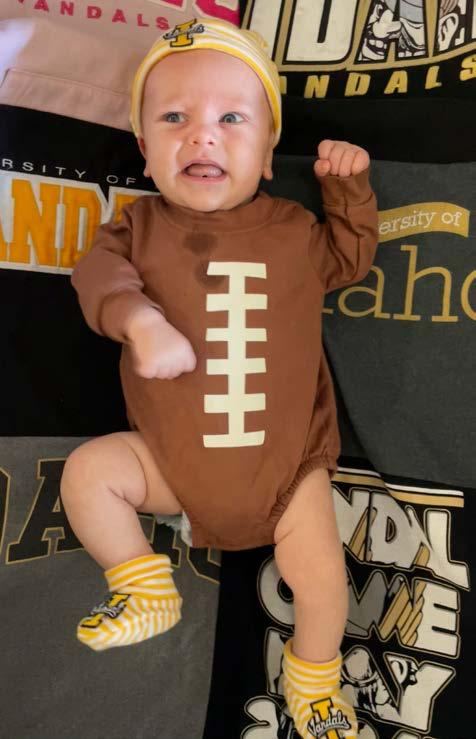
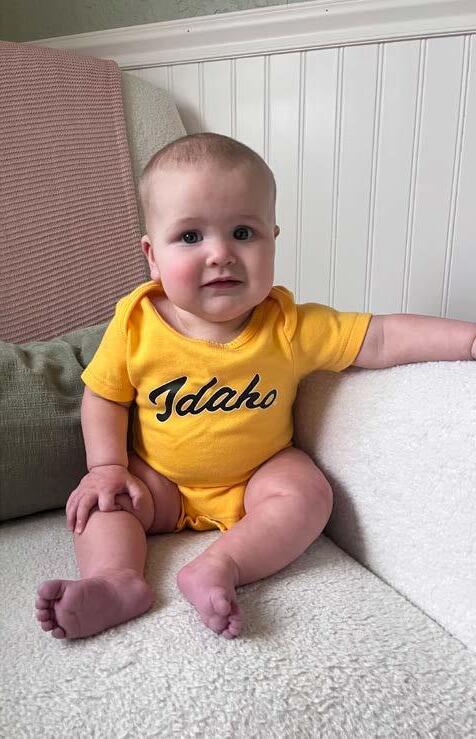
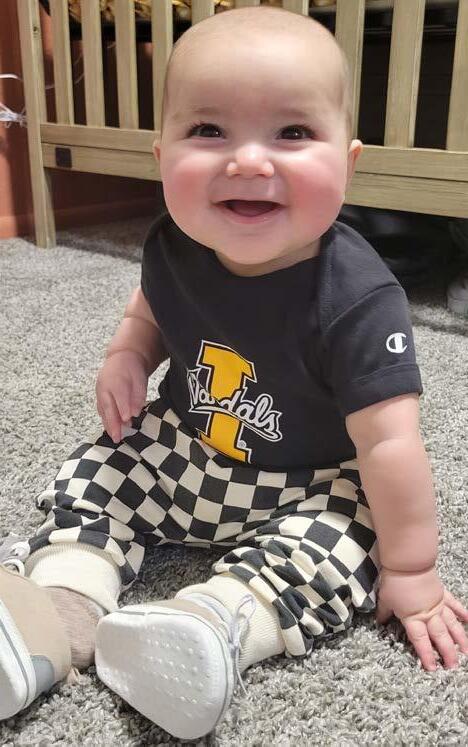
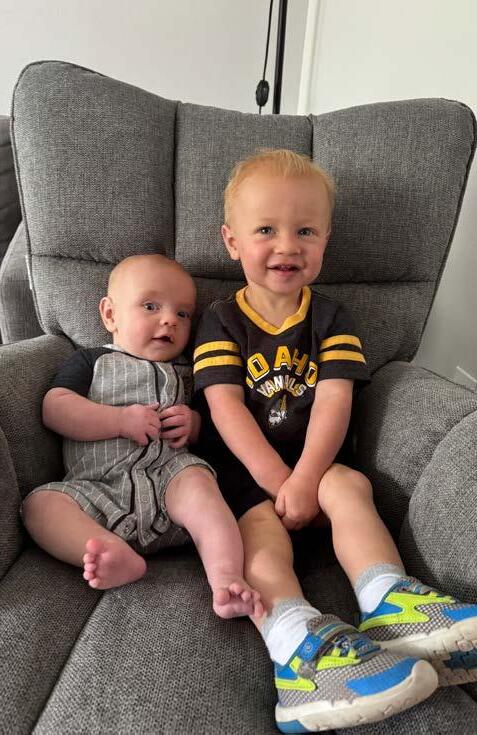
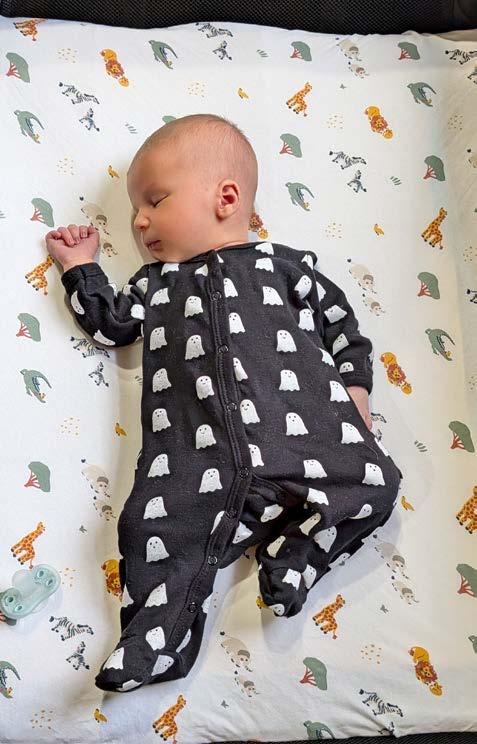
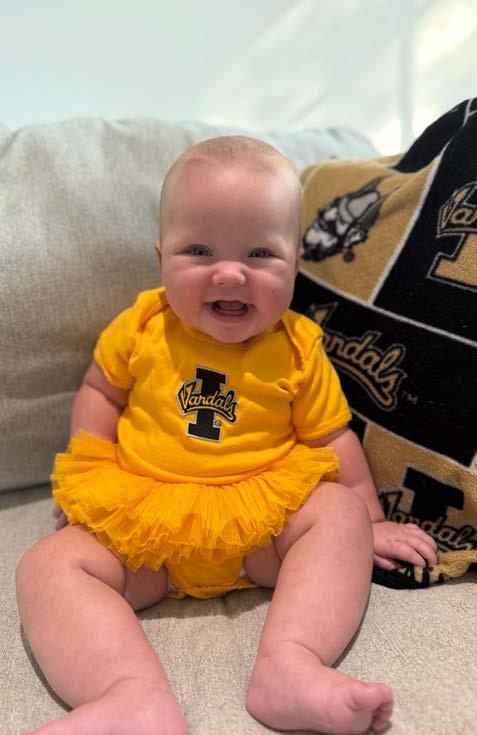

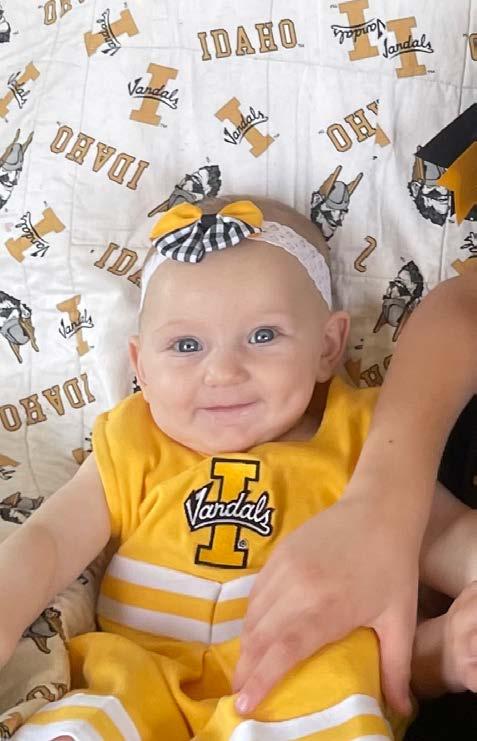
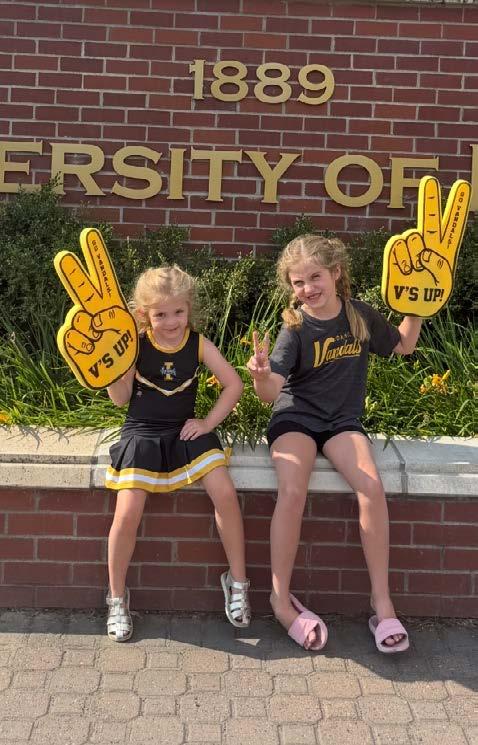
1. John Liam Bell, son of Allison Noel (Hill) ’13 and John Kawika Bell ’14
2. Mallory Bernauer, daughter of Colten ’16 and Shelby (Bergren) Bernauer ’17
3. Arlo Andreas Gaide, son of Samantha (Breeding) Gaide ’14
4. Hayes Holmes and Hank Holmes, sons of Morgan (Woods) Holmes ’12
5. Sebastian James Kochersperger, son of Seth Charles Kochersperger ’13
6. Brooklyn Charlotte Krastins, daughter of Erica (Fuhrman) Krastins ’12
7. Patrick Scott Norby and Killian Taylor Norby, sons of Michael Shea (O’Donnell) ’14 and Michael Norby ’13
8. Hannah Uhrich, daughter of Bret ’09 and Kara (Riordan) Uhrich ’10
9. Harper Jewel and Isla Ann, daughters of Caroline ’10 and Beau Willert ’07