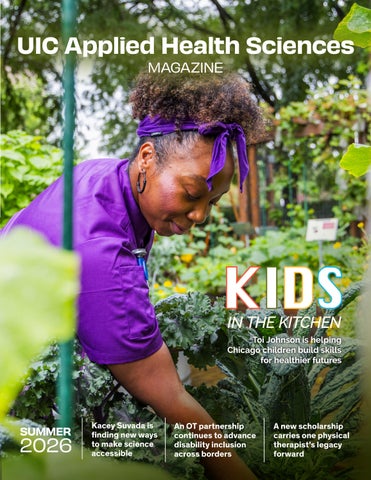
UIC Applied Health Sciences MAGAZINE
KIDS IN THE KITCHEN
Toi Johnson is helping Chicago children build skills for healthier futures
SUMMER
2026
Kacey Suvada is finding new ways to make science accessible
An OT partnership continues to advance disability inclusion across borders
A new scholarship carries one physical therapist's legacy forward
TABLE OF CONTENTS FEATURES 14 Finding the right audience Kacey Suvada is helping make science more accessible, both in the lab and through laughter
16 From promise to partnership Now 18 years strong, OT's partnership with the Centro Ann Sullivan del Peru continues to foster cross-cultural learning and advance disability inclusion
19 Keeping Chrissy’s care in motion A scholarship honoring Christina Rose Smith is helping future physical therapists carry forward her lifelong commitment to helping others
22 Kids in the kitchen A Schweitzer Fellowship is helping Toi Johnson equip Chicago children and their families with the skills to build healthier futures
NOTEBOOK 3 Tanvi Bhatt establishes an endowed scholarship for students
6 Anjali Forber-Pratt named head of DHD
10 AHS cohosts future leaders in food and agriculture
PEOPLE 24 AHS at AMI 2026
On the cover: Toi Johnson in the UIC Teaching Nutrition Garden. Photo: Steven Karl Metzer/UIC
Spring 2025 AHS Commencement Ceremony, May 7. Photo: Elizabeth Piarowski/GradImages
MESSAGE FROM THE DEAN The 2026-27 academic year has begun, and although many of us have years of experience returning to the starting line, the ground beneath our community feels like it has shifted. All around the country, students and educators are grappling with rapid changes to what and how we learn, questioning how advancements in technology and artificial intelligence will affect their scholarship and careers. Along with the excitement of innovating with state-of-the-art tools comes anxiety about whether technology will introduce new inequities. I believe AHS has a leg up in this environment because the work we do is quintessentially human. The people of AHS know that reaching out, partnering and participating with others are essential to sustaining health and well-being. We don't wait for places, platforms or structures to be built by someone else to make things happen; we collaborate and have conversations within communities to uplift others. The stories in this issue are shining examples of how AHS thrives on this sort of connection. Kacey Suvada, a KN postdoctoral researcher, foregrounds the human element of her highly technical work, bringing complex biomechanics to students, patients with impaired mobility and even lay audiences in a comedy club. Yolanda Suarez-Balcazar, professor in OT and DHD, sustains a decades-long partnership with the Centro Ann Sullivan del Peru, a nonprofit education center in Lima for people with disabilities and their families. Her collaboration with the center, forged through her friendship with the founder, which began when they were grad students, is a testament to the value of cross-cultural education and the reciprocal learning that can happen when inclusion is at the forefront. Toi Johnson, a master's student in nutrition and winner of a Schweitzer Fellowship, is building on her decorated culinary career and personal history to help Chicago-area kids and their families develop nutrition knowledge and cooking skills that support a lifetime of health. Andrew Boyd, BHIS professor and coinvestigator on a project that uses AI to improve healthcare data, doesn't stop at technical innovation; he builds community and supports human endeavor. At the second annual hackathon he organized this spring, multidisciplinary researchers from around the country gathered to develop novel health solutions for vulnerable populations using the clinical data he and his coinvestigators have collected. For these standouts, and for so many others across AHS, true health is about more than data, systems or disciplines; it's about people. Technology will continue to reshape how we learn, practice and conduct research, but our purpose remains constant: to build human agency and help others lead healthy, self-determined lives. As we begin this new academic year, let's recommit ourselves to that focus.
Carlos J. Crespo Dean and professor College of Applied Health Sciences e
UIC Applied Health Sciences Magazine SUMMER 2026 EDITOR Erika Chávez Director of marketing and communications DESIGN Heidi Schlehlein Assistant director of design and digital services CONTRIBUTING WRITERS Brian Flood, Tess Joosse, Jae Jin Pak, Emily Parenti-Lopez, Francesca Sacco, Daniel P. Smith and UIC contributors. CONTRIBUTING PHOTOGRAPHERS UIC Creative and Digital Services, UIC Office of Strategic Marketing and Communications ©2026 University of Illinois Chicago. All rights reserved. Published by the Office of the Dean, UIC College of Applied Health Sciences, 808 S. Wood St., 169 CMET, Chicago, IL 60612-7305. Views expressed in this publication do not necessarily reflect the opinions of the editor, the college or university. TELEPHONE
(312) 996-6695
FAX
(312) 413-0086
eachavez@uic.edu
WEBSITE
ahs.uic.edu
You might notice abbreviations throughout this issue. They correlate to academic units and programs in the College of Applied Health Sciences. AT
Athletic Training
BHI
Biomedical and Health Informatics
BHIS
Department of Biomedical and Health Information Sciences
BVIS
Biomedical Visualization
DHD
Department of Disability and Human Development
DIS
Disability Studies
EP
Exercise Physiology
HI
Health Informatics
HIM
Health Information Management
KINES
Kinesiology
KN
Department of Kinesiology and Nutrition
MLS
Medical Laboratory Sciences
MS
Movement Sciences
NUT
Nutrition
OT
Department of Occupational Therapy
PT
Department of Physical Therapy
RS
Rehabilitation Sciences
NOTEBOOK AHS News and Notes Tanvi Bhatt establishes an endowed scholarship for students pursuing research careers Tanvi Bhatt ’05 PhD MS, PT and RS professor, has established a new scholarship that will support MS or PhD students in Rehabilitation Sciences and DPT students who are working with a PT faculty mentor to explore new research. The UIC Tanvi Bhatt Endowed Scholarship will distribute its first $1000 award in Spring 2027, and the fund’s investment earnings will provide Tanvi Bhatt support for students in perPhoto: Jenny Fontaine petuity. Bhatt’s motivations for beginning this scholarship were both personal and professional as a long-time faculty member and an alumna of AHS. “I recently finished 25 years of being at UIC and 20 years of employment here, so I’ve been thinking of doing this for a while,” Bhatt said. “I really wanted to give back, because when I was a student — and I was an international student — I received the Torrance and Roach scholarships, and that helped me travel to some international conferences.” Bhatt hopes to encourage students pursuing careers in research despite the challenges on that path. “With the current environment, where securing research funds is more difficult, and in our field, where physical therapy is moving toward evidence-based practice, I really want to see younger generation students be involved in some sort of research activities,” Bhatt said. “It doesn’t have to be laboratory focused; it can be community-based research, participatory research — in whatever field they are in.”
Bhatt’s own research explores alternative cognitive and motor therapies. In late 2024, she was awarded two major grants totaling more than $1.5 million and $3 million from the U.S. Department of Defense and the National Institute on Aging. The first grant supports a three-year study on functional balance interventions for people with multiple sclerosis. The second studies task-specific balance training to reduce the risk of falls among aging adults. More recently, she has received a $500,000 award from the National MS Society for a mentor-based postdoctoral fellowship to reduce mobility dysfunction in people with MS. Bhatt hopes her endowed scholarship will continue to grow with the support of faculty who might consider donating a portion of award winnings, alumni looking to give back or other friends of AHS. Anyone can contribute to the UIC Tanvi Bhatt Endowed Scholarship by visiting yourgift.uic.edu/Tanvi. Bhatt reflects fondly on her early career at UIC, remembering that as she hit each milestone, she felt the urge to reach just one step higher. “I was a clinician, and at every step after my PhD I thought I’m never going to go back to do a postdoc. Then I did my postdoc, and I thought I’m never going to be a faculty member. Then I became a faculty member, and I thought, RO1s and grants, I just want one. And now I have several.” “I feel like UIC has shaped my life so much and I just want that spark, as our chancellor says, to be alive in students who would like to pursue research. Every little amount counts, and if they can use it towards research activities, that’s great.”
RealTalk MS: a novel approach to treating MS-related depression Robert Motl shared insights on an innovative approach to treating depression in people with multiple sclerosis as a guest on the RealTalk MS podcast. Motl discussed the Mood and Exercise Training Study for Multiple Sclerosis (METS for MS), a clinical trial he leads exploring how exercise may improve mental health and quality of life for people living with MS. Listen to the episode. Photo: Jenny Fontaine
SUMMER 2026
UIC APPLIED HEALTH SCIENCES MAGAZINE
3
NOTEBOOK
Expanding access in northeast Illinois electronic health records coordinator while readying them for the Registered Health Information Administrator exam. The Master of Science in Health Information Management equips working professionals for leadership positions in data governance, healthcare informatics and health IT operations. Both fully online programs offer Lake County residents the flexibility needed to earn a degree from a nationally recognized public research university.
From left to right: BHIS head Kal Pasupathy, UCLC executive director and dean Myra Gaytan-Morales and AHS dean Carlos Crespo at the UIC plaque installation ceremony on the UCLC campus. Photo: University Center of Lake County
During the spring semester, AHS deepened its presence at the University Center of Lake County and marked a significant milestone by installing a new program plaque at the UCLC campus. A ceremony in February marked AHS’ formal commitment to expanding health science education in Lake County, increasing access to highquality UIC degrees for residents who may not be able to study on the Chicago campus. Carlos Crespo, AHS dean, and Kal Pasupathy, BHIS department head, traveled to UCLC's Grayslake campus to hang the plaque and highlight the two online health information management programs available to UCLC students since the fall of 2024. The Bachelor of Science in Health Information Management prepares graduates for roles like health information analyst and
Since the plaque installation, AHS has participated in multiple community engagement efforts on the UCLC campus. In March, Mario Diaz, assistant dean for recruitment, joined Crespo and Pasupathy for a meeting with leaders from UCLC and Endeavor Health to identify gaps in Lake County's healthcare workforce and explore how AHS offerings could help address them. The gathering included more than a dozen administrators and workforce development professionals. Diaz also served as a panelist at Endeavor Health's ASPIRE Lake County Career Discovery Day on March 19, an event to help high school students understand their next steps toward entering the healthcare industry. Joining Diaz were representatives from the College of Lake County, UIC’s Urban Health Program and Rosalind Franklin University. The event drew high school students from the region as well as participants from YouthBuild, a program for underserved youth in Lake County. Panelists offered students an introduction to healthcare careers and fielded questions on topics ranging from the college application process and scholarships to what it takes to be a competitive job applicant. Together, these efforts reflect AHS’ sustained commitment to building accessible academic pathways and strengthening a partnership that is already delivering results for Lake County residents.
Building healthcare pathways for CPS students On April 13, AHS partnered with City Colleges of Chicago at a health science event for high school students through Chicago Public Schools’ Department of Early College and Career Education. The event offered 35 students from Little Village Lawndale High School and D.H. Williams Medical Prep High School roadmaps to college and career planning in the healthcare sector and included a handson team challenge to put their new knowledge into practice.
By participating in events like this one and in the overall Chicago Roadmap 2.0 project, AHS and its partners support student success from the ground up, inspiring the next generation of health science scholars and professionals.
The event was hosted under Chicago Roadmap 2.0, a partnership that helps students transfer seamlessly from CPS to CCC to UIC without losing course credits and earn their bachelor's degrees in a timely, affordable fashion. Representatives from AHS outlined post-secondary opportunities, particularly in rehabilitation sciences, and showcased zero–credit loss transfer plans that integrate early college coursework during high school. Clinical associate professor in RS Jennifer Wescott ’17 MS OT, ’18 P-OTD led an interdisciplinary team of AHS faculty and students as they facilitated a hands-on team challenge for the highschoolers, who learned about supporting clients with disabilities and person-centered rehabilitation. The goal was to develop a strategy to help a client with disabilities safely and meaningfully return to cooking after an injury or illness. 4
Orit Schwartz, HRS senior clinical instructor, provides high school students with expert guidance on applying a person-centered approach during the problem-solving phase. Photo: City Colleges of Chicago
Students select Sofia Cienfuegos for 2026 Silver Circle Award spent as a doctoral student before becoming faculty. She teaches nutrition courses while remaining active in her own research, most recently on the benefits of time-restricted eating for women with polyendocrine metabolic ovarian syndrome.
Sofia Cienfuegos
For today’s young adults interested in nutrition, parsing through the barrage of online advice for real evidence can be a challenge. But KN clinical assistant professor Sofia Cienfuegos ’18 MS NUT is creating a refuge from the noise. “This has been a challenging time for higher education and for science in general,” said Cienfuegos. “Students are exposed to a huge amount of misinformation on many of the topics I teach. I want my classroom to be a space where they can engage, ask questions and enjoy the process of learning.” Cienfuegos is AHS’ 2026 winner of the Silver Circle Award. This recognition, given annually since 1996 to one faculty member from each of UIC’s colleges, is awarded by the graduating seniors — a testament to the instructor’s ability to connect with students. “Dr. Cienfuegos embodies what we are looking for in a faculty member, somebody who is truly dedicated to their teaching and the students we serve,” said KN department head David Marquez. Cienfuegos has been at UIC for eight years, five of which were
Cienfuegos’ course load includes Nutrition Assessment, Nutrition and Metabolism and Nutrition Science II. She also teaches The Research Process, in which students learn to find, read and evaluate scientific literature. “This course is very important to me,” she said, “because it empowers students to engage with evidence-based nutrition and become more confident.” Cienfuegos is always looking for ways to go beyond her nutrition curriculum to influence and engage students. “I care a lot about mentoring, writing letters of recommendation and helping students move forward into careers they’re excited about,” she said. “It’s very motivating to see students become passionate about science.” Beyond the impactful experiences she’s had with her students during the 2025-2026 term, developments in Cienfuegos’ personal life have made this year special. “I am becoming a mother, and I’ve been teaching throughout my pregnancy, which has been a very meaningful experience,” she said. “I hope to continue doing the work I love while also embracing this new chapter. I feel incredibly grateful — for my students, for this recognition and for the opportunity to do work I truly enjoy every day.” SUMMER 2026
OT program earns top ranks in U.S. News AHS’ doctoral occupational therapy programs are among the best in the country, according to the 2026 U.S. News & World Report’s Best Graduate Schools. The list, released April 7, includes overall rankings, which assess performance across an institution, and specialty rankings, which evaluate individual disciplines, such as occupational therapy. UIC’s OT program ranked fifth in the nation, tied with University of Southern California, University of North Carolina Chapel Hill and Washington University in St. Louis. UIC's physical therapy program was also nationally recognized, ranking 34th. This distinction reflects the OT department’s strong reputation within the profession. “As the standards for excellence in occupational therapy education continue to rise, the UIC OT community remains committed to shaping the future of the field, amplifying UIC’s mission to provide the broadest access to the highest levels of education, research and clinical excellence,” said OT department head Susan Magasi '02 MS OT, '06 PhD DS. “Our shared commitment to innovation and impact unites every member of our community to ensure that clients and communities receive evidenceinformed, theory-driven services that support meaningful participation in the things that they want and need to do.” “That is the beauty of this program and the power of the profession of occupational therapy,” said Magasi.
#5
UIC'S OCCUPATIONAL THERAPY PROGRAM
(NATIONALLY TIED)
#34
UIC'S PHYSICAL THERAPY PROGRAM
(NATIONALLY TIED)
UIC APPLIED HEALTH SCIENCES MAGAZINE
5
NOTEBOOK
Anjali Forber-Pratt named head of the Department of Disability and Human Development record in wheelchair racing. She has since dedicated her life to helping others recognize their potential and believes members of the disabled community are often the best suited for leadership in their areas of focus. “As a disabled person, adapting — it’s in our blood, right? We adapt constantly, just for existing. We’re natural problem solvers, because we have to be. But also because this turns into a real asset when it comes to work.”
Anjali Forber-Pratt and service dog Leopold III.
Anjali Forber-Pratt — disability activist, two-time Paralympic medalist and director of research at the American Association on Health & Disability — has been named head of the Department of Disability and Human Development. She succeeded interim department head Carrie Sandahl beginning Aug. 16. Forber-Pratt comes to DHD with 20 years of high-level experience in research, sport and organizational leadership. She previously served as the presidentially appointed director of the National Institute on Disability, Independent Living and Rehabilitation Research, and she has held academic appointments at Vanderbilt University and the University of Kansas. The author of more than 65 peer-reviewed articles and numerous chapters, she focuses her research primarily on disability identity development. And as a wheelchair user herself for more than 40 years, her lived experience informs her work. “I’ve spent my career working at the intersection of disability justice, racial equity and health equity,” she said, “embedding equity into strategy, operations, funding, organizational culture, and really being able to treat this as an integrated effort, not just on the periphery.” Forber-Pratt was a member of Team USA at the 2008 and 2012 Paralympic Games, where she won medals and set an American
6
Forber-Pratt has worked on a global scale to advocate for disabled people’s access to employment, education and sport, with projects in Bermuda, India, Zambia and Ghana. She has also received numerous recognitions from influential organizations, including Photo: Anjali Forber-Pratt a Special Contribution Award from the Alliance for NIDILRR Grantees in 2026, the Citizen Psychologist Award for Advancing Disability as a Human Right and Social Justice Issue Award from the American Psychological Association in 2020 and the Paul G. Hearne Leadership Award from the American Association of People with Disabilities in 2013. She was also honored by the White House as a Champion of Change in 2013 and participated in a roundtable discussion with President Obama about disability policy issues. With deep experience and respect across different sectors of disability policy, advocacy and identity-building, Forber-Pratt is well positioned to lead DHD through this moment in which equity-driven work is often sidelined. “We can be at the table in this critical time in our country when disability funding, programs and services are being threatened, and DHD can help shape that future. My hope for the future of DHD is that we not only continue being recognized as a disability leader, but as a disability champion in uncharted territories — that we bring our collective expertise to all of the tables.”
New joint master’s in health information management and informatics Beginning in fall 2026, AHS will offer a new joint degree program combining the Master of Science in Health Information Management and the Master of Science in Health Informatics. Offered fully online, the three-year pathway allows graduate students to earn both credentials for 58 total credit hours, shaving 19 hours off the 77 required to complete the programs separately. The new degree pathway builds on the successful joint Bachelor of Science in Health Information Management/Master of Science in Health Informatics program launched in fall 2025, expanding shared coursework to the graduate level. While MSHIM focuses on data governance, privacy, compliance and revenue cycle management, MSHI centers on information systems, analytics and technology implementation. The new joint pathway bridges those two critical tracks. Unlike the undergraduate joint track, students applying for the MSHIM/MSHI must commit to the joint pathway before they matric-
ulate into either graduate program. Applicants must meet the admission requirements of both programs and apply to each separately before submitting a joint-degree application. “The joint degree is unique because it prepares graduates to understand both the technical infrastructure of health information systems and the regulatory, operational, financial and governance requirements surrounding healthcare data,” said MSHIM program director Lois Hitchcock. “Graduates should be better positioned for roles that require collaboration across HIM, information technology, analytics, compliance, clinical operations and organizational leadership.”
Intermittent fasting improves PMOS symptoms in women Polyendocrine metabolic ovarian syndrome — PMOS, formerly known as PCOS — affects 18% of all childbearing-age women. The condition causes an overproduction of a group of hormones called androgens, chiefly testosterone, which may result in menstrual irregularity, obesity and even infertility. The first line of treatment is typically hormonal birth Krista Varady control, said KN professor Krista Varady. But there can be negative side effects to mood, libido and metabolism, plus an increased stroke risk in some people, Varady said. “We’re looking for other ways of lowering testosterone levels in these women,” she said. “One way is through weight loss. If someone loses around 5% of their body weight, they can actually help lower testosterone levels and sidestep any kind of drug intervention.” A study led by Varady and published in Nature Medicine tested how one weight-loss method, intermittent fasting, affects hormones and symptoms in patients with PMOS. The study was conducted prior to the condition’s name change. The research was a team effort among KN faculty, including clinical assistant professor Sofia Cienfuegos, who designed and ran the
SUMMER 2026
study with Varady, assistant professor Kelsey Gabel, professor Lisa Tussing-Humphreys ’09 PhD NUT and assistant professor Vanessa Oddo. Other coauthors from AHS include Sarah Corapi, Mary-Claire Runchey, Jodie Lyons, Maria Alonso de Leon, Vasiliki Pavlou and Mark Ezpeleta. The team studied a type of intermittent fasting called time-restricted eating, which limits eating to a set six- or eight-hour period each day. During the remaining 18 or 16 hours, you fast with calorie-free beverages and water. Simply put, the strategy helps people eat less, Varady said. So does counting calories, a method Varady and her colleagues tested alongside intermittent fasting in the study. A group of 76 premenopausal women with PMOS were split into two groups — one for time-restricted eating between 1 and 7 p.m. daily and another for calorie counting — and outcomes were compared after six months. Both diet schemes cut participants’ intake by about 200 calories per day, leading to average weight loss of about 10 pounds over the six months. Both groups also experienced a decrease in testosterone concentrations. But only time-restricted eating reduced the free androgen index, a marker of how much active testosterone reaches the body’s tissues. It also improved A1C levels, a marker of diabetes risk. Though intermittent fasting did not lessen other PMOS symptoms, like menstrual period irregularity, Varady suggested those symptoms might improve with more time on the diet and greater weight loss. About 80% of participants in the time-restricted eating group said they would continue the diet, Varady said.
UIC APPLIED HEALTH SCIENCES MAGAZINE
7
NOTEBOOK
Sports science on an Olympic stage For Lindsay Slater Hannigan, PT assistant professor and sports sciences manager for U.S. Figure Skating, the journey to work with Olympic athletes began with a cold call.
Lindsay Slater Hannigan
U.S. Figure Skating said yes when Hannigan, then a master’s student, proposed an internship in biomechanics. She worked unpaid during the summer and continued volunteering throughout her PhD in exchange for research data.
After earning her doctorate, the organization hired her as a contractor, and today, Hannigan manages U.S. Figure Skating’s sports science program. She uses data to “help employees, coaches and athletes make performance decisions, injury-prevention decisions and rehabilitation decisions,” Hannigan told the Chicago Tribune from Stamford, Connecticut, where she helped NBC produce its coverage of the 2026 Winter Olympics. Hannigan specializes in jumping athletes and studies how figure skaters can quantify workload. In other sports, measuring repetitions is a straightforward count, like pitches thrown in a baseball game, but for figure skaters, tracking jumps performed in practice or rotations performed within jumps is more complex.
Hannigan and her colleagues addressed this problem by partnering with 4D Motion Sports to develop wearable technology that collects this data. Sensors worn on the hip track rotational velocity to quantify how many jumps are performed in a day and determine when it’s best to stop, before a decline in performance. Hannigan’s path through the sports science field has included some unexpected turns. In the middle of a postdoctoral fellowship studying ACL injury recovery at the Shirley Ryan AbilityLab, a sudden change in mentorship nearly ended her research career. At the eleventh hour, an established researcher offered Hannigan a job in prosthetics engineering, a discipline far outside her wheelhouse. Taking that chance helped her make novel connections between recovering athletes and people navigating disabilities. “I learned so much about individuals with prosthetics, and the parallels between rehabilitation needs for those with leg amputation and athletes recovering from knee injuries were remarkable. However, no one was studying rehabilitation from amputation to the extent that researchers were studying rehabilitation from ACL injuries.” The bridge Hannigan built between amputation rehabilitation and athletic recovery has become her own niche in the research, and she wouldn’t have developed such a unique specialization without first taking that bold leap on an unfamiliar fellowship. “It ended up being the best thing that ever happened to me,” she said. “Life and success are not linear. Learning experiences usually come from the less-than-ideal circumstances.”
Advancing AI to better understand patients To unlock the true potential of artificial intelligence in healthcare, computational models must understand the perspectives of the entire clinical team. Andrew Boyd, BHIS professor, is leading UIC’s groundbreaking effort to make that a reality. Through the ARPA-H funded Creating AI-Enabled AllHealth Team Data Fabric (CAIDF) project, Boyd collaborated with clinicians Andrew Boyd from the University of Illinois, Photo: Jenny Fontaine University of Iowa, University Photo: Jenny Fontaine of Missouri, Loyola University and the University of Texas at Austin to create the world’s largest collection of human-annotated, multiprofessional clinical notes. The team has successfully annotated 4,500 clinical notes, establishing the foundation for a massive dataset of more than 14 million records. 8
Drawing on data from the University of Illinois Health, Iowa Health Care and Missouri University Health Care, the resulting collection is the first of its kind: a multisite compilation of structured data and unstructured clinical notes. Encompassing 13,000 NICU patients and 73,000 adults hospitalized for traumatic falls, it is now the third-largest NICU dataset and the largest dataset in the world for falls-related hospital treatment. The project’s true significance lies in its inclusion of multiple health professions. Historically, efforts to standardize clinical terminology have focused heavily on physicians and nurses. By explicitly capturing data from physical therapy, occupational therapy and speech-language pathology, Boyd and his collaborators are filling critical gaps in healthcare data. These human-annotated notes provide the “ground truth” AI models need to make accurate predictions. By centering the contributions of allied health professionals, this AHS-driven initiative is building the vital infrastructure necessary to improve clinical decision-making, enhance team communication and deliver comprehensive patient care.
KN professors among UIC’s 2025-2026 Distinguished Researchers Each year, the UIC Office of the Vice Chancellor for Research awards outstanding representatives of the UIC community who create local and global impact with their contributions to science, education or our understanding of history. This year’s Distinguished Researchers include AHS’ Timothy Koh in the basic life sciences category and Robert Motl in the clinical sciences category. The awardees were celebrated at a ceremony in the Field Museum of Natural History on April 22. Timothy Koh, KN professor, studies wound healing in people with diabetes, a process that can be hampered by damaged blood vessels, impaired immune cells and poor circulation. Chronic wounds, experienced by up to 25% of people with diabetes, can have devastating effects.
Timothy Koh
“We’re trying to identify potential pathways we can target to improve healing and prevent downstream events like amputation and death,” Koh said. Although improving tissue repair is the main goal, Koh foregrounds patient experience throughout his research process. “We tend to be focused on what’s happening in the wound, but it’s attached to a person,” Koh said. After arriving at UIC in 2001, Koh pursued a master’s degree in sports biomechanics and a PhD in muscle mechanics before turning his attention to tissue injury thanks to Dr. Luisa DiPietro, professor of periodontics and director of the Center for Wound Healing and Tissue Regeneration. “She’s been instrumental in gathering wound-healing researchers at UIC and in Chicago,” Koh said.
Robert Motl
Koh’s research has been funded by the National Institutes of Health, the Department of Defense and the Department of Veterans Affairs. Currently on sabbatical, he has been developing a new KN course that prompts students to dive deeper into trending health topics. For 23 years, Robert Motl — KN professor and director of the Integrative Physiology Lab and the Exercise Neuroscience Research Lab — has investigated how exercise training programs improve the lives of people with conditions such as multiple sclerosis and Parkinson’s disease. “We want to study how exercise can help people manage symptoms of the disease, like fatigue and depression,” said Motl. “We also want to understand how exercise can restore physical and cognitive function and how that translates into improved quality of life.”
SUMMER 2026
Photos: Jenny Fontaine
Once a professional cyclist, Motl now remains active by climbing mountains and doing yoga. While he never intended to build a career around exercise, he called his journey serendipitous. “I had an idea, and it got funded. And once it was funded, I started taking a deep dive into exercise and neurological diseases. There was just so much opportunity to do novel, innovative and impactful research,” Motl said. Motl hopes to study the effect of exercise programs in other contexts — for long COVID patients, people with chronic kidney disease or cancer prevention — and to create an Exercise is Medicine center at UIC that would integrate research and clinical programs. “All of my colleagues in kinesiology and nutrition have been extremely supportive and wanting to engage in collaboration,” he said, “and that’s been the root base of all my success at UIC.” UIC APPLIED HEALTH SCIENCES MAGAZINE
9
NOTEBOOK
AHS cohosts statewide gathering of future leaders in food and agriculture
Eduardo Bustamante leads a roundtable discussion.
In collaboration with the World Food Prize Foundation, AHS cohosted the inaugural Illinois Youth Institute, an event that engaged high school students in important conversations and experiential learning focused on the future of food and agriculture. The daylong event held on May 12 at Student Center East gathered students from Chicago Public Schools and across the state for workshops and roundtables with experts on topics from sustainability and climate resilience to agricultural innovation, nutrition education and food equity. To attend the Illinois Youth Institute, high school students were required to write a research paper on food security under the supervision of a teacher or mentor. For their research and participation at the institute, the students were recognized as Borlaug Scholars. This distinction makes students eligible for the Global Youth Institute in Des Moines, Iowa and the Borlaug-Ruan International Internship. In addition to sparking conversations about agriculture, food security and sustainability, the event exposed high school students to diverse career paths and insights from experts committed to shaping the future of global food systems. Several members of the AHS community who are involved in this work led workshops and roundtable discussions. The first workshop, led by KN instructor Tina Lam and KN clinical assistant professor Kirsten Straughan ’07 MS Exercise 10
Physiology taught students how to make evidence-backed nutrition choices in a world full of social media–fueled food noise. Another workshop held by KN community nutrition instructor Sherri Ambrose explored food access and fairness, revealing how a person’s neighborhood shapes what food choices are available, affordable and realistic. Roundtable discussions were led by PT professor and AHS associate dean for strategic initiatives Sangeetha Madhavan, KN professor and head David Marquez, KN associate professor Eduardo Bustamante ’13 PhD KN and AHS’ Urban Health Program assistant director Jennifer Hernández. Tami Craig Schilling, a member of the University of Illinois Board of Trustees, delivered a keynote address on students’ role in the future of food. Remarks were also made by UIC chancellor Marie Lynn Miranda and AHS dean Carlos Crespo, who co-organized the event with AHS associate dean of student affairs Eileen Doran. The World Food Prize Foundation's mission is to stimulate innovation and impact around the quality, quantity and availability of food. In addition to cohosting 40 youth institutes in various countries and 22 U.S. states, the foundation administers the World Food Prize, often likened to the Nobel Prize in the field of food and agriculture.
AHS students and faculty create AI-enabled improvements to patient care and health data Students and faculty from AHS stood out among participants in this year’s hackathon hosted by Creating AI-Enabled All-Health Team Data Fabric, bringing home first and second-place wins. The second annual hackathon, held the last weekend in May at the Crowne Plaza Chicago Hotel, awarded $50,000 in prizes to teams from around the country who created innovative health solutions using CAIDF’s massive, all-team data sets. Representing more than 80,000 patients, the comprehensive data were gathered from physicians, nurses, physical therapists, occupational therapists and speech-language pathologists who treat patients who have experienced one of two complex situations: NICU care or falls that lead to serious injury. Research has shown that datasets with observations from various providers on the care team yield more accurate predictions than physician notes and lab results alone.
First-place winning team members (from left to right): Lawrence Salud, Abhishek Basu, Amy Wang and Luis Cisneros.
Hackathon competitors worked in multidisciplinary teams to summarize, integrate and visualize this extensive data. Participants also created point-of-care innovations that clarify the relationships between medical interventions and patient outcomes. “It brought me great joy to see different professions and expertise come together with innovative ideas in a short period of time,” said BHIS professor Andrew Boyd, co-principal investigator of CAIDF and hackathon event organizer. Lawrence Salud, PhD student in BHI, was part of the first-place team that developed a clinical decision-making project called NextStep.ai. The platform provides care teams with advanced summaries of multidisciplinary patient data. “There is a unique energy that happens when you put developers, data scientists and healthcare experts in a room together,” said Salud. “That highly collaborative environment allows you to learn from complementary perspectives, rapidly prototype and bring solutions to life in less than 48 hours.”
Next Steps second-place winning team members (from left to right): Ivan Bala, Mit Patel, Morgan Merrill and Jayalakshmi Jain.
Jayalakshmi Jain, PhD student in BHI, and Morgan Merrill, MS student in BVIS, were on one of the tied second-place teams; BVIS faculty member Sarah McGuinness was on the other. Jain and Merrill built a personalized fall-prevention tool for use during hospital discharge, and McGuinness created a program focused on closing the loop of care. Led by Boyd and his co-principal investigators at the University of Missouri and the University of Iowa, CAIDF has secured up to $10 million from the federal Advanced Research Projects Agency for Health to elicit innovations like these. Other AHSaffiliated investigators on the CAIDF team include Tanvi Bhatt ’05 PhD MS (PT and RS professor), Sam Bond ’16 MS BVIS The Loop second-place winning team members (from left to right): Mary Salazar, Jessie Hansen and Sarah McGuinness. (PT and BVIS clinical assistant professor) and Mary Khetani (OT and RS professor). SUMMER 2026 UIC APPLIED HEALTH SCIENCES MAGAZINE
11
NOTEBOOK
12
Disability pride in action The UIC Department of Disability and Human Development, the Department of Occupational Therapy and the Institute on Disability and Human Development joined thousands of advocates, families and community organizations for the 2026 Disability Pride Parade in downtown Chicago on July 25. AHS faculty, staff and students marched alongside participants from the Chicagoland Disabled People of Color Coalition to celebrate the disability community. The Assistive Technology Unit's accessible technology van also made its parade debut. Following the parade, DHD, IDHD, OT, the Great Lakes ADA Center and CDPCC connected with attendees at the Disability Pride Resource Fair, sharing resources and highlighting UIC's commitment to accessibility and community partnership.
Photo: Jae Jin Pak
Read additional news and notes: go.uic.edu/AHSNews
SUMMER 2026
UIC APPLIED HEALTH SCIENCES MAGAZINE
13
Kacey Suvada presenting a stand-up comedy solo performance. Photo: Provided by Kacey Suvada
Finding the right audience Kacey Suvada is helping make science more accessible, both in the lab and through laughter.
Kacey Suvada, KN postdoctoral research associate, has presented projects from her undergraduate, doctoral and postdoctoral training to countless audiences. But the toughest presentation wasn’t at a scientific conference. It was at an improv comedy show. This spring, Suvada guest-starred in Uncontrolled Variables, a comedy show at Chicago’s Lincoln Lodge where comedians and scientists team up to explore research through humor and conversation. A longtime audience member, Suvada said her passion for science communication pushed her to take the stage and connect with people who might never attend a scientific presentation.
Suvada uses motion-capture technology to track and quantify how participants move during everyday tasks. She attaches sensors to study participants’ feet, ankles, arms, legs and hips while high-precision cameras capture the signals and locate those points in space. The sensors measure stride length, joint angles, velocities and ground reaction forces, then quantify the overall movement pattern to create a digital skeletal model. During a five- to 10-minute stroll on a special treadmill, joint angles and the forces of each footstep are computed and breathing is tracked. Together, the data create a detailed picture of how a person moves, helping researchers better understand individual movement patterns and informing future rehabilitation approaches.
“When it comes to explaining research to the general public, sometimes scientists fall flat,” said Suvada.
For Suvada, however, the research is about much more than numbers.
“Scientists need to express research in a way that everyone can relate to and get excited about.”
“It’s a privileged position to hear patients’ stories and understand what they’re going through,” Suvada said. “Both of my parents have underlying movement conditions and witnessing that has made me more attuned and empathetic to patients.”
That philosophy shapes more than her appearances on stage. It also guides her work in the Biomechanical and Clinical Outcomes Lab, where her research is helping to improve people's everyday lives. Off stage, at AHS, Suvada works with associate dean of research and KN professor Kharma Foucher to study altered movement patterns in adults with osteoarthritis, the most common form of arthritis. Biomechanics researchers study how principles of physics and engineering apply to human movement, developing rehabilitation strategies that improve mobility and function. “Think of all the ways you might pick up a coffee cup,” Suvada said. “People who have osteoarthritis or have experienced a stroke,” which she studied during her PhD at Northwestern University, “are more limited in what their body can do and may be constrained to a few movement strategies as a result.” 14
“Our ultimate goal is to reduce activity limitations and improve the ability to fully engage in valued personal and community roles,” said Foucher. “Although our approaches can be complex and highly technical, we strive to put the person and their goals at the center of our work.” STORIES WITHIN THE SCIENCE To holistically capture each participant’s situation, Suvada collects information about both physical and psychological health, recognizing that each can influence recovery. “What is driving someone’s lack of function?” Suvada said. “Is it physical weakness, low energy levels or a fear of reinjury? The intention of our work is to improve accessibility and reduce pain in real people’s lives. The more we understand the individual person, the more we can move toward specialized approaches in rehabilitation medicine.”
“I’m passionate about continuing to get the next generation of scientists access to research experiences.”
Suvada uses a computer to track participants’ movements as they walk on a two-belt treadmill. Photo: Jenny Fontaine/UIC
Members of the Biomechanics and Clinical Outcomes Lab. From left to right: Craig Hensley, Oiza Peters, Ava Haghnaji, Gabrielle Kindy and Kacey Suvada. Photo: Jenny Fontaine/UIC
Her commitment to communicating science extends beyond biomechanics. While pursuing her PhD in neuroscience, she volunteered with the National Alliance on Mental Illness’s Ending the Silence program, speaking with students across the Chicago area about mental health and working to reduce stigma surrounding mental health conditions.
At AHS, Suvada has mentored undergraduate and PhD students in diverse programs, from exercise science and engineering to physical therapy and medicine.
“I went to schools around Chicago to educate the younger generation about mental health and help to end stigma surrounding mental health conditions. A student came up to me after my presentation once and stated that they appreciated hearing me talk and having access to this workshop, which was so meaningful,” she said.
Long before she stepped onto a comedy stage, Suvada learned another lesson about perseverance as a competitive figure skater, a hobby she still enjoys at the Maggie Daley Skating Ribbon in downtown Chicago.
RELENTLESS PURSUIT With one year of postdoctoral training under her belt, Suvada looks for opportunities to share science with her community — through comedy or in the classroom. “I feel like I’ve learned so much in a year,” she said. “I’ve had meaningful research experiences my whole life, but I didn’t realize I wanted to run my own lab until the last few years.” SUMMER 2026
“I’m passionate about continuing to get the next generation of scientists access to research experiences,” she said.
“Skating cemented that sense of relentless pursuit of a passion, dealing with the ebbs and flows of discovery, research, rejection and acceptance. Having to hurdle yourself in the air and face potentially falling has prepared me for academia in accepting that sometimes you will fail. However, I’m excited to prepare others for their own pursuits of science and show them it’s about getting up again and again.”
UIC APPLIED HEALTH SCIENCES MAGAZINE
15
FROM PROMISE TO PARTNERSHIP
Now 18 years strong, the Department of Occupational Therapy's partnership with the Centro Ann Sullivan del Peru continues to foster cross-cultural learning and advance disability inclusion. When OT and DHD professor Yolanda Suarez-Balcazar and Liliana Mayo were graduate students at the University of Kansas, they made a promise to one another: one day, they would create a partnership that would connect U.S. students with the transformative work taking place at the Centro Ann Sullivan del Peru, which Liliana had founded a few years earlier. “We made a promise to each other,” Suarez Balcazar said, “that as soon as we could, we would build a partnership.” That promise came to fruition in 2008, when Suarez-Balcazar and her fellow OT and DHD professor Joy Hammel brought the first cohort of students from Chicago to CASP, the nonprofit educational and training center that Mayo had been running for nearly 30 years. What began in 1979 as a program for five students in Mayo’s own home in Lima has since grown into a massive operation in Peru and internationally, offering education for independent living, learning opportunities for families,
school inclusion resources, supported employment assistance, training for disability professionals and more. For nearly two decades, Suarez-Balcazar, Hammel, OT clinical professor Ashley Stoffel, and Robin Jones, a former longtime director of the Great Lakes ADA Center, have been accompanying students to Lima to work with and learn from the CASP community. Twenty-six students from the occupational therapy doctoral programs and the disability studies PhD program have participated since the partnership began. After a few years’ break from in-person collaboration that began during the COVID-19 pandemic, Suarez-Balcazar re-upped the program this spring, returning from her most recent trip in March of 2026. This year’s visit was attended by Jones, Suarez-Balcazar and her mentees, DIS PhD student Claudia Castillo and Jazmin Villanueva ’26 E-OTD.
Members of CASP families welcome the AHS delegation. Pictured with Liliana Mayo (second from left) are Robin Jones, Yolanda Suarez-Balcazar, Claudia Castillo Ayala and Jazmin Villanueva. The families welcomed the delegation with a traditional song. Photo: CASP staff member
16
The mission of CASP is the same today as it was when Mayo and Suarez-Balcazar planted those early career seeds back in Kansas: “to ensure that all people with different abilities can become independent, productive and happy.”
“The center received my daughter,” she said, “so in the morning, she went to her classroom, and I went to my meetings and programs. If I didn’t have that support, I wouldn’t have been able to go on the trip.”
CASP uses the term “different abilities” rather than “disabilities” — a variation that reflects distinct American and Peruvian histories of disability rights and CASP’s focus on full immersion into society. Castillo explained how the terminology mirrors CASP’s philosophy, foregrounding participants’ strengths and seeking inclusion across settings.
All parents of CASP participants are invited to participate by learning about the functional curriculum and how best to support their children's independence. Some are actively involved in the center’s School of Families, a monthly conference series on topics relevant to the community.
“Here [in the U.S.], I think there's a focus on barriers and trying to see what other ways people have to participate in a society. At CASP, we focused on things that participants were able to do.” A SCHOOL OF FAMILIES CASP follows a “functional curriculum,” Suarez-Balcazar said. “They work together with the participant, their family, teachers and employers to ensure from the beginning that the person is integrated and learning skills that make them independent across settings: home, community center, school and work.” In practice, this means CASP participants are taught to assume the same responsibilities as other family and community members. They are supported so they can learn, work, socialize and self-regulate with as little separation from the wider community as possible. Castillo’s exposure to this functional curriculum was a departure from her typical work back home on disability policy and its intersections with immigration. For two weeks, she worked primarily with the parents of young CASP participants, giving workshops along with Suarez-Balcazar and participating in discussion groups. As a parent herself of a four-year-old daughter with a disability, she experienced firsthand the integration between family life and CASP programming.
“They truly believe that it’s not just about the parents dropping the kids at the center and coming back to pick them up,” Suarez-Balcazar said, “but that parents are part of the training so that participants can sustain that independence at home and in the community and be productive.” Though CASP’s curriculum is not explicitly occupational therapy–focused, its model and programming align with the discipline. “Occupational therapists support individuals as they engage in activities that are meaningful to them,” Suarez-Balcazar said. “In the context of CASP, participating as a family member — in all the activities that any family member does at home and in the community — is critical to full inclusion and independence.” Suarez-Balcazar gave the example of a longtime CASP participant, Juan Carlos, who was brought to the center by his mother from their rural hometown outside Lima when he was a toddler. “The healthcare providers available to her said he's never going to learn anything; he’s never going to learn to walk,” Suarez-Balcazar recalled. Juan Carlos is in his early thirties now, and after years of working through CASP’s functional curriculum, he lives a fully integrated and independent life. “He works for a company. He’s incredibly savvy with computers and technology. He purchased his own motorcycle and also participated in an exchange trip to UIC in 2011. Now he's the one who supports his family.”
From left: Claudia Castillo Ayala, Liliana Mayo, the mother of Juan Carlos, Yolanda Suarez-Balcazar, Juan Carlos, Robin Jones and Jazmin Villanueva gather at the center. Juan Carlos, who has autism and has been a CASP participant since he was 4 years old, took time away from work to reunite with the visiting UIC delegation. Photo: CASP staff member
SUMMER 2026
UIC APPLIED HEALTH SCIENCES MAGAZINE
17
CULTURAL CONNECTIONS Although CASP’s methods yield unquestionable results, visitors from UIC must situate them within the center’s cultural context. Part of the unique value of this collaboration over the years has been observing how the center successfully navigates Peru’s limited resources for people with disabilities. UIC students often return with a new perspective on our own country’s disability services. “People [with disabilities in Lima] are isolated, but the services offered by CASP are more community-based,” Castillo said. “Here in the U.S., services are more widely available but more individualized.” Villanueva, a new E-OTD graduate, was struck by the way specialists, therapists, staff, and families helped participants thrive despite constraints. "[They] used readily available materials and focused on practical, low-cost solutions,” she said. "Effective intervention is not dependent on expensive equipment, but rather on creativity, collaboration and understanding the needs of the individual and their family.” Issues of liability are another consideration in U.S. disability education, especially regarding family participation. Since returning from CASP, Villanueva has been able to confront some of these issues head-on, drawing on the strategies she observed in Lima and applying them in her own context. As part of her capstone project, she worked at the child development center at El Valor, a Chicago-based organization that serves thousands of children and adults with disabilities each year. One of her project deliverables was an educational handbook for parents emphasizing the importance of working with teachers. She also participated in workshops that taught parents strategies and activities to use with their children at home. Like CASP, El Valor makes a concerted effort to involve families in a child’s development across settings, but there are a few more layers of red tape in Chicago than there are in Lima.
grown up in Mexico and worked on immigration and disability issues throughout her career. But the trip was a way for her to embody that knowing. Seeing up close how community services operate at the center was a window into the cultural nuances people carry across borders. “There is no one good way or proper way to view disability,” she said. “Everyone has different experiences.”
Jazmin Villanueva works with a young CASP participant during a home visit. The visits give students firsthand experience with CASP's family-centered model, which emphasizes learning in everyday environments. Photo: Yolanda Suarez-Balcazar
With several students already interested in a spring 2027 trip, Suarez-Balcazar hopes to attract funding to offset flight and lodging costs and faculty to help expand the program's reach. Anyone from the AHS community interested in getting involved can reach out to ysuarez@uic.edu. “The students get an immersion into a very effective functional curriculum that integrates home, center, school, workplace and community — all of these settings working together to support people with different abilities to be happy, productive and independent,” she said. “And our students love it.”
“While both programs emphasize family engagement, CASP involves families directly in the learning process,” Villanueva said, “whereas El Valor focuses on parent education and carryover at home.” Inspired by CASP's model, Villanueva suggested incorporating a parent-child session into the workshops at El Valor. “I understand that family involvement must be adapted to each community's needs, as work schedules and other responsibilities may limit participation,” Villanueva said. “Meaningful family engagement requires flexibility, cultural responsiveness and an understanding of each family's unique circumstances. There are multiple ways to support family-centered practice.” A LASTING IMPRESSION For UIC students, the trip to CASP is a transformative professional and personal experience. “Their commitment to empowering students and families creates a positive and inclusive environment that leaves a lasting impression,” Villanueva said. Castillo went into CASP already attuned to different understandings of disability across cultures and communities, having 18
Claudia Castillo Ayala, DHD PhD student, walks with her daughter, Emilia, on the CASP campus. Photo: Claudia Castillo Ayala
Keeping Chrissy’s care in motion A scholarship honoring Christina Rose Smith is helping future physical therapists carry forward her lifelong commitment to helping others. Leo Arguelles, PT visiting clinical assistant professor, is not accustomed to receiving messages from strangers looking to give away money, so as he began reading the email that appeared in his inbox late last year, he felt a healthy twinge of skepticism. After all, Arguelles was neither familiar with the email’s sender, Gina Higgin, nor with the organization she represented, The Christina Rose Smith Foundation: Making Moments Matter. But as Arguelles continued reading Higgin’s message about the foundation, his initial caution gave way to earnest curiosity. Founded in 2024 to honor the life of local physical therapist Christina (Chrissy) Smith, the foundation had amassed funds from a series of individual donations and an annual community event, and it was eager to create a student scholarship at a physical therapy training program. Higgin asked Arguelles if UIC might be interested. Higgin’s note propelled Arguelles into deeper research. While Smith held no specific ties to UIC herself, Arguelles recognized familiar names and organizations dotting Smith’s history, including Athletico, where Smith had worked for more than 15 years. The more Arguelles learned about Smith, the more he noted shared values and a common mission. A scholarship would honor the legacy of Smith, a devoted physical therapist for more than three decades, and also Smith posing with her bicycle after completing a cycling event. unlock opportunity for the college’s PT students. SUMMER 2026
UIC APPLIED HEALTH SCIENCES MAGAZINE
19
“It was pretty clear a scholarship at UIC meshed well with the person Christina was: active, giving and appreciative of the profession as an outlet to help others,” Arguelles said. One of the newest endowed scholarships in the Department of Physical Therapy, the UIC Christina Rose Smith Legacy Award in Physical Therapy pledges financial support to students with demonstrated financial need and a genuine desire to improve the lives of others, particularly those with health, mobility or rehabilitation needs. “For those of us who lived with Chrissy and loved her, establishing this scholarship is so special,” said Higgin, Smith’s older sister. “We’re helping someone do work Chrissy so loved and supporting the physical therapy community that was her world.”
Honoring a loved one
Raised in west suburban Elmhurst, the fifth of eight children in a tight-knit household, Smith earned her physical therapy degree from Indiana University–Purdue University Indianapolis. She practiced as a physical therapist in hospitals and private clinics across the Chicago area and Arizona before seeing clients at Athletico for the final 15 years of her career. Colleagues described Smith as dependable and compassionate, blending relentless energy with strong clinical skills. Though Smith managed physical therapy clinics at different points throughout her career, Higgin said her sister most enjoyed hands-on work with patients and promoting active living. She became a trusted resource for young athletes battling injuries and navigating recovery, readily dispensing guidance to nephews, nieces and their teammates on the mend. She led wellness talks and introduced health programming at worksites. She pushed individuals in the clinic to challenge their limits. “Chrissy was always going somewhere,” Higgin said. “She was a giver, a connector, bright and intelligent but hard-nosed, too. She wanted people to get well.”
A memorial centerpiece at the 2026 Miles for Moments 5K in Villa Park, Illinois. Photo: Kristen Kepnick
Lombard, traversing a 3.1-mile route that passed Smith’s home. The day was full of stories and memories, laughs and tears. “Chrissy was about connecting with people, being present with others and helping others, and the 5K celebrated that,” Kathy Smith said. In 2023, Smith’s loved ones repeated the 5K. Both attendance and proceeds soared. The following year, the event set another round of participation and fundraising records and sparked the official launch of The Christina Rose Smith Foundation.
Kathy Smith, a childhood friend who later married Smith’s brother, Craig, agreed with Higgin's characterization. “Chrissy loved helping people, and physical therapy was her way to do that.” Smith died Aug. 7, 2021, after an impaired driver struck her vehicle head-on as she drove home from paddleboarding on Powers Lake in Wisconsin. She was 56. In the years that followed, her family transformed their grief into action through the Christina Rose Smith Foundation. In spring 2022, they organized a community run/walk, the Miles for Moments 5K, and designated proceeds to entities aligned with Smith’s values. Friends and family gathered in west suburban 20
Smith presenting at a professional development event for physical therapists. Photo provided by the family of Christina Rose Smith
Among its many activities, the foundation has directed monetary donations to organizations like the Alliance Against Intoxicated Motorists and Girls on the Run, adopted local families in need during the holidays and funded scholarships at Smith’s alma mater, Immaculate Conception College Prep in Elmhurst. “Chrissy was about giving to others,” Higgin said. “The foundation has enabled us to spread her generosity and love.”
Finding a partner
When the fourth annual Miles for Moments 5K in 2025 raised more than $30,000, another all-time high, Higgin pushed foundation leadership to make an impact related to physical therapy. “Physical therapy was Chrissy’s passion,” Higgin said. “It wasn’t her job or her career but her passion, and I thought we should honor that.” Prompted by one of Smith’s longtime colleagues, Diane Newquist, Higgin approached Tina Jonas from Doctors of Physical Therapy, a nationwide network of clinics, about creating a student scholarship within a college’s physical therapy program. Higgin asked for recommendations and Jonas delivered a list of contacts in higher education, including Arguelles. Higgin’s outreach to other colleges resulted in dead ends, but Arguelles welcomed the opportunity. He invited Higgin and other foundation leaders to visit UIC and see the college’s PT program up close. He highlighted the program’s diverse student body and championed its focus on producing capable, confident and compassionate clinicians.
“The connection with UIC was almost immediate,” Higgin said. “And the more we learned about who UIC serves, its culture and its student body, the more we knew we were in the right place at the right time with the right partner.” Arguelles connected Higgin with AHS advancement officials, who explained the mechanics of establishing an endowment scholarship. Within weeks of first contacting Arguelles, the foundation established the UIC Christina Rose Smith Legacy Award in Physical Therapy Fund with AHS. The foundation started with a $25,000 contribution, including funds that allowed the college to immediately award its first scholarship.
A legacy realized
In April, AHS announced Elzbieta Wojtasik ’23 BS KINES, a DPT student set to graduate in 2027, as the inaugural recipient of the UIC Christina Rose Smith Legacy Award. A native of Poland and one of 10 children, Wojtasik was inspired to pursue a career in healthcare, specializing in patients with neurological conditions,
after watching her younger brother participate in occupational and physical therapy to combat complications of Erb’s palsy. Wojtasik earned her undergraduate degree in kinesiology from UIC in 2023 before enrolling in the DPT program in August 2024. Elzbieta Wojtasik While pursuing her DPT degree, Wojtasik has worked part-time at an organization providing vocational counseling to individuals with disabilities, an experience that strengthened her desire to help individuals with mental or physical limitations improve quality of life. Wojtasik said the award has eased the financial burdens she faces, especially as she enters full-time clinical rotations, and enhances her ability to focus more fully on her education. After graduation, she hopes to support individuals from underrepresented communities and build sincere, long-term relationships with patients – something Smith deftly accomplished throughout her professional life. “I found Christina's story incredibly inspiring and, like her, I hope to become a clinician who never turns away an opportunity to help those in need,” Wojtasik said. For Smith’s friends and family, the foundation’s work, including the scholarship at UIC, continues to promote healing and brings silver linings to the tragedy of Smith's untimely passing. “It’s something to smile about, for sure,” Kathy Smith said, expressing how she hopes the scholarship will continue to grow in the years ahead. Higgin agrees, grateful that her sister’s name endures and that the foundation will help aspiring physical therapists like Wojtasik pursue their education with added energy and confidence. “With this scholarship, Chrissy’s memory lives on,” Higgin said. “Even more, Chrissy’s commitment to helping others continues and supports a new generation of physical therapists. She’d have been incredibly pleased and proud of that.”
Help carry Chrissy's legacy forward. Visit yourgift.uic.edu/Christina or scan the QR code to support the UIC Christina Rose Smith Legacy Award. SUMMER 2026
UIC APPLIED HEALTH SCIENCES MAGAZINE
21
KIDS When it comes to pursuing goals, Toi Johnson isn’t one to wait. The master's student in the coordinated nutrition program has already earned three fellowships on her path to becoming a registered dietitian: a maternal-child fellowship with KN professor Lisa Tussing-Humphreys ’09 NUT and a second fellowship curating recipes for cancer patients with Andrew McLeod. A Navy veteran, single mother of two and vegan chef, Johnson recently added Health & Medicine's Chicago Area Schweitzer Fellowship to that list for the 2026-2027 year. 22
IN THE KITCHEN A Schweitzer Fellowship is helping Toi Johnson equip Chicago children and their families with the skills to build healthier futures. The fellowship is allowing Johnson to launch a project she once thought would have to wait several years into her career to pursue. “I wanted to start an organization where I teach kids how to shop, prep, cook, and store food, maybe one to three years into my dietetics career,” Johnson said. Encouraged by Tussing-Humphreys, Johnson applied for the Schweitzer Fellowship, giving her the opportunity to bring that vision to life sooner than she expected.
Since 1996, the Chicago Area Schweitzer Fellowship has supported graduate students from a variety of health professions in developing projects that improve the health and well-being of Chicago communities. Johnson’s fellowship began in May 2026 and continues through May 2027, giving her the opportunity to realize those goals through the Essential Kitchen Initiative.
Johnson’s sous chef, assisting with cooking demonstrations and hands-on instruction.
STARTING THEM YOUNG
Drawing on her degrees in culinary arts and hospitality, her career in kitchens and a decade of healthy vegan cooking at home, she challenges families to rethink their assumptions. Her goal is to reorient kids and their families in the grocery store, guiding them toward the produce section rather than the middle aisles, and to encourage weekly meal prep sessions.
Johnson's project is a culinary and nutrition literacy program for youth between eight and 12 years old and their families in underserved communities in Chicago. The goal of the Essential Kitchen Initiative is to address nutrition disparities by helping children and families build practical cooking skills, nutrition knowledge, budgeting confidence and sustainable household habits. For Johnson, focusing on children was both a practical and personal decision. “Adults are set in their ways,” Johnson said with a laugh. “And I think it's easier working with kids because they are impressionable, and cooking is a life skill that they will build on as they grow up.” Tussing-Humphreys sees Johnson's project as a natural extension of both her experiences and her training. “Toi’s passion for improving child nutrition and health is rooted in lived experience,” Tussing-Humphreys said. “Her Schweitzer project was inspired by nutrition-related diseases in her community and her belief that children need nutrition and culinary education early in life. Toi’s personal experiences, combined with her training as a chef and her clinical nutrition science training at UIC, position her uniquely to serve some of Chicago’s most vulnerable youth.” The Essential Kitchen Initiative will roll out in phases. During the pilot phase, Johnson has worked in a summer camp setting, engaging children through nutrition games, produce exploration, flavor discovery stations, gardening activities and informal conversations about food. The goal is to observe what captures children’s attention, evaluate engagement and refine the curriculum before her recruitment period and the academic year, when EKI will be in full swing. “Even though I’m still in the pilot phase,” Johnson said, “this experience has already reinforced how important it is to make nutrition education interactive, relatable and fun for children.” Participants will work with Johnson throughout the year on grocery shopping basics, nutrition label reading, budgeting and meal preparation. Caregivers will be included throughout the process by joining family cooking workshops. When the fellowship concludes in spring 2027, a sustainability plan will be designed to transition EKI into a long-term nonprofit organization. As Johnson builds the initiative, she is relying on mentors and collaborators from across UIC. She is working with Jewel Younge and the Younge Lab as a primary community partner and with her mentor and community nutrition instructor Sherri Ambrose. The research component is supported by Tristesse Burton, assistant professor in the College of Pharmacy and principal investigator of the Plants, People, and Culture Lab, and Ange Asanzi, College of Pharmacy postdoctoral research associate. During the culinary interventions, Chef Emani Muhammad, currently pursuing a BS in nutrition, will serve as SUMMER 2026
MAKING HEALTH ACCESSIBLE
At the heart of Johnson's philosophy is the belief that healthy eating should be accessible to everyone.
“It's this misnomer that it’s expensive to eat healthy, and I want to teach people a different way,” she said. “Everybody has four hours — give me four hours per week, and we could knock this out.” Johnson also hopes to change the way families think about cooking itself. Rather than simply sending participants home with healthy recipes, she wants them to understand how cooking methods, ingredient choices and presentation can make nutritious meals more appealing and sustainable. “I don't like saying healthy food; any food could be unhealthy,” Johnson said. “I tell people, as a Black woman, I don't eat swimming greens. You're cooking all the nutrients out of them, and I still want to see color. Eat your colors. The plate has to be beautiful.” Johnson's personal schedule is proof of concept. Between full-time classes, fellowships, working, parenting a 15- and an 8-year-old and a Sunday meal prep routine she keeps under four hours, she practices exactly what she preaches. “I want to be somebody to make life easy for you,” she said. “Not make life hard for you.” Though her programming will equip kids with the skills they need to succeed in the kitchen, Johnson's goal extends beyond basic nutrition education.
“Nutrition education isn’t just about providing information, it’s about creating an environment where children feel comfortable exploring and connecting food to their everyday lives.”
Toi Johnson is photographed in the college’s Nutrition Teaching Garden and Metabolic Kitchen, located on the west side of the UIC campus. Photos: Steven Karl Metzer/UIC
UIC APPLIED HEALTH SCIENCES MAGAZINE
23
PEOPLE AHS Alumni Highlights Editor’s note: In this issue of UIC Applied Health Sciences Magazine, we feature AHS alumni, students, faculty and staff who attended the UIC Program in Biomedical Visualization Alumni Dinner during the Association of Medical Illustrators 2026 Annual Conference in Madison, Wisconsin.
BVIS program director Leah Lebowicz ’12 MS BVIS (left) and BVIS clinical assistant professor Sam Bond ’16 MS BVIS.
BVIS students and Class of 2026 alumni. L to R: Shaina Lieberson (student), Adam Kessler, Ashley Yuhm, Hanie Jaffery, Justine Arizabal (student), Anna Waddell, Ananya Ananth and Kendal Schreder.
L to R: Leah Lebowicz ’12 MS BVIS, Marcelo Oliver, Justine Arizabal (BVIS student) and Shaina Lieberson (BVIS student).
L to R: Rachel Bajema ’05 MS BVIS, Wei-Zen Chen (BVIS student), Yuming Wang ’26 MS BVIS, Kai Clane Belonio (BVIS student) and Kohle Jackson (BVIS student).
L to R: BVIS students Starr Nguyen, Liv Schicke, Marissa Olin, Kennedy Miracle, Kamryn Krishnan, Jess Reynolds and Greta Thiel.
L to R: Kevin Brennan ’05 MS BVIS, BVIS clinical assistant professor Karen Bucher, Saraina Adam ’20 MS BVIS (adjunct), Peg Gerrity ’89 MS BVIS, Sarah McGuinness ’20 MS BVIS (adjunct), Katie Harvey ’21 MS BVIS, Emi Frohn ’21 MS BVIS, Hayley D'Alessandro ’25 MS BVIS and Riley Cutler ’24 MS BVIS.
24
L to R: Hannah Koffman ’23 MS BVIS, Greta Thiel (BVIS student) and Eliza Stierle.
BVIS Class of 2026 alumni and faculty. L to R: Melinda Thompson, Liana Lanford, Ashley Yuhm and Anna Waddell, BVIS clinical assistant professor Amami Antia-Obong ’13 MS BVIS, Amanda Dazo and Sharon Tran.
BVIS alumni, students, friends, faculty and staff enjoy dinner and conversation.
View the event album: go.uic.edu/AHSatAMI2026
Photos: Kristen Kepnick, Leah Lebowicz and Heidi Schlehlein
Stay connected!
Exciting life change? New milestone? Ready to get involved? Submit a class note to the UIC Alumni Association: go.uic.edu/UICAAClassNotes or contact Ashley Spell, director of alumni engagement, at aspell@uic.edu. SUMMER 2026
UIC APPLIED HEALTH SCIENCES MAGAZINE
25
College of Applied Health Sciences University of Illinois Chicago 808 S. Wood St., 169 CMET Chicago, Illinois 60612-7305 Address Service Requested
@UICAHS WELCOME TO THE 2026-27 ACADEMIC YEAR!
Nonprofit Org. U.S. Postage PAID Chicago, Illinois Permit No. 4860