Thursday, Sept. 11, 2025
UIARGONAUT.COM
FOR, OF AND BY THE STUDENTS SINCE 1898
Hazing law takes effect Beta Theta Pi on probation for violations Julia Kolman ARGONAUT
The University of Idaho has begun keeping a public record of hazing incidents on campus regarding any student organization, athletic team or living group in accordance with H.R.5646, the Stop Campus Hazing Act, signed into federal law in January of 2025. The law requires institutions of higher education that participate in federal student aid programs to follow standards surrounding hazing prevention, education and accountability. One of the law’s provisions further requires that universities be transparent
about the discovery of any hazing in their student organizations. These disclosures are now included in the annual safety report as well as a public hazing transparency report available on the UI website. These records will be publicly available for at least five years. A hazing report for Beta Theta Pi has already been filed and made public this semester. Beta Theta Pi was investigated and found responsible for the hazing of potential new members following their bid opening on Aug. 18. The Argonaut reached out to Beta Theta Pi for comment, but did not receive a statement. The investigation lasted from the Aug. 18-25, and the fraternity is under probation until fraternity members, advisors and housing corporation members have completed mandatory hazing workshops and updated
bid day planning and member orientation have been incorporated. Beta Theta Pi is currently on probation with the university, but it is in good standing with headquarters, according to the UI website. “The Interfraternity Council condemns all forms of hazing,” Robbie Reinhardt, Interfraternity Council vice president of community development, wrote in an email to The Argonaut. “We are committed to upholding the values of safety, respect and accountability across our community,” Reinhardt wrote. “At this time, we urge everyone to refrain from spreading rumors or speculation. It is in the best interest of all parties to allow the university to conduct a thorough and impartial investigation.” The Argonaut also reached out to Cari Fealy, the Associate Dean of Students, about the enactment of this law on
up in Counter-Strike 2. The program had 10,000 visitors to its gaming lab last year, Ebenroth added. In April, Esports approached the Student Fee Committee, comprised of members of ASUI and the Graduate and Professional Student Association, to institute a $2 student fee dedicated to Esports. The committee denied the request. If ASUI had funded the fee request, there would have been no need to charge a player fee, Ebenroth said. The proposed fee would have raised about $30,000. Esports’ annual budget is about $180,000, allocated by Student Affairs. Other student programs on campus charge fees for participation, such as intramural and club sports and Student Recreation Center programs. Two Esports players told The Argonaut that they understand the need for a fee, but questioned the amount. Thomas Hubbell, a member of the varsity Rainbow Six Siege team, said that $50 seems “steep.” “I can understand and see why a player fee is an option, but the amount is concerning to me,” Hubbell said. “I know that if I was a freshman and I was shown these fees, I likely wouldn’t have joined.” Hubbell also discussed the importance of funding for esports organizations. “Travel is expensive, equipment is expensive. A fee is a realistic option, but $50 is really steep, and I think that excluding some players based on rank is not a good way to waive something like a fee.” Zachary Callos, a
member of the Varsity Rocket League team, shared his concern for team morale. “This fee is an easy method for the Esports team to get better funding, but it is creating tension, so why not just have everyone pay or no one pay?” Callos said. These payments are also creating some discouragement among some members, according to Callos, because many of these video games are able to be downloaded and played for free. “I have a friend in another team. The fact that he now has to pay to play a game that he could play for free at home is incredibly upsetting to him,” Callos said. The Esports program has also increased the production quality of its streams through Twitch and YouTube. They have a new broadcasting room and increased quality of equipment. There’s also a new viewing area to see other matches and review past games and tournaments. This semester also marks the start of an academic support program. “We want to implement our version of what the athletic programs do to help support and lift up our players,” Ebenroth said. All current members with a GPA of 2.5 or less must check in with a liaison once a week, who will monitor their grades and progress to ensure that they are academically successful. “We are taking this seriously. If someone’s behind, they’re getting benched,” Ebenroth said. “We want our players to succeed, but that means they must also be fully successful with their classes.”
campus. “The Stop Campus Hazing Act will affect campus and fraternity and sorority life in a number of ways,” Fealy
wrote in an email to The Argonaut. “The new law underscores the seriousness of hazing on all levels, and it is the responsibility of all
student organizations … to create healthy environments for their members.” SEE HAZING, PAGE 2
Esports growth prompts player fees
Program sees huge growth in two years, requiring more funds Austin Kieckefer ARGONAUT
As the University of Idaho Esports team enters its third year, it has instituted a new pay-toplay fee structure to help fund the program. This year, Esports instituted a $50 membership fee per semester for all players, but higher-ranked players can get the fee waived. Esports also added options for non-members to use the gaming facilities in the Bruce Pitman Center basement, which includes $5 day passes, $50 per semester and $75 for the academic year. The fees should generate about $10,000 in annual income, according to Esports director Wayne Ebenroth. Ebenroth told The Argonaut the fees help the team’s budget and instill a sense of commitment to the competitions. “It’s a matter of showing the commitment that our players have, as well as helping to fill the needs of the team, including jerseys and travel and equipment,” Ebenroth said. “We are always striving to be welcoming to all players, but these fees also help increase the quality of the Esports program.” Esports has grown from 24 players in fall of 2023 to 110 this semester. The program has won back-to-back Big Sky championships in multiple titles. It was also a national runnerNews, 1
Life, 4
Sports, 6
Opinion, 8
Gallery, 10
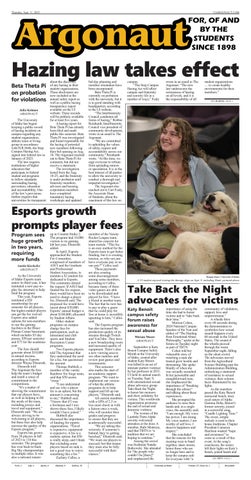
Reagan Jones | University of Idaho
A UI student enjoyed visiting the therapy dogs on Sept. 9, including Hank, pictured above
Take Back the Night advocates for victims Katy Benoit campus safety forum raises awareness for sexual abuse Miriam Moore ARGONAUT
September is Katy Benoit Campus Safety Month at the University of Idaho, created after student Katy Benoit was killed in an act of intimate partner violence by her professor in 2011. UI held its annual march on Tuesday, Sept. 9, with international sexual abuse advocacy group Take Back the Night, to honor her memory and show solidarity for victims. This worldwide organization promotes the end of sexual and domestic violence. The women of the Lambda Theta Alpha sorority welcomed attendees at the door. A member, Rubi Montoya, said that TBTN is “a tradition that we are hoping to continue.” Among the crowd was freshman Natalie Butkowski. She attended for “the people who couldn’t be [there]” and emphasized the
importance of using the time she had to honor victims and to “take back their time.” Marissa Cohen, 2024 National Campus Speaker of the Year and author of “The Healing from Emotional Abuse Philosophy,” spoke at the forum on Tuesday night as part of TBTN. Cohen told her vulnerable story of watching a man she trusted grow hostile and demeaning. She spoke bluntly of when she was sexually assaulted. In her personable and straightforward tone, she emphasized the importance of “breaking through the silence” and talking about these experiences. She prompted the audience to raise their hands and, in a single voice, the assembly said, “I am enough. My voice has power. I am strong. My voice matters. I am worthy of self love. I deserve happiness and respect.” She concluded that the reasons for the meeting were to band together, share stories, honor those who are no longer here and to keep the campus safe for everyone with “a
University of Idaho
community of validation, support, love and empowerment.” A whistle blew every 68 seconds during the demonstration to symbolize how sexual assault happens every 68 seconds in the United States. The sound of the whistle pierced through the warm September night, falling on the silent crowd. The advocates moved from the Agricultural Science Building past the Administration Building, embodying a statement of resistance to sexual violence, their solemn faces illuminated by tea lights. As the marchers passed the Katy Benoit memorial bench, teary eyed sisters of Alpha Gamma Delta, Benoit’s former sorority, joined in a sorrowful song, “Candle Lighting Time.” The sweet, simple melody is used in their house traditions. Chapter President Cameron Harelson wanted “hope and awareness” to come as a result of this event. At the song’s conclusion, the sisters left their lights on Katy’s bench, joined hands and
Volume 127, Issue no. 2
SEE TBTN, PAGE 2 Recyclable