History of the College of engineering
1908–2008
In 2008 the College of Engineering, University of Hawai‘i at Ma¯noa, celebrates its centennial. When classes began in 1908, there was one engineering professor; today there are 54. Since the College issued its first engineering diploma in 1912, over 9,000 engineering majors have graduated. It is an appropriate time to look back on the events and developments that have shaped the College, to honor key individuals, and to consider the role of engineers in the high-tech world we inhabit today.
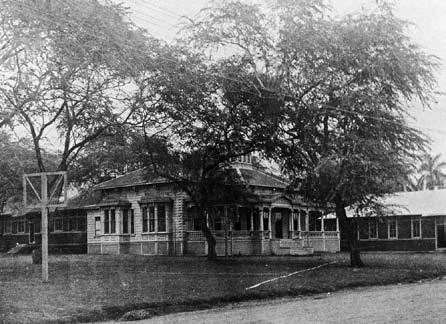
Engineering instruction first began in 1908 under the auspices of the newly-chartered land grant College of Agriculture and Mechanic Arts of the Territory of Hawai‘i, later to become first the College and then the University of Hawai‘i. To launch the new College, the newly-appointed president, John Gilmore, recruited the faculty, many of them from Cornell University, a New York land-grant institution. The faculty numbered thirteen, a fact of some amusement in the community since the first faculty outnumbered the first five regular students. It was soon evident that the engineering program proved more attractive than agricultural studies since the sons of immigrant workers were looking for a way out of plantation life rather than a return to that hard life. Classes began on Young Street near Thomas Square in quarters that had once been the Chinese Consulate, but in 1912 moved to the new campus in Ma¯noa Valley.
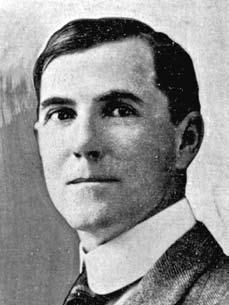
John Mason young, father of engineering education in Hawai‘i
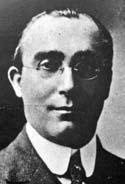
Among the initial thirteen faculty was John Mason Young, the new school’s only engineer. Young was the son of a Tennessee Presbyterian minister. The family’s finances were modest so Young worked as a mechanist and as a phosphate mine administrator until he earned enough money to attend college. He graduated from Cornell with a mechanical engineering degree. Recruited for Hawai‘i’s new College of Agriculture and Mechanic Arts, Young taught approximately half of all the engineering courses. He served as dean of the College before a president was appointed and as acting president during the absences of the president. By 1909 Young had completed a plan for the new college in Ma¯noa. Academics today speak of “vision statements.” Young’s plan for the new college was indeed visionary and included provisions for future schools of law, medicine, veterinary science,
Thomas Square facilities
John Mason Young
1907
College of Agriculture and Mechanic Arts of the Territory of Hawai‘i opens in temporary quarters near Thomas Square.
1911
College of Agriculture and Mechanic Arts becomes College of Hawai‘i and moves to Ma¯noa campus.
1912
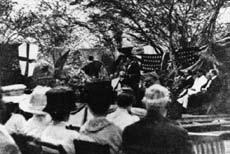
First degree in engineering awarded in ceremonies for first graduating class, College of Hawai‘i.
and architecture. There was even an observatory planned to be situated on Wa‘ahila Ridge above the College. Facilities, except for the observatory, were arranged in a quadrangular design, strongly resembling Cornell where Young had studied and taught. In an era when a line between “engineer” and “architect” was not so clearly drawn, Young was instrumental in the planning of the College’s first building, Hawai‘i Hall, and he designed and supervised the construction of other early buildings of the University: Miller, Dean, and Crawford Halls. Young’s campus structures were all in the neo-classical mode of architecture. After that, all efforts to maintain a unified campus architectural style were abandoned to the winds.
In addition to his teaching duties, Young joined the Pacific Engineering Company as chief engineer. Young’s endeavors in the private sector led to what were probably the University’s first conflict of interest cases. College president Gilmore recommended that Young be fired because he was spending too much time away from his teaching duties, but Young was to outlast Gilmore and continued to teach structural engineering at the College, and later the University, for over thirty years.
One of Young’s contributions to the city of Honolulu was the introduction of reinforced concrete power poles impervious to termite damage, woodrot, and heavy winds. Notable John Mason Young buildings in Honolulu include the Hawai‘i Theater, Theo H. Davies building, the central YMCA, the Young Hotel annex, McInerny, the Scottish Rite Cathedral, and the Hawaiian Pineapple and Libby-McNeill-Libby canneries.
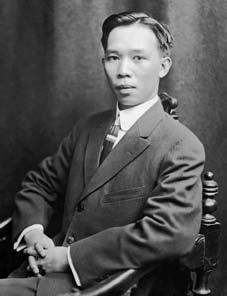
yong fook tong, Hawai‘i’s first engineering graduate
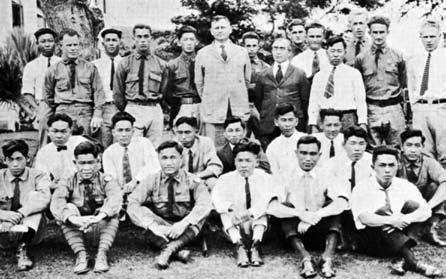
Shortly after the move to the new campus, the College held its first graduation ceremony. Unfortunately none of the original five students managed to graduate. Other students had replaced the original five, and among these was Yong Fook Tong, the College’s first engineering graduate. Tong was listed on College rolls as a resident of Maunawai, O‘ahu, a coastal area of Waimea Bay. Yong Fook Tong left Hawai‘i and is known to have been employed as an “office engineer” at the Armstrong Brothers in New York City until around 1920. Sometime after 1920, Yong Fook Tong moved to China and by 1928 was employed as chief engineer of the China United Engineering Corporation in Shanghai, an agent of the Truscon Steel Company of Youngstown, Ohio.
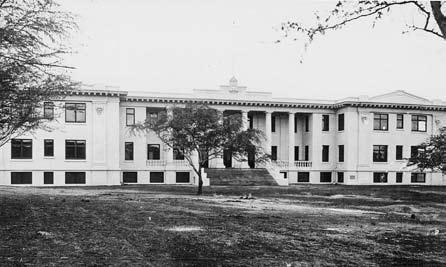
Hawai‘i Hall, the University’s first building
Yong Fook Tong
1915
Engineering Materials Testing Laboratory, the second oldest building on campus (after Hawai‘i Hall) erected.
the Keller era
1916
Engineering Professor Arthur Keller and his students oversee construction of the first paved road on campus.
1918
Mechanical and electrical engineering courses discontinued and only civil engineering courses offered.
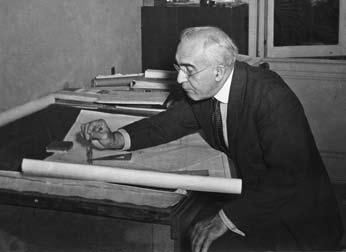
The legendary Arthur R. Keller joined the College in 1909 as a professor of civil engineering, and along with John Mason Young, was the mainstay of the engineering faculty until the end of the World War II days. One of Keller’s first achievements was the planning and execution of a paved road, the beginning of what was to become Campus Road. To test the durability of various road materials, Keller and his students designed the road in sections, the first of plain concrete, the second of reinforced concrete, the third of Warrenite, and the last of crushed concrete. Keller also concocted a drainage system for the grounds, at that time a marshy, overgrown tangle of kiawe and weeds.
a student reflects on His Courses, 1917
In the beginning, courses in mechanical, electrical, and civil engineering were offered, an ambitious program for a faculty of two professors. In 1916 a student, Leslie Hicks, recorded his impressions of courses for the school’s annual Palapala, leaving a firsthand personal record of engineering education in its early days:
In the first year, he learns mechanical drawing and carpentering. In the drawing room he begins with simple exercises to learn the use of drawing instruments and to make legible lettering. By the end of the year he is making drawings of small pieces of machinery. In the wood-shop he learns the use of carpenters’ tools, electrically driven saws, planes, etc., and most important of all, he learns the value of careful and accurate work.
By the second year the student finds his practical work in the foundry, in forging and surveying. If he has survived the first year with soft white hands, he soon loses them in foundry practice. He is given a blacksmith’s forge, anvil, hammers and other tools and shown how to use them. By the end of the first semester, if he is not hopeless, he has learned how to weld iron and temper steel. In the second semester he studies methods of forging at first hand in the very smoke and flare of molten metal and the roar of steam hammers and riveters. In the surveying class he appears in old clothes, and armed with the instruments of the profession he sallies forth.
Arthur R. Keller
Leslie Hicks
1920
College of Hawai‘i becomes University of Hawai‘i and engineering becomes a department of the newly
organized College of Applied Science with Arthur Keller named head of the latter.
1928
Engineering Quadrangle completed, four one-story concrete buildings surrounding
the Engineering Materials Testing laboratory. Engineering Materials Testing Laboratory
In the third year now he has arrived at the very fundamental of all structural engineering. In the materials laboratory he puts through practical tests of all materials of interest to engineers: iron, steel, sand, cement, rock, brick, wood, and the fuel, lubricating and road oils. He learns to use the electrical apparatus, calculating instruments and various power recording apparatus. On the basis of knowledge gained in the laboratory, he writes a notebook of some four hundred pages, a valuable reference book in after years. In chemistry for engineers, hydraulics, railroad surveying, and topographical surveying, the student finds work of practical application and absorbing interest.
In the fourth year comes the most interesting researches in bacteriology, electrical measurements, materials, municipal engineering, steam machinery, bridge design, structural design, contracts, and specifications.
(LESLIE HICKS, PALAPALA, 1916)
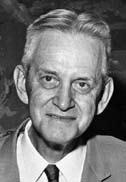
Leslie Hicks, later to become one of Hawai‘i’s most prominent electrical engineers, was one of the last engineering students at the College to work in the forge and machine shops. When John McTaggart, the shop instructor, died in 1908, the requirement of shop work was dropped. It was also decided that the expense of equipping the mechanical and electrical engineering facilities was not warranted by the limited demand, and thereafter engineering offerings were more realistically reduced to courses in civil engineering only.
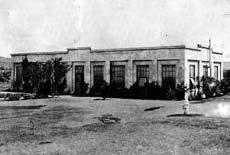
engineering Materials testing laboratory and the engineering Quad
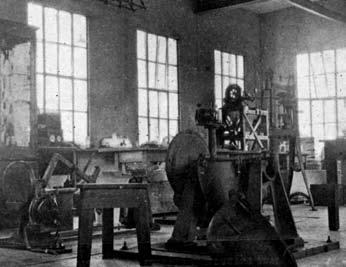
Hawai‘i Hall, the College’s first building, was completed in 1912. To house engineering laboratory equipment that could not be accommodated in Hawai‘i Hall, in 1915 the Engineering Materials Testing Laboratory, the college’s second permanent building, was erected. Built at a cost of $8,146, it still stands and is in use today for publication purposes. It probably represents the Territory’s best bargain in public buildings.
The pride of the engineering faculty was the Reihle Universal Testing Machine, a 150,000 pound machine purchased second-hand. It served to demonstrate to students the behavior of materials under stress but also served the community, and was used for testing concrete construction work
Fourteen engineering degrees awarded.
1940–41
One hundred engineering students enrolled.
1947
Wilfred Holmes becomes second dean of the College of Applied Science.
at the Pearl Harbor dry dock. The rugged machine survived many mishaps, but served for sixty years until in 1969 it was transferred to Honolulu Community College.
The Engineering Quadrangle, a complex of four rectangular single-story structures, was built between 1915 and 1928. It housed classrooms and storage for the engineering department. Arthur Keller designed the durable structures, four of which still remain in use. In 1965 the complex was officially named for John Mason Young. A plaque mounted on a moss rock originally located within the Quadrangle, but now situated in the courtyard of engineering’s present quarters, bears the insignia: “Dedicated to the memory of John Mason Young, 1908–1940.”
the College of Hawai‘i Becomes a University
With World War I hastening change, William Kwai Fong Yap, a Honolulu bank official, led a movement in 1920 which succeeded in changing the provincial land grant college into a university with two colleges: Arts and Sciences, and Applied Sciences. Engineering studies were placed within the College of Applied Science, along with home economics, agriculture, and sugar technology. Engineering enrollments were sparse, and by the start of World War I, only seven engineering students had graduated.
By the 1930s there were six engineers on the faculty. John Mason Young taught structural design on a part-time basis. Ernest Webster was dean of student personnel for the university and also taught engineering mathematics and surveying. Carl B. Andrews, chair of the engineering department, carried a full load of courses. Russell Brinker, a young instructor, taught mechanical drawing, surveying, and mathematics. Wilfred J. Holmes, a jack-of-all-trades instructor, joined the engineering faculty in 1936 and taught physics, electrical engineering, mechanical engineering, civil engineering, and mathematics. Arthur Keller carried on his teaching assignments, but also was a vice president of the University as well as dean of the College of Applied Science. Alvin Hoy, a mathematician, taught calculus courses to engineering students and Willard Eller of the physics department, taught electrical engineering courses.
Engineering classes between the two world wars remained small, and only about seven engineers a year were graduated in this period.
Agricultural studies leaves College of Applied Science to become a separate College of Agriculture.
1950
Mae Nakatani becomes the first woman to graduate with a degree in engineering.
War years
1953
Hawaiian Electric and Westinghouse Electric companies give University the equipment for a heat power laboratory, enabling
the University to offer courses in general engineering in addition to civil engineering.
By the time bombs fell on Pearl Harbor engineering enrollments were up to around 100 students. University classes were suspended for about two months, and when they resumed, Keller was appointed as acting president of the University, in addition to his teaching duties. Half the student body and a large share of the faculty were drained off by the war effort. Two years earlier, the foresighted Keller had initiated a program of evening classes in naval architecture, taught by Pearl Harbor naval architects to senior engineering students and recent graduates. The design section of Pearl Harbor eagerly absorbed the graduates of this program, but the engineering department rapidly declined until there were only two engineers on the University faculty. Keller taught as many as eight classes during the war years. Nine engineering degrees were awarded during the war years, but only one in 1946.
Post War and the enrollment explosion
Keller retired in 1947 and Wilfred Holmes, who had returned from wartime naval service, became dean of the College of Applied Science.
GI Bill veterans flooded the campus after the war and space problems became critical. Joseph Kunesh, a Honolulu engineer, joined the University staff, first as university engineer and then, for four years, as dean of the College of Applied Science. In a bold move to deal with the space crunch, he acquired an entire army surplus field hospital for the University and transported about ninety wooden barracks to the campus, converting them to classrooms, offices, and even living quarters. Although university president Gregg Sinclair was appalled with the aesthetics of the new “temporary” buildings, they served the purpose. Some of these survive on campus today.
Mae nakatani, first female engineering graduate
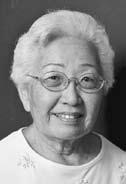
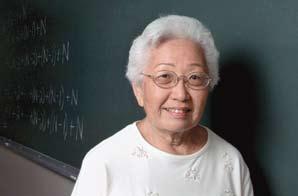
Mae Nakatani earned a place in university history by becoming the first woman to graduate with a degree in engineering. Both Nakatani’s uncle and father, she said, were interested in engineering, and this encouraged her own interest. Nakatani recalled that when she attempted to register, she was advised to go into another field. She persisted and graduated in 1950
1924: 1st engineering society (Palapala)
1953
Engineering and mathematics departments separated administratively.
1958
Department of Engineering becomes College of Engineering.
1959
Keller Hall, a new home for engineering and mathematics activities, completed.
as the only woman in a class of 53. Soon after graduation, she married an engineering classmate, Rikio Nishioka. She went on to a successful career as an engineer. She was employed in the Highway Planning Department of the Territory, later joined the Hawai‘i Irrigation Authority, and then the Public Works department of the Department of Transportation. She was a Facilities Planning officer at the University of Hawai‘i and a head of that unit until her retirement in 1983. Despite her initial reception when she first registered for classes, she did not experience discrimination in her professional activities.
Record setting seems to run in her family. Her mother was the first American Japanese to graduate from Queen’s Hospital School of Nursing and her daughter Susan is a Hawai‘i Swimming Hall of Fame inductee.
a new Home for engineering, Keller Hall
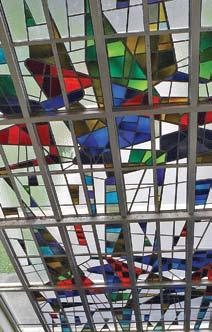
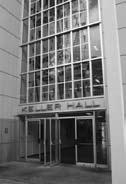
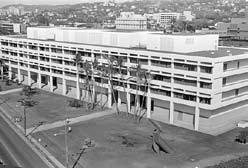
In 1959, Hawai‘i’s statehood year, Keller Hall was erected to house the engineering and mathematics departments. Named in honor of the many contributions of Arthur Keller, Keller Hall was designed by Clifford F. Young. The builder was Edwin M. Tani, a 1949 graduate in engineering. Distinguishing this four-story reinforced concrete structure are striking stained glass windows, 12 feet wide and three stories high, designed by art professor Murray Turnbull and his wife Phyllis. Concerning these works the artists wrote, “The principal purpose of the colored glass was to provide an opening of space and a life of color and light in the otherwise enclosed boxlike spaces of the building. No story or symbolism was involved; the basic intention was to enrich the lighting and character of spaces which were to be primarily functional.”
Agricultural studies had split off from Applied Science in 1947 to become a new College of Agriculture, leaving Applied Science with curricula in engineering, nursing, and medical technology. When Nursing and Medical Technology left the bed and board of Applied Science, only Engineering was left, and in 1959 the engineering department became the College of Engineering. Wilfred Holmes’ title was now dean of the College of Engineering.
Mae Nakatani Nishioka
Keller Hall
1961
First group of electrical engineers graduate.
1963
First group of mechanical engineers graduate.
1963
Master’s degrees in civil engineering and in electrical engineering authorized.
1965
Center for Engineering Research created from Engineering Experiment Station.
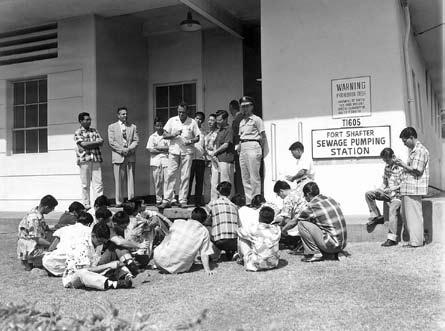
1958 engineering class visiting Fort Shafter Pumping Station (UH Archives)
Broadening the engineering Curriculum
In post-war years engineering enrollments rose rapidly, so much so that a broadening of engineering offerings became desirable.
In 1953 Hawaiian Electric and the Westinghouse Electric companies gave the University equipment for a heat power laboratory. It was then possible to increase offerings in mechanical engineering and to offer a degree in general engineering in addition to civil engineering. Fourteen general engineering degrees were awarded in 1959. Since 1980 degrees in general engineering were no longer awarded.
When Keller Hall was occupied, space was released in the old engineering quadrangle, making room for electrical engineering laboratories. Emeritus Professor Kazutoshi Najita recalls the early days of the electrical engineering program when he and Ralph Partridge, starting from bare walls, developed a laboratory. Najita came to the University from the Sperry Corporation; Partridge was earlier involved with the US missile defense program. Both were interested in research. They acquired Navy surplus materials that students helped them assemble. Each Sunday Najita and Partridge would write out the experiments for the week. Under the direction of Ralph Partridge at first and later under Paul Yuen, the electrical engineering program developed rapidly. Najita and Yuen carried out some groundbreaking research on ionospheric characteristics. In 1962 the Engineers’ Council for Professional Development accredited the electrical engineering curriculum. The first group of electrical engineers graduated in 1961.
Electrical engineer Edward Weldon was one of the first professors to encourage the concept of entrepreneurship for faculty members. Weldon, a national leader in communications, with two other UH faculty members, formed the Adtech company. Adtech was a Hawai‘i success story (it was later incorporated by Spirent Communications, a large coding and network company). The formation of local firms has important implications for the electrical engineering job market. Traditionally civil engineers have no trouble finding positions in Hawai‘i, but electrical engineers often necessarily leave the islands for employment opportunities. More companies mean more jobs.
A curriculum in mechanical engineering was first offered in 1960 and in 1963 the first group of mechanical engineers graduated.
1966
Dept. of Ocean Engineering established as a graduate program. James K. K. Look Laboratory of Oceanographic
Engineering transferred to the College from the US Army Corp of Engineers. Doctorate in electrical engineering authorized.
1969
Masters degree in mechanical engineering authorized.
graduate Programs
Graduate instruction was neglected until the 1960s because of the urgent need to develop a strong undergraduate program. With this accomplished, masters’ degree programs in civil engineering and in electrical engineering were authorized by the University in 1963 and for mechanical engineering in 1969.
The electrical engineering department first offered a PhD in 1966, and the first doctorate was awarded in 1969; Chin-Long Chen of Taiwan was that graduate with a dissertation titled: “Some results on algebraically structured errorcorrecting codes.” The mechanical engineering doctorate was offered beginning in 1985. Thereafter, the Board of Regents had a strong disinclination to authorize new doctoral programs. The university’s Graduate Program Review team urged engineering to consider a single-college “umbrella” doctorate rather than a doctorate in civil engineering, but in the end, concluded that such a plan was not feasible. A PhD program for civil engineers was finally approved in 1992.
ocean engineering
An innovative program in ocean engineering, one of the first in the country, began in 1966. The program became a department in 1968. A strong faculty, headed by Charles Bretschneider, an expert in coastal engineering, beach erosion, and tsunami wave forces, and Manley St. Denis, who had done pioneering work on sea-keeping in random seas, founded the program. Later, the multi-talented marine scientist John Craven, recruited by Governor John Burns to place Hawai‘i at the forefront of world maritime affairs, added additional depth and glamour to the program. Hawai‘i, situated in the middle of a natural laboratory with clear, warm, deep water relatively close to shore, was a natural choice for such a program and the department thrived. During the first decade of the program, there was a concentration on hydraulic studies, coastal structures, and offshore platforms. Emphasis shifted in the second decade to research based on computer modeling and exploration of ocean resources, especially on the potential of ocean thermal energy conversion.
The James Look Laboratory of Oceanic Engineering was transferred from the federal government to the university in 1966 and served as a major applied research facility for coastal engineering. The Look Laboratory was named in honor of UH engineering graduate, James Look, who lost his life while making observations in Hilo for the U.S. Corps of Engineers during the 1960 tsunami. The Look Laboratory closed in 2004.
1972
Holmes Hall, housing all engineering activity on Ma¯noa campus, completed.
1974
Fujio Matsuda becomes first engineer to become UH president.
1980 Department of general engineering disbanded.
1981
Paul Yuen becomes dean of College of Engineering.
In a somewhat controversial move, in 1989 ocean engineering was transferred to the newly established School of Ocean and Earth Science and Technology (SOEST). Close ties remain between the reorganized Ocean and Resources Engineering department and the College of Engineering in the form of joint research activities and the use of background engineering courses by ocean engineering students.
Holmes Hall and the gate of Hope
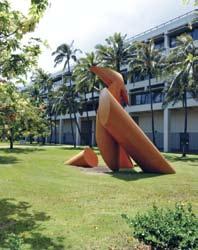
Groundbreaking for the College of Engineering’s new quarters took place in 1969 and the building was occupied in 1972. Gracing the new building is an immense sculpture, a thirty-foot high work constructed of 3/4 inch thick steel plates, rolled and welded together, created by the Russian-American artist, Alexander Liberman. Opinions on the piece were mixed, but noteworthy are comments from the respected artist Mamora Sato who found the work “artistically appealing, working well in terms of the space provided in terms of color, and interesting from all different angles.” The bright-orange sculpture “Gate of Hope” was originally designed to be complemented by the orange trim and railings of Holmes Hall and the surrounding flame-red poinciana trees. Liberman’s works are held by major museums throughout the country. A 2006 book Them by his daughter-in-law, the writer Francine du Plessix Gray, details some of the colorful events of his life.
engineering education and socio-economic issues, 1970–2000
The College of Engineering, along with the rest of the University, in the last decades of the twentieth century suffered through a number of state and federal economic downturns. Engineering Dean John Shupe, successor to Wilfred Holmes, identified another problem for engineers in general. Especially in the 1970s, Shupe commented, the engineering profession was held in low esteem because the public blamed environmental ills on misdirected technology. Shupe was a vocal advocate for the development of alternative energy sources. His alternative energy campaign kept the College of Engineering in the headlines throughout the 1970s. He was acutely aware of Hawai‘i’s over-reliance on oil and its particular vulnerability as an island state. Shupe’s successor as dean, Paul Yuen, continued a focus on alternative energy sources. Shupe was influential in the 1974 founding of the Hawai‘i Natural
“Gate of Hope” sculpture in front of Holmes Hall
1985
Doctoral program in mechanical engineering begins.
1989
Ocean engineering transferred to new School of Ocean and Earth Science Technology.
1992
Doctoral program in civil engineering established.
Energy Institute, a multi-disciplinary organization devoted to research and development of natural energy technologies, and both Shupe and Yuen served as directors of that Institute. As University historians, Robert M. Kamins and Robert Potter, point out however, not all residents were happy with some energy projects, most notably geothermal research.
As the century closed, budget cuts had severely hampered engineering programs. The operating budget had been cut by 30%, the faculty had decreased by 20%, and enrollment in the last five years of the 1990s dropped by 30%. Dean Wai-Fah Chen, who assumed the deanship in 1999, credits Governor Ben Cayetano with a one million dollar cash infusion to the College’s base budget. Chen used the funds to retain faculty, to bring in some new faculty members, and to recruit and retain a strong student body.
the growth of research
Through research, Hawai‘i’s academic engineers can connect to the community, offer tangible benefits, and positively effect economic and social progress. Arthur Keller’s 1916 experiment with road-construction materials, resulting in the first campus road, illustrates an early research contribution to the community. (“For the first time,” rejoiced the Board of Regents, “the college is readily accessible by automobile in all sorts of weather and a battery of foot-scrappers is not necessary!”). Examples from the late 1960s coming from the university’s Look Laboratory include erosion prevention models for the popular Ku¯hio¯ Beach and stability studies for Honolulu airport’s new reef runway.
A major development in the academic research world was an administrative structure designed to deal with the critical importance of extramural funding for research activities. Issues of patents, revenue sharing, and proprietary interests arose. Professors learned to add grantsmanship to their arsenal of skills and to balance both teaching and research duties. Today external research funding provides more than half the College’s total operating budget.
The most visible research project of the early 1970s was the Additive Links On-line Hawai‘i Area Systems Network (ALOHA). This story begins with the faculty appointment of W. Wesley Peterson, noted for his invention of the Cyclic Redundancy Check, for which he was awarded the prestigious Japan Prize. Peterson’s work Error Correcting Codes is the standard text on
1999
Wai-Fah Chen appointed as dean of College of Engineering.
2001
Hawai‘i Center for Advanced Communications established. Native Hawaiian Science and Engineering Program established.
2002
Civil Engineering becomes Civil and Environmental Engineering.
2006
Peter Crouch assumes deanship.
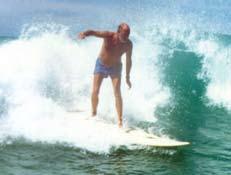
this subject. Peterson’s presence on the University campus attracted other scientists in the field. Among these was Norman Abramson. Abramson’s passion was surfing, but he had other talents as well. Abramson is credited with the development of the ALOHA protocol that transmits data via radio waves, rather than by wires. Funded by IBM, the Nippon Electric Company, and NASA, the project attracted international attention, and was a steppingstone to today’s advanced wireless communication systems. A PBS program acknowledges Abramson’s contributions, as does the book Nerds 2.0, a history of the internet.
One of the most important projects, which was headed by Frederick Munchmeyer, a professor of mechanical engineering, was the ocean thermal energy conversion program at Kea¯hole Point on the Big Island. From that project, the NELH was founded, which contributes to the Hawai‘i economy in many ways other than energy production. It was the vision and drive of John Craven that got funding for NELH.
In the 1970s, the College’s research efforts were in computers, communications and electronics; alternative energy; marine environments; structures; freshwater and the environment; space and motion; and transportation. Faculty were studying errors in computer data transmission, especially for satellite communications, computer communication networks and other multi-use systems. Fundamental limits of communication caused by noise, power, static, bandwidth or other factors were also being investigated. Methods of sending voice signals by digital means, counting the number of electrons between a fixed point on earth and a geostationary satellite to lead to better satellite placement, fiber optics, artificial or machine intelligence, development of digital simulation techniques suitable for investigations of stability and performance of sound projection and funding for a solid-state device laboratory where students learn to design and construct integrated circuits were all part of the on-going research in computers, communications and electronics during this time.
Alternative energy resources were important research topics in the 1970s and 1980s, especially since Hawai‘i has no fossil fuel resources. Research on understanding how heat is transferred in porous media such as the rock structure in Hawai‘i’s geothermal fields led to using geothermal heat to generate power. Another project, also studying heat transfer mechanisms, used refrigerants such as Freon-11 as the working fluid in alternative energy systems such as ocean thermal energy conversion. A group of researchers
Norman Abramson
Hawai‘i Space Flight Laboratory established.
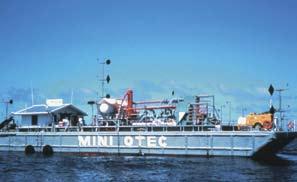
looked at wind energy, designing wind energy generators and means to interface wind turbine generators with the utility grid. Several faculty worked on the use of hydrogen as an alternative fuel, looking at issues such as generation and storage. Others looked at solar energy to power photovoltaic cells and for solar heating. In the newly constructed Renewable Resources Research Laboratory, research was done on a pyrolysis process (the breaking apart of complex molecules into simple units by the use of heat) that uses sunlight to convert biomass to liquid hydrocarbon gases and liquids. Biomass particles included wood chips, sugar cane, and corn cobs. Ocean thermal energy conversion (OTEC), another alternative technology based on solar energy, uses the principle of a heat engine that operates between two sources that are at different temperatures to produce electricity. Wave energy was another alternative energy source, with much of the ocean energy research conducted by the Ocean Engineering Department, a part of the College of Engineering until 1989 when it was transferred to the newly-formed School of Ocean and Earth Science and Technology.
Research in the 1990s dealt with areas such as high tech applications, environmental issues, ocean-related interests and space applications. Energy continued to be a concern during this time. Computer chip designs, integrated circuit designs, chip fabrication, microelectromechancial systems (MEMS), millimeter-wave systems for wireless communications, passive sampling devices, and video compression were investigated. MEMS refers to the integration of mechanical elements, sensors, actuators, and electronics on a common silicon substrate through microfabrication technology. While the electronics are fabricated using integrated circuit process sequences, the micromechanical components are fabricated using compatible ‘micromachining’ processes that selectively etch away parts of the silicon wafer or add new structural layers to form the mechanical and electromechanical devices.
In the environmental area, faculty looked at subjects such as the creep characterization of tropical soils, mitigating natural hazards damage, concrete durability, waste ash for geotechnical application, bioremediation of contaminated soils and monitoring the H-3 North Ha¯lawa viaduct. Studies on corrosion were also conducted. Ocean-related projects included the study of wave-induced responses of very large floating structures, a multiple autonomous vehicle imaging system, underwater robotics, development and
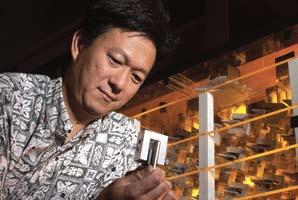
Lloyd Hihara doing corrsion studies
Mini-OTEC experimental barge
testing of a wave-driven artificial upwelling device, and a large project on the development of a semi-autonomous underwater vehicle for intervention missions. Space research included the application of composite and smart materials to space structures, and error control coding techniques for space and satellite communications. Energy research included the Hawai‘i electric vehicle demonstration project.
In more recent years, engineering professor Lloyd Hihara’s research program addresses corrosion, an international issue but one especially problematic in Hawai‘i because of the high salt-content of the air. The Pacific Rim Corrosion Research Program (PRCRP), headed by Hihara in cooperation with the US Army and other sponsors, is developing testing sites around the state, testing various protective treatments, and looking at the effect of corrosion on advanced electronics systems.
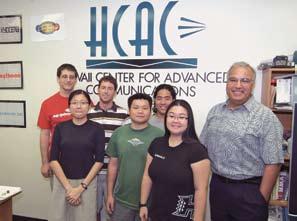
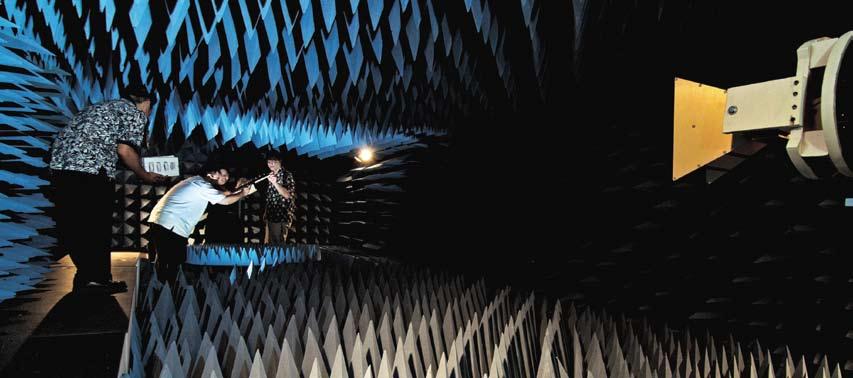
In 2000, the Board of Regents established the Hawai‘i Center for Advanced Communications (HCAC) within the College of Engineering. HCAC aims to become the leading center for multi-disciplinary research in the telecommunications field. Special emphasis is on broadband wireless communications and integrated communication systems that include wireless, optical power-line, and satellite communications. Internationallyrecognized Magdy Iskander, a Fellow of IEEE and a former National Science Foundation program director, was recruited from the University of Utah where he had held an endowed chair. The center has attracted extramural funding and brought two major IEEE conferences on wireless technology and antenna systems to Hawai‘i. Wireless communication advances have profound implications for the technological and economic future of Hawai‘i. Iskander speaks of his goal of a “Wireless Waikı¯kı¯” to attract business and convention people, and a “Wireless Pearl Harbor” in support of the defense industry. The Center has also reached out to Hawai‘i schools to encourage a new generation of telecommunication entrepreneurs.
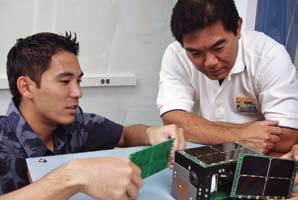
In 2007 the Hawai‘i Space Flight Laboratory was launched as a joint project of the College of Engineering and the School of Ocean and Earth Science and Technology. Participants will design, launch, and operate microsatellites configured for a variety of scientific and educational tasks. Electrical Engineering Professor Wayne Shiroma is co-director of the program.
Magdy Iskander (right) with HCAC graduate students
Justin Akagi (left) and Wayne Shiroma, co-director of the Hawai‘i Space Flight Laboratory working on a micro-satellite
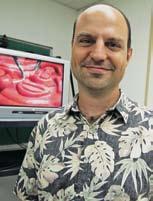
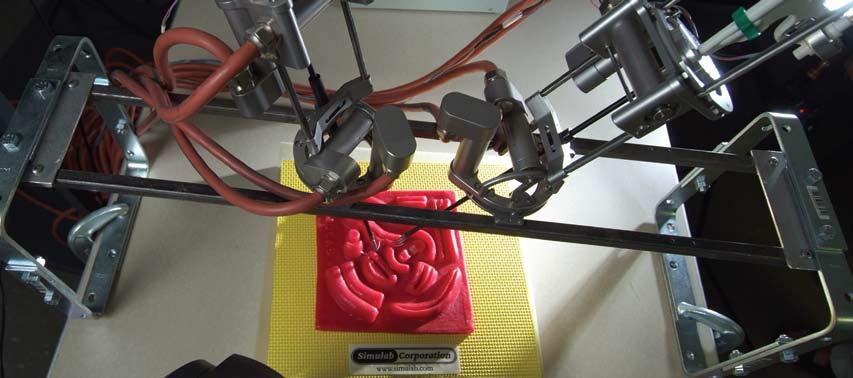
The National Academy of Engineers identifies bioengineering as one of the waves of the future. Professor of Mechanical Engineering Peter Berkelman has designed an experimental robot that looks ahead to this future. Berkelman’s tool is designed to be attached to an endoscope (a specialized video camera attached to a long, thin rod inserted into the human body) to display images of internal tissues on a video monitor during surgery. The robotic tool allows the physician to manipulate and control the endoscope with various hands-free command interfaces such as voice recognition.
Another ongoing futuristic biomedical research project is that of electrical engineering professors Olga Boric-Lubecke, Victor Lubecke, and Anders Host-Madsen, who have developed a new technology called the Heart Sensing Radar/Life Reader. The device marries microwave Doppler radar to digital signal processing to create a means of detecting life signs. It is wireless, can see through walls, and can distinguish the signals of multiple people. Practical applications of this might include searching for signs of life at an accident scene, scanning airport security lines for signs of anxiety or hostility, or unobtrusive monitoring of at-risk medical patients.
Civil engineering: Connecting to the Community
To a large extent, the Department of Civil and Environmental Engineering and its graduates are responsible for the infrastructure of the State of Hawai‘i.
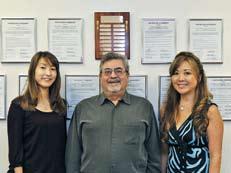
The Hawai‘i Local Technical Assistance Program (LTAP) represents a town and gown connection for Hawai‘i’s civil engineers. The program, one of 58 US LTAP centers, was transferred from the Hawai‘i Department of Transportation to the Department of Civil and Environmental Engineering in 1998. LTAP’s mission is to deliver a broad range of quality training, technology transfer, and information sharing through cooperative relationships that promote best practices throughout the statewide transportation system. LTAP receives its basic funding from the Federal Highway Administration and the Hawai‘i Department of Transportation. To strengthen its ties to the engineering community, to date the program has executed ten partnering and resource-sharing agreements with Hawai‘ibased industrial and professional groups, the most of any of the 58 centers
Peter Berkelman
Constantinos Papacostas (center) with LTAP staff members Gail Ikeda (left) and Juli Kobayashi (right)
across the nation. Civil Engineering Professor Constantinos Papacostas has directed the program since its UH inception, has organized numerous workshops and training activities, provided technical and policy assistance to local and state governments,, and has edited the LTAP newsletter Hawaiian Connections. The newsletter covers current developments and projects and since its beginning has become a compendium of practical information on such matters as notable transportation projects (preserving the historic character of Hanalei Bridge, for example), the “building a better mousetrap” column (devices invented by local workers to improve engineering operations), and until 2002, the “Lum’s Rule of Thumb” column (advice from the late master engineer Walter Lum on ways to solve complex problems).
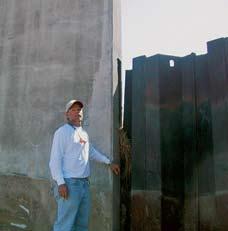
The College supplies a solid team of experts who have responded to Hawai‘i’s natural disaster emergencies. Geotechnical engineer Peter Nicholson has served as a local volunteer for a number of geo-related disasters, including the rockfall at Ma¯kaha Towers, the rockfall at Sacred Falls, and the Kaloko Dam failure on Kaua‘i in 2006. He was one of an expert faculty team that assessed damage from the 2007 Kı¯holo Bay and Ha¯wı¯ earthquakes on the Big Island. On the national scene, in the days following Hurricane Katrina on the US Gulf Coast, he was called on to assemble a team of engineers to inspect the hurricane production system and determine causes of the catastrophic failure. His team wrote the first report on the causes of the levee failure.
Peter Nicholson next to a failed levee wall in New Orleans.
H onors
regents’ Medal for excellence in research College of engineering faculty awards
2006 Albert Kim, Civil Engineering
2002 Marc Fossorier, Electrical Engineering
regents’ Medal for excellence in teaching College of engineering faculty awards
2003 Wayne Shiroma, Electrical Engineering
2002 Beei-Huan Chao, Mechanical Engineering
1999 Rahul Chattergy, Electrical Engineering
1994 Peter Nicholson, Civil Engineering
1991 Vinod Malhotra, Electrical Engineering
1990 Bruce Liebert, Mechanical Engineering
1982 Arthur Chiu, Civil Engineering
national science foundation
Presidential young investigator award College of engineering recipients
1991 Kenneth Zeger, Electrical Engineering
1991 Junku Yuh, Mechanical Engineering
1990 Lloyd Hihara, Mechanical Engineering
1989 Galen Sasaki (awarded in Texas), Electrical Engineering
1989 Michael Smith, Electrical Engineering
1988 Anthony Kuh, Electrical Engineering
a Century of l eadership
arthur ripont Keller (1882–1961)
Arthur Keller joined the faculty of the College of Agriculture and Mechanic Arts in 1909. When he first came to Hawai‘i, he had a civil engineering degree from Cornell and a law degree from the National University Law School. In 1915, he went on a sabbatical leave and returned with two engineering masters’ degrees, one from MIT and one from Harvard. By the time Keller returned from active duty in World War I, the College of Hawai‘i had become the University of Hawai‘i, and Keller was appointed as the first dean of the College of Applied Science, which included engineering, agriculture, home economics, and sugar technology.
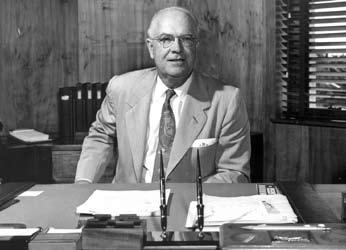
Keller’s name is associated with many phases of the young University’s development. He maintained a heavy teaching schedule, helped plan the buildings and grounds of the University, served as an administrator, and was acting University president during World War II days. The city of Honolulu often drew on his expertise in matters relating to city planning, health services, and sewer design. This versatile man played on the 1911 college football team and at the age of 58 took flying lessons. Keller’s depth of knowledge was legendary. Once, another professor tried to substitute for him for a course on engineering contracts. Too late, the substitute professor realized that to stand in for Keller meant lecturing on Hawaiian land law, Hawaiian laws of water rights, statute law, and the case histories of local court decisions affecting engineering. The instructor confessed that he could not teach the course as Keller had. “Nobody else can either!” was the only sympathy the instructor received.
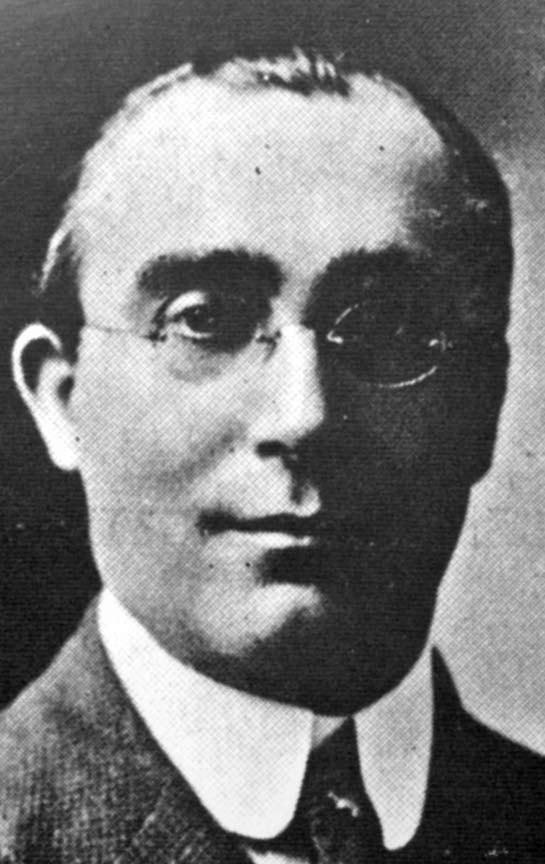
One of Keller’s many contributions was the design of a campus drainage and flood control system. After the disastrous campus flood of 2004, his portrait fell from the wall of Keller Hall where it had hung for 44 years, confirming the belief of some that Keller’s spirit haunts his namesake building.
Wilfred Jay Holmes (1900–1986)
Wilfred Holmes graduated from the US Naval Academy in 1922 and thereafter was assigned to submarine duty. A disability forced his retirement from the Navy and in 1936 he joined the University of Hawai‘i faculty as an assistant professor of engineering and mathematics. During World War II, he was recalled to active duty and served as an intelligence officer under Chester Nimitz. He worked in a secret room located under the Pearl Harbor headquarters building, helping to decode information from Japanese radio transmissions. Holmes returned to academia after the war to become dean of engineering. Holmes served as dean of the College of Engineering from 1947 to 1965 (there were short breaks in his deanship when he returned to teaching or was called to University administrative duties). Holmes saw many changes during his tenure. When he first came in 1936 there were only a few dozen engineering students. When he retired enrollment counts reached some 800. Holmes led an alternative life as a successful writer. Under the pen name Alec Hudson, and drawing on his military experiences, he published a number of fictional stories on submarine warfare in the Saturday Evening Post as well as several fictional and non-fictional books on this subject.
One of the most notorious incidents of his writing career concerns the “second attack on Hawai‘i” in March of 1942. That month bombs ripped holes in Tantalus although no one was hurt. After the war it was confirmed that the bombs were indeed launched from a Japanese seaplane fueled by a submarine. Earlier Holmes had published a short story “Rendezvous” describing in strikingly similar terms the methodology of such an attack. Holmes dismissed any suggestion that the attack was inspired by his story. The technology was well known to the world’s navies, and moreover, he said, he doubted that Japanese commanders sat around reading the Saturday Evening Post.
H onors
national science foundation Career awards College of engineering recipients
2008 Anyuan Cao, Mechanical Engineering
2006 Gurdal Arslan, Electrical Engineering
2005 Albert Kim, Civil Engineering
2002 Audra Bullock, Electrical Engineering
2000 Farzad Mashayek, Mechanical Engineering
1999 Zixiang Xiong, Electrical Engineering
1998 Marc Fossorier, Electrical Engineering
1995 Eun Sok Kim, Electrical Engineering
1995 Patrick Phelan, Mechanical Engineering
1995 Gregory Uehara, Electrical Engineering
eta Kappa nu alton B. Zerby and Carl t. Koerner outstanding electrical or Computer engineering award
College of Engineering Student Recipients
2007 Monte Watanabe (honorable mention)
2005 Blaine Murakami
2003 Aaron Ohta
2001 Kendall Ching
John Wallace shupe (1924–2001)
John Shupe held a bachelor’s degree in mechanical engineering from Kansas State University, a master’s in civil engineering from the University of California, and a doctorate in civil engineering from Purdue. He was stationed in England during World War II and flew missions over Germany as a B-17 navigator. In a flight over Leipzig, he suffered near-fatal injuries and for that received a Purple Heart and Distinguished Flying Cross. He was associated with Hughes Aircraft and Consolidated Vultec Aircraft Corporation, and before his appointment as dean of the UH College of Engineering, he was coordinator of an Agency for International Development unit that sponsored an engineering educational program in Egypt. Shupe was dean of the UH College of Engineering from 1965–1980.
As an academic, Shupe had a mission and that was promotion of alternative energy sources. He spoke out often on the danger of Hawai‘i’s dependence on imported oil and was an ardent advocate for Hawai‘i’s rich stores of alternative sources: solar, ocean temperature differentials, wind, waves, geothermal power, and biomass.
When he left Hawai‘i in 1996, he became the director of the Pacific Site Office of the US Department of Energy in San Diego.
Paul C. yuen
Yuen was born in Hilo but moved with his family to Honolulu where he graduated from Roosevelt High School. He earned a B.S. from the University of Chicago and a PhD from Illinois Institute of Technology. He was an engineer at Standard Coil Products and Armour Research Foundation before beginning a teaching career at Illinois Institute of Technology. Yuen joined the UH faculty as an associate professor of electrical engineering in 1961 and was dean of the College of Engineering from 1981–1999.
His academic interests and writings center on atmospheric dynamics, renewable energy, and high technology. One of his notable projects was the innovative PEACESAT project that linked Hawai‘i with some twenty Pacific island nations. Yuen was the engineer for the project; John Bystrom and Katase Nose participated in other capacities. As dean, Yuen pioneered a curriculum that focused on real world projects supported by strong technical skills. He was ahead of his time in developing a summer program encouraging native Hawaiians to consider engineering as a career, although ironically, he remembers, the program ran afoul of civil rights advocates. A modest man, he is not inclined to talk about his accomplishments, but he does report on his satisfaction with delivering what the people of the state wanted, a fully accredited engineering school.
He was called upon to serve as UH vice president for academic affairs, UH senior vice president, executive vice chancellor and acting UH president. To these positions he brought a rare understanding of how the state government of Hawai‘i works and as a result improved communication lines between the University and “downtown.”
Reginald Young was interim dean of the College of Engineering during the five-year period of Yuen’s administrative leave.
fa CU lty e ndo WM ents
the arthur n.l Chiu endowed scholarship
The Arthur N.L. Chiu Endowed Scholarship, established in 2006, honors one of the College of Engineering’s most respected professors. Chiu, an international authority on the effect of wind on structures, taught civil engineering classes for over 42 years. Robert Akinaka and Edward Hirata helped establish the scholarship as a means of giving back for all of Chiu’s contributions. “You know how we all credit that one teacher for our success, the one teacher you remember, who took personal interest? For many of us, that’s Dr. Chiu,” Akinaka said.
Chiu died in 2006 after suffering a stroke at a meeting of the Structural Engineering Association of Hawai‘i, “literally on the job,” said Hirata.
the dr. Hi Chang Chai excellence in teaching award endowment fund
The Hi Chang Chai Endowment provides three teaching awards each year, one each for civil, electrical and mechanical engineering faculty. Chai established the endowment in 1998 to provide a cash award to those faculty who exemplify excellence in teaching. Chai was the advisor to all graduating seniors in mechanical engineering, ensuring that they were on track to graduating and keeping in touch with the students after they graduated.
Wai-fah Chen
“War, war, war. Run, run, run.” This is Wai-Fah Chen’s description of growing up in China. With his brothers he escaped to Taiwan. His undergraduate degree was from the National Cheng-Kung University in Southern Taiwan. He studied structural engineering at Lehigh University in Pennsylvania, a fortunate choice, he says, because of Lehigh’s revolutionary program in plastic design replacing an older method of allowable stress design. Chen’s PhD was from Cornell with a concentration on plasticity, a branch of applied mathematics describing the inelastic behavior of materials. Chen returned to Lehigh to teach and later moved on to Purdue where he was to become the first Distinguished Professor Chair of Civil Engineering. Two of his early books brought him considerable acclaim: Limit Analysis and Soil Plasticity and Theory of Beam-Columns Other works followed and he became a respected leader in the field of plasticity, structural stability, and structural steel design. He is a member of the US National Academy of Engineering and the Academia Sinica.
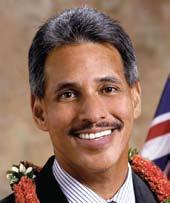
Chen served as dean of the College of Engineering from 1999–2006. His goal for the College, he stated, was simple and clear: “to elevate the College to the level of the nation’s top-tier engineering schools by building academic excellence.” When he retired as dean he was able to cite tremendous progress. He had added faculty, strengthened research programs, improved facilities, and increased enrollment.
Peter e. Crouch
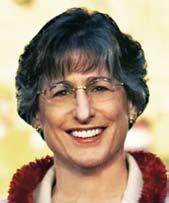
Crouch holds BS (Engineering Science) and MS (Control Theory) degrees from Warwick University in England and a PhD in applied science from Harvard. He assumed the deanship of the UH College of Engineering in 2006 following a distinguished career as administrator, educator, and scholar at Arizona State University. Previously, Crouch taught at Warwick University, served as vice provost for global engineering at Arizona State University, and led that University’s Ira A. Fulton School of Engineering. As dean at ASU for more than a decade, Crouch was responsible for elevating the school to one of the top 50 engineering programs in the nation. He has authored some 120 scientific articles and two books.
His research interests center on control theory, nonlinear system theory and dynamical systems. Crouch is well-traveled and especially interested in China. He takes as a goal better connections of the College with Asia and Europe.
The University of Hawai‘i has been an invaluable source of very talented engineers. It has been the UH College of Engineering’s integration into the professional community that has facilitated their graduates’ understanding of the industry’s needs. Working closely with local and national Architect/Engineer firms, the College has been able to supply local and cultural insight to the curriculum of science and engineering that has produced highly qualified engineering students.
The Hawai‘i Council of Engineering Societies is proud to have the UH College of Engineering as a member.
TOdd C. BARNES, P.E. Chair 2006–2007
Hawai‘i Council of Engineering Societies
o ur f uture
a Message from dean Peter Crouch: Envisioning the future of engineering, internationally and at the University of Hawai‘i
As we end our brief look into the history of the College, we see that society today faces many serious challenges. These include the provision of housing and civil infrastructure for the world’s population, mitigation of natural disasters, provision of sufficient renewable energy to diminish the build up of carbon dioxide in the atmosphere, delivery of drinking water to the people of the world, developing techniques to counter the degradation of the natural environment, health care diagnosis and delivery to the world’s inhabitants, mitigation of human disabilities, and providing a security environment for all. Engineering professionals have the capacity to provide many solutions to these challenges.
However, in comparison with other professions, the engineering profession is generally not understood or valued by many in the US or those in other societies. Moreover, society is in general increasingly technologically illiterate and with the continued acceleration of scientific and technological knowledge the increasing gap between the technologically literate and illiterate is creating societal tensions. The engineering workforce is growing faster in many parts of Asia than in Europe, Japan, and the US, which is creating economic tensions in a once economically secure US, Japan and Europe. The engineering community is beginning to understand the critical role it must play in the concurrent evolution of public policy related to the solutions or potential solutions it provides.
More and more fundamental research is taking place at intersections of scientific and technological disciplines. The most recognized intersections are occurring at the boundaries of nanotechnology, computer science, and biology. The evolution of some branches of engineering is becoming increasingly linked with a concurrent evolution in the sciences, especially the life sciences, and computer and information sciences, creating new areas such as biomedical engineering and embedded systems. US industry performs significantly less research and development (R & D) than in the past, potentially leaving the higher education system in the US with an enhanced role to play. But, US federal support of R & D is decreasing while in many Asian countries it is increasing.
The US higher education system has shown a tendency to become more isolationist in an increasingly “flattening” world. The events of 9/11 played a major role in an even more pronounced period of isolation from which the US is only now recovering. In contrast, many European, Asian, and Australasian communities have worked hard to internationalize education and research.
As pathways through higher education, Science, Technology, Engineering and Mathematics (STEM) curricula are in general no more attractive now than they have ever been for the K-12 population, despite much recent effort to popularize STEM in K-12. There are particular problems in attracting under-represented segments of the population and women to STEM careers. New K-12 educators are typically not exposed to STEM subjects in their higher education pathways, creating an ever increasing need for K-12 STEM educators. To combat some of these trends many countries, including the US, are putting much more emphasis on innovation in STEM teaching methods in higher education and developing many after school programs for K-12 students aimed at attracting students to STEM careers.
Faced with these many challenges and opportunities to contribute toward society’s needs, it is not at all clear what areas of inquiry and research will have the greatest payoff. This is especially challenging in a relatively small island state like Hawai‘i with limited resources. However, despite the risks, it is important to make some choices for the future research directions for the College as it heads into the 21st Century. Tentative decisions on these directions have been made and are summarized here.
e ngineering for a sU staina B le HaWai‘i
Hawai‘i has a special interest in sustainability and mitigating the effects of global warming because of its isolation and dependence on imports for so much of its current existence. Engineering to support a sustainable Hawai‘i can take many forms: photovoltaic devices, deep ocean water heat exchange, fuel cells, environmental engineering, water treatment and supply, dams and watersheds, solid and liquid waste disposal, food production, supplying the infrastructure for biotechnology in both land-based and ocean-based agriculture, transportation and mass transit, alternative fuels, pavements and roads, and affordable and sustainable housing. The College should develop capabilities and expertise that reinforces the development of the technologies related to some, if not all, of these needs.
e x P loration e ngineering
The University of Hawai‘i at Ma¯noa has significant “big-science” strengths, those involving the School of Ocean and Earth Science and Technology (SOEST) and those involving the Institute for Astronomy (IfA). Both of these big-science strengths involve significant engineering efforts. These big-science endeavors embody a developing discipline of “exploration engineering”, whether that is at the bottom of the oceans, on the surface of the oceans, in near space or deep space. This is made possible because of the existence of some unique facilities in Hawai‘i, many of which are being developed in association with the programs at UH. Examples include the telescopes operated by IfA, the ships and underwater exploration vehicles
operated by SOEST and the Pacific missile range on Kaua‘i. The College should leverage these areas of national and international prominence and develop capabilities and expertise that complement the science and facilitate the corresponding growth of the associated technologies, especially with companies in Hawai‘i.
e ngineering for a se CU re HaWai‘i and t H e United s tates
Hawai‘i’s geographic position ensures that it is representative of the many natural hazards and potential disasters that can befall the US. Its geographic position in the middle of the Pacific ensures that it also plays a major role in the national security of the entire US as far as threats from Asia are concerned. These threats range from those posed by unfriendly nations to the spread of disease. UH and the College of Engineering currently have some expertise in many of these areas. The College can work with existing UH resources to build nationally competitive areas of expertise that provide local and national capability in the analysis, mitigation, and response to hazards and potential disasters.
dUal U se H ig H te CH nologies
The military presence in Hawai‘i provides for a large component of the current technologically-based economic opportunities available in Hawai‘i.
The most natural place for the development of Hawai‘i’s future economic diversification therefore surrounds the harnessing of underlying technologies that are being developed for military applications, and developing them for use in the civil sector. These areas include computation, modeling and simulation capability, software/hardware co-development, communication and information technologies, wireless and radar platforms, sensors, optics, and materials research including nano-electronics, mechanics and corrosion. The College should develop areas of expertise that reflect the natural capabilities of local companies and national defense contractors in these areas that have a significant presence in Hawai‘i.
Bio M edi C al e ngineering
The State of Hawai‘i has recently made a large investment in the John A. Burns School of Medicine (JABSOM) and other medical units associated with UH. Perhaps the greatest expansion of new knowledge in any discipline is occurring at the fusion of the life sciences, physical sciences and information sciences. The College needs to be a part of this very exciting scientific and technological revolution, and leverage the State investments in the medical arena. There are several areas of technological interest where the College is already strong including imaging and sensor design, among others. The College should continue to develop these areas of expertise with an ever increasing dialog with JABSOM.
e ngineering fa M ilies
Another prolific UH engineering family is that of Reginald Young, UH emeritus professor of civil engineering, and a former interim dean of the College from 1989–1993. Young’s uncle Quan Yuen
Ching (class of 1932) got the family started in engineering. Four Young brothers are graduates of UH in engineering: Reginald and Leonard in 1959, Thomas in 1950, and Hung Joong in 1941. First cousin Walter Hee is a 1961 civil engineering graduate. Four Young nephews are graduates of the College: Jeffrey (class of 1976), Jon (class of 1979), George (class of 1978) and Bruce (class of 1980). Further, Jon married Linda Katsura, class of 1979. Ethan Young, a grandson of Reginald Young, is currently a freshman at UH Ma¯noa, majoring in civil engineering.
a Brief Hawaiian language glossary for engineers
Once thought virtually extinct, the Hawaiian language today is alive and well. It has adapted to the needs of the modern world. Some engineering terms are merely substitutions of the Hawaiian alphabet for English spellings. More interestingly, many engineering terms are deeply rooted in the native Hawaiian cognitive system.
building Hale
building permit Palapala ‘ae e ku¯kulu
cement Kamiki (Hawaiianized English)
computer Lolo uila
(Lit.: electric brain)
corrosion Popopo
contract ‘Aeliki
EI Palapala Ho¯‘ike Hopena Kaiapuni
earthquake ‘Ola‘i
electric Uila
electric light Kukui uila
energy ‘Eleu
engineer Wilikı¯ (Lit. “turn key”)
ferry Moku halihali
geothermal Uila ma¯hu Pele
groundwater Wai honua
heat Wela
high rise building Haleku‘i (Lit. “added house”)
irrigated terrace Lo‘i
laboratory Ke‘ena hana
laser Wana‘a¯ plastic ‘Ulina (malleable)
satellite Ukali sewer ‘Auwai lawe mea ‘ino (ditch carrying rotten things)
soil Lepo
stone Po¯haku
street Alanui
survey Ana
steel Kila (Hawaiianized English)
tunnel Ana puka
wave Nalu
wind Makani
wood La¯‘au
SOURCE
Pukui, Mary Kawena and Samuel Elbert. Hawaiian Dictionary and Ko¯mike Hua‘o¯lelo, Hale Kuamo‘o, ‘Aha Pu¯nana Leo Ma¯maka Kaiao: A Modern Hawaiian Vocabulary
s o U r C es
Main printed sources consulted: Alumni News; Chen, Wai-Fah. My Life’s Journey: Reflections of an Academic; Kamins, Robert M. and Robert E. Potter. Ma¯lamalama A History of the University of Hawai‘i; Holmes, Wilfred J. College of Engineering: A Record of its History and its Alumni (accompanied by 1981 update); Kobayashi, Victor N. ed. Building a Rainbow: A History of the Buildings and Grounds of the University of Hawai‘i’s Ma¯noa Campus; Honolulu Advertiser; Honolulu Star Bulletin; Ma¯lamalama (University of Hawai‘i magazine); Ka Palapala; University of Hawai‘i Catalog; Quadrangle; UH Alumni magazine; Wiliki
Personal communications: Lowell Angell; James Cartwright; Wai-Fah Chen; Troy Ching; Peter Crouch; Tep Dobry; Edward Hirata; Fay Horie; Joshua Kaakua; Edith Katada; Ronald H. Knapp; Anthony Kuh; Kazutoshi Najita; Mae Nishioka; Sheryl Nojima; Michael O’Hara; Peter Nicholson; Sara Rutter; Sherman Seki; Wayne Shiroma; Murray and Phyllis Turnbull; Paul Wermager; Reginald Young; Paul Yuen.
Special acknowledgments: College of Engineering Centennial history committee: Kristi Bates, Kerri Van Duyne, Carrie Matsuzaki, Jean Imada; Annette Summerlin, Hawaiian Electric Company Archives; College of Engineering unofficial historian, C. Papacostas.
Written by Nancy J. Morris, PhD and designed by Michael Tamaru