NSSE 2016 Snapshot
University of Houston-Downtown
A Summary of Student Engagement Results
Student engagement represents two critical features of collegiate quality. The first is the amount of time and effort students put into their studies and other educationally purposeful activities. The second is how institutional resources, courses, and other learning opportunities facilitate student participation in activities that matter to student learning. NSSE surveys first-year and senior students to assess their levels of engagement and related information about their experience at your institution.
The comparison group featured in this report is
Southwest Public Comparison Group
See your Selected Comparison Groups report for details.
This Snapshot is a concise collection of key findings from your institution’s NSSE 2016 administration. We hope this information stimulates discussions about the undergraduate experience. Additional details about these and other results appear in the reports referenced throughout.
Engagement Indicators
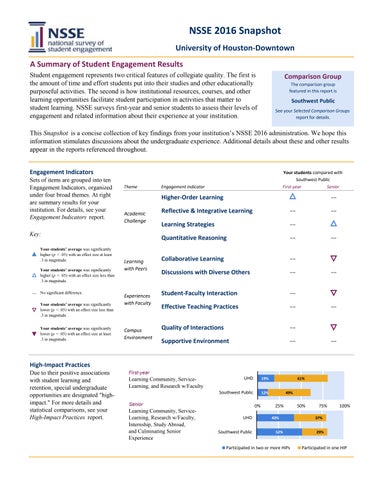
Sets of items are grouped into ten Engagement Indicators, organized under four broad themes. At right are summary results for your institution. For details, see your Engagement Indicators report.
Theme Engagement Indicator
Higher-Order Learning
Reflective & Integrative Learning
Your students compared with
Southwest Public First-year Senior
Key: Academic Challenge
Your students’ average was significantly higher (p < .05) with an effect size at least .3 in magnitude.
△ Your students’ average was significantly higher (p < .05) with an effect size less than .3 in magnitude.
No significant difference.
▽ Your students’ average was significantly lower (p < .05) with an effect size less than .3 in magnitude.
▼ Your students’ average was significantly lower (p < .05) with an effect size at least .3 in magnitude.
High-Impact Practices
Due to their positive associations with student learning and retention, special undergraduate opportunities are designated "highimpact." For more details and statistical comparisons, see your High-Impact Practices report.
Learning
with Peers
Experiences
with Faculty
Learning Strategies
Quantitative Reasoning
Collaborative Learning
Discussions with Diverse Others
Student-Faculty Interaction
Effective Teaching Practices
Quality of Interactions
Supportive Environment
First-year
Learning Community, ServiceLearning, and Research w/Faculty
Senior Learning Community, ServiceLearning, Research w/Faculty, Internship, Study Abroad, and Culminating Senior Experience
Academic Challenge: Additional Results
NSSE 2016 Snapshot
University of Houston-Downtown
The Academic Challenge theme contains four Engagement Indicators as well as several important individual items. The results presented here provide an overview of these individual items. For more information about the Academic Challenge theme, see your Engagement Indicators report. To further explore individual item results, see your Frequencies and Statistical Comparisons, the Major Field Report, the Online Institutional Report, or the Report Builder—Institution Version.
Time Spent Preparing for Class
This figure reports the average weekly class preparation time for your first-year and senior students compared to students in your comparison group.
Reading and Writing
These figures summarize the number of hours your students spent reading for their courses and the average number of pages of assigned writing compared to students in your comparison group. Each is an estimate calculated from two or more separate survey questions.
Challenging Students to Do Their Best Work
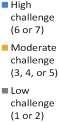
To what extent did students' courses challenge them to do their best work? Response options ranged from 1 = "Not at all" to 7 = "Very much."
First-year
Academic Emphasis
How much did students say their institution emphasizes spending significant time studying and on academic work? Response options included "Very much," "Quite a bit," "Some," and "Very little."
Responding "Very
Item Comparisons
NSSE 2016 Snapshot
University of Houston-Downtown
First-year
Highest Performing Relative to Southwest Public
About how many courses have included a community-based project (service-learning)?e (HIP)
Evaluating a point of view, decision, or information sourcec (HO)
Institution emphasis on helping you manage your non-academic responsibilities (…)c (SE)
Spent more than 10 hours per week on assigned readingf
Institution emphasis on encouraging contact among students from different backgrounds...c (SE)
Lowest Performing Relative to Southwest Public
Discussions with… People from an economic background other than your ownb (DD)
Discussions with… People with religious beliefs other than your ownb (DD)
Institution emphasis on providing support for your overall well-being...c (SE)
Discussions with… People with political views other than your ownb (DD)
Institution emphasis on attending campus activities and events (…)c (SE)
By examining individual NSSE questions, you can better understand what contributes to your institution's performance on the Engagement Indicators. This section displays the five questionsa on which your first-year and senior students scored the highest and the five questions on which they scored the lowest, relative to students in your comparison group. Parenthetical notes indicate whether an item belongs to a specific Engagement Indicator or is a High-Impact Practice. While these questions represent the largest differences (in percentage points), they may not be the most important to your institutional mission or current program or policy goals. For additional results, see your Frequencies and Statistical Comparisons report. Percentage Point Difference with Southwest Public
Senior
Highest Performing Relative to Southwest Public
About how many courses have included a community-based project (service-learning)?e (HIP)
Extent to which courses challenged you to do your best workd
Institution emphasis on attending events that address important social/econ./polit. issuesc (SE)
Reviewed your notes after classb (LS)
Evaluating a point of view, decision, or information sourcec (HO)
Lowest Performing Relative to Southwest Public
Asked another student to help you understand course materialb (CL)
Talked about career plans with a faculty memberb (SF)
Institution emphasis on providing support for your overall well-being...c (SE)
Institution emphasis on attending campus activities and events (…)c (SE)
Participated in an internship, co-op, field exp., student teach., clinical placemt. (HIP)
Percentage Point Difference with Southwest Public
a. The displays on this page draw from the items that make up the ten Engagement Indicators (EIs), six High-Impact Practices (HIPs), and the additional academic challenge items reported on page 2. Key to abbreviations for EI items: HO = Higher-Order Learning, RI = Reflective & Integrative Learning, LS = Learning Strategies, QR = Quantitative Reasoning, CL = Collaborative Learning, DD = Discussions with Diverse Others, SF = Student-Faculty Interaction, ET = Effective Teaching Practices, QI = Quality of Interactions, SE = Supportive Environment. HIP items are also indicated. Item numbering corresponds to the survey facsimile included in your Institutional Report and available on the NSSE website.
b. Combination of students responding "Very often" or "Often."
c. Combination of students responding "Very much" or "Quite a bit."
d. Rated at least 6 on a 7-point scale.
e. Percentage reporting at least "Some."
f. Estimate based on the reported amount of course preparation time spent on assigned reading.
g. Estimate based on number of assigned writing tasks of various lengths.
How Students Assess Their Experience
NSSE 2016 Snapshot
University of Houston-Downtown
Students' perceptions of their cognitive and affective development, as well as their overall satisfaction with the institution, provide useful evidence of their educational experiences. For more details, see your Frequencies and Statistical Comparisons report.
Perceived Gains Among Seniors
Students reported how much their experience at your institution contributed to their knowledge, skills, and personal development in ten areas.
Perceived Gains
(Sorted highest to lowest)
Thinking critically and analytically
Writing clearly and effectively
Working effectively with others
Understanding people of other backgrounds (econ., racial/ethnic, polit., relig., nation., etc.)
Developing or clarifying a personal code of values and ethics
Speaking clearly and effectively
Percentage of Seniors Responding "Very much" or "Quite a bit"
Satisfaction with UHD
Students rated their overall experience at the institution, and whether or not they would choose it again.
Percentage Rating Their Overall Experience as "Excellent" or "Good"
Percentage Who Would "Definitely" or "Probably" Attend This Institution Again
Acquiring job- or work-related knowledge and skills
Solving complex real-world problems
Being an informed and active citizen
Administration Details
Response Summary
See your Administration Summary and Respondent Profile reports for more information.
What is NSSE?
Additional Questions
Your institution administered the following additional question set(s): Academic Advising Civic Engagement
See your Topical Module report(s) for results.
NSSE annually collects information at hundreds of four-year colleges and universities about student participation in activities and programs that promote their learning and personal development. The results provide an estimate of how undergraduates spend their time and what they gain from attending their college or university. Institutions use their data to identify aspects of the undergraduate experience that can be improved through changes in policy and practice.
NSSE has been in operation since 2000 and has been used at more than 1,600 colleges and universities in the US and Canada. More than 90% of participating institutions administer the survey on a periodic basis.
Visit our website: nsse.indiana.edu