
FSSE-NSSE
Combined Report 2025
University of Houston-Downtown

FSSE-NSSE Combined Report 2025
About This Report
The display below highlights details in the FSSE-NSSE Combined Report that are important to keep in mind when interpreting your results. For more information about the survey, please visit our website (fsse.iu.edu) or contact a member of the FSSE team.
Sample: The FSSE-NSSE Combined Report shows responses from both students and faculty at your institution who completed NSSE and FSSE. This report contains responses from faculty who responded to the survey based on their experiences teaching either a lower- or upper-division course. Data from faculty who responded based on another type of course or who did not report a course level are not included in this report. All student responses are based on information from all randomly selected or census-administered students at your institution.
Class level: Frequency distributions are reported separately for faculty who report teaching lower-division or upper-division courses. Student responses are reported separately for first-year students and seniors as reported by your institution.
Item numbers: Item numbering corresponds to the survey facsimiles included in your Institutional Report and available on the NSSE and FSSE websites.
Item wording and variable names: Survey items are worded as they appear on the instrument. Variable names are included for easy reference to your data file, codebook, and other reports.
Faculty responses: The percentage of faculty who selected the indicated response categories. To match the response categories provided on the FSSE instrument, this column heading varies throughout the report.
Student responses: The percentage of students who selected the indicated response categories. To match the response categories provided on the NSSE instrument, this column heading varies throughout the report. The distribution of student responses match those in your NSSE Frequencies and Statistical Comparisons report.
Academic Challenge
FSSE-NSSE Combined Report 2025 University
of Houston-Downtown
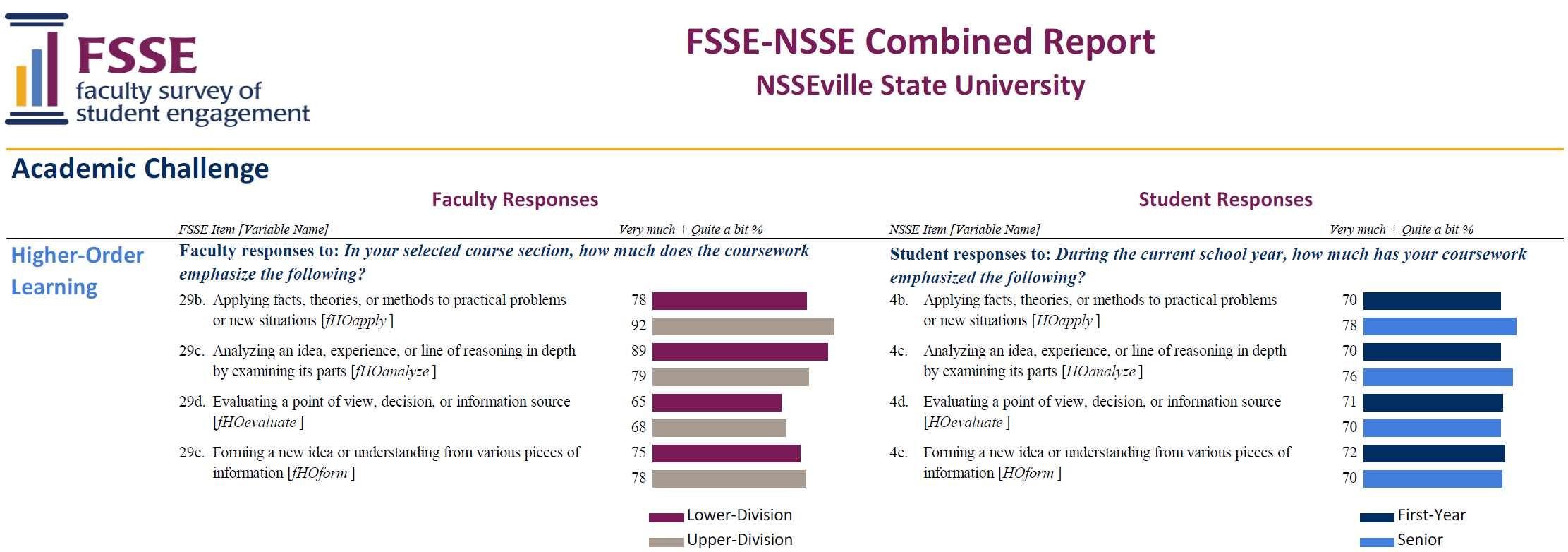
Faculty responses to: In your selected course section, how much does the coursework emphasize the following? FSSE
Applying facts, theories, or methods to practical problems or new situations [fHOapply ]
Analyzing an idea, experience, or line of reasoning in depth by examining its parts [fHOanalyze ]
Evaluating a point of view, decision, or information source [fHOevaluate ]
Forming a new idea or understanding from various pieces of information [fHOform ]
FSSE Item [Variable Name]
Faculty responses to: In your selected course section, how important is it to you that the typical student do the following?
Combine ideas from different courses when completing assignments [fRIintegrate ]
Connect their learning to societal problems or issues [fRIsocietal ]
Include diverse perspectives (political, religious, racial/ethnic, gender, etc.) in course discussions or assignments [fRIdiverse ]
Examine the strengths and weaknesses of their own views on a topic or issue [fRIownview ]
Try to better understand someone else's views by imagining how an issue looks from their perspective [fRIperspect ]
Connect ideas from your course to their prior experiences and knowledge [fRIconnect ]
Student
Responses (from NSSE 2025)
Student responses to: During the current school year, how much has your coursework emphasized the following?
Applying facts, theories, or methods to practical problems or new situations [HOapply ]
Analyzing an idea, experience, or line of reasoning
[
Evaluating a point of view, decision, or information source [HOevaluate ]
Combined ideas from different courses when completing assignments [RIintegrate ]
Connected your learning to societal problems or issues [RIsocietal ]
Included diverse perspectives (political, religious, racial/ethnic, gender, etc.) in course discussions or assignments [RIdiverse ]
Examined the strengths and weaknesses of your own views on a topic or issue [RIownview ]
Tried to better understand someone else's views by imagining how an issue looks from their perspective [RIperspect ]
something that changes the way you
Connected ideas from your courses to your prior experiences and knowledge [RIconnect ]
Academic Challenge (continued)
FSSE-NSSE Combined Report 2025
University of Houston-Downtown
Faculty responses to: In your selected course section, how much do you encourage students to do the following?
Identify key information from reading assignments [fLSreading ]
Review notes after class [fLSnotes ]
Summarize what has been learned from class or from course materials [fLSsummary ]
Student responses to: During the current school year, about how often have you done the following?
Identified key information from reading assignments [LSreading ]
Reviewed your notes after class [LSnotes ]
Summarized what you learned in class or from course materials [LSsummary ]
NSSE Item [Variable Name] Very important + Important %
Faculty responses to: In your selected course section, how important is it to you that the typical student do the following?
Student responses to: During the current school year, about how often have you done the following?
Use numerical information to examine a real-world problem or issue (unemployment, climate change, public health, etc.) [fQRproblem]
Evaluate what others have concluded from numerical information [fQRevaluate ]
Faculty responses to: How important is it to you that your institution increase its emphasis on each of the following?
In
Used numerical information to examine a real-world problem or issue (unemployment, climate change, public health, etc.) [QRproblem ]
Evaluated what others have concluded from numerical information [QRevaluate ]
responses to: How much does your institution emphasize the following?
During the current school year, to what extent have your courses challenged you
Learning with Peers
FSSE-NSSE Combined Report 2025
University of Houston-Downtown
Faculty responses to: In your selected course section, how much do you encourage students to do the following?
Ask other students for help understanding course material [fCLaskhelp ]
Explain course material to other students [fCLexplain ]
Prepare for exams by discussing or working through course material with other students [fCLstudy ]
Work with other students on course projects or assignments [fCLproject ]
Discussions with Diverse Others
Faculty responses to: In your selected course section, how much opportunity do students have to engage in discussions with people from the following groups?
Student responses to: During the current school year, about how often have you done the following?
Asked another student to help you understand course material [CLaskhelp ]
Explained course material to one or more students [CLexplain ]
Prepared for exams by discussing or working through course material with other students [CLstudy ]
Worked with other students on course projects or assignments [CLproject ]
Student responses to: During the current school year, about how often have you had discussions with people from the following groups?
People of races or ethnicities other than your own [DDrace ]
People from economic backgrounds other than your own [DDeconomic ]
People with religious beliefs other than your own [DDreligion ]
Experiences with Faculty
FSSE-NSSE Combined Report 2025
University of Houston-Downtown
Faculty responses to: During the current school year, about how often have you done each of the following with the undergraduate students you teach or advise?
Talked about their career plans [fSFcareer ]
Worked on activities other than coursework (committees, student groups, etc.) [fSFotherwork ]
Discussed course topics, ideas, or concepts outside of class [fSFdiscuss ]
Discussed their academic performance [fSFperform ]
FSSE Item [Variable Name]
Faculty responses to: In your undergraduate courses, to what extent do you do the following?
Clearly explain course goals and requirements [fETgoals ]
Teach course sessions in an organized way [fETorganize ]
Use examples or illustrations to explain difficult points [fETexample ]
Provide feedback to students on drafts or works in progress [fETdraftfb ]
Provide prompt and detailed feedback on tests or completed assignments [fETfeedback ]
NSSE Item [Variable Name] Very often + Often %
Student responses to: During the current school year, about how often you have done the following?
Talked about career plans with a faculty member [SFcareer ]
Discussed your academic performance with a faculty member [SFperform ] Worked with a faculty member on activities other than coursework (committees, student groups, etc.) [
Discussed course topics, ideas, or concepts with a faculty member outside of class [SFdiscuss ]
responses to: During the current school year, to what extent have your instructors done the following?
Campus Environment
FSSE-NSSE Combined Report 2025
University of Houston-Downtown
Faculty responses to: Indicate your perception of the quality of student interactions with the following people at your institution.
Other students [fQIstudent ]
[fQIadvisor ]
Other administrative staff and offices (registrar, financial aid, etc.) [fQIadmin ]
Note: Response options for faculty and student Quality of Interactions items ranged from 1=Poor to 7=Excellent; High ratings (6 or 7).
FSSE Item [Variable Name]
Faculty responses to: How important is it to you that your institution increase its emphasis on each of the following?
Students using learning support services (tutoring services, writing center, etc.) [fSElearnsup ]
Encouraging contact among students from different backgrounds (social, racial/ethnic, religious, etc.) [fSEdiverse ]
Providing opportunities for students to be involved socially [fSEsocial ]
Providing support for students' overall well-being (recreation, health
counseling, etc.) [fSEwellness ]
Helping students manage their non-academic responsibilities (work, family, etc.) [fSEnonacad ]
Students attending campus activities and events (performing arts, athletic events, etc.) [fSEactivities ]
Students attending events that address important social, economic, or political issues [fSEevents ]
Student responses to: Indicate the quality of your interactions with the following people at your institution.
[QIstudent ]
Academic advisors [QIadvisor ]
Student services staff (career services, student activities, housing, etc.) [QIstaff ]
Other administrative staff and offices (registrar, financial aid, etc.) [QIadmin ]
Using learning support services (tutoring services, writing center, etc.) [SElearnsup ] NSSE Item [Variable Name]
Providing support to help students succeed academically [SEacademic ]
Encouraging contact among students from different backgrounds (social, racial/ethnic, religious, etc.) [SEdiverse ]
Helping you manage your non-academic responsibilities (work, family, etc.) [SEnonacad ]
Attending campus activities and events (performing arts, athletic events, etc.) [SEactivities ]
Attending events that address important social, economic, or political issues [SEevents ]
Additional Engagement Items
FSSE-NSSE Combined Report 2025
University of Houston-Downtown
Faculty responses to: To what extent do you structure your selected course section so that students learn and develop in the following areas?
Student responses to: How much has your experience at this institution contributed to your knowledge, skills, and personal development in the following areas?
Speaking
Thinking
Analyzing
Acquiring
Working effectively with others [fcgothers ]
Developing
Acquiring
Ask
Student responses to: During the current school year, about how often have you done the following?
Asked
FSSE-NSSE Combined Report 2025
University of Houston-Downtown
FSSE Item [Variable Name]
Faculty responses to: How important is it to you that undergraduates at your institution do the following before they graduate?
Student responses to: Which of the following have you done while in college or do you plan to do before you graduate?
Faculty responses to: In your selected course section, how much does the coursework emphasize the following?
Student responses to: During the current school year, how much has your coursework emphasized the following?
Faculty responses to: In an average 7-day week, about how many hours do you think the typical student in your selected course section spends doing each of the following?
Preparing for class (studying, reading, writing, doing homework or lab work, analyzing data, rehearsing, and other academic activities) [ftmprep ]
Participating in co-curricular activities (organizations, campus publications, student government, fraternity or sorority, intercollegiate or intramural sports, etc.) [ftmcocurr ]
Student responses to: About how many hours do you spend in a typical 7-day week doing the following?
Preparing for class (studying, reading, writing, doing homework or lab work, analyzing data, rehearsing, and other academic activities) [tmprep ]
in co-curricular activities (organizations, campus publications, student government, fraternity or sorority, intercollegiate or intramural sports, etc.) [tmcocurr ]
Relaxing and socializing (time with friends, video games, TV or videos, keeping up with friends online, etc.) [ftmrelax ]
Relaxing and socializing (time with friends, video games, TV or videos, keeping up with friends online, etc.) [tmrelax ]
High-Impact Practices
FY Participation
SR Participation
Faculty Participation
Faculty Importance
NSSE
FSSE-NSSE Combined Report 2025
University of Houston-Downtown
FY Participation
SR Participation
Faculty Participation
Faculty Importance
FY Participation
SR Participation
Faculty Participation
Faculty Importance
FY Participation
SR Participation
Faculty Participation
Faculty Importance
FY Participation
SR Participation
Faculty Participation
Faculty Importance
FY Participation
SR Participation
Faculty Participation
Faculty Importance
FY/SR Participation Faculty Participation Faculty Importance
The "FY Participation" and "SR Participation" figures display the percentage of first-years and seniors who have participated in the particular HighImpact Practice. Percentages represent the proportion of students responding "Done or in Progress" except for service-learning which is the percentage who responded that at least "Some" courses included a community-based project.
The "Faculty Participation" figures display the percentage of your faculty who participate in these High-Impact Practices in a typical week. For ServiceLearning, this represents the percentage of faculty responding that at least "Some" of their courses include a service-learning component. For the remaining experiences, this represents the percentage of faculty responding "Yes" to participating in the given activity during the current school year.
The "Faculty Importance" figures display the percentage of your faculty who believed it was "Very important" or "Important" for undergraduates at your institution to participate in the particular High-Impact Practice before they graduate.