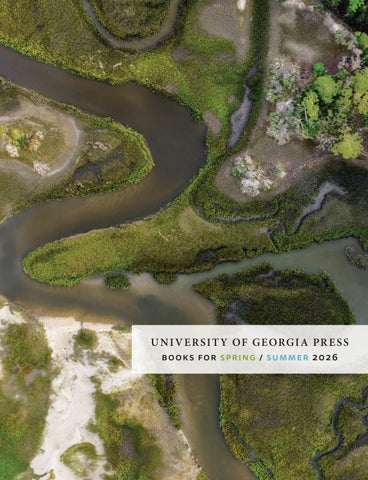
U N I V E R SI T Y OF GE ORGI A PR E S S b o o kS F or Spr In g / SUm m er 20 26
un i v e r s i t y o f g e o r g i a pr e s s / fa l l 2025 | 3
CATALOG HIGHLIGHTS
9
13
10
22
31
TITLE INDEX 20 the amerIcan
48 In pUrSUIt oF FreeDom
7 a SeaSon
9 amerIcan bacon
41 laDIeS oF lIttle rock
5 the SeaSon oF bIrDS anD StoneS
11 bookIn’ In the bIg hoUSe
24 learnIng From SaVannah
Boorstin, Jon
Johnson, Mark A.
Devoto, Pat Cunningham
40 the coUntry people
Wallace, Shaun R. C. Harper, Misti Nicole
Gobel, David W., and Robin B. Williams
Walsh, Michael Joseph
Renfro, Yelizaveta P.
46 SerVIng the Street
Schneider, Matthew Jerome
31 loVIng InSectS
6 SIFtIng the FemInIne
50 cUban tobacco In the age oF SeconD SlaVery
28 the maD
47 tereSa bengUela anD FelIpa crIoUla Were pregnant
42 DeSerter DeclaratIonS
43 mercy In DISaSter
44 emotIonal FIlIpInoS
21 oFF the coaSt oF paraDISe
27 eVeryboDy neeDS SomethIng
45 olIVe groWIng In paleStIne
26 Fall lIne
16 palmS, prIeStS, anD pIrateS
Hurt, R. Douglas
Morgan, William A.
Browning, Judkin, ed.
Radics, George Baylon
Faranello, Melanie Pappadis Starnes, Joe Samuel
25 FInDIng Sarah anD mary Jones Royster, Jacqueline
29 Flannery anD regIna Shloss, Carol Loeb
18 hackIng hIp hop Wilson, Joycelyn
15 IF I am comIng to yoUr toWn, SomethIng terrIble haS happeneD Glawe, Justin
Front cover: Palms, Priests, and Pirates, p. 16
Tobin, Beth Fowkes Mabasa, Ignatius T. Schear, Angela G., ed.
Dunn, Erin, and Beryl Gilothwest Simaan, Juman
Doster, Stephen, and Benjamin Galland
19 paSSport to cItIZenShIp Dunning, Arthur N.
22 pImento cheeSe Lang, Rebecca
52 reInVentIng the rIVer cIty Pettit, Raymond
Anderson, Ashley
Telles, Lorena Féres da Silva
51 terrItorIalIZIng Democracy Halvorsen, Sam
13 the UltImate Shell Seeker’S gUIDe Oliphant, Ashley
4 UnIteD StateS oF reJectIon Kinney, Alison
10 U.S. hIStory at the 250th
Clinton, Catherine, and Jim Downs, eds.
49 We are amerIcan cItIZenS Bourhis-Mariotti, Claire
14 WooDlanDS oF the mInD O’Donnell, Kevin E., and Scott Randolph Honeycutt
Advancing knowledge for the public good SINCE ITS FOUNDING IN 1938, the primary mission of the University of Georgia Press has been to publish innovative scholarship and compelling stories that inspire and inform the people of Georgia and the world. The University of Georgia Press is the oldest and largest book publisher in the state. We currently publish 70 new books a year and have a long history of publishing significant scholarship, creative and literary works, and books about the state and the region for general readers.
AUTHOR INDEX 6 ANDERSON, ASHLEY | sifting the feminine
4 KINNEY, ALISON | united states of rejection
20 BOORSTIN, JON | the american
22 LANG, REBECCA | pimento cheese
49 BOURHIS-MARIOTTI, CLAIRE | we are american citiZens
28 MABASA, IGNATIUS T. | the mad
42 BROWNING, JUDKIN, ED. | deserter declarations 10 CLINTON, CATHERINE, AND JIM DOWNS, EDS. | u.s. history at the 250th 11 DEVOTO, PAT CUNNINGHAM | bookin’ in the big house 16 DOSTER, STEPHEN, AND BENJAMIN GALLAND | palms, priests, and pirates
50 MORGAN, WILLIAM A. | cuban tobacco in the age of second slavery 14 O’DONNELL, KEVIN E., AND SCOTT RANDOLPH HONEYCUTT | woodlands of the mind 13 OLIPHANT, ASHLEY | the ultimate shell seeker’s guide 52 PETTIT, RAYMOND | reinventing the river city 44 RADICS, GEORGE BAYLON | emotional filipinos
21 DUNN, ERIN, AND BERYL GILOTHWEST | off the coast of paradise
5 RENFRO, YELIZAVETA P. | the season of birds and stones
19 DUNNING, ARTHUR N. | passport to citiZenship
43 SCHEAR, ANGELA G., ED. | mercy in disaster
27 FARANELLO, MELANIE PAPPADIS | everybody needs something
46 SCHNEIDER, MATTHEW JEROME | serving the street
15 GLAWE, JUSTIN | if i am coming to your town, something terrible has happened
29 SHLOSS, CAROL LOEB | flannery and regina
24 GOBEL, DAVID W., AND ROBIN B. WILLIAMS | learning from savannah 51 HALVORSEN, SAM | territorialiZing democracy 41 HARPER, MISTI NICOLE | ladies of little rock 40 HURT, R. DOUGLAS | the country people 9 JOHNSON, MARK A. | american bacon 25 JONES ROYSTER, JACQUELINE | finding sarah and mary
45 SIMAAN, JUMAN | olive growing in palestine 26 STARNES, JOE SAMUEL | fall line 47 TELLES, LORENA FÉRES DA SILVA | teresa benguela and felipa crioula were pregnant 31 TOBIN, BETH FOWKES | loving insects 48 WALLACE, SHAUN R. C. | in pursuit of freedom 7 WALSH, MICHAEL JOSEPH | a season 18 WILSON, JOYCELYN | hacking hip hop
2 | uni ver s i t y o f ge o r gia pr e ss / spr in g 2026
TRADE TITLES
un iv e r s i t y o f g e o r g i a pr e s s / s pr i n g 2026 | 3
Creative nonFiCtion / memoir
An exploration of real-life, relatable rejections through reporting and lively storytelling
United States of Rejection
A Story of Love, Hate, and Hope
alISon kInney
CRUX: THE GEORGIA SERIES IN LITERARY NONFICTION
“The trick that Alison Kinney manages to pull off throughout United States of Rejection is tacking around the idea of rejection, both personal and universal, and making a book-length argument about rejection and America. Light and often funny, Kinney’s narrative voice in this book is great: It’s conversational without being glib and scholarly without being dull. Playful and serious at once, this is the best kind of creative scholarship: Everything in these pages takes on emotional resonance and layered meaning. Dazzling, really!”—Ander Monson, author of Predator: A Memoir, a Movie, an Obsession ALISON KINNEY is assistant professor of writing (nonfiction) at Eugene Lang College, The New School. She is the author of the books Hood and Avidly Reads Opera. Her writing on culture, history, science, and social justice has appeared in many publications, online or in print, including The New Yorker, The Paris Review Daily, Lapham’s Quarterly, The New York Times, The Guardian, Harper’s, and Gay Magazine. She lives and writes in Brooklyn, New York.
This is a love-hate story about personal and political relationships in the United States, told through the intimate stories of both the rejectors and the rejected: lovers, families, neighbors, and a nation and its people. Although we’re taught not to care about others’ opinions, rejection always hurts, and it hurts some people a lot more than others. To prove it, this book marshals contemporary neuroscience, the Founding Fathers’ rejection advice, and four centuries of personal narratives, many of them hilarious, many more heartbreaking. These rejection and acceptance stories span loving and disastrous American first encounters, soldiers and dancers rejected on front lines and chorus lines, playground bullies invoked before the Senate, and generations of lovers and patriots battling or swiping right to defend their loved ones and their country.
Michael Brady
Abraham Lincoln wrote, “The true rule, in determining to embrace, or reject any thing, is not whether it have any evil in it; but whether it have more evil, than of good.” But rejection is often unjust, often deserved, and unusually complicated, depending on who’s rejecting whom and why.
MAY
5.5 X 8.5 | 352 PP. PaPerBaCK $28.95t 9780820377230 eBooK availaBle
In laboratories, diaries, self-help manuals, auditions, lawsuits, and wars, we find models for “getting past” rejections, not just through personal resilience, but also through creating accountability and justice. United States of Rejection begins with heartbreak and ends with hope: an urgent self-improvement program for changing our relationships and the future of our messy nation.
4 | uni ver s i t y o f ge o r gia pr e ss / spr in g 2026
creative nonfiction / essays
A wide-ranging collection of essays that engages with the natural world through encounters in national parks and other wild places
The Season of Birds and Stones Essays
yelIZaVeta p. renFro CRUX: THE GEORGIA SERIES IN LITERARY NONFICTION
“At its brightest moments, the most compelling arguments of the book come from its incisive reflections on the relationship between artist and the environment. Renfro interrogates the narratives we construct about the natural world and examines the interplay between our desires and perceptions—what we see versus what we think we ought to see.” —Susan Briante, author of Defacing the Monument
The essays that make up The Season of Birds and Stones grapple with questions of what wilderness means and how we can interact with and learn from other species. Set in some of our most stunning public lands, including Denali National Park and Preserve, Great Basin National Park, Isle Royale National Park, and Porcupine Mountains Wilderness State Park, Renfro’s essays examine her encounters with bears, arctic ground squirrels, loons, red-winged blackbirds, moose, and wolves, as she wrestles with a range of subjects including motherhood, mental illness, grief, and darkness. Whether focusing on bears in Alaska or the darkness of the Upper Peninsula, searching for moose bones on Isle Royale, or seeking out her past self in the landscape of Great Basin, her essays are rooted in the natural world but also in storytelling—the stories we tell about ourselves, the stories we tell about others, and the stories we tell about other species. Both deeply personal and meticulously researched, Renfro’s essays seek to illuminate the natural world and show its deep relevance and resonance in all of our lives.
YELIZAVETA P. RENFRO is the author of Xylotheque and A Catalogue of Everything in the World. Her work has appeared in North American Review, Creative Nonfiction, Orion, Terrain, Colorado Review, and other publications. Renfro has served as artist-in-residence at Denali National Park and Preserve, Isle Royale National Park, and Porcupine Mountains Wilderness State Park. She lives in South Bend, Indiana, and teaches creative writing at Saint Mary’s College in Notre Dame, Indiana.
David Chritton
”The Season of Birds and Stones is a fiercely ravishing book. Endlessly capacious in her curiosity, and immensely generous in her sense of presence, Yelizaveta Renfro meditates on the nature of memory, stories, and story-making as well as the ways in which nature catalyzes narratives that reflect the desires, fears, and hopes of human beings. Here, nature transcends the spectacle of the gazed-upon object and becomes the reciprocal subject that gazes back to illuminate the firefly-like flickering of the human heart.”—Lee Horikoshi Roripaugh, author of unMothered, unTongued
MARCH
5.5 X 8.5 | 224 PP. 8 B&W imaGeS PaPerBaCK $24.95t 9780820377308 eBooK availaBle
un iv e r s i t y o f g e o r g i a pr e s s / s pr i n g 2026 | 5
Creative nonFiCtion / eSSaYS
Examining the creation and consideration of femininities based on how we treat women’s bodies
Sifting the Feminine
Essays on a Woman’s Body
aShley anDerSon CRUX: THE GEORGIA SERIES IN LITERARY NONFICTION
“Sifting the Feminine strikes exactly the right balance for a work about an embodied experience that will draw readers looking for validation as well as artistry; the artistry is there, but it doesn’t need to be appreciated to find the empathy in the writing.”—Sarah Einstein, author of Mot: A Memoir
Sifting the Feminine: Essays on a Woman’s Body examines how we define and understand femininity in relation to how we consider and treat women’s bodies. Through a collection of personal, lyric, and flash essays, Ashley Anderson explores how illness, particularly polycystic ovarian syndrome (PCOS), manifests and affects the relationships between women, their bodies, and the world. In retaliation against a history of scrutiny, Sifting the Feminine upends the idea that our bodies are always within our own control. Meditating on illness, health care, social media, storytelling, clothing, various forms of violence, and popular culture, Sifting the Feminine seeks to understand why women’s bodies that challenge societal and cultural expectations of femininity are routinely disregarded in a world where no two bodies, regardless of gender, exist in the same way.
Ariel Fried
ASHLEY ANDERSON has had essays, short stories, and scholarship appear in Quarter After Eight, Permafrost, Newfound, Tahoma Literary Review, SLAB, Assay: A Journal of Nonfiction Studies, and other publications. Sifting the Feminine: Essays on a Woman’s Body was a semifinalist for the 2022 Santa Fe Writers Project Literary Awards. Anderson holds a PhD in English with a creative writing emphasis from the University of Missouri–Columbia. She currently teaches at the University of Missouri and lives in Columbia, where she makes a lot of crafts, drinks a lot of coffee, and listens to a lot of Taylor Swift.
“Sifting the Feminine is for anyone who has looked in the mirror and sucked in her gut. It’s for anyone who has starved herself to fit into a dress, into a mold, into an imagined ‘better’ version of herself. Anderson’s essays are raw, vulnerable, honest, and fierce. Through her writing, she clears a path with courage so others can follow more easily.”—Julija Šukys, author of Artifact: Encounters with the Campus Shooting Archives
MARCH
5.5 X 8.5 | 124 PP. PaPerBaCK $22.95t 9780820367903 eBooK availaBle
6 | uni ver s i t y o f ge o r gia pr e ss / spr in g 2026
poetry
A collection of ecstatic, uncanny meditations on intimacy and distance, infinity and void, and self and world
A Season Poems
mIchael JoSeph WalSh SelecteD by anDreW ZaWackI THE GEORGIA POETRY PRIZE
“With precision and quiet plenitude, Michael Joseph Walsh stages and disintegrates decadent and lyrical modes, now languorous, now in ‘sudden bloom.’ A Season elaborates a microclimate of self-alienation which inverts to its most surprising hypocrite double: sympathy. Against all expectations, the drunken boat finds its needle, and ‘with astonishment, propels itself along,’ ‘into the heart like a cool green sea.’”—Joyelle McSweeney, author of Death Styles “Maybe, I think to myself, Michael Joseph Walsh is amnesia’s Proust. In his exhilarating second book, a person is born seemingly right into adulthood, drenched in experience and yet somehow innocent—unknown to himself but known to the world that forms him the way ‘vegetable juices swell gradually into the perfect leaf.’ The bracing syntax and haptic precisions of this lyrist feel corporeally intimate, earthbound and giddy, ever on the exuberant cusp of—dare one say it?—beauty, of ‘autonomy, [. . .] an enormous ray / Of sunlight / Which is the buzz of coming back online.’” —Aditi Machado, author of Material Witness
MICHAEL JOSEPH WALSH is the author of Innocence, which was selected by Shane McCrae as the winner of the 2021 Lighthouse Poetry Series. He is the editor of APARTMENT Poetry, and his poems, translations, and criticism have appeared in The Brooklyn Rail, Denver Quarterly, Guernica, Fence, Poetry Daily, and elsewhere. He lives in Philadelphia.
Adalena Kavanagh
A Season is a visionary meditation born out of a spiritual crisis. As the poems attempt to remake a life within the ghostly limbo into which they’ve fallen—between self and world, sound and echo, the uncanny and the sublime—they work to reweave an intimacy between the past and the present, the “self” and its others, and between the world that remains and a world that’s been irrevocably lost. Full of strange ecstasies and waking dreams, A Season is a selfportrait as blank space, a self-portrait as continual becoming—“a house of mirrors in which every face is perpetually on its way.”
MARCH
5.5 X 8.5 | 96 PP. PaPerBaCK $19.95t 9780820375526 eBooK availaBle a GeorGia anD BruCe mCever FunD For tHe artS anD environment PuBliCation
un iv e r s i t y o f g e o r g i a pr e s s / s pr i n g 2026 | 7
HiStorY / FooD StuDieS
The four-century history of a gastronomic phenomenon in the United States
American Bacon
The History of a Food Phenomenon
mark a. JohnSon
“Mark A. Johnson fries up the preeminent cultural history of bacon in America. Covering four hundred years, American Bacon shows how and why bacon’s role and meaning has dramatically transformed from mundane option to impoverished foodstuff, an unhealthy choice to a maniainducing culinary darling. Wide-ranging, deeply researched, surprising, and satisfying.”—Emily J. H. Contois, author of Diners, Dudes, and Diets
MARK A. JOHNSON, from Milwaukee, earned a PhD in history from the University of Alabama. Previously, he earned an MA from the University of Maryland and BA from Purdue University. He currently teaches at the University of Tennessee at Chattanooga and is the author of An Irresistible History of Alabama Barbecue: From Wood Pit to White Sauce and Rough Tactics: Black Performance in Political Spectacle, 1877–1932.
Courtesy of the author
In American Bacon, Mark A. Johnson asks (and answers) a seemingly simple question: How has bacon overcome centuries of religious prohibition, cultural contempt, and dietary advice to become a twenty-first-century culinary and cultural powerhouse? Starting in early modern Britain and tracing the story of bacon through the colonial era, Civil War, Progressive Era, modern fad diets, and the emerging craft bacon industry, Johnson provides a new perspective on some familiar American narratives. More than a story of production, marketing, and consumption, Johnson argues, this cultural history connects bacon to race, class, and gender while also illuminating major historical forces, such as migration, warfare, urbanization and suburbanization, reform movements, cultural trends, and globalization. For Johnson, bacon’s story from “most dangerous food in the supermarket” to pop culture and gastronomic phenomenon reflects the cultural values of a nation.
APRIL
6 X 9 | 344 PP. 74 B&W imaGeS HarDBaCK WitH DuSt JaCKet $34.95t 9780820375403 eBooK availaBle a BraDleY Hale FunD For SoutHern StuDieS PuBliCation
un iv e r s i t y o f g e o r g i a pr e s s / s pr i n g 2026 | 9
HiStorY / ameriCan StuDieS
A dynamic dialogue with top historians, unpacking the impact and paradoxes of our nation’s birthday
U.S. History at the 250th From the Revolution to the History Wars
SanDra enrÍQUeZ, annette gorDon-reeD, SanDy granDe, nIkole hannah-JoneS, erIka lee, robert parkInSon, marc SteIn, anD WIllIam StUrkey In conVerSatIon WIth catherIne clInton anD JIm DoWnS HISTORY IN THE HEADLINES
The year 2026 marks the 250th anniversary of the Declaration of Independence. But does the nation begin in 1776, or do we trace its origins to some point earlier—for example, the arrival of the first enslaved people in 1619 or the initial settlement of Indigenous people? What’s at stake with establishing a date that marks the nation’s origins? Where does the history of the nation begin? In colonial New England, the Chesapeake, or in the Southwest?
CATHERINE CLINTON is the Denman Professor of American History at the University of Texas at San Antonio. She has served as president of the Southern Historical Association, is an elected member of the Society of American Historians, and is a recipient of a Guggenheim fellowship. She is the author and editor of more than two dozen volumes, including Harriet Tubman: The Road to Freedom; Mrs. Lincoln: A Life; Stepdaughters of History; and Civil War Stories (Georgia).
Jaci Downs Photography
JIM DOWNS is the Gilder Lehrman-National Endowment for the Humanities Professor of History at Gettysburg College, a 2025–26 Guggenheim Fellow, and the director of the African American History Program at the Library Company of Philadelphia. In addition to coediting Beyond Freedom: Disrupting the History of Emancipation and Connexions: Histories of Race and Sex in North America, he has authored Maladies of Empire: How Colonialism, Slavery, and War Transformed Medicine; and Sick from Freedom: African-American Illness and Suffering During the Civil War and Reconstruction.
In this unprecedented volume, leading thinkers come together to debate these—and many other—issues. Their conversation shows that U.S history is not just about what happened but who gets to tell the story and the political implications of the narratives we tell. The participants include two Pulitzer Prize winners: Nikole Hannah-Jones, who created the 1619 Project and ignited a national conversation about slavery and the nation’s founding; and Annette Gordon-Reed, who documented Thomas Jefferson’s relationship with Sally Hemmings. The other specialists include experts in Asian American, civil rights, Native American, Latino, LGBT, and early American history.
10 | uni v er s i t y o f ge o r gia pr e ss / spri n g 2026
MAY
5 X 7 | 192 PP. PaPerBaCK $24.95t 9780820377124 HarDBaCK $119.95X 9780820377117 eBooK availaBle
creative nonfiction / women, gender & sexuality / civil rights & social justice
The chronicle of a prison book club and the lessons learned by all
Bookin’ in the Big House
What I Learned Leading a Women’s Prison Book Club
pat cUnnIngham DeVoto NEWSOUTH BOOKS
Pat Cunningham Devoto had specific hopes for the women imprisoned at the Montgomery Women’s Facility who participated in her book club for the better part of seven years. She hoped the books they read would give some respite from their daily prison life and, at the same time, hoped the individual members might gain valuable knowledge that would have a positive impact on their future. Doesn’t that sound lovely? Instead, Devoto learned how to “brew” a batch of beer—right under the guards’ noses; how to assume a stone-faced expression while a guard berated her because she brought books—to the book club; what it’s like to have a wedding, complete with trimmings, while imprisoned; how to anonymously pester the parole board from the prison phones; how to make hand sanitizer punch; and how to use PREA cards in the exact opposite way they are meant to be used. In other words, the best way for a self-proclaimed naïve, middle-class, law-abiding novice like Devoto to learn how to be a crook was to go to prison. But in the beginning, of course, she hadn’t a clue. While most of her teachers are now gone, in one way or another, Bookin’ in the Big House is Pat’s remembrance of them and of the place they lived.
Pat C unn ingh am D evoto
Book Big H in’ ouse
in t
he
Wha tIL earn Wom Leadin ed en’s P g a Book rison Club
PAT CUNNINGHAM DEVOTO is a one-time high school history teacher and a member of the USTA Southern Tennis Hall of Fame. Pat is the author of five novels, including My Last Days as Roy Rogers, Out of the Night That Covers Me, and The Summer We Got Saved. She lives and writes in both the Atlanta Metro and Alabama.
MARCH
5.5 X 8.5 | 190 PP 13 B&W imaGeS PaPerBaCK $27.95t 9781588385673 eBooK availaBle
un iv e r s i t y o f g e o r g i a pr e s s / s pr i n g 2026 | 11
environment & nature / travel
environment & nature / travel
A veteran beachcomber offers an inside look into the exciting complexities of shell seeking
The Ultimate Shell Seeker’s Guide Building a Better Beachcombing Strategy
aShley olIphant
The Ultimate Shell Seeker’s Guide is the book that beachcombers have been anxiously waiting for an expert to finally write. Join Dr. Ashley Oliphant as she reveals the secret calculus that the best beachcombers in the world are constantly working in their brains as they decide when and where to plan their next hunt. This is not just another identification guide that offers species names and descriptions. Instead, this book is a practical field manual that puts the reader on the beach with one of the most well-known beachcombers in the country. Oliphant reveals the insider knowledge that so many veteran collectors want to keep hidden from newcomers to the hobby, including where to hunt and how to read the tides, moon phases, wind directions, wave heights, and seasonal fluctuations that have such a dramatic impact on beachcombing success. The text delivers the foundational information that beginners need but then advances beyond those fundamentals to offer experienced hunters more complex strategies to help improve their game. Along the way, readers will be entertained by Oliphant’s unique personal stories and enthusiastic outlook—both of which have made her such a sought-after speaker on the national circuit.
ASHLEY OLIPHANT is a nationally recognized seashell and shark tooth hunter who offers workshops, lectures, courses, and excursions for ocean enthusiasts wanting to improve their beachcombing strategy. She is the author of Shark Tooth Hunting on the Carolina Coast and four other books, including two novels and biographies of Ernest Hemingway and Jean Laffite. After retiring as an English professor with twenty years of service and stints as the chair of an English department and a humanities department, Oliphant pursued her passion for the sea and became a full-time writer and ocean educator. She now travels all over the country sharing her expertise with eager audiences and visiting the best shelling beaches on the planet.
Beth Yarbrough
MAY
6 X 9 | 312 PP. 387 Color PHotoS FleXiBaCK WitH FlaPS $29.95t 9780820374741 a WormSloe FounDation nature BooK
un iver s i t y o f g e o r g i a pr e s s / s pr i n g 2026 | 13
environment & nature
Rambles through the histories and forested lands of fifteen colleges and universities in eleven states of the eastern United States
Woodlands of the Mind Rambles Through Campus Forests
keVIn e. o’Donnell anD Scott ranDolph honeycUtt Throughout the eastern United States, hundreds of colleges and universities own acres of forested lands. These holdings range from modest parcels like Virginia Tech’s eleven-acre Stadium Woods to more substantial tracts like Rutgers University’s five-hundred-acre William L. Hutcheson Memorial Forest in New Jersey. KEVIN E. O’DONNELL grew up in northeastern Ohio. He holds a PhD from the University of Wisconsin– Milwaukee and is professor of English at East Tennessee State University. He has published articles about nineteenth-century American magazine writing and nature writing and about environmental history in the Southeast, and he coedited, with Helen Hollingsworth, Seekers of Scenery: Travel Writing from Southern Appalachia, 1840–1900. He lives in Upper East Tennessee.
This book features fifteen notable campus forests in eleven states in the eastern United States, stretching from North Georgia, on up through the Ohio Valley and the mid-Atlantic region, into coastal Maine. The schools range from small religious colleges to state land-grant schools and Ivy League universities. The forests represent diverse ecosystems and attitudes on management: Some are left wild, notable for their tracts of old growth, while others are more contained or controlled, intended more for recreation than conservation or research. Many of these woodlands face considerable challenges; while some are protected in perpetuity, others are threatened by money troubles and development. All face ecological threats. But each forest is managed differently, reflecting the various ways it serves its campus and local community: as a place for research, recreation, and preservation.
SCOTT RANDOLPH HONEYCUTT grew up in Virginia and Tennessee. He holds a PhD in American literature from Georgia State University and is professor of English at East Tennessee State University. He has published numerous poems, including two chapbooks, This Diet of Flesh and Twelve Miles North of the Kentucky River. He lives in Upper East Tennessee.
Brian O’Donnell
MAY
6 X 9 | 304 PP. 18 B&W imaGeS, 1 maP PaPerBaCK $32.95t 9780820375571 HarDBaCK $119.95X 9780820375564 eBooK availaBle
Courtesy of the author
Woodlands of the Mind serves as a travel book for wanderers and armchair adventurers alike. These fifteen narratives, or “rambles,” guide readers through forests that range from small, hidden parks to vast preserves. Like an engaging travel companion, the essays discuss each forest’s ecology, landscape architecture, and history— especially the history of American universities and the relationship between higher education and land management and protection.
14 | uni ver s i t y o f ge o r gia pr e ss / spr i n g 2026
creative nonfiction / civil rights & social justice
A reporter’s journey into American violence and chaos while descending into a dark battle of his own—and the path to recovery for both the nation and himself
If I Am Coming to Your Town, Something Terrible Has Happened The Life and Times of a Domestic War Correspondent
JUStIn glaWe
NEWSOUTH BOOKS
If I Am Coming to Your Town, Something Terrible Has Happened offers one journalist’s version of the truth about how we ended up here and how nasty, sad, and disturbing it really is. This is the real, unvarnished history whose first draft was written in the same chaotic and roughshod way that it always has been—by some weary reporter just trying to figure shit out. But this isn’t just a story about Justin Glawe and his experiences as a domestic war correspondent. It’s about how the things we love— or thought we loved—can break us. From long-forgotten deaths in his Midwestern hometown and far northern Minnesota, through the ravages of endless police killings, to the border and its desperate migrants, in small towns torn apart by spree killings, at the Vegas massacre, the Dallas massacre, Ferguson, and through the stories of corrupt politicians and dirty cops as reported from dive bars, cheap motels, and truck stops across the nation, readers of If I Am Coming to Your Town, Something Terrible Has Happened will see through visceral writing what most people never see: the seams of an entire country tearing apart in front of their very eyes.
Colin Gray
But just because something breaks you doesn’t mean you have to stay broken. Things may be falling apart all around us, but we don’t always have to bring it home. You can leave your gas mask—and your Jameson—at the door and be human again.
JUSTIN GLAWE is a writer and independent journalist who has covered much of the chaos, violence, and unrest of the past decade of American life. Originally from Peoria, Illinois, Glawe got his start in journalism at small newspapers in the Midwest. Since then, his work has appeared in The Guardian, Rolling Stone, The Bulwark, The New York Times, The Washington Post, Esquire, The Daily Beast, VICE, and other news publications. He lives in Savannah, Georgia, with his wife, two dogs, and many guitars that he enjoys playing with his band, the Savannah Morning Blues.
JUNE
5.5 X 8.5 | 176 PP 34 B&W PHotoS PaPerBaCK $24.95t 9781588385734 eBooK availaBle
un ive r s i t y o f g e o r g i a pr e s s / s pr i n g 2026 | 15
history / photography
The first comprehensive illustrated history of a popular island off the coast of northeast Florida
Palms, Priests, and Pirates The Epic History of Amelia Island, Florida
Stephen DoSter photographS by benJamIn gallanD In Palms, Priests, and Pirates: The Epic History of Amelia Island, Florida, Stephen Doster offers the first comprehensive examination of the rich and captivating history of this unique barrier island off the northeast coast of Florida. Drawing on extensive research and a deep personal connection to the region, Doster has chronicled Amelia Island’s remarkable story—from its initial Native American settlement, through the Spanish colonial era and the founding of Fernandina, to the island’s tumultuous periods of pirate raids, American “patriot” invasions, Civil War upheaval, and devastating yellow fever outbreaks. By weaving together these diverse threads of Amelia Island’s past, with spectacular images by acclaimed photographer Benjamin Galland, Doster aims to offer readers an unparalleled understanding of the island’s pivotal role in the broader history of Florida and the early formation of the United States. From the cultural clashes between Indigenous populations and European colonizers to the strategic military significance of this Atlantic coastal outpost, Doster’s book provides a fresh and illuminating perspective on an often-overlooked corner of American history. Ultimately, Palms, Priests, and Pirates celebrates the remarkable resilience and enduring spirit of Amelia Island, a place whose dramatic saga from its earliest occupation to the present has remained largely untold— until now. 16 | uni ver s i t y o f ge o r gia pr e ss / spr i n g 2026
history / photography
BENJAMIN GALLAND (right), born and raised on St. Simons Island, grew up exploring and photographing the pristine and unparalleled beauty of the southeastern coast. Aside from his artistic photography, he owns Volo Project and offers commercial marketing photography specializing in lifestyle, tourism, hospitality, food, and conservation. With a passion for storytelling, the outdoors, and conservation, Galland uses his camera to portray the things that matter most to him. He has five books published with the University of Georgia Press: Island Time: An Illustrated History of St. Simons Island, Georgia; Island Passages: An Illustrated History of Jekyll Island, Georgia; Sapelo: People and Place on a Georgia Sea Island; Cumberland Island: Footsteps in Time; and Following the Tabby Trail: Where Coastal History Is Captured in Unique Oyster-Shell Structures. Galland is an avid outdoorsman and enjoys kayaking, fly-fishing, camping, and exploring.
MAY
10 X 9 | 400 PP 360 Color anD B&W imaGeS HarDBaCK WitH DuSt JaCKet $39.95t 9780820375212 a WormSloe FounDation PuBliCation
Jess Swan
STEPHEN DOSTER (left) was born in Kingston, England, and raised on St. Simons Island, Georgia. He is an award-winning author and editor of several books, most of which focus on Georgia and the Georgia coast, including Lord Baltimore and Voices from St. Simons: Personal Narratives of an Island’s Past. He also produced Saint Simons 360, a historical video. Doster was named a 2021 Georgia Author of the Year by the Georgia Writers Association for his book Cumberland Island: Footsteps in Time (Georgia). He lives in Nashville, Tennessee.
BlaCK StuDieS / muSiC
How Hip Hop functions as a powerful design methodology through remix, storytelling, and cultural memory
Hacking Hip Hop
Design Remix Logic in Research, Method, and Practice
Joycelyn WIlSon
MUSIC OF THE AMERICAN SOUTH
JOYCELYN WILSON is an interdisciplinary researcher, essayist, and associate professor of educational anthropology, design, and media cultures at Georgia Tech. She is the founder of the HipHop2020 Innovation Archive and creator of Design Remix Logic, the framework at the heart of Hacking Hip Hop. Her work is featured in both academic and popular outlets, including The Routledge Handbook of Remix Studies and Digital Humanities, Bitter Southerner, Billboard, and Google Arts & Culture. Wilson is a member of the Recording Academy and a contributor to national conversations on culture, technology, education, and design. She currently resides in Georgia.
Hacking Hip Hop is a methodological memoir and critical study that positions Hip Hop as a powerful system of design thinking. Drawing on personal narrative, cultural analysis, mathematical reasoning, and more than two decades of teaching and research, Dr. Joycelyn Wilson introduces “Design Remix Logic” (DRL)—a framework that captures how Hip Hop artists, educators, and technologists remix systems of culture, sound, memory, and media to create meaning and spark innovation. While grounded in the aesthetics and ethics of Hip Hop and Black expressive traditions, the book connects Hip Hop’s creative practices to disciplines as wide-ranging as architecture, digital humanities, and computational media. It affirms that DRL is practiced by Hip Hop natives as well as those inspired by its methods—across disciplines, geographies, and identities. Employing resources such as Kendrick Lamar’s performances, OutKast as methodology, and the evolution of Southern Hip Hop archives, Wilson shows how DRL can be used as both an analytical tool and a pedagogical method. Written for scholars, educators, artists, and designers, Hacking Hip Hop offers a distinctive view of how Hip Hop works as a cultural force, creative arts technology, and design language—one that builds new worlds while preserving the stories that shape our own.
AUGUST
6 X 9 | 296 PP 6 DiaGramS, 2 taBleS PaPerBaCK $34.95S 9780820377384 HarDBaCK $119.95X 9780820377377 eBooK availaBle
18 | uni ver s i t y o f ge o r gia pr e ss / spr i n g 2026
creative nonfiction / memoir
One man’s lifelong quest to throw off the bonds of caste in America, serve his country, and share a love of other cultures
Passport to Citizenship Finding America by Living Abroad
arthUr n. DUnnIng NEWSOUTH BOOKS
Born deep in rural south Alabama, in one of the poorest corners of the poorest counties in the state, the grandson of people born into slavery, Arthur N. Dunning left Alabama as a young airman while the Vietnam War raged half a world away. And then, the burden of accumulated trauma inflicted by the racial caste system he experienced in Alabama melted away when he was removed from it, leaving him free to grapple with and come to terms with it. When outside the United States, Dunning felt free to wander unfamiliar neighborhoods, eat different foods, speak with foreign people, and analyze his experiences without having to look over his shoulder—literally and figuratively. By seeing himself and his country through other people’s eyes, experiencing the rich and ancient traditions of nations around the world, Dunning ended up, like James Baldwin, a new man in a new world. A person curious about the human condition.
Albany State University
Passport to Citizenship reveals how Dunning evolved from a provincial, angry Black teenager who was very much a product of his time into a calmer, more thoughtful person. And while Dunning never despised his country like some of his generation did, he felt the magnitude of its failures, and he was determined to move past them. This is Dunning’s story of how he took what his parents, who were both educators themselves, his grandparents, and his local community in Sweet Water, Alabama, gave him out into the larger world. In so doing, Dunning came to appreciate his upbringing— and his experiences—even more.
ARTHUR N. DUNNING is a veteran administrator, scholar, and lecturer with a distinguished track record in higher education in Alabama and Georgia, including service as vice chancellor for international programs and outreach for the University of Alabama System; senior vice chancellor for human and external resources with the University System of Georgia; vice president for public service and outreach at the University of Georgia; and president of Albany State University. The author of Unreconciled (Georgia), Dunning currently lives in Greenville, South Carolina.
JUNE
5.5 X 8.5 | 160 PP. PaPerBaCK $26.95t 9781588385703 eBooK availaBle
un iver s i t y o f g e o r g i a pr e s s / s pr i n g 2026 | 19
HiStorY / BioGraPHY
A trenchant and moving illumination of a celebrated historian and a reappraisal of his vision of America— told by his son
The American
The Hidden History of Daniel J. Boorstin and His Twentieth Century
Jon boorStIn
JON BOORSTIN is an Oscarnominated filmmaker and the author of The Newsboys’ LodgingHouse: or The Confessions of William James, winner of the New York Society Library Award for Historical Fiction. He lives and writes in Los Angeles. Visit jonboorstin.com for more information.
What does it mean to be American? Daniel J. Boorstin, one of the most important intellectuals of the twentieth century, spent a lifetime pondering that question. And many people thought he came as close as anyone to providing answers that captured the nuances of that existential question. But as his son, novelist and filmmaker Jon Boorstin, reveals in The American, the nation’s story— and his father’s story—is far more complicated. As the twelfth Librarian of Congress and a University of Chicago professor, Boorstin won a Pulitzer Prize in 1974 for the half-million words he wrote about being American and authored another trilogy about the history of humanity (The Discoverers, The Creators, and The Seekers). Yet he wrote just nine pages about himself. While his histories were embraced by readers for his celebration of frontier optimism and America’s infinite capacity for hope, his own story suggests a more complicated truth—about humanity and America. In searching for the America that shaped Daniel J. Boorstin, Jon confronts the story Daniel never told. A true story about fathers and sons, about Jews and race, and the price of becoming an American.
Leni Boorstin
Part biography, part family history, and a crucial extension of his father’s work, Jon Boorstin illuminates what we might learn from what was left out. And how, during another challenging time for America, we may renew our own faith in the future.
AUGUST
6 X 9 | 392 PP. 79 B&W imaGeS HarDCover WitH DuSt JaCKet $34.95t 9780820377070 eBooK availaBle a FrienDS FunD PuBliCation
20 | u ni ver s i t y o f ge o r gia pr e ss / spri n g 2026
photography / environment & nature
An examination of the impact Ossabaw Island had on artists in the late twentieth century
Off the Coast of Paradise Artists and Ossabaw Island, 1961–Now
eDIteD by erIn DUnn anD beryl gIlothWeSt Off the Coast of Paradise is the first major exhibition and publication to explore the profound impact of Ossabaw Island—an undeveloped, 26,000-acre barrier island off the coast of Savannah— on artists in the United States during the latter half of the twentieth century. The show, which opens at the Jepson Center, Telfair Museums, in Savannah, Georgia, in March 2026, focuses on a pair of revolutionary multidisciplinary residency programs known as the Ossabaw Island Project (OIP) and Genesis that ran on the island from 1961 to 1982 and their legacies in its examination of Ossabaw as a site for creative experimentation. Taking its name from a poem written by renowned poet and former Genesis member, Henri Cole, the exhibition and publication feature the work of internationally renowned artists who either participated in the residency programs or who have spent time on Ossabaw in the years since, including Harry Bertoia, Agnes Denes, Allison Janae Hamilton, Marcy Hermansader, Suzanne Jackson, Ellen Lanyon, Doris Lee, Sally Mann, Michael Mazur, Ross McElwee, Athena Tacha, Betty Tompkins, and Anne Truitt.
Hannah La Follette Ryan
Jason Thrasher
These artists have considered the island through a myriad of lenses in their work, including the historical, the environmental, the social, the cultural, and the personal. The lavishly illustrated exhibit catalogue features new scholarly essays and firsthand accounts on topics including Sandy West’s ecofeminist vision for Ossabaw, African American artists in the Georgia Sea Islands, and Gullah Geechee lived experience in oral history and film.
ERIN DUNN is curator of modern and contemporary art at Telfair Museums in Savannah, Georgia. She has organized numerous exhibitions including Frank Stewart’s Nexus: An American Photographer’s Journey, 1960s to the Present in collaboration with the Phillips Collection, Washington, D.C. Her writing has appeared in the exhibition catalogue for Phillip J. Hampton, Late Night Polaroids: Photographs by Emily Earl, and Seven Rivers. BERYL GILOTHWEST is the deputy director of research and exhibitions at the Calder Foundation, New York, which is dedicated to exhibiting and preserving the art of Alexander Calder. He has also collaborated with institutions worldwide on exhibitions of Calder's work. As a writer, he has contributed to exhibition catalogues and such publications as The Brooklyn Rail, Art in America, and Degree Critical.
MARCH
9 X 12 | 184 PP 75 Color illuStrationS HarDBaCK over BoarDS $45.00t 9780933075252 PuBliSHeD BY telFair BooKS DiStriButeD BY tHe univerSitY oF GeorGia PreSS
un ive r s i t y o f g e o r g i a pr e s s / s pr i n g 2026 | 21
A collection of recipes mixed with the history of a popular Southern dish
Pimento Cheese
The Southern Spread
rebecca lang photography by kathryn mccrary
“Rebecca Lang’s book celebrates pimento cheese with recipes that are classic, creative, and downright irresistible. The gorgeous photographs are guaranteed to make your tummy rumble! With her warm voice and approachable style, she’s created the essential book for longtime fans who already love this endlessly versatile Southern staple—or newcomers certain to fall in love for the first time.”—Virginia Willis, chef and James Beard Award–winning cookbook author
Pimento Cheese with Chili Crunch makes 31/4 cups
Chili crunch makes almost everything better, including pimento cheese. Think of a crunchy mixture of pepper flakes, seeds, and crispy bits of goodness combined with oil. Now widely available in grocery stores, it’s fun to find a brand and the level of heat you like. Chili crunch has a little more texture than chili crisp, but either will work great for this recipe. I’ve never met one I didn’t like. 2 (8-ounce) blocks extra-sharp cheddar cheese 4 ounces cream cheese, softened 1/3 cup mayonnaise 1 (4-ounce) jar diced pimentos, undrained 1/4 cup chili crunch, well stirred
Grate the cheddar using the large holes of a box grater. Combine the cheddar, cream cheese, mayonnaise, and pimentos in a medium mixing bowl. Spread into a shallow serving bowl, but leave some texture so the pimento cheese isn’t smooth on top. At serving time drizzle with about 1 tablespoon of chili crunch over the pimento cheese. Store in the refrigerator, covered with plastic wrap, for 2 days. Let sit at room temperature for 25 minutes before serving. 22 | uni ver s i t y o f ge o r gia pr e ss / spr i n g 2026
food studies
Dennis McDaniel
In Rebecca Lang’s Pimento Cheese, the storied food writer and ninth-generation Southerner gives readers a taste of the famed spread’s history and versatility. The collection includes more than sixty-five recipes—pimento cheese–centered recipes and recipes that include pimento cheese—alongside rich storytelling. Readers will learn the origin story of pimento cheese as a textile workers’ staple in South Carolina during the 1920s and how Georgia became the largest grower of pimentos in 1929 after the boll weevil ravaged the state’s cotton economy. The book expands the recipe repertoire of pimento cheese lovers with recipes that incorporate unexpected ingredients like lemon, goat cheese, honey, and horseradish in dishes like Pimento Cheese Buttermilk Biscuits, Adair’s Tomato and Pimento Cheese Pie, and First Lady Rosalynn Carter’s “Plains Special” Cheese Ring. But Lang stays true to her roots as well, encouraging us to stack up the white bread and make a sandwich worthy of a meal—or the Masters.
REBECCA LANG is the author of nine cookbooks and has appeared on the Food Network as a judge for Chopped Junior. She has cooked at the James Beard House and has been featured in Parade Magazine, Martha Stewart Living, The Wall Street Journal, Los Angeles Times, The Atlanta Journal-Constitution, The Washington Post, Glamour, Parade, and Fitness magazines. A resident of Athens, Georgia, Lang has degrees in journalism from the University of Georgia and culinary arts from Johnson and Wales University, and she apprenticed with Nathalie Dupree.
MARCH
7.5 X 9 | 152 PP. 35 Color PHotoGraPHS HarDBaCK $27.95t 9780820374673 a FrienDS FunD PuBliCation
un i v e r s i t y o f g e o r g i a pr e s s / fa l l 2025 | 23
GeoGraPHY
Uncovering the groundbreaking qualities that have enthralled Savannah’s visitors, as well as international architects and planners, for centuries
Learning from Savannah From Ideal City to Elastic Urbanism
DaVID W. gobel anD robIn b. WIllIamS
DAVID W. GOBEL is professor of architectural history at the Savannah College of Art and Design, where he has taught since 1996. He has published articles in a variety of architectural and urban-planning journals, and he is one of four coauthors of the award-winning SAH Buildings of Savannah guidebook. He lives in Savannah, Georgia. ROBIN B. WILLIAMS has taught at the Savannah College of Art and Design since 1993, chairing Architectural History since the founding of the department in 1996. He is the lead author of the guidebook Buildings of Savannah, which won the Best Guidebook Award from SESAH in 2018. He currently lives in Savannah, Georgia.
“Much has been written about Savannah's remarkable plan implemented during the eighteenth and first half of the nineteenth centuries. Building upon this corpus, Learning from Savannah adds an impressive array of historical details as well as a compelling conceptual framework, taking the city's development up to the present. This is a model study and an important work for anyone interested in how cities evolved over time.” —Richard Longstreth, professor emeritus, George Washington University and Fellow and past president, Society of Architectural Historians
Learning from Savannah bridges the mostly separate worlds of the history of Savannah’s famed urban plan and the history of the city’s architecture. The authors analyze the history of the urban plan, how it functions, and how it has shaped the city’s buildings in distinctive ways. Distilling over two decades of original research on the history of Savannah’s built environment, as well as the daily experience of it, Gobel and Williams uncover the complex and illusive qualities that have enthralled visitors since the nineteenth century and architects and planners since the mid-twentieth. The book includes many previously unpublished historic maps and images, as well as numerous original analytical diagrams that interpret the city in fresh ways.
AUGUST
8 X 10 | 360 PP. 112 Color anD B&W imaGeS, 58 HiStoriCal maPS, 30 DiaGramS PaPerBaCK $29.95t 9780820374604 HarDBaCK $119.95X 9780820374598 eBooK availaBle a WormSloe FounDation PuBliCation
24 | u ni v er s i t y o f ge o r gia pr e ss / spri n g 2026
black studies / history / genealogy
A history of two African American families that showcases the potential of finding success in pursuing one’s ancestry
Finding Sarah and Mary
Unraveling African American Genealogy from the Ground Up
JacQUelIne JoneS roySter
“This is a personal story, but as we know from Carol Hanisch’s commonly repeated refrain, ‘the personal is political.’ Thoroughly researched, Finding Sarah and Mary exemplifies this sentiment, illustrating how the lives of individual citizens were directly affected by the sociopolitical climate at state and national levels. In telling the personal story of her family and her quest to know more fully her roots, Jacqueline Jones Royster offers readers a nuanced way of understanding the nation’s past and its impact on the present.”—Patty Wilde, author of Winning Our Wonder: Rhetorical Re/Constructions of American Civil War Women on the Web
Courtesy of the JJRoyster Collection
In Finding Sarah and Mary, Jacqueline Jones Royster combines memoir, family lore, DNA data, local history, and national history to create an ancestral history narrative. Surveying a forty-year journey of discovery, Jones Royster weaves and reweaves data and details corralled from multiple sources and anchors the narrative with two women: Sarah Ashe (c. 1740–1820), a maternal ancestor, and Mary Craddock Wilson (1825–1907), a paternal ancestor. With these two women as anchor points, the volume offers a view of the lives and legacies of ordinary folk in the making and shaping of an American story and demonstrates the necessity of broadening, deepening, and often upending our vision to see how our ancestors lived. Finding Sarah and Mary offers a clearer and more vibrant understanding of what it has meant for people of African descent to live and work in a nation that often ignores them or leaves them out of their own story.
JACQUELINE JONES ROYSTER is professor emerita at the Ohio State University and Georgia Institute of Technology. She is the author and coauthor of several books, including Making the World a Better Place: African American Women Advocates, Activists, and Leaders, 1773–1900.She is the editor of Southern Horrors and Other Writings: The Anti-Lynching Campaign of Ida B. Wells, 1892–1900 and Critical Inquiries: Readings on Culture and Community, and the coeditor of Double-Stitch: Black Women Write About Mothers and Daughters and Calling Cards: Theory and Practice in the Study of Race, Gender, and Culture. She lives and writes in Atlanta.
MAY
6 X 9 | 258 PP. 36 B&W imaGeS, 13 DiaGramS PaPerBaCK $29.95t 9780820375168 HarDBaCK $119.95X 9780820375151 eBooK availaBle
un ive r s i t y o f g e o r g i a pr e s s / s pr i n g 2026 | 25
FiC tion
A story of land grabs, loss, wounded families, bitterness, hypocrisy, violence, and revenge in a changing South
Fall Line
A Novel
Joe SamUel StarneS NEWSOUTH BOOKS
“A Southern-noir saga . . . [with Starnes an] expert in local color by doing right by his all-but-vanished region.”—Publishers Weekly “Starnes has produced a novel worthy of attention, providing real insight into how the power of money and government contributed to the loss of the agrarian South. Starnes knows his home area and its people and how to write about them with admirable authority and poetic understanding.” —Jean Cash, Studies in American Culture JOE SAMUEL STARNES is the coauthor of Leth Oun’s memoir, A Refugee’s American Dream: From the Killing Fields of Cambodia to the U.S. Secret Service and three critically acclaimed novels, the most recent of which is Red Dirt: A Tennis Novel. His journalism has appeared in The New York Times, The Washington Post, The Philadelphia Inquirer, and various magazines, and his essays, short stories, and poems in literary journals. He was awarded a fellowship for the 2006 Sewanee Writers Conference.
“At times, Fall Line is reminiscent of James Dickey’s Deliverance, while at others it reminds you of Harry Crews’s brilliant novel A Feast of Snakes. But Starnes applies his own eye to the Southern detail. The cast of characters is rich with color both in word and deed. Readers will see the dam construction from the view of a mutt-Chow dog, a disgruntled white male native of the farmland to be flooded, and a Black widow losing her only possession—home. The prose reads smooth and clean but still serves up layers of texture in scene and style.”—Chattanooga Times Free Press
December 1, 1955: Flood gates are poised to slam shut on a concrete dam spanning the Oogasula River, creating a lake that will submerge a crossroads community and thousands of acres of woodlands in rural Georgia. The novel unfolds in one day’s action as viewed through the eyes of Elmer Blizzard, a troubled ex-deputy; Mrs. McNulty, a lonely widow who refuses to leave her doomed shack by the river; Percy, her loyal, aging dog; and a rapacious politician, State Senator Aubrey Terrell, for whom the new lake is named.
Jonathan Kolbe
Originally published in 2011 to critical acclaim, Fall Line is a story of loss, bitterness, hypocrisy, violence, and revenge in the changing South and is populated by complex characters who want to do the right thing but don’t know how. An Atlanta Journal-Constitution “Best of the South” selection, Joe Samuel Starnes’s novel is a memorable, beautiful, and heartbreaking tale of a backwater hamlet’s damaged people and its transformed landscape.
APRIL
6 X 9 | 256 PP PaPerBaCK $24.95t 9781588385802
26 | uni ver s i t y o f ge o r gia pr e ss / spri n g 2026
fiction
A collection of stories that delves into characters’ inner lives, revealing subtle fractures in relationships and the human impulse to keep loving, living, and finding meaning
Everybody Needs Something Stories
melanIe pappaDIS Faranello “In fourteen swift and sharply observed stories, Melanie Pappadis Faranello assembles a world of odd beauty, deep uncertainty, and bracing possibility. Her characters surge forward, driven by yearnings that are idiosyncratic but also familiar to anyone. Everybody Needs Something offers visions of love, family, and fate that surprise, disrupt, and delight.”—Debra Jo Immergut, Jordan Prize judge and author of You Again, The Captives, and Private Property
Melanie Faranello’s debut collection, Everybody Needs Something, delves into the interior lives of characters longing for connection, revealing the deep human desire to reach one another. A poignant exploration of the complexities of love, loss, and what is often left unsaid, the stories center on the space between us—couples, families, aging parents, children, and evolving selves that are shaped over time. A newly widowed construction worker travels to a debris-filled healing pool to ease his grief; a retired couple relocates across the globe hoping to escape their troubles only to discover a new problematic infestation; a father places an ad inviting strangers to his first solo Thanksgiving dinner; a couple on the brink endures a wildlife lecture at the elementary school between hospital visiting hours for their daughter; a young divorcee has an unexpected encounter with her long-dead father during a Latin Ballroom dance class. Quietly powerful and carefully observed, these fourteen stories resonate with emotional landscapes and hidden heartbreaks as characters meet their breaking points before somehow finding the courage to keep going.
MELANIE PAPPADIS FARANELLO has authored numerous stories and essays that have appeared in various publications, including Swamp Pink, Electric Literature, StoryQuarterly, Hippocampus, Vol 1. Brooklyn, Huff Post Personal, Blackbird, StorySouth, and elsewhere. Her work has been twice nominated for a Pushcart Prize and won Key West Literary Seminars’ Emerging Writers Award for Novel-inProgress. She was a 2024 writer-inresidence at Monson Arts and holds her MFA from The New School. She is also the founder of Poetry on the Streets. Originally from Chicago, she lives with her family in West Hartford, Connecticut, where she is a teaching artist and at work on a novel. Read more at www.melaniefaranello.com and find her on Instagram and Facebook.
Sara Huber
MARCH
5.5 X 8.5 | 188 PP. PaPerBaCK $21.95t 9798991456531 eBooK availaBle PuBliSHeD BY ColumBuS State univerSitY PreSS DiStriButeD BY tHe univerSitY oF GeorGia PreSS
un ive r s i t y o f g e o r g i a pr e s s / s pr i n g 2026 | 27
FiC tion / BlaCK StuDieS
A fearless dissection of the most personal and private moments of Africans whose lives are ruled by social, political, and spiritual fears
The Mad
IgnatIUS t. mabaSa tranSlateD by J. tSItSI mUtItI AFRICAN LANGUAGE LITERATURES IN TRANSLATION WINNER OF THE ZIMBABWE BOOK PUBLISHERS ASSOCIATION AWARD
IGNATIUS T. MABASA is a Zimbabwean storyteller, writer, and translator who mainly creates in his mother language, Shona. A former Fulbright scholar and former writer and storyteller in residence, Mabasa has been giving fresh impetus to Shona folktales for the past fifteen years by making them available in film form and on social media platforms. He resides in Harare, Zimbabwe. J. TSITSI MUTITI, a freelance editor and translator, is a lecturer at Midlands State University (Zimbabwe). She writes short stories and poetry in English and has had pieces published in various anthologies, including A Roof to Repair; African Women Writing Resistance; and Dreams, Miracles, and Jazz.
In The Mad, originally published in Shona as Mapenzi and awarded the Zimbabwe Book Publishers Association Award, Mabasa’s pen runs riot, using sarcasm, humor, and a disjointed writing style that gels with its troubled and unpredictable characters. Set in the second decade of Zimbabwe’s independence, the novel paints a vivid portrait of poverty, violence, dehumanization, and postcolonial dislocation. It doesn’t shy away from painful truths, instead laying bare the realities of marginalized communities in Zimbabwe and exploring madness, dreams, strife, and a search for something that seems elusive. Evocative of the hustle and bustle in the lives and minds of many Zimbabweans during this period, the story reeks with the experience of people struggling to survive poverty, violence, disintegration, fear, coloniality, and dejection. Structured in a way that echoes oral performance, with dramatic monologues, dialogue-driven exposition, and moral ambiguity that swim in a pool of decolonial language politics, The Mad is not only a milestone in Zimbabwean literature but a powerful African literary work that redefines what the modern African novel can be. It uniquely contributes to the broader conversation around how African societies manage cultural continuity and rupture in the face of colonial legacies, poverty, and globalization. It is no surprise, then, that The Mad has been awarded the Zimbabwe Book Publishers Association Award and that The Times Literary Supplement has called The Mad “one of the most significant books to have come out of Africa.”
APRIL
5 X 8 | 152 PP. PaPerBaCK $19.95t 9780820376936 HarDBaCK $119.95X 9780820376943 eBooK availaBle PuBliSHeD WitH tHe GenerouS SuPPort From Karen anD art DunninG
28 | uni v er s i t y o f ge o r gia pr e ss / spr i n g 2026
creative nonfiction / literary criticism
The story of two women in the mid-twentieth-century South navigating financial independence, a changing rural landscape, and social norms
Flannery and Regina The Andalusia Chronicles
Flannery and Regina The Andalusia Chronicles
carol loeb ShloSS NEWSOUTH BOOKS
Flannery and Regina tells the story of Flannery O’Connor and her mother, Regina, after Flannery’s lupus diagnosis forced her to move back to Milledgeville, Georgia. Just as her career as one of the twentieth century’s most distinguished writers of short fiction was beginning to take off, the disease that killed her father confined her to the family farm, Andalusia. The book fills in the gaps for fans of Flannery on the role of Regina in her life but more broadly presents a story of two women in the South of the 1950s and 1960s navigating financial independence, a changing rural landscape, and social norms.
CAROL LOEB SHLOSS is a former acting professor of English and Irish literature at Stanford University. Widely known for her work on modernist writers, her books include Lucia Joyce: To Dance in the Wake, a Pulitzer Prize nominee and finalist for the National Book Critics Circle Award; Let the Wind Speak: Mary de Rachewiltz and Ezra Pound; Flannery O’Connor’s Dark Comedies: The Limits of Inference; and two books on literature and photography. Since writing her seminal book on Flannery O’Connor in 1980, she has published essays and reviews in Flannery O’Connor Review and many other journals. She currently resides in Philadelphia.
Courtesy of the author
It’s a story of a mother and daughter, sometimes understanding each other, often not, but trying to cobble together parallel and overlapping lives. Perhaps most interesting to readers of O’Connor, or anyone interested in the biography of an author no longer able to control a public image, is the detailing of how Regina tried to direct and cultivate Flannery’s image after her death, though we get the sense she understood very little of her daughter as an artist.
Carol Loeb Shloss
JUNE
5.5 X 8.5 | 200 PP. 15 B&W imaGeS HarDBaCK WitH DuSt JaCKet $32.95t 9781588385772 eBooK availaBle
un ive r s i t y o f g e o r g i a pr e s s / s pr i n g 2026 | 29
30 | uni ver s i t y o f ge o r gia pr e ss / spr i n g 2026
HiStorY / environment & nature
The life and work of an overlooked early American artist, naturalist, and specimen hunter
Loving Insects
John Abbot’s Drawings and Natural History Collecting in the Atlantic World, 1760s–1840s
beth FoWkeS tobIn
“Tobin’s book on the remarkable artist, naturalist, and insect lover, John Abbot, is a gift for scholars and general readers interested in collecting and eighteenth-century natural history.”—Deirdre Coleman, author of Henry Smeathman, the Flycatcher
BETH FOWKES TOBIN is professor emerita of English and women’s studies at the University of Georgia. She is the author and/or editor of several books, including The Duchess’s Shells: Natural History Collecting in the Age of Cook’s Voyages and two award-winning books, Picturing Imperial Power: Colonial Subjects in Eighteenth-Century British Painting and Colonizing Nature: The Tropics in British Arts and Letters, 1760–1830. She lives and writes in Chicago.
Joe Tobin
John Abbot’s love of insects manifested itself in his exquisite watercolor drawings of butterflies, moths, beetles, cicadas, dragonflies, wasps, and spiders. Considered one of the finest illustrated entomological publications of its era, The Natural History of the Rarer Lepidopterous Insects of Georgia combined those watercolors with Abbot’s terse notes that described his encounters with these creatures. Born in London in 1751, Abbot journeyed to the American South in 1773 to collect and draw insects and birds for natural history collectors in Britain. Although he had had ambitions as a young man to join the ranks of London’s natural history illustrators, he never returned to Britain. Instead, Abbot lived most of his long life in Georgia, where he made thousands of watercolor drawings of insects and supplied thousands of insect specimens to his British, European, and American clients. Despite his accomplishments as a naturalist and an artist, he is little known today. Loving Insects aims to rectify this omission by detailing Abbot’s activities as a natural history artist, a specimen hunter, and a naturalist and by claiming a space for him as a major figure in the history of early American natural history.
JULY
8 X 11 | 272 PP. 91 Color imaGeS, 1 HiStoriCal maP HarDBaCK $39.95t 9780820373577 a WormSloe FounDation nature BooK
un iver s i t y o f g e o r g i a pr e s s / s pr i n g 2026 | 31
NEW GEORGIA PAPERBACKS
HiStorY / Civil riGHtS & SoCial JuStiCe
Candid leadership lessons in diversity and change from a veteran educator
Unreconciled
Race, History, and Higher Education in the Deep South
arthUr n. DUnnIng
“Unreconciled has two compelling stories: one of a young African American growing up in the Deep South in the depth of the Jim Crow era and the other about the man, now a university president, charged with merging a historically Black institution with a historically white one. It is a gripping and powerful narrative that is more relevant to our times than ever before.”—G. Wayne Clough, president emeritus of Georgia Tech and secretary emeritus of the Smithsonian Institution
Albany State University
ARTHUR N. DUNNING is a veteran administrator, scholar, and lecturer with a distinguished track record in higher education in Alabama and Georgia, including service as vice chancellor for international programs and outreach for the University of Alabama System; senior vice chancellor for human and external resources with the University System of Georgia; vice president for public service and outreach at the University of Georgia; and president of Albany State University. He lives in Greenville, South Carolina.
MARCH
6 X 9 | 312 PP. 17 B&W imaGeS PaPerBaCK $28.95t 9780820378046 eBooK availaBle a SaraH millS HoDGe FunD PuBliCation
How do well-meaning people help a community move beyond its past when confronted by those who hold ingrained stereotypes, profit from maintaining the status quo, or are filled with antipathy toward others? This book tells the story of how a Black university president tried to do just that when he led the first non-courtordered merger of an historically Black university with an historically white two-year college in Albany, Georgia. Arthur “Art” N. Dunning came of age in the Black Belt of Alabama during the Jim Crow era. Among many pivotal experiences, he was part of a group of student athletes who helped to integrate Bear Bryant’s University of Alabama football team in 1967. The values instilled in him by his family and those in his close-knit community, together with life experiences through education and from living, working, and traveling abroad over more than forty years as an educator, shaped his approach to leading Albany State University, an HBCU, through its 2016 merger with all-white Darton State College. The community’s reaction to the merger proved to be an extreme example of what our nation is experiencing today. The perceived threat of embracing change while racially integrating two institutions brought out painful stereotypes, racial orthodoxy, tribalism, suspicion, and conspiracy theories. It peeled away a veneer of racial harmony and exposed unhealthy patterns of behavior and entrenched beliefs held by community members of both races. Dunning shares here the hard but valuable leadership lessons learned when his race and his personal Southern history intersected with a university and city that were abruptly forced to acknowledge their own history—and were challenged to envision a different future.
32 | uni ver s i t y o f ge o r gia pr e ss / spri n g 2026
NEW GEORGIA PAPERBACKS
history / women, gender & sexuality
A far-reaching and stunning biography of one of the great unknown activists of the twentieth century
I Lay This Body Down
The Transatlantic Life of Rosey E. Pool
lonneke geerlIngS
POLITICS AND CULTURE IN THE TWENTIETH-CENTURY SOUTH
“I Lay This Body Down is a suspenseful and gripping biography of one of the twentieth century’s most fascinating figures. Lonneke Geerlings’s meticulously researched and marvelously paced narrative rescues from obscurity Rosey E. Pool’s remarkable, hybrid life. Through the eyes and exploits of this queer, monocle-wearing, antifascist champion of African American literature, the history of the twentieth century is revealed anew. As a history of resistance. As a history of alliances between the oppressed. As a minoritarian history. As a counterhistory.”—Diarmuid Hester, author of Wrong: A Critical Biography of Dennis Cooper
Rosey E. Pool (1905–71) did not live an ordinary life. She witnessed the rise of the Nazis in Berlin firsthand, tutored Anne Frank, operated in a Jewish resistance group, escaped from a Nazi transit camp, published African American poets in Europe, operated a London “salon” with her partner, witnessed independence movements in Nigeria and Senegal, and took part in the American civil rights movement. I Lay This Body Down is the first study of Pool and her remarkable transatlantic life.
LONNEKE GEERLINGS is an independent researcher and a policy officer at Stichting UvO and holds a PhD from Vrije Universiteit in Amsterdam. She lives on the North Sea coast in the Netherlands.
Rosey E. Pool’s life allows Lonneke Geerlings to explore intersections of European and American history. As a Holocaust survivor and activist fighting against segregation in the Deep South, Pool connects stories that are often studied and told in isolation. Her life helps us understand the intersecting histories of Jewish Europe and Black America, but it also allows us to see how Pool dealt with tragedy, trauma, and loss. At its core, this book is about resilience and hope. Indeed, Pool’s life illuminates the power of reinvention for dealing with both challenging personal circumstances and the traumas of global history.
Courtesy of the author
A translator, educator, and anthologist of African American poetry, Pool corresponded, after World War II, with Langston Hughes, W. E. B. Du Bois, Naomi Long Madgett, Owen Dodson, Gordon Heath, and others who fostered her involvement in the Black Arts Movement, both in Britain and the United States. Though Pool was often cast as an outsider—one poet was amazed that “one so removed” was interested in the Black cause—she saw herself as part of a transatlantic struggle against oppression. For Pool, the “yellow Jew stars” the Nazis forced her to wear “were our darker skins.”
MARCH
6 X 9 | 256 PP. 23 B&W imaGeS PaPerBaCK $29.95t 9780820378053 eBooK availaBle
un ive r s i t y o f g e o r g i a pr e s s / s pr i n g 2026 | 33
NEW GEORGIA PAPERBACKS
Creative nonFiCtion / HiStorY / BlaCK StuDieS
The social activism and courage of MacArthur Cotton and others of his era
Mississippi’s Black Cotton
macarthUr cotton WIth John obee NEWSOUTH BOOKS
“Far too often, the history of the modern civil rights movement is told through ‘savior narrative’ myths, stories meant to anesthetize and turn our attention away from continuing systemic injustices. Mac Cotton’s life, captured so powerfully in this moving memoir, shows us the ‘everydayness’ of racial apartheid, and therefore the need, every day, to withstand it, to fight back, to refuse to back down.”—Eddie S. Glaude Jr., author of We Are the Leaders We Have Been Looking For
MacARTHUR COTTON was a field secretary for the Student Nonviolent Coordinating Committee (SNCC) in Mississippi from 1961 through 1966. He later served as chairman of the Attala County NAACP and the Attala County Democratic Party. He lives in Kosciusko, Mississippi.
Focal Point
ShakaDaShuta Photographers
JOHN OBEE served in the Civil Rights Movement in Mississippi in the 1960s and later worked at the Michigan Department of Civil Rights, during which time he obtained his law degree. A former adjunct professor of law at Michigan State University, he has lectured nationally and internationally on discrimination issues.
MARCH
The literature of the civil rights movement is replete with stories about the major actors in the movement, including, for example, Martin Luther King, but there is little focus on the MacArthur Cottons of the era: the young Black men and women who at great risk to their physical and mental health chose to become involved in the movement when so many others chose not to. Without these young Black people there would have been no movement, and what was accomplished with the Civil Rights Acts of the 1960s would never have happened. This was particularly true in Mississippi, the most repressive of all fifty states, and one that had sponsored state terrorism to ensure that white supremacy reigned supreme. Despite having no real reason to believe that change could happen, MacArthur Cotton and those like him believed that they had to act. In Cotton’s case, his actions were in the tradition of his activist family, and he relates his involvement with many of the important figures in the Mississippi movement, such as Medgar Evers and Fannie Lou Hamer. Importantly, he also honors others like him, who are largely unknown to history, such as the Greenes and McGees in Greenwood, who were waging their own war against their oppressive state. While having been imprisoned many times and having lived in a constant state of terror, Cotton persisted as a foot soldier in a war and, as with all veterans of wars, was left with emotional and psychological scars. Despite the toll that it took on him as a person, however, he remains a committed activist to this day.
6 X 9 | 320 PP. PaPerBaCK $27.95t 9781588385864 eBooK availaBle a SaraH millS HoDGe FunD PuBliCation
34 | uni v er s i t y o f ge o r gia pr e ss / spr i n g 2026
NEW GEORGIA PAPERBACKS
history / revolutionary
The first comprehensive history of the long-dismissed and overlooked fourteenth American colony
Fourteenth Colony
The Forgotten Story of the Gulf South During America’s Revolutionary Era
mIke bUnn
NEWSOUTH BOOKS
“Historian Mike Bunn spotlights British West Florida during the American Revolution in this accessible and well-researched account. Bunn combines deep scholarship and vivid storytelling in this comprehensive record of the period.”—Publishers Weekly “An illuminating exploration of a chapter of American history most readers haven’t previously encountered.”—Kirkus Reviews
The British colony of West Florida—which once stretched from the mighty Mississippi to the shallow bends of the Apalachicola and portions of what are now the states of Florida, Alabama, Mississippi, and Louisiana—is the forgotten fourteenth colony of America’s Revolutionary era. The colony’s eventful years as a part of the British Empire form an important and compelling interlude in Gulf Coast history that has for too long been overlooked. For a host of reasons, including the fact that West Florida did not rebel against the British government, the colony has long been dismissed as a loyal but inconsequential fringe outpost, if considered at all.
Tonya Bunn
But the colony’s history showcases a tumultuous political scene featuring a halting attempt at instituting representative government; a host of bold and colorful characters; a compelling saga of struggle and perseverance in the pursuit of financial stability; and a dramatic series of battles on land and water that brought about the end of its days under the Union Jack. In Fourteenth Colony, historian Mike Bunn offers the first comprehensive history of the colony, introducing readers to the Gulf Coast’s remarkable British period and putting West Florida back in its rightful place on the map of colonial America.
MIKE BUNN is the director of Historic Blakeley State Park in Spanish Fort, Alabama. The author or coauthor of several books, including This Southern Metropolis (Georgia), Bunn is also the editor of Muscogiana, the journal of the Muscogee County Genealogical Society. Additionally, he is a member of the board of directors of the Alabama Historical Association, chair of the Baldwin County Historical Development Commission, and treasurer of the Friends of Old Mobile. Mike and his wife live in Daphne, Alabama, with their daughter, Zoey. Find out more at www.mikebunn.net.
MARCH
6 X 9 | 304 PP. 60 B&W imaGeS PaPerBaCK $28.95t 9781588385871 eBooK availaBle
un ive r s i t y o f g e o r g i a pr e s s / s pr i n g 2026 | 35
NEW GEORGIA PAPERBACKS
FiC tion
The imagined—but historically informed—telling of the trial of the infamous political assassin, Lee Harvey Oswald
The Trial of Lee Harvey Oswald A Novel
WIllIam alSUp NEWSOUTH BOOKS
“Brilliant from start to finish! The Trial of Lee Harvey Oswald is thoroughly entertaining—as good as it gets, in fact—but it’s also a remarkable meditation on the Kennedy assassination, the evolution of American jurisprudence, and the quirks and trapdoors that occasionally bedevil the legal system. Judge Alsup has written a masterpiece.”—Martin Clark, national best-selling author of The Substitution Order WILLIAM ALSUP is a senior U.S. District Judge of the U.S. District Court for the Northern District of California. Born in Jackson, Mississippi, Alsup received a bachelor of science degree in mathematics from Mississippi State University in 1967, a juris doctor from Harvard Law School in 1971, and a master of public policy from Harvard University’s John F. Kennedy School of Government in 1971.
The assassination of Lee Harvey Oswald by Jack Ruby robbed the nation of the closure it so desperately needed following the death of John F. Kennedy. The Trial of Lee Harvey Oswald asks what might have happened if the assassin had lived to stand trial for his murder of America’s beloved president. This meticulously researched and riveting courtroom drama follows prosecutors Abe Summer and Elaine Navarro as they work to bring Oswald to justice despite the legend in Oswald’s corner: famed attorney Percy Foreman. With mysteries and coincidences swirling around the case, Oswald’s conviction doesn’t seem set in stone. After Ruby fails to assassinate the assassin, can Summer and Navaro bring peace of mind back to the American people by sending a murderer to prison? William Alsup’s fair and thrilling novel is all the more compelling thanks in no small part to his experiences and expertise as a federal judge. With his background in research and jurisprudence, Alsup has become an expert on the Oswald case. From newspaper clippings to the Warren Report, The Trial of Lee Harvey Oswald is based on real and complicated history. Readers with a passion for the procedural will relish the details Alsup provides behind the scenes of a prosecution, demonstrating just how much time and effort goes into even cases that seem cut and dry. America never recovered from the killing of its king of Camelot, but The Trial of Lee Harvey Oswald provides a window into what might have been.
MARCH
6 X 9 | 320 PP. PaPerBaCK $28.95t 9781588385888 eBooK availaBle
36 | uni ver s i t y o f ge o r gia pr e ss / spr i n g 2026
NEW GEORGIA PAPERBACKS
environment & nature
The evolution of the Georgia coast and how we can further protect it
Tracking the Golden Isles
The Natural and Human Histories of the Georgia Coast
anthony J. martIn
“The Sherlock Holmes of the Georgia coast, Anthony J. Martin bounds onto shores and marshes, eager to solve mysteries found there. How does a knobbed whelk bury itself in the sand? Why, once buried, does it attract dwarf surf clams? Why are there two tiny holes next to each of them? Which gull has left its prints around? With remarkable passion, a lighthearted style, and a beautiful way of translating science into plain language, Martin teaches us to read the coastal landscapes. He pays attention to the smallest of details, tiny things I would miss. This mesmerizing book is being proudly added to my knapsack of field guides.”—Janisse Ray, author of Ecology of a Cracker Childhood and Drifting into Darien
Martin’s thorough but approachable overview of Georgia barrier island ecosystems—including maritime forests, salt marshes, dunes, and beaches—explores how these ecosystems are as much a product of plant and animal behavior as they are geology. Through descriptions of animal tracks, burrows, nests, and more, Martin explains what trace fossils tell us about their makers and how they can document the behaviors of animals from millions of years ago. Martin also discusses the five-thousand-year history of humans on the Georgia coast, taking readers from the Native American shell rings on Sapelo Island to the cobbled streets of Savannah that are paved with ballast stones of slave ships and beyond. Martin poses the sobering idea that climate change, with its resultant extreme weather and rising sea levels, is the ultimate human trace affecting the Georgia coast, and he leaves readers with the question: How can the traces of the past and present help us to better predict and deal with our uncertain future?
Ruth Schowalter
In this collection of essays, Anthony J. Martin invites readers to investigate animal and human traces on the Georgia coast and the remarkable stories these traces, both modern and fossil, tell us, and how these traces enabled geologists to discover that the remains of ancient barrier islands still exist on the lower coastal plain of Georgia.
ANTHONY J. MARTIN is professor of practice in the Department of Environmental Sciences at Emory University, where he has taught for more than thirty years. A paleontologist and geologist who specializes in ichnology, he is the author Life Sculpted, The Evolution Underground, Dinosaurs Without Bones, and Life Traces of the Georgia Coast. In recognition of his significant contributions to ichnology and paleontology, he was elected as a Fellow in the Explorers Club and in the Geological Society of America. He lives in Decatur, Georgia, with his wife, Ruth.
MARCH
6 X 9 | 304 PP. 82 B&W illuStrationS, 2 DiaGramS, 1 maP PaPerBaCK $30.95t 9780820378060 eBooK availaBle a WormSloe FounDation nature BooK
un ive r s i t y o f g e o r g i a pr e s s / s pr i n g 2026 | 37
38 | u ni ver s i t y o f ge o r gia pr e ss / spri n g 2026
S C H O L A R LY TITLES
un ive r s i t y o f g e o r g i a pr e s s / s pr i n g 2026 | 39
HiStorY / revolutionarY
A comprehensive and authoritative history of agriculture during the American Revolution
The Country People
An Agricultural History of the American Revolution
r. DoUglaS hUrt
The Country People brings the many pieces of this story together in a synthesis that provides an overview of agriculture during the American Revolution—from 1774 until signing of the Peace of Paris on September 3, 1783. In so doing, preeminent agricultural historian R. Douglas Hurt asks (and answers) three essential questions: What did farmers do in their daily lives during the revolutionary years from 1774 to 1783? How did the war affect farmers and planters, and how did they influence the war? And what were the consequences of the war on American agriculture?
Mary Ellen Hurt
R. DOUGLAS HURT, professor emeritus in the Department of History at Purdue University, is a past president of the Agricultural History Society, a former editor of Agricultural History, and a Fellow of the Agricultural History Society. Recipient of the Gladys L. Baker Award for Lifetime Achievement from the Agricultural History Society, he is the author of Agriculture and Slavery in Missouri’s Little Dixie, which won the Missouri Book Award, and Agriculture in the Midwest, 1815–1900, which won the Jon Gjerde Book Prize. Hurt lives and writes in eastern Tennessee.
Although historians have given considerable attention to the American Revolution, the agricultural history of the American War for Independence exists only in pieces found in scattered articles and passing references in various books dealing with the war. Nonagricultural historians have ignored it or treated it almost as an aside and unworthy of analysis, even when it is related to other war topics. Yet, the revolution had profound effects on American agriculture during the war and after.
AUGUST
6 X 9 | 364 PP. 12 B&W imaGeS, 3 maPS PaPerBaCK $32.95S 9780820377193 HarDBaCK $119.95X 9780820377209 eBooK availaBle
40 | u ni v er s i t y o f ge o r gia pr e ss / spr i n g 2026
history / twentieth century / black studies
The story of middle-class Black girls and women who led a desegregation movement
Ladies of Little Rock
Black Femininity and Respectability Politics in the Fight to Desegregate Central High School
mIStI nIcole harper SOUTHERN LEGAL STUDIES
MISTI NICOLE HARPER is an assistant professor of African American history at the University of North Carolina Pembroke. Her work has appeared in Arkansas Historical Quarterly and International Journal of Humanities Education, and she is the author of the e-textbook Crossing the Deep River: An Introduction to African American History. Harper also served as the historical consultant for Focus on the Women’s Suffrage Movement, part of the Read Woke Books children’s educational series. She currently lives in North Carolina.
Willis Glassgow
Ladies of Little Rock explores the agency and activism of middleclass Black women and girls who led the movement to desegregate Little Rock Central High School. Misti Nicole Harper argues that these ladies assumed this responsibility as part of a broader legacy of middle-class Black women who wielded respectability politics as social justice strategy. Black women such as Daisy Bates, president of the Arkansas state chapter of the NAACP, and the six Black girls of the “Little Rock Nine” proved their politically savvy and imminent respectability in Little Rock and on the international stage. Black ladies threatened the precarious social position of working-class white women and girls whose lone claim to social privilege was their whiteness and who spearheaded massive resistance as a direct reaction to the challenge that middle-class Black women posed.
JULY
6 X 9 | 280 PP 23 B&W imaGeS PaPerBaCK $29.95S 9780820377278 HarDBaCK $119.95X 9780820377261 eBooK availaBle PuBliSHeD in PartnerSHiP WitH tHe Center For tHe StuDY oF SoutHern Culture
un ive r s i t y o f g e o r g i a pr e s s / s pr i n g 2026 | 41
HiStorY / Civil War
Firsthand accounts of North Carolinian Confederate deserters and their motivations for deserting
Deserter Declarations
Letters from North Carolinians Who Abandoned Their Confederate Units
eDIteD by JUDkIn broWnIng
NEW PERSPECTIVES ON THE CIVIL WAR ERA
“Judkin Browning stands as one of the most knowledgeable in this field, and Deserter Declarations is the culmination of many years of inquiry. Browning has done extensive interpretive work adding to the already high value of the sources."—Brian McKnight, author of Confederate Outlaw: Champ Ferguson and the Civil War in Appalachia
Chase S. Reynolds, Appalachian State University
JUDKIN BROWNING is a professor of military history at Appalachian State University and the author of five books on the Civil War, including An Environmental History of the Civil War. In addition to being awarded major research grants and winning several teaching and research awards, Browning also maintains the digital humanities website TarheelTroops .org, which provides several databases, letters, and blog posts about North Carolina soldiers during the Civil War.
Deserter Declarations explores nearly two hundred letters from Confederate deserters to Governor Zebulon B. Vance from 1861 to 1865. It shares the voices of deserters or friends and family petitioning on their behalf. Browning helps us understand who deserters were and lets us tease out some of the factors that motivated soldiers to leave their posts. These letters add vivid specificity to the often-contentious debates over deserters in the Confederacy and shed light on the changing attitudes of deserters over the course of the war. North Carolina is an excellent case study for desertion, as the state had the highest number of deserters. The Old North State also represents a microcosm of the entire South’s geography and demography.
APRIL
6 X 9 | 280 PP. PaPerBaCK $29.95S 9780820375656 HarDBaCK $119.95X 9780820375649 eBooK availaBle
42 | u ni v er s i t y o f ge o r gia pr e ss / spri n g 2026
history / civil war
A window into the emerging role of women, medical care, and the struggle for Black freedom
Mercy in Disaster
Abby Hopper Gibbons’s Journals and Letters from Four Years of Civil War Nursing
eDIteD by angela g. Schear NEW PERSPECTIVES ON THE CIVIL WAR ERA
“In her compelling and insightful book, Angela G. Schear uses the letters and journals of an extraordinary Civil War nurse, Abby Hopper Gibbons, to explore the politics of antislavery, the role of women in wartime medicine, and the process by which Americans coped with death during the nation's deadliest war.”—Wendy Venet, author of A Changing Wind: Commerce and Conflict in Civil War Atlanta ANGELA SCHEAR is the first descendant of Abby Gibbons to become a nurse. She was a pediatric ICU nurse for seven years and currently serves as an emergency department nurse. She enjoys following her ancestor’s footsteps in disaster relief, deploying multiple times beginning with a stint in Haiti in 2010, followed by stints in Israel, the Philippines, Puerto Rico, Armenia, three COVID field hospitals with Samaritan’s Purse, and Ukraine in April 2022. Schear is a guest speaker for her local historical society and lives in Kansas City, Missouri.
Adelynn Reese Photography
Mercy in Disaster is about the forgotten nurse in America’s signature, iconic photograph of Civil War wounded: abolitionist Abby Hopper Gibbons. Hung in museums large and small, pictured in books, and found across the internet, rarely is what The New York Times called “one of the most remarkable women of this century” identified. More practitioner than pundit, an organizer and social reformer for nearly six decades before the war, Gibbons spent the majority of America’s largest crisis at the front or in various hospitals. Mercy in Disaster is the compilation of Gibbons’s wartime letters and journals, which are a vivid window on the emerging role of women, medical care, the struggle for freedom by African Americans, and Gibbons’s fascinating place in it all. An educated Quaker, Gibbons chronicles her efforts to overcome, avoid, or accommodate the obstacles confronting the women of her time. She responded to the suffering of war, witnessed medical care in evolution, and everywhere abetted the end of chattel slavery through aid and advocacy.
APRIL
6 X 9 | 312 PP. 27 B&W PHotoS PaPerBaCK $29.95S 9780820375342 HarDBaCK $119.95X 9780820375335 eBooK availaBle
un iver s i t y o f g e o r g i a pr e s s / s pr i n g 2026 | 43
SoCioloGY
The role of emotions and Islamic separatism pushing back against the U.S. colonial footprint
Emotional Filipinos
The American Myth of the “Lazy Native” and Islamic Separatism in the Philippines
george baylon raDIcS
SOCIOLOGY OF RACE AND ETHNICITY
JT Wong
GEORGE RADICS is a senior lecturer in the Department of Sociology at the National University of Singapore. After receiving his PhD in sociology from the National University of Singapore (NUS), he earned a juris doctor with a concentration in Asian law from the University of Washington and worked for the Supreme Court of Guam for two years. He is also a member of the New York Bar. His articles have been published in Columbia Human Rights Law Review, Journal of Human Rights, Current Sociology, and Philippine Sociological Review.
In the first half of the twentieth century, the United States attempted to build a colony in the Philippines in its own image— one fraught with racist notions of what it means to be civilized, developed, and worthy of self-rule. These imported notions of race and modernity left a profound imprint on the nation. More recently, we have seen a menacing rise of Islamic “terrorism,” political polarization, populism, xenophobia, and isolationism. Conventional wisdom has attributed this rise to a “failed state” or economic insecurity and cultural backlash. In this book, however, George Radics explains this forgotten part of U.S. history with emotions as a driving force behind social action. The Philippines is currently experiencing the longest-running Muslim-Christian conflict in the modern world and an increasingly anti-Western populist government. By unpacking the role of emotions from the American colonial period to the present, Emotional Filipinos blurs the line between American colonizer and Muslim-Filipino “terrorist,” highlighting the lasting effects of America’s footprint in Southeast Asia. Radics humanizes this fraught history and reveals unexplored connections between past and present.
APRIL
6 X 9 | 256 PP. 7 B&W imaGeS, 1 taBle PaPerBaCK $29.95S 9780820375458 HarDBaCK $119.95X 9780820375441 eBooK availaBle
44 | uni ver s i t y o f ge o r gia pr e ss / spri n g 2026
sociology
How everyday life builds resistance and resilience in the face of military occupation
Olive Growing in Palestine
Stories of Everyday Forms of Resistance
JUman SImaan
SOCIOLOGY OF RACE AND ETHNICITY
“Olive Growing in Palestine is like no other, not just for its lyrical text but for its accuracy and for its documentation of concepts being faded away by colonial and genocidal forces. In a world where Palestinians are described as uncivilized, Simaan documents the poetry and tenderness of everyday life in Palestine, where care and well-being are communal efforts. . . . I hope the whole world reads this book as an inspiration for how to be human in an inhumane world.”—Viven Sansour, artist and founder of the Palestine Heirloom Seed Library
Grounded in ethnographic research over five years in Palestinian villages near Bethlehem, Olive Growing in Palestine follows the lives of four families and fifty other individuals involved with olive growing as resistance. Providing a counterpoint to Eurocentric studies of daily lives and labor, Simaan shares perspectives from Global South scholarship, which offers alternate analysis of why people do what they do and how they respond to adversity. The book focuses on two questions: How has Israeli settler colonialism affected olive farmers’ daily lives? and, How do olive farmers respond to the restrictions on their daily activities caused by structures and policies that aim to divorce them from their land and trees?
JUMAN SIMAAN (he/him) is an associate professor of occupational therapy at Edinburgh Napier University. He is an associate editor at Journal of Occupational Science, and he works with his local communities in Palestine and Scotland, where he currently lives, on issues of social justice, food sovereignty, and land rights.
Gavin McGregor
Olive Growing in Palestine explores a collection of values and action that shape the daily lives of these farmers: Sutra (doing for being), ‘Awna (doing for belonging), and Sumud (doing for belonging and becoming). These values recalibrate our understanding of Global South knowledge and practice. That recalibration gives communities, activists, and scholars new tools to counter global forces of ethnic-based discrimination, imperialism, colonialism, white supremacy, and the human-made climate crisis.
MARCH
6 X 9 | 188 PP. 7 B&W imaGeS PaPerBaCK $29.95S 9780820374871 HarBaCK $119.95X 9780820374864 eBooK availaBle
un ive r s i t y o f g e o r g i a pr e s s / s pr i n g 2026 | 45
SoCioloGY
A close observation of the relationship between race, class, urban space, and volunteers
Serving the Street
Volunteering as Charity, Racial Justice, and Poverty Tourism
mattheW Jerome SchneIDer SOCIOLOGY OF RACE AND ETHNICITY
“Serving the Street is a richly researched ethnography that adds to the burgeoning studies that focus on how well-intentioned whiteness reproduces durable inequalities. The lessons learned here are valuable for social-justice-oriented individuals and groups in that it implicitly questions the degree to which white allies can participate in antiracist social movements or day-to-day action where whiteness is simultaneously invisible and omnipresent.”—Daina Cheyenne Harvey, professor of sociology and anthropology, College of the Holy Cross
Volunteering is typically thought of as an act of altruism, yet there are power dynamics embedded in volunteer-service recipient relationships, especially when volunteers operate from privileged positions. Following six grassroots homeless service organizations in St. Louis, Missouri, Matthew Schneider unpacks the tensions between race, class, urban space, and volunteerism. Volunteers are well intentioned and provide vital, life-saving services. However, Serving the Street explores how many of these same volunteer groups helped to reproduce racialized stigma and stereotypes about poverty, homelessness, and marginal urban space through volunteer practices that bordered on “poverty tourism.” If our goal is to make communities more inclusive and equitable, this book suggests a need for greater self-reflection, even among wellintentioned, social-justice-oriented volunteers.
Brian F. O’Neill
MATTHEW JEROME SCHNEIDER is an assistant professor of sociology at the University of North Carolina Wilmington, a collaborating professor with the Nippon Foundation Ocean Nexus Center, and the codirector of the Sustainability, Equity, and Action Laboratory. Situated in the areas of race and racism, environmental sociology, urban sociology, and community and civic engagement, his work has appeared in numerous outlets including Qualitative Sociology, Sociological Forum, Radical Teacher, Environmental Justice, and Inside Higher Ed.
MARCH
6 X 9 | 156 PP. 10 B&W imaGeS PaPerBaCK $29.95S 9780820375373 HarDBaCK $119.95X 9780820366388 eBooK availaBle
46 | uni v er s i t y o f ge o r gia pr e ss / spr i n g 2026
history / black studies
A look over the shoulders of enslaved women who navigated reproduction and motherhood in Rio de Janeiro during the nineteenth century
Teresa Benguela and Felipa Crioula Were Pregnant
Motherhood and Slavery in Nineteenth-Century Rio de Janeiro
lorena FÉreS Da SIlVa telleS tranSlateD by anthony Doyle GENDER AND SLAVERY
LORENA FÉRES DA SILVA TELLES is a historian and was a postdoctoral researcher at the Center for Latin American Studies (CLAS) at the University of Pittsburgh and in the History Department at the State University of Campinas. Her research for this book won the Award for Best Dissertation in Social Sciences from the Latin American Studies Association.
Katiuska Salles
Teresa Benguela and Felipa Crioula Were Pregnant examines the experiences of motherhood for enslaved African women and their descendants who navigated the realities of reproduction in nineteenth-century Rio de Janeiro. Drawing on an extensive array of historical sources—including doctoral theses from the Faculty of Medicine of Rio de Janeiro, clinical case studies, manuals and treatises on popular medicine, commercial and runaway advertisements, baptismal records, and works by naturalists and ethnographers who traveled to Central and West Africa, as well as travel literature, fiction, memoirs, and a collection of watercolors and photographs—Telles illuminates the experiences of sexual autonomy, sexual violence, pregnancy, labor, breastfeeding, and the care of enslaved and freed babies in Rio de Janeiro between 1830 and 1888. Teresa Benguela and Felipa Crioula Were Pregnant also details the sorrows and hopes of these enslaved women and illuminates their escapes, strategies of resistance and survival, and the social networks they built to cope with the harsh realities and limitations that slavery imposed on motherhood in nineteenthcentury Rio de Janeiro.
MAY
6 X 9 | 392 PP. 21 B&W imaGeS, 5 taBleS PaPerBaCK $32.95S 9780820375687 HarDBaCK $119.95X 9780820367576 eBooK availaBle
un ive r s i t y o f g e o r g i a pr e s s / s pr i n g 2026 | 47
HiStorY / BlaCK StuDieS
An illuminating study that explores the complexities of fugitivity and slavery in the early American republic
In Pursuit of Freedom
Fugitive Slaves and Advertised Escape in the Early Republic
ShaUn r. c. Wallace
“Wallace's in-depth analysis of fugitive slave ads in Georgia and Maryland in the early national period offers new insights into what actions prompted those ads, as well as what political impact the actions of the enslaved had on the system of slavery.”—Richard J. M. Blackett, author of Samuel Ringgold Ward: A Life of Struggle
Courtesy of the author
SHAUN R. C. WALLACE is a senior lecturer in U.S. history at the University of Bristol. His research on fugitive slaves in Georgia and Maryland included the creation of the Fugitive Slave Database, a unique digital archive preserving one of the largest collections of fugitive slave advertisements published between 1790 and 1810.
In Pursuit of Freedom is a pioneering study of advertisements for fugitive slaves published in the early American South. Recovering, reconstructing, and reimagining stories that fugitive slaves compelled enslavers to advertise in print when they fled, the book unearths articulations of agency and expressions of resistance by enslaved persons. Drawing on a database of nearly six thousand advertisements, Wallace challenges the historiographical tendency to interpret escape as a rebellious response to the conditions of enslavement by emphasizing the agency behind freedomseekers’ decision to escape. In Pursuit of Freedom explores the complexities of fugitivity—a phenomenon that Wallace defines as a “transitionary moment” in a wider freedom struggle as fugitive slaves distanced themselves, physically and psychologically, from bondage—in the Upper South (Maryland) and Lower South (Georgia). In so doing, Wallace illuminates what fugitive slave advertisements can tell us about slavery in those regions, the lives of those who fled, and the actions of the enslaved in the early American republic.
MAY
6 X 9 | 248 PP. 4 DiaGramS, 19 taBleS PaPerBaCK $32.95S 9780820375489 HarDBaCK $119.95X 9780820375496 eBooK availaBle
48 | uni ver s i t y o f ge o r gia pr e ss / spr i n g 2026
history / civil rights & social justice / black studies
A reexamination of the role of the antebellum Colored Conventions that redefines them as part of the long civil rights movement
We Are American Citizens
The Colored Conventions Movement and the Long Struggle for Civil Rights
claIre boUrhIS-marIottI RACE IN THE ATLANTIC WORLD
CLAIRE BOURHIS-MARIOTTI is a professor of African American history and the codirector of the research unit TransCrit at the University of Paris 8-Paris Lumières. In addition to Wanted! A Nation! (Georgia), she is the author of Isaac Mason: Une vie d’esclave and coeditor of Writing History from the Margins: African Americans and the Quest for Freedom. She lives and writes in France.
François Fanuel
We Are American Citizens offers a groundbreaking reexamination of the antebellum national Colored Conventions, demonstrating that these gatherings constituted the first structured civil rights movement in the United States, and examines the emergence of Black transnationalism within this context. Drawing from an extensive archive of convention minutes, press coverage, and writings by Black activists, Bourhis-Mariotti shows how free people of color used these conventions not only to protest racial injustice but to build a collective political identity and formulate strategies to claim their rightful place as American citizens. Indeed, the conventions functioned as collaborative spaces where diverse voices debated, strategized, and forged solidarity across regional and (trans)national boundaries. These animated discussions gave rise to a diasporic political and social consciousness, shaping the Black community as both a social and political group in the decades leading up to the Civil War. The study reveals how strategies—from respectability to emigrationism—evolved in response to shifting local and federal contexts and how Black activists engaged with American and foreign people of color. Importantly, it challenges the view that Black emigrationism undermined civil rights efforts, positioning it instead as a foundational expression of Black transnationalism. Ultimately, the book restores the conventions to their rightful place at the heart of early Black activism and political thought.
JUNE
6 X 9 | 224 PP. 9 B&W imaGeS, 1 maP PaPerBaCK $29.95S 9780820376974 HarDBaCK $119.95X 9780820376981 eBooK availaBle
un ive r s i t y o f g e o r g i a pr e s s / s pr i n g 2026 | 49
HiStorY / CariBBean / aFriCan ameriCan
An exploration of the creation and development of tobacco as part of Cuba’s plantation economy
Cuban Tobacco in the Age of Second Slavery
WIllIam a. morgan
RACE IN THE ATLANTIC WORLD
WILLIAM A. MORGAN is a professor of history at Lone Star College. His research has been awarded a Lydia Cabrera Fellowship from the Conference on Latin American History, a Franklin Research Grant from the American Philosophical Society, two Mellon/ ACLS Faculty Fellowships, and a Folger Research Fellowship. He is the author of A Brief History of Cuba, and his work has appeared in Slavery & Abolition, Colonial Latin American Review, Agricultural History, and The Journal of Imperial & Commonwealth History. Morgan lives and writes in Austin, Texas.
By 1865, more than 750,000 enslaved Africans had arrived in Cuba, making it the leading Spanish American slave colony and the epicenter of slavery in the Atlantic. At the height of the global tobacco economy, tens of thousands of these slaves labored in Pinar del Río, Cuba—a region devoted exclusively to tobacco cultivation. These enslaved people were responsible for exporting a record fourteen million pounds of raw tobacco per year, leaving one contemporary writer to argue that no agricultural economy produced more value, in proportion to the capital and labor employed, than tobacco. While tobacco was second only to sugar in export significance and in the number of rural enslaved, tobacco was unequivocally as dependent on enslaved labor as the more infamous export. Despite Cuba being one of the first-introduced and last-abolished slave societies in the Atlantic world, this slave economy remains largely ignored, existing outside the considerable and recent scholarship on the region. Cuban Tobacco in the Age of Second Slavery directly refutes the myth of tobacco as a small-scale, family, and free-labor crop promoted by both contemporary and current scholarship. It also rejects the prevailing use of sugar as the model for epitomizing Cuban slavery—a paradigm that obscures the full measure of diversity in this region and era. Arguing tobacco was more counterpart than counterpoint to sugar, Cuban Tobacco in the Age of Second Slavery focuses on the development of tobacco as a plantation economy— and the exponential increase in forced labor supporting it—to suggest an alternative narrative in understanding both Cuban and Atlantic slavery in this period.
JUNE
6 X 9 | 296 PP. 5 B&W imaGeS, 1 maP PaPerBaCK $32.95S 9780820376899 HarDBaCK $119.95X 9780820376929 eBooK availaBle
50 | u ni ver s i t y o f ge o r gia pr e ss / spri n g 2026
politics / geography
A fresh framework showing how territory and its control affect participation and activist struggles over urban space
Territorializing Democracy
Strategies of Popular Participation in Buenos Aires
Sam halVorSen
GEOGRAPHIES OF JUSTICE AND SOCIAL TRANSFORMATION
SAM HALVORSEN is a reader in human geography at Queen Mary University of London, where he codirects the Center for Research on Latin America and the Caribbean. He is the editor of Latin American Geographies and has published widely in journals such as Progress in Human Geography, Transactions of the Institute of British Geographies, and Annals of the American Association of Geographers. Halvorsen currently leads a major research project across seven countries: Participation in the City: How Urban Participatory Innovations Are Reshaping Democracy, Governance, and Trust (PAR-CITY). He lives in London. Queen Mary University of London
Territorializing Democracy argues that the political control of space is key to understanding political participation in the city. Drawing on a decade of research in Buenos Aires, this book shows that participation is not simply a response to innovations in urban governance; it is a strategy rooted in the relational context of territory. Examining key sites of activism over recent years— campaigning for a people’s park, upgrading an informal settlement, the “national-popular” movement of Kirchnerism, and struggles over urban redevelopment—speaks to pressing democratic debates around autonomy and self-management, populism and clientelism, and democratic innovation and “participatory articulations.” Through the lens of space and geography, this book offers a relational analysis of popular participation, working between multiple neighborhoods and scales, across different struggles, and between the streets and political institutions, activists, and politicians. In doing so, Halvorsen proposes a dual understanding of the territorialization of democracy: a reflection of the changing political conditions shaping today’s critics and a tool for assessing how democratic practices emerge from specific, grounded struggles over space.
JULY
6 X 9 | 240 PP 10 B&W imaGeS, 2 maPS PaPerBaCK $29.95S 9780820377162 HarDBaCK $119.95X 9780820377155 eBooK availaBle
un ive r s i t y o f g e o r g i a pr e s s / s pr i n g 2026 | 51
SoCioloGY / GeoGraPHY
Unpacking Cincinnati’s complex relationship with the Ohio River throughout the twentieth century
Reinventing the River City
Riparian Infrastructure, Cincinnati Elites, and the Ohio River
raymonD pettIt
GEOGRAPHIES OF JUSTICE AND SOCIAL TRANSFORMATION
“Reinventing the River City not only provides a new way to think about the Ohio River and its relationship to Cincinnati but also how rivers in general shape urban development, politics, and economics.”—Robert Gioielli, author of Environmental Activism and the Urban Crisis: Baltimore, St. Louis, Chicago
RAYMOND PETTIT is a researcher committed to a multidisciplinary investigation of the past. His work has straddled anthropology and archaeology for more than two decades, including studies of Icelandic settlement patterns as part of the CUNY Hunter College Zooarchaeology Laboratory and human rights investigations with the Argentine Forensic Anthropology Team for cases such as the Cadereyta and Ayotzinapa massacres in Mexico. In the last decade, he has also been active in fighting for worker rights, including at the Cincinnati Interfaith Worker Center and Restaurant Opportunities Centers United. He currently works as director of partnerships at Possibility Labs, an organization he helped found in 2020, providing flexible infrastructure for building a solidarity economy that works for everyone and the environment.
As the first major U.S. urban center located west of the Appalachian Mountains, Cincinnati depended on the Ohio River for its early development, eventually becoming one of the country’s iconic river cities, with incredible growth during the golden age of steamboats. By the end of the nineteenth century, however, the river had lost its shine and became known as the “poor man’s highway.” The twentieth century ushered in a period of incredible activity concentrated on the Ohio River. Local elites began a series of infrastructural projects focused on transforming both the Ohio River and Cincinnati, bringing to the fore a new kind of river city. Unlike many water management projects that wanted to tame rivers, Cincinnati elites sought to build a sustained relationship with the Ohio River. For its part, the Ohio River actively took part in these projects, becoming a major contributor to the successful realization of elite objectives around urban growth, public health, and white supremacy.
6 X 9 | 256 PP. 11 B&W imaGeS PaPerBaCK $29.95S 9780820374918 HarDBaCK $119.95X 9780820374901 eBooK availaBle
Karla Mares
APRIL
52 | u ni ver s i t y o f ge o r gia pr e ss / spr i n g 2026
un ive r s i t y o f g e o r g i a pr e s s / s pr i n g 2026 | 53
S A L E S I N F O R M AT I O N ORDERS & CUSTOMER SERVICE University of Georgia Press c/o Longleaf Services, Inc. 116 S. Boundary Street Chapel Hill, NC 27514-3808
PHONE
800-848-6224 or 919-966-7449
FAX
800-272-6817 or 919-962-2704
orders@longleafservices.org customerservice@longleafservices.org
• Libraries and institutions with established accounts may be billed or may order through a wholesaler. • Direct orders must be prepaid using Discover, MasterCard, Visa, or American Express. • Shipping charges are subject to change without notice and shipped via economy methods unless otherwise requested. • Tax will apply in some states. • All prices are subject to change without notice.
RETURNS • Permission to return overstock is not required provided books are returned within 18 months of sale. • Books must be clean, undamaged, and saleable copies of titles currently in print as listed on our website. • Full credit allowed if customer supplies copy of original invoice or correct invoice number; otherwise maximum discount applies. • Please send books prepaid and carefully packed via traceable method to: Longleaf Services, Inc. c/o IPS Distribution Solutions Returns 1550 Heil Quaker Blvd, Ste 200 LaVergne, TN 37086
OTHER INQUIRIES SUBSIDIARY RIGHTS PHOTOCOPY PERMISSIONS REPRINT PERMISSIONS
Elizabeth Adams elizabethadams@uga.edu / 706-542-1007
PUBLICITY
Jason Bennett jason.bennett@uga.edu / 706-542-9263 Candice Lawrence candice.lawrence@uga.edu / 706-542-4712
MARKETING & SALES
Rachel Watkins rachel.watkins@uga.edu / 706-542-4145
54 | uni ver s i t y o f ge o r gia pr e ss / spr i n g 2026
S A L E S R E P R E S E N TAT I V E S SOUTH & SOUTHWEST
MIDWEST
WEST
Geoff Rizzo FL (exccluding Panhandle), GA Coast Southern Territory Associates 772-223-7776 rizzosta@gmail.com
Richard McNeace Northern CA, Bay Area & Coastal Areas, Southern CA 323-273-7763 richard@fahertybooks .com
Angie Smits East TN, NC, VA, SC Southern Territory Associates 336-574-1879 hasmits@aol.com
Joseph Tremblay AK, HI, OR, WA 503-490-3141 joe@fahertybooks.com
Rayner Krause TX, OK, AR Southern Territory Associates 972-618-1149 knrkrause@aol.com Tom Caldwell LA, MS, Middle & West TN, Chattanooga, AL, GA (excluding coast), FL panhandle, Pensacola Southern Territory Associates 773-450-2695 tomcaldwell79@gmail .com
Trevin Matlock Northern CA: Sacramento, Davis, Central Valley & Sierras; select Southern CA 909-263-2346 trevin@fahertybooks. com Jim Sena AZ, CO, ID, MT, NM, NV, UT, WY Wilcher Associates 719-210-5222 sena.wilcher@gmail .com
Meighan Bell Larbi Ingram, AWB Company, Books-A-Million Southern Territory Associates 469-362-8126 meighanlarbi@tx.rr.com
Emily Johnson KS, MN, MO, ND, SD, NE, select IA, WI 800-701-2489 emily@abraham associatesinc.com Sandra Law IL, IN, MO, select MI, select OH 800-701-2489 sandra@abraham associatesinc.com Alice Mesjak IL, MN, select OH, select KY, new Midwestern accounts 800-701-2489 alice@abraham associatesinc.com John Mesjak IA, IL, WI, select KY 800-701-2489 john@abraham associatesinc.com Ted Sehkoa 800-701-2489 ted@abraham associatesinc.com
CANADA sales Ampersand Sales Toronto 866-849-3819 Vancouver 888-323-7118 ampersandinc.ca/ contact
Gary Lovely KY, MI, OH 800-701-2489 gary@abraham associatesinc.com
distribution University of Toronto Press 1-800-565-9523 utpbooks@utpress .utoronto.ca EDI through Pubnet: SAN 115 1134
NEW ENGLAND & MID-ATLANTIC Eileen Bertelli Western NY State, NJ, MD, DE, CT, Philadelphia Metro and Eastern PA Parson Weems 845-492-7309 eileenbertelli@ parsonweems.com Christopher R. Kerr MA, RI, ME, VT, NH Parson Weems 914-329-4961 chriskerr@ parsonweems.com Jason Kincade New York City Metro, Hudson Valley, Washington, DC Metro Parson Weems 347-244-2165 jasonkincade@ parsonweems.com Brendan Coyne Western PA & Western NY Parson Weems 443-854-5504 brendancoyne@ parsonweems.com Causten Stehle Parson Weems 914-948-4259 office@parsonweems .com
UNITED KINGDOM, EUROPE, MIDDLE EAST, AFRICA, NEW ZEALAND, AND ASIA Liverpool University Press John Wiley & Sons Ltd European Distribution Centre
New Era Estate, Oldlands Way Bognor Regis West Sussex PO22 9NQ, UK +44 (0) 1243 843291 liverpool.csd@wiley.com
For individual orders: liverpooluniversitypress.co.uk
un ive r s i t y o f g e o r g i a pr e s s / s pr i n g 2026 | 55
Following page: Loving Insects, p. 32
the UnIVerSIty oF georgIa preSS Main Library, Third Floor 320 South Jackson Street Athens, Georgia 30602 www.ugapress.org
keep up to date with the university of georgia press
Back cover: The Ultimate Shell Seeker's Guide, p. 13
2 | uni ver s i t y of ge o r gia pr e ss / fall 2025