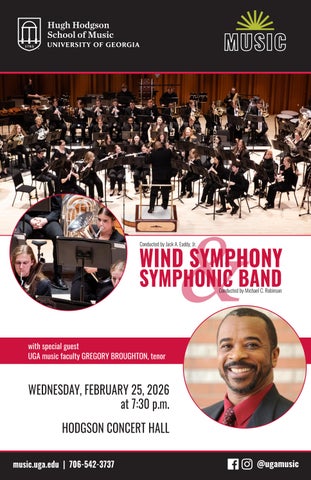
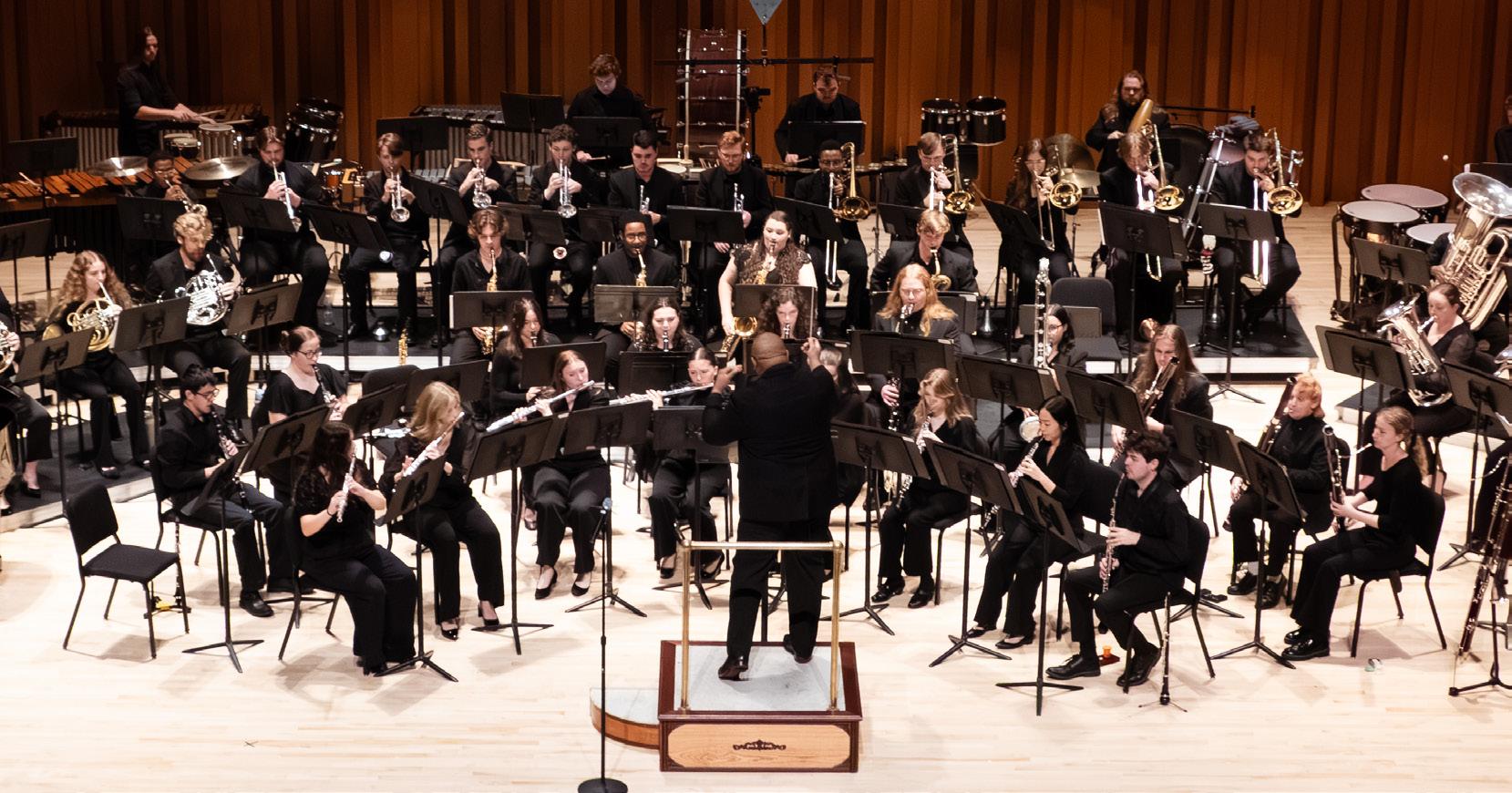
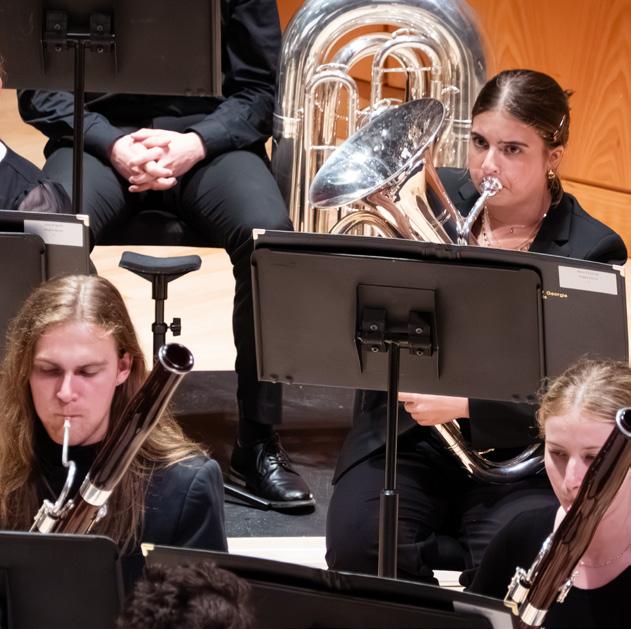
WEDNESDAY, FEBRUARY 25, 2026 at 7:30 p.m.
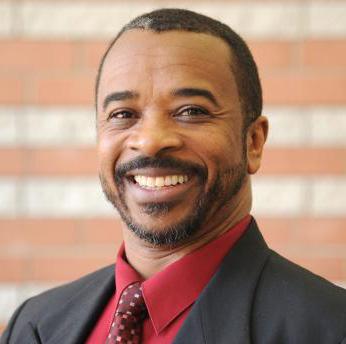
Wednesday, February 25, 2026 at 7:30 p.m.
Hodgson Concert Hall
UGA Performing Arts Center
University of Georgia Symphonic Band
Michael C. Robinson, Conductor
Jordan M. Fansler, Doctoral Conducting Associate
Alexia Toma, Flute
University of Georgia Wind Symphony
Jack A. Eaddy, Jr., Conductor
Derik J. Wright, Doctoral Conducting Associate
Marcus Morris, Guest Conductor
Gregory Broughton, Tenor
Ignition
Skye Boat Song
PROGRAM
University of Georgia Symphonic Band
Todd Stalter
William Ross
arr. Percy A. Grainger and David Stanhope
Jordan M. Fansler, Doctoral Conducting Associate
Concertino For Flute, op. 107
The Seal Lullaby
Alexia Toma, Soloist
Cécile Chaminade arr. Wilson
Eric Whitacre
Alleluia! Laudamus Te Alfred Reed
INTERMISSION
University of Georgia Wind Symphony
All or Nothing
Molly Joyce
Derik J. Wright, Doctoral Conducting Associate
A Song for Tomorrow Kevin Day
Grace, “Listening Beneath the Hymn”
Eternal Father, Strong to Save
Spiritual Symphony
World Premiere
Marcus Morris, Guest Conductor
Drinkin’ Gourd/Wade in the Water
Motherless Child
Deep River
What a Morning/Go Tell it
Gregory Broughton, Tenor
Chandler L. Wilson
Claude T. Smith
Benjamin Horne
Ignition (2011) (2’35”)
Todd Stalter (1966)
Ignition is a blindingly fast, raucously energetic concert opener that derives its title from the consecutive rising three-note cells that are the building blocks for almost the entire work. However, the energy unleashed in the music and the imagery of the title serve both as a metaphor for the “spark” of creativity, and as a “celebration in sound” for those who find and follow their own true life’s passion and pass it along to others, “igniting” the flame for another generation.
- Program Note by the Publisher
Todd Stalter received his Bachelor of Music Education degree (cum laude) and Master of Music in trumpet performance from Illinois State University, where he studied trumpet with Richard Lehman (solo cornet of “The President’s Own” United States Marine Band) and Dr. James Buckner, and conducting with Dr. Stephen K. Steele. He has served as a conducting assistant for such luminaries as Robert W. Smith, Gary Green, Larry Gookin, Marguerite Wilder, Randy Vaughan, Cody Birdwell, and Richard Floyd at the Music for All Summer Symposium. Stalter is currently the director of bands at Eureka High School in Eureka, Ill., and serves as chair of the Department of Fine Arts for CUSD #140. He has also been active as a church musician, recently retiring as principal trumpet and arranger for the Grace Brass at Grace Presbyterian Church in Peoria, Ill. after nearly 30 years of service.
Skye Boat
Song (1782/1900/2002) (5’)
William Ross (1762–1791)
In 1900 Percy Grainger (then about 18) arranged some Scottish folk songs for voice and piano after a holiday in Scotland, including the Skye Boat Song. As this arrangement is hardly known, I have sought to make it better known by expanding it in a version for concert band and optional voices. The first half of this new arrangement is entirely as Grainger wrote it (harmonies, suspensions etc.), apart from the change in scoring. There follows some new material with canons and key shifts before a majestic finale.
- Program Note by the Arranger
William Ross was a Scottish writer of Romantic poetry in Scottish Gaelic from the Isle of Skye and a Church of Scotland parish schoolmaster. More than two hundred years after dying in his twenties of tuberculosis, Ross remains a highly important and admired figure in Scottish Gaelic literature and is considered one of the greatest poets and writers in the history of the language. Ross’ most famous poems include “Farewell to the White Cockade,” and the lament, “Cuckoo of the Tree,” the tune of which is now known throughout the Anglosphere as The Skye Boat Song, based on multiple sets of Scottish English lyrics composed a century later.
Concertino For Flute, op. 107
(1902/1960) (8’25”)
Cécile Chaminade (1857-1944)
Commissioned by the Paris Conservatoire for their annual Concours Competition, the Concertino For Flute, op. 107 was originally composed for flute and orchestra, although it is now more frequently performed with piano accompaniment. Possessing a memorable melodic theme, the piece tests the performer through the unending phrases, virtuosic flourishes and the resultant
nimble fingerwork required. The structure is clearly identifiable through the themes that mark each of the sections: the lyrical melody that opens the work, the exciting piu animato that ends with a demanding cadenza, and the final recapitulation that is followed by a cheeky and vivacious codetta that brings the work to a dramatic close.
-Program Note from Appalachian State University
Cécile Chaminade was born into a musical family. Her father was an excellent violinist and her mother was known as a remarkable pianist and singer. Chaminade studied piano with her mother, who was her only teacher until she was fifteen. After hearing some of her compositions, written at the age of eight, Hector Berlioz encouraged her parents to give her a complete music education. At fifteen she began studying fugue and counterpoint with Augustin Savard, followed later by piano with Félix Le Couppey and composition with Martin-Pierre-Joseph Marsic and Benjamin Godard. She gave her first public piano recital at sixteen and the first recital of her works at age eighteen. Chaminade toured as a concert pianist to many cities, including Philadelphia where she played her Concertstuck with the Philadelphia Orchestra in 1908. During the tour she appeared at a music symposium with John Philip Sousa regarding the question of popular music.
The Seal Lullaby (2004/2011) (3’45”)
Eric Whitacre (b. 1970)
The Seal Lullaby was written initially for a classic animated film based on Kipling’s The White Seal, which was never created. It begins with the mother seal singing softly to her young pup.
Oh! Hush thee, my baby, the night is behind us,
And black are the waters that sparkled so green. The moon, o’er the combers, looks downward to find us, At rest in the hollows that rustle between. Where billow meets billow, then soft be thy pillow, Oh weary wee flipperling, curl at thy ease!
The storm shall not wake thee, nor shark overtake thee, Asleep in the arms of the slow swinging seas!
Rudyard Kipling, 1865-1936
After the film’s cancellation, Whitacre writes “...I didn’t do anything with it; just sang it to my baby son every night to get him to go to sleep. (Success rate: less than 50%.) A few years later the Towne Singers commissioned the choral arrangement of it, and in 2011 I transcribed the piece for concert band. I’m grateful to them for giving it a new life, and to the schools, colleges and directors listed who have believed in this new transcription. And I’m especially grateful to Stephen Schwartz, to whom the piece is dedicated. His friendship and invaluable tutelage has meant more to me than I could ever tell him.
GRAMMY Award-winning composer and conductor, Eric Whitacre, is among today’s most popular musicians. A graduate of The Juilliard School, his works are performed worldwide, and his groundbreaking Virtual Choirs have united well over 100,000 singers from more than 145 countries. Among his recent accolades and awards, Eric received the Richard D. Colburn Award from the Colburn School and an Honorary Doctor of Arts from Chapman University (CA). His long-term
relationship with Decca Classics has produced several no.1 albums which have enduring success. He served consecutive terms as Artist in Residence with the Los Angeles Master Chorale and currently holds the position of Visiting Composer at Pembroke College.
Alleluia! Laudamus Te (1973)
(6’15”)
Alfred Reed (1921-2005)
Alleluia! Laudamus Te is a hymn of praise without words, with the band serving as a single massive choir and, at times, broken down into individual sections, each performing as a separate choir. The music is based on three main themes, the first being a massive chorale in the brass, the second a long flowing line in the horns and woodwinds, and the third a quasi-fanfare figure first heard in the trumpets and then spreading throughout the other sections of the orchestra as it is developed. The work was commissioned by Richard S. Mountford and the Malone College Concert Band, which premiered the work, conducted by Reed, at its third annual band festival in February 1973.
- Program Note by William Johnson
Alfred Reed first developed his compositional skill during World War II when he served as Radio Production Director and Associate Conductor of the 529th Army Air Corps Band, producing over 150 weekly broadcasts and composing and arranging nearly 100 works for band. Following the war, Reed studied composition with Vittorio Giannini at The Juilliard School. He later received his BM and MM degrees from Baylor University. For years, he taught composition and conducting at the University of Miami in Coral Gables, Florida. In his lifetime, Reed composed over 250 published works for wind band, chorus, orchestra, chamber ensemble, and solo instrument.
All or Nothing (2019) (5’)
Molly Joyce (b. 1992)
All or Nothing enacts a progression from attack to sustain, highlighting the process’ consistencies and inconsistencies, and asking if the concept of having “all” or “nothing” is desired. The inquiry stems from recent research into social uniformity and particularly through the social model of disability, which states that people are disabled by barriers in society rather than by impairment or difference. Therefore by asking if all or nothing is desired, I hope to illuminate overriding challenges in such a polarizing categorization, as well as utilize the singular body of the symphony band, an optimal instrumentation to execute such differences.
-Program Note by the Composer
Molly Joyce is a composer and performer whose work explores disability as a creative source. Described by The Washington Post as “one of the most versatile, prolific, and intriguing composers working under the vast new-music dome,” her music has also been praised by The New York Times for its “serene power.” Joyce frequently performs on an electric vintage toy organ that physically suits her disability, as well as further adaptive music technologies. Her 2025 album State Change was praised by The Wall Street Journal and long-listed for NPR’s Best New Albums. Joyce has presented work at Carnegie Hall, Hirshhorn Museum, National Sawdust, and is currently a Dean’s Doctoral Fellow at the University of Virginia.
A Song for Tomorrow (2019) (8’)
Kevin Day (b. 1996)
A Song for Tomorrow is a composition that is very near and dear to my heart. The piece was composed in memory of my friend Jonathan Foreman, who tragically died in September of 2018. Jonathan, his older brother David, and their family and I were close when we were in high school, and so his death hit me very hard; as well as the family, and the students and faculty of Arlington High School. For his funeral, the room was packed with Arlington High School teachers, students and alumni who knew Jonathan. Arlington High School was always a family and it was amazing to see how many people came out to support and say their goodbyes. After the funeral service, I felt a deep pulling on my heart that I need to write something for Jonathan and the Foreman family, as a tribute to Jonathan. I pondered what to do for months until I was able to come up with a title and an idea for the piece. The title of the composition, A Song for Tomorrow, is inspired by a Latin phrase that was printed on Jonathan’s funeral program. The phrase read “Cras alius dies est,” which means “tomorrow is another day.”
-Program Note by the Composer
Kevin Day is an internationally acclaimed composer, conductor, and pianist based in Las Vegas, NV. He has composed over 250 works for various mediums including many concertos, chamber music, orchestra, and wind band compositions. His music often intersects between the worlds of jazz, minimalism, Latin music, fusion, and contemporary classical idioms. Day has won a BMI Composer Award, was a finalist for the ASCAP Morton Gould Composer Award, the ABA-Sousa Oswald Award, and the NBA William Revelli Award. He studied at the University of Miami, the University of Georgia, and Texas Christian University.
Grace, “Listening Beneath the Hymn” (2026) (12’)
Chandler L. Wilson (b.
1984)
Grace, “Listening Beneath the Hymn” is my personal re-imagining of the tune we know today as Amazing Grace. For generations this melody has been sung in moments of celebration, mourning, love, and hope. Yet its origins are far more complex than its familiar simplicity suggests. John Newton, the writer of the hymn’s text, once served as the captain of a slave ship, an agent within one of history’s most devastating systems of human suffering. Though Newton later expressed remorse and ultimately aligned himself with the abolitionist cause, the shadow of that past remains intertwined with the hymn’s legacy.
Many believe that Newton’s melody was shaped, consciously or not, by the sounds he heard from the enslaved people confined below deck: wordless humming, moans, and melodic fragments rooted in West African musical traditions. The pentatonic quality of Amazing Grace is so central to its identity and sits apart from many Western harmonic practices, yet it resonates deeply with African musical languages. This juxtaposition creates an unsettling paradox: a tune revered in church pews, memorials, and civic ceremonies may carry echoes of voices that were never free.
In Grace, I explore this paradox by placing the familiar melody in conversation with musical elements drawn from West African rhythmic practice, especially the driving patterns of the West Coast. These rhythms evoke the uncertainty, fear, and resilience of people forced into unimaginable circumstances, illuminating perspectives often overlooked in the hymn’s traditional
interpretations. Moments of fragmentation, chase, and unease reflect the lived experiences of those whose musical expressions shaped the very foundation of the tune.
As the piece unfolds, Grace moves between turbulence and reflection, dissonance and clarity. The work ultimately returns to the melody’s sense of hope. A hope that has come to symbolize peace and healing for many communities in America. Yet the ending resists a tidy resolution. Instead, it holds a charged stillness, acknowledging the diverse racial, ethnic, and religious experiences that inform our modern understanding of grace.
The piece concludes not with certainty, but with energy: a question directed toward the future, and an invitation to consider what comes next when we listen to our history fully, its beauty, its contradictions, and its truths.
-Program Note by the Composer
Chandler Wilson is an American composer, conductor and educator. Dr. Wilson is a native of Miami, FL, and attended Florida A&M University where he earned his Bachelor of Science degree in music education. During his time at FAMU, he was selected as the student arranger and conductor for the marching and symphonic bands and was selected as one of the first student staff members for the “Marching 100”. Dr. Wilson earned a Master of Arts degree in wind band conducting from the Indiana University of Pennsylvania where he studied with Dr. Jack Stamp. He received his Ph.D. in music education with an emphasis in wind band conducting from Florida State University. He has studied conducting under the batons of Prof. Richard Clary, Dr. Jack Stamp, Dr. Julian White, Dr. Shelby Chipman, Dr. Roby George, Maestro Raffaele Ponti, and Mr. Neil Jenkins.
Spiritual Symphony (2025) (20’)
Benjamin Horne (b. 1995)
Spiritual Symphony is a collection of settings of African American spirituals for wind band. Together, this compilation synthesizes into a large work that engages with symphonic form.
The first movement is primarily based on Follow the Drinking Gourd. Filled with many inferences and descriptions, there is belief that the song may have been used as directions for slaves escaping along the Underground Railroad. The lore around this song also includes Peg Leg Joe as the “old man” referenced in the lyrics “comin’ just to carry you to freedom.” Joe was believed to have been a figure who would travel to plantations to deliver the “instructions.” This work uses the melody from the chorus of the song as a strophic theme that gradually intensifies and recedes like Peg Leg Joe coming to teach you how to escape and then disappearing in the dead of night. Wade in the Water, another spiritual believed to be used for a similar purpose, is also interwoven throughout this movement.
Motherless Child is the musical bedrock for the second movement. Shrouded in anguish and desperation, the song’s lyrics suggest a state of worthlessness and a sense of one feeling lost -having squandered their sense of identity and humanity.
Deep River was previously a standalone setting written for my friend Anthony Morris. This edited version makes up the third movement. The setting pays homage to Henry Burleigh whose published versions in the 1910s helped popularize the song as well as the recordings of Paul Robeson. In contrast to the earlier movements, Deep River expresses a sense of hope and a longing desire to
“cross over” to a land of freedom and peace.
The final movement opens with My Lord, What a Morning as a chorale before progressing into an exuberant rendition of Go Tell It on the Mountain. Both songs contain references to biblical events in their lyrics, but the connecting idea of a “new life” or a “new age” resonates throughout. Spiritual Symphony was the winner of the National Band Association’s William D. Revelli Memorial Composition Contest in 2025.
-Program Note by the Composer
Benjamin Horne is a conductor, composer/arranger, and low brass performer. Horne’s works and arrangements span various styles. Horne has worked with and had music performed by musicians from the Chicago Symphony, Dallas Symphony, San Antonio Symphony (now reorganized as Philharmonic), Atlanta Symphony, Chicago Lyric Opera, Houston Opera, “The President’s Own” US Marine Band, as well as other renowned instrumental soloists. He has worked with the SOLI Chamber Ensemble, Musiqa (Houston), Atlanta Chamber Players, Decoda (New York), and Picosa (Chicago) professional new music ensembles as well as several university large ensembles. His music has been featured as required repertoire for several international solo competitions and as lab music for conducting symposia. Horne’s music has been performed across the world in Europe, Asia, and South America. Also, his music has been performed at several events including state music educator conferences, the Midwest International Band and Orchestra Clinic, the International Trombone Festival, the Lätzsch Trombone Festival in Germany, the International Tuba and Euphonium Conference, the International Euphonium Tuba Festival, the Leonard Falcone International Euphonium and Tuba Festival, International Trumpet Guild Conference, the International Horn Society Symposium, as well as the College Band Directors National Association Conference.
UNIVERSITY OF GEORGIA BANDS GRADUATE STAFF
Jordan M. Fansler, Doctoral Conducting Associate
R. Scott Mullen, Doctoral Conducting Associate
Derik J. Wright, Doctoral Conducting Associate
Joseph Johnson, Graduate Assistant
Michelle Moeller, Graduate Assistant