MUSIC 26|27
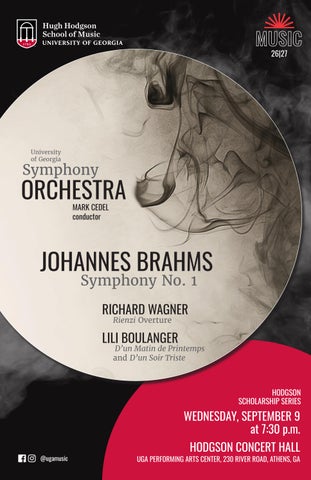
University of Georgia
Symphony
ORCHESTRA MARK CEDEL conductor
JOHANNES BRAHMS Symphony No. 1 RICHARD WAGNER Rienzi Overture
LILI BOULANGER
D’un Matin de Printemps and D’un Soir Triste
HODGSON SCHOLARSHIP SERIES
WEDNESDAY, SEPTEMBER 9 at 7:30 p.m. @ugamusic
HODGSON CONCERT HALL
UGA PERFORMING ARTS CENTER, 230 RIVER ROAD, ATHENS, GA
ARTS
FRANKLIN FINE AND PERFORMING
Embrace the arts. ENRICH YOUR WORLD.
26 | 27 SEASON
JOIN US FOR A FULL SEASON OF PERFORMANCES, EXHIBITIONS,AND MORE!
TICKETS NOW ON SALE LAMAR DODD SCHOOL OF ART
UGA DEPARTMENT OF DANCE
SCAN QR CODE OR VISIT OUR WEBSITES FOR SCHEDULE AND DETAILS SPECIAL PACKAGES AND OFFERS AVAILABLE HUGH HODGSON SCHOOL OF MUSIC
UGA DEPARTMENT OF THEATRE AND FILM
art.uga.edu dance.uga.edu music.uga.edu ugatheatre.com
MUSIC 26|27
HODGSON SCHOLARSHIP SERIES
JOHANNES BRAHMS Symphony No. 1
University of Georgia Symphony Orchestra Mark Cedel, conductor Daniel Marcos Rodriguez, assistant conductor Wednesday, September 9 at 7:30 p.m. Hodgson Concert Hall UGA Performing Arts Center
PROGRAM Overture to the Opera Rienzi
Richard Wagner (1813 – 1883)
D’un matin de printemps
Lili Boulanger (1893 – 1918)
D’un soir Trieste intermission
Symphony No 1, C minor, opus 68
Un poco sostenuto – Allegro Andante sostenuto Un poco Allegretto e grazioso Adagio – Allegro non troppo, ma con brio
Johannes Brahms (1833 – 1897)
Make plans to attend the America 250 concert, Thursday, October 1. Bernstein Candide Overture, Copland Lincoln Portrait, Gershwin Porgy & Bess Suite
PERFORMANCE NOTES
Overture to the Opera Rienzi (12’) - Richard Wagner Three flutes, two oboes, two clarinets, three bassoons, four horns, four trumpets, three trombones, tuba, timpani, military drum, tenor drum, bass drum, cymbals, and strings The overture to Rienzi embodies the usual tropes descriptive of the “grand opera” style including melodies from the opera itself and a loud, boisterous fanfare that rushes to the end. However, for all its energy and beauty, it was Wagner’s initial attempt to swing open the Paris opera world for himself. In 1839, after arriving in Paris at age 26, Wagner desperately sought out anyone with influence who would take a chance on his new opera Rienzi, which tells the story of a Roman tribune chosen from among the oppressed to represent their plight and alleviate their burdensome lives. Rienzi eventually overthrows the government, liberating the people only to slowly become the villain until his own followers overthrow him. Wagner’s musical output in this opera and its libretto, which he wrote himself, exercised the common “grand opera” style that included large productions, grand choruses, historical epics. Vocal traditions from Italy and France were greatly influenced by Rossini, Meyerbeer, and Weber. The overture opens with a trumpet call that slowly introduces the warm melody of Rienzi’s Act 5 prayer aria before erupting into military fanfare that constantly builds through long crescendos and chromatic movement. The full opera enjoyed a brief popularity in its time. Apart from its overture, it is seldom performed. Nonetheless, the overture presents a young Wagner making his way towards the heights of opera royalty before his known Germanic style takes full force. D’un matin de printemps (5’) - Lili Boulanger piccolo, two flutes, two oboes, english horn, two clarinets, bass clarinet, two bassoons, contrabassoon, four horns, three trumpets, three trombones, tuba, percussion, celeste, harp, and strings D’un soir triste (11) - Lili Boulanger two flutes, two oboes, english horn, two clarinets, bass clarinet, two bassoons, contrabassoon, four horns, three trumpets, three trombones, tuba, timpani, cymbal, bass drum, tam-tam, celesta, harp, and strings Lili Boulanger, the younger sister of the famous composition teacher Nadia Boulanger, was an incredibly gifted young composer during her short life. Descending from a musical family, Lili began her musical studies as young as two years old. She famously
competed and became the first woman to win the covetous Prix de Rome for her cantata Faust et Helena. However, upon winning her scholarship to study composition in Rome, her declining health began to surface. As a result, her final completed pieces, D’un matin and D’un soir, were composed in tandem and in her own hand. Transcribed for orchestra, both compositions are impressionistic in nature, but completely opposite in tone and emotion. D’un matin begins with animated strings and spring-like frolicking from the woodwinds, a particular favorite color of French impressionistic music. Its tone remains playful and carefree with repeated ascending melodic phrases, dynamic surprises, and bright woodwind timbre. Conversely, D’un soir takes the original melody from D’un matin at a much slower speed introduced by the bassoon in a deeper register and darker timbre. As the tension rises, melodies in the cellos and clarinets drag along the listener, ever delaying the approaching despair and, perhaps, the inevitable end as the strings reach tremendously high registers. Notice how D’un soir is twice as long as D’un matin. These works masterfully capture Lili’s talent and mastery over the orchestra displaying all the music she still had left to give this world. She was 25 when she died of tuberculosis. Her sister, Nadia, continued to be her advocate, successfully leading to the premiers and publications of both D’un matin and D’un soir. Symphony No. 1, C minor, opus 68 (45’) - Johannes Brahms Two flutes, two oboes, two clarinets, two bassoons, contrabassoon, four horns, two trumpets, three trombones (4th mvt.), timpani, and strings Brahms spent nearly twenty-two years composing his first symphony, knowing it would ultimately be compared with his idol, Beethoven, whom he and all Vienna admired so deeply. Beethoven’s triumphant Ninth Symphony left the musical world in sheer awe. That along with Robert Schumann’s illustrious praise of Brahms’s earliest works placed the pressure squarely on Brahms as the world waited in anticipation for his First Symphony. Ironically, Brahms’s Serenades, Piano Concerto #1, and Variations on a Theme by Hadyn were in many ways his introductions and tinkering towards the symphonic medium in all but name. Nonetheless, he worked tirelessly for many years, sending sketches to Clara Schumann for her thoughts and critiques. Finally, in 1876, his First Symphony premiered in Karlsruhe. Brahms enjoyed employing degrees of variations in his “symphonic” works and piano sonatas, and the first movement of this symphony is no different. The introduction opens with poundings of a low C in the timpani and basses along with a three-note motive heard between the violins and woodwinds moving in contrary motion. There is a struggle that is seeking to be resolved
music.uga.edu |
@ugamusic
but instead leads the listener into the main portion of the movement. As the symphony develops, the three-note motive
is continually disrupted by the violas to varying degrees until the dynamic tide reaches the recapitulation. After restating the main exposition, the variations of interrupting violas immediately change into shared two-note motives between the strings and woodwinds until Brahms uses the climax to transition the listener to C major rather than the expected C minor ending. Movements two and three are based on Brahms’s particular love of relative thirds. His second movement begins in E major and his third movement in Ab major. The second movement spins a gentle yet rich melody in the strings, which is soon picked up by the oboe in pure bliss. This is pouring forth is achieved through careful threading of melodic material across the bar line from instrument to instrument. The third movement provides more gracious movement through an opening 5-bar phrase given by the clarinet which then slowly erupts into a brighter key until it finally slows down again reaching another hushed ending. The finale nearly mirrors the similar timbres of the first movement with strings and timpani but then moves into a playful pizzicato building towards the dread of the introduction again. Then, the horns enter with a hopeful melody ever rising towards the Allegro, which some have said is an homage to Beethoven’s “Ode to Joy” melody. As the Allegro continues towards the Coda, rhythms become ever more syncopated and complex with triplet figures. Once in the Coda, the chorale returns fully realized in a complete, radical eruption of C major racing to the end with joy. Daniel Marcos Rodriguez
MEET THE ARTISTS Mark Cedel conductor
Now in his 33rd year at UGA, Mark Cedel brings a wealth of professional experience to his position as Director of Orchestral Activities. Prior to his appointment at UGA, he was Associate Conductor of the Charlotte Symphony Orchestra. In his four seasons with that orchestra, he conducted over 200 performances; appearing on every series offered by the orchestra. Before joining the Charlotte Symphony, Cedel was Principal Viola and Assistant Conductor of the Charleston (SC) Symphony Orchestra for nine years. While in Charleston, he served for two seasons as that orchestra’s Acting Music Director. From 1986-1990, he was a member of the artist faculty at the Brevard Music Center and was principal conductor of the Brevard Repertory Training Program. In addition to directing orchestral activities at UGA, Cedel served as professor of viola from 1994-2002. During that period he performed, toured, and recorded regularly as extra/substitute viola with the Atlanta Symphony Orchestra, including its northeast tour with concerts in Carnegie Hall. He returned to teaching viola for the 2009-2010 academic year, while a search was conducted to fill the position. Cedel has been associated with many orchestras in the southeast. This includes Principal Viola of the South Carolina Chamber Orchestra and the Guest Principal Viola of the Savannah Symphony, and orchestras in Augusta, Macon, and Jacksonville. He has performed with many distinguished conductors such as Claudio Abbado, Leonard Bernstein, Riccardo Muti, Zubin Mehta, Eugene Ormandy, and Carlo Maria Giulini. Daniel Marcos Rodriguez was born in Miami, FL, to Cuban and Puerto Rican parents and began conducting at age 16 under Dr. Adalberto Yanes. He earned a Bachelor of Music in Music Education from Florida International University and taught K–8 general music for seven years in Orlando, FL. He furthered his training at Miguel Harth-Bedoya’s Conducting Institute and participated in international workshops, receiving an Honorable Mention for the Respighi Prize in Conducting with the Chamber Orchestra of New York.
music.uga.edu |
@ugamusic
In 2022, Daniel debuted as Associate Conductor with Opera Orlando conducting Die Zauberflöte, later contributing to productions of Tosca, Frida, Lucia di Lammermoor, and The Juniper Tree. He currently serves as their Orchestra Librarian. Additionally, he was Assistant Conductor for the International Summer Opera Festival of Morelia in Mexico, assisting with Don Giovanni and Carmen. Daniel completed an M.M. in Orchestral Conducting at Valdosta State University, where he served as Assistant Conductor of the Valdosta Symphony Orchestra and Principal Conductor of the Valdosta Community Symphony Orchestra. He also served as Assistant Conductor for Georgia’s Governor’s Honors Program Orchestra. Daniel is currently pursuing a DMA degree in Orchestral Conducting at the University of Georgia, serving as Graduate Conducting Assistant to the University of Georgia Symphony Orchestra.
University of Georgia Symphony Orchestra performs “Fan Favorites” during the March 26, 2026 performance. Photo by Zoe Lanham.
PERSONNEL
University of Georgia
Symphony
ORCHESTRA Mark Cedel, Conductor Daniel Marcos Rodriguez, Assistant Conductor VIOLIN I Sarah Nienhiser,
VIOLA Jensi Perng, principal
BASS TRUMPET Wueliton Dal Pont, principal Will Cuneo, principal
Anika Meisel
Fernando Almeida
Adriano Estraiotto
Yiming Zhao
Antonio Peirano
Palmer Hartley
Obi Uchime
Austin Carter
Morgan Clark
Alexis Boylan
Devin Bennett
Madeline Bower
Jhonni Campos
Clinton Stempien
Danielle Olibis
Jingyi Wei
Reagan Gary
Phillip Pickeral
Jocelyne Andronache-Opris
Marissa Evans
Sergio Sabillon
Caleb Paradis
Karla Mejias
Dorothy Park
Zijie Sheng
Rania Haque
Hermes Meija-Holguin
Benji Nguyen
Ellis Kim
Zora Ayeni
Zhijie Xiu
Prhust Saleh
OBOE Xander Herman, principal
Zeb Tate
Anisa Herbert
co-concertmaster Clarissa Tamara, co-concertmaster
VIOLIN II Ori Kang, principal Simms Murray Mei Takuno Kiera Johnson Abigail Kim Edric Nduwimana Joey Pak Leo Jahn Briana Darden Athziri Moreno-Martinez Han Yang Hazel Moreno Chloe James Selma Obideen
CELLO Tianbo Zhang, co-principal Hsi-Yuan Christine Kao, co-principal Mary Allison Swaim Priya Gingrich Katherine Lamback Kristen Song Benjamin Hackworth Joshua Nguyen Katherine Selby David Zoblisein
TROMBONE James Diffey, principal Jonah Tully
FLUTE
Jacob Gehr, bass
Shengyu Cui, principal
TUBA
Olivia Simpson
Jack Gordon
Madeline Shell
PERCUSSION
Triston Fielding Andrew Engels CLARINET Claudia Reve Romero, co-principal Luis Da Silva, co-principal
Hsiao Huang, principal Drake Smith Angelina Vasquez Grayson Pruitt KEYBOARD Joey Pak HARP Dania Lane McKay Magness
Tim Fitzgerald
LIBRARIAN Alexis Boylan
BASSOON Jazmyn Barajas-Trujillo,
PERSONNEL &
principal Caleb Jackson
PRODUCTION Sergio Sabillon
Skylar Ward
PRODUCTION
HORN
ASSISTANTS Christine Kao
Connor Parr, co-principal Ian Welch, co-principal
Jingyi Wei
Gabriel Espelid Gibson Krolikowski MacKenzie Shields
music.uga.edu |
@ugamusic
HUGH HODGSON SCHOOL OF MUSIC FACULTY
Felix Olschofka, Director Brandon Craswell, Associate Director, Director of Undergraduate Studies Emily Gertsch, Associate Director, Director of Graduate Studies Amy Pollard, Associate Director, Director of Performance Activities PERFORMANCE FACULTY Josh Bynum Brandon Craswell Jean Martin-Williams James Naigus *Matthew Shipes Gilbert Villagrana
trombone trumpet horn horn tuba/euphonium trumpet
Kimberly Toscano Adams * Timothy Adams
percussion percussion
John Coble Scott Cuellar Damon Denton * Grace Huang Emely Phelps Greg Satterthwaite Anatoly Sheludyakov James Weidman Alan Woo
organ piano piano piano piano piano piano piano piano
Levon Ambartsumian Shakhida Azimkhodjaeva Karen Bergmann Daniel Bolshoy Michael Heald James Kim Edward Kreitman * Milton Masciadri Maggie Snyder
violin violin strings guitar violin cello Suziki double bass viola
Gregory Broughton Jay Ivey Elizabeth Knight *Amy Petrongelli Anne Slovin
voice voice voice voice voice
* Angela Jones-Reus D. Ray McClellan Reid Messich Amy Pollard Brandon Quarles
flute clarinet oboe bassoon saxophone
BANDS Mia Athanas Brett Bawcum Jack A. Eaddy, Jr. Marcus Morris * Nicholas Enrico Williams CHOIRS * Daniel Bara Gregory Broughton Colin Mann Daniel Shafer COMMUNITY MUSIC SCHOOL & SUMMER CAMPS Stephen Fischer COMPOSITION & THEORY Adrian Childs Emily Gertsch *Emily Koh Peter Lane Dickie Lee Trinity Vélez-Justo Morgan Weeks CONDUCTING STUDIES Daniel Bara Brett Bawcum Mark Cedel Jack Eaddy Colin Mann *Nicholas Williams JAZZ STUDIES David D’Angelo Gregory Satterthwaite James Weidman
MUSIC EDUCATION *Rebecca Atkins Alison Farley Tyler Goehring Roy Legette Kristen Lynch Michael Robinson Johanna Royo Brian Wesolowski MUSIC THERAPY *Ellyn Evans Sally Ann Nichols Jenny Stull MUSICOLOGY & ETHNOMUSICOLOGY Karen Bergmann * Naomi Graber David Haas Jared Holton Jean Kidula Eleanor Price Rumya Putcha Joanna Smolko OPERA * Daniel Ellis Andrew Voelker ORCHESTRA * Mark Cedel RECORDING & STREAMING Eric Dluzniewski Jamie Tagg
*Area Chair
HUGH HODGSON SCHOOL OF MUSIC STAFF Susan McClure, Administrative Assistant to the Director
Shaun Baer Levi Dean Elizabeth Durusau Heather Gozdan-Bynum Scott Higgins Kathleen Powell Rocky Raffle James Sewell Jared Tubbs Marshall Williams
Director of Public Relations Development Associate Music Library Manager Undergraduate Academic Advisor Senior Piano Technician Graduate Program Administrator Administrative Associate in Bands Production & Events Manager Sectioning Officer Director of Admissions
SUPPORT HOW TO GIVE
THE SCHOOL OF MUSIC
Under each of the available funds below is a QR code where you can scan and donate directly to that fund. However, if you would like to learn more about alternative ways to donate, scan the QR code now to visit our “How to Give” page with additional details and options.
SUPPORT THE THURSDAY SCHOLARSHIP FUND
Scholarships and Graduate assistantships funded by donations to the Thursday Scholarship Fund make it possible for students to learn and pursue their passions at the Hugh Hodgson School of Music. Please consider a taxdeductible gift to the Thursday Scholarship Fund so we may continue to support our students and make their education possible. Scan the QR code now or reach out to Melissa Roberts at roberts@uga.edu or 706-254-2111.
SUPPORT INDIVIDUAL AREAS OF THE SCHOOL OF MUSIC
In addition to our primary Support and Scholarship Funds, many specialized areas of interest, including our orchestra and choral programs, have support and scholarship funds you can contribute to directly. You can now learn more about all the ways and areas you can support the Hugh Hodgson School of Music. Scan the QR code or visit music.uga.edu/giving-and-alumni to the support the Hugh Hodgson School of Music area of your choice.
JOIN THE DIRECTOR’S CIRCLE
Gifts of all amounts are greatly appreciated. However, annual giving at the $1,500 level and higher provides membership in the Director’s Circle, our Hugh Hodgson School of Music Honor Roll. Director’s Circle members are invited to exclusive events and performances throughout the academic year. For large gifts, please contact Melissa Roberts at roberts@uga.edu or 706-254-2111.
THANK YOU FOR YOUR CONTINUED SUPPORT OF THE UNIVERSITY OF GEORGIA HUGH HODGSON SCHOOL OF MUSIC.
MUSIC 26|27
FEATURED PERFORMANCE
GEORGIA BRASS QUINTET $15 - Adults $3 UGA students plus $3 transaction fee
music.uga.edu 706-542-4400
MONDAY, SEPTEMBER 14 at 7:30 p.m. Ramsey Concert Hall The Georgia Brass Quintet is presenting an All-American program of classical- and jazzinspired compositions comprised of original works and transcriptions.
FREE PERFORMANCE GUEST ARTIST RECITAL OLIVER JIA, piano
TUESDAY, SEPTEMBER 15 at 7:30 p.m. Ramsey Concert Hall
FEATURED PERFORMANCE
WIND ENSEMBLE
PAUL HINDEMITH
with
The Swan Turner $15 - Adults $3 UGA students plus $3 transaction fee
music.uga.edu 706-542-4400
MAGGIE SNYDER viola
THURSDAY, SEPTEMBER 17 at 7:30 p.m. Ramsey Concert Hall
This concerto for viola is sometimes referred to as the Concerto from Old Folk Songs. The piece follows a wandering medieval minstrel performing and embellishing these folk tunes.
music.uga.edu | 706-542-4400 | 230 River Road, Athens, GA
@ugamusic