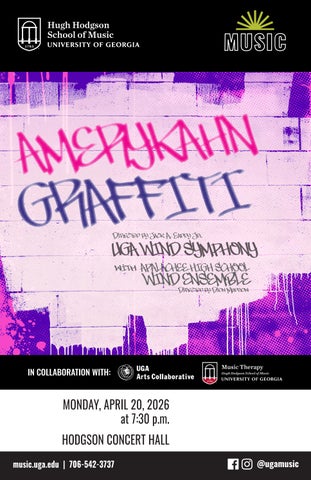



MONDAY, APRIL 20, 2026 at 7:30 p.m.
HODGSON CONCERT HALL
Monday, April 20, 2026 at 7:30 p.m.
Hodgson Concert Hall
UGA Performing Arts Center
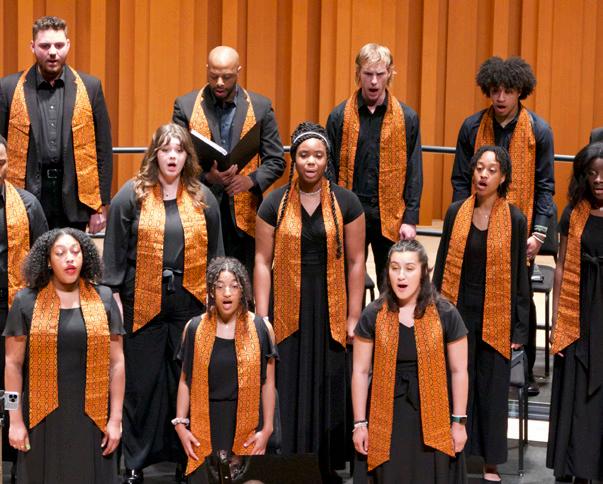
Apalachee High School Wind Ensemble
Dion Muldrow, Conductor
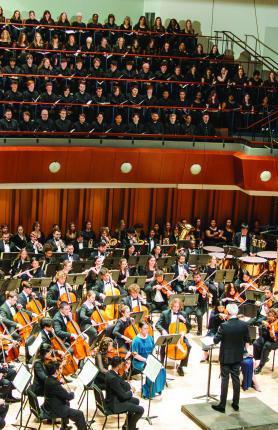
University of Georgia Wind Symphony
Jack A. Eaddy Jr., Conductor
Brett Bawcum, Guest Conductor
R. Scott Mullen, Doctoral Conducting Associate
Marie Douglas, Composer in Residence
This program is supported in part by the UGA Arts Collaborative, an interdisciplinary initiative for advanced research in the Arts. arts-collab.uga.edu
Tonight’s performance is a sensory-friendly concert, presented in collaboration with the UGA Music Therapy Association. Sensory-friendly concerts give opportunities for individuals with disabilities or sensory needs to enjoy a formal music experience in an accessible environment.
The Inferno
Robert W. Smith
El Relicario José Padilla/arr. Robert Longfield
On a Hymnsong of Philip Bliss
Abram’s Pursuit
Afrospire
Soul Suite No. 2
Licks n Hits
Sweet Potato Pie
10972018Z
David R. Holsinger
David R. Holsinger
Havana Nights Randall Standridge
INTERMISSION
University of Georgia Wind Symphony
For what shall it profit a man...?
World Premiere Apalachee High School Wind Ensemble
Bakhari Nokuri
Marie A. Douglas
Four Tableaux
Hard Grape
The Steel Mill
Sunset on the River
Blue Angels
R. Scott Mullen, Doctoral Conducting Associate
World Premiere
Keaton Marek
Hail to the Spirit of Liberty
Amerykahn Graffiti
Promenade
Gothika
Love is an Offering
Brett Bawcum, Guest Conductor
Sarah, Sephonia, Sweet Thing & Peaches
Boogieman
Soulstice
Georgia Premiere
John Philip Sousa
Katahj Copley
Afrospire (2023) (5’30”)
Bakhari Nokuri (b. 2005)
This composition is a swelling-dance inspired by Afro-Cuban rhythms and grooves, most notably from Chick Corea’s La Fiesta and Stan Kenton’s Malagueña. When I started the work, I was going through a particularly challenging time in school, lacking motivation and drive. I had to dig deep inside myself to find a sense of motion and reason to go on. I turned to music, finding songs that instilled a fire in me. I found that the sounds of African drums resonated within my soul the most, making me feel connected to my African roots, and pushing me to go on. Afrospire encapsulates this feeling of being transcended from reality and being left in a trance or dream that tells you to keep going. The word itself is a combination of two words: “afro-”, meaning relating to African diaspora, and “spir-”, deriving from spirit.
-Program Note by the Composer
Bakhari Nokuri is an African-American composer, producer, and drummer based in Los Angeles. Nokuri is an undergraduate composition student at the University of Southern California Thornton School of Music, and studies with Camae Ayewa. Primarily self-taught until 2023, he has also studied with Adrian B. Sims, Andrew Norman, Ted Hearne, and Will Kennedy. Though he grew up in Howard County, Maryland, Bakhari’s heart and soul are rooted in Baltimore, where he spent much of his time with his mother, Charmaine (Michelle) Nokuri, a jazz performance major at the Peabody Conservatory. His music reflects this dual influence: while drawing from the bold orchestral voices of Mahler, Bernstein, and Hazo, his work also carries the improvisatory spirit of jazz greats such as Robert Glasper, Herbie Hancock, and Chick Corea, layered with the colors of contemporary artists like Thundercat, Tyler, the Creator, and Hiatus Kaiyote. Constantly searching for new textures and grooves, Bakhari infuses his music with an energy that is both fresh and deeply engaging.
Soul Suite No. 2: A Modular Suite (2026) (9’)
Marie A. Douglas (b. 1987)
Soul Suite No. 2: A Modular Suite, commissioned by Jack A. Eaddy Jr. and the University of Georgia Wind Symphony, is a multi-movement work for winds that integrates electronic and visual media with audience participation to expand the traditional concert experience. Drawing on a wide spectrum of Afro-diasporic musical styles, each movement offers a distinct sound world: Licks n Hits delivers a high-energy, funk-inspired brass and percussion fanfare rooted in the composer’s childhood memories and the influence of bands like Earth, Wind & Fire; Sweet Potato Pie blends acoustic ensemble with electronic accompaniment in a dynamic, roller-coaster-like form full of shifting textures and climactic moments; 10972018Z explores nuanced, groove-driven textures that evolve from intimate, smoky sonorities into the bold, visceral energy of HBCU marching band traditions; and For What Shall It Profit a Man…? reimagines the spiritual Give Me Jesus for woodwinds and percussion, building from delicate arpeggios to a hypnotic, reflective climax. Together, the movements create an immersive, community-centered work that celebrates memory, culture, and sonic innovation.
-Program Note by the Composer
Marie A. Douglas, a composer hailing from Atlanta, has garnered widespread acclaim for her exceptional talent in seamlessly blending genres and textures within her captivating concert stage pieces. Her music serves as a profound reflection of her inner-city upbringing and her
diverse musical experiences, infusing a genuine and authentic essence into each composition. Douglas draws significant inspiration from the African Diaspora, effectively integrating elements of hip-hop and western art music idioms to create compositions that resonate with a wide range of audiences. With her works captivating concert-goers across the United States and Canada, Marie’s artistry extends beyond the stage as she collaborates with various ensembles and lends her creative prowess to the world of film music, as well as hip hop and r&b.
Four Tableaux (2026) (12’)
Keaton Marek (b.1998)
Four Tableaux is one of many of my compositions inspired by visual art. “Hard Grape” is based on an abstract painting of the same name by Susan Tessem. In this movement, I focus on taking certain shapes and elements of art present in the painting and translating them into musical gestures that evolve and take different shapes over time. “The Steel Mill” is based on a Thomas Hart Benton painting of the same name. I evoke the harsh, steamy, and heavy sounds of a steel mill in this movement and enter the wandering mind of the lonesome worker represented at the center of the painting. George Inness’s painting titled “Sunset on the River” serves as the basis for the third movement. In this movement, I explore the contrast between light and dark as presented in the painting, while generally maintaining a sense of calmness and tranquility. The final movement, “Blue Angels,” is based on a photograph that my brother took of the U.S. Navy Blue Angels during one of their shows. I evoke feelings of excitement, intensity, and precision to mirror the same emotions felt during a Blue Angels show. The keen listener will also hear a motive in the movement derived from Van Halen’s “Dreams,” a song that is closely associated with the Blue Angels. -Program Note by the Composer
Keaton Marek is a DMA composition student and teaching assistant at the University of Georgia. Marek’s recent compositions and research interests focus on exploring the intersection between static visual art (such as paintings, sculptures, and photographs) and the compositional process. Marek has had recent performances of his works at the University of Georgia, Florida State University, Baylor University, East Texas A&M University, the University of Central Florida, the Morton H. Meyerson Symphony Center in Dallas, and the International Horn Symposium. As a music theorist, Marek has recently presented his research at several conferences, including the South Central Society for Music Theory Conference and the Music Theory Southeast Conference. After concluding his studies at the University of Georgia, Marek plans to pursue a career as a music educator in higher education to help shape the next generation of musicians, artists, educators, and creators.
Hail to the Spirit of Liberty (1900) (3’)
John Philip Sousa (1854-1932)
Sousa and his band proudly represented the United States at the 1900 Paris Exposition on their first overseas tour, where their performances were enthusiastically received and helped challenge European perceptions of America as artistically underdeveloped. A central highlight of their engagement was the July 4 unveiling of the Lafayette Monument—presented on behalf of American children and depicting Lafayette offering his sword to the Revolutionary cause—during which the Sousa Band premiered Hail to the Spirit of Liberty and later marched through the streets of Paris. Although portions of the march may have been adapted from an earlier operetta (as suggested by
manuscript fragments discovered in 1965), its success contrasts with a story from Sousa’s daughter, who claimed the piece had once lost a composition contest to an otherwise forgotten work.
John Philip Sousa was a renowned American composer and conductor, celebrated for his contributions to the genre of military and patriotic band music. Often referred to as “The March King,” Sousa composed numerous iconic marches, including The Stars and Stripes Forever, Semper Fidelis, and The Washington Post March, which have become enduring staples of American music. His innovative arrangements and dynamic performances, particularly with his own Sousa Band, helped popularize the symphonic band format in the United States. Sousa’s work not only defined the sound of American marches but also left a lasting legacy in the world of concert band music.
Amerykahn Graffiti (2026) (24’)
Katahj Copley (b. 1998)
Graffiti has long stood at the crossroads of controversy and creativity. For some it is a sign of failure. A forecast of urban decay. But for others it is the truth—unfiltered, unapproved, and unbought. What others feared was the brilliance in the chaos, the power in color that never asked for permission to exist. Graffiti is not vandalism. It’s a conversation. It’s an expression. It’s a voice that refuses to be silent. For the artists, instead of being in society’s frame by being held within museums, they built their own—on trains, on walls, on canvases people tried to forget. Amerykahn Graffiti is an homage to that gallery. It is the canvas. It is a sonic offering. A reimagining of Mussorgsky’s Pictures at an Exhibition, painted in sound and soul, it is a journey through the Black experience—our joy, our wounds, our beauty, our rage. Each movement is a mural. Each sound, a heartbeat. Each note, a stitch in a story quilt. It moves through the sounds once called “noise” — hip-hop, gospel, funk, jazz, and other black music—sounds born in basements, communities and backstreets, now cornerstones in music creation. Like graffiti, these sounds were ridiculed, erased, fear. But they endured. They transformed. They became the soundtrack of the human soul.
This isn’t background music.
It’s a living, breathing, unapologetic portrait of a people who are as bold and colorful as any art. This is a tribute.
This is a love letter.
This is a cry.
This is a testimony.
This is Amerykahn Graffiti.
Georgia native, Katahj Copley premiered his first work, Spectra, in 2017 and hasn’t stopped composing since. As of now, Katahj has written over 100 works, including pieces for chamber ensembles, wind ensembles, and orchestra. His compositions have been performed and commissioned by universities, organizations, and professional ensembles, including the Cavaliers Brass, California Band Director Association, Admiral Launch Duo, and “The President’s Own” Marine Band. Katahj has also received critical acclaim internationally with pieces being performed in Canada, the United Kingdom, Japan, China, and Australia. Katahj received two Bachelor of Music degrees from the University of West Georgia in Music Education and Composition in 2021. In 2023, he received his Masters in Music Composition from the University of Texas at Austin - studying with Omar Thomas and Yevgeniy Sharlat. He has recently completed his Doctor of Musical Arts Degree in Composition from Michigan State University.