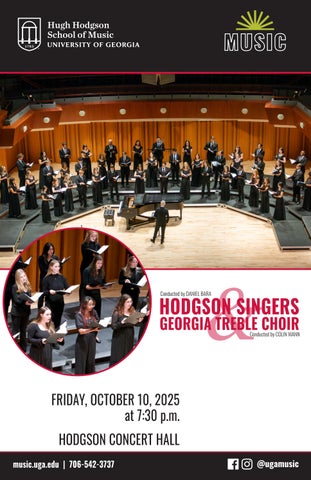
FRIDAY, OCTOBER 10, 2025 at 7:30 p.m. HODGSON CONCERT HALL music.uga.edu | 706-542-3737
@ugamusic
Friday, October 10, 2025 at 7:30 p.m. Hodgson Concert Hall UGA Performing Arts Center
Georgia Treble Choir Colin Mann, conductor Abigail Weller, administrative coordinator and assistant conductor Tzu-Wei Wang, piano University of Georgia Hodgson Singers Daniel Bara, conductor Christopher Hickey, assistant conductor Carol Zheng, pianist
PROGRAM Georgia Treble Choir Song of Miriam
I. Abigail Weller, conductor
Elaine Hagenberg (b. 1979)
II. La Mia Stella
Ivo Antognini (b. 1963)
Peace upon you, Jerusalem
Arvo Pärt (b. 1935) III.
Lamma Bada Yatathanna (As He Swayed)
Lisan Al-Din Ibn Al-Khatib Mohamed Abdel Rahim Al-Masloub arr. Shireen Abu-Khader (b. 1972)
Užaugo Liepa (Up Grew the Linden Tree)
Traditional Lithuanian Kęstutis Daugirdas (b. 1985) IV.
Wanting Memories
Ysaÿe M. Barnwell (b. 1946) INTERMISSION
PROGRAM Hodgson Singers The Greatest Good of All Is Knowledge
Jocelyn Hagen
from The Notebooks of Leonardo da Vinci
Text: Leonardo da Vinci
Jubilate Deo No. 2
Vytautas Miškins Text: Psalm 65:2
Der Geist hilft unsere Schwachheit auf, BWV 226
Johann Sebastian Bach Text: St. Paul’s Epistle to Romans; M. Luther
INSTRUMENTALISITS Alexis Boylan, violin Jhonnisvan Campos, violin Daniel Boscan, viola Thomas LaMon, cello Daniel Pina, bass Amanda Withrow, oboe Xander Herman, oboe Anisa Herbert, English horn Tarryn Goldner, bassoon Come to Me
Ivo Antognini Text: Christina Rosetti
What Was I Made For
Bille Eilish and Finneas O’Connell arr. Jennifer Lucy Cook
Didn’t My Lord Deliver Daniel
African American Spiritual arr. Stacey Gibbs
Tallis Canon
Thomas Tallis arr. Bob Chilcott
GEORGIA TREBLE CHOIR TEXTS, TRANSLATIONS, AND PROGRAM NOTES
Song of Miriam
Text by Rabbi Ruth Sohn Rabbi Ruth Sohn wrote the reflective text “Miriam, stand at the sea” from the perspective of Miriam, the sister of Aaron and Moses first described in the Book of Exodus. Miriam helped lead the people of Israel out of Egypt and across the Red Sea. “The Song of Miriam” refers to the praising and celebrating once safely across the water. Miriam is named a prophet for her courage and for her ability to mobilize people. Elaine Hagenberg amplifies Miriam’s interior and exterior journey with music. Perfect unions to perfect fifths may symbolize the parting of the Red Sea or the physical separation of self and people. Hurried triplets paint more expressive and perhaps anxious feelings Miriam may be experiencing while mustering the strength to convince herself– and others–to keep the faith. She insists that we look and listen inward to move forward. I. Miriam, stand at the sea I stand at the sea and turn to face the desert stretching endless and still. My eyes are dazzled The sky brilliant blue Sunburnt sands unyielding white. My hands turn to dove wings. My arms reach for the sky and I want to sing the song rising inside me. My mouth open I stop. Where are the words? Where the melody? In a moment of panic My eyes go blind. Can I take a step Without knowing a Destination? Will I falter Will I fall Will the ground sink away from under me?
The song still unformed— How can I sing? To take the first step— To sing a new song— Is to close one’s eyes and dive into unknown waters, For a moment knowing nothing risking all— But then to discover The waters are friendly The ground is firm. And the song— the song rises again. Out of my mouth come words lifting the wind. And I hear for the first time the song that has been in my heart silent unknown even to me.
La Mia Stella
Text by Ivo Antognini Most times, composers borrow text from other authors when crafting choral music. However, composer and author Ivo Antognini constructed this text–and its broader narrative–after reading a cover story in an Italian newspaper. Antognini noticed a graphic photo of three hundred Africans huddled together on a small boat traveling from Tunisia to Lampedusa, a rocky
GEORGIA TREBLE CHOIR TEXTS, TRANSLATIONS, AND PROGRAM NOTES island in the Mediterranean Sea settled between Africa and Italy. Two elements stood out to Antongini: the picture’s caption which read, “Many will not arrive alive on the shores of Lampedusa,” and one child holding onto a parent. “La Mia Stella” is a story developed by the composer depicting many devastating truths of refugees caught between worlds and often harboring children. Antognini blends Swahili (“nyota yangu”) and Italian (“la mia stella”) in a strong effort to share a story so many face when seeking asylum in new lands. Lyrical rhythms in the piano illustrate lapping water against the voyaging boat while vocal texture and tessitura extremes bridge the celestial images above with the dark, cold, watery depths of those tragically lost below. Nyota yangu
My star
Guarda quella stella disse il mio papà Segui la sua luce: lei ti guiderà In un mondo senza guerre, Dove tu potrai giocar; Dai, chiudi gli occhi, bambino mio, Prova a sognar…
“Look up to that start,” my father said; “Follow its light: it will lead you “into a world without war, “where you will be free to play. “My son, close your eyes, “See if you can dream…”
Soffro tanto il freddo disse il mio papà Stai attento all’onda: presto tornerà. Chissà quante notti ancora Dovremo aspettar un nuovo mondo, una nuova vita, Su questa barca in mezzo al mar?
“I am cold,” my father said: “Look out for the wave, it will come back. “Who knows how many nights “We will have to wait for a new world, a new life “In this boat a drift at sea?”
Ma la mia stella, lassù nel ciel, Presto ci manderà un salvatore Per tutti noi e anche per quelli in fondo al mar…
“But my star, up in the sky, “Soon, he will send us a savior “for all of us and also for those lost at sea.”
Nyota yangu
My star
Guarda com’é grande disse il mio papà; Tieniti più forte: non ti prenderà Come ha fatto con la mamma Che riposa in fondo al mar. Chiudi la bocca, bambino mio, Non respirar…
“Look how big it is,” my father said; “Hold on tighter, it won’t sweep you away “As it did your mother “Now asleep on the bottom of the sea. “Do not open your mouth, my son, “Do not breathe.”
Vado dalla mamma disse il mio papà: Oramai sei grande: tu rimani qua. So che non avrai paura e che presto troverai un’altra terra, Un’altra vita comincerà!
“I’m going to join your mother,” my father said; “You are grown up now, you stay here. “I know you will not be afraid “And soon you will find another land, “Another life will begin!”
GEORGIA TREBLE CHOIR TEXTS, TRANSLATIONS, AND PROGRAM NOTES E la mia stella, lassù nel ciel, Presto ci manderà un salvatore Per tutti noi e anche per quelli in fondo al mar…
“But my star, up in the sky, “Soon, he will send us a savior “for all of us and also for those lost at sea.”
Ma cosa fai? Ma Dove sei? Stellina mia, lassù nel cielo… Fatti vedere, stellina mia! Fatti trovare lassù nel cielo.
“But what do you do? Where are you? “My little star up in the sky… “Let me look at you, my little star! “Let me find you up in the sky.”
Nyota yangu
My star
Peace upon you, Jerusalem Text from Psalm 122 (121)
Arvo Pärt is the most prolific Estonian composer of the last century. Although choirs may be familiar with The Beatitudes, Magnificat, and his mass settings, Pärt has also composed various works for instruments and chamber ensembles. He recently turned ninety-years-old and has since retreated from public life, but he mentors new composers at the Avro Pärt Music Information Centre located in a pine forest near the Baltic Sea. In “Peace upon you, Jerusalem,” Pärt’s rhythms are as fragmented and as broken as rubble in Jerusalem, the earthly house of Yahweh. For as edgy as the notes look on the page, Pärt is a clever architect. His harmonic plan runs the gamut: he shifts between standard harmonic progressions while also splitting up triads to invoke bell-like sounds, a process called tintinabulation. While visiting Estonia this past summer, I noticed several quotes of Arvo Pärt peppered on the Tallinn airport walls. Amidst his wisdom, he is credited by saying, “Love is the source of all arts. Art will exist for as long as there exists an ability to love.”
I rejoiced that they said to me, ‘Let us go to the house of Yahweh.’
Pray for the peace of Jerusalem, Prosperity for your homes!
At last our feet are standing At your gates, Jerusalem!
Peace within your walls, Prosperity in your palaces!
Jerusalem, built as a city, In one united whole,
For love of my brothers and my friends I will say, ‘Peace upon you!’
There the tribes go up, The tribes of Yahweh, A sign for Israel to give thanks To the name of Yahweh.
For love of the house of Yahweh our God I will pray for your well-being.
For there are set the thrones of judgement, The thrones of the house of David.
GEORGIA TREBLE CHOIR TEXTS, TRANSLATIONS, AND PROGRAM NOTES
Lamma Bada Yatathanna (As She Swayed) Text by Lisan Al-Din Ibn Al-Khatib
“Lamma Bada Yatathanna” is one of the most famous pan-Arab muwashshah or classical Arabic Andalusian strophic songs. This song form was created in the mid-ninth century first used to convey sung poetry. The word muwashah is derived from wishah, an Arabic word for an embroidered jeweled scarf. Although this art form of sung poetry was commonly practiced for nearly five centuries, it is now less popular and left only to a few selected professional singers. In classical Arabic poetry, only male gender pronouns are used; however, gender fluidity is widely accepted in promoting diverse stories of love and lust. While most music of this region is learned through oral transmission, “Lamma Bada Yatathanna” can be learned through written notation. The song uses the Nahawand mode and a steady Samā’i Thaquil (“heavy or serious listening”) pattern. Shireen Abu-Khader uses harmonic minor pitch content and a time signature of 10/8 to represent these melodies through a written western lens. Lammā badā yatathanna Ḥibbī gamāluh fatannā Aw mā bilaḥdhuh asarnā Ghuṣnun thana ḥīna māl Wa‘dī wa yā ḥīratī Man lī raḥīm shiqwatī Fī al-ḥubbi min law‘atī Illā malīk el-gamāl
As he swayed, O night, O my eyes My love, the beautiful one, entrances me I am enraptured by a glimpse My beloved’s beauty is a tender branch in a breeze O my destiny, O my perplexity Who can comfort me in my misery, in my lamenting and suffering for love But the queen of all beauties
Užaugo Liepa (Up Grew the Linden Tree) Based on a traditional Lithuanian partsong
Learning part-songs from different nations help us to investigate unfamiliar cultures. One genre of Lithuanian songs are called sutartinės. Mirroring the intricacies of Baltic fiber arts, these songs are crafted like decorative cloth–melodic threads are woven together in variegated patterns. “Užaugo Liepa” is a story of a linden tree and a woman’s reverie. The linden tree has been used since ancient Greco-Roman times to symbolize fertility. It also represents a gathering place both for social justice circles and in celebration of Laima, the goddess of fate. Even GermanRomantic composer Franz Schubert set his protagonist under a linden tree for quiet reflection in his nineteenth-century song-cycle Winterreise. Composer Kęstutis Daugirdas expands the tonal and rhythmic themes found in this traditional Lithuanian song. Short melodic cells are repeated and then used in canon between voices. Daugirdas plays with the onomatopoetic sounds of the language to create textual drama. The refrain “Dautuvo, dautuvala dautuvo” binds the verses together. Užaugo liepa, lioj dautuvo, Lygioj vėtalaj, lylia ratilio. Turėjo liepa … devynias šakas … Visas devynias … vatrala laužė … Iš tų šakelių kraslalius dirbsiu. Tuosi kraslaliuos pati sedėsiu.
Up grew the linden tree, in a flat place The linden tree had nine branches All nine were battered by the storm From those branches, I will make chairs In those chairs, I will sit myself
GEORGIA TREBLE CHOIR TEXTS, TRANSLATIONS, AND PROGRAM NOTES Iš viršunalas lovalį dirbsiu. Tojoj lovalaj klosiu patalali. Tojoj lovalaj bernelį guldysiu. Tinai paguldžius pati palyliuosiu.
From the topmost branches I will make a bed On that bed I will lay the sheets In that bed I will lay down a young man Having laid him there, I will sing him to sleep.
Wanting Memories
Text by Ysaÿe M. Barnwell “Wanting Memories” is one of Ysaÿe Barnwell’s most frequently performed and best-known compositions. Her words speak to the power of relationships and how those relationships form and shape who we become as people. Barnwell was a member of the all African American, Grammy Award winning, female a cappella ensemble Sweet Honey in the Rock. Since 1973, their mission has been to educate, entertain, and influence audiences through their powerful, musical communication–of which includes reaching the deaf and hard-of-hearing through American Sign Language interpretation and movement in performances. Before joining Sweet Honey in the Rock, Dr. Barnwell completed degrees and professional experience in speech pathology (BS, MSed), craniotomy-facial studies (Ph.D.), and public health (MSPH).
I am sitting here wanting memories to teach me To see the beauty of the world through my own eyes. You used to rock me in the cradle of your arms, You said you’d hold me till the pains of life were gone. You said you’d comfort me in times like these and now I need you, And now I need you, and you are gone. And I am sitting here wanting memories to teach me To see the beauty of the world through my own eyes. I thought that you were gone, but now I know you’re with me; You are the voice that whispers all I need to hear. I know a “please,” a “thank you,” and a smile will take me far, I know that I am you and you are me and we are one, I know that who I am is numbered in each grain of sand, I know that I’ve been blessed again and over again.
HODGSON SINGERS TEXTS, TRANSLATIONS, AND PROGRAM NOTES
Jubilate Deo No. 2
Vytautas Miškins – Text: Psalm 65:2 Translation of Latin: Shout with joy to God, all the earth sing ye a psalm to His name; come and hear, all ye that fear God, and I will tell you what great things the Lord hath done for my soul. Alleluia!
Der Geist hilft unsere Schwachheit auf, BWV 226
Johann Sebastian Bach - Text: St. Paul’s Epistle to Romans; M. Luther Translation of German: The Spirit helps us in our weakness; for we do not know how we ought to pray, but the Spirit himself intercedes for us with sighs too deep for words. But the one who searches hearts knows what the Spirit intends, because the Spirit intercedes for the saints according to the will of God. Chorale: O sacred warmth, sweetest comfort, now help us to remain joyful and unafraid in your service steadfastly, so that trouble may not drive us away. O Lord, prepare us by your power and strengthen the weakness of the flesh, that we may valiantly struggle here, pressing through death and life toward you. Alleluia, alleluia!
GEORGIA TREBLE CHOIR Colin Mann, conductor Abigail Weller, administrative coordinator and assistant conductor Tzu-Wei Wang, piano Jade Adebomojo Julia Aldridge
Avery ArmourEpps Victoria Bazile Julia Beauchamp Lucy Smith Biemiller Josie Bowden Logan Broun Ellie Brown Ella Buczek Sofia Castillo Cadence Collette Caroline Connors
Katie Drybrough* Teagan Durham
Jenny Edwards Lainie Ewers Riley Fishman Madison Fountain Alice Gardner Eliza Gavin Kathleen Go Amanda Grande Emma Gross Galilea Guevara Zuri Consuela Harris Hailey Hilton Kaitlyn Horn
Jana Hornsey Giavanni Jackson
Mackenzie Roquemore Kyra Ross
Lucy Jones Bella Knight Livana Lekas Rebecca Letke Finn McClelion Phoebe Mikanda Maeva Moorman Chizua Ndukwe Ava Obermeier Shaoey Pace Michele Presley Hannah Robiel Amanda Robinson
Abhigna Sala Brianna Sao Sabrina Soriano Kinley Stitt Mallika Suyal Andrea Vaughan Maggie Watson Abigail Weller* Linda Williams Toni Williams Logan Wynns Sylveste Zimmermann
* denotes Graduate Assistant
UNIVERSITY OF GEORGIA HODGSON SINGERS Daniel Bara, John D. Boyd UGA Foundation Professor of Choral Music, conductor Christopher Hickey, assistant conductor Carol Zheng, piano Sopranos Ava Bogarde Briana Darden Zaria Doss Katie Drybrough* Phoebe Feibus Page Hall Joy McCarthy Laurel McFarland Ange Sanches Fuentes Lillie Sims Lauren Smith Meera Srinivasan Emily Taylor Abigail Weller Margaret Wilson
Altos Rylee Aguirre Julie Alridge Anna Bossert Avery Britt Elle Dignam Quinn Dillard Sarah Dudley Elisa Garnia-Carreras Lucy Kellam Caroline Malcom Kathryn McWhorter Shelby Miller Shayna Suddeth De’Nasia Thomas Danielle Vergara
Tenors August Bauer Benjamin Brown Colton Carter Noah Colwell Aiden Eclavea Matthew Elsey* Christopher Hickey* Alex Gilliam Liam Mueller Will Pollard Julian Riviera-Summerville Sean Wilson
Basses JR Banitt Lucas Baughcum Milo Bauman West Clayton Peter Dixon Justin Herrin Peter Kandra Evan Lambert Andrew Latimer Owen Margaret-Verrett Walter Moody Sam Son Liam Taylor
* denotes Graduate Assistant
HUGH HODGSON SCHOOL OF MUSIC FACULTY Daniel Bara, Interim Director Brandon Craswell, Associate Director, Director of Undergraduate Studies Emily Gertsch, Associate Director, Director of Graduate Studies Amy Pollard, Associate Director, Director of Performance Activities PERFORMANCE FACULTY *Angela Jones-Reus D. Ray McClellan Reid Messich Amy Pollard Brandon Quarles
flute clarinet oboe bassoon saxophone
Josh Bynum Brandon Craswell Jean Martin-Williams James Naigus *Matthew Shipes Gilbert Villagrana
trombone trumpet horn horn tuba/euphonium trumpet
Kimberly Toscano Adams *Timothy Adams
percussion percussion
Gregory Broughton Jay Ivey *Elizabeth Knight Amy Petrongelli Anne Slovin Wanda Yang Temko
voice voice voice voice voice voice
John Coble Damon Denton Scott Higgins Grace Huang Emely Phelps Evgeny Rivkin Anatoly Sheludyakov *Liza Stepanova Alan Woo
organ piano piano piano piano piano piano piano piano
Levon Ambartsumian Shakhida Azimkhodjaeva *Daniel Bolshoy Monica Hargrave Michael Heald James Kim Edward Kreitman Milton Masciadri Maggie Snyder
violin violin guitar harp violin cello Suziki double bass viola
BANDS Mia Athanas Brett Bawcum Jack A. Eaddy, Jr. *Nicholas Enrico Williams CHORAL Daniel Bara Colin Mann Daniel Shafer COMMUNITY MUSIC SCHOOL SUMMER CAMPS Stephen Fischer COMPOSITION & THEORY Tyler Beckett Adrian Childs Emily Gertsch Daniel Karcher *Emily Koh Peter Lane Dickie Lee Jared Tubbs Trinity Vélez-Justo
MUSIC THERAPY *Ellyn Evans Sally Ann Nichols Jenny Stull MUSICOLOGY & ETHNOMUSICOLOGY Karen Bergmann Naomi Graber *David Haas Jared Holton Jean Kidula Sarah Pickett Rumya Putcha Joanna Smolko OPERA Daniel Ellis Andrew Voelker ORCHESTRA Mark Cedel RECORDING & STREAMING Eric Dluzniewski Paul Griffith
JAZZ STUDIES David D’Angelo Gregory Satterthwaite James Weidman MUSIC EDUCATION *Rebecca Atkins Alison Farley Tyler Goehring Roy Legette Kristen Lynch Michael Robinson Johanna Royo Brian Wesolowski
*Area Chair
HUGH HODGSON SCHOOL OF MUSIC STAFF Edith Hollander, Administrative Assistant to the Director Shaun Baer Levi Dean Elizabeth Durusau Heather Gozdan-Bynum Tony Graves Scott Higgins
Director of Public Relations Development Associate Music Library Manager Undergraduate Academic Advisor Piano Technician Senior Piano Technician
Marcus Morris Kathleen Powell Rocky Raffle James Sewell Jared Tubbs Marshall Williams
Assistant Director of Athletic Bands Graduate Program Administrator Administrative Associate in Bands Production & Events Manager Sectioning Officer Director of Admissions
TUES 9/9 10/14
7:30 7:30 p.m. p.m. Hodgson Concert Hall $15, Adult $3, Student Additional fees for online purchases apply.
TUES 10/14
7:30 p.m. Ramsey Concert Hall FREE CONCERT
THURS 10/16
Imagine the
Possibilities
RACHMANINOFF SYMPHONY NO.2 SYMPHONY ORCHESTRA
Rachmaninoff has been known as a barnstorming pianist/composer of the late romantic period. However, his work as a symphonist is equally impressive as you will hear in his second symphony. The score is dedicated to Sergei Taneyev, a Russian composer, teacher, theorist, author, and pupil of Pyotr Ilyich Tchaikovsky. This evening will be conducted by Nicholas Han as his final Doctor of Musical Arts recital.
GUEST ARTIST RECITAL: TESSERAE TRIO
The Tesserae Trio was founded by violinist Fabiola Kim, cellist Leo Singer, and pianist Alan Woo. As passionate chamber musicians and acclaimed artists in their respective fields, the trio brings inventive and engaging programs to audiences around the world.
5:30 p.m. Ramsey Concert Hall
FACULTY/GUEST ARTIST RECITAL MAGGIE SNYDER W/ ALLEMAGNETTI “BACH ‘N STUFF”
FREE CONCERT
UGA Faculty Maggie Snyder, viola (pictured) with Allemagnetti.
THURS 10/16
7:30 p.m. Ramsey Concert Hall FREE CONCERT
UNIVERSITY OF GEORGIA PHILHARMONIA
As one of the Hugh Hodgson School of Music’s large orchestral ensembles, the University Philharmonia offers an outlet for musical expression to all string players at the University of Georgia. The ensemble performs three times per academic year. The University Philharmonia is conducted by Nicholas Han.
music.uga.edu | 706-542-4400 | 230 River Road, Athens, GA
@ugamusic