MUSIC 26|27
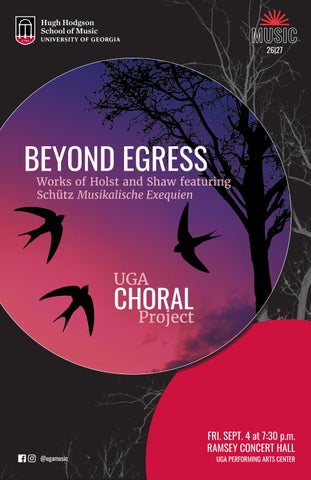
BEYOND EGRESS
Works of Holst and Shaw featuring Schütz Musikalische Exequien
UGA
CHORAL
Project
@ugamusic
FRI. SEPT. 4 at 7:30 p.m. RAMSEY CONCERT HALL UGA PERFORMING ARTS CENTER
BEYOND EGRESS
MUSIC 26|27
Works of Holst and Shaw featuring Schütz Musikalische Exequien University of Georgia Choral Project Colin Mann, conductor Andrew Voelker, organ Mía Mangano, violone Friday, September 4 at 7:30 p.m. Ramsey Concert Hall UGA Performing Arts Center
PROGRAM The Evening-Watch Two Motets for unaccompanied choir (1924-25), op. 43 Daniel Shafer, tenor Theresa Chafin, mezzo-soprano and the swallow (psalm 84)
Gustav Holst (1874-1934) 4’39”
Caroline Shaw (b. 1982) 3’50”
••• Musikalische Exequien, SWV 279-281 Teil I: Concert in Form einer teutschen Begräbnis-Missa Teil II: Motette “Herr, wenn ich nur dich habe” Teil III: Canticum Simeonis
Henrich Schütz (1585-1672) 30’
PERSONNEL
UGA
CHORAL
Project
The past three decades have seen marked growth for professional choral singing in the United States. In the early 1990s, there were only a few truly professional choirs doing regular work in the U.S., most of which rehearsed on a weekly model using the same mostly-local roster all season long. Today, many companies rehearse on a “project” model, where singers from all over the country are engaged for singular projects, travel to a city, rehearse intensely for a few days before the concert, perform, and then scatter again. The UGA Choral Project seeks to imitate this project model, and provide our singers with a near-professional experience during their training. Each semester, the UGA Choral Project builds its roster alongside an intensive rehearsal schedule, usually spanning two weeks. Because of its project-based structure, size and membership vary each semester. Recently, the ensemble has performed Italian and Spanish Renaissance music of Monteverdi and Vivanco; the Burgundian paraphrase mass Missa Pange Lingua of Josquin des Pres; and music of Lithuanian composer Jeronimas Kačinskas and British composer Cecilia McDowall. UGA Choral Project Music Director Colin Mann is Assistant Professor of Music and Associate Director of Choral Activities at the University of Georgia. SOPRANO Ariel Alvarado Briana Darden Katie Drybrough Elaina Ewers Paige Hall Waverly Noble Emily Taylor Hope Unger Abigail Weller
ALTO Theresa Chafin Phoebe Feibus Danielle Olivares Brenna Pursley De’Nasia Thomas Danielle Vergara
TENOR Colton Carter Jay Dunn Matthew Elsey Christopher Hickey Daniel Shafer
BASS JR Banitt Thomas Dixon Mitch Gindlesperger Samuel Son Jeff Unger
Special thanks to Shaun Baer, Jared Tubbs, Daniel Bara, Eric Dluzniewski, Jamie Tagg, the Cathedral of St. Philip Atlanta, Dale Adelmann, Chase Loomer, and Matthew Elsey.
music.uga.edu |
@ugamusic
PERFORMANCE NOTES Gustav Holst’s compositional success blasts beyond The Planets. His two later motets of 1925—one of which being “The Evening-Watch”—was written in the last decade of his life. The text is of seventeenth-century metaphysical poet Henry Vaughan, whose interests stemmed from merging complex cerebral ideas into metered poetic lines. His collection Silex Scintillans (1650) unpacks themes of spiritual redemption through a disquieted soul. Holst interprets Vaughan’s struggle through a sodden 8-part choral texture. Abandoning triadic harmony, Holst complicates the voices through a quartal blueprint—he builds chords using rigid fourths instead of sweet thirds. Most of Vaughan’s vision of “the Soul” is saturated in these dense, entangled chords-withinchords that creates a rather austere, ethereal harmonic cloud of sound. Among the most joyful birds, swallows are known for their narrow beaks and bodies, covered with steely-blue plumage, that allows them to glide freely in the air. Their forked tails promote quick pivoting as they often take sharp turns. Birders comment on their “aerial acrobatics” and deep pursuits to catch flying insects and to drink water without ever landing. In summary, they are always in flight. While some migratory birds build a new nest each year, swallows return home after thousands of miles to their cupshaped mud nests. Pulitzer Prize winner Caroline Shaw conveys these birds in “and the swallow (psalm 84)” by engineering ceaseless flight. Notably, melodic lines dart upwards and downwards illustrating many peaks and valleys of tessitura. Phrases are delivered together while others are in strict canon, perhaps influencing the nexus of sonic predictability and of chance in bird flight. Shaw designs the beating of wings by directing the choir to make quick, fluttering consonants with the lips and tongue—iconically, she is known for vocal aleatory as demonstrated in the ensemble Roomful of Teeth. Although “and the swallow” starts and ends on a Gb major triad, the ending is transfigured somehow. The musical information is familiar but now delivered in a higher place than where we started. Lutherans are as transfixed on preparation as birds are on building nests. In the Early Modern Age, planning for and displaying death was among the most prestigious demonstrations of self-display. Also, a lavish and proper burial legitimized the peaceful transfer of power among kin. Unfortunately, death was everywhere. Heinrich Schütz witnessed the entire course of the Thirty Years’ War (1618-1648) that devastated Europe—people suffered from hunger, illness, and especially the consequences of the deadly plague epidemic. Death was not only certain but served as an answer, a resolution, and a reward in a seventeenth-century Lutheran’s mind. So planning for death was a necessary and artful pursuit.
During these grim times, the territorial sovereign Heinrich Postuhumus Reuss, Lord of Gera, Lobenstein, and Ober-Kranichfeld (1572-1635) prepared himself for his own inevitable death. Lord Reuss carefully curated a selection of biblical passages from church hymns to be used as inscribed funeral eulogies on his coffin. These biblical dicta and hymn stanzas serve as the “Teutsche Begräbnis Missa” (German funeral mass) or
the first section of Heinrich Schütz’s Musicalische Exequien, commissioned after Reuss’ death. In his detailed preface, Schütz conveys that the first part of the Exequien should be sung by a group of vocal soloists—in a concerto style—accompanied by continuo, with all voices joining together for the chorale verses. He further suggests that the singing of the chorales be reinforced by additional voices or instruments. Its total formal design is of two sacred concertos framing a motet for double chorus. The work is built of three distinct layers: the chosen text on Reuss’ coffin, the psalm used from the funeral (Psalm 73: 25-6), and the Canticum Simeon or Nunc dimittis (Luke 2: 29-32). In the middle section, Schütz sets a funeral motet for double chorus, a tradition that lasted at least into the eighteenth century. In the third section, the Canticle of Simeon draws on the latest developments of the concerto to fashion a riveting dramatization of the soul ascending (Beata anima) as it is guided to heaven by two angels. This final section is the expressive climax of the entire work. Like Reuss, Schütz was also concerned with dramatics. He simulates echo effects with fortiter/submisse alterations, intensifying the louds and softs by manipulating the number of singers per part. He rapidly employs question-and-response patterns, signifying the connection between Heaven and Earth as similarly used by Claudio Monteverdi in his Vespro della Beata Vergine (1610). Schütz manifests a heavenly connection by directing performers be placed around various parts of the church—at a “distance” or hidden from view—playing on the theatricality of the spatial separation. Its unique combination of biblical and poetic texts, of the Lutheran tradition of ars moriendi, and of modern music practices has contributed to its survival beyond a single occasion. Colin Mann
music.uga.edu |
@ugamusic
MEET THE ARTISTS
Andrew Voelker organ
Mía Mangano violone
Colin Mann conductor
Mía Mangano is a Cuban multi-instrumentalist based in Atlanta. She began her cello studies at an early age and later expanded her training to include the double bass. She completed her degree at the Higher Institute of Arts (ISA) in Cuba, where she deepened her focus on the viola da gamba, excelling in both solo performance and continuo playing. She has performed with leading ensembles including the National Symphony Orchestra of Cuba, Solistas de La Habana, and the Havana Grand Theatre Symphony Orchestra. In Mexico, she served as head of the cello and double bass department at the Trinitate Philharmonia Academy and as a solo violist da gamba with Los Tiempos Pasados, an ensemble specializing in Sephardic, Judeo-Spanish, and Arabic music. Her festival appearances span Cuba, Mexico, Argentina, and the United States, including the International Cervantino Festival, the Havana International Ballet Festival, and the Oregon Bach Festival. Currently, she is the Assistant Principal Double Bass with the Northwest Florida Symphony Orchestra (NFSO) and a section double bassist with the Pensacola Symphony Orchestra. Active in historically informed performance, she plays baroque cello with the Atlanta Baroque Orchestra, baroque double bass/violone with the North Carolina Baroque Orchestra, and frequently appears as a guest artist with St. Pete Baroque, Amethyst Baroque Ensemble, and New Trinity Baroque, among other groups throughout the Southeastern United States.
Andrew Voelker serves as Vocal Coach and Music Director of Opera Theatre in the Hugh Hodgson School of Music at the University of Georgia. Last season, Voelker directed music for the Southeastern US premiere of Erich Korngold’s The Ring of Polykrates and conducted Jonathan Dove’s Mansfield Park at the State Botanical Gardens of Georgia at UGA. Voelker previously served on the faculty of the Crane School of Music at SUNY Potsdam. As the music director of the award-winning Crane Opera Ensemble, they
conducted the workshop and premiere of Computing Venus (Takach/Vincent), the winner of the 2024 Domenic J. Pellicciotti Opera Composition Prize. While serving as Associate Instructor of Collaborative Piano at Indiana University’s Jacobs School of Music, Voelker coached productions of Le nozze di Figaro, La traviata,
Little Women, Serse, and L’incoronazione di Poppea. Previously, under the mentorship of Dr. Christopher Bagan, they prepared harpsichord continuo in historical styles for works including Dido and Aeneas, Giulio Cesare, and Lully’s Persée. Voelker’s 2026-2027 performance season at UGA, in addition to the UGA Choral Project, includes: A Faculty Artist Series recital with Jay Ivey, Faculty Chamber Series concert with the UGA Voice Faculty, UGA Opera Theater performances of Fall Opera Scenes and Joseph Bologne’s L’Amant anonyme, as well as masterclasses and performances at universities in the southeast and central United States. Colin Mann is Assistant Professor of Music and Associate Director of Choral Activities at the Hugh Hodgson School of Music at the University of Georgia. Mann conducts the Georgia Treble Choir, the UGA Glee Club, the Georgia Choral Union, and the UGA Choral Project as well as teaches conducting, graduate choral literature, and advises graduate conducting students. In May of 2025, Mann led the Nazareth Treble Choir in a choral tour to Poland where students performed at national festivals in Kraków and collaborated with choirs at the University of Rzeszów. Mann’s current scholarship focuses on nation building through choral music in the Baltic states. Recently, Mann was one of six American conductors to represent the American Choral Directors Association (ACDA) by participating in an international conducting exchange program with Lisbon, Portugal. He has conducted several choral-orchestral works including Poulenc Gloria, Mozart Vesperae solennes de confessore, Duruflé Requiem, Haydn Lord Nelson Mass, Bernstein Chichester Psalms, and he has helped prepare Beethoven Missa Solemnis and Vaughan Williams Dona Nobis Pacem with the Eastman-Rochester Chorus and Eastman Philharmonia and Orff Carmina Burana at the University of Georgia. As chorus master and conductor of the Viva Bach Peterborough Festival in New Hampshire, Mann has conducted over ten cantatas, three motets with instruments, and the St. John Passion with professionals from Boston, New York, and New Haven.
music.uga.edu |
@ugamusic
TRANSLATIONS AND TEXTS
The Evening-Watch Text by Henry Vaughan from Silex Scintillans (1650) The body Farewell! I go to sleep; but, when The daystar springs, I’ll wake again. The soul Go, sleep in peace; and when thou liest Unnumbered in thy dust, when all this frame Is but one dram, and what thou now descriest In sev’ral parts shall want a name, Then may his peace be with thee, and each dust Writ in his book, who ne’er betray’d man’s trust! The body Amen! but hark, ere we two stray, How many hours dost think till day? The soul Ah! go; thou’rt weak and sleepy. Heav’n Is a plain watch, and without figures winds All ages up; who drew this circle even He fills it; days and hours are blinds. Yet, this take with thee; the last gasp of time Is thy first breath, and man’s eternal Prime.
and the swallow (psalm 84) how beloved is your dwelling place, o lord of hosts my soul yearns, my heart and my flesh cry the sparrow found a house, and the swallow her nest, where she may raise her young they pass through the Valley of Bakka, they make it a place of springs the autumn rains cover it with pools
Musikalische Exequien, SWV 279-281 Texts by Johannes Gigas, Ludwig Helmbold, Nikolaus Herman, Johann Leon, and Martin Luther; German Biblical texts. Teil I: Concert in Form einer teutschen Begräbnis-Missa
Part I: Concerto in the form of a German burial Mass
INTONATIO (TENOR I) Nacket bin ich von Mutterleibe kommen,
Naked I came out of my mother’s womb
(TENOR I/II, BASS) Nacket werde ich wiederum dahinfahren. Der Herr hat’s gegeben, der Herr hat’s genommen, der Name des Herren sie gelobet.
(CAPELLA) Herr Gott, Vater im Himmel, erbarm dich über uns!
(SOPRANO I/II, TENOR I) Christus ist mein Leben, Sterben ist mein Gewinn. Siehe, das ist Gottes Lamm, das der Welt Sünde trägt.
(CAPELLA) Jesu Christe, Gottes Sohn erbarm dich über uns!
(ALTO, BASS) Leben wir, so leben wir dem Herren; sterben wir, so sterben wir dem Herren; darum, wir leben oder sterben so sind wir des Herren. (CAPELLA) Herr Gott, Heiliger Geist erbarm dich über uns! INTONATIO (TENOR I) Also hat Gott die Welt geliebt, daß er seinen eingebornen Sohn gab,
Naked shall I return The Lord gave and the Lord has taken away Blessed be the name of the Lord. (Job 1:21)
Lord God, Father in heaven, have mercy upon us! (Kyrie eleison)
Christ is my life and to die is gain. Look, this is the Lamb of God, which carries the sin of the world. (Philippians 1:21, John 1:29b)
Jesus Christ, Son of God, have mercy upon us! (Christe eleison)
When we live, we live for the Lord; when we die, we die for the Lord: therefore, whether we live or die, we are the Lord‘s. (Romans 14:8) Lord God, Holy Spirit, have mercy upon us! (Kyrie eleison) God loved the world so much, that he gave his begotten son,
music.uga.edu |
@ugamusic
(SOPRANO I/II, ALTO, TENOR I/II, BASS) auf daß alle, die an ihn gläuben, nicht verloren werden, sondern das ewige Leben haben.
(CAPELLA) Er sprach zu seinem lieben Sohn: die Zeit ist hie zu erbarmen; fahr hin, mein‘s Herzens werte Kron, und sei das Heil der Armen, und hilf ihn‘ aus der Sünden Not, erwürg für sie den bittern Tod und laß sie mit dir leben.
(SOPRANO II, TENOR II) Das Blut Jesu Christi, des Sohnes Gottes, machet uns rein von allen Sünden.
(CAPELLA) Durch ihn ist uns vergeben die Sünd, geschenkt das Leben. Im Himmel soll‘n wir haben, o Gott, wie große Gaben!
(SOPRANO I, BASS) Unser Wandel ist im Himmel, von dannen wir auch warten des Heilandes Jesu Christi, des Herren, welcher unsern nichtigen Leib verklären wird, daß er ähnlich werde seinem verklärten Leibe. (CAPELLA) Es ist allhier ein Jammertal, Angst, Not und Trübsal überall, des Bleibens ist ein kleine Zeit, voller Mühseligkeit, und wer‘s bedenkt, ist immer im Streit.
(TENOR I/II) Wenn eure Sünde gleich blutrot wäre, soll sie doch schneeweiß werden; wenn sie gleich ist wie rosinfarb, soll sie doch wie Wolle werden.
so that all who believed in him would not be lost, but have everlasting life. (John 3:16)
He spoke to his beloved Son: now is the time for mercy, go, my heart‘s worthy crown, and be the salvation of the poor and help them from the distress of sin; take upon yourself the bitterness of death and let them live with you. (Martin Luther, 1523)
The blood of Jesus Christ, God‘s Son, cleanses us from all sin. (1 John 1:7b)
Through Him our sin is forgiven, our life restored. In heaven we shall have, O God, what wondrous benefactions! (Ludwig Helmbold, 1575)
Our life is for heaven: from there also we look for the Savior, Lord Jesus Christ: he will transfigure our futile body to become similar to His glorious body. (Philippians 3:20-21a)
Here all around is a vale of tears, need and sorrow everywhere, our stay here is for but a brief time full of hardship, and if you think about it, you are always in disharmony. (Johann Leon, 1582/89)
If your sin were as red as blood, it shall be as white as snow, were it red like crimson, it shall be as wool. (Isaiah 1:18b)
(CAPELLA) Sein Wort, sein Tauf, sein Nachtmahl dient wider allen Unfall, der heilge Geist im Glauben lehrt uns darauf vertrauen.
(ALTO) Gehe hin, mein Wolk, in deine Kammer und schleuß die Tür nach dir zu! Verbirge dich einen kleinen Augenblick, bis der Zorn vorübergehe.
(SOPRANO I/II, BASS) Der Gerechten Seelen sind in Gottes Hand, und keine Qual rühret sie an; für den Unverständigen werden sie angesehen, als stürben sie, und ihr Abschied wird für eine Pein gerechnet, und ihr Hinfahren für Verderben, aber sie sind in Frieden. Aber sie sind in Frieden.
(TENOR I, ALTO, TENOR II, BASS) Herr, wenn ich nur dich habe, so frage ich nichts nach Himmel und Erden. Wenn mir gleich Leib und Seele verschmacht’, so bist du, Gott, allzeit meines Herzens Trost und mein Teil.
(CAPELLA) Er ist das Heil und selig Licht für die Heiden, zu erleuchten, die dich kennen nicht, und zu weiden. Er ist seines Volks Israel der Preis, Ehr, Freud und Wonne.
(BASS I/II) Unser Leben währet siebenzig Jahr, und wenn’s hoch kömmt, so sind’s achtzig Jahr,
His word, His baptism, His Eucharist serve against all misfortune; belief in the Holy Spirit teaches us to have faith. (Ludwig Helmbold, 1575)
Go, my people into your chamber and shut the door behind you! Hide yourself for a little moment until the wrath has passed. (Isaiah 26:20)
The souls of the righteous are in the hand of God and no torment shall touch them; in the sight of the unwise they seem to die, and their departure is taken for torment, and their going away be destruction; but they are in peace. But they are in peace. (Wisdom of Solomon 3:1-3)
Lord, if I have but you, I ask neither for heaven nor earth. And when my body and soul are dying, you, God, are always the comfort of my heart and part of me. (Psalm 73:25-6)
He is the salvation and blessed light for the heathen, to enlighten those who don‘t know you and to tend them. He is of His people Israel the prize, honour, joy and delight. (Martin Luther, 1524)
We live for about seventy years, and at best for eighty years,
music.uga.edu |
@ugamusic
und wenn es köstlich gewesen ist, so ist es Müh und Arbeit gewesen.
(CAPELLA) Ach, wie elend ist unser Zeit allhier auf dieser Erden, gar bald der Mensch darniederleit, wir müssen alle sterben, allhier in diesem Jammertal ist Müh und Arbeit überall, auch wenn dir’s wohl gelinget.
(TENOR I) Ich weiß, daß mein Erlöser lebt, und er wird mich hernach aus der Erden auferwecken, und werde darnach mit dieser meiner Haut umgeben werden und werde in meinem Fleisch Gott sehen.
(CAPELLA) Weil du vom Tod erstanden bist, werd ich im Grab nicht bleiben, mein höchster Trost dein Auffahrt ist, Todsfurcht kannst du vertreiben, denn wo du bist, da komm ich hin, daß ich stets bei dir leb und bin, drum fahr ich hin mit Freuden.
(SOPRANO I/II, ALTO, TENOR I/II, BASS) Herr, ich lasse dich nicht, du segnest mich denn.
(CAPELLA) Er sprach zu mir: Halt dich an mich, es soll dir itzt gelingen, ich geb mich selber ganz für dich, da will ich für dich ringen. Den Tod verschlingt das Leben mein, mein Unschuld trägt die Sünden dein, da bist du selig worden.
and if it was delightful, it was trouble and labour. (Psalm 90:10a)
Ah, how wretched is our time here on earth, soon man lies down, as we all must die: Here, in this vale of tears, Is everywhere trouble and labour, even if you prosper. (Johannes Gigas, 1566)
I know that my Redeemer lives, and he shall make me then stand up from the earth: and this my skin then shall cover my body and in my flesh I shall see God. (Job 19:25-6)
Since you arose from death, I shall not remain in the grave, your Ascension is my greatest comfort, you can drive away the fear of death, for where you are, I will go too, so that I may live and be with you forever, therefore I die with Joy. (Nikolaus Herman, 1560)
Lord, I won‘t let you go, except if you bless me. (Genesis 32:27b)
He said to me: Hold on to me, you will succeed; I give myself all for you, and I struggle for you. My life swallows up death, my innocence bears your sins, and you found salvation. (Martin Luther, 1523)
Teil II: Motette “Herr, wenn ich nur dich habe” (CHORUS I/II) Herr, wenn ich nur dich habe, so frage ich nichts nach Himmel und Erden. Wenn mir gleich Leib und Seele verschmacht’, so bist du doch, Gott, allezeit meines Herzens Trost und mein Teil.
Part II: Motet “Lord, if I have but Thee”
Lord, if I have but you, I ask neither for heaven nor earth. And when my body and soul are dying, you, God, are always the comfort of my heart and part of me. (Psalm 73:25-6)
Teil III: Canticum Simeonis
Part III: Canticle of the blessed Simeon
INTONATIO (TENOR) Herr, nun lässest du deinen Diener
Lord, now you let your servant
(CHORUS I) in Frieden fahren, wie du gesagt hast. Denn meine Augen haben deinen Heiland gesehen, welchen du bereitet hast für allen Völkern, ein Licht, zu erleuchten die Heiden, und zum Preis deines Volks Israel. (CHORUS II SERAPHIM I, II UND BEATA ANIMA) Selig sind die Toten, die in dem Herren sterben, sie ruhen von ihrer Arbeit, und ihre Werke folgen ihnen nach. Sie sind in der Hand des Herren, und keine Qual rühret sie.
go in peace, as you said. For my eyes have seen your salvation which you offered for all people, a light to enlighten all Gentiles, and for the glory of your people Israel. (Luke 2:29-32)
Blessed are the dead who die in the Lord; they rest from their labours, and their works do follow them. They are in the hand of the Lord, and no torment touches them. (after Revelation 14:13 and Wisdom of Solomon 3:1)
music.uga.edu |
@ugamusic
HUGH HODGSON SCHOOL OF MUSIC FACULTY
Felix Olschofka, Director Brandon Craswell, Associate Director, Director of Undergraduate Studies Emily Gertsch, Associate Director, Director of Graduate Studies Amy Pollard, Associate Director, Director of Performance Activities PERFORMANCE FACULTY Josh Bynum Brandon Craswell Jean Martin-Williams James Naigus *Matthew Shipes Gilbert Villagrana
trombone trumpet horn horn tuba/euphonium trumpet
Kimberly Toscano Adams * Timothy Adams
percussion percussion
John Coble Scott Cuellar Damon Denton * Grace Huang Emely Phelps Greg Satterthwaite Anatoly Sheludyakov James Weidman Alan Woo
organ piano piano piano piano piano piano piano piano
Levon Ambartsumian Shakhida Azimkhodjaeva Karen Bergmann Daniel Bolshoy Michael Heald James Kim Edward Kreitman * Milton Masciadri Maggie Snyder
violin violin strings guitar violin cello Suziki double bass viola
Gregory Broughton Jay Ivey Elizabeth Knight *Amy Petrongelli Anne Slovin
voice voice voice voice voice
* Angela Jones-Reus D. Ray McClellan Reid Messich Amy Pollard Brandon Quarles
flute clarinet oboe bassoon saxophone
BANDS Mia Athanas Brett Bawcum Jack A. Eaddy, Jr. Marcus Morris * Nicholas Enrico Williams CHOIRS * Daniel Bara Gregory Broughton Colin Mann Daniel Shafer COMMUNITY MUSIC SCHOOL & SUMMER CAMPS Stephen Fischer COMPOSITION & THEORY Adrian Childs Emily Gertsch *Emily Koh Peter Lane Dickie Lee Trinity Vélez-Justo Morgan Weeks CONDUCTING STUDIES Daniel Bara Brett Bawcum Mark Cedel Jack Eaddy Colin Mann *Nicholas Williams JAZZ STUDIES David D’Angelo Gregory Satterthwaite James Weidman
MUSIC EDUCATION *Rebecca Atkins Alison Farley Tyler Goehring Roy Legette Kristen Lynch Michael Robinson Johanna Royo Brian Wesolowski MUSIC THERAPY *Ellyn Evans Sally Ann Nichols Jenny Stull MUSICOLOGY & ETHNOMUSICOLOGY Karen Bergmann * Naomi Graber David Haas Jared Holton Jean Kidula Eleanor Price Rumya Putcha Joanna Smolko OPERA * Daniel Ellis Andrew Voelker ORCHESTRA * Mark Cedel RECORDING & STREAMING Eric Dluzniewski Jamie Tagg
*Area Chair
HUGH HODGSON SCHOOL OF MUSIC STAFF Susan McClure, Administrative Assistant to the Director
Shaun Baer Levi Dean Elizabeth Durusau Heather Gozdan-Bynum Scott Higgins Kathleen Powell Rocky Raffle James Sewell Jared Tubbs Marshall Williams
Director of Public Relations Development Associate Music Library Manager Undergraduate Academic Advisor Senior Piano Technician Graduate Program Administrator Administrative Associate in Bands Production & Events Manager Sectioning Officer Director of Admissions
SUPPORT HOW TO GIVE
THE SCHOOL OF MUSIC
Under each of the available funds below is a QR code where you can scan and donate directly to that fund. However, if you would like to learn more about alternative ways to donate, scan the QR code now to visit our “How to Give” page with additional details and options.
SUPPORT THE THURSDAY SCHOLARSHIP FUND
Scholarships and Graduate assistantships funded by donations to the Thursday Scholarship Fund make it possible for students to learn and pursue their passions at the Hugh Hodgson School of Music. Please consider a taxdeductible gift to the Thursday Scholarship Fund so we may continue to support our students and make their education possible. Scan the QR code now or reach out to Melissa Roberts at roberts@uga.edu or 706-254-2111.
SUPPORT INDIVIDUAL AREAS OF THE SCHOOL OF MUSIC
In addition to our primary Support and Scholarship Funds, many specialized areas of interest, including our orchestra and choral programs, have support and scholarship funds you can contribute to directly. You can now learn more about all the ways and areas you can support the Hugh Hodgson School of Music. Scan the QR code or visit music.uga.edu/giving-and-alumni to the support the Hugh Hodgson School of Music area of your choice.
JOIN THE DIRECTOR’S CIRCLE
Gifts of all amounts are greatly appreciated. However, annual giving at the $1,500 level and higher provides membership in the Director’s Circle, our Hugh Hodgson School of Music Honor Roll. Director’s Circle members are invited to exclusive events and performances throughout the academic year. For large gifts, please contact Melissa Roberts at roberts@uga.edu or 706-254-2111.
THANK YOU FOR YOUR CONTINUED SUPPORT OF THE UNIVERSITY OF GEORGIA HUGH HODGSON SCHOOL OF MUSIC.
Monday, October 20 RIDAY, OCT. 24 at 3:30 p.m. Ramsey Concert Hall
MUSIC 26|27
FEATURED PERFORMANCES Symphony
ORCHESTRA
JOHANNES BRAHMS Symphony No. 1 $20 - Adults $3 UGA students
WEDNESDAY, SEPTEMBER 9 at 7:30 p.m. Hodgson Concert Hall
plus $3 transaction fee
An evening of masterworks...Wagner’s overture the opera Rienzi and French impressionist Lili Boulanger. Brahms’ first symphony, sometimes called “Beethoven’s 10th.”
music.uga.edu 706-542-4400
GEORGIA BRASS QUINTET $15 - Adults $3 UGA students plus $3 transaction fee
music.uga.edu 706-542-4400
MONDAY, SEPTEMBER 14 at 7:30 p.m. Ramsey Concert Hall The Georgia Brass Quintet is presenting an All-American program of classical- and jazzinspired compositions comprised of original works and transcriptions.
FREE PERFORMANCE GUEST ARTIST RECITAL OLIVER JIA, piano
TUESDAY, SEPTEMBER 15 at 7:30 p.m. Ramsey Concert Hall This concerto for viola is sometimes referred
@ugamusic music.uga.edu | 706-542-4400 | 230 River Road, Athens, from GA Old Folk Songs. to as the Concerto The