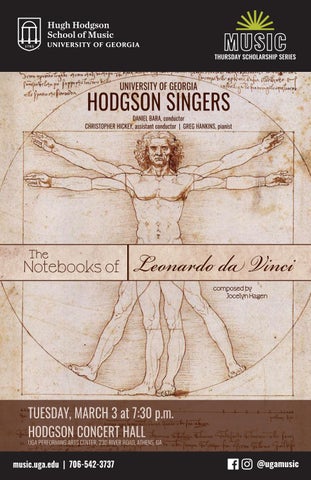


Tuesday, March 3, 2026 at 7:30 p.m.
Hodgson Concert Hall
UGA Performing Arts Center
Which Was The Son of...
As a Phoenix
A Silence Haunts Me
The Fruit of Silence
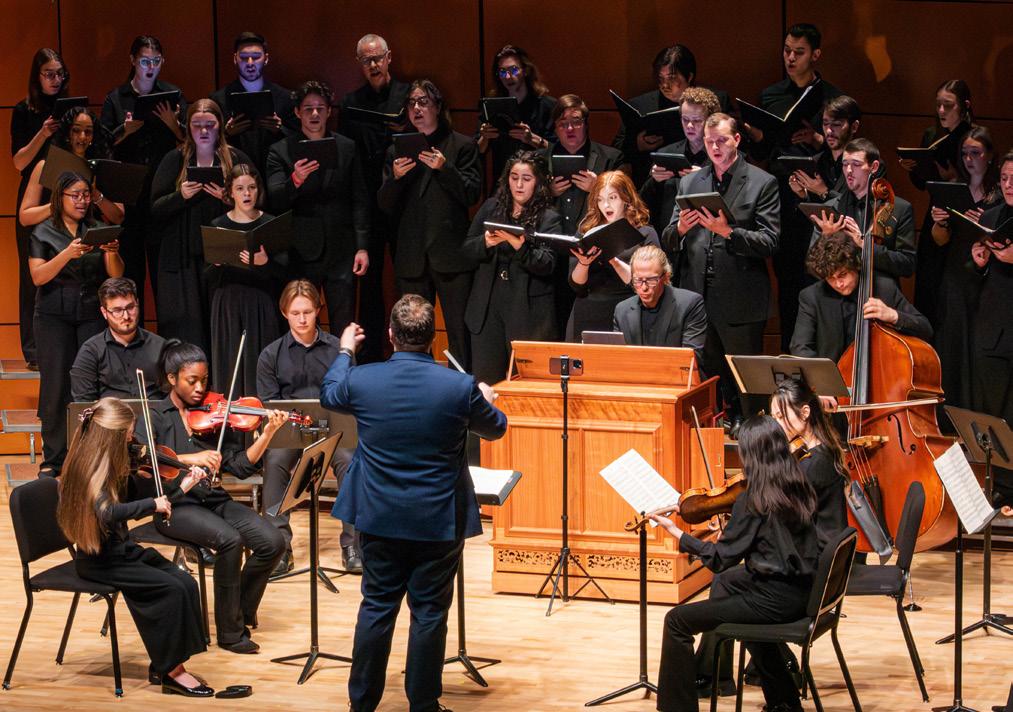
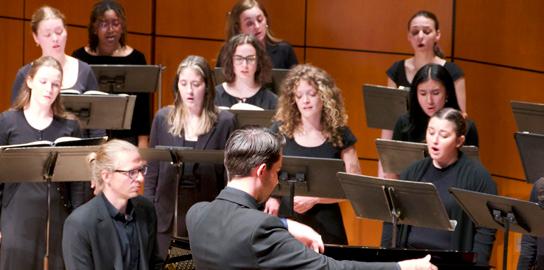
University of Georgia Hodgson Singers
Daniel Bara, conductor
Christopher Hickey, assistant conductor
Gregory Hankins, pianist
PROGRAM
Arvo Pärt (b. 1935)
Reece Moseley (b. 2003)
Christopher Hickey, conductor World Premiere
Jake Runestad (1986)
Pēteris Vasks (1946)
INTERMISSION
Notebooks of Leonardo da Vinci Painting and Drawing Practice Ripples The Greatest Good
Vitruvian Man Invention Nature Perception
Look at the Stars
Projection Artists: Isaac Gale, Joseph Midthun, Justin Shell
Jocelyn Hagen (1980)
Which Was the Son of…
Text: Luke 3: 23-38
And Jesus Himself had become about thirty years of age, being (as was supposed) the son of Joseph, which was the son of Heli, which was the son of Matthat, which was the son of Levi, which was the son of Melchi, which was the son of Janna, which was the son of Joseph, which was the son of Mattathias, which was the son of Amos, which was the son of Nahum, which was the son of Esli, which was the son of Naggai, which was the son of Maath, which was the son of Mattathias, which was the son of Semei, which was the son of Joseph, which was the son of Juda, which was the son of Joanna, which was the son of Rhesa, which was the son of Zerubbabel, which was the son of Shealtiel, which was the son of Neri, which was the son of Melchi, which was the son of Addi, which was the son of Cosam, which was the son of Elmodam, which was the son of Er, which was the son of Jose, which was the son of Eliezer, which was the son of Jorim, which was the son of Matthat, which was the son of Levi, which was the son of Simeon, which was the son of Judah, which was the son of Joseph, which was the son of Jonan, which was the son of Eliakim, which was the son of Melea, which was the son of Menan, which was the son of Mattatha, which was the son of Nathan, which was the son of David, which was the son of Jesse, which was the son of Obed, which was the son of Boaz, which was the son of Salmon, which was the son of Nahshon, which was the son of Amminadab, which was the son of Aram, which was the son of Hezron, which was the son of Perez, which was the son of Judah, which was the son of Jacob, which was the son of Isaac, which was the son of Abraham, which was the son of Terah, which was the son of Nahor, which was the son of Serug, which was the son of Reu, which was the son of Peleg, which was the son of Eber, which was the son of Shelah, which was the son of Cainan, which was the son of Arphaxad, which was the son of Shem, which was the son of Noah, which was the son of Lamech, which was the son of Methuselah, which was the son of Enoch, which was the son of Jared, which was the son of Mahalaleel, which was the son of Cainan, which was the son of Enos, which was the son of Seth, which was the son of Adam, which was the son of God.
As a Phoenix
Poetry: Quinn Dillard
Burning lakes
Fill my eyes with Your ashen face.
Molten cores
Spin into spears
Breaking through my skin.
Why, Why,
Why does it burn and burn?
Why can’t I see you?
In the hearth
Around my heart
I see you,
Cardinals With wings of flame
I see you,
I sing your name, A lesson In the wind.
I hear you I hear you Echo.
Blessed, Beloved, I will burst
As a Phoenix Calling out into The night.
The embers of my Becoming, Scatter and bloom For you.
A Silence Haunts Me
Text: Adapted from Ludwig Van Beethoven by Todd Boss
Hear me, brothers —
I’ve a confession painful to make. Six years I have endured a curse that deepens every day. They say that soon I’ll cease to hear the very music of my soul. What should be the sense most perfect in me fails me, shames me, taunts me. A silence haunts me.
They ask me —
Do you hear the shepherd singing far-off soft? — Do you hear a distant fluting dancing joyously aloft?
— No. — I think so? — No. — I think so? — No.
God, am I Prometheus? — exiled in chains for gifting humankind my fire? Take my feeling — take my sight — take my wings midflight but let me hear the searing roar of air before I score the ground!
Why? — Silence is God’s reply — and so I beg me take my life — when lo — I hear a grace and feel a ringing in me after all — so now as leaves of autumn fall, I make my mark and sign my name and turn again to touch my flame of music to the world, a broken man, as best I can, As ever,
Faithfully yours, (— A bell? — A bell?)
Hear me, and be well.
The Fruit of Silence
Text: Mother Teresa
The fruit of silence is prayer.
The fruit of prayer is faith.
The fruit of faith is love.
The fruit of love is service.
The fruit of service is peace.
The Notebooks of Leonardo da Vinci
Text: Leonardo da Vinci
Painting and Drawing
O Painter!
A painter is not admirable unless he is universal. A painting is a poem seen but not heard, a poem is a painting heard but not seen. Hence these two poems, or two paintings, have exchanged the senses by which they pierce the intellect.
Practice
Those who are in love with practice without knowledge are like the sailor who gets into a ship without rudder or compass and who never can be certain whither he is going. Practice must always be founded on sound theory, and to this, perspective is the guide and the gateway; and without this nothing can be done well in the matter of drawing.
Ripples
Just as a stone flung into the water becomes the center and cause of many circles, and as sound diffuses itself in circles in the air; so any object, placed in the luminous atmosphere, diffuses itself in circles, and fills the surrounding air with infinite images of itself. And is repeated, the whole everywhere, and the whole in every smallest part.
The Greatest Good
The greatest good of all is knowledge.
Obstacle cannot crush me. Every obstacle yields to firm resolve. The acquisition of any knowledge is always useful to the intellect, because it will be able to banish useless things and retain those that are good. For nothing can be loved or hated unless it is first known.
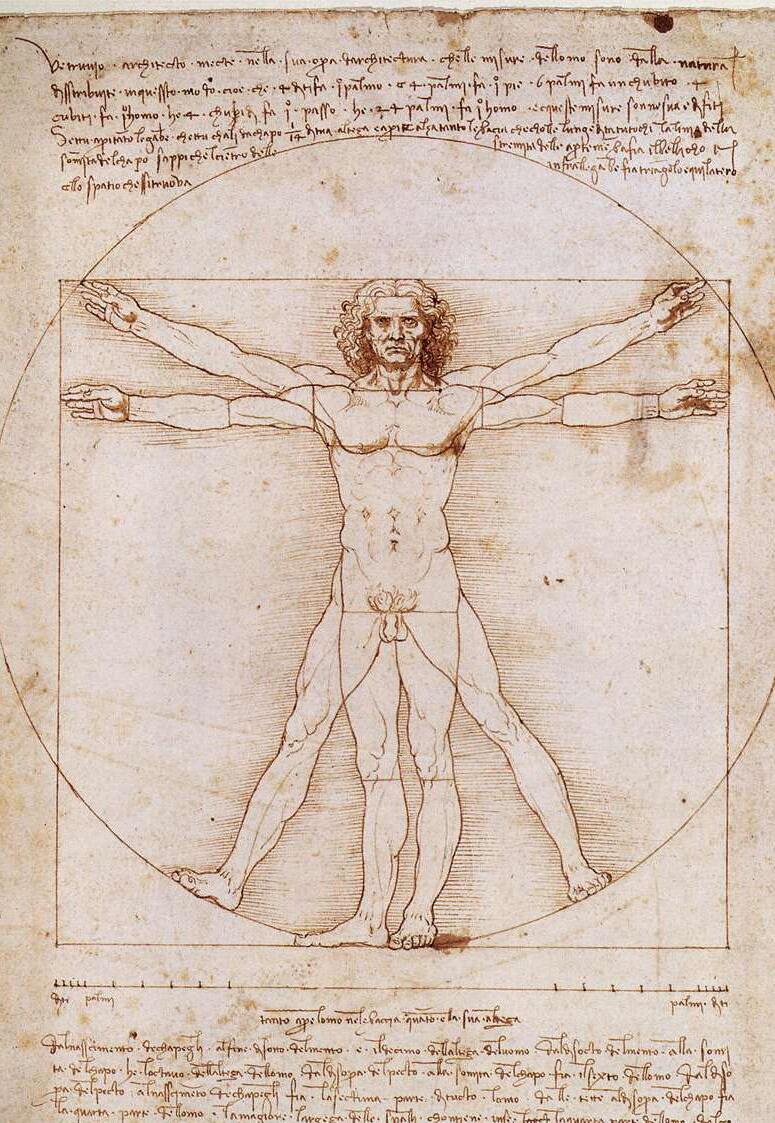
The Vitruvian Man
Vitruvius, the architect, says in his work on architecture that the measurements of the human body are distributed by Nature as follows:
four fingers make one palm, four palms make one foot, six palms make one cubit; four cubits make a man’s height. These measures he used in his building.
If you open your legs so much as to decrease your height one- fourteenth and spread and raise your arms till your middle fingers touch the level of the top of your head you must know that the centre
of the outspread limbs will be in the navel and the space between the legs will be an equilateral triangle.
From the roots of the hair to the bottom of the chin is the tenth of a man’s height; from the bottom of the chin to the top of his head is one eighth of his height; from the top of the breast to the top of his head will be one sixth of a man. From the top of the breast to the roots of the hair will be the seventh part of the whole man.
From the nipples to the top of the head will be the fourth part of a man. The greatest width of the shoulders From the elbow The whole hand below the knee
The length of a man’s outspread arms is equal to his height. The face forms a square in itself. The distance from the attachment of one ear to the other is equal to that from the meeting of the eyebrows to the chin, and in a fine face the width of the mouth is equal to the length from the parting of the lips to the bottom of the chin. The ear is exactly as long as the nose. The ear should be as high as from the bottom of the nose to the top of the eyelid. The space between the eyes is equal to the width of an eye.
Invention (orchestra only)
Nature
Though human ingenuity may make various inventions, it will never devise inventions more beautiful, nor more simple, nor more to the purpose than Nature does; because in her inventions nothing is wanting, nothing is superfluous. Necessity is the teacher and tutor of Nature.
Perception
All our knowledge has its origin in our perceptions.
Look at the Stars
O Time! Consumer of all things; O envious age! Thou dost destroy all things and devour all things with the relentless teeth of years, little by little in a slow death.
If you look at the stars, cutting off the rays, you will see those stars so minute that it would seem that nothing could be smaller; it is in fact their great distance that is the reason of their diminution, for many of them are many times larger than the star which is the earth with water.
Now reflect what this, our star, must look like at such a distance, and then consider how many stars might be added — both in longitude and latitude — between those stars that are scattered over the darkened sky.
Look at the Stars. O Time!
Wisdom is the daughter of experience.
-crafted by Jocelyn Hagen using various public domain English translations from Leonardo da Vinci’s notebook pages
Daniel Bara, John D. Boyd UGA Foundation Professor of Choral Music, conductor
Christopher Hickey, assistant conductor
Gregory Hankins, piano
Sopranos
Briana Darden
Zaria Doss
Katie Drybrough*
Phoebe Feibus
Page Hall
Mia Hansen
Laurel McFarland
Lauren Smith
Meera Srinivasan
Emily Taylor
Hope Unger
Abigail Weller
Margaret Wilson
Altos
Rylee Aguirre
Julie Alridge
Anna Bossert
Avery Britt
Elle Dignam
Quinn Dillard
Sarah Dudley
Elisa Garnia-Carreras
Lucy Kellam
Caroline Malcom
Kathryn McWhorter
Shelby Miller
Ange Sanches Fuentes
Shayna Suddeth
De’Nasia Thomas
Danielle Vergara
Tenors
August Bauer
Benjamin Brown
Colton Carter
Noah Colwell
Aiden Eclavea
Matthew Elsey*
Christopher Hickey*
Alex Gilliam
Liam Mueller
Will Pollard
Julian Riviera-Summerville
Sean Wilson
Basses
JR Banitt
Lucas Baughcum
Milo Bauman
West Clayton
Trip Drennan
Sean Helms
Justin Herrin
Peter Kandra
Evan Lambert
Andrew Latimer
Owen MargaretVerrett
Walter Moody
Sam Son
Flute
Blair Carrier
Oboe
Amanda Withrow
Clarinet
Ryan Hanling
Bassoon
Caleb Jackson
Horn
Peter Dixon
* Denotes Graduate Assistant
INSTRUMENTALISTS
Percussion I
Grayson Pruitt
Percussion II
Samuel (Dane) Warren
Piano
Greg Hankins
Violin I
Alexis Boylan
Jhonni Campos
Karla Mejias
Violin II
Zeyu Yuan
Ellis Kim
Hyejun Kang
Viola
Daniel Boscan
Devin Bennett
Cello
Gabriella McClellan
Thomas LaMon
Bass
Daniel Pina
The Hodgson Singers and all of the seven UGA Choirs are generously supported by: Pierce Arant Memorial Choral Funds; The John D. Boyd UGA Foundation Choral Music Professorship
The Hoveland Choral Fellowship; The Gerald Mayo Choral Fund; and The Choral Activities Fund
Join us for the SECOND ANNUAL...