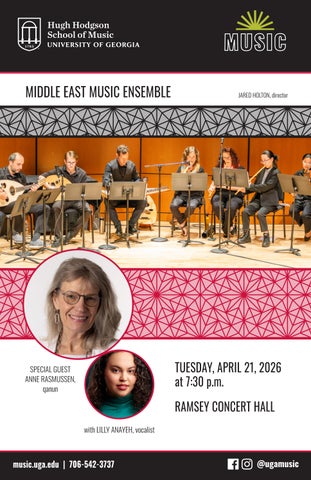
Middle East Music Ensemble - Tuesday, April 21, 2026
TUESDAY, APRIL 21, 2026 at 7:30 p.m.
RAMSEY CONCERT HALL
Tuesday, April 21, 2026 at 7:30 p.m.
Ramsey Concert Hall
UGA Performing Arts Center
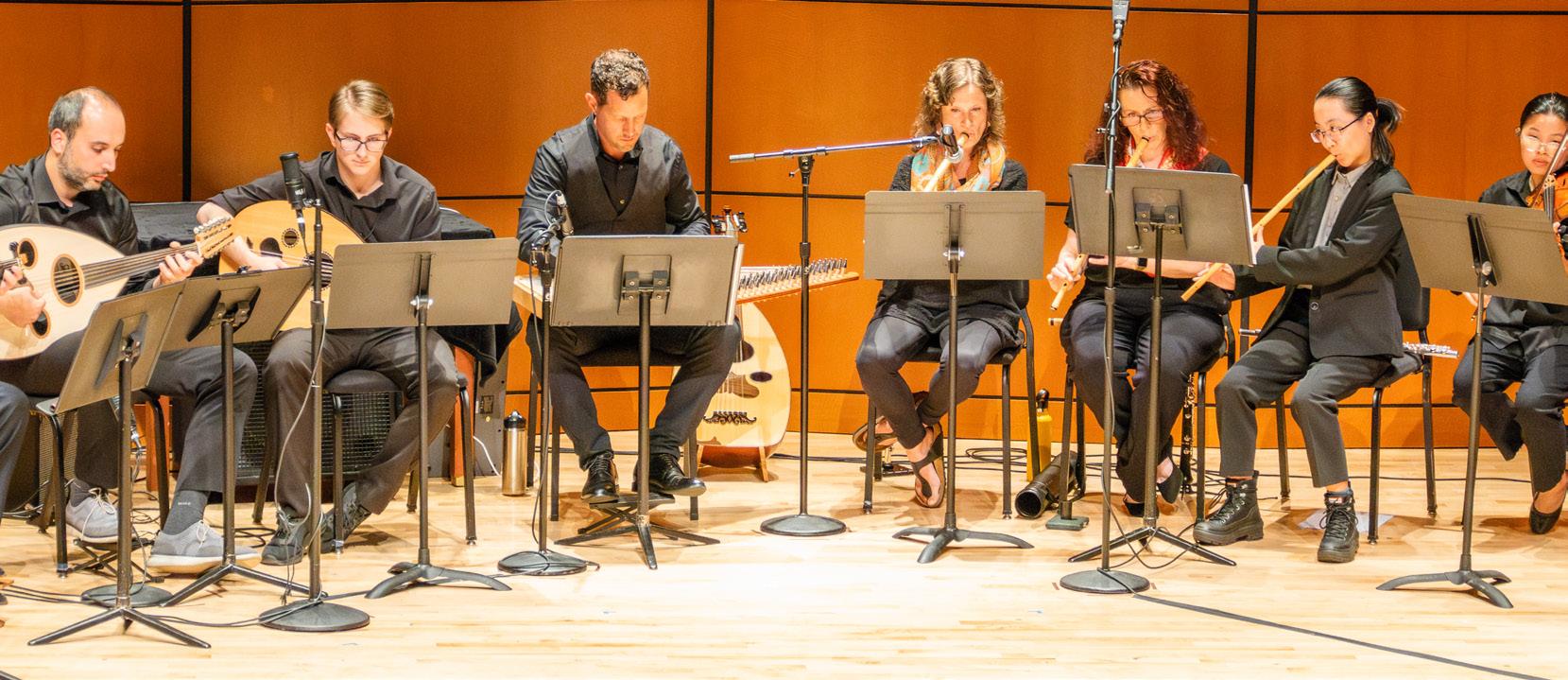
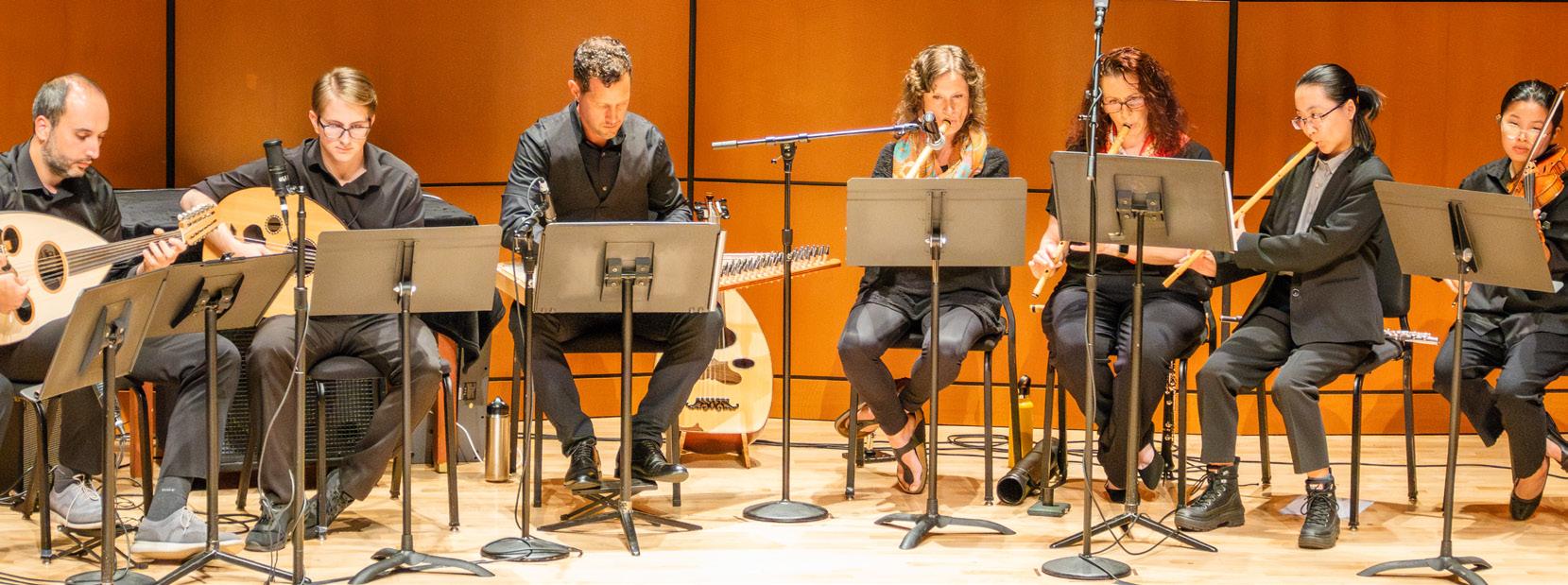
University of Georgia Middle East Music Ensemble
Jared Holton, director with Anne Rasmussen
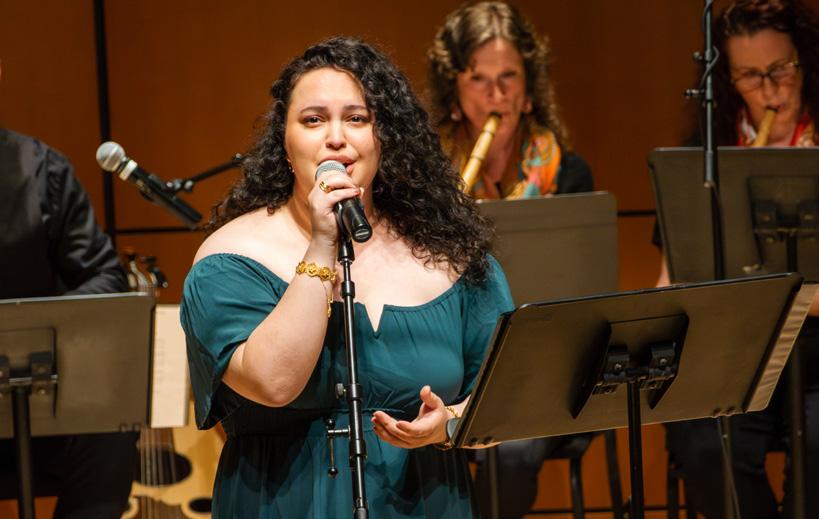
Lilly Anayeh
PROGRAM
Mayyala Ali Jihad Racy (b. 1943)
Wasla in Maqam al-Hijaz
Dulab Hijaz
Miserlou
Khatwat Habibi
Traditional
Traditional, Eastern Mediterranean / Greek-Ottoman Muhammad ‘Abd al-Wahhab (1902-1991)
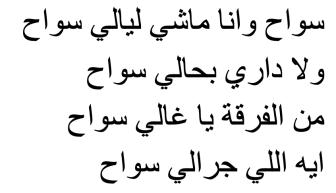
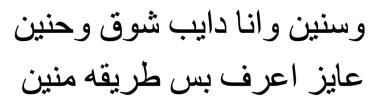
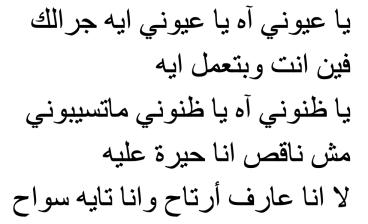
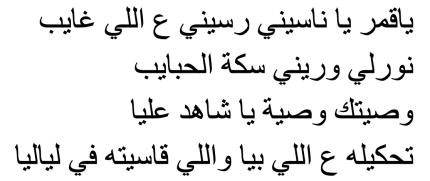
Sawwah Baligh Hamdi (1932-1993), composer Muhammad Hamza (1940-2010), lyricist
Sama‘i Bayyati Ali Jihad Racy
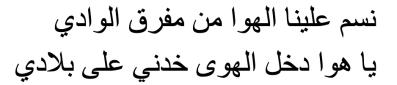
Nassam ‘Aleyna l-Hawa Assi Rahbani (1932-1986) and Mansour Rahbani (1925-2009) Composers and lyricists Famously performed by Fairuz (b. 1935)
Longa Shahnaz Adham Effendi (Ottoman, 19th cent.)
Sultani Yegah Sirto Refik Fersan (1893-1965)
Wasla in Maqam al-Rast
Dulab Rast
Wi-Nabi Yamma
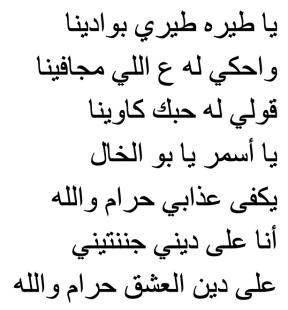
Ya Tirah Tiri
Ma Lik Ya Hilwa
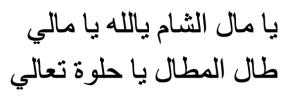
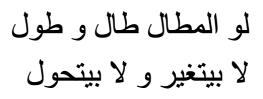
Ya Mal i-Sham
Traditional, Eastern Mediterranean Following recordings by Sabah Fakhri (1933-2021)
Texts and translations can be found after the upcoming events page at the back of this program.
UNIVERSITY OF GEORGIA MIDDLE EAST MUSIC ENSEMBLE
Jared Holton, Director
Vocalist
Zaria Doss
‘Ud (lute)
Jon Hollis
Jared Holton
Malek Mushref (buzuq)
Sydney Passmore
Hoberdan Peno Da Silva
Jeremy Raj
Nay (reed flute)
Richie Arndorfer
Kaman (violin)
Andreea Barca
Sageiana Codispoti
Qanun (zither)
Anne Rasmussen
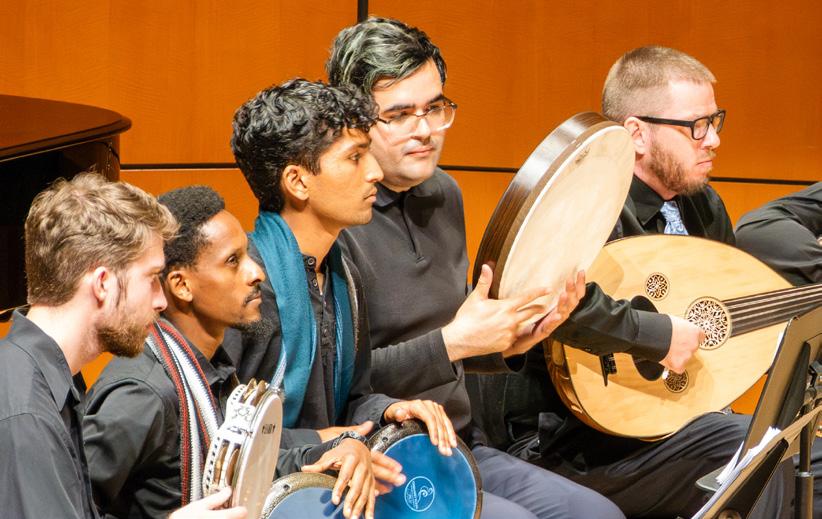
Percussion (riqq, tabla, daff)
Nderitu Kiragu
Nicole LeCorgne
David MacPherson
Robert Moser
Shaoey Pace
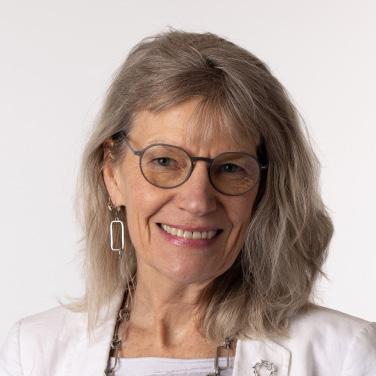
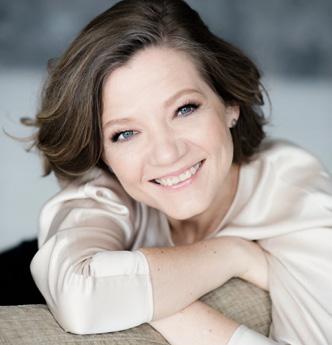
Anne K. Rasmussen is Professor of Ethnomusicology and Bickers Professor of Middle Eastern Studies at William & Mary where she also directs the William & Mary Middle Eastern Music Ensemble (Est. 1994). Her first ethnographic and historical research on music and community in Arab America led to a career-long investment in the studying, teaching, performing, programming, and advocating for the music of a broadly Multicultural America. Her subsequent research and award-winning publications encompass music of the Middle East and Muslim worlds, with a focus on Indonesia and the Indian Ocean region, and music in a multicultural United States, with a focus on Arab America. Recipient of two Fulbright Fellowships for research in Indonesia, a Sultan Qaboos Cultural Center Fellowship for research in Oman, and a fellowship from the American Council of Learned Societies (ACLS), and a grant from the French Centre National de Recherche Scientifique, she has also served as President of the Society for Ethnomusicology. She is author of Women, the Recited Qur’an, and Islamic Music in Indonesia (California 2010 // Indonesian translation, Mizan 2019) and co-editor of The Music of Multicultural America (Schirmer 1997, 2nd revised edition U Press of Mississippi 2016), Divine Inspirations: Music and Islam in Indonesia (Oxford 2011), and The Music of Arabia (Indiana 2021). At William & Mary she was awarded a Plumeri Prize for Faculty Excellence and has served as the highest presiding officer of Phi Beta Kappa, Alpha of Virginia. Anne Rasmussen is known for the interdisciplinary, experiential learning programs she has designed for students in Oman and Morocco, as well as for her semester-long program “Washington and the Arts” taught on various occasions at William & Mary’s Washington Campus, as well as for the international cohort of artists and scholars with whom she regularly collaborates.
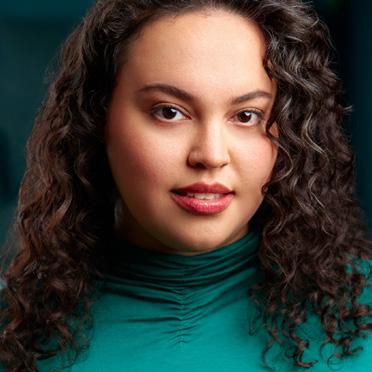
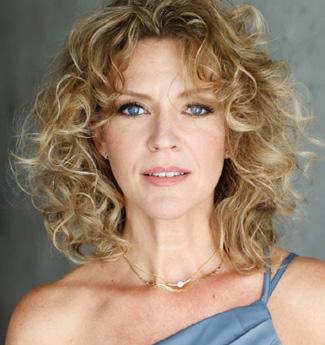
Lilly Anayeh is a singer, actor, piano and voice teacher, and choreographer, originally from Jacksonville, Florida. Lilly earned a BFA in Musical Theatre with studies in choreography from The University of Alabama at Birmingham. She was a resident performer and choreographer at Barter Theatre in Abingdon, VA for 2 seasons. Currently, Lilly teaches through City Springs Theatre Company and Aurora Theatre, and is an Adjunct Professor of Voice at Brenau University. Lilly participated in the 2024 Arabic Music Retreat, and as a proud Palestinian-American, is honored to further invest in her culture through Middle Eastern music.
DIRECTOR BIOGRAPHY
Jared Holton is Assistant Professor of Musicology and Ethnomusicology at the University of Georgia, where he teaches classes that interrelate musical theory and practice; global studies; and cultural theory. His research focuses on the musical modes of North African Andalusi music, their ecologies of performance, and their networks of transmission in Tunisia and Libya. He is a disciple of musicians and scholars from Libya, Tunisia, and California and holds a Ph.D. in Ethnomusicology from the University of California in Santa Barbara.
ABOUT THE UGA MIDDLE EAST MUSIC ENSEMBLE
The UGA Middle East Ensemble is an extension of the Musicology/Ethnomusicology program in the Hugh Hodgson School of Music, and serves as a forum for research and performance.
SUPPORT THE SCHOOL OF MUSIC
HOW TO GIVE
Under each of the available funds below is a QR code where you can scan and donate directly to that fund. However, if you would like to learn more about alternative ways to donate, scan the QR code now to visit our “How to Give” page with additional details and options.
Scholarships and Graduate assistantships funded by donations to the Thursday Scholarship Fund make it possible for students to learn and pursue their passions at the Hugh Hodgson School of Music. Please consider a taxdeductible gift to the Thursday Scholarship Fund so we may continue to support our students and make their education possible. Scan the QR code now or reach out to Melissa Roberts at roberts@uga.edu or 706-254-2111.
SUPPORT INDIVIDUAL AREAS OF THE SCHOOL OF MUSIC
In addition to our primary Support and Scholarship Funds, many specialized areas of interest, including our orchestra and choral programs, have support and scholarship funds you can contribute to directly. You can now learn more about all the ways and areas you can support the Hugh Hodgson School of Music. Scan the QR code or visit music.uga.edu/giving-and-alumni to the support the Hugh Hodgson School of Music area of your choice.
JOIN THE DIRECTOR’S CIRCLE
Gifts of all amounts are greatly appreciated. However, annual giving at the $1,500 level and higher provides membership in the Director’s Circle, our Hugh Hodgson School of Music Honor Roll. Director’s Circle members are invited to exclusive events and performances throughout the academic year.
For large gifts, please contact Melissa Roberts at roberts@uga.edu or 706-254-2111.
THANK YOU FOR YOUR CONTINUED SUPPORT OF THE UNIVERSITY OF GEORGIA HUGH HODGSON SCHOOL OF MUSIC.
ImaginePossibilities the
7:30 p.m.
Hodgson Concert Hall
$23 - Adults
$6 - UGA Students THURS 4/23
FOR TICKETS:
THURSDAY SCHOLARSHIP SERIES: ORFF’S “CARMINA BURANA”COMBINED CHOIRS AND SYMPHONY ORCHESTRA
Carmina Burana is a powerful cantata composed by Carl Orff in 1935-36 based on a collection of twenty-four medieval poems. Recurring themes from Carmina Burana, such as the “O Fortuna,” have appeared in hundreds of films and television commercials. This recognizable piece continues to be a popular crowd pleasing experience for audience and musicians alike.
There is nothing quite like the power of more than three hundred student musicians collaborating on a single concert. The University of Georgia Symphony Orchestra is joined by the UGA Hodgson Singers, Treble Choir, University Chorus, UGA Glee Club, as well as talented student and faculty soloists.
FRI 4/24
7:30 p.m.
Hodgson Concert Hall
FREE CONCERT
MON 4/27
3:30 p.m.
Ramsey Concert Hall
FREE CONCERT
MON 4/27
7:30 p.m.
Hodgson Concert Hall
FREE CONCERT
UNIVERSITY OF GEORGIA AFRICAN AMERICAN CHORAL ENSEMBLE
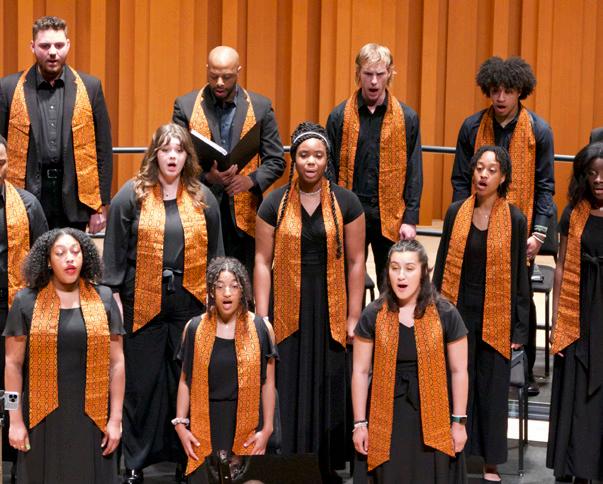
Since the 70’s as the Pamoja Singers, the African American Choral Ensemble (AACE) has kept concert halls and churches filled with the powerful musical treasures birthed from the African American experience. AACE is a beacon tower of fellowship and friendship for the university community, conducted by Gregory Broughton.
UNIVERSITY OF GEORGIA REPERTORY SINGERS
The Repertory Singers is a mixed chamber choir directed by graduate student conductors. Its format offers laboratory rehearsal and performance experience for conductors and singers alike.
UNIVERSITY OF GEORGIA PHILHARMONIA & SYMPHONIC BAND
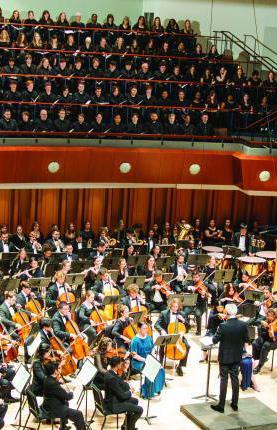
As one of the Hugh Hodgson School of Music’s large orchestral ensembles, the University Philharmonia offers an outlet for musical expression to all string players at the University of Georgia. The University Philharmonia is under the supervision of Mark Cedel. The University of Georgia Symphonic Band is one of the Hugh Hodgson School of Music’s large wind bands and focuses on the classic band repertoire as well as exciting new music. Symphonic Band is conducted by Michael C. Robinson.
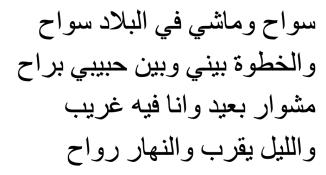
I am a wanderer who walks the land. The steps between my lover and me are many. I am far away, and I feel like a stranger. The day is over and nighttime is near.
I am a wanderer walking at night, a wanderer. Or my mind in a daze, a wanderer. From the separation, Oh my Dear! Awanderer. What has happened to me?Awanderer.
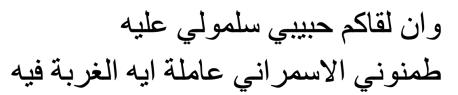
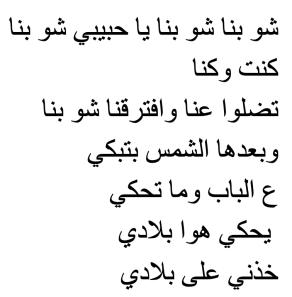
What has happened to us? Oh my love, what has happened to us?
We used to be together and we were...
We’ve lost the way and have separated, what happened to us?
Even the sun is weeping
At the door, saying nothing, While the breeze of my home speaks
Take me to my home! [refrain]
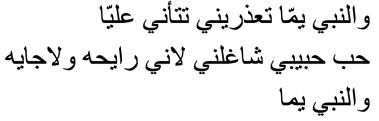
I Swear, Mama / Wi-n-Nabi Yamma /
امي
Refrain
wi-n-nabī yammā ta‘zurīnī tit’annī ‘alayya
ḥubbi ḥabībī shāghilnī lānī rāyḥa wa lā gāyya
wi-n-nabī yammā
I swear, mama, have patience, go easy on me. Love for my beloved occupies me. I don’t know if I’m coming or going. I swear, mama...
Verse 1
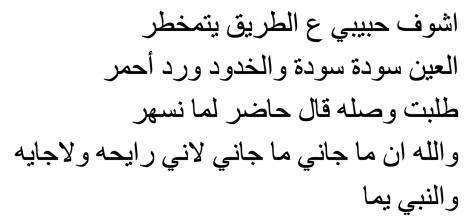
ashūf ḥabībī ‘a ṭ-ṭarī’yitmakhṭar
wi-l-‘ayn sūda sūda wi-l-khudūd ward ahmar
ṭalabt waṣluh ’āl ḥaḍir lammā nishar
w-allāh in mā gānī mā gānī lānī rāyḥa wa lā gāyya
wi-n-nabī yammā
I see my beloved strutting down the road. His eyes black, so black, and his cheeks like a red rose.
I asked for a tryst, and he said, “Fine, let’s meet late at night.”
I swear, if he doesn’t come, if he doesn’t come, I won’t know if I’m coming or going.
I swear, mama...
Verse 2
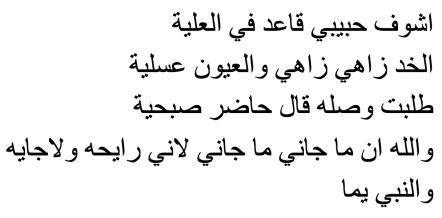
ashūf ḥabībī ’āyid fi-l-‘illiyyah
Il-khadd zāhī zāhī wi-l-‘uyūn ‘asaliyyah
ṭalabt waṣluh ’āl ḥaḍir ṣubḥiyyah
w-allāh in mā gānī mā gānī lānī rāyḥa wa lā gāyya wi-n-nabī yammā
I see my beloved sitting up on the balcony. His cheeks bright, so bright, and his eyes are honey-colored.
I asked for a tryst, and he said, “Fine, let’s meet in the early morning.”
I swear, if he doesn’t come, if he doesn’t come, I won’t know if I’m coming or going.
I swear, mama...
What’s Wrong with You, Beautiful One? / Mā Lik Yā
mā lik yā ḥilwa mā lik huwa l-garām ghayyar ḥālik fatanū ‘alayki ‘udhdhālik lamma ra’ūk bi-jamālik
Mā Lik /
What’s wrong with you, beautiful one? It is love that changed your whole state. They told on you the jealous and envious ones when they saw your beauty.
inti ḥayātī wa rūḥ ’albī baḥibbik lākin eh dhanbī mā mṭḥoṭṭī ’albik ’alā ’albī dāwī ḥabībī bi-waṣālik
You are my life and the soul of my heart. I love you, but what did I do wrong? Why don’t you put your heart on my heart? Heal me, my beloved, my being close.
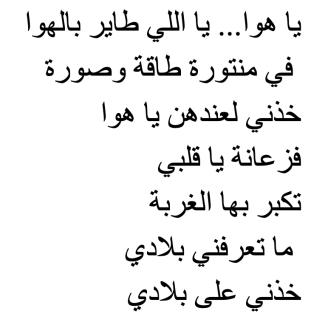
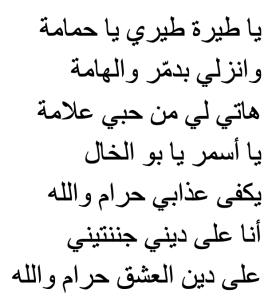
Fly to Dummar and Hama. Bring me a sign from my beloved. The dark-skinned one with a beauty mark on his cheek. Enough suffering, it’s ḥarām, by God! I swear, you made me wildly possessed. I swear, this passion is ḥarām, by God.
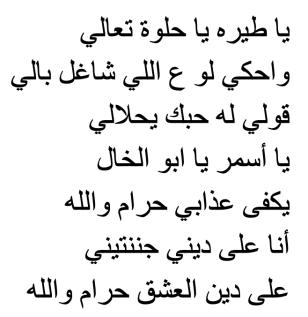
Oh beautiful bird, come, And tell him what preoccupies my mind. Tell him, “Your love pleases me.”
The dark-skinned one with a beauty mark on his cheek. Enough suffering, it’s ḥarām, by God! I swear, you made me wildly possessed. I swear, this passion is ḥarām, by God.
Oh bird, fly to our valley, And tell him what happened to us. Tell him, “Your love has burned us.”
The dark-skinned one with a beauty mark on his cheek. Enough suffering, it’s ḥarām, by God! I swear, you made me wildly possessed. I swear, this passion is ḥarām, by God.
O Syrian (Damascus) Woman / Yā Māl i-Shām /
yā māl ish-shām yallā yā mālī
ṭāl il-māṭāl yā ḥilwa ta‘ālī
Oh Syrian (Damascus) woman, Oh my treasure! You have been away for a long time. Oh beautiful one, come back.
law il-māṭāl ṭāl wa ṭawwil mā bitghayyir wa-lā bitḥawwal
Even if you were away for a long and still longer time, I won't change, and I won't turn away (from you).