MUSIC 26|27
FACULTYARTIST series
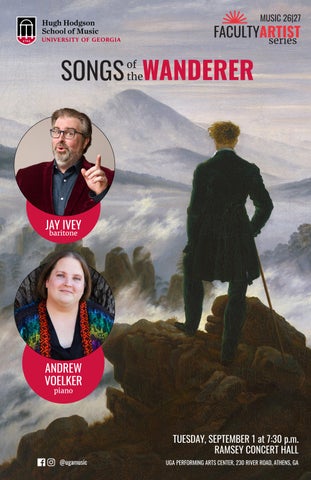
SONGS WANDERER of the
JAY IVEY baritone
ANDREW VOELKER piano
TUESDAY, SEPTEMBER 1 at 7:30 p.m. RAMSEY CONCERT HALL @ugamusic
UGA PERFORMING ARTS CENTER, 230 RIVER ROAD, ATHENS, GA
ARTS
FRANKLIN FINE AND PERFORMING
Embrace the arts. ENRICH YOUR WORLD.
26 | 27 SEASON
JOIN US FOR A FULL SEASON OF PERFORMANCES, EXHIBITIONS,AND MORE!
TICKETS NOW ON SALE LAMAR DODD SCHOOL OF ART
UGA DEPARTMENT OF DANCE
SCAN QR CODE OR VISIT OUR WEBSITES FOR SCHEDULE AND DETAILS SPECIAL PACKAGES AND OFFERS AVAILABLE HUGH HODGSON SCHOOL OF MUSIC
UGA DEPARTMENT OF THEATRE AND FILM
art.uga.edu dance.uga.edu music.uga.edu ugatheatre.com
MUSIC 26|27
FACULTYARTIST series
SONGS WANDERER of the
Jay Ivey, baritone
Andrew Voelker, piano Friday, September 4 at 7:30 p.m. Ramsey Concert Hall UGA Performing Arts Center, 230 River Road, Athens, GA Please join us after the performance for a meet-and-greet reception in the lobby.
PROGRAM The Wandering Errant Knight Quatre chansons de Don Quichotte by Jacques Ibert, texts by Pierre de Ronsard and Alexandre Arnoux (1890-1962; 1524-1585; 1884-1973) I. Chanson du départ II. Chanson à Dulcinée III. Chanson du Duc IV. Chanson de la mort de Don Quichotte
The Wandering Bard/Troubadour Let Us Garlands Bring by Gerald Finzi text by Shakespeare (1901-1956; 1554-1616) 1. Come away, come away, death (Twelfth Night) 2. Who is Sylvia? (Two Gentlemen of Verona) 3. Fear no more the heat o’ the sun (Cymbeline) 4. O Mistress Mine (Twelfth Night) 5. It was a lover and his lass (As You Like It) The Wayfarer Lieder eines fahrenden Gesellen music and text by Gustav Mahler (1860-1911) I. Wenn mein Schatz Hochzeit macht II. Ging heut’ Morgen über’s Feld III. Ich hab’ ein glühend Messer IV. Die zwei blauen Augen von meinem Schatz From The Man of LaMancha by Mitch Leigh, text by Joe Darion (1928-2014; 1911-2001) The Impossible Dream
MEET THE ARTISTS
Jay Ivey baritone
Andrew Voelker piano
Jay Ivey joined the voice faculty at the Hugh Hodgson School of Music with a specialization in musical theatre and contemporary commercial styles. A versatile baritone, pianist, composer, and teacher, his work is united by a commitment to storytelling that is immediate, stylistically informed, and deeply connected to text. On the operatic stage, Ivey has performed leading roles including Don Giovanni, Gianni Schicchi, Rigoletto, Lescaut in Manon, and Morales in Carmen. His work with Opera Theatre of St. Louis includes the British Ambassador in the world premiere of the revised edition of John Corigliano’s The Ghosts of Versailles, as well as roles in Les contes d’Hoffmann, Madama Butterfly, and Troilus and Cressida. He also served as the company’s Artist in Residence. As a concert and chamber soloist, Ivey has appeared in repertoire ranging from Baroque to contemporary, including Carmina Burana, Belshazzar’s Feast, Elijah, and numerous Requiem settings. He has performed Barber’s Dover Beach with the St. Louis Symphony String Quartet and collaborated with orchestras, universities, and festival organizations throughout his career. Ivey is also active as a composer and arranger. His arrangements of spirituals have been performed by mezzo-soprano Jamie Barton, and his original works have been heard at Carnegie Hall, the Kennedy Center, and Wigmore Hall. His recorded work includes A Dialogue of Songs: Self and Soul, on which he appears as both vocalist and pianist. A published scholar, Ivey is the author of Feuer und Eis: Duality in the Life and Lieder of Franz Schubert, selected for the recommended reading list at lieder.net. His research interests include vocal pedagogy, interdisciplinary approaches to singing and acting, and technology in performance practice. He also shares performances and musical explorations on TikTok at @jiveysings. Andrew Voelker serves as Vocal Coach and Music Director of Opera Theatre in the Hugh Hodgson School of Music at the University of Georgia. Last season, Voelker directed music for the Southeastern US premiere of Erich Korngold’s The Ring of Polykrates and conducted Jonathan Dove’s Mansfield Park at the State Botanical Gardens of Georgia
at UGA. Voelker previously served on the faculty of the Crane School of Music at SUNY Potsdam. As the music director of the award-winning Crane Opera Ensemble, they conducted the workshop and premiere of Computing Venus (Takach/Vincent), the winner of the 2024 Domenic J. Pellicciotti Opera Composition Prize. While serving as Associate Instructor of Collaborative Piano at Indiana University’s Jacobs School of Music, Voelker coached productions of Le nozze di Figaro, La traviata, Little Women, Serse, and L’incoronazione di Poppea. Previously, under the mentorship of Dr. Christopher Bagan, they prepared harpsichord continuo in historical styles for works including Dido and Aeneas, Giulio Cesare, and Lully’s Persée. Voelker’s 2026-2027 performance season at UGA, in addition to this Faculty Artist Series recital with Jay Ivey, includes: UGA Choral Project, Faculty Chamber Series concert with the UGA Voice Faculty, UGA Opera Theatre performances of Fall Opera Scenes and Joseph Bologne’s L’Amant anonyme, as well as masterclasses and performances at universities in the southeast and central United States.
music.uga.edu |
@ugamusic
NOTES, TEXTS, & TRANSLATIONS
by Jay Ivey
all translations also by Jay Ivey Every figure on tonight’s program is, in one way or another, a traveler without a fixed home — by exile, by heartbreak, by vocation, or by choice. Some wander a real landscape; others wander only in the imagination, chasing an ideal that keeps receding. Taken together, the four sets trace a kind of composite journey: comic delusion, exile and homecoming, private grief, and finally the decision to keep walking anyway. Jacques Ibert’s Quatre chansons de Don Quichotte gives us wandering in its most literal form—a knight who has quite literally left home to look for an adventure that does not exist. The set began as film music; In 1932, director G. W. Pabst was preparing a screen version of Don Quixote starring the great Russian bass Feodor Chaliapin and approached several prominent composers, among them Marcel Delannoy, Manuel de Falla, Ibert, Darius Milhaud, and Maurice Ravel. Only Ravel and Ibert ultimately delivered completed songs. Ibert’s were chosen; Ravel, working from Saint-Jean-de-Luz, missed the production’s tight deadline, though he went on to complete his own set anyway. That score became Don Quichotte à Dulcinée, now one of the most frequently performed cycles in the baritone repertoire—an odd twist, since the “loser” of the competition arguably wrote the more famous work. Ibert himself conducted the music for the film and later arranged his four songs for voice and piano. They have held the stage ever since, prized for a sound that is at once Spanish in flavor, French in polish, and shaped by the storytelling instincts of a film composer. None of the texts comes directly from Cervantes. The final three are by Alexandre Arnoux, but the opening Chanson du départ de Don Quichotte takes us on an even stranger journey: its text is a poem by Pierre de Ronsard written in 1552, more than half a century before Cervantes created Don Quixote. Ronsard could not possibly have been writing about the wandering knight; his Renaissance poem was only later transplanted into Quixote’s world and placed in his mouth as a song of departure. Fittingly, then, even the poetry in this cycle has wandered—across centuries, countries, languages, and literary identities—to arrive here. The set ends with Quixote’s wandering finally completed, not in triumph but in death, as he imagines the long-desired island of peace waiting for him just beyond the horizon.
Chanson de départ | Song of departure Pierre de Ronsard This radiant castle, newly raised, Its walls adorned with marble and royal stone,
Was built by Love to be his sovereign realm, Where heaven itself displayed its finest art. It stands as a fortress against all vice, A sanctuary where Virtue reigns alone. The eye is captivated, The soul filled with wonder, And every heart is drawn to serve within its walls. So noble is this stronghold That none may cross its gates Unless descended from the greatest kings, A victor in battle, Courageous in spirit, And faithful in love. No knight, however bold his wandering, Can hope to claim this place Unless he proves himself worthy of its grace.
Chanson á Dulcinée | To Dulcinea Alexandre Arnoux A single day stretches into a year Whenever I am parted from my Dulcinea. Yet Love has left her image everywhere To soften the ache of longing: In the shimmering fountain, In drifting clouds, In every dawn, And every flower that greets the morning. A single day stretches into a year Whenever I am parted from my Dulcinea. She is forever near, Yet always beyond my reach— The guiding star above my endless road. The breeze carries her breath Whenever it stirs the jasmine blossoms. A single day stretches into a year Whenever I am parted from my Dulcinea.
music.uga.edu |
@ugamusic
Chanson du Duc | Song of the Duke Alexandre Arnoux Here I sing of the lady who dwells within my dreams, She lifts me above this world of dust and clay. Her heart, pure as diamond, Knows neither falsehood nor deceit, And even the rose grows pale Beside the radiance of her face. For her I have embraced the greatest adventures. My arm has freed captive princesses, Vanquished dark enchanters, Unmasked the faithless, And bent the world itself To honor her name. My lady, for whom I walk this earth alone, Unenslaved by empty illusion, Against every reckless knight I will defend your matchless splendor And your sovereign grace.
Chanson de la mort de Don Quichotte Song of Don Quixote’s Death Alexandre Arnoux Do not weep, Sancho—do not weep, my faithful friend. Your master is not dead. He has only gone before you. He lives upon a blessed isle, Where all is pure And nothing false remains. One day you, too, will find That long-awaited shore— That cherished island, My dear Sancho. The books are burned, Reduced at last to ash. Though books once led me to my death, One alone is enough To grant me life beyond it.
Gerald Finzi’s Let Us Garlands Bring turns to a different kind of wanderer — not Shakespeare the man, who spent most of his career settled in London, but the itinerant, displaced, and footloose characters who populate his plays and sing these very songs. Feste, who sings “Come away, death” and “O Mistress Mine,” is Twelfth Night’s licensed fool — a figure with no fixed place in the household, free to drift between court and
kitchen, wisdom and nonsense. “Who is Sylvia?” is sung by a page in The Two Gentlemen of Verona, a play built almost entirely around characters traveling between cities chasing people who won’t stay put. Coming from the more obscure play Cymbeline, “Fear no more the heat o’ the sun,” the emotional center of the set, is sung over a presumed corpse by two young men raised in a cave in exile from the court that is rightfully theirs. It serves as a comforting lament, characterizing death as freedom from the struggles of life. “It was a lover and his lass” comes from As You Like It, whose entire second half unfolds among nobles banished to the Forest of Arden — exile reimagined as freedom. Finzi, gathering these songs across more than a decade, seems to have recognized that Shakespeare’s wanderers rarely suffer for long: displacement, in these plays, tends to resolve into something like grace. The work reflects Finzi’s lifelong devotion to English poetry and his gift for setting the natural rhythms of the language. Like many English composers of his generation, Finzi preferred to assemble his songs as a set rather than a traditional song cycle, allowing each piece to retain its individual character while sharing common themes of love, mortality, and renewal. Composed between 1883 and 1885, Gustav Mahler’s Lieder eines fahrenden Gesellen (Songs of a Wayfarer) marks the beginning of the composer’s mature artistic voice. Written during the aftermath of an unhappy love affair with soprano Johanna Richter, Mahler penned both the poetry and the music, creating an intensely personal portrait of heartbreak, longing, and self-discovery. He later orchestrated the cycle, and several of its themes reappear in his First Symphony, revealing the close relationship between his songs and symphonic writing. The title refers not simply to a traveler but to a journeyman—a young craftsman who wanders from place to place in search of experience and purpose. This archetype of the wandering seeker lies at the heart of the cycle and resonates throughout Romantic-era literature and music. Mahler’s wayfarer travels through forests, fields, and villages, but his true journey is inward, as grief gradually gives way to acceptance. The four songs chart this emotional pilgrimage: “Wenn mein Schatz Hochzeit macht” (“When My Beloved Is Married”), the despair of lost love; “Ging heut’ Morgen übers Feld” (“I Went This Morning Across the Field”), whose radiant folk-like melody is shadowed by lingering melancholy; “Ich hab’ ein glühend Messer” (“I Have a Gleaming Knife”), an explosive outpouring of anguish propelled by restless rhythms and dramatic contrasts; and “Die zwei blauen Augen von meinem Schatz” (“The Two Blue Eyes of My Beloved”), where a solemn funeral march gradually yields to a fragile, hard-won peace beneath the shade of a linden tree. Throughout the cycle, Mahler’s richly evocative writing transforms simple folk-inspired melodies into a sweeping emotional landscape, making the wayfarer’s journey both deeply personal and profoundly universal.
Wenn mein Schatz Hochzeit macht When My Beloved Is Wed When my beloved celebrates her wedding, Her joyful wedding day, Mine is a day of sorrow. I retreat to my little room, Dark and lonely, And there I weep— For my beloved, My dearest love. Little blue flower, Do not fade away. Sweet little bird, You sing across the green meadow: “How beautiful the world is!” Do not sing. Do not bloom. Spring has passed for me. Each evening, as I close my eyes, My thoughts return To the sorrow I cannot leave behind. Ging heut’ Morgen über’s Feld I Walked Across the Fields This Morning I walked across the fields this morning Where dew still shimmered on the grass. A cheerful finch called out to me: “Good morning! Isn’t the world a beautiful place? Bright and full of life— How I love this world!” The bluebells rang their tiny chimes, Greeting the morning with delight: “Isn’t the world a beautiful place? How fair it is!” Then, in the golden sunlight, The whole earth seemed to sparkle. Everything awakened— Color and song, Flowers and birds,
Great and small alike, All welcomed the day, Proclaiming: “Isn’t the world a beautiful place?” And I thought,
“Perhaps my happiness begins today.” But no— Never. For me, No spring will ever bloom again. Ich hab’ ein glühend Messer I have a burning knife, a knife, Buried deep within my heart. Oh, woe! It cuts through every joy, Every hope, Every moment of happiness, Leaving only pain. What cruel companion is this, That never grants me peace? It never rests, By day or by night, Not even in sleep. Whenever I look toward the heavens, I see her two blue eyes. When I walk through the golden fields, I glimpse her fair hair Drifting upon the wind. When I wake from dreams And hear the echo Of her silvery laughter, I long to lie Upon a dark bier, Never to open my eyes again. Die zwei blauen Augen von meinem Schatz The Two Blue Eyes of My Beloved The two blue eyes of my beloved Have sent me out into the wide world. So I was forced to leave The place I cherished most. O blue eyes, Why did you ever look at me?
music.uga.edu |
@ugamusic
Now sorrow is my companion forever. I set out Into the quiet night, Across the dark heath. No one was there To bid me farewell. Love and grief Walked beside me. At the roadside stood a linden tree, And there, for the first time,
I found rest in sleep. Its blossoms drifted down around me Like a gentle blessing. There, beneath its branches, I no longer felt The weight of life. For one peaceful moment, Everything was made whole again— Love and sorrow, The world and its dreams.
Inspired by Miguel de Cervantes’ Don Quixote, the 1965 musical Man of La Mancha presents the aging knight as the eternal dreamer—a wanderer whose greatest journeys are those of the spirit. Though the world sees madness, Don Quixote pursues honor, justice, and beauty with unwavering conviction. “The Impossible Dream,” the musical’s most enduring anthem, gives voice to Quixote’s guiding philosophy: to pursue goodness, justice, and beauty regardless of the odds or the cost. More than a declaration of optimism, it is a testament to the enduring human spirit and the belief that life’s greatest journeys are often measured not by their destination, but by the courage to continue the quest. SELECTED REFERENCES Banfield, Stephen. Sensibility and English Song: Critical Studies of the Early Twentieth Century. 2 vols. Cambridge: Cambridge University Press, 1985. Barham, Jeremy, ed. The Cambridge Companion to Mahler. Cambridge: Cambridge University Press, 2007. Fischer, Jens Malte. Gustav Mahler. Translated by Stewart Spencer. New Haven, CT: Yale University Press, 2011. Johnson, Julian. Mahler’s Voices: Expression and Irony in the Songs and Symphonies. New York: Oxford University Press, 2009. McVeagh, Diana. Gerald Finzi: His Life and Music. Woodbridge, UK: Boydell Press, 2005.
Queron, Elsa. “Jacques Ibert’s La Mort de Don Quichotte: In Between Two Worlds.” Elsa Queron: French Diction and Opera Blog. April 3, 2022.
HUGH HODGSON SCHOOL OF MUSIC FACULTY
Felix Olschofka, Director Brandon Craswell, Associate Director, Director of Undergraduate Studies Emily Gertsch, Associate Director, Director of Graduate Studies Amy Pollard, Associate Director, Director of Performance Activities PERFORMANCE FACULTY Josh Bynum Brandon Craswell Jean Martin-Williams James Naigus *Matthew Shipes Gilbert Villagrana
trombone trumpet horn horn tuba/euphonium trumpet
Kimberly Toscano Adams * Timothy Adams
percussion percussion
John Coble Scott Cuellar Damon Denton * Grace Huang Emely Phelps Greg Satterthwaite Anatoly Sheludyakov James Weidman Alan Woo
organ piano piano piano piano piano piano piano piano
Levon Ambartsumian Shakhida Azimkhodjaeva Karen Bergmann Daniel Bolshoy Michael Heald James Kim Edward Kreitman * Milton Masciadri Maggie Snyder
violin violin strings guitar violin cello Suziki double bass viola
Gregory Broughton Jay Ivey Elizabeth Knight *Amy Petrongelli Anne Slovin
voice voice voice voice voice
* Angela Jones-Reus D. Ray McClellan Reid Messich Amy Pollard Brandon Quarles
flute clarinet oboe bassoon saxophone
BANDS Mia Athanas Brett Bawcum Jack A. Eaddy, Jr. Marcus Morris * Nicholas Enrico Williams CHOIRS * Daniel Bara Gregory Broughton Colin Mann Daniel Shafer COMMUNITY MUSIC SCHOOL & SUMMER CAMPS Stephen Fischer COMPOSITION & THEORY Adrian Childs Emily Gertsch *Emily Koh Peter Lane Dickie Lee Trinity Vélez-Justo Morgan Weeks CONDUCTING STUDIES Daniel Bara Brett Bawcum Mark Cedel Jack Eaddy Colin Mann *Nicholas Williams JAZZ STUDIES David D’Angelo Gregory Satterthwaite James Weidman
MUSIC EDUCATION *Rebecca Atkins Alison Farley Tyler Goehring Roy Legette Kristen Lynch Michael Robinson Johanna Royo Brian Wesolowski MUSIC THERAPY *Ellyn Evans Sally Ann Nichols Jenny Stull MUSICOLOGY & ETHNOMUSICOLOGY Karen Bergmann * Naomi Graber David Haas Jared Holton Jean Kidula Eleanor Price Rumya Putcha Joanna Smolko OPERA * Daniel Ellis Andrew Voelker ORCHESTRA * Mark Cedel RECORDING & STREAMING Eric Dluzniewski Jamie Tagg
*Area Chair
HUGH HODGSON SCHOOL OF MUSIC STAFF Susan McClure, Administrative Assistant to the Director
Shaun Baer Levi Dean Elizabeth Durusau Heather Gozdan-Bynum Scott Higgins Kathleen Powell Rocky Raffle James Sewell Jared Tubbs Marshall Williams
Director of Public Relations Development Associate Music Library Manager Undergraduate Academic Advisor Senior Piano Technician Graduate Program Administrator Administrative Associate in Bands Production & Events Manager Sectioning Officer Director of Admissions
SUPPORT HOW TO GIVE
THE SCHOOL OF MUSIC
Under each of the available funds below is a QR code where you can scan and donate directly to that fund. However, if you would like to learn more about alternative ways to donate, scan the QR code now to visit our “How to Give” page with additional details and options.
SUPPORT THE THURSDAY SCHOLARSHIP FUND
Scholarships and Graduate assistantships funded by donations to the Thursday Scholarship Fund make it possible for students to learn and pursue their passions at the Hugh Hodgson School of Music. Please consider a taxdeductible gift to the Thursday Scholarship Fund so we may continue to support our students and make their education possible. Scan the QR code now or reach out to Melissa Roberts at roberts@uga.edu or 706-254-2111.
SUPPORT INDIVIDUAL AREAS OF THE SCHOOL OF MUSIC
In addition to our primary Support and Scholarship Funds, many specialized areas of interest, including our orchestra and choral programs, have support and scholarship funds you can contribute to directly. You can now learn more about all the ways and areas you can support the Hugh Hodgson School of Music. Scan the QR code or visit music.uga.edu/giving-and-alumni to the support the Hugh Hodgson School of Music area of your choice.
JOIN THE DIRECTOR’S CIRCLE
Gifts of all amounts are greatly appreciated. However, annual giving at the $1,500 level and higher provides membership in the Director’s Circle, our Hugh Hodgson School of Music Honor Roll. Director’s Circle members are invited to exclusive events and performances throughout the academic year. For large gifts, please contact Melissa Roberts at roberts@uga.edu or 706-254-2111.
THANK YOU FOR YOUR CONTINUED SUPPORT OF THE UNIVERSITY OF GEORGIA HUGH HODGSON SCHOOL OF MUSIC.
MUSIC 26|27
FREE PERFORMANCE
BEYOND EGRESS Works of Holst and Shaw featuring Schütz Musikalische Exequien
UGA
CHORAL
FRIDAY, SEPTEMBER 4 at 7:30 p.m. Ramsey Concert Hall
Project
Musikalische Exequien weaves together Germanic Biblical and poetic texts with Italianate musical textures and style.
FEATURED PERFORMANCE
onday, IDAY, OCT. 24 msey
October 20 at 3:30 p.m. Concert Hall
Symphony
ORCHESTRA
JOHANNES BRAHMS Symphony No. 1 $20 - Adults $3 UGA students
WEDNESDAY, SEPTEMBER 9 at 7:30 p.m. Hodgson Concert Hall
plus $3 transaction fee
An evening of masterworks...Wagner’s overture the opera Rienzi and French impressionist Lili Boulanger. Brahms’ first symphony, sometimes called “Beethoven’s 10th.”
music.uga.edu 706-542-4400
meet
FELIX OLSCHOFKA
PLUS: Join us before the show at 6:30 p.m. for a light reception to welcome the new Director of the Hugh Hodgson School of Music, Felix Olschofka!
This concerto for viola is sometimes referred
@ugamusic music.uga.edu | 706-542-4400 | 230 River Road, Athens, from GA Old Folk Songs. to as the Concerto The piece follows a wandering medieval minstrel
MUSIC 26|27
FEATURED PERFORMANCE
GEORGIA BRASS QUINTET $15 - Adults $3 UGA students plus $3 transaction fee
music.uga.edu 706-542-4400
MONDAY, SEPTEMBER 14 at 7:30 p.m. Ramsey Concert Hall The Georgia Brass Quintet is presenting an All-American program of classical- and jazzinspired compositions comprised of original works and transcriptions.
FREE PERFORMANCE GUEST ARTIST RECITAL OLIVER JIA, piano
TUESDAY, SEPTEMBER 15 at 7:30 p.m. Ramsey Concert Hall
FEATURED PERFORMANCE
WIND ENSEMBLE
PAUL HINDEMITH
with
The Swan Turner $15 - Adults $3 UGA students plus $3 transaction fee
music.uga.edu 706-542-4400
MAGGIE SNYDER viola
THURSDAY, SEPTEMBER 17 at 7:30 p.m. Ramsey Concert Hall
This concerto for viola is sometimes referred to as the Concerto from Old Folk Songs. The piece follows a wandering medieval minstrel performing and embellishing these folk tunes. This concerto for viola is sometimes referred
@ugamusic music.uga.edu | 706-542-4400 | 230 River Road, Athens, from GA Old Folk Songs. to as the Concerto The