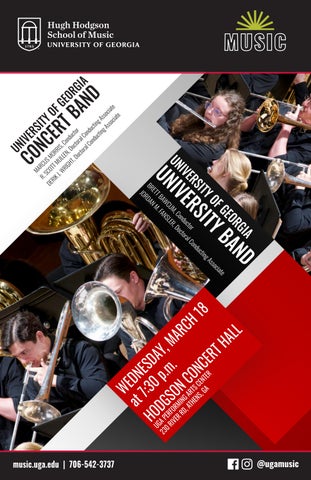
Wednesday, March 18, 2026 at 7:30 p.m.
Hodgson Concert Hall
UGA Performing Arts Center
University of Georgia Concert Band
Marcus Morris, Conductor
R. Scott Mullen, Doctoral Conducting Associate
Derik J. Wright, Doctoral Conducting Associate
University of Georgia University Band
Brett Bawcum, Conductor
Jordan M. Fansler, Doctoral Conducting Associate
PROGRAM
University of Georgia Concert Band
The Liberty Bell March
Rocketship!
Derik J. Wright, Doctoral Conducting Associate
Of Endless Miles and Empty Rafts
R. Scott Mullen, Doctoral Conducting Associate
A Longford Legend
I. A Longford Legend
II. Young Molly Bawn
III. Killyburn Brae
American Riversongs
Derik J. Wright, Doctoral Conducting Associate
INTERMISSION
University of Georgia University Band
John Phillip Sousa
Kevin Day
Jordan M. Fansler, Doctoral Conducting Associate
American Hymnsong Suite
II. Ballad on Balm in Gilead
III. Nettleton (Come Thou Fount of Every Blessing)
IV. March on Wilson (When We All Get to Heaven)
Sharp Nine
Rippling Watercolors
The Footlifter March
Jordan M. Fansler, Doctoral Conducting Associate
Jordan M. Fansler, Doctoral Conducting Associate
Michele Fernández
Robert Sheldon
Pierre LaPlante
Dwayne S. Milburn
Omar Thomas
Brian Balmages
Henry Fillmore
The
Liberty Bell March (1893/c. 2001) (4’)
John Phillip Sousa (1854-1932)
The Liberty Bell March was originally intended for an operetta called The Devil’s Deputy, but Sousa withdrew the work after a contract dispute with comedian Francis Wilson over the price. The march found its permanent name after Sousa’s band manager, George Frederick Hinton, suggested The Liberty Bell upon seeing a visual of the bell during a performance called “America”. This suggestion was confirmed the following morning when Sousa received a letter from his wife describing their son’s participation in a Philadelphia parade honoring the return of the historic bell from a tour. This composition became significant as it was among the first Sousa sold to the John Church Company and marked the beginning of his substantial financial success. Furthermore, the march features a theme contributed by Marcella Lindh, the Sousa Band’s first soprano, who allowed Sousa to incorporate her catchy, whistled tune into the work.
John Philip Sousa was a renowned American composer and conductor, celebrated for his contributions to the genre of military and patriotic band music. Often referred to as “The March King,” Sousa composed numerous iconic marches, including The Stars and Stripes Forever, Semper Fidelis, and The Washington Post March, which have become enduring staples of American music. His innovative arrangements and dynamic performances, particularly with his own Sousa Band, helped popularize the symphonic band format in the United States. Sousa’s work not only defined the sound of American marches but also left a lasting legacy in the world of concert band music.
Rocketship! (2017) (4’20”)
Kevin Day (b. 1996)
Rocketship! is an energetic concert piece formed by two sections which express energy in different ways. The first is composed of short rhythmic patterns that start quietly before building to the end of each phrase. The second section introduces a marching snare drum solo accompanied by open fifths, known as power chords, in the winds. Brief motives accompany the sustained power chords, but quickly dissipate as a new motive begins. The different sections shrink as the composition develops until they are played one after the other at the very end.
- Program Note by Cole Hairston
Kevin Day is an internationally acclaimed composer, conductor, and pianist based in Las Vegas, NV. He has composed over 250 works for various mediums including many concerti, chamber music, orchestra, and wind band compositions. His music often intersects the worlds of jazz, minimalism, Latin music, fusion, and contemporary classical idioms. Day has won a BMI Composer Award, was a finalist for the ASCAP Morton Gould Composer Award, the ABA-Sousa Oswald Award, and the NBA William Revelli Award. He studied at the University of Miami, the University of Georgia, and Texas Christian University.
Of Endless Miles and Empty Rafts (2023) (5’)
Michele Fernandez (b. 1967)
Throughout time and regardless of origin, immigrants have shown a spiritual courage and resolve to survive that has found countless families suffering perilous journeys in search of safety. Many have been lost along the way. As a child of Cuban parents who fled oppression (leaving much behind to build a new life), my respect and empathy for all immigrants runs deep. Although my parents’ (still traumatic) exoduses were not by sea, several family members’ and friends’ journeys were. Throughout my life I have heard stories of near losses and rafts washing ashore, empty. I still recall the feelings since childhood -- wondering who they were, and what happened to them. This piece is in no way intended as a contemporary statement, rather as an empathic look at humanity’s struggles to protect innocent families throughout history, and a tribute to my own ancestors’ courage.
- Program Note from the Composer
Michele Fernández is a clinician/conductor, adjudicator, instrumental music composer and oboist. Her compositions have been premiered at Midwest, IAJE and Regional Honor/All-State venues. Ms. Fernández frequently serves as a guest clinician/conductor for regional and all-state groups and honors Jazz/symphonic groups. She has appeared as a Midwest Clinic lecturer on rehearsal techniques, JEN, FMEA Conference lecturer, clinician for Clark College Annual Festival (WA), and frequent clinician for Florida State University summer camps.
Michele recently retired from teaching after 30 years, where her Miami Senior High ensembles earned top honors and gained international acclaim. Her groups have been selected for appearances at the Midwest Clinic, IAJE, Montreux Jazz Festival (Switzerland), FMEA Conference, and national publications. Michele has been the subject of a documentary spot on CBS Sunday Morning, cover story in Band Director’s Guide and featured as an outstanding educator in Downbeat Magazine.
A Longford Legend (1996) (7’)
Robert Sheldon (b. 1954)
A Longford Legend was commissioned by the Normal Community West High School Band, Normal, Illinois, Lisa Preston, director. The piece was written in 1996 and premiered in April of that year with the composer conducting. It is based on the composer’s impressions of three poems found in a collection of eighteenth-century Irish ballades, and is written as a tribute to the wonderful music of Grainger, Holst, and Vaughan Williams.
Robert Sheldon is an American composer, arranger, conductor, and educator. Sheldon has taught instrumental music in the Florida and Illinois public schools, and has served on the faculty at Florida State University where he taught conducting and instrumental music education classes, and directed the university bands. As Concert Band Editor for the Alfred Publishing Company, he maintains an active composition and conducting schedule, and regularly accepts commissions for new works. Sheldon received the Bachelor of Music in Music Education from the University of Miami and the Master of Fine Arts in Instrumental Conducting from the University of Florida.
American Riversongs (1991) (6’05”)
Pierre LaPlante (1943-2024)
American Riversongs is a moving tribute to an earlier time, when our rivers and other waterways were the lifelines of our growing nation. Featuring Down The River; Shenandoah (Across The Wide Missouri); The Glendy Burk and a delightful Creole bamboula tune.
- Program Note from the Publisher
Pierre LaPlante was an American composer of French-Canadian descent who grew up in Sturgeon Bay, Wisconsin. He received his Bachelor and Master of Music degrees from the University of Wisconsin-Madison, where he was a composition student of James Christensen. LaPlante played bassoon with the Beloit-Janesville Symphony Orchestra. He retired after teaching general music and beginning band at Pecatonica Elementary School in Blanchardsville, Wisconsin, for twenty five years. He was a member of MENC, ASCAP, Wisconsin Music Educators Conference, Wisconsin Youth Band Directors Association, as well as the Madison Wind ensemble.
American Hymnsong Suite (2007) (6’30”)
Dwayne S. Milburn (b. 1963)
American Hymnsong Suite is firmly rooted in my family history as church musicians. I grew up singing and playing many different hymns, including the four tunes featured in this work. The final impetus to compose this particular treatment came during the course of an organ concert in Atlanta, Georgia. One section of the program featured innovative settings of three hymns. With the gracious consent of composers Joe Utterback and Brooks Kukendall, I adapted their settings to act as the inner movements of the suite, bracketed with my own original treatments of favorite hymns. While audience members will certainly make various connections to this piece, the ongoing goal is to introduce all listeners to the richness of our American musical heritage.
- Program Note by the Composer
Dwayne S. Milburn is an American composer, conductor, and military officer. In 1986, Milburn graduated from UCLA with a Bachelor of Fine Arts in music and received a Master’s of Music in orchestral conducting from the Cleveland Institute of Music in 1992. He received his Ph.D. in music from UCLA in 2009. Prior to his Ph.D. studies, Milburn served as one of twenty four commissioned officer conductors in the United States Army Band Program. His assignments included duties as the associate bandmaster for the U.S. Continental Army Band, Fort Monroe, Virginia; the U.S. Army Band “Pershing’s Own,” Washington, DC; and the U.S. Army Europe Band and Chorus, Heidelberg, Germany. He also commanded the Army Ground Forces Band in Atlanta. Since he completed his Ph.D. studies, he resumed his military service and currently serves as the commander and conductor of the U.S. Army Europe Band and Chorus in Heidelberg. Among his military honors are the President Benjamin Harrison Award, the Meritorious Service Medal, Army Commendation Medal, and the NATO Medal.
Sharp Nine (2020) (3’25”)
Omar Thomas (b. 1984)
Sharp Nine is a grooving, stomping 12-bar blues in B-flat, written in a straight-eighths New Orleans ragtime-style march, which pays homage to jazz cornetist and early jazz pioneer Charles Joseph “Buddy” Bolden. It is a first and significant step in my writing towards bridging the gap between the worlds of traditional wind ensemble and improvisation in a jazz context. Sharp Nine serves as a vehicle to introduce young musicians to the rich sounds of natural and altered tensions on dominant chords, and to give them the opportunity to take choruses of improvisation using the blues scale. Sharp Nine also provides opportunities for the musicians to compose their own bluesbased riffs to support whoever is soloing in the moment.
-Program Note by the Composer
Born to Guyanese parents, Omar Thomas moved to Boston in 2006 to pursue a Master of Music degree in jazz composition at the New England Conservatory of Music. He is the protégé of Ken Schaphorst and Frank Carlberg, and has studied under Maria Schneider. Thomas’s music has been performed in concert halls across the country. He has been commissioned to create works in both jazz and classical styles. His work has been performed by such diverse groups as the Eastman New Jazz Ensemble, the San Francisco and Boston Gay Men’s Choruses, and the Colorado Symphony Orchestra.
Rippling Watercolors (2015) (4’10”)
Brian Balmages (b.1975)
The idea for Rippling Watercolors came from a simple set of watercolors. When children get hold of these and use their imagination, the most amazing things can happen. Children can see things that adults never see. They open our minds while we help them grow and learn. With a little imagination, these watercolors can become a magnificent sunrise or sunset over the ocean, a gorgeous view from a mountaintop, or an image of a supernova in space. The smallest drop can change the pattern and create something entirely new, either with a brush or entirely within nature. It is my hope that Lily and Charlotte grow up with an infinite palette of watercolors, and that every drop creates a new, fantastic world. Rippling Watercolors is dedicated to my cousins Lily and Charlotte Balmages, who, combined with my two boys, form the next generation of the Balmages name in the United States. - Program Note by the Composer
Brian Balmages’ compositions have been performed worldwide at conferences including the College Band Directors National and Regional Conferences, the Midwest Clinic, the International Tuba/Euphonium Conference, the International Trombone Festival, and the International Trumpet Guild Conference. His active schedule of commissions and premieres has incorporated groups ranging from elementary schools to professional ensembles, including the Baltimore Symphony Orchestra, the Miami Symphony Orchestra, the University of Miami Wind Ensemble, and the Dominion Brass Ensemble. He has also had world premieres in prestigious venues such as Carnegie Hall along with numerous performances abroad.
The Footlifter March (1928/2003) (3’)
Henry Fillmore (1881-1956)
The Footlifter March was composed for a series of radio broadcasts sponsored by a small Cincinnati insurance agency in 1928. The company’s slogan was “A penny a day” (for insurance), and the march was referred to as the “Penny-a-Day March” for the short duration of the sponsorship –short because of the widespread depression. However, the president of the agency remarked that the piece certainly was a “footlifter,” and Fillmore used the title while the work was in manuscript. During a discussion with his good friend Phil Gates at a massed band concert in Piqua, Ohio in 1930, Fillmore remarked that the most energetic “footlifters” were the best marchers. Gates then suggested the same term for a future march title -- not realizing the coincidence -- and the name became permanent.
Henry Fillmore was the eldest of five children. In his youth he mastered piano, guitar, violin, and flute – as well as the slide trombone, which at first he played in secret. Fillmore was also a singer for his church choir as a boy. He began composing at eighteen, with his first published march, Higham, named after a line of brass instruments. Fillmore entered the Cincinnati Conservatory of Music in 1901. While best known for march music and screamers, Fillmore also wrote waltzes, foxtrots, hymns, novelty numbers, overtures and waltzes.
UNIVERSITY OF GEORGIA BANDS GRADUATE STAFF
Jordan M. Fansler, Doctoral Conducting Associate
R. Scott Mullen, Doctoral Conducting Associate
Derik J. Wright, Doctoral Conducting Associate
Joseph Johnson, Graduate Assistant
Michelle Moeller, Graduate Assistant