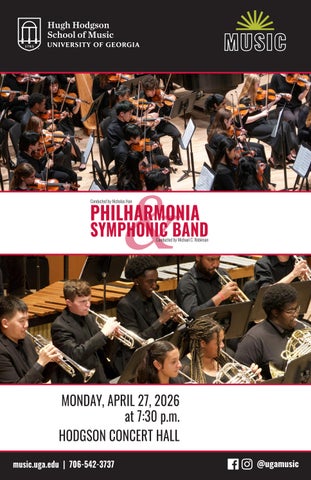
MONDAY, APRIL 27, 2026 at 7:30 p.m.
HODGSON CONCERT HALL
Monday, April 27 at 7:30 p.m.
Hodgson Concert Hall
UGA Performing Arts Center
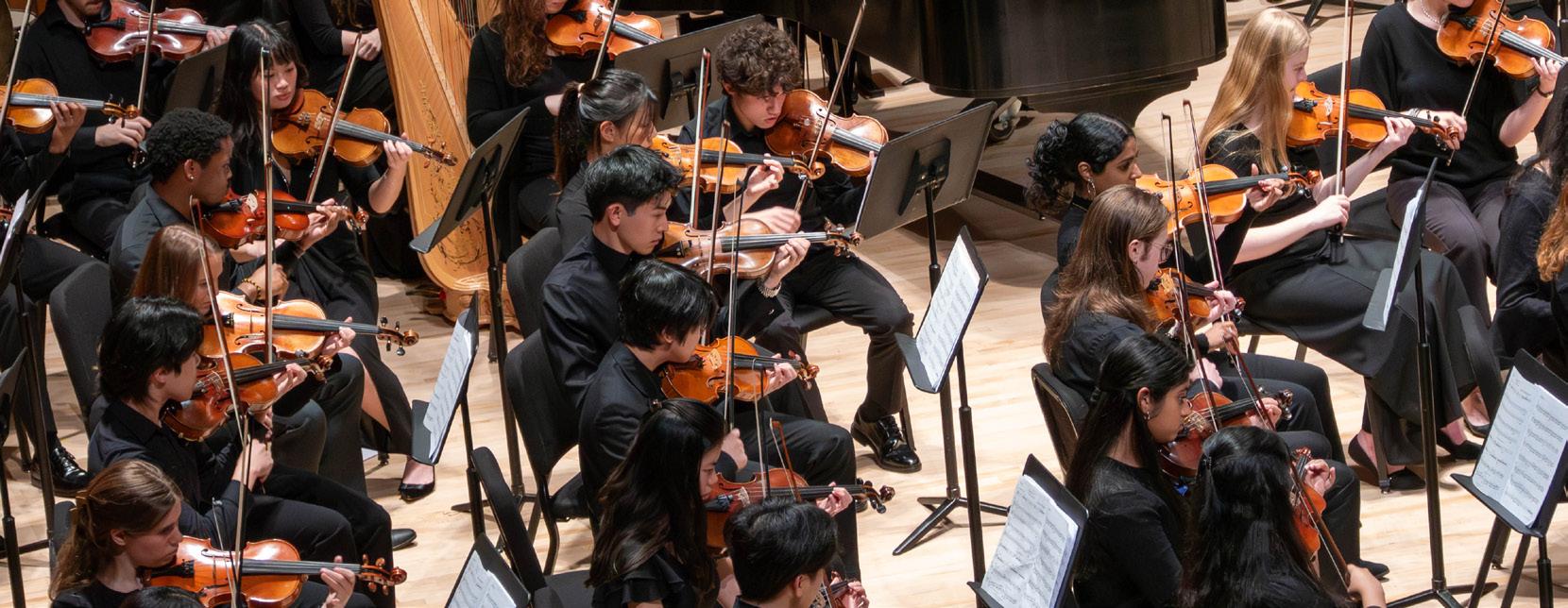
University of Georgia Philharmonia
Nicholas Han, Conductor
Liza Stepanova, Piano
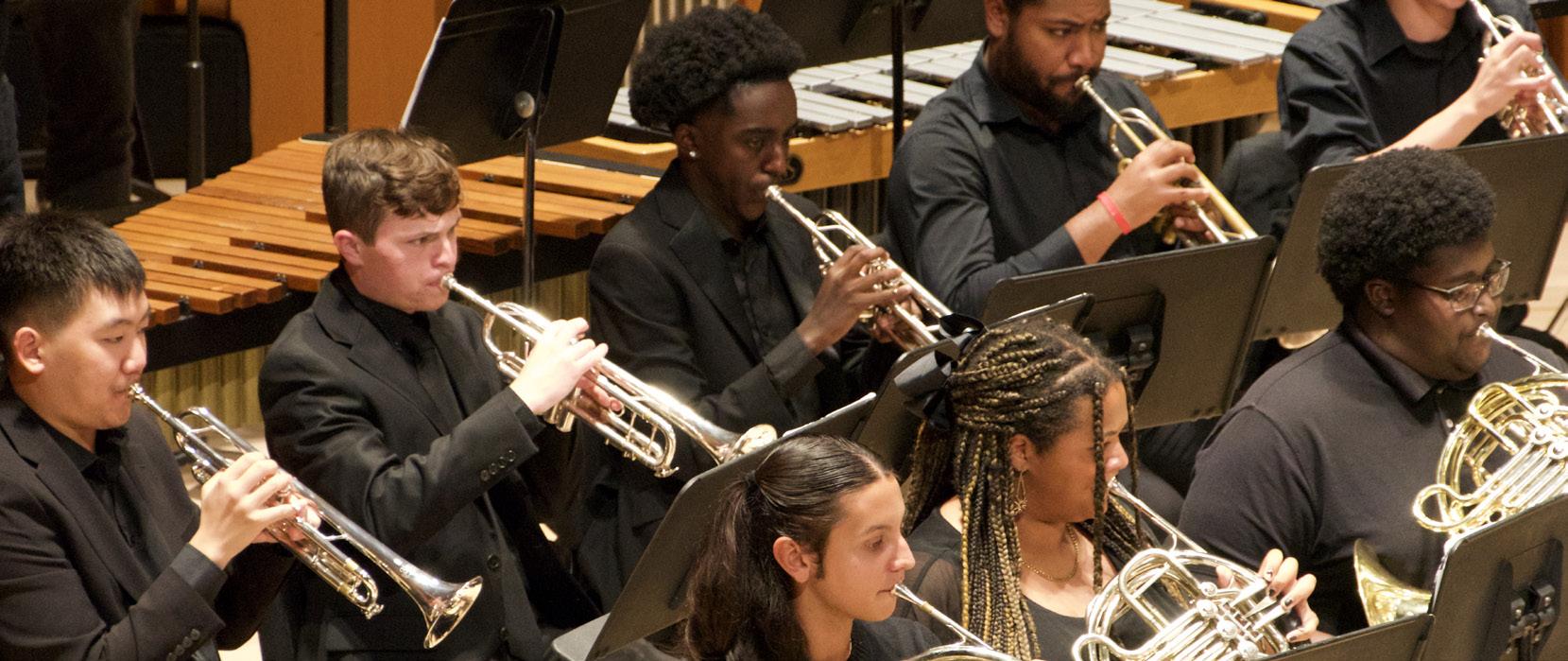
University of Georgia Symphonic Band
Michael C. Robinson, Conductor
Derik J. Wright, Doctoral Conducting Associate
Marcus Morris, Guest Conductor
James Naigus, Horn
Overture No. 2 in D Major
University of Georgia Philharmonia
Piano Concerto No. 4 in C minor, Op. 44
I. Allegro moderato – Andante
II. Allegro vivace – Andante – Allegro
Liza Stepanova, piano
University of Georgia Symphonic Band
Emilie Mayer
Windsprints
Marcus Morris, Guest Conductor
Love Everlasting Grasu Mwakaliku
World Premiere
Summer Dances
Derik J. Wright, Doctoral Conducting Associate
Brian Balmages
Concerto for Horn
I. Prelude-Rhapsody
Cajun Folk Songs Two
I. Ballad
II. Country Dance
James Naigus, Horn
Wind Ensemble World Premiere
Jacob Evarts
Frank Ticheli
Overture No. 2 in D Major (10’)
Scored for: two flutes, two oboes, two clarinets, two bassoons, two horns, two trumpets, timpani, and strings.
Emilie Mayer’s Overture in D Major is a dynamic and expressive orchestral work, showcasing her exceptional talent as a 19th-century composer. Premiered in the mid-1800s, the overture demonstrates Mayer’s mastery of classical form blended with Romantic expressiveness. It features a bold and spirited opening, followed by lyrical themes and intricate developments, highlighting her skill in orchestration and thematic transformation. Mayer’s Overture in D Major reflects her unique voice in a male-dominated musical landscape, contributing significantly to the Romantic repertoire. Its vibrant energy and emotional depth continue to captivate audiences, solidifying her legacy as a pioneering female composer.
Piano Concerto No. 4 in C Minor, Op. 44 (25’)
Scored for: two flutes, two oboes, two clarinets, two bassoons, two horns, two trumpets, three trombones, timpani, and strings.
Camille Saint-Saëns (1835-1921) composed five piano concertos in his long career. Numbers two, four, and five have proved to be the most popular with concert audiences over the years, as well as with recording companies. Some noted pianists have traversed the complete set, while others have put to record the second and fourth. Regardless, Saint-Saëns’ piano concertos have stood the test of time and are established works in the keyboard literature of any reputable pianist.
Keyboard instruments were central to Saint-Saëns life as a composer and performer. He was a master of the organ, so much so that Franz Liszt, a formidable organist in his own right, declared Saint-Saëns the ‘greatest organist in the world.’ In 1854, he became chief organist at the Church of St. Merry’s in Paris, and three years later, he assumed the same position at L’église de la Madeleine, a post he retained for twenty years. The organ is a key element in his third, last and most dazzling symphony, and is so designated in the title, Symphony No 3 in C minor, ‘Organ.’
The piano, not the organ, however, was Saint-Saëns instrument of choice for his tours and his compositions. It was his instrument at his debut at age five, and it was the instrument on which he gave his last public performance in 1921. He composed his first piano concerto in 1858. During his tours at home and abroad in the 1860s, this concerto garnered him a fair amount of success. He revised it in 1868 at about the time he was spurred to write a new piano concerto for a visiting dignitary.
In the spring of 1868, the great Russian pianist, composer, and conductor, Anton Rubinstein came to Paris for a series of concerto performances with Saint-Saëns as conductor for the occasion, Saint-Saëns set out to compose a new work within three weeks. He had the work ready
for performance in seventeen days. The premiere performance took place on May 13, 1868, in Paris, with Rubinstein conducting and Saint-Saëns playing the Piano Concerto No 2 in G minor, Op 22. The performance was quite successful, and the concerto has been in the active repertoire since.
Like the Piano Concerto No 2, the Piano Concerto No 4 in C minor was composed in relative short order and premièred on October 31, 1875, at the Théâtre du Châtelet in Paris, with the composer as soloist. It is one of Saint-Saëns’ most popular piano concertos, second only to the Piano Concerto No. 2.
The Concerto No. 4 is based on fragments of an unfinished symphony which the composer wrote and then abandoned in his late teens. Why did he abandon the symphony idea, yet use the material for a piano concerto? A noted scholar, Daniel M. Fallon, offers several reasons. One, the material lacked the dramatic quality usually associated with a symphony; two, the lyrical theme of the second movement is “beautifully poetic, a quality that is best captured by the intimacy of the solo instrument”; and, three, the composer may have felt that by “transforming themes, he would be able to spin out a Finale from the germinal ideas in the draft.”
The formal layout of the Concerto is one that Saint-Saëns used again a decade later with his Symphony No 3 in C minor, “Organ”. The two movements of the Concerto, as in the Symphony, are in fact four movements, joined at notable junctions. Additionally, both compositions begin in C minor and end in C major and rely on thematic transformation to progress the music along. Regardless of its original source, the Piano Concerto No 4 in C minor, Op 44, “is a unique example of the piano concerto in the late nineteenth century.”
Program notes by Nicholas Han
Windsprints (2003) (2’05”)
Richard L. Saucedo (b. 1957)
Windsprints is a flourish of notes and rhythms meant to stir the kind of emotion one might experience during the running of a 50- or 100-yard dash. The piece gets off the “starting blocks” quickly and immediately involves numerous wind and percussion instruments in a technical “race to the finish line!”
- Program Note by the Composer
Richard L. Saucedo is a freelance arranger and composer, having released numerous marching band arrangements, concert band works, and choral compositions. He is currently on the writing staff for Hal Leonard Corporation, and is constantly in demand as an adjudicator, clinician, and guest conductor for concert band, jazz band, marching band, orchestra, and show choir. He has served as a brass and music judge for Drum Corps International.
Love Everlasting (2026) (5’30”)
Grasu Mwakaliku (b. 2007)
Love Everlasting is a piece that came about during the end of one era and the beginning of the next. As a senior in high school at the time I began to reflect back on my four years, and further to my childhood, and realized how quickly it all went by. All of the moments on the playground, in the classroom, the conversations with people in which I didn’t realize yet, but would not see ever again. I began to think about the people I love. My family, parents, brothers, cousins, aunts and uncles realized that there are many times that I wish I had said more. I wish that I hadn’t taken moments in childhood for granted, as they would soon be just memories, fleeting. I wrote this piece as a tribute to the longing many feel to go back in time, to say the things they did not get a chance, or did not get to say at that moment. With the help of my friend Sebastian Livers, Love everlasting takes you through a story of memories, of passion that was lost, and memories that have been forgotten. But there is always time to act upon this longing. There is always time to make more connections, to talk to the person in the elevator, to make human connections that in the moment may seem small but will mean the world later down the road. There is time to express how you feel, whether that be to a partner, your family, friends, or anyone else you may come across. There is time to right wrongs, apologize, sympathize, and empathize with the people around you. Though our lives may be finite, Love, in my opinion, will always be Everlasting.
-Program Note by the Composer
Grasu Mwakaliku is a Music Education student at the University of Georgia. A 2025 graduate of Brookwood High School, he has performed with a diverse array of ensembles, including marching and concert bands. He also leads his own jazz ensemble, Soul Parade, which has appeared at numerous venues throughout the Atlanta area. Raised in a household with immigrant parents, Grasu was exposed to a rich variety of global musical traditions and cultures. He aspires to continue creating music for wind band that fosters a sense of togetherness and hope on a global scale.
Summer Dances (2000) (6’)
Brian Balmages (b. 1975)
Exciting woodwind flourishes set the stage for the heroic main motive of Summer Dances, stated by the brass. This theme is woven throughout the piece in contrasting settings, styles, and colors. A beautiful, lyric chamber section gives way to a stately dance presented by the full ensemble. A powerful ending caps this dynamic piece.
- Program Note by the Publisher
Brian Balmages is known worldwide as a composer and conductor who equally spans the worlds of orchestral, band, and chamber music. His music has been performed by groups ranging from professional symphony orchestras to elementary schools in venues such as Carnegie Hall, the Kennedy Center, Sydney Opera House, Toronto Centre for the Arts, and many more. He is a
recipient of the A. Austin Harding Award from the American School Band Directors Association, won the 2020 NBA William D. Revelli Composition Contest with his work Love and Light, and was awarded the inaugural James Madison University Distinguished Alumni Award from the School of Visual and Performing Arts. In the same year, he was commissioned by his other alma mater, the University of Miami, to compose music for the inauguration of the institution’s sixth president, Julio Frenk. His music was also performed as part of the 2013 Presidential Inaugural Prayer Service, which was attended by both President Obama and President Biden. As a conductor, Balmages enjoys regular engagements with All-State and regional ensembles as well as university and professional groups throughout the world. He is an elected member of the American Bandmasters Association and has taught instrumental conducting at Towson University where he also served as Assistant Director of Bands and Orchestras. Currently, he is Director of MakeMusic Publications and Digital Education for Alfred and MakeMusic.
Concerto for Horn (2023/2026) (7’25”)
Jacob Evarts (b. 2003)
My Concerto for Horn combines three aspects of music I cherish dearly: The horn, the orchestra, and music for film. A love for the combination of all three of these components drove me to write this piece. Set in three movements, the piece showcases the versatility of the horn in tone color, range, and technical ability. This new version of the first movement, Prelude-Rhapsody, utilizes the color palette of the wind band to accompany the horn soloist.
-Program note by the Composer Jacob Evarts is an award-winning composer of concert and media music. His works have been performed internationally by ensembles including the Atlanta Symphony Orchestra, the US Naval Academy Band, and the Orlando Philharmonic. He began composing at age ten and went on to win the Georgia Music Educators Composition Competition for five consecutive years. His orchestral piece Wonder of the World was selected by the 2022 National Young Composers Challenge, and in 2025, he won first place in the International Horn Society Composition Contest for his Concerto for Horn and Orchestra. He won 2nd place in the 2025 American Prize in Composition (wind band division) with his piece An Opening Fanfare
Jacob holds a B.M. in Composition with a certificate in Film and Media Scoring from the University of Georgia, where he studied horn and composition. In addition to concert music, he has scored student films and promotional content for UGA. He currently lives in the North Georgia mountains with his family, where he enjoys the peace and quiet to write!
Cajun Folk Songs Two (1997) (10’15”)
Frank Ticheli (b.1958)
This work is the second set of folk songs composed as a tribute to the people of the old Cajun culture. Cajuns are descendants of the Acadians, a group of early French colonists who settled in Nova Scotia and were driven south to Louisiana by the British in the mid-1750s.
Louisiana-born Frank Ticheli based these works on folk melodies whose precise origins are unknown, freely combining them with original music. In the first movement, he opens with a personal reflective brass chorale, followed by two different settings of a Cajun folk song. This melancholy Ballad, with its starkly beautiful textures and harmonies, is followed by a brash and lively Country Dance. This music evokes the energetic feeling and style of a Cajun two-step, a form commonly used in the dance halls of southern Louisiana that has stylistic similarities to Scottish folk dances and the American hoedown.
Frank Ticheli is an American composer and conductor. Ticheli joined the faculty of the University of Southern California’s Thornton School of Music in 1991, where he served as Professor of Composition until 2023. From 1991 to 1998, Ticheli was Composer in Residence of the Pacific Symphony, and he still enjoys a close working relationship with that orchestra and their music director, Carl St. Clair.
Ticheli is well known for his works for concert band, many of which have become standards in the repertoire. In addition to composing, he has appeared as guest conductor of his music at Carnegie Hall, at many American universities and music festivals, and in cities throughout the world, including Schladming, Austria, at the Mid-Europe Music Festival; London and Manchester, England, with the Meadows Wind Ensemble; Singapore, with the Singapore Armed Forces Central Band; and numerous cities in Japan, with the Bands of America National Honor Band.
VIOLIN
J Acuff
Olivia Arcement
Hadley Artz
Kennedey Boothe
Maja Brooker
Tessa Butterworth
Chloe Cooper
Nina Dolensky
Charlotte Finley
Natalia Fontanillas
Adriana Godamunne
Katey Harwood
Elizabeth Julve-Hejazi
Esther Hollingsworth
Keval Joshi
Harah Kang, concertmaster
Charles Kim, co-concertmaster
Ryan Kim
Zack Knightly
Anne Marie Kosseifi
Wayne Lam
Amanda Le
Issy McNair
Sydney Minton
Kennadi Morton
Azul Navarrete
Lawrence Njugna
Christina Paul
Arthur Radesavenvic
Mason Rountree II
Mary Sippel
Luke Snyder
Sneha Sony
Anna Spitalnick
Erin Suh
Deshawn Thompson
Emma Wilson
Salome Won