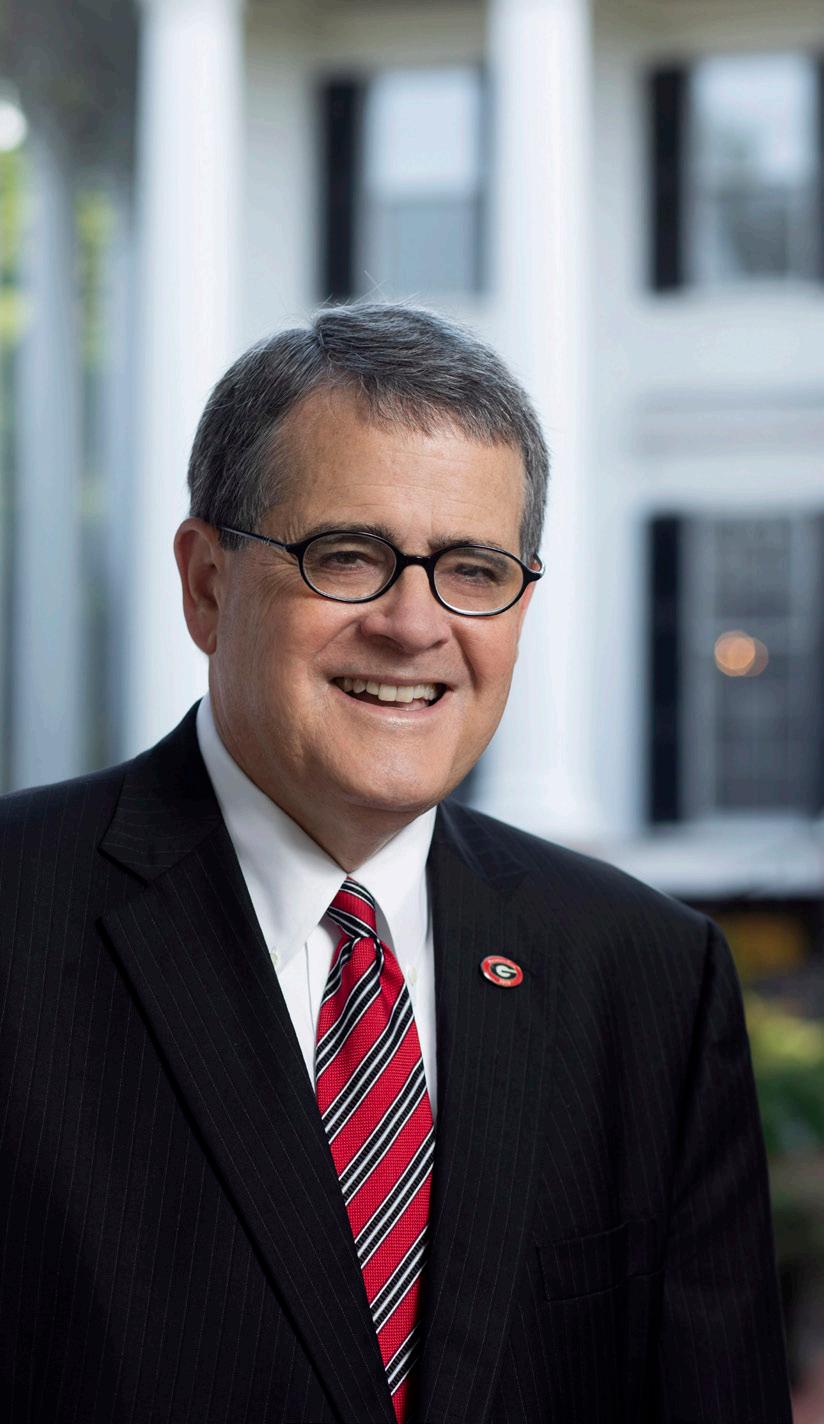
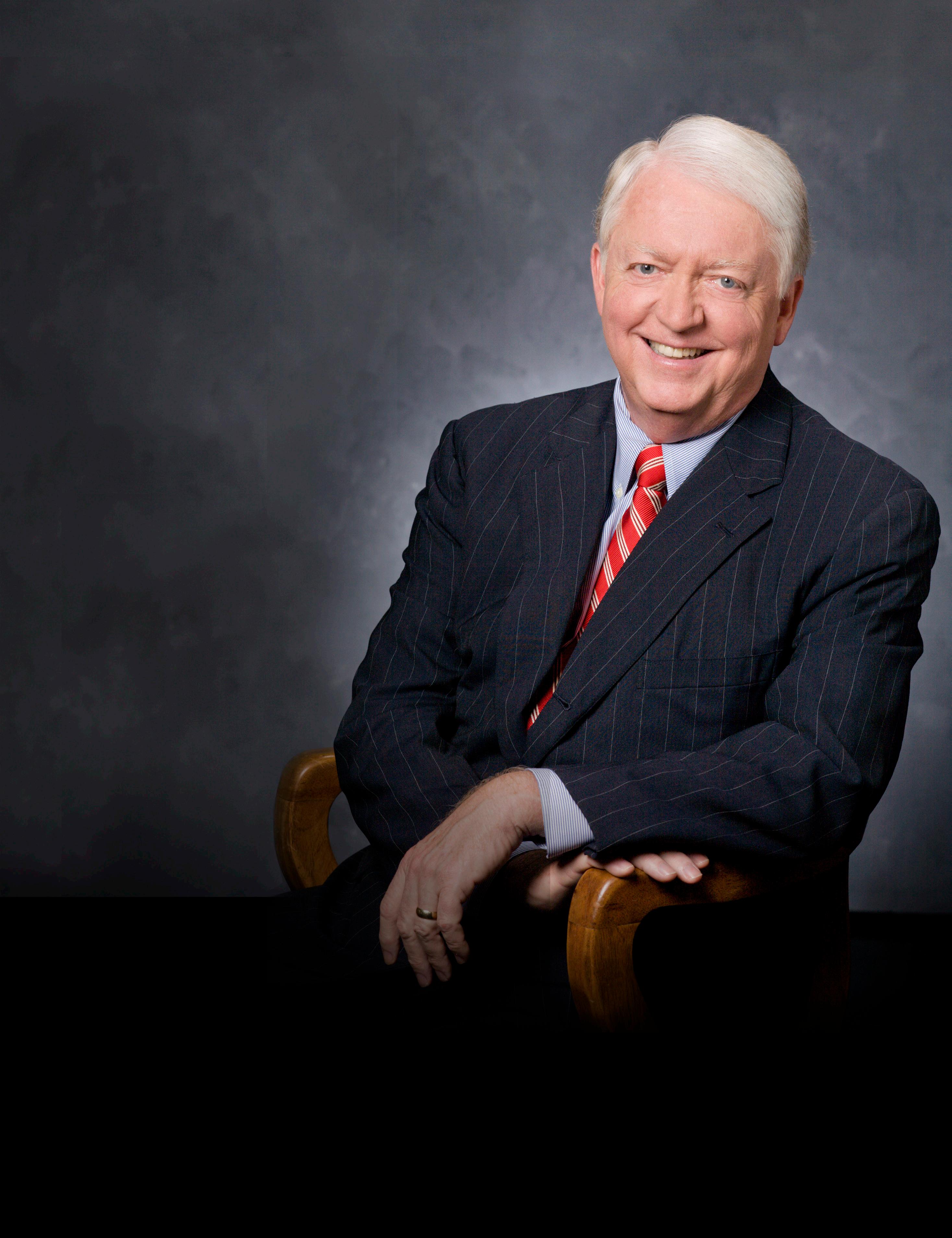
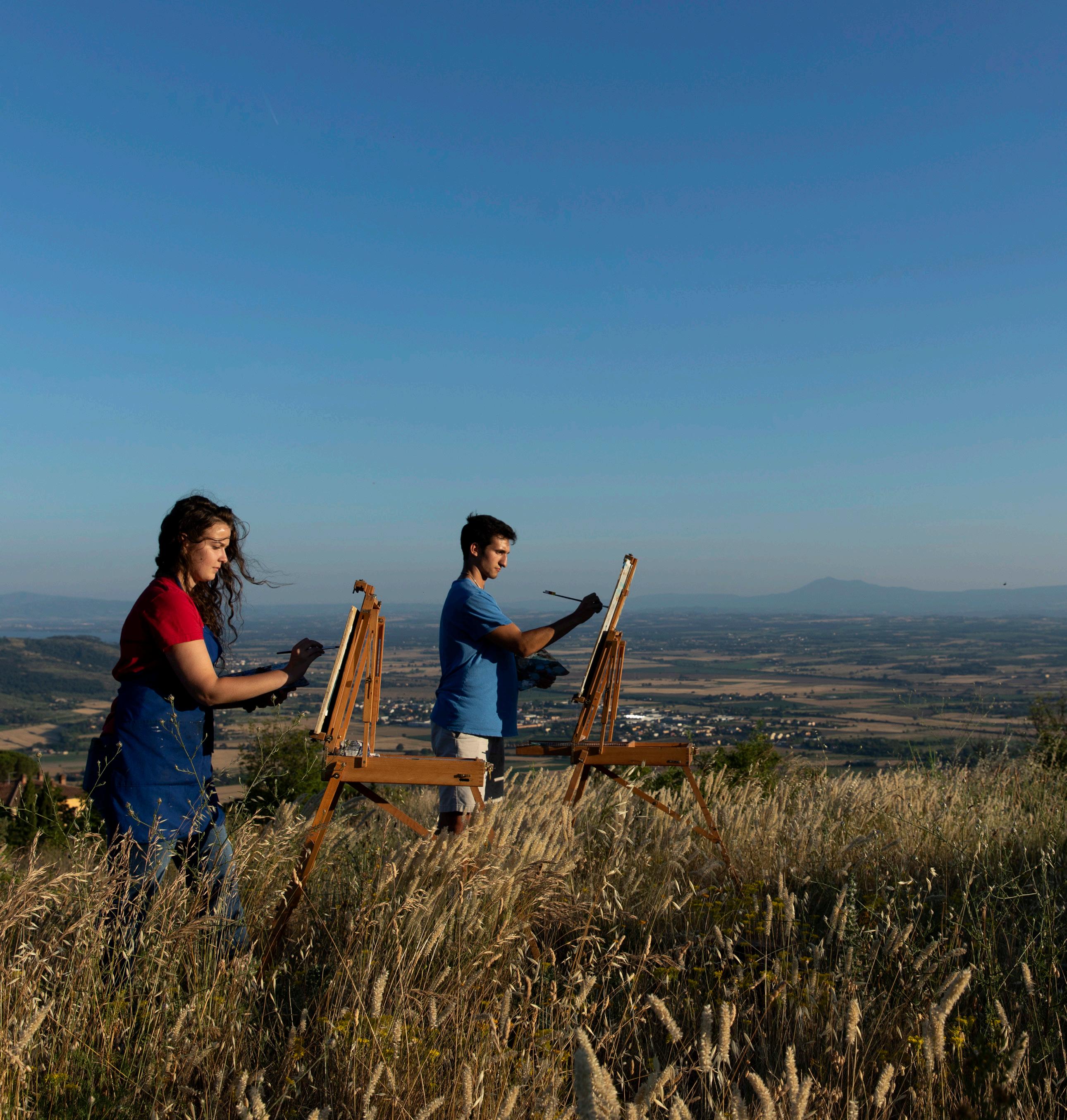
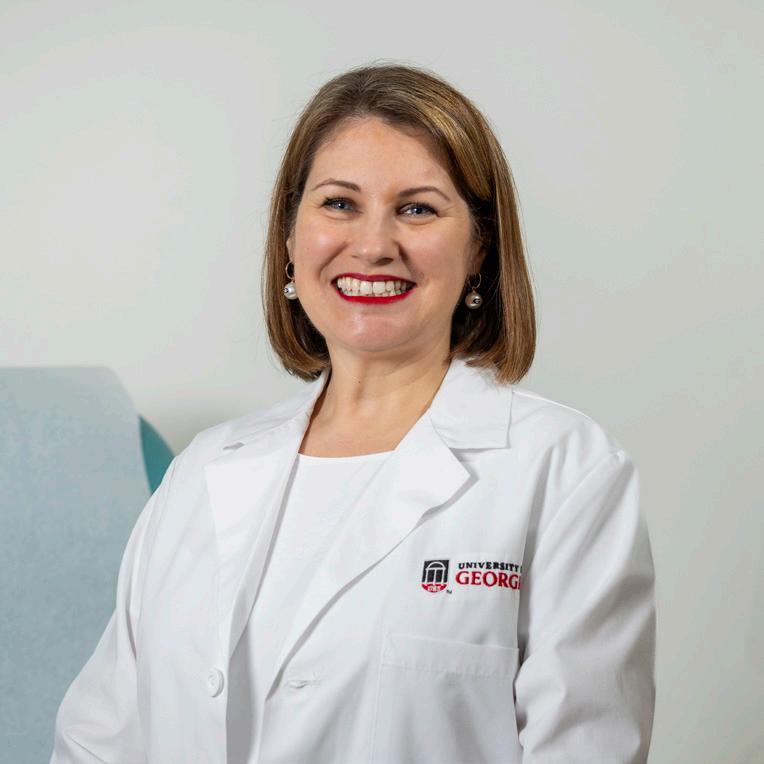
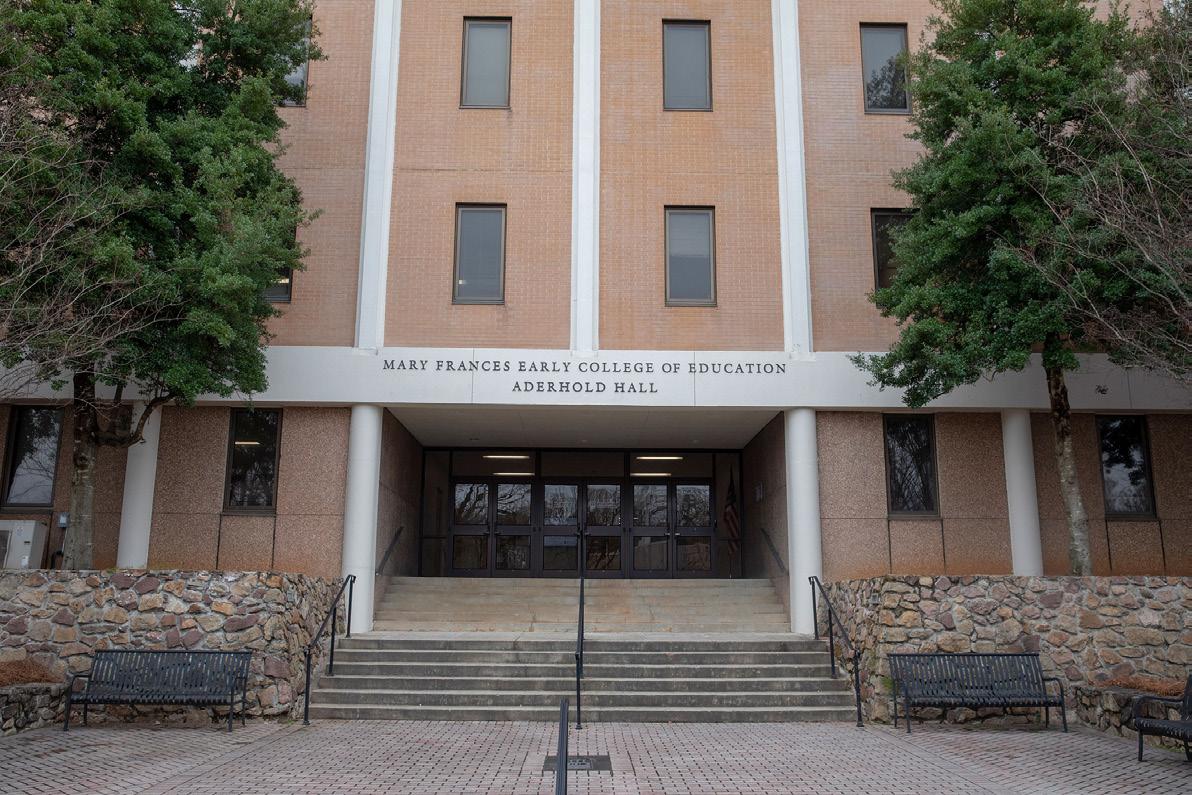
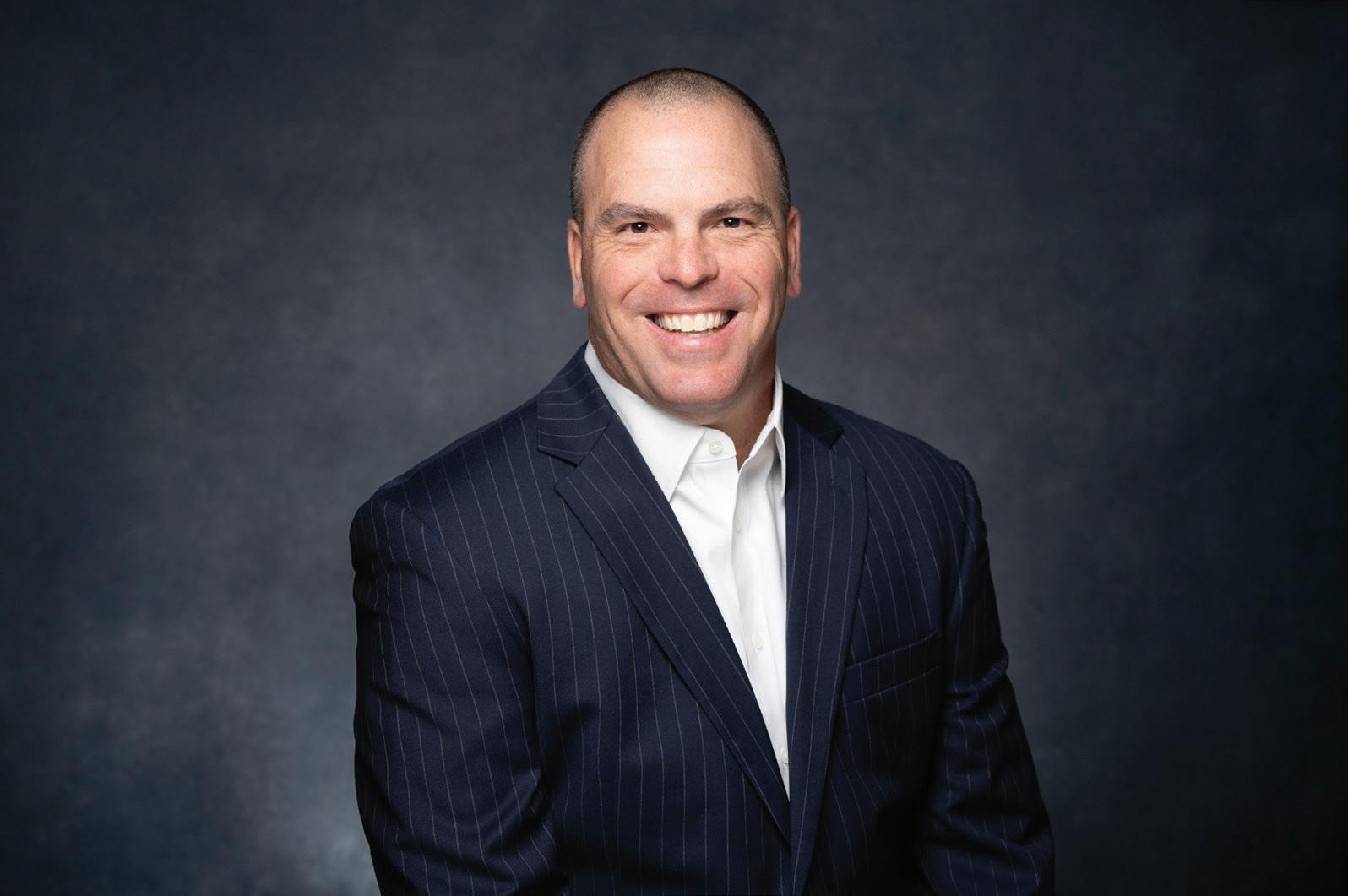
President Jere W. Morehead discusses the real-world impact of UGA research.
from across the UGA community.
Your handy guide to the symbolism embedded in UGA’s Spring Commencement.
News for UGA alumni in Georgia, across the country, and around the world.
Meet the UGA alumni behind a beloved roadside rest stop chain, an innovative gift and party supplies company, and nearly four decades of work at NASA headquarters.
Get to know David Okech, Georgia Athletics Association Professor in Social
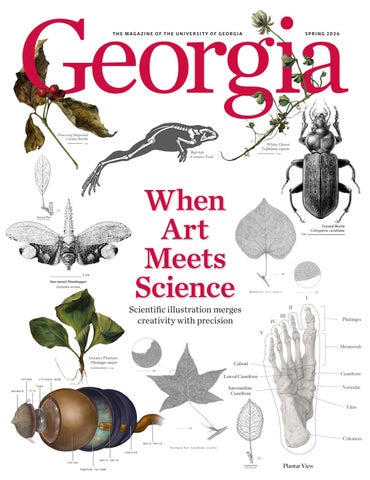
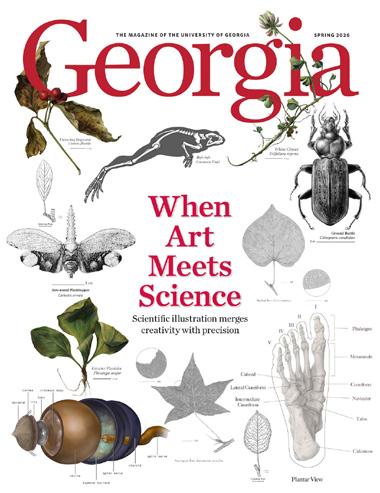
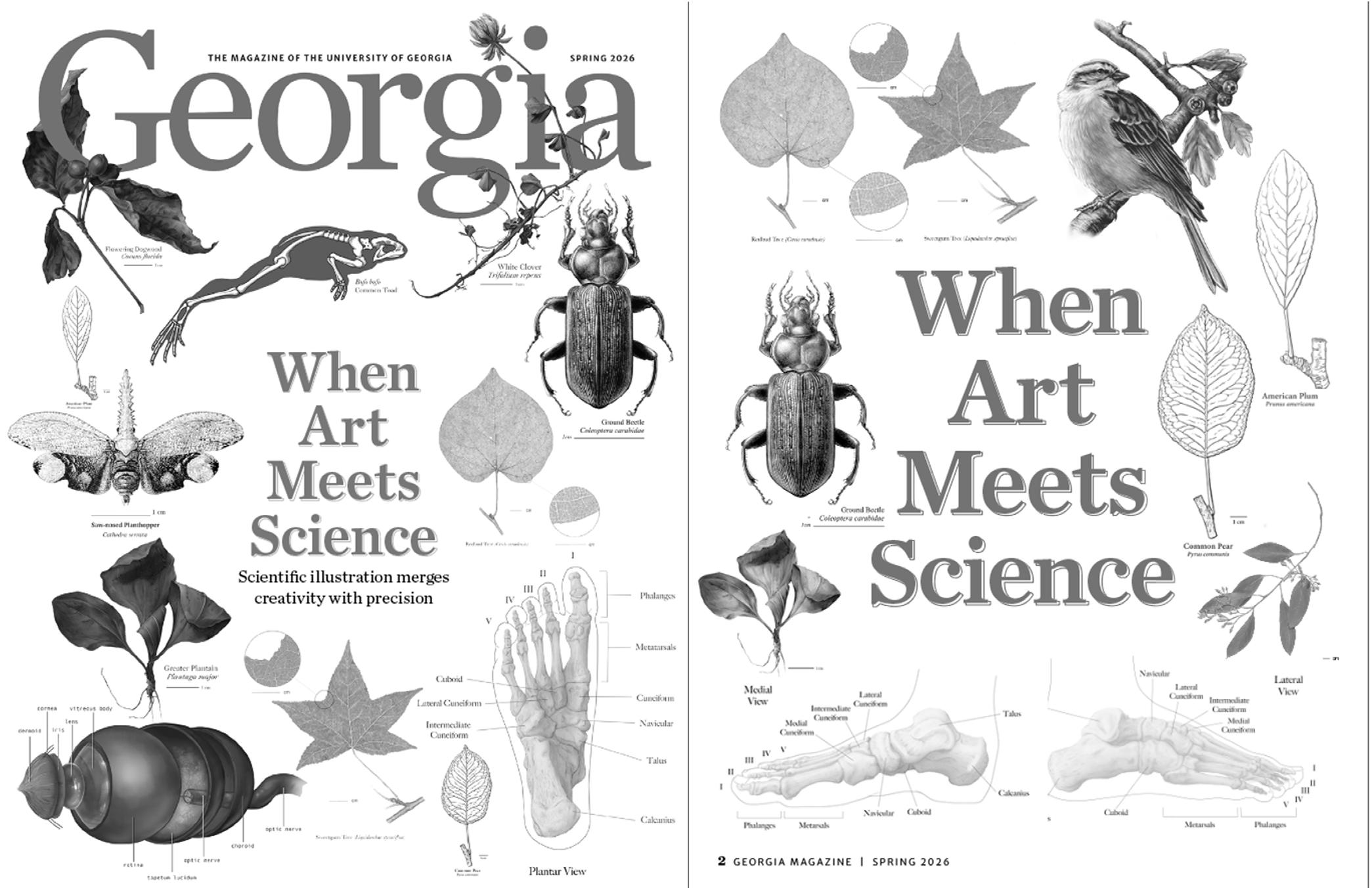
When Art Meets Science
Scientific illustrators merge creativity with precision, conveying complex information through imagery that’s easy to understand.
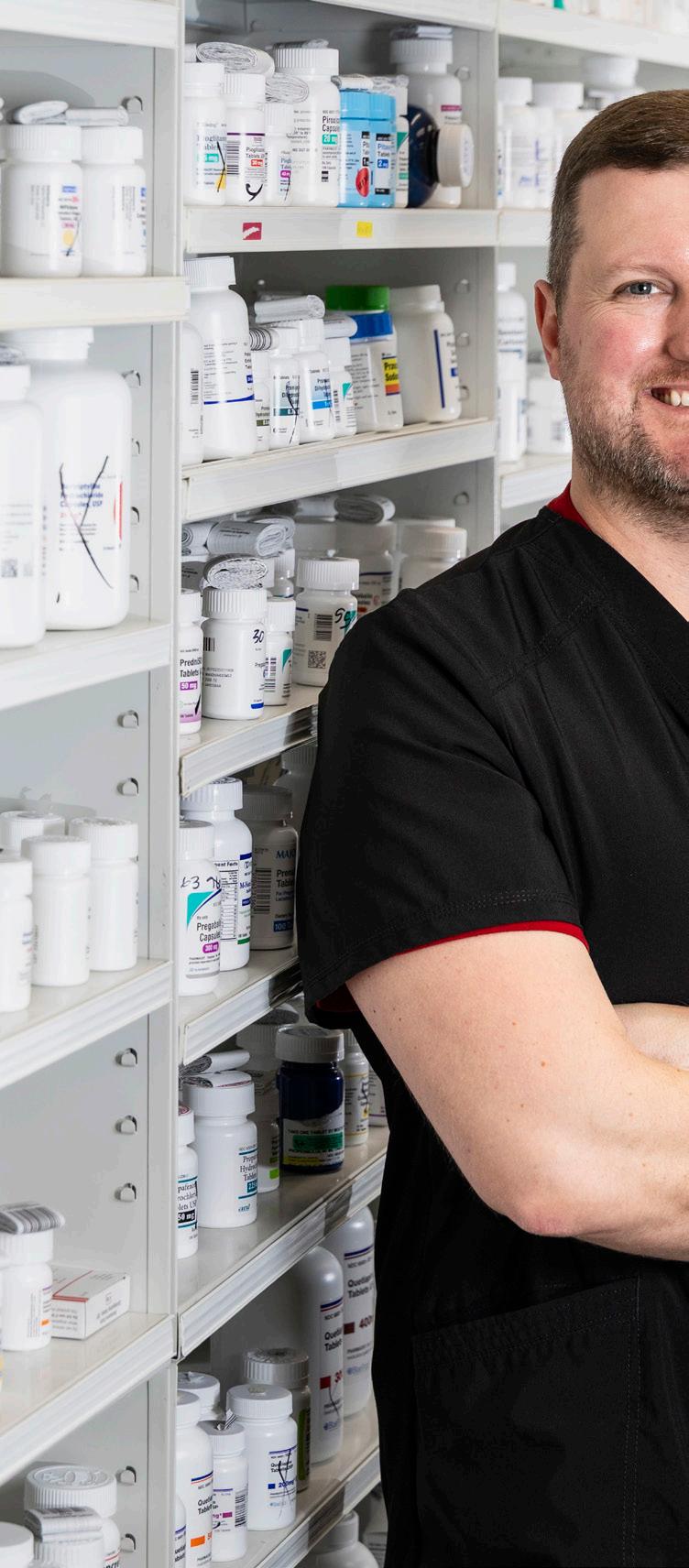
Pharm Life
Work and life is fulfilling for the alumni entrepreneurs behind the counter at some of Georgia’s most successful independent pharmacies.
Leadership Matters
UGA is producing tomorrow’s enlightened, thoughtful leaders through Terry College’s Institute for Leadership Advancement.
in a Name?
Through the years, the Love and Money Center has helped thousands of clients navigate some of life’s most challenging experiences.
to Back
The Bulldogs won their second straight SEC title in 2025—their third in the last four years and 16th overall—with a dominant 28-7 win over Alabama.
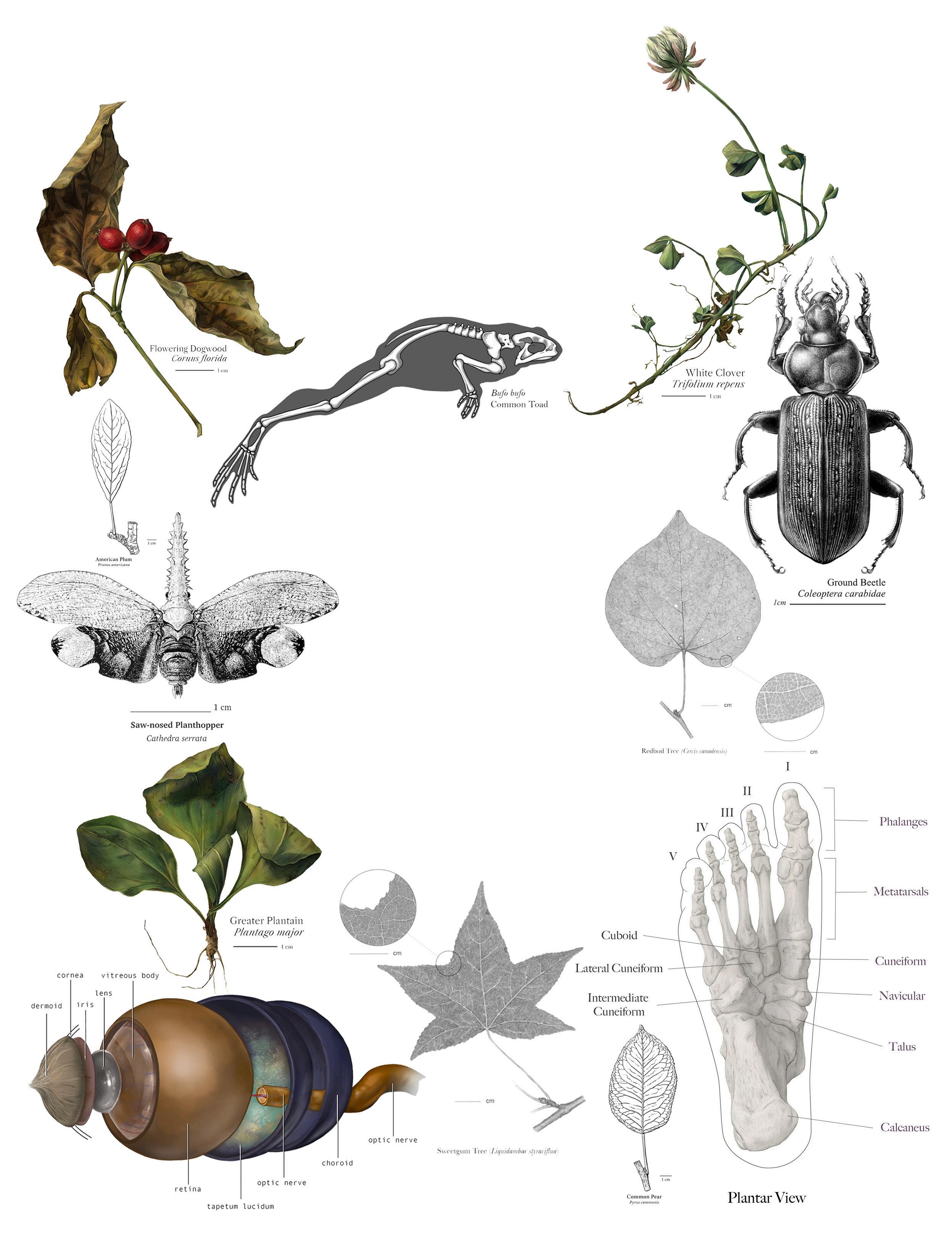
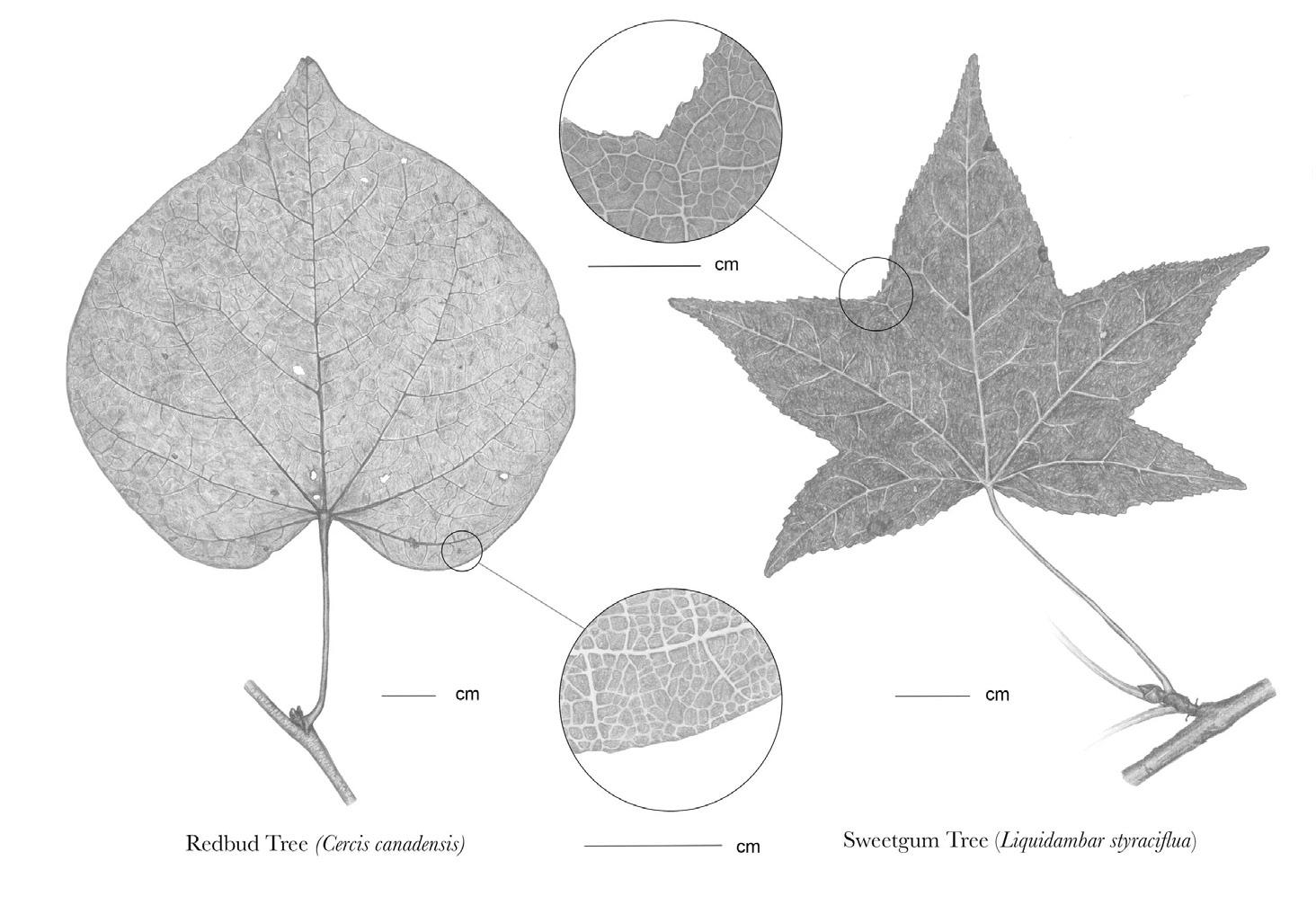
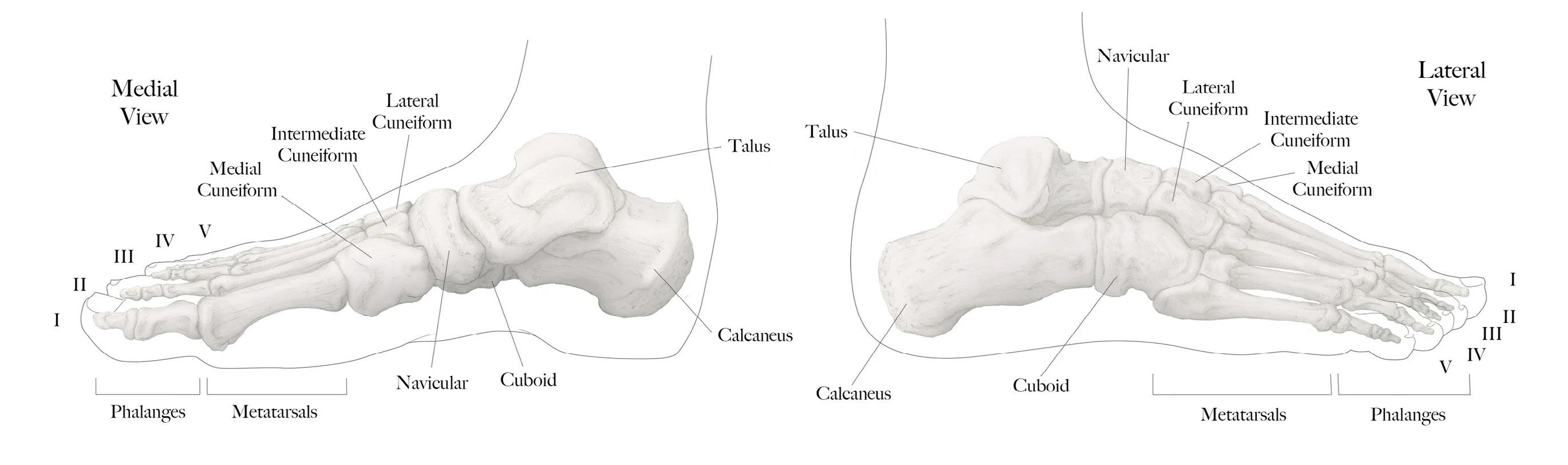
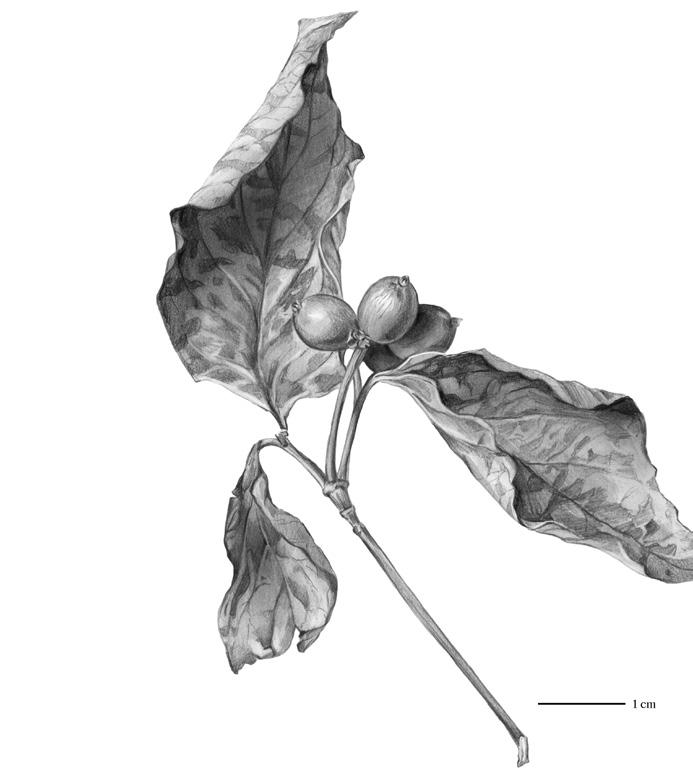
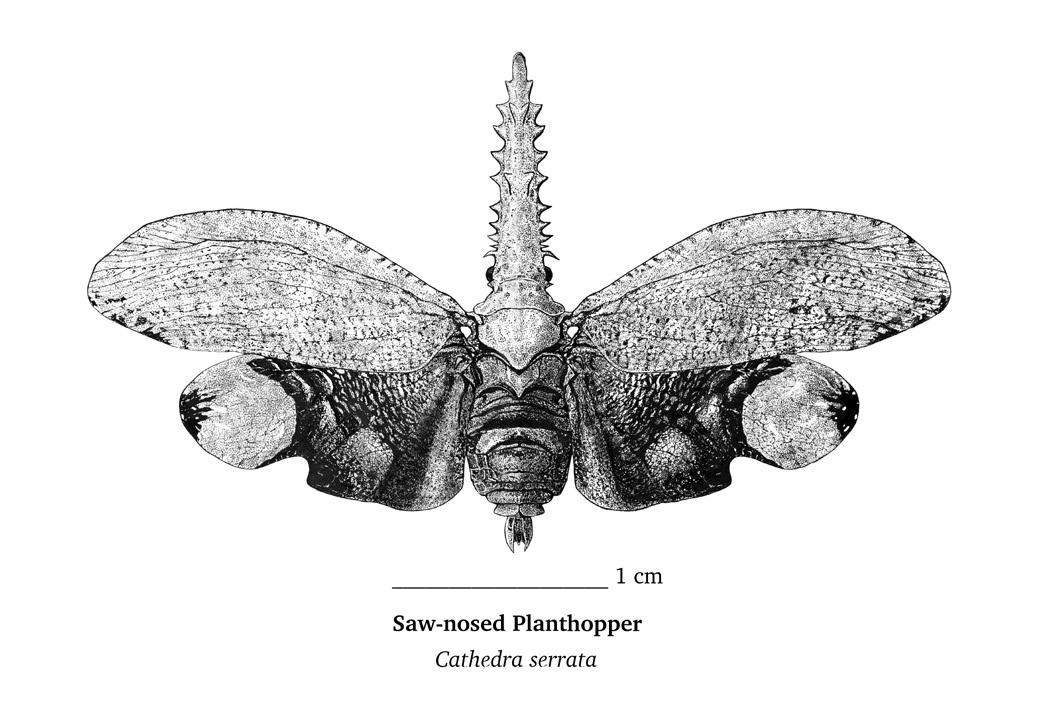
Scientific illustration links art and research.
Art director Lindsay Robinson combines the works of current scientific illustration students and graduates of the program, showcasing the range of the specialty from human anatomy to nature.
Look Every Which Way
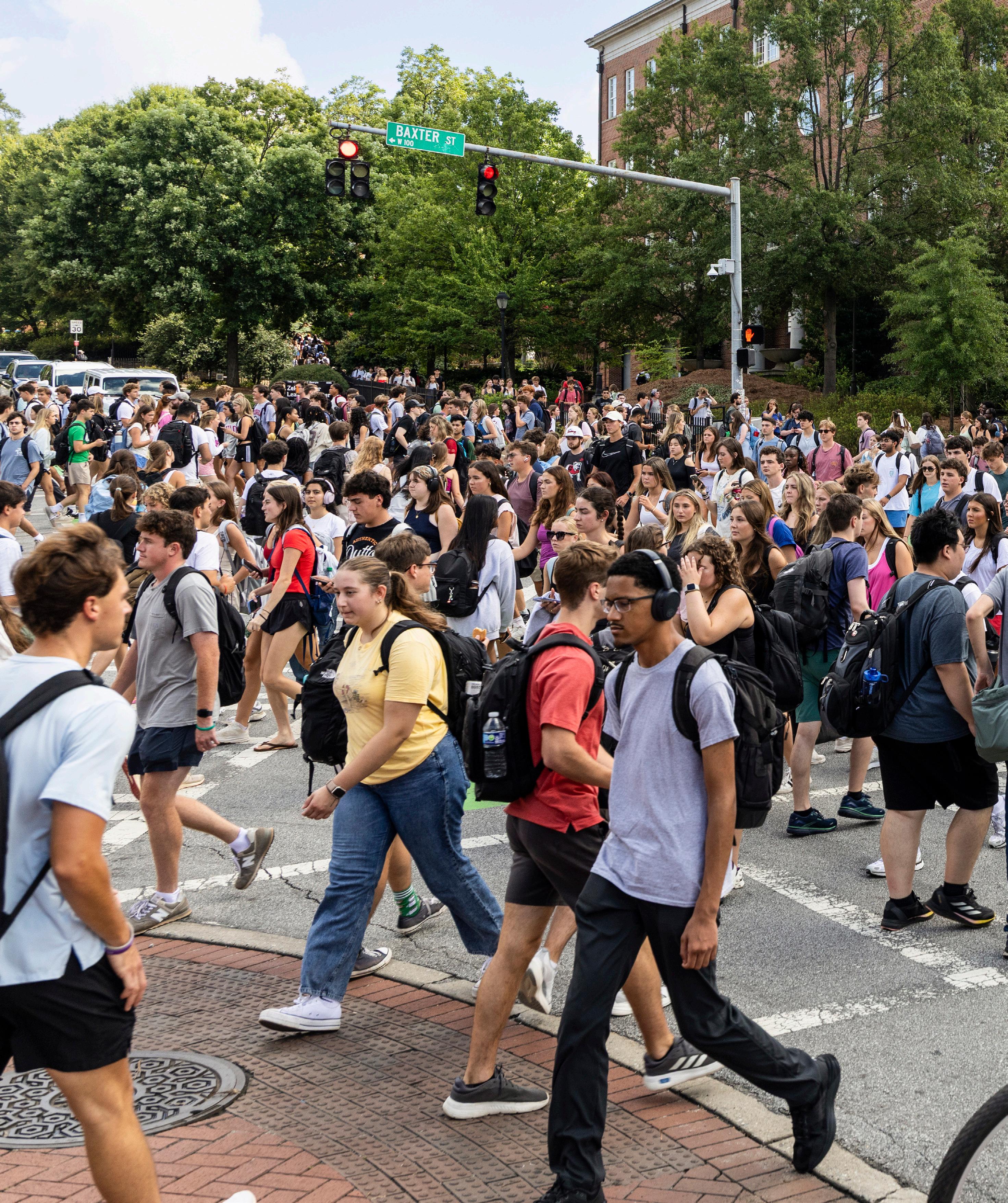
WHAT’S THE BUSIEST INTERSECTION AT THE University of Georgia? Baxter and Lumpkin, of course.
CHAMBERLAIN SMITH
SPRING 2026
VOLUME 106 ISSUE NO. 2
GEORGIA MAGAZINE
Editor · Eric Rangus MA ’94
Associate Editors · Aaron Hale MA ’16 and Leigh Hataway MA ’17
Staff Writers · Cole Sosebee BS ’19, MA ’25, Jayne Roberts, Kristen Linthicum PhD ’18, Savannah Peat AB ’19, and Hannah Gallant
Art Director · Lindsay Robinson ABJ ’06, MPA ’11, MA ’22
Advertising Director · Kipp Mullis ABJ ’93
Photo Editor · Chamberlain Smith ABJ ’18
UGA Photographers · Andrew Davis Tucker and Dorothy Kozlowski BLA ’06, ABJ ’10
Contributing Writers · Rachael Andrews BA ’17, MA ’21, Lilli Sosbee AB ’22, Alexandra Shimalla MA ’19, and Sarah Lippert
Contributing Designers · Andrea Piazza ABJ ’12, MA ’19, Whitney Mathisen, Kaiya Plagenhoef, Marisa Castengera, and Jules Sherrill AB ’22, MA ’23
Editorial Interns · Maura Rutledge and Caroline Newbern
Research Writing Graduate Assistant · Sydney Barrilleaux BS ’24
Senior Executive Director for Operations & Fiscal Affairs · Fran Burke
Project Manager · Brittney Wurdeman
ADMINISTRATION
President · Jere W. Morehead JD ’80
Senior VP for Academic Affairs & Provost · Benjamin C. Ayers
VP for Finance & Administration · Ryan Nesbit MBA ’91
VP for Development & Alumni Relations · Jill S. Walton BSA ’99, MPA ’03
VP for Instruction · Marisa Anne Pagnattaro PhD ’98
Interim VP for Research · Christopher King
VP for Public Service & Outreach · Stacy Jones BSFCS ’93, EdD ’19
VP for Student Affairs · Michelle Cook
VP for Government Relations · Blake Raulerson AB ’14
VP for Information Technology · Timothy M. Chester
Senior Director for Marketing and Communications for Development and Alumni Relations · Lacey Creech
Change your mailing address by contacting e: records@uga.edu or ph: 888-268-5442
Find Georgia Magazine online at news.uga.edu/georgia-magazine
Submit Class Notes or story ideas to gmeditor@uga.edu
ADVERTISE in Georgia Magazine by contacting Kipp Mullis at e: gmsales@uga.edu or ph: 706-542-9877
FINE PRINT
Georgia Magazine (issn 1085-1042) is published quarterly for alumni and friends of UGA.
POSTMASTER | Send address changes to: University of Georgia
286 Oconee Street, Suite 200 North Athens, GA 30602
“In 2025, industry partners and startups created 69 new products from UGA research—a record for our institution that showcases the diverse nature of academic activity on campus.”
Where Research Becomes Real-World Impact
For three straight years, the University of Georgia ranks No. 1 in the country for commercial products brought to market based on university research.
At the University of Georgia, our research enterprise is defined by its purpose: improving lives across our state, nation, and world. Whether faculty are pursuing critical advances in key areas such as biomedicine, food security, or biodegradable plastics, their work delivers meaningful solutions to real-world challenges.
Our faculty embrace UGA’s land- and sea-grant mission, conducting research that provides relevant, innovative solutions for Georgia’s communities. In 2025, industry partners and startups created 69 new products from UGA research—a record for our institution that showcases the diverse nature of academic activity on campus. Faculty created everything from virtual reality tools for disaster preparedness to new varieties of turfgrass. UGA is delivering real benefits to our economy, environment, and communities.
To amplify the impact of the research they conduct on campus, UGA faculty engage directly with communities throughout Georgia, connect with leading industry partners, and launch businesses based on their discoveries. In fact, every $1 of research funding at UGA generates $2.13 in economic activity. As a result of faculty discovery, more than 200 companies have been launched, creating jobs and spurring further economic activity.
UGA has been consistently recognized for productive industry partnerships. For three years in a row, an annual survey by a leading research association (AUTM) has ranked the University of Georgia No. 1 among U.S. universities for number of commercial products brought to market by industry partners based on university research. Overall, AUTM has named UGA one of the top five institutions in the country for 12 consecutive years.
UGA’s research and development expenditures have increased by 75% since 2015. Last year marked a historic milestone as our research and development expenditures exceeded $650 million for the first time in our university’s history.
As the University of Georgia’s research enterprise thrives, our faculty’s outstanding work improves lives, transforms communities, and addresses our state’s greatest needs each and every day. We are proud to answer this important call to lead and to know that the university’s research endeavors continue to push the bounds of what is possible in the state of Georgia and beyond.
Jere W. Morehead President
Adams Leaves Impressive Legacy
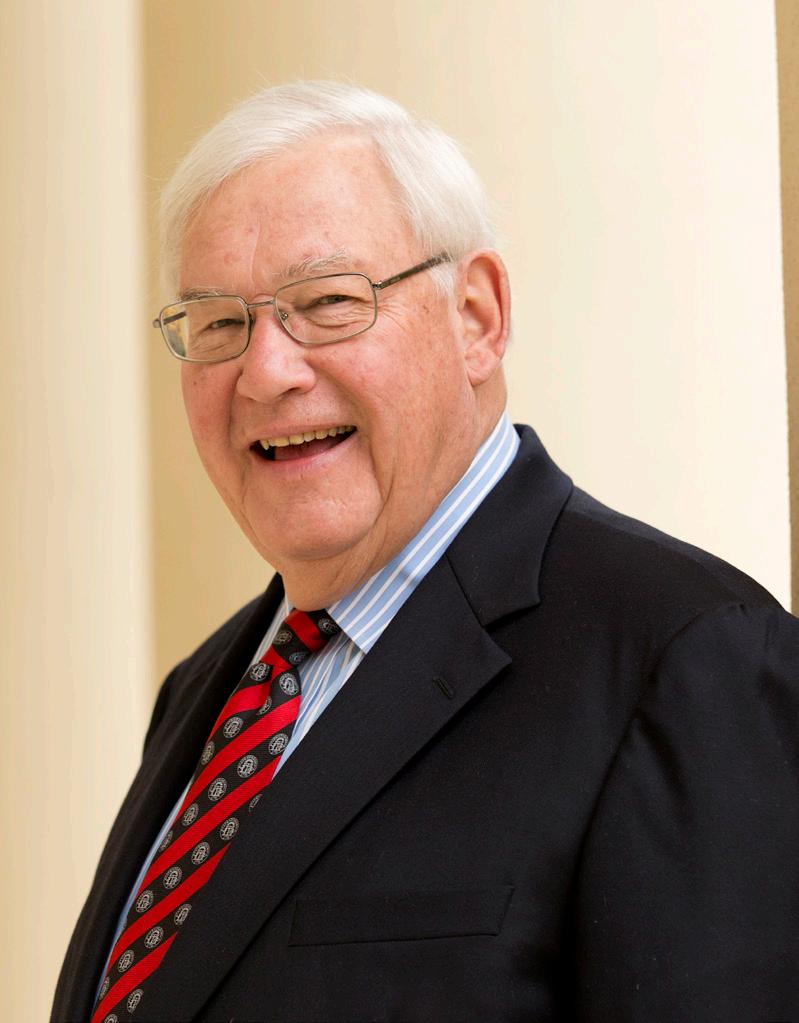
Michael F. Adams, University of Georgia president emeritus, died Jan. 25. He was 77 years old.
Adams, who served as the university’s 21st president from 1997 to 2013, led the university to national prominence as one of the country’s top 20 public research universities. During his tenure, the university grew enrollment, expanded its faculty, increased fundraising, and enlarged its footprint—all while improving academic quality across the board.
Adams’ leadership helped UGA become a more selective academic institution while growing enrollment from nearly 30,000 students in 1997 to 35,000 in 2012. UGA added 127 endowed professorships and 14 Georgia Research Alliance eminent scholars, and federal research expenditures nearly tripled.
At the conclusion of his presidency, Adams’ signature appeared on some 110,000 degrees earned by almost half of UGA’s living alumni.
Adams’ stewardship helped create five new colleges and schools as well as the Medical Partnership with Augusta University.
During his presidency, the university also transformed its campus. New facilities provided space for teaching, research, the arts, and housing—ranging from the East Campus Village, the Zell B. Miller Learning Center, the Paul D. Coverdell Center for Biomedical and Health Sciences, the Richard B. Russell Building Special Collections Libraries, and the expanded Georgia Museum of Art. UGA enhanced its international presence, emphasizing study abroad programs and adding year-round residential sites in Oxford, England; Cortona, Italy; and San Luis, Costa Rica.
Adams believed these developments went far beyond numbers.
“It is about people, about opportunity, about the power of education to improve both an individual’s life and the community in which he or she lives. It’s about transformation,” Adams said in 2013 during his final State of the University address.
“I believe in this place. I believe in higher education. I believe in the power of education to change lives,” he said.
Adams is survived by his wife, Mary Lynn Ethridge Adams, and their sons, David and Taylor (Carrie), as well as three granddaughters, Campbell, Tucker, and Lawson Adams.
“I believe in this place. I believe in higher education. I believe in the power of education to change lives.”
MICHAEL F. ADAMS, AT HIS FINAL STATE OF THE
2013
Robert Newcomb
to
UGA Z
UGA Tops National List of Study Away Rankings
The University of Georgia ranks No. 1 in the nation for short-term study abroad participation and No. 5 overall, according to the 2025 Open Doors Report released by the Institute of International Education in partnership with the U.S. Department of State.
A total of 3,322 UGA degree-seeking students studied abroad for academic credit during the 2023-24 academic year. Of those, 3,038 students participated in short-term study abroad programs, defined as programs lasting up to eight weeks.
UGA students studied in 68 countries during the 202324 academic year. The most popular destinations were the
Viva Italia! The University of Georgia has sent students abroad to its campus in Cortona for more than 55 years.
Highlights from across the UGA community
United Kingdom, Italy, Spain, France, and Australia.
“Achieving the top national ranking for short-term study abroad participation is a testament to UGA’s longstanding investment in global experiential learning and the extraordinary commitment of our faculty, staff, and partners who create transformative global learning opportunities for our students,” says Yana Cornish, director of global education. New initiatives continue to expand opportunities for UGA students. First-year students in 2025-2026 have access to 13 Connect Abroad programs, designed to integrate international experiences early in their undergraduate journey.
GEORGIA GLOBETROTTERS
Youth Screen Use Linked to Family Conflict
Want a happier home life? Maybe skip the phones for the little ones.
Two new UGA studies found that, by age 11, adolescents who use smartphones argue with their parents more often and more intensely. The earlier a child received a smartphone, the less likely their parents were to know if their child had anxiety or depression—right when those symptoms tend to increase.
This is especially true for young girls who are active on social media, as they begin to build relationships and compare themselves to others at an early age.
Never getting your kid a phone may not be the answer, but the researchers recommend waiting until they’re older, placing limits on screentime, and focusing on face-to-face interactions.
Founding Dean Named for UGA School of Nursing
Carolyn K. Clevenger, a nationally recognized academic leader in advanced practice nursing, geriatrics, and gerontology, has been appointed the founding dean of the University of Georgia School of Nursing.
Currently a professor at Emory University’s Nell Hodgson Woodruff School of Nursing and founder and director of Integrated Memory Care at Emory Healthcare, Clevenger brings more than two decades of experience in health care instruction, research, and leadership to UGA.
“Georgia needs more nurses, and UGA is uniquely positioned to prepare them, building a school of nursing that will educate compassionate leaders ready to serve every community in our state,” Clevenger says.
Clevenger’s research focuses on models of care for people living with dementia, psychoeducational programs for dementia family caregivers, and the geriatric health workforce.
The University System of Georgia Board of Regents authorized the establishment of an independent School of Nursing at UGA in May, and the university plans to welcome its first nursing students as early as fall 2027.
UGA’s $5M grant will help create an alliance that will work to recognize teachers and provide them with professional learning opportunities.
UGA Receives $5M Grant to Support Science Education
The University of Georgia has been awarded a $5 million grant from the National Science Foundation to develop a statewide alliance that will strengthen and elevate science teaching.
The alliance will leverage the expertise of state education organizations and teacher leadership groups to form three hubs that recognize teachers and provide them with various professional learning opportunities.
The program is led by Julie A. Luft, the Athletic Association Professor of Science Education and Distinguished Research Professor in the UGA Mary Frances Early College of Education, and will also include contributions from Paula P. Lemons, senior associate dean of the Franklin College of Arts and Sciences.
“It’s a collaborative effort, and there’s a plan for it to be sustainable,” Luft says. “Down the road, this project will in some iteration continue to support science teachers in their professional learning and recognize them for their significant work.”
NSMITH
PETER FREY
MAKING A DIFFERENCE
Finding Meaning in Your Work May Prevent Burnout
According to new research, thinking your work has an impact could mean the difference between sticking it out and quitting during times of high stress.
“Our findings suggest that if someone chooses an occupation because they want to help people, they find their work to be very meaningful. And that can help provide some psychological or emotional buffer to the stresses they face.” says Bradley Wright, lead author the study and a professor in the School of Public and International Affairs.
Public service employees such as police officers, nurses, and teachers are often overworked, underpaid, and underappreciated for the emotionally draining work they do. Public service fields face high rates of turnover and burnout, especially during times of crisis.
Previous studies have primarily focused on how the desire to help others can guard against burnout. This study suggests that public service employees also need to feel like they regularly are helping people to successfully prevent burnout.
“Leaders need to remind people not only of the importance of their work but also show them the impact of their work,” Wright says. “That will help employees feel better about their job, be more inspired about their job, and be more engaged in doing their job well.”
A BEAUTIFUL PLACE
UGA Receives National Award for Community Design Impact
The University of Georgia has been named the 2025 recipient of the Association of Public and Land-grant Universities’ Innovation and Economic Prosperity Award in the Place category.
UGA’s award-winning submission highlights statewide initiatives led by units of Public Service and Outreach, including the Carl Vinson Institute of Government’s Renaissance Strategic Visioning and Planning (RSVP) and Community Branding programs, as well as the Archway Partnership’s impact in Hartwell.
Launched in 2013, the RSVP program helps Georgia communities revitalize their downtowns through public engagement, design-based planning, and implementation support.
To date, 25 communities across the state have completed plans through the program, resulting in more than $500 million in combined public and private investment.
“This recognition affirms the University of Georgia’s enduring commitment to serving the people of our state, and we are proud to be a national model for university-led economic development,” says President Jere W. Morehead JD ’80. “Our faculty, staff, and students are helping communities realize their potential and build vibrant futures.”
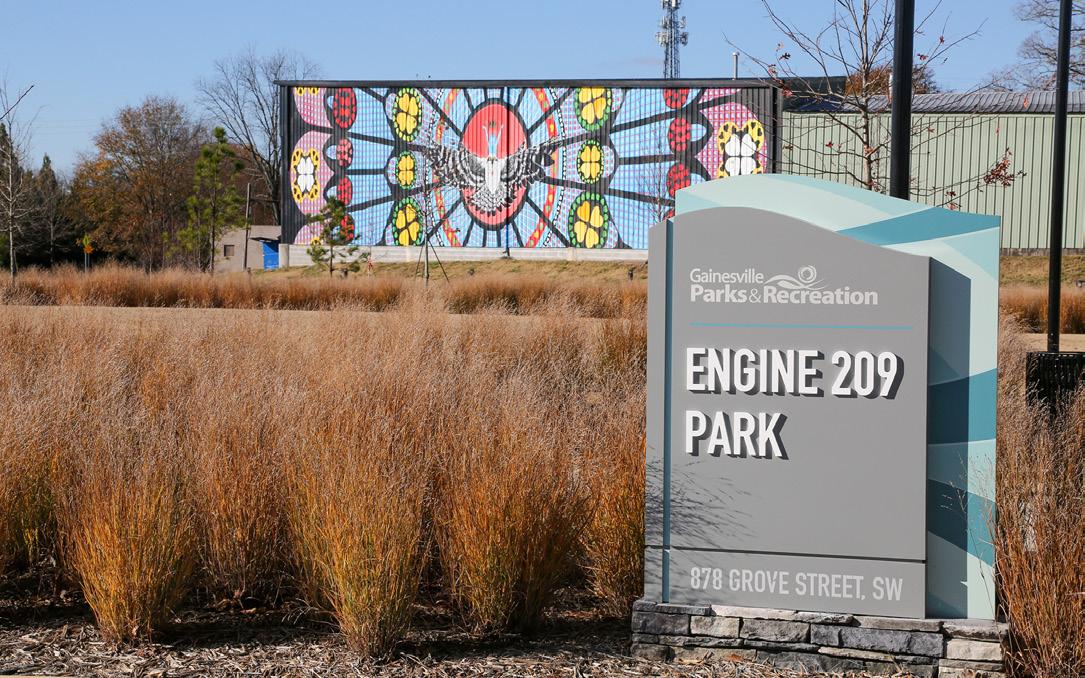
The Innovation and Economic Prosperity Award won by the University of Georgia reflects more than a decade of exciting, creative work. Examples of UGA’s economic engagement impact include (from top to bottom): Hartwell’s Downtown Railroad Park, Engine 209 Park in Gainesville, a pocket park in downtown Hawkinsville, and community branding in the Copper Basin.
SHERRIE RALEIGH
SHANNAH MONTGOMERY
SHANNAH MONTGOMERY
NOT TORTURED ARTISTS
Positive Emotions May Boost Creativity
Your happiness and self-fulfillment could have a direct impact on how creative you are, according to new research from the University of Georgia.
Researchers from the Mary Frances Early College of Education found that positive emotions can translate to increased engagement in creative activities like drawing, writing, and playing music.
The study suggests that day-to-day emotions are more influential than personality when it comes to engaging with creative actions. Being creative may also improve well-being.
“When people are more creative, they tend to feel better. But at the same time, when they feel positive emotions, they tend to be more creative,” says Sakhavat Mammadov, lead author of the study and an associate professor in the department of educational psychology. “Positivity was a robust predictor of not only today’s creativity but tomorrow’s creativity as well.”
“In pursuing a career as a physician-scientist, I hope to combine medical knowledge of infectious diseases and a broader understanding of prevention and control strategies,” says Finn Walsh, the university’s 10th and latest Marshall Scholar.
2026 Marshall Scholar to Focus on Infectious Diseases
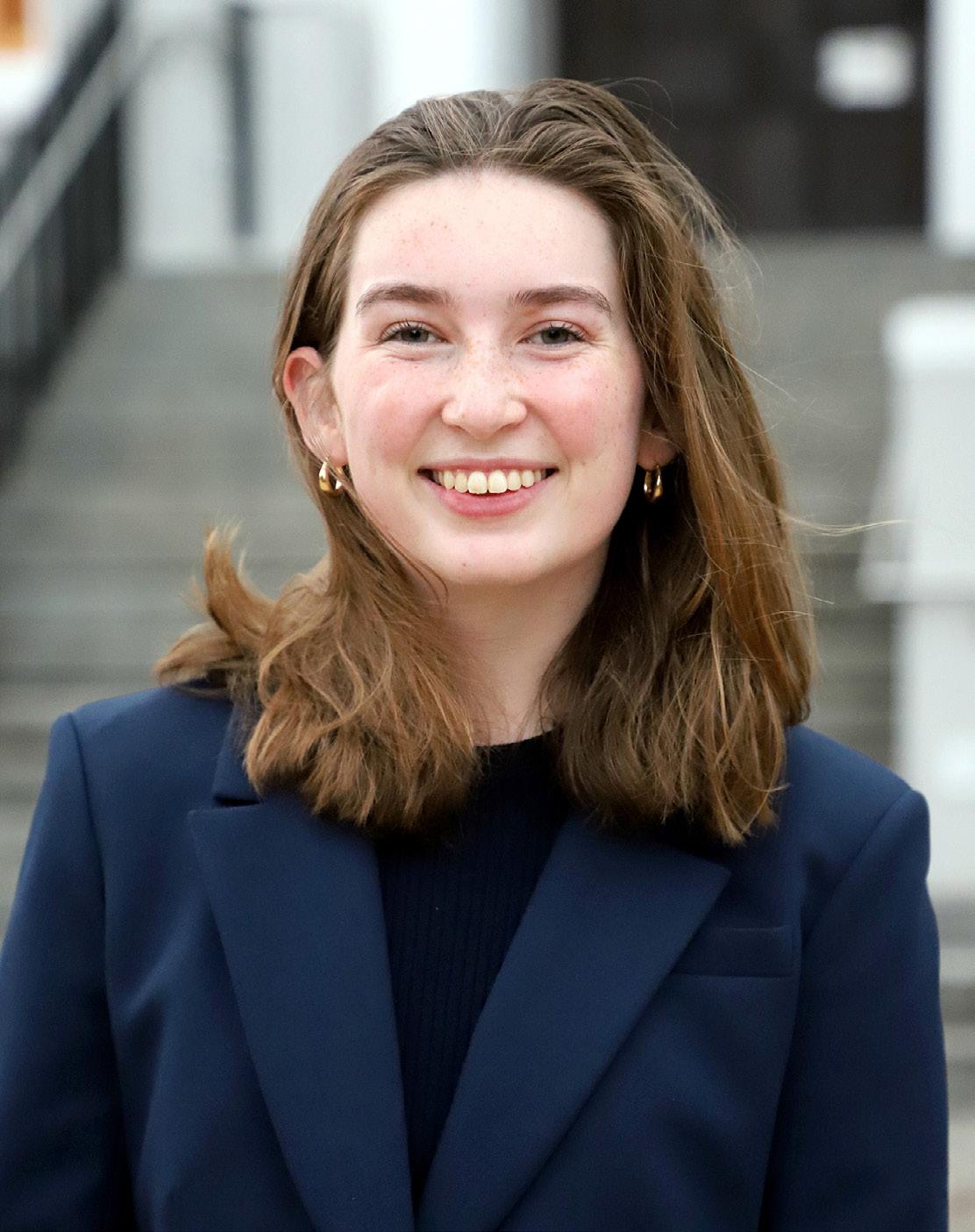
University of Georgia senior Finn Walsh will build on her studies in infectious diseases next fall as UGA’s newest Marshall Scholar. The scholarship is among the most selective graduate awards for American college students.
Walsh, an Honors student from Atlanta, graduates in May with a bachelor’s degree in genetics and a minor in Spanish through the Franklin College of Arts and Sciences. She has conducted research through the Center for Undergraduate Research Opportunities, with most of her work in the Odum School of Ecology.
Funded principally by the British government, the Marshall Scholarship allows up to three years of fully funded graduate study at any university in the United Kingdom.
Walsh is interested in how the connections among humans,
animals, and ecosystems impact the health of all three. As a Marshall Scholar, she plans to pursue two master’s degrees, the first in medical anthropology and the second in One Health.
Eventually, she hopes to pursue a Ph.D. and medical degree before working in infectious disease control, specializing in vectorborne diseases.
“Infectious diseases simultaneously fascinate and terrify me,” Walsh says. “They have shaped our health, our history, and even our genome. In pursuing a career as a physician-scientist, I hope to combine medical knowledge of infectious diseases and a broader understanding of prevention and control strategies.”
With the addition of Walsh, UGA has produced 10 Marshall Scholars since the scholarship’s inaugural class in 1954.
STEPHANIE SCHUPSKA
After-work Hangs May Stress Out Your
Co-workers
New research from the Terry College of Business suggests that there can be both positives and negatives to getting an invite from coworkers to after-work events, but that impact depends on the person.
While extroverts tend to feel good about themselves and their workplace when they get after-work invites, those with more reserved personalities can become more withdrawn and stressed when invited, which can harm their productivity at work.
Researchers say acknowledging your own preferences and wellbeing in the workplace can help you feel better overall and make you more equipped to handle the possible added stress of social gatherings.
It’s also important for co-workers to know each other and to consider the potential impact of invitations before they’re given.
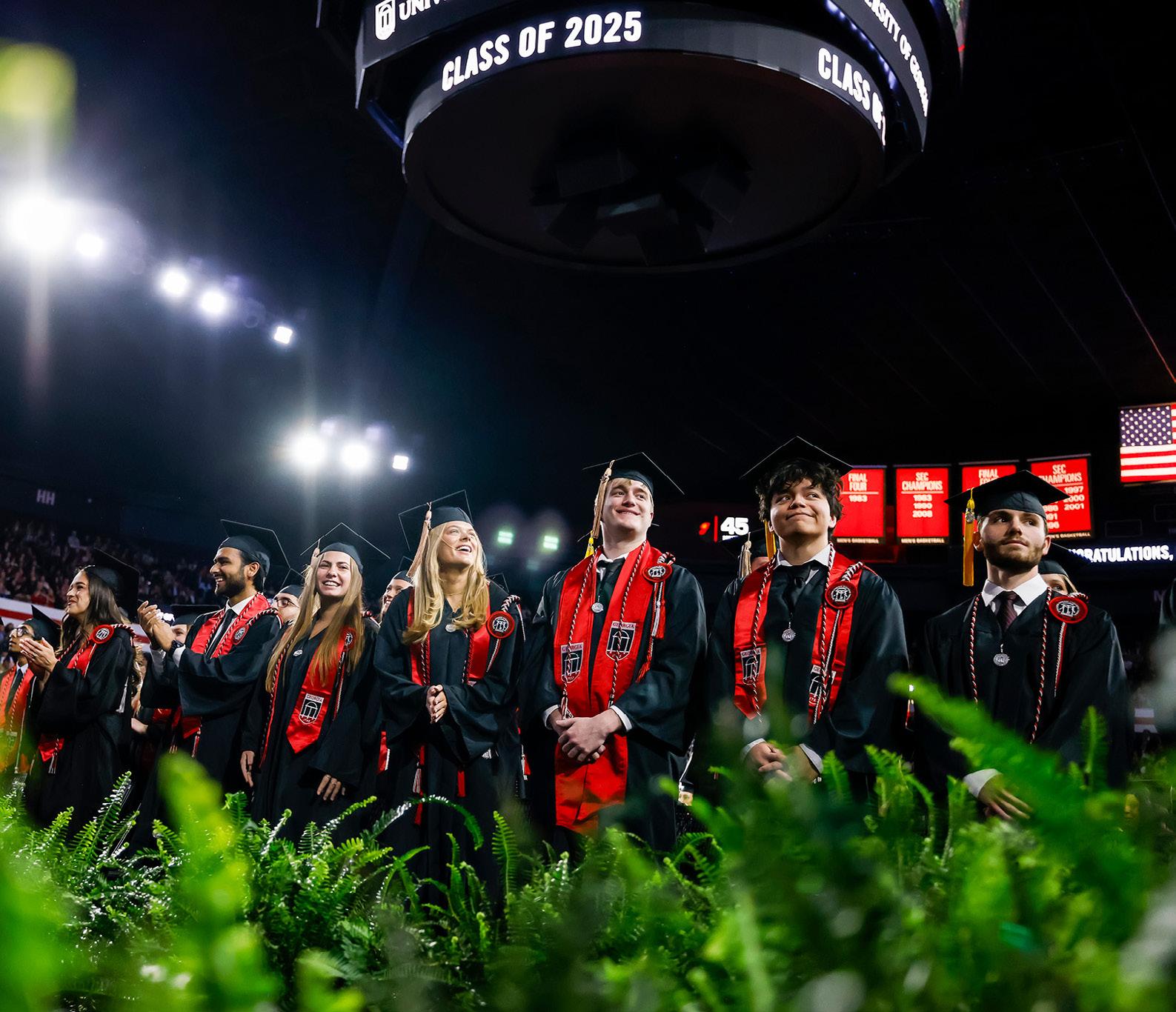
Celebrating UGA’s Fall 2025 Graduates
Commencement marks the end of one journey and the beginning of another, and the graduates carry with them all the lessons learned along the way.
During the undergraduate Commencement ceremony on Dec. 12 at Stegeman Coliseum, M. Douglas Ivester BBA ’69, president of Deer Run Investments, delivered the keynote address and some inspirational advice to graduates.
“I intend to dream of achievements and experiences that I have not yet had, and that, my friends, is my message to you today,” said Ivester, an emeritus trustee of the UGA Foundation who retired as the CEO of The Coca-Cola Company in 2000. Last year, Investor and his wife helped establish the M. Douglas & V. Kay Ivester Institute for Business Analytics and Insights in the Terry College of Business.
“Dream. Dream big. Dream constantly. Dream forever,” he said.
A total of 3,234 students—1,649 undergraduate and 1,585 graduate students—met requirements to walk in the university’s fall Commencement ceremonies. Of the graduate students, 344 were doctoral candidates, and 1,241 received their master’s or specialist degrees.
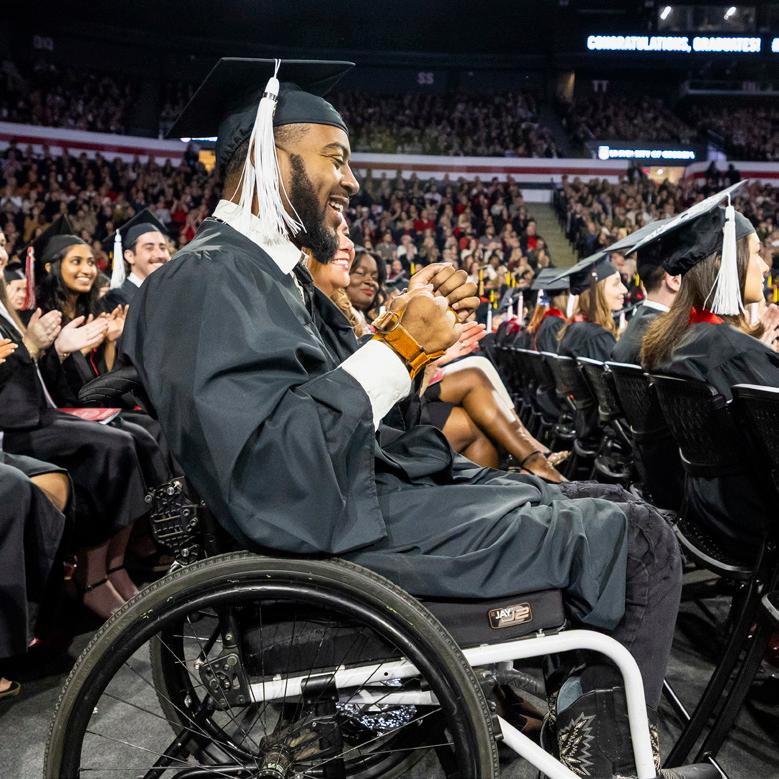
Individual recognitions included former Southern University football player Devon Gales AB ’25, who was paralyzed during a 2015 game at Sanford Stadium against the Bulldogs. He returned to UGA as a student in 2021 and graduated with a bachelor’s degree in communications.
Reid McAdams BBA ’25, a Morehead Honors College student who received his bachelor’s degree in finance from the Terry College of Business, served as the student speaker during the undergraduate ceremony.
“The word ‘commencement’ does not mean only an ending. It means a beginning,” McAdams said. “The door in front of us is our beginning. May we walk through it with wisdom, pursue justice with strength, and practice moderation with grace. May we serve, not for applause, but for impact.”
UGA’s 3,234 fall graduates include Devon Gales (inset), a former Southern University football player who was paralyzed during a 2015 game against the Bulldogs. He came to UGA as a student in 2021 and graduated with a bachelor’s degree in communications.
CHAMBERLAIN SMITH
C H AMBERLAINSMITH
HONORING FRANKLIN ALUMNI
Leaders, Innovators, Changemakers
With over 100,000 alumni worldwide, Franklin College of Arts and Sciences’ alumni exemplify our Franklin Spark—the attributes that define us at the intersection of arts and sciences: ambition, creativity, curiosity, innovation, and leadership. For more than 200 years as UGA’s cornerstone, Franklin has united arts and sciences to champion multidisciplinary learning, fuel discovery, and strengthen communities. Our alumni are leaders with distinguished careers spanning industries including creative design, computer science, health, medicine, and beyond. From pioneering discoveries, creating innovative solutions, providing visionary leadership, and supporting the next generation through philanthropy, they embody the transformative impact of a Franklin education. We are pleased to honor our alumni who carry this legacy forward, making a difference locally and globally. Thank you for showcasing the Franklin Spark every day! Our 2026 honorees are:
YOUNG ALUMNI AWARD
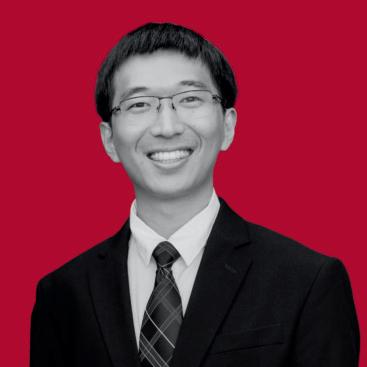
DANNY LEE
(BS Computer Science ’18) Google software engineer and student mentor
MID-CAREER AWARD
ASMA SHARAFI (MS Chemistry ’13) CEO, Volkswagen’s North American battery company
FAMILY AWARD
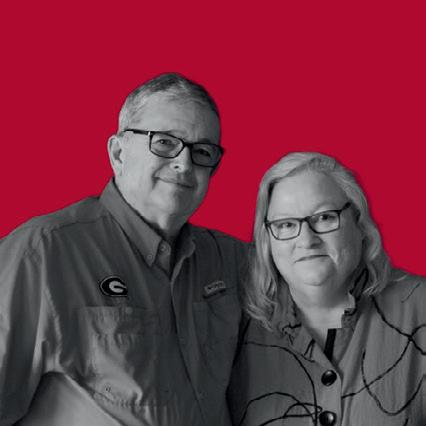
GEORGE & BETSY CROSSLEY
(BS/MS Microbiology ’77 and ’80) Philanthropists fueling graduate research
AWARD-WINNING FRANKLIN ALUMNI
COLLEGE SERVICE AWARD
REBECCA WINKLER (AB Psychology ’98) UGA Trustee and supporter of student opportunities
DISTINGUISHED ALUMNI AWARD
JEFF ARNOLD
(AB Communication Studies ’18) Entrepreneur, founder WebMD and Sharecare
We are also pleased to recognize 36 Franklin alumni who have received recent UGA awards —40 under 40 and Bulldog 100.
INNOVATION AWARD
CAITLIN LEMOINE (BFA Graphic Design ’15) Creative Director at Meow Wolf
LIFETIME ACHIEVEMENT AWARD DR. CHARLES DASHER (BSPY Physics ’68) Decades of contributions to medicine and education
WHITE COATS. RED AND BLACK SPIRIT.
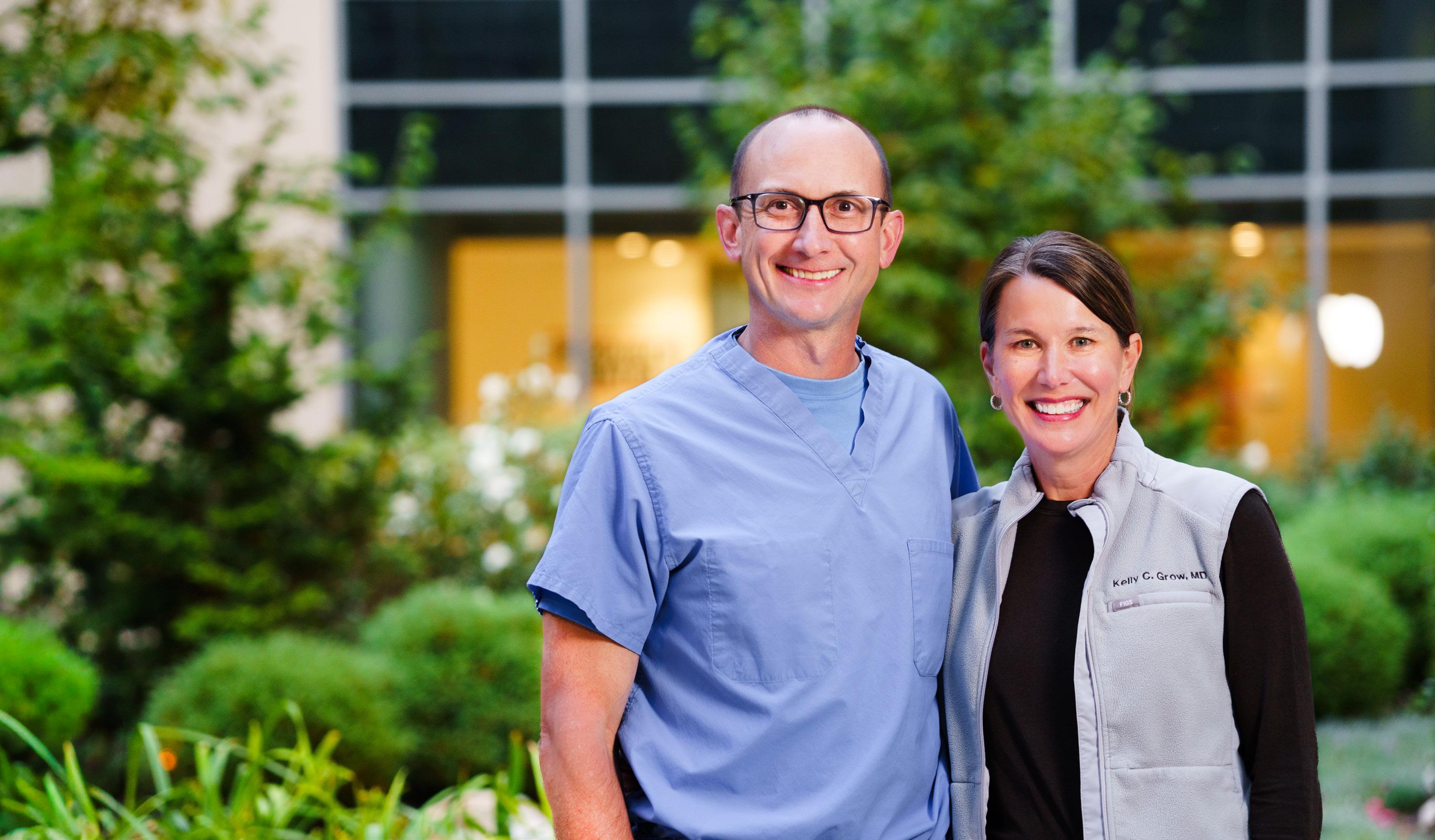
As supporters of UGA’s School of Medicine, Parker and Kelly Grow keep the future of medicine in focus.
“People tend to stay where they train. The more doctors we train in Georgia, the more we’ll retain to serve our communities.”
KELLY GROW, GASTROENTEROLOGIST, UGA ALUMNA, AND SUPPORTER OF THE UGA SCHOOL OF MEDICINE
For Kelly BS ’94 and Parker Grow BS ’97, the University of Georgia isn’t just where their academic journeys began. It’s the heartbeat of their personal and professional lives. As proud Bulldogs, Athenians, and practicing physicians, their connection to the university runs deep, and their enthusiasm for the new School of Medicine is nothing short of contagious.
Both Parker, a cardiologist, and Kelly, a gastroenterologist, trained at Emory University after completing their undergraduate degrees at UGA. Their careers have flourished in Athens, where they’ve mentored countless students through shadowing opportunities and mentoring preceptorships, especially those from the AU/UGA Medical Partnership.
“They’re always excited,” Parker says of the students. “Young minds just want to soak up all the information we can give them.”
Their involvement with the School of Medicine was a natural next step. “There’s no way we wouldn’t have been involved,” Parker says. “Living in Athens, going to undergrad here—it’s exciting to finally have a UGA School of Medicine.”
Kelly adds that the pride students feel wearing the Georgia emblem on their white coats mirrors her own. “We go to all the football games, the baseball games, gymnastics, even equestrian. We’re deeply invested in this university.”
But their support goes far beyond cheering from the stands. Parker and Kelly were among the first donors to contribute to the construction of the medical education and research building, and now, as the university turns its focus to scholarships, they recognize the importance of attracting the best and brightest to UGA through offering aid.
“Educating medical students is not inexpensive,” Kelly explains. “Scholarships and endowments are what keep tuition reasonable and make it possible for students to graduate without overwhelming debt.”
Their motivation is rooted in a broader vision—the future of
Georgia health care. “There’s a huge shortage of physicians in the state,” Kelly says. “And people tend to stay where they train. The more doctors we train in Georgia, the more we’ll retain to serve our communities.”
Parker points out that UGA ranks among the top 10 universities nationally for producing students who go on to medical school. “We want to keep that talent here.”
With their son now a freshman at UGA and a daughter hoping to follow, Parker and Kelly’s legacy at the university continues to grow.
Their hope for the School of Medicine is ambitious and heartfelt. “We want UGA to become the premier medical school in Georgia,” Kelly says. “When you meet a doctor from UGA, we want you to say, ‘That’s the doctor I want.’”
Join the Grows and support Georgia’s future physicians with scholarships at the UGA School of Medicine: TINYURL.COM/GMAGBGBSPRING26
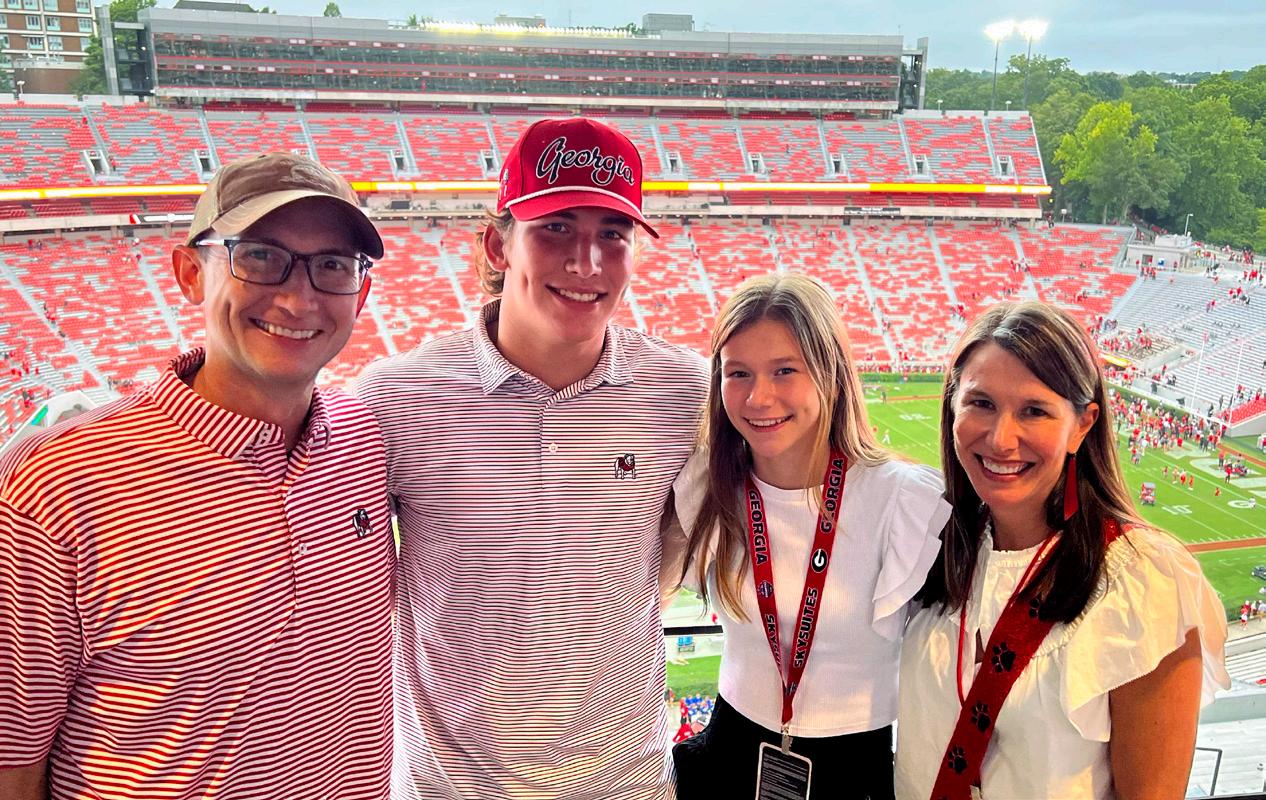
Parker (far left) and Kelly Grow with their son, Crawford (second from left), and daughter, Caddie (second from right), at Sanford Stadium.
EDWIN HAMMOND
When Art Meets Science When Art Meets Science
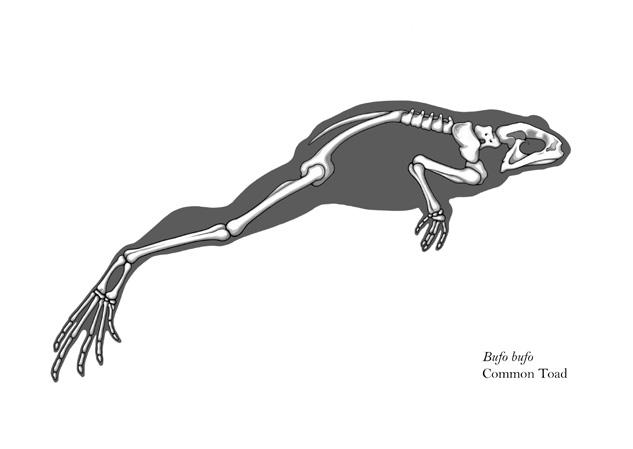
Scientific illustration merges creativity with precision to convey complex information accurately. UGA is one of fewer than 20 institutions worldwide to offer a bachelor’s degree in this important specialty.
WRITTEN BY LEIGH HATAWAY MA ’17
Consider the diagrams of the human body in a science textbook, infographics that guide readers through geological processes, or renderings of extinct creatures that are so detailed that they almost spring back to life.
Scientific illustrators must strike a careful balance to provide the right amount of information to a public that may have little knowledge of the concept or scientific area depicted.
Too much detail or jargon can overwhelm or confuse readers. Too simple and audiences might miss information or, worse, come away with an inaccurate understanding of what they’re seeing.
The scientific illustration program is housed in the Franklin College of Arts and Sciences’ Lamar Dodd School of Art. It is one of fewer than 20 undergraduate degrees in the specialty worldwide.
With only 18 students—all third and fourth years—the scientific illustration concentration is small and incredibly selective. But that selectivity is good preparation for what’s to come.
Scientific illustration is a niche field, and competition is fierce. Students who graduate from UGA’s program, though, are more than up for the challenge.
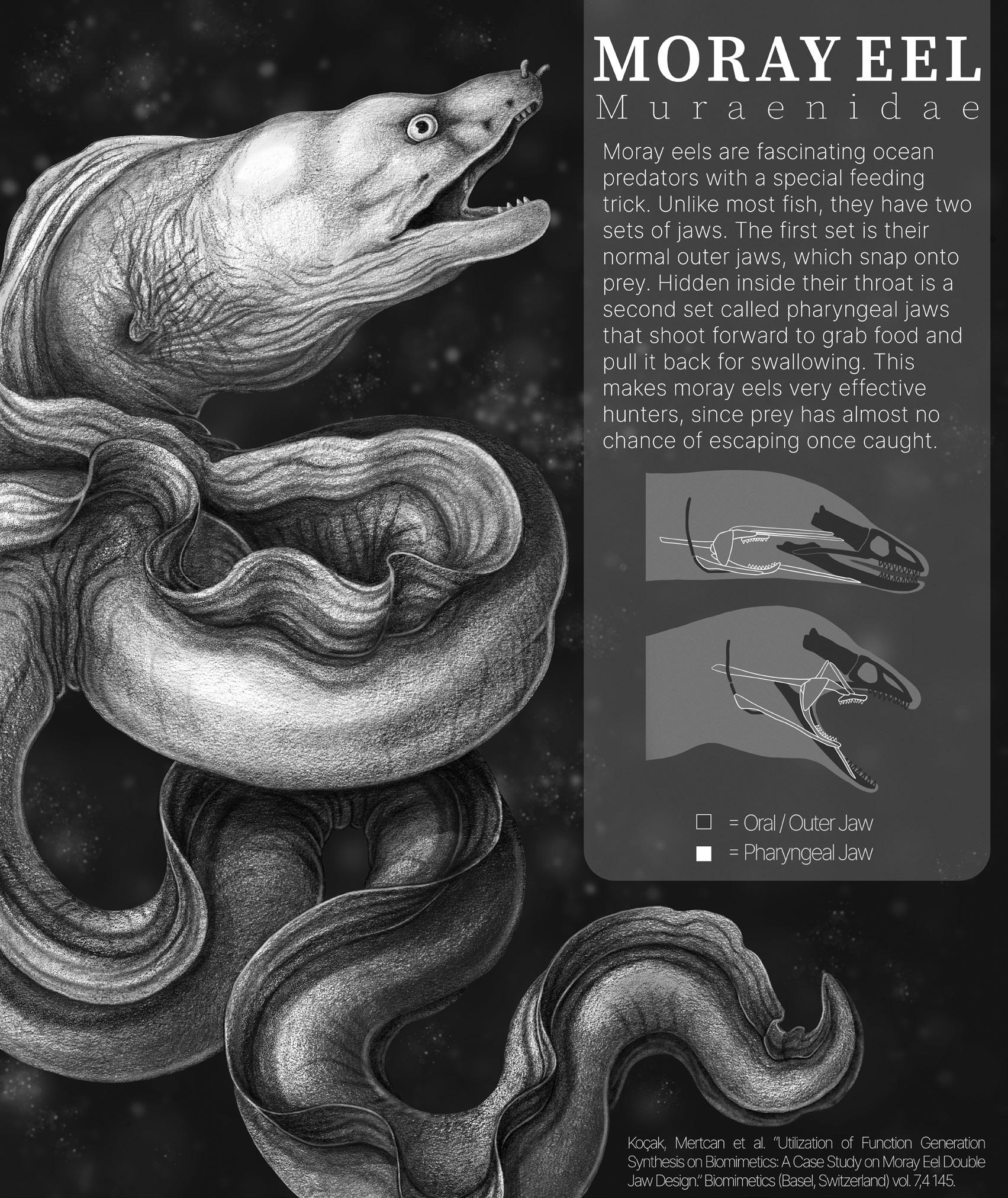
Alanna Ledvina, a 2025 graduate of UGA’s scientific illustration program, created this infographic detailing characteristics of moray eels.
The Teacher
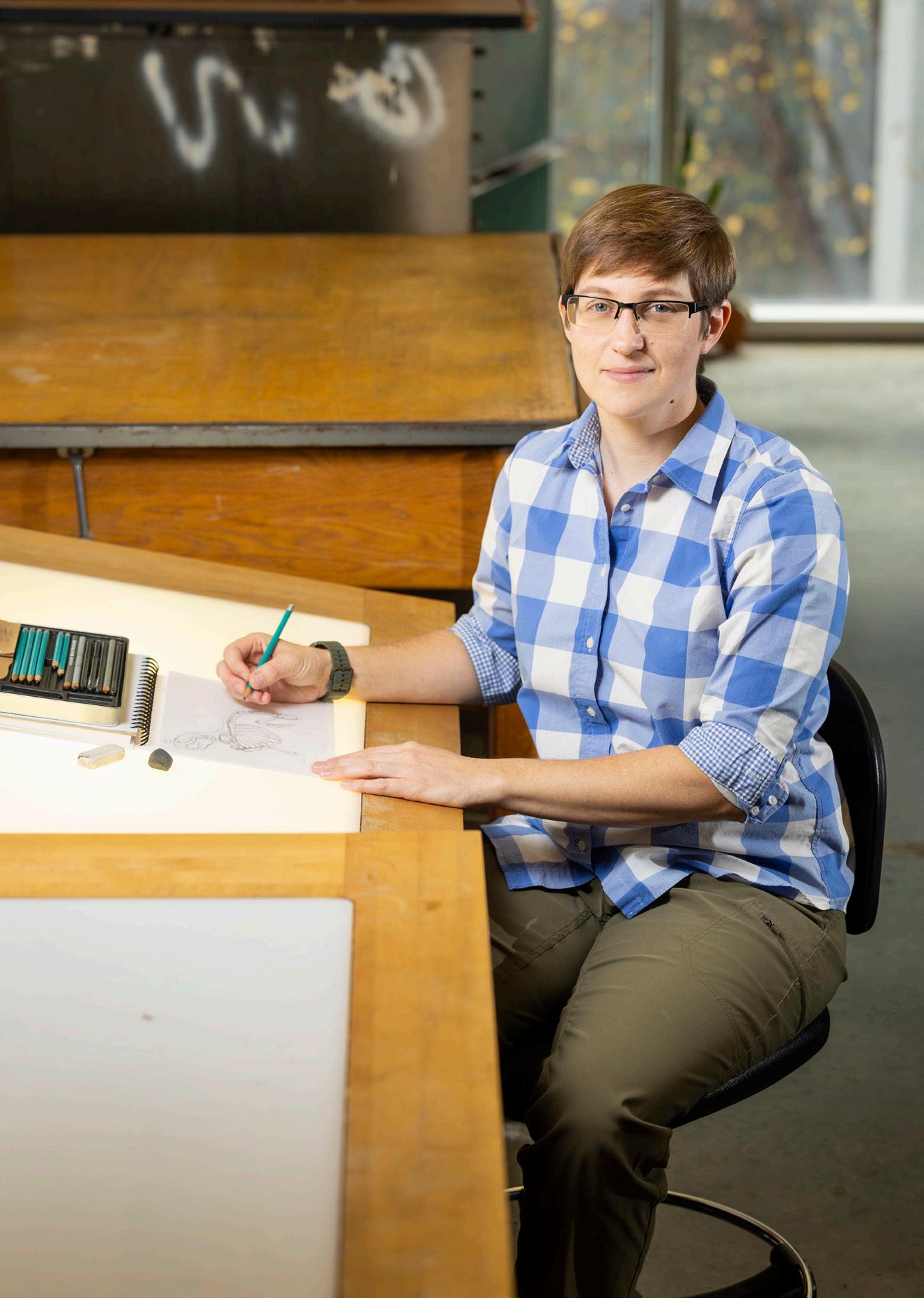
Amanda M. Manowski BFA ’18 had never heard of scientific illustration before coming to the University of Georgia.
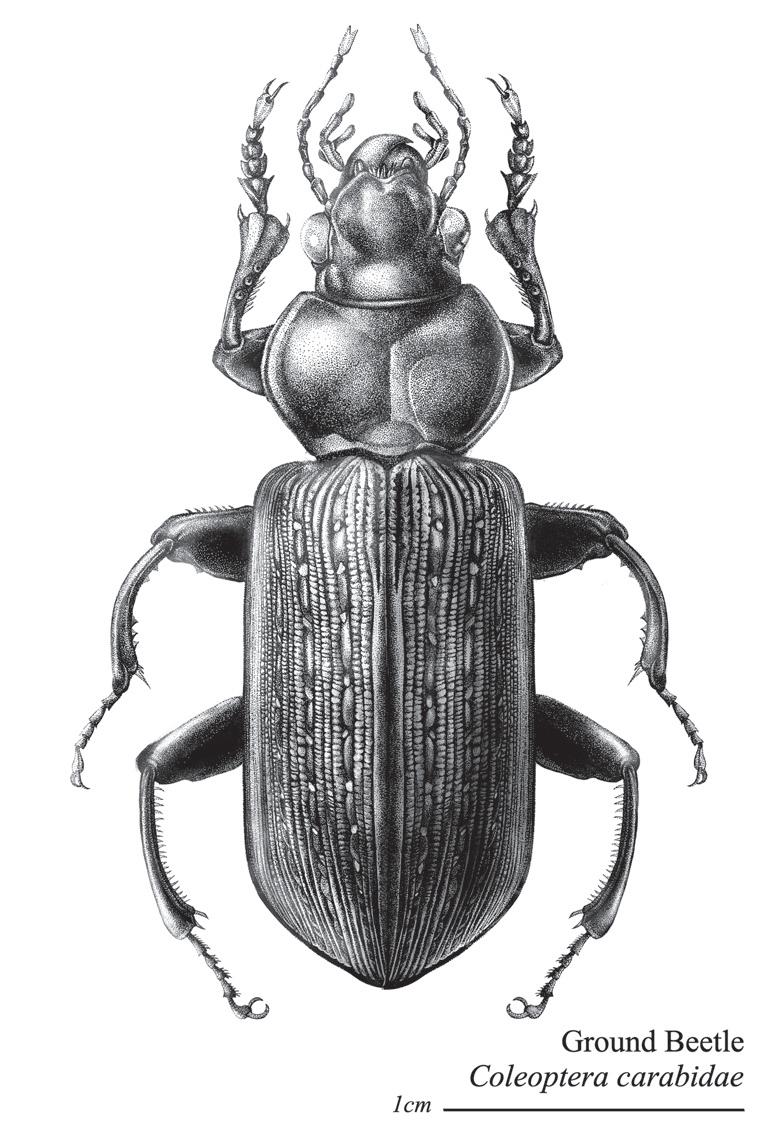
As a freshman, Manowski spotted her roommate’s friend sketching a group of three beetles and thought, ‘Why are you drawing bugs for a school assignment?’
“I had no idea there was a whole sector of art with a very utilitarian purpose of educating people,” says Manowski. “I did some research and found the Guild of Natural Science Illustrators and the Association of Medical Illustrators. I was immediately sold.”
So she switched her major, studied under then-Chair of Scientific Illustration Gene Wright, earned a master’s degree in medical illustration from the Medical College of Georgia at Augusta University, and began freelancing as a medical animator and illustrator.
When Wright retired in 2023, Manowski returned to UGA to become the program’s new director.
“Scientific illustration is a difficult concentration,” says Manowski. “Like other intensive studio disciplines, it’s about so much more than simply checking off course requirements. This is real job training.”
That means teaching students the latest digital tools and foundational techniques, of course. But it also means client interactions.
Researchers need graphic support for academic papers. Museums require illustrated explanations for exhibits. Scientific illustration students can fill those needs while also earning valuable experience managing projects, timelines, presentations, and client expectations.
“A potential student could be a great artist, but if they don’t understand the science, then their illustrations won’t achieve their objective,” Manowski says. “On the other hand, they could be an excellent scientist, but without the technical art skills, they won’t be able to convey those correct scientific points.
“It all matters.”
Amanda M. Manowski is the Area Chair of Scientific Illustration at UGA. She illustrated this 3D molecule of a ribosome (above, right) in an underwater-inspired environment.
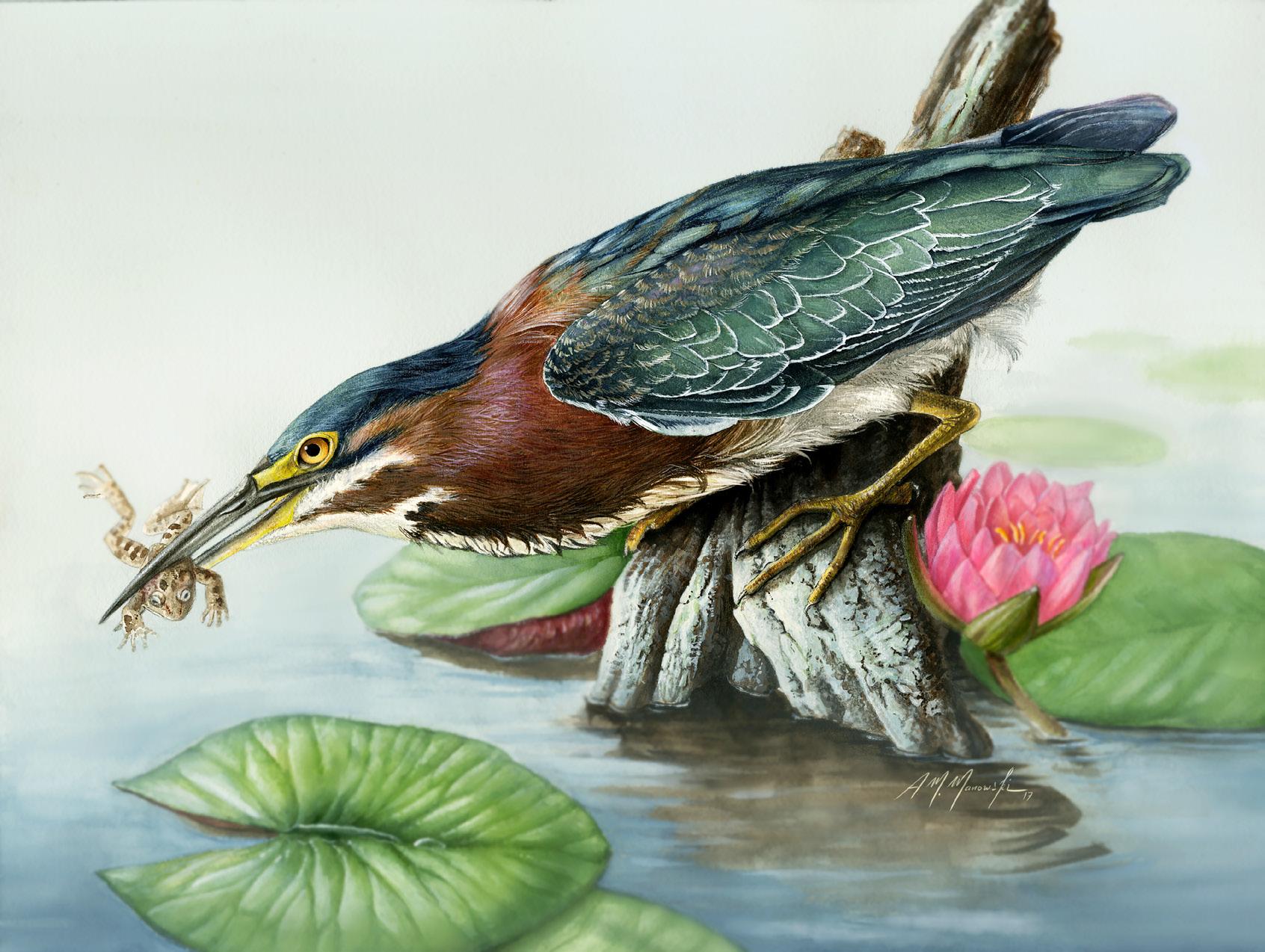
Manowski explored watercolor to depict a green heron its natural habitat for an assignment when she was a student in UGA’s scientific illustration program.
CHAMBERLAIN SMITH
The Naturalist
Going into natural science illustration instead of medical illustration will be hard. I don’t recommend it.
Liz Sisk BFA ’19 knew the advice was coming from a kind place. Natural science illustration is a niche field within the niche field of scientific illustration, focusing on depicting the natural world and everything in it. There aren’t a lot of jobs, and the ones that exist— particularly the staff jobs at publications or agencies—are tough to come by.
“I’d rather my path be more challenging than do something I don’t love,” Sisk told herself at the time.
Thankfully, UGA’s program teaches students how to draw up contracts, set rates, and manage client interactions, all key skills for thriving as a freelance scientific illustrator.
Sisk hit the ground running after graduation, creating depictions of everything from the spotted skunk and bongo antelope to diagrams and infographics on nitrogen pollution and the anatomy of a pit viper. She did projects for the U.S. Geological Survey and researchers at universities, among others, and she also interned at the National Museum of Natural History. Through those jobs, Sisk made connections that led to her current position as an associate graphics editor at National Geographic Magazine.
“Science education is really important to me,” Sisk says.
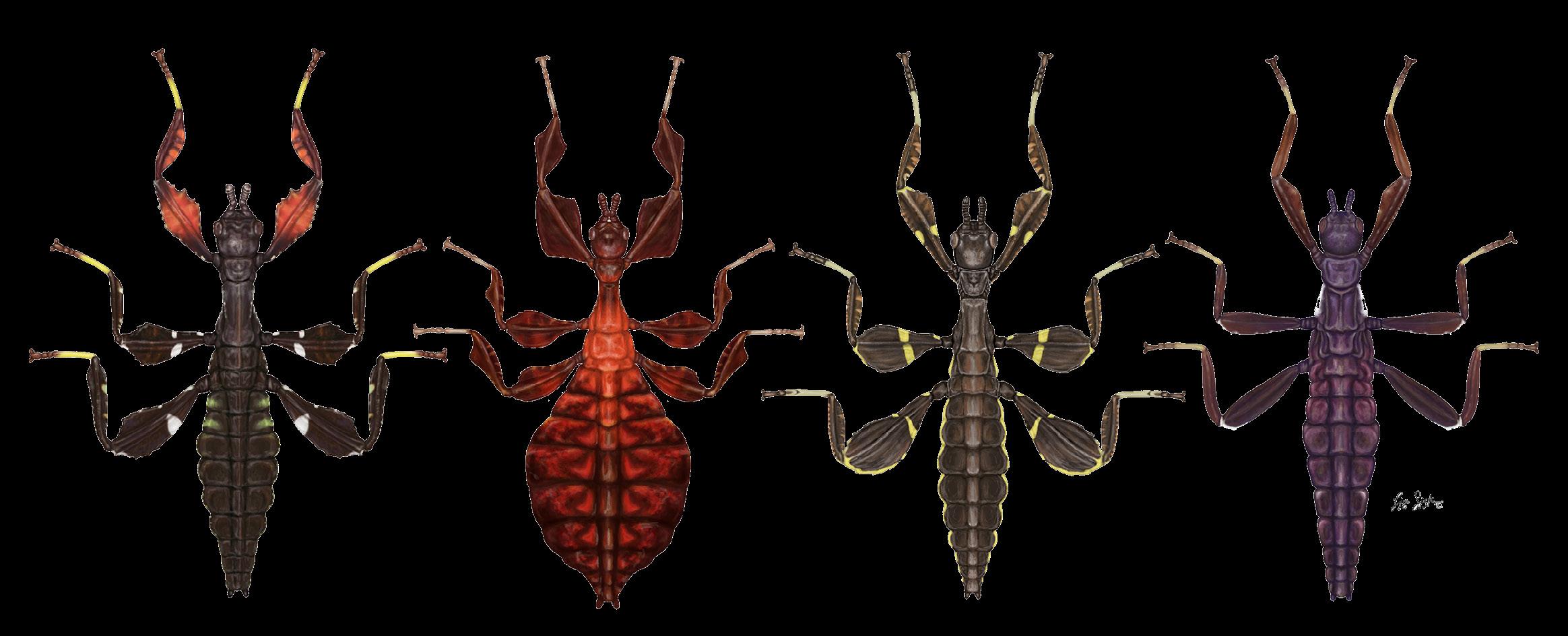
“People are like, ‘Why don’t we just take pictures of the bugs?’
Have you ever tried to take a picture of a bug? And did you tell it to just stick its arms out perfectly straight? Did it listen to you? No.
“Sometimes a drawing is worth a thousand words.”
Sisk created these leafbugs (from left: Cryptophyllium “Philippines,” Pulchriphyllium abdulfatahi, Phyllium letiranti, and Chitoniscus “Fiji”) in collaboration with City University of New York entomologist Royce Cumming.
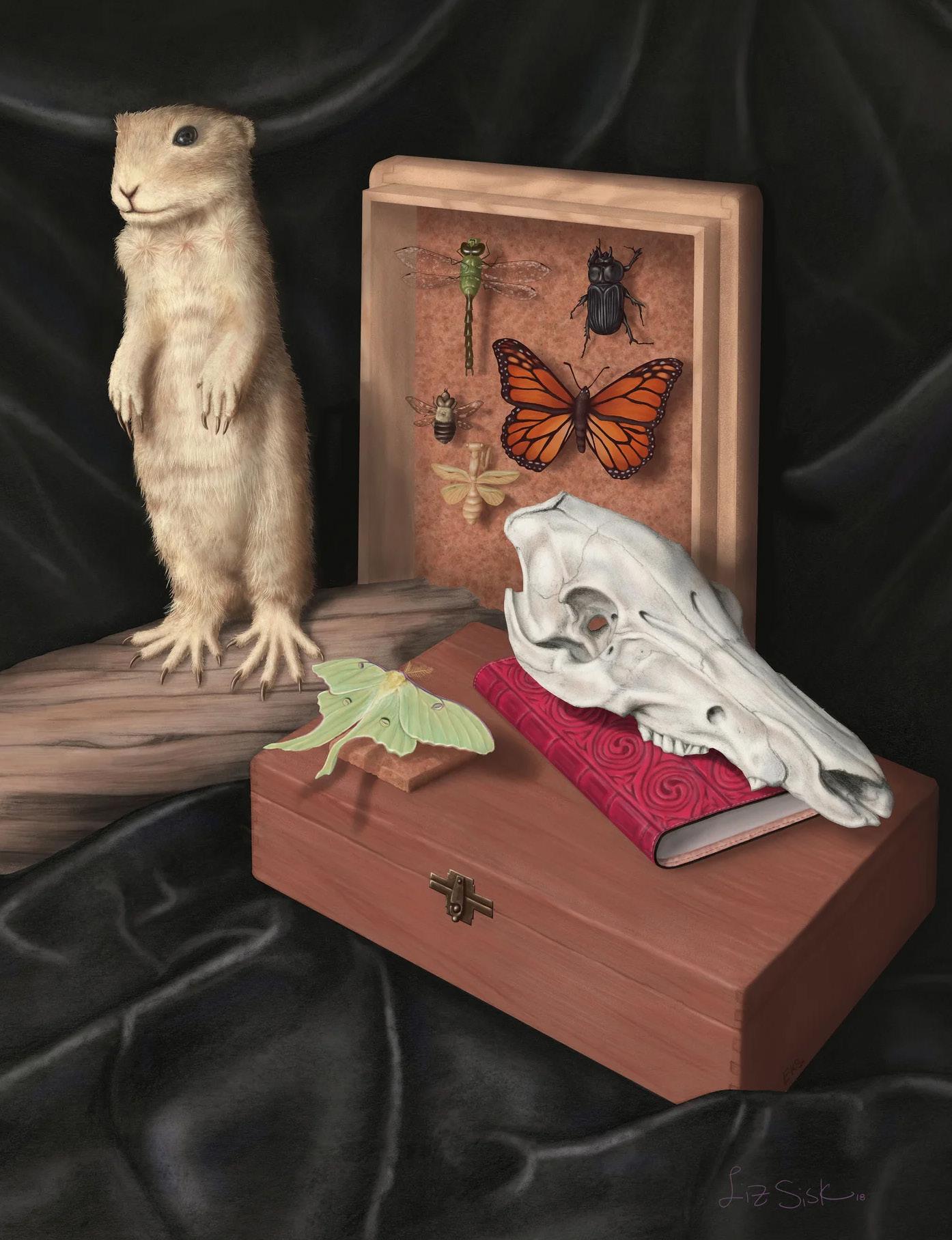
Liz Sisk created the above illustration of a ground squirrel, hog skull, and insects by first drawing them in graphite and then adding color in Adobe Photoshop.
The Textile Artist
Greyson Hull BFA ’25 argues that medicine wouldn’t exist without art.
“Early medical illustrators, like Leonardo da Vinci, they would study and draw anatomy,” Hull says. “And that’s how people learned. Visual aids are important, and art is such a beautiful communication tool.”
But scientific illustration abounds in more than just the medical field, Hull says.
“It’s not just in textbooks or educational materials,” she says. “It’s everywhere.” Precision. Realism. Accuracy.
In addition to technical skills, these tenets of scientific illustration stayed with Hull as she expanded to textile work, developing a swimsuit line and marketing her creative and scientific work to boutiques in Charleston, South Carolina.
Increasingly, though, she finds those worlds merging. Scientific illustrations are
popping up on clothing and influencing interior design choices.
Prints of antique illustrations of native plants hanging on living room walls. Gift wrap covered in flying insects with their scientific names embossed underneath. Sweatshirts with anatomically correct hearts on the chest.
Hull’s here for all of it.
“Before I entered the program, I don’t think I had ever sat down and done a
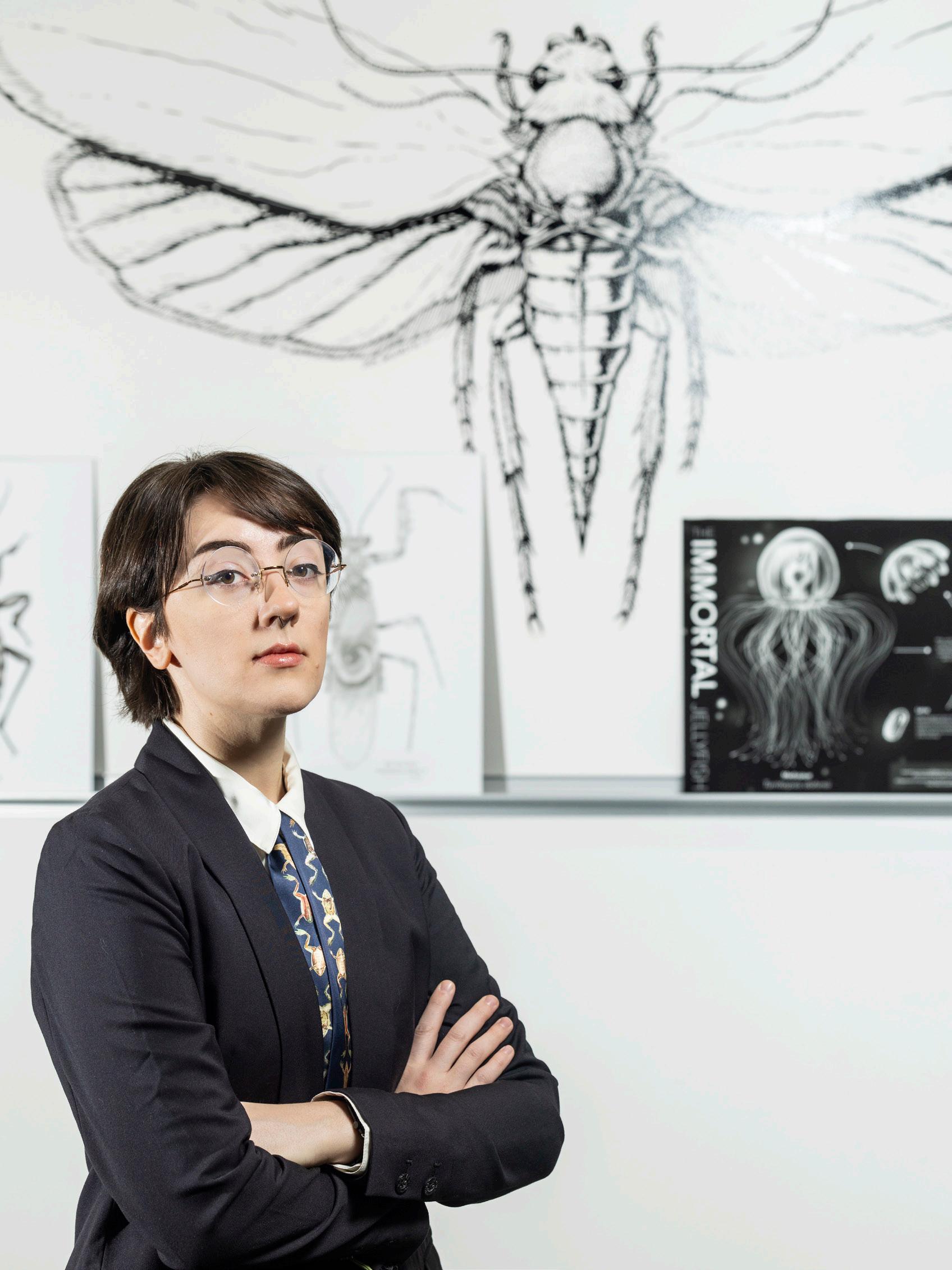
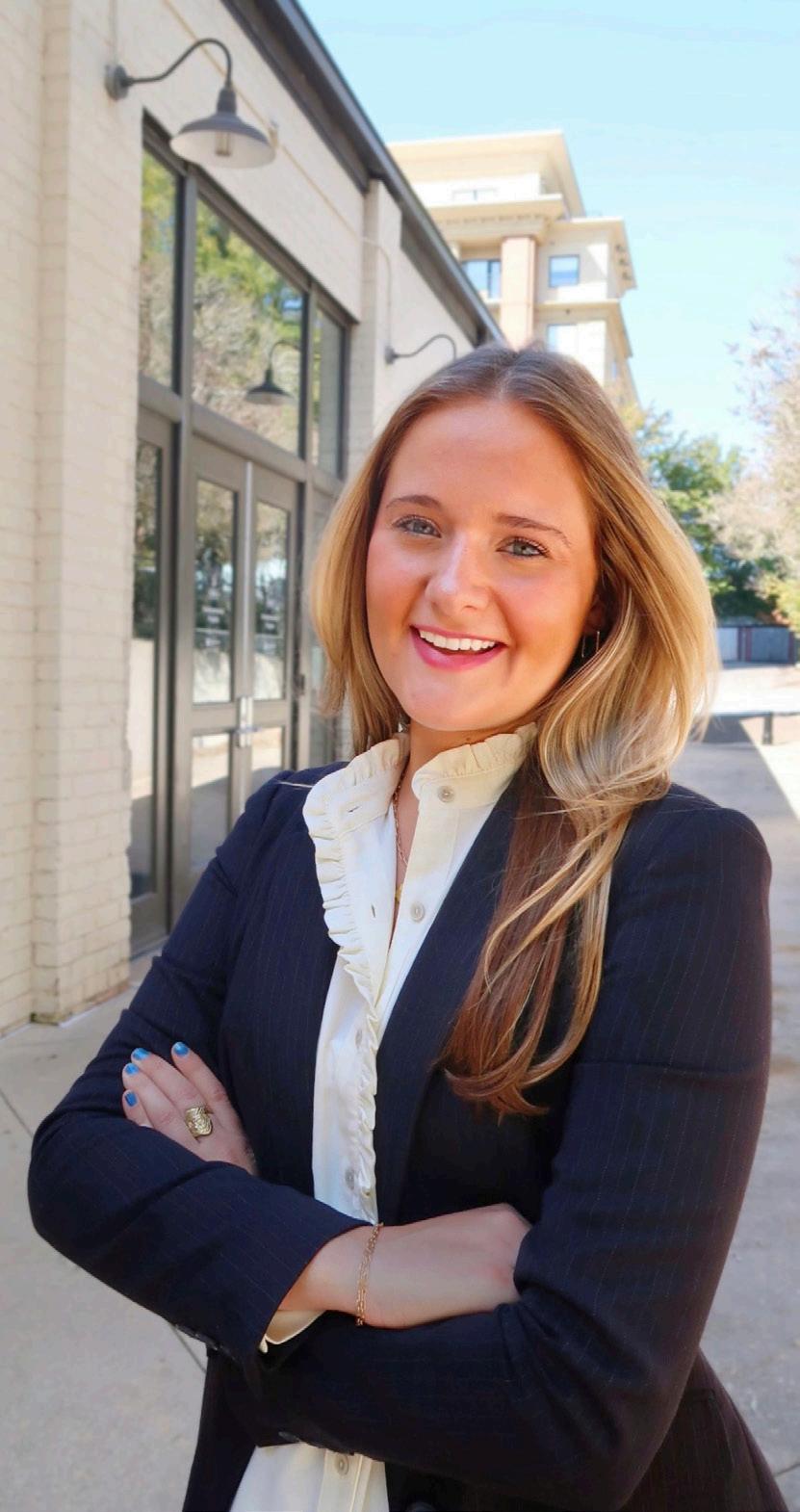
Greyson Hull is the Founder and Creative Director of BY GREY Design.
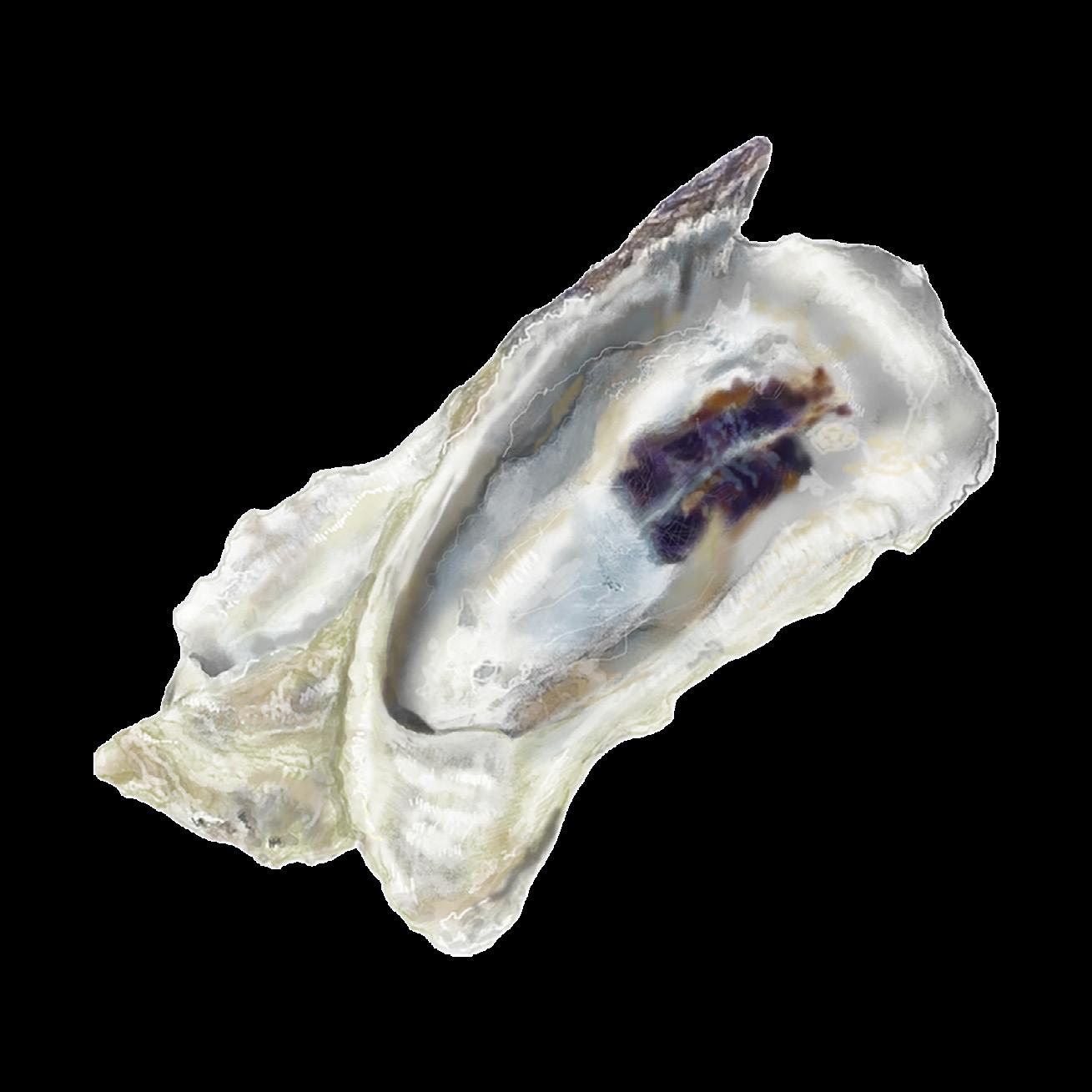
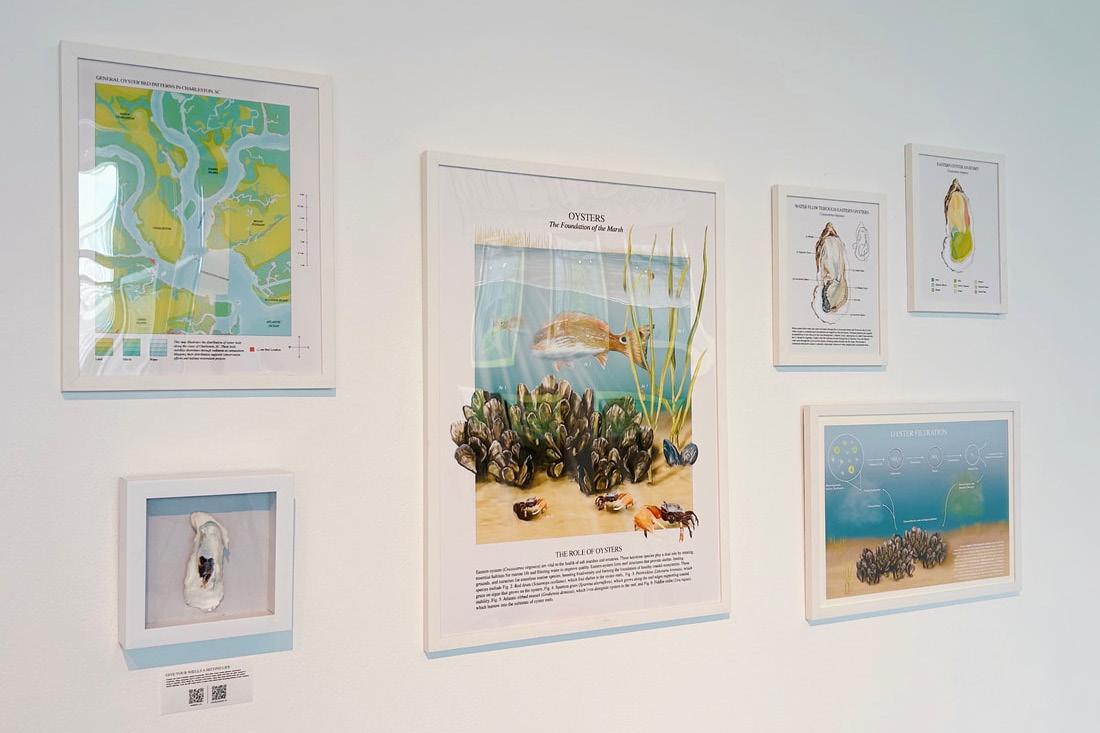
Hull grew up spending time on the marsh and made oysters the focus of her exit show because they are the “foundation of the marsh.”
The Conservationist
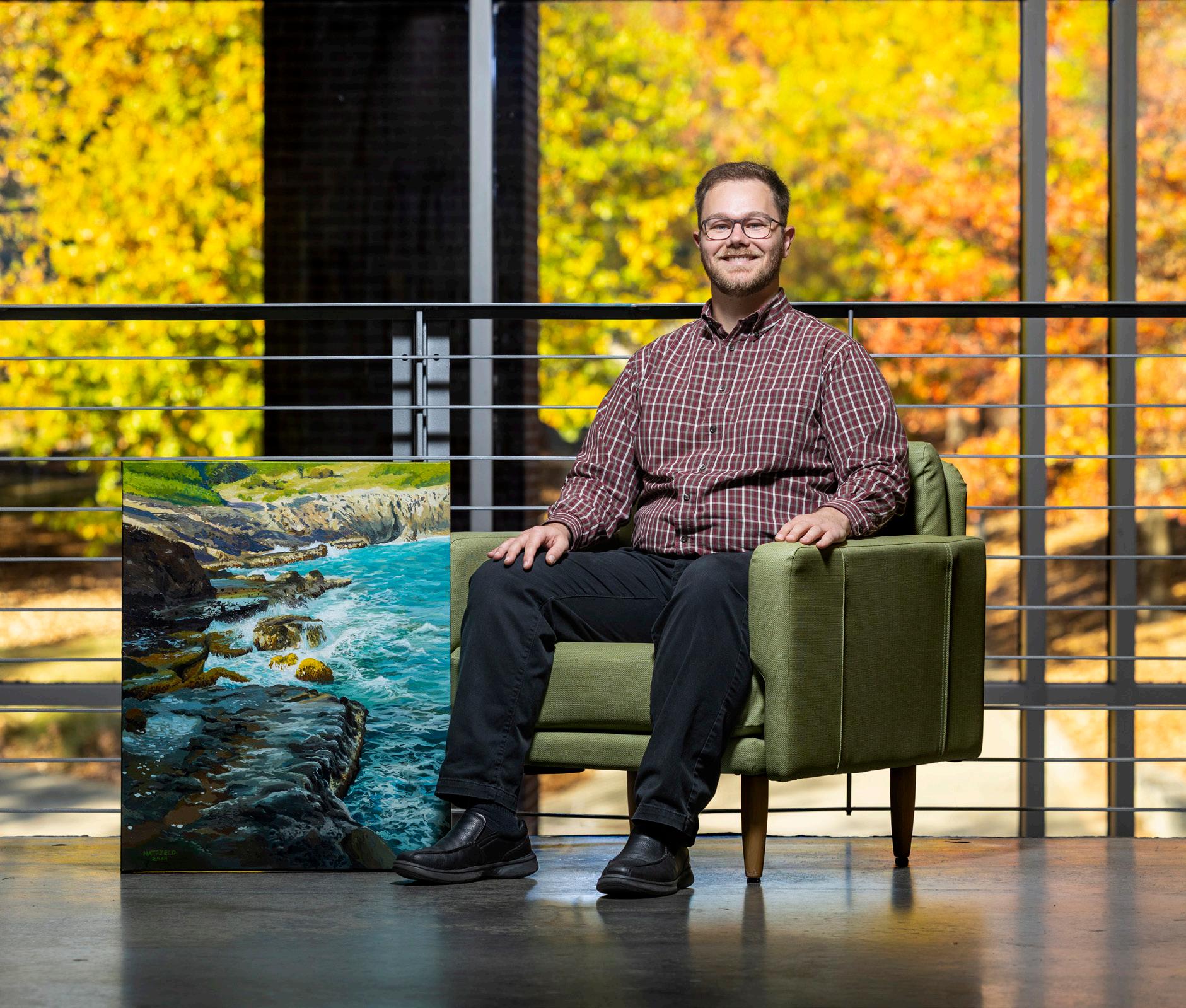
For Josh Hatfield BFA ’18, it was a children’s book on human anatomy.
Weird topic for that audience? Maybe. But also super cool.
He loved that book, and he held onto it for years.
“Someone had to create these illustrations and models,” he remembers thinking as he thumbed through the pages as a high schooler.
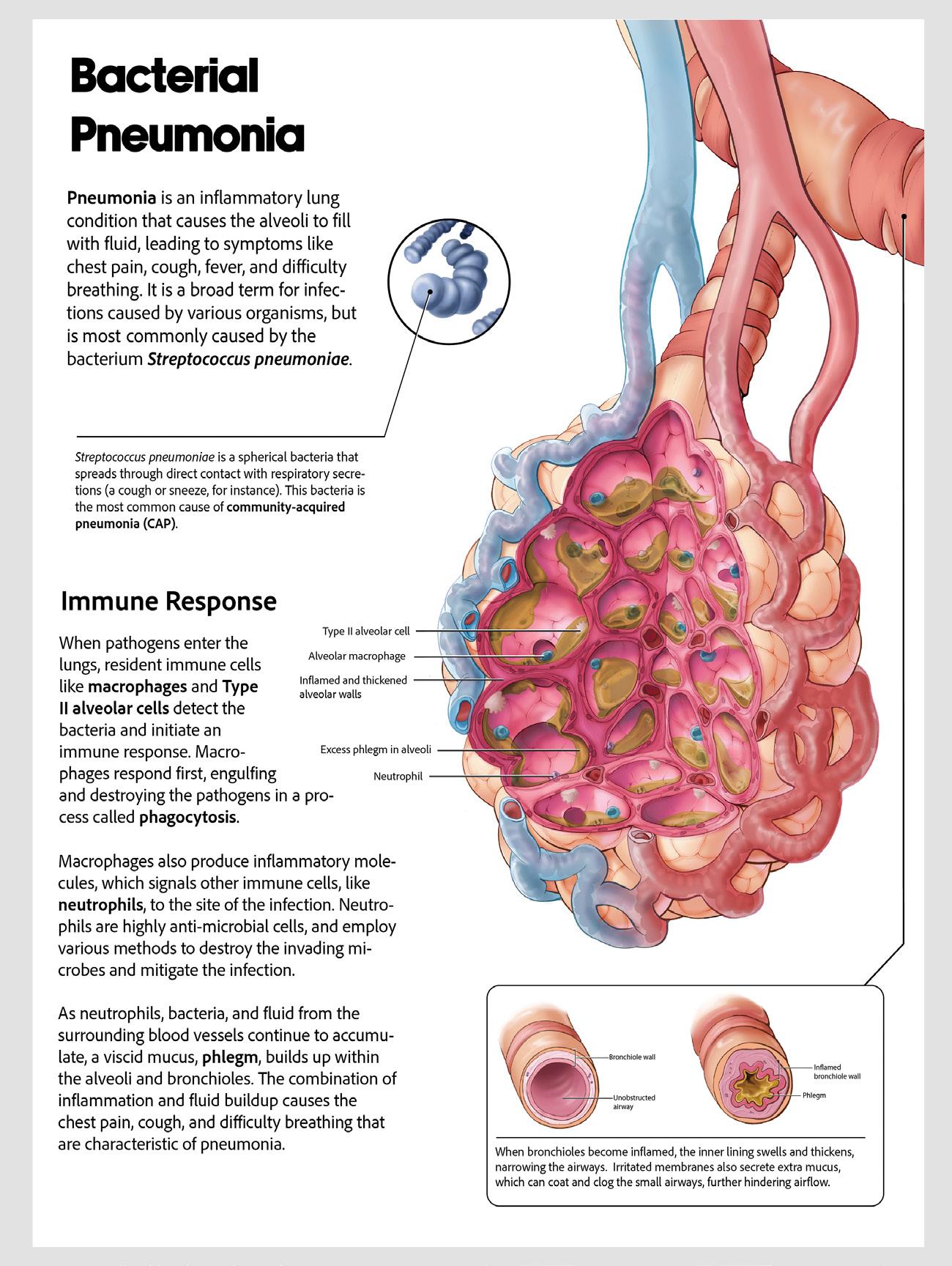
“With scientific and medical illustration, the didactic value is more important than the aesthetic. Does it describe the anatomy or the scientific process accurately or not?” Hatfield says.
While Hatfield loves creating artwork, that commitment to accuracy drew him to UGA’s scientific illustration program. But it also made some projects more challenging.
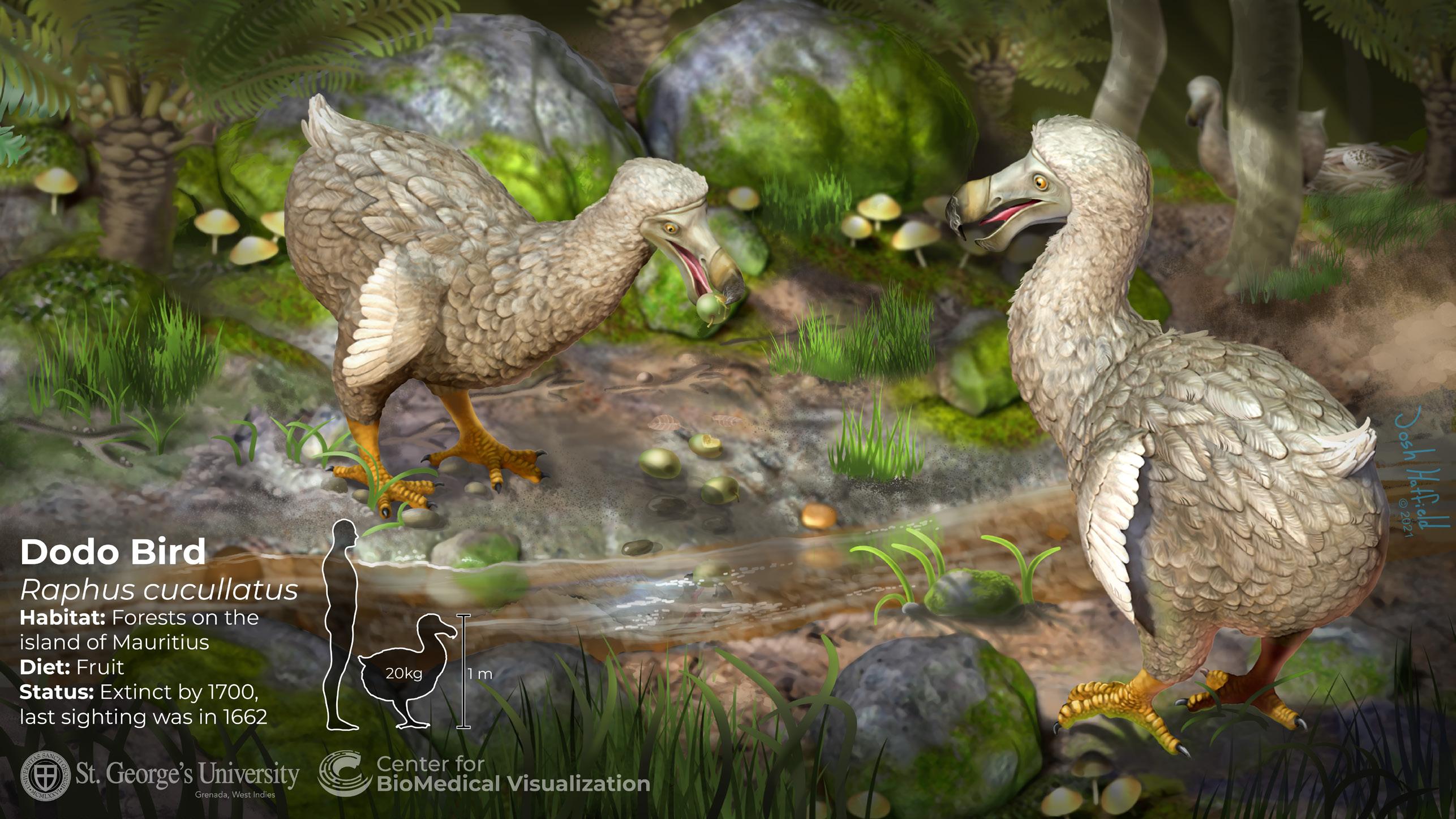
During his fellowship in biomedical visualization at St. George’s University, Hatfield was tasked with bringing the dodo bird back to life. On paper, at least.
“We don’t have many tissue samples or fossils of dodo birds. And obviously, this is before cameras, so we don’t have any photos of them either. I found original sketches that were done by some of the explorers who first visited the island of Mauritius (where the dodo bird existed).
“I had to pull together what little information I had and figure out, ‘Well, how is this thing supposed to look?’”
And he did. The 3D model and poster he created were designed to educate students about biology, ecology, conservation, and extinction at St. George’s and beyond.
Josh Hatfield created this painting of L’anse Aux Epines (above) in Grenada, where he developed a rendition of the dodo bird (below) during his fellowship in biomedical visualization at St. George’s University.
CHAMBERLAIN SMITH
The Medical Illustrator
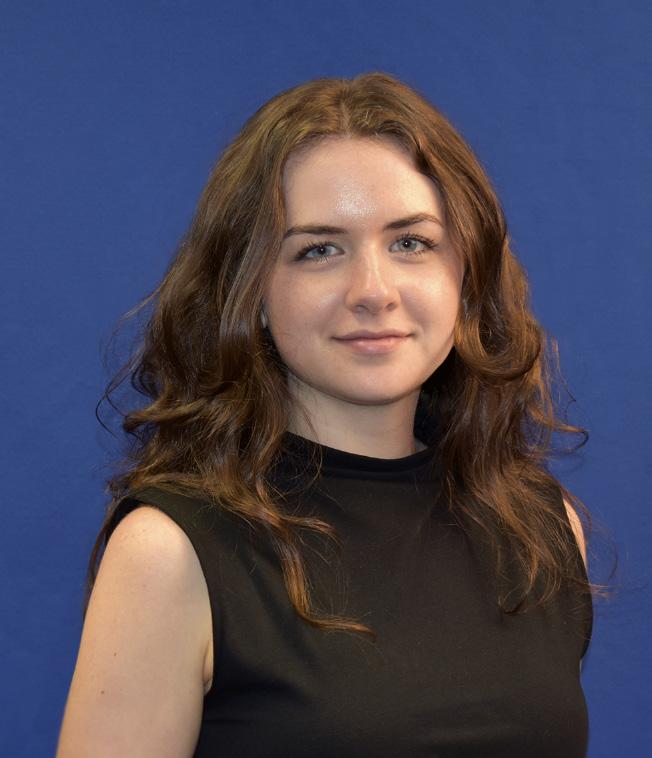
Reading about how cells work is one thing. But for Lily Jordan BFA ’25, seeing those processes depicted in print was another.
“The visuals—renderings of what was going on in the human body or within the cell—affected me differently than the words in the textbook,” she remembers.
She’d never had formal art training and came to UGA as a biology major, but when Jordan learned of the scientific illustration program, she knew it would be a perfect blend of her passion for science and her interest in art.
“Access to information can be empowering,” says Jordan, who is currently pursuing a master’s degree in medical illustration from the Medical College of Georgia at Augusta University. “People digest information in different ways, and giving people access to information in the way that they understand most clearly matters to me.”
A doctor’s office waiting room, for example. It’s a vulnerable place, and there may be information that you don’t understand as the patient, Jordan says.
“As a scientific or medical illustrator, you’re more than just an artist,” she says. “You are also a researcher, a designer, an editor. There’s a lot of work that goes into creating accurate and well-thoughtthrough illustration.”
Lily Jordan is a graduate student in medical illustration at the Medical College of Georgia at Augusta University.
1. Olivia Lee
2. Kayla Schlueter
3. Mariah Yori
4. Lily Jordan
5. Phoebe Seitz
6. Liz Sisk
7. Anna Grubbs
8. Anna Trevathan
9. Greyson Hull
Art by:
Olivia Lee has always loved illustrations and science, but until learning about UGA’s scientific illustration program, she didn’t realize she could pursue both.
The Next Class
Intended scientific illustration students spend the first two years of their undergraduate art education learning the basics—color, composition, drawing, three-dimensional design—before submitting for a portfolio review.
This is, of course, alongside the general core requirements of a Franklin College bachelor’s degree.
Once accepted, scientific illustration students spend their first semesters honing their skills, ensuring that they firmly grasp how to draw objects with proper proportions, texture, and form.
“Any time I tell somebody what I’m going to school for now, they’re like, ‘What is scientific illustration?’” says Mariah Yori BS ’13. “It’s almost hard to explain because it’s so allencompassing.”
Each student has his or her own interest, says third-year Olivia Lee, and the program is one place where they can all geek out over their favorite caterpillar or the workings of the human circulatory system.
“Everyone is very nerdy in the best way possible.”
Support the Lamar Dodd Academic Excellence Fund.
CHAMBERLAIN SMITH
CHAMBERLAIN SMITH
Mariah Yori works in UGA’s animal and dairy science department. She is also pursuing a degree in scientific illustration on the side.
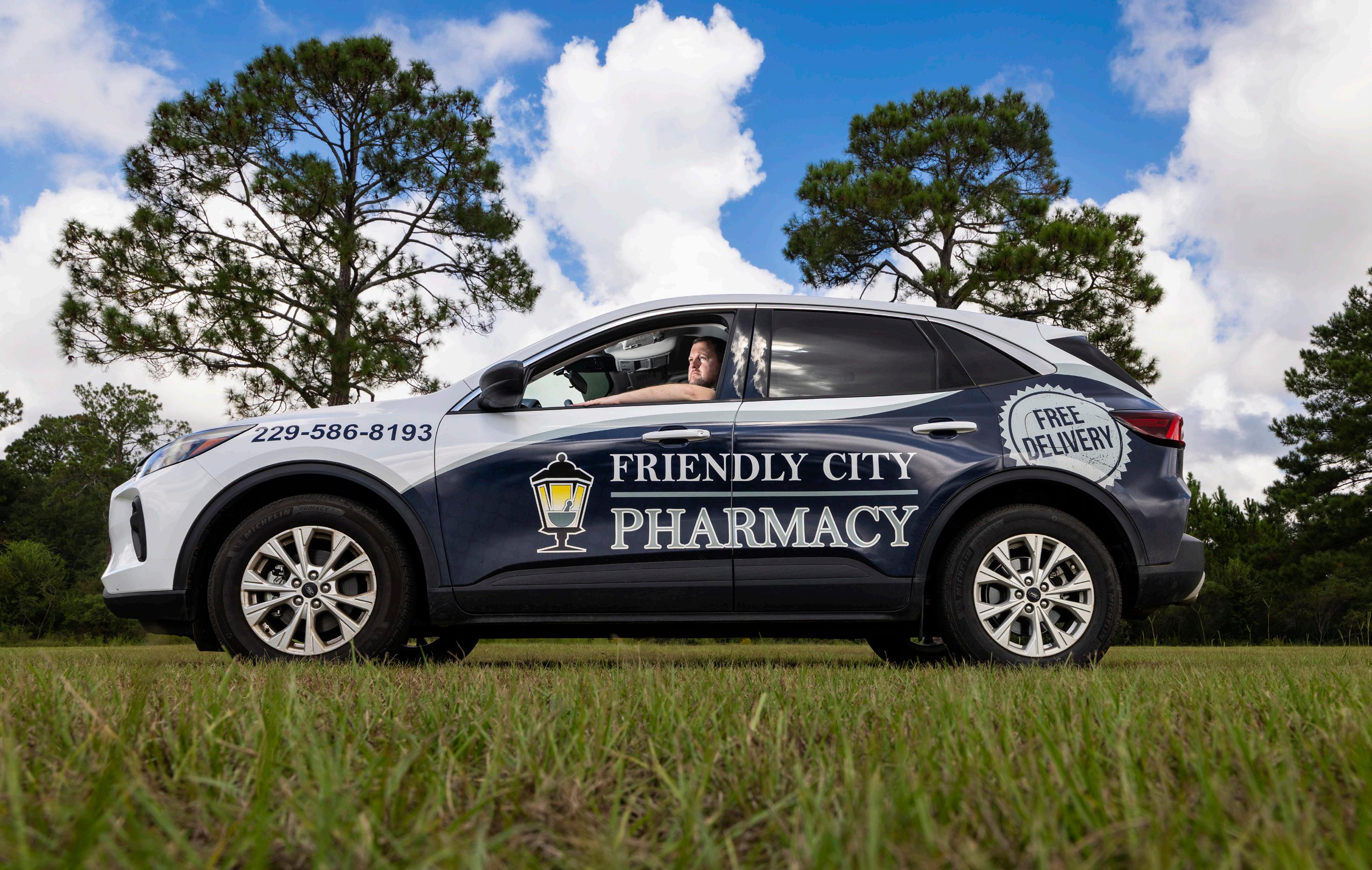
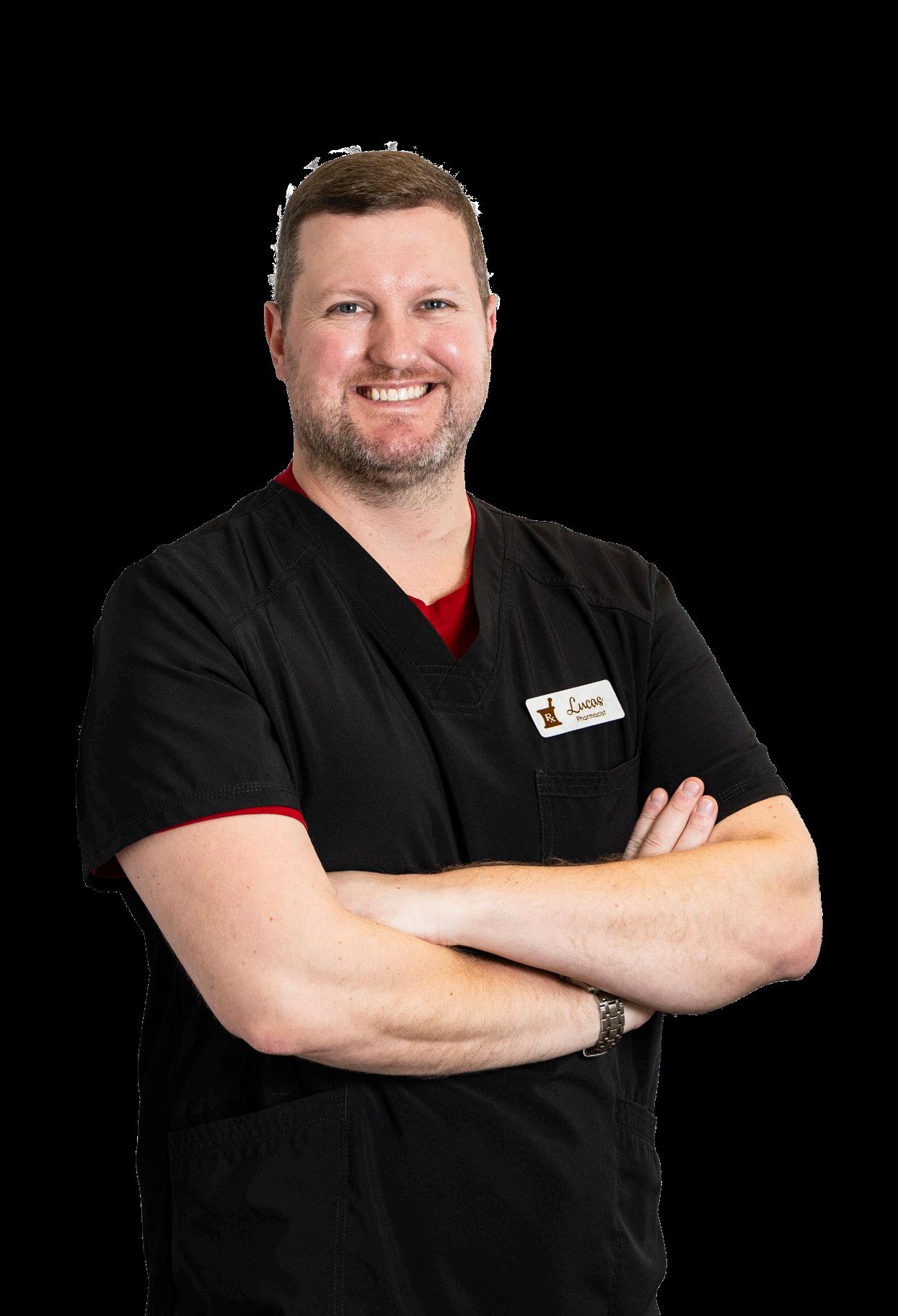
Customer service is a hallmark of independent pharmacies. Lucas Brown’s Friendly City Pharmacy takes that one step further, offering free prescription delivery. In rural South Georgia, where transportation can sometimes be a challenge, it could literally save lives.
Pharm Life
Meet the UGA alumni entrepreneurs behind the counter at some of Georgia’s most successful independent pharmacies.
WRITTEN BY ERIC RANGUS MA ’94
Each spring, the University of Georgia’s Division of Development and Alumni Relations celebrates the Bulldog 100, which honors the 100 fastest growing organizations and businesses owned or led by UGA alumni.
The new list, which often includes alumni returning from the previous year, is released in February, and it’s followed by a banquet that draws honorees, all decked out in their red and black.
In 2025, an impressive number of those honorees graduated from the College of Pharmacy. In all, eight Pharmacy alumnirun businesses made the list, and six of them were independent pharmacies.
“We are incredibly proud of these Pharm Dawgs and the impact they are making in their communities and the pharmacy profession,” says Kelly Smith, dean of the College of Pharmacy. “Their recognition in the Bulldog 100 speaks to their entrepreneurial excellence and the innovation that defines our alumni.”
The careers of College of Pharmacy grads progress in all sorts of directions. Many work in large retail pharmacies or local and national health care systems.
Others start or run businesses that build on their education and address specific health care issues. Reed Liggin PHARMD ’94 is the CEO of Sliced Health, a cloud-based technology platform for health systems, and Dr. Naveed Tharwani PHARMD ’11 runs SynerGrx, a
company that serves on-site clinical pharmacists. Both were ranked No. 8 and No. 28, respectively, in the 2025 Bulldog 100.
But most of the honored alumni own independent pharmacies located in small cities and towns across Georgia. They are frequently the only pharmacies within a 30-mile radius. And the pharmacists who run them are community leaders. They know their customers by name.
The College of Pharmacy helps provide the tools to get independent pharmacists started. Several alumni spoke of the college’s Certificate in Pharmacy Entrepreneurship, which prepares them to own and operate a pharmacy.
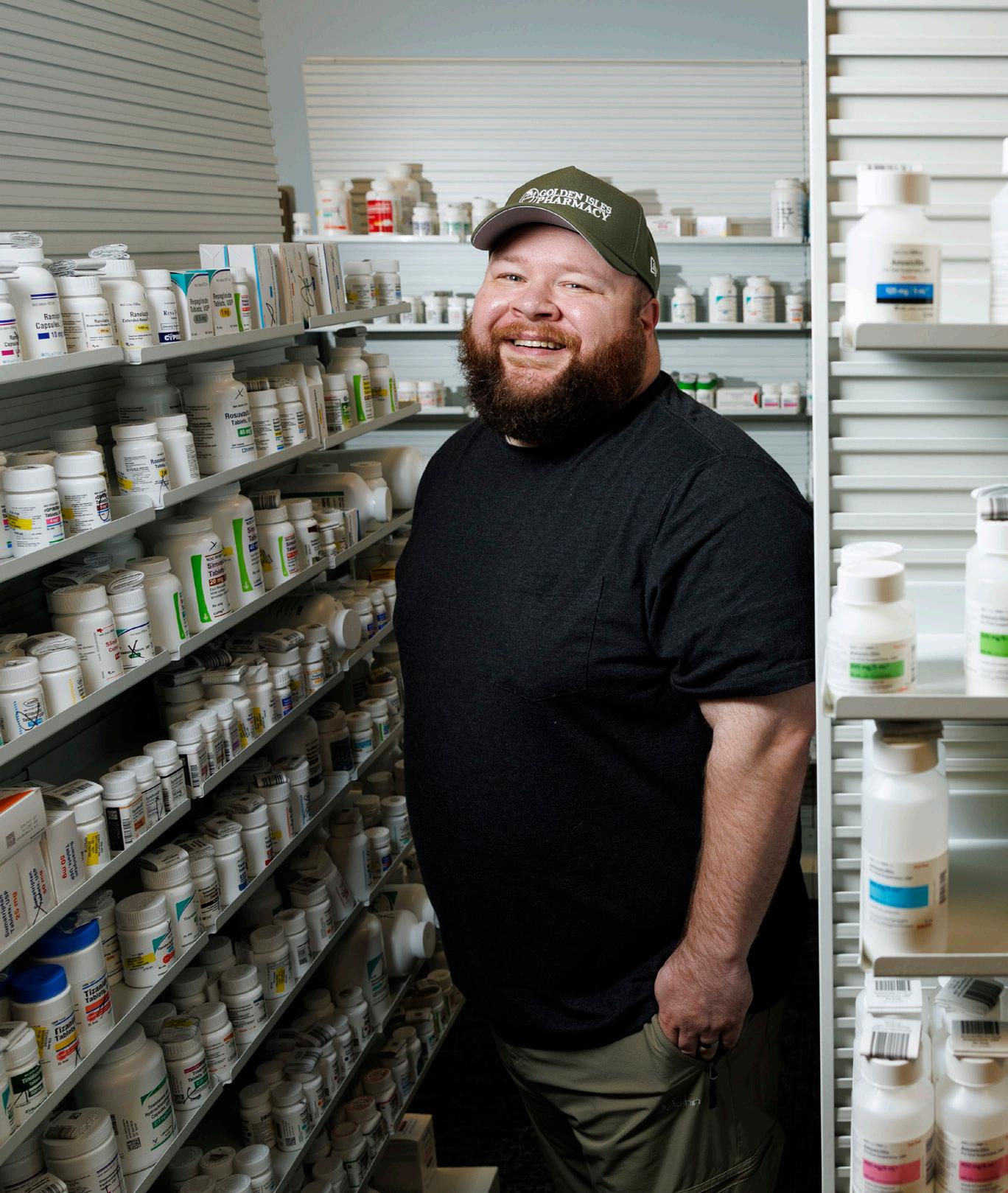
“That was invaluable,” says Matt Donato PHARMD ’14, the owner of Golden Isles Pharmacy in Brunswick. “You’d get in the weeds with pharmacies. They’d open their books for you. It really helped us understand the business side. I still have spreadsheets from some of the businesses we studied.”
An independent pharmacy is a business after all, but—at least for these UGA alumni entrepreneurs—there is a beating heart that powers them.
When brainstorming names for his pharmacy, Valdosta native Lucas Brown embraced the nickname of his adopted hometown, Tifton: the Friendly City. With a focus on customer service, he works every day to live up to that name.
Lucas Brown
PHARMD ’14
Friendly City Pharmacy • Tifton
2025 Bulldog 100 #13
Lucas Brown takes the nickname of his adopted hometown to heart. Brown, a native of Valdosta, moved to Tifton to take a job at a chain pharmacy after graduating from UGA. The position wasn’t without its positives—he met his wife, Christina, a fellow pharmacist, there.
But he was restless to go out on his own.
When he did open his own pharmacy, he didn’t want to name it after himself.
“Brown Pharmacy. We didn’t want to call it that,” says Brown, who served in the Marines before coming to UGA. “Who is ‘Brown’? What if we weren’t there or when it came time to retire?”
So instead, he and Christina leaned into Tifton’s nickname. Welcome to Friendly City Pharmacy. The first location opened in 2021, and since then, a second has come online. The Browns also own Colony Discount Drugs in Fitzgerald.
“Friendly City” also reflects Brown’s dedication to customer service with a personal touch. Good customer service isn’t limited to independent pharmacies, of course, but Brown does take his commitment to his neighbors seriously.
“If someone needs a prescription immediately, they can call me on my cell,” he says. “There is less red tape.”
In rural areas like South Georgia, access to pharmacies isn’t always guaranteed. That’s why Brown’s pharmacies offer free prescription delivery services, drug compounding, and compliance packaging, which organizes customers’ medications based on
A
Matt Donato
PHARMD ’14
Golden Isles Pharmacy • Brunswick
2025 Bulldog 100 #55
Being an entrepreneur implies solitude or at least independence. But that doesn’t mean you can’t lean on others.
The friends and mentors Matt Donato met while at the College of Pharmacy—classmates like John Hyer (see page 25) and Lucas Brown—changed his life. And they continue to influence it in positive ways.
“Without being there and meeting those guys, I may never have had my own place to begin with,” Donato says. Indeed.
Donato, a native of Brunswick, had always wanted to own his own pharmacy, so when he decided to take the plunge in 2017, Hyer was an early investor. The venture has been a huge success. Donato paid Hyer back years ago, and he now runs two Golden Isles Pharmacies in his hometown.
He continues to message Hyer and Brown on an almost daily basis. They bounce ideas off each other, discuss trends, and offer advice.
They also figure out ways to give back to UGA. In 2025, Donato; his wife, Jamanda; and John and Dorris Hyer created the Hyer-Donato Pharmacy Entrepreneurial Scholarship Fund in the College of Pharmacy. Ben (see page 24) and Lauren Ross created a fund as well.
“Pharmacy school, any school really, is expensive,” Donato says. “We did this as an entrepreneurial-type scholarship because it’s what we love. Anything we can do to help students, we’ll do.”
native of Brunswick, Matt Donato long wanted to own his own pharmacy. He now has two.
ANDREW DAVIS TUCKER
Mary Nagel
PHARMD ’16
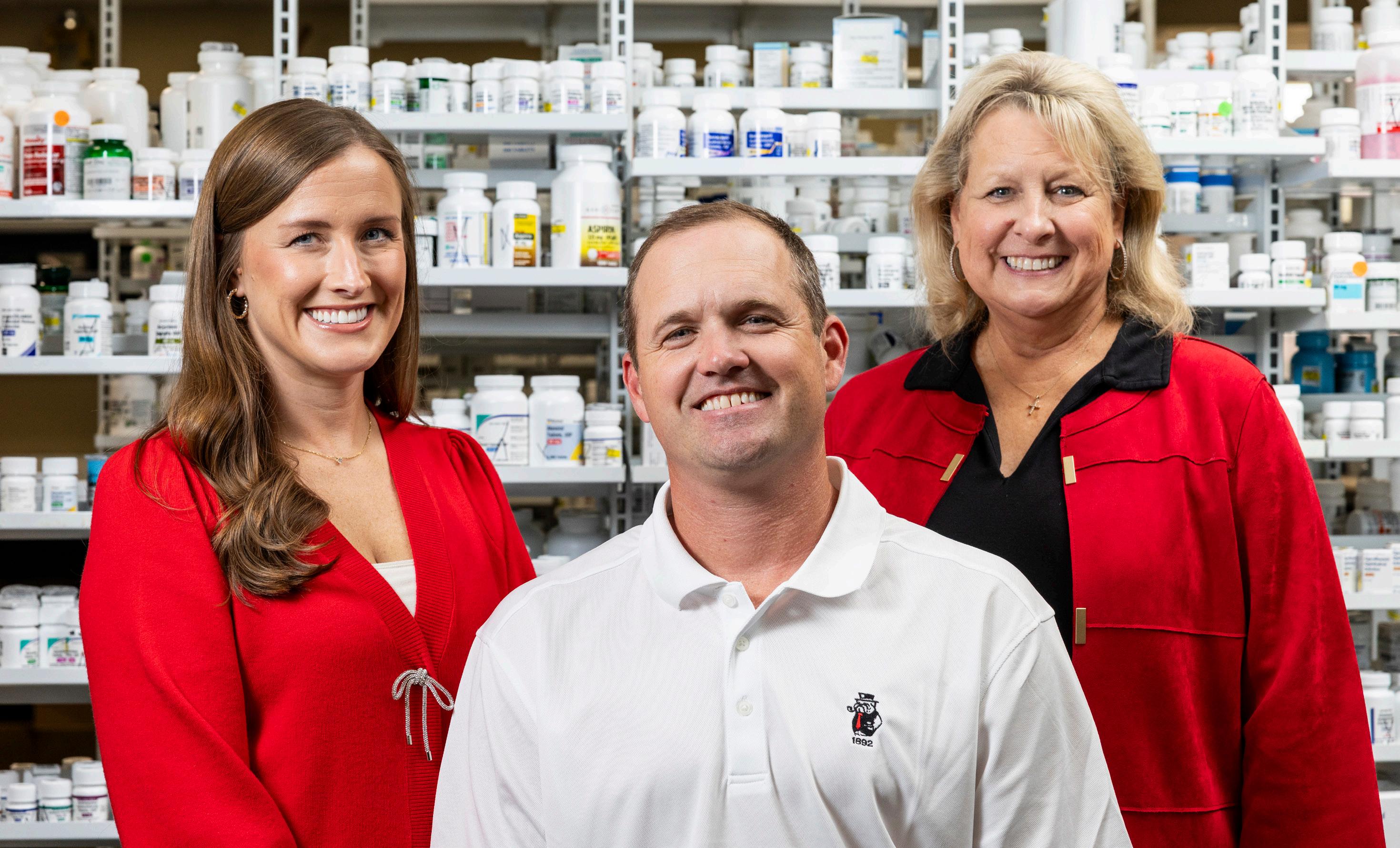
Ben Ross is a busy guy.
Ben Ross PHARMD ’08
Clark Drug Company • Waynesboro
2025 Bulldog 100 #47
He owns or co-owns three Bulldog 100 pharmacies across the state: Ross Drug (No. 78) in Sylvania (a store that was founded by his father, Sonny BSPH ’74 ), Coastal Drug Company (No. 56) in Midway, and Clark Drug Company in Waynesboro.
It’s a resume that earned Ross the Michael J. Bryan Award, which recognizes a returning Bulldog 100 honoree who exemplifies entrepreneurial spirit and sustained business growth, in 2025.
Ross also has a keen sense of picking partners. One of his co-workers in that first job in Sylvania was Mary Nagel’s husband, Pete. In addition to the Bulldog 100 pharmacies, Ross and the Nagels are partners in several other pharmacies, including one in Lyons, where Mary spends most workdays.
“We all work where we’re from,” says Mary, who was also a
Starr
Clark
BSPH ’87
multi-business honoree through her co-ownership of Coastal Drug. “I’m from Vidalia, which is right next to Lyons. I loved Athens and would have stayed forever if I could, but I wanted to come home.”
That hometown touch was front-of-mind for Nagel and Ross when they explored the acquisition of a pharmacy in Waynesboro, south of Augusta. Ross reached out to Starr Clark, who’d worked for pharmaceutical chains for 30 years.
“He could have pulled me through the phone, I was so excited,” Clark says.
Since then, Clark Drug has made the Bulldog 100 multiple times and solidified its place in town.
“We have our pulse on the community,” Ross says. “We do it all, and we know our customers. We go to church with them. We coach their kids in Little League. We support schools and every community activity. We love our communities.”
Mary Nagel and Ben Ross are partners in several pharmacies across Georgia. Starr Clark is a co-owner in Waynesboro where she runs the day to day.
CHAMBERLAIN SMITH
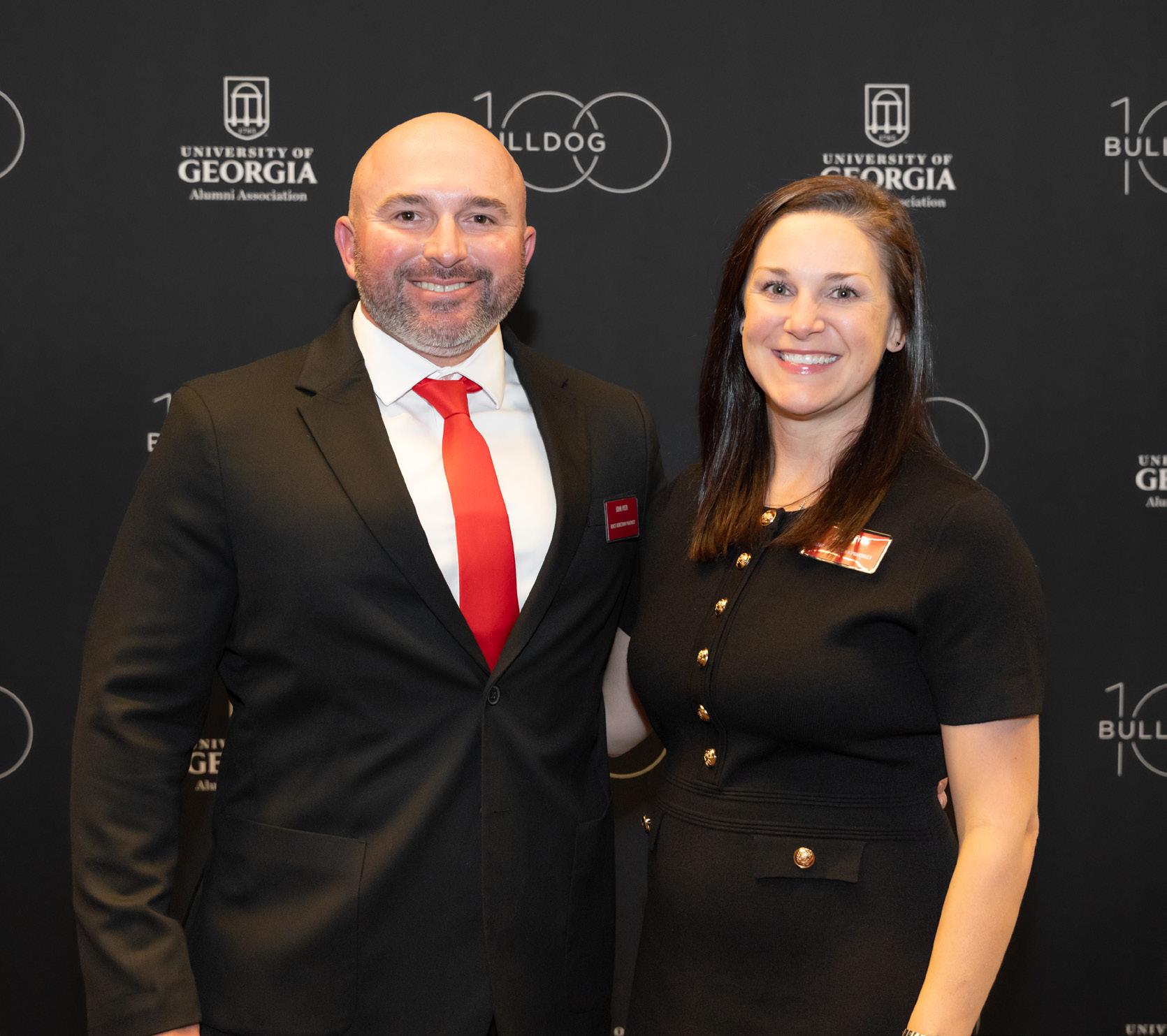
John Hyer PHARMD ’12
Dorris Hyer
PHARMD ’12
King’s Hometown Pharmacy • Blairsville
John and Dorris Hyer bought their first pharmacy in Murphy, North Carolina, in 2013. A year later, they bought another in nearby Hayesville. They expanded to a third pharmacy in 2019, this time across the Georgia border in Blairsville. At the time the Hyers bought each location, they were surviving but not thriving.
That changed.
“The support from the communities we serve has allowed us to grow and keep the pharmacies modern and current,” John says.
The couple met while attending UGA. Before coming to Athens, John—like Lucas Brown—served in the Marine Corps and began college at Georgia Southern University; Dorris attended Valdosta State University after high school.
They got married the same month they graduated in 2012 and then immediately started post-graduate residencies in Tuscaloosa, Alabama.
“Halfway through, I knew that wasn’t what I wanted for my career. The dream was to own a business,” John says. “So I started my hunt to buy a pharmacy. It didn’t matter where I found it. If it was the right opportunity, I was buying it!”
Dorris was a bit slower to embrace entrepreneurship but didn’t want to go the hospital route or work for a chain pharmacy. She did both to make ends meet the first few years, though. Once the Hyers’ pharmacies were able to support another pharmacist role, Dorris joined full time.
The Hyers now live in Murphy and spend the majority of their time managing the businesses behind the scenes.
“Transitioning from being in the stores every day, to more of the business development work is difficult,” John says. “That’s the toughest part of business ownership. But it’s the only way to lead and manage. You trust your team.” GM
TEACHING BEYOND ATHENS
Whether it is through educating a class or working with colleges, spreading innovation and knowledge is pivotal. Through the year-long Graduate Certificate in Clinical Pharmacy, College of Pharmacy students are able to enhance their skillsets and specialties while still receiving academic support.
UGA’s Postgraduate Year 1 Pharmacy residency program in Albany promotes learning and growth while preparing students for their careers ahead. Students complete their residency at Phoebe Putney Memorial Hospital.
The program allows students to earn graduate credit, explore different interests, and work directly with UGA faculty for research and teaching. Upon completion of the program, students will receive the Graduate Certificate in Clinical Pharmacy in addition to their residency certificate.
“The benefits of this program to me are the ability to have mentorship along the way from a faculty advisor at UGA as a student. I did not have a lot of teaching experience, so my mentor is teaching me how to teach, ” says Dr. Meghan Riney PHARMD ’21, who completed the graduate certificate program during her Albany residency.
Mentors are also able to check in with students and make sure they are fulfilling their requirements. The Albany extension prepares future health care workers for diverse patient care, practice management, leadership, and education while also making sure students feel supported and understood.
In addition to the Albany location, UGA has residency programs in Athens, Augusta, and Savannah, with each offering a distinctive experience for future health care providers.
Maura Rutledge
John and Dorris Hyer own two pharmacies in North Carolina, in addition to their Blairsville business. Their success landed them in the Bulldog 100, which they celebrated in 2025.
Learn more about the Bulldog 100: ALUMNI.UGA.EDU/B100/
DAN JOHNSON
Leadership Matters
The University of Georgia is producing enlightened, thoughtful leaders of tomorrow through its innovative Institute for Leadership Advancement within the Terry College of Business.
WRITTEN BY ERIC RANGUS MA ’94
Values based. Impact driven. Leadership focused.
Catchy phrases all, but what does it really mean to be values based or impact driven? What impact? What values?
“For me, that’s what gets me up in the morning: my values,” says Ryan Chandler, a
third-year finance major from Savannah. “It’s what I hold dearest to me.”
What Chandler holds dearest includes his family and friends. What he doesn’t list as a value is getting rich.
“Values can seem like a very abstract concept, but I try to think about it in terms of ‘why?’ Why am I doing the things I’m doing?” says Kiefer Adams, a third-year finance and political science double major from Whitefish, Montana. “Why are we in this program? Why are we wanting to go into these career paths? Why do we value these relationships? The answers get you to that deeper level.”
Exploring that deeper level is what Chandler, Adams, and 29 other third-year Terry College of Business students (ILA Leonard Scholars) as well as another 120 Terry and non-Terry students (ILA Leadership Fellows) are doing every year through the college’s Institute for Leadership Advancement (ILA).
The ILA is a privately funded institute that offers a certificate program blending
coursework and real-world experience to train the next generation of leaders, not just in business but across a spectrum of disciplines.
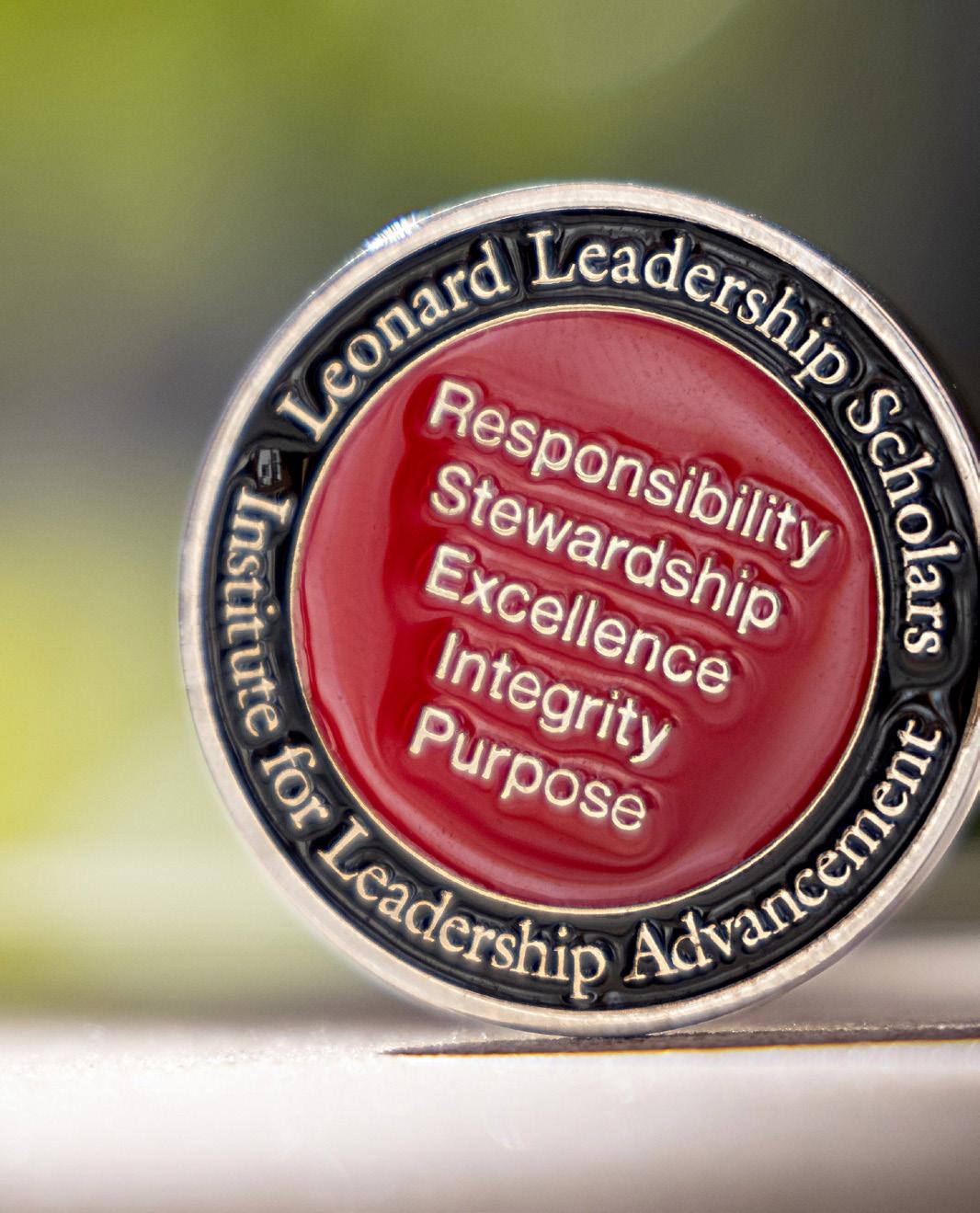
Responsibility, stewardship, excellence, integrity, and purpose. These are the core leadership values that the ILA looks for in students. Now, are these qualities innate or learned?
“For sure, some people are born with skills that predispose them to be great leaders,” says Stacy Campbell, PhD ’07, Synovus Director of the ILA. “But leadership is something you can teach.”
Campbell and the rest of the ILA team are dedicated to teaching those skills to students who go through their program. Not just the hard business skills but the socalled “soft” skills of relationship-building. Lesson one? Good leaders know themselves and know how to work with others.
“You’ve got to be able to motivate people, you’ve got to influence them to get results, and you’ve got to develop them. That’s what leadership is about,” Campbell says.
Stacy Campbell, a doctoral graduate of the Terry College of Business, is the Synovus Director of the ILA. One of the first lessons she imparts on students is that good leaders know themselves and know how to work with others.
BRIAN POWERS
Origin Story
In the 1990s, when Earl Leonard ABJ ’58, LLB ’61 was in his last decade at The Coca-Cola Company, he found himself unimpressed by the job candidates coming straight out of college. They lacked leadership skills. It made him think about how higher education might train future generations to be better leaders.
Leonard, a Double Dawg and former faculty member in the Grady College of Journalism and Mass Communication, naturally thought of the University of Georgia. He’d been president of the Alumni Association, helped start the Presidents Club giving society, and served on the Foundation board of trustees, as well as a host of other roles with the institution.
Upon retiring in 1999 as the company’s senior vice president for corporate affairs, Leonard and his wife, Bebe ABJ ’63, established the Bebe and Earl Leonard Leadership Scholars Program in the Terry College. The ILA program came about two years later.
“I wanted to do something to give back to the University of Georgia, which I credit with making me a successful person,” Leonard told Georgia Magazine in 2014 as part of a cover story on the ILA.
In the 25 years since its founding, the ILA’s leadership development programs have graduated more than 2,300 UGA students. And the bonds among ILA alumni are strong.
ILA Scholar alumnus Michael Lage BBA ’05, chief marketing officer at Chickfil-A, is part of a steering team that keeps Chick-fil-A connected to ILA leadership.
His experience with the ILA as a student is one that has guided his steps ever since he earned his certificate. And it’s a path that current students can follow. In their own way.
“The No. 1 realization of great leadership is that it’s not about you. It’s about others,” Lage says. “One of the most important questions ILA posed to us—and I still think about it today—is: Why would
The ILA’s Leadership Scholars Program is named for Earl Leonard and his wife, Bebe. The former executive of The Coca-Cola Company supported leadership education in Terry from the beginning.
anyone want to be led by you? Essentially, what are you bringing to the table that will create value for others? It’s this othersfocused, servant-based perspective on leadership that shapes how I try to lead today.”
ANDREW DAVIS TUCKER
ANDREW DAVIS TUCKER
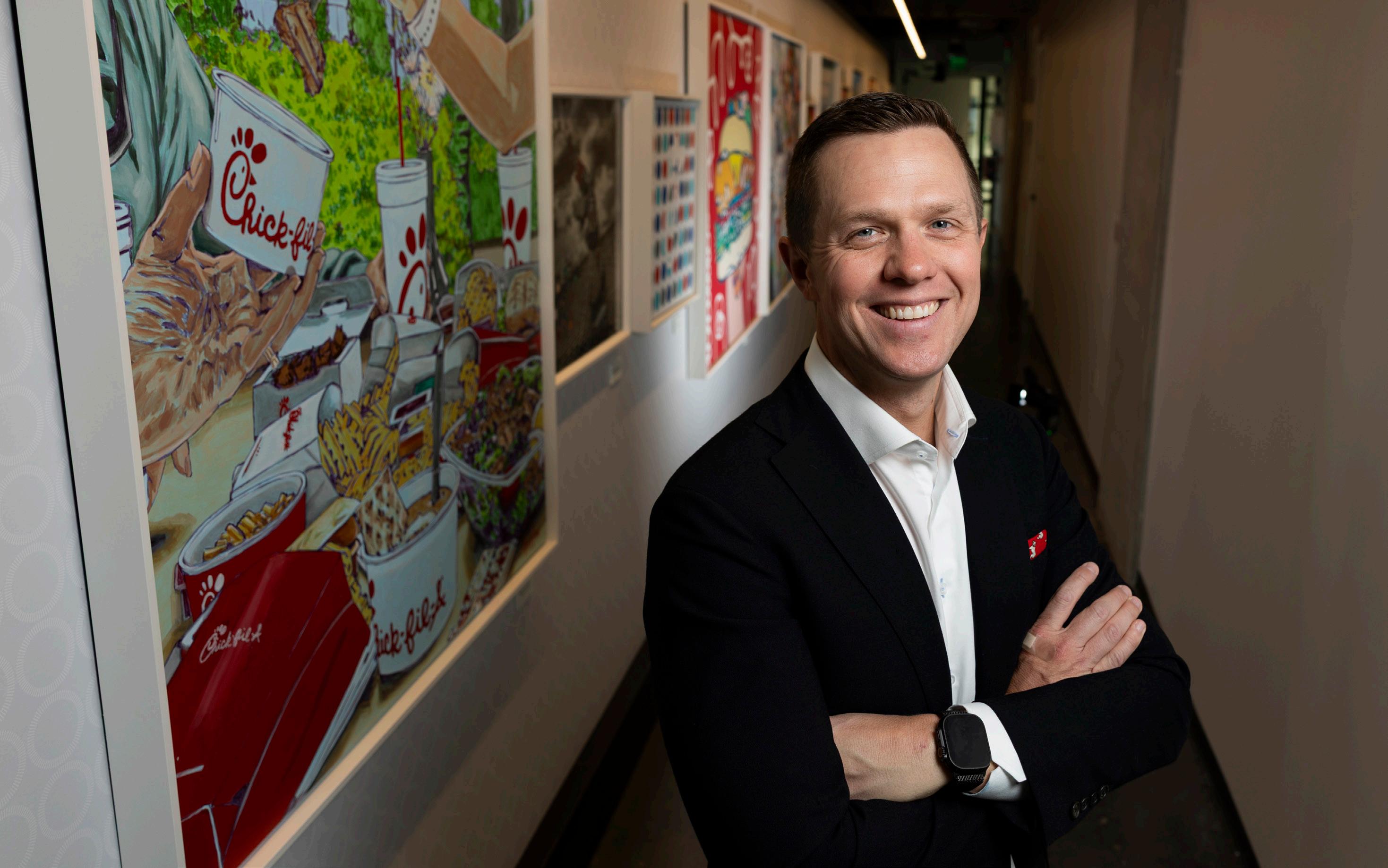
Michael Lage, chief marketing officer at Chick-fil-A, is an ILA graduate. He remains connected to the program, visiting campus to speak with students and also inviting them to tour Chick-fil-A’s offices in Atlanta.
ILA Scholars work hard learning about themselves, no doubt, but they also get to know their fellow students on deeper levels.
Just Asking Questions
The first semester of the ILA experience focuses on the students themselves.
“My favorite part is getting to know the students and seeing them gain confidence through self-discovery and relationship building,” says Courtney Aldrich MEd ’05, the ILA’s associate director.
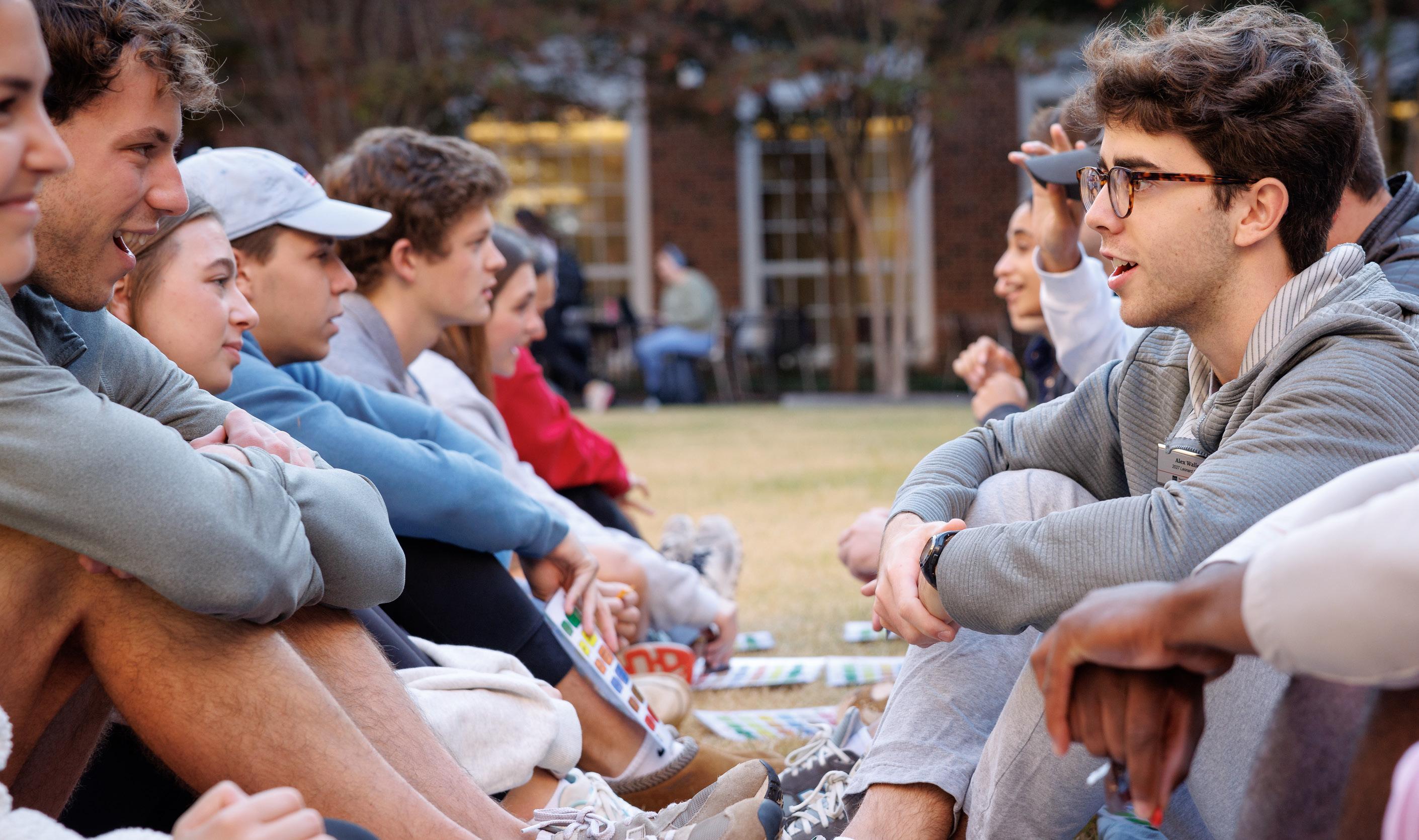
The students also get to know each other. One exercise Aldrich created is kind of an advanced ice breaker. Students sit across from partners and receive a color-coded chart. They’re given M&Ms. The color of the M&M corresponds to which question they ask. The practice of asking good questions and actively listening helps the students develop confidence in networking. Getting to eat the candy is a happy bonus.
“We get to learn about each other on a much deeper level throughout the semester,” says Emma Golota, a third-year marketing major from Gainesville, Georgia. “We talk about deeper topics and that makes us open up about the things that matter to us. ‘What’s your favorite book? What do you love to learn about?’ These may seem simple, but these are things we
don’t already know about each other.”
At the end of their first semester, both scholars and fellows put together a personal development and leadership plan (PDLP) that articulates their personal values, develops a leadership vision, assesses strengths and weaknesses, and creates an action plan.
“It’s really important to know where you excel,” says Asal Montazer, a third-year finance major from Marietta. “You can lean into your strengths and work on your weaknesses. Being able to know yourself at that level is important.”
brianpowersThat’s something Campbell likes to see.
“We give students time to reflect,” she says. “That’s one of the ways we teach values. Give someone time to think.”
“My favorite part is getting to know the students and seeing them gain confidence through selfdiscovery and relationship building.”
COURTNEY ALDRICH, ASSOCIATE DIRECTOR OF THE ILA
BRIAN POWERS
Making an Impact in the Community
The second year of the ILA experience focuses on organizational leadership and service-learning.
Students take what they have learned about themselves and work in teams on real challenges of a nonprofit or rural Georgia community. With this project they get to practice the skills they are learning but also begin to understand the importance of servant leadership. In working on these service-learning projects, ILA students are making a real impact in their community.
One of the strengths of the ILA program is its longstanding network of alumni who continue to invest in students long after graduation. With more than 2,300 alumni who stay actively engaged—mentoring current students, offering site visits, speaking in classes, and serving as professional resources—the program benefits from a built-in support system that reinforces student learning and opens doors to realworld opportunities. This consistent
involvement ensures that leadership development is not confined to the classroom but is reinforced through meaningful, ongoing relationships.
According to Samantha Brodrick, public relations specialist for the ILA, the steady flow of alumni and corporate partners returning to connect with students reflects something deeper than routine engagement.
“People come back because the relationships they build here matter,” she says. “There’s a sense of community—students want to hang out in the ILA suite with their faculty, graduates want to stay involved, students become alumni who do the same, and the cycle keeps strengthening the program.”
Support the ILA Scholars Endowment: T.UGA.EDU/ILA
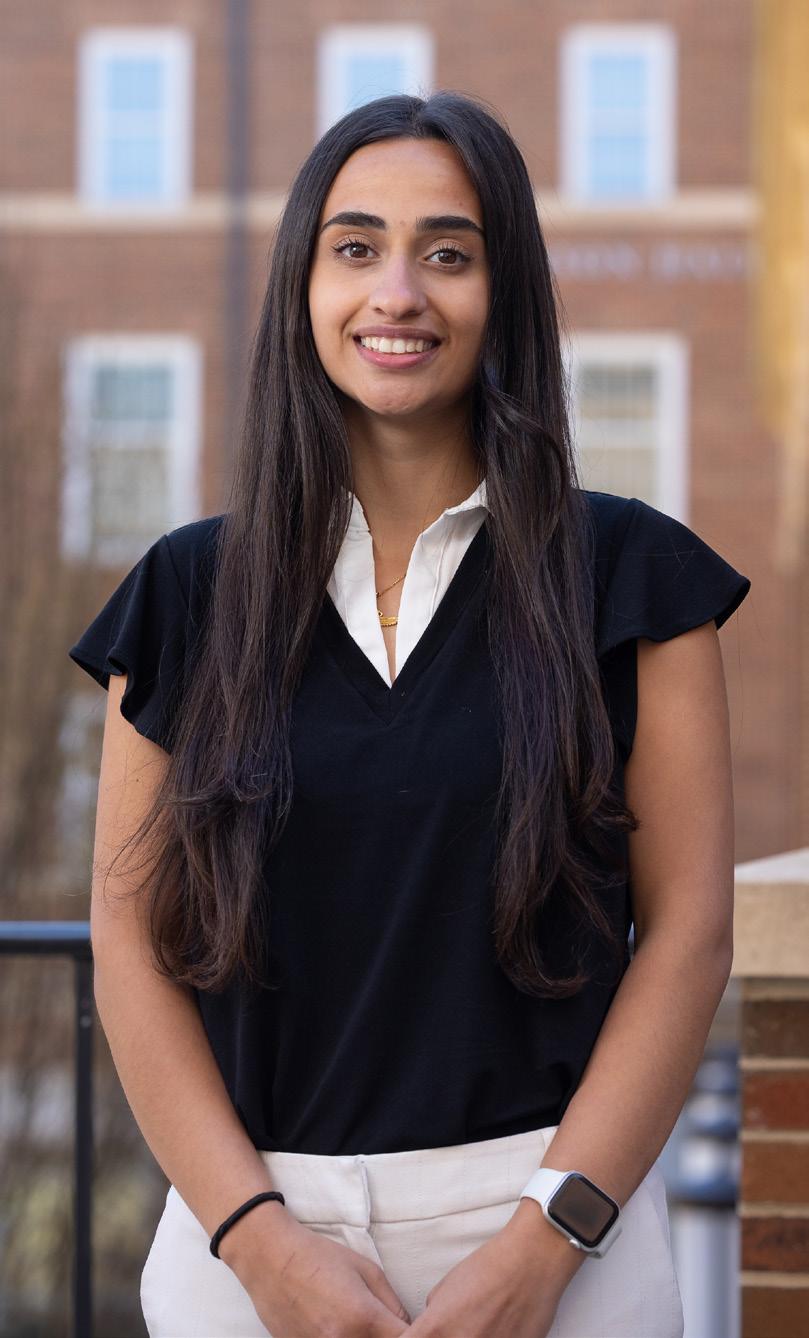
“It’s really important to know where you excel,” says Asal Montazer, a third-year finance major and first-year ILA Scholar. “You can lean into your strengths and work on your weaknesses.”
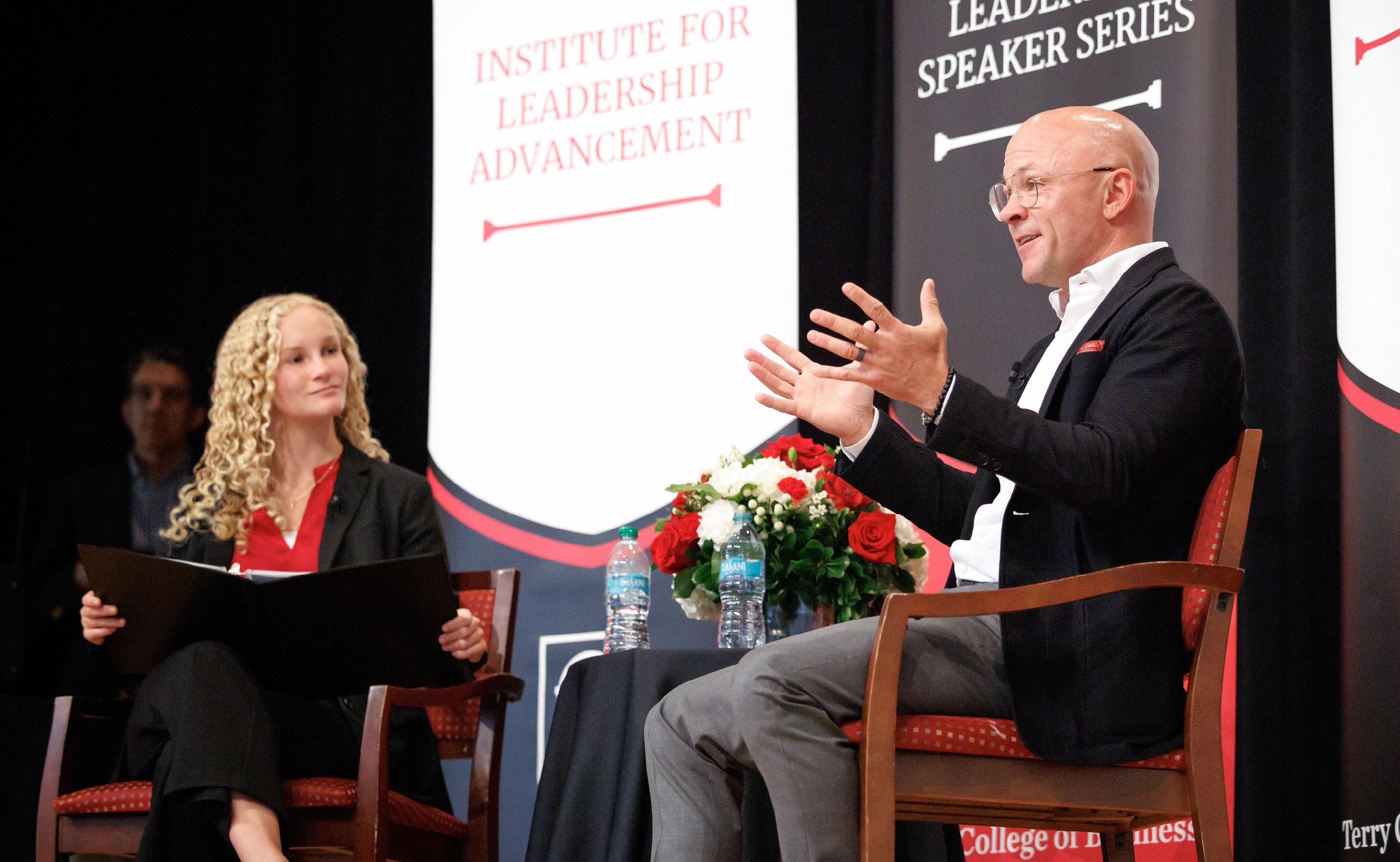
The ILA’s Shoukry Leadership Series features guests like Chick-fil-A CEO Andrew Cathy (right), who discussed his professional experiences with fourth-year ILA Leadership Scholar
Hailey Franz in September in the UGA Chapel.
BRIAN POWERS
BRIAN POWERS
WHAT’S IN A NAME?
UGA’s Love and Money Center has a new brand but the same mission.
What’s the last thing that stressed you out?
Chances are it’s one of the following: your job, your finances, your relationship, or your well-being. While these are common anxieties, they’re anything but simple to fix.
That’s why the University of Georgia’s Love and Money Center for Relational and Financial Well-Being—better known as the Love and Money Center—is such an apt name. It clearly signals a place designed to help people navigate some of life’s most complicated challenges.
Meeting People Where They Are
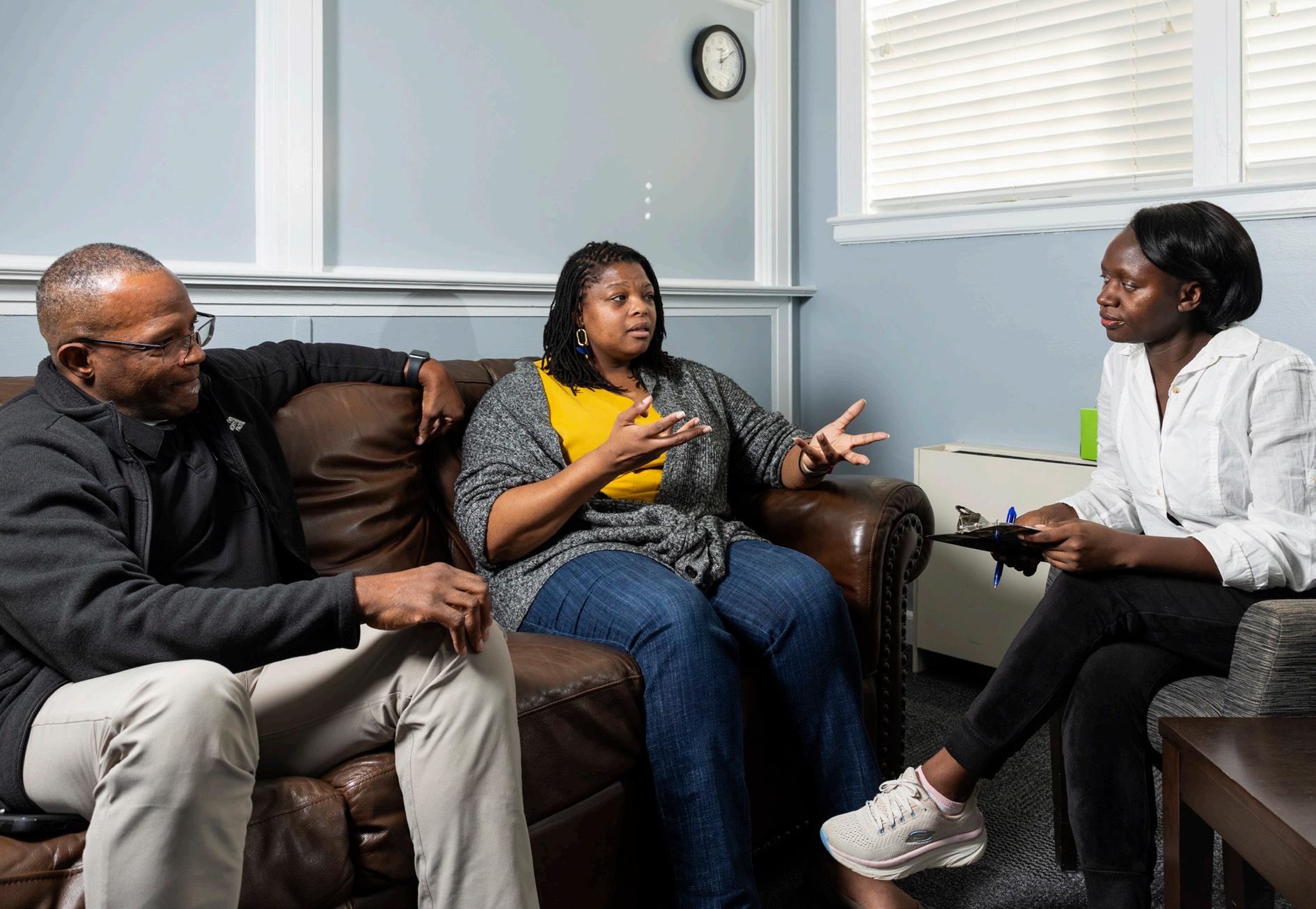
Situated on South Campus, housed within the UGA College of Family and Consumer Sciences (FACS), the center features eight comfortable rooms for individuals, couples, or families who have already taken the hardest step: asking for help.
There’s no shortage of people who need it. What’s in short supply is the number of professionals available to give it. Enter the Love and Money Center, where the next generation of helping professionals is learning how to meet that need.
“There are not enough trained mental health and financial professionals to meet the need in our state. We are dedicated to changing that story. We train our students to be compassionate and smart, and to have a systemic lens to really know how change happens,” says Christine Hargrove PhD ’24, the center’s assistant director. “What does it feel like to get better? If you
WRITTEN BY SAVANNAH PEAT AB ’19
have an idea of what the end game is— because you actually have some exposure to it through a center like this—it is so much easier to keep the end in mind and to have that ongoing momentum.”
Since its launch in 2009, the center has helped more than 3,000 people, offering specialized assistance in individual mental health, couple and family therapy, financial planning, or any combination of the above.
While some clients seek to solve one-off problems, others require a dozen dedicated sessions or may even come back to the center with a different issue years later.
It’s not just love or money (or both), however. The center houses a dedicated team of professionals-in-training who offer broad counseling on everything from navigating trauma to managing anxiety and
depression to improving work-life balance.
All the center’s services are either free or based on a sliding scale that is significantly lower than similar options without insurance.
The center also delivers services virtually, which not only fills a critical gap but also reflects its mission to reach as much of the community as possible.
“Clients can expect to feel embraced for where they are at this moment. That is our hope,” says center director Megan Ford PhD ’22. “It can be difficult and scary to approach change in your financial situation, your relationship, or your relationship with self. That can be tough, so I think first and foremost, we hope that people feel the warmth, acceptance, and dignity we provide.”
CHAMBERLAIN SMITH
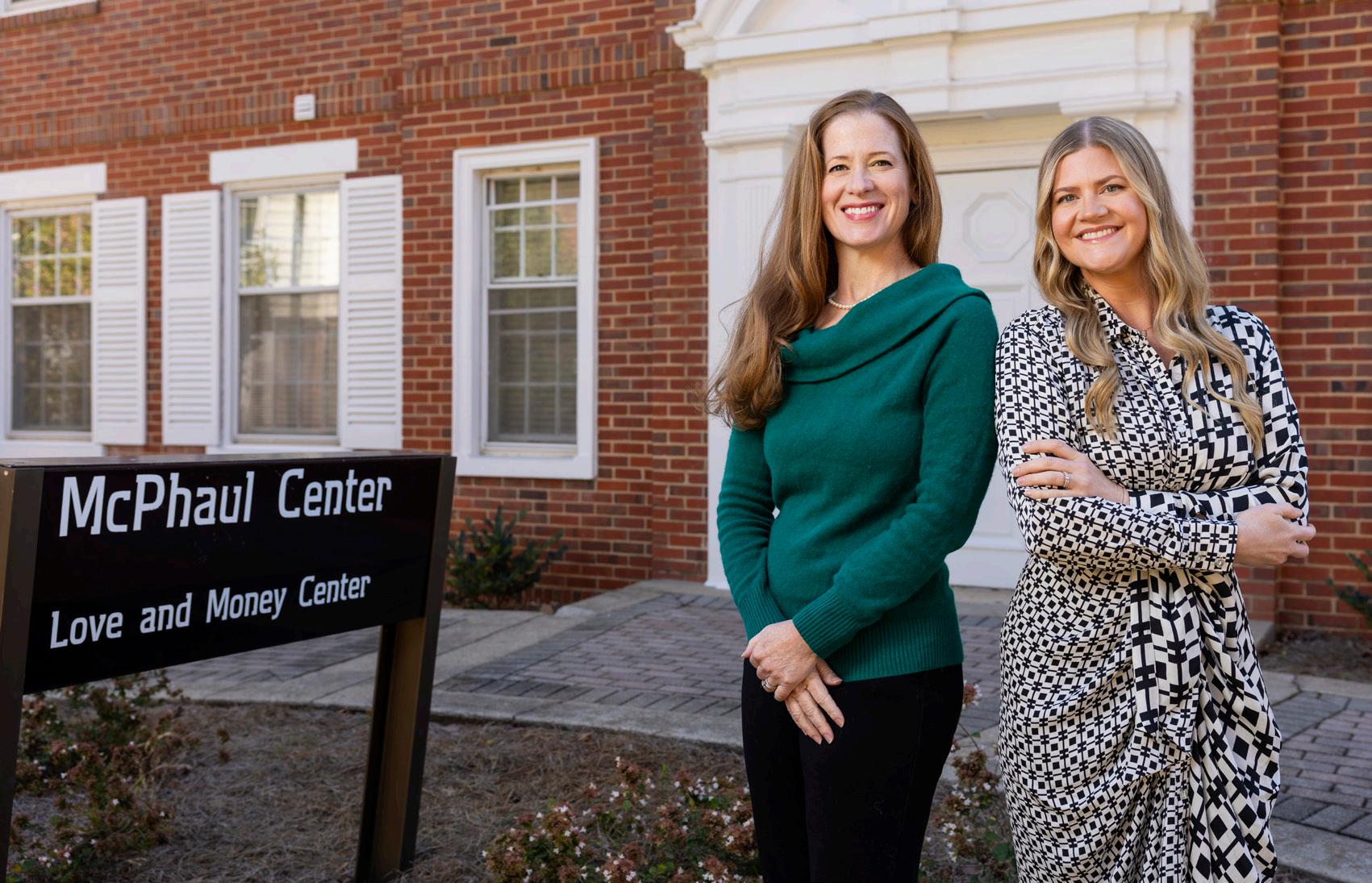
At the Love and Money Center, Christine Hargrove (left) and Megan Ford focus not only on providing counseling services but also on finding better ways to deliver them.
Tomorrow’s Practitioners Today
The Love and Money Center is appreciated not just for the outcomes it gives clients but also the opportunities it gives its students and faculty.
More than 550 undergraduate and graduate students across disciplines in FACS and beyond, get hands-on experience through the center before they enter their chosen fields. They observe interactions and conduct mock sessions. Some even provide services under the supervision of licensed professionals before they graduate.
“Part of our mission is to ensure that students feel more prepared for their career and go into it with eyes wide open. Many of them are out there as licensed or certified practitioners now serving their communities, and it’s just a really beautiful thing to see,” Ford says.
Faculty, too, are constantly evaluating how effective training at the center can be. If there are new tools or methods that could improve the work done at the intersections of love and money, Ford says they likely came from folks at the center.
One of those innovations is the emerging field of financial therapy. Rather than treating finances and emotional well-being as separate issues, the Love and Money Center has been a leading advocate for integrating the two, and it is one of the only centers in the country doing so.
“Financial therapy is not only what’s wrong, but what are we going to do about it? There are lots of complicated issues with money,” says Hargrove.
Love and Money and...
The center began its work many years ago as the McPhaul Marriage and Family Therapy Clinic. Then, it was known as the ASPIRE Clinic, an acronym that was easier to remember than its unwieldy official name: Acquiring Strategies for Personal Improvement and Relationship Enhancement. In 2024, FACS officially rebranded the ASPIRE Clinic as the Love and Money Center.
Through the years, hundreds of students have enhanced their counseling skills at the Love and Money Center before they even entered the field.
The new name for the center is setting the stage for its next chapter. As times become more complicated, the center offers approachable, client-centered solutions.
With such a significant focus on financial therapy, the Love and Money Center is poised to become the premier destination for training and research in this field of study, with two notable publications already coming out of the center’s data.
Ford says that as the UGA School of Medicine, School of Nursing, and FACS’s new
“Healthy trees produce good fruit, and it’s surprising sometimes how few people really understand what it takes to have healthy relationships, healthy families, even though we all desire it so much.”
CHRISTINE
HARGROVE, ASSISTANT DIRECTOR LOVE AND MONEY CENTER
Name changes aside, the center’s mission has stayed the same: help community members find holistic solutions to common but complex personal problems.
“We wanted to refine our identity to make ourselves more identifiable for what we’re about and what we excel at,” Ford says. “Those two words—love and money— are ones that people immediately get. And if people don’t understand what we do, if we’re not relevant and meeting the needs that exist right now, then we’re missing the point of why we’re here.”
Ralston Institute on Behavioral Health and Developmental Disabilities come to fruition, the university’s ability to help Georgians will only grow. And that’s pretty exciting for folks at the Love and Money Center.
“The rebrand was really just a next step, a next iteration in this journey to serve, research, and teach holistically,” she says. “This space is one of a kind. We want the Love and Money Center to be known nationally and internationally as the hub for relational and financial well-being.
“We’re not ambitious whatsoever,” Ford laughs. GM
How do you celebrate a second straight SEC championship? It just means more confetti.
BACK TO BACK
The Georgia Bulldogs dominated Alabama and won their second straight SEC title, 28-7. It’s Georgia’s third SEC title in the last four years and 16th overall.
WRITTEN BY ERIC RANGUS MA ’94 PHOTOGRAPHY BY ANDREW DAVIS TUCKER
While the 2025 SEC Championship game may have looked like a tight matchup on paper, once Georgia and Alabama took the field at Mercedes-Benz Stadium on Dec. 9, it quickly became clear that one team was rising to the occasion.
Georgia dominated every phase of the game, including the scoreboard, which ended 28-7 for the Bulldogs.
Offensively, Gunner Stockton—who was named game MVP— was 20-for-26 for 156 yards and three touchdown, while Georgia’s defense clamped down the Alabama attack throughout. The Crimson Tide managed 209 total yards and minus-3 on the ground. But it was a special teams play that gave Georgia the momentum it never lost.
Senior Cole Speer blocked an Alabama punt, which the Bulldogs recovered on Tide’s 21-yard-line. Four plays later, Stockton hit fullback Roderick Robinson for a 1-yard score, and Georgia never looked back.
The victory avenged the Bulldogs’ only regular season loss of 2025—a 24-21 defeat on Sept. 27 at the hands of the Tide that also snapped Georgia’s 33-game wining streak at Sanford Stadium. It also marked Georgia’s first victory, in five tries, over Alabama in the SEC title game.
Georgia, which entered the game ranked No. 3, qualified for the College Football Playoff at the same spot and was joined by four other SEC teams: Ole Miss, Oklahoma, Texas A&M, and Alabama. No other conference had more than three teams selected.
Georgia’s defense harassed Alabama quarterback Ty Simpson all night. The Bulldogs sacked him three times, intercepted him once, and held the Tide to just 209 total yards. Most of those came in the fourth quarter when the majority of Alabama fans were sitting in traffic.
UGA XI always draws a crowd.
The Bulldogs didn’t look back after Nate Frazier’s 9-yard touchdown gave them a 21-0 lead in the third quarter.
COMMENCEMENT CLASSICS
The
traditional
items that welcome each new class of UGA alumni.
WRITTEN BY KRISTEN LINTHICUM AB ’09, PhD ’18
ILLUSTRATED BY KAIYA PLAGENHOEF
The University of Georgia celebrates its graduates at spring and fall Commencement ceremonies. Whether graduates are attending the spring undergraduate ceremony in Sanford Stadium or the graduate ceremonies in Stegeman Coliseum, they see and wear specific items that carry forward the university’s storied traditions.
Class Rings
The Mace and Breastplate
Gonfalons
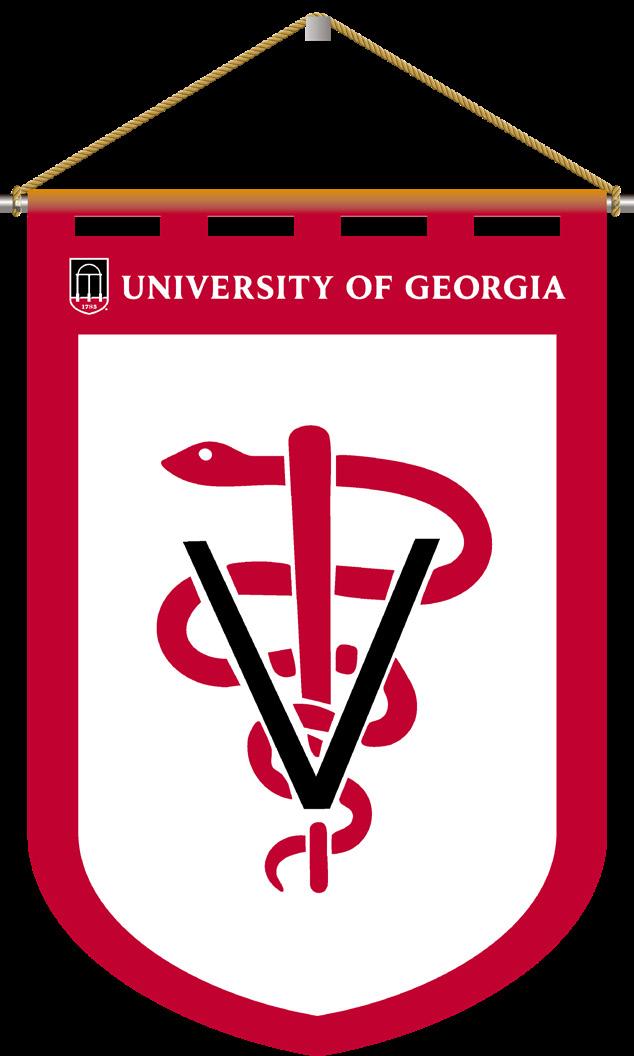
Gonfalons are banners that represent each of UGA’s 20 schools and colleges. The College of Veterinary Medicine can be seen above. The tradition of gonfalons stems from the medieval republics of Italy as an ensign of state or office and have been adopted by colleges and universities around the world. At UGA’s Commencement, the gonfalons are marched into the ceremony as part of the processional and are positioned on the stage for the entirety of the ceremony.
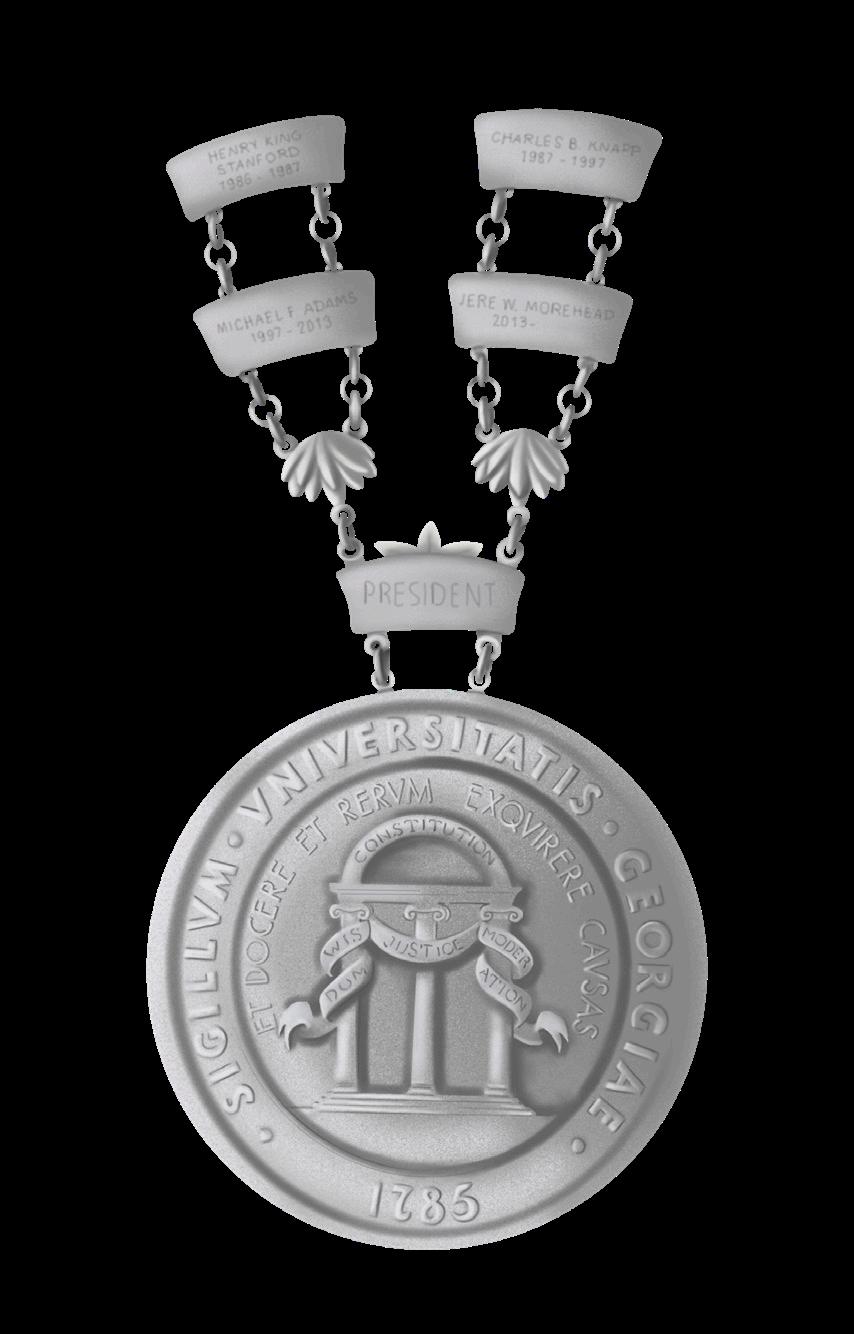
The mace and breastplate have traditionally symbolized leadership and authority since the Middle Ages. Their use became a tradition at the university in 1968, after art professor Robert Ebendorf was commissioned to create the items for the inauguration of UGA’s 17th president, Fred C. Davison DVM ’52.
UGA’s Commencement Ceremony begins with an academic processional led by the Grand Marshal, the faculty member who carries the mace. It features the university’s seal and is engraved with the name and founding year of each of UGA’s 20 schools and colleges.
Continuing a tradition that began in 1968, President Jere W. Morehead JD ’80 wears the breastplate and chain of office over his academic robe at each Commencement ceremony. The breastplate displays the University of Georgia seal, and the chain names each UGA president and his years of service.
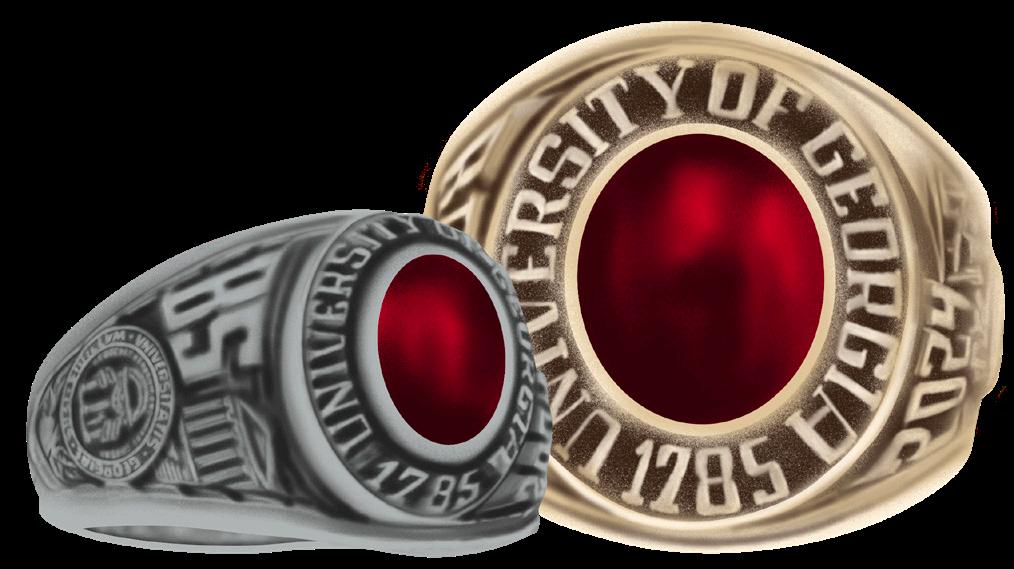
The tradition of the class ring began at UGA in 1923 when juniors and seniors created the official Senior-Alumni Ring. The current ring, which features many of the traditional ring’s elements, was redesigned in 2005 by a group of students, administrators, and alumni. UGA students are eligible to purchase a class ring when they have earned 60 or more credit hours.
Graduation Gowns
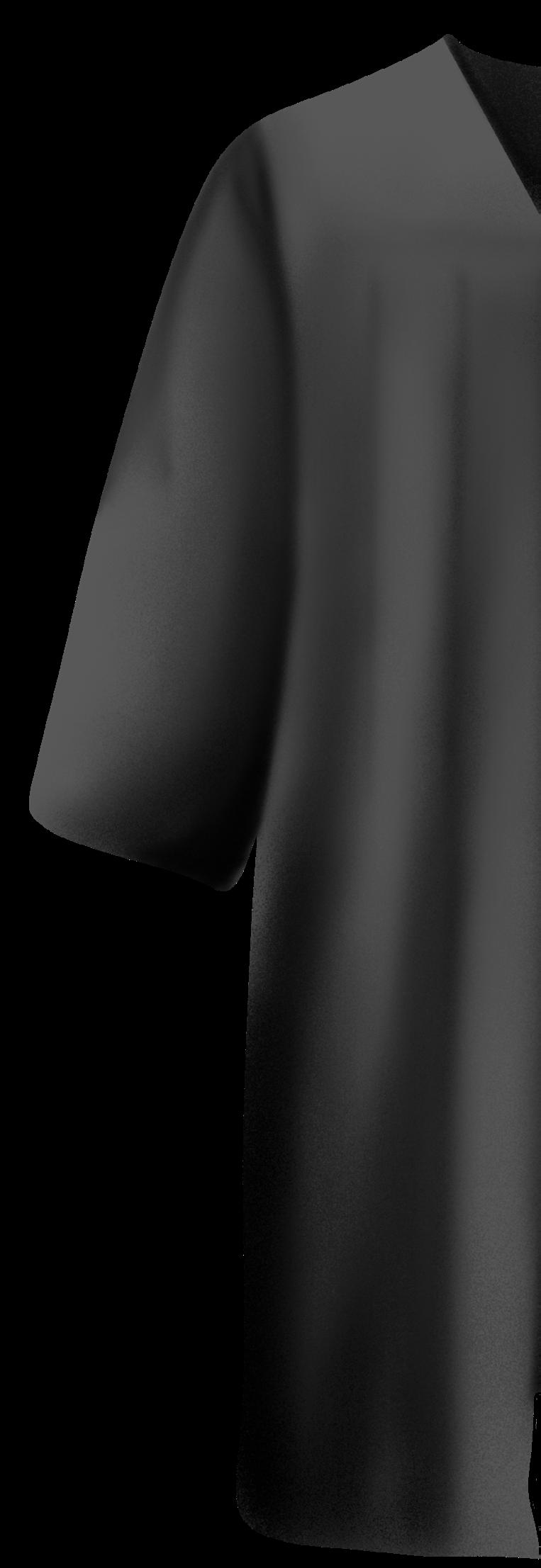
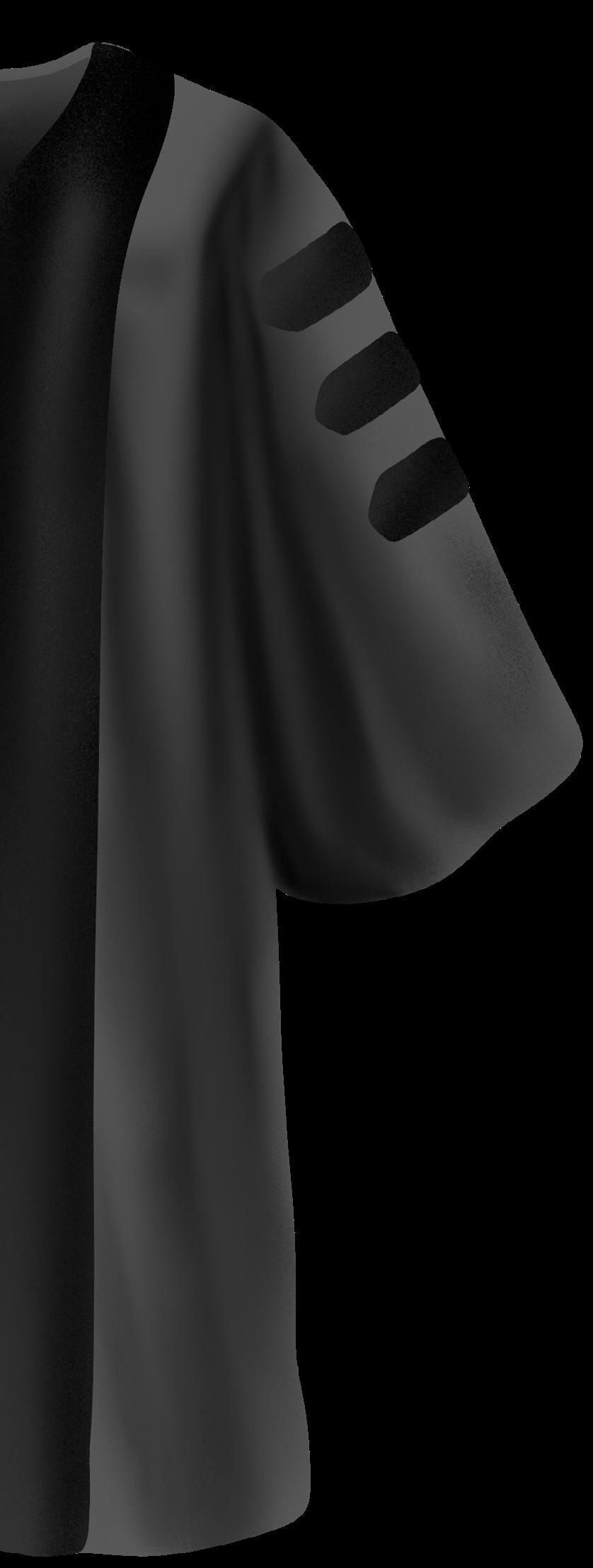
Both the bachelor’s and master’s gowns worn by graduates at Commencement are black and zip up the front, but they differ in sleeve design. Bachelor’s degree recipients’ sleeves are long and pointed, and master’s gowns have oblong sleeves open at the wrists. Doctoral robes have velvet facings down the front and velvet stripes on the bell-shaped sleeves.
Tassels
Worn on graduates’ caps, tassels are positioned to the right of each graduate’s face when the Commencement ceremony begins. Once degrees are conferred, the new graduates shift their tassels to the left. Each tassel color, shown below, represents an academic area of study. For instance, students who studied agriculture wear maize tassels, and education graduates wear light blue.
Bachelor’s degree candidates who are graduating with honors are eligible to wear tassels representing their academic accomplishments. Graduates with the distinction of Summa Cum Laude wear a red, silver, and black tassel. The Magna Cum Laude distinction is represented by a red and silver tassel. Those who are graduating Cum Laude wear a red and black tassel. A braided cord called a fourragere is on the left shoulder of each First Honor Candidate.
Master’s and Doctoral Hoods
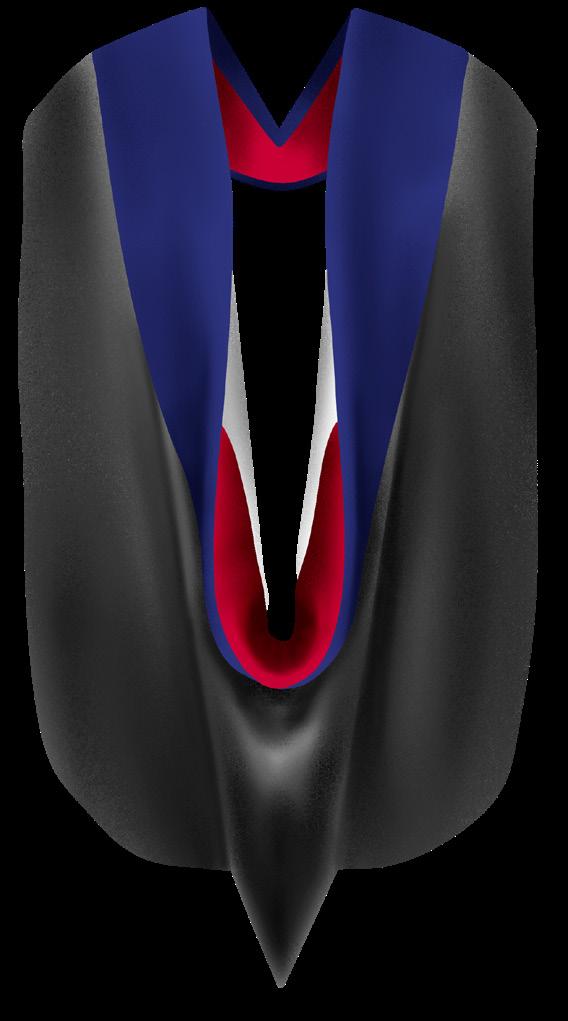
Master’s and doctoral candidates wear hoods over their robes. The University of Georgia’s hoods are lined in silk and decorated in UGA’s signature red and black. The binding of each hood is velvet and represents the color of the subject studied by the graduate, corresponding with the traditional tassel colors. The purple in the example below represents law.
Undergraduate and master’s degree candidates wear mortarboard caps with a black cloth cover.
Master’s gown sleeve
Bachelor’s gown
Doctoral robe
Doctoral candidates wear a softer, circular cap with a gold tassel called a tam.
What color is your college’s tassel? Find out
don't miss out!
DAWG DAY OF GIVING
March 26
Get ready for the 24-hour fundraising spectacular! We’re calling all Dawgs to make any gift of any size to any area of campus you’re passionate about. Will you answer? Learn more at givingday.uga.edu
SENIOR SIGNATURE DEADLINE
March 31
Students graduating in May, August, or December 2026 can make a $30 gift to any area of campus that enhanced their UGA experience. Deadline to give is March 31. Learn more at alumni.uga.edu/seniorsignature.
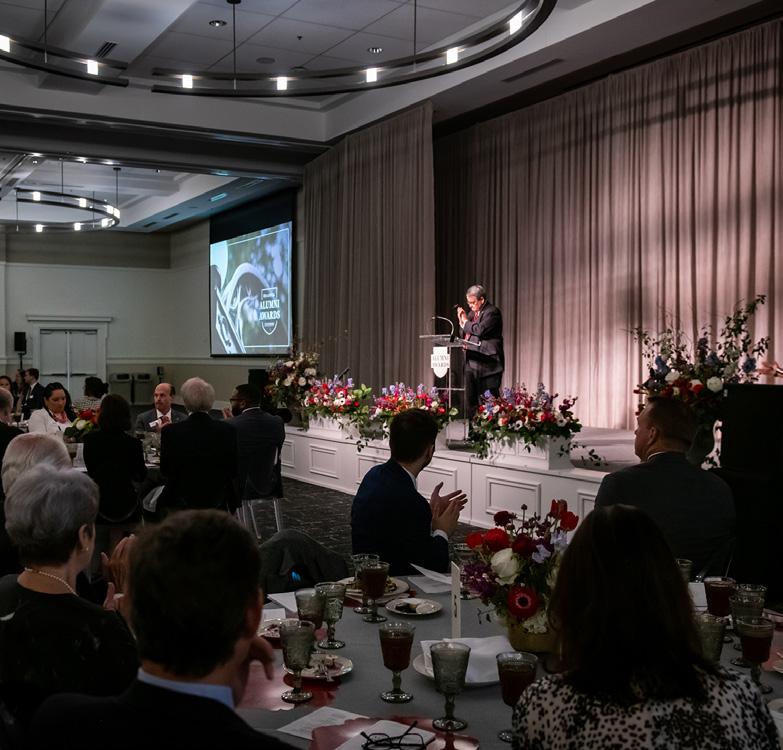
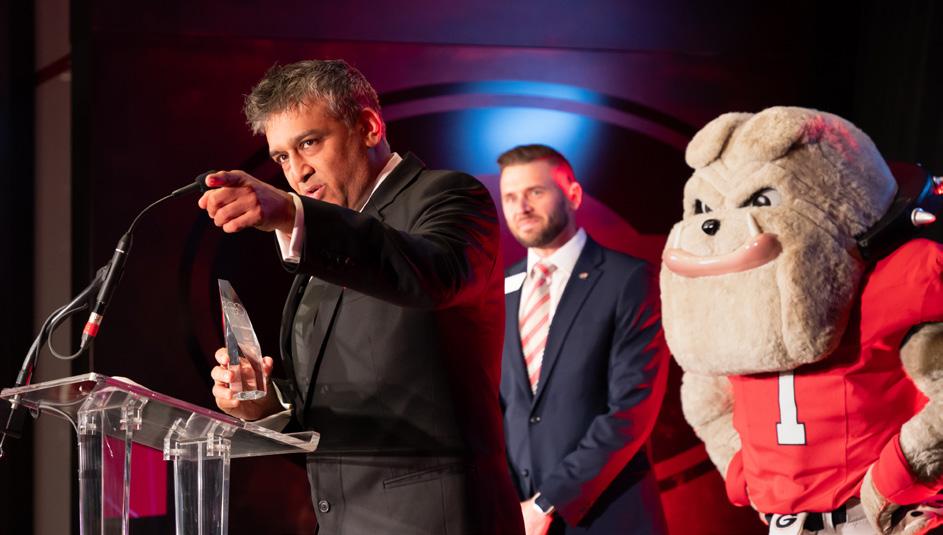
89TH ANNUAL ALUMNI AWARDS LUNCHEON
April 2
The university will celebrate this year’s honorees for the annual Alumni Merit, Family of the Year, Faculty Service, and Young Alumni Awards. Honorees will be announced in April at alumni.uga.edu/alumniawards
BULLDOG 100 CLASS HONORED AT UGA
Smyrna-based KBH Industrial landed at the top of the 2026 Bulldog 100 list. Every February, UGA recognizes the 100 fastest-growing businesses owned or led by alumni. Companies are ranked based on their compounded annual growth rate for the previous three years. Learn more about the program at alumni.uga.edu/b100.
chapter spotlight
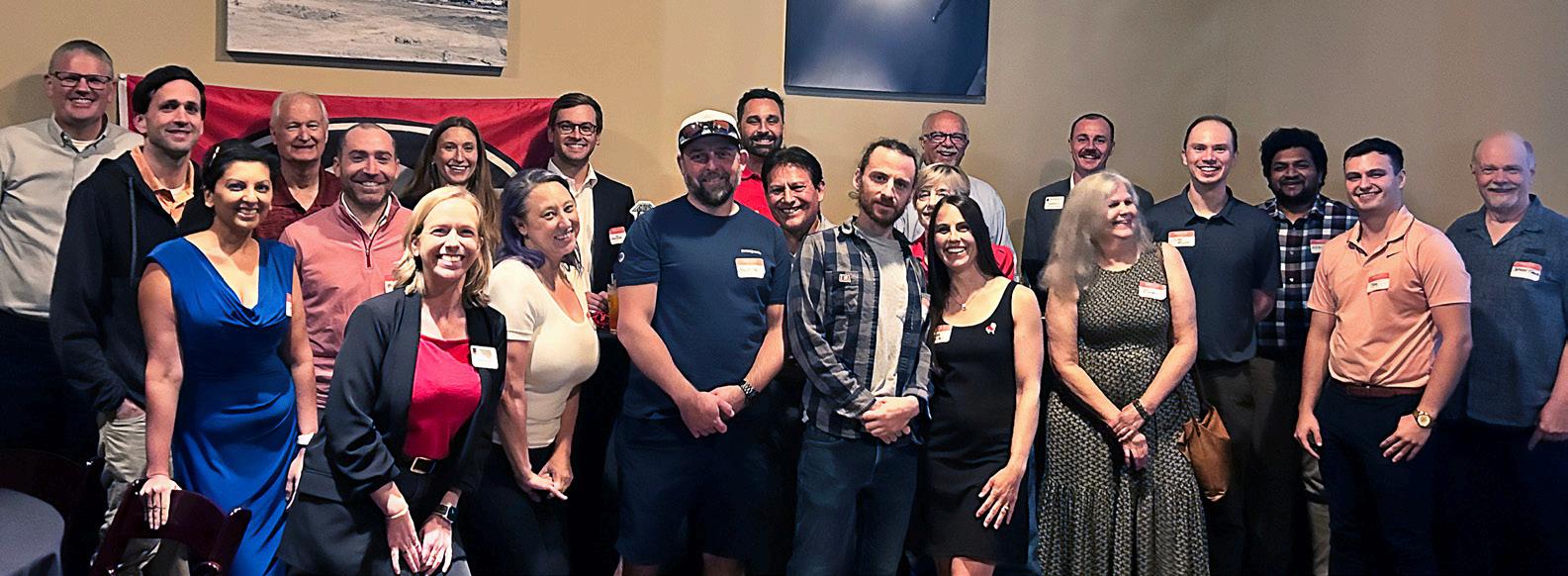
HOUSTON CHAPTER
Chapter President: Katie Wesche AB ’12
Number of Local Alumni: 1,905
The Houston Chapter keeps the Bulldog spirit alive and well in its corner of the Lone Star State. Houston-based alumni organize events throughout the year to share the expertise and connections of UGA with their fellow alumni. In October, the chapter partnered with UGA’s Department of Geology to host professor and department head Adam Milewski (left) for a networking event. Milewski discussed the role of geoscience in addressing challenges such as securing critical minerals, transitioning to cleaner energy sources, managing water resources, and building more resilient communities.
SCHOLARSHIPS AT UGA
The University of Georgia has launched a bold scholarship initiative to attract top academic talent and reduce overall student loan debt. With an initial fundraising goal of $75 million, the campaign aims to provide greater resources and stronger incentives for students to choose a UGA education and to ensure affordability for current and future generations of Bulldogs. Learn more at give.uga.edu/scholarship
GIVE BULLDOGS A BOOST IN THE JOB MARKET!
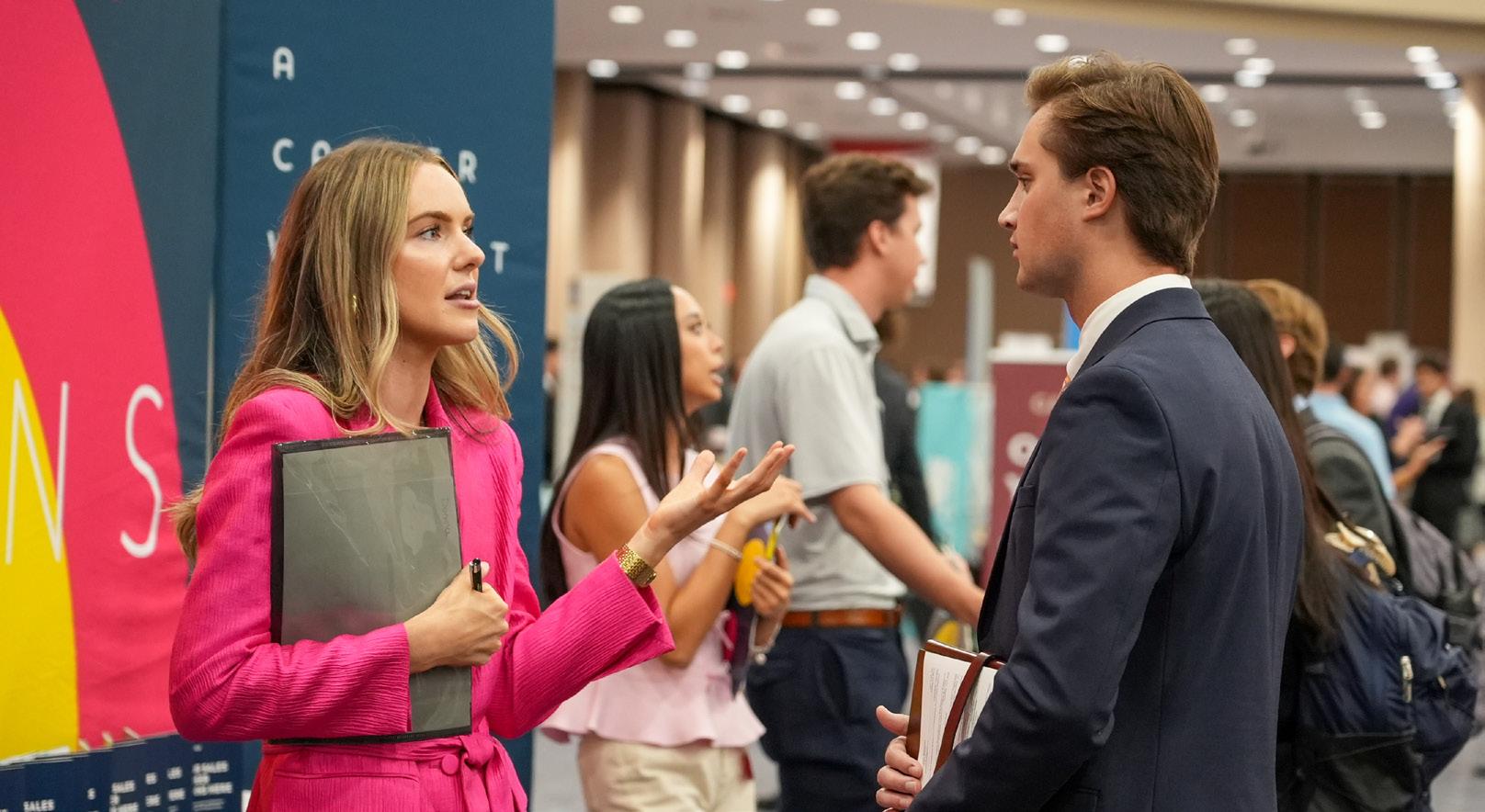
Entering a highly competitive professional job market can be daunting. Through the UGA Career Center, you can support students as they launch their careers. Alumni and businesses can register for upcoming webinars at career.uga.edu/calendar/alumni_events and offer students hands-on industry experience by participating in Intern for a Day at career.uga.edu/hireuga/ifad. Inspire the next generation by joining the UGA Mentor Program at mentor.uga.edu. Or recruit talented Bulldogs at a UGA Career Fair and post job openings at career.uga.edu/hireuga.
and update your email or mailing address with UGA.
LOGAN LEWIS
CHAMBERLAIN SMITH
class notes
ALUMNI PROFILE
A Coming Back Story
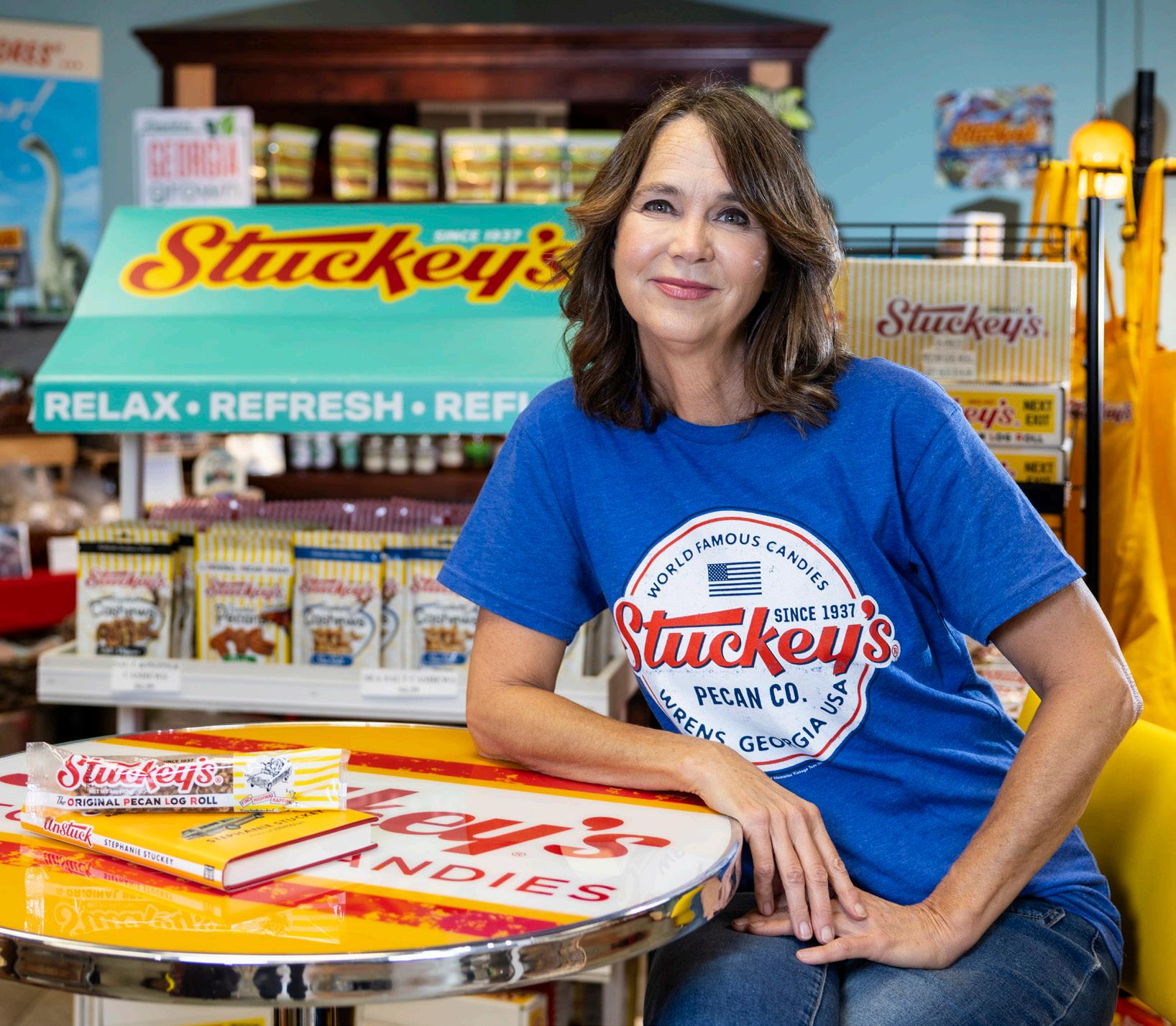
Try googling “Stuckey’s” and “comeback.” You’ll get a lot of results.
For Americans of a certain age, the classic brand represents the excitement and unlimited possibilities of the open road. At its peak, the Stuckey’s chain of innovative roadside convenience stores— famous for its kitschy souvenirs, pecan log roll candies, and other tasty treats— boasted some 370 locations across 30 states.
For Americans of a slightly younger age, Stuckey’s is perhaps most remembered for the crumbling remains of those once vibrant stores. The late 20th century was not kind to Stuckey’s as its once innovative niche was usurped by the Wawas, QTs, and Buc-ee’s of the world.
But in recent years, a new story has emerged.
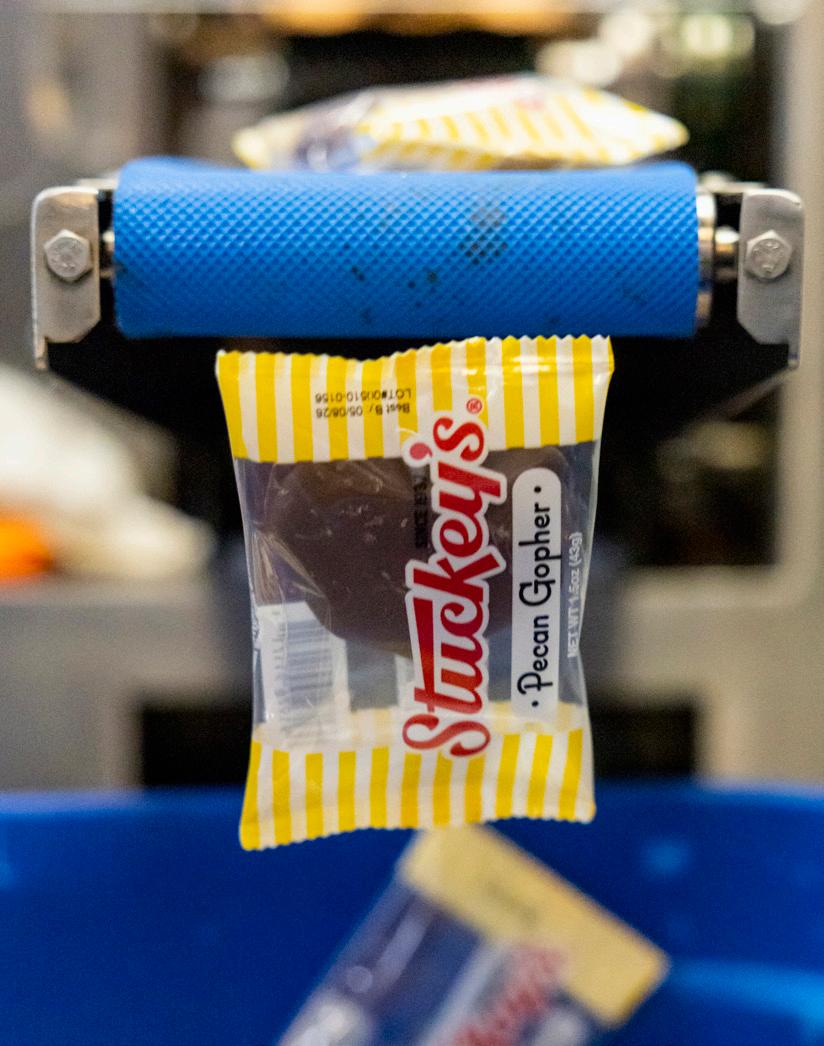
The Stuckey’s brand has refocused and returned to its roots as a pecan and candy company. And it’s becoming more popular—and profitable—each year.
A comeback?
Don’t call it that.
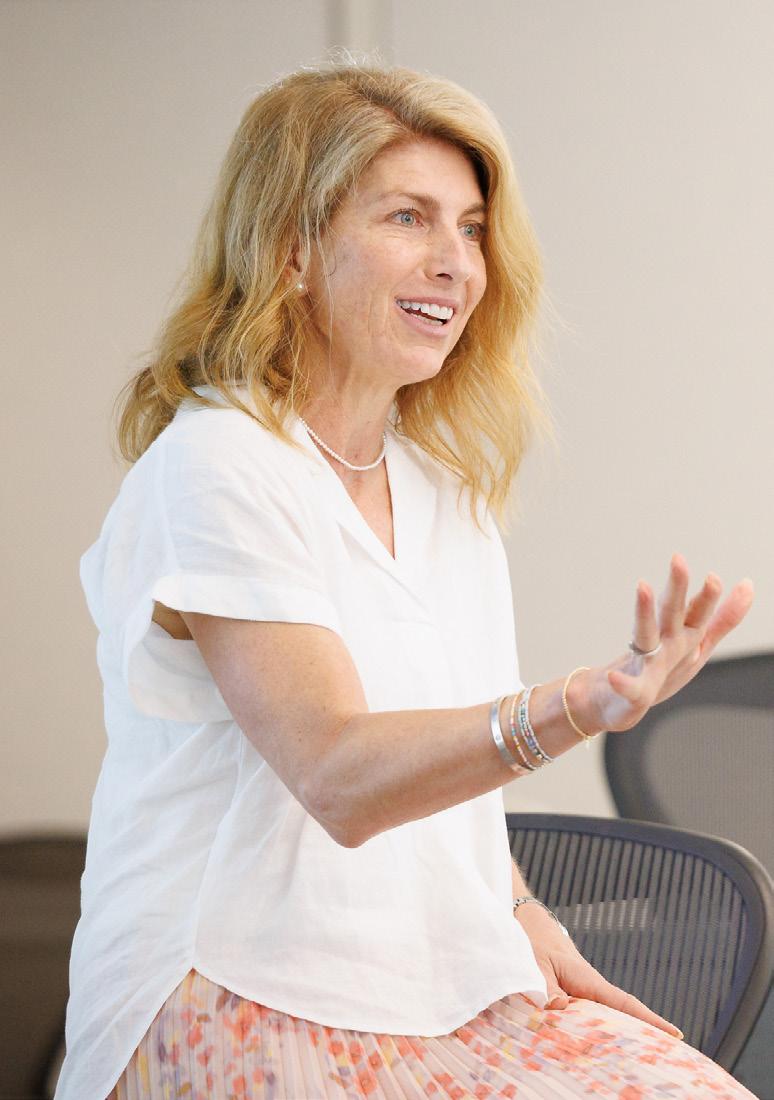
“It’s a ‘coming back’ story,” says Stephanie Stuckey AB ’88, JD ’92, the company’s chair and the granddaughter of its founder. “It’s an action word. And we’re not there yet.”
And Stuckey is all about action. Since the day she used her own money to buy the company from investors in 2019, Stuckey has worked ceaselessly to revive it. She streamlined its business, brought in new partners, opened a factory, and refreshed the Stuckey’s look. She travels anywhere and everywhere to personally promote Stuckey’s products, handing them out from the trunk of her car.
Just like her grandfather did.
Compiled by Maura Rutledge and Caroline Newbern
When Stephanie Stuckey purchased the company her grandfather started in the 1930s, it was barely hanging on. In 2024, Stuckey’s revenues rose to more than $10 million.
Hitting the Road
Stephanie Stuckey was born in the tiny town of Eastman (pop. 5,513), southeast of Macon, but she grew up in Washington, D.C.
That’s where her father, Rep. Billy Stuckey BBA ’56, LLB ’59, served five terms in Congress. But the company’s story starts with Stephanie’s grandfather, Sylvester.
In 1937, amid the Great Depression, Sylvester Stuckey dropped out of the UGA School of Law. To make ends meet, he sold pecans and pecan treats made by his wife, Ethel, first from the back of his truck and then from a roadside stand. And that’s where the Stuckey’s brand was born.
Through World War II and into the interstate age of the 1950s and 1960s, blue-roofed Stuckey’s stores stood as an
CHAMBERLAIN SMITH
1960-1964
Arnold Young BBA ’63, LLB ’65 is listed in The Best Lawyers in America 2026. He is an attorney at HunterMaclean.
1965-1969
Vince Matthews BS ’65, MS ’67 won the 2024 Outstanding Scientist Award from the Rocky Mountain Association of Geologists, and his book Land of Ice: Jaunts into Colorado’s Glacial Landscape is a 2025 winner in the Colorado Book Awards.
carried her family name, but she worked hard to establish herself beyond it.
She worked as a public defender in DeKalb County before opening her own firm. In 1999, Stuckey entered politics and served seven terms in the Georgia House before stepping away to lead an Atlantabased public interest law firm. Stuckey followed that up by serving in two different roles with the City of Atlanta.
A Brand Worth Saving
All her life, Stuckey heard stories from friends, family, and even strangers about what Stuckey’s meant to them. More than just a store, Stuckey’s was a meeting point, an oasis, an escape. It’s those stories that helped inspire Stuckey to reclaim her family’s company.
David Sipple AB ’66, MPA ’69 is listed in The Best Lawyers in America 2026. He is an attorney at HunterMaclean.
Betty Biddle BSHE ’68, MEd ’75 retired from 35 years of teaching at Roswell High School in Fulton County. She served as the department head of Family and Consumer Sciences.
Stuckey’s fresh ideas include a pivot away from roadside locations. Fewer than 20 freestanding Stuckey’s stores exist these days. Now, the focus is leveraging its increasingly robust online business and getting Stuckey’s products on grocery and convenience store shelves. The brand is now available in more than 4,000 retail locations nationwide. The new efforts are paying off. Sales across the board have increased each year since Stuckey bought the company, and in 2024, revenues rose above $10 million.
Becoming UnStuck
Stuckey lives in Atlanta but doesn’t spend a lot of time there. Instead, her life resembles one big road trip.
integral part of the American road trip. They stayed that way until Sylvester, tired from the grind, sold the brand to corporate interests, which treated Stuckey’s as an afterthought. A slow, steady decline followed.
By the time Stephanie came along, even though stores carried her name, she didn’t feel particularly attached.
“We took road trips, and we’d stop at Stuckey’s, but it wasn’t like I thought a lot about it,” Stuckey says.
After earning her bachelor’s in French and a law degree from UGA, Stuckey didn’t exactly run away from the brand that
Written by Eric Rangus MA ’94
“There are these special brands and places that are part of our shared collective memories, and a lot of them are going away,” Stuckey says. “I just think these things are worth saving. And how often do you get a chance to bring back a nostalgic brand that has your family name on it?”
UGA helped get her started.
Stuckey worked with UGA’s Small Business Development Center (SBDC) to draft the company’s first business plan. The SBDC also lent a hand with Stuckey’s first marketing plan, as well as a merger plan with R.G. Lamar’s Front Porch brand pecans. That led to the purchase of a roughly 46,000-square-foot facility in Wrens, 90 minutes southeast of Athens, that serves as Stuckey’s candy factory and corporate headquarters.
It’s all part of Stuckey’s (the business and the person) new story.
She’s in Wrens a couple days a week, pitching in whenever needed and running the headquarters’ charming gift shop. Stuckey is the company’s lead marketer, and she runs the website. She is also an in-demand speaker, meeting with audiences of all types. And she is a fixture at fairs and festivals, selling Stuckey’s treats out of the back of her car—just like her grandfather. For fans who can’t meet Stuckey in person, her social media presence is energetic and irreverent.
In 2024, she released her memoir, UnStuck: Rebirth of an American Icon, which dives deeper into the Stuckey’s story that she writes and rewrites every day.
“I haven’t quite decided what that moment of success will look like,” Stuckey says. “Sometimes I think of it in terms of how much revenue we make. But the more I think about it, success means that we are making a difference in people’s lives. That’s really what it’s about.”
Stephanie Stuckey AB ’88, JD ’92
Stuckey’s harvests its pecans from local growers. Those nuts find their way into various treats that are produced at Stuckey’s candy factory—and corporate headquarters—in Wrens, 90 minutes southeast of Athens.
CHAMBERLAIN SMITH
1970-1974
Byron Edwards BSEd ’70 released the contemporary inspirational novel Living In the Light, now a No. 1 bestseller on Amazon.
Nancy Donaldson BSEd ’71, MEd ’72 is a real estate agent at HM Properties. She also served as a public school teacher, caterer, and community volunteer.
Maxine Clark ABJ ’71 is the founder and former CEO of BuildA-Bear Workshop, which was inducted into the International Toy Hall of Fame in 2025.
Charles Green Jr. BLA ’71 retired as an architect after more than 25 years of practice and over 16 years with Smoak Design.
Robert Laney BBA ’71 retired from the South Carolina Department of Labor, Licensing, and Registration after 43 years of service.
Michael Mizell BBA ’73 is the founder and director of The Colonel’s Cup Foundation, a nonprofit dedicated to helping veterans and their families.
1975-1979
Rebecca Brown BSEd ’75, EdS ’04 retired as a family and consumer science teacher at North Hall High School in Gainesville, GA. She now works part time for Jostens selling class rings and graduation needs.
Larry West BBA ’75 is the senior pastor of Mount Airy Baptist Church in Washington, DC, and is the former chairman of the board of directors for the National Baptist Convention USA.
William M. Edge Jr. ABJ ’76 was elected quartermaster of the John L. Whitworth Veterans of Foreign Wars Post 5897 in Lavonia.
Jan Cress Dondi BSHE ’77 wrote the narrative nonfiction book, The Navigator’s Letter: The True Story of Two WWII Airmen, a Doomed Mission, and the Woman Who Bound Them Together, which was released by Hachette in February.
Regina Downey BSA ’79, DVM ’83 has practiced veterinary medicine for 42 years and is the owner and founder of Holistic Animal Healing Clinic in Exeter, NH.
Chip Stewart ABJ ’79 retired from Atlanta-based Cookerly Public Relations, concluding a career that included 12 years in broadcasting and 39 in communications. He will continue to provide consulting services to the firm.
1980-1984
Ira Gleser BBA ’81 published Stewardship for Business, a book on customer relationship management.
Chris Phillips BSFR ’83, MFR ’85, JD ’88 was listed in The Best Lawyers in America 2026. He is an attorney at HunterMaclean.
Marshall Welsh ABJ’ 84 is an American Culinary Foundationcertified executive chef and is the chef manager at Ole Miss Dining in Oxford, MS.
1990-1994
Tracy Coley ABJ ’90, MFA ’19 launched Lucky Dog Press, a boutique hybrid publishing firm providing comprehensive services in writing, editing, and design for news/magazine feature and book-length work, including narrative nonfiction, memoir, biography/ autobiography, poetry, and fiction.
Jack Selman Jr AB ’91 has worked on the shuttle program for the Kennedy Space Center for more than 30 years.
Chris Allen BBA ’92 is chief financial officer for the University of Chicago Medicine Health System.
Paul Grosswald BBA ’92 is a certified public accountant with more than 30 years of experience in strategic planning, mergers and acquisitions, and financial management.
Tony Chimera MBA ’93 was promoted to chief administrative officer at Westfield Specialty Insurance.
The Good Fight
When Jeff Yarvis began his studies in social work, he had never even heard of the role that would form the core of his 34-year Army career.
Yarvis PhD ’04, a licensed clinical social worker, built that career at the intersection of the military and mental health. The two interests collided in 1993 while Yarvis was completing his graduate degree in social work and met an Army social worker for the first time.
“I had no idea that the Army had social workers,” says Yarvis, who retired as a colonel in 2021. “I got the opportunity to combine the two things I wanted to do. A month out of graduate school, I got deployed with my first unit as a combat social worker, and I fell in love with all of it.”
Written by Sarah Lippert
Over the next decade, Yarvis completed several deployments and earned numerous decorations including the Bronze Star and Combat Action Badge. He also earned two additional academic degrees, got married, and had two children. In the meantime, Yarvis was presented with the opportunity to get his doctoral degree in social work, paid for by the Army. By this point, he had found his niche in providing mental health services and support to soldiers.
“The U.S. military is a representative sample of the U.S.,” Yarvis says. “We have all the same problems—scarcity, racism, sexism, even homelessness—that require the skills of a social worker. And I’ve always thought I could have a greater impact from within this system than outside of it.”
Yarvis was drawn to the UGA School of Social Work’s rigorous research, which helped him focus on creating impact from within. A month into his program, 9/11 happened. Suddenly, his thesis topic of PTSD in soldiers became a highly important military focus.
After earning his doctorate in 2004— his sixth academic degree—Yarvis returned to the field and put his research into action, helping to spearhead mental health initiatives across the Armed Forces. That work earned him a Social Work Pioneer honor from the National Association of Social Workers Foundation, the largest membership organization of professional social workers in the world.
All the while, Yarvis remained in the academy, teaching social work at the undergraduate and graduate levels at schools across the country. In 2012, he joined the faculty at the Tulane School of Social Work as a senior professor of practice. His research focused on post-traumatic stress disorder in service members and veterans, and the role of therapy in the lives of active-duty service members. Yarvis turned that research into his first book. In 2020, he released his second book, Combat Social Work, which examines the ways that lessons learned in war can be applied to life outside of a combat zone.
While he remains on the Tulane faculty, Yarvis returned to UGA in 2022 as a part-time instructor in the School of Social Work, where he teaches courses in military social work curriculum that he and colleagues at the Council of Social Work Education spent years developing.
After decades of helping to bring out the best in those around him, Yarvis says that his current role as a full-time academic has been fulfilling. As an onlooker, it’s not surprising. For three decades, it was soldiers and veterans; today, it’s social work students who are undoubtedly inspired by Yarvis’s passion and his lifelong pursuit of it.
SPECIAL
Jeff Yarvis served 34 years in the Army and retired as a colonel. He is now a faculty member at Tulane University whose work focuses on posttraumatic stress disorder in both active-duty service members and veterans.
Jeff Yarvis PhD ’04
Sharon Hesterlee BS ’93, BFA ’93 is the interim president and CEO for the Muscular Dystrophy Association.
Shannen Oyster ABJ ’93 is the co-founder of Oyster Bamboo Fly Rods, located in Blue Ridge and established in 1998 with her husband, Bill Oyster BFA ’94
Bradley Pope BSFR ’93 serves as executive managing director at JLL in Atlanta, focusing on industrial real estate brokerage.
Chris Walker BBA ’93 is a client advisor for Sterling Seacrest Pritchard, one of the nation’s top commercial insurance brokers.
Suzanne Deal BSEd ’94 is a board-certified specialist in swallowing and swallowing disorders by the American Board of Swallowing and Swallowing Disorders.
Kim Jarret ABJ ’94 is a writer at Cox Communications and previously worked for 12 years at Cartoon Network.
Hanim Salleh BSAE ’94 is a professor in the Mechanical Engineering Department, Universiti Tenaga Nasional, Malaysia.
1995-1999
Amy Brown ABJ ’95 is a registered parliamentarian through the National Association of Parliamentarians.
David McKillips AB ’95 is the CEO of CEC Entertainment, parent company of the Chuck E. Cheese establishments.
Harrison Clay AB ’96, AB ’96 serves as the head of Biogas at Mercuria Energy Americas.
April Ripley BBA ’96, MSL ’23 was elected president of the Georgia Council for International Visitors’ International Women Associates and serves as a board member for the Georgia Council of International Visitors.
Christi Williford BFA ’96 is the principal and creative director for Elemental Studio, a streamlined boutique agency in Minneapolis. She previously served as art director and senior designer for companies including Julep Beauty, Airborne Express, Starbucks, and Wunderman, Seattle.
Lisa Abegglen BS ’97 is a research associate professor at the University of Utah and consultant to Peel Therapeutics, which focuses on mechanisms of cancer suppression across species.
Dale Williamson BSA ’97 is a sales manager for the monogastric group at Global Animal Product.
Chareè Brown BSEd ’98, MEd ’00, MEd ’03, EdS ’07 works for Georgia Tech Research Institute.
Michelle Linquist BSA ’98 is the founder and CEO of Harmonius Designs. She has received two patents for the V-Music Eggmate, a wrist and hand posture teaching aid for violin, viola, and cello students.
Jackson Ballard BBA ’99 is president of Eventpoint, a leading event technology company.
Jonathan Jackson ABJ ’99 is multiplatform scheduling manager for Turner Broadcasting and has worked in promotions and program scheduling at the company since 2000.
Ginny Phillips BSFCS ’99 is an audiology technician for Expert Hearing in Savannah.
Sara Robertson ABJ ’99 is the chief operating officer for Austin PBS in Texas.
Priscilla Powers BSFCS ’99 graduated from Mercer University with a doctorate in counselor education and supervision.
2000-2004
Bo Fuller BBA ’00 leads the brokerage firm Fuller Group Real Estate, which specializes in luxury residential real estate. The firm opened a new office on Music Row in Nashville this year.
Jennifer Nilsson BBA ’00 and Merissa Davis BFA ’03 co-founded Clementine Creative, an award-winning, women-led creative marketing and branding agency.
Jason Ham BMus ’01 founded The Gathering, a nondenominational church in Springfield, MA.
Joey Peters ABJ ’02 is a senior account executive with Interrupt Marketing, a leading brand and marketing agency for the building products industry, in Sylvania, OH.
Corrie Mays BSES ’03 serves in the Marine Corps, was a Blue Angel, and recently joined the board of directors for Heroes In Transition, a nonprofit dedicated to assisting military families and veterans.
Melissa Parker BSEd ’03 is a curriculum specialist for Clay County District Schools in Florida.
Mary Elise Cox BSFCS ’04 is the senior director for global development at the Association of Energy Engineers. Under her leadership, the association has established operations in more than 70 countries worldwide.
Jordan W. Gerheim AB ’04 has been selected for The Best Lawyers in America for 2026.
Andrea Thurairatnam Imdacha AB ’04 and her longform prose, “Seven Urns,” was published in the Fall 2025 issue of Ploughshares by Emerson College.
2005-2009
Latinda Dean AB ’05 is the principal of Northside Elementary School in Albany, GA. Candace Mazza BSEd ’05 has served as a teacher for 21 years and currently lives in Eastman.
Meredith Monsour ABJ ’05 is working in the advancement office at St. Martin’s Episcopal School in Metairie, LA, as its alumni director.
Christy Wentworth BS ’05 is the director of research and evaluation for ARC-PA, the organization that accredits physician assistant programs in the U.S.
Charlotte Poss Chromiak BMus ’06 teaches preschool in the Clarke County School District. She is also a children’s music assistant and cherub choir director at First Presbyterian Church in Athens.
Melanie Ramsey BS ’06 is the deputy director for the Office of Rural Health at the Centers for Disease Control and Prevention.
Michael Homer BSFR ’07, MS ’11 is a fisheries biologist with Texas Parks and Wildlife Department in Abilene, TX, and recently began a new role as the coordinator of the department’s habitat and angler access program.
Kirk Shook BSEd ’07, MPA ’13, EdD’ 24 was the 2025 Commencement speaker for Shorter University in Rome, GA. He is the executive director of the Georgia Nonpublic Postsecondary Education Commission.
Karina Green MEd ’08, EdS ’13 is the International Baccalaureate and Advanced Placement coordinator at Decatur High School, as well as the career program vice president for the Association of International Baccalaureate World Schools of Georgia.
India Brown BS ’09 is the founding CEO of MindFull Tutoring.
Christine E. Fox AB ’09, MNR ’12 is a wildlife biologist with U. S. Fish and Wildlife Service.
James Harris AB ’09, AB ’09, JD ’13 joined Instacart as counsel for digital media, advertising, and marketing.
Nathan Hertzog AB ’09, MPA ’09 is a partner in Bradley’s Corporate and Securities Practice Group.
Chanda White MEd ’09 is a licensed clinical social worker and was promoted to director of health services at Brightmoor Hospice.
Geoffrey C. Poss AB ’09, MIP ’14 is a U.S. Army foreign area officer with the Defense Threat Reduction Agency.
2010-2014
William McLane BS ’11, MS ’17, PhD ’21 is the co-founder and CEO of YOM Ice Cream and founder of McLane Consulting Group.
Barbara Ellen Burch BS ’13 is the chief marketing officer at Sun Energy Partners, a nationwide residential and commercial solar installer. Burch is also the CEO and founder of 180 Degrees Solar and 180AI.
Austin Langley BBA ’13 launched Cofounder Ventures to support early-stage founders and investors pursuing outlier potential.
MY GEORGIA COMMITMENT
Getting to know UGA’s most committed Bulldogs
For Elizabeth Newton ABJ ’99, being part of the UGA community didn’t end at graduation: It’s a lifelong commitment. Newton, the founder of the popular jewelry brand enewton, credits much of her success to the relationships, education, and experiences she gained at the University of Georgia and the Grady College of Journalism and Mass Communication.
She began making jewelry with her kids in 2011 as gifts for friends, family, and teachers. When people started asking to buy her designs, she and her husband, Ben AB ’00, realized her hobby could make an impact. Today, Atlantabased enewton employs 250 craftspeople, and philanthropy remains at its heart.
Q: Where does your UGA story begin?
A: I was born a Bulldog! Both of my parents, my brother, aunts, uncles, and cousins all went to UGA. My family has had season tickets to football games since I was little. At 3 years old, I told anyone who would listen that I wanted to go to UGA.
Q: What is a favorite or treasured UGA memory?
A: As a freshman, I would walk a certain way to class to see a cute boy who made me laugh every day. I married that boy! I still get chills when I drive by the building where we first met.
Q: What keeps you connected to UGA?
A: One of our daughters is a freshman, so we visit Athens often. For years, football brought us back, and then enewton was named a Bulldog 100 business—a real pinch-me moment. Since then, I’ve reconnected with UGA and have loved serving on panels and speaking at events. Being back on campus reminds me of everything UGA has given me personally and professionally.
Q: How has being a UGA alumna informed your life and business?
A: The relationships that I built at UGA shaped the life I live today. I met dear friends and developed business relationships simply because I am a Dawg. It’s an instant bond. Who else would proudly start barking with strangers?
Q: Favorite spot on UGA’s campus?
A: The bridge overlooking Sanford Stadium. Full or empty, it gets me every time. In the quiet moments, I can imagine the roar of the fans and all Bulldogs coming together.
Q: Why do you think it’s important to give back to UGA?
A: My parents taught me to “remember where you came from.” I would not be where I am today without UGA. The network my family built for generations is something I will never take for granted.
Q: Is there a cause or fund that you feel most passionate about?
A: There are two! We give to the Magill Society in memory of my dad, Ridley Howard, who played tennis for Dan Magill in the late ’60s. I am also a founding member of Georgia Women Give. As a mother of triplet daughters, it is so important that younger generations have people to look up to who lead, inspire, and give.
Q: What would you say to others considering becoming a donor?
A: You can’t put a price tag on the relationships and education you gain from UGA. There is no gift too large or small. Just give. If every alum gave something, together we would make a monumental impact.
Q: When you are in Athens, you are always sure to…
A: Go down memory lane. Rolling down the car windows, listening to music, and telling my kids the same story for the 100th time— it’s pure joy!
Elizabeth Newton sees her successful jewelry brand, enewton, as a platform to give and lift others up. As a lifelong Bulldog, she is passionate about the impact that gifts of any size can make at UGA.
LEAVE A LASTING LEGACY
For Kathy Hoard, making a planned gift at UGA allowed her to ensure the legacy of her late husband, Ed, continues for generations to come.
“Our scholarship is an ideal tribute to my husband, serving as a lasting memorial to him and his life’s work, to those whose gifts have enhanced its value, and to the deserving young people whose lives are enriched by its existence.”
- Kathy Hoard
Amplify your impact at UGA with a planned gift. Whether through your will, trust, IRA, or a charitable gift annuity, the Office of Gift and Estate Planning can guide you through your options. Interested? Contact us or scan the QR code to learn more.
ugalegacy@uga.edu | 706-542-8140
Kathy Hoard with scholarship recipient Mason Howard.
Rooted in Service
In Morgan County, the work starts early and can last until nightfall.
Students feed their pigs before class, the principal stops by between meetings to check on the livestock, and parents and community members fill every seat for a wreath-making workshop later that evening. To hear 2026 Georgia Teacher of the Year and Morgan County High School agriculture education teacher Rachel Kinsaul describe it, the Morgan County Agricultural Learning Lab isn’t just a facility—it’s a symbol of what can happen when a community decides to raise students together.
Kinsaul BSA ’09, MAL ’11, who studied animal science and agricultural leadership in the College of Agricultural and Environmental Sciences, never set out to be a teacher. Growing up on a beef cattle farm in Greene County, she didn’t even know agricultural education existed until a mentor encouraged her to explore it. Now, after 15 years in the classroom, she leads one of the state’s most innovative programs, rooted in service and powered by local support.
“We’re connecting classrooms and communities and teaching kids how they can use their skills to serve their communities,” Kinsaul says about her mission for the school. “We’re trying to give back and instill a heart for service in the kids.”
Kinsaul’s path from college student to state honoree traces back to lessons she learned at UGA’s Block and Bridle Club, where she chaired the annual rodeo and honed her fundraising skills. Those early experiences became vital when she launched Morgan County’s floral design program. Created as an entry point for girls who might not otherwise take agricultural courses, the class and activities have transformed the program’s demographics from 28% female in 2017 to 44% today.
“This floral design class is our bright and shining star to get girls in the door,” she says. “Once they’ve taken floral design, I’m like, ‘Oh, you should take intro to agriculture. You should take horticulture. You should take animal science.”
Written by Cole Sosebee BS ’18, MA ’25
Floral design quickly grew from an elective to a full-scale community enterprise. Students arrange centerpieces for weddings, county events, and even the UGA CAES annual awards banquet, all while learning valuable business management skills.
Kinsaul’s impact is easiest to see in the students who discovered strengths they never knew they had. She points to one in particular—Sydney Fish—as her “floral success story.” Fish, now a sophomore at the University of Georgia, would never have enrolled in one of Kinsaul’s classes if not for floral design. But once she did, she quickly became an officer, a standout FFA member, and a student Kinsaul recognized as having real potential.
“One contest, a little success led to more success,” Kinsaul says, recalling how Fish eventually launched her own floral business and became a State Star in Agribusiness finalist. “She didn’t realize she had potential in the agriculture field until that.”
That entrepreneurial model expanded again with the opening of the Morgan Agricultural Learning Lab, affectionately called the MALL. Now, students can board their animals on site, learn livestock care hands-on, and monitor health and weight daily. The $2.7 million facility began with a $300,000 gift from Meta and grew through matching grants and local donations, ultimately totaling more than $1 million before the school district completed the project.
Kinsaul’s statewide platform, Rooted in Service, aims to make the connection between learning and giving back explicit. On March 18, she is leading a Georgia Public Schools Day of Service, encouraging each of Georgia’s 2,300 public schools to engage in community projects.
Despite the whirlwind of keynotes, board meetings, and award applications, Kinsaul says she’s still drawn back to where it all began. “I love this year, but my heart is in the classroom,” she says. “My work there isn’t done.”
ANDREW DAVIS TUCKER
Standing inside the Morgan Agricultural Learning Lab, Rachel Kinsaul reflects on how the community-built barn has reshaped agricultural education for her students. She is the 2026 Georgia Teacher of the Year and a finalist for National Teacher of the Year.
Rachel Kinsaul BSA ’09, MAL ’11
2015-2019
Jamie Chapman BS ’15 is senior human resources manager at Bealls, where she leads enterprise-wide compliance initiatives, associate relations programs, and HR risk management strategies.
Buck Patton BBA ’15, BBA ’15 was promoted to a senior wealth adviser for Truxton, a personalized wealth management, private banking, and investment services firm with offices in Nashville, TN, and Athens.
Mary Bostwick Russell AB ’15 is an attorney at HunterMaclean and was recognized on the list of “Ones to Watch” issued by The Best Lawyers in America 2026.
Travis Vaught BFA ’16 is the head of marketing for Yippee Kids TV, a Christian streaming service for children.
Brandy McNeil BSFCS ’17 is the social media coordinator at Johnson and Wales University in Charlotte, NC. McNeil also runs Ephemuse, specializing
in fashion photography and creative direction.
Jacob Cohen BBA ’18, JD ’21 is an associate attorney at Waldon Adelman Castilla McNamara and Prout where he practices insurance defense.
Cara Lavender BBA ’18 is a senior manager on the research team at John Burns Research and Consulting.
Dr. Nick Weinand BSCHEM ’18 and Dr. Alexandra Flemington BS ’18, BS ’18 were married. They both finished internal medicine residencies at Vanderbilt Medical in Nashville in June. Both started fellowships at Washington University in Saint Louis: Flemington in pulmonary/critical care and Weinand in cardiology.
John Leuer BSFCS ’19 joined Intercontinental Exchange as a client support and delivery specialist II at its HQ in Atlanta.
Joshua Mixon AB ’19 opened Lucky Goat Coffee Company in Dunwoody.
Harry Vildibil BS ’19 is a resident physician specializing in otolaryngology at Baylor College of Medicine in Houston.
2020-2024
Morgan Bell BS ’20, BS ’20 received her doctoral degree in atmospheric sciences from North Carolina State University and is now working in reinsurance as a natural catastrophe specialist at Swiss Re.
Jenna Landstrom AB ’20 started a new role as the tourism and marketing director for the City of Gallatin, a suburb of Nashville, TN.
Kassidy Thomas AB ’20 works in the digital technology and activation space for Intercontinental Exchange, parent company of the New York Stock Exchange.
Camilla Hess BSBCHE ’21 works as municipal water treatment manager for TOMCO Systems, designing and selling CO2 systems to municipalities.
Dr. Ashley Scott AB ’21, BS ’21 graduated from the Wake Forest University School of Medicine and is currently interning at Peacehealth Southwest in Vancouver, WA.
William Evans AB ’22, BFA ’22 earned his master’s in art from Ohio State University in August. He is an associated faculty member in OSU’s department of art. Evans has also been selected as the John O. Calmore Artist-in-Residence at the McColl Center in Charlotte, NC.
Hallie Turner AB ’22 serves as the community engagement specialist for Columbia County Government in Evans, GA.
Julia Harbison BS ’23 is a sales coordinator at Duck Head, a men’s apparel company.
Morgan Pietri AB ’23 works in sales for Quad, a marketing agency in Chicago.
Aria Surka AB ’23, AB ’23 is a reporter for WEAR in Pensacola, FL.
Driving to corner of Georgia
impact every
From the mountains to the coast, UGA faculty, staff, and students work hand-in-hand with communities to turn knowledge into action. Through public service and outreach embedded in schools, colleges, UGA Extension, and eight dedicated PSO units, we combine local insight with university expertise to build a stronger, more resilient Georgia. Join us on the journey.
La Ryel Waldon BS ’23, BS ’23 is a pharmacy student at Skaggs School of Pharmacy and Pharmaceutical Sciences at UC San Diego.
David Harrell BSME ’24 is a sales engineer at STEGO.
Renat Kashapov BSME ’24 is a green tax incentive engineering consultant at Ryan, a global tax services, software, and technology firm in Fort Lauderdale, FL.
Declan Loughlin BLA ’24 works for the park development division of City of Austin Parks and Recreation Department in Texas.
Grace Maneein BBA ’24 completed the AT&T Sales Development Program and relocated to New York City.
Cole Ceryan BBA ’25 is working in the underwriting professional development program at Travelers in Alpharetta.
Wil Hudson BBA ’25, BS ’25 is an actuarial consultant for Guidestone within its communities, energy, and infrastructure segment.
Alice Staggs BSFCS ’25 works as an assistant allocator at Free People Movement in Philadelphia.
Caroline Wheeler BSPH ’25 is a clinical research assistant at Imperial College in London, focusing on cardiology.
Jack Savoie BSEd ’24 started physical therapy school in June at MGH Institute of Health Professions in Boston.
Bryce Zell BBA ’24 is the founder of C.A.Y.A. (Come As You Are) Run Club in New Jersey.
2025
Taylor Bell BSFR ’25 is working as an education interpreter at the Georgia Sea Turtle Center on Jekyll Island.
Romee Maitra AB ’25, BS ’25 started the master’s program in management at the Kellogg School of Management at Northwestern University.
Caden Martin BBA ’25, BBA ’25 is a part of the development program at PNC Bank and works under the credit products group.
GRADNOTES
ARTS AND SCIENCES
Kenneth Robbins MFA ’69 published Hiroshima: A Collection in September. It includes stories, memoirs, essays, a play, and a novella. The book follows his participation in a Japan Foundation Artists Fellowship.
Joseph P. Hester PhD ’73 wrote an entry, “Moral Vision: A Catalyst for Values-Based Leadership,” in The Palgrave Encyclopedia of Leadership and Organizational Change
Robert Wyatt PhD ’92 retired after 30 years of teaching at University of the Virgin Islands and Western Kentucky University.
Patrick Wheaton MA ’93, PhD ’01 was named president of the Southern States Communication Association in April.
Ellen Dunson MS ’95 graduated with a doctorate in industrial-organizational psychology from Liberty University in May. She also launched her consultancy, Dunson Insights, which specializes in helping organizations accelerate innovation, maximize performance, and sustain employee engagement.
Raka Shome PhD ’96 published Cleansing the Nation: India, the Hindu Modern, and Mediations of Gender.
Cindy Dietz Skalicky PhD ’02 is the founder of On Point Communications and the bestselling author of Red Light, Green Light: How Top Leaders Present With Polish, Get Buy-In, and Become More Influential.
Lisa Sims PhD ’12 is the 2024-2025 District School Counselor of the Year for Akron Public Schools in Ohio.
Plan, Train, Fly
Alack of sight never kept Tracy Minish BS ’84 away from flight.
Minish spent 40 years at NASA programming space shuttle computers, training astronauts, and leading as the Control Center operations manager, among a variety of senior positions. He has gradually lost much of his vision from retinitis pigmentosa, a genetic eye disease that causes severe vision impairment.
“People with disabilities are underrated because we’re great problem solvers,” Minish says. “NASA thinks outside the box, but people with disabilities have stomped the box.”
Minish started experiencing significant vision loss in high school, beginning with his ability to see at night. By the time he was a computer science major in UGA’s Franklin College of Arts and Sciences, he was legally blind, though most people didn’t notice as his central vision remained fairly intact.
Now, Minish is an advocate for genetic testing, which helped him discover the specific genetic defect that causes his variation of retinitis pigmentosa. He is involved in clinical trials and continues to raise awareness about his condition. “If I can do anything to kick that can just a little bit closer to the cure, that’s great.”
But when he began his career at NASA in 1984, Minish kept his impairment a secret from management out of concern that it would limit his career trajectory. That changed after a five-hour meeting where he gave a 40-slide presentation on flight-readiness reviews. He arrived 45 minutes early to the meeting with all his slides memorized. After the meeting, coworkers praised his presentation skills, but he wanted to tell them that it wasn’t even possible for him to read off his slides.
While it went well, that experience was the tipping point for Minish to no longer keep his vision loss a secret. He was getting his work done, and there was no need to hide how he made accommodations for his vision loss.
As his eyesight continued to deteriorate, Minish began using screen
Written by Hannah Gallant
by the PRPF31 genetic defect. He wears a T-shirt to highlight it (right) and to raise awareness of genetic testing in the push for a cure.
readers, voice dictation, and other assistive tools to program software, send emails, and create presentations. At NASA meetings, it was an unspoken rule that his seat in conference rooms was the one nearest the door.
He even had the chance to fly, experiencing zero gravity in a specially modified plane used for astronaut training exercises.
“I did not have a license to drive, but NASA gave me a license to fly,” Minish jokes.
For years, he traveled to Russia, Japan, Germany, France, England, and Italy as the chair of NASA’s ground segment control board to connect and negotiate with NASA’s international partners.
Minish retired from NASA in 2023 and started a new company: Plan, Train,
Fly. With this new project, he speaks to audiences around the country about selfadvocacy and pursuing their goals.
“Find out what tools are available and learn how to use those tools,” he says when speaking to students with disabilities. “We don’t want to be known for our weaknesses, but for our strengths—not for what we can’t do, but what we can do, not for our disabilities, but for our abilities.”
Leaning on his abilities was not only the theme of his work at NASA but also in Minish’s hobbies. He’s run 31 marathons, including Boston, New York, and Chicago, plus more than 100 half marathons.
“Somebody runs beside me to guide, someone is in front of me to protect me, and someone is behind me to encourage me. But I have to run.”
SPECIAL
Tracy Minish mans the controls inside the NASA shuttle simulator crew station in 1992 as he prepares for an astronaut crew training class. His vision loss from retinitis pigmentosa is caused
Tracy Minish BS ’84
YOUR CONFERENCE , OUR CAMP US
PRESIDENTIAL PORTRAITS
A current exhibition at The Abraham Lincoln Presidential Library and Museum in Springfield, Illinois, features 12 digitally drawn portraits of the 16th president created by Roz Dimon BFA ’75
Dimon, a Georgia-born, New York-based artist, is a pioneer of new media art and a graduate of the Lamar Dodd School of Art. Her work unites traditional drawing with digital innovation to explore themes at the crossroads of technology, spirit, and society.
Drawn with a digital pen, her 12 portraits are part of a series created between December 2020 and February 2021 and were inspired by Alexander Gardner’s 1863 photograph of Abraham Lincoln.
Dimon says that her practice in digital drawing and interactive visual storytelling was seeded during her time at UGA. “It’s meaningful to bring this work—rooted in questions of democracy, leadership, and American identity— into a national museum dedicated to Lincoln’s legacy,” she says.
ABRAHAM LINCOLN: Expressive Portraits 2020–2021 by Roz Dimon will be on display through March.
The Business of Joy
Some company presidents deal solely in numbers, forecasts, and spreadsheets. Maxine Burton deals in happiness.
Her average workday might involve designing giant paper flowers, selecting the perfect message for a birthday balloon, or brainstorming product lines for holidays years in the future. As the founder of burton + BURTON, she has built a legacy making people smile.
Burton BSEd ’72, MEd ’78 didn’t begin her career in business. Before she married her husband, Bob, she worked in education. After her children were born, she worked alongside him at Flowers, Inc., which Bob co-owned. That’s when the idea sparked.
“Foil balloons were really new at the time, and I saw the potential for them to be more than a stand-alone novelty,” she says. “We could make them a part of the gift experience, like a floating greeting card.”
She was one of the first people to creatively imprint messages and images on foil balloons. She began by promoting balloons to flower shops. Soon, she expanded into gift items, creating matching ensembles of flowers, balloons, vases, and enclosure cards that tied the arrangement together. From there, the party kept getting bigger and bigger.
Her company grew into an industry innovator when it came to party supplies. From flower shops to hospital gift shops to grocery floral departments, everything from balloons to holiday decor had burton + BURTON’s name on it.
Written by Jayne Roberts
Maxine Burton BSEd ’72, MEd ’78
Shaping an Industry
Over its 44-year history, burton + BURTON has been recognized multiple times by the Georgia’s governor’s office because of the jobs the company has created as well as its positive impact on the state’s economy. The governor’s office even dubbed September as International Balloon Month. The company is now one of the largest wholesale balloon and gift distributors in the world.
Despite the impact of her growing empire, Burton makes sure the company still feels like a family business, mostly because it is one. Her children now work alongside her, and she hopes her grandchildren choose to join one day (after getting experience outside the business, per the family rule).
But that sense of family extends beyond bloodlines. Burton is deeply committed to her more than 300 employees, many of whom have spent decades with the company. She says that a large part of her drive comes from “making sure the business carries on for all the people who have put so much hard work into it.”
Looking back, Burton is proud that she created more than a company. She changed how people see the balloon. Balloon art, celebratory decor, and coordinated party packs are all part of the legacy she grew alongside her company.
“That’s been one of the most rewarding parts,” she says. “Helping to shape this industry and continue shaping it as it evolves. You never ‘make it.’ You always have to keep going in order to be successful.”
Smiles by Design
Burton often feels like she’s living in the future, designing for holidays months or even years in advance. One day, she’s reviewing Christmas ornaments for 2026, and the next she’s finalizing spring designs for 2027 or approving a balloon message that won’t hit shelves for another year.
“It keeps you on your toes,” she laughs. “Sometimes I have to stop and ask myself what month it actually is.”
Today, Burton’s days in the office look like creative workshops. She can often be found in her favorite department: design. Even if her job always has her thinking ahead, she still stops to appreciate the impact of her work.
“We hope every product is going to make a difference for someone,” she says. “When I hire people, I always tell them that they’ll never work anywhere that’s going to be happier because that’s what we’re selling: happiness. They’re not just balloons and plush toys. They’re moments of joy in someone’s life.”
DOROTHY KOZLOWSKI
Maxine Burton, founder of the world’s largest balloon and coordinated gift supplier, burton + BURTON, showcases one of the signature items that reflects the company’s celebratory spirit.
A Workplace Pioneer
When Allison O’Kelly BBA ’94 had her first child, she was working at Toys “R” Us and struggling to balance the demands of motherhood and working full time. Aiming to reduce her stress while remaining professionally competitive, she started an accounting firm, offering part-time and freelance work to local clients.
“I was an A-type, go-getter person, and it really was not in my DNA to not work and not have a career,” she says. “I wanted to come up with a way that I could still keep my toe in the water without being stressed all the time.”
The demand for accountants was so
Written by Alexandra Shimalla MA ’19
Joydip Ghosh PhD ’13 is a quantum physicist working for Northrop Grumman in defense and aerospace and leading Ford Motor Company’s quantum computing initiative with more than 17 years of experience.
Ahmad Al-Omari PhD ’15 is a tenured professor of bioinformatics at Yarmouk University in Jordan.
McKenzie Todd MA ’25 is the assistant director of advancement services at Berry College in Rome, GA.
In 2005, Allison O’Kelly launched Mom Corps, a company that offered flexible work opportunities for mothers. That innovative perspective led to Corps Team, an executive search firm that has placed thousands in dream jobs.
high that within six months O’Kelly was running a small business with multiple employees. That small business continued to grow until it morphed into Corps Team, a recruiting and executive search company.
O’Kelly recalls adjusting from being an accountant to a salesperson, pitching the skills that mothers and people who wanted flexible work had to offer—even if they weren’t in the office full time.
“In 2003, there was no flexibility in the workplace. People would look at me like I was crazy,” O’Kelly says. “It was very forward-thinking at the time.”
In 2005, she rebranded her small business as Mom Corps, a company that offered flexible work for mothers (or anyone) who were looking for work that fit their schedules—not the other way around. The idea was so novel that O’Kelly was invited on the TODAY Show multiple times. She was also featured in The Wall Street Journal and Working Mother Magazine.
“I was very proud of the fact that I was changing not only lives but also changing perceptions and the way we think about women in the workplace,” O’Kelly says.
“When you think about my generation, Generation X, we grew up with moms
Henry Kitiabi PhD ’25 is a data analyst intern with the Georgia Department of Public Health’s Occupational Surveillance Program.
BUSINESS
Robbi Converse MBA ’24 joined InVeris Training Solutions in Suwanee as a sales analyst/ salesforce system manager.
Allison O’Kelly BBA ’94
who told us you could be anything you want to be. We grew up thinking that was the case until we realized that when we had kids, you can’t.”
For O’Kelly, the only way to be both a mother and a working professional was to strike a balance, one that’s often hard to achieve by working full-time. One route requires child care, which can be a financial burden, while the other route of not working at all can also pose financial challenges.
In the late ’90s and early ’00s, O’Kelly recalls a divide between working mothers and stay-at-home moms, whereas today— and through the work her company helped achieve—both sides are beginning to understand the nuance.
“I wouldn’t say these two groups judged each other, but they didn’t get each other,” she says. “They were just two completely different ways of living. It doesn’t have to be so black and white.”
Corps Team has helped thousands of people and earned numerous awards over the years as a woman-run company focused on flexibility. Corps Team has also broadened its reach over the years to help place full-time positions and expanded the areas of service to include human resources, development, IT and engineering, marketing and creative, and executive searches.
“With entrepreneurship, you have to keep your eyes open,” O’Kelly says. “You’re not necessarily going to be doing what you started out to do, and that’s OK.”
EDUCATION
Jamie C. Atkinson MEd ’08, PhD ’18 is an associate professor in the College of Education at Missouri State University. Gabriel Snell MEd ’18 started a new career as a talent and organizational development consultant at Oak Ridge National Laboratory in Tennessee.
Kari Smith-Murphy MEd ’19 has completed her doctoral degree in educational leadership at Auburn University.
JOYCE SMITH
Hope Barr EdD ’24 is the director of teaching and learning for Newton County Schools.
ENVIRONMENT AND DESIGN
Thiago Almeida MUPD ’24 is working as a planner for Berks County, PA.
LAW
Saunders Aldridge JD ’75 is listed in The Best Lawyers in America 2026. He is an attorney at HunterMaclean.
Wade W. Herring II JD ’83 is listed in The Best Lawyers in America 2026. He is an attorney at HunterMaclean.
McCracken Poston Jr. JD ’85 was named 2025 Georgia Independent Author of the Year. His true crime memoir, Zenith Man: Death, Love, and Redemption in a Georgia Courtroom, also won the Georgia Spotlight Award.
Kirby G. Mason JD ’89 is listed in The Best Lawyers in America 2026. He is an attorney at HunterMaclean.
Thomas S. Cullen JD ’94 is listed in The Best Lawyers in America 2026. He is an attorney at HunterMaclean.
Edward O. Henneman Jr. JD ’94 is listed in The Best Lawyers in America 2026. He is an attorney at HunterMaclean.
Colin A. McRae JD ’99 is listed in The Best Lawyers in America 2026. He is an attorney at HunterMaclean.
Alan C. Galis JD ’10 is listed in The Best Lawyers in America 2026. He is an attorney at HunterMaclean.
Liz Moore Mooney JD ’20 was recognized in this year’s Best Lawyers: Ones to Watch.
PHARMACY
Stephanie Flanagan PharmD ’04 is a pharmacist for Lee King Pharmacy in Newnan.
SOCIAL WORK
La Shaun White MSW ’22 is a special education teacher in an elementary school therapeutic day program, which supports students with trauma-related challenges and behaviors. She also founded Shaun’s World Hope Walks Here, a nonprofit suicide awareness organization.
KEEP UP WITH THE
BULLDOG NATION
ADVERTISE IN Georgia Magazine
Published quarterly and mailed to the household, your advertising message reaches your audience directly, giving you one of the strongest demographic buys in the region. For information on advertising in the award-winning Georgia Magazine, contact gmsales@uga.edu or 706-542-9877.
SEND US YOUR NOTES
Help the Bulldog Nation—and especially your classmates—keep up with what’s happening in your personal and professional life. Send us a Class Note!
You can send us notes in two ways: 1. Through the UGA Alumni website or 2. By email directly to Georgia Magazine.
We will run your note in the first available issue. We receive a lot of notes (thank you!) and really appreciate your patience. It may take a few months for your note to appear, and we may need to edit them for length and/or clarity. When submitting a note, please include your current mailing address.
TWO WAYS TO SEND CLASS NOTES:
Through the UGA Division of Development and Alumni Relations: alumni.uga.edu/classnote
Email Georgia Magazine: gmeditor@uga.edu
David Okech
Georgia Athletics Association
Professor in Social Work SCHOOL OF SOCIAL WORK
In 2010 while co-leading a study abroad program to Ghana, West Africa, David Okech witnessed the plight of human trafficking victims firsthand.
The experience motivated him to focus on the problem and try to reduce its prevalence globally.
Now, Okech serves as the director of UGA’s Center on Human Trafficking Research and Outreach. The interdisciplinary, multi-institutional center develops strategies to end human trafficking and help survivors heal.
“I have seen victims of trafficking,” Okech says. “I have seen their conditions. I have heard their stories. No human being should experience that.”
—Sydney Barrilleaux BS ’24
Can you describe the scale of human trafficking?
Today, in absolute numbers, we have more people in slavery-like conditions than at any other time in the history of the world.
Human trafficking can happen in your community. It is hidden yet always in plain sight. It’s a multibillion-dollar criminal industry that spans the globe.
I invite more researchers, practitioners, and policymakers to get involved in trying to solve it.
But if you’re a researcher, how do you measure human trafficking? That’s why we’re working on a special issue for the Journal of Human Trafficking where we’ve developed a set of 39 indicators that can help people understand what human trafficking is and enable researchers to collect reliable and sound data that informs their next steps.
What’s the most meaningful part of your work?
When I meet somebody who was trafficked and they are freed from that. In Senegal, we have voluntarily removed over 300 girls and women from sex trafficking, some as young as 11 years old. To see these women in the shelter and know that soon they’ll be on a plane going back to their home country has been one of the most impactful and meaningful things in my life as an applied researcher.
Endowed chairs—positions that receive supplemental support generated from private donations—are essential to recruiting and retaining leading faculty who are committed to world-changing research and preparing the next generation of problemsolvers, pioneers, and leaders. Learn more about supporting UGA’s leading faculty at GIVE.UGA.EDU
1. KBH Industrial
2. Marlin Construction Partners Inc.
3. SlicedHealth
4. The King Firm, LLC
5. I Buy All Shoes
Rugged Road
Merit Partners
Hess Media Inc. 9. Ellsworth Cleaning & Facility Services
Rise Property Group
Learn more about the 2026 Bulldog 100 businesses at alumni.uga.edu/b100.