Introducing Our New Urban Horticulturist
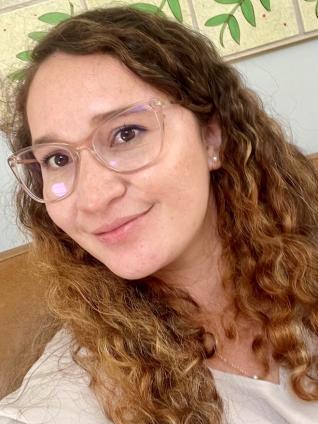
By: Sara MacDonald, UF/IFAS St. Lucie County Extension Urban Horticulture Extension Agent
My name is Sara MacDonald, and I serve as the Urban Horticulture Extension Agent with the University of Florida in St. Lucie County. I have a strong background in invasive species management and biological control, and a Ph.D. in Entomology. My academic training and applied research have equipped me with the tools to advance sustainable horticultural practices, promote native biodiversity, and enhance the management of urban green spaces through science-based, practical solutions.
As a bilingual scientist originally from Ecuador, I am passionate about making horticultural education accessible. I have developed and delivered outreach programs, workshops, and educational materials in both English and Spanish, focusing on pest identification and invasive species management. In my new role, I look forward to collaborating with residents, community partners, and local organizations to cultivate resilient, vibrant urban landscapes throughout St. Lucie County.
Master Gardener Volunteers: Educating Our Communities
By: Danielle Shalginewicz, UF/IFAS St. Lucie County Extension Master Gardener Volunteer Program Specialist
Did you know that Master Gardener Volunteers are available to speak at community events, library workshops, garden clubs, or social groups? Our volunteers are trained to provide science-based information from the University of Florida/Institute of Food and Agricultural Sciences (UF/IFAS) to our community.
Master Gardener Volunteers cover a wide range of topics, including fragrant flowers in the landscape, Florida-friendly landscaping principles such as attracting wildlife, creating pollinator gardens, herb gardening, container gardening, and much more.
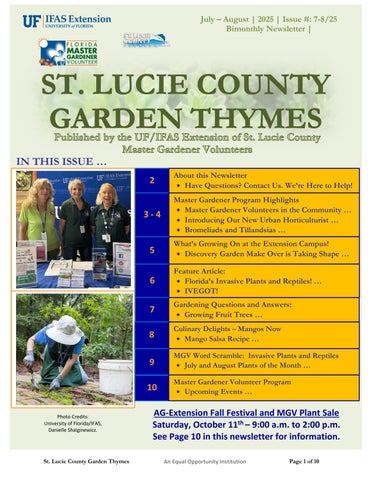
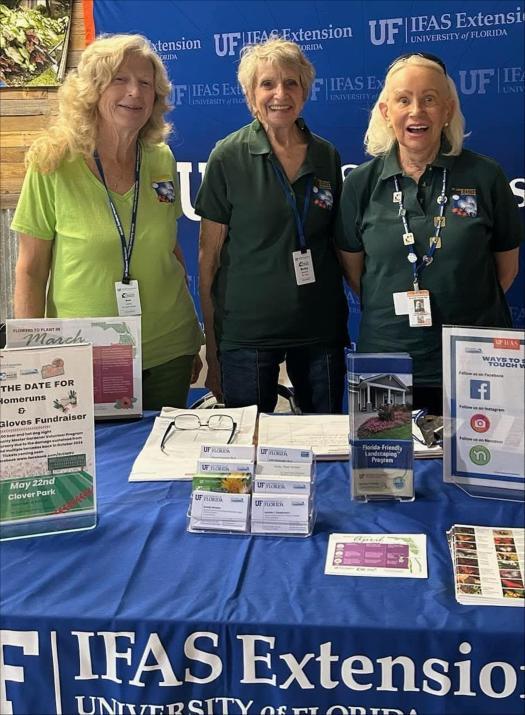
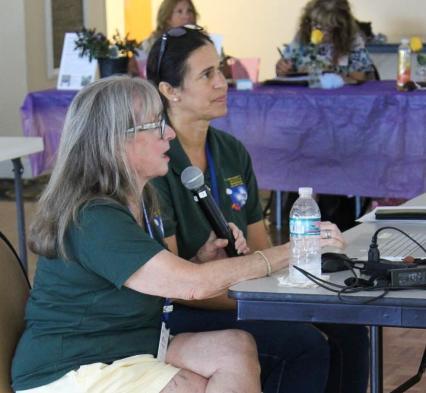
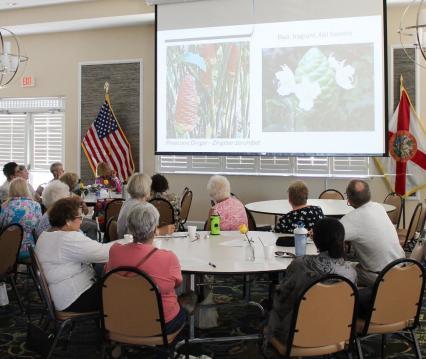
In early July, St. Lucie County Master Gardener Volunteers Susan Wise and Sandra Bruno presented to approximately 40 people in the Kings Isle community on the topic of fragrant flowers in the landscape. They answered questions about different types of flowers and soil, all while utilizing FloridaFriendly Landscaping resources.
If you, your department, or your community would like to have a Master Gardener Volunteer speak about a specific topic or if you would like suggestions, please reach out to the St. Lucie County Master Gardener Volunteer Program Specialist, Danielle Shalginewicz, at 772.462.1445 or email dshalginewicz@ufl.edu. Our Master Gardener Volunteers are knowledgeable and passionate about volunteering in our community.
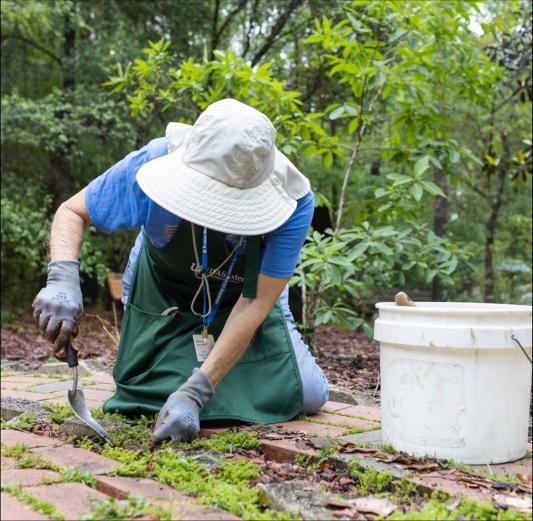
Photo Credit: UF/IFAS, Sara MacDonald.
Photo Credits:
UF/IFAS, Katherine Westenhaver
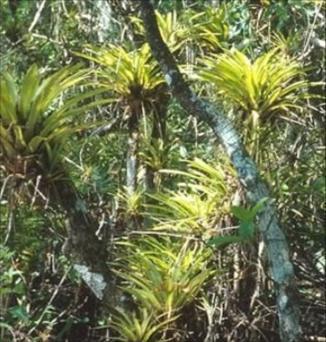
Bromeliads, Family Bromeliaceae, Genus Tillandsia
By: Carolyn Luxion, UF/IFAS Extension St. Lucie County, Master Gardener Volunteer
Bromeliads and Tillandsias
Native to all of South America, Mexico and the United States, but mainly in Florida and South Georgia, Bromeliads and Tillandsias (a genus of Bromeliads) can be found growing in forests, mountain sides, and deserts. They are often to referred to by their common name, “air plants”. Primarily epiphytes, they cling with wire like roots to whatever surfaces are readily available: tree branches and bark, plants, rocks, and even outdoor telephone wires (things that will not be saturated with water for very long). Although as epiphytes that can use plants, trees and bark to attach to, they will not hurt or parasitize them; they simply use it for support.
Bromeliads and Tillandsias are tremendously adaptable because of the development of plant cells called stomata and trichomes. Stomata cells open at night to intake carbon dioxide there by restricting evaporation of water in the process. Trichomes are cells that open immediately to intake water, air born minerals, and desert dew and are an important water sources in hot dry areas.
Did you know that Florida is the home to 16 native Bromeliad species and two natural hybrids (created by cross-pollination between two different species), with ten listed as threatened or endangered. Depending on the varieties of Bromeliads and Tillandsias selected, they can grow either in sun, partial sun, shade, or under indirect bright light Bromeliads and Tillandsias thrive in USDA zones 9-12 year-round, where they grow happily outdoors. They prefer to live in temperatures between 60-80° F and they are not tolerant of cold or frost. If you live outside of zones 9-12, bring them indoors during the colder months.
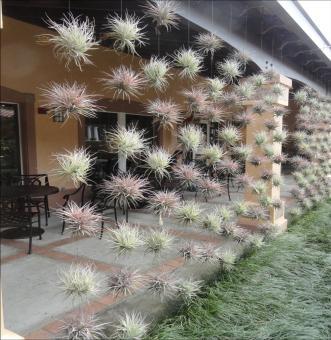
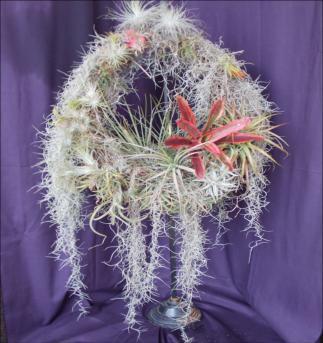
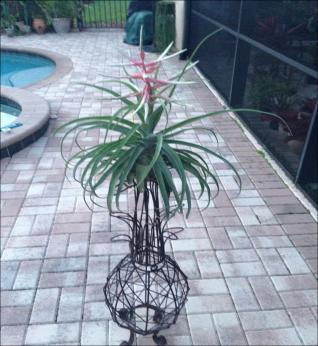
Inspired with the thought of growing Bromeliads without pots and soil sparked my interest and encouraged me to think of ways to use their unique adaptability to display the tremendous diversity of this genus. Materials for attaching are for example: stainless steel wire, E6000 Industrial Strength Adhesive (found at big box and craft stores), zip ties, rope, nylon stocking material, nylon net, fishing line and screen wire.
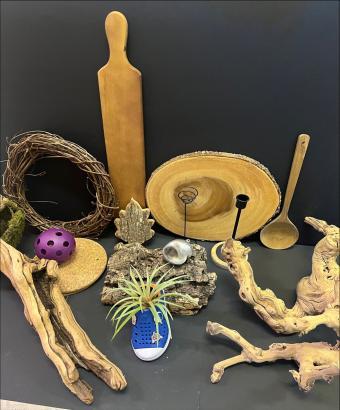
Use your imagination for what you can use for your base display. It can be fun, silly or very natural. Cedar wood, wooden kitchen utensils, paddles, cork board, tree bark, driftwood (no salt), grape vines, tennis racquets, kids clog shoes, a small tree cemented in a pot, wire baskets, sea shells, an old wooden step ladder are just a few examples. Use flea markets to find old wooden or other items for displaying your Bromeliads.
For more information, refer to the following website: https://edis.ifas.ufl.edu/publication/uw205 or the QR Code at the right.
~Enjoytheseremarkableplants!–Carolyn.
Photo Credits: University of Florida/IFAS, Danielle Shalginewicz Katherine Westenhaver. Art Credit: University of Florida/IFAS, Danielle Shalginewicz.
Photo Credits: Top 4 photos: Carolyn Luxion. Bottom photo: UF /IFAS, J. H. Frank
Preparing Your Landscape for the Hurricane Season
Invasive Plants, Reptiles, Animals, and More!
By: Karen Cartmill, UF/IFAS Extension St. Lucie County Master Gardener Volunteer
By: Karen Cartmill, UF/IFAS Extension St. Lucie County Master Gardener Volunteer
The time to prepare your landscape is long before the risk of a hurricane Hurricane season runs from June 1st to November 30th . If you haven’t already, now is the time to perform the following tasks.
Invasive species exist where ever we live, but Florida ranks # 1 for invasive species in the United States with more than 500 species of reptiles, amphibians, fish, animals, birds, plants, noxious weeds, pathogens, and pests. Florida is ground zero and the annual impact of invasive plants, animals, and diseases to Florida’s agriculture industry is estimated at $179 million. Florida spends millions a year in its efforts to manage and eradicate invasives species. Invasives gain a hold for many reasons: Florida’s subtropical climate, reptile and plant trade, intentional and unintentional releases, international ports of entry, individuals bringing in invasive species, and hurricane winds carrying damaging pests.
Invasive species are non-native to an environment and cause damage to the environment, ecosystem, economy, households, and/or human health. They often displace, destroy, or eradicate native species, and forever alter our ecosystem.
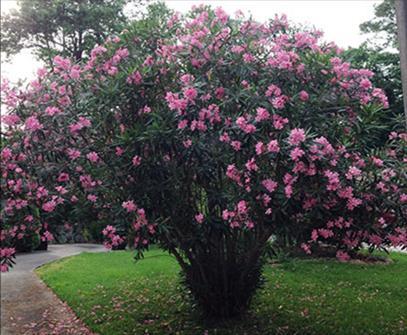
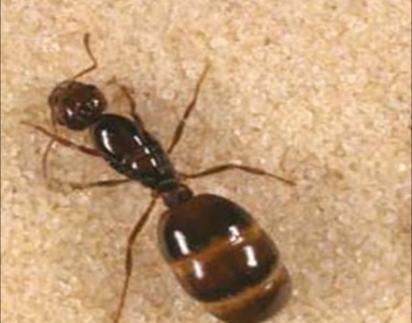
Invasive species can be found throughout Florida, with some located in certain areas, but in time, through adaptation they will spread to other areas of the state. Some of the most invasive species range from West Indian Drywood termites and Red Imported Fire Ants; American and German Cockroaches; Roof Rats and Feral Hogs; Egyptian Geese and Feral Pigeons; Cuban Tree Frogs and Cane “Bufo” Toads; Lion and Snakehead fish; Itchgrass, Yellow Bristlegrass, Brazilian Pepper Trees, Air Potato, to common landscape plants such as Wax Begonias, Coral Vine, Common Lantana, Oleander, Agave Century Plant, Golden Trumpet Allamanda, Japanese Clematis, and Spider Plants; to Nile Monitors, Argentine Black and White Tegus, Green Iguanas, and Pythons.

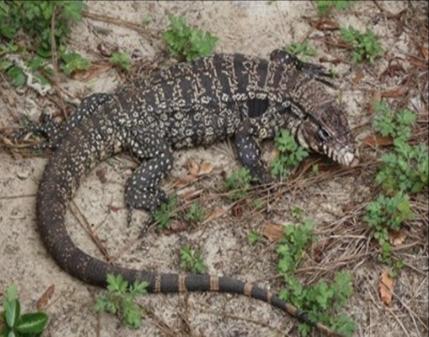






Of great concern are the Argentine Black and White Tegus found here in St. Lucie County, as an established breeding county that can do a tremendous amount of damage, and pose a threat to plants, humans, canines, and small animals. If you see a Tegu, please report these to the IveGot1 mobile app or on the website. To determine which plants are invasive, updated as of June, 2025, check out the following website: https://www.floridainvasives.org/plant-list/2023-invasive-plant-species/. Before you plant, determine if your selection is on the invasive list. If so, replace your choice with a non-invasive one. To learn more about Florida’s invasive species: type the species in question followed by the word IFAS to search the University of Florida’s database
IVEGOT1
Report Sightings of Nonnative Reptile Species in (3) Different Ways:
1. For iPhone and Android phones, download the "IveGot1" at the appropriate app store and use to report.
2. By Internet, use the web form at Report Sightings of Nonnative Species | FWC. You will need to create a free account the first time you report a sighting online.
3. Call the FWC’s Hotline at 888-Ive-Got1 (483-4681) from 8 a.m. - 5 p.m. to report high priority nonnative species, including all snakes, monitor lizards, and tegus. A voicemail can be left if the operator is unable to answer the call or for calls placed after normal operating hours.
QR Code: Florida’s Invasive Plant List
Photo courtesy of Florida Fish and Wildlife Conservation Commission
Middle Photo: UF/IFAS. Above Photo: UF/IFAS. Lyle J. Buss
Red Imported Fire Ants
Argentine Black and White Tegu Oleander
By: Nancy Meyer, UF/IFAS Extension St. Lucie County Master Gardener Volunteer and Plant Clinic Volunteer
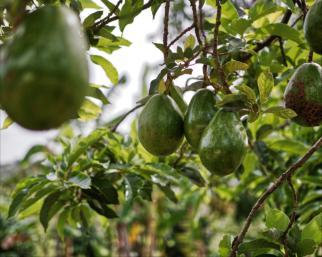
Question: Can I grow an avocado tree from the pit in my avocado from the grocery store? ~ Inquisitive
Yes, you can usually grow an avocado plant from the pit of a grocery-store fruit, but they may not produce fruit. You usually don’t know the particular cultivar of avocado purchased and whether it will go well here. It is better to go to a local nursery and purchase a known variety that will produce well in our area. For more information, refer to the following website or the QR Code at the right: https://edis.ifas.ufl.edu/publication/MG213.
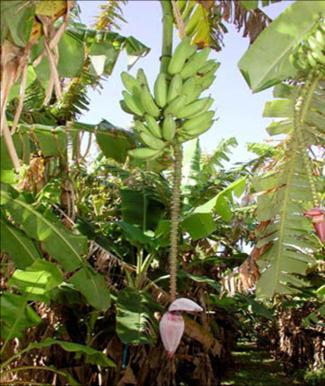
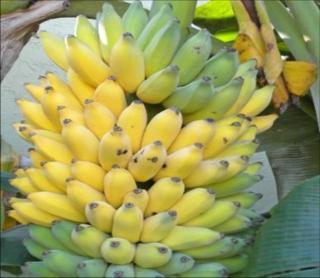
Question: How do I grow a banana tree? ~ Wondering
Select your desired banana plant from a reputable local source. Consider the space and make sure it has adequate room for its mature size. There are dwarf varieties that require less space. Bananas are susceptible to wind damage, so a more sheltered location is preferable. They require full sun (6-8 hours) and welldraining soil, rich in organic matter.
Water regularly and fertilize monthly. You can expect fruit production 9 to 20 months from planting, depending on the cultivar and cultural conditions. IFAS has an excellent article entitled “Banana Growing in the Florida Home Landscape” by Johnathan Crane and Carlos Balerdi.
For more information, refer to the following websites or QR Codes at the right.
1. https://edis.ifas.ufl.edu/publication/MG040
2. https://blogs.ifas.ufl.edu/pinellasco/2014/10/29/gobananas/
3. https://blogs.ifas.ufl.edu/miamidadeco/2024/07/24/ growing-bananas-in-south-florida/
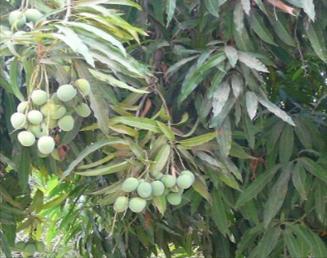
Question: What mango varieties are recommended for South Florida? ~ Curious
4.
There are many different types of mangoes recommended for growth in South Florida. Some varieties are Fairchild, Rosigold, Glenn, Angie and Orange Sherbet. Please refer to “Growing Mangoes in the Florida Home Landscape” on the IFAS website or the QR Code at the right for a table of recommend recommended varieties for our area and their growth habits. https://edis.ifas.ufl.edu/publication/MG216.
QR Code 1: Growing Banana Trees
QR Code 2: Go Bananas
QR Code 3: Bananas in South Florida
Photo Credit: UF/IFAS
Avocado Tree
QR Code: Growing Avocados
QR Code: Growing Mangos in South Florida
Photo Credit: UF/IFAS
Mango Tree
Photo Credits 1: UF/TREC Ian Maguire
Photo 2: UF/IFAS 'Apple' banana. J. H. Crane
Bananas
Banana Tree
By: Betty Bianconi, UF/IFAS Extension St. Lucie County Master Gardener Volunteer
Florida’s mango season peaks from May through August, making summer an ideal time to enjoy locally grown fruit. Mangos are succulent tropical fruits that thrive in our USDA hardiness zone 10B and if grown in full sun plus protected from freezing temperature zone 10A as well. Native to South Asia, mango trees feature long, narrow, shiny dark green leaves and striking spring flower spikes in white, yellow, or reddishpink. The fruit comes in many shapes and colors from greenish-yellow to deep red and contains sweet, juicy yellow to orange flesh, sometimes fibrous, surrounding a large, flat seed in a woody husk.

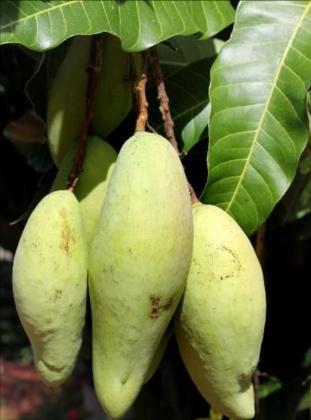

Select a sunny, well-drained spot and choose disease-resistant varieties. Some trees can reach 60 feet tall and 50 feet wide, so plant only if you have ample space. For smaller yards, try smaller cultivars like Fairchild, Rosigold, Glenn, Angie, or Orange Sherbet. Prune trees after harvesting to allow additional light and airflow, keeping height under 15 feet. This helps prevent disease and simplifies picking.
The following websites provide additional information on mangos or scan their QR Codes at right
1. Mango – Gardening Solutions
2. Mango season 2024 is taking shape: UF/IFAS experts offer their views - News
3. HS2/MG216: Mango Growing in the Florida Home Landscape
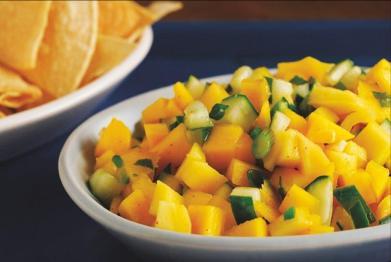
Recipe Provided By: Katherine Westenhaver, UF/IFAS Extension St. Lucie County. Outreach Coordinator
Edited By: Betty Bianconi, UF/IFAS Extension St. Lucie County Master Gardener Volunteer
Serve with chips, over grilled chicken, fish tacos, or just grab a spoon and enjoy it as-is. If you’re feeling bold, stir in chopped jalapeño to dial up the heat.
• 2 ripe mangoes, peeled and coarsely chopped
• 3–5 Roma tomatoes, coarsely chopped
• 1 small red onion, diced
• ¼ cup chopped fresh cilantro
• 2 tablespoons fresh lime juice
• 1 tablespoon olive oil (extra virgin)
• ½ teaspoon salt (pink or coarse)
• 1 jalapeño, seeded and finely chopped (optional, for extra spice)
In a medium bowl, combine mangoes, tomatoes, red onion, and cilantro. Drizzle in lime juice and olive oil; sprinkle in salt. If desired, add chopped jalapeno. Toss until well mixed. Chill, covered, for 15–30 minutes to let the flavors mingle. Makes about 3 - 3 ½ cups.
~Enjoy!–BettyandKatherine
Enjoy! ~ Betty
QR
Photo
Photo
By: Scramble and Flowers of the months: Karen Cartmill, UF/IFAS Extension
St. Lucie County Master Gardener Volunteer
Unscramble each of the mixed-up letters to form correct words or phrases. Once solved, use the letters in the red circles to solve the themed word of this scramble. The green colored cells are meant to be a space separating two words in the phrase where no letters should appear. Hint: Many of the words are in this newsletter.
GUTES
SDRIPE PNTALS
YRTCNEU VGEAA
NELI TONMRIOS
ORCLA INVE
IRA TOPASTEO
RENEG AIGANSU
1VIEOTG
Themed word of this word scramble.
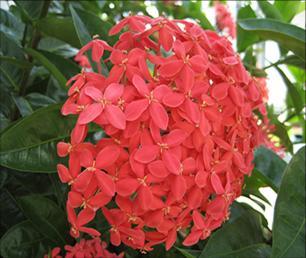
Ixora
Ixora coccinea
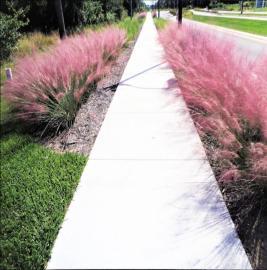
Muhly Grass
Muhlenbergia capillaris
A Florida native, drought tolerant, gets by with little to no irrigation. Moderately salt tolerate Plant can tolerate some moisture with virtually no care needed. Exceptional Fall color Produces clumps, 2 to 3 feet tall and up to 3 feet wide. Plant now to enjoy fluffy pink to purple flowers in fall. A white flower variety exists, too Thrives in full sun but can tolerate some shade Does well in USDA Zones 7-11. Stalks are upright with slender, dark green foliage that turns copper in fall. In late winter, prune back to the ground before the spring brings new foliage. Landscape designers often plant muhly grass in large groups for a stunning visual, aesthetic effect. Photo Credit Above: UF/IFAS. https://blogs.ifas.ufl.edu/sarasotaco/2023/1 1/09/plants-at-their-peak-magical-muhly/.
Please Note: If planting now, provide supplemental watering, as needed, during the summer months due to the extreme heat we are experiencing to allow the plant’s roots to become established.
A Florida-Friendly plant with many popular varieties including red clustered flowers ‘Nora Grant’; ‘Maui’ with orange flowers; and ‘Herrera’s White’ with white flowers. Dwarf Ixora’s come in orange, pink, red and yellow. They produce an abundance of flowers year-round and are evergreen in nature with dark green leaves. Moderately drought and salt tolerant, with a soil pH of around 5. Each flower cluster can last between 6 to 8 weeks. Landscape designers often plant in large groups for a stunning visual, aesthetic effect. Attracts hummingbirds. Plant in full sun to partial shade. If not pruned, they will grow 10-15 feet tall and 4-10 feet wide. Dwarf varieties can grow up to 3 feet tall and wide. Does well in USDA Zones 10-11 and can be planted year-round. Photo Credit: UF/IFAS.
https://blogs.ifas.ufl.edu/ charlotteco/2022/08/11/ge tting-your-moneys-worthin-flowers-this-year-ixorain-the-landscape/.
By: Danielle Shalginewicz, UF/IFAS St. Lucie County Extension Master Gardener Volunteer Program Specialist
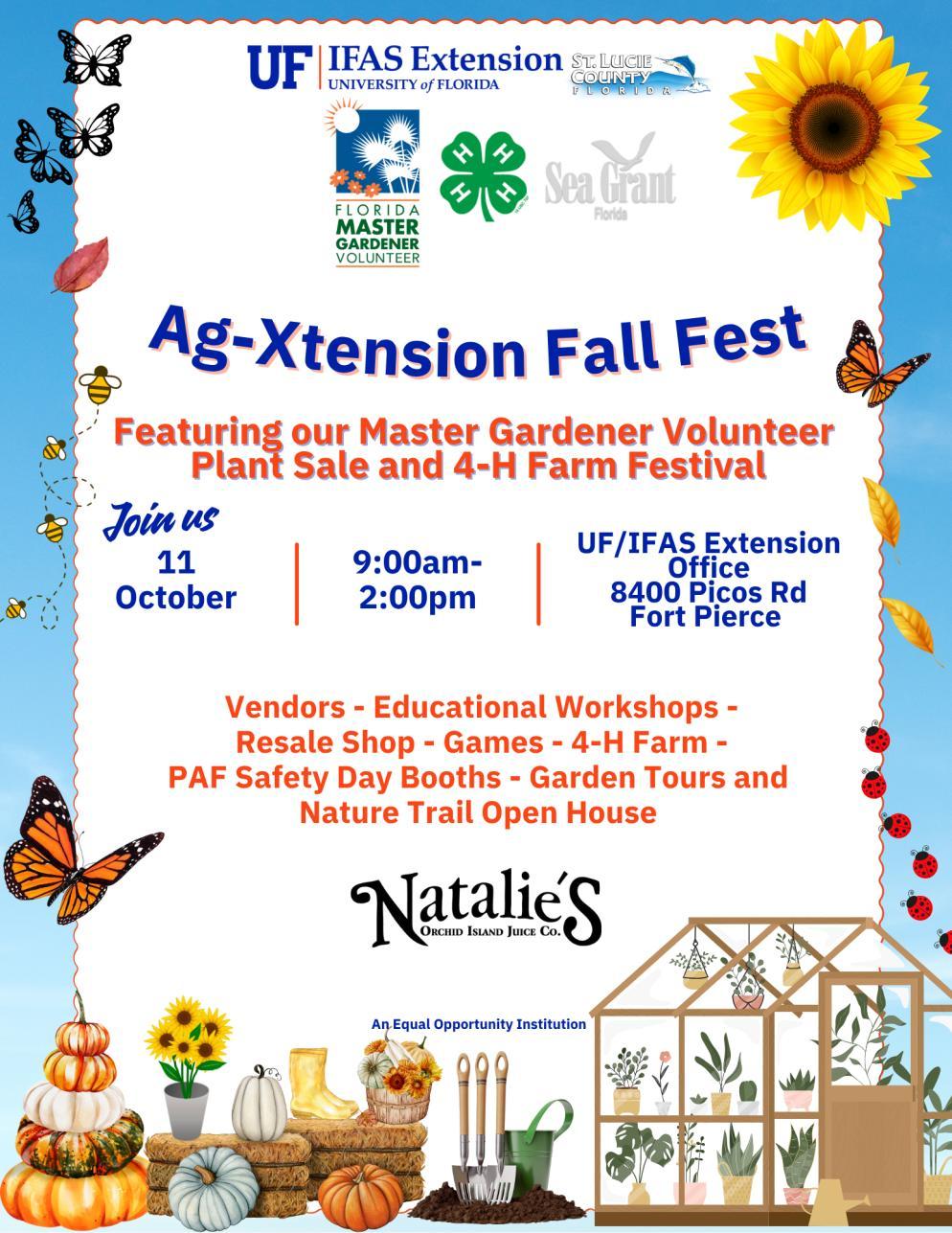
Ag-Xtension Fall Fest
We are looking for vendors and sponsors for our annual event. We have added more fun to the mix with the 4-H farm fest along with garden tours and our Nature Trail. Come be a part of this amazing event. Please Contact Danielle Shalginewicz, UF/IFAS St. Lucie County Extension at 772-462-1445.
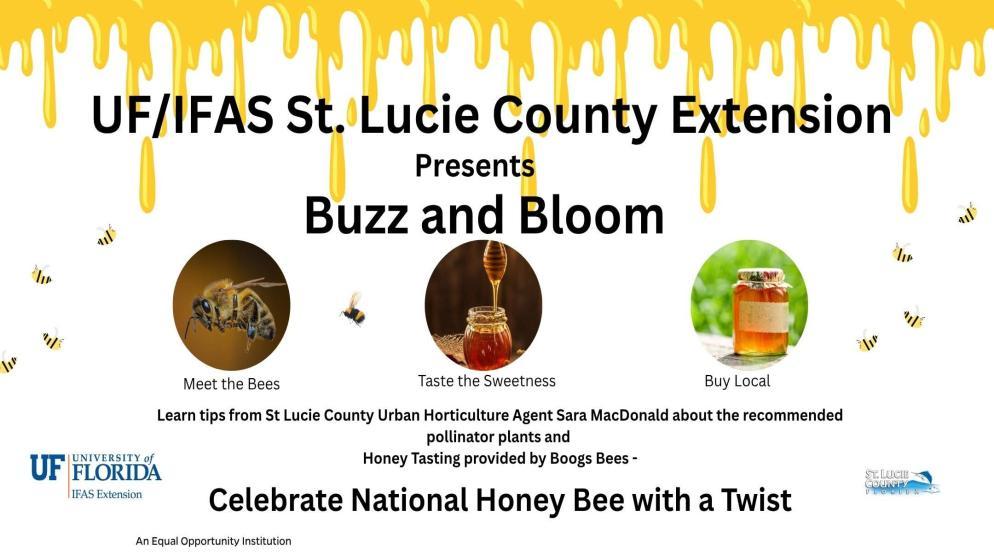
Buzz & Bloom Workshop
Are you interested in creating a pollinator garden and learning which plants attract specific pollinators? Do you appreciate the importance of honeybees?
If you enjoy honey, join our Urban Horticulture Agent Sara MacDonald and Boogs Bees for an informative session on Saturday August 16th , which is also National Honeybee Day on the porch at the SailfishBreweryinFortPierce. She will discuss how important pollinators are in our environment, recommend plants for your garden, providealivedemonstrationofhow a hive functions, and offer a honey tastingfeaturingavarietyofflavors.
Sailfish Brewery will also be offering a beer pairing to complement the honey. Honey tasting will be by Boogs, and their honey will be for sale also.
Registration is required through Eventbrite: Buzz and Bloom Tickets, Sat, Aug 16, 2025 at 6:00 PM | Eventbrite. The registration fee is $5.00. For questions, please call the Extension Office at 772-462-1660 option 0.