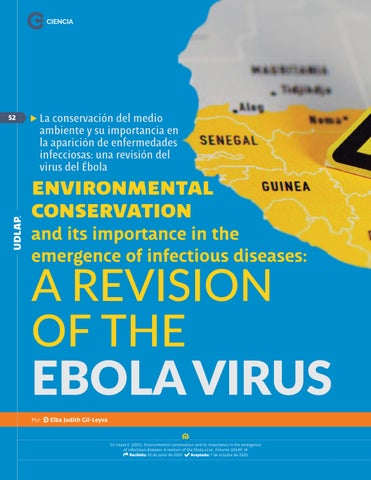
La conservación del medio ambiente y su importancia en la aparición de enfermedades infecciosas: una revisión del virus del Ébola
diseases: environmental conservation
and its importance in the emergence of infectious
La conservación del medio ambiente y su importancia en la aparición de enfermedades infecciosas: una revisión del virus del Ébola
and its importance in the emergence of infectious
EIDS EVENTS HAVE RISEN SIGNIFICANTLY OVER THE LAST DECADES; ACCORDING TO JONES ET AL. (2008) THERE HAS BEEN 335 EIDs between 1940 and 2004
RESUMEN
La emergencia de enfermedades infecciosas (EIDs por sus siglas en inglés) es una problemática global, que es consecuencia sobre todo de las actividades antropológicas y afectan tanto la salud pública como la salud de la vida silvestre al alterar la capacidad de adaptabilidad de los organismos ante el cambio. Por ello, es de importancia mejorar la predicción y manejo de las EIDs, lo cual requiere un enfoque multidisciplinario donde se busque correlacionar el impacto que provocan las actividades antropológicas a los factores ambientales que provocan los brotes, y de esta forma desarrollar propuestas de conservación para minimizar los brotes de EIDs. Un caso de estudio que refleja la importancia de este enfoque son los brotes de ébola en África Central que se extendieron hasta África occidental a través de murciélagos, debido a la alteración de su hábitat y el aumento de contacto con ellos por actividades antropogénicas.
PALABRAS CLAVE EIDs, Actividades antropológicas, Ébola.
IN THE LAST DECADE A NEW GLOBAL PROBLEM HAS ARISEN, THE EMERGENCE OF INFECTIOUS DISEASES (EIDS).
The emergence of infectious diseases (EIDs) is a global problem, which is mainly a consequence of anthropological activities that affect public and wildlife health by altering their capacity to adapt against change. Therefore, it is important to improve the prediction and management of EIDs, which requires a multidisciplinary approach that seeks to correlate the impact caused by anthropological activities to the environmental factors that cause outbreaks, and thus develop conservation proposals to minimize EID outbreaks. A case study that reflects the importance of this approach are the Ebola outbreaks in Central Africa that spread out up to West Africa through bats, as a reult of the alteration of their habitat and a higher contact with them due to anthropogenic activities.
EIDs, Anthropological activities, Ebola.
In the last decade a new global problem has arisen, the emergence of infectious diseases (EIDs). A relatively new concept for many, it refers to any disease that has been caused by a pathogen that has undergone recent growth in it’s geographical distribution and incidence, and has incorporated new hosts or has just been discovered (Medina-Vogel, 2010). EIDs events have risen significantly over the last decades; according to Jones et al. (2008) there has been 335 EIDs between 1940 and 2004. The majority of these events originated in wildlife, for example: hiv, Ebola virus, Nipah virus, and severe acute respiratory virus (sars) coronavirus (Jones et al., 2008). And more recently, Smith et al. (2014) through a new dataset from over 12, 000 records of EIDs outbreaks from 1980 to 2013, concluded that the total number of outbreaks and richness of causal diseases has increased globally, being sixty-five per cent zoonoses, which caused 56% of the outbreaks analysed. If this is not reason enough for worry, the appearance of EIDs involves the complex interactions of genetic, biological, social, economic, political, ecological and physical envi-
ronmental factors. (Wilcox & Gubler, 2005). As a result, a great variety of fields of study are involved, which makes the production, management and interpretation of all the data related to an EID hard. Especially, since as up to the last decade there have not been a lot of studies where specialists of different disciplines sum up their efforts to reach a major vision of the full consequences an EID can produce.
Furthermore, EIDs are a threat to not only public health, but also wildlife health (Plowright et al., 2008). Wildlife health does not have an established definition, but it involves all the interactions (biological, social or environmental) that influence the capacity of an organism to cope through changes (Stephen, 2014), so any factor that alters this capacity can contribute to species extinction (Plowright et al., 2008). Wildlife EIDs can cause widespread wildlife death that can lead to local and global extinctions, which can then further impact the ecosystems and lead to complicated and costly conservation issues (Daszak, Cunningham & Hyatt, 2001). The objective of this work is to demonstrate the importance of correlating anthropological activities and environmental factors to improve the prediction of possible new EIDs and management of the existing outbreaks due to EIDs. The example that will be used to further this concept is the Ebola outbreaks.
The family of Filoviruses contains the Ebolaviruses and the Marburgviruses. To date six filoviruses have been described in Africa, including four Ebolaviruses (Zaire, Sudan, Taï Forest and Bundibugyo) and two Marburgviruses (Marburg and Ravn; Hassin et al. , 2016). From the species of Ebola virus (ebov), the Zaire ebolavirus (zebov) and Sudan ebolavirus (sebov) are the most highly pathogenic for human and nonhuman primates, causing viral hemorrhagic fever (vhf), with a fatality rate of up to 90% (Groseth, Feldmann & Strong, 2007). The Ebola disease (eid) first emerged in 1976 in the Democratic Republic of Congo and South Sudan and since then, there have been a total of 24 outbreaks in 10 countries in Central and West Africa (Walsh & Haseeb, 2015). But, it is important to note that
at first, ebov caused outbreaks only in Central Africa and it was not until 2014 that outbreaks in West Africa started, the importance of this detail will be explained later.
At the beginning, the efforts to know more about the ebov was centered in its molecular biology and pathogenesis, while it’s maintenance and transmission in nature was ignored (Groseth, Feldman & Strong, 2007). It was later that the search for the reservoir started, it was hypothesized that ebov persisted in its area due to a zoonotic reservoir. This means that an animal spread the disease while not falling sick itself. Following this idea, the apes were discarded, as it was seen that many had succumbed to ebov infection (Groseth, Feldmann & Strong, 2007). Neither the sampling of thousands of arthropods nor vertebrates since 1970 gave any indication of who the reservoir could be. It was not until 2005, that Leroy et al (2005) provided the first molecular evidence that fruit bats may be the reservoir host for zebov. Subsequently, bats started being intensively studied to better understand their role in the maintenance, transmission and evolution of filoviruses (Hassanin et al., 2016). Nowadays, it is known that fruit bats are in fact a reservoir of ebov, but why is this important? Is important because then research can be made of the geographical distribution of this reservoir and correlate it with the areas in which outbreaks have happened. If there is a correlation, then models can be made to predict which populations are in danger of being in contact with it and as a consequence, being vulnerable to ebov. Further research can determined if whether potential reservoirs and/or amplifying host could be involved. Basically, we can know the ecological niche of ebov and be aware of any factors that have the capacity of altering the ecology of the ecosystem in which this niche resides (Medina-Vogel, 2010).
The idea of correlating the distribution of the reservoir and the area of ebov outbreaks has great merit, because up to 2014 -as we said before- the outbreaks only occurred in Central Africa, but in that year the largest and deadli-

SMITH ET AL. (2020) THROUGH A NEW DATASET FROM OVER 12, 000 RECORDS OF EIDS OUTBREAKS FROM BEING SIXTY-FIVE PER CENT ZOONOSES , WHICH OF THE OUTBREAKS ANALYSED.

TO 2013 CAUSED 56%
CONCLUDED THAT THE TOTAL NUMBER OF OUTBREAKS AND RICHNESS OF CAUSAL DISEASES HAS INCREASED GLOBALLY.
The objective of this work is to demonstrate the importance of correlating anthropological activities and environmental factors to improve the prediction of possible new EIDs and management of the existing outbreaks due to EIDs.
The example that will be used to further this concept is the Ebola outbreaks.
THE EBOLA DISEASE (EVD) FIRST EMERGED IN
1976 IN THE DEMOCRATIC REPUBLIC OF CONGO AND SOUTH SUDAN AND SINCE THEN
THERE HAVE BEEN A TOTAL OF 24 OUTBREAKS IN 10 COUNTRIES IN CENTRAL AND WEST AFRICA (WALSH & HASEEB, 2015).
est Ebola outbreak recorded happened in West Africa (Elston et al., 2017). The question is, how did the ebov get all the way over to West Africa?
There were several theories, one was that the virus has always been present in the region, but nobody ever noticed, another is that the virus was recently introduced (Bausch &Schwarz, 2014). The first possibility implied that the Guinea outbreak in West Africa was caused by a distinct strain from Central Africa. Baize et al. (2014), through the comparison of the genetic material of the filoviruses (that were available in the database GenBank and the new ebov Guinea sequences), suggested that the outbreak in Guinea was caused by a divergent variant of the ebov lineage. In contrast to this, Dudas & Rambaut (2014) made a subsequent reworking and interpretation of the limited genetic material available. They suggested that the outbreak in Guinea was caused by a zebov lineage that spread from Central Africa into Guinea and West Africa in recent decades. This idea has more merit, because if zebov had been present in Guinea for some time, a greater sequence variance than the 97% homogeneity isolated from the Central Africa outbreaks would have been expected (Baize et al., 2014); this results in the refuting of the first hypothesis.
The second possibility was more likely, at first it was thought it could have been an introduction by a human traveler but the low level of regular travel and/or trade between Central Africa and Guinea, as well as roads that make it a minimum of 12 hours of travel from the capitals of Guinea, Liberia or Sierra Leona, makes it unlikely that it was introduced by a human traveler (Bausch & Schwarz, 2014). The reason is that ebov has a incubation period typically of 4 to 10 days and a fatality rate up to 90% (Groseth, Feldmann & Strong, 2007). In order to have no reported cases along the road, the human traveler would have been required to
traveled rather quickly from Central Africa to Guinea. So, a bat introduced ebov and a subsequent introduction into humans may have occurred through exposures related to hunting and consumption of fruit bats (Bausch & Schwarz, 2014). A comparative phylogeography, or in other words a comparison of the historical processes that affected the populations of the African fruit bat demographic which may have left evolutionary footprints on the present geographic distribution (Avise, 2000), was made in order to establish which fruit bat species might serve as a potential reservoir and circulating hosts of ebov from Central Africa to West Africa or vice versa.
Hassanin et al. (2016) studied the family Pteropodidae, which is highly dependent on plants for food. This explains why the species richness of fruit bats is higher in equatorial regions, where fruits and flowers are more diverse and available most of the year. Curiously, until 2007, 17 outbreaks of evd in Africa all have occurred within 10º degrees of the equator (Groseth, Feldmann & Strong, 2007). So, as Pteropodidae do not hibernate, they need food all year round, resulting in some species being migratory and others nomadic. Their genetic analyses showed that three fruit bat species have dispersal movements between Central and West Africa; they have the capacity of disperse ebov. Of the three fruit bat species, Hypsignathus monstrosus is restricted to rainforest habitats, where all zebov outbreaks have occurred; while Eidolon helvum and Rousettus aegyptiacus are commonly found in savannah woodland. Moreover, inter-species infections of zebov could be due to the fact that fruit bats often eat on the same trees, particularly during the two biannual birthing seasons of the main reservoir host species (Hassanin et al., 2016). So far, we have established a reservoir of ebov and how its life cycle and behavior make it possible to spread ebov further to the area,
where most of its outbreaks had happened. The last question that remains is, what factors contribute to raising the contact with the reservoirs and, therefore to ebov (an eid)? There are many factors. The first is that the dynamic host-pathogen between wild species, or between wild species and humans can be affected as a result of the alteration, fragmentation or loss of habitat (Medina-Vogel, 2010). Habitat fragmentation can increase stress on animals through displacement and crowding, and this stress can affect the immune response of the host, increasing the possibility that an infection will lead to a disease (McCallum & Dobson, 2002). On the other hand, there can be species that have adapted to human-dominated landscapes and increased their abundance and expanded their range. As a result, the probability of human contact with infectious reservoirs increased, as well as, the zoonotic virus richness and the risk of virus spillover (Jonhson et al., 2020). A specific example, is that viral richness increased with larger distribution areas and fragmentation of bat distribution, according to the measure of their distribution shape (Maganga et al., 2014). And a study by Rulli et al. (2017), also demonstrated that the transmission of ebov to human populations is more likely to occur in highly disturbed forested areas, 8 of the 11 infections events they studied took place in fragmentation hotspots, of the 3 exceptions, one was very close to a high fragmentation and the other two were associated with hunting/poaching activities.
The second factor is the introduction of exotic or non-native species or vectors by humans, which is closely linked to the emergence of eids in wild species, because this exotic species can interact with native species favoring the contagion (Medina-Vogel, 2010). This introduction is the result of breaching bioegreaphic barriers by human action or abiotic factors. In the case of human actions it can be via air and
THE EFFORTS TO KNOW MORE ABOUT THE EBOV WAS CENTERED IN ITS MOLECULAR BIOLOGY AND PATHOGENESIS, WHILE IT’S MAINTENANCE AND TRANSMISSION IN NATURE WAS IGNORED (GROSETH, FELDMAN & STRONG, 2007).
OF THE THREE FRUIT BAT SPECIES, HYPSIGNATHUS MONSTROSUS IS RESTRICTED TO RAINFOREST HABITATS, WHERE ALL ZEBOV OUTBREAKS HAVE OCCURRED; WHILE EIDOLON HELVUM AND ROUSETTUS AEGYPTIACUS ARE COMMONLY FOUND IN SAVANNAH WOODLAND. MOREOVER, INTER-SPECIES INFECTIONS OF ZEBOV COULD BE DUE TO THE FACT THAT FRUIT BATS OFTEN EAT ON THE SAME TREES.
surface transport (on land or by sea) of goods and people, or by the deliberate transport and introduction of invasive species, such as international pet trade or bioterrorism (Ogden et al., 2019). On the contrary, in the case of abiotic factors it can be considered as a third factor due to its importance. The consequences of climate change, such as global warming, is happening at great scale in regions with mayor latitudes and altitudes. As a response, species will move to regions where they would not have reached before, thus, making contact with new vectors and hosts. These environmental and climate changes can cause physiological stress and compromise the host’s immunological resistance (Medina-Vogel, 2010). In addition, extreme weather events can generate economic consequences and destabilize the affected human communities, which leads to enviromental sanitation problems, social instability and weakened public health systems (Ellwanger et al., 2020). All of this contribute to a higher frequency of EIDs.
Taking these factors into account, the study of Pigott et al. (2014) is a baseline for a correlation between ebov and environmental factors. This study mapped the regions that are most at risk of a future Ebola outbreak, in order to do this, the data used included the locations of all recorded primary cases of Ebola in human populations, the locations of recorded cases of ebov in wild bats and primates from the last forty years, information about environmental factors and new predictions of the range of wild fruit bats. It did not include data about how infections spread from one person to another. As a result, they had to re-evaluate the zoonotic niche from evd in Africa, and predict an estimation of the population at risk in both in countries that have confirmed index cases and those
that have a predicted environmental suitability for outbreaks. Their analysis shows that the zoonotic niche of the pathogen is more widespread than what it was previously predicted or appreciated, most notably in West Africa.
Walsh & Haseeb (2015) used Pigott et al.’s (2014) work and furthered it, because there was still a need to clearly delimitate the biological, physical and social features of the landscape that defines zoonotic infection risk. Locating potential points of spillover by recognizable features in the landscape could be useful in blocking zoonotic transmission to humans and thus, preventing human outbreaks before they happen (Walsh & Haseeb, 2015). So, their work sought to explore the role of human population density and vegetation cover on the spatial distribution and risk of zoonotic transmission of the evd, focusing specifically on isolated spillover events. Their investigation was the first attempt to quantify zoonotic transmission risk as spatially dependent on human-forest interaction across the complete zoonotic evd outbreaks in West and Central Africa. In the end, they identified a strong association among evd spillover, population density and effect modification with vegetation cover. The results also suggest relationships with temperature and altitude, though these may be incidental to the as yet unknown range of the reservoir species. These findings cannot be interpreted as causal due to the observational nature of the data, but they do suggest that the specific landscape configuration of interaction between human populations and forested land may facilitate zoonotic evd transmission.
Therefore, evd was an eid from the last century that still is a source of major concern due to its great virulence. At the beginning, the research objectives were to elucidate its mo-
lecular biology and pathogenicity, later, they focused on trying to identify the reservoir of ebov, whereas now they seek to find a correlation among the environmental, epidemiological and social factors involved in the outbreaks of ebov . The evolution of the research focus shows that it is really necessary to have a multidisciplinary approach so as to prevent and treat eid s. Furthermore, as it was described in the case of ebov, data about possible reservoirs was non-existent when the outbreaks started, economical features were not considered at that time to be the cause of the spread of this outbreaks and nobody thought that civil war in Sierra Leone, Liberia and Cote d´Ivoire or the poverty of Guinea would cause an ecological burden as people expanded their range of activities to stay alive, plunging into the forest for hunting or in mines to extract minerals (Bausch &Schwarz, 2014).
In addition, the absence of any biological monitoring caused a huge lack of data about which type of species, vegetation and climate were in these areas. As a consequence, nobody noticed at that time how biotic (living) and abiotic (non-living) factors changed over time, as population density grew and land usage changed. Nobody knew which species (due to being migratory or nomadic), had contact with other species in other areas and could contract or spread eid s in new areas, like in this case with several fruit bats. It is incredible that despite its first appearance in 1976, it was not until 2014 that a study was made to investigate whether or not migration of these bats enables the spread the eid to new areas where no outbreaks had previously occurred. The larger spread of eid could be associated with human encroachment in forested areas, leading to forest destruction, habitat fragmentation and may
AN ECONOMIC APPROACH CAN HELP VISUALIZE THE IMPACT AN EID CAN HAVE IN TERMS ALL PEOPLE CAN UNDESTAND, MONEY.
AN EXAMPLE IS THE ANALYSIS MADE BY DOBSON ET AL. (2020), WERE THEY SUGGEST THAT THE COST OF PREVENTIVE EFFORTS WOULD BE SUBSTANTIALLY LESS THAN THE ECONOMIC AND MORTALITY COST OF RESPONDING TO AN EID.

THEY PROPOSE TO INVEST A SUM BETWEEN PER YEAR GLOBALLY IN PREVENTIVE EFFORTS, A REASONABLE QUANTITY IF WE COMPARE IT TO THE LOST OF IN GDP EXPECTED FOR 2020 DUE TO THE $22 TO $31 BILLION $5 TRILLION
THE EMERGENCE OF INFECTIOUS DISEASES HAS OCCURRED THROUGHOUT HUMAN HISTORY, WE ARE CURRENTLY LIVING THROUGH THE EFFECTS OF ONE OF THEM, AND THEY WILL CONTINUE TO EMERGE.
increase exposure to other zoonotic infections through interactions with wildlife reservoir species resulting from direct contact as well as potentially decreasing biodiversity (Rulli et al., 2017).
In order to prevent and manage an existing eid, it is necessary to have a multidisciplinary approach. Conservation biology (through biological monitoring) can facilitate not only the narrowing of possible reservoirs (for ebov, the fruit bats), but also the vulnerable areas that could be in contact with these reservoirs due to its distribution (Central and West Africa). It can also help to predict the emergence of outbreaks or eids when the area of surveillance is altered by climate change, fragmentation, pollution, habitat loss or any other factor. Meanwhile, an epidemiological approach helps to find, through these reservoirs and existing cases, the pathogenesis of the eid and possible treatments or vaccines. A social approach, gives us the anthropogenic activities (war, agriculture, mining) that in each region predominates, thus, providing us with an idea of how they can influence the future in the environment and if environmentally friendly alternatives can be made. Finally, an economic approach can help visualize the impact an eid can have in terms all people can undestand, money. An example is the analysis made by Dobson et al. (2020), were they suggest that the cost of preventive efforts would be substantially less than the economic and mortality cost of responding to an eid. They propose to invest a sum between $22 to $31 billion per year globally in preventive efforts, a reasonable quantity if we compare it to the lost of $5 trillion in gdp expected for 2020 due to the covid-19 pandemic. This interdisciplinary approach can make it easier to develop countermeasures for EIDs, to minimize public health risks and species extinction, as eids are not only a problem for human health, but also for wild species. Especially those that are endangered, an example is that ebov not only is fatal to humans, also for non-human primates.
This work used the Ebola virus as an example to explain and emphasize the importance of the management of EIDs, as these types of events have repeatedly occurred throughout history. One of the oldest and more famous eids of the past was the Black Death, caused by the bacillus Yersinia pestis. This disease was endemic of Central Asia, but with the growth of trade routes the plague travelled east to China and westward, where it reached the Middle East, North Africa and Europe (Wain-Hobson & Weiss, 2001). Now, the most recent eid is the present pandemic caused by severe acute respiratory syndrome coronavirus 2 (sars -CoV-2), which causes the coronavirus disease 2019 (covid-19) (Guo et al., 2020). Notably, human activities were also involved, a characteristic shared with other EIDs. The huge land use and cover change (Wang et al., 2008, Xu et al., 2010, Kabba & Li, 2011), and increase in wildlife trade and consumption, especially of bats and pangolins (van Staden, 2020; Zhang, Wu & Zhang, 2020), seem to be the major activities involved in the emergence of covid-19. In conclusion, the emergence of infectious diseases has occurred throughout human history, we are currently living through the effects of one of them, and they will continue to emerge. It is a consequence of the biodiversity alteration that has occurred in the last decades, as it was exemplified by the Ebola case. Hence, this cooperation among different knowledge areas in order to deal with them is of great importance for both human and wildlife species health, as well as, to reach a better management of natural resources to prevent an accelerated rise in the frequency of EIDs.

Elba Judith Gil Leyva Estudiante de las licenciaturas de Bioquímica Clínica y Biología en la Universidad de Las Américas Puebla. Tiene una publicación científica en el área de toxicología sobre la zootoxinas con propiedades inmunomoduladoras. elba.gilla@udlap.mx
• Avise, J.C. (2000). Phylogeography: the History and Formation of Species Amsterdam, Netherlands: Amsterdam University Press.
• Baize, S., Pannetier, D., Oestereich, L., Rieger, T., Koivogui, L., Magassouba, N., … Günther, S. (2014). Emergence of Zaire Ebola Virus Disease in Guinea. New England Journal of Medicine, 371(15), 1418-1425. doi: 10.1056/NEJMoa1404505
• Bausch, D. G., & Schwarz, L. (2014). Outbreak of Ebola Virus Disease in Guinea: Where Ecology Meets Economy. PLoS Neglected Tropical Diseases, 8(7), e3056. doi:10.1371/journal.pntd.0003056
• Daszak, P., Cunningham, A. A., & Hyatt, A. D. (2001). Anthropogenic environmental change and the emergence of infectious diseases in wildlife. Acta Tropica, 78(2), 103–116. doi:10.1016/s0001-706x(00)00179-0
• Dobson, A. P., Pimm, S. L., Hannah, L., Kaufman, L., Ahumada, J. A., Ando, A. W., Bernstein, A., Busch, J., Daszak, P., Engelmann, J., Kinnaird, M. F., Li, B. V., Loch-Temzelides, T., Lovejoy, T., Nowak, K., Roehrdanz, P. R., & Vale, M. M. (2020). Ecology and economics for pandemic prevention. Science 369(6502), 379–381. https://doi.org/10.1126/science.abc3189
• Dudas G, Rambaut A. (2014). Phylogenetic Analysis of Guinea 2014 EBOV Ebolavirus Outbreak. PLOS Currents Outbreaks. doi:10.1371/currents.outbreaks.84eefe5ce43ec9dc0bf0670f7b8b417d.
• Ellwanger, J. H., Kulmann-Leal, B., Kaminski, V. L., Valverde-Villegas, J. M., Da Veiga, A. B. G., Spilki, F. R., Fearnside, P. M., Caesar, L., Giatii, L. L., Wallau, G. L., Almeida, S. E. M., Borba, M. R., Da Hora, V. P., & Chies, J. A. B. (2020). Beyond diversity loss and climate change: Impacts of Amazon deforestation on infectious diseases and public health. Anais Da Academia Brasileira de Ciências, 92(1), e20191375. https://doi.org/10.1590/0001-3765202020191375
• Elston, J. W. T., Cartwright, C., Ndumbi, P., & Wright, J. (2017). The health impact of the 2014–15 Ebola outbreak. Public Health, 143, 60–70. doi:10.1016/j.puhe.2016.10.020
• Groseth, A., Feldmann, H., & Strong, J. E. (2007). The ecology of Ebola virus. Trends in Microbiology, 15(9), 408–416. doi:10.1016/j.tim.2007.08.001
• Guo, Y.-R., Cao, Q.-D., Hong, Z.-S., Tan, Y.-Y., Chen, S.-D., Jin, H.-J., … Yan, Y. (2020). The origin, transmission and clinical therapies on coronavirus disease 2019 (COVID-19) outbreak – an update on the status. Military Medical Research, 7(1). doi:10.1186/s40779-020-00240-0
• Hassanin, A., Nesi, N., Marin, J., Kadjo, B., Pourrut, X., Leroy, É., … Bonillo, C. (2016). Comparative phylogeography of African fruit bats (Chiroptera, Pteropodidae) provide new insights into the outbreak of Ebola virus disease in West Africa, 2014–2016. Comptes Rendus Biologies, 339(11-12), 517–528. doi:10.1016/j.crvi.2016.09.005
• Johnson, C. K., Hitchens, P. L., Pandit, P. S., Rushmore, J., Evans, T. S., Young, C. C. W., & Doyle, M. M. (2020). Global shifts in mammalian population trends reveal key predictors of virus spillover risk. Proceedings of the Royal Society B: Biological Sciences, 287(1924), 20192736. https://doi.org/10.1098/ rspb.2019.2736
• Jones, K., Patel, N., Levy, M., Storeygard, A., Balk, D. Gittleman, J. L. & Daszak, P. (2008). Global trends in emerging infectious diseases. Nature, 451(7181), 990–993. doi:10.1038/nature06536
• Kabba, V. T. S., & Li, J. (2011). Analysis of Land Use and Land Cover Changes, and Their Ecological Implications in Wuhan, China. Journal of Geography and Geology, 3(1). doi:10.5539/jgg.v3n1p104
• Leroy, E. M., Kumulungui, B., Pourrut, X., Rouquet, P., Hassanin, A., Yaba, P., Délicat, A., Paweska, J. T., Gonzalez, J. P., & Swanepoel, R. (2005). Fruit bats as reservoirs of Ebola virus. Nature, 438(7068), 575–576. https://doi. org/10.1038/438575a
• Maganga, G. D., Bourgarel, M., Vallo, P., Dallo, T. D., Ngoagouni, C., Drexler, J. F., … Morand, S. (2014). Bat Distribution Size or Shape as Determinant of Viral Richness in African Bats. PLoS ONE, 9(6), e100172. doi:10.1371/journal. pone.0100172
• McCallum, H., & Dobson, A. (2002). Disease, habitat fragmentation and conservation. Proceedings of the Royal Society B: Biological Sciences, 269(1504), 2041–2049. doi:10.1098/rspb.2002.2079
• Medina-Vogel, G. (2010). Ecología de enfermedades infecciosas emergentes y conservación de especies silvestres. Archivos de Medicina Veterinaria, 42(1). doi:10.4067/s0301-732x2010000100003
• Ogden, N. H., Wilson, J. R. U., Richardson, D. M., Hui, C., Davies, S. J., Kumschick, S., Le Roux, J. J., Measey, J., Saul, W.-C., & Pulliam, J. R. C. (2019). Emerging infectious diseases and biological invasions: a call for a One Health collaboration in science and management. Royal Society Open Science 6(3), 181577. https://doi.org/10.1098/rsos.181577
• Pigott, D. M., Golding, N., Mylne, A., Huang, Z., Henry, A. J., Weiss, D. J., … Hay, S. I. (2014). Mapping the zoonotic niche of Ebola virus disease in Africa. eLife, 3. doi:10.7554/elife.04395
• Plowright, R. K., Sokolow, S. H., Gorman, M. E., Daszak, P., & Foley, J. E. (2008). Causal inference in disease ecology: investigating ecological drivers of disease emergence. Frontiers in Ecology and the Environment, 6(8), 420–429. doi:10.1890/070086
• Rulli, M. C., Santini, M., Hayman, D. T. S., & D’Odorico, P. (2017). The nexus between forest fragmentation in Africa and Ebola virus disease outbreaks. Scientific Reports, 7(1). doi:10.1038/srep41613
• Smith, K. F., Goldberg, M., Rosenthal, S., Carlson, L., Chen, J., Chen, C., & Ramachandran, S. (2014). Global rise in human infectious disease outbreaks. Journal of The Royal Society Interface, 11(101), 20140950. https://doi. org/10.1098/rsif.2014.0950
• Stephen, C. (2014). Toward a Modernized Definition of Wildlife Health Journal of Wildlife Diseases, 50(3), 427-430. https://doi.org/10.7589/201311-305
• van Staden, C. (2020). COVID-19 and the crisis of national development. Nature Human Behaviour. doi:10.1038/s41562-020-0852-7
• Wain-Hobson, S. & Weiss, R. A. (2001). The Leeuwenhoek Lecture 2001. Animal origins of human infectious disease. Philosophical Transactions of the Royal Society B:Biological Sciences, 356(1410), 957-977. doi:10.1098/ rstb.2001.0838
• Walsh MG, Haseeb M. (2015). The landscape configuration of zoonotic transmission of Ebola virus disease in West and Central Africa: interaction between population density and vegetation cover. PeerJ 3:e735. https://doi. org/10.7717/peerj.735
• Wang, X., Ning, L., Yu, J., Xiao, R., & Li, T. (2008). Changes of urban wetland landscape pattern and impacts of urbanization on wetland in Wuhan City. Chinese Geographical Science, 18(1), 47–53. doi:10.1007/s11769-008-0047-z
• Wilcox, B. A., & Gubler, D. J. (2005). Disease Ecology and the Global Emergence of Zoonotic Pathogens. Environmental Health and Preventive Medicine, 10(5), 263–272. doi:10.1265/ehpm.10.263
• Xu, K., Kong, C., Liu, G., Wu, C., Deng, H., Zhang, Y. & Zhuang, Q. (2010). Changes of urban wetlands in Wuhan, China, from 1987 to 2005. Progress in Physical Geography, 34(2), 207–220. doi:10.1177/0309133309360626
• Zhang, T., Wu, Q., & Zhang, Z. (2020). Probable Pangolin Origin of SARSCoV-2 Associated with the COVID-19 Outbreak. Current Biology. doi:10.1016/j. cub.2020.03.022