DR. RAFAEL
CARRERA
ESPINOZA, DR. PABLO MORENO
GARIBALDI, DR. MELVYN ÁLVAREZ
VERA, DAMIÁN
GUTIERREZ SOSA, ISMAEL LÓPEZ
RODRÍGUEZ, VALERIA
LÓPEZ LÓPEZ, FRANCISCO
JAVIER ROMERO
ÁLVAREZ
Dr. Rafael Carrera Espinoza, Dean of the School of Engineering.
Dr. Pablo Moreno Garibaldi, Academic Director of the Industrial and Mechanical Engineering program
Dr. Melvyn Álvarez Vera, full-time professor at Universidad de las Américas Puebla since 2021.
Damián Gutierrez Sosa, Mechanical Engineering graduate at Universidad de las Américas Puebla and Honors Program member.
Ismael López Rodríguez, undergraduate Mechanical Engineering student at Universidad de las Américas Puebla and Honors Program member.
Valeria López López, Mechanical Engineering graduate at Universidad de las Américas Puebla as an Honors Program member.
Francisco Javier Romero Álvarez, undergraduate student in Mechatronics, Robotics, and Automation Engineering at Universidad de las Américas Puebla and Honors Program member.
DESIGN AND FABRICATION OF A PIN ON DISC
under standard G99-01 and with diamond indenter
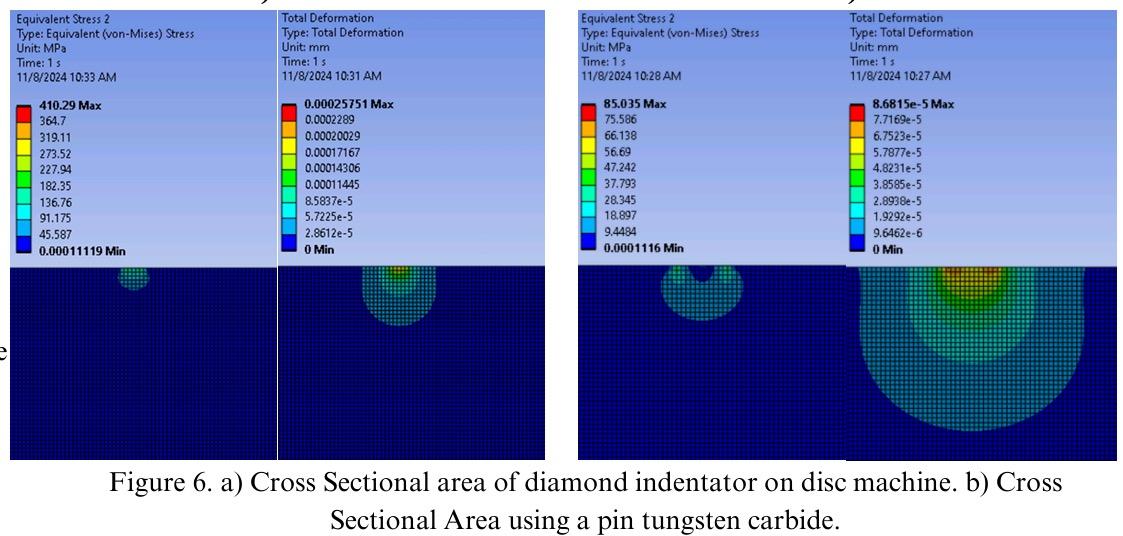
The following article presents the development of a pin on disc machine that works under standard astm G99. The outline for its parameters was established according to the necessities and the characteristics of the design when it is compared with the competitions. Also, an implement was added to allow it to increase the pressure contact of area, resulting in bigger stresses. This was the case for the spherical tungsten carbide 85.035 MPa, while, for the diamond indenter, it was 410.29 MPa. Henceforth, this changed the wear mechanism, from abrasion to a combined effect of abrasion and micro-ploughing.
In the study of the mechanical properties of a material, friction is a common characteristic to measure. However, it is not a simple task since there are a lot of variables that can affect the final measure. Machines that can determine the force friction and the coefficient of friction have been developed. These instruments are called tribometers (Hidalgo et al., 2022). To normalize the process to determine the measure of coefficient of friction and wear rate values, the standard astm G99 is used to determine the main characteristics of design (astm International, n. d.).
There is another mechanism to characterize materials, a scratch test is useful to determine the resistance to abrasion and wear for a lot of different materials (Saba, Jawaid & Sultan, 2018). Parameters for load, distance, and humidity are mentioned in astm c-1624 (astm International, n. d.). However, there is no information that exposes the uses of a scratch test using the configuration of a pin on a disc machine. Hence, the aim of this work is to develop a machine that can perform an standardized pin on disc test, with the chance to use, in the same configuration, a diamond indenter to increase the contact and wear damage, by changing the wear mechanism from only abrasion present by the spherical tungsten carbide to abrasion and
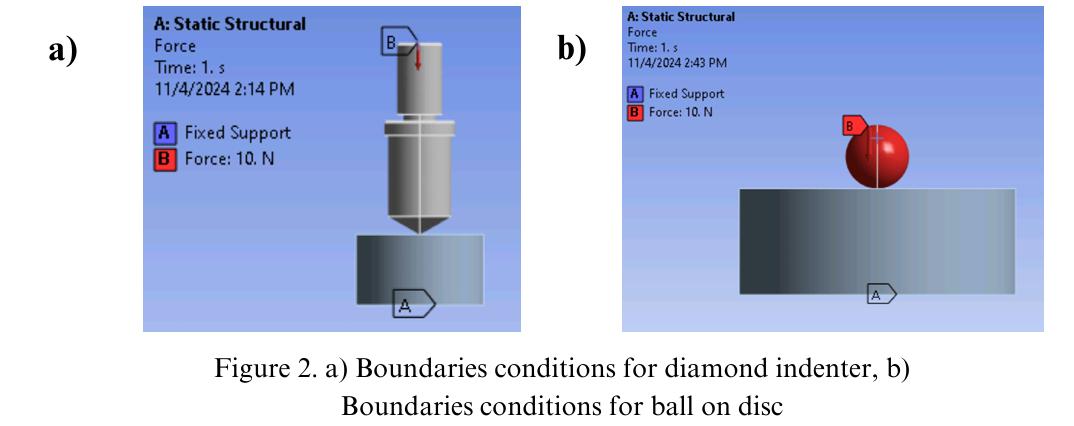
2. a) Boundaries conditions for diamond indenter, b) Boundaries conditions for ball on disc.
micro-ploughing using a diamond indenter. For the design methodology, it was necessary to consider the characteristics that we have implemented to the design. For this, the Quality Function Deployment (qfd) was developed, considering the necessities that the machine has to cover, how good is doing it, and compare it against the competition, figure 1, shows the qfd diagram, that validates the viability of the design.
The purpose of using a diamond indenter is to increase the contact pressure that exists between the pin (or indenter) and the test that is going to be submitted to the test. In this scenario, it was convenient to analyze how stresses behave according to the contact of area. For this reason, the contact was analyzed using
ansys Workbench to determine it. The parameters for boundary conditions were fixing the lower part of the disc and applying a force of 10 N, in the elements that apply load. Figure 2 a) shows the boundary condition used for the diamond indenter, while on b) shows the boundary conditions for the ball on the disc.
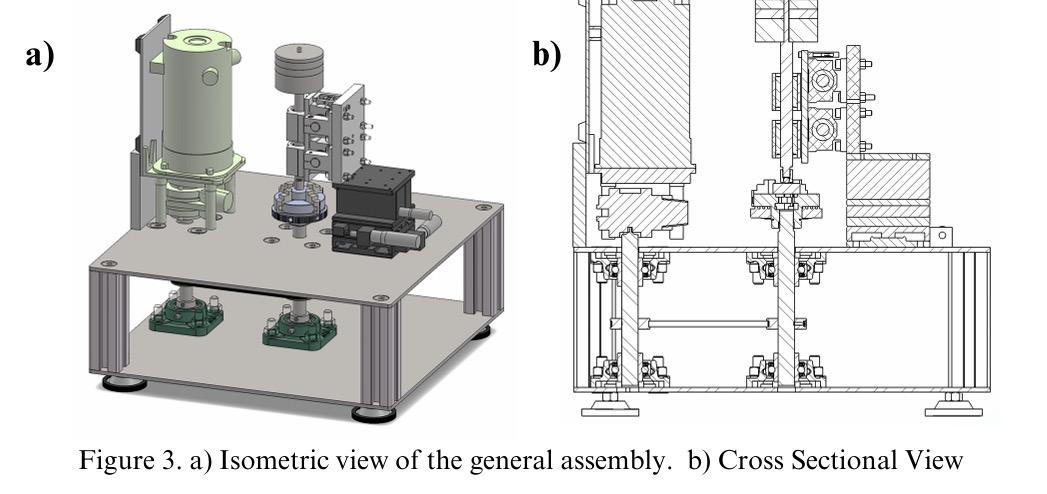
The machine that works as a tribometer pin on disc under standard astm G99 with a complement that allows the use of a diamond indenter to increase the contact area between surfaces was designed using the software SolidWorks. Figure 3 on a) shows the isometrical views of the final assembly, meanwhile, on b) it is possible to see the transmission, load and acquisition system in a cross sectional view.
Figure 1. QFD for Pin on disc machine.
Figure
a)
Figure 3.
Isometric view of the general assembly.
b) Cross Sectional View.
Figure 5
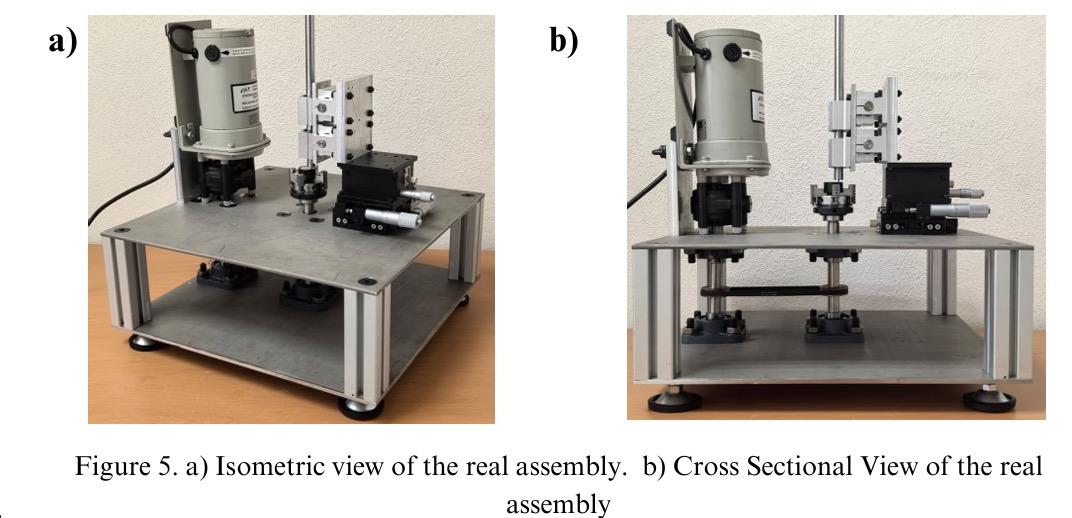
b) Cross Sectional View of the real assembly.
Figure 4
b) Cross Sectional view using a diamond indenter.
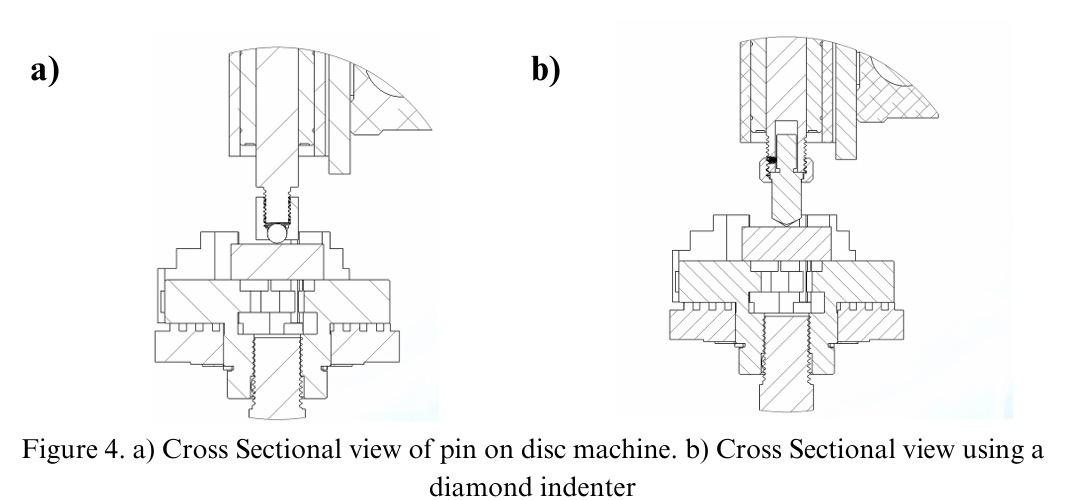
Figure 4 a) shows the zoomed cross-sectional area that is related to the pin on disc condition test, in this case is a ball of 6 mm that is clamped with a holder to the load axis, in this case is following the disposition of the standard that establishes that the test must be performed perpendicularly between surfaces; b), is the new implementation, in this case the diamond indenter is inside the axis load and clamped with a screw and a holder.
Figure 5 a) presents the isometric view of the machine that has been manufactured during the last period, while, in b) shows the left view. in this part it is possible to see the system that transmits motion and how the load is applied to the piece that is hold by the chuck.
Figure 6 presents the equivalent von Mises stress and total deformation results. In (a), the diamond indenter reached 410.29 MPa with 0.25 μm deformation, while in (b), the tungsten carbide pin reached 85.04 MPa with 0.08 μm deformation. The simulation confirms that the indenter concentrates and increases stress compared to the spherical pin.
Conclusions
The new design increased contact pressure from 85.04 MPa to 410.29 MPa using a diamond indenter. This shift changed the wear mechanism from pure abrasion to a combination of abrasion and micro-ploughing, significantly increasing wear damage. Additionally, the setup allows testing both standard pin-on-disc and diamond indenter configurations under international standards.
astm International. (s. f.). Standard test method for adhesion strength and mechanical failure modes of ceramic coatings by quantitative single point scratch testing (astm C1624-22). https://www.astm.org/c1624-22.html
astm International. (s. f.-b). Standard test method for wear testing with a pin-on-disk apparatus (astm G99-17). https://www. astm.org/g0099-17.html
Hidalgo, B. D. A., Erazo-Chamorro, V. C., Zurita, D. B. P., Cedeño, E. A. L., Jimenez, G. A. M., Arciniega-Rocha, R. P., Rosero-Montalvo, P. D., Lema, A. T. & Pijal-Rojas, J. A. (2022). Design of pin on disk tribometer under international standards. In Lecture Notes in Mechanical Engineering, 49-62. https://doi.org/10.1007/978-981-19-02963_6
Saba, N., Jawaid, M. & Sultan, M. (2018). An overview of mechanical and physical testing of composite materials. In Elsevier eBooks, 1-12. https://doi.org/10.1016/ B978-0-08-102292-4.00001-1
Figure 6 machine. b) Cross Sectional Area using a pin tungsten carbide.