Student
◊ ISA HUDZIAK EDITOR-IN-CHIEF
Government Association presidential debate on April 5

For the first time in many years, the Student Government Association is holding a debate between two presidential candidates on April 5 at 3 p.m. in Hislop Auditorium located in Thurston Hall.
The candidates are second years Kathi Jabe, a biochemistry major with a minor in human rights advocacy, and Kyle Mitchell, a political science major.

“They’re both very good candidates. They both have their pros and cons,” said Tyler Stottsberry, a cybersecurity major and the current SGA chief justice. “I think either way with either one of them winning, the school will be in a good spot and the students will be in a good spot.”
Stottsberry organized the upcoming debate and explained that it will follow standard debate structure.
There will be six main categories with 30 questions, along with questions submitted via Google Forms which was sent in an email from the SGA Communications Team.
The candidates will be posed a question with time to give an initial response, a rebuttal and a re-rebuttal. The debate is expected to take one and a half to two hours total.
According to Stottsberry,
one of the goals of this debate comes from the recent past of SGA presidents running unopposed, which creates a sense of doubt of the president’s reflection of student voices and validity of their election.
“I think when we have more than one person running, it’ll get rid of all of that [concern] so whoever takes the position, for them, they won’t have to
worry about did I actually earn it, or was I just the only person?” Stottsberry said. “Which I think will be a positive thing and make [whoever is elected] a stronger leader.”
Colby Kusinitz, the current SGA president and cybersecurity major, said he believes a strong leader for the students is necessary during this transitional time when current Provost Todd Pfannestiel is inaugurated as the tenth president of Utica University.
“My team has taken great strides to bring the two candidates, Kathi and Kyle, to the students. I encourage all students to not only attend the debate but to also consider running for student government if they feel passionate about student life and student issues,” Kusinitz said. “Students should be the change they want to see in student government.”
Candidate Q&A on page 4
Changes to the RA system will offer new positions
◊ BRADY BARNARD STAFF WRITER
The role of resident assistant will be changed at Utica University.

Resident assistants or “RA’s” are students who are trained to help other students with a variety of concerns. Every floor in every dorm building on campus students have access to an RA.
Director of Student Living

Marissa Hall said that the university has worked to develop a model that shifts the existing resident assistant role into multiple roles. These roles will include community advisors, student living assistants, student living operations coordinators, student living marketing coordinators, senior community advisors and
move in/out assistants.
Currently, the student living staff model employs about 25 students each semester. The new model will employ approximately 50 students every academic year and employ more than 100 students during August and May.
“This new model will hopefully address concerns of burnout
and workload in the existing RA position while also providing residential students with more events and opportunities to socially engage within their community,” Hall said.
Current RA staff have completed an application process to indicate which position they are interested in pursuing next year. The senior community advisor position is an exclusive position that is
VOL. LXXVI, ISSUE 5 FRIDAY, MARCH 31, 2023 UTICATANGERINE.COM The Student engagement increases NEWS | PG. 5 “In The Blood” opening FEATURES | PG. 11 Track and Field ends on a high SPORTS| PG. 12
TANGERINE
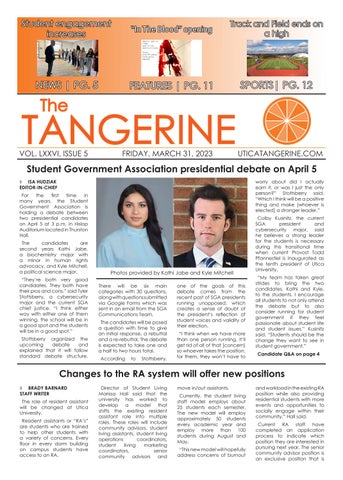
Photos provided by Kathi Jabe and Kyle Mitchell
Spring 2023 STAFF
@UticaTangerine
@Utica_Tangerine
@Utica_Tangerine
Editor-In-Chief - Isa Hudziak
Managing Editor - Hollie David
News Editor - Mickale Thompson
Features Editor- Selma Dizdarevic
Sports Editor - Harlee Lucier
Special Assignments Reporter - Mariami
Kentchadze
Social Media Manager - Nicolas Leonard



Circulation Manager - Briana Ajayi Adviser - Mary Christopher
Submission Policy
Letters to the editor are welcomed from all members of the Utica University community. Letters must meet fair and accurate publishing standards and contain no libelous material. Anonymous letters to the editor will not be printed. All letters and editorials must meet the print deadline of 5 p.m. on Mondays. Please send all submissions to tanger@utica.edu. Takeback requests are a form of censorship and therefore not accepted.
Advertising Information
The Tangerine accepts paid advertisements. Advertising copy is subject to the same professional publishing standards as content. The Tangerine reserves the right to reject advertising that does not meet the standards established, is libelous, is in poor taste or violates discrimination laws. Please direct all inquiries to tanger@utica.edu. The deadline for publication is 10 a.m. on Tuesdays.
The opinions and columns expressed in The Tangerine are those of the individual writers and do not represent the views of The Tangerine or Utica University.

News Tips? Opinions? Contact The Tangerine! TANGER@UTICA.EDU
PAGE 2 FRIDAY, MARCH 31, 2023 UTICATANGERINE.COM
Tangerine is published biweekly during the academic year by and for Utica University students. To reach a member of the staff, email tanger@utica.edu or call 315-792-3065. All material printed in The Tangerine is copyrighted. The Tangerine was first published as the Utica College News on Nov. 6, 1946.
STAFF About The
only open to current RAs. This position closely resembles the existing role but with a few tweaks and changes.
The current staff and faculty also have the opportunity to refer students who they think would be good candidates for any of the new positions.
Some positions, such as the student living marketing coordinators and the student living operations coordinators, may also be open to new students depending on available positions after returning students have applied.

“A formal website with more detailed information should be up and running shortly but any student who has questions about these positions can schedule a meeting with any of the student living staffMarissa, Lauren, Jen or Kaitie,” Hall said.

Any students interested in open positions can apply on the Student Employment Portal.
Campus safety Blotter

PAGE 3 FRIDAY, MARCH 31, 2023 UTICATANGERINE.COM Date Of Incident Time Of Incident Short Description Building 3/8/2023 12:00 PM Vehicle Parking Regulations Parking Lot 3/9/2023 8:10 PM Smoke Alarm North Hall 3/10/2023 11:15 AM Medical Assist Moses G. Hubbard Hall 3/10/2023 7:50 AM Marijuana Violation North Hall 3/10/2023 7:20 PM Alcohol/Drug Paraphernalia Alumni Hall 3/10/2023 8:00 PM Fire Safety Violation North Hall 3/10/2023 8:00 PM Alcohol Violation Boehlert Hall 3/10/2023 9:00 PM Alcohol Violation Pioneer Village 3/10/2023 8:15 PM Alcohol Violation Pioneer Village 3/10/2023 9:15 PM Alcohol Violation Pioneer Village 3/10/2023 1:00 PM Alcohol Violation Pioneer Village 3/11/2023 9:00 AM Alcohol Violation Pioneer Village 3/11/2023 8:55 AM Alcohol Violation Pioneer Village 3/11/2023 8:50 AM Alcohol Violation Pioneer Village 3/11/2023 8:50 AM Fire Safety Violation Alumni Hall 3/11/2023 10:30 AM Prohibited Items North Hall 3/21/2023 10:10 AM Fire Alarm Bell Hall
NEWS
Candidate Q&A: Kathi Jabe Candidate Q&A: Kyle Mitchell
Kathi Jabe is a second year pre-med student majoring in biochemistry and minoring in human rights advocacy. She currently holds Executive Board status in the Chemistry Club, Asa Gray, Model UN and the Class of 2025. She is a TRIO mentor, TA for chemistry and office assistant and tutor for Young Scholars LLP.
Q: How long have you been involved with SGA? What inspired you to join?
A: Since my freshman year, I have had the privilege of being involved with the Student Government Association (SGA). As a passionate and driven individual, I recognized the value of my unique perspective and ideas in advancing the student experience at our university. Thus, I joined as a Senator, eager to contribute to the betterment of our community. As fate would have it, my dedication and commitment did not go unnoticed. At the end of my first year, I was offered the opportunity to become a member of President Kusinitz’s board as Treasurer - a position I have proudly held for the past year.
Q: What inspired you to run for the SGA Presidential role?
A: I believe it’s time for a change in leadership. As a first-generation student, refugee, and woman of color, I offer a unique perspective that our leadership has not seen in far too long. Furthermore, my extensive experience serving
in numerous leadership roles both within and beyond the Student Government Association (SGA) has sharpened my abilities in fostering transparent communication, generating pioneering programming, and leading fruitful collaboration, all of which can contribute towards enhancing the overall student experience.
Q: If you were elected, what is the first thing you would do?
A: In my capacity as President, my first objective is to improve the student experience. To this end, I have devised a plan to transform the House of Orgs meetings into a welcoming and inclusive forum, where every student can freely express their views and concerns regarding not only my leadership, but also their academic progress, extracurricular activities, and the overall functioning of our institution. Moreover, I am committed to streamlining the procedure for students to obtain funding, club memberships, and individual requests, making it a more user-friendly and straightforward process by providing greater access to information and guiding them through each step of the way.
Kyle Mitchell is sophomore political science major who plans to go into law school to pursue a Juris Doctorate and a Doctorate in Psychology or Public Administration. He is involved in numerous clubs on campus as executive board member and general status member, including but not limited to the Residence Hall Association, Organization of Justice Studies, Outdoors Club and PioneerOne. He is also involved with the Diversity, Equity and InclusionCollaborative, Strategic Advisory Committee on Diversity, Equity, and Inclusion and the Utica University Honors Program Association.
Q: How long have you been involved with SGA? What inspired you to join?
A: I have been involved in Student Government since my freshman year at Utica University. During my freshman year I held the position of Class President and Underclass Senator. [I joined because I have] desire to make a positive difference on campus. Taking an active role in Student Government, allowed me to help shape policies and decisions that affect the entire student body. Desire to build a sense of community and connection on campus. [I have a] desire to work with other students to achieve shared goals, develop meaningful relationships and feel more engaged in campus life. I also felt inspired to join Student Government for the opportunity to develop leadership skills and networking opportunities.
Overall, I was inspired by the upperclassmen in Student Government at the time and through forming friendships with them, I developed a desire to run for office.
Q: What inspired you to run for the SGA Presidential role?
A: I was inspired to run for the SGA Presidential role for many reasons. As a candidate for SGA President, I want to address an important issue that I believe is affecting our Student Government: a lack of confidence. It is important that we have faith in our representatives, and I want to restore that confidence in our Student Government. I recognize that there have been instances in the past where the actions of the Student Government may have caused mistrust among the student body. However, I want to assure you that as your future SGA President, I am committed to being transparent and accountable to all of you.
Q: If you were elected, what is the first thing you would do?
A: If I were elected as President of Student Government, my first priority would be to meet with members of the student body to gather feedback on their concerns, needs, and priorities. I would create an open forum where students could express their opinions and share their ideas for how the Student Government could best serve them. Based on this feedback, I would work with the Student Government team to develop a strategic plan that addresses the most pressing issues facing the student body.
PAGE 4 FRIDAY, MARCH 31, 2023 UTICATANGERINE.COM NEWS
Undergraduate Commencemeent is Thursday, May 11 at 5 p.m. Graduate Commencement is Friday, May 12 at 10 a.m. Located at the Adirondack Bank Center at the Utica Memorial Auditorium
Student engagement sees an increase post-pandemic
KAYDEN LAMPHERE CONTRIBUTING WRITER
◊
Repealing social restrictions set during the pandemic at Utica University has allowed for a return to full-scale events, both student and faculty lead.
Many students have been taking advantage of the plethora of on-campus activities now available to them post-pandemic, as event attendance has reportedly been hitting all time highs.
“There have been 237 events this semester so far, and we are currently working with many club/ orgs who have a lot of ideas for upcoming events,” Director of Campus Engagement Lauryn Moore said.
According to Moore, many different aspects of campus engagement have been on the rise in the past two semesters, with Greek life and the Utica Campus Programming Board being two notable examples.
“We have two new sororities looking to form on campus,” Moore said. “And we have 18 potential members who are going through the recruitment process now to officially join a Greek org.”
Despite this, some clubs have been reporting low involvement from university students in the past few semesters, with some events garnering few to no new attendees.
According to Kate Vaughan, a computer science major, some
students do not attend events because they are busy.
“I am usually busy with homework, rehearsal, friends or taking time for myself,” Vaughan said.
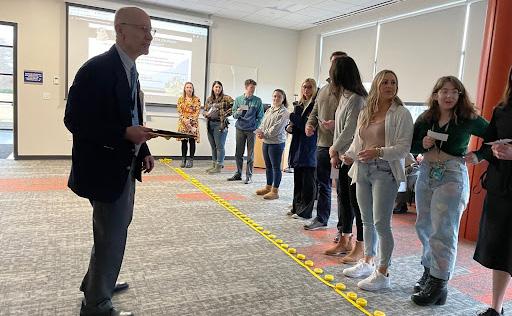
In order to combat lower attendance rates, there are many different strategies clubs and organizations on campus can utilize, and according to Moore, one of the best is collaboration.
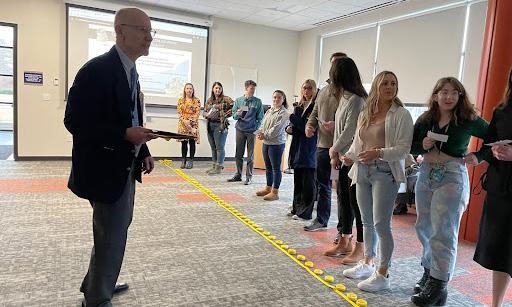
“When students can join forces it allows for more resources, more help at the event and the social networks from each group can intertwine to create more of a buzz about the event on campus,” Moore said.
Other ways campus clubs and organizations could draw a bigger attendance, as stated by Moore, include having a healthy variety of event topics, utilizing the Ralph F.
Strebel Student Center as a meeting location, seek funding from the Student Government Association, offer virtual options for students and attend events as an organization leader yourself to see how other clubs run their events.
Students like William Trombley, a chemistry major, usually attend events that relate specifically to his major, such as the ASA Gray Seminars.
“I always enjoy going to these talks because I am able to learn more about different areas in science and can relate the research they are doing to what I am currently learning in my classes,” Trombley said. “It also helps that these talks are sometimes virtual which means that you do not even need to be on campus in order to attend them.”
Organizations should take all of these ideas into consideration when planning events in the future, as participation from students only seems to be on the rise.
“We are incredibly hopeful about student engagement on campus,” Moore said. “There are a lot of students who have new ideas for clubs, have a passion for event planning, and who want to provide fun opportunities for other students.”
For more information about campus engagement, contact Lauryn Moore (lamoore@ utica.edu), Richard Racciopa (rraciop@utica. edu), or stop by the Office of Student Living and Campus Engagement at 206 Strebel Student Center, open MondayFriday from 8:30 a.m.5:00 p.m.
PAGE 5 FRIDAY, MARCH 31, 2023 UTICATANGERINE.COM
NEWS
A compounding interest in the classroom workshop hosted by Professor Rick Fenner for education students on Monday, March 27. / Photo: Katie Hanifin
The mystery of the missing pages explained
Dear Tangerine readers,
It has come to our attention that there were many questions across campus regarding the cut-out pages in our last print issue on March 10. We thought it would be best to explain what happened and express our gratitude to those who showed concern.
The decision to cut out pages (very messily, we admit but we are doing our best) was made by the editorial staff for a number of reasons:
There was a mix-up on which version of a story was supposed to be included in print, and we happened to print the incorrect version that contained some sensitive information that a source wanted removed.
Our printer delivered the papers earlier than expected, but we were not able to distribute them until Friday afternoon, which is later than usual.
Since we are a small campus newspaper, we had the power to remove the source material to protect someone else where a larger print organization would not have the opportunity to. In our minds, removing the pages was the clear choice between the options of: let the paper go out knowing it was incorrect or do something about it.
While sitting in the office and seeing those cardboard boxes of papers staring at us, knowing that one of our sources had asked expressly for certain things to be removed, the editorial staff came to a decision. We would circulate fewer papers, since it was the day before Spring Break and later in the afternoon, and remove the incorrectly printed page to protect the source. Who would even notice?
Now, I can imagine a question might be: “Why didn’t you just use a marker and block out the incorrect information?” Well… we tried. We went on a journey throughout Hubbard and the Faculty Center searching for Sharpies to borrow for an undisclosed reason of course but fell short (in the end we had one fine tip Sharpie and a pen). However, we realized that we did have two pairs of scissors and the time on our hands to remove the pages to the best of our ability.
Now that we have solved the mystery, The Tangerine staff would like to thank everyone who sent us an email, stopped us in the hallway, approached us in Price Chopper or came down to the office to check on us. Knowing we have so many people on campus who care about our well-being makes everything we do here worth it.


We’ve included the correct version of the removed article in this print issue. Thank you all for being dedicated readers of our paper and we hope to continue keeping our campus informed.
Best,
PAGE 6 FRIDAY, MARCH 31, 2023 UTICATANGERINE.COM EDITORIAL
Isa and Hollie :)
Q&A with the Student Veterans Association & gallery
◊ MARIAMI KENTCHADZE SPECIAL ASSIGNMENTS REPORTER
Utica University is an educational institution that allows students to be involved in the community by housing various organizations. One of these organizations is the Student Veterans Association (SVA) at Utica University.
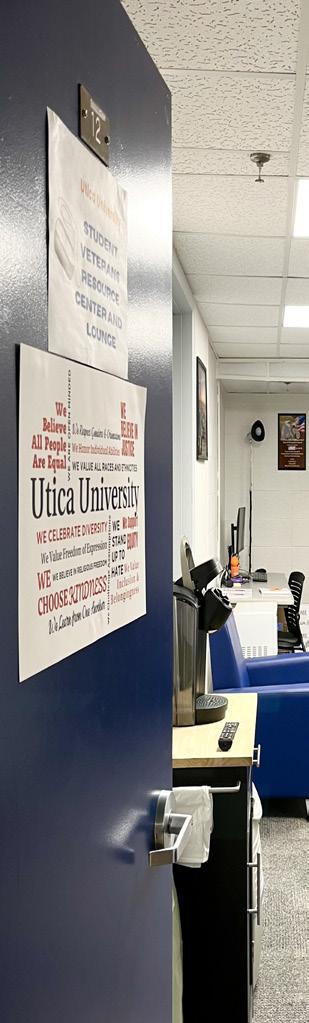
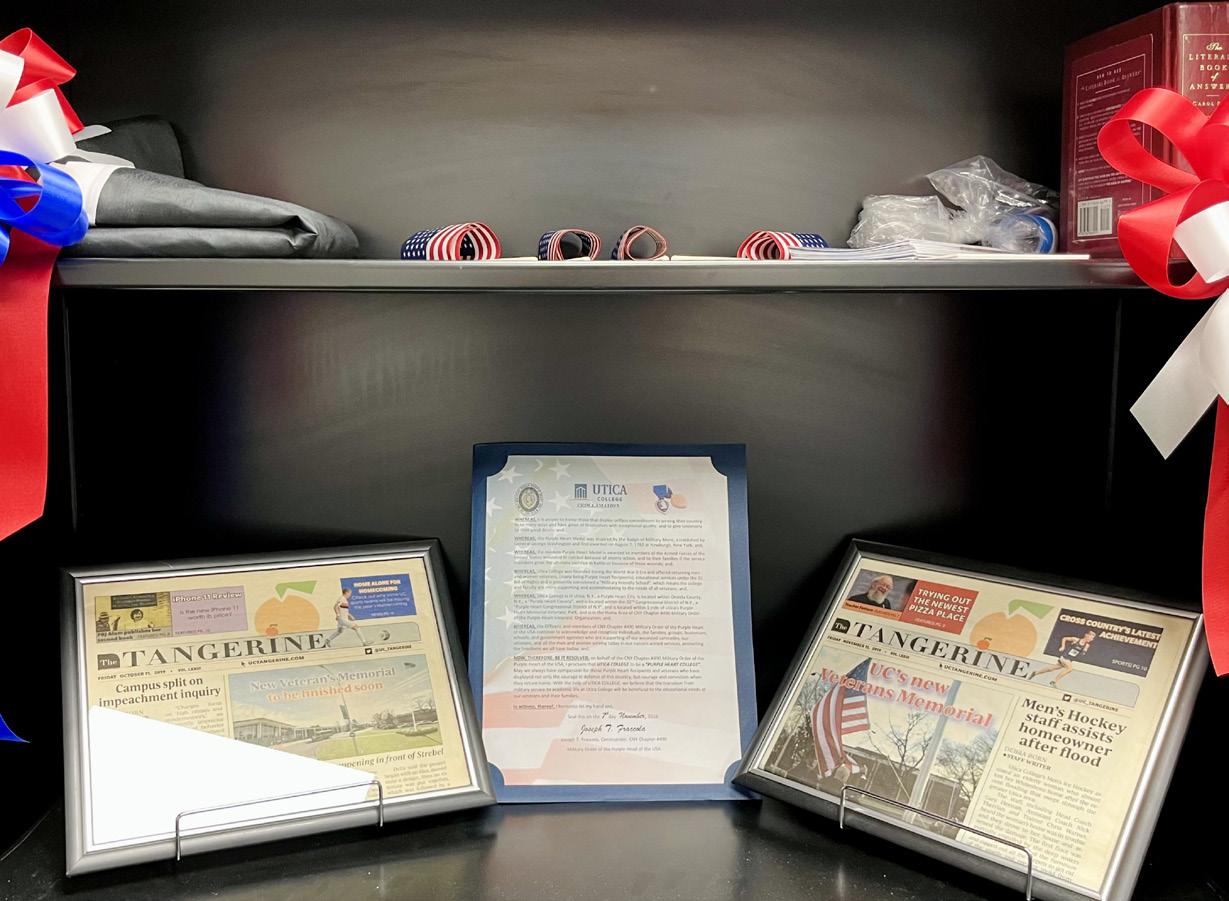
The mission of the SVA is to help veterans successfully transition into college life, encourage social engagement, enhance academic success and improve the local veteran environment.

The Tangerine conducted an interview with Jack Givens, associate professor of cybersecurity and the advisor of the SVA, and Nathaniel Illingsworth, the current club president who contributed significantly to creating the club.
Q: Why was the Student Veterans Association (SVA) created?
A: The student veterans’ organization at Utica University is a formally organized chapter of Student Veterans of America, which is the nation’s largest organization supporting and advocating for student veterans. Our chapter was incorporated in 2018. It’s important to note that Utica University was founded largely to serve veterans returning to the United States from World War II in 1946. So, our institution’s history, and our support to student veterans, are deeply intertwined.
Q: Who created SVA?
A: The SVA at Utica University was first created through the efforts of a Utica alumnus named Clayton Hawes, an Army reservist and cybersecurity major who served as our chapter’s first president. He and a group of fellow student veterans
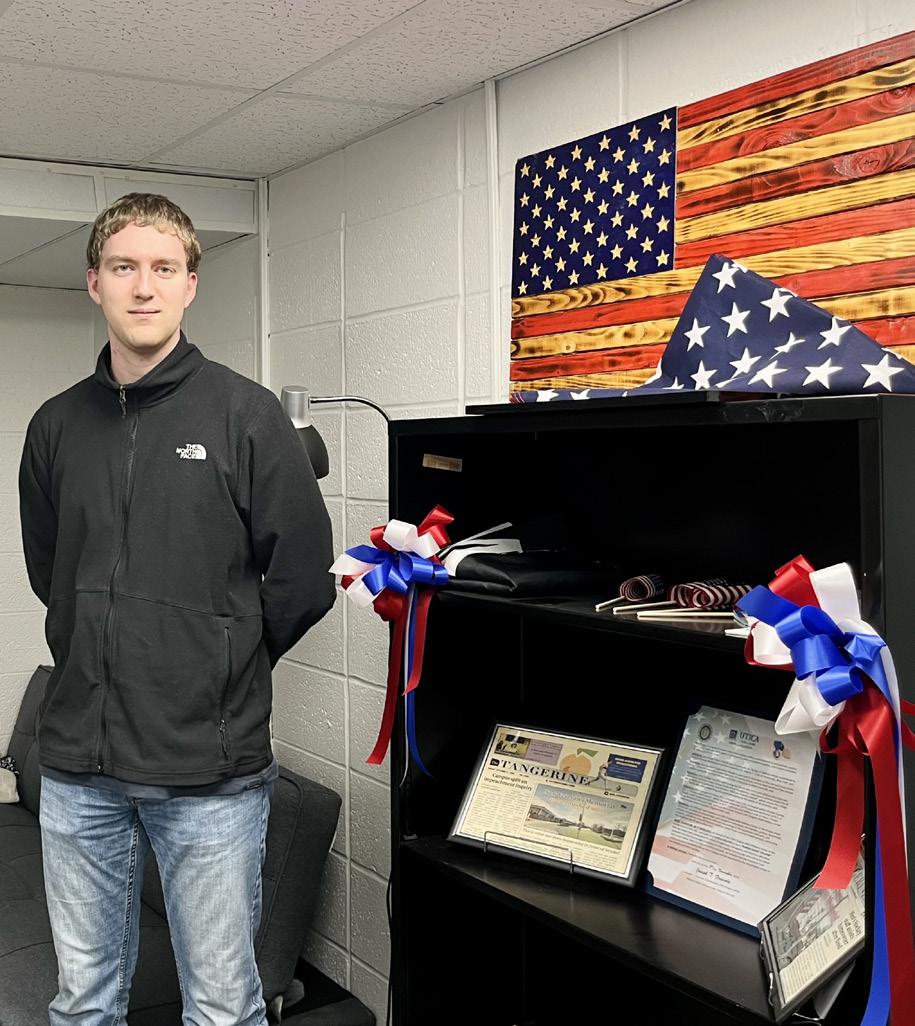
formed the first leadership team. Prior to their efforts, student veterans were supported through an ad hoc network of Utica faculty and staff.

Q: Why is SVA important for people individually?
A: Student veterans are an essential part of our institution’s diversity. Advocating for and supporting student veterans is a moral imperative and the right thing to do for our society and our institution. According to data from the Council on Foreign Relations, a think tank, less than 0.5% of the U.S. population is serving on active duty in the U.S. armed forces. So, we are talking about a very small minority group. Among
college students, veterans have a wealth of experience that enriches our institutional culture, including world travel, leadership, initiative, self-motivation, discipline, and a well-developed sense of personal responsibility and accountability. Getting involved with the SVA at Utica University means you are helping to promote and sustain these things within our institution. And that benefits us all.
Q: How can students help out and support SVA more?
A: Contact Nathan Illingsworth, our president, or Jack Givens, our faculty advisor, to learn more about how to get involved. Coming to meetings, helping organize programming and
fun excursions–everything helps. Our strength comes from member involvement and enthusiasm. Whether you have a personal connection to the armed forces or not does not matter, all are welcome.
Q: About the veterans’ lounge:
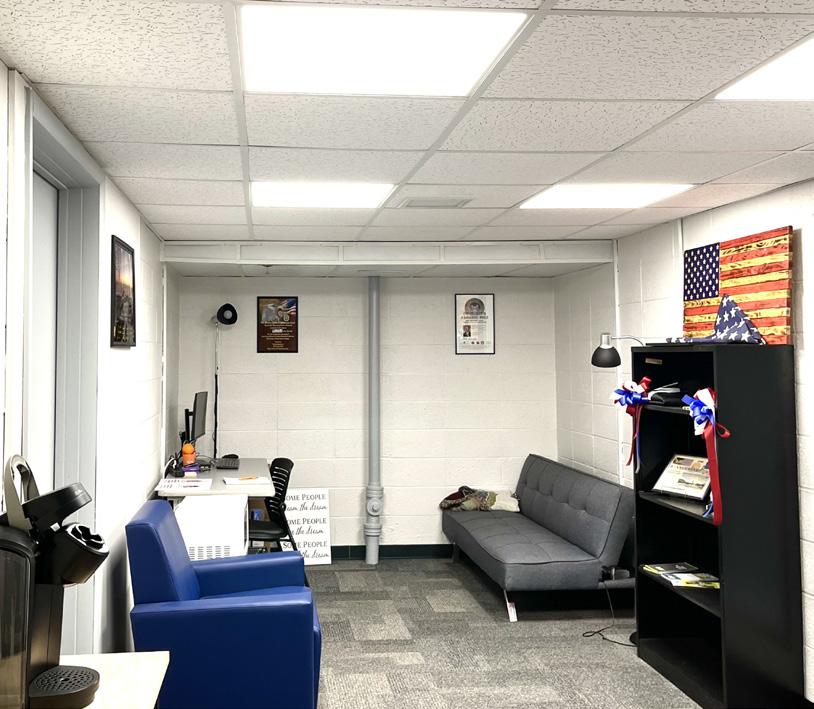
A: We have a dedicated lounge located in Hubbard Hall, B12, for which we are extremely grateful to the Utica University administration. It features a flat-screen TV, coffee maker, computer workstation and comfortable seating. It’s a great place to study, meet or just relax. At the moment the SVA uses it primarily for meetings, though we anticipate using it for other purposes in the future, too.
PAGE 7 FRIDAY, MARCH 31, 2023 UTICATANGERINE.COM FEATURES
FEATURES
Laurah Klepinger Profile:
◊ DIANA SIDOREVICH CONTRIBUTING WRITER
Laurah Klepinger is a lifelong student.
Since her first time in college, Klepinger realized how much she loved learning and writing papers. Encouraged by her grandfather through their frequent correspondence by letter, she decided, “I would do this forever.”
“Learning and communicating with other people who have challenging thoughts and ideas and try to understand complex theories, that’s my love,” Klepinger said.
She now holds a Master of Arts and a Master of Fine Arts in Dance, a Master of Arts and Ph. D in Anthropology and completed a Bachelor of Dance Arts.
Klepinger has been teaching in the Anthropology department at Utica University for almost seven years. Helen Blouet, Chair of the Sociology and Anthropology department, describes her as approachable and eager to connect with students. That’s a legacy she carries from a past professor and friend throughout her life, Evelyn Vélez-Aguayo.
Klepinger recalled the role Vélez-Aguayo played in “shocking me out of myself,” by being a downto-earth professor that cared about her students and asked about their lives beyond addressing course-related material.
She inspired Klepinger to begin yoga and gave her her first yoga mat and pillow.
It was through yoga that Klepinger found a deep spiritual community that she spent many years with, the Sivananda Yoga Vedanta Centres. Klepinger was deeply connected to the organization, traveling with them, doing yoga courses in India and directing children’s yoga camps. The women cooking and cleaning for the devotional community became an inspiration for Klepinger’s book, “Transnational Yoga at Work: Spiritual Tourism and its Blind Spots.”
As she was working on her now-published book in December 2019, a woman that was a longtime affiliate with the organization came forwards alleging sexual abuse, and many women followed suit. Many people she cared about were accused of abuse and/or of helping to cover up alleged abuse.
It was a “shattering of my faith,” and then the “deep darkness and solitude of COVID came up,” Klepinger said.
Through it all, Klepinger remained a source of inspiration for her students.
A graduate of the anthropology program, Cara Patterson said Klepinger sparked her interest in social justice, diversity, equity and inclusion and made her think about the world in a different way. She learned to view cultures through a different lens.
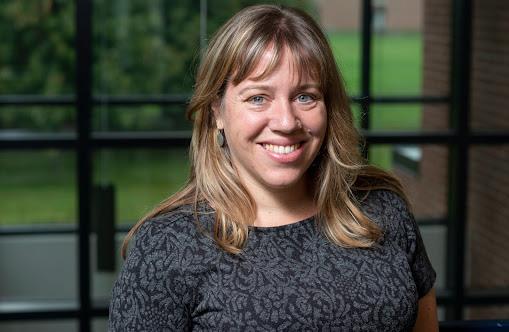
Patterson learned about empathy through her classes with Klepinger.
“I see that as being her gift, her natural empathy,” Patterson said. “You can sense she cares about you and she cares about what she does.”
As part of the search committee that hired Klepinger, Blouet says Klepinger’s creativity in teaching on campus and online stood out to her.
“She’s not trying to be aloof or untouchable
expert, but she’s trying to bring her knowledge to the students, get them to apply it to their own lives, get them engaged in their own learning and to be motivated and complete tasks at hand,” Blouet said.
Klepinger brings her expertise to help connect what’s going on academically to a larger, more widespread DEI office on campus and is instrumental in connecting programs across campus. In addition to being involved in various programs and being a professor on campus, Klepinger has been a single parent for most of her eleven-yearold daughter’s life. She describes her relationship with her daughter as the most challenging and most beloved.
Her own mother has been the most influential person in her life. She got her selfesteem and confidence to try new things from her relationship with her. Klepinger wants to pass that on to her daughter as well.
Klepinger uses the privilege of being empowered by her upbringing and is a force of inspiration on Utica’s campus.
As Blouet says, “If there’s one professor you would go to knock on their door and chat with, just go to Laurah.” Her office is equipped with bean bag chairs.
PAGE 8 FRIDAY, MARCH 31, 2023 UTICATANGERINE.COM
‘If there’s one professor you would go to knock on their door and chat with, just go to Laurah’
Headshot of Klepinger from Utica University /Photo: Laura Klepinger
FEATURES
Utica University students dedicate time raising awareness for furry paws in shelters
◊ BREANNAN O’HARA CONTRIBUTING WRITER
Local animal shelters are always looking for volunteers and donations to help provide care to their animals, which is why the Animal Shelter Association at Utica University was created. The Animal Shelter Association is a club that spreads awareness and supports local animal shelters in a variety of ways. The group dedicates their time to raise donations and spread love for the animals without a home. Through these meetings and events, friendships and good memories are also created.
“It’s a fun group to be a part of and a way to make new friends,” said Gillian Bradley, a senior who is a member of the club. “During some of the meetings we make treats or blankets to be donated to the local animal shelters in which the group bonds in these shared activities together.”
This club provides a significant amount of help to local shelters, especially the Humane Society of Rome. Last semester, $200 was raised by selling Utica Coffee and then was donated to the Humane Society of Rome.

According to club president Julyanna Sauschuck, the club has made big accomplishments that impact local shelters and Utica students.
“Our major accomplishment is the Doggy Destress Day that
has occurred for the past two years,” Sauschuck said. “We ask professors to bring their dogs and then anyone on campus is allowed to interact with them in hopes that it will bring joy and comfort to students.”
The donations raised by the club significantly helps shelters by providing extra supplies for the many animals they take care of.
The club also dedicates some of their time each week to physically go to these shelters to volunteer. Sauschuck said volunteers provide “extra love and attention” for the animals that need a home and “service” for the individuals that work at these shelters.
“Our job when volunteering can range from walking dogs, cat socialization and cleaning everyday items used by the animals,” Bradley said.
Since the club has been active, there has been growth in donations and time spent volunteering. Since the Animal Shelter Association gives a voice to animals that cannot speak for themselves, it needs help in maintaining active members.
“Our long-term goal is to ensure that we have new members stepping into the e-board positions for next year since the whole e-board is leaving,” said
“That’s a big challenge we’re facing right now.”
If anyone is interested in helping the local animal shelters and spreading awareness for the animals without a home, they should consider joining the Animal Shelter Association here at Utica University.
“Most importantly though, we encourage people to volunteer at animal shelters whenever they can,” McNeil said.
To learn more, check out their Instagram page @asa_utica.
PAGE 9 FRIDAY, MARCH 31, 2023 UTICATANGERINE.COM
Michael McNeil, the vice president of the club.
Photo from the Animal Shelter Association’s Instagram page, https://www.instagram.com/asa_utica
Professor David Chanatry Hosts WCNY’s Ivory Tower

◊ DIANA SIDOREVICH CONTRIBUTING WRITER
Having a 20 year career at NBC as a writer and producer along with a second career as a professor of journalism, David Chanatry is a pillar of the Communication and Media faculty at Utica University.
Added to his expertise, he recently co-produced a documentary called “Utica: The Last Refuge” and for the past seven years has hosted the show “Ivory Tower” in Syracuse. Students hear him mention his show among the stories sprinkled through his lessons but wonder, what does he do and what is the show about?
The term ‘ivory tower’ refers to a metaphorical place of “privileged seclusion or separation from the facts and practicalities of the real world.” The Oxford Dictionary uses the term “the ivory tower of academia” as an example. That’s exactly what the show is.
“Ivory Tower” is a roundtable discussion with usually four panelists about the latest hot topics in news from professors’ perspectives. I was able to sit in on the taping of the show on Friday morning before Spring Break.
From where I was standing, a pair of glasses seemed to be a panelist requirement. That might have something to do with the panelists’ age, but in all fairness, that was Professor Chanatry’s comment.
As a host, Professor Chanatry’s role requires news-binging throughout the week. On Tuesdays, he isolates for news
research, formulating a list of 10-12 topics that the panelists vote on and the final three are selected by Wednesday. Panelists spend the next two days researching the topics in depth.
The host fills a unique role. A host or moderator should not make their opinion known on topics that most people feel passionately about and should be able to neutrally play devil’s advocate for the opposing viewpoint.
“It’s up to David to throw out stuff to make them think about the other side,” producer Douglas Moreau said. “If everybody is agreeing, that makes a terrible show.”
“Ivory Tower” is not your regular news pundit program. It began in 2002 when former host David Reuben wanted to develop a show discussing everyday things happening in local and national news. His goal was for academics to express diverse viewpoints while remaining cordial and not interrupting one another. This is becoming a lost art in today’s heated discussions.
Chanatry said each scholar is a “well of
expertise” in their respective field. The episode that I sat in on consisted of an impressive assortment of well articulated scholars.
The panel included Chad Sparber, who holds a Ph.D. in Economics and is a professor at Colgate University; Nina Moore, also from Colgate, who holds a PhD in Political Science and has written books on race and politics; retired Brigadier General Ty Seidule currently serving as a visiting professor of history at Hamilton College, who has also authored several books including his latest Robert E. Lee and Me; and Sarah Pralle holding a Ph.D. in Political Science currently serving as associate professor of Political Science at Syracuse University.
“The depth of the program I like to think is significantly different from what you see on a regular news channel,” Chanatry said.
According to Moreau, panelists serve as volunteers, must be up to date and have time to do research on topics in order to talk “dynamically and wittingly” about them on Friday morning. He tries to choose professors from different schools for each
episode to increase diverse thought.
“There are perfectly good people who have different opinions than you but that doesn’t make them bad people,” Chanatry said.
Panelists discussed the murders of American citizens in Mexico and whether the U.S. military should increase their involvement, ESG (Environmental, Social, and Governance) and if expanding the House of Representatives would be beneficial for the U.S. Students don’t often bother keeping up with current events and news since they usually require time to research. The topics discussed on “Ivory Tower” are, however, impactful and consequential. The 65 and over crowd has time to mind politics—they make up the majority of viewers for this highest-rated locally produced show at the PBS station.
True to their profession, the panelists end each episode with a grading session, A’s and F’s. Each professor assigns an A and F to something that happened in the week.
Pralle gave the federal government an “F” for ending the pandemic era policy that increased food assistance payments to people who are on the SNAP program. Moore gave an “A” to President Joe Biden’s 2024 budget that includes billions for childcare, early childhood education.
Ivory Tower gets an “A” from this student for the panelists ability to respectfully disagree and communicate conflicting viewpoints.
PAGE 10 FRIDAY, MARCH 31, 2023 UTICATANGERINE.COM FEATURES
Professor David Chanatry prepares for the show.
/Photo: Diana Sidorevich
FEATURES
Utica University Theater Department to present “In The Blood” with six showtimes
◊ SELMA DIZDAREVIC FEATURES EDITOR
The Utica University Theatre Department will present the play “In The Blood” on March 31, April 1, 6, 7 and 8 at 7:30 p.m. and April 2 at 2 p.m. in Strebel Auditorium.

The play is a modern adaptation of the classic novel “The Scarlet Letter.” It tells the story of Hester, a single mother of five, who battles poverty, discrimination and social rejection while trying to support her family.
“The whole play is really an extended meditation on the idea of the ‘welfare queen,’ or someone who lives in poverty, and how they are damaged by systems that are supposed to help them,” Director Rachel Wolfe said.
According to Wolfe, the play was chosen because it was popular among students when she taught it in her “Black Feminisms on Stage” course.
“It was the most popular play that my students read that semester,” she said. “And quite frankly, my students are right. It’s an excellently written play.”
“In The Blood” marks the department’s first show to be performed on
two weekends instead of one. Wolfe said she hopes the extended run will provide more time for reviewers to attend.
“This is actually the first year that we are trying to have a two-weekend run of the show,” she said. “We’re hoping that will result in more people coming to see our play.”
Lead actor V Prather, who plays Hester, described how “In The Blood” touches
on important topics surrounding women of color and oppression. She said that while playing the role can be difficult because of the play’s heavy material, she was inclined to tell Hester’s story.
“I was drawn to this role and really wanted to take care of Hester,” Prather said.
Prather said she is proud of the work she and her castmates have put into the show
for the past six weeks and is excited to share it with the audience.
The play is recommended for mature audiences only and tickets will be sold at the door. Admission is $5 for students and $10 for the general public. Tickets can also be purchased in advance on the Utica University Theatre Department website.
PAGE 11 FRIDAY, MARCH 31, 2023 UTICATANGERINE.COM
Track and Field season ends on a high
◊ HARLEE LUCIER SPORTS EDITOR
The Utica University track and field off the back of a successful year had 26 members selected for the Empire 8 all-conference team this season. The Pioneers received two national qualifiers, eight conference champions, 13 school records broken, and 79 Utica all-time top 10 lists.

Andy Hadasz, an MVCC transfer, and company, racked up 232 total points for the Pioneers. The sprinter wrapped up his first indoor championship season with multiple university alltime top 10 list rankings and the Empire 8 200m championship.
Following the conclusion of the indoor season Hadasz offered some words of advice to incoming freshmen and fellow teammates.
“Come to practice with the mindset to get better every day,” he said. “Instead of taking a rep off to really focus on every rep, focus when you’re in the training room, and don’t skip days.”
Putting the work in while trusting the process and the coaching staff, Hadasz said is important, especially during the times when you might come up short.
Trusting the process is exactly what graduate student Laura Meade did, putting all faith in the coach’s decision to have her run the pentathlon.
Meade has an extensive track resume having run every sprint event, 400m hurdles, and long and triple jumps. However, one week before the indoor championships Meade was
diagnosed with tendinitis in her knee making it difficult for her to walk.
Still, she was determined to finish out the season. In the end, she broke the pentathlon record despite being jokingly confused about how the points tally works.
“My first time running it was this season and I actually broke the school record my first time doing it,” Meade said. “Then I just rebroke it again at the Empire 8 championships.”
According to Meade, doing the workouts given by the coaches and trusting that they know best will help is an important factor at the end of the day.
“You might think you do but they know what they are doing,” Meade said. “Don’t be afraid to try new events because you never know what may happen when you try a new event. You may end up being way better at it than any other event that you have been trying. The coaches will be able to see that in

you, always trust them.”
Fellow teammate Mackenzie Mix finished the indoor season having qualified for nationals in the 400m. Mix finished the event in second place while representing the Empire. She also finished as conference champion in the 200m, placed 12th in the all-Atlantic region championships, and 11th in the 60m dash. She also ran a 56.90 in the 400m NCAA division III champions in Alabama which saw her rank 18 nationally.
Senior jumper Zuriel Wright also qualified for national in the high just having set the Pioneer school record for the in the event at 2.05m and tied for sixth place at the all-regional championships meet with a height of 1.95m.
At nationals, Wright finished 18th in the nation bowing out at 2.03m. He attributes his success to the relationship he has with his teammates and how they’ve improved together.
“Watching my teammates get better and improve each meet kept me going,” Wright said. “We have a lot of new talent on the team and it’s inspiring watching them get better every day.”
The camaraderie in the team kept the squad locked in on event days. They took it one step at a time and didn’t overthink things throughout the season.
“My coach always says forget that and move on to the next one,” Meade said. “If I have a bad workout he’ll say you know what you are capable of, just because you have one bad day doesn’t mean you are bad.”
Wright echoed the same sentiment by saying that his best advice is to “win the day” and be proud of your victories as they come.
“The team really encourages each other [and] picks each other up when we have bad reps or your times aren’t good,” Hadasz said. “Everyone is there for each other and everyone’s rooting for you. It’s like a small family even though it’s not so small. There are more people than you can name on a track team. One of my favorite parts this year is how close the team is”
PAGE 12 FRIDAY, MARCH 31, 2023 UTICATANGERINE.COM SPORTS
The Track and Field turf. /Photo: Uticapioneers.com