THE HIGHLANDER
UNIVERSITY OF CALIFORNIA, RIVERSIDE
FOR THE WEEK OF TUESDAY, JANUARY 21, 2020
VOL. 68, ISSUE 14
est. 1954
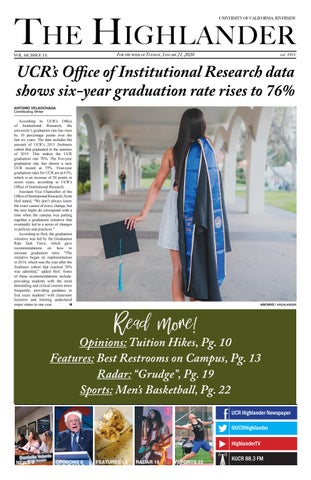
UCR’s Office of Institutional Research data shows six-year graduation rate rises to 76%
ANTONIO VELAOCHAGA Contributing Writer
According to UCR’s Office of Institutional Research, the university’s graduation rate has risen by 10 percentage points over the last six years. The data includes the amount of UCR’s 2013 freshmen cohort that graduated in the summer of 2019. This makes the UCR graduation rate 76%. The five-year graduation rate has shown a new UCR record at 75%. Four-year graduation rates for UCR are at 61%, which is an increase of 20 points in seven years, according to UCR’s Office of Institutional Research. Assistant Vice Chancellor of the Office of Institutional Research, Scott Heil stated, “We don’t always know the exact causes of every change, but the new highs do correspond with a time when the campus was putting together a graduation initiative that eventually led to a series of changes in policies and practices.” According to Heil, the graduation initiative was led by the Graduation Rate Task Force, which gave recommendations on how to increase graduation rates. “The initiative began its implementation in 2014, which was the year after the freshmen cohort that reached 76% was admitted,” added Heil. Some of these recommendations include: providing students with the most demanding and critical courses more frequently, providing guidance to first years students’ with classroom lecturers and limiting undeclared major status to one year. ■H
ARCHIVE / HIGHLANDER
Read more!
Opinions: Tuition Hikes, Pg. 10 Features: Best Restrooms on Campus, Pg. 13 Radar: “Grudge”, Pg. 19 Sports: Men’s Basketball, Pg. 22
f UCR Highlander Newspaper @UCRHighlander HighlanderTV NEWS 4
OPINIONS 8
FEATURES 13
RADAR 18
SPORTS 22
KUCR 88.3 FM
2
HIGHLANDER // highlandernews.org
TUESDAY, JANUARY 21, 2020
HUMANS OF UCR
UPCOMING EVENTS: WEEK 3
GHANNEA RAVE | BUSINESS ADMIN. | FIRST YEAR-TRANSFER COMPILED BY LLOYD KAO
21
Networking Your Way to a Job 12:00pm to 1:00pm HUB (Highlander Union Building), 260
ASPB Present: Get to Know Jordyn Woods 7:00pm HUB (Highlander Union Building), 302
APSP Lunar New Year Festival 6:00pm to 8:00pm Costo Hall, 244
ASPB Presents: Rollercade 6:00pm SRC
23
LGBTRC Community Forum Hour 1:30pm to 2:30pm Costo Hall , 245
E&J Gallo Winery Coffee Chat 2:30pm to 4:00pm Olmsted Hall, 2340
24
Video 101 Training Session 9:00am to 10:00am HUB (Highlander Union Building), 268
Evening with Industry 2020 5:00pm to 9:00pm HUB (Highlander Union Building), 302
25
Women’s Basketball vs Hawaii 5:00pm to 7:00pm Student Recreation Center (SRC), Arena
CNAS Early Student Career and Planning Expo (ESCAPE) 9:00am to 2:30pm Highlander Union Building (HUB) 302
26
UCR Music. 6th annual Villa-Lobos International Chamber Music Festival 4:00pm to 5:30pm UCR ARTS
27
Active Minds Rejuvenation Stations 9:00am to 4:00pm HUB (Highlander Union Building), 248, 260, 265, and 268
Tuesday
22
Wednesday
Thursday
“I was hesitant about transferring over to UCR as I commute far to get to my classes, but it was all worth it. Everyone here is friendly and supportive, and it pushes me to improve myself. I am normally shy when it comes to interacting with others, but the atmosphere on campus gives me the
Friday
push to join new clubs and connect with others.“
Saturday
Sunday
CONTACT US
HIGHLANDER STAFF EDITOR-IN-CHIEF
MANAGING EDITOR
Evan Ismail
Jonathan Fernandez
managingeditor @highlandernews.org
editorinchief @highlandernews.org
ASST. NEWS EDITOR
NEWS EDITOR
Laura Anaya-Morga lanay004@ucr.edu
Amani Mahmoud
news@highlandernews.org OPINIONS EDITOR
Samuel Harrison
opinions@highlandernews.org FEATURES EDITOR
Asst. Features editor
Mark Bertumen
Christine Tran ctran104@ucr.edu
features@highlandernews. org A&E EDITOR
ASST. A&E EDITOR
Colin Carney
Adam Alvernaz aalve003@ucr.edu
radar@highlandernews.org SPORTS EDITOR
Jordan Hom
sports@highlandernews.org PRODUCTION MANAGER
ART DIRECTOR
Kerry Mulia
Amanda Joy Teano highlander.art.director@ gmail.com
productionmanager @highlandernews.org PRODUCTION ASSISTANTS
Kathy Garcia Brinly Den Celine Hoang
Judy Tu
Asst. Photo Editor
PHOTOGRAPHY EDITOR
Martin Lopez
Ryan Poon rpoon003@ucr.edu
photo@highlandernews.org STAFF PHOTOGRAPHERS
Leo Yue Lydia Tsou ASST. VIDEO EDITOR
Sara Bernal
sbern016@ucr.edu BUSINESS MANAGER
COPY EDITOR
Melanie White
Silvia Ferrer
highlanderads@gmail.com
copyeditor.highlander@ gmail.com
DISTRIBUTION MANAGER
TECH DIRECTOR
Sarang Majmudar
MARKETING COORDINATOR
Cody Davis
Jeffrey Juan
techdirector@highlandernews.org
marketing.highlander@gmail.com
Highlander 101 Highlander Union Building Riverside, CA 92521 www.highlandernews.org editorinchief@highlandernews.org TIP LINE: (951) 827-2105 Help the Highlander stay on top of what is happening on campus and in the general UCR community. Call this number and leave a message for the Editorial Board with your tip. Be sure to include your full name, relation to UCR, and a number or email address where you can be reached for more details. Editorial Office: (951) 827-3617
Business Office: (951) 827-3457
Classifieds & Billing: (951) 827-5039
Fax: (951) 827-7049
LETTERS TO THE EDITOR The Highlander accepts letters from the campus community. They must be 600-800 words at length and include the author’s name and contact information. Topics should be UCR-centric and/or pertain to our generation of students. Contact Opinions Editor Samuel Harrison at opinions@highlandernews.org by Wednesday if interested in writing a letter and submit the completed letter by Saturday at noon. Letters can and will be rejected if it does not meet requirements. LEGAL The Highlander is published and copyrighted by the Highlander for the students, faculty and staff of UCR. All rights are reserved. Reprinting of any material in this publication without the written permission of the Highlander is strictly prohibited. Readers are allowed one free copy of the newspaper. For additional copies or for subscription information, please contact the Highlander. The Highlander fully supports the University of California’s policy on non-discrimination. The student media reserve the right to reject or modify advertising whose content discriminates on the basis of ancestry, color, national origin, race, religion, disability, age, sex or sexual orientation. The Highlander has a media grievance procedure for resolving complaints against it. All inserts that are printed in the Highlander are independently paid publications and do not reflect the views of the Editorial Board, the staff or The University of California or the Associated Students of UCR.
Monday
MULTIMEDIA
CLASSIFIED ADVERTISEMENTS ADVERTISING INFORMATION Please submit Classifed ads by calling 951-827-3457 or by emailing Highlanderads@ucr.edu PAYMENT Visa and Mastercard Make checks payable to The Highlander Newspaper No refunds RATES Classified: $2 per line; 17 characters (spaces, dashes, etc.)
Persian Poetry and Prose 4:00pm to 5:00pm HUB (Highlander Union Building), 355
UCRHIGHLANDER
f
UCR HIGHLANDER NEWSPAPER @UCRHIGHLANDER HighlanderTV KUCR 88.3 FM
News 4
TUESDAY, JANUARY 21, 2020
HIGHLANDER // highlandernews.org/news
UC Board of Regents hosts first town hall forum to search for next UC president
ANTONIO VELAOCHAGA Contributing Writer SILVIA FERRER Senior Staff Writer
On Thursday, Jan. 16, the UC Board of Regents held the first town hall open forum for students, faculty, staff and stakeholders to voice their thoughts on the selection of the new president of the University of California. The event was held on campus in HUB 302. Following the announcement that UC President Janet Napolitano will be resigning from her position at the end of this school year, the Board of Regents were tasked with selecting the next UC president. The board chair appointed a special committee within the Board of Regents to globally search for the new UC president. The committee consisted of 10 regents. “This is the first UC presidential search in which a special committee is going beyond what is written in policy and make itself available to input from additional stakeholders of the public,” said vice chair of the Special Committee on Nominations Sherry Lancing. Lancing introduced the purpose of the town hall, which consisted of the special committee listening to the comments of various speakers to help their decision-making process. All of the speakers voiced their desire for the board to select a president who will address UCR’s internal and external issues. Vice chairwoman of the special committee, Cecilia Estolano, said that she wanted to appoint someone who is excellent in collaboration, has the respect of faculty, is a strong advocate for students, understands patience and maintains dedication. “I want that president to exemplify the importance of diversity of experiences, boldy moving forward, constantly innovating, taking risks and investing in those who receive the least resources,” said Estolano. Graduate Student Association (GSA) President John Haberstroh said that the next UC president must have the courage to face sensitive issues and stand against the majority if necessary. Haberstroh addressed the hardships
that many graduate students face in the UC system including depression, food insecurity, homelessness and financial instability. He stated that the next president must strive for the betterment of struggling UC students. Several UCR students and instructors pointed out the limited resources, staff and facilities within certain courses that prevent the graduation of many students. Multiple speakers voiced a deep concern for the low funds that UCR receives compared to other UC schools. Silvia Ferrer, fourth-year political science and English major spoke about how resources in place at UCR had helped her succeed. “I would not have the peace of mind to make the most of my college experience without them. But these programs are substantially underfunded, which comes as no surprise considering that UCR is the lowest core-funded campus in the UC system,” she said. Media and Cultural Studies Professor Patricia Morton stated that UCR is the most underfunded UC because it is the most diverse UC with the most number of minority students; she stated that this is a prime example of institutional racism. Morton said, “We understand that there are weighted allocation algorithms that are involved in this, but we still believe this is an instance of institutional racism because we also educate more underrepresented minority students than other campuses.” Many speakers voiced a need for the new UC president to be someone who advocates for diversity and inclusion. They emphasized the need for a president who could represent the underrepresented within the UC school system. Vice Chancellor of Advancement Peter Hayashida voiced the priorities that the new UC president should have, such as academic excellence, access and diversity. Hayashida stated, “A president must align with our values … To me this means strengthening our support of California residents, DACA recipients and low-income and first-generation students.” Estolano said that accessibility to the UC system is an important issue that should
be addressed. Regarding the students admitted to the UC school, she said, “We need to show that we truly are an avenue for mobility … Any smart kid that’s in high school ought to be able to go and there shouldn’t be a barrier for costs.” Student speakers voiced their support for AFSCME 3299 movement. This movement protests against the practices that they believe the UC system implements on its workers, such as outsourcing low paying jobs, raising health care costs and providing unfair payment and benefits to their workers. Associate Director of Sustainability Brian Siana voiced the urgency of the climate change and called for the next UC president to acknowledge and take immediate action to reduce carbon emissions in the UC system. Estolano said that the president must work to significantly reduce greenhouse gas emissions in the UC system and create a sustainable model that the UC community can follow. Estolano stated that the new president should acknowledge the UC system’s role to educate the leaders of the
LYDIA TSOU / HIGHLANDER
nation and advance research made within the institution. Regarding the forum, Estolano stated, “The passion that the folks feel about the mission of the university and their deep affection for this campus came across loud and clear.” She emphasized that the UC Board of Regents’ process of choosing the next UC president would be thorough. “I think it’s probably the most prestigious appointment in higher education,” she added. Director of Government Relations of ASUCR’s Lobby Corps Vincent Rasso expressed his concern with the Regents’ proposal to increase tuition over a period of five years. He stated, “This hasty proposal breaks precedent by not being heard by a committee, lacking student input and affecting entire years of students.” When the event ended, the board thanked all of the speakers and said that there will be three upcoming town hall meetings on UC campuses. The dates of the upcoming forums will be posted on the UC Board of Regents website. ■H
ASUCR hosts 6th annual R’Gear distribution
LIZBETH MARQUEZ TORRES Contributing Writer
Hundreds of students lined up outside the Student Recreation Center (SRC) on Thursday, Jan. 15, for the annual distribution of R’Gear led by ASUCR. The Highlander met and briefly spoke with Carolyn Chang, the vice president of finance, who was in charge of organizing and leading the event. She informed The Highlander that
this is the sixth year in a row that ASUCR has organized the distribution of free UCR apparel for undergraduate students. Chang has been involved with ASUCR for four years and was happy that the event was going according to plan. Chang stated that she worked alongside two other people to plan out the logistics of the annual event. She also had to find a vendor that would make the sweaters within the budget
LEO YUE/ HIGHLANDER
price so that it could be approved by the ASUCR Senate. According to Chang, they ordered 4,000 sweaters. When deciding on a design, Chang and her team were seeking to produce something “trendy,” and they wanted to incorporate mountains because UCR’s campus is surrounded by them. They spent months planning this event. Chang said that she felt that R’Gear
was a productive way of spending money that derives from student fees. Chang stated that R’Gear is open to all undergraduate students and is therefore the best way to “benefit as many students as possible.” According to ASUCR’s social media posts, there was a distribution of wristbands with priority given to freshmen in order to ensure first years would receive a sweater. The wristbands soon ran out and students were advised that without a wristband, they would not be guaranteed an apparel item but were more than welcome to wait in line and see what was left by the time they reached the front. Many students decided to wait in line despite the warning; many said that their wait ranged from an hour and a half to two hours. Alaa M., a first-year pre-business student, who asked that her last name be withheld, said that she had been waiting in line for almost two hours. Alaa stated that while she was supposed to be given priority because she is a freshman, she was not given a gold wristband that distinguished freshman students from upperclassmen. Alaa was instead given a blue wristband and placed in line with everyone else. She suggests that perhaps ASUCR could be “more organized” when putting on events this big. Alaa felt this was an efficient way of spending student fees. She stated that the free apparel is a boost of motivation to do well in the quarter and something to look forward to every year. H The event officially ended at 9 p.m. ■
HIGHLANDER // highlandernews.org/news
NEWS
ASUCR
TUESDAY, JANUARY 21, 2020
5
ASUCR president argues changes to bylaw regarding removal and vacancy procedures for senate would be unconstitutional
ARCHIVE/ HIGHLANDER
LAURA ANAYA-MORGA Senior Staff Writer
On Friday, Jan. 17, ASUCR held their second meeting of the quarter. At the start of the meeting, BCOE Senator Maurice Arstrong motioned to amend the agenda to include the GCAP allocations during committee reports. CHASS senator Angelica Garcia motioned to amend the agenda to include the finance hearing from Jan. 14 and CHASS Senator Isaiah Kim motioned to add the elections timeline. All motions to amend the agenda passed 10-0-0. During Committee Reports, CHASS Senator Miguel Ramirez began discussion of the bill SB-W20-001 and invited senate intern Orlando Cabalo, a first-year history major, to speak
on the matter. Cabalo stated that he had been working on the new bylaw change with former President Pro Tempore and former School of Public Policy Senator Preeti Juturu. The change would make the removal and vacancy procedures of members in the cabinet more concise. The proposed change would also define malfeasance and dereliction of duty in Section 5 and Section 6 of the bylaw. Section 5, Item A defines malfeasance as “malicious intent to harm an individual physically, to engage in bribery (whether monetary or otherwise), an intense self-service through one’s elected office, and/or other high crimes/ misdemeanors.” Section 6, Item A defines dereliction of duty as any consisted and repeated violation of the job required by all
members in ASUCR. Cabalo stated that he believes the definitions of these terms are important because “in the constitution it is really vague so, especially with malfeasance, you can just be impeached for anything that anyone thinks is bad.” President Julian Gonzalez added that he had concerns over certain items in the bylaw that are inconsistent with the constitution and would potentially be influencing a shift in power between the branches. Section 5, Item A of the bylaw states that “any member of the Executive Cabinet may be removed from office for malfeasance or dereliction of duty,” and charges may be brought on by any member of the executive cabinet to the judicial council. In Section 2, Item A the bylaw de-
MARTIN LOPEZ/ HIGHLANDER
fines that the executive cabinet consists of not only the current executive cabinet but also the elections director, undergraduate sustainability director, marketing and promotions director, personnel director and the transfer and nontraditional student director. Gonzalez stated that this would be going against the constitution because it states that the five added directors are part of the executive branch. “We’re not supposed to define anything in the bylaws because, when it comes to issues or charges brought up to the judicial council, the judicial council is in charge of creating that definition … which can always be different year-to-year depending on who the justices are,” stated Gonzalez. Cabalo argued that without the definitions of malfeasance and dereliction of duty, the bylaw is too vague to enforce. The senate motioned to table senate bill SB-W20-001 until next week’s meeting and the motion passed 10-1-0. Vincent Rasso, the government and relations director for ASUCR, stepped up to the podium to discuss SB-W20-002 to update and amend the titles of the ASUCR Lobby Corps Committee to include three coordinators for local, state and federal government relations. Additionally, a campaign coordinator and a legislative analyst would be included. The bill was approved 10-0-1. Next in Committee Reports, Elections Director Dyanna Castaneda discussed ASUCR’s collaboration with the Student Conduct and Academic Integrity Program (SCAIP) to check the grades and misconduct for the previous quarter of any candidates running for senate. ASUCR would send the names and
ID numbers of potential candidates to SCAIP and they would tell them if they are eligible to run. Senator Kim raised concerns over the short background check of only one quarter and asked if it was possible to extend the checking period to an entire academic year. Due to the urgency to make a decision because of candidacy opening on Wednesday, Jan. 22, the proposal was approved and the senate agreed to make the proper changes next year. The motion passed 11-0-0. The elections timeline was also approved 11-0-0. During Executive Official Reports, Castaneda stated that during next week’s meeting, the senate will be voting on a candidate to fill the president pro tempore and school of public policy senator vacancies. These vacancies follow the resignation of former President Pro Tempore and Public Policy Senator Preeti Juturu. ASUCR Marketing and Promotions Director William Wang stated that he will be making more of an effort to stay up to date and consistent with posting on ASUCR’s social media pages. He also wants to increase tabling for the rest of the year with interactive activities and promotional items to attract more students. During Senator Reports, Adam Gutierrez introduced himself as the new CHASS Senator after CHASS Senator Aaron Sanchez’s resignation. He stated that he has joined the campus safety committee to identify the poorly lit places on campus and they have begun working with UCPD to patrol in those areas. He is also part of the Highlander Union Building (HUB) governing board, who are currently discussing possible renovations to the HUB first floor that would H accommodate more seating. ■
6 TUESDAY, JANUARY 21, 2020
HIGHLANDER // highlandernews.org/news
California governor creates proposal to allocate $25 million to UCR School of Medicine
ATENAS ODRIOZOLA Contributing Writer
On Friday, Jan. 10, California Governor Gavin Newsom proposed a $222 billion state budget to address current challenges California faces, such as homelessness, funding of K-12 education and climate change. Within the 2020-21 California proposal, $25 million would be allocated to the University of California, Riverside School of Medicine. The funding from the proposal would be used to increase enrollment and provide further operational support. This is not the first time California has invested in UCR School of Medicine. In the state budget of 2019-20, $80 million was allocated for building UCR’s Medical Education Building through Assembly Bill 94. Newsom’s renewed proposal would continue to fund ongoing programs, continue existing operations and replace old equipment, while also allowing for increased enrollment. Currently, there are only 250 medical students enrolled in the school. However, if the proposal passes, UCR’s School of Medicine would increase its enrollment to 500 medical students, or 125 students per year, each fiscal year through Assembly Bill 1740. In a statement given to The Highlander, Chancellor Kim Wilcox stated, “The additional funding for the school in the governor’s budget proposal will help us train and retain more doctors in underserved areas. The greatest indicator of where physicians will practice is where they completed their medical training.” UCR School of Medicine opened its doors in 2013 with the mission statement to “improve the health of the people of California and, especially, to serve Inland Southern California by training a diverse workforce of physicians.” In an emailed statement given to The Highlander, Deborah Deas, vice chancellor for health sciences and Mark and Pam Rubin Dean of the School of Medicine, explained how the School of Medicine has tried to fulfill this mission. “The School of
Medicine has graduated 128 new M.D.s over the last three years. We currently have 284 medical students enrolled across the four-year program. 84% of these graduates entered residency programs in California, 71% in Southern California, and 33% in the Inland Empire. In addition, there are approximately 280 resident physicians and fellows across 16 training programs sponsored by or in partnership by the UCR SOM,” Deas wrote.
“Previously, some patients would have to travel outside of the Inland Empire to receive necessary specialty services,” Deas wrote, “however these services are now provided by UCR Health physicians.” The additional funding would continue to try to fulfill the school’s mission. However, in the meantime, the legislature will negotiate the proposal until June 15; if the budget passes, it will come into effect on July 1. ■H
ARCHIVE / HIGHLANDER
Dining Services highlights the sustainable and fair trade coffee options available on campus
LAURA ANAYA-MORGA Senior Staff Writer
Over the past year, UCR Housing, Dining & Hospitality Services has introduced a variety of fair trade and sustainable coffee options to the many dining facilities on campus. According to the Dining Services website, fair trade certified coffee “represents thousands of products that improve millions of lives by protecting land and waterways in 45 countries and counting.” Currently, the Italian Roast at Starbucks at the Market at Glen Mor and Estima at Bytes, Ivan’s, Emerbee’s and Scotty’s are all fair trade and also follow Coffee and Farmer Equity Practices (C.A.F.E.). The Dining Services website states that C.A.F.E. Practices “create a long-term supply of high-quality coffee and positively impact the lives and livelihoods of
coffee farmers and their communities.” In an interview with The Highlander, Benjamin Eisenstein, the marketing and strategic communications manager for UCR Housing, Dining & Hospitality Services wrote, “We’ve found that students of this generation – not just at UCR, but nationally – increasingly favor brands that align with their values.” Eisentstein stated that Housing, Dining & Hospitality Services introduced fair trade coffee options to UCR in order to be socially responsible and transparent about the items being sold on campus. In addition to the fair trade options from Starbucks, two options from Mammoth Coffee Roasting have been added to the residential restaurants at A-I and Lothian. Mammoth Coffee Roasting is a company run by UCR Alumnus Steve Shatkin and 20% of the proceeds benefit the Guardian Scholars
LYDIA TSOU/ HIGHLANDER
Program, which assists foster youth in pursuing a higher education. Mammoth is also certified by The Rainforest Alliance, which, according to the Dining Services website, “works with sustainable coffee farmers to improve their livelihoods and the health and well-being of their communities.” Eisentstein acknowledged that there is still further work to be done in terms of sustainability on campus and encourages the UCR community to reach out to Housing, Dining & Hospitality Services with any ideas for improvement. Eisenstein stated that for now, these criteria help to match the needs and values of students with the food and beverages they consume on campus. He wrote, “In the future, this will be even more the case as we continue to increase our sustainability programs and boost our plant-forward menu offerings. Stay tuned.” ■H
Be imaginative.
Do you have an interest in writing, photography, design or marketing? The Highlander can help you polish your skills. Come to our weekly meetings every Monday at 5:15 p.m. in HUB 101 to learn more.
Highlander LYDIA TSOU /HIGHLANDER
Opinions
8 TUESDAY, JANUARY 21, 2020
OPINIONS
HIGHLANDER // highlandernews.org/opinions
HIGHLANDER EDITORIAL
Riverside Mayor Rusty Bailey is setting the standard for helping the homeless
R
i v e r s i d e M a y o r Rusty Bailey has spent somewhere between 10 and 15 nights in an aluminum homeless shelter since the beginning of October in an effort to raise awareness for the city’s homeless crisis. The shelters, designed by Pallet, are 8 feet wide by 8 feet long, and while Bailey’s shelter was not equipped with a heater or an air conditioner, the shelters are designed to accommodate them in future builds. It is heartening to see such a long-time advocate for homeless reform make the effort to understand his constituents. At the same time, it is important to recognize that while the Pallet shelters are a step in the right direction, efforts to aid the homeless should not stop here. Mayor Bailey is simultaneously calling attention to a drastically long overlooked issue while also educating himself on said issue. Too few elected officials know what it’s like to be trapped outside when it’s cold and raining. If there is any hope of progress, elected officials need to understand the importance of a roof over one’s head. The security the shelter provides is perhaps their greatest asset. Each structure
JUSTUS ROSS / HIGHLANDER
comes with a lock, which is invaluable when living on the streets. Theft is an unfortunate but common occurrence, and occupants will likely rest a little easier knowing their bags won’t be taken from them while they’re asleep. The security of the shelter is particularly noteworthy in that it provides a safe space for homeless women, a population that is especially at risk for physical and sexual assault. At the same time, one must not get hung up on praising the mayor. These aluminum shelters are a solid foundation, but it is time to focus on improving the sheds themselves. There is one immediately apparent flaw: these sheds do not come equipped with a bathroom, a sink or a kitchen. Occupants will have no access to running water. Pallet had originally designed the sheds to contain these important fixtures, but they were later advised against including them by formerly homeless employees, who warned that providing such amenities could discourage occupants from ever leaving. The fear that people may overstay their welcome led them to redesign the structure so that it now has space for up to four beds, a shelf, a heater, an air conditioning unit and nothing else.
At first glance, the view that people need to be encouraged to seek better circumstances may seem like a well-meaning sentiment, but it ignores the fact that, in the meantime, many of these people have no reliable access to a bathroom or running water. It can be hard to find a job when one isn’t able to find a shower first, and many women need bathroom access for sanitary reasons. Like the anti-homeless spikes found under overpasses and the slanted benches found outside bus stops, this just seems like another effort to push homeless folks out of spaces. The shelters are 64 square feet, which is six square feet less than the California standard. Perhaps that space could be filled with a sink or a toilet. Equipping the shelters with plumbing may complicate the process, but the people will be better for it. Of course, shelter alone does not solve the homeless crisis. This is but the first step toward a more permanent solution. Those who insist that the homeless should be making every effort to escape poverty cannot say so in earnest without actually providing the homeless with a way out. There must be a path to employment. It would be another expense, but if local
job listings were provided at the shelters folks would have a way out. That being said, it is incredibly difficult to obtain and then maintain a job if you are struggling with addiction or mental health issues, as many attempting to survive homelessness are. Oftentimes, those out on the streets suffer from addictions that are no fault of their own — addictions that they developed due to the opioid epidemic. It is all too easy to become dependent on prescription drugs, but when the prices of those drugs begin to rise, many people find themselves turning to cheaper, more readily available alternatives, like heroin. The critique that those who are homeless are homeless simply because they refuse to work is an all too common one, but it is also horribly ignorant and shortsighted. It is difficult to find work and perhaps even more difficult to keep it when you’re addicted to substances or your mental health is suffering. If society is serious about “getting folks off the street,” rehab and mental health services will be necessary. People must be given the means to escape poverty. Moving forward, one must not forget that fighting homelessness is a regional
effort. Bailey has come out and said that he will not be running for reelection in March of 2020, so California residents must take care to vote in leaders who will continue to fight for positive change. If efforts are to be successful, however, elected officials like Eric Garcetti, the mayor of Los Angeles, would do well to take a page out of Bailey’s book and go out and interact with their constituents. There is nothing to be learned by leaders staying in their ivory towers. These Pallet shelters are a heartening step in the right direction, but they certainly are not the last step. While it is true that legislation addressing homelessness is notoriously difficult to pass, the lives of thousands of individuals depend on reform. The stigma associated with homelessness must be addressed and erased. It’s within society’s best interest — after all, 40% of Americans are just a paycheck away from H facing poverty themselves. ■
Highlander editorials reflect the majority view of the Highlander Editorial Board. They do not necessarily reflect the opinions of the Associated Students of UCR or the University of California system.
HIGHLANDER // highlandernews.org/opinions
OPINIONS
TUESDAY, JANUARY 21, 2020
9
OPINION POLL Compiled by Lydia Tsou Staff Photographer
“What can Riverside do to help the homeless?”
Alexandria Que English Third-year
Nicole Velasco Psychology First-year
Nur Hazirah Hamzah Chemical Engineering Fourth-year
Carlos Delgado Sociology Fourth-year
Christopher Jimenez Business Admin Fourth-year
Kevin Valero Political Science Fourth-year
“I feel like one of them is to be aware of their situation, rather than disregarding it, and being knowledgeable of what’s happening in the city.”
“Increase homeless shelters. I’ve driven around [Riverside] so many times and I’ve never seen one, especially near here (UCR).”
“I think by giving them free food at least once a week.”
“Most important would be to insert and enforce types of laws that would help the less fortunate. ”
“Assist with the living in homeless shelters. Make support groups to help them not feel ashamed of being homeless and encourage them to become a productive member of society and build off of that. To encourage them is important.”
“Riverside can provide homeless shelters and affordable housing to address the homelessness problem. They can work with the Salvation Army and Goodwill to provide clothing.”
Warren’s smear on Bernie is another lie from a known liar, and CNN’s cooperation is shameful TIMOTHY HUGHES Staff Writer
For most of the Democratic primary, the two most progressive candidates, Bernie Sanders and Elizabeth Warren, have had a sort of unspoken truce. That truce ended when Warren chose to smear Sanders as sexist. Democratic voters are now left with a he-said-she-said conundrum, seeking evidence in an evidenceless issue. Voters are left to weigh the records of the candidates against one another, and, when one does so, it becomes clear that this controversy is a stunt from Warren’s failing campaign in an effort to slander Sanders. On Monday, Jan. 13, members of the Warren campaign leaked information about a conversation that Warren and Sanders had in 2018, accusing Sanders of telling Warren that “a woman can’t win in 2020.” Warren has since personally confirmed this version of events while Sanders has emphatically denied it. What makes Warren’s version of events suspect is the fact that Sanders has been documented as an advocate for women for over 40 years, while Warren has developed a pattern of lying about important issues. Sanders has been a known advocate for equality and equity for all people throughout his decades-long political career. He is well known for his consistency on issues and, most importantly, his honesty. In 1987, Bernie spoke to a classroom of third graders and said there aren’t enough women in politics and encouraged the little girls to consider politics as their career. He pointed out that times are changing, but they aren’t changing fast enough. In 1988, Bernie appeared on television saying that, in his opinion, a woman could be elected president. Warren’s version of events is further weakened by the fact that Bernie encouraged Warren to run in 2016, only stepping up himself when she decided not to. Bernie clearly believes a woman can win a presidential election. Elizabeth Warren has developed a pattern of lying for personal gain both during and before her political career. More than one of Warren’s lies surround her infamous claim of Native American heritage. In 1986, she listed herself as Native American on her Texas bar card, and was hired by Harvard as a professor
U.S. Senator Bernie Sanders speaking with attendees at the 2019 California Democratic Party State Convention at the George R. Moscone Convention Center in San Francisco, California
in 1995 and is still touted as their first woman of color on the faculty. These claims are, of course, false. Elizabeth Warren is a white woman. A genetics test done at Stanford showed that if Warren had any Native heritage at all, it was 6-10 generations ago. Warren’s lies about her heritage go so deep that she claims her parents had to elope because of the racism against the “interracial nature” of their relationship. This is also false. The Warren marriage was celebrated openly in the town it occurred in, even being written about in the local newspaper. Warren also worked for the Dow Chemical Company, representing them as legal counsel during a class action lawsuit suing Dow for their products’
links to breast cancer. Warren lied about her involvement, saying she set up a trust fund for the victims, but she actually defended Dow, working to limit their liability in compensating the claimants. Warren has also been very critical of politicians working with lobbyists, yet hired one to her campaign in September. In light of these integrity issues, Warren’s credibility is suspect at best. Unfortunately, despite the hearsay nature of this sexism controversy, CNN ran the story, treating Warren’s version of events as fact. This is suspect, as the original story was released on the morning of the debate, leading many to believe this was a coordinated effort between Warren’s campaign and the
COURTESY OF GAGE SKIDMORE VIA FLICKR
network. CNN went on that evening to chastise Sanders during the debate, again making the assumption that Sanders must be lying. CNN has treated this story as if it has reliable sources, and has received criticism even from outlets such as MSNBC for their terrible handling of the story. CNN should be ashamed of their shoddy journalism. It is time for the Democratic voter to make their choice. While comparing the records of Sanders and Warren would typically lead one to take Sanders’ side, the choice must be made voter to voter. What is undebatable is that Warren has a history of lying and may have colluded with CNN, a major network holding democratic debates, to release this story. Sanders is an advocate to the end. ■H
10
TUESDAY, JANUARY 21, 2020
OPINIONS
HIGHLANDER // highlandernews.org/opinions
The UC wants another tuition hike, it’s time to fight back
ORLANDO CABALO Contributing Writer
Going hungry at night, living in a car and being squeezed for more money are phrases that should never apply to students in America. Unfortunately, many students at campuses across the nation are struggling financially while studying full time. To make matters worse, the University of California Board of Regents will vote on a tuition hike this Wednesday, Jan. 22. Not only is this a reckless course of action, but economically, it doesn’t make sense in the long term. For starters, with the student debt crisis sitting at a whopping $1.5 trillion, it is economically risky and morally bankrupt to raise tuition for students already struggling to pay for their education. In fact, in the UC system alone, the recent Accountability Report conducted by the UC estimated students in 2018 had on average $20,200 of loan debt after college. While this is less than the national average of $37,172 per student, it should be noted that college was once substantially cheaper and, in many cases, free. Surprisingly enough, until 1970, attending a UC was actually tuition free for in-state residents and about $1,200 for out-of-state students. This was the case when state and federal governments actually focused on funding education. However,
The University of California Board of Regents discussed the cohort-based tuition model, contracting outside labor and the budget of the UC Office of the President at the third day of its July meeting. Kristie-Valerie Hoang /Daily Bruin
as time went on, instead of treating college education as an investment to fund, the Board of Regents and the state have continually treated students as piggy banks to extort as much wealth as possible from. While this may keep the UC afloat in the short term, it is hindering the ability of working and middleclass students to attend university. Not only is this completely contradictory to the “American Dream” that so many politicians love to cling to, but the decision to make it harder for people to afford college is economically reckless. This is for two main reasons: higher amounts of
student debt will only worsen a possible recession in the event people cannot pay their debt, and furthermore, raising tuition also slashes possible tax revenue for governments in the future. In fact, according to a nonprofit thinktank, the Research and Development Corporation (RAND), a highly educated populace is less likely to need social programs and residents are likely to pay more taxes since they generally make more money. Not only does increased education create prosperity for newer generations, but it is also extremely lucrative for American tax dollars.
The government is investing in America’s future by funding education, which in turn grows wealth and allows citizens to focus on the looming crises that must be addressed in the near future — key of which is the need to turn the colossal energy sector toward renewable resources. Unfortunately, instead of working with students to pressure the government to fund education, the UC Board of Regents is debating whether or not they should further punish students for seeking an education. Against all logic, the Board of Regents and their supporters have continued to throw up a
weak defense of how tuitionfree college would be funded. For starters, the state and federal governments have a treasure trove of wealth, they just need to shift their priorities. The federal government is bent on dumping taxes into fossil fuel subsidies for wealthy corporations and a ballooning military budget. In fact, according to the Environmental and Energy Study Institute (EEPI), the U.S. wastes about $4 billion dollars in subsidies for coal corporations alone. Keep in mind that coal is no longer economically viable and is environmentally catastrophic to our planet. And with the new military budget at an insane $780 billion dollars, while estimates for free public colleges sitting at around $60 billion, it makes one wonder what Congress thinks. With a sliver of the taxes that the government collects, every public college could be tuitionfree. Depressingly enough, the UC Board of Regents seems likely to attempt another tuition hike despite the countless studies that suggest doing the opposite. So it looks like students are alone in this fight. To say the least, if there’s any shot at actually stopping another tuition hike, we as students need to organize and mobilize. There is power in numbers, and students need to do everything in their power to fight for lower tuition. ■H
The quarter system is harmful to educators and students
KRISTEN HUBBARD Contributing Writer
University of California, Riverside’s motto of “Finish in Four” means that students must take anywhere from 12 to 15 units every quarter in order to complete their educational goals in what UCR deems a timely manner. Such an arrangement may be ideal for members of the student body with ample time on their hands, but the fast pace of the quarter system punishes the many Highlanders and UCR faculty who hold other responsibilities. According to a study done by The National Center for Education Statistics in 2017, 43% of full-time undergraduate students hold a job. Among the 43% of full time undergraduates who worked while attending college, 57% were found to be raising children. UC Riverside’s Commuter Resources page also states that, “more than 14,000 students commute to and from UC Riverside everyday,” and commuting times can vary drastically based on distance from campus, traffic and mode of transportation. Members of the student body who juggle any combination of extracurricular responsibilities — such as the aforementioned work, commuting, child care or the myriad of other life obligations students can possess — are often punished by the demands of the quarter system. It would seem as though UCR expects a student
to devote themselves entirely to their studies. The quarter system is especially taxing on these students
UCR offers a variety of clubs, services, extracurricular activities and sporting events for students to enjoy. UCR frequently hosts
already trying to divide up their time between school and outside obligations, so chances to join a club, attend a game and engage in
COURTESY OF PEXELS
during finals week. With so much riding on final exams and essays, students with extracurricular responsibilities have to decide which of those responsibilities to cut out of their lives if they want to succeed academically. In order to keep up with the demands of finals weeks, busy students may call out of work, skip classes or suffer sleep deprivation. Lack of time is the major drawback of the quarter system and it extends beyond a student’s studies. Aside from education,
a variety of activities such as the on-campus markets and concerts, and the school currently boasts over 450 student organizations. Ideally, students would be able to take full advantage of these opportunities to interact with other students, get involved, demonstrate pride in their university and enjoy their college experience. Under the quarter system, however, there is hardly enough time in the day to study, let alone attend an event. A little less than half the student body is
general student interaction suffer as a result. This being said, students are not the only ones who are punished by the quarter system. Classes tend to run anywhere from 50 minutes to an hour and 50 minutes and professors are expected to lecture within that allotted time. Unfortunately, things do not always go as planned and sometimes even professors fall behind. When professors fall behind they are faced with the possibility of having to alter
future content in order to make up for the content they couldn’t cover that day, or trying to catch up during the next session and interfering with that day’s lesson plan; time is lost either way. More often than not, time is not a friend to adults, who tend to have duties and obligations teen students usually don’t possess. University students are already stressed out and sleep deprived without having to worry about a time crunch as severe as 10 weeks. In a 2014 study done by The Department of Neurology at The University of Michigan, 70% of America’s college student body reported insufficient sleep. Studies done by The American College Health Association in 2018 proved that out of a group of 73,912 reponsdents, 35.3% cited stress as affecting their academic performance. An extra two to five weeks provided for every grading period could prove invaluable to those students who juggle multiple responsibilities and those teachers who want to give in-depth lectures without worrying about cutting into the next days lesson or having to cut content out of exams and assignments. Considering the pressure put upon university students, they should have the extra time the semester system provides so they can pursue the best educational experience they can get and educators should have that time so they can help provide the best H educational experience possible. ■
HIGHLANDER // highlandernews.org/opinions
OPINIONS
TUESDAY, JANUARY 21, 2020
The Naked Philanthropist: how her sex work has saved millions and how social media chose to react
MADISON RHEINS Contributing Writer
The Australian wildfires have been one of the most talked about tragedies on social media since the turn of the new year. The flames ravaged forests, endangered animals and put many Australian citizens at risk of being homeless. People donated money and adopted koala bears, but no instance of philanthropy generated quite as much attention as Kaylen Ward and her Instagram and Twitter account the Naked Philanthropist. Her unorthodox methods may have been the most outrageous acts of initiative the media has seen in recent years. Many have spoken online since her breakout and while she may have received some negative backlash, there is no denying that though she wasn’t the hero the media may have wanted, she was the hero Australia needed. The way people make money nowadays has changed in response to the growing popularity of streaming services. The craze started when millions of people began tuning into streaming services like Twitch to watch other people play their favorite video games and it has since evolved into a variety of other trends, like mukbang, in which viewers live vicariously through internet stars who eat extravagant meals. Of course, many men and women saw this as an opportunity to explore cyber sex. It is very common to see online sex workers advertise their content from streaming services like Patreon or Onlyfans. Cyber sex workers are often confused with prostitutes and bombarded with hate. The truth behind cyber sex work is that it is more professional than how the media
percieves it. Online sex workers are able to create boundaries with their clients, reduce the risk of physical sexual violence and take control of their environment all from the safety of their home. Erotic labor for these individuals is a viable source of income just as any other occupation would be. With brave individuals like Kaylen Ward using her sex work for philanthropic causes, cyber sex work has been given a platform in the media. While many argue that the media wasn’t upset over her actions, their behavior spoke otherwise. People online started digging into her personal life in an attempt to unearth negative things about her. The media being overly involved in Ward’s personal life was just another example of underlying sex-negativity. Ward’s actions weren’t violating any online laws and she wasn’t hurting anybody. Celebrities, including Kim Kardashian, who also has a sex tape out, donated money only after the media nagged her into doing so. Ward donated to the cause without anyone asking her to do so, and yet it was her account that got deactivated on Instagram. So many people give money to content creators online and some content can be labeled as sex work even if people don’t want to admit it. The fact that Twitch gamer women put out racy content that would otherwise be regarded as sex work and don’t get penalized just because they also happen to be playing video games is a huge red flag that people must not ignore. Ward already had a sizable following and profit before the Australian fires, but people only chose to care when she was trending and making more money. This is a perfect example of the media’s sex-negativity toward
11
COURTESY OF TWITTER
women. It is obvious that people are only recognizing sex work if they see it making more money than what they expect. It wasn’t right for her account to get suspended just on the basis that her content was inappropriate. If being lewd and inappropriate was the issue, the Instagram accounts of the KardashianJenners would be deactivated by now too. Ward was not hurting people — she just wasn’t the idea people envision when they think of philanthropy. If any other celebrity raised as much money, no one would bat an eye. It’s a mixture of classism and ignorance that caused Ward to get so much hate and get her account removed. Jeff Bezos donated the equivalent of what he makes in five minutes to the fire only after the media
COMICS TALL TAIL #32 BY: JUSTUS ROSS
pestered him to. When Ward stepped up and donated up to $700,000, the media didn’t know how to react even though they got what they ultimately wanted. This goes to show that the media doesn’t care about the money. They only care about the fact that she’s a sex worker and that they can craft a sensational story around her. Cyber sex work should be normalized. These women reclaiming sex work as something beautiful and professional should be a sign that, as decades pass, new modes of capitalism will start to emerge. Just as birth control was criticized at first for being sold, cyber sex is also a huge contender in today’s economy. Ward may have been the catalyst the media needed to introduce the market of cyber sex and its effects to the world. ■H
HIGHLANDER // highlandernews.org/features
Features
FEATURES
TUESDAY, JANUARY 21, 2020
13
Campus Cope: The best restrooms on campus and where to find them
By: Jordan Hom, Senior Staff Writer During the peak hours of campus, there is always traffic in the restrooms. Sometimes, there are long lines and it could take several minutes for a stall to open up. Other times, the smell is quite pungent which will make you want to hold your nose. On occasion, the paper towel dispenser will run out of paper towels or the trash can holding the towels will be filled to the brim with the subsequent pieces left to overflow onto the floor. Nevertheless, there are a few restrooms on campus that rarely have these problems and find themselves above the normal standards of what a campus restroom is supposed to entail.
1.
INTN second and third floors
The restrooms on the second and third floor of the INTN building are one of the few places on campus with a unisex private restroom. Since the floors are mostly offices of professors and academic advisors, the building doesn’t get too crowded; thus, there isn’t too much traffic or people fighting to use those restrooms. The restrooms here are usually always clean and maintained on a regular basis.
There are restrooms near the microwaves that garner a lot of traffic, but many people don’t know about the private restroom on the side of the information desk. Located in the hallway past the printers, there is a private unisex restroom in the HUB. Besides privacy, the restroom also has a free feminine hygiene dispenser with pads and tampons for anyone that needs products. On the third floor of the HUB, there is another restroom similar to the layout of the unisex restroom of the first floor.
3.
Psychology building second floor
2.
HUB first floor
The second floor of the Psychology building has restrooms that are fairly modern, as the Psychology building was built during this last decade. On each side of the second floor, there is a male and female restroom. Inside the main stall, there is also a slightly lowered sink within the confinements of the stall, giving easier access to the user or individuals in wheelchairs. Since the building is located on the outskirts of campus behind Olmsted, there aren’t many people who frequent these restrooms.
At the Student Recreation Center (SRC), there is a private unisex restroom located right in the middle before the entrances of the locker rooms. Considering the fact that the SRC is of the more populated places on campus, restrooms and locker rooms here don’t have as much feeling of privacy as the other locations on campus.
4.
SRC main floor
However, because of the high traffic of people there are always student staff members patrolling the recreation center during their hours of operation so the restrooms are cleaned and maintained more often. In addition to being a unisex restroom, it also includes a shower inside. ■ H
14
TUESDAY, JANUARY 21, 2020
FEATURES
HIGHLANDER // highlandernews.org/features
E R U T A FE
Buttonwillow By: Joaquin Romero, Contributing Writer
It was well past nine when the last train let him off at the downtown station. Ray was the first to disembark, and as he trudged toward the staircase leading over the platforms to the adjacent bus terminal, a crowd — mostly of other students but also young families and commuters — formed behind him. The students, for their part, were all much the same. They carried bags from department stores in the city, where they had gone in packs to shop over the weekend. Many walked while chatting in little clusters. Others continued silently, looking at their phones. The others, though, were unique. On the platform Ray noted a couple in their 20s. The woman was short and wore a pink top and rhinestone jeans. In her hands, she held a baby and was visibly agitated. Though Ray could scarcely hear her Spanish over the roar of the train engines, it was clear she was reprimanding her boyfriend. He walked dejectedly beside her, his eyes to the ground, pushing an empty stroller. So too was there the young man who had spoken to Ray on the train. He was well dressed, with round prescription glasses and a pinstripe long sleeve tucked into corduroys. He carried in his hand a well-worn vinyl of Erik Satie’s “Gymnopedies” bought at a Japantown swap meet. He was eager, therefore, to speak on his love of music, and how the band he was a guitarist for would be playing in town soon — date to be announced. As Ray climbed the flight of stairs to the bridge he felt his body faltering. He had experienced the first inklings of this fatigue hours before as he had stood silently on the main concourse of the city’s Union Station. At that point it had already been some 16 hours since he had woken up in his childhood bed before the sun had come up. He had returned home for a weekend to visit his family and to dissuade the heavy bout of homesickness that so often accompanies college life. It was a long journey back to the university, and he had carried two heavy bags the entire way. The load was manageable at first, but the hours of travel had taken their toll, and Ray now walked with slow, exhausted steps, wishing to himself that he had left more with his parents. The bridge was a long structure, encased with railings and glass. It crossed directly over the whole complex, suspended over the tracks. If one were to go halfway down the corridor and looked directly north, one could watch the commuter train make its way through the yard. It would follow the track for a time, before turning in the direction of Moreno Valley, and then Perris, where it would come to a halt for the night. Ray looked out this way, past San Bernardino and toward the mountains on the horizon, but he did not stop to contemplate it. Once his eyes found his reflection in the glass he relented and stared again toward the opposing stairwell. Hours before, Ray remembered, he had been nowhere near all this. He was on the bus for some time, stopping only
once briefly in Buttonwillow. Buttonwillow was a little oasis in the middle of the valley seemingly comprised only of gas stations and fast food, a town so small that it only showed up on maps because it happened to be next to an interstate. The bus had stopped for 30 minutes, so the passengers would have a chance to finally stretch their legs after ages stuck in traffic. Ray had walked outside for a few minutes, looking for a place to eat. He settled on a cheap burger and fries just across the way. The restaurant was filled with other travelers, as was the parking lot. The line of cars for the drive-thru stretched around the block. But the service was fast, and Ray ate his food feverishly before scurrying back to the awaiting bus. For a second as he crossed he had been keenly aware of himself, like he rarely was. At that moment he was independent, self-sufficient. It was as if the delayed excitement of newfound adulthood had hit him all at once. Here he was, in the middle of nowhere, with his food, his wits and a way to get home. It was a moment of clarity and of excitement. Ray boarded the bus feeling mindful of everything around him. He was aware of the way the sun shone through the tinted glass of the windows, how the cars snaked up the highway just up ahead and how everything seemed strangely serene in such a desolate place. The bus departed. The clarity faded as it wound between the mountains and disappeared as it entered an endless sprawl of houses and strip malls and empty business parks. Some hours later, Ray pulled his two bags out of the bus’ luggage compartment and went to stand in a corner in Union Station. He waited, feeling fatigued, until his last connection appeared on the timetable overhead. He walked to the platform and boarded the train, where he sat again for a lonely couple of hours, drifting in and out of sleep. His phone died finally, and he amused himself by making small talk with a young man sitting in the next row. The man carried an album with him, and apparently was in a band. With this thought, Ray snapped out from his daydream. He was on the other side of the train platform by now, though he did not remember descending the stairs. He stood at the curb where the local bus would pick him up and finally take him to the university. The crowd of students had subsided, but a few still stood near him, awaiting their ride. Ray stood staring at the skyline that lay just past the freeway. He thought once again of home, of waking up in a bed he recognized, and then, curiously, of Buttonwillow. In the distance, the bus at last came into view. It was nearly empty, and the others perked up expectantly, ready to board. He watched the vehicle veer around one last corner as it approached. Though his body ached from the scope of his day, he stood up straight to meet it. Surely, he thought, it would not be much longer. ■H
HIGHLANDER // highlandernews.org/features
FEATURES
TUESDAY, JANUARY 21, 2020
15
From the pages of a book By: Sofia Garcia, Contributing Writer
My title matters not at the moment, but I will tell you what I am. I am an old book here on an old shelf. You might wonder about my history, but I cannot tell you. It’s one of those, “You had to be there” things. You see, I can talk all day long about the warmth I felt when being read by the reader wrapped in a blanket by the fireplace. I could talk about the suspense I felt as the young reader one day read me on his bed with nothing but a flashlight under the covers, hoping that he would be able to reach the end before his parents came and took me from him. I’d like to describe the adoration I felt when I was one day read to a whole room of young children, all sitting in their beds, leaning forward in anticipation. I remember visiting that room with children several times over the years, and there was always something that felt odd to me. The
children sometimes changed. A little girl with sad eyes occupied the bed where the boy who needed help to breathe had once stayed. Over time all but one had left, I never knew where they went. The one who stayed all that time was a young adult by the time I came into her possession, my previous reader had decided to give me to her as a gift for leaving the room. I never knew what the room was, but I was glad when she left with me tucked under her arm. I could feel that she was happy too. My pages became so wonderfully worn in her care. She moved often and every night was a new place, but she always fell asleep with my binding open and my words in her mind. I stayed with her for many years and she one day passed me on to another young child. I was sad to be separated from a reader who had cared so well for me, but
I was also excited to meet this new one. This one though, exchanged me for a few small sheets of green paper and then I sat on a shelf, simultaneously surrounded by my kind and completely alone. I saw new potential readers almost every day, but for some reason they all passed me by. A few pulled me out of the shelf to examine. Two readers even took me all the way to see the one with the green paper, but they always found some reason to leave me behind in that room of strangers who were my family. I did at one point reunite with an old friend who had been in the home of my reader by the fire. We were so ecstatic to meet again and shared all of our adventures in our time apart. They actually went out to sea, on a boat with their reader. They said that the reader could walk all day and still not cover the whole length of the ship. Their reader had kept them in a very safe suitcase apparently, because one day that great big ship went into the water and never came out, a lot of things never came out. Neither did their reader; if only the reader could have been safe in a suitcase too. My friend was found by some readers on a tiny boat and told me that they were the ones who sold my friend to the one
with the green paper. I quickly realized that my friend still missed their reader so I made it my immediate mission to find someone who would be able to care for them well. That was a lot harder than I had originally anticipated though, because I am a book, and I have no ability to move, or speak, or do anything in any way aside from allowing myself to be read. There was, though, a book down the shelf who often spoke of positive thinking, which was their subject. They would go on and on about how if you put a thought out into the universe, it will eventually come into reality. I then started thinking with all of my might about a reader who would love my friend as much as our old readers had. It was in this way that I started today, thinking about a good future for my friend when you, new reader, came in and picked me. You took me all the way to the front and even brought me to your home. I saw your little reader, and I heard you promise to them that you would read to them from my pages tonight. I can’t wait, but I know I will have to because I’m just a book. All I can do is let you read me when you want to, and hope with everything I have that you’ll do so soon. ■H
Written Voice By Sa brina Hunter, Co ntrib uting Writer
I’ve fallen in love with writing. The rhythmic tapping of keys, The faint scribbling of a pen, The sound of an eraser taking away the mistakes that were born to become masterpieces. It gave me a voice. One that I didn’t hide Or leave me alone in fear of judgement One that was connected to my soul and not my body. I couldn’t hate this voice. The words from my mouth was a squeal of a siren in comparison; The voice from my soul spoke as if sent from heaven for the angels to hear. Bringing life into the inanimate characters that now dance across my page. The voice shown to humanity pushed people away, My heavenly voice drawing them back in with a blissful lullaby. The voice that my pencil hears is the one I want. Giving me an ability to sing when I can’t even bring myself to speak. Giving a new meaning to empty words. The pencil wrapped in my hand that had become its temporary home; The cramp in my hand is only a side effect to this in the universe I created. This love was unworldly, My ethereal love boundless in a universe of rules. My new voice heard by others will change over time, As had the many before mine. I’ve fallen in love with writing. And the voice it brings. Others may fall too, And maybe they will fall in love with their voice And mine.
n o i t c fi
16
TUESDAY, JANUARY 21, 2020
HIGHLANDER // highlandernews.org/features
Delicious soyrizo breakfast burritos ADRIANA MANDUJANO ANGEL, Contributing writer Growing up my mother would make us breakfast burritos when she had the time. Bean, egg and cheese, or ham, egg and cheese and my favorite, chorizo, egg and cheese. Despite loving chorizo, I was constantly put off by the texture and the fact it consisted of mushed up animal byproducts. I stopped eating chorizo in my teen years and avoided the kitchen whenever my mom would make it. Up until recently when I went on a trip to the grocery store I stared at the chorizo section and discovered soyrizo. When I got home I made a quick breakfast burrito and enjoyed every bite of it. To begin making your own you will need:
Ingredients: 1 package of soyrizo (I found mine at WinCo Foods) 2 eggs 1 tablespoon sour cream Cheese (I used a pepper jack and mozzarella blend) 2 mini flour tortillas A pinch of salt and pepper
steps:
1.Set your pan on medium heat and take 1/4 cup of soyrizo and stir for 3 to 5 minutes. 2. After you will crack two eggs inside the pan (or scramble in a bowl beforehand) and keep mixing for another 3 to 5 minutes until the eggs are thoroughly cooked. 3. Turn the pan off and sprinkle 1/4 cup of cheese on top. Let that sit while you warm up your flour tortillas. 4. Once both sides of your tortillas are brown, add a tablespoon of sour cream to the tortilla and half of the soyrizo and egg mix. 5. Wrap and repeat for the rest of the soyrizo and egg mix. Once they are wrapped they are ready to enjoy; however, if you enjoy a crispy tortilla like me, I usually set my burritos on the pan to crisp up while I clean up. â– H ADRIANA ANGEL / HIGHLANDER
Be together.
Do you have an interest in writing, photography, design or marketing? The Highlander can help you polish your skills. Come to our weekly meetings every Monday at 5:15 p.m. in HUB 101 to learn more.
HIGHLANDER
MARTIN LOPEZ /HIGHLANDER
RADAR
ARTS & ENTERTAINMENT
EVENTS THIS WEEK 02/06 02/13 02/27
ASPB Presents: Free Film Premiere: Birds of Prey 10:00 PM UV Theater ASPB Presents: Film Fest 6:00 PM HUB 302 ASPB Presents: SoundClash 7:00 PM HUB Plaza
MARTIN LOPEZ /HIGHLANDER
RADAR
HIGHLANDER // highlandernews.org/arts
ARTS & ENTERTAINMENT
TUESDAY, JANUARY 21, 2020
19
Grudge’ ’isTHE another horrifying Hollywood remake
By: Atenas Odriozola, Contributing Writer “The Grudge” is out … again. This new adaptation of Takashi Shimizu’s “Ju-On: The Grudge,” written and directed by Nicolas Pesces, creator of “The Eyes of My Mother” and “Piercing,” tries to give a modern twist on a drawn-out franchise, but with little success. The story begins with Fiona Landers (Tara Westwood) as she leaves Japan and heads back to Cross Rivers, Pennsylvania. Her new caretaking job in the house of Kayako Saeki, the iconic ghost associated with “The Grudge,” has made her uneasy and ready to leave. However, as she walks out, Saeki’s hand grabs her and passes down the curse to Fiona. Flash-forward two years later and there’s a new detective in town. Detective Muldoon (Andrea Riseborough) is a widowed mother who is moving to get a fresh start with her son after her husband died of cancer. Her first investigation is looking into how Lorny Moody (Jacki Weaver), a “compassionate presence” for those who wish for assisted suicides, died. However, once the other detectives find out that she was connected to Fiona’s murder house, they drop the case — except Muldoon. She continues to investigate the murder house and eventually gets cursed as well. I’ll save you the anticipation. If you were waiting for Kayako Saeki to make more of an appearance, you are out of luck. The only time Saeki makes an appearance was when she grabbed Fiona’s leg in the beginning. Pesces apparently thought that making a reboot without the iconic character attached to it would be wise. In his defense, it could have worked had the new ghosts been memorable. But while Saeki was known as
a creepy ghost, whose appearance could make the hairs on the back of your neck stand, Pesces’ ghosts play peekaboo with Muldoon. The movie is littered with jump scares, which often act as alarms to keep you awake. As for the plot itself, it bombards you with cliches. When you think something bad is about to happen, you can bet Pesces will draw the moment out with cliche scary music and jump-cuts between the person and what they are scared of. Even without the jump scares, the plot has predictable moments scattered around to progress the story. It’s one thing to add some cliches for the sake of convenience, but when you make the whole movie about them, the tension is lost when the audience can see the twist coming. Even if you’re not a horror movie enthusiast, you’re likely to know what will happen next. It’s quite a shame that the writing of this film was terribly executed since it distracts from the actors. Horror film veterans were casted, including Demian Bichir (“The Nun”) and Lin Shaye (the “Insidious” series). Though Bichir was given a small role, her performance was remarkable. Her acting skills in this movie had me more scared of her than the ghosts itself. Another actor who deserves some recognition is John Cho, a relatively new actor to the horror film realm that didn’t fall short to the veterans. There is one scene in the movie where he is confronted with one of the ghosts without him knowing, but as an audience member, it has you on the edge of your seat. All of their performances felt believable and made you feel like you were actually there and not sitting in a movie the-
COURTESY OF COLUMBIA PICTURES
ater. Their performances were captivating and any of their stories could have been the whole movie in itself, but sadly, the characters were painted more as bodies for the kill count instead of actually fleshed out individuals. The characters themselves were written badly with one trait personalities and static character development. I thought the time they cut from their backstories before they became ghosts may have been used to better improve the plot or at least make the ending memorable. I was wrong. The ending leaves you asking for more, or
at the very least for the time you wasted on the movie back. It is one of Pesces’ biggest mistakes. As he tried to add on to the body count, he was left to juggle five separate storylines with little success. If Hollywood thought that Pesces could make a good adaptation of this beloved franchise, then this blockbuster flop shows they were wrong. It would have been better if the film was a straight to DVD movie. As a stand-alone film, 2020’s “The Grudge” is a boring horror film, but as a part of a beloved franchise, it’s just a disappointment. ■H
COURTESY OF COLUMBIA PICTURES
Verdict:
Skip the movie. Nothing good comes out of seeing this. It is just another money grab movie of the classic “The Grudge” sequel. A good cast can’t save the badly written plot.
20
HIGHLANDER // highlandernews.org/arts
TUESDAY, JANUARY 21, 2020
Radar Replay allows the Radar writers to celebrate a certain piece of media for its impactfulness or importance. It’s here where we get the chance to discuss the significance of our favorite pop culture pieces and the value they carry today.
RADAR
REPLAY
‘Transistor’ exemplifies the introspective nature of science fiction NICHOLAS VU, CONTRIBUTING WRITER
Supergiant Games were coming in hot after their successful debut action role-playing title “Bastion” had won numerous awards and accolades. The pressure of attempting to catch lightning in a bottle again in an artistic medium (especially one as fraught as the game industry) is a Herculean task. And yet, after a particularly difficult and long development cycle of reinvention, “Transistor” would rise to the challenge. “Transistor” is a devilishly smart action role-playing game with clever mechanics based on real-time and turn-based design principles. Even setting aside gameplay, there is a lot to love about “Transistor.” It is accompanied by a gorgeous color palette and a wholly unique aesthetic that can best be described as art deco cyberpunk. The characters avoid being conventional caricatures and stereotypes. Our main heroine is Red, a jazz singer in the city of Cloudbank. From the start, she is a character with her own motivations and agency, lending a degree of empathy to Red’s struggles. Joining you for the journey is the Transistor, a mysterious sci-fi greatsword with his own pleasant personality. “Transistor” largely works because each aspect is thematically and tonally consistent. “Transistor” is set in a creative bastion where everyone has the means to achieve what they want in order to best serve the goals of Cloudbank. The story of “Transistor” starts in the middle of the story; from what we can piece together, an assassination was attempted on Red by the Camerata (this world’s
illuminati). The group was using the Transistor to control the Process, a hiveminded robotic entity that assimilates people, to attack her. The Camerata loses control of the entity when it falls into Red’s possession. Although she loses her voice in the attack, she survives only because her lover steps in to take her place. After being fatally stabbed by the Transistor, the man’s consciousness now only exists within the sword itself, acting as a guiding voice and literal weapon to reinforce Red’s tenacity on her path to save the world from being reset by the Process and bring the Camareta to justice. Although the Camerata are the main antagonists of the game, they’re never exactly mustache-twirling villains. They too are nuanced in their characterization which lends them a degree of sympathy. The members of the Camerata formed the group in response to personal dissatisfaction with the small changes enacted by the citizens of Cloudbank, stifling the potential for bigger changes. Ultimately, the Camerata didn’t really have grand ulterior goals with Red, they just messed up when trying to use her and subsequently, the society collapsed because of their ambition. Thematically, each individual Camerata is a foil to Red, acting as a mirror of sorts to deepen our understanding of her and the relationship she has with the world. By the end, there is catharsis in the story and character’s resolution, but one can’t help but feel a sense of melancholy. Every victory in a way was also a defeat — a mutual acknowledgement of the
potential good that exists within others that’s purposefully squandered. Each character’s motivation then becomes a means to further build out what type of world Cloudbank is. Further worldbuilding was done by the game’s mechanics to instill this notion. In terms of gameplay, the game implicitly trusts you to have the creativity to play around with its mechanical depth. “Transistor” carries over the isometric view Supergiant is known for, but it adds innovative twists on combat by mixing turn-based planning with real-time action. In combat you have four main slots from which you can choose and equip functions of your core abilities. Narratively, functions assist with worldbuilding by exemplifying the spirit of Cloudbank. Each function used to be a citizen of Cloudbank, accompanied with a subject card detailing who they were and their role in the city before the Process integrated them. When Red reintegrates each citizen into the Transistor, citizens are given a new function. The uniqueness of each function then becomes a commentary of the promotion of individuality and potential of collaborative effort in Cloudbank. Losing in battle also becomes slightly more horrifying because instead of restarting anew, you have to continue forward without someone that was just by your side. The aesthetic choices in the game’s art style further implies another aspect of the ethos in Cloudbank. Art deco was a prominent aesthetic choice of the Roaring ‘20s and carries with its organic design,
a sentiment of optimism for the future. In contrast, cyberpunk carries with it the potential and shortcomings of living in a place created by technological progress. “Transistor,” then, is a weird paradox. Cloudbank is romantic, elegant and sprawling to look at, yet totally saccharine and parasitic in its artifice. Its world is dystopic and proposes that the structures in place are unstable by the very nature of its design. The “progress” the citizens of Cloudbank seem to enjoy lend to a sense of stagnation and dissatisfaction for others. These “others” would then form the Camerata as a response to this nihilism, setting off the events of the game. “Transistor” seems to argue that this oversight in not truly being able to account for everyone’s autonomy will inevitably doom the world. The genre of science fiction has always been in one way or another a means of holding a mirror to our own society, and “Transistor” is no different. The immaculate design of the mechanics gives robust options in creative tactical play that are satisfying to execute. The characters are infused with a type of charming gravitas and personality uncommonly found. Every aspect of the game (even the amazing soundtrack) does a lot of work to flesh out a fantastical yet believable world. Most of all this worldbuilding was done in service to elicit introspection on the nature of our world leaders and how their ignorance, incompetence, narcissism or outright malice affects the citizens of the world and how the game advocates for empathy on those affected. ■H
COURTESY OF SUPERGIANT GAMES
HIGHLANDER // highlandernews.org/arts
ARTS & ENTERTAINMENT
TUESDAY, JANUARY 21, 2020
21
KUCR Presents
OFF
Record the
COURTESY OF WIKIMEDIA COMMONS
Tame Impala’s dive into the ‘20s: a look into the legacy and future of the psych pop champions CONRAD TALAMANTES Contributing Writer
Tame Impala might have been the biggest band of the previous decade. The band’s debut album “Innerspeaker” came out in 2010 and played a huge role in ushering in a new era of psychedelic rock (psych rock). Flaunting a classic ‘60s foundation akin to early Pink Floyd and hippie era Beatles with a sleek millennial facelift, “Innerspeaker” was about as successful as a first album could be, especially in a decade where rock is no longer the top genre. Their sophomore LP “Lonerism” shed a thin layer of that ‘60s influence and expanded its modern identity by utilizing more pop-based melodies and contemporary synth keyboard frequencies. The bass, drums and guitars still kept a proper psychedelic groove. The result was a sound that kept Tame Impala ahead of the curve in a time where imitation bands began crawling out the depths of the internet. Mastermind Kevin Parker and the band had already earned a respectable amount of success with these first two releases, but it was 2015’s “Currents” that skyrocketed Tame Impala into massive popular recognition. The album had a much cleaner production, sound and song structure. The previously loose lofi drums and fuzzy bass lines that kept the groovy jam band vibe within the project almost completely vanished. In its place is a high quality crisp drum sound and tight consistent rhythms not too different from sensual rhythm and blues or hip-hop beat. Natural guitar sounds faded away as dreamy keys took the front, and vocals were now in a higher pitch and a style that seemed like a slight remnant of Michael Jackson. Still with all of this mainstream infection spreading, “Currents” still managed to stand out among the rest of what is normally considered pop music. This is largely due to Parker’s commitment to organic instrumentation and his signature, albeit now subtle, rock-androll foundation. The result is something for everyone: a well balanced album that’s enough of a trippy sonic odyssey to keep the hipsters happy while also harboring all the right soulful summertime pop vibes to catch the attention of the mainstream crowd. For almost four years, “Currents” stood as a pillar of pop music among the youth. You’d be just as likely to hear songs from the album like “Let It Happen” and “The Less I Know the Better” at a random house today as you would when it first came out. Still, the world was patiently waiting for the band’s
next release. Finally, in 2019 Tame Impala began its leap back into the spotlight with the release of new material. “Patience” came out in late March and brought with it a tweak on the modern pop sound of the last album by utilizing bright organic piano chords and a steady background bongo beat to produce a glamourous disco-esque dance track. “Borderline” came out just weeks after, bearing many of the same qualities as its predecessor, with the addition of sparse flute sections to add a certain air of warm charm to the mix. Later in the year, two more singles were released: “It Might Be Time” in October and “Posthumous Forgiveness” in December. Anybody who worried that Parker was losing his psychedelic edge, given the lack of anything spacey on the springtime singles, was sure to be pleasantly reassured with these two brain flippers. Both songs feature the return of old Tame Impala qualities such as glowing neon synth melodies that sound like laser beams and vocal performances that take on a bit more of a melancholic tone. The drum production has a touch of more grit in its sound, giving the songs overall a small fuzzy boost in attitude. Their latest song “Lost In Yesterday” came out on Jan. 8 and is the last single before the release of their new album “The Slow Rush,” which is set to release on Feb. 14. This track finds a solid middle ground between the two separate worlds that the band presented in 2019. The keys have a distinct synth timbre that leans on the psychedelic side, but the chord progressions are minimal and relate much more to the disco-pop influence of the first two singles. The same could be said about the bass and guitar: a thick muddy rock-and-roll based tone with sleek dance floor melodies. The drums are the opposite, incorporating high production sound with an unorthodox yet fluid beat that utilizes intricate hi-hat work and a plethora of repetitive descending drum rolls. Parker’s vocals also follow this strategy, with a tone that sounds a bit down and sad at first, but he manages to keep a breath of positivity and relaxation. The lyrics also delve into this attitude, describing the pains of regret and nostalgia while also accepting that one can only keep moving and looking forward when dealing with these feelings. As far as evolution goes, “Lost In Yesterday” and the rest of the singles aren’t too different from the shiny dreamy melodies of “Currents,” but that isn’t a bad thing. “Currents” is huge for a reason, and the current songs that are previewed to be on this new album are a splendid extension of that infectious
sound, with a respectable nod to that old groovy sound on their first two albums. Parker’s voice varies from song to song, sometimes high and soulful, sometimes a downtrodden croon; and while the drums and bass are still in a cloud of soul and R&B inspiration, we’re graced with the return of more prevalent guitars and synth keyboards that blend the classic ‘60s psychic organ sound with the cutting edge tones of proper modern music technology. This return of form has worked Tame Impala’s fanbase into a frenzy; fans are relieved to witness the return of the champion of psych pop and eagerly anticipating Feb. 14. Considering the early release and relatively lack of major new music so far, there are a lot of high hopes floating around “The Slow Rush” for 2020. If the album is able to live up to its current hype, Tame Impala will have successfully ushered us into a new decade of modern sound. ■H
COURTESY OF WIKIMEDIA COMMONS
Sports
ISURU KARUNATILLAKA /HIGHLANDER
HIGHLANDER // highlandernews.org/sports
TUESDAY, JANUARY 21, 2020
SPORTS
23
Highlander Cal State Northridge hands the men’s Hot Take: basketball team their first conference loss The reenergized KEVIN SANCHEZ-NERI Contributing Writer
The Highlanders (12-8, 2-2) hosted the California State University, Northridge Matadors (712, 2-1) on Thursday, Jan. 16, 2020. Players wore t-shirts imprinted with “4ASDKids” during their pre-game warmups, honoring two organizations who are dedicated to educate and raise awareness concerning autism. Cheered on by a boisterous student section throughout the game, the Highlanders went toeto-toe with Cal State University, Northridge’s (CSUN) fast-paced offense, but were unable to complete a comeback late in the second half. Despite the loss, the Highlanders historic start to the season remains sound. The Highlanders began the first half of the game with a strong offensive showing, netting 53% of their shots from the field. What ensued was a back and forth frenzy of lead changes, with five of them occurring in a 90-second interval. It wasn’t until CSUN sophomore forward Lamine Diane and the Matadors took over in the latter half, with Diane scoring a game-best 36 points. The Highlanders’ ball handling began slipping up, and were easily outscored late in the second half.
CSUN’s offensive effort was on full display the entire night and set the tone at the onset of the second half. The Matadors quickly established a nine-point lead to open the second period. They held onto this advantage for the remainder of the game, effectively outpacing the Highlanders, especially outside of the paint. The Highlanders had a difficult night when it came to threepointers, attempting 28 shots from beyond the arc with only nine points to show for it. On the other side of the court, CSUN’s junior guard Terrell Gomez, the top scorer in the Big West Conference, was lethal, accounting for 12 points on three-pointers alone. Riverside freshman point guard Zyon Pullin was able to cut into the deficit with seven points off the bench, but a manageable five-point deficit in the second half quickly vanished. The Highlanders fell as far as 15 points behind on their way to a 12-point loss. The Highlanders’ shooting struggles became more apparent in the free throw statline, where they shot a measly 8-of-17. This was a deciding factor for the game, as CSUN finished well above the Highlanders, netting
Pelicans will make the playoffs JONATHAN FERNANDEZ Senior Staff Writer
14-of-20. Sophomore center Angus McWilliam led the Highlanders with 16 total points, followed by sophomore center Callum McRae and senior guard Dikymbe Martin, who finished with 14 and 13 points, respectively. The Highlanders put up a fight all night long, but were ultimately unable to fill the gap that
JOSHUA WANG / HIGHLANDER
was quickly going in the wrong direction. The fact still remains, UCR is off to a red-hot start, achieving a 12-win record faster than any UCR men’s basketball program in their Division I history. Next up, the Highlanders will face off against the California Polytechnic San Luis Obispo Mustangs (4-13, 1-2) on Thursday, Jan. 23 at 7 p.m. ■H
TRACK AND FIELD SCOREBOARD Men’s
Ondrej Rapp
Fabian Bodden Ethan Van Setten
Event: 60 m Time: 7.22
Event: 200 m Time: 23.11
Event: 400 m Time: 49.91
Tanner Anderson
Set indoor record for UCR Event: 600 m Time: 1:19.17
women’s
Asia Mallory
Alonna Johnson
Event: 60 m Time: 7.64
Event: 600 m Time: 1:37.85
Maya Cook
Event: 200 m Time: 25.41
Don’t look now, but the New Orleans Pelicans are only three and a half games back of the eighth playoff spot in the West, and they’re really starting to find their stride. According to ESPN’s strength of schedule tracker, the Pelicans have played the most difficult schedule up to this point in the season. However, the final 40 games of their schedule will be one of the easiest, and it couldn’t come at a better time. New Orleans has been on a roll, winning 10 of their last 14 games. Yet, their 16-26 record doesn’t exactly reflect their recent level of play, or the playoff threat that they are. Despite that ugly record, their increased level of play combined with their remaining schedule should be enough to catapult the Pelicans into the playoffs. There have been a couple of factors to consider when thinking about New Orleans’ slow start. The obvious being injuries, but the main deficiency was the team’s atrocious defense to start the year. Their improved defense has been a big part of their turn around over the past month, and Derrick Favors’ return to the lineup has been key. With Favors on the floor, opponents score four less points per 100 possessions. This might not sound like much, but this metric is by far the best defensive rating held by any player on the team. His ability to be the team’s veteran defensive anchor that can disrupt the oppositions’ drives to the rim should not be understated. Brandon Ingram has made a huge jump this season and has been the one consistent force for this team. Ingram’s scoring average has jumped eight points, from 18 to 26 points per game, but the most impressive improvement in his game has been his three-point shots. Last season, Ingram shot only 33% from deep on only two attempts per game; this year his percentage is up to 40 and his attempts have tripled. He’s played like an All-Star from the beginning of the season until now, and whether he makes the team or not, it doesn’t look like he’s going to be slowing down anytime soon. Lonzo Ball has also looked better as of late compared to his early season struggles. Ball is finally looking healthy and reenergized and recently had a four-game stretch where he scored 20 or more for the first time in his career. And of course, there is the Zion Williamson factor. Williamson is significant in the how the Pelicans make the playoffs equation for a couple of reasons. The first is that he is finally going to make his NBA debut on Wednesday, Jan. 22. Williamson’s insertion into the lineup will likely inject the Pelicans with even more energy. The other aspect of this is that Williamson isn’t a typical rookie. Although he is yet to play in an NBA regular season game, he has already competed against NBA competition during the preseason and was showing why he was the number one pick in the draft. Through four games, Williamson averaged 23 points per game on 70% shooting from the field. 70! That’s not normal, especially not for a rookie. If Williamson can return and produce, even at a slightly lower level, he will provide the Pelicans with much more than just energy. Ingram and Williamson’s production combined with a soft schedule will be more than enough to hoist New Orleans back into the playoffs. ■H
SPORTS 24
HIGHLANDER // highlandernews.org/sports
TUESDAY, JANUARY 21, 2020
Women’s basketball bounces back from loss against Hawaii with a win versus UCSB
CHRISTINE TRAN Senior Staff Writer
COURTESY OF UCR ATHLETICS
On Thursday, Jan. 16, the Highlanders (6-11, 2-1) made their way to Hawaii to play against the University of Hawaii Rainbow Warriors (8-9, 2-2), where they suffered a defeat. The final score was 80-57, in favor of Hawaii. The Highlanders struggled offensively from the beginning of the game. While they managed to
put up a couple baskets, a majority of their shots didn’t connect and they went 11-33 from the field during the first half. The first quarter ended with Riverside trailing behind Hawaii, 23-7, and at halftime, they were down 46-23. UCR improved their offense in the second half of the game, outscoring Hawaii 14-7 in the first seven minutes of the third quarter
and bringing it down to a 15 point difference at 53-38. But this was not enough against Hawaii, as their defense forced the Highlanders to turn the ball over 13 times. While UCR outrebounded the Rainbow Warriors, Hawaii still edged them out offensively, shooting 48.4% from the field. Hawaii also outran UCR throughout the game with nine fastbreak points versus UCR’s
two. The top scorer of the night for the Highlanders was senior guard Jannon Otto, who finished with 21 points and 11 rebounds. For Hawaii, junior guard Julissa Tago led the charge with 25 points and four rebounds, with eight players from Hawaii’s team contributing five points or more and the bench adding a total of 23 points. The Highlanders shook off their loss against Hawaii with a home game against UC Santa Barbara (710, 2-2) last Saturday, Jan. 18. The Highlanders shot 45.6% from the field to secure the win over UCSB, with a final score of 61-66. UCR dominated the Gauchos during the first half, going on a 6-0 scoring spree at the beginning of the first quarter. In the middle of the first quarter it was announced that Otto had officially scored her 1,000th point of her college career. This only further encouraged the Highlanders to push their lead to 18 points going into halftime. UCSB did not go down without a fight, however. During the second half, the Gauchos sent UCR scrambling defensively. The Gauchos outrebounded the Highlanders 41-34 and matched UCR in steals. They fought and brought UCR’s lead down to a mere three points. In an interview with The Highlander, Head Coach Seyram
saturday
7:00 Pm vs. Cal poly slo
Home game
women’s tennis
COURTESY OF UCR ATHLETICS
12:00 Pm @ San Diego State University
5:00 Pm vs. hawaii
Home game
men’s tennis
Home match
3:30 Pm vs. ucsd
saturday
women’s basketball sunday
thursday
men’s basketball
athl
7:00 Pm @ Cal poly slo
e
ek
jan 23 jan 23 jan 25 jan 25 jan26
women’s basketball
of th e e t we
thursday
UPCOMING GAMES
Bell said, “I thought we did a good job with our effort level. I think we kind of missed some things, we didn’t execute defensively and we missed some things offensively but I think those adjustments we can make.” As the gap closed, both teams began to foul more with 19 and 20 personal fouls for UCSB and UCR respectively. Toward the end, UCSB’s Coco Miller and Ila Lane both had to be pulled out of the game with four fouls each, which hurt the Gaucho’s chances because Miller and Lane were their top scorers of the night, with 16 and 15 points, respectively. UCR’s junior guard Keilanei Cooper dominated the game with 23 points and seven rebounds with support from Marina Ewodo and Otto with 17 and 14 points, respectively. Cooper was also the one to close off the night with the final six points to ensure their win. “One of our goals for the future is to focus for the 40 minutes and to lock in and execute the game plan. Sometimes we tend to drift off and do our own things and we need to remain focused and executing offensively and defensively,” stated Bell. The Highlander’s next game will be on the road against the Cal Poly Pomona Mustangs (311, 0-3) on Thursday, Jan. 25, at 7 p.m. ■H
tanner anderson Track and field sophomore Set the UCR program record for indoor 600m