THE HIGHLANDER
UNIVERSITY OF CALIFORNIA, RIVERSIDE
FOR THE WEEK OF TUESDAY, JANUARY 14, 2020
VOL. 68, ISSUE 13
est. 1954
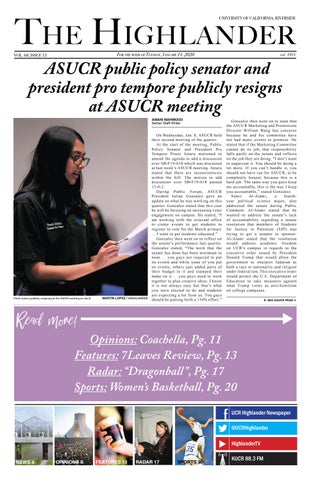
ASUCR public policy senator and president pro tempore publicly resigns at ASUCR meeting AMANI MAHMOUD Senior Staff Writer
Preeti Juturu publicly resigning at the ASUCR meeting on Jan.8.
MARTIN LOPEZ / HIGHLANDER
On Wednesday, Jan. 8, ASUCR held their second meeting of the quarter. At the start of the meeting, Public Policy Senator and President Pro Tempore Preeti Juturu motioned to amend the agenda to add a discussion over SB-F19-018 which was discussed at last week’s ASUCR meeting. Juturu stated that there are inconsistencies within the bill. The motion to add discussion over SB-F19-018 passed 13-0-2. During Public Forum, ASUCR President Julian Gonzalez gave an update on what he was working on this quarter. Gonzalez stated that this year he will be focusing on increasing voter engagement on campus. He stated, “I am working with the external office to create events to get students to register to vote for the March primary ... I want to get students educated.” Gonzalez then went on to reflect on the senate’s performance last quarter. Gonzalez stated, “The work that the senate has done has been minimum to none ... you guys are required to put on events and while some of you put on events, others just added parts of their budget to it and stamped their name on it ... you guys need to work together to plan creative ideas. I know it is not always easy but that’s what you were elected to do and students are expecting a lot from us. You guys should be putting forth a 110% effort.”
Gonzalez then went on to state that the ASUCR Marketing and Promotions Director William Wang has concerns because he and his committee have not had many events to promote. He stated that if the Marketing Committee cannot do its job, that responsibility falls partly on the senate and reflects on the job they are doing. “I don’t want to sugarcoat it. You should be doing a lot more. If you can’t handle it, you should not have run for ASUCR, to be completely honest, because this is a hard job. The same way you guys keep me accountable, this is the way I keep you accountable,” stated Gonzalez. Samir Al-Alami, a fourthyear political science major, also addressed the senate during Public Comment. Al-Alami stated that he wanted to address the senate’s lack of accountability regarding a senate resolution that members of Students for Justice in Palestine (SJP) was trying to get a senator to sponsor. Al-Alami stated that the resolution would address academic freedom on UCR’s campus in regards to the executive order issued by President Donald Trump that would allow the government to interpret Judaism as both a race or nationality and religion under federal law. This executive order would permit the U.S. Department of Education to take measures against what Trump views as anti-Semitism on college campuses. ► SEE ASUCR PAGE 4
Read more!
Opinions: Coachella, Pg. 11 Features: 7Leaves Review, Pg. 13 Radar: “Dragonball”, Pg. 17 Sports: Women’s Basketball, Pg. 20
f UCR Highlander Newspaper @UCRHighlander HighlanderTV NEWS 4
OPINIONS 8
FEATURES 13
RADAR 17
SPORTS 20
KUCR 88.3 FM
2
HIGHLANDER // highlandernews.org
TUESDAY, JANUARY 14, 2020
HUMANS OF UCR
UPCOMING EVENTS: WEEK 2
TERI DEL ROSARIO | BIOENGINEERING | SECOND-YEAR COMPILED BY RYAN POON
14
Tuesday
15
How to Get Involved Workshop 4:00pm to 5:00pm HUB (Highlander Union Building), 229
Let’s Talk about Bisexuality & Pansexuality 5:00pm to 6:00pm Costo Hall , 245
Winter Involvement Fair Walk and Talk with Chancellor Wilcox 11:00am to 2:00pm 12:15pm to 12:45pm UCR Bell Tower Meet at Scotty the Bear Statue
Wednesday
16
Thursday
“At first, I only started playing volleyball to get out of taking another P.E. class but I didn’t expect that I would eventually come to love the sport. Being a part of a team really drives you to work on yourself and the motivation of your teammates helps you keep going. With this and the competitive
CHASS Transfers F1RST: Time Men’s Basketball vs CSUN Management Workshop 7:00pm to 9:00pm 10:00am to 11:00am Student Recreation Center (SRC), Arena CHASS Interdisciplinary South, 1109
17
Design A Bucket Hat 3:30pm to 5:00pm HUB 355
Friday
U.S. Policy on the Arabian Peninsula 3:00pm to 4:30pm UCR Extension Center
dynamic of the sport, there’s always so much energy and positivity in each game. “
18
Saturday
Women’s Basketball vs UC, Santa Barbara 7:00pm Student Recreation Center (SRC), Arena
19 Sunday
CONTACT US
HIGHLANDER STAFF EDITOR-IN-CHIEF
MANAGING EDITOR
Evan Ismail
Jonathan Fernandez
managingeditor @highlandernews.org
editorinchief @highlandernews.org
ASST. NEWS EDITOR
NEWS EDITOR
Laura Anaya-Morga lanay004@ucr.edu
Amani Mahmoud
news@highlandernews.org OPINIONS EDITOR
Samuel Harrison
opinions@highlandernews.org FEATURES EDITOR
Asst. Features editor
Mark Bertumen
Christine Tran ctran104@ucr.edu
features@highlandernews. org A&E EDITOR
ASST. A&E EDITOR
Colin Carney
Adam Alvernaz aalve003@ucr.edu
radar@highlandernews.org SPORTS EDITOR
Jordan Hom
sports@highlandernews.org PRODUCTION MANAGER
ART DIRECTOR
Kerry Mulia
Amanda Joy Teano highlander.art.director@ gmail.com
productionmanager @highlandernews.org PRODUCTION ASSISTANTS
Kathy Garcia Brinly Den Celine Hoang
Judy Tu
Asst. Photo Editor
PHOTOGRAPHY EDITOR
Martin Lopez
Ryan Poon rpoon003@ucr.edu
photo@highlandernews.org STAFF PHOTOGRAPHERS
Leo Yue Lydia Tsou ASST. VIDEO EDITOR
Sara Bernal
sbern016@ucr.edu BUSINESS MANAGER
COPY EDITOR
Melanie White
Silvia Ferrer
highlanderads@gmail.com
copyeditor.highlander@ gmail.com
DISTRIBUTION MANAGER
TECH DIRECTOR
Sarang Majmudar
MARKETING COORDINATOR
Cody Davis
Jeffrey Juan
techdirector@highlandernews.org
marketing.highlander@gmail.com
Highlander 101 Highlander Union Building Riverside, CA 92521 www.highlandernews.org editorinchief@highlandernews.org TIP LINE: (951) 827-2105 Help the Highlander stay on top of what is happening on campus and in the general UCR community. Call this number and leave a message for the Editorial Board with your tip. Be sure to include your full name, relation to UCR, and a number or email address where you can be reached for more details. Editorial Office: (951) 827-3617
Business Office: (951) 827-3457
Classifieds & Billing: (951) 827-5039
Fax: (951) 827-7049
LETTERS TO THE EDITOR The Highlander accepts letters from the campus community. They must be 600-800 words at length and include the author’s name and contact information. Topics should be UCR-centric and/or pertain to our generation of students. Contact Opinions Editor Samuel Harrison at opinions@highlandernews.org by Wednesday if interested in writing a letter and submit the completed letter by Saturday at noon. Letters can and will be rejected if it does not meet requirements. LEGAL The Highlander is published and copyrighted by the Highlander for the students, faculty and staff of UCR. All rights are reserved. Reprinting of any material in this publication without the written permission of the Highlander is strictly prohibited. Readers are allowed one free copy of the newspaper. For additional copies or for subscription information, please contact the Highlander. The Highlander fully supports the University of California’s policy on non-discrimination. The student media reserve the right to reject or modify advertising whose content discriminates on the basis of ancestry, color, national origin, race, religion, disability, age, sex or sexual orientation. The Highlander has a media grievance procedure for resolving complaints against it. All inserts that are printed in the Highlander are independently paid publications and do not reflect the views of the Editorial Board, the staff or The University of California or the Associated Students of UCR.
20
UCDC Application Deadline Washington DC 5:00pm Hinderaker Hall 1100
Monday
MULTIMEDIA
CLASSIFIED ADVERTISEMENTS ADVERTISING INFORMATION Please submit Classifed ads by calling 951-827-3457 or by emailing Highlanderads@ucr.edu PAYMENT Visa and Mastercard Make checks payable to The Highlander Newspaper No refunds RATES Classified: $2 per line; 17 characters (spaces, dashes, etc.)
UCRHIGHLANDER
f
UCR HIGHLANDER NEWSPAPER @UCRHIGHLANDER HighlanderTV KUCR 88.3 FM
News 4
TUESDAY, JANUARY 14, 2020
HIGHLANDER // highlandernews.org/news
ASUCR
ASUCR public policy senator and president pro tempore publicly resigns at ASUCR meeting
► FROM ASUCR
Al-Alami stated, “What this executive order means is that it will attack academic freedom on this campus because it means if you critique anything about the state of Israel, it will be considered anti-Semetic.” Al-Alami went on to state that he expected more courage from the senate to actually at least propose revisions and possibly have this resolution ready for that day’s meeting. He also stated, “To stand complicit against these injustices is a grave injustice upon this institution ... a few years ago, students attempted to ban Sabra hummus from being sold on campus. You wouldn’t believe the blowback that senators received. The Israeli consulate called. But senators still stood up and voted on the resolution and it passed so why can’t it happen again today?” Shawn Martinez, a member of UCR’s SJP also addressed the senate on the subject. Martinez stated, “I was made aware that one of the senators was reached out to sponsor the bill but their immediate concern was the controversy it could cause ... I urge the student government to come together to stand in solidarity with a threatened minority on-campus.” He noted that if any senator would like to learn more, SJP would be happy to speak with them one-on-one about the issue. Juturu addressed Martinez’s and Al-Alami’s concerns stating that the bill was not on the agenda because the Legislative
Review Committee (LRC) did not meet this week, but a senator would still be needed to sponsor the bill before it can be considered. CNAS Senator Matthew Nguyen also addressed Martinez and stated that he was the senator who was approached to sponsor the bill, but chose not to sponsor it not just because it is a controversial topic, but also because he was not informed enough about the topic at hand and did not feel comfortable sponsoring it due to his lack of information. The meeting then moved on to Committee Reports. Juturu broke down what she believed were inaccuracies within SB-F19018. Juturu stated that according to Article 4, Section A, Item 1 of the ASUCR constitution, it states that the executive cabinet shall consist of five executive officers and five non-voting director positions. Article 4, Section H, Item 2 states that candidates for any executive officer position must have one year of ASUCR experience. SB-F19-018 states that the five nonvoting members positions shall be considered a part of the extended executive branch and that these members do not need one year of ASUCR experience except for the undergraduate sustainability director, personnel director and the marketing and promotions director. Juturu stated that this bill is redundant because the constitution states that the executive cabinet needs one year of experience, but not necessarily the directors. The senate then approved rescinding SB-
F19-018 with a vote of 12-0-3. After the bill was rescinded, the meeting moved on to public comment. Juturu first approached the podium and stated, “I announce my resignation from both of my positions. I have other priorities that I need to turn my attention to and I need to step back from ASUCR affairs to take care of my personal affairs and because I am disappointed in the senate for not critically thinking about any of the issues that we have had in the past ... I do not think that is going to change any time soon.” She stated that she has done her job to ensure that all of ASUCR has the tools and the necessary resources to write legislation well. She stated that she hopes that her fellow senators can take up legislation and write impactful and meaningful legislative pieces throughout the year and that it is accurate and thorough in nature. “Before I go, I would like to emphasize that it takes every senator, every director, every vice president and the president within ASUCR to work diligently, honestly and with precision in order to benefit the interests of the public,” stated Juturu. She claimed that they were all elected to serve the common good and to set aside their self interests in order to create significant policy change. She said, “I hope that one day, due to the hard work of every single ASUCR elected official, ASUCR can become an organization that students associate with professionalism,
progress, and comprehensive positive change.” Though she will not hold a title anymore, Juturu said that she will continue to work on the projects she has been working on. She thanked her constituents for voting her in, her interns and the friends she made during her time at ASUCR. She concluded her statement saying, “I wish my colleagues sitting on the horseshoe the best of luck in their future pursuits. I hope that by the end of the academic year each one of you would have left behind a legacy of through the work that you did. Thank you again and it has been an honor and privilege to have served as your senator and pro tempore.” Toward the end of the meeting, Executive Vice President Abigail Cortes announced that there is a CHASS senator vacancy and that the alternate has already agreed to fill the position. This follows CHASS Senator Aaron Sanchez’s resignation. Sanchez’s and Juturu’s resignations mark the fourth and fifth ASUCR resignations of the 2019-2020 year. She also announced that the distribution of R’Gear will be taking place Wednesday, Jan. 15. Due to the R’Gear event, the ASUCR meeting will be rescheduled and will not be taking place Wednesday at 6:45 p.m. At the time of writing, the rescheduled time and date are yet to be determined. H The meeting was adjourned at 7:49 p.m. ■
Former president pro tempore and public policy senator discusses her resignation
AMANI MAHMOUD Senior Staff Writer
On Wednesday, Jan. 8, Preeti Juturu, ASUCR president pro tempore and public policy senator publicly resigned at the ASUCR meeting. During the meeting she stated, “I need to take a step back from ASUCR affairs and I need to take care of my personal affairs ... I am disappointed in the senate for not critically thinking about the issues and policies that we have had in the past.” In an interview with The Highlander, Juturu further expanded on her time at ASUCR and why she resigned. Juturu was originally a CHASS senator, but after a vote by the senate, it was decided that she would transition to become a public policy senator, which was a newly created position this academic year. Juturu received the most votes out of all CHASS senators during the 2018-2019 ASUCR elections. Juturu told The Highlander, “It was an honour (sic) to have received the most votes during the CHASS Senator elections, and it proved that anyone can win if they work hard and are genuine in their beliefs.” She stated that she believes many of her constituents will be disappointed once they hear of her resignation, but she hopes that they understand why she resigned and that it was a very tough decision she had to make. Juturu believes that some of her accomplishments during her time as senator include sponsoring more than seven pieces of legislation, introducing the first keynote speaker at the third annual PERSIST: Women’s Political Engagement Conference, getting support from UCR and non-UCR
organizations for the Farmer’s Market Food Recovery project and being able to act as a mentor for her two interns. “I am proud of all the work I was able to do and have been extremely fortunate to have made close friends and connections due to my role as an ASUCR member,” stated Juturu. Expanding on her decision to resign, Juturu stated, “2019 was a very challenging year for me, and I sacrificed a lot of my time and energy into serving the public as an ASUCR member. However, what began to frustrate me was the lack of dedication and effort taken by many of my fellow senators.” As president pro tempore, her hope was that she could encourage legislative writing. As a public policy major, Juturu stated that she recognizes that it is impossible to bring about efficient and effective change within a system that is fundamentally flawed. “Legislation is the foundation of any governmental agency, and ASUCR is no exception,” said Juturu. She added, “However, it became clear to me that senators treated legislation as an inconvenience rather than their duty or as a true method to bring about feasible change. I spent hours of my time to provide senators with resources, create sample legislation pieces, host legislative writing workshops during my office hours, et cetera.” Juturu claimed that she felt that she continued to receive legislation that was clearly written in haste and without careful consideration or understanding of ASUCR bylaws or the ASUCR constitution. Juturu noted that she felt that the responsibility fell on her if senators were to pass legislation that ended up being incomplete or inappropriate. She stated
that this would prompt her to, on occasion, rewrite pieces of legislation. “The lack of responsibility, lack of diligence, and carelessness within legislative writing became extremely frustrating because senators had numerous resources available to them to complete proper legislative pieces. It was disrespectful to my time and to the members of the Legislative Review Committee, and nothing seemed to change regardless of the steps I took,” wrote Juturu. She wishes whoever becomes the new president pro tempore the best of luck because they will realize where her frustrations came from, as well as just how time consuming the role is. She has full faith that most of the members of the Legislative Review Committee will continue legislative affairs smoothly and in the appropriate manner. She hopes that they read the legislation submissions in detail and approve of legislation that is beneficial and free of issues. She added that she also hopes that she was able to help her constituents and the UCR community in her time as a senator. She stated that she knows that she dedicated a lot of her effort to represent the platforms that she ran on. “I believe that I was consistently determined when working on projects and legislation, bold by speaking my mind against negative policies, and tried to be as reliable as possible when pertaining to legislative and project affairs,” said Juturu. Juturu stated that she ran for ASUCR senator and for president pro tempore because she knew that in order to bring about substantive change, it requires change on an internal level first. She claimed that
ASUCR has the power to bring about positive change on campus, but in order to do that, it must be running smoothly internally. “I tried in my full capacity to ensure that internal affairs were improved upon, starting with legislation. However, I came to realise (sic) that it is impossible for only one person to change the entire system. It takes every member of ASUCR to, at the very least, perform the duties that are outlined in the bylaws and constitution, so that internal operations run smoothly,” stated Juturu. She noted that she also ran because she wanted to help the people around her, and that she will still continue to work on the Farmer’s Market Food Recovery Program. Currently, she is in the process of starting the initiative in collaboration with various campus and local entities. She said that ASUCR did not provide many resources or accessible funding for the project, and she realized that it was more efficient to work on the project without being in ASUCR. In regards to ASUCR’s performance this year, Juturu said that she cannot say that she is disappointed in the performance of ASUCR. She hopes that her former colleagues can take initiative and dedicate their time and energy into their paid positions. She concluded the interview by stating, “However, considering the lack of productivity last quarter and the years prior to this one, I am unsure if there will be a change in the current trend. I do, however, hope that hardworking and genuine students file for candidacy and aren’t disheartened by how ASUCR has been in the past and present.” ■H
HIGHLANDER // highlandernews.org/news
NEWS
TUESDAY, JANUARY 14, 2020
5
Voter registration committee proposes an added feature on R’Web that will increase voter engagement
LAURA ANAYA-MORGA Senior Staff Writer
The Voter Engagement Workgroup is organized by Student Life and consists of students from various organizations including ResLife, CalPIRG, ASUCR, ASPB, Mi Familia Vota, the Women’s Resource Center and the UC Advocacy Network. These students are working toward the common goal of increasing civic and voter engagement at UCR. In an interview with The Highlander, Samuel Roberts, a fourth-year public policy major and representative for the voter registration committee, said the purpose of the workgroup is to make sure students are “politically and civically engaged and have an understanding of how to vote.” For students, the voting process may be intimidating or complex and the voter registration committee strives to make the process as easy as possible. They are proposing that a feature be added onto R’Web that will lead students to register to vote in under two minutes through studentvote.org. The feature would not only be “convenient for busy students but also enticing for those unfamiliar with voter registration to check it out,” said Roberts. UCLA and UC Berkeley currently have similar icons on their student portals and it has increased the number of student voters on campus, stated Roberts. The workgroup was put together in 2018 and since then, they hosted midterm election polling sites for the 2018 midterm elections which had a student turnout of over one thousand. When they gathered data from past elections they found that the percentage of students who
are either registered to vote or actually voted at UCR went up by 25.5% since 2014. Roberts says that this growth is especially important because “we have one of the most important elections coming up and with an increasingly polarized society, this has set the stage for an important primary and general election.” The workgroup submitted a proposal to ASUCR in November which was backed by former President Pro Tempore Preeti Juturu. However, after her resignation, the proposal will now be backed by CNAS senator Natalie Hernandez. “Hopefully this will be on R’Web by the end of the school year,” stated Roberts. In the coming months, the workgroup hopes to get their proposal approved by the Registrar of the Banner
Leadership Committee, which controls R’Web. They would also like to work with UCR’s Information Technology Solutions to get a model of the application running on R’Web to test out. Roberts is also working on a seminar series that will educate students on the voting process. It will be about “teaching students how to register to vote and teaching students what’s on the ballot,” said Roberts. It is currently in the early stages of planning and Roberts hopes it will be rolled out by the end of winter quarter. Roberts says the ultimate goal of the voter registration committee is to “empower students to vote because their voice matters” and adding the application icon on R’Web would “give them the tools to do so.” ■H
LYDIA TSOU/ HIGHLANDER
New greenhouse facility will enhance the research of various departments on campus
An artist’s rendition of the Plant Growth Environments Facility. The $22 million project will add 33,000 square feet of greenhouse space.
LAURA ANAYA-MORGA Senior Staff Writer
The Plant Growth Environments Facility is currently underway near East Campus Drive and Eucalyptus Drive. Katherine A. Borkovich, professor and chair of the Department of Microbiology and Plant Pathology with the College of Natural and Agricultural Sciences (CNAS) said that this new greenhouse facility will expand the amount and the quality of greenhouse space on campus. This is a $22 million project being conducted by the Office of Planning, Design & Construction and is considered integral for the research of numerous departments on campus. This is the first new greenhouse and plant growth facility being built on campus in nearly 50 years. It will allow students and faculty “the opportunity to do research in state-of-the-art facilities with much greater control over the growth environment,” wrote Peggy Mauk, director of agricultural operations and a subtropical horticulture specialist with CNAS. The
30,000 square foot, two-story facility will feature growth chambers on the bottom floor which UCR does not currently have. The chambers are small and intended for much smaller scale research. Each chamber will be able to house plants, pathogens and insects in an isolated environment to keep experiments more controlled. However, since this is not a quarantine facility, “research will only be conducted on organisms that can be grown outside of a quarantine,” wrote Mauk. Mauk stated that the current greenhouses on campus are facing various challenges with maintaining temperatures within specific ranges so that plants and experiments are not damaged. However, the new facility enables researchers to conduct studies on plants, pathogens and insects that are limited by high temperatures or need higher humidity. The Plant Growth Environments Facility will include greenhouse modules on the top floor made of double-layered clear glass. Each module will
COURTESY OF INSIDE UCR
have the ability to control the temperature, humidity and lighting of the room via wireless technology. Mauk added, “(researchers) will be able to adjust the temperature so that plants that grow in high altitudes under much cooler day/night temperatures can be studied here.” The additional air conditioned space alone will enhance the experiments of researchers who require environments with a consistent temperature. The space will also include various labs and work spaces so research may be conducted in-house without having to be transported from place to place, making the research more efficient. “This space is modern, flexible and was designed with UCR needs in mind. It should enable a more reliable plant growth environment,” wrote Borkovich. This facility is the first in a series of plant growth spaces planned to replace the aging greenhouses at UCR. “This greenhouse will promote the research productivity and success of UCR faculty and students,” added Borkovich. ■H
6 TUESDAY, JANUARY 14, 2020
HIGHLANDER // highlandernews.org/news
UCR alumni Marie Shultz is appointed new associate vice chancellor for development
ANTONIO VELAOCHAGA Contributing Writer
On Thursday, Jan. 2, after a six month national search, UCR alumni Marie Shultz was appointed the new associate vice chancellor for development. The search advisory committee that selected Shultz was led by Assistant Vice Chancellor Johnny Cruz and consisted of six other campus leaders. Shultz served as the assistant vice chancellor of development at UCR for six years. She gained her bachelor’s degree in natural and agricultural sciences in 1998 and worked in UCR’s Office of Development for 26 years. In an interview with The Highlander, Shultz said, “I’ve grown my career along with the huge growth in the development trajectory at UCR.” UCR’s Office of Development is a part of the University Advancement team that supports research, programs, facilities, students and faculty through academic priorities. Securing resources through public or private entities is how the office of development advances UCR’s teaching, research and services. In 2016, UCR’s Office of Development launched the large-scale fundraising campaign called Living the Promise. This was the university’s first comprehensive fundraising campaign that had a goal to raise $300 million through donations. As the new chief development officer, Shultz is
responsible for completing the Living the Promise campaign in December 2020. Shultz stated, “My job will be to lead a team of development professionals who are helping to raise private philanthropic support for the university.” She added that she and her department are helping to expand the culture of philanthropy within the campus community in order to gain support from donors and alumni. Shultz emphasized that she would bring passion to her new role, as she wishes to excite the UCR community. “I think the bigger piece of all of this is the excitement around how we tell UCR’s story ... and as the new associate vice chancellor I can bring my enthusiasm for the campus community,” said Shultz. Regarding the success of the Living the Promise campaign, Shultz commended UCR’s Office of Development staff for their hard work in raising funds and developing relationships with donors. However, she said that while academics, research, shared endowments and the giving program were flourishing within the campaign, student support and success was an area that needed more help. When the Living the Promise campaign ends, Shultz will manage a follow-up initiative that will concentrate on student success and
COURTESY OF UCR
assistance. Shultz stated that this unnamed initiative will expand on the Living the Promise campaign. Shultz said that she wants to create excitement around the philanthropy
in UCR and the major impacts it has on the campus community. The initiative following the Living the Promise campaign will launch in the fall of 2021. ■H
Community meets to discuss provost and executive vice chancellor candidates
ATENAS ODRIOZOLA Contributing Writer
On Tuesday, Jan. 7, a campus-wide forum was hosted in HUB 260 to discuss desirable traits and qualifications for the new potential UC Riverside provost and executive vice chancellor positions. The search comes in wake of former Provost and Executive Vice Chancellor Cynthia Larive accepting the position of chancellor at the University of California, Santa Cruz (UCSC). The
decision was announced on May 16 by the University of California Office of the President (UCOP). Monica Carson, professor and chair of UCR’s biomedical sciences, was the coordinator of the event. The forum was meant to bring an array of faculty members from different departments and students to share their input on what they were looking for in candidates for the provost position. Their opinions were heard by members of the search committee who were also present.
The search committee has previously established the types of characteristics desired in candidates. One desired trait that the forum established was that the chosen candidate should be able to help the university’s strategic priorities and also establish a plan to help the university continue to grow in both size and impact. At the Jan. 7 forum, the search committee made suggestions on what qualifications the chosen candidate should have. They also established that
ARCHIVE / HIGHLANDER
the chosen candidate should work to improve UCR’s reputation. The committee suggested that the chosen candidate should be a chair or a head of a department because they would have the desired experience they felt was necessary. One audience member, however, noted these positions often lack representation of women and people of color. The audience member stated restricting candidates to only those who have held these positions would limit the range of candidates the committee should consider. It was, however, agreed upon that the candidate chosen should have experience handling a budget and relevant experience as well. Another suggestion made was that the candidate chosen should make changes that align with UCR’s mission and would also improve the university as a whole. The members of the forum agreed that the candidate chosen should highlight UCR as a research institution. The forum collectively agreed that the candidate should highlight what is already great about UCR. Ultimately, Chancellor Kim A. Wilcox will be deciding who the next provost and executive vice chancellor will be, but the search committee’s suggestions would provide ideas and suggestions for Wilcox’s final decision. The candidates have not been finalized and the committee is still accepting submissions from candidates until mid-January. The final candidates will be decided in mid-February or early March. ■H
Be strong..
Do you have an interest in writing, photography, design or marketing? The Highlander can help you polish your skills. Come to our weekly meetings every Monday at 5:15 p.m. in HUB 101 to learn more.
Highlander MARTIN LOPEZ /HIGHLANDER
Opinions
8 TUESDAY, JANUARY 14, 2020
OPINIONS
HIGHLANDER // highlandernews.org/opinions
HIGHLANDER EDITORIAL
Trump and Soleimani: the perfect example of “shoot f irst, ask questions later”
COURTESY OF WIKIMEDIA COMMONS
A massive crowd attends Qasem Soleimani’s funeral in Azadi Square in Tehran on Jan. 6, 2020.
“W
e took action last night to stop a war. We did not take action to start a war.” These were the words Donald Trump proclaimed on Friday, Jan. 3. He was referring to the U.S.’ preemptive air strike at Iraq’s Baghdad International Airport earlier that day — an air strike that resulted in the death of Iranian General Qassem Soleimani, the intended target. Secretary of State Mike Pompeo later said Soleimani was planning an imminent “broad, largescale attack against American interests,” namely, American facilities in the Middle East. Pre-emptive strikes must be calculated with the most careful consideration especially when no one would ever know if the claims were true. Trump tweeted that Soleimani “has killed or badly wounded thousands of Americans over an extended period of time,” and millions more “directly or indirectly,” but even if Trump was allowed to strike without consulting Congress first, the airstrike was the most severe choice top officials offered him. The option was made available because American contractor Nawres Hamid was killed by militia at an Iraqi base. Officials
did not anticipate Trump’s decision, and as a result, Trump’s attack comes off as grossly hasty, using Hamid’s death as a weak justification for extreme retaliation. Preemption was an afterthought. Iran’s response has been explosive from all sides, from hundreds of thousands of mourners stampeding into Tehran to pay respects to the hailed Iranian figure, to the bombings of U.S. bases in Iraq only days later. This is in line with the promise of “harsh retaliation” from sympathizing Iranians. The media has been broadcasting anti-American sentiment in the country, Iranian members of parliament chanted “Death to America” and U.S. flags were burned and continue to be burned in the streets. This is all in stark contrast to the tweet Trump made the day of Soleimani’s death, where he said the General “was both hated and feared within the country.” Tensions with Iran have been escalating ever since Trump reestablished trade sanctions in 2018, throwing Iran into a recession. It’s reminiscent of Iran’s 66% inflation rate created by U.N., U.S. and E.U. sanctions in response to the country’s hyper-conservative former President Mahmoud
Ahmadinejad. With the signing of the Joint Comprehensive Plan of Action (JCPOA), Iran agreed to end those sanctions (which began in 2005) in 2015, and it seemed as though the nation’s global relations would grow less tense; Trump even campaigned with a platform to remove troops from the Middle East, wishing an end to America’s “endless wars.” Despite Trump’s promise to reduce the military presence in Iraq and the peace the nuclear deal presented, the U.S. president chose to exit it, believing the resources it gave Iran allowed them to further their work on nuclear programs, even though the deal restricted Iran from doing so and Trump provided no evidence of his claim at the time. The re-imposed sanctions followed months later, Iran’s economic situation reverted and tensions have boiled over to the point that Iran has pulled out of the deal as well, cementing a complete reversal of a peace so long searched for, now out of sight yet again. In response to Iran’s threats of retaliation, Trump said that the U.S. had targeted “52 Iranian sites,” in reference to the 52 American hostages held in Tehran if Iran made
the choice to retaliate, and he pointed out that some were of great cultural importance. Criticisms ran rampant, even by Republican governors, stating that destroying sites so invaluable to Iranian heritage would be a war crime. Three days later, Trump retracted his statement, plainly stating that “if that’s what the law is, I like to obey the law.” Trump is backing away from any further military action in Iran, following the Iranian government’s statement that “proportionate measures” were carried out in vengeance for Soleimani. This was in reference to the missile strikes on American bases, which did not kill anybody; some analysts suggest that Iran did it to follow through with their threat without causing real damage. Unfortunately, a week was all that was needed for irreparable damage to be done; it was days after 156 people died in a Ukranian airliner crash that Iran admitted to having accidentally shot down, attempting to retaliate against U.S. forces. Iranian Foreign Minister Mohammad Javad Zarif succinctly tweeted his sentiments: “human error at (sic) time of crisis caused by U.S. adventurism led to disaster.”
Canadian Prime Minister Justin Trudeau also spoke up for the 57 Canadians aboard the plane, asserting that “Canada will not rest until we get the accountability, justice, and closure that the families deserve.” Iranians are now in the streets demanding that Supreme Leader Ali Khamenei step down, and Trump has shown support for it, tweeting, “I’ve stood with you (the Iranian people) since the beginning of my Presidency … We are following your protests closely, and are inspired by your courage.” Just a week ago, the world was against Trump; yet in a surprising turn of events the negative focus has shifted, as Iran’s people turn their scorn to their president instead. It feels like Trump just got the luckiest break from a choice that the world’s already forgotten about — or at the very least, stowed away for later. ■H
Highlander editorials reflect the majority view of the Highlander Editorial Board. They do not necessarily reflect the opinions of the Associated Students of UCR or the University of California system.
HIGHLANDER // highlandernews.org/opinions
OPINIONS
TUESDAY, JANUARY 14, 2020
9
OPINION POLL Compiled by Lydia Tsou Staff Photographer
“What class are you most excited for this quarter?” Simran Sandhu Neuroscience First-year
Sam Hashemi Political Science Fourth-year
Diana Gaspar Biochemistry First-year
Bryan Dodd Pre-Business First-year
Mark Uy Biology Second-year
“I’m most excited for Dynamic Genome. The lab work is so exciting and it’s a good opportunity to learn something new. Even though it’s hard, I’m excited to see how it goes and I like challenges.”
“I’m most excited for Armed Forces and Politics. With everything going on right now, it would be interesting to look through the eyes of a political scientist. ”
“I would say Dynamic Genome. I’m excited to gain more experience in research and lab.”
“Probably nothing. Not too many exciting classes this quarter.”
“Hahaha, that’s a hard one. My classes are really hard. I think I’m most excited for Genetics. It’s interesting learning about our genetic makeup.”
Construction on the western side of UCR’s campus.
Myriam Dueñas Political Science/ Public Service Third-year “I’m most excited for Russian Foreign Policy. As a transfer student, this is my first political science class and I am also interested to learn about Russia’s foreign policy.”
MARTIN LOPEZ/ HIGHLANDER
UCR should plan future projects around existing mature foliage, not on top of it TIMOTHY HUGHES Staff Writer
If one spent time on the western part of UCR’s campus during the fall quarter, they would have noticed some interesting changes to the landscape. To the common passerby, it started inconspicuously enough. A red layer of cloth had been wrapped around the bottom of two tall trees outside the student services building. A few weeks later a massive blue construction fence was erected, closing off large areas of campus and limiting student movement. Step one of the construction project in question was to deroot and chop down two old, large and beloved oak trees. UCR administration needs to plan more carefully in the future so no more trees are chopped down in the name of university expansion. There are a few obvious reasons why UCR should stop cutting down trees. First
and foremost, the action suggests a deep disrespect for the natural environment. The two trees, both estimated to be in their 50s, are nearly as old as the campus itself. Cutting down these historical trees leaves a spiritual scar on the landscape of the campus along with a physical one — a reason indigenous students fiercely spoke out against the destruction of the trees and laid the red cloth around them. During talks with indigenous students the administration agreed to save the wood from the trees and use it in the construction project soon to be erected over the grave of the mighty oaks. While this has been seen as a sort of compromise, the decision to use the wood for building is utilitarian in nature, which is disrespectful toward the trees and cannot make up for the damage caused. Climate change and ongoing campus
sustainability efforts are also exemplary of why the killing of these trees was a mistake. Trees are important carbon sinks in the atmosphere. To combat climate change, the world needs more trees, not less. Considering that the UC system has set a goal of carbon neutrality by 2025, the removal of trees is not only thoughtless but harmful. While administration has committed to planting other trees, it will take time before they are able to offset the loss of the oaks. This issue is made more infuriating as there were surely ways to plan around the trees or include them in the eventual building project. Lastly, the removal of the trees has limited recreational and student mobility as well as degraded the aesthetic quality of the campus. The blue walls are, frankly, an eyesore, and moving about lower campus has become difficult. The green space of the open grass lawns
and the shade provided by the lovely oaks were common picnic and napping spots, and student organizations have held meetings and events under them for decades. This underscores a consistent issue with UCR’s administration: not involving students in decision making. The recent commencement location controversy immediately comes to mind. The tree chopping affects students, and perhaps it would not have happened if students had been in the room affecting the decisions. Instead, the administration once again asks for forgiveness, not permission. The murder of the trees is a tragedy. It is spiritually insulting, ecologically reckless, and gives little consideration to students. The administration needs to do better and students must hold them accountable. Hopefully, future building projects will be more responsible. ■H
10
TUESDAY, JANUARY 14, 2020
OPINIONS
HIGHLANDER // highlandernews.org/opinions
The Australian bushfires are a climate premonition, but they don’t have to be
Helitack douses flames in Australia.
CYRUS TOSCO Contributing Writer
The Intergovernmental Panel on Climate Change (IPCC) released a special report in 2018 outlining the need to limit global warming to 1.5 degrees Celsius (2.7 degrees Fahrenheit). Current global concentrations of carbon dioxide roughly correlate to nearly quadruple that temperature; effects of warming have already been observed over the last few weeks in Australia where, after the annual average temperature increased by more
COURTESY OF NINIAN REID VIA FLICKR
than 1.5 degrees C, bushfires erupted across its eastern coast. Unfortunately, the harsh reality of these climate conditions is that if, by some miracle, carbon emissions were to drop to zero tomorrow, Earth’s temperature would continue to increase over the upcoming centuries. That being said, while a 1.5 degree threshold is unlikely, a failure to set an idealistic landmark will result in more severe tropical storms, wildfires and weather anomalies over a longer time scale. More importantly, there are effective responses that can
be implemented on a shorter time scale that can reduce the effects of these natural disasters. The most obvious of these responses is making significant moves to renewable sources of energy, and the easiest way to implement renewable energy is to nationalize the power grid. Historically, nationalizing power has had a substantial effect on the infrastructure and economy of one notable area: the Tennessee Valley. After the Tennessee Valley Authority (TVA) was authorized, unemployment dropped dramatically and
energy production grew. Further expansion of the TVA on a national scale could have similar effects while providing the federal government the means to include renewable sources of energy nationwide and to modernize the electrical grid. Likewise, public transportation needs to be modernized to include low emission vehicles and fully electric vehicles. Currently, carbon capture technology is being used to create biofuels with extremely low emissions compared to the average gasoline in cars while transportation accounts for 29% of total greenhouse gas emissions. Expanding the use of biofuels and using fully electric public transportation will not only be instrumental in moving further to net negative carbon emissions, it is already being used. There are federal grants for public transportation to transition to low emissions fuels. Further expansion of public transportation would make car ownership less of a necessity. The specter of climate change has cast its shadow
over humanity for more than 20 years, and one of its most horrific images reared its head only a few weeks ago when nearly an entire continent caught fire. While humanity can point to individuals responsible, the fact remains that Australia was experiencing a drought caused by a heat wave caused by long periods of low precipitation as a result of climate change. Moreover, one can argue that changes in emissions in the United States do not affect Australia, but emissions, regardless of their source, do, in fact, have global cascading effects that have proven capable of large scale change, such as acidifying the ocean or rewriting global wind and sea currents. Australia should be seen as the wake-up call humanity needs to take on this crisis. As far as climate change goes, there is an almost overwhelming number of problems that need to be fixed, and it is easy to concede defeat when one is faced with such a Herculean task. However, as is the case in Australia, inaction will do nothing more than fail those whose lives are at risk due to a climate crisis. ■H
The future of energy: shedding light on different renewable energy options after the Chevron announcement.
MADISON RHEINS Contributing Writer
After the big oil corporation, Chevron, announced their $11 billion write-down, experts are predicting a negative future for the oil industry. The chances of making a profit in the oil industry are now on the decline due to investors seeking out more ecofriendly resources. Many are wondering if accessibility to such renewable resources will increase in the following years. Furthermore, with talks of the oil industry declining, people are wondering what that may mean for legislation concerning new energy sources and how they will be implemented in daily life. One thing is certain — there are plenty of eco-friendly, energy options available as opposed to Chevron’s oil. This downward spiral comes as a surprise to consumers, as the oil industry was perceived to be making great strides in growth. In fact, the oil and gas industry had a 36.3% increase in profits between 2018 and 2019. In prior decades, the oil industry would do everything in their power to eliminate any idea of their role in global warming. Many oil companies would funnel millions into anti-climate change campaigns and even pay to suppress scientific facts with their own falsified information, just as cigarette companies
would do in the past. As if the oil industry wasn’t powerful enough, they also had strong political figures backing them up. Notably, United States President Donald Trump defended big oil businesses by pulling out of the Paris Climate Accords. Capitalist greed led the president to believe that dominating scarce resources like oil would grant the United States economic growth. With so many big players encouraging the use of fossil fuels, it was hard for society to swim against the tide. Coming into the new decade, it’s almost unbelievable that the fossil fuels industry is taking such hard financial hits when one considers their past success. For those wondering what brought on this sudden reckoning, the answer is quite simple: whether big oil companies like it or not, the public is beginning to recognize the harsh effects of climate change. Investors are deciding to pull out and focus more on clean energy resources. Firms such as Goldman Sachs have also quit financing oil drilling in certain areas due to climate change and the general cost of the process. With faith from important investors declining in big oil corporations, it is predicted that by 2025, 10 of the largest oil companies will decline in value. In the political arena, many protests, like the
COURTESY OF CLOTEE ALLOCHUKU VIA FLICKR
September Climate Strikes, have begun in an effort to speak out against excessive greenhouse gas emissions. The people are demanding new policies on climate change. Renewable energy has become the most successful combatant against the oil industry. Cleaner energy alternatives such as solar and wind power and electric vehicles have become increasingly affordable and easier to access. Demand for electric vehicles has gone up, decreasing the need for gasolinepowered cars. It is predicted that electric vehicles will forever change how people think about transportation. Electric vehicles aren’t just eco-friendly, they are
also cost efficient. With prices slowly rising, electric vehicle owners don’t have to invest in gasoline. Lithium-ion battery powered vehicles also possess a range almost as large as gasoline vehicles that will only increase over time. In regards to lawmaking, cities like Bellingham, Washington may attempt to ban the heating of all homes with natural gas. The city has also replaced street lights with low-power LEDs and has given bicycles to city employees. Policymaking like this could be the catalyst for other cities in America to do the same. Bellingham could serve as an example for many state or federal lawmakers. If big oil companies
continue down the path they are heading and the country keeps searching for better eco-friendly alternatives, lawmakers will want to invest in the more successful renewable energy companies and would therefore be more likely to pass laws implementing the use of these alternative resources. It is uncertain whether or not the oil business will go back to normal or continue on their path to nonexistence, but one thing is for sure, the country has recognized its carbon footprint. With the loss of money and support for the oil corporations, room has been made for a new industry that is in favor of fixing climate change for future generations to come. ■H
HIGHLANDER // highlandernews.org/opinions
OPINIONS
TUESDAY, JANUARY 14, 2020
11
Metaphors in biological scientific literature are being used to reinforce societal perceptions of gender LEILA SHIBLAK Contributing Writer
Juniors in highschool may recall watching a video about the egg and the sperm as part of a sex education course. Students would watch uncomfortably as the sperm “raced” to the egg — a symbol of passivity. What these students are not aware of is the gendered metaphorical language used by the narrator to describe the fertilization process. Scientific knowledge is sometimes expressed metaphorically in academic texts — ultimately shaping how students perceive gender. Because students are an impressionable audience and are particularly receptive to social cues and hints, this issue demands attention. It is critical to examine the usage of metaphors in science, specifically in regards to how they solidify stereotypes about gender. Students should be cognizant of the language they use and how it may uphold gendered stereotypes. Feminists have provided considerable criticism regarding the way scientific texts describe the fertilization process to reflect commonly held notions of gender. The sperm, produced by the male body, is perceived as an entity with robust agency. It seeks out the egg on a brave quest. There have also been scientific accounts that have compared the egg’s role to that of sleeping beauty, patiently awaiting her prince. The sperm is described as inquisitive and is endowed with agency, while the egg is automatically rendered as the sperm’s fixed counterpart. A more accurate description would explain that the sperm has no greater agency than the egg, and is actually just as dependent upon
Human ovum and sperm.
other processes. The language that scientists have used to explain female reproductive functions reveals an undervaluing of the female reproductive systems. Egg production, for instance, has been described by scientists as wasteful because the majority of eggs produced die in the ovaries. The way in which scientists have described the wastefulness of the eggs ignores the fact that trillions of sperm are produced and lost before one child is conceived. Despite this dramatic waste of sperm, the loss of eggs are sensationalized by scientific findings and are thereby deemed a pitfall of female biology. The depiction of biological processes reflects a patriarchal worldview — one that considers the male the universal human model. Because science has been largely dominated by male bodies,
COURTESY OF ED UTHMAN VIA FLICKR
academic research privileges the male sex, upholding their positions of power. Currently, women hold far fewer high ranking positions in the scientific field relative to men, and this disparity is reflected in the field’s limited interest in creating accurate biological descriptions of their bodies. Even more, when women are included in scientific discourse, their abilities are often disregarded and deemed inferior to their male counterparts. In this context, engaging with metaphors that reflect dominant discourses surrounding gender bolster male scientists’ privileged status. The metaphors employed in the biological sciences are all too often damaging to the perception of women because they uphold notions of female passivity. In an attempt to address these issues in semantics, academics must
transform the tools used to describe such biological processes. It’s important to be cognizant of the language academics use and how it is relayed to students in a university setting. Becoming actively engaged in recognizing and calling out gender-biased metaphors can alter the way society perceive the sexes. Ultimately, questioning the authority of scientific inquiry would be a step forward in removing these harmful implications. Finding progressive alternatives to misinformed depictions of biology can be modeled after the evolutionary characteristics of the human species. The human body is constantly engaged in evolution in response to its ever-changing environment. Academia must similarly evolve and replace these metaphorical devices with language that accurately describes biological processes. ■H
To Coachella or not Coachella: the controversy surrounding Phil Anschutz
VICTORIA DAVY Contributing Writer
Throughout the years Coachella has become the heart of the music community. From their impeccable taste in music guests, their Instagram worthy locations and imaginative food selections, Coachella has it all. In recent years it has come to the public’s attention that Phil Anschutz, the owner of the festival’s parent company, The Anschutz Entertainment Group (AEG) has been donating money to antiLGBTQ organizations, as well as progun groups, anti-abortion rights groups and conservative politicians. Coachella should disclose the fact that the owner
Sunset at Coachella in 2014.
of their parent company contributes to organizations that alienate some of their attendees and performers so that future attendees and performers can make an informed decision before attending the event. This year’s Coachella lineup is stacked with artists that are very liberalleaning like Brockhampton, Frank Ocean and King Princess. Some attendees and artists are contributing to a company that finances organizations that lobby against their interests. If a company like Hobby Lobby can be open about their political inclinations, then an event that is as beloved as Coachella should do the same. That being said, the problem may not lie in consumer awareness. It is entirely
possible that the artists and attendees are aware of AEG’s conservative leanings and still choose to participate in the event. It is a privilege as well as a career milestone for an artist to play at Coachella. The desire for this elite experience could temporarily override an artist’s political or moral views. The attendees could view Coachella as a once-in-a-lifetime opportunity. Their desire to experience such a unique event can supersede their political judgements. Still, AEG has a responsibility to be transparent with their customers. Concert-goers and artists should have the information so that they can make an informed choice based on their values. Companies like Hobby Lobby, Disney
and Chick- Fil-A have complicated pasts when it comes to controversy. There are people who have boycotted these companies and people who support them in spite of said controversy. Whatever an individual’s choice may be, said individual made it because the company’s political stance was readily available. The responsibility to support inclusivity lies with the individual. It is the individual’s job to do their due diligence and research where they spend their money. AEG should disclose who they donate their money to because concertgoers have the right to know. Without the consumers, a business cannot thrive. Where one chooses to spend their money makes all the difference. ■H
COURTESY OF WIKIMEDIA COMMONS
12 TUESDAY, JANUARY 14, 2020
OPINIONS
HIGHLANDER // highlandernews.org/opinions
The Democratic Party’s efforts to sway members of the GOP are likely to fail due to partisan politics HEEWON KIM Contributing Writer
The House of Representatives’ decision to impeach President Donald Trump has caused an uproar in the United States. On Wednesday, Dec. 18, 2019, Donald Trump became the third president to be impeached after Andrew Johnson and Bill Clinton. However, President Trump has yet to be removed from office, which might be reassuring news to Trump supporters. Impeachment of a president is a two-step process. First, the House must pass the articles of impeachment and the majority must vote to impeach. Then, the U.S. Senate can hold a trial to decide if the president should be removed from office. Long before President Trump’s impeachment, the Democratic Party has been outspoken about their disdain for the leader’s actions regarding foreign affairs and presidential opponents. President Trump’s recent phone conversation with the Ukrainian president, Volodymyr Zelensky, in which Trump asked Zelensky to investigate 2020 Democratic Party presidential primary candidate Joe Biden and his son, Hunter Biden, was interpreted as
abuse of his presidential power for the sake of his reelection. Additionally, the president’s response to the House subpoena was to block testimony and refuse to show documents which led to his second charge of obstruction of Congress. With that being said, the Democrats need to sway four votes from the GOP in order to pass what they consider equitable rules for the trial. It appears that three Republican senators — Senators Mitt Romney, Lisa Murkowski, and Susan Collins — may be swayed. There is a possibility that those members of the GOP will break from the party since they weren’t against the House’s impeachment inquiry. There are a handful of others who may break from the GOP as well, which bodes well for Democrats, as swaying Republican votes will be pivotal if the Senate Democrats want the upcoming Senate impeachment trial to carry on with what they believe are fair trial rules. The disagreement as to whether the opening statements and witness testimony should occur in the beginning of the trial is also representative of how partisan the trial will be. The
The House of Representatives voting on Donald Trump’s articles of impeachment. COURTESY OF WIKIMEDIA COMMONS
Democrats wish to approve rules allowing their desired witnesses, including White House Chief of Staff Mick Mulvaney and former Trump National Security Adviser John Bolton, to testify near the beginning of the trial. The Republicans fear that questioning the witnesses so early in the trial might cause voters to reach a conclusion too early without procedural questioning and would rather carry out the trial in a similar fashion to former President Bill Clinton’s, during which the questioning of the witness’ occurred later in the trial to avoid any controversy. Even though former Presidents Andrew Johnson and Bill Clinton
were impeached by the House, or in Johnson’s case, he went as far as being tried in the Senate, both were ultimately not removed from office. Due to this history, it’s highly possible that the Democratic Party is afraid that it will end in the same stalemate for President Donald Trump, because, ultimately, they want him out of office. From the very beginning, Democrats had a goal to remove President Trump from office — a goal that becomes increasingly obvious as the second step of the impeachment process draws near. Their motive became even more apparent when House Speaker Nancy Pelosi was against
handing over the articles of impeachment to the Senate unless they agreed to the rules proposed by the Democratic Party. In other words, the Democrats want the Republicans to play by their rules. Overall, the more the Democrats are excited about moving forward with the impeachment the less likely it is that Republicans will be swayed into breaking against party lines. If the Democrats want President Trump to be tried by the Senate they shouldn’t make the Republican Party abide by their rules. The decision will be pivotal even if the aforementioned Senators seem likely to break away from their party. ■H
Features HIGHLANDER // highlandernews.org/features
FEATURES
TUESDAY, JANUARY 14, 2020
13
UNDER THE
KILT
When I went back home in the winter break of 2018 after my first year as a transfer student at UCR, I felt defeated. I was separated from my family, had to build new friendships, faced constant employment rejections and had no existing love life. I was not even close to prepared to go back home for the winter break when I had just gone through such a tough start to the school year. This winter break was just a repeat of last year, but at least I had some slight progress. I got a job on campus, made some friends and got slightly familiar with Riverside. Despite this, I was still having a rough year and wasn’t ready to go back home when the time came. College life may be tough, but it’s harder leaving the routine. I had to leave my bubble of comfort for family who would interrogate everything about my life. When I left my hometown, I got my independence but when I went back home — I gave it up. However the greater price I paid to go back home was my peace of mind because I experienced a barrage of questions about my academic life, romantic life, work situation and even personal growth. They were hard to navigate because those aspects of life are difficult to articulate into concise answers. No one likes to boast about their 8 a.m. class stress from every other day. Nor could I easily talk about the romantic hardships I faced when academic, college and work life struck. It’s not easy dealing with all of the components of an average college student’s life. They all hit at once like cold symptoms because life doesn’t always give enough recovery time in moments when it’s necessary. The only solution to avoid the reminder of my issues was to avoid questions about them. I just dropped the vaguest of information. My family didn’t own the hardships in my life, so no one had to know every facet of it. When I went back home I initially shared the few accomplishments I had to own up to at the time. I was doing great academically and I had grown more as a writer, which I prominently overshared whenever I had the chance. When I encountered the question, “How are you doing in school?” I vaguely responded with, “I’m doing well and I’m closer toward my goal of getting my degree.” It was very true at the time and vague enough to avoid falling into any social anxiety. Then there was the other annoying question, “What about your love life? Anyone special come into your life?” The best deflection that had benefited me was a piece of advice I received from former KMIR sports reporter Julie Buehler. When I interned at KMIR she told me, “When
Going Home for the Holidays
you’re in college, you don’t need to date. You need to be selfish and value your time alone to thrive.” This piece of advice also proved crucial to me as a gay Latino man at a time when I haven’t come out. Especially since I’ve faced the question, “Where is your girlfriend?” The only way I have worn out that question was by adamantly weaving in an LGBT-centric political issue into conversation. Although five years have passed since that question and since I’ve been out, I still stick to that habit since I want my family to care about LGBT rights even when I’m not around. Talking around an issue is a tactic that allows me to focus on things that relate to the subject but never explicitly state the subject. It can be summed up in the famous words of Juan Gabriel as, “Lo que se ve no se dice.” What can be seen doesn’t need to be said. If it is apparent that you are not in a relationship, then it isn’t necessary to address being single. Going back home poses the risk of confronting toxic family members as well. This is an obstacle of finding common ground with that family member. It’s always best to have a buffer group in your family and know who you can hang out with to avoid the toxic family members. You may also have to prepare reasons as to why you don’t hang out with these family members and
By: Alejandro Meza Aguilar
shift the guilt to ensure your physical safety and emotional well being. Shift guilt over to the toxic family member when they call you out on avoiding them. Their guilt trip would make them lose power and be looked down upon. I would do this to my mom who has always been on my case about most aspects of my life. To avoid her probing, I usually gravitate to my grandparents to get peace of mind, but also to avoid unnecessary judgement of my life. However, the best thing to do to help a toxic family member improve is to ask them tough questions. It’s never going to be easy to ask them in person because current experiences are difficult to articulate and even more so if they are issues that cause a rift with a family member. It’s better to ask the hard questions when you’re away at school and have the space and time to do so. In that time it’s better to find ways to weave the question in or talk around it because asking over the phone or in text takes away the emotional burden of dealing with intimidating facial expressions or potential consequences. It may be difficult to confront issues with toxic family at first, but it’s a process that is necessary for personal growth. While it may seem like a tangent in campus life at UCR, it is a part of college life and growing into adulthood to understand the family members who cause trouble. It’s H the only way to ever make going back home survivable. ■
COURTESY OF PEXELS
14
HIGHLANDER // highlandernews.org/features
TUESDAY, JANUARY 14, 2020
UNDER THE
KILT
Getting down to business: wrestling with resolutions By: Adriana Mandujano Angel, Contributing Writer
I recently opened up the diary I kept throughout high school. It was full of happy moments like the day I got my two dogs or the day I got my braces off and could finally eat an apple. Hidden behind countless doodles were also my past New Year’s resolutions. Looking back, my New Year’s resolutions from 2018 were pretty simple. My biggest goal was to earn a 4.0 GPA and get into any college. I did not manage to get the 4.0, but here I am in college with a whole new set of resolutions for 2020 from an adult perspective that I never imagined myself writing. My personal list of New Year’s resolutions include: learning better money management skills, improving my mental health and building my credit history, all of which is much easier said than done. As a first-generation college student, it has been difficult to go to my parents for help, so since I began my college journey, I have done everything on my own. One of my biggest struggles was the lack of money during my first and second years of college. I managed to get a job and since then I’ve been stuck in an unhealthy mentality that is basically “Oh, I’ll get a paycheck in two weeks so I can buy anything!” I was oblivious to my excessive spending of money because I had gone almost my whole life without receiving any luxury items like makeup or new clothes. I was new to adulting and indulged in doing everything I couldn’t do as a teen. That is why learning money management skills is one of my biggest goals in 2020. At the end of the day, my student loans are not going to pay themselves off. My first step toward better budgeting was downloading a budgeting app on my phone. I decided on an app called Mint, which shows you what you are spending your money on and allows you to allocate money to different categories. The app showed me that I was unsurprisingly spending a lot of money eating out and buying products on Colourpop a little too often.
It hurt seeing my bad spending habits laid out in front of me but coming to terms with where my money is going and how I can practice good budgeting etiquette can hopefully save me money and time in this new decade. My next resolution is tackling my lack of credit history. I seriously have no idea how to even get started with this goal because, again, I can’t ask my parents for a detailed explanation. But I do know that I can’t keep living in the student apartments, and in order to live somewhere after college, I need a good credit score. The best option for what I have found online is to research credit cards and which
COURTESY OF PEXELS
ones are beneficial. Doing these things alone is pretty nervewracking, but I hope that one day I can teach my younger siblings how to handle this aspect of personal finance when they become young adults. My last goal for the decade is to continue improving my mental health. I do not plan on bottling my emotions anymore in 2020 or letting personal hardships become detrimental to my health. I began frequently visiting the CAPS building a year ago and it has gotten me through many tough situations. I will continue to attend appointments and ensure that I am in a good mental state as I tackle the new decade. ■H
COURTESY OF PEXELS
Overall, my New Year’s goals will be beneficial to me in the long run but relying only on myself to find useful resources and information on how to reach them will be a tough hurdle to overcome. However, I am ready to get down to business and achieve my goals.
FEATURES
HIGHLANDER // highlandernews.org/features
TUESDAY, JANUARY 14, 2020
15
Campus Cope:
P i c t u r i n g t h e b e s t fo r 2 0 2 0 By: Alexandria Esteban, Contributing Writer
Instead of giving myself a typical New Year’s resolution where I promise to eat healthier or exercise more, I decided that I would do a fun challenge that has been on my bucket list for a long time. I want to be able to take at least one picture every day for an entire year. I’ve always managed to forget about this challenge whenever a new year rolled around and it felt wrong to start in the middle of a year. When I was reminded about this challenge through a photo on Pinterest, I knew that it was time to give it a try. What a perfect way to remember the start of a new decade. Through this challenge, I hope to capture what made each day unique, even on the days that I don’t find particularly interesting.
1
Committing to a New Year’s resolution is hard, but not impossible.
The first step is to break down the main goal one step at a time.
Focusing on the long term goal can be overwhelming and can cause people to quit before they even start. For me, instead of stressing about how many pictures I will be taking every week or every month, I choose to focus on meeting the daily goal of taking just one photo. Having smaller goals gives you an easier target to reach and the success gained from reaching those goals can give you the motivation to continue toward reaching your larger goal.
2
COURTESY OF PEXELS
Focus on what you can control.
3
I try to keep a mental list of different photo opportunities I might come across based on what sort of activities I have planned on a specific day. There will be days where I will be too busy with school work or rainy days where I can’t step outside to find something picture-perfect. By focusing on what I can control, I can still find ways to meet my daily goal. If I have too much homework one day then I can snap a picture of my workload and hope that the next day my schedule will be less hectic. If it’s raining outside then I can come up with an arts and crafts project that I can take a picture of instead. There are many ways you can achieve your goals if you take the time to think outside of the box.
COURTESY OF PEXELS
Set aside time in your schedule to meet your goal.
Working a particular time into your schedule is helpful in making your New Year ’s resolution a part of your routine. This is also a good way to help ensure that you don’t forget your goal. I recommend setting an alarm on your phone. I’ve set an alarm every night in the event that I’ve forgotten to take a picture during the day. This way, I still have time to make my daily goal.
4
COURTESY OF PEXELS
Keeping track of your progress
is a good way to keep yourself motivated and to make sure you are still committing to the resolution you’ve made. By maintaining a steady streak, you become less willing to let that streak break. One way I’m keeping track of my own progress is through social media. By uploading my pictures to my Instagram account, I am more motivated to make each picture represent something new and different each day. In this way, I feel less likely to cheat myself by taking random photos of my bedroom wall. By the end of the year, I don’t want over 300 pictures that are meaningless to me. I want a gallery of photos that remind me of all the things I experienced in 2020.
However, keeping track of your progress can have negative consequences. Knowing you have a streak can lead you to base your entire motivation on keeping that streak going. This way of thinking can lead to people giving up once the streak is broken. Don’t let the end of a streak be the end of a New Year ’s resolution. Come up with ways to still meet your goal. Be proud of yourself for maintaining a streak no matter how long it lasted and make plans to make up for the loss the next day. If I manage to miss a day of picture taking then I can still continue to take pictures the day after. Maybe I wouldn’t have reached my main goal, but at least I would know that I made a valiant effort.
With all these tips in mind, I wish you luck in completing your own New Year’s resolution.
■H
16
FEATURES
TUESDAY, JANUARY 14, 2020
7
HIGHLANDER // highlandernews.org/features
food review
LEA
VES CAFE
offers a delightful alternative to the countless Starbucks stores surrounding UCR Samuel Harrison, senior staff writer
MARTIN LOPEZ / HIGHLANDER
house coffee
8/10 price:
The University of California, Riverside has long been cursed with a terrible affliction: our local coffee options are atrocious. Aside from The Coffee Bean & Tea Leaf found toward the center of campus, almost every other coffee shop within walking distance is a Starbucks. Likewise, new dining fixtures, such as the recently constructed Emerbee’s, also serve Starbucks products, and when a store closes, as was the case with the Starbucks located in the nearby University Village (UV), another pops up across the street to take its place. Like weeds in a garden, Starbucks has sprouted up and spread all around UCR, leaving students too few options. Too few options, that is, until very recently. Last Saturday afternoon, the 7 Leaves Cafe hosted its grand opening in the UV, taking the place of the aforementioned Starbucks. The line to get in wrapped around the UV water fountain, and extended past Pho Vinam, with the first 200 people in line receiving a free drink. Whereas before students would have to make the trek out to Augie’s or Arcade Coffee Roasters if they wanted a decent cup of joe, now we have a tasty option right next to the UCR campus. Sonny Nguyen, one of the founders of the the 7 Leaves Cafe,
Sea Cream Black Coffee
7/10 $
made an appearance at the grand opening. Having left Vietnam after the war, Nguyen and his three brothers eventually settled down in California. Alongside his brothers, two of their in-laws and a good friend, Nguyen opened the first 7 Leaves Cafe in Garden Grove, Orange County. They were the 7 co-owners; the eponymous seven leaves. “We didn’t come from food and beverage,” Nguyen explained. He himself was an executive at Bank of America, and his brothers worked in a variety of fields, ranging from medicine all the way to software engineering. “That diversity helps build the business,” Nguyen continued, and, judging by the length of the line right beside us, it seems the business was built quite well. Despite the fierce coffee competition in Orange County, the 7 Leaves chain has not only survived but opened its doors in 26 new locations, with the most recent opening taking place here in Riverside. As is the case with any good cafe, when you walk in you smell the heady aroma of sweet coffee before you even notice the decor. Speaking of decor, the store itself is fairly unassuming. With a somewhat rustic aesthetic, the setting is fairly basic. Wooden barrels have been placed around
Mint Serano
9/10
Ambiance:
the room to fill in some of the empty space, and big red bows are tied to the lamps that hang over the seating area. Near the lamps, a television set hangs above the customer’s heads, but it doesn’t appear to be set up yet. Other than that, the room was surprisingly sparse. Luckily, decor alone does not make the cafe. The staff was incredibly helpful and kind, recommending menu items, providing samples and going out of their way to offer me a free drink when they realized they would have to cut more mint before making my Mint Sereno. After placing my order, I realized my only other gripe with this particular store location: it appears as though, with the transition from Starbucks to 7 Leaves Cafe, customers have lost access to half the store. Before, you could go to the back of the restaurant to find more tables, but now all of that space is part of the kitchen. The only seating available is by the window and it’s in an uncomfortable bar style. This is not the kind of cafe you sit and study in. Of course, the great drinks easily make up for the lack of seating. Before long the barista called my name and handed me the House Coffee, priced at a reasonable $4.00 for a regular-
Strawberry
Macaron
7/10 6/10
sized drink. The staff was quick to inform me that it is their most popular item. The drink itself looked appealing enough — iced coffee topped by a layer of white sea cream, and it tasted even better. It possessed the refined bitterness you’ve likely come to expect from Vietnamese coffee but the sea cream leant it a layered and smooth sweetness. The House Coffee was a little denser than the coffee I’m used to, and that was by no means a bad thing. But don’t take my word for it: Sierra Lopez, a fourth-year bioengineering major at UCR ordered the same beverage and had no complaints, going so far as to say that, while she doesn’t “usually like the taste of coffee,” 7 Leaves is definitely a go-to for her now. Suffice it to say, there was no mystery as to why the House Coffee was 7 Leaves’ most popular drink. If you’re looking for something sweet but not quite as sweet as the house blend, the Sea Cream Black Coffee is another stellar choice. Priced at $4.00 just as the House Coffee was, this particular blend was equal parts refreshing and flavorful. “You can tell that the quality of the coffee is better than something like Starbucks” said Timothy Hughes, fourthyear environmental science major, after trying the blend.
“The sea cream is a light flavor that has a little bit of saltiness to it,” he continued. The drink went particularly well with the cafe’s $2.00 Strawberry Macaron, which was satisfyingly crisp on the outside and delightfully gooey on the inside. Though it wasn’t my favorite item on the menu, I would gladly recommend it to anyone who thinks it might strike their fancy. I also had the pleasure of tasting their delicious Mint Sereno, which was my personal favorite drink. It only comes in one relatively small size and is 25 cents more than the two aforementioned drinks, but it was incredibly smooth. The balmy mint sprigs, the cream and the brown sugar they use make for a drink that is not quite as sweet as the rest of the menu but is just as good. While I probably wouldn’t get the sweeter drinks with any regularity, the Mint Sereno is something I will try again soon. Like most items on the menu, it’s the perfect pick-me-up. UCR coffee addicts rejoice — we have finally been gifted a tasty alternative to the humdrum Starbucks coffee that plagues our campus. If you too were of the opinion that there were no decent Vietnamese coffee options within walking distance, you might want to check out the 7 Leaves cafe; you won’t be disappointed. ■H
Radar
HIGHLANDER // highlandernews.org/radar
ARTS & ENTERTAINMENT
TUESDAY, JANUARY 14, 2020
17
Radar Replay allows the Radar writers to celebrate a certain piece of media for its impactfulness or importance. It’s here where we get the chance to discuss the significance of our favorite pop culture pieces and the value they carry today.
RADAR
REPLAY
‘Dragon Ball’ the underappreciated beginnings of a cult classic ADAM ALVERNAZ, SENIOR STAFF WRITER
COURTESY OF TOEI ANIMATION
“Dragon Ball” is possibly one of the most recognizable and beloved anime of all time. Many think of the sequel, “Dragon Ball Z” (DBZ), when referring to the series overall. It’s fast paced action, electrifying transformations and amazing fights have captured the hearts of many since its inception in 1989. It has become the de facto example of a great battle anime due in part to its lovable protagonist, Son Goku. The character has become a household name and synonymous with the series as a whole. He is even a cultural icon for Japan as Goku will help represent the 2020 Tokyo Olympics as it’s official ambassador. Yet, Goku’s origins and original series as a whole is widely overshadowed by its much more popular sequel. In fact, “Dragon Ball” is certainly a much more compelling and focused series than DBZ. In the early 80s, manga artist Akira Toriyama was creating “Dr. Slump” for weekly manga magazine, Shonen Jump. This series was a simple and lighthearted gag manga; yet, Toriyama would create something more serious with the original “Dragon Ball” on Nov. 20, 1984. The series focused around a young boy named Goku and his adventures to become the greatest martial artist in the world. He understands what it means to be a noble martial artist as fighting is what allows him to change the world for the greater good. This new series allowed Toriyama to try his hand at crafting a dynamic story, satisfying battles and complex characters. While the series retained “Dr. Slump’s” silly humor at times, it greatly expanded upon its story beats to resemble the popular Chinese legend, “Journey to the West.” Using the famous and timeless story as a framework, Toriyama was able to create a very compelling and deep story while reverberating the original legends’ character archetypes and themes. Despite the story being based on a well-known legend, the best part of “Dragon Ball” is the limited scope of its story and action. While its sequel series would introduce new characters and transformations to make them stronger, the original takes a more simple approach to showing growth. Throughout the series, Goku trains under a wide variety of masters that aid him in his journey to become stronger.
People like the turtle hermit Master Roshi who continually challenges Goku to not grow stagnant or plateau but rather he urges him to keep improving as a fighter and to never feel complacent. This is a theme Goku would continue to reverberate to others for the rest of his life. Yet, this is compounded with the type of action the original “Dragon Ball” chooses to highlight. Each fight is orchestrated carefully to display the characters’ abilities and talents to the fullest. Such is the case when Goku is pitted against King Piccolo who killed the wish granting dragon Shrenron. The battle shows the audience the full strengths of these characters and uses the action effectively. Thanks to the series early stages, this fight serves as a grand display of the characters’ abilities because of its pacing and emotional weight. Unlike the series sequel, these early battles aren’t bogged down by lengthy and pointless transformation scenes the series is known for. It was certainly a simpler time in “Dragon Ball” where the fighting was an intimate display of characters’ strength, not tasteless transformations. Even the characters introduced in the original series have engrossing arcs and are affected by Goku’s interaction with each of them. Perhaps the best part of the “Dragon Ball” world is the characters that inhabit it. Goku’s main prerogative is to become the strongest martial artist and this goal leads him to cross paths with many enemies, rivals and eventual friends. While it may seem simple in concept, Toriyama creates interesting character arcs for many of the series characters. For example, Goku’s charismatic and optimistic attitude is what drives his rival Tien Shinhan to befriend him and train alongside him. These other characters learn to appreciate Goku’s goal as he is always looking for a way to surpass his limits and improve as a fighter. The series would also introduce unique antagonists like Tao Pai-Pai who is crass and sadistic, a perfect foil for Goku’s positivity. Their interactions serve for interesting character moments that highlight their differences as Goku’s plight to be stronger overwhelms Tao as he succumbs to his own hubris in underestimating his opponent. It’s characters like Tien and Tao that make “Dragon Ball” much more special
and unique in comparison to DBZ. “Dragon Ball” is one of the most important pieces of Japanese media as it’s influence stretches beyond the scope of just manga and anime. By adapting the “Journey to the West” and creating a fulfilling story with interesting action and character moments, “Dragon Ball” has cemented itself in history as one of the best adapted pieces of media. It highlights many important themes, including the idea of defeating one’s self in order to overcome one’s limits to become stronger. The series’ main theme of selfimprovement allows Goku to change others around him because of his flat character arc, which makes the world feel improved and changed for the better because of his interactions with those he crosses paths with. Today, the original “Dragon Ball” can be experienced in its original manga or adapted TV anime. It’s a timeless and classic series that is worthy of a replay for new and old fans who may have not had the chance to appreciate its simplistic, yet fulfilling storytelling. ■H
COURTESY OF TOEI ANIMATION
18
HIGHLANDER // highlandernews.org/arts
TUESDAY, JANUARY 14, 2020
Why “Cats” proves theater adaptations can be far from purrfect
COU RTE SY O
F UN
IVER SAL P ICTUR ES
By: Nicholas Vu, Contributing Writer
The 2019 movie “Cats,” is an adaptation of Andrew Lloyd Webber’s musical play of the same name, of which Webber originally based off T.S. Eliot’s “Old Possum’s Book of Practical Cats.” From a cursory glance the general public expected “Cats” to be forgotten as yet another example of a poor adaptation of its source material. This isn’t what happened; “Cats” as a movie did indeed bomb at the box office and among critics, but the real intrigue behind the film isn’t so much because of its artistic merits (or lack thereof) but rather how its development and release can be considered within a wider cultural context. Theoretically, adapting “Cats” is full of potential, especially because the grandeur of the play offers itself well to a film adaptation. The anodyne nature of “Cats”’s story should have helped this notion as well. Once a year a tribe of cats called the “Jellicles” gather to sing about themselves and choose a single cat worthy of ascending to “The Heaviside Layer” (a metaphor for reincarnation). The play consists primarily of song and dance numbers filled with Seussian lyrics set to an absurd world reminiscent of the poems that originally inspired it. The task in adapting a body of work from one medium to another isn’t that simple though. The strengths in one medium generally do not carry over when adapted to another medium. A major distinction concerning theater and film is the relationship
between t h e actors and the audience. For theater, plays are performed live and the illusion of its world is more easily kept because the audience is actually there to feel the intimacy and emotion conveyed by the actors. Films, on the other hand, have a certain amount of distance between the audience and the work of fiction; films are able to frame its world and characters in clever ways (via shot composition and cuts) but they sacrifice immersion in return. For instance, acting in theater is a little over-the-top and that’s part of its appeal, but doing so in film (unless called for) creates emotional dissonance within viewers. The core conceit of “Cats” may be simple, but the premise is ridiculous upon any introspection. The play never runs into this issue because the ridiculousness of its drama is the initial buy in. In contrast, the film never really addresses this issue. Yet, the movie is unique in that despite its apparent awfulness, it still holds public intrigue because, instead of being downplayed, the ridiculousness is hyper-elevated by other creative decisions.
The most glaring issue with this adaptation was the decision to motion capture the actors and impose their movements onto CGI cat bodies, leading to a particularly bad case of the uncanny valley. When the first trailer dropped in July, “Cats” instantly achieved meme status. People were in paradoxical awe and fright at the subtextual sexual nature of how each cat moved and talked. The internet was justifiably terrified by the artistic decision to create a film where uncanny bipedal cat bodies with hyper-realistic fur were singing and asking us to empathize with their plights. The internet’s reception could partially be blamed on the rushed production schedule. Principal photography took place from Dec. 2018 to April 2019. This only allowed for eight months of post production work before release. This is troubling because good VFX work, especially in a film so reliant on it, needs proper time to refine and polish. Upon release, the shoddiness of the work was bad, not because the
technical artistry on display itself was awful but rather because it was literally unfinished. Moviegoers could spot improperly rendered textures within key segments of the film. The movie would receive an updated version a few weeks after already being in theaters, but this wouldn’t salvage the movie because the the hyper realistic hybrid human-cat bodies was still a bad artistic decision. This, however, could be explained in how the film industry views and treats its VFX artists. Within the wider context of the film industry, visual effects artists are undervalued, underpaid, overworked and are routinely not even trusted to handle major artistic decisions, which is strange because they are the artists actually producing the visual effects. This clues us into the fact that “Cats” was probably grossly mismanaged from a visual standpoint as well. What major movie studios financing their projects fail to realize and what artists generally already know, is that when adapting characters from fantastical pieces of work to the big screen,
hyper realism rarely pans out because animated and exaggerated art styles better complements these settings. The proposition of making a movie, let alone adapting something to film, is hard. A studio has to juggle the logistics of marketing, budgets, creative decisions, post production, etcetera without the promise that their efforts will be met with a return on financial investment or critical recognition. “Cats” is notable in that it was a perfect storm of what could go wrong in an adaptation from an artistic and commercial standpoint. It would be a small reprieve if at least the bad publicity garnered led to financial success but opening weekend the movie would only gross $6.5 million of its $100 million budget (not even accounting for marketing expenses). Yet from a cultural standpoint the adaptation is a huge success if the proliferation of memes about “Cats” is anything to go by. Top to bottom “Cats” is a chimera of sorts, both literally and within the context from which it was developed. It’s easy to discount “Cats” as a very expensive joke at the expense of investor money and artists’ wellbeing but “Cats” is so much more. It wholly exemplifies Hollywood arrogance in such a poignant and blatant way that it’s bizarre context becomes a lighting rod to the callous nature of how adaptations and the people within the industry are treated writ large. ■H
HIGHLANDER // highlandernews.org/arts
ARTS & ENTERTAINMENT
TUESDAY, JANUARY 14, 2020
19
KUCR Presents
OFF
Record the
SARAH BAZZY / HIGHLANDER
California’s best kept secret: the Inland Empire arts scene SARAH BAZZY Contributing Writer
The legitimacy of the Inland Empire music and arts scene has always been a hot topic of debate between folks from Los Angeles and people from the Inland Empire (IE). This subject gained even more attention in early September when musician Tyler the Creator took to Twitter to defame Moreno Valley and publicly thank his mom for not moving his family to the IE in his younger days. This implies that the artistic scene in the IE is dead. Some people agree and think LA is the only place to be when it comes to cultural scenes in Southern California, while others represent the IE to the grave. However, some people might argue that the IE is Southern California’s best kept secret. So many young creatives are forming music and art collectives all around the area like Chamber of Cyphers, Future Soul, Golden Girls, Serious Cartoons and Inland Mujeres, alongside musicians like Quitapenas, Brainstory, Foreign Native, Maxo, Xinxin and Hook. With these and so many others emerging from the scene, it’s hard to deny that the IE is a force to be reckoned with. Furthermore, what makes the IE’s culture so different from any other artistic city is the sense of community, a lack of ego and a shared love for the spaces we inhabit. A perfect example of this can be found in the small yet vibrant innovative spaces of Riverside and Rialto.
First, let’s take a look at Chamber of Cyphers, a music and art collective that pioneered the beat and hip-hop scene in Riverside and the surrounding area within the past two years. Chamber started as an artist meetup in the small guesthouse of one of its founders, Ugo Nwagbala; IE creatives would pack into the tiny living room to dance to the mixes of resident DJs like Wolfstone, AYCE, Will of Realms, Kandy and Sample. What makes this event all the more special is the participation from the audience to engage and create live art by freestyling to original beats by resident DJs and local beat makers. The small quaint living room is a safe space for freedom of expression through all five senses for the audience to rap, sing and dance to the beat of their individuality. Furthermore, Chamber of Cyphers makes it a point to gather artists from all around the IE into one space and in doing so has created a strong network between the creatives in the area. Over the past two years Chamber has hosted nights in venues across downtown Riverside, Redlands, Pomona, Highland and their DJs have even performed in LA. Despite this, the Chamber of Cyphers team has remained committed to the certain je ne sais quoi that makes their events so great: their sense of community and focus on the love for the arts. Chamber is still alive and thriving in a new clandestine living room and if you’d like to find out how to be a part of the community, you can look them
up on Instagram and join the movement. Another example of the strong sense of community that exists in the IE arts scene came to life in the living room of Brainstory’s childhood home. On Nov. 30, the band hosted a release party for their latest project, “Buck,” in Rialto, California. Brainstory is no stranger to the IE area as they have been performing at places like Back to the Grind in downtown Riverside, KUCR events and house shows over the years. Within the past year or so the band signed to Brooklyns soul lowrider power house, Big Crown Records and produced their debut album in New York. Although they have grown immensely since they first started in the small confines of Inland Empire backyards, Brainstory has not lost touch with their roots — choosing to throw a show in their parents’ home is a testament to that dedication. Although they don’t live there anymore, they wanted to host the event at the place where it all started, which was humbling and created a safe and intimate environment for the show. It really started to feel like an IE show when bassist and singer Tony Martin started to sing “I want Baker’s” as his vocal warmup. As the night went on the band’s two old hound dogs roamed around the living room as we all danced and sang to our favorite songs off “Buck” together. Brainstory shouted out members of the community several times, including the DJ of the
night, Brian, who was a local skater that members of Brainstory claim was a mentor to them. The band even had local rapper from San Bernandino Cam Gnarly get on the mic for the song “beautiful beauti.” People from all around the IE trickled into this small cozy home to hear Brainstory give the most heartwarming and intimate performance I have ever had the pleasure of witnessing. Furthermore, Brainstory was humble enough to open up their own show and let the Tropicalia group, Quitepenas, close the night out with their high energy songs. What made the experience all the better was everywhere I looked there was someone I recognized from a different show in the IE. Even when talking to strangers, there were always interconnected experiences, like being at the same show or having listened to each others bands without knowing each other personally. The IE scene is a strong, diverse and humble one that takes pride in the community that shapes it. Collectives like Chamber of Cyphers and musicians like Brainstory and Quitepans have gone on to tour all around America, but have not forgotten the people and places that supported them from the beginning. There is no ego that grows when moving from these modest backyard shows to the big city stages of New York and LA because we know that the love born at home is something to be carried into every new destination. ■H
Sports 20 TUESDAY, JANUARY 14, 2020
HIGHLANDER // highlandernews.org/sports
Women’s basketball tips off conference play with a nail biting victory over UC Davis CALLIE LAWSON-FREEMAN Staff Writer
The UCR women’s basketball team (510, 1-0) defeated UC Davis (5-9, 0-1) in a close game on Thursday, Jan. 9 at the SRC Arena on Diabetic Awareness night. The 75-70 victory was part of a UCR-UC Davis doubleheader, as men’s basketball also won their season opener against UC Davis on the road, starting Big West conference play on an exciting note for both teams. The game started with a low scoring first half where neither team was able to secure a significant lead. UCR came out hot in the second half with sharp shooting to accompany their continued aggressive defense and gained a 14-point lead, 48-34. However, the Aggies were able to close the gap with a nine-to-two scoring run and went into the final quarter of the game trailing 5043. The fourth quarter saw another Aggie scoring rally met by key three-pointers from Riverside senior guard Jannon Otto and sophomore guard Lauryn Pointer to keep the score close. With only 30 seconds left in the game, the score was 72-70 with the Highlanders holding onto a narrow lead. The Highlander victory was sealed as Jannon Otto made both of her free throws after being fouled by Davis freshman guard Evanne Turner on a fastbreak attempt. UC Davis leads the conference in threepoint field goal percentage and gave UCR a hard time as they attempted a whopping 32 three-point attempts. “During previous
games in pre season when things weren’t going our way we would tend to fold and get down ourselves. In this game, things weren’t going well. They made that little run and we did not fold. We stayed strong,” Head Coach Seyram Bell said in a post-game interview with The Highlander. Otto echoed that sentiment, saying, “We just played hard. Obviously we went through a little struggle there in the fourth quarter but I feel like we just kept fighting as a team.” Davis junior guard Mackenzie Trpcic was especially impactful, scoring all 15 of her points from behind the three-point line. Otto led the team in scoring with 26 points while also grabbing nine rebounds. This game was especially significant for Otto as she is a type 1 diabetic, and was able to use her platform to spread awareness and set an example for others diagnosed with diabetes. “I feel like it’s really special that they did that … I think they had American Diabetes Association tabling so it’s cool to spread awareness about that and just let them know they can do this too,” Otto said. Three other Highlanders scored in double figures: junior guard Keilanei Cooper with 13 points and 10 rebounds, senior forward Marina Ewodo with 15 points and seven rebounds and Lauryn Pointer who finished with 10 points. Next, the Highlanders will travel to Manoa and face the University of Hawaii (6-9, 0-2) for the second game of official conference play on Thursday, Jan 16 at 7:30 p.m. ■H
MARTIN LOPEZ / HIGHLANDER
Men’s basketball starts conference season 2-0 after wins over UC Davis and CSUF
COURTESY OF UCR ATHLETICS
DAMIAN GARCIA Contributing Writer
The new year welcomed a different chapter for the UCR men’s basketball team (12-6, 2-0). Although they managed to maintain a winning record in previous competitions, Thursday, Jan. 9 marked their first Big West Conference match against UC Davis (6-11, 0-1) on the road. In a conference opener that stunned the home crowd, UCR went in headstrong from the initial tip-off to win 65-59. The Highlanders carried the momentum from this game into the weekend, as they defeated Cal State Fullerton (5-12, 0-2) on Saturday, Jan. 12, in
a tense battle than ended 65-59. In the first five minutes of play in their midweek matchup against UC Davis, the Highlanders dictated the pace of play as they started the game on a 9-2 run. With just over eight minutes left to play in the first half, the first media timeout was called. The break proved beneficial for UCR to reorganize as they continued to build on the lead after the break, increasing it to 12 with the score at 26-14. The Aggies were able to cut the lead to eight just before halftime, making the score 37-29. In the first half, UCR’s offense displayed greater overall efficiency than Davis’, as they shot 62% going 16-of-26 from the field,
compared to the Aggies’ 46% shooting. Junior guard George Willborn III continued his consistent play from previous games. At the 20 minute mark, Willborn led the team with 11 points, shooting 5-of-11. More impressively, on the defensive end the Highlanders were able to hold their opponent’s leading scorer, senior guard Joe Mooney, to just three points in the first half. The Highlanders were all over the boards, managing to outrebound Davis 14-11. From this, the Highlanders were able to convert those rebounds into 24 points from inside the paint, compared to just six rebounds from the host team. UCR emerged with the same intensity in the second half as they continued to dominate. Defensively, the Highlanders cranked up the intensity as they held Davis to an even lower field goal efficiency at just 37%. On offense, junior forward Arinze Chidom and sophomore forward Angus McWilliam joined Willborn in scoring 11 points each. Junior guard Dominick Pickett came up big for the Highlanders in the second half. Pickett finished the game with 13 points with eight of those points coming in the second half. The intensity increased as the home team scored six unanswered points late, cutting the deficit to three. Coming off of the bench, senior guard Dikymbe Martin managed to drill a pair of three-point shots to
keep the Aggies at bay, ending the game in a 65-59 win for the Highlanders. In their first conference home game of the season, UCR faced a different challenge as they hosted Cal State Fullerton (5-12, 0-2). The two sides looked evenly matched early, as only a point separated both teams at the 10 minute mark, 15-14, in favor of the Highlanders. UCR was able to distance themselves from their opponents going into halftime, taking a 37-22 lead. The second half of the game saw the Titans cut the lead to four with just under eight minutes left of play, in part due to the Highlanders only being able to shoot 19% in the second half, compared to 51% in the first. Even so, the Highlanders exhibited discipline in their fundamentals, as they shot 74% from the free throw line, making 17-of21 free throws. Martin had another big game leading UCR with 13 points. Pickett was the only other Highlander in double figures with 10 points. Ultimately, a team effort was essential in keeping the Highlanders in the match with six players scoring seven points or more. Up next, the Highlanders will aim to stay on top as they host Cal State Northridge (612, 1-1) on Thursday, Jan. 16 at the SRC Arena. Over the weekend, they will then travel to Irvine as they take on UCI (9-8, 1-0) on Saturday, Jan. 18. ■H