The Highlander
UNIVERSITY OF CALIFORNIA, RIVERSIDE
VOL. 68, ISSUE 10
For the week of Tuesday, November 26, 2019
est. 1954
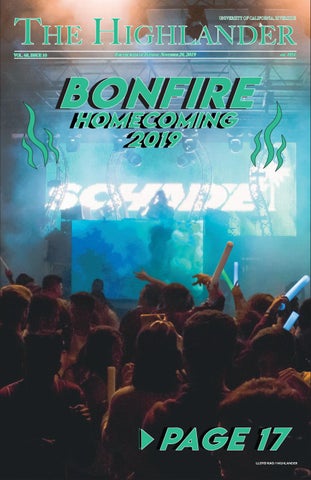
BONFIRE BONFIRE homecoming homecoming 2019 2019
page page 17 17 LLOYD KAO / HIGHLANDER
2
HIGHLANDER // highlandernews.org
TUESDAY, NOVEMBER 26, 2019
HUMANS OF UCR
UPCOMING EVENTS: WEEK 9
PREETI JUTURU | PUBLIC POLICY | SECOND-YEAR COMPILED BY MARTIN LOPEZ
26
Tuesday
27
Wednesday
UCR Music - Japanese Drumming Demonstration by the UCR Taiko Ensemble 12:00pm to 1:00pm Arts Building, Amphitheatre Steps
Men’s Basketball vs Longwood 7:00pm to 9:00pm Student Recreation Center (SRC)
APSP Womxn’s Program: “Let’s Talk” #HealthyRelationships 11:00am to 12:00pm Costo Hall, 244
UCR Music Wednesday@Noon 12:00pm to 12:50pm Arts Building, Room 213
28
Thursday
“Something many people don’t know about me is that I can play over five instruments and have taught, wrote and created music for the entirety of my life. All throughout my life, music has allowed me to feel my emotions in their rawest forms and wield them, so that I can create something beautiful. Music has taught me discipline, acceptance and perseverance. If it weren’t for music, I don’t know who I’d be today.”
29
Men’s Basketball vs SUIE 2:00pm to 4:00pm Student Recreation Center (SRC), Arena
Friday
30
Film: Loving Vincent: The Impossible Dream 1:00pm to 2:00pm UCR ARTS, Culver Center of the Arts
Saturday
1
Sunday
CONTACT US
HIGHLANDER STAFF EDITOR-IN-CHIEF
MANAGING EDITOR
Evan Ismail
Jonathan Fernandez
managingeditor @highlandernews.org
editorinchief @highlandernews.org
ASST. NEWS EDITOR
NEWS EDITOR
Laura Anaya-Morga
Amani Mahmoud
news@highlandernews.org OPINIONS EDITOR
Samuel Harrison
opinions@highlandernews.org FEATURES EDITOR
Asst. Features editor
Mark Bertumen
Christine Tran ctran104@ucr.edu
features@highlandernews. org A&E EDITOR
ASST. A&E EDITOR
Colin Carney
Adam Alvernaz aalve003@ucr.edu
radar@highlandernews.org SPORTS EDITOR
Jordan Hom
sports@highlandernews.org PRODUCTION MANAGER
ART DIRECTOR
Kerry Mulia
Amanda Joy Teano artdirector. highlander@gmail.com
productionmanager @highlandernews.org PRODUCTION ASSISTANTS
Kathy Garcia Brinly Den Celine Hoang
Judy Tu
Asst. Photo Editor
PHOTOGRAPHY EDITOR
Martin Lopez
Ryan Poon rpoon003@ucr.edu
photo@highlandernews.org STAFF PHOTOGRAPHERS
Leo Yue Lydia Tsou ASST. VIDEO EDITOR
Sara Bernal
sbern016@ucr.edu BUSINESS MANAGER
COPY EDITOR
Melanie White
Silvia Ferrer
highlanderads@gmail.com
copyeditor.highlander@ gmail.com
DISTRIBUTION MANAGER
TECH DIRECTOR
Sarang Majmudar
MARKETING COORDINATOR
Cody Davis
Jeffrey Juan
techdirector@highlandernews.org
marketing.highlander@gmail.com
Highlander 101 Highlander Union Building Riverside, CA 92521 www.highlandernews.org editorinchief@highlandernews.org TIP LINE: (951) 827-2105 Help the Highlander stay on top of what is happening on campus and in the general UCR community. Call this number and leave a message for the Editorial Board with your tip. Be sure to include your full name, relation to UCR, and a number or email address where you can be reached for more details. Editorial Office: (951) 827-3617
Business Office: (951) 827-3457
Classifieds & Billing: (951) 827-5039
Fax: (951) 827-7049
LETTERS TO THE EDITOR The Highlander accepts letters from the campus community. They must be 600-800 words at length and include the author’s name and contact information. Topics should be UCR-centric and/or pertain to our generation of students. Contact Opinions Editor Samuel Harrison at opinions@highlandernews.org by Wednesday if interested in writing a letter and submit the completed letter by Saturday at noon. Letters can and will be rejected if it does not meet requirements. LEGAL The Highlander is published and copyrighted by the Highlander for the students, faculty and staff of UCR. All rights are reserved. Reprinting of any material in this publication without the written permission of the Highlander is strictly prohibited. Readers are allowed one free copy of the newspaper. For additional copies or for subscription information, please contact the Highlander. The Highlander fully supports the University of California’s policy on non-discrimination. The student media reserve the right to reject or modify advertising whose content discriminates on the basis of ancestry, color, national origin, race, religion, disability, age, sex or sexual orientation. The Highlander has a media grievance procedure for resolving complaints against it. All inserts that are printed in the Highlander are independently paid publications and do not reflect the views of the Editorial Board, the staff or The University of California or the Associated Students of UCR.
2
Get Tested Before Your Tests 11:00am to 2:00pm Rivera Library, 3rd Floor
Coffee Chat with Applied Medical 10:00am to 11:00am Olmsted Hall, 2340
Monday
MULTIMEDIA
CLASSIFIED ADVERTISEMENTS ADVERTISING INFORMATION Please submit Classifed ads by calling 951-827-3457 or by emailing Highlanderads@ucr.edu PAYMENT Visa and Mastercard Make checks payable to The Highlander Newspaper No refunds RATES Classified: $2 per line; 17 characters (spaces, dashes, etc.)
UCRHIGHLANDER
f
UCR HIGHLANDER NEWSPAPER @UCRHIGHLANDER HighlanderTV KUCR 88.3 FM
News 4
TUESDAY, NOVEMBER 26, 2019
HIGHLANDER // highlandernews.org/news
ASUCR
ASUCR discusses replacing election debates with an open house AMANI MAHMOUD Senior Staff Writer
ASUCR passes six pieces of legislation
On Wednesday, Nov. 20, ASUCR held their second State of the Association Meeting of the quarter. ASUCR executive cabinet members discussed what projects they have been working on or completed so far this quarter. During Committee Reports, the finance hearing minutes for Nov. 18 and Nov. 20 were both approved 12-0-1 and 13-0-0. The meeting then moved on to the Legislative Review Committee reports. Six pieces of legislation were passed. The first piece titled SBF19-012: Expanding Legislation Requirements for ASUCR Senators proposed that the number of senate sponsors on a senate resolution be expanded to three primary authors instead of two. GSOE Senator Evelyn Castaneda noted that this bill would change the number of primary authors on a senate resolution but not on a senate bill. The bill was passed 13-0-0. SB-F19-013: VPCIA Commissioner of Mental Health Bill was then presented by Vice President of Internal Affairs Jocelyn Ortiz, who explained that this bill would edit Section 8, Commissioner of Mental Health of the Vice President of Internal Affairs’ bylaw to state that, “This position description shall be rewritten during spring 2020 in conjunction with the AVC of Health, Counseling and Wellness after final departmental assessments and restructure have been completed.” Ortiz explained the reason for this change is because, “we have a new vice chancellor of student health and wellness Denise Woods. She is reevaluating the mental health program on campus. She wants us to hold off on this committee until after winter quarter so that they can evaluate where ASUCR can help.” The bill was passed 13-0-0. The next bill the LRC went over was SB-F19014: Amending Chapter V to Revise Policy on Travel Contract Reimbursements which would correct a conflict in Chapter 5 of the ASUCR bylaws. The bylaw states that travelers shall not be reimbursed for expenses paid on behalf of others. Each traveler needs to provide individual receipts for their own expenses. Receipts must be submitted within seven days to coincide with ASUCR policy per Part V, Section A. This bill would fix a conflict in the bylaw in which one section previously stated 21 days but should have said seven. The bill was passed 13-0-0. The senate then discussed SB-F19-015: Amending Chapter VI to Keep a Record of ASUCR Committee Members. This bill was originally intended to keep a record of all committee members within ASUCR. However, President Pro Tempore and Public Policy Senator Preeti Juturu stated that in the bylaws it states that the Personnel Committee needs to vote on any changes to their bylaws prior to being presented to the LRC. Juturu also stated that in Chapter 6, Section 2, Part 3 of the ASUCR bylaws, it already states that the Personnel Director must compile and continuously update a list of all ASUCR committees and committee members and submit to the Executive Director each quarter for recording and eligibility purposes. The bill was then tabled with a vote of 14-0-0. SB-F19-016: Enacting Chapter LII: “The Highlander Pride” Committee was then presented. This bill would reinstate the We Are Highlander Pride Committee under the Personnel Director ’s bylaw, which was previously accidentally deleted. The motion passed 15-0-0. Two representatives from CalFresh, a program
LLOYD KAO /HIGHLANDER
that provides qualifying students with up to $194 a month to buy healthy and nutritious foods, presented SR-F19-003: Resolution in Support of CalFresh Awareness and Registration Efforts. This bill would provide information sessions to educate students about the CalFresh program and how to register for it. The bill was passed 15-0-0. The Elections Director then presented a report on the proposed 2019-2020 elections timeline. On Jan. 15, referendum and initiative applications will be due. On Jan. 22, pro/con group applications will be due and filing for candidacy will open. Files for candidacy will close on Feb. 14. The campaigning period will take place from March 3 to March 24. Voting week will take place from March 20 to March 24. Election results will be announced on March 29. Elections Director Dyanna Castaneda announced that instead of holding the traditional candidate debates, the Elections Committee proposed that they hold a Senator Open House on March 7 and an Executive Branch Open House on March 14. Castaneda stated that the reason for this change is that, “The debates are often polarizing and I think that an open house is more effective. An open house or tabling is much more personal.” This announcement prompted debate from the senate. President Pro Tempore and Public Policy Senator Juturu stated that her concern with replacing debates with an open house is that it presents problems for students who are running without a lot of exposure, such as underclassmen, and that the candidate debates allow students to get that sort of exposure. Castaneda confirmed that candidates would still be able to give speeches at the open house to present their campaign and platform to students in attendance. BCOE Senator Maurice Armstrong agreed with the Election Committee’s decision to replace the debates with an open house. Armstrong stated, “Not a lot of people from the student body actually show up to the debates. Even if people are there they are not actually analyzing what you’re saying. The only exposure the debates really get is through The Highlander but not everyone reads it.” Armstrong also stated that it is the candidates responsibility to table and campaign in order to gain exposure.
ASUCR President Julian Gonzalez then stated, “I disagree with those who are stating that debates are not effective. Debates allow people to verbally hear a candidate’s platform ... I think debates are much more effective than going up to someone’s table at an open house just so you can get an incentive of a slice of pizza. Debates are valuable and what makes ASUCR special and professional.” After debate, the motion to approve the elections timeline was approved 13-2-0. The meeting then moved on to Officer Reports for the second State of the Association Meeting of the quarter. Transfer/Non-Traditional Director Eric Calderon announced that he is proud of his committee for tabling on Mondays and Tuesdays. He stated that he believes that his committee will continue to table for the rest of the year to ensure that they have the best outreach to transfer and non-traditional students. Personnel Director Luna Sebastian stated during her report that they will no longer be accepting senator reports from senators if they are submitted past the deadline. She asked senators to stay on top of their reports and to submit detailed reports. Sebastian stated, “Keep yourself in check before a student from the public comes up here to remind you guys to do your job.” President Gonzalez stated during his report that two new committees were created that the ASUCR president must sit on: the UCPD Campus Advisory Board as well as the Commencement Committee. He also stated that the furniture and appliances for the senate chamber remodel were ordered and delivered and to expect construction to be happening soon. During Public Comment, GSOE Senator Castaneda expressed her disappointment with the lack of ASUCR attendance at the Native American Student Programs 5k run. She stated, “I asked you guys to attend the event for support and some of you even personally told me that you would come. I feel horrible telling NASP that you guys would be there and none of you showed up.” Castaneda also stated that she felt like ASUCR members are ignoring her in their GroupMe group chat while they answer other members promptly. The meeting was adjourned at 8:14 p.m. There will be no ASUCR meeting next week. ■H
HIGHLANDER // highlandernews.org/news
TUESDAY, NOVEMBER 26, 2019
NEWS
5
Chancellor Wilcox holds fall campus update
AMANI MAHMOUD Senior Staff Writer
On Thursday, Nov. 21, Chancellor Kim. A Wilcox held a fall campus update at 12 p.m. The update included presentations by the chancellor and Vice Chancellor for Student Affairs Brian Haynes, with opportunities for questions afterward. At the beginning of the meeting, Wilcox provided a land acknowledgement. The beginning of the acknowledgement stated, “In the spirit of Rupert and Jeanette Costo’s founding relationship to our campus, we would like to respectfully acknowledge and recognize our responsibility to the original and current caretakers of this land, water and air: the Cahuilla, Tongva, Luiseño, and Serrano peoples and all of their ancestors and descendants, past, present and future.” Wilcox stated that he wanted to roll this statement out more broadly in order to remind the campus about what land the campus rests on and what the campus owes to the people who came before us. Wilcox then gave a powerpoint presentation. The first part of the powerpoint was titled, “Changing the Narrative in Higher Education.” Wilcox noted some of UCR’s successes in the past years. He mentioned that UCR was named the fastestrising university in America by U.S. News, Forbes, Wall Street Journal and Times Higher Education. UCR was also included in the top 20 Public University list by Washington Monthly, Money Magazine and Forbes. Additionally, the Center for World University Rankings named UCR as being in the top one percent of universities worldwide. Wilcox stated, “We move students further ahead than anyone else in the country and I think that is amazing.”
LEO YUE / HIGHLANDER
The next slide Wilcox presented was titled, “Campus Budget and Priorities.” The slide stated that UCR has a $1 billion total budget which includes auxiliary services that are not funded by state support or tuition and fees. This includes housing, dining and hospitality services and transportation services. UCR has a $575 million core budget which comprises of core teaching and research operations for the campus. Wilcox then explained that UCR’s core revenue comes from: 50% student tuition and fees, 44% from California state general funds and 6% from non-resident student supplemental tuition. According to Wilcox, 68% of UCR’s core expenditures go toward total salaries and benefits, 17% goes toward financial aid and 15% goes toward other expenses. Wilcox then noted that UCR is the lowest state-funded campus in the UC, has the highest student-staff ratio in the UC, has critical capital and infrastructure needs and that UCR’s School of Medicine is significantly undercapitalized. Wilcox stated, “It would take 740 new staff members to get the correct student-staff ratio. We do not have the people that we should have to get the job done ... The state of some of our buildings, there are terrible buildings ... You cannot be underfunded all this time and not have consequences.” The next slide Wilcox presented was on California Proposition 13. This proposition would create a school and colleges facilities bond in March of 2020. This would focus on seismic improvements, deferred maintenance and enrollment growth. It would grant $2 billion to the UC system. Wilcox stated that the priorities for the bonds would create new undergraduate classrooms and a lab and studio teaching
facility. It would also go toward Spieth Hall improvements, Rivera Library improvements, a new School of Business Building and a new Bourns College of Engineering Building. All of these priorities are still pending review and approval. The presentation then moved on to UCR’s task forces and initiatives. Wilcox stated that new task force is being put in place and will be called the Campus Culture Task Force. This task force, stated Wilcox follows the 298-page investigative report released by the UC Office of the President that detailed a pattern of inappropriate behavior in direct violation of the UC’s Sexual Violence and Sexual Harassment (SVSH) policy on the part of James Sandoval, former vice chancellor of student affairs. Wilcox stated, “We have a lot of work to do about our own environment and this group has been tasked to conduct a review UCR’s culture.” Haynes then gave a presentation on student affairs at UCR. Haynes stated that the Student Affairs office conducted a workplace assessment and found emerging themes of a lack of a sense of belonging, employee satisfaction, trust in leadership and a need for professional development among staff and faculty at UCR. Haynes also gave a presentation on campuswide task forces and committees. One of these committees is the AdHoc North District Naming Committee. Haynes stated, “Traditionally at UCR, we name all of our residence halls after places in Scotland. This committee is looking to revise that policy to take into account the indigenous people of this region, the state of California and of this nation ... We are thinking of moving away from naming residence halls in the North District after locations in Scotland and instead focusing on Native American history.” Another focus group created is the Black Student Experience Working Group, stated Haynes. According to Haynes, this group will focus on increasing black student enrollment, black student success and understanding black culture at UCR. A Commencement Focus Group has also been created to discuss alternatives and solutions for UCR’s commencement ceremonies. The meeting then moved on to a short question and answer portion. One member of the audience stated, “We are the most diverse university in the UC system and yet we are the most underfunded. I find that depressing and pathetic.” Wilcox responded stating, “You are singing my song ... there is a negative correlation between our diversity and the dollars provided to our campus.” The campus update event ended at approximately 12:50 p.m. ■H
TAPS partners with Waze Carpool to assist students and staff
AMANI MAHMOUD Senior Staff Writer
UCR Transportation and Parking Services (TAPS) has recently partnered with Waze Carpool to help students and staff at UCR find someone to carpool with on their drive to campus. In an interview with The Highlander, Transportation Demand Management Specialist Tara Elizabeth Pueschel stated that most people already know Waze as a GPS navigation system that provides real time information on traffic conditions. “They have recently launched Waze Carpool which assists nonprofessional drivers to offer rides to people who are traveling on a similar route for a nominal fee,” stated Pueschel. Riders are charged a maximum rate of 58 cents per mile which is the current IRS reimbursement rate for business travel by car. Pueschel stated that the idea is to reimburse the driver for driving-related costs, such as gas. “UCR Transportation Services (TAPS) is promoting the Waze Carpool app as a tool to help connect students and staff so that they can potentially carpool and save time and money on their commute to campus,” stated Pueschel. According to Pueschel, ridesharing in general helps alleviate parking congestion as every two person carpool takes one vehicle off the road. TAPS is currently piloting the new 3+ Undergraduate Program and using rideshare matching tools such as Waze Carpool or Zimride can help people find a carpool partner, claimed Pueschel.
She stated, “Hopefully by using Waze, they might be able to find a permanent carpool arrangement and take advantage of the 3+ Undergrad program.” Waze Carpool is also working with several other UCs to promote carpooling. There is no cost to UCR and no agreement required. Waze provides TAPS with marketing materials and artwork to promote the initiative. They are also willing to work with TAPS on special promotions. Pueschel noted that, “During the month of October Waze offered $2 rides and they paid the driver the balance. We are hoping to hold another
promotion in the spring.” Pueschel stated that students and staff interested in participating in the program would need to download the Waze Carpool app on their smartphone. Students can go online to bit.ly/UCRCarpoolers for more information. When registering, students and staff should use their UCR email address so that they will be able to participate in any UCR specific promotions. Students and staff have the ability to filter the matching so that the user will only be matched with others commuting to UCR or matched with same gender only. ■H
MARTIN LOPEZ / HIGHLANDER
6 TUESDAY, NOVEMBER 26, 2019
HIGHLANDER // highlandernews.org/news
NEWS IN BRIEF: Recent UCR doctoral graduate discusses the significance of the fundamentalist Mormon communities in Mexico
COURTESY OF CRISTINA ROSETTI VIA TWITTER
ANDY LI Contributing Writer
Cristina Rosetti, a doctoral student specializing in religious studies who graduated from UCR in June 2019 has recently been interviewed by news organizations, including CNN, ABC and CBS News in regards to the massacre of nine American fundamentalist Mormons in Sonora, Mexico approximately two weeks ago by a Mexican drug cartel. Rosetti has been studying fundamentalist Mormonism for several years and provided her thoughts on the religious sect. “I would agree with most journalists who have been reporting on the recent massacre that it was very
likely an accidental event caused by feuds between rival gangs,” said Rosetti. The fundamentalist Mormon community in northern Mexico are a longestablished religious group dating back to the 1880s, and have contributed greatly to the local economy. “Many people commonly confuse mainstream Mormonism, or the LDS church, with fundamentalist Mormonism,” explained Rosetti. According to Rosetti, the key difference is the LDS (Latter Day Saints) church does not endorse polygamy at all and are not affiliated with the fundamentalists, who take a much more conservative and literal interpretation of Joseph Smith’s teachings, the original founder of the religion. Rosetti believes that the best strategy to prevent
future tragedies, such as the recent massacre in Mexico is by legalizing polygamy, or at least decriminalizing it in the U.S. “The reality is, the United States is their ancestral homeland, and many of them would still like the opportunity to return,” said Rosetti. She argues that while controversial, legalizing polygamy will reduce the social stigma that this community faces and ensure that they are less likely to be victims of violence in Mexico and elsewhere. Rosetti acknowledged that the current political climate with President Trump in the Oval Office has only made tensions between the U.S. and Mexico worse. “There’s no doubt that Trump’s hardline rhetoric against Hispanics and his threats to build a wall on the southern border has put the American Mormon community in Mexico in a particularly uncomfortable situation,” Rosetti stated. Rosetti explained that the fundamentalist Mormons tend to be more libertarian than traditional LDS Mormons, who lean Republican. They are highly skeptical of government intervention in their daily lives given the unique social situation that they are in. Currently, the Mexican government has been assisting the FBI in their investigation into the recent massacre in Sonora. Several persons of interest have been arrested, although convictions are still pending. Rosetti stated that the Mormon community in Mexico has been around for over a hundred years, and they will continue to play an influential role in Mexican society. She stated, “Hopefully, we all learn to get along with one another and preach tolerance, ■H not violence.”
UCR Mobility HUB project over budget, leads to delays
ANTONIO VELAOCHAGA Contributing Writer
Drew Hecht, co-director of management of UCR’s Office of Planning, Design & Construction and principal architect for the HUB Mobility Project, gave an update on the Mobility HUB on Wednesday, Nov. 20. The Mobility HUB project, which would have been a joint effort with the Riverside Transit Agency, was focused on developing a central transit center on campus.
It would have included a bus plaza, a pick-up and dropoff zone, a structural canopy, benches and landscaping. This project would have redesigned the layout of many campus locations, such as Lot 19, the intersection of University Avenue and Canyon Crest Drive and various other locations across campus that would have benefited the UCR community. The purpose of this HUB was to enhance UCR’s alternative transportation options on campus.
Hecht said that the proposal to undertake the project came with a financial cost that was around $5 million over budget, which was 34% over what the Office of Planning, Design & Construction originally planned. He stated that budgeting issue caused a delay in the construction process. Hecht said, “We are saving this site for a future transit center, based on a revised financial model that would be feasible to deliver a project for UCR and RTA.” The H project was expected to begin by November of this year.■
UCR launches Veterans Resource Center website for veteran and military-affiliated students
ANTONIO VELAOCHAGA Contributing Writer
This past Veterans Day, UCR’s Veterans Resource Center (VRC) launched their official website for student veterans. The VRC is a UCR service center meant to provide veteran and militaryaffiliated students with a support system, community resources and networking opportunities. In an interview with The Highlander, Veteran Services Coordinator Tami Thacker said that the website is important because it is the first time that all of the VRC’s information is online. She stated, “When a student veteran is looking for admissions information, they can find it there, if they’re looking for benefit or financial information, they can find it there, if they want to know how current student veterans feel about attending UCR, they can find it there.” Thacker stated that the website
COURTESY OF UCR VETERANS RESOURCE CENTER
symbolizes the support that UCR is providing the VRC, as it gives them a space to introduce themselves to new and potential students.
Thacker said, “I think the website is organized and friendly and we can only hope that this initial experience with UCR is enough
for them to look at us as a whole.” Currently, the UCR community has over 300 military-affiliated students. ■H
Be strong..
Do you have an interest in writing, photography, design or marketing? The Highlander can help you polish your skills. Come to our weekly meetings every Monday at 5:15 p.m. in HUB 101 to learn more.
Highlander MARTIN LOPEZ /HIGHLANDER
Opinions
8 TUESDAY, NOVEMBER 26, 2019
OPINIONS
HIGHLANDER // highlandernews.org/opinions
HIGHLANDER EDITORIAL
The US Supreme Court must rule against Trump’s decision to end DACA
T
he Trump administration has long been fighting to end the Deferred Action for Childhood Arrivals program (DACA), a program that protects over 700,000 young immigrants from the threat of deportation. This would put those hundreds of thousands of people at risk of being deported, and many are afraid that the U.S. Supreme Court is finally ready to let the administration have its way. The decision to end such an important policy is terribly shortsighted and will affect so many people. DACA should not be snuffed out; if anything, the program should be expanded upon. Trump’s administration was quick to say that they sympathize with these youths, commonly referred to as “Dreamers,” but they insist that DACA is unconstitutional and that the Obama administration skirted the approval of Congress when the former president issued an executive order to install the program. This argument is incredibly disingenuous. The administration insists that this is grounds to pull the plug on DACA, but they choose to ignore the fact that Trump himself has used executive orders in the past, most famously when he published executive order 13769 to deny the entry to refugees from
JORDAN HOM / HIGHLANDER
six majority Muslim countries, and executive order 13767 which intends on further militarizing the U.S.-Mexico border. The administration’s claim that they wish to end DACA for legal reasons is dishonesty at its finest. The decision to end DACA has never been rooted in a desire to preserve the integrity of the Constitution. It is rooted in petulant and virulent racism. There is no other way of looking at it — attempting to end DACA is outright ethically deplorable. Supporters of stricter immigration laws often express a desire to send immigrants back to what they assume to be the individual’s home country, but many of these DACA recipients have spent the majority of their lives in the U.S., having come to the country when they were children. Trump’s administration would have these people shipped off to foreign nations that they have no prior experience with, some lacking the ability to even communicate in said countries’ native language because they grew up in the U.S. Looking past moral and ethical arguments, the administration’s desire to end DACA is simply shortsighted. Not only has the administration failed to propose any alternative to the program, ending DACA would result in the possible deportation of hundreds of thousands of people, which would severely affect the
U.S. economy. A 2016 national survey yielded results suggesting that DACA recipients make “significant contributions” to the economy by buying homes and cars. Many DACA recipients are entrepreneurs and their businesses significantly stimulate economic growth. The desire to send hundreds of thousands of able-bodied workers and bright minds away to other countries is nothing short of foolish. As of right now, nobody is entirely certain how the Supreme Court might rule. While the most conservative justices seem to be leaning in Trump’s favor, the Supreme Court has outright refused to take the DACA case for quite some time, and are only now choosing to hear oral arguments. The justices are trying to collect information at the moment, and while it is indeed frightening that the futures of many DACA recipients are currently dangling over a precipice, the decision can still go either way. That being said, if they do rule against DACA, there are few places recipients will be able to turn. To give credit where credit is due, in terms of the Californian experience, Janet Napolitano issued a statement this past September implying that the UC system does not support Trump’s plan to end DACA, and that the UC system will continue to support the DACA recipients amongst the student
body. Furthermore, sanctuary cities may also prove pivotal to protecting past recipients in the event of DACA’s end. Sanctuary cities and counties refuse to take part in the hunting and deportation process, and they can provide free public education to those in need. If DACA does end, perhaps these places can serve as temporary havens for recipients of the program. Still, neither the support of the UC system nor the existence of sanctuary cities are true solutions to the problem. Of course, polls show that people on both sides of the political spectrum support DACA, and those people must be outspoken about their desire to not see DACA end if they aren’t already. Moreover, if the Supreme Court does indeed rule against the Trump administration’s effort to end DACA, it is important to remember that the fight is far from over. While DACA was well intentioned, it was never meant to be a permanent solution to the immigration issue. The program must be revised so that it is more accessible. Many recipients struggle to afford the $495 required to renew DACA every two years. Furthermore, many would-be recipients may lack the English fluency needed to fully understand the complex legal jargon that one must be well acquainted with in order to correctly submit the lengthy paperwork required for the
program, and many are unable to afford a lawyer who can help them submit said paperwork. Compounding entrance issues, the program is also far too limited in how it helps those who qualify to receive its protections. While DACA recipients qualify for some college financial aid, they are ineligible for federal financial aid. They are also excluded from many scholarships due to their lack of citizenship, and are likewise prevented from voting in U.S. elections. In light of all of these restrictions, a revised program could provide an accessible path to true citizenship. There should be no doubt that an individual who was brought to the United States at a young age and spent their entire life in the country is indeed an “American.” Spite and xenophobia fuel the decision to end DACA, and the people must speak out and make it clear that any decision to end the protection of “Dreamers” is immoral. DACA must not come to an end — it should only be improved so that an easier path H to citizenship can be created. ■
Highlander editorials reflect the majority view of the Highlander Editorial Board. They do not necessarily reflect the opinions of the Associated Students of UCR or the University of California system.
HIGHLANDER // highlandernews.org/opinions
OPINIONS
TUESDAY, NOVEMBER 26, 2019
9
OPINION POLL Compiled by Martin Lopez Staff Photographer
“What are your Thanksgiving plans?” Amani Mahmoud Public Policy Third-year
Colin Carney Political Science Third-year
“I’m having dinner with my relatives at my house.”
“I’m going back home for the weekend to have dinner with my family.”
Jordan Hom Media and Cultural Studies Fourth-year
“I plan to go home to eat some homemade Chinese food made by my grandma. Afterwards, relax and prep for finals.”
Adam Alvernaz English Third-year “Relax and finals!”
prep
for
Mark Bertumen Business Third-year
Evan Ismail Political Science Fourth-year
“Cook one hell of a dinner for my family. Then promptly knock out after doing that for about 13 hours.”
“Eat a lot and maybe go camping.”
Pulling out of the Paris climate accord is bad for the environment and the US’ reputation JONATHAN FERNANDEZ Senior Staff Writer
On Monday, Nov. 4, the U.S. took the first step in a year-long process to formally withdraw from the Paris climate accord. The accord was signed into effect on Nov. 4, 2016, by 196 states that agreed to prioritize a global response to climate change. As part of the agreement, each state had to propose plans that displayed how they would reduce greenhouse gas emissions. By formally pulling out of the agreement the U.S. will harm not only the environment, but also their reputation as a superpower. The U.S. has consistently been one of the top producers of carbon dioxide emissions worldwide. The U.S. Energy Information Administration estimated that the U.S. emitted 5.1 billion metric tons of energy related carbon dioxide in 2017, which would account for about 15% of global emissions. As a world
superpower and major contributor of global emissions the U.S. should hold itself accountable and attempt to work alongside other nations toward a solution. Choosing to back out of the landmark agreement is a significant decision, as the climate approaches “the critical point of no return.” However, this move should not come as a surprise to anyone. The Trump administration has consistently dubbed climate change as a hoax, choosing instead to prioritize domestic issues that affect cities within the U.S. While trying to focus on affairs in the country could be seen as admirable and logical, it is important to emphasize that the environment is nearing the point of no return and saving it will require effort from all who inhabit it, especially a country that claims the superpower label. Tackling climate change was a priority for the Obama administration,
which is why he signed the Paris climate accord and created the Clean Power Plan. Since Trump took over the presidency he has been hell-bent on undoing the strides Obama made toward decreasing greenhouse gas emissions. Throughout its tenure, the Trump administration has continuously attempted to undercut efforts to reduce greenhouse gas emissions: the administration has weakened methane regulations, eliminated Obama’s Clean Power Plan and allowed for more oil drilling. Backing out of an agreement that they helped establish hurts the U.S.’ reputation on an international scale. A superpower should be at the forefront of initiatives that confront global issues and could help extend their influence over other developing countries, but conversely the U.S.’ withdrawal from the Paris climate accord created fear that developing nations would follow
their lead. Despite those initial fears, developing countries decided to stay on board, partially due to a joint statement from France, Germany and Italy that helped calm any overreactions from developing countries. Nonetheless the withdrawal from the Paris climate accord served as a sign that America, as currently constituted, is not a country to admire. The back and forth swing in policy and beliefs between presidents of different parties has also made the U.S. appear inconsistent in their approach, making them an unreliable country. Although the U.S. is currently formally withdrawing from the Paris climate accord, the 2020 elections symbolize a beacon of hope for the future. The finalization of the withdrawal will take effect on Nov. 4, 2020, a day after the elections, so if a new president is elected, they will have the opportunity to change course and get America back on the right track. ■H
COURTESY OF WIKIMEDIA COMMONS
10
TUESDAY, NOVEMBER 26, 2019
OPINIONS
HIGHLANDER // highlandernews.org/opinions
Twitter turmoil: banning political ads will have unintended consequences
TIMOTHY HUGHES Staff Writer
On Wednesday, Oct. 30, Jack Dorsey, the CEO of Twitter, announced that the platform will no longer run paid political ads. This appears to be a direct response to Mark Zuckerberg’s decision to not ban or restrict political ads on his own social network. Political ads have been under scrutiny on social media and are often blamed for
the spread of misinformation, but this blame is misplaced and Twitter’s ban will ultimately have unintended effects on political races. Mark Zuckerberg was brought before Congress in October to testify to what Facebook is doing to curb misinformation. A line of questioning from Rep. Alexandria Ocasio-Cortez revealed that Facebook is doing next to nothing to fight lies on
COURTESY OF JD LASICA VIA FLICKR
the network. In her questioning, she included an example of how misinformation spreads through political ads, and the coverage from mainstream media has centered on political ads since. The focus on advertisements is shortsighted because political ads are not the main culprit of the spread of misinformation. During the 2016 presidential election, Russia, a perpetrator of misinformation online, only spent $100,000 on paid ads
and promotion attempting to influence the results, far less than any political candidate in the race, and they were very successful in their manipulation. What spread misinformation more often was the organic sharing of posts by sources known for spreading misinformation, such as Infowars and Breitbart, on social media. Paid political ads are not the root or major cause of the spread of misinformation — users’ inability to discern and fact check info is. Banning paid political ads may disadvantage candidates with less name recognition in political races. When candidates like Joe Biden or Bernie Sanders announce they are running for office, they find it easy to bring in donations quickly and early in the race when it is crucial to do so. This is because people know their names and are aware of their political experience. Name recognition is important, and candidates with more of it don’t need to spend as much time letting people know who they are. Lesser known candidates must spend a great deal of time and resources
early in their campaigns to get the word out that they are running. A major way this is done is through paid political ads. A good example of this phenomena is the incumbency advantage in America. When an elected official runs for office, they find it much easier to raise money than their opponent, as their name is known and donors pockets are looser for them. This correlates to the reelection rates of officials in America, which has never fallen below 80%. Twitter may mean well, but the ban on political ads is not going to solve the problem of misinformation. Americans need to get better at discerning what is and isn’t true and fact check for themselves before sharing. Twitter’s decision also supports incumbents and celebrities that decide to run for office or reelection, as they don’t need to put out as many ads to get attention. Social media users need to be more careful with what they’re sharing and start looking into lesser known candidates running this cycle, because Twitter won’t be helping. ■H
Facebook doesn’t care about user privacy
BENJAMIN DENZLER Contributing Writer
Facebook doesn’t have a strong reputation for respecting privacy — in fact, the company thrives on being as invasive as possible. It collects as much personal data on users as possible across all of their services. Using Facebook and Instagram gives the company a wealth of information, including hobbies and interests, and even if a user doesn’t have any accounts, their browsing habits are still recorded if you visit any of the 8 million websites that use Facebook’s trackers for analytics. Though this process is undeniably invasive, the company is more than happy to collect this data because it’s extremely lucrative — the information gathered is used to create profiles on users, which are sold to third parties for personalized advertising. It’s so profitable, in fact, that digital advertising made up 98% of Facebook’s $55.8 billion revenue in 2018. Facebook’s business model relies entirely on users giving up their privacy. It’s surprising then, that at their own F8 Conference this spring, the company declared a newfound commitment to privacy. CEO Mark Zuckerberg stated, “the future is private,” acknowledging the real need for social platforms that value privacy. Changes are already being made. For example, Facebook outlined a plan to encrypt all its messaging
apps, which would prevent the company from viewing any of its users text or voice messages, and will provide more options that limit data storage. While these changes sound great for consumers and would help Facebook have the appearance of an ethical company, ethics is far from the company’s primary concern. The company is doing this to save face, and to ultimately profit from the changes. Facebook’s reputation and stocks have been rapidly declining after numerous scandals and accusations. In 2016, the company was blamed for allowing Russian agencies to push divisive ads on the site during elections, and just last year, Facebook was shown to have leaked the personal information of about 87 million people to British consulting firm Cambridge Analytica. Facebook has continually demonstrated that it can’t be trusted with users’ personal data, so of course it’s trying to “change”; there is no other choice. The company doesn’t care about its users’ privacy — it is trying to keep up with the negative press it is rightfully receiving by shifting its brand’s image to something more positive, so users and stockholders alike will feel better. It seems pessimistic to assume Facebook is rebranding itself for selfish reasons, but the ways it is implementing “privacy” suggests this change in direction
COURTESY OF WIKIMEDIA COMMONS
is motivated by money rather than altruism. The company has been boasting a centralized infrastructure for all their messaging apps (e.g., allowing Instagram to talk to people on Messenger) that is entirely encrypted, so all messages going through their services will be private. This is a great step, but it’s addressing the wrong problem; Facebook never collected personal data from chats in the first place. Algorithms might scan messages to ensure you’re sending safe content, but nothing is ever collected to use for advertising, because it’s much easier to track users elsewhere. Facebook is encrypting chats because it will create the appearance of caring about privacy while hardly impacting their business model. This change doesn’t affect the disturbing amounts of data it
collects outside of their chat platforms, which is of much greater importance. Additionally, encrypting chat apps means the company no longer needs to spend money to maintain algorithms that moderate messages, and combining the infrastructure of the chat services makes it much more difficult for regulators to split the company up. It seems disheartening, but there are solutions. There’s nothing inherently evil about advertising, even when it’s personalized — companies just need to be transparent about what data they’re collecting and how it’s being used instead of hiding it behind features and marketing. Privacy policies exist, but they should be much more accessible and easy to understand. Websites should explicitly tell users when data is being collected and for
what reason. Ad targeting should be opt-in, and users deserve the right to access and erase all of their data at any time. The internet should be private by default, and a great step toward this is pushing for federal regulations that would force tech companies to respect personal data. The EU’s data protection law, the General Data Protection Regulation, has certainly improved the situation, and similar regulation at the federal level in the U.S. would be a tremendous step toward privacy everywhere. Despite their claims, Facebook and companies like Google don’t care about user privacy because user data is how they make money. More awareness and concern for privacy is desperately needed —- too much trust is put in these companies that know everything about their users. ■H
HIGHLANDER // highlandernews.org/opinions
OPINIONS
TUESDAY, NOVEMBER 26, 2019
11
‘Ok boomer’: The meme that is changing the scope of politics and its participants
MADISON RHEINS Contributing Writer
If someone is a frequent user of social media platforms and takes part in the trends, then they shouldn’t be a stranger to the prevalent “ok boomer” phenomena. This phrase has become a popular discourse topic between generations and is causing many people to take sides on the once comedic and lighthearted meme. Due to the significance many groups have attributed to this phrase, it is now rapidly shaping social politics. The “ok boomer” trend can be traced back to a TikTok made in November of 2019. Since then, however, it has resurfaced on Twitter and news outlets as a topic of debate. With the hashtag going viral, it has given several young activists a newfound confidence to combat the ever-present baby boomers in world governments. Opinions on this trend have been split, with some arguing that the “ok boomer” movement marks the end of friendly relations between generations. Other media outlets have explained that this is just another version of the blame game. After many years of baby boomers blaming millennials and Generation Z (zoomers), the tables have turned — and the average boomer just doesn’t know how to react to this. The frenzy over this hashtag has become widespread, and some adults have even compared the phrase to an extreme racial slur. This further demonizes the phrase and the young people who use it. However, comparing “ok boomer” to that of a slur reveals the underlying racism of the older generation. This became evident when conservative New York radio host Bob Lonsberry tweeted about how the “ok boomer” trend is the ageist equivalent to the N-word. Lonsberry’s argument makes it evident that those who are offended by this trend are scrambling to victimize themselves by attaching themselves to
other oppressed groups. Society shouldn’t allow this, as it takes away the real negativity from the actual racial slurs that are hurting minorities. “Ok boomer” isn’t a racial slur, nor will it ever be. It is an exasperated, political outcry that the older generation can’t seem to handle. It’s ironic how before this movement, it was always the older generation insulting millennials and zoomers. Millenials and zoomers have been constantly harassed by baby boomers for being lazy, entitled children for years now. However, now that the “ok boomer” trend is gaining momentum, suddenly older generations are at a loss for words. The “ok boomer” movement is a way for the younger generation of new political activists to show that they are tired of watching the world be ruined by old ideas. This has led people to believe that the world deserves new faces, fresh ideas and young energy. Young activists are tired of the slow process and never changing policies of the
baby boomers, especially when it comes to social and environmental issues. The younger generation is here to prove the older generation wrong and show them that they have what it takes to make the world a better place in a changing society. Zoomers and millennials aren’t lazy snowflakes; in fact, they’ve produced some of the greatest young activists thus far, such as Greta Thunberg. Millennials and zoomers can influence the future of politics. They are more socially conscious and hold progressive ideas on topics such as climate change, a clear juxtaposition to their older counterparts. It’s time to turn a new leaf and ignore the idea of respecting your elders blindly. Although the “ok boomer” trend seems harsh, it’s a way for zoomers and millennials to show they are putting their foot down when it comes to issues of political discourse. They are not afraid of the backlash they receive and will do whatever they can to change the world they
COURTESY OF PEXELS
live in. They believe they are responsible for bearing the burden of climate change, and they urge their adult opponents to look at the world differently. Older generations are constantly scolding the young for having silly, radical ideas, and “ok boomer” provides a way to shut them down and force them to listen. To the relief of the baby boomers, this trend isn’t enough to incite an intergenerational war, contrary to popular belief. However, it isn’t because zoomers are weak and scared of what’s to come — they simply don’t care about the older generation anymore and would rather turn their attention to the issues that their predecessors have failed to address. Instead of fighting with the ever bitter boomers, zoomers are determined to create the change they want to see in the world. Although the “ok boomer” trend may lose it’s trending spot on social media in a few weeks, the impact it has left will continue to influence society for years to come. ■H
A ‘well regulated militia’ is not private gun ownership
COURTESY OF WIKIMEDIA COMMONS
ROBERT GOLD Contributing Writer
The Second Amendment should be reinterpreted to protect the rights of states to protect themselves with well-regulated militias. Home protection should be done with nonlethal weaponry. Hunting should be permissible in designated hunting zones with weapons provided on the hunting grounds. But most importantly, the Second Amendment in its current form should be eliminated, private gun ownership should be eliminated and local police departments should be disarmed. Those who wield power over others are susceptible to moral infringements as their authority can often change the nature of their everyday behaviors. Police officers who wield immeasurable levels of power over the civilian population become akin to occupational military forces in the towns and
cities that they patrol. The abuses of power are prevalent in all professions, but very few professions wield the same levels of power as police officers. People can be fallible to the corruption of power; therefore, it is important to arm these “domestic servants” with nonlethal firearms so that when the inevitable moral infringements and power corruptions occur, civilians will not face public servants armed with lethal fire power. Legally purchased firearms are more likely to kill a family member than a perpetrator. The argument revolving around home protection is a fallacy. Those who truly care about protecting their loved ones would actually be safer keeping a gun away from the home entirely. When someone brings an instrument of death into their household, the statistics show increases in domestic violence, suicides and accidents with children. Compared to other developed nations, an American child between the
ages of 5 to 14 is 11 times more likely to be the victim of an accidental gun death with a legally purchased firearm. In 2010, an estimated 19,392 people commit suicide with a legally purchased firearm. Every month, 52 women are shot and killed by an intimate partner with a legally purchased firearm. The Founding Fathers wrote the Second Amendment as a fail-safe apparatus in case their democratic experiment was ever threatened by the forces of absolutism. The assumption by anti-government type people in America today that believe that simply because they are fighting against the “establishment” or “the man” that somehow that puts them on the side of moral righteousness. This is a false notion. The argument that Americans need guns because they are going to someday overthrow their tyrannical government is a flawed perspective, because the truth is that the tyranny could very well be coming from the people trying to overthrow their government. It is not unwarranted to say that the U.S. government may someday fall to the perils of autocracy. Legal scholars have varying interpretations of the Second Amendment. Constitutional analysts theorize that: “A well regulated militia, being necessary to the security of a free state, the right of the people to keep and bear arms, shall not be infringed,” is not an approbation of private gun ownership. It is the proposed acquiescence of all states to maintain armies that could oppose government oppression. Even with a broad restructuring of the second amendment, the Founding Fathers desire to have a fail-safe against rising tyrannies would lay intact. These would be difficult policies to pass
in the United States, where gun ownership is often equated as the cornerstone of America’s foundations of freedom and liberty. This nation was founded with the Second Amendment. 243 years of private gun ownership cannot be erased. But despite the popularity of firearms, Americans will one day tire of living in a culture of fear — the fear that they encounter every time they step into a movie theater and the lights dim. There is a culture of fear in America that university students suffering from depression or mental disorders can easily obtain firearms. This fear stretches into grade school classrooms where some students are socially awkward, and many worry that these young, troubled adolescents will find access to firearms. It ruins the escapism element of movie going when every American is always subconsciously worried that violent movies are bound to inspire acts of real world violence. People who support gun ownership argue that it stands as a testament to freedom and liberty, but there is nothing liberating about living in fear in your own country. The Second Amendment infringes upon every American’s right to a safe and peaceful coexistence. Nobody who claims to cherish life can so blatantly uphold a weapon of death. The Founding Fathers endowed us with inalienable rights, but being scared all the time was not one of them. People are not being ordained with a life of liberty and happiness when every troubled person can too easily put that angry behind the barrel of a gun. America is not living up to the legacy of its Founding Fathers. A culture of fear and constant terror is not freedom, it’s a prison that stretches two oceans. ■H
12
FEATURES TUESDAY, NOVEMBER 26, 2019
FEATURES
HIGHLANDER // highlandernews.org/features
GO SCOTTY, : IT’S YOUR Y A D ’ R BIRTHDAY! HEEWON KIM Contributing Writer
On Wednesday, Nov. 20, at 11:00 a.m., the Associated Students Program Board (ASPB) celebrated the 20th birthday of UCR’s iconic mascot: Scotty the Bear. UCR celebrated his 20th birthday as ASPB provided free chicken veggie bowls from WaBa Grill and ice cream sandwiches from Slickables. They put out tents where students could pick from black, turquoise, navy blue or orange ink to customize their Scotty’s Birthday shirt. They also brought Lake Chon, a DJ duo consisting of two members, Chris Khe and Torrance Cui, to provide electronic music to the party. Right next to Scotty’s Birthday celebration was the Nintendo Switch event, a two-day event that wasn’t affiliated with Scotty’s Birthday celebration, but convenient for students to go to during or after the party. Daniel Kim, a fourth year majoring in religious studies, expressed his experience as an unforgettable one even with the dreary weather. “Today’s event was pretty lit. I had a good time and it was really chill, literally, because it was raining,” stated Kim. Kim attempted to gain as much free gear and food as he could with his friends. “I went to the Slickable tent and got a free ice cream sandwich, got a free turquoise t-shirt, and I’m about to go to the ASPB tent for a chance to win a free sweatshirt.”
JOSHUA WANG / HIGHLANDER
Despite the cold weather and the constant rain drops hitting his face, Kim still enjoyed the celebration. “The ice cream was probably one of the best ice creams I’ve ever had, it was a blizzard of flavor in my mouth. I’d rather have the weather be really cold and eat ice cream than when it’s super hot,” describes Kim. Throughout the celebration fellow students walked around the Bell Tower with either a bowl of steamed vegetables, meat and rice, or a delectable ice cream sandwich. Sean Kim, a fourth year majoring in
LLOYD KAO / HIGHLANDER
psychology, was drawn to the celebration after noticing the long lines that reached to the Rivera Library. “There were huge lines and I found out they were giving out free stuff, I got free Slickables and I got a free Scotty’s birthday shirt,” stated Sean Kim. After Lake Chon played their first song around 12:30 p.m., the main attraction, Scotty the Bear himself appeared to his own celebration decked out in R’Gear. ASPB and UCR’s cheer team sang an exciting rendition of “Happy Birthday” to Scotty while students around the vicinity sang along and applauded for Scotty’s celebration. As always, this friendly character walked around the event spreading a happy virus and school spirit to students despite the murky weather. Unlike most birthdays, according to Geovanni Mayoral, an interim student organization coordinator and the Highlander Band coordinator, Scotty the Bear doesn’t have a specific birth date, but is celebrated on the Wednesday of the week of Homecoming. Interestingly, UCR’s mascot wasn’t always a bear, it was initially a Scottish terrier. “There was a professor in the school’s inception, who owned a Scottish terrier, and that was the school’s mascot for the first two years of the school’s existence,” said Mayoral. In 1956 students were able to vote for a new mascot. “They landed with Hylanders at the time it was spelled with a ‘y’ instead of ‘igh’ because we are the highest elevation UC in the UC system,” stated Mayoral. Drawing from the Scottish theme, they
came up with the name Scotty and dressed him in traditional Scottish clothing such as the kilt and the Balmoral bonnet, which is the Scottish hat. “The change in terms of animals has to do with the preexisting schools mostly, so UCLA and Berkeley were already bears. The UC system at the time when the school was being made wanted to be consistent with their sister schools,” stated Mayoral. In recognition of Scotty, the graduating class of 2002, 2004, 2007 and 2009 donated the bronze Scotty statue built next to the big, silver UCR sign nearby the HUB, where students can sit to take pictures. This friendly bear appears every Wednesday for R’Day and nooners to lighten up the atmosphere and to ignite school spirit. If you haven’t already, you might catch him expressing his comedic gestures by jokingly cutting people in a long line or making silly poses for pictures. The celebration for Scotty’s 20th birthday concluded at 1:00 p.m. ASPB tables every Wednesday for R’Day, where students can get a chance to win all sorts of R’Gear, while listening to the nooner’s featured artist. They also let students choose which artists they want to see at big events such as Block Party and Spring Splash. Some of their future events include “Breakfast Sandwiches” that will be held in the Rivera Library on Monday, Dec. 9 at 2:00 p.m., where students who come will be served free breakfast sandwiches as part of the Finals Week Stress Relief series. ■H
HIGHLANDER // highlandernews.org/features
FEATURES
TUESDAY, NOVEMBER 26, 2019
13
Highlander Con GAMER CULTURE ABOUNDS AT HIGHLANDER GAMING’S SPOTLIGHT EVENT MARK BERTUMEN Senior Staff Writer
The HUB’s third floor was crowded by hundreds as Highlander Con began last Sunday, Nov. 17, at 11 a.m. Hosted by Highlander Gaming (HLG), UCR’s major gaming organization with over 1,000 connected members, the Con offered students and non-student visitors alike a chance to engage with con-goers through video games — and many games there were, all with a culture of their own. In the middle of HUB 302 were two rows of TVs, stretching almost from the door of the room to the stage at the north end. Con-goers were playing “Super Smash Bros. Ultimate” (SSBU) and “Super Smash Bros. Melee” (SSBM) as a part of Con’s customary tournaments, which this time around were also held for first-person shooters (FPS) “Counter Strike: Global Offensive” (CS:GO) and “Rainbow Six Siege,” as well as the hit multiplayer online battle arena (MOBA) game “League of Legends” (LoL). LoL teams from UCR, Cal State University Fullerton (CSUF), Cal Poly Pomana (CPP), UC Los Angeles (UCLA) and Norco Community College (NCC) came out to fight it on stage and on the big screen. Matches were broadcast throughout the day, where viewers cheered and jeered as teams slayed the competition or bit the dust on the game’s titular map, Summoner’s Rift. Final matches for other tournaments were displayed as the evening came.
Visitors were also free to play their own games on their own time in HUB 260, or the online mouse-based rhythm game called “osu!” in HUB 269. On the west side of HUB 302, visitors could don a virtual reality mask and play the hit rhythm game “Beat Saber,” supplied by one of HLG’s sponsors, many of which lined the west wall. Many of the sponsors were of the computer gear industry, like Nvidia, which sells graphic processing units (GPU) and HyperX which is known for gaming headphones and keyboards. They talked about their products to interested attendees, and some even hosted giveaways throughout the day. If con-goers wanted a break from the games and its virtual facets, they could stop by the Artist’s Alley, where student artists and traveling artists could sell their work to purveyors. But the art in the Alley was not the Con’s only take on visual creativity: cosplayers of all sorts traversed the Con, exhibiting garb inspired by video games or even anime. One of the staff photographers was dressed up in fox ears, a blue dress and black heels, a wardrobe inspired by the magical “Caster” from the Japanese “Fate” series. Consisting of video games and anime, “Fate” is notorious for what some would consider convoluted storylines but is popular (having received over $3 billion for their recent mobile game) and pervasive enough to have found its way into the Con. At around 12 p.m., many cosplayers found their way to the stage as the Cosplay Contest began. Second-year history major
Juan Baumer was dressed up with props inspired by in-game cosmetics from FPS “Team Fortress 2” (TF2). “Highlander Con is one of our few chances (as students) during classes that we can express our preferences for certain video games and genres,” Baumer expressed, and his outfit showed his own preferences very well. On his head was a pair of bunny ears, inspired by the TF2 cosmetic “Max’s Severed Head,” referring to character interactions between a heavy weapons operator and a detective bunny named Max. In his hand was a weapon known as “The Conscientious Objector.” It was a makeshift picket sign where supposed users “gave peace a chance,” but noted that “it didn’t work,” based on the game description. TF2 is humorously known by the gaming community as “Hat Simulator,” due to its copious levels of for-sale virtual hats and other items, but that doesn’t stop Baumer from enjoying the main game itself. “Don’t be afraid of what others think of the games you like to play,” Baumer said. “TF2 might not be as relevant as games like LoL or Rainbow Six Siege, but you still have the right to enjoy it.” Non-student visitor John and his friends dressed up as Rainbow Six Siege characters, each of them decked out in tactical gear based on a playable character. “We just attend cons like these to show off our stuff,” John said; showing off their stuff they did, with one of his friends winning first place and the rest of them winning prizes as well. But as impressive as their attire was, so was the cost to make them; “mine probably cost
around $150, and maybe more for the others,” John said. As attendees played and explored everything the Con offered, the event itself concluded around 10 p.m., as the final tournament matches ended on-stage. John highlights the sentiment con-goers experienced
throughout the day, saying, “It’s nice to see so many people with the same interests all together in one place.” HLG frequently hosts gaming events and tournaments, and posts about all upcoming events on their Facebook, Twitter and Instagram pages. ■H
MARTIN LOPEZ / HIGHLANDER
MARTIN LOPEZ / HIGHLANDER
14
FEATURES
TUESDAY, NOVEMBER 26, 2019
HIGHLANDER // highlandernews.org/features
Highlanders, what dri
Alexan
jor
major
g ma
g itin
I’m thankful that Armageddon hasn’t happened yet because now I have more time left to knock some stuff off my to be read list.
r
Emilio Roble s se co
m
“I’m thankful for where I am in my life. I’m the only individual in my first generation Hispanic family of over 30 cousins who’s attending a college in California. I’m thankful that I made it here, and I will continue to reach heights beyond the seas, mountains and the universe.”
first-year En e l i gli ak K sh y e m
ma jor
re ltu
-year Media a h t r u nd o f z Cu de
Ma r
I am thankful that the only man I’m cooking for this year is Mr. Bubby (my cocker spaniel poodle).
ies major Stud
Jonathan F e rn an
reative Writing C r ea an y d d n
y m a j or soph ilo Ph
aM
ajo
J en n
I’m thankful for my mother. Why? Because she’s a Scorpio and perfect.
za third-year TF o d DP en
cond-year Crea e s n tiv a b e e st
itin
aE
urth year Cr eat i ve
Wr
z fo e d an n r
Wr
Kev in H e
By: Highlander
I am thankful for Baby Yoda memes and NBA League Pass.
I’m thankful for the fact that I am very self aware of my own flaws and that I always work to improve myself.
FEATURES
HIGHLANDER // highlandernews.org/features
TUESDAY, NOVEMBER 26, 2019
15
are you thankful for? dh i
urt h-
Evan Ismail fo
major
uble major
h-year Creativ t r u eW fo n ri so
Pablo
major
Jamie Dor io
or m aj
ce ien
I’m thankful for the fact that I found a lot of loving people in the LGBT Resource Center (LGBTRC) that make me feel welcome and at home when I don’t have a sense of home elsewhere.
-year Creative d r i Wr , th e it nn
ing
c
I am thankful for words and nature. Also, good memories with good people that come to mind when I’m in nature with my words, reflecting on life.
Turq
ls
ajor
jor
z re
h-year politi t r u ca fo
gm
Pet er
econd-year bi s n a i och m a e ag
tin
I’m thankful for free food at school events.
y ma str mi
Mich ael B
sycholog y an de
I am thankful for caffeine.
I am thankful to have the opportunity to go to UC Riverside and to have been able to make so many friends that I wouldn’t have otherwise met. Without these luxuries, I would still be very introverted and unwilling to step outside of my comfort zone.
Gut i er
ar p e y h t r ou
ion cat du
do ry sto
r a e y
al science c i t i l an po
Alejandro R o sa sf
Staff
I’m thankful for my student aid. I didn’t think I’d be able to afford university. It’s amazing to be here.
16
TUESDAY, NOVEMBER 26, 2019
HIGHLANDER // highlandernews.org/features
Easy Peach Cobbler By: Annjolie Seng-Kim, Contributing Writer
In my family, we always have the best desserts for Thanksgiving. My favorite is my dad’s special peach cobbler. It is a sweet and spice filled dessert that leaves you feeling warm and fuzzy after eating it. It’s just the right amount of ooey and gooey and goes amazingly with vanilla ice cream. As we prepare for Thanksgiving, I realized that it is a perfect dessert for Thanksgiving for the less culinarily gifted. It is one of the most forgiving, versatile and unfussy desserts to make. The flavor is enough to fool friends and family into believing that you are a culinary genius. However, for some of us Thanksgiving may get a little more expensive with the large feast to be made for the family. A lot of us are also college students that don’t have the money to go all out on Thanksgiving. With that in mind, I modified the recipe a little to be more budget friendly, so that we all can enjoy a nice delicious dessert for Thanksgiving this year. The estimated price for the ingredients in the recipe is about $15.
Ingredients: • 1 tablespoon of unsalted butter • 1 cup all-purpose self rising flour (if you don’t have this, use 1 cup of all purpose flour with 1 tablespoon of baking powder) • 1 cups sugar • Pinch of salt • 1 cup milk • 1 can of peaches sliced • 1 tablespoon of vanilla extract • Ground cinnamon (optional) • Vanilla ice cream (optional)
ANNJOLIE SENG-KIM / HIGHLANDER
Steps: 1. Butter the baking dish with warm butter. For less mess, I recommend having it melt slightly in the oven and then taken out and spread across the dish when it is liquid enough. Be sure to watch it carefully so that it does not burn. 2. In a large mixing bowl, combine your dry ingredients, flour, sugar and salt. 3. In a separate bowl, combine your wet ingredients: milk, a little of the syrup from the peach can (just a small pour for peach flavor in the batter) and vanilla extract. 4. Combine your dry and wet ingredients. Do not overstir. Stir just until all the dry ingredients are moistened. 5. Pour batter over the hot or warm butter (do not stir). 6. Arrange the peaches over the pan any way you’d like. Pour the syrup from the can over it. The amount you pour depends on how soft you want the cobbler to be. My family prefers for it to be soft, so we use all of the syrup. If you want it more solid, you can use half of the remaining syrup. 7. Sprinkle with cinnamon as much as you desire. 8. Bake at 375 degrees for 40-45 minutes or until golden brown. 9. Serve cool or warm. Top with a scoop of vanilla ice scream to make this dessert even more delicious! 10. Enjoy! ■ H
HIGHLANDER // highlandernews.org/arts
RADAR
ARTS & ENTERTAINMENT
TUESDAY, NOVEMBER 26, 2019
17
DER
HLAN
HIG EZV / IN LOP MART
e h t s g n i r b a 9 1 d 0 n 2 e a r i M D f E ! e e c Bo n m r a e i l f f g h i n t i w n heat nt retur a h p m u i r t
R WR ITE F F R S TA O I laughing and N E S , Z A screaming the whole night. ERN V L A This souped-up ferris wheel in A l m o s t DAM A : Y particular always had people two hours had gone B
As the quarter winds down to a close and students everywhere are anxious and worried about finals, ASPB held its last concert of 2019. Bonfire is a beloved pep rally tradition, with the latest rendition finally returning the namesake of the event to its fullest glory. While the amenities and side attractions are passable distractions for those interested, the music gave the event the much needed hype and excitement. Thankfully this year, Bonfire was able to get people’s attention with its lit concert and fire. Frontrunning the event was SoCal local, Schade. Keeping it fresh with clean mixes and appeasing the crowd, he was able to maintain the energy of the audience for the right amount of time. He gave the crowd some
early energy to maintain good vibes to ride into the pep rally for our basketball teams. While brief, the rally intermission raised the spirits of students and the respective teams that led the men’s team to win 73 to 49 this past weekend! This all led to the burning of the Denver Pioneer’s effigy. Of course the main draw of the event was clearly the return of the massive fire. Students missed out last year due to the wildfires across Southern California. This year, ASPB pulled out all the stops with their blazing column of flames. The tower was ablaze in mere seconds and was warming students everywhere. The best part of the event was most certainly the amazing fireworks display. As the blaze raged on, fireworks fired off one after the other to make for an extravagant spectacle of color.
Students gawked at the raw amount of firework rockets blasting off as it appeared endless. With vibrations in our chests, the music changed pace to headliner Medasin’s smooth musical prowess. Opening with the empowering Halo theme, attendees were in for a great show. As the event’s closer, he was able to utilize his chill and mellow side to rival the fierce EDM that had come before him. Despite this, Medasin attracted the crowd’s full attention with some great remixes and hypeinducing DJ skills. Any great ASPB event always has food on their radar and this was no exception. Returning vendor, In-N-Out Burger, was packed by the time the event had fully begun. The line far surpassed last year’s record and continuously grew longer as the event moved on. Unfortunately, not every student was able to get a free hamburger like last year.
by and the In-N-Out truck was empty, turning away many eager students. Despite not being able to serve everyone, the event was host to more food vendors than ever. New vendor, Better Booch, provided a wide variety of kombucha drinks for students to indulge in. While it was not my favorite drink, it was a nice change of pace from all the various sugary treats and greasy food. Shaking it up with El Ojo De Agua Taqueria, students were treated to great tacos and delicious Horchata drinks. Even Mom’s Mini Donuts, another classic vendor, attracted quite a few hungry students with their tasty buckets of sugar. Overall, the variety of food for a smaller concert was a welcomed addition to keep students fed and enjoying the event. While the attractions are never really anything to write home about, they provide a fun, calming distraction from the hype and commotion of the concert. The Rock-O-Plane had students
lined up throughout the night. ASPB also provided a slide as a more tame attraction for students who were scared of heights. The fan favorite photo booths returned as well giving students a great way to remember the night. While there was nothing absolutely necessary to visit, the side additions were great distractions for students wanting a change of pace. While not as crowded or over the top as Block Party, Bonfire provided a fun Friday event to wind down the quarter. Because it is a smaller event, I can make amends with little attractions and only two food options. The music was a great balance of high energy EDM and relaxing vibes. Of course the fire’s reappearance was enough to get students to go to the event, and it was well worth the wait. ASPB did well to deliver a fun distraction for students heading into finals. It was definitely one of the better Bonfires in recent memory and H one I was glad to be there for. ■
18
HIGHLANDER // highlandernews.org/arts
TUESDAY, NOVEMBER 26, 2019
‘A Beautiful Day in the Neighborhood’
is a nostalgic, wholesome reminder of forgiveness By: Anna Baik, Contributing Writer Many of us grew up under the tutelage of daytime television. Hours upon hours were spent sitting on the living room floor on a Saturday morning watching shows like “Sesame Street” or “Blue’s Clues.” One children’s television show caught the attention of both the youth and their parents — “Mr. Rogers’ Neighborhood,” which ran from 1968 to 2001. The eponymous show starred Fred Rogers, who led his young audience on a journey that covered heavy topics like disability, divorce, racism and even assassination. His impact was influential to people from all walks of life. In his new movie, Tom Hanks took on the iconic red cardigan in “A Beautiful Day in the Neighborhood.” “A Beautiful Day in the Neighborhood” does not follow the memorable television host, instead it follows an investigative journalist named Lloyd Vogel (Matthew Rhys). Vogel works for Esquire and is infamous for his brutally honest articles. One character remarks that Vogel’s articles “lack humanity.” When Vogel is assigned to interview and write a short piece on Rogers, he is frustrated (as this is not typical of his usual work), but reluctantly agrees. Much to his surprise, Mr. Rogers completely changes Vogels outlook on life and helps him become a better person. In actuality, Vogel is a fictional character based on real-life investigative journalist Tom Junod. The film is adapted from Junod’s article “Can You Say… Hero?” The article has the same title and message as the one Vogel eventu-
ally writes in the film. While it was originally supposed to solely be about Mr. Rogers’ impact on American youth, it instead shed light on Junod himself. A simple, mere 400 character article turned into a lengthy, analytical piece on Mr. Rogers. The film is a pure reflection of the article’s material, a rare example of film replicating reality (despite a few changes, of course). Don’t walk into “A Beautiful Day in the Neighborhood” expecting a biography of sorts; it is a thoughtful reminder of what it is like to be a kind human being. “A Beautiful Day in the Neighborhood” begins just like a normal episode on “Mr. Roger’s Neighborhood.” Mr. Rogers comes in, singing his usual song while he changes shoes and pulls on his red cardigan. He then introduces Vogel just as he would introduce a problem or topic on the show. Rather than using footage of actual skylines or neighborhoods, the film opts for miniature buildings — typical of a normal episode of “Mr. Roger’s Neighborhood.” This approach to mechanize the format of the television show in the film is both a nostalgic and creative way to tie in Mr. Rogers and the actual topic matter together. Vogel’s story is just another episode on “Mr. Roger’s Neighborhood” that we can learn from. Just as the show covered difficult issues for children to learn, the film does the same by incorporating Vogel’s story in the show. I thought this film would be somewhat of a straightforward biography of Mr. Rogers. Instead, it shows how Mr. Rogers impacted the lives of average, everyday people. Hanks captures the essence of Rogers perfectly. It’s fitting to have a beloved movie star play an equally loved television host. Hanks is able to capture the mannerisms and small details of
COURTESY OF SONY PICTURES RELEASING
Mr. Rogers causing you to almost believe it really is him in the flesh. Vogel’s inner rage and turmoil is ever-so present in Rhys’ performance. Their characters are complete foils of each other: Mr. Rogers being a caring, slowtalking icon to Vogel being a demanding, fast-paced journalist. Despite this, they play very well off of each other as it became evident that Mr. Rogers was just the person Vogel needed to open up to. The film also introduces Vogel as a man with problems and nothing more in terms of character. There isn’t much background from him.
What the audience generally learns is from the remarks of other characters. Despite this being a bit of a setback, it is reflective of an average guest on “Mr. Rogers’ Neighborhood”: a person that we do not know much about that has a problem of sorts. Despite the enthralling performances both Hanks and Rhys bring to the table, “A Beautiful Day in the Neighborhood,” is a rather slow paced film. Those that know Mr. Rogers will be patient enough to get through it; those that don’t will find it rather boring. However, it’s important to remember that the film’s message
VERDICT: “A Beautiful Day in the Neighborhood” is an
emotional, thoughtful film, not necessarily about Mr. Rogers, but about dealing with inner anger and loss. Paired with the spirit and talent of Tom Hanks and Mr. Rogers, audiences will be inspired to take some insight into their own lives.
of dealing with anger and forgiveness is rather simple, serving to be applicable to all people. “A Beautiful Day in the Neighborhood” is no blockbuster, but a movie that requires thought and patience. “A Beautiful Day in the Neighborhood” is an ernest, emotional picture of internalized rage and brokenness. Treated like an episode of “Mr. Rogers’ Neighborhood,” the film takes on a simple, childlike message of dealing with anger through the guidance of Mr. Rogers. The film features a talented cast that help deliver an honest, nostalgic message. ■H
frozen II
HIGHLANDER // highlandernews.org/arts
ARTS & ENTERTAINMENT
TUESDAY, NOVEMBER 26, 2019
19
is a heartwarming thanksgiving movie
COURTESY OF WALT DISNEY STUDIOS MOTION PICTURES
JAMIE PETERSON Contributing Writer
When we think of water having memory, we think of science and study; not the memory of family and history excavated by Elsa (Idina Menzel), the queen of Arendelle, in hopes to unlock the secrets of her past and power. This is the kind of magic that continues long after “Frozen.” The characters we know and love are plunged into a breathtakingly animated new world. In contrast to the first film, Elsa is no longer an outcast for her powers since she is not the only known magical being: rock-formed earth giants sleep near rapid rivers and a fire-wielding chameleon skitters through autumn leaves. Considering the first movie’s $1.27 billion box office revenue, it is hard to imagine that there is anything left to say about this royal family. The writers play it safe with noticeable Hollywood tropes and hints of melodrama, but this new mythical world combined with the returning sister dynamic will leave audiences going back and forth in laughter and tears. “Frozen 2” starts with a flashback into Elsa and Anna’s childhood where their father tells them a bedtime story of when he once visited a far-off enchanted forest as a young prince. The forest was
inhabited by an indigenous tribe called the Northuldra. Despite the Arendellian efforts to create peace, a fight between the two groups erupts. This disturbs the forest’s magical elemental spirits of water, fire, earth and air, who entrap the forest in a wall of mist no one can get through. Only the young prince escapes and becomes King of Arendelle. Fast forward three years after Elsa’s coronation and Arendelle’s gates are opened. We are reintroduced to our beloved royal family playing a game of charades, reminding us why we fell in love with them. Everyone seems content until Elsa is driven by a mysterious woman singing, convincing her to travel “Into the Unknown” (one of two songs the sequel provides to follow up with Elsa’s female empowerment anthem, “Let it Go”). Despite insisting she travel alone, Anna follows along with the original cast of Kristoff (Jonathan Groff), Sven and Olaf (Josh Gad). Eventually, they find the enchanted forest and the people who were trapped there 35 years ago. Introducing new characters such as Arendellian Lieutenant Destin Mattias (Sterling K. Brown) and Northuldra tribe leader Yelena (Martha Plimpton) is the first step to unlocking a new world of beauty and secrets. This new world along with the same
sister dynamic drives the movie as a whole. From the set up to the finale, the animation and autumn colors bring the movie to life. In contrast to the first film’s restricted use of different shades of blue, the warmth that was seen at the end of “Frozen” was built upon in the sequel as they added even more reassuring seasonal colors. The castle is covered in a gold tint and returning characters are dressed in bright but soft spring clothing. When refamiliarizing ourselves with Olaf, the snow of his mouth jiggles when delivering his blunt but innocent jokes. These visuals become even more impressive when the team travels to the enchanted lands. Although, the elemental spirits of earth, water, fire and air struck me as a little too reminiscent of “Avatar: the Last Airbender” (Elsa practically looks like she’s water bending), it is still animated in a beautiful but terrifying way. The film combines nature, that is terrifying in and of itself, with powerful magic. Enraging purple flames light up autumnal forests so high that Elsa struggles to put them out. During her second empowering ballad, “Show Yourself,” Elsa struggles to cross a vast ocean. This cinematic scene is blue, paralleling Elsa’s crossing of the North Mountain in the first film.
Except this time the ocean currents are meaner than the frigid mountain from 2013. The realistic current pushes and pulls Elsa and she tumbles into the waters depth when colliding with huge waves. Even Anna gets her own cinematically animated scene when she has to pull herself up from the depths of darkness and find the courage usually reserved for Elsa despite Anna’s equal capability in strength. Despite melodramatic lines like “Hello, darkness I’m ready to succumb” that might take people out of the scene, it is cinematically beautiful. We get up close and personal to Anna’s freckles as the light comes in from the cave when she sings, giving it a Broadway feel. The beautiful visuals and the writers careful return to the characters are the only things that keep this film from being a bad sequel. It is interesting to note that the film does not have a sole antagonist. There is no Hans pinned against the sisters this time around. Instead, the conflict relies on the tension between communities and the royal family alike. The Northuldra tribe is just as Nordic as Arendelle but they live in a way where they worship nature. This upholding of tradition and the tension they have with the Arendellians hold under-
lying messages of war, showing that the movie is more than just magical fiction. The introduction of a new character, Ryder (Jason Ritter), doesn’t seem necessary since he is basically a Northuldra version of Kristoff (talking to reindeers and such) but it shows how people from different cultures can resonate with each other and become friends. Returning characters such as Anna, Elsa, Kristoff and Olaf also have dynamic relationships, just like a family. Anna’s reluctance to let Elsa discover more of who she is as well as Elsa ignoring Anna when indulging in the risks that lie ahead tug at our heartstrings. Because of Anna’s worry for Elsa, she unintentionally ignores Kristoff’s show of affection and both sisters unintentionally ignore Olaf’s existential crisis. Returning characters encapsulate these humanistic traits that ground them and play off each other to drive the story. This once again makes the “Frozen” series stick out from other Disney princess movies. “Frozen 2” might not take much risk in it’s story but makes up for it in many other aspects of the film. Things like animation, humor, folklore and the tension between characters will inevitably pull families together for the holidays. ■H
verdict: “Frozen 2” might not live up to its predecessor, but its lively colors, stunning animation and realistic complexity come just in time for Thanksgiving.
20
TUESDAY, NOVEMBER 26, 2019
‘
ARTS & ENTERTAINMENT
HIGHLANDER // highlandernews.org/arts
S TAR WAR S J E D I: FALLEN ORDER
’ crafts a captivating story that transports players to a g a l a x y f a r , fa r a w a y
BY: COLIN CARNEY, SENIOR STAFF WRITER Following the disappointing and controversial release of, “Star Wars: Battlefront II,” fans were justifiably skeptical when EA announced “Star Wars Jedi: Fallen Order” alongside Respawn Entertainment. However, “Fallen Order” differed as a single-player story experience rather than a first person online shooter. Fans of Star Wars had been wanting a single player Star Wars game for years, especially after the much hyped “Star Wars 1313” was cancelled in 2013. Luckily, “Fallen Order” manages to craft a captivating Star Wars story while also delivering on entertaining gameplay. “Star Wars Jedi: Fallen Order” takes place five years after the events of “Star Wars: Episode III - Revenge of the Sith” following the dissemination of the Jedi Order and the subsequent rise of the Galactic Empire. The story centers around Cal Kestis, a former Jedi Padawan (apprentice) who barely escaped Order 66 (the Jedi purge) and has been in hiding ever since. Events transpire that force Cal to tap into the Force, resulting in his Jedi past being discovered by the Empire. In response, the Empire dispatches members of its feared Inquisitorius, powerful force users trained to hunt down Jedi by Darth Vader, led by a cruel and manipulative inquisitor named the Second Sister. While on the run from these inquisitors, Cal joins up with another Jedi survivor who takes him under her wing to locate a Jedi Holocron (memory storing device) containing the names of force sensitive children across the galaxy in hopes of bringing back the Jedi Order. The story is a thrill to play and offers plenty for fans and newcomers to enjoy along the way. The story is deeply ingrained in the greater Star Wars universe, but never felt inaccessible to casual players. Everything necessary to the understanding of the plot is explained to the player simply and never comes across as overwhelming exposition. Furthermore, the exciting Easter eggs and references to events from the Star Wars canon are there for die hard fans to enjoy and catch, but never feel as if they over complicate things for newcomers to the franchise. The cast of characters that populate the game’s narrative are each complex and elevate the game’s story overall. Cal’s mentor, former Jedi Cere Junda, offers a compelling and fascinating backstory to the plot as she struggles with decisions she made following the Jedi purge. Her words of wisdom and efforts to guide Cal make her captivating in the scenes they share. Even Cal’s droid companion, BD-1, manages to steal his scenes as he joins the ranks of other lovable droids such as R2-D2 and BB8. Undoubtedly, the character that stood out
the most in my playthrough was the game’s antagonist, the Second Sister. As an inquisitor, the Second Sister prides herself on her ability to get under the skin of her Jedi opponents and manipulate them to distrust those around them. Elizabeth Grullon’s voice acting is superb and her motivations become clear and impactful as her history is revealed. The only character that didn’t really stand out by the end of the story is the game’s primary protagonist Cal. By no means was he dull or poorly written, but the story of a Padawan struggling with the aftermath of the Jedi purge is nothing new to Star Wars and Cal is often overshadowed by a great supporting cast. With regards to gameplay, “Fallen Order” is a blast to play. The combat is thrilling as the player wields a lightsaber and steps into the shoes of a Jedi. The core mechanics of combat center around striking, parrying and dodging while also integrating a progressively increasing amount of force abilities such as push, pull and freeze. Common stormtrooper variants offer little challenge to players so long as you don’t get overwhelmed, but advanced units such as the Jedi-hunting purge troopers offer a meaningful challenge to players as they can block and counter your attacks. Additionally, boss fights are thrilling as they force players to think out their attacks as blindly striking their opponent will yield little results. Bosses will even break your defense if you can’t manage your stamina bar. Each combat opportunity in “Fallen Order” is a joy to experience and rarely feels dull as each encounter offers its own challenge and provides enough enemy variety to keep the game interesting. Another large portion of gameplay in “Fallen Order” is its puzzle solving and traversal. Reminiscent of games in the “Uncharted” series and “Titanfall,” the player will often find themselves climbing vines, jumping between platforms and running on walls. Furthermore, several planets Cal visits are home to temples that feature unique and complex puzzles that require the player to think critically and utilize their force abilities to solve. These
puzzles offer a fun and unique change of pace from the standard stormtrooper combat that fills the rest of the game. Additionally, players are given the chance to explore several planets, both new and old to the franchise. Each planet is large and detailed, but force players along preset paths. However, planets become much larger as new force abilities are unlocked which in turn open up new routes for Cal to explore. Though this game features a great story and enjoyable gameplay, it is still not without its flaws. During my playthrough on the PS4, I experienced occasional frame rate drops and outright freezes that took me out of the game. Thankfully these issues never occurred during combat or other important moments, but instead became prevalent during exploration and traversal. Additionally, the game has no real endgame beyond the search for additional collectibles and XP. The game takes roughly 30 hours to reach 100% completion, but offers the player no incentive to continue playing after the credits roll. Overall, “Star Wars Jedi: Fallen Order” is a blast to play and offers players an entertaining story to follow. Wielding a lightsaber as a Jedi on the run never gets old as the combat, traversal and puzzle solving compliment each other to create a worthwhile gaming experience. Despite annoying bugs sprinkled throughout and a nonexistent endgame, “Fallen Order” offers enough to keep casual fans interested; it is a joy to play and worth the purchase for any Star Wars fan. ■H
VERDICT:
“Star Wars Jedi: Fallen Order” provides players with a riveting story of a Jedi on the run from the tyrannical Galactic Empire. Great combat coupled with beautiful world design and compelling characters make for a worthwhile installment in the Star Wars franchise.
COURTESY OF EA
HIGHLANDER // highlandernews.org/arts
ARTS & ENTERTAINMENT
TUESDAY, NOVEMBER 26, 2019
21
KUCR Presents
OFF
Record the
SARAH BAZZY
Contributing Writer
COURTESY OF WIKIMEDIA COMMONS
T h e E vo lu t i o n o f A n d e r s o n . Pa a k The gospel, soul and funk inspired musician, Anderson .Paak, has become an international sensation and highly respected musician in the industry in what seems like a blink of the eye. However, the road to becoming Anderson .Paak was not short at all, it took a long and difficult journey to achieve the success he has today. Growing up in Oxnard, California, Brandon Paak Anderson experienced ups and downs in his childhood as he watched his father slide into drug and alcohol addiction and witnessed his mother going to prison. However, .Paak found solace in music and taught himself to play the drums at a young age; every Sunday you could find him playing the drums for his church choir, hence his gospel influences. By high school, .Paak was already producing mixtapes under the alias, Breezy Love Joy. After highschool, .Paak went through a few more rough patches before fame. He married early on and had a child by the time he was 24. Now we all know making music doesn’t always pay the bills right away and because of that .Paak was homeless. He jumped from couch to couch until a friend took him in and helped him get on his feet. Realizing he had a family to support, .Paak started taking music more seriously. He began to develop a routine and started treating music production like a full-time job. Along the way, he changed his name to Anderson .Paak (thank god!) and developed the album “Venice.” This album embodies the quirky, crafty, unpredictable spirit of the California beach city by experimenting with a plethora of different sounds and textures over its 50 minute course time. The reception of this album caught the attention of hip-hop legend Dr. Dre. Soon after, Dre and .Paak collaborated on Dre’s third studio album “Compton.” Right after the collaboration, .Paak signed to Dre’s label, Aftermath Entertainment, and went to work on his second studio album, “Malibu.” This album represented the energy of another Californian city,
this time embracing a more cohesive sounding, sunny, rich album. .Paak combines the bright sounds of a privileged city like Malibu with dark toned lyrics that tap into his painful past. “Malibu” is the album that really put .Paak on the map and steadily grew his fanbase to international success. About two years later, .Paak released “Oxnard,” the album he said he had been dreaming of since high school. With Dr. Dre as the executive producer, this record heavily picks up on West Coast sounds, such as G-Funk, and West Coast style hip-hop. In contrast to “Malibu,” .Paak approached this record as more of a rapper than a singer and came off as more gritty than soulful and funky. However, he returned to his soul influences more than ever
in a surprise album that was released just months after “Oxnard,” called “Ventura.” “Ventura” is a mixture of different rhythm and blues, soul and funk styles, resulting in a smooth, smoky, funky record with features from legends like Smokey Robinson, Lalah Hathaway, Andre 3000 and Brandy. All in all, .Paak is a diverse artist that is bringing a refreshing revival to hip-hop and R&B. With every album being so different yet subtly drawing on central themes and sounds, you never know what he will bring to the table next. Moreover, the pains and hardships he experienced throughout his life has taught him to be attentive to detail, a hard worker, a dreamer and has created a star that is oh so deserving of being in the winner’s circle. ■H
COURTESY OF WIKIMEDIA COMMONS
Sports
JOSHUA WANG/ HIGHLANDER
HIGHLANDER // highlandernews.org/sports
SPORTS
TUESDAY, NOVEMBER 26, 2019
23
Highlanders bested in Riverside showdown against Cal Baptist University DAMIAN GARCIA Contributing Writer
Spectators gathered at the SRC Arena on Wednesday, Nov. 20, as the UC Riverside volleyball team (6-22, 2-14) hosted their crosstown rival, Cal Baptist University (CBU), in a back-and-forth battle. The match had higher stakes as the two teams battled to see who is the best team in Riverside. Fans from both sides were in attendance at the SRC Arena cheering for their respective team to earn the victory. In their highest scoring match of the season, the Highlanders rallied from a two set deficit to force a decisive fifth set. The emotion of a match of this caliber was reflected by the final score of all five sets, as each was won by just two points. However, the Highlanders fell just short of a victory as they lost the final set, 21-19. Although UCR matched CBU (14-16, 7-9) point-for-point in the first two sets, the Lancers’ defensive discipline on the net proved lethal as a pair of match-ending kills solidified their momentary lead. After dropping the opening sets, Riverside emerged reinvigorated as they displayed an attack-oriented strategy that overwhelmed the Lancers in sets number three and four, 26-24 and 29-27 respectively. Freshman outside hitter Amarachi Osuji continued her impressive play on the net. Osuji led the offense with a season-high 25 kills, while also providing 12 digs and three blocks on defense. Freshman middle blocker Isabella Scarlett had 11 kills, junior
middle blocker Kat Lowry contributed 13 kills and junior Ayla Fresenius added 19 kills as she contributed on the net for a collective .224 hitting percentage. In the final set of the match, the Highlanders were unable to answer the Lancers’ aggressiveness on the net as they took a brief 8-3 lead. However, in a similar fashion to their previous sets, UCR once again showcased their determination and mounted a comeback, even taking a 16-15 lead. The back-and-forth effort from both sides continued until CBU’s junior middle blocker Sydney Marks capped off the night with a pair of back-to-back kills, handing UCR a disheartening loss 21-19. Sophomore setter Dejah Jade and junior setter Morgan Kline worked under the net to collectively create a season-best 74 assists. Individually, Jade had four blocks while Kline had nine digs. On Saturday, Nov. 23, the Highlanders battled against UC Davis (17-12, 9-7) where they lost their 22nd match of the season. Fresenius had 10 kills while Osuji added 7 and freshman middle blocker Isabella Scarlett had six kills. With their latest defeat, the Highlanders finish the season in 9th and tied for last place overall in the Big West Conference. UCR ended the season with a 6-22 record, their worst record since 2014 when they finished with only two wins. The University of Hawaii was the top school, as they achieved a 24-3 record overall and 14-2 record within the Big West Conference. ■H
JOSHUA WANG / HIGHLANDER
JOSHUA WANG / HIGHLANDER
Sports 24
HIGHLANDER // highlandernews.org/sports
TUESDAY, NOVEMBER 26, 2019
Men’s basketball wins two straight games, earning a victory on Homecoming night
CALLIE LAWSON-FREEMAN Contributing Writer
The UC Riverside men’s basketball team (4-2) dominated Redlands University in their fifth non-conference game of the season on Thursday, Nov. 21. The matchup was the first of a basketball double header at the SRC Arena, followed by the women’s basketball game against Utah Valley. The Highlanders and Bulldogs have a brief matchup history, playing only four games since Dec. 2, 1978. Thursday night’s game was UCR’s first meeting with the Division III team since 1985 and served as Redland’s second exhibition game of the season. UC Riverside’s 76-44 victory brings their all-time record against Redlands to an undefeated 4-0. The Redlands Bulldogs (3-1) started the game strong with a 7-0 lead until the Highlanders scored 11 straight points and maintained the lead until the end of the game. Sophomore center Callum McRae contributed three blocks during the Highlanders’ first period scoring stretch. The second half was dominated by the Highlanders who started the quarter with a 16-point
lead. In the last four minutes of the game, the UC Riverside bench rose to their feet after sophomore guard Dragan Elkaz took a charge while playing clean defense. The momentum started to pick up even more for UC Riverside as they improved their 25-point lead to a final 42 point win, scoring 17 points in a little over three minutes. Standing just over seven feet tall and hailing all the way from Palmerston North, New Zealand, McRae led the Highlanders with a perfect 14 points, shooting 7-for7 from the field. He also posted 10 rebounds and posted his third double-double of the season. Two other Highlanders also scored in double figures for UC Riverside; junior guard George Wilborn III scored 11 points and sophomore small forward Daniel Mading scored 10 points. Overall, the Highlanders finished the game shooting 56.9% from the field. The Bulldogs were led by Riverside native Hass Berry, who attended Riverside Polytechnic High School. The junior guard scored 15 points and grabbed four rebounds. Redlands struggled offensively, shooting just 27.3% from the field. However, Redlands
LEO YUE / HIGHLANDER
played a consistently aggressive defense, forcing the Highlanders to commit a notable 19 turnovers. On Saturday, Nov. 23, UCR faced off against the University of Denver for their Homecoming game. Excited Highlander fans showed up and cheered for the
home team in their 73-49 victory. McRae led the Highlanders once again, as he scored 18 points and grabbed a team-high nine rebounds. The big man also contributed three assists and two blocks to the box score. Freshman point guard Zyon Pullin also
had a strong night offensively as he scored 15 points on 6-of-9 shooting from the field. Pullin also had six rebounds and four assists. Next, the Highlanders will host the Longwood University Lancers (4-2) at the SRC Arena, Tuesday, Nov. 26, at 4 pm. ■H
Women’s basketball snaps three-game losing streak, defeating Utah Valley 67-53 KEVIN SANCHEZ-NERI Contributing Writer
LEO YUE / HIGHLANDER
The Highlanders (2-4), led by junior Keilanei Cooper, put on a dominant performance over the Utah Valley Wolverines (0-4) on Thursday, Nov. 21. Cooper led the team in scoring, with 22 points off the bench, and sunk a career-high five three pointers. Senior guard Jannon Otto and forward Marina Ewodo, also scored in double figures for the Highlanders; Otto finished with 21 points and Ewodo finished with 10. Ewodo also grabbed a gamehigh eight rebounds, matching her teammate, redshirt senior forward Skyler Lewis. Otto put up the first points of the game, setting the tone for what ended up being a strong shooting performance for the Highlanders in the first half. UCR shot 81.8% on their shots in the first half, outscoring the Wolverines 23-11 in the first 10 minutes of the game alone. The Highlanders would maintain their shooting prowess for the rest of the half, establishing a comfy 41-26 lead at halftime. The Highlanders went right back to work in the second half, scoring 27 points off turnovers alone. Utah Valley struggled to hold on to the
ball, giving it away 22 times — thanks in part to 10 steals by the Highlanders, with senior point guard Ann Jernigan responsible for three. The Wolverines persistence in the second half was met with a brick wall of a defense from UCR as Utah Valley shot a mere 28.3%, making only 17 out of 60 shots. In addition to capitalizing on turnovers, the Highlander bench displayed their talents, adding another 27 points for UCR. The Highlanders went home with a season-high 10 forced turnovers and nine successful three pointers. Wolverines sophomore Eve Braslis would finish the game as Utah Valley’s leading scorer, ending the night with 16 points. Sophomore Josie Williams also had a double-digit scoring game and finished with 10 points. GoHighlanders.com reported UCR Head Coach Seyram Bell’s comments on the Highlanders dominant performance: “The girls have been working hard to get better every day and it’s showing.” The Highlanders certainly responded in dominant fashion after losing their last three nonconference matchups. UCR’s next game will be on the road against the University of H Arizona (5-0) on Friday, Nov. 24.■