THE HIGHLANDER
UNIVERSITY OF CALIFORNIA, RIVERSIDE
FOR THE WEEK OF TUESDAY, NOVEMBER 12, 2019
VOL. 68, ISSUE 08
est. 1954
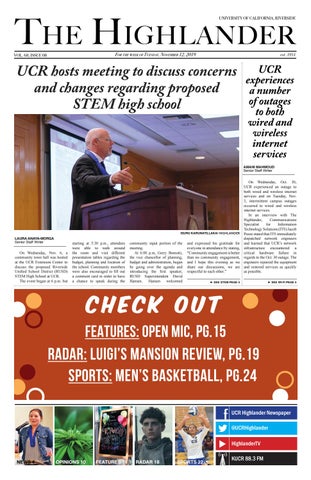
UCR hosts meeting to discuss concerns and changes regarding proposed STEM high school
UCR experiences a number of outages to both wired and wireless internet services
AMANI MAHMOUD Senior Staff Writer
and expressed his gratitude for everyone in attendance by stating, “Community engagement is better than no community engagement, and I hope this evening as we share our discussions, we are respectful to each other.”
On Wednesday, Oct. 30, UCR experienced an outage to both wired and wireless internet services and on Tuesday, Nov. 5, intermittent campus outages occurred to wired and wireless internet services. In an interview with The Highlander, Communications Specialist for Information Technology Solutions (ITS) Jacob Poore stated that ITS immediately dispatched network engineers and learned that UCR’s network infrastructure encountered a critical hardware failure in regards to the Oct. 30 outage. The engineers repaired the equipment and restored services as quickly as possible.
► SEE STEM PAGE 5
► SEE WI-FI PAGE 5
ISURU KARUNATILLAKA/ HIGHLANDER
LAURA ANAYA-MORGA Senior Staff Writer
On Wednesday, Nov. 6, a community town hall was hosted at the UCR Extension Center to discuss the proposed Riverside Unified School District (RUSD) STEM High School at UCR. The event began at 6 p.m. but
starting at 5:30 p.m., attendees were able to walk around the room and visit different presentation tables regarding the budget, planning and location of the school. Community members were also encouraged to fill out a comment card in order to have a chance to speak during the
community input portion of the meeting. At 6:00 p.m, Gerry Bomotti, the vice chancellor of planning, budget and administration, began by going over the agenda and introducing the first speaker, RUSD Superintendent David Hansen. Hansen welcomed
check out FEATURES: open mic, PG.15 RADAR: luigi’s mansion Review, PG.19 Sports: men’s basketball, PG.24 f UCR Highlander Newspaper @UCRHighlander HighlanderTV NEWS 4
OPINIONS 10
FEATURES 14
RADAR 18
SPORTS 22
KUCR 88.3 FM
2
HIGHLANDER // highlandernews.org
TUESDAY, NOVEMBER 12, 2019
HUMANS OF UCR
UPCOMING EVENTS: WEEK 7
RUTH HWANG | COMPUTER SCIENCE | SECOND-YEAR COMPILED BY RYAN POON
12
Creat’R LaunchPad Cafe 10:00am to 11:30am Orbach Library (Science Library), 140 (Creat’R Lab)
Cultural Showcase 6:00pm to 9:00pm HUB Plaza
“Major!” Film Screening 12:00pm to 3:00pm HUB 355
Native Jam Night 5:30pm to 8:00pm R’Garden
14
APSP’s Roundtable Discussion: “In My Feelings” 1:00pm to 2:00pm Costo Hall 244
Pumkin Patch Open House 7:00pm to 10:00pm Student Recreation Center (SRC), Challenge Course
15
Feminist Friday 12:00pm to 1:00pm HUB (Highlander Union Building), 379
Film: El Norte 7:00pm to 9:30pm UCR ARTS, Culver Center of the Arts
16
Spirit of the Tribes 5K Run/Walk 7:00am to 1:00pm UCR Bell Tower
ScotFest 1:00pm to 3:30pm UCR Bell Tower
17
Youth Community Outreach Program: Know Your Roots 9:30am to 3:00pm HUB (Highlander Union Building), 260
UCR Dance. EarthWaterBone: :HuesoAguaTierra 1:00pm to 3:00pm Watkins, Outdoor performance between Watkins 1000 & Sproul Hall
18
Relaxation Room 11:00am to 1:00pm HUB (Highlander Union Building), 260
APSP’s CEP: Hapa this, Hapa that 1:00pm to 2:00pm Costo Hall, 244
Tuesday
13
Wednesday
Thursday
“As a woman in computer science (CS), I cannot walk into class or many of the extracurriculars provided without feeling out of place, a feeling many women and girls in CS struggle with. I want to change this feeling by being involved in organizations that support women in STEM and the growth of young women in CS. Although I have yet to make a significant impact to the World of STEM, I believe I am making a change little by little.”
Friday
Saturday
Sunday
CONTACT US
HIGHLANDER STAFF EDITOR-IN-CHIEF
MANAGING EDITOR
Evan Ismail
Jonathan Fernandez
managingeditor @highlandernews.org
editorinchief @highlandernews.org
ASST. NEWS EDITOR
NEWS EDITOR
Laura Anaya-Morga
Amani Mahmoud
news@highlandernews.org OPINIONS EDITOR
Samuel Harrison
opinions@highlandernews.org FEATURES EDITOR
Asst. Features editor
Mark Bertumen
Christine Tran ctran104@ucr.edu
features@highlandernews. org A&E EDITOR
ASST. A&E EDITOR
Colin Carney
Adam Alvernaz aalve003@ucr.edu
radar@highlandernews.org SPORTS EDITOR
Jordan Hom
sports@highlandernews.org PRODUCTION MANAGER
ART DIRECTOR
Kerry Mulia
Amanda Joy Teano artdirector. highlander@gmail.com
productionmanager @highlandernews.org PRODUCTION ASSISTANTS
Kathy Garcia Brinly Den Celine Hoang
Judy Tu
Asst. Photo Editor
PHOTOGRAPHY EDITOR
Martin Lopez
Ryan Poon rpoon003@ucr.edu
photo@highlandernews.org STAFF PHOTOGRAPHERS
Leo Yue Lydia Tsou ASST. VIDEO EDITOR
Sara Bernal
sbern016@ucr.edu BUSINESS MANAGER
COPY EDITOR
Melanie White
Silvia Ferrer
highlanderads@gmail.com
copyeditor.highlander@ gmail.com
DISTRIBUTION MANAGER
TECH DIRECTOR
Sarang Majmudar
MARKETING COORDINATOR
Cody Davis
Jeffrey Juan
techdirector@highlandernews.org
marketing.highlander@gmail.com
Highlander 101 Highlander Union Building Riverside, CA 92521 www.highlandernews.org editorinchief@highlandernews.org TIP LINE: (951) 827-2105 Help the Highlander stay on top of what is happening on campus and in the general UCR community. Call this number and leave a message for the Editorial Board with your tip. Be sure to include your full name, relation to UCR, and a number or email address where you can be reached for more details. Editorial Office: (951) 827-3617
Business Office: (951) 827-3457
Classifieds & Billing: (951) 827-5039
Fax: (951) 827-7049
LETTERS TO THE EDITOR The Highlander accepts letters from the campus community. They must be 600-800 words at length and include the author’s name and contact information. Topics should be UCR-centric and/or pertain to our generation of students. Contact Opinions Editor Samuel Harrison at opinions@highlandernews.org by Wednesday if interested in writing a letter and submit the completed letter by Saturday at noon. Letters can and will be rejected if it does not meet requirements. LEGAL The Highlander is published and copyrighted by the Highlander for the students, faculty and staff of UCR. All rights are reserved. Reprinting of any material in this publication without the written permission of the Highlander is strictly prohibited. Readers are allowed one free copy of the newspaper. For additional copies or for subscription information, please contact the Highlander. The Highlander fully supports the University of California’s policy on non-discrimination. The student media reserve the right to reject or modify advertising whose content discriminates on the basis of ancestry, color, national origin, race, religion, disability, age, sex or sexual orientation. The Highlander has a media grievance procedure for resolving complaints against it. All inserts that are printed in the Highlander are independently paid publications and do not reflect the views of the Editorial Board, the staff or The University of California or the Associated Students of UCR.
Monday
MULTIMEDIA
CLASSIFIED ADVERTISEMENTS ADVERTISING INFORMATION Please submit Classifed ads by calling 951-827-3457 or by emailing Highlanderads@ucr.edu PAYMENT Visa and Mastercard Make checks payable to The Highlander Newspaper No refunds RATES Classified: $2 per line; 17 characters (spaces, dashes, etc.)
UCRHIGHLANDER
f
UCR HIGHLANDER NEWSPAPER @UCRHIGHLANDER HighlanderTV KUCR 88.3 FM
News 4
TUESDAY, NOVEMBER 12, 2019
HIGHLANDER // highlandernews.org/news
ASUCR
ASUCR approves R’Gear allocation, approves nomination of new judicial council members Deletion of We Are Highlander Pride Committee bylaw creates confusion
AMANI MAHMOUD Senior Staff Writer
On Wednesday, Nov. 6, ASUCR held their sixth meeting of the quarter. During New Business, ASUCR President Julian Gonzalez presented his three nominees for the judicial council. The three students are: Cindy Gutierrez, who is a third-year sociology major, Adrian Wong, who is a third-year public policy major and Kylee Sanchez, who is a third-year political science major and global climate change minor. All the nominees presented the reasons why they believed they would be a good addition to the judicial council. The nominees were all approved 16-0-0. The finance meeting minutes for Nov. 4 and Nov. 6 were both approved 16-0-0 during Committee Reports. Gonzalez and Vice President of Finance Carolyn Chang then presented a slideshow on this year’s R’Gear initiative. This is the sixth annual R’Gear initiative. Chang noted that this year’s admission increased by approximately 2,000 students. In 2017, the finance committee allocated $51,818. In 2018, they allocated $37,799.85 and in 2019, the allocated amount was $40,000. Chang noted that this year she felt as if it would be smarter to purchase more crewnecks versus black hoodies because crewnecks are cheaper. Based on the invoice she presented, Chang is proposing thatASUCR order 1,300 black hoodies in sizes small, medium, large and extra large, and 2,600 crewnecks. They would be ordering 4,000 sweaters in total. Chang noted that crewnecks are $7.49 while hoodies are $10.29. Including tax, the total for R’Gear would be $37,620.63. Chang also presented an invoice for renting out the SRC, which is where R’Gear would be distributed to students. Renting the SRC from 12 p.m. to 12 a.m. would cost $719. With the SRC rent fee, the total amount for R’Gear would be $38,339.63. Chang noted that the money allocated toward R’Gear would not be coming from student fees and would come from non-student fees. She stated that a portion of the R’Gear allocation would come from the profit ASUCR receives from campus vending machines. Gonzalez then discussed and presented the design for this year’s R’Gear. Gonzalez stated,
“Something that makes R’Gear special is that you can’t find the design anywhere because it is student made.” This year’s design is inspired by astrology. Gonzelez said, “We wanted to keep it trendy and since astrology is a thing right now we decided to do that.” The sweaters will have a slogan on them stating, “University of California Riverside, shining since 1954.” Gonzalez stated that since they will be using the ramps outside of the SRC for line control, they will be donating R’Gear to the Student Disability Resource Center directly in order to compensate for the inconvenience. The official date for R’Gear distribution will be Wednesday, Jan. 15, and distribution will occur from 4 p.m. to 8 p.m. The meeting then opened up for discussion from the senate regarding R’Gear. BCOE Senator Maurice Armstrong asked whether any additional organizations or departments besides the Student Disability Resource Center would receive a box of sweaters. Gonzalez responded, “No. What we have seen in the past is that when we do donate R’Gear to other organizations or departments, it does not go to who it was intended to. I know for housing we used to donate a lot but they used to end up in the arms of RA’s versus first years.” After more discussion from senators, Executive Vice President Abigail Cortes then stated that they would be conducting a closed ballot to vote on whether they would be allocating $38,339.63 for R’Gear. This prompted GSOE Senator Evelin Castaneda to ask why they were doing a closed vote to which Cortes replied, “Because I decided we were doing a closed ballot.” With a vote of 13-0-3, R’Gear was approved. SB-F19-011: Updating Chapter V, Section 3: The Finance Committee was passed 14-01 during the Legislative Review Committee Reports. This bill, according to CHASS Senator Angelica Garcia, will add a 10 minute maximum for organizations to present their budget at finance hearings into the ASUCR bylaws. Garcia stated that this would allow the finance committee to hear from more organizations. Chang also noted that this 10 minute maximum would ensure fairness for other organizations so their time to
present is not taken from them. The meeting then moved on to Public Comment. During Public Comment, Personnel Director Luna Sebastian announced that she encountered an issue with one of her committees. She stated that her committees include Campus Safety, We are Highlander Pride, Women’s Rights and Gender Equity and International Student Voice. She stated that during a meeting with the director for We Are Highlander Pride, they attempted to open the committee’s bylaw (Chapter 52 of the ASUCR bylaws). The bylaw, however, states that it was removed by ASUCR on Mar. 13 2019 due to inactivity. Sebastian claimed that, “I know for a fact that that is not true because I was appointed as personnel director after that date and I was accessing that bylaw over and over again.” Sebastian also noted that she did not appoint the director for the committee until September, during which she continued to access the bylaw. In an interview with The Highlander, ASUCR Executive Director Laurie Sinclair stated that the LRC made an attempt to clean up the ASUCR bylaws last year, which included placing committee bylaws under an officer or director. She stated in an email, “While these committee descriptions/bylaws were written in good faith, they were not being executed because no one had “ownership” of them.” One of those bylaws was the We Are Highlander Pride bylaw that described a committee to oversee future ASUCR scholarships. It was partnered with an Endowment Procedures bylaw.
LYDIA TSOU / HIGHLANDER
Sinclair wrote, “As far as I can tell, the We Are Highlander Pride bylaw was listed under the purview of the Personnel Director (in their bylaw). However, this was not indicated in the scholarship bylaw and since nothing had been done in 2 years to further the effort, the LRC suggested deleting it (along with the endowment bylaw).” According to Sinclair, the senate then voted to eliminate both, but since the scholarship bylaw was not deleted from the personnel director’s bylaw, they assumed they were still in charge of coordinating the committee. However, Sinclair added, with no description, they assumed it was a committee about school pride, and moved forward to create a committee to initiate school pride efforts. “I was not aware of any school pride committee last year, but I guess they were meeting unbeknownst to me,” stated Sinclar. She added that the personnel director this year has taken on the same committee on school pride although the original bylaw was about scholarships and not school pride “The original name was misleading to say the least,” stated Sinclair. President Pro Tempore Preeti Juturu stated during Roundtable and Announcements that the LRC has a vacancy. EVP Cortes then announced that the CNAS senator alternate failed to give her a decision in the time frame she provided so she notified the next alternate and will make another announcement next week. She also stated that a special election to appoint a new undergraduate sustainability director will be happening soon to fill the vacant position. The meeting was adjourned at 8:05 p.m. ■H
NEWS IN BRIEF: Small brush fire breaks out on UCR’s campus AMANI MAHMOUD Senior Staff Writer
MARTIN LOPEZ / HIGHLANDER
On Sunday, Nov. 3, a small brush fire broke out on UCR’s campus near the Bannockburn Village apartments. The fire broke out at approximately 2:10 p.m. In an interview with the Highlander, Assistant Chief of Police John Freese stated that the Riverside Fire Department investigated the fire and was not able to determine the cause. By 4:13 p.m. the fire was extinguished and the streets were reopened. Freese stated in an email, “We ask our community that if they ‘see something, say something’, which basically means we rely on our community to partner with us in policing the campus by reporting anything that looks out of place or suspicious, so we can look into it.” ■H
HIGHLANDER // highlandernews.org/news
NEWS
TUESDAY, NOVEMBER 12, 2019
5
UCR experiences a number of outages to both wired and wireless internet services ► FROM WI-FI
The incident was unrelated to fires in the area. Poore stated that in regards to the Nov. 5 outage, upon investigation, ITS engineers identified a defective component in their core network infrastructure as well as an error in the manufacturer’s software code that required patching. The outage on Oct. 30 lasted approximately two hours. The first outage on Nov. 5 lasted approximately 30 minutes while the second outage lasted approximately four hours with intermittent availability, according to Poore. Interim Chief Information Officer for ITS David Gracey sent an email to the campus on Nov. 5 stating that one of their campus core routers experienced two separate failures earlier that day. He stated that ITS was working to restore services to the campus and it is possible additional intermittent outages could occur. “We are working with our vendor and have identified the root cause of the issue. An emergency change will be implemented at 4:00am (sic) tomorrow to fully resolve the issue,” stated Gracey in the email.
JOSHUA WANG /HIGHLANDER
Poore noted that, “Unfortunately, technology hardware and equipment do have the potential to fail. However, ITS has expert network engineers who regularly and proactively evaluate and make improvements to UCR’s network infrastructure redundancy to increase
the reliability of our wired/wireless operations throughout campus and mitigate outages like the ones we recently experienced.” He added that unplanned events like this do happen; however, ITS works proactively every day to ensure maximum uptime of
their systems, including wired or wireless internet services. Poore stated, “Keeping the UCR campus connected to support teaching, learning, and research at UCR is among our highest priorities as an organization.” ■H
UCR hosts meeting to discuss concerns and changes regarding proposed STEM high school
ALEJANDRO MEZA-AGUILAR /HIGHLANDER ► FROM STEM
Jeff Kraus, the director of community and local government relations, addressed some concerns regarding the previous proposed location of the high school. The proposed site changed from Watkins Avenue and Valencia Hill Drive to the southwest corner of Blaine Street and Canyon Crest Drive in June. In response to concerns regarding traffic around the area, Kraus stated that according to UCR and RUSD, “Blaine and Canyon Crest are more significant streets than Watkins and so the traffic impact will be far less.” Another previous concern that students had was the removal of two recreational fields that are utilized
by intramural sports at UCR. Kraus assured that “UCR is committed to replacing the rec fields … when this project moves forward those will be relocated to the corner of Linden and Canyon Crest as part of the North District Project,” a campus expansion project that began construction in July. Another concern that Kraus addressed was potential constraints to UCR faculty time to which Kraus responded, “UCR is not able to commit with faculty members to partner with the STEM high school, but it is something that we anticipate will happen given its proximity.” At the previous campus forum held in June, Kraus said that student safety was a concern that had
been brought up by many. He stated, “Student safety is RUSD and UCR’s number one priority.” Kraus also mentioned that the provost committee has reached out to other high schools on or near college campuses to research the best practices, security, use of resources, parking. Since, they’ve received feedback from UC San Diego, CSU Dominguez Hills, CSU Fresno and Cal Poly Pomona. “We’ve been able to get some great information from them,” stated Kraus. Sergio San Martin, the assistant superintendent of operations for RUSD, went on to speak about how Measure O is helping fund the school. Measure O was a bond measure that
was passed by the city of Riverside in 2016 to “repair and upgrade Riverside schools” as well as “build a center for the study of advanced science, technology, engineering and math, that will give local high school students access to college-level instruction” as stated on the ballot under Resolution 2015.16-56. The STEM high school is set to cost around $64 million, half of which will be funded by the Measure O bond. San Martin also stated that the site is being investigated to meet state standards including a risk assessment, geotechnical analysis and an environmental impact report. After the presentations, the community portion brought around 80 speakers. Speakers were given two minutes to voice their opinion on the project and their responses varied from positive to negative. Kraus reminded the crowd that this would not be the only time they would be having a community discussion as they “have a standing invitation and have been talking to ASUCR about having another student forum … hopefully before the end of the quarter.” This would be similar to the town hall that was held in June. More town halls are set to take place toward the end of the year and early 2020 that will allow for further community input and more information about the progress they have been making to break ground on the school. A final site analysis is set to take place during late November and December. Beginning in 2021, the city will conduct environmental reviews, approvals and bidding. Construction is set for early 2022. If the timeline provided by RUSD is correct, the site ■H should open in mid-2024.
6 TUESDAY, NOVEMBER 12, 2019
HIGHLANDER // highlandernews.org/news
Women’s Resource Center hosts PERSIST political engagement conference
ANTONIO VELAOCHAGA Contributing Writer
On Friday, Nov. 8, the Women’s Resource Center (WRC) hosted the third annual PERSIST: Women’s Political Engagement Conference in the HUB 302 from 9:30 a.m. to 6:26 p.m. The event featured a number of political speakers who addressed the underrepresentation of women in politics, spoke about the challenges women of color face in politics and encouraged women aspiring to join politics to pursue these ambitions. WRC Director and Redlands Mayor Pro Temp Denise Davis said that the PERSIST conference is designed to engage more women in politics and emphasize the focus on women of color, gay women and people from marginalized communities. Davis introduced UCR Associate Vice Chancellor (AVC) and Dean of Students Christine Mata. Mata stated, “The focus of the conference is to connect us to visionary leaders, organizers, nonprofit CEOs and women who are holding local office.” “History was made in two groundbreaking elections this week,” said Davis. Davis stated this in regards to Erin Edwards and Gabby Plascencia, the first women in six years join the Riverside City Council and the first LGBT woman and first Latina to be elected, respectively. Near the end of the conference, Edwards and Plascencia spoke about their campaign experience and their thoughts on women in politics. Plascencia stated, “This is our win. This is the community’s win. This is the youth’s win because you will be next. I was here last year as a candidate ... Imagine where you could be a year from today.” Regarding her own experience, Edwards said, “To the
students in the room, if you ever doubted that your voice matters, it matters a whole lot and it’s actually the only way we can see the change that we create.” The first keynote speaker was Supermajority’s Head of Community Engagement Yvonne Gutierrez. She said, “Supermajority is on a mission to build women’s political power across issue, race, generation and geography.” Gutierrez said Supermajority has collected data from participating women of color during conventions to try to uncover what issues they were interested and how they wanted to handle them. Gutierrez stated, “We have to think about how we can be more thoughtful about mobilizing ... We have to be organizing on issues that people care about.” Gutierrez stated one major issue is that “the U.S. is the only industrialized country in the world without paid family leave.” Gutierrez said that a woman who gives birth in the U.S. today are 50% more likely to die from childbirth than previous generations. Gutierrez added that these statistics are much worse for women of color. Free food and snacks were provided at the event. There were breaks between speaking engagements to allow the audience to eat and browse the resource fair, where women’s advocacy organizations and affiliations were tabling. These tables included Mi Familia Vota, Riverside Area Rape Crisis Center (RARCC), justCARE, Ignite and many other political or women’s advocacy groups. During this break, the WRC held a separate program in the HUB lobby called Mentor Cafe, where audience members could have one-on-one dialogue with the conference speakers. After the resource fair and mentorship
sessions, there were two breakout sessions where audience members could participate in workshops led by the organizations present. These different breakout programs included the Underground Scholars Initiative, Close the Gap campaign, Parenting and Politics, justCARE: The Power of Student Organizing, Women in Politics: Ignite and many more. Following the breakout workshops, the WRC continued with the next panel: Women’s Wave of 2018. This panel was moderated by Tiffany Tran, field representative for Jose Medina’s office. The panel was focused on the Inland Empire’s local elected officials and their impact on the communities they represent. CEO of the Women’s Foundation of California (WFC) Surina Khan expressed her concern for the gender disparity that is present in the Inland Empire. The WFC is a nonprofit organization that is devoted to reaching economic, racial and gender justice through a focus toward the experience and knowledge of communities that have the immense systemic injustice. She said, “Modern gender justice movement and greater representation in policy is needed because we are coming
across threats to our freedom and agency every day.” The last keynote speaker Ericka Flores, a law school graduate spoke of the struggles of being a poor, undocumented immigrant attending law school. Flores described how difficult it was fitting into a law school and a judicial environment that did not have many women of color. The final panel of the conference was on criminal justice reform and was moderated by WRC member Jessica Moronez. The panelists discussed the unjust damage the prison system has done to many women of color and their families. They talked about the way the prison systems in the U.S. do not try to rehabilitate inmates, but instead cause long lasting social, physical and psychological damage to inmates. Reseda said, “Policy is used as a tool to control people’s lives who are impacted by the incarcerated system ... the policies will always reflect the culture and the culture will reflect the policies.” Regarding the conference, Davis stated, “I think it’s powerful for those who attend. We hear stories about how the events inspire people to take action in their own lives to pursue ■H advocacy or activism.”
MARTIN LOPEZ/ HIGHLANDER
AFSCME holds student labor town hall to discuss mission and need for student support
SILVIA FERRER Senior Staff Writer
On Thursday, Nov. 7, at 7 p.m., the American Federation of State, County and Municipal Employees (AFSCME) 3299 held a student labor town hall in HUB 221. According to its website, AFSCME is the University of California’s largest employee union, representing more than 24,000 employees at UC’s 10 campuses, five medical centers, numerous clinics, research laboratories and UC Hastings College of the Law. The event was comprised of a presentation, panel and Q&A that featured External Organizer Michael Kile, Senior Cook, AFSCME Executive Board Member and Bargaining Representative Jesse Hernandez, Senior Custodian Christine Stuckey and Interns Felisa Vasquez and Lizette Inzunza. The town hall began with an introduction of the panel members and of AFSCME’s background. “AFSCME’s contract expired and ever since then, the UC has not met any of the demands that AFSCME has been asking for the workers,” said Vasquez. Kile said that the union plans to oppose the university’s unfair labor practices by striking on Wednesday, Nov. 13, between the Arts and CHASS buildings. “The strike is all day but the main ask for students is to be present on the line around noon for the rally and the march,” said Kile. He continued to state that student support was very important to AFSCME. “The university tries to divide and conquer students and workers … being at the strike line is a key component in both building community and for workers to continue feeling the energy and support of their students. It’s a huge component in their mental health,” Kile said. According to Hernandez, the upcoming
strike is focused on the six unfair labor practice charges the university is facing, all of which regard outsourcing. He stated that outsourced workers had increased from 7,000 to 10,000 in the past three years. “Christine (Stuckey) has a full-time job with benefits and she still has to have a second job. Imagine if you don’t even have a full-time job. We don’t want to eliminate outsourcing. We want to bring those workers in the fold,” he said. Both Stuckey and Hernandez identified diversity, wages and job stability as relevant issues that are affecting UC workers. Hernandez, who has been working at UCR since 1999, said, “I used to work at Latitude 55. I’m lucky I still have a job. After nearly 17 years, they sat me down and told me they’d close shop. Luckily, the union was able to displace me, but the thing is, without that fight, how would I pay for my bills?” A flyer was passed around with statistics of diversity within the UC system that highlighted how the percentage of black workers was decreasing, wage disparities between black women and white men in the same position and the lack of a pathway to management positions. “Since I’ve been here, I’ve noticed they really haven’t really hired people of my color as supervisors … We’re still on the bottom. That is not fair,” said Stuckey. During the panel, Kile reiterated how students could help workers. “The UC will try to claim, ‘Oh, you’re just using students as bargaining chips.’ When students are present, it removes their ability to say that … students can use their position of privilege to push on their administrators.” Hernandez said he hoped that students would help by joining AFSCME during the day of the strike. “We want the solidarity.
The support from students. We’re not trying to shut down the university but we want to be disruptive. I’m asking (students) to boycott services on that day.” He continued to say students could stand together with AFSCME by refusing to buy food on campus or eat in the dining halls. Another important way that third-year political science major Inzunza said that students can help is by reaching out to their respective organizations and requesting that they sign a petition that will eventually be sent to the UC Office of the President. She explained that 20 organizations signed the petition last year, but she hoped that those numbers would increase. “But it’s not just about endorsing the strike. It’s about actually coming out and organizing a delegation of members to come out.” The presentation then moved onto the Q&A portion. CHASS Senator Nelson Huerta, who is also a student worker, asked whether working on the day of the strike would go against the values that AFSCME was promoting. Hernandez said that students could support the strike by calling off work to stand in solidarity with the workers. “They (management) cannot retaliate against you. It’s illegal. On that day, it’s a day of protection. You can show solidarity. You have that right,” he said. Inzunza emphasized that there was information on a student worker’s right to strike available. Inzunza stated further that, “When AFSCME or any other worker goes on strike, UC relies on student workers to fulfill that labor gap on that day.” When a student brought up how concerning it was that dining hall management wasn’t allowing students to take food home, Hernandez said that the administration was ignoring the food insecurity on campus. “Dinner is like
$16. They don’t even want you to take water. Again, it shows their priorities,” Hernandez said. Kile also stated that this showed how worker and students’ food and housing insecurity issues are linked. “The UC is trying to make us fight each other for crumbs while they run off enriching themselves. Coming out physically makes a show of solidarity to prevent that,” he said. The latter half of the Q&A portion of the event focused on the toll on university workers, outsourcing and AFSCME’s support for ACA 14, the University of California: support services: equal employment opportunity standards assembly amendment. Personnel Director Luna Sebastian expressed concern over the workers’ mental and physical health. Hernandez said that that was directly connected to the outsourcing. Kile said that UCs have tried to cut down costs by eliminating jobs at the lower levels used the firing of 175 UCI Health employees as an example. “They don’t do this to save costs, they do this to bring in more profit,” added Hernandez. He stated that outsourcing is affecting outsourced workers and union workers alike. Vasquez said that ACA 14, although separate from AFSCME, would help union workers have more job security and help outsourced workers receive the same rights that union members do. Inzunza stated that ACA 14 stopped in the senate because several senators abstained from voting on the amendment. Hernandez added that, “If it passed through the senate, it would go onto the March ballot. Voters decide if it’ll pass. By abstaining, senators such as Richard Roth are not letting the voters decide that.” ■H The event concluded at 8:05 p.m.
HIGHLANDER // highlandernews.org/news
NEWS
TUESDAY, NOVEMBER 12, 2019
7
Chancellor Wilcox announces no decisions have been made regarding commencement in campuswide email AMANI MAHMOUD Senior Staff Writer
On Thursday, Nov. 7, Chancellor Kim. A Wilcox sent a campuswide email updating the campus on their continuing deliberations regarding commencement ceremonies for 2020. In June, Wilcox sent an email to the campus stating that in surveying students after commencement each year, their primary feedback has been to move the ceremonies indoors and to shorten the length. Wilcox also stated that the venue poses additional challenges: uneven sight lines to the stage and video monitors, umbrellas, hats and other items that obstruct views, crowd control issues and misuse of alcohol and other substances. In October, Wilcox sent another update to the campus which stated that in order to address repeated concerns from graduates and families regarding the above concerns, UCR’s formal commencement ceremonies would be held at the Toyota Arena in Ontario. In response to student feedback, names would be individually announced as students walk across the stage. Wilcox also noted that these ceremonies would include many of UCR’s traditions, including the Pipe Band and graduate procession. They would plan to hold all three campuswide ceremonies in a single day during the weekend, rather than over a five or six day period, which he stated can be challenging for family and friends who work during the week. In his Nov. 7 message to the
campus, Wilcox announced that they have continued to engage in multiple discussions with undergraduate and graduate students (including ASUCR and GSA), academic department chairs, Staff Assembly and the Academic Senate’s Executive Council. Wilcox emphasized that the campus community is deeply committed to all of its students’ success. “Commencement represents a significant opportunity for all of us to celebrate our students, as well as an opportunity for each of us to participate in and contribute toward our UCR traditions at the end of each academic year. We should all be proud of this shared commitment to UCR,” stated Wilcox. In regard to the commencement ceremonies, Wilcox stated that there are multiple aspects that help determine whether UCR ceremonies are highquality events that reflect the needs of its distinctive student body. Wilcox wrote that these include, but are not limited to: reading of individual student names, number of tickets available, temperature control, comfortable seating, photography and stage visibility. There are also some limiting factors such as keeping ceremonies under three hours in length, scheduling during weekends and availability of parking, staff and budget, stated Wilcox. In his message, Wilcox stated that holding several ceremonies off campus at the Toyota Arena in Ontario could help to increase the number of tickets available to each graduate and provide
ARCHIVE /HIGHLANDER
better temperature control and stage visibility for families and friends. “However, some of our students, staff and faculty have described holding offcampus ceremonies as less than ideal, because of the importance of celebrating the UCR experience on campus,” stated Wilcox. Wilcox then wrote, “Keeping all of our commencement ceremonies on campus is a possibility for 2020, but is not sustainable for the long term.” With increasing graduation rates and steady enrollment growth, Wilcox stated that UCR would need to consider that the number of tickets would be limited even further if ceremonies are held in indoor venues such as the Student Recreation Center, University Lecture Hall, University Theater and the HUB. Additional ceremonies might also involve greater faculty and staff
engagement and support than has been the case in the past. At present, there is no firm decision regarding next year’s commencement, stated Wilcox. He wrote, “As we continue to solicit campus input, I have asked Vice Chancellor for Student Affairs, Brian Haynes, and CNAS Dean, Kathryn Uhrich, to convene a working group to provide recommendations for commencement in 2020 and in the long term.” The working group will consist of students, staff and faculty, and their plan will be to announce the dates and locations for next spring’s commencement ceremonies before the end of fall quarter. If students wish to provide input, the deadline for submitting ideas and suggestions to an online form that he links in the email has been extended to Tuesday, Nov. 12. ■H
R’Kids to propose new student parent resource center in Bannockburn
SAMHITHA TUMKUR Contributing Writer
R’Kids, a student-led organization dedicated to offering a community and resources for student parents are currently in the midst of attempting to institutionalize their organization and gain a space on campus to carry out its activities. As of this year, the student organization is petitioning the university administration via change.org and during tabling on Wednesdays to get their organization to become an official organization supported by UCR. In addition to petitioning the university, R’Kids needs to be approved by the chancellor and vice chancellor to become a university sponsored organization. R’Kids would like to have a physical space on campus for student parents upon institutionalization and they are proposing that it be located at the
Bannockburn Village apartments. This is partly due to the amount of space available to host the organization and its close proximity to both the main campus and Oban, the family housing center. In an interview with The Highlander, R’Kids President Yvonne Marquez said that the organization would like its resource center to be located at Bannockburn because it has enough space to accommodate for the center and is optimally located Marquez explained. She stated, “It is both on and off campus and it’s also very near the Veterans Resource Center and they have a very large population of student parents. There’s a grassy area and it’s close to Oban.” Marquez explained that the goal of R’Kids at the moment is “getting UCR senators to sponsor the resolution.” She continued, “And from there, after we have that accomplished, we’re going
ARCHIVE /HIGHLANDER
to present it to the chancellor and vice chancellor and see what happens.” If the organization becomes an official university run organization, Marquez would like R’Kids to have resources for student parents such as finding housing off campus, drop in child care hours, and homework clubs for the student’s children. According to Marquez, the organization was founded in 2013 but went through some rough patches in its history because it has not been able to become institutionalized. “If there’s not somebody willing to take up the role of the board each quarter and continue the work, it falls apart, especially because most of us are transfer students enrolled for two years,” said Marquez. During their tabling to promote their organization, Marquez said R’Kids members were motivated to take the initiative to become established as an official organization while talking to other student parents about the lack of resources available to them through UCR. “There’s not emergency housing. There’s a huge lack of childcare both on campus and just a lack of funding in general. So we’re experiencing things completely differently. And we’re essentially no different from any other student,” Marquez said. According to Marquez, student parents also receive little resources, and even the ones that they do have at their disposable are not enough to make a big difference. “We saw the crisis managers,” Marquez said. “We did everything we
were supposed to do. And yet it’s two, three, four years later and the university has not acted. All they’ve actually done is admitted more of us and put an even bigger strain on the resources that do exist.” Even the family housing, Oban, according to Marquez, is unsuitable for student parents — albeit good for families, it is inconvenient and not built for students due to the lack of study spaces and access to printing. In addition, trying to get into Oban is difficult in itself as Marquez claims that the waiting list for Oban currently has over 350 students. Along with UC Berkeley, UCR has the highest amount of undergraduate student parents in the UC system according to a report published by the UC in January. However, unlike UC Berkeley, UCR does not have a resource center for childcare hours. Marquez argues that the UCR administration should be more considerate of student parents. “Because most of us are low income, first-generation students who are nontraditional, we already are 10 steps back from our peers,” said Marquez. “They have to recognize that we are here and start backing up the resources to help us be successful.” Marquez noted that if you lift one generation out of poverty, you automatically bring the next generation out of poverty with them. She stated, “The university needs to recognize that and start having those resources for the non-traditional students that they like to brag come here.” ■H
8 TUESDAY, NOVEMBER 12, 2019
HIGHLANDER // highlandernews.org/news
School of Business hosts the 2019 Inland Empire economic forecast conference
ANTONIO VELAOCHAGA Contributing Writer
On Wednesday, Nov. 6, the UCR School of Business’ Center for Economic Forecasting and Development hosted the annual Inland Empire Economic Forecast Conference. The event was held at the Riverside Convention Center and began at 8:46 a.m. The name of this year’s conference was “The House that Wasn’t Built,” in reference to the main theme of the conference. The theme was that the Inland Empire and California have a scarcity of housing that challenges the economic growth of the region. President and CEO of the Inland Empire Regional Chamber of Commerce and Publisher of the Inland Empire Business Journal Edward Ornelas moderated the event. The CEO of Stronghold Engineering Inc. Beverly Bailey and Dean of the UCR School of Business Yunzeng Wang gave opening remarks at the event. The keynote speaker was Director of the Center for Economic Forecasting and Development School of Business at UCR Christopher Thornberg. Thornberg gave his data and analysis of the housing shortage along with his thoughts on how to handle the situation. The event provided pamphlets of the economic forecast that gave the information and the main agenda of discussing the
housing shortage in the Inland Empire. Thornberg spoke of the misunderstanding that most people have in regards to the housing issue in the Inland Empire. He said, “This event is wrapped around that mission of education. Giving people the real story.” Thornberg stated that the housing issue is not regarding the affordability of houses but of a lack of houses. He said, “If there’s nothing, the only thing you’re going to do is push prices even higher … This is a supply problem and we have to start talking about supply.” Throughout the event, Thornberg expressed that it has been difficult to solve this issue because many media outlets have falsely reported that the region is not making living affordable. Thornberg stated, “We’re trying to help this community exceed its current great trends by focusing the conversation on real issues.” Thornberg mentioned the overall success of the Inland Empire’s growth in gross domestic product and rise in wages. Thornberg said that the region should build upon the positive things that have occurred in the region while focusing on issues that need fixing, such as people leaving the Inland Empire and California. Thornberg said that it is detrimental to the region if people leave the Inland Empire. Other speakers who gave their perspective on the region’s housing shortage included Associate Professor
COURTESY OF FLICKR
of Urban Planning and Public Policy of UCLA’s School of Public Affairs Dr. Paavo Monkkonen, CEO and President of National CORE Steve PonTell and Director of Economic Research at the UCR School of Business’ Center for Economic Forecasting and Development Robert Kleinhenz. PonTell gave his take on the importance of revitalizing communities in the Inland Empire. He said, “The reason I advocate for housing is because housing matters to
people.” Regarding the UCR School of Business’ connection to the Inland Empire, Thornberg said, “Universities have a mission not just work with the students but also work with the community that they’re in.” After Thornberg was finished, he moderated a conversation between Monkkonen, PonTell and Kleinhenz about the housing issue. Following this conversation, the audience was allowed to ask questions. The event ended at 11:40 a.m. ■H
UCR public policy professor discusses the increasing influence of Asian Americans in the 2020 Democratic presidential primaries
COURTESY OF UCR TODAY
ANDY LI Contributing Writer
In an October interview with the Los Angeles Times, UCR Professor of Political Science and Public Policy discussed how the Asian American vote will play a key and decisive role in choosing the eventual nominee to take on incumbent President Trump. “This has been an already historic election season, with three Asian and Pacific Islander candidates running in the primaries: Andrew Yang, Kamala Harris and Tulsi Gabbard,” said Ramakrishnan.
He stated, “With more representation, Asian American voters will feel more motivated to turn out at higher rates in the election.” Ramakrishnan notes that Asian Americans haven’t always been consistently Democrat-leaning. “Until Bill Clinton, most Asian Americans voted for Republicans, because the GOP platform promised economic opportunity coupled with traditional values, which had a strong appeal to the Asian community,” Ramakrishnan explained. He also noted, however, that over the decades,
Republicans have taken “increasingly hawkish positions against immigration and social welfare programs, which, combined with the rise of the Evangelical right as a potent political force in the party, has quickly driven Asian Americans into the Democratic Party.” According to Ramakrishnan, despite being the highest-earning income racial demographic in the United States, Asian Americans continue to support progressive economic policies such as higher taxes on the wealthy and universal healthcare access. Ramakrishnan said that this is due to the fact that Asian American voters are more motivated by the proimmigration rhetoric coming from the Democratic Party rather than the “pull yourself up by the bootstraps” mentality of the GOP. “Given that they’ve historically faced discrimination and exclusion not so long ago, Asian Americans still feel passionately about keeping America open to immigrants arriving from all over the world,” stated Ramakrishnan. However, even with several major Asian American candidates running for the presidency, former Vice President Joe Biden, Massachusetts Senator Elizabeth Warren and Vermont Senator Bernie Sanders continue
to lead in both national and statewide polls. “I will concede that both Harris and Yang could do better connecting with voters, especially Asian Americans,” said Ramakrishnan. He went on to state that Harris is seen as too scripted and lacks authenticity. “As for Yang, he could certainly improve by taking Asian American issues more seriously rather than issuing crass jokes reinforcing the stereotype that all Asians are doctors,” added Ramakrishnan. Although Asian Americans have increasingly leaned toward the Democratic Party, Ramakrishnan concedes that their combined vote is not identical across ethnic boundaries. “In particular, Chinese Americans, especially recent, first-generation Chinese immigrants, are the most likely Asian American cohort to strongly oppose affirmative action programs,” he said. He also stated that the recent Harvard admissions scandal that is being litigated at the Supreme Court has galvanized the Chinese American community to become more open to supporting conservative, anti-affirmative action politicians, including Republicans. Still, Ramakrishnan added that not only will Asians have the opportunity to play an
outsized role in determining the eventual nominee — they will also be key to preventing President Trump from winning a second term. “In 2012, after Romney’s loss to Obama, the GOP developed an autopsy report that found that increased alienation of Latinos and Asians would make it virtually impossible to ever win back the White House again,” explained Ramakrishnan. He stated that despite this report, Trump managed to upend conventional wisdom in 2016 by demonizing Hispanics and Muslims while still seizing the presidency despite losing the popular vote. “But in the long term, this strategy is unsustainable because demographic shifts will cause states like Arizona, Texas and Georgia to become more competitive in the future, diluting Trump’s gains in the Midwest,” stated Ramakrishnan. The Asian American population is currently the fastest growing immigrant demographic group in the United States. While they currently stand at approximately 5% of the population, they are projected to become 13% by 2044 — by which time Hispanics will grow to a quarter of the total population and Caucasians will no longer be a majority group in ■H the country anymore.
Be proud.
Do you have an interest in writing, photography, design or marketing? The Highlander can help you polish your skills. Come to our weekly meetings every Monday at 5:15 p.m. in HUB 101 to learn more.
Highlander RYAN POON/HIGHLANDER
Opinions
10 TUESDAY, NOVEMBER 12, 2019
OPINIONS
HIGHLANDER // highlandernews.org/opinions
HIGHLANDER EDITORIAL
It’s high time cannabis received the indepth research attention it deserves
T
he Lancet psychiatry released a metaanalysis this past October that examines the use of cannabinoids and their effect on mental health by reviewing academic research published between Jan. 1, 1980 to April 30, 2018, and the results may not be quite what most cannabis users were hoping to hear. The analysis yielded very little evidence that cannabinoids are effective in treating most mental disorders, and “very low-quality evidence” that the drug slightly improved anxiety symptoms amongst individuals with comorbid conditions. To be blunt: society just doesn’t have the information needed to make the call on whether or not cannabis can be used as an at-home remedy. While the aforementioned findings certainly don’t mean cannabis is without its uses, the lack of concrete evidence for the drug’s efficacy in treating mental health disorders suggests that the drug requires further research before people dose themselves in an effort to improve their mental wellbeing. Until further research is conducted and more solid results are found, cannabis use in this context will continue to be seen as little more than homeopathic nonsense. Going forward, tactful regulation of cannabis products will be key. Because current data
COURTESY OF PEXELS
does not favor the drug, it would be unwise to publicly promote consumption. To be sure, people will dose themselves regardless, but media outlets must avoid championing cannabis as a cure-all based solely on anecdotal evidence. The long-term effects of the drug are not yet fully understood, and some studies seem to indicate that the drug has had more adverse effects on test subjects than positive ones, with some studies going so far as to suggest that the use of the drug could actually exacerbate already present psychotic symptoms. That being said, it is also important to acknowledge that cannabis is currently classified as a Schedule I drug, meaning the federal government believes it to have a high potential for abuse and no accepted medical use in the U.S. The drug first received this classification way back in 1971, when President Richard Nixon signed the Controlled Substances Act into law in an effort to categorize drugs by their potential for abuse. Most perplexingly, this places cannabis in the same category as drugs like heroin and ecstasy — implying that it has greater abuse potential than Schedule II drugs like methamphetamine, fentanyl and cocaine. This harsh classification heavily restricts what research can be done on cannabis. Scientists looking
to conduct studies have a single outlet when procuring the drug for research purposes: a small research facility at the University of Mississippi, and the cannabis grown at this facility is significantly inferior to the product available on the streets, with one scientist going so far as to describe it as “brown, muddy garbage.” While some of the studies discussed in the meta-analysis above suggest that cannabis use may result in unintended side effects, none of the effects listed warrant a Schedule I placement. Drugs like cannabis should never be placed on the same level as drugs like heroin, which has much more disastrous and immediately apparent short-term and long-term side effects. There is no satisfying explanation for this Schedule I status. Truth be told, the classification is likely the direct result of the extreme social stigma surrounding the drug — a stigma that finds its roots all the way back in racism and prejudice against those of low socioeconomic status. The drug was commonly used by marginalized groups within Mexico’s borders, like soldiers and prisoners, and the violence prevalent in such communities was then attributed to the drug, creating a sensationalized image that persists to this day. This presents a sort of Catch-22: more thorough
research could help reduce the stigma around the drug, but the stigma itself prevents proper research from being conducted. Unfortunately, there are special interests within the U.S. that have every reason to keep the stigma alive. Pharmaceutical companies, in particular, have a vested interest in perpetuating societal fears regarding cannabis use. Historically, prescription rates for opioids and other commercially available medication tend to fall in states that pass laws allowing the sale of cannabis for medical purposes. Big Pharma needs to sell its own drugs, and pharmaceutical companies are quick to argue that cannabis is bad for public health. Of course, the pharmaceutical drugs that these companies peddle also carry their own host of side effects that often outweigh any of the side effects one might experience from consuming cannabis, but they have enough money that they don’t need to substantiate their opinions. The only option is complete legalization. Cannabis must be legalized if there is any hope of moving past the stigma and properly researching the drug. The U.S. Congress could pass a joint resolution that legalized cannabis on the federal level. If a comprehensive cannabis reform was passed, the federal government could then begin funding research.
One of the major shortcomings of The Lancet Psychiatry’s metaanalysis is the fact that it included studies that were conducted as far back as 1980. The cannabis of today has undergone nearly 40 years worth of selective breeding, and is radically different from the product used in the original tests. With proper funding and reduced restrictions, more modern and relevant strains of the drug could be experimented upon, and the body of research for future research will be widened. People seeking therapeutic treatment for poor mental health through the use of cannabis should probably look elsewhere for now, but the drug should not be discounted entirely. Dosing with a substance that isn’t well understood will never be the wise choice. For now, society must continue to advocate for the legalization of the drug so that more thorough research can be conducted. Until then, it will be impossible to tell whether or not cannabis can serve as the panacea so many are hoping it to be. ■H
Highlander editorials reflect the majority view of the Highlander Editorial Board. They do not necessarily reflect the opinions of the Associated Students of UCR or the University of California system.
OPINIONS
HIGHLANDER // highlandernews.org/opinions
TUESDAY, NOVEMBER 12, 2019
11
OPINION POLL Compiled by Lydia Tso Staff Photographer
“Do you believe medical cannabis can be used to improve mental health?”
Jaqueline Dighero
PhD. Students in Higher Education Admin & Policy
Second-year
“Yes. What we need is a lot more research on it. Because it’s been illegal for so long, we need to do more research to find the benefits.”
Julia Zamaya Dance Fourth-year
Christian Valdez Religious Studies and Art History Second-year
John Calligan Music Second-year
Kyle Towne Biology Fifth-year
Annie Zhou Psychology Fourth-year
“I can definitely see how it can help. If the research is there, why not? There’s also some agency for people who think it has benefits. If they think it helps them, then it helps them.”
“Yes, but only if that is your intention. Cannabis allows you to deprogram your perspective. But if you wish only to see what you want to see, nothing will change.”
“Yes, especially CBD or hemp oil is very relaxing and calming. Everybody is different, but there are plenty of anecdotes and scientific evidence that say there are positives.”
“Yeah. It’s known to help calm nerves. It’s been shown to help people with anxiety and people in pain.”
“Yes, if it’s prescribed by doctors and used in a medical way.”
Racial bias in the Rodney Reed case underscores why the death penalty shouldn’t exist
TIMOTHY HUGHES Staff Writer
On Wednesday, Nov. 20, an innocent man will be killed. When Stacey Stiles’ body was found in Texas, police initially suspected her fiance, former police officer Jimmy Fennell, who has a history of violence against women. But when the police found out that Stiles, a white woman, had been having an affair with Reed, a black man, the entire investigation changed. Reed was arrested and put on trial where an all white jury convicted him of murder and a white judge sentenced him to death. Reed has sat on death row for the past two decades, always maintaining his innocence and asking for more evidence to be used to overturn his conviction; but as the execution date approaches, hope for his rescue is dimming. Too often has capital punishment oppressed black Americans and murdered innocents. The death penalty should not exist. The conviction still stands despite Stacey Stiles’ family testifying Stiles’ relationship with Reed was consensual, Reed’s solid alibi and Fennell’s lack of one. Additionally, Fennell was quoted saying Stiles “got what she deserved,” at her funeral and Fennell has been arrested for the kidnapping and assault
of a woman in 2008. Experts even called the trial a botched miscarriage of justice. It is clear that police were looking for an easy scapegoat for the crime and racial bias led them to choose Reed. Now Rodney Reed, an innocent man, will be murdered by the state of Texas before the end of the month. If not for the death penalty, Reed’s life would not be in danger, and there would be much more time to pressure the governor of Texas to have his sentence commuted. Today there is a petition with more than 2 million signatures asking for the release of Reed, but even if the governor wanted to release Reed, bureaucratic hurdles may stop the governor from making the decision before the execution date. The death penalty has a history of racial disparity. Black defendants are nearly twice as likely to be sentenced to death than whites defendants, and murderers of white victims were 4.3 times more likely to be sentenced to death than those with black victims. The racism portrayed in the statistics of the death penalty is shocking, but the most shocking statistic is the number of innocent individuals the United States executes. Rodney Reed’s predicament is far from unique. A 2014 study showed that 4.1% of individuals executed, or every
COURTESY OF FLICKR
one in 25, are innocent. The same study espouses the likelihood that more than half of the innocent people murdered by the state are unaccounted for. The glaring injustice of the death penalty cannot be ignored. A murder is permanent. When the state kills someone
who did nothing wrong, they are taking away any chance of their exoneration. As more innocent — mostly black — people are killed every day, it becomes more clear that the death penalty must be federally outlawed and left to be another bad memory in America’s past. ■H
COURTESY OF FLICKR
12 TUESDAY, NOVEMBER 12, 2019
OPINIONS
HIGHLANDER // highlandernews.org/opinions
Marvel movies are not cinema, they’re business
CYRUS TOSCO Contributing Writer
Last month, acclaimed film director Martin Scorsese likened the Marvel Cinematic Universe (MCU) to the movie equivalent of a theme park and immediately afterward, several news sites scrambled to publish statements regarding his quote. Scorsese is one of the best directors in film history, but not all of his movies have been financially successful. Meanwhile, the MCU is now the highest grossing film franchise in history. The more central conflict between these two asks whether it is more important to make art or money. That said, when analyzing cinema strictly as a visual art form, the MCU should not be considered real cinema: it should be seen as a business. To be clear, the movies comprising the MCU are not bad movies; they simply play to sensibilities that Martin Scorsese does not deem cinematic or artistic in what is inherently an artistic medium. The most memorable part of “Captain America: Civil War,” for instance, is the end battle between Captain America and Iron Man. Those who enjoyed the movie might point to the scene in which Iron Man shoots his blasters at Captain America’s shield when discussing the most iconic shot, but this fight can really be distilled as a misunderstanding between the two. It contains no
depth and says nothing essential about either character. Compare that image to the iconic opening image of one of Scorsese’s favorite films: “2001: A Space Odyssey;” the shot of the moon, Earth and the sun aligned while “Also Sprach Zarathustra” plays gorgeously in the background. There’s a depth and grandiosity to this image, and the way it is shot provokes reflection on how small humanity is compared to the rest of the solar system. In fact, that image is replicated a few times in the movie to include the monolith as a symbol of human evolution. One might interpret the shot as a plea for humanity to evolve, which returns to the central theme of “2001.” The depths of this one repeated image provokes more thought than “Captain America: Civil War” in its entirety. That is not to say the movies in the MCU cannot discuss complex topics; they absolutely can, but it is clearly not their priority. In “Avengers: Infinity War,” there is a recurring theme of sacrifice to see one’s objective realized through Thanos and Scarlet Witch. The former willingly gives up a loved one for a greater purpose, while the latter initially refuses to do so. By the end of the film, however, there is nothing to be said for either of those sacrifices: Thanos may end up somewhat conflicted, but he accomplishes everything he sought to accomplish, and
COURTESY OF WIKIMEDIA COMMONS
Scarlet Witch loses everything. The message conveyed by the struggles of these two appears to suggest that one should be willing to sacrifice anything for one’s goals, but both of them end up with opposing results, despite ultimately making the same choices. In this scenario, Thanos could realize a plan that requires the sacrifice of a loved one must be flawed, and develop into a better character. That said, “Infinity War” ends in the most appropriate position for a sequel because sequels and monetization are actually what Disney is interested in. As intellectual property of the Disney corporation and due to the mass amount of money these
movies make, greater turns to the business side have become noticeable. Captain America’s uniform, for instance, has been redesigned nine times, while Iron Man has shown 50 different kinds of armor. In fact, the emotional payoff and the beginning of the third act in “Spider-Man: Far From Home” includes a scene of Peter Parker meticulously designing a new suit for himself, for a total of four suits shown throughout the franchise. Of course, all of these redesigns have been merchandised. The most apparent and most glaring proof shows in the newest Spider-Man deal, which allows Disney to take a smaller cut of the film profit as long as they
keep the merchandising rights. While this deal may have been made when merchandising could be unpredictable, in 2013 Disney had reportedly made $41 billion off merchandising alone. None of this should be surprising. After all, Disney owns Disneyland, the very kind of theme park Scorsese would likely use to describe the MCU. To act as if these movies are cinematic brilliance in the same way one would describe “Citizen Kane” or “The Dark Knight” is ludicrous. Again, that is not to say they are bad by any means. Rather, viewers must acknowledge them for what they are: fun, safe popcorn movies that play to business and fan interests. ■H
Identity politics can lead voters astray ROBERT GOLD Contributing Writer
COURTESY OF WIKIMEDIA COMMONS
Diversity is important, but one must not simplify people to one aspect of their identity. Characteristics a person does not choose for themself should not define an individual. A person has the right to be heard for their ideas and their values, not just their race, gender or sexual orientation. Pete Buttigieg is receiving considerable attention for his sexual preferences, which, while important to recognize, is, unfortunately, all that most people know about him as a candidate. Aside from possibly being more intuned to LGBT issues, he is also in favor of eliminating private prisons, the death penalty, unlimited campaign spending, marijuana criminalization and the electoral college. He also wants to raise the federal minimum wage to $15, enfranchise felons and give citizenship to Dreamers. As with other candidates, his policies should take center stage, not his sexual orientation. Furthermore, it would be erroneous to imply Buttigieg would be the first gay president. He would also not be the first openly gay president either. Before becoming president in 1857, James Buchanan openly lived with William Rufus King, a senator from Alabama. The question at times has been whether
King and Buchanan were open about their relationship. The two men never attempted to hide their courtship. Contemporaries often made reference to their kinship; Andrew Jackson regularly referred to King as “Miss Nancy”; a euphemism for a gay man. Letter correspondence between the two gentlemen shows the two men expressing their romantic love for one another. Some claim that critics of identity politics are attempting to discourage diversity. Diversity is important, but the truth is that identity politics sum people up by their class, gender, sexual orientation, religion or race. Buttigieg may be the best candidate for the job but no one will ever know this because they are too focused on his sexual orientation. Progressives may decide to vote for Elizabeth Warren over Bernie Sanders simply on the basis of gender at which point, identity politics is leading the voters astray. It is important that people look past the superficial details and judge a candidate based on their policies and past actions. Pete Buttigieg may very well make a great president of the United States, but nobody following politics right now knows much more about him other than the fact that he is gay, and that is a sign that today’s American culture cares more about what H you are rather than who you are. ■
HIGHLANDER // highlandernews.org/opinions
OPINIONS
TUESDAY, NOVEMBER 12, 2019
13
Coming to terms with social media addiction
ARCHIVE / HIGHLANDER
VICTORIA DAVY Contributing Writer
One item that everyone has on them at all times is their phones. Cell phones have become society’s source for not only communication but information and entertainment. This issue is so prevalent that many articles and studies have come out in recent years stating that people
have become dependent on and, in some cases, addicted to their phones. This is a misunderstanding of the situation. People have become addicted to social media and other platforms that can be accessed on the internet. Instead of limiting phone usage, people should be mindful of what they use their phone to access. Phones are a vehicle for addiction. A person can develop an addiction for many
reasons, but oftentimes it’s due to the positive or rewarding feelings that come from a behavior. While looking through likes, retweets and follower counts on social media, dopamine is released, which is a neurotransmitter in the brain that plays an important role in a person’s ability to feel pleasure. The feelings of gratification do not come from the physical phone itself but from the information that’s on
the phone. There have been numerous cases where people have performed outrageous acts because they couldn’t be on social media. There was an instance where a woman called the police because her Instagram account was deleted. Her reasoning was that her Instagram getting deleted felt like murder because she had put so much time and effort into her account. She had become so addicted to the likes and followers that the loss of her account was the last straw. Social media and other places on the internet are the root cause of the addiction. Instead of detoxing from their phones, people should detox from the gratification that comes from receiving likes on social media. Muting notifications or deleting addicting apps can help lower a person’s chances of mindlessly scrolling through their phone. One could even take this detox a step further by deleting some of the more tempting apps, effectively eliminating the need to check them multiple times a day. The convenience of a phone makes it easier to stay connected to a person’s temptation at any given moment. The phone is a way of constantly staying connected to the likes, retweets and follows. Without it, it would be nearly impossible to get the same instant gratification that comes from easy access of apps on the phone. Phones are not the cause of addiction but rather phone addiction is a symptom of a larger problem. Addiction can come from anything so it is important for people to be mindful of what they consume. A detox from both could be beneficial, but it is up to the person to seek help. ■H
Weak regulation means that the chemical contamination in California’s water supply will not be resolved anytime soon
ESTHER CHOI Contributing Writer
California is facing a huge crisis with its chemical contamination in the water supply. This crisis is not something that just occurred overnight; it started years ago. Chemicals known as per- and polyfluoroalkyl substances (PFAS) have been found in more than 600 wells across the state. These chemicals will affect many people who receive their drinking water from these sources. Furthermore, it is important to note that only a small fraction of water sources were tested which means that this is only a first step in what is likely to be a years-long effort. Since California is a huge state with many water resources, the contamination problem will not be resolved soon. The chemical contamination in California’s water supply is affecting more than 7 million Californians and 74 community water systems have some amount of PFAS chemicals. PFAS are man-made chemicals that are used to make cleaning and anti-stain products. The two most common PFAS pollutants are perfluorooctane sulfonate (PFOS) and perfluorooctanoic acid (PFOA). The PFAS — which are also called “forever chemicals” — do not degrade in the environment and have a long halflife, which means that they do not decay. People consume PFAS all the time through food, water, cosmetics and food packaging. Very low doses of PFAS chemicals have been linked to increased risk of cancer, reproductive and immune system harm, liver and thyroid disease and other health problems. The negative health effects of PFAS should concern many policymakers
and regulators, as there will be severe consequences if they do not take action to eliminate PFAS at a faster rate. Since PFAS do not break down or disappear, taking immediate action is the key solution. Policymakers and regulators, whose role is to serve the community and people, need to step up. They should create or revise policies to cater to the needs of the people and community. Their role is extremely critical at this moment in time to protect people’s health. Regulations and policies to maintain an acceptable water supply are not strong enough to solve this crisis. California does not set maximum contaminant levels for the chemicals. There would be no way to determine what level of contamination would be considered unhealthy. California does not have a policy that requires companies to inform their consumers of any level of PFAS pollution, although a policy that will attempt to address this issue will be in effect starting next year. To confront this issue, California Gov. Gavin Newsom has signed a policy and regulators are working together to set a standard. The policies should be strict so that companies will not be able to ignore it. Also, it is important to inform people about PFAS more often so that they can be aware and help contribute to finding solutions to the water crisis. It is disturbing to know that the Environmental Protection Agency (EPA) did not set a national standard for limiting the levels of PFAS in drinking water because they view it as an “emerging contaminant.” This is clearly not an “emerging” contaminant because, since 2013, the Environmental Working Group (EWG) has tested for contaminants in drinking water sources. Instead of enforcing
COURTESY OF PEXELS
policy, they would rather recommend water utilities to notify the public if the levels of the chemicals reached a combined 70 parts per trillion. Currently, they are not obligated to notify consumers of any detection of the chemicals. This makes it more important that people are aware that these chemicals exist around them. Another alarming fact is that there are no restrictions on the release of PFAS into the environment nor is there any enforcement of cleaning up legacy contamination. In the future, California will need to create stronger and stricter policies that will at the very least keep a large portion of PFAS pollutants out of our system and test regularly. People’s health is at stake and this should be alarming to everyone, especially policymakers and companies that release these harmful chemicals. This
is a matter of moral and ethical values. It is important to inform people and companies more about the health and environmental effects of PFAS. This will allow everyone to pitch their ideas and come to a solution soon. Informing people of the negative effects and relating them to their health can force people to come together to propose a solution. The solutions could include boycotting products that have PFAS chemicals and possibly organizing a team of community members to clean up legacy contamination. Also, if there are enough voices for a proposal or change in policy regarding PFAS chemicals, the government may be pressured to place stricter measures on it. The water contamination crisis will not be resolved any time soon because it will take time to test resources and create ■H policies.
Features campus spotlight: 14
TUESDAY, NOVEMBER 12, 2019
FEATURES
HIGHLANDER // highlandernews.org/features
The Well celebrates their 10th anniversary HEEWON KIM Contributing Writer HANNA RUTQVIST Contributing Writer
On Friday, Nov. 8, The Well celebrated its 10th anniversary since its establishment. The center threw a birthday celebration from 1 p.m. to 3 p.m. at the HUB 248, to commemorate its years of providing services for students’ health, ranging in areas like sexual health to mental well-being. “It’s promoting all the efforts that have happened across the years, including the peer programs, the increase in staff, and just everything we have done,” said Mental Health Educator Connie Marmolejo. The Well has been a vital resource center for UCR students for over a decade. It provides student assistance through programs like the R’Pantry or by directly helping students with sexual protection, mental health advising and simple leisure. Marmolejo said it’s the place to get “condoms, tea, naps, and sleep masks.” Aside from these services is a history of getting students’ mental health into the mainstream discussion and garnering approval from universities to provide such resources. Jonathan Godoy, the budget personal and program assistant, explained to The Highlander how The Well was created. “There was a whole mental health initiative where a lot of UCs decided to invest resources into a new department for assistance. On this campus in particular, it became The Well,” said Godoy. “In the beginning of its inception, it basically focused on student mental health.” Since its conception, The Well grew to oversee facilities that became vital to students’ everyday lives — most notably, the R’Pantry, which is a food resource that provides for students that can’t afford their own substantial source of daily meals. This brings attention to widespread food insecurity among UCR students. The R’Pantry is open to any UCR student, though the staff encourages students to prioritize those who truly need it. The anniversary event included a displayed timeline of the center’s most significant moments, and a large part of it is the R’Pantry’s development. Devon Sakamoto, the current director of The Well, spoke about its growth. “2015 is when we started overseeing the pantry, but it was in a tiny space at the Bear’s Den,” she said. The R’Pantry moved to its current location
MARTIN LOPEZ /HIGHLANDER
at Costo Hall in 2017, and in 2018 they were able to form a peer group to run the pantry. The Basic Needs and Aid Referendum, recently passed in February 2019, boosted funding for the R’Pantry so it can provide for an even wider array of students. This achievement marks The Well’s most recent milestone on their timeline. Another achievement is Active Minds, an overall expansion of the student mental wellbeing initiative. Active Minds, advised by Marmolejo and The Well, is a student-body advocacy group for mental health awareness. Students find peace of mind by sharing and hearing struggles from other students who are in the same situation. According to the website, it is now nationally recognized and leads the cross-country discussion on young
adult mental health. One of the activities was petting a pony named JJ, a miniature horse and service animal used for therapy. The organizers hosted this particular event to match what a 10-year-old person might want for their birthday. Cruz Ramirez, a first-year mathematical science major shared his first experience at The Well that day. “I was actually dragged by my friend, but after I heard there was a pony that I could pet I didn’t even need to think twice. The pony was lit and so was the food,” Ramirez said. Shamika Martinez, a fourth-year liberal studies major who frequently visits The Well shared her experience, “I was walking by the HUB and saw a poster that the Well was going to have a party and they were having free massages which was the selling
point for me.” Martinez added, “The massages were really good actually and it lasted around 5 minutes. The music kind of helped me relax.” The Well concluded their event at 3 p.m. However, the activities and resources at the Well don’t end there. As Martinez stated, The Well provides many resources for students such as condom services, peer mentor programs, sleep sessions, free tea and coffee, sex education and mental health programs. “I try to come at least once a week and I just check in and check what events they’re holding. Anyone is free to come in,” Martinez said. More of their featured events include Peanut Butter and Jogging, which will be held on Nov. 15 at 8:50 a.m. at HUB 248. More of their events and workshops can be found on their website at well.ucr.edu. ■H
HIGHLANDER // highlandernews.org/features
FEATURES
TUESDAY, NOVEMBER 12, 2019
Fall Nooner:
Open Mic Night showcases student talents
Raye Zaragoza performs for celebration of Native American Heritage Month HEEWON KIM Contributing Writer
Native American Heritage Month celebrates the traditions of the indigenous groups, showcasing their culture and educating the general public of their histor y. This also acknowledges the various adversities and challenges they have gone through throughout histor y and in the present. Native American Student Programs (NASP) organized an event, with the help of ASPB, to begin the celebration of Native American Heritage Month. NASP brought Raye Zaragoza, a 26-year-old folk singer and song writer who writes songs focused on social justice that incites a powerful message that challenges and inspires people. “My song ‘In The River’ is definitely one that is rooted in indigeneity. The song was originally written for the Standing Rock movement and represents the resilience of Native American people,” stated Zaragoza. The performance officially began at 12 p.m. when Zaragoza performed her first song, “Warrior.” Zaragoza chose to open with this song because, “As college students, you’ve been dreaming about this time in your life for forever, and now it’s here and it’s kind of terrifying,” she explained. The artist reassures students that although her song is about her tumultuous experiences of adulthood, she is a warrior and believes she has the courage to conquer her fears and challenges. Zaragoza comes from a background of both indigeneity and immigrants. In an email to The Highlander, Zaragoza said, “My mom is an immigrant from Japan (moved to the US when she was 3) and my dad is from the Bay Area but is of Mexican & Akimel O’odham descent.” Akimel O’odham, or River People (formerly known as Pima), are a group of Native Americans that inhabited central and southern Arizona. “I like to think that I represent a bridge between indigenous people (my dad’s side) and immigrants (my mom’s). It means a lot to me to tell their stories and show the resilience of marginalized minorities,” continued Zaragoza. Joaquin Tarango is one of the program coordinators of NASP. Tarango explained why NASP chose to bring Zaragoza specifically, saying, “She’s done a lot of protest songs and has been out in the community. She’s one of the few Native American artists out there and we thought it would be awesome to put her out. She was actually out here 2 to 3 years ago, students loved her then and we thought ‘Let’s bring her back out.’” Tarango also believes Zaragoza carries a powerful message in her songs, which was another reason NASP wanted to showcase her performance. Zaragoza was also able to gain participation from the students with one of her songs, “Fight For You.” She encouraged her audience to shout “Stand up, fight back!” at a certain point in her performance.
Because her songs have the intent to inspire people, she also receives inspiration to produce compelling and influential pieces. “I take inspiration from ever ything around me. But I love writing songs directly inspired by my experience as a woman of color. It’s a point of view that is so often ignored and I want to do my part shining a light on our stories,” said Zaragoza. ■H
15
HANNA RUTQVIST Contributing Writer HEEWON KIM Contributing Writer
On Thursday, Nov. 7, aesthetic fluorescent light bulbs dimly lit up HUB 302. Students helped themselves to free refreshments and pastries as they eagerly awaited for the Open Mic Night to begin, hosted by HUB Programs. While the aroma of Starbucks coffee,
SOFIA BAUTISTA / HIGHLANDER
MARTIN LOPEZ / HIGHLANDER
cheese danishes and blueberry muffins filled the room, the first performers took the stage. The event began around 6:50 p.m. with the first performers Kristen Lambiuicio and Caleb de la Cruz. Lambiuicio started their performance with delicate strums on her ukelele and began her duet with de la Cruz with the song, “An Awkward Duet,” by Dodie Clark. Their performance portrayed two awkward individuals who are aware of their musical skills but are nervous to sing with each other. There is a very implicit love connection between the characters they portray in the song. The lyrics, such as “Cause I can sing/ I swear it’s true/I’m just a little nervous in front of you,” incited an “aww” from the audience. The next performer, Louise Emret Labra sang “If I Were A Boy” by Beyonce. Labra moved the audience with her strong vocals and energy throughout her performance. Even though a technical difficulty occurred in the middle of her performance which stopped her music, Labra continued on by shouting “Acapella!” which encouraged the audience to clap to the rhythm of her song until the end. Other performances included Alex Chen and Marina Martinez, who recited a satirical poem about controversies and performed a poem she wrote about being betrayed by a loved one, respectively. Stacy Chao, a third-year mathematics major, is an event organizer for UCR HUB Programs. Chao shared what it means to give students the opportunity to show their talent. “We don’t really have events like these that often,” she said. “We just want to provide a welcoming space for people who wanted to perform, but didn’t have a place.” HUB Programs first organized Open Mic Night fall quarter of 2018, and hosted another Open Mic with UCR Dining in Starbucks at Glen Mor that spring quarter. According to Chao, they decided it’s best to host it around the middle of campus so it’s easier for students to attend. “It’s important that if you want to be able to show people your talents, and you want people to enjoy it, then you should be able to have that opportunity to,” commented Chao. Other than posters, HUB Programs usually advertise through their Instagram account. “We make posts and do Instagram stories pretty daily. We update the event throughout the night, so if you check our stories, you’ll see the different performers,” said Chao. Though the event is entirely set up by HUB Programs, the reciprocity of student participation is equally important. Good spirits of the audience and enthusiasm from performers to go on with the show make a worthy viewing of the entirely voluntary showcase. The HUB Programs encourage UCR students to support their peers in the performing arts. “It’s a talent, it’s a skill that people need to develop, and it should be respected,” said Chao. ■H
16
HIGHLANDER // highlandernews.org/features
TUESDAY, NOVEMBER 12, 2019
Campus Cope
F i r s t - g e n e r at i o n students By: Alexia Aguilar, Contributing Writer
As UCR’s student population family. include Tutorial Assistance Program new experiences can connect you to continues to rise, it is important to Being a first-gen student can result and Supplemental Instruction which like-minded people, even if they don’t keep in mind that more than half of in a lack of guidance from family helps support students academically. seem so at first. Forming friendships undergraduates are first-generation members. You have the unique challenge Additionally, CHASS has programs that takes communication, holding honest students, who face their own unique of adjusting to the new terrain that are specifically designed to help first- conversations with an open mind and set of problems. For example, parents comes with enrollment at a university. year students adjust to schools, such as being thoughtful of others. You will of first-generation students tend to be This makes first-generation students Fall Transitions and HASS 001. then discover more about others, which inexperienced in college matters and feel like they have to figure everything The feeling of being out of place in will widen your view of the world. may misunderstand the time and effort out alone, which can become dangerous college may come from the differences You may also feel lost about your that goes into university academics. if you don’t ask for help when you in background and socioeconomic path in school, in which case, reach You may end up feeling pressured to need it. This discrepancy in outward status between you and your peers. out to older peer mentors. A mentor do good in school in order to financially expectations and what you know can For many first-generation students, it’s will be more familiar with life and the support your family in the future. path you want to pursue. Asking In the worst-case scenario, a them questions about their own lack of proper emotional support experiences may open you up to may result in students unable to other career paths. complete classes or dropping “In these moments of stress, you must face your family and be There are many peer mentor out entirely. groups on campus that may be what honest with how it impacts you to lessen the burden you feel. In these moments of stress, you are seeking to get by in college. You must be able to tell your family that even if they hold you must face your family and Some of these include CHASS be honest with how it impacts their own ideas about your education, it might not be what F1RST, the CNAS Scholar Peer you to lessen the burden you Mentor, First Year Mentor Program you want as a college student.” feel. You must be able to tell and Chicano Link Peer Mentor your family that even if they Program. Some groups also focus hold their own ideas about your solely on specific communities, education, it might not be what like the Chicano Link Program. you want as a college student. As a vital member of this Loved ones can find other ways of lead to low academic self-esteem. common for them to have grown up in campus community, you should use the support that will help motivate your To combat this, use campus resources a community where they are seen as resources and assistance needed to make pursuit of education and other personal that are meant to assist students in the majority. First-generation students, your years as a Highlander fulfilling. goals. navigating UCR. UCR has implemented therefore, lean toward associating with It might appear terrifying, but keep in Counseling and Psychological many campus resources in line with the people who share the same cultural mind that the struggles of being a firstServices (CAPS) is an on-campus UCR First Year Initiative, established background for a large portion of their generation college student are shared by facility that provides counseling and “with the intention of identifying first- lives. Due to this, there is limited many. You are never alone in this sense mental health resources. If you’re generation faculty to serve as role models communication and interactions among because there will always be others who struggling with the distance from your for first-gen students” according to peers from different backgrounds. can share ways they overcame their family, try to visit them more often; it’s UCR News. This includes the Academic Culture shock seems to be a big issue struggles. ■H a great way to stay connected to them. I Resource Center which is set to that first-gen students face; the first step know of many students on campus that provide academic support, tutoring and to acclimating is educating yourself take weekends to go home to be around mentoring to students. These services on other backgrounds. Being open to
HIGHLANDER // highlandernews.org/features
TUESDAY, NOVEMBER 12, 2019
FEATURES
UNDER THE
KILT
17
Navigating college as an undocumented, firstgeneration student
By: Alejandro Meza-Aguilar, Contributing Writer
Being a first-generation student is difficult and it’s even more difficult with the added layer of being undocumented. An undocumented individual is not a legal citizen or resident of the United States, which presents intricate complications to a student’s college experience. San Diego State University conducted a study on undocumented student demographics and found that there are 25,000 undocumented students graduating from California high schools. Their identity is not always protected or discussed within campus demographics. The process to obtain legal residency can be extensive and varies among cases; for me, it took 13 years. The time it takes to become a citizen can take up to two decades. When I went to my first interview for my residency, it was stress-inducing and traumatic. The interviewer kept asking me, “Are you affiliated with a gang?” Even after I responded that I wasn’t, it was met with the threat of deportation. When I was in my senior year of high school, I had no clue what I was going to do with my undocumented status. Even if I was in honors and AP classes, I had no way to receive financial aid and many scholarships have documentation obstacles. When I tried to apply for financial aid, I was referred to multiple counselors who had no idea how to help me in my dilemma. My counselors weren’t equipped with the information to guide undocumented students into higher education. It was only because of a counselor who went out of his way to help me that I found about the
California Dream Act. The Dream Act is a program that provides financial aid for college tuition to undocumented students. After I applied to the Dream Act, it was already late in the college application season. I was rejected by my top choice, and because I wasn’t taught to have multiple backups, my choices were limited. I was rejected by all the colleges I applied to and I was devastated. This prompted me to go to my local community college. My parents taught me that I had to go to college to be successful, so taking a gap year wasn’t an option for me. This was around the time of the 2016 election, which caused my family to worry for my safety and wonder if I would obtain my residency to stay in this country. However, I was able to obtain my residency that summer by working with an attorney who appealed my case and helped me get a second chance at the interview process. My immigration status switched from AB 540, which only grants undocumented students in-state tuition costs, to my residency. My legal residency status went into effect one year and one day after my interview. Afterward, I was able to apply to FAFSA with the information my high school counselors had told me previously. Currently as a UCR undergraduate, I am navigating my educational journey far away from home — especially as the first in my family to leave our hometown of Coachella. Upon coming to campus, I felt at home because the majority of it, 41.5%, is comprised of Latinos, as stated by UCR’s Office of Diversity, Equity and Inclusion.
There are still moments in which I’m reminded of my legal residency status and the time I have to get my citizenship. It comes up most often during election season when I get asked, “Did you vote already?” It’s usually awkward to explain what my rights are as a legal resident. Then there were times in which my community college experience was an impediment. Being a transfer means being a lower priority for registering for classes. This means I often have a later date to obtain the classes I need to graduate, which as a result left me behind a quarter or two. My experience as an undocumented and firstgeneration student has taught me that I have to work twice as hard to get ahead. Upon stepping onto campus, I was happy to see the Undocumented Student Programs (USP) because it meant that one of my identities was acknowledged. I felt at ease knowing that I had a resource for any immigration questions. I’ve always had to keep up with deadlines for all the extra paperwork and reach out to resources, such as a network of other undocumented students. I remember that a student from Chicano Student Programs talked about how difficult it was for the campus to process her AB 540 forms. I know this may not reach every student but the best advice I can ever give undocumented students is to use oncampus resources, such as USP, and be in touch with your community. I wouldn’t have gotten as far in community college as an undocumented student without having a community to support me with ■H communication and empathy.
JOSHUA WANG / HIGHLANDER
18
HIGHLANDER // highlandernews.org/arts
RADAR
TUESDAY, NOVEMBER 12, 2019
‘The King,’
a brutally honest depiction of 15th century war and monarchy By: Anna Baik, Contributing Writer
Time and time again, people around the globe often fantasize about the illusion that is the English monarchy. Many TV shows and movies have given their take on what it would be like to be a sovereign ruler. “The King” is a film that does such. Is the monarchy a freeing, glamorous life with riches beyond belief, or is it a difficult, treacherous prison that royals cannot escape? Notable English poet William Shakespeare gave his own interpretation of this very question in “Henry IV, Pt 1 and 2” and “Henry V.” Inspired by these iconic plays and history itself, “The King” features the reluctant King Henry V’s rise to power. The film follows Hal (Timothee Chalamet), the defiant young son of King Henry IV (Ben Mendleson). Despite being next in line for the throne, Hal has an estranged relationship with his father and consequently has been living outside of the palace with his friends. Away from the politics of the throne, Hal spends his days partying and enjoying himself. Feeling like he is nearing death, Henry IV declares Thomas, Hal’s younger brother, king of England. When Thomas unexpectedly dies during battle, a somber Hal is crowned King Henry V and vows to be different than his father, who admittedly destroyed the state of his kingdom. “The King” wastes no time establishing the gruesome nature of
war. The film opens with a bleak shot of a battlefield, where thousands of dead bodies lay scattered everywhere. Through the use of impressive cinematography, the grim opening shot of the battlefield is dark, but incredibly powerful visually. The scene features an English soldier noticing a Scottish rebel still alive on the battlefield. The soldier remarks that the Scottish rebel is reaching for the winds of England, not of Scotland. He kills him, but the resentment of war is evident on his face. War, a concept that was regarded as honorable for years is depicted as a merciless, sour consequence of obeying the orders of the reigning monarch. Rather than focusing upon the fantasy that is the British monarchy, “The King” chooses to go down a different route. Hal is portrayed as a perverse, disobedient son who is clearly not fit to be king. This blatant honesty toward the illusion of honor and monarchy does “The King” a huge favor; it humanizes characters that are unrelatable to a modern-day audience. By taking down the barrier that separates the monarchy from the people, the audience is able to take an up close, personal look at the struggles surrounding being royalty. The accuracy in some of “The King’s” finite details is worth mentioning. In the early parts of the film, Prince Thomas goes to battle with Hotspur, a soldier turned rebel in his own army. Hal takes
COURTESY OF NETFLIX
Thomas’ place and fights Hotspur hand-to-hand wearing full armor and chainmail. Within mere seconds, the two are already out of breath. Many films set in old English times do not tend to feature how heavy and uncomfortable metal armor is, choosing to focus more on the valiant, courageous efforts of the characters. Rather, “The King” shoots for historical accuracy. It’s worth noting that despite “The King” centering on a real historical figure, it is wholly based on Shakespeare’s interpretation of King Henry V. It’s the little details — such as the heaviness of armor — that tie fact and fiction together. Another piece of accuracy can be seen in Hal’s ability to speak multiple languages. When Hal approaches a French assassin sent to kill him, the assassin is surprised that Hal can not only understand him but can also speak the language. The real Henry V was well-versed in speaking English, French and even Latin. Chalamet is actually fluent in French, making for a better performance overall. Despite being American, Chalamet offers a convincing 15th century English accent. Overall, his performance stands out amongst the other characters as Hal faces several challenges throughout the film. Although he was only in the film briefly, Mendleson shines as King Henry IV. Throughout the film, several side
characters commented on how Henry IV ruined England. His defeat and failure is evident in Mendleson’s performance. His agonizing death is symbolic of the aging of England’s customs and its need for someone young and fresh, like Hal. Additionally, Joel Edgerton plays Falstaff, Hal’s loyal friend and trusted ally. His performance outshone both that of Chalamet and Mendleson. He nailed the character’s blunt, yet supportive personality that made for a great addition to the cast of “The King.” While his moments were brief, DeanCharles Chapman’s fiery performance as the vengeful Prince Thomas served as a foil to Chalamet’s laid back, yet serious depiction of the famous king. Champman, in just a few scenes was able to elucidate Thomas’ inner struggle onto the screen, making for an emotional performance. Overall, “The King” had a stunning cast that supported each other well on screen. Netflix’s “The King” is a harsh, honest depiction of the monarchy in 15th century England and tackles issues the eponymous protagonist faces as king of England. Through the use of gorgeous cinematography and jarring battle sequences, “The King” gives its own take of the beauties and horrors of life in the age of King Henry V. The film features a remarkable, talented cast that delivers the justice their characters deserve. ■H
: t c i d Ver
“The King” offers an honest depiction of the hardships that come with being the reigning monarch of England. The film is a gritty, challenging picture that highlights the instability of 15th century England.
COURTESY OF NETFLIX BACKGROUND COURTESY OF FLICKR
HIGHLANDER // highlandernews.org/arts
ARTS & ENTERTAINMENT
TUESDAY, NOVEMBER 12, 2019
Luigi returns with his most creative adventure yet in By: Adam Alvernaz Senior Staff writer Luigi has finally returned to ghost hunting in his biggest outing yet, “Luigi’s Mansion 3.” Released on Halloween, the game signifies a true return to form after “Luigi’s Mansion 2: Dark Moon,” which was heavily criticized for its bland mission structure and lack of interconnectedness. Thankfully, “Luigi’s Mansion 3” rectifies these issues by introducing a new grand hotel full of ghouls for Luigi to capture. The game opens with a very simple plot. The Mushroom Kingdom is cordially invited to stay at a hotel for vacation. However, things start to go awry after King Boo reveals that the hotel was merely a ruse intended to trap Luigi and his family. Luigi is then tasked with rescuing his friends with the help of Professor E. Gadd and his new vacuum, the Poltergust G-00. After setting up a new lab, Luigi is tasked with finding his friends and building up E. Gadd’s ghost collection. Fearfully making his way through the mansion, Luigi must traverse through 15 spooky floors filled to the brim with character and charm. Each level is themed with a wide variety of unique set pieces. Each environment is very aesthetically
pleasing, like Paranormal Productions, the film set level that incorporates a wide variety of set pieces and tricky puzzles. Each floor has Luigi facing off against a unique boss that is a caricature of their respective floor. This new mansion is once again chock full of gold for Luigi to collect and accumulate. Besides money and boss ghosts, Luigi can also hunt down special gems and defeat the returning boos for extra rewards. To Luigi’s benefit, the ghost hunting mechanics have been sizably improved, thanks to some great new additions. Thankfully, Luigi has some new and returning tools to aid him in this new mansion full of terror. Luigi retains his ability to stun ghosts with the Strobulb ability and reveal hidden objects with the dark light mechanic. He’s even able to use his trusty plunger attachment to pull and toss big obstacles in his way. The Poltergust G-00 is also able to shoot out a burst of air as a shockwave to destroy smaller obstacles or push away ghosts. My favorite addition to the game’s combat was the slam ability Luigi has access to when battling ghosts. Draining a ghost’s health for long enough
’Luigi’s Mansion
lets Luigi fling the ghosts into the ground repeatedly to rack up more damage. Each of these new unique moves deepens the combat and helps to streamline the exploration process a lot more. One of E. Gadd’s newest inventions, the Virtual Boo, is a revolutionary handheld device that acts as this game’s communication gadget. Other than just displaying a map and keeping track of collectibles, it’s more so a glorified pause screen that lacks any real in game functionality. The biggest addition to the gameplay, is Gooigi, a copy of Luigi made entirely out of goo. This new copy gives the game more depth by requiring both characters to solve puzzles and fully explore the mansion. However, the true purpose of Gooigi is to allow a second player to jump into the ghost busting action. For most of my journey through the mansion, I played in co-op mode, which made the experience much more satisfying. Having a second player control Gooigi to help figure out puzzles, capture ghosts or just explore is a huge advantage. I highly recommend trying the cooperative mode as it breaks up the monotony of travel-
ing from floor to floor. Mechanically, the game controls well with the combat being especially stellar. Maneuvering through the mansion is satisfying as the game encourages you to use the Poltergust to its fullest potential. The level design prods your imagination to look for the unexpected with its inventive puzzles and hidden secrets. The ghost catching this time around is much more involved thanks to all the new gadgets and skills Luigi can use. I found that the difficulty was paced well with some decent challenge aspects to experience. Thankfully, there are enough hearts for Luigi to keep his health up, yet the challenge was toned down with the advent of co-op letting the second player continuously revive. From a visual standpoint, the game looks immaculate as its Luigi’s first HD title. Each floor of the mansion is appropriately designed with the environments looking as gorgeous as possible. The game’s many cutscenes are a treat for long-time fans with many scenes depicting the family friendly humor we have come to appreciate Nintendo for. The cell shaded style pops out this time
COURTESY OF UNIVERSAL PICTURES
Verdict:
“Luigi’s Mansion 3” is an excellent follow-up title in the series and proves itself to be one of the best Switch titles of 2019. The game is well worth a play and is the definitive ghost catching experience. Players will be entranced in the hotel around them as the sheer scale of it will inspire even the most apprehensive ghost hunters like Luigi himself.
19
3’ around thanks to the upscaled graphics, yet I found that the sound didn’t pique my interest as much. While the game looks and feels great, the soundtrack did leave something to be desired. Many of the level themes are just remixes of the main theme which defeats the purpose of having unique environments. While the droning string instruments add to the spooky exploration, I would’ve liked to hear more variety. Only the latter end of the game’s bosses feature better tunes, with DJ Phantasmagoria’s disco style being one of the best. The only catchy song was the Virtual Boo’s ringtone, which was a remix of the original “Luigi’s Mansion” theme song. I felt that the game featured some good tracks, but they were few and far between leading me to lose interest in the soundtrack as a whole. Overall, “Luigi’s Mansion 3” is one of the best Switch titles released in the past few months. With inventive gameplay, an emphasis on exploration and impressive visuals. I found myself constantly wanting more out of the game as I systematically con■H quered each floor of frights.
COURTESY OF NINTENDO
20
TUESDAY, NOVEMBER 12, 2019
ARTS & ENTERTAINMENT
HIGHLANDER // highlandernews.org/arts
THE BATTLE OF THE STREAMING SERVICES: THE END OF THE NETFLIX AND CHILL ERA Christine Tran, Senior Staff Writer
COURTESY OF PEXELS
This year, consumers were met with the announcement of three new streaming services: HBO Max, NBCUniversal’s Peacock and Disney Plus. Currently, Netflix is the most popular streaming service with nearly 140 million subscribers worldwide. With Netflix soon to lose the licensing to many of its popular titles, the promising plans for Disney Plus, HBO Max and Peacock give them a fighting chance to survive in this market. The top contender to become the new king of streaming, Disney Plus, is making its debut on Tuesday, Nov. 12 in North America. With a rate of $6.99 a month for ad-free streaming, it is nearly half the price of its competitors, Netflix and Amazon TV. But with half the price Disney Plus comes with only half the content library, totaling 7,500 television episodes and 500 films. Despite their smaller content library, Disney Plus understands that it’s their recognizable franchises that will get their subscribers hooked. While certain Marvel TV shows and Pixar movies will stay on Netflix until 2020, Disney plans to end its licensing agreements with the streaming giant and has stopped all 2019 Disney releases from appearing there as well. This is where Disney Plus has an advantage because it will be the only place where consumers can watch newly released movies such as “Toy Story 4,” or “Frozen 2.” At the same time, the platform will be providing iconic content such as the original Star Wars films, all Marvel Studios films and all 30 seasons of “The Simpsons.” If that isn’t enough, Disney Plus invokes a sense a nostalgia with its audience by creating several new original series that will be spin-offs of
previous beloved Disney works such as the “High School Musical: The Musical: The Series.” The release of Disney Plus goes hand in hand with Comcast agreeing to sell its ownership stake in Hulu to Disney. Disney has gained full operational control of Hulu and plans to use the service as a platform to host its adult content. It all comes together because, eventually, Disney plans to create a bundle where consumers can get Disney Plus, adsupported Hulu and ESPN Plus for $12.99 a month. This combination of services is virtually the same price as a Netflix subscription but will appeal to a wider range of ages, which might be just enough to secure Disney Plus the number one spot. NBC Universal will kick off the new year with the release of its own streaming service, Peacock, in April 2020. What will make-or-break Peacock is the direction that NBCUniversal decides to take it. As of right now, it seems that NBCUniversal is planning to make an ad-supported version of Peacock that will be free for anyone with the option to pay for an adfree version. With over 15,000 hours of entertainment, their line-up looks promising with classics like “The Office,” “Parks and Recreation,” “Brooklyn NineNine,” “Battlestar Galactica,” “Downton Abbey” and the “Fast and Furious” franchise. NBCUniversal also intends to follow the trend of creating original shows, with reboots of “Saved by the Bell,” “Battlestar Galactica” and a “Brave New World” TV series, just to name a few things currently in the works. Yet, even with Netflix’s number one
most streamed series, “The Office,” it is unlikely Peacock will survive if NBCUniversal decides to make it a paid subscription service. This is because unlike Disney Plus and HBO Max, NBCUniversal isn’t aggressively pulling its shows off other streaming services right away. “The Office” will remain on Netflix until 2021, and with Peacock’s original shows needing time to generate buzz, NBCUniversal’s current catalog isn’t strong enough to justify a full monthly fee. A free ad-supported service is their best shot at staying relevant in this competitive market. Following closely behind with its U.S. release date set for May 2020 is HBO Max. To start off, HBO Max has the strongest line up of ad-free licensed content. It has acquired the rights to popular shows such as “Pretty Little Liars,” “South Park,” “Rick and Morty,” “Doctor Who,” “Friends” and will bring over award-winning shows from HBO Now like “Game of Thrones” and “Euphoria.” HBO Max challenges Disney’s Marvel Studios by integrating all of the DC Comics movies from the past decade into its own content library, with old and new DC Comics TV shows planning to follow shortly after. It also rivals Disney Plus with its plan for follow-ups to well-known franchises; the platform is planning a reboot or prequel for “Adventure Time,” “Gossip Girl” and “Looney Toons.” The biggest barriers to HBO Max’s success is its higher price and its smaller selection for children. While HBO Max will have a handful of kid-friendly shows like “Sesame Street” and a new Elmo late night talk show, it is nowhere close
to matching Disney Plus or Netflix’s selection for children. HBO Max is currently the most expensive major streaming platform, at $14.99 a month. This high price is not encouraging for new subscribers who can be easily enticed by the lower prices of Disney Plus or Hulu. Unlike other platforms, HBO Max will have a built-in audience upon release since customers who are already subscribed to HBO Now or AT&T wireless can easily switch over and get double the amount of content for no added price. By charging this heftier monthly price, HBO Max is banking on customers to remain faithful and fans to be dedicated to their favorite shows. As of November 2018, “Friends” was the second most streamed show on Netflix in the U.S. and considering the show has been off-air for 15 years, this is a promising sign for HBO Max who obtained exclusive rights to the show. With the continued popularity of shows like “Friends” meeting with critically acclaimed titles like “Game of Thrones,” HBO Max might be able to cultivate a loyal enough fanbase to keep their platform afloat. While Netflix and Amazon TV may still have the upper hand with their current ability to reach international viewers, over time they will most likely have trouble keeping up with the low prices of Disney Plus and Peacock and the highquality content of HBO Max. Disney Plus especially finds a good balance between price and quality titles that could draw people away from their old streaming services. While nothing can be said for sure until all three are officially released, it seems 2020 could mark the end of the Netflix and chill era. ■H
HIGHLANDER // highlandernews.org/arts
TUESDAY, NOVEMBER 12, 2019
ARTS & ENTERTAINMENT
21
Cinema in the Age of the Superhero Blockbuster
ROSA TEJEDA
Contributing Writer
altered into a discussion about what cinema should be and what it should look like, due to the historical legacy of white Hollywood. The definition of cinema has historically been seen through a white perspective. It’s an ongoing issue that has been challenged through movements such as #OscarsSoWhite, which continues to be a prominent talking point when award season rolls around each year. The vast majority of high-profile executives, producers and directors are white men. This has an impact on the types of stories that get told, essentially governing who gets to decide what cinema should be at the big studio level. This history factors into the culture of these studios, namely their lack of diversity. The point is, these men were in power so they had the final say on what type of art could be made and, in effect, what type of people got to see themselves represented on the screen. That concept of power in the movie industry is what underlies some filmmakers’ issues with Marvel as a company, not the creators and the other hundreds of hardworking people that put in the necessary effort to make something that we can all talk about on Reddit.
“
w
hen you have a huge company that formulaically pumps out these superhero
“
I would be lying if I said I wasn’t part of the hordes of people who talked about “Avengers: Endgame” online for weeks, saw the memes and cried once the final end credits flashed on the big screen. It was a communal event, a shared catharsis. It’s a collective sigh when a sad scene takes place or when it feels like everyone in the room is holding their breath and hoping that, for god’s sake, the relatable protagonist makes it through the end. It’s what makes moviegoers want to stand in a ridiculously long line and create a blacklist for friends who have already seen the film to avoid any form of spoilers. Marvel films are incredibly emotional and personal to many, that much can be agreed upon. So it comes as no surprise that when Oscar winning director Martin Scorsese, while doing press for his new movie “The Irishman,” claimed Marvel films are not real cinema, that this comment was met with more than just a little outrage. He has since come out with an article further explaining what he meant by that statement, but it has not extinguished the ongoing dumpster fire blazing on film discussion boards as people scramble to find out who’s right: the Marvel fans or the real “cinephiles.” The issue that I don’t think most people understand is that there are two separate ideas that are being conflated. These separate points are the definition of “real cinema,” and the ramifications of big studios, like Marvel, overcrowding the box office. That being said, I do think Marvel films are real cinema since artistic choices are being made throughout each film and the storytelling is captivating until the end. If you want decent character growth, look no further than Tony Stark’s development throughout the “Iron Man” movies and into “The Avengers.” The billionaire philanthropist is challenged and is transformed into a man willing to make sacrifices for those he loves. Still, I don’t think that labeling Marvel films as real cinema is all that important in the larger conversation of filmmaking in this era. All the more important is recognizing that the superhero movie has changed the landscape of moviegoing in general. Discussions about the nature of cinema is oftentimes
films, it sets a new precedent for the types of movies people are willing to pay money for.
If companies think that original stand-alone pieces aren’t going to make money, they aren’t going to receive funding and innovative movies aren’t going to get made.
We’re finally starting to see some form of intersectionality in the industry with more people of color, women and LGBTQ creators finally getting a chance to push storytelling through distinct perspectives. These are the real films that consumers miss out on when they choose to disregard them in favor of the newest Hollywood blockbuster. The extreme focus on profitability and appeal to the masses is what characterizes these big budget movies. The model of these blockbusters promotes likability over an original script wherein they are constantly screen testing and researching what the mass audience would like. It means catering to everyone, rather than pushing artistic lines, so they can get more bodies in the theater. You’re not going to see new artistic advances if all companies care about is the final dollar. Some people are pointing to streaming services as the place for original films to be made, but magic is lost when you can’t see films in the theater. The sense of a communal movie experience is lost in online streaming. By supporting the small artists with the understandably overpriced $15 ticket, you support an environment that is hospitable to a greater diversity of art. Perhaps a Netflix-owned theater could exist sometime in the future, but for now, it would do no harm to pay attention to what we all decide to spend our money on. Give a chance to the smaller films. You’d be surprised by how many great writers and directors are creating new and interesting cinema. Lulu Wang directed and wrote one of the most complex and heartwarming films I’ve ever seen with “The Farewell.” “Roma,” which was directed by Alfonso Curon, deserved all the hype that it got on film Twitter. Greta Gerwig encapsulated every argument you’ve ever had with your mom and romanticism for greener pastures in a way that was refreshing and new with her debut film “Lady Bird”. With that in mind I can say that both smaller films and Marvel films are cinema — they’re a story on a screen. But we shouldn’t lose sight of the impact corporations have on dictating what movies will have the space to be shown in theaters. ■H
22
HIGHLANDER // highlandernews.org/arts
TUESDAY, NOVEMBER 12, 2019
KUCR Presents
OFF
Record the
Swans’ new album ‘leaving meaning.’ is far from a swansong JOSHUA MORENO Contributing Writer
From a contemporary standpoint, Swans is a band that’s sure to push the envelope, as they never confine themselves to a genre and always shift their sound. Their music is punishing at times, forgiving in others, but an underlying ferocity has always been present. Swans’ new album “leaving meaning.” is no different in this regard, yet where past albums have a sense of satisfaction, this latest album grows dull around its halfway mark. The album is presented as a double album with the first half beginning with the tracks “Hums” and “Annaline.” “Hums” is a drone opening reminiscent of their 1996 album “Soundtracks for the Blind,” acting as an introduction not only to the album but also to the next track “Annaline.” This track altogether is Swans at their most accessible. Lead singer and songwriter Michael Gira opts out of his usual monotone singing pattern for a more melodic and comforting appeal. The sound of keys illuminates Gira’s singing, making for a soft introduction to the album. “The Hanging Man” kicks off in usual Swans fashion with a more experimental and bludgeoning sound. Gira again experiments with his voice as he bellows and shouts out in between verses while a dazzling rhythm section plays in the background. “Amnesia” is a complete dreamscape that features different instruments and a heavy percussion presence. After this comes the title song, which shows off Gira’s genius. The appeal of Gira’s songwriting is his experimentation and ear for applying essential accents to his music. In the case of “leaving meaning.,” Gira includes a beautiful piano that cascades over the backing track like heavy rain. It is a purifying and entrancing song that sadly, is the last great
Verdict:
COURTESY OF WIKIMEDIA COMMONS
track on the album. “Sunf-----” acts as the closing to the first half of the album and from this point onward, the songs begin to follow this pattern of building to either anticlimactic ends or to nothing at all. Where the previous tracks mentioned, like “The Hanging Man” and “leaving meaning.,” follow this same motif, the basis of these songs are interesting enough to carry the listener through their 10 minute length. Songs like “Cathedral of Heaven” and “The Nub” feel like ideas that never fully materialize. “Some New Things” is a CD-exclusive track that feels shoehorned into
the final product. The track hurts the pacing of an already disjointed album; this embodies the biggest issue of the album, which is that none of the tracks truly complement each other. The album feels more like a collection of ideas rather than a concrete product. This removes the usual satisfaction that comes from a Swans’ album. Past albums acted like two-hour soundtracks, which allowed the listener to traverse in a sense of hypnotic fever. In this album, the hypnosis is gone as soon as the track fades into the next song because there is no cohesiveness ■H between them.
“leaving meaning.” is a product of Michael Gira’s genius, but it never quite reaches the heights it strives for. It feels more like a collection of great ideas rather than a cohesive album.
A foolproof guide to avoid disappointment from your favorite musician
COURTESY OF PEXELS
MARC ARTEAGA Contributing Writer
I would like to share what the ideal experience all music fanatics should go through when anticipating new material from a favorite artist. Here’s how the plan goes: you wait around for
the new material to be announced, the artist announces new music to be released, you become excited because you’ve waited so long, the album is published and everyone who waited loves it so much because it’s everything they’ve ever wanted to hear. Sadly, it just never seems to go that way. The good news is that neither of these possibilities are nearly as real as they seem. In order to overcome this phenomenon, one must be aware of why they are disappointed. I want you to think of one of your favorite artists you have grown up listening to. I imagine you feel some sort of nostalgia from the time when you first discovered them. You might have liked them so much because you found them so relatable in one way or another. Identifying with an artist’s persona or lyrics can really help you feel a sense of belonging, which is one of the most important things to have at a young age. The music we discover at the young ages of middle and high school has an impact on what else we consider to be good music. This collection of artists that you follow can make it easier to relate to other people your age who listen to the same genre of music. These musicians you have never met give you a comfortable sense of identity, especially at an age when you need it most. With this in mind, it is easy to see why people hold high expectations for these artists. That being said, with some songs, you really do need to be in a certain state of mind or situation to relate to. The timing must be right; both when an artist decides to release music and
when a person hears it in order to fall in love with it. As time progresses and this person ages, however, there are likely other ideas that they care about now as opposed to what they did a few years in the past. Likewise, the artist might want to carry on a new persona or write a different style of music than they did previously. So when the time comes to follow up with new material, both parties have matured into different people. Now it becomes very unlikely for the artist to be just as impactful on the individual as they were just a few years ago. But all too often, we make the mistake of believing they are still the same person they were previously. Even more so, we fail to notice when we have changed over time as well. It’s common to be less than pleased with new songs. Knowing this, listeners should be respectful of artists’ new material. Not only is it quite naive to expect the artist to make as big of an impact on their lives as they did in the past, but it is only normal for people to change constantly throughout the course of their lives. Rather than go into a new album with the mindset that the artist will leave as big of an influence on you as discovering them years ago did, go in curious to hear how they have changed, or maybe listen for what elements of their previous releases have stayed the same. Acknowledge that listening to this extension of their discography will not be as meaningful as the first one; instead, be more excited to see what the next chapter of their career will look like. It will feel like ■H seeing an old friend after a while.
HIGHLANDER // highlandernews.org/sports
SPORTS
TUESDAY, NOVEMBER 12, 2019
23
Men’s and women’s cross country finish fourth and sixth overall at Big West Conference Championships
CALLIE LAWSON-FREEMAN Contributing Writer
The men’s and women’s cross country teams hosted Big West Conference Championships at their home course on Saturday, Nov. 2. The men’s team finished fourth overall in the 10k with two athletes, senior Jonathan Lee and junior Arman Arani, who both earned all-conference honors. Lee finished the race in third place running 24:34.72. Arani placed fifth and finished with a time of 24:40.96, even though, according to Coach Robert Hansen, he was fighting through sickness. “Jon and Arman train great together. They have a nice balance where if one is guy is struggling, he has the other to rely on,” Hansen said in an interview with The Highlander. The duo proved to be a historic one for the Highlanders. It was the first time in the school’s history that the Highlanders had more than a top five finisher and the first time in 10 years of having more than one top 10 finisher. Lee’s third place finish was also the first in five years for the Highlanders. The team’s fourth place standing was secured by close finishes from the rest of the team. Sophomore Antonio Carbajal earned a top 25 finish in the 8k race, placing 17th with a time of 25:27.57, followed by senior James Sever who finished 31st, running a 26:06.00 time. Sophomore Isaac Acosta and junior Austin Dai, came in 37th
COURTESY OF UCR ATHLETICS
and 38th place respectively. “(It) really is a whole team effort,” Coach Hansen said. “Toni, James and Isaac all share the load with the rest of the group.They communicate well with each other and the guys have great chemistry and common goals.” The women’s team took sixth overall with senior Emily Sanchez as their top performer in the 6k, earning a top 25 finish. Sanchez ran a 21:43.71, followed by junior Haley Cabrera who ran 22:03.26 for 34th place.
Junior Kylie Atwood and seniors Samantha Poliakon and Leslie Rivera contributed points for the sixth place finish as well. They ran together until the end with Atwood finishing 43rd closely followed by Poliakon who came in 47th and Rivera, who finished 52nd. “The ladies had a solid day. We definitely left a little bit out there and we’re excited to get up to Washington State and compete at a high level,” said Coach Hansen.
Both teams ran well enough to secure their trips to NCAA West Regionals. “Not going out over their heads is imperative,” stated Coach Hansen. “Other than that, attack the second half is the philosophy for both groups.” The meet will be hosted by Washington State at Colfax Golf Club in Colfax, Washington on Friday, Nov. 15. The women’s 6k will start at 11:30 a.m. followed by the men’s 10k at 12:20 p.m. ■H
Volleyball snaps 10-game losing streak after defeating UC Irvine at home DAMIAN GARCIA Contributing Writer
COURTESY OF UCR ATHLETICS
Following a pair of back-to-back matches in which the UCR volleyball team (6-18, 2-11) fell to Long Beach State (9-15, 6-6) and Cal State Northridge (11-13, 6-6), the Highlanders returned home on Tuesday, Nov. 4 to take on UC Irvine. Although the Highlanders lost the first set in an ugly fashion to Irvine, their resilience was instrumental in pushing the game to five sets and ultimately earning the win at home. UC Riverside failed to find their footing in the first set, losing 25-11. UC Irvine (UCI) was dominant on the net, posting a hit rate of .591 collectively. The Highlanders’ sloppy play was reminiscent of their play through their 10game losing streak. However this time, they were finally able to adjust their gameplay and revamp their offensive strategy completely entering the second set. The Highlanders displayed a disciplined offense last seen in their only other conference win against Cal State Fullerton (11-11, 3-8) on Tuesday, Sep. 24. Led by junior setter Morgan Kline, who created 42 assists, three Highlanders were able to post double digits in the kill department. Freshman outside hitter Amarachi Osuji and junior outside hitter Ayla Fresenius both tallied 14 kills a piece. Notably, junior middle blocker Kat Lowry capitalized on 13 kills to fin-
ish the match with an imposing .667 hitting percentage. Kline was determined to lead the team on the net. Kline, who also finished the match with seven kills on offense and eight digs on defense, began her impressive performance early on in the second set which the Highlanders took 25-21. With their newly found momentum, the Highlanders were able to stay on top of UCI for a majority of the set. This was the set where Osuji and Fresenius displayed a gritty attitude to keep the fight going. Osuji led the set across both teams with five kills, while Fresenius contributed 4 kills of her own. The third set ended 25-20 in favor of UCR. UCI exhibited similar enthusiasm of their own, forcing a fifth and final set after taking the fourth set 25-21. Despite the effort, their hopes of escaping Riverside with a victory was diminished early on in the final set. The Highlanders rallied for an initial 5-0 run. From that point on, UCR’s lead would not drop lower than three points. Outside hitter freshman Ashley Dittmann, who earned seven kills throughout the match, finished the set 15-8, with the final kill. The Highlanders will travel away from home as they play two of their last three games. They will match up with UC Irvine (4-19, 1-10) once again on Friday, Nov. 15 and play their final away game against Cal State Fullerton (11-11, ■H 3-8) on Saturday, Nov. 16.
Sports Women’s basketball defeats New Mexico State in season-opening trip 24
HIGHLANDER // highlandernews.org/sports
TUESDAY, NOVEMBER 12, 2019
CALLIE LAWSON-FREEMAN Contributing Writer
UCR’s women’s basketball team clinched their first official win of the season on Tuesday, Nov. 5 at New Mexico State, 60-58. The Highlanders (1-2) tipped off their season with a trip to the Southwest, stopping at University of New Mexico (2-0), New Mexico State (1-1) and the University of Texas (0-1). Riverside faced each team on their opening night, playing three games over the course of five days. UCR was able to bounce back from their initial loss to University of New Mexico (UNM) and grapple their way to a win against New Mexico State. “This wasn’t a pretty win, but we’re glad to have it along with the lessons we learned in it. I’m excited to see how we apply them in our next game,” Interim Head Coach Seyram Bell told Highlander Athletics. The first half was a close battle with no lead over five points for either team, despite 15 turnovers for the Highlanders. In the third quarter sophomore forward
Daphne Gnago and senior forward Skylar Lewis contributed nine straight points, with Gnago scoring four and Lewis scoring five. It
a six point lead with only two minutes and 32 seconds left in the game. Senior forward Marina Ewodo
scored on the next possession, earning four points in slightly over 30 seconds. This cut the Highlander deficit to only two points. UCR
COURTESY OF UCR ATHLETICS
wasn’t until the fourth quarter when the Aggies went on a 14 point scoring streak to establish
drove to the rim and drew a foul, made both of her free throws, then snagged a defensive rebound and
then forced a shot clock violation on defense and used their final time out of the game. The following
possession, the Highlanders gave the ball to Lewis who hit a jump shot to tie the game. The nail biter came down to a final defensive play; a steal at the baseline and quick pass to senior point guard Ann Jerigan resulted in a clutch layup to secure the win, 60-58. The leading scorers of the game were sophomore forward Daphne Gnago, senior forward Marina Ewodo and senior forward Skylar Lewis, earning 15, 14 and 12 points, respectively. Senior point guard Ann Jernigan also secured an impressive eight rebounds. The Highlanders were not able to maintain the winning momentum against University of Texas at El Paso on Saturday, Nov. 9. Allowing the Miners to establish an early lead, UCR committed 18 turnovers in the first half of the 63-50 loss and couldn’t lower the deficit to less than 10 points. Senior forward Daphne Gnago led the team with 14 points and 11 rebounds. Up next, UCR will play their home opener against the University of Southern California (2-0) on Friday, ■H Nov. 13 at the SRC Arena.
Willborn III ties record for most defensive rebounds as men’s basketball wins two straight JORDAN HOM Senior Staff Writer
The UC Riverside men’s basketball team earned their first win of the season on the road against the University of Nebraska (0-2) on Tuesday, Nov. 5. The game was within a four point margin at halftime but the Highlanders took control offensively in the second half, securing the 66-47 victory. After the first 10 minutes of action, the Highlanders had a nine point deficit and were down 19-10 to the Cornhuskers. However, after a timeout from Head Coach David Patrick, the Highlanders regrouped and started an offensive surge to shift the momentum back to their side. By halftime, the Highlander had the lead, 32-28. The Highlanders continued their offensive surge in the second half as they began to increase their lead with a barrage of three-pointers. They came out of the locker room shooting a red-hot 53% from beyond the arc. The Cornhuskers were unable to match the pace of the Highlanders and the game resulted in a loss for Nebraska. Junior guard George Willborn III led the way for the Highlanders, tying the UCR program record
COURTESY OF UCR ATHLETICS
for the most defensive rebounds in a game with 18. Willborn III tied the record with former Highlanders Kevin Bradshaw and Taylor Johns. Willborn also contributed 13 points and three steals to the box score. UCR dominated Nebraska on the boards, grabbing 49 rebounds as a
team compared to the 29 rebounds from Nebraska. In total, the Highlanders accumulated 36 defensive rebounds, half of which were snagged by Willborn III alone. Multiple Highlanders contributed on the offensive end as four Highlanders scored in double figures.
Sophomore guard DJ McDonald was the high scoring man for the Highlanders, finishing the night with 15 points on 66% shooting from behind the arc. McDonald also had a perfect night from the free-throw line, going three for three.
Dragan Elkaz, a sophomore guard from Australia, also had a strong night offensively, scoring 14 points. Elkaz knocked down four three-pointers in the game on 50% shooting from three. Elkaz also contributed five rebounds to the box score. Junior guard Dominick Pickett added 10 points, four of which came from the free-throw line. Sophomore forward Zac Watson did not score in the game but still managed to grab a career-high 12 rebounds. Callum McRae, a center from New Zealand, got the start at center for the Highlanders. McRae had a solid night and totaled nine points and six rebounds. McRae was quite impactful on the defensive end of the court as he patrolled the paint and finished with two steals and a block. On Saturday, Nov. 9, the Highlanders earned another win against the University of Idaho (1-1). McRae led the team with a doubledouble, posting 21 points and 10 rebounds. Up next, the Highlanders will look to continue the momentum of their two-game winning streak when they battle Sacramento State (1-0) on Friday, Nov. 15, in Sacra■H mento.